SPACE-AGE APPROACH TO
TRANSMIT MEDICAL IMAGE WITH
CODEBASE CRYPTOSYSTEM OVER
NOISY CHANNEL
DEO BRAT OJHA
Professor, Department of Mathematics,Raj Kumar Goel Institute of Technology, 5th K.M. Stone Delhi – Meerut Road,Ghaziabad, U.P.201003,INDIA
AJAY SHARMA
(Research Scholar Singhania University, Jhunjhunu, Rajsthan)
Department of Information Technology, Raj Kumar Goel Institute of Technology, 5th K.M. Stone Delhi – Meerut Road,Ghaziabad, U.P.201003, INDIA
ABHISHEK DWIVEDI
(Research Scholar Singhania University, Jhunjhunu, Rajsthan) Department of M.C.A., Raj Kumar Goel Engineering College,
Pilkhuwa,Ghaziabad, U.P., INDIA
NITIN PANDEY
(Research Scholar Mewar University, Chittorgarh, Rajsthan, India) Amity Institute of Information Technology,
Noida, U.P., INDIA
AMIT KUMAR
(Research Scholar Mewar University, Chittorgarh, Rajsthan, India) Innovative College of Education & Technology,
Greater Noida, U.P., INDIA
Abstract :
Today’s era, the medically sensitive information data transmission is more important to save the life. So, it is necessary to make perfectly secure and error free medical information for improvement in the respective field. In this paper, we present an efficient and futuristic approach, which provide us a errorless integrated secure transmission of medical information data like Image, Audio, Video etc. We also used lossless compression technique like Sequitur for efficient utilization of communication channel. The combination of encryption (McEliece public-key cryptosystem) with compression provides confidentiality in the transmission.
Keywords: Cryptography, McEliece Cryptographic Scheme, Encryption, Decryption, Sequitur, Fuzzy Error Correction Code.
1. Introduction
Cryptography is a tool of security that aims to provide security in the ciphers of any kind of messages. Cryptographic algorithms use encryption keys, which are the elements that turn a general encryption algorithm into a specific method of encryption. The data integrity aims to verify the validity of data contained in a given document. [2]
McEliece proposed the first public-key cryptosystem (the McEliece Scheme) based on algebraic coding theory in 1978[1] . The idea behind McEliece public-key cryptosystem is based on the fact that the decoding problem of an arbitrary linear code is an NP-hard problem [2].The McEliece scheme has the advantage of high speed encryption and decryption and this system employs probabilistic encryption [1,2], which is better than other type of deterministic encryption[9] in preventing the elimination of any information leaked through public-key cryptography.
It is point of remark [9] that the security comparison is made here for classical attackers. The picture changes drastically to the advantage of the McEliece system if we consider two systems
Table No.1 [9] Efficiency and security of the McEliece cryptosystem vs. RSA cryptosystem
System Size public key (
bytes)
Work factor (binary operations) Encryption/
Block size
Decryption/ Block size
Best Attack
McEliece [1024, 524, 101] 67,072 29 213.25 265
RSA 362-bit Modulus 46 217 217 268
McEliece [2048, 1025, 187] 262,400 210 214.5 2107
RSA 1024-bit Modulus 256 220 220 2110
RSA 2048-bit Modulus 512 222 222 2145
McEliece [4096, 2056, 341] 1,052,672 211 215.5 2187
RSA 4096-bit Modulus 1024 224 224 2194
to offer the same level of security if breaking them requires quantum computers with the same number of qubits. In this current article, we describe SEQUITUR, an algorithm that infers a hierarchical structure from a sequence of discrete symbols. The ability to deal easily with long sequences has greatly extended the range of SEQUITUR’s application. By introducing McEliece cryptosystem and SEQUITUR algorithm, an errorless image transmission with compression and encryption can be achieved. We estimate the errors which are generated during transmission and correct these errors through fuzzy error correcting code. This arrangement distributes in different phases and each phase plays an important role in manner.
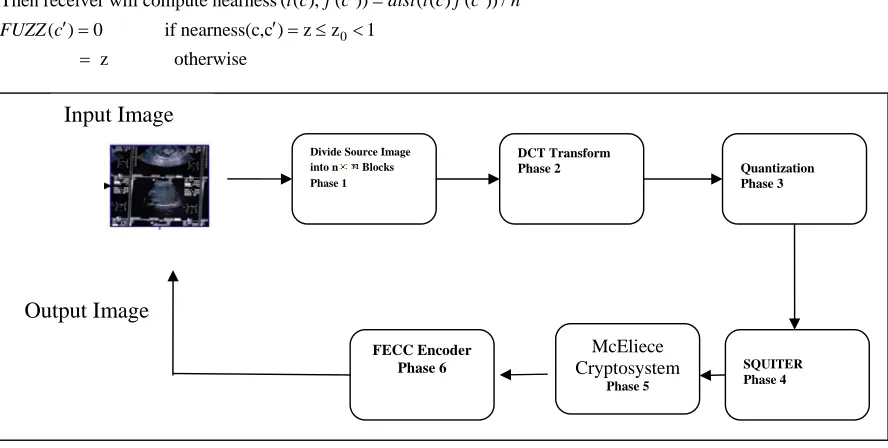
Phase 1 describe the generation of blocks, Phase 2, 3 shows DCT & quantization and Phase 4, 5 define the encryption and compression process. Phase 6, 7, give the complete solution of transmission error using fuzzy error correcting code. After completion of all above phases, receiver applies the reverse process of all phase and generates an actual error free image.
2. Preliminaries
2.1 McEliece Public-Key Cryptosystem[1,2]
Secret Key: W is a random (kk)non-singular matrix over GF(2), called the scrambling matrix,T is a
(kn)generator matrix of binary Goppa code T with the capability of correcting an n-bit random error vector of weight less than or equal to , and Q is a random(n n ) permutation matrix.
Public Key: V WTQ
Decryption: The receiver first calculates c= cQ1= mWTeQ1,where Q1is the inverse of Q. Because the weight of eQ1is the same as the weight of e, the receiver uses the decoding algorithm of the original code
Tto obtain m mW. Finally, the receiver recovers m by computingmm W 1, where W1is the inverse of
W.
2.2 Compression
A compression scheme can be employed what is known as lossless compression on secrete message to increase the amount of hiding secrete data, a scheme that allows the software to exactly reconstruct the original message [6].
The transmission of numerical images often needs an important number of bits. This number is again more consequent when it concerns medical images. If we want to transmit these images by network, reducing the image size is important. The goal of the compression is to decrease this initial weight. This reduction strongly depends of the used compression method, as well as of the intrinsic nature of the image. Therefore the problem is the following:
1. To compress without lossy, but with low factor compression. If you want to transmit only one image, it is satisfactory. But in the medical area these are often sequences that the doctor waits to emit a diagnostic.
2. To compress with losses with the risk to lose information. The question that puts then is what the relevant information is to preserve and those that can be neglected without altering the quality of the diagnosis or the analysis. The human visual system is one of the means of appreciation, although subjective and being able to vary from an individual to another. However, this system is still important to judge the possible causes of degradation and the quality of the compression [7].
2.2.1 The SEQUITUR Algorithm [8]
The SEQUITUR algorithm represents a finite sequence as a context free grammar whose language is the singleton set {s}. It reads symbols one-by-one from the input sequence and restructures the rules of the grammar to maintain the following invariants:
(A) no pair of adjacent symbols appear more than once in the grammar, and
(B) every rule (except the rule defining the start symbol) is used more than once. To intuitively understand the algorithm, we briefly describe how it works on a sequence 123123. As usual, we use capital letters to denote non-terminal symbols. After reading the first four symbols of the sequence 123123, the grammar consists of the single production rule S 1, 2, 3, 1 where S is the start symbol. On reading the fifth symbol, it becomes S 1, 2, 3, 1, 2 Since the adjacent symbols 1, 2 appear twice in this rule (violating the first invariant), SEQUITUR introduces a non-terminal A to get
S A, 3,A A 1, 2
Note that here the rule defining non-terminal A is used twice. Finally, on reading the last symbol of the sequence 123123 the above grammar becomes
S A, 3, A, 3 A 1, 2
This grammar needs to be restructured since the symbols A, 3 appear twice. SEQUITUR introduces another non-terminal to solve the problem. We get the rules
S B,B B A 3 A 1 2
However, now the rule defining non-terminal A is used only once. So, this rule is eliminated to produce the final result.
S B, B B 1, 2, 3
Note that the above grammar accepts only the sequence 123123.
2.3 Error Correction Code
A metric space is a set C with a distance function dist :C C R [0, ) , which obeys the usual properties(symmetric, triangle inequalities, zero distance between equal points)[12].
Definition : Let {0,1}n
C be a code set which consists of a set of code words ciof length n. The distance metric between any two code words ciand cjin Cis defined by
1
( , ) ,
n
i j ir jr i j r
dist c c c c c c C
Definition : An error correction function f for a code Cis defined as
( ) { /i j ( , ) is the minimum, over i j { }}i
f c c dist c c Cc . Here, cj f c
i is called the nearest neighbor of ci[12].Definition :The measurement of nearness between two code words cand cis defined by
nearness ( , )c c dist c c( , ) / n, it is obvious that 0 nearness (c,c ) 1[12].
Definition : The fuzzy membership function for a codeword cto be equal to a given cis defined as[12]
0
( ) 0 if nearness(c,c ) z z 1 z otherwise
FUZZ c
3. Proposed Scheme
In our proposed scheme, we use sequitur as a compression technique and McEliece as a encryption technique, which give us improved result. Sequitur is a single-pass hierarchical algorithm that builds a context-free grammar for a string. The resulting grammar compactly represents the original structure and has the interesting property that the compressed format itself contains useful information about the string. The McEliece scheme has the advantage of high speed encryption and decryption and this system employs probabilistic encryption. Input an medical image and follows these phases:
Phase 1: Generating n n blocks
In RGB space the image is split up into red, blue and green images. The image is then divided into 8 8 blocks of pixels and accordingly the image of w h pixels will contain WH blocks. Where, W w/ 8, H h/ 8.
Phase 2: DCT
All values are level shifted by subtracting 128 from each value. The Forward Discrete Cosine Transform of the block is then computed. The mathematical formula for calculating the DCT is:
0 0
( , ) ( , ), ( , , , )
n n
x y
T u v f x y g x y u v
Where , ( , , , ) 1 ( ) ( ) cos (2 1) cos (2 1)
4 2 2
x u y v
g x y u v u v
n n
Where
1
... , 0
( ) 2
1... , 1, 2,... 1.
for u u
for u N
Phase 3: Quantization
Quantization is the step where the most of the compression takes place. DCT really does not compress the image, as it is almost lossless. Quantization makes use of the fact that, the high frequency components are less important than the low frequency components. The Quantization output is
( , ) (
( , ) D C T
T u v Q r o u n d
Z u v
The ( , )Z u v matrix could be anything, but the JPEG committee suggests some matrices which work well with image compression.
Phase 4: Compression using SEQUITUR
DCT based image compression using blocks of size 8x8 is considered. After this, the quantization of DCT coefficients of image blocks is carried out. The SEQUITER compression is then applied to the quantized DCT coefficients.
Phase 5: Encryption using McEliece Cryptosystem
Secret Key: W is a random (kk)non-singular matrix over GF(2), called the scrambling matrix,T is a
(kn)generator matrix of binary Goppa code T with the capability of correcting an n-bit random error vector of weight less than or equal to , and Q is a random(n n ) permutation matrix. Public Key : VWTQ
Encryption : Let g m: mV,where m is a 64-bit message. Then after for the sake of secrecy add errore , which is a n-bit random error vector of weight .
then Eg m( )e, Eis a n-bit ciphertext .
Phase 6, 7: Error Correction
Receiver check that dist t c c( ( ) ), 0, he will realize that there is an error occur during the transmission. Receiver apply the error correction function f to c,: ( )f c .
Then receiver will compute nearness( ( ), ( ))t c f c, dist t c f c( ( ) ( )) /, n 0
( ) 0 if nearness(c,c ) z z 1 z otherwise
FUZZ c
Figure 1: Diagrammatic Approach .
4. Conclusion:
In the new scenario the Health Insurance Portability and Accountability Act (HIPAA) [11] requires that medical providers and insurance companies implement procedures and policies to protect patient’s medical information. In this paper, we used McEliece scheme due to its probabilistic property. As we know that if nN and let
{0,1}
F be the field of two elements, consider F-vector space n
F ,then a decoding problem having ,n kN k, n, an ( , )n k code , and C yFn, to find xCsuch that dist x y( , )is minimum. For y0
the decoding problem is the minimum weight problem if x0.Berlekamp, McEliece, and Van Tilborg [2] show that the minimum weight problem is NP-complete. Linear codes can be used for error correction. A message k
mF is encoded as zmC .
The encoded message mis transmitted. It is possible that during the transmission some bits of m are changed. The receiver receives the incorrect messagem. He solves the decoding problem, that is, he calculates
xCsuch that dist x y( , ) is minimum. If the error is not too big, that is, ( , ) 1 2 dist m m
d
,where d is the
minimum distance of any two distinct code words, then
x
is equal to the original message m.Linear codes are also used for encryption, for example in the McEliece cryptosystem [2] , to encrypt a message it is encoded andDivide Source Image into n Blocks Phase 1
McEliece Cryptosystem
Phase 5 DCT Transform
Phase 2 Quantization Phase 3
SQUITER Phase 4
Input Image
FECC Encoder Phase 6
an error vector of fixed weight is added. Decryption requires the solution of the decoding problem. In order for error correction to be efficient, the decoding problem must be efficiently solvable. Also, coding theory based cryptosystems can only be secure if decoding is hard without the knowledge of a secret. This is both true for binary Goppa codes. Decryption of a coding theory based cryptosystem means solving a decoding problem for which the weight of the error vector is known. If we have no special knowledge about the linear code such as a generating polynomial of a Goppa code, then generic methods for decoding can be used. The efficiency and security of McEliece cryptosystem comparatively better than the RSA cryptosystem also[9,10]. Here we use sequitur as a compression technique and Sequitur has the ability to read a stream in reverse also. So our approach is more appropriate, secure and futuristic than previous literature of medical data transmission over un-secure and noisy channel. .
References
[1] R.J.McEliece, “ A public-key cryptosystem based on algebraic coding theory,” DSN Progress Report,42-44,1978,pp.114-116. [2] E.R.Berlekemp, R.J.McEliece, and H.C.A. vanTilborg, “ On the inherent intractability of certain coding problems,” IEEE
Transactions on Information Theory, vol.24, No.5, 1978, pp.384-386.
[3] G. Lo-varco,W. Puech, and M. Dumas. “Dct-based watermarking method using error correction codes”, In ICAPR’03, International Conference on Advances inPattern Recognition, Calcutta, India, pages 347–350, 2003.
[4] R. Norcen, M. Podesser, A. Pommer, H.P. Schmidt, and A. Uhl. “Confidential storage and transmission of medical image data”, Computers in Biology and Medicine, 33:277–292, 2003.
[5] Diego F. de Carvalho, Rafael Chies, Andre P. Freire, Luciana A. F. Martimiano and Rudinei Goularte, “Video Steganography for Confidential Documents: Integrity, Privacy and Version Control” , University of Sao Paulo – ICMC, Sao Carlos, SP, Brazil, State University of Maringa, Computing Department, Maringa, PR, Brazil.
[6] Nameer N. EL-Emam, “Hiding a Large Amount of Data with High Security Using Steganography Algorithm” Applied Computer Science Department, Faculty of Information Technology, Philadelphia University, Jordan
[7] Borie J., Puech W., and Dumas M., “Crypto-Compression System for Secure Transfer of Medical Images”, 2nd International Conference on Advances in Medical Signal and Information Processing (MEDSIP 2004), September 2004.
[8] N.Walkinshaw, S.Afshan, P.McMinn ”Using Compression Algorithms to Support the Comprehension of Program Traces” Proceedings of the International Workshop on Dynamic Analysis (WODA 2010) Trento, Italy, July 2010.
[9] Johannes Buchmann, Carlos Coronado, Martin D¨oring, Daniela Engelbert, Christoph Ludwig, Raphael Overbeck, Arthur Schmidt ,Ulrich Vollmer, Ralf-Philipp Weinmann, “Post- Quantum Signatures”,eprint.iacr.org/2004/297.
[10] Canteaut and N. Sendrier, “Cryptanalysis of the original McEliece Cryptosystem, Advances in Cryptology” - ASIACRYPT ’98 Proceedings, Springer-Verlag ,1998, pp.187–199.
[11] “Health Insurance Portability and Accountability Act (HIPAA) and Its Impact on IT Security,” Regulatory Compliance Series 3 of 6, Apani Networks White Paper Compliance Series. May 12, 2005. http://www.apani.com.
![Table No.1 [9] Efficiency and security of the McEliece cryptosystem vs. RSA cryptosystem](https://thumb-us.123doks.com/thumbv2/123dok_us/9624692.1490565/2.612.87.525.224.436/table-efficiency-security-mceliece-cryptosystem-vs-rsa-cryptosystem.webp)