Internet-Enabled Interactive Multimedia Asthma Education Program:
A Randomized Trial
Santosh Krishna, PhD*; Benjamin D. Francisco, RN, MSN‡; E. Andrew Balas, MD, PhD*; Peter Ko¨nig, MD, PhD§; Gavin R. Graff, MD¶; and Richard W. Madsen, PhD储
ABSTRACT. Objective. To determine whether health outcomes of children who have asthma can be improved through the use of an Internet-enabled interactive mul-timedia asthma education program.
Methods. Two hundred twenty-eight children with asthma visiting a pediatric pulmonary clinic were ran-domly assigned to control and intervention groups. Chil-dren and caregivers in both groups received traditional patient education based on the National Asthma Educa-tion and PrevenEduca-tion Program. IntervenEduca-tion group partic-ipants received additional self-management education through the Interactive Multimedia Program for Asthma Control and Tracking. Pediatric Asthma Care Knowledge Survey, Pediatric Asthma Caregiver’s Quality of Life Questionnaire, asthma symptom history, spirometry, and health services utilization data were collected at the ini-tial visit and at 3 and 12 months.
Results. Interactive Multimedia Program for Asthma Control and Tracking significantly increased asthma knowledge of children and caregivers, decreased asthma symptom days (81 vs 51 per year), and decreased number of emergency department visits (1.93 vs 0.62 per year) among the intervention group participants. The interven-tion group children were also using a significantly lower average daily dose of inhaled corticosteroids (434 vs 754 g [beclomethasone equivalents]) at visit 3. Asthma knowledge of all 7- to 17-year-old children correlated with fewer urgent physician visits (r ⴝ 0.37) and less frequent use of quick-relief medicines (rⴝ0.30).
Conclusions. Supplementing conventional asthma care with interactive multimedia education can significantly improve asthma knowledge and reduce the burden of childhood asthma. Pediatrics 2003;111:503–510; asthma, education, pediatric, self-management, multime-dia, interactive, computer, Internet.
ABBREVIATIONS. IMPACT, Interactive Multimedia Program for Asthma Control and Tracking; QOL, quality of life; ICS, inhaled corticosteroids.
A
sthma affects 26 million people in the United States, 8.6 million of whom are children.1It is estimated that 5% to 10% of children have asthma, making it the most common chronic disease seen in the pediatric population.2 Children with asthma have a higher number of school absences, nighttime awakenings, missed school days, and missed work days by parents than nonasthmatic chil-dren.3,4In addition, asthmatic children incur signifi-cantly more health care-related expenses than other children, with a spending of over 3 billion dollars per year.5,6According to the Centers for Disease Control and Prevention, National Center for Health Statistics, in 1998, 3.8 million 0- to 17-year-old children had an asthma episode or attack, with males more likely to have had an asthma episode or attack (59 per 1000 males vs 41 per 1000 females).7 In the same year, there were 5.8 million outpatient visits for asthma, over 867 000 emergency department visits, and over 89 000 hospitalizations by children aged 0 to 17 years, with highest numbers occurring among 0- to 4-year-old children.7Multiple factors are responsible for excessive asthma morbidity including under-treatment,8lack of adherence to recommended treat-ment regimens,9inadequate antiinflammatory treat-ment usage, environtreat-mental triggers, and inadequate patient/caregiver education.10
The Expert Guidelines for the Diagnosis and Man-agement of Asthma11advocate patient education as a critical component of quality asthma care. Yet, sig-nificant health system barriers exist that make it dif-ficult to provide effective education in clinical set-tings.12 Major challenges include allocation of adequate staff time for patient education, selection of instructional approaches that can be sustained across various settings of care (clinic, home, and school), adjustment of content to meet individual patient’s needs, assessment of learners’ comprehension, pro-vision of appropriate remedial education, documen-tation of instructional activities and educational out-comes, and conservation of patients’ time and resources. Other major constraints are high costs and lack of reimbursement for patient education. These barriers ultimately result in the failure of the health care system to provide adequate asthma education.12 Interactive patient education has been shown to be effective in the management of several diseases.13–15 Multimedia instructional programs can complement one-on-one education by a health professional;
how-From the *School of Public Health, Saint Louis University, St Louis, Mis-souri; ‡Sinclair School of Nursing, §Department of Child Health, Section of Pulmonology, and储Statistics/Biostatistics, School of Medicine, University of Missouri, Columbia, Missouri; and ¶Department of Pediatrics, Pennsyl-vania State College of Medicine, Hershey, PennsylPennsyl-vania.
Received for publication Jan 3, 2002; accepted Jul 22, 2002.
ever, this approach has been rarely used, attributable primarily to the high cost and technical complexity of free-standing tutorial systems. The Internet con-stitutes a widely available and affordable multime-dia instructional medium that can help overcome some of the barriers to delivering effective patient education. Internet-enabled programs that use a se-cure server can deliver, customize, and record tuto-rial sessions, as well as provide the patient an oppor-tunity to communicate with their health care team.16 Although a number of computer-based asthma edu-cation programs have been developed and evalu-ated, there has been no report to our knowledge of an Internet-enabled asthma education program for chil-dren and caregivers that has been evaluated in a randomized, controlled trial.17–20
The purpose of this study was to determine whether the addition of an interactive multimedia asthma education program (based on the National Asthma Education and Prevention Program)11 to a traditional clinic-based patient education program would improve children’s and caregivers’ knowl-edge and health status and decrease use of health care resources.
METHODS
A randomized, controlled study was designed to determine: 1) whether addition of an interactive multimedia asthma education program significantly increases asthma knowledge of children and caregivers; 2) whether asthma knowledge is significantly related to the disease outcomes and health care resource utiliza-tion by asthmatic children; and 3) whether there is a significant difference between the intervention group and the control group in disease outcomes and use of health care resources among asthmatic children.
Population and Site
The population for this study consisted of children under 18 years old who have asthma and their caregivers who were fol-lowed at the Pediatric Pulmonary and Allergy Clinic of the Uni-versity of Missouri-Columbia Health Care between February 1999 and October 2000. The clinic provides care to⬎1000 children who are referred by their primary care physicians for asthma and who come from a 22 county service area. The study was approved by the Institutional Review Board of the University of Missouri-Columbia Health Sciences Center.
Eligibility and Sample
Patients and their caregivers were eligible for the study if a child had a confirmed diagnosis of asthma11and was under 18
years old. Children with a diagnosis of cystic fibrosis, broncho-pulmonary dysplasia, or other chronic lung diseases were not eligible. A sample size calculation determined that 100 children in each of the 2 groups would have a power of 94% for detecting an effect size of 0.5 (the difference in the group means divided by the common standard deviation) in any of the variables studied. All children meeting the eligibility criteria were invited to participate, and no children were excluded based on the severity of asthma.
Randomization and Blinding
All eligible pediatric patients and their caregivers were given the opportunity to participate in the study and were enrolled if they signed an informed consent form. They were then randomly assigned to 1 of 2 groups, the traditional asthma education group or the interactive multimedia education group. The pulmonolo-gists in the Pediatric Pulmonary and Allergy Clinic caring for the participant children were blind to which patients were enrolled in the study and to what group they were assigned.
Instruments and Data Collection
During the initial visit, baseline demographic data were col-lected for both the child and the caregiver. For every child enrolled in the study a caregiver completed a Caregiver Enrollment Form. For children 6 years and younger, caregivers completed additional instruments: Child Enrollment Form, Asthma Summary Since Last Visit, Pediatric Asthma Care Knowledge Survey, and Pediatric Asthma Caregiver’s Quality of Life Questionnaire.21The
knowl-edge questionnaire consists of 50 questions on basic asthma con-cepts and 10 questions on dilemmas dealing with real-life asthma scenarios. Children 7 years of age and older completed the Child Enrollment Form, Asthma Summary Since Last Visit, Pediatric Asthma Care Knowledge Survey and Pediatric Asthma Quality of Life Questionnaire.22Data were collected at 2 subsequent visits
scheduled at⬃3 and 12 months, before being seen and participat-ing in educational activities. Intervention group children and care-givers also completed a Program Evaluation form during the last visit.
The Control Group—Printed and Verbal Asthma Education
All control group participants received asthma education as part of the usual care, including verbal and printed information on the disease and concepts related to its control. A total of 26 instructional sheets in the Caring for Kids With Asthma series were available to the clinical team to help families understand asthma, selected devices, medications, and environmental factors. These illustrated information sheets were written at a second-grade reading level. Each family received a basic set of 8 and 4 or more additional sheets describing specific aspects of the child’s plan of care, such as the particular medications or devices needed. Education and training were provided to all families by a nurse practitioner. This involved approximately 1.5 hours of direct pa-tient contact over the first 3 visits after initial diagnosis and an additional 15 minutes per visit when the plan of care changed significantly. During clinic visits each child or caregiver took part in one-on-one training to ensure correct use of devices and med-ications. All families received an individualized, computer-gener-ated asthma action plan with detailed instructions for daily self-management, as well as guidelines for handling exacerbations and emergencies.23Copies of the asthma action plan were also
pro-vided to the day care or school, the primary care physician, and the hospital chart.
The Intervention Group—Internet-Enabled, Interactive Multimedia Asthma Education
In addition to receiving conventional patient education, chil-dren and families in the intervention group used Interactive Mul-timedia Program for Asthma Control and Tracking (IMPACT) during routine office visits. The IMPACT Asthma Kids CD was designed and produced by the Advanced Technology Center and the Children’s Hospital at the University of Missouri-Columbia. It consists of vignettes covering the basic pathophysiology of asthma, environmental triggers, quick-relief and control medi-cines, and strategies to control and manage asthma. The program incorporates principles of self-management in an interactive for-mat consisting of anifor-mated lessons, each averaging a minute in length. Ten of the lessons present real-life scenarios and require decisions about alternative behaviors that would likely affect asthma. Other lessons involve activities in which children learn to more accurately describe their symptoms and medication use.
were developed and used for consistency. Finally, IMPACT used the Internet and a Web-based server to respond to individual learner needs.
The program is password-protected, and its technical features are implemented through a secure database on a server that is accessed over the Internet. The program was only made available to children and families during clinic visits. This decision was made in view of the fact that making the program available from home would add an access variable that would introduce bias in comparison of the groups.
Content in both the printed educational materials and IMPACT was based on the Asthma Expert Guidelines.11The program tracks
educational progress of individual children and generates stan-dardized reports to help children, families and schools record current symptom level and medication use. The program reports the percentage of the 44 lessons mastered, as defined by a user having correctly answered questions after viewing a vignette. After entering an incorrect answer a user is immediately presented with the correct answer and an explanation of the concepts. The program can be completed in approximately 1 hour 20 minutes, although the actual time may vary depending on the reading level and comprehension of the user.
A computer was available in each consultation room and in a waiting area within the clinic. Program use occurred during reg-ular appointments as clinic staff entered and left the room and no additional encounters were scheduled for computer learning. At each tutorial session, IMPACT first presented for review lessons previously viewed for which incorrect answers were entered, followed by new content, progressing in a linear fashion through the 44 lessons. To minimize the risk that critical concepts would be forgotten between visits, the program automatically reviewed any lesson that had aged⬎6 months. Consistent with a self-manage-ment approach, IMPACT interspersed several types of lessons, including traditional instructional vignettes, decision-making sce-narios, and exercises to improve the child’s ability to report their symptoms and medication use. If the child was in the 0- to 6-year age group, the parent used the program and their knowledge was assessed. Children 7 to 17 years used the program while their parents observed. In this group both the child’s and parent’s knowledge were measured. Participants used the program during every visit.
Analysis
The data were analyzed using SAS statistical software (SAS Institute Inc, Cary, NC) on an intention-to-treat basis. To analyze the data, both control and intervention groups were subdivided into 3 subgroups— caregivers of children 0 to 6 years old, care-givers of the children 7 to 17 years old, and children 7 to 17 years old.
RESULTS
The original study sample consisted of 246 chil-dren and their caregivers, which were randomized into the control group (n⫽127) and the intervention
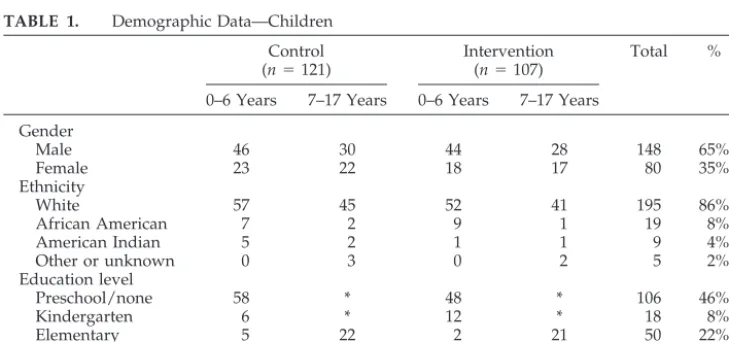
group (n ⫽ 119). Of the 249 eligible families who were invited to participate into the study, 3 families declined to participate, giving “too busy,” “not in-terested,” and “too much hassle” as the reasons for their nonparticipation. Seventeen subjects, 6 from the control group and 11 from the intervention group, were excluded either at the request of the partici-pants themselves or for lack of data. One interven-tion group child was excluded from analysis because of suspected diagnosis of Munchausen by proxy, leaving a final sample of 228 children. The demo-graphic data for children are summarized in Table 1. Of the 228 caregivers, 88% were females, 90% white, 6% African American, and 4% of other ethnic origins. Fifty-four percent of caregivers had a high school education, 37% had 1 or more years of college, and the remaining 9% had junior high school education or less. Results of Wilcoxon rank sum tests evaluat-ing asthma-related outcome variables (all P values
⬎.05) indicated that control and intervention groups were comparable in asthma severity at baseline.
Knowledge
Asthma knowledge scores between visits 1 and 3 for the 3 subgroups in both control and intervention groups were analyzed (Table 2). Results of the signed rank sum tests showed that all 3 subgroups for both control and intervention showed a significant in-crease in knowledge (P⬍.05; Table 3). To determine whether there was a significant difference between groups, control and intervention groups were com-pared using the Cochran-Mantel-Haenszel statistic, controlling for the baseline knowledge scores through stratified analysis. Knowledge improvement between visits 1 and 3 was significantly greater among all 3 intervention groups: caregivers of chil-dren 0 to 6 years old with a 2 ⫽ 6.921, P ⬍ .01; caregivers of children 7 to 17 years old with a2⫽ 7.2084,P ⬍ .01; and the intervention group of 7- to 17-year-old children with a2⫽ 11.706,P⬍ .01.
Relationship Between Knowledge and Health Outcomes, Resource Utilization
Assessment of the relationship between asthma knowledge of all 7- to 17-year-old children and of
TABLE 1. Demographic Data—Children Control (n⫽121)
Intervention (n⫽107)
Total %
0–6 Years 7–17 Years 0–6 Years 7–17 Years Gender
Male 46 30 44 28 148 65%
Female 23 22 18 17 80 35%
Ethnicity
White 57 45 52 41 195 86%
African American 7 2 9 1 19 8%
American Indian 5 2 1 1 9 4%
Other or unknown 0 3 0 2 5 2%
Education level
Preschool/none 58 * 48 * 106 46%
Kindergarten 6 * 12 * 18 8%
Elementary 5 22 2 21 50 22%
Junior high school * 24 * 19 47 19%
High school * 6 * 5 11 5%
both groups of caregivers at visit 3 and change in health outcomes and resource utilization was done using Spearman correlation coefficients. Analysis re-vealed that increased asthma knowledge of all 7- to 17-year-old children at visit 3 had significant corre-lations with fewer urgent physician visits (r⫽ 0.37;
P⫽ .01) and decreased use of quick relief medicine (r⫽ 0.30;P⬍ .05) by these children. Knowledge of caregivers of all children 7 to 17 years old was significantly related to caregiver’s Emotional Func-tion (r⫽0.44;P⬍.01), Activity Limitation (r⫽0.55;
P ⬍ .01) and overall quality of life (QOL; r ⫽ 0.50;
P ⬍ .01) scores. Relationships between caregivers’ or 7- to 17-year-old children’s knowledge at visit 3
and change in other health outcomes and resource utilization variables were not statistically significant (P⬎.05).
Health Outcomes, Resource Utilization, and Inhaled Steroids
Table 3 shows within-group changes in knowl-edge, health outcomes, health care resource utiliza-tion, and use of inhaled corticosteroids (ICS). Both control and intervention group children showed sig-nificant reductions from visit 1 to visit 3 in days with asthma symptoms, days of quick relief medicine use, nights of sleep disturbance, urgent visits to physi-cians, and emergency department visits (P ⬍ .05). TABLE 2. Knowledge Scores—Caregivers and Children
Visit 1 Visit 2 Visit 3
n Mean (SD) n Mean (SD) n Mean (SD)
Control
Caregivers children 0–6 y* 69 48.41 (6.64) 45 51.27 (5.57) 23 52.30 (5.55) Caregivers children 7–17 y† 52 49.57 (4.75) 43 52.02 (3.89) 28 51.70 (4.42) Children 7–17 y‡ 52 43.44 (6.10) 43 45.95 (5.67) 28 47.51 (5.95) Intervention
Caregivers children 0–6 y* 62 47.94 (5.24) 40 50.40 (6.24) 24 55.68 (4.28) Caregivers children 7–17 y† 45 49.95 (5.59) 35 51.66 (5.07) 26 55.38 (4.16) Children 7–17 y‡ 45 43.11 (6.76) 35 49.67 (5.98) 25 53.12 (5.56) SD indicates standard deviation.
In2comparison between control and intervention groups:
*P⬍.01. †P⬍.01. ‡P⬍.001.
TABLE 3. Changes in Knowledge, Health Outcomes, Resource Utilization Between Visits 1 and 3
n Mean (SD) Median 95% CI
Median
PValue
Control
Days with asthma symptoms 44 ⫺44.17 (98.19) 17.16 8.40, 63.15 .0010 Days of quick relief medicine 45 ⫺73.00 (133.23) 19.35 8.40, 100.38 .0004 Days of activity limitation 45 ⫺15.33 (52.20) 0.00 0.00, 12.05 .0951 Nights of sleep disturbance 45 ⫺38.69 (94.17) 12.05 2.56, 37.60 ⬍.0001 Urgent visits to physician 45 ⫺5.48 (11.32) 0.00 0.0, 06.21 ⬍.0001 Emergency room visits 45 ⫺1.46 (3.65) 0.00 0.0, 0.0 .0219
Hospitalizations 45 ⫺0.73 (3.29) 0.00 0.0, 0.0 .0313
Days of stay in hospital 45 ⫺3.65 (13.51) 0.00 0.0, 0.0 .0781 School days missed 43 ⫺1.63 (16.74) 0.00 0.0, 0.0 .1479 Inhaled steroids 49 172.65 (664.93) 0.00 ⫺32.00, 0.0 .0364 Knowledge caregivers (0–6) 23 2.52 (6.71) 5.00 ⫺0.38, 5.42 .0293 Knowledge caregivers (7–17) 28 2.38 (4.38) 2.50 0.0, 4.00 .0079 Knowledge children (7–17) 27 4.44 (5.49) 4.00 2.00, 7.00 .0001 Intervention
Days with asthma symptoms 42 ⫺88.33 (107.68) 57.67 21.9, 87.60 ⬍.0001 Days of quick relief medicine 41 ⫺68.25 (131.40) 24.82 1.83, 62.78 .0002 Days of activity limitation 40 ⫺54.39 (100.74) 4.02 0.0, 24.46 ⬍.0001 Nights of sleep disturbance 42 ⫺51.47 (93.81) 15.33 0.0, 30.66 ⬍.0001 Urgent visits to physician 40 ⫺5.11 (7.30) 0.00 0.0, 6.21 ⬍.0001 Emergency room visits 42 ⫺1.83 (4.75) 0.00 0.0, 0.00 .0024
Hospitalizations 42 ⫺0.73 (1.83) 0.00 0.0, 0.00 .0625
Days of stay in hospital 42 ⫺1.46 (5.84) 0.00 0.0, 0.00 .1563 School days missed 40 ⫺5.37 (13.49) 0.00 0.0, 4.55 .0001
Inhaled steroids 45 34.04 (511.36) 0.00 0.0, 0.0 .8327
Knowledge caregivers (0–6) 24 7.97 (4.57) 7.00 5.00, 11.00 ⬍.0001 Knowledge caregivers (7–17) 26 4.62 (4.48) 3.00 2.00, 7.00 ⬍.0001 Knowledge children (7–17) 25 10.00 (6.99) 8.00 7.00, 11.00 ⬍.0001 SD indicates standard deviation; CI, confidence interval.
School days missed are based on 174 school days in a year.
Health outcome and resource utilization variables are rates based on 365 days a year. Knowledge scores are out of 60 total points.
Steroid use is beclomethasone dose equivalent.
The control group also demonstrated significant de-crease in number of hospitalizations from visit 1 to visit 3 (P ⬍ .05). Days of activity limitation and number of school days missed decreased signifi-cantly between visits in the intervention group alone (P⬍.01).
To assess differences in health outcomes, control and intervention groups were compared using Coch-ran-Mantel-Haenszel statistic, controlling for base-line scores through a stratified analysis. The inter-vention group demonstrated significantly greater decrease in days with asthma symptoms (81 vs 51 per year) with a 2 of 6.65, P ⬍ .01 (Table 4). The intervention group also showed significantly greater decrease in the number of annual emergency depart-ment visits at year end (1.93 vs 0.62 per year) with a 2 of 5.07, P ⬍ .01 (Table 4). At visit 3, the (be-clomethasone equivalent) average daily dose of ICS used by the intervention group was significantly lower (434 g) compared with that of the control group (754g) with a 2of 7.31,P ⬍ .01 (Table 5), although at visit 1 the doses were similar (353 vs 351g).
Differences between groups were not significant for caregivers’ QOL scores for all children at visit 3 and change in scores between visits 1 and 3 (2 ⫽ 0.036;P⫽ .85) or for children 7 to 17 years old (self
assessment) QOL score (2⫽ 2.51;P⫽ .11). Results for the quality of life subscales for 7- to 17-year-old children were similar, with allPvalues⬎.05.
Program Evaluation
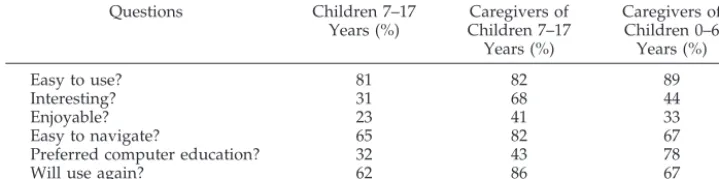
The intervention group participants filled out a ques-tionnaire to provide feedback about the IMPACT com-puter program. Results are presented in Table 6. Users found the program easy to use and navigate, interesting, and enjoyable. Teenage children found the program least enjoyable (23%). Although the pro-gram was ranked second to physician as a source of obtaining asthma information, ⬎61% participants said that they would use the program again. Pro-gram use varied greatly. Based on the percent com-pletion statistic reported by the program it ranged from 40% to 100% among the caregivers of 0- to 6-year-old children completing visit 3 (Table 2), with 50% of users having completed 40% or more of the vignettes. The percent completion report showed that children in 7- to 17-year-old group who com-pleted visit 3 had mastered 48% to 100% of the pro-gram, with half of them completing 58% or more of the program. Actual program use was higher than reflected here because of the 6-month start-over fea-ture.
TABLE 4. Health Outcome and Resource Utilization—Children Visit 1
Mean (SD)
Visit 2 Mean (SD)
Visit 3 Mean (SD)
Control (n⫽119) (n⫽84) (n⫽44)
Days of asthma symptoms* 97.8 (109.0) 53.7 (89.3) 48.2 (80.0) Days of quick relief medicine 90.7 (114.8) 46.6 (90.0) 41.0 (82.0) Days of activity limitation 35.3 (71.4) 17.9 (50.0) 13.5 (31.4) Nights of sleep disturbance 62.0 (93.0) 33.1 (84.3) 17.1 (54.0) Urgent visits to physician 6.4 (10.5) 1.7 (5.0) 1.3 (2.2) Emergency room visits† 1.2 (2.8) 0.37 (1.3) 0.6 (1.1) Hospitalizations 0.6 (2.3) 0.04 (0.4) 0.1 (0.3) Days of stay in hospital 2.0 (8.7) 0.11 (1.1) 0.4 (2.6) School days missed 6.4 (12.6) 1.7 (4.1) 5.4 (19.8) Intervention (n⫽105) (n⫽67) (n⫽42)
Days of asthma symptoms* 104.5 (113.3) 39.4 (71.2) 23.9 (29.6) Days of quick relief medicine 90.0 (118.2) 27.7 (50.1) 26.3 (56.6) Days of activity limitation 46.2 (94.6) 15.5 (56.1) 6.7 (21.1) Nights of sleep disturbance 64.7 (100.4) 18.6 (38.8) 15.2 (32.8) Urgent visits to physician 6.6 (10.5) 1.4 (4.0) 0.8 (1.5) Emergency room visits† 2.0 (4.2) 0.6 (3.6) 0.1 (0.4) Hospitalizations 0.1 (2.2) 0.0 (0.2) 0.1 (0.4) Days of stay in hospital 2.7 (7.9) 0.2 (1.7) 0.6 (1.8) School days missed 7.9 (18.4) 1.67 (4.4) 1.4 (3.2) In2comparison between control and intervention groups:
*P⬍.01. †P⬍.05.
TABLE 5. Daily Dose of Inhaled Corticosteroids Visit 1
Mean (SD)
Visit 2 Mean (SD)
Visit 3 Mean (SD)
Control (n⫽119) (n⫽84) (n⫽44)
350.53 (649.61) 442.40 (636.46) 753.88 (706.94) Intervention (n⫽105) (n⫽67) (n⫽42)
353.09 (615.83) 390.85 (618.21) 433.51 (569.13) SD indicates standard deviation.
DISCUSSION
This study shows that supplementing traditional verbal and printed asthma education with the inter-active multimedia asthma education program can result in increased asthma knowledge, reduced asthma morbidity, and reduced emergency room costs. The benefits of the program occurred while it was used during waiting times within the customary flow of clinic activities between the recording of vital signs, performance of spirometry, history taking, physical examination, discussions of therapeutic op-tions, and discharge teaching. This approach had the perceived benefit of using patient and family time more efficiently, while not incurring additional staff-ing overhead.
Knowledge gain was viewed as a primary indica-tor of program use and effectiveness. The only pro-gram utilization variable reported by IMPACT was percent completion. No attempt was made to corre-late this statistic with outcomes, because the percent completion statistic would not be expected to ade-quately reflect knowledge gain. If a child viewed 10 lessons during a 20-minute session and correctly an-swered questions for only 2 lessons, then the percent completion would be very low. However, this prob-ably underestimates knowledge gain, because for each incorrect answer, a user receives immediate feedback with a restatement of the concept and a rationale for the correct answer. Change in knowl-edge scores was viewed as a more likely correlate of group differences in outcomes. In addition, the in-tent-to-treat principle was applied to this study, whereby the analysis accepted program use as an uncontrolled variable.
Length of program use among participants varied and was influenced by travel time to the clinic and duration of the visit. It is important to note that completion of even small portions of the program corresponds with comprehension of critical concepts. If the first 5 of 44 vignettes are completed, a child is exposed to the basic pathophysiology of asthma and the range of symptoms associated with it. If 12 vi-gnettes are completed the concept of control medi-cations is mastered as well. Completing 28 vignettes offers additional information on environmental trig-gers and how to avoid them.
This study demonstrates that in a busy clinical environment computer-based interactive multimedia education is a feasible adjunct that can be incorpo-rated into the visit without any disruption of the regular visit flow. Our study also demonstrates that traditional care, even with an excellent
multidisci-plinary asthma team and a structured educational program, can be enhanced by multimedia education. Both control and intervention groups received opti-mal clinical care, education, and phone support through a team that included a pediatric pulmonolo-gist, a pediatric nurse practitioner, a licensed practi-cal nurse, and a respiratory therapist. Clinipracti-cal care addressed the major modifiable factors that alter asthma morbidity, including management of envi-ronmental triggers, treatment of comorbid condi-tions, appropriate use of antiinflammatory drugs and bronchodilators, and education for self-manage-ment. Within-group changes among control children in this study demonstrate the value of guideline-based clinical care (Tables 3 and 4). One would ex-pect that additional improvements in health status might be difficult to demonstrate in settings where excellent clinical care is provided. However, even greater reductions in the burden of asthma are pos-sible with more effective education for self-manage-ment. This is apparent among intervention children after use of IMPACT (Tables 3 and 4).
It is particularly noteworthy that although these substantial improvements occurred among interven-tion children, their mean ICS dose significantly de-creased during the trial compared with the control group (Table 5). This paradoxical finding should be appreciated in context. In the clinical setting where the study was conducted children were often started at higher doses of ICS and over time could usually be managed with lower doses. It is not surprising that children who knew more about asthma and who had better self-management skills eventually required lower ICS doses. Avoidance of environment triggers, better inhalation technique, and closer adherence to therapeutic regimens could all result in a reduction in asthma symptoms, which in turn should encour-age a clinician to step down the ICS dose. This is especially true of a child who has learned to commu-nicate their asthma signs and symptoms more pre-cisely. Although the intervention group ended up on a significantly lower mean dose of ICS, it should be noted that the group mean of 434 g (beclometha-sone equivalent) still falls in the medium dose range. (This equates to 5 puffs twice a day of a beclometha-sone chlorofluorocarbons propellant metered dose inhaler or about 1 puff twice a day of the more potent fluticasone 110g metered dose inhaler) The control group mean was in a higher dose range at 754 g. This suggests that interactive multimedia education is a potent therapeutic intervention in childhood asthma that has a steroid-sparing effect.
TABLE 6. Program Evaluation—Percentage of Children and Caregivers Answering “Yes” Questions Children 7–17
Years (%)
Caregivers of Children 7–17 Years (%)
Caregivers of Children 0–6 Years (%)
Easy to use? 81 82 89
Interesting? 31 68 44
Enjoyable? 23 41 33
Easy to navigate? 65 82 67
Preferred computer education? 32 43 78
A number of other multimedia educational pro-grams designed as games for pediatric asthma have been designed and tested. At least 4 interactive com-puter programs using a game format have been de-veloped to teach children about asthma.17–20 All 4 studies reported a significant increase in asthma-related knowledge; however, efforts to evaluate health outcomes were variable. Two studies showed a reduction in emergency department visits.17,19 An-other18showed a lower hospitalization rate and im-proved functional status. A third study found that health outcomes of the group that played an asthma computer game were not significantly better than the control group children who reviewed written materials.19In contrast, IMPACT reduced the burden of asthma in numerous ways and increased knowl-edge far more effectively than traditional written materials.
As a multimedia educational program, IMPACT departs sharply from the prevailing gaming ap-proach and is unique in several important ways. The effectiveness of IMPACT is likely a result of several factors. Although IMPACT was designed to be un-derstood by young school-age children, the content includes concepts that adult caregivers often do not know. This was evidenced by the increase in knowl-edge scores and by the verbal comments of many parents who remarked that they had learned a great deal from what seemed at first to be just a program for children. The integration of multimedia design principles, its capability to respond to individual learner needs, and the systematic use of guiding behavioral theory of self-regulation to produce the program resulted in a dramatically more effective program and likely contributed greatly to the success of IMPACT program.
Although this study was not specifically designed to determine the full financial impact of the interven-tion on asthma care, it is clear that cost savings occurred. This finding is consistent with existing ev-idence that self-management asthma education is cost-effective.24At our institution, the average cost of an emergency department visit for asthma was $470 during the study period. Reduction in emergency room visits in the intervention group at our institu-tion translated into a savings of approximately $907.10 per child (compared with $291.40 for the control group). There was also a significant reduc-tion in the rate of school absences among interven-tion children (Table 3), a decrease of 5.4 days per child per school year compared with 1.6 days for control children. This represents a direct financial benefit to public schools whose funding is tied to attendance. It is likely that related indirect savings were realized by working parents and employers. Cost savings related to change in medication use was not calculated.
This study demonstrates that effective self-man-agement education is a potent intervention for reduc-ing asthma morbidity, yet it might be argued that the financial burden of such an intervention would fall on physicians in primary care who are not reim-bursed for the cost of education. Loss of revenue resulting from reduced office sick visits might also be
a concern. These concerns ignore the fact that with-out appropriate care, children with poorly controlled asthma are more likely to end up in hospital or specialty settings. Scheduling more regular office visits would reduce the need for urgent care by increasing opportunities to reassess and monitor the child, adjust therapy, and improve self-management. This strategy that is advocated by expert guidelines would actually increase reimbursement for primary care services, while lowering the overall cost of asthma to the health system. Another concern is the cost and difficulty of using computers in busy prac-tices. In clinics where computer terminals with Inter-net access are not available, use of portable, wireless devices with earphones would be more practical and would have the added advantage of engaging the patient in useful activities from check-in until com-pletion of the visit.
This study addressed the basic question of whether the tutorial content and interactive design of IMPACT delivered within the context of an office visit would contribute to improved asthma out-comes. Although this study did not evaluate each Internet-enabled program feature, such as symptom and medication-use reporting, the tutorials were co-ordinated and reported by a secure server over the Internet. This fact has tremendous bearing on the eventual cost, accessibility, and sustainability of this educational intervention. A similar program using a local client server would not provide the same capa-bilities.
Although this study focused on program use in a specialty clinic setting, IMPACT was designed to be used by the individual child at multiple locations. Future studies should evaluate the effectiveness of this approach at home, school, primary care, and community settings, such as libraries, where most children live with asthma day-to-day. Greater access to Web-enabled multimedia programs of this type could extend substantial benefits to larger popula-tions of children who have asthma and possibly other disease processes. Health policy changes are needed to ensure adequate funding for Web-enabled multimedia patient education.16 Several advantages are afforded by this approach. Barriers to effective patient education can be removed by strategic use of the Internet. Resources for software design and maintenance can be centrally pooled in a Web-en-abled model with the effect of lowering cost to the end user, enhancing program quality, facilitating au-tomatic content updates, and promoting easy and widespread access. These factors increase the likeli-hood that economically disadvantaged and at-risk populations will benefit.25
pattern of asthma over several months. At the time of the study no suitable, validated knowledge instru-ment existed. The 60-item knowledge instruinstru-ment used in our study has not been subjected to rigorous psychometric analysis. Also, it would have been very useful to know how many and which particular les-sons were viewed by each IMPACT program user, including the ones not mastered. Other useful data would include the number of vignettes accessed and the frequency of access. We would like to point out that as expected, percentage of 7- to 17-year-old chil-dren who said that they enjoyed the program is much lower than the caregivers of both younger and older children.26This confirms that the current ver-sion of the IMPACT program is suitable for children under 12 years and if it were to be used by older children, it will require significant design changes that will appeal to older children.
Our findings of increased asthma knowledge, de-creased morbidity, and lowered use of emergency services have direct implications for health care pro-viders and insurance companies. Physicians should consider incorporating interactive multimedia edu-cation into routine clinical practice. Health mainte-nance organizations and third-party payers should finance effective education for self-management so that patients and caregivers can achieve better con-trol of asthma, and health systems can conserve re-sources. A specific Current Procedural Terminology
code for individual education should be adopted to facilitate reimbursement and to further encourage clinicians to prescribe self-management education as a therapeutic intervention in the care of children with asthma.
ACKNOWLEDGMENTS
This work was supported in part by grants from the National Heart Lung and Blood Institute, 1 F31 HL 10205– 01, Aetna Aca-demic Medicine and Managed Care Forum (Schering Plough Cor-poration, Integrated Therapeutics Group), National Library of Medicine (LM07089), and University of Missouri Columbia-Chil-dren’s Hospital.
REFERENCES
1. American Lung Association. Prevalence based on revised National Health Interview Survey. Data and Statistics, November 2001. Available at: http://www.lungusa.org/data/data㛭102000.html. Accessed Octo-ber 8, 2001
2. Weitzman M, Gortmaker SL, Sobol AM, Perrin JM. Recent trends in the prevalence and severity of childhood asthma. JAMA. 1992;268: 2673–2677
3. Fowler MG, Davenport MG, Garg R. School functioning of US children with asthma.Pediatrics.1992;90:939 –944
4. Diette GB, Markson L, Skinner EA, Nguyen TT, Algatt-Bergstrom P, Wu AW. Nocturnal asthma in children affects school attendance, school performance, and parents’ work attendance.Arch Pediatr Adolesc Med. 2000;154:923–928
5. Lozano P, Fishman P, Vonkorff M, Hecht J. Health care utilization and
cost among children with asthma who were enrolled in a health main-tenance organization.Pediatrics.1997;99:757–764
6. Weiss KB, Sullivan SD, Lyttle CS. Trends in the cost of illness for asthma in the United States, 1985–1994.J Allergy Clin Immunol.2000;106:493– 499 7. Centers for Disease Control and Prevention, National Center for Health Statistics. New asthma estimates: tracking prevalence, health care, and mortality. Available at: http://www.cdc.gov/nchs/products/pubs/ pubd/hestats/asthma/asthma.htm. Accessed November 29, 2001 8. Diaz T, Sturm T, Matte T, Bindra M, Lawler K, Findley S, et al.
Medi-cation use among children with asthma in East Harlem. Pediatrics. 2000;105:1188 –1193
9. Scarfone RJ, Zorc JJ, Capraro GA. Patient self-management of acute asthma: adherence to national guidelines a decade later. Pediatrics. 2001;108:1332–1338
10. Diette GB, Skinner EA, Markson LE, et al. Consistency of care with national guidelines for children with asthma in managed care.J Pediatr. 2001;138:59 – 64
11. National Asthma Education and Prevention Program.Expert Panel Re-port 2: Guidelines for the Diagnosis and Management of Asthma. Bethesda, MD: National Institutes of Health; 1997. Publ. No. 97-4051
12. Peterson MW, Strommer-Pace L, Dayton C. Asthma patient education: current utilization in pulmonary training programs.J Asthma.2001;38: 261–267
13. Krishna S, Balas EA, Spencer DC, Griffin JZ, Boren SA. Clinical trials of interactive computerized patient education: implications for family practice.J Fam Pract.1997;45:25–33
14. Krishna S, Balas EA, Boren SA, Maglaveras N. Patient acceptance of educational voice messages: a review of controlled clinical studies. Methods Inf Med.2002;41:360 –369
15. Balas EA, Jaffrey F, Kuperman GJ, et al. Electronic communication with patients: evaluation of distance medicine technologies.JAMA.1997;278: 152–159
16. Weitzman M, Shiffman RN, eds. Information technology and the future of child health care: a revolution is occurring.Arch Pediatr Adolesc Med. 2001;155:990 –991
17. Rubin DH, Bauman LJ, Lauby JL. The relationship between knowledge and reported behavior in childhood asthma.J Dev Behav Pediatr.1989; 10:307–312
18. Barthalomew LK, Gold RS, Parcel GS, et al. Watch, discover, think, and act: evaluation of computer-assisted instruction to improve asthma self-management in inner-city children.Patient Educ Couns.2000;39: 269 –280
19. Homer C, Susskind O, Alpert HR, et al. An evaluation of an innovative multimedia educational software program for asthma management: report of a randomized, controlled trial.Pediatrics.2000;106:210 –215 20. Yawn BP, Algatt-Bergstrom PJ, Yawn RA, et al. An in-school CD-ROM
asthma education program.J Sch Health.2000;70:153–159
21. Juniper EF, Guyatt DH, Feeny DH, Ferrie PJ, Griffith LE, Townsend M. Measuring quality of life in the parents of children with asthma.Qual Life Res.1996;5:35– 46
22. Juniper EF, Guyatt DH, Feeny DH, Ferrie PJ, Griffith LE, Townsend M. Measuring quality of life in children with asthma.Qual Life Res.1996; 5:27–34
23. Volsko TA. A pediatric asthma clinic pilot program reduces emergency department visits, hospitalizations, and cost of care.Respir Care.1998; 43:107–113
24. Liljas B, Lahdensuo A. Is asthma self-management cost-effective.Patient Educ Couns.1997;32:S97–S104
25. FitzGerald JM, Turner MO. Delivering asthma education to special high risk groups.Patient Educ Couns.1997;32:S77–S86
DOI: 10.1542/peds.111.3.503
2003;111;503
Pediatrics
Graff and Richard W. Madsen
Santosh Krishna, Benjamin D. Francisco, E. Andrew Balas, Peter König, Gavin R.
Randomized Trial
Internet-Enabled Interactive Multimedia Asthma Education Program: A
Services
Updated Information &
http://pediatrics.aappublications.org/content/111/3/503
including high resolution figures, can be found at:
References
http://pediatrics.aappublications.org/content/111/3/503#BIBL
This article cites 22 articles, 4 of which you can access for free at:
Permissions & Licensing
http://www.aappublications.org/site/misc/Permissions.xhtml
in its entirety can be found online at:
Information about reproducing this article in parts (figures, tables) or
Reprints
http://www.aappublications.org/site/misc/reprints.xhtml
DOI: 10.1542/peds.111.3.503
2003;111;503
Pediatrics
Graff and Richard W. Madsen
Santosh Krishna, Benjamin D. Francisco, E. Andrew Balas, Peter König, Gavin R.
Randomized Trial
Internet-Enabled Interactive Multimedia Asthma Education Program: A
http://pediatrics.aappublications.org/content/111/3/503
located on the World Wide Web at:
The online version of this article, along with updated information and services, is
by the American Academy of Pediatrics. All rights reserved. Print ISSN: 1073-0397.