Original Research Article
Assessment of patient satisfaction in outpatient department of a tertiary
care hospital in West Bengal, India: a questionnaire based study
Pankaj Kumar
1, Anjan Adhikari
2*, Moumita Ray
2, Rania Indu
2,
Sangita Bhattacharya
2, Anup Kumar Das
2INTRODUCTION
Quality of health care is a global issue. Transformations are needed in the health care industry in order to cope up with the demands of its patient population as well as complying the global change. In this competitive world, hospitals should modify and reform in order to satisfy the demands of their customers/clients, i.e, patients. Therefore, it is very relevant to assess the quality of their
health care on the perception of beneficiaries. Quality assessment studies depend on three types of outcomes: medical outcomes, costs, and client satisfaction. In case of client satisfaction, clients are interrogated to provide their opinion regarding the services they received and the difficulties they faced from the health care.1-3
Literature revealed an increased association between satisfaction levels, patient‟s compliance and success of ABSTRACT
Background: Feedback is an important and integral part of any system. Perception of the beneficiaries in any healthcare setup provides impact for refining the system. The assessment of the patients‟ satisfaction on different issues regarding healthcare services provides insight about the drawbacks of different healthcare systems. This could assist to upgrade the quality of services through different interventional measures. Present study evaluated the patient satisfaction in outpatient departments (OPD) of a tertiary care hospital, Kolkata, West Bengal.
Methods: A total of 500 patients, attending different OPD in a tertiary care hospital were randomly selected for an observational, questionnaire based interview study, initiated in 2016. Some predictors for patients‟ satisfaction like „outpatient department services‟, „waiting time‟, „cleanliness‟, „privacy‟ and „any problem faced during health checkup‟, „overall satisfaction‟ were evaluated.
Results: Present study showed 78% of the study population was satisfied with the service received and 81% opined that clean environment was effectively maintained in the hospital premises and different outpatient departments. 83%, 84% and 75% of the patients were satisfied regarding the registration process, services received from the doctors and pharmacy, respectively. However, waiting time was too long and privacy was not maintained properly.
Conclusions: Present study regarding patients‟ satisfaction towards quality health care concluded that optimal care can be provided by combining both medical and social aspects, influencing the psychological factors of the patients. A separate system should be developed on assessment of “need of the patient” as well as guiding the patient for proper use of the health facilities.
Keywords: Patients‟ satisfaction, Quality health care, Government, Tertiary, Outpatient department
1
Department ofCommunity Medicine, Govt. Medical College, Bettiah, Bihar, India
2Department of Pharmacology, R G Kar Medical College, Kolkata, West Bengal, India
Received: 22 May 2018
Revised: 06 July 2018
Accepted: 09 July 2018
*Correspondence:
Dr. Anjan Adhikari,
E-mail: [email protected]
Copyright: © the author(s), publisher and licensee Medip Academy. This is an open-access article distributed under the terms of the Creative Commons Attribution Non-Commercial License, which permits unrestricted non-commercial use, distribution, and reproduction in any medium, provided the original work is properly cited.
the treatment in India and abroad.4,5 A study in a French hospital revealed that 94% of the patients were able to judge hospital service quality, especially in its relational, organizational and environmental dimensions. In many developing countries, primary care services are fully financed by the state.6 The healthcare service scenario in India is evolved in more developed stage. Emphasis should be given on patient satisfaction as this is an important parameter for the assessment of the hospital services. With the change in the concept of patient satisfaction, the hospitals are using variety of techniques to improve patient care and organizational efficiency. Patient satisfaction questionnaire is a validated instrument to assess the level of the satisfaction of adult patients.7
Research on patient satisfaction is an important tool to evaluate the quality of services in any healthcare set up.8,9 Despite of extensive research in developed world on client satisfaction, there is a lack of data on patient satisfaction in India. Present study was therefore undertaken with the aim to find out patient satisfaction in relation to different parameters of quality health care in the outpatient department (OPD) of the tertiary healthcare hospital of Kolkata, West Bengal, India.
METHODS
Study design
It was an observational, cross sectional, questionnaire based survey.
Study setting
Outpatient department of R. G. Kar Medical College, Kolkata, West Bengal, India.
Study period
Study period- from 1st August to 31st August 2016, i.e., for one month.
Inclusion criteria
Inclusion criteria were patient or relative of the patient attending the OPD of the hospital; respondents should have 18 years of age; every third patient or their accompanying relatives requested to participate in the study; only willing patients or their relatives who consented verbally to participate in the study were included.
Exclusion criteria
Exclusion criteria were patients admitted in the indoor or attending the emergency were excluded from the study; patients attending OPD of pediatrics/ radiotherapy/ psychiatry/ physical and rehabilitation medicine or the super-speciality departments like, gastroenterology,
cardiology, urology, plastic surgery and or their relatives were excluded from the study.
Study population
The study was conducted among the patients attending outpatient department (OPD) of a tertiary care hospital during their hospital visit. Total 500 patients from different outpatient departments were selected randomly through stratified sampling, within the study period of one month. In order to get the details from patients, an exit interview was done with a questionnaire, designed to include questions eliciting knowledge, awareness and perception of patients about the impression on outpatient department services, like, waiting time, cleanliness, privacy and any problem faced during health check-up. The study was cleared from Institutional Ethics Committee.
Statistical analysis
The statistical analysis i.e., mean and percentages were calculated with the help of Microsoft excel tool.
RESULTS
In the present study, the responses of 500 patients visiting the OPD of a tertiary care hospital, Kolkata, for their health problem, were collected in a structured, predesigned, pre-coded, pretested questionnaire format. It was evaluated that the patients were from five major departments namely Medicine, Surgery, Gynaecology & Obstetrics, Eye & ENT and Orthopaedics. Among the total study population (n=500), from each department 20% (100) responses were collected randomly. Among the responders 59.2% (296) was male and 40.8% (204) was female.
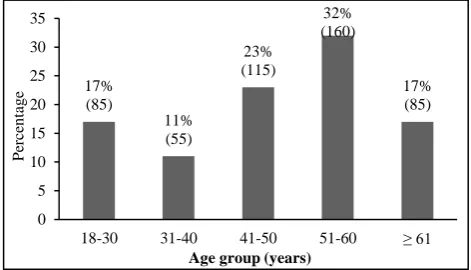
Figure 1: Age distribution of study population (n=500).
In the present study population (n=500), 85 participants (17%) were between 18-30 years old, 55 (11%) were between 31-40 years, 115 (23%) responders were 41-50 years and 85 (17%) was more than 50 years. The rest 160 participants i.e. 32% of the total study population were of the age between 51 to 60 years old (Figure 1).
17% (85)
11% (55)
23% (115)
32% (160)
17% (85)
0 5 10 15 20 25 30 35
18-30 31-40 41-50 51-60 ≥ 61
P
er
ce
n
ta
g
e
Table 1: Responses regarding WHO client satisfaction indicators among the study population (n=500).
Parameters No. of
responses
% of response
Overall impression on service received
Very good 95 19
Satisfied 390 78
Bad 15 3
Based on the client satisfaction indicators established by World Health Organization (WHO), present study showed the impression of the patients on the overall service received in the hospital was very satisfactory, 78% were satisfied regarding the service received and 19% indicated it to be very good (Table 1). But it was noted that most of the responders declared that they could not avail the service with an ease.
Table 2: Responses regarding different parameters among the study population (n=500).
Parameters No. of
responses
% of response
Privacy
Yes 60 12
No 245 49
Not relevant 195 39
Waiting time
Didn‟t wait 20 4
As usual 270 54
Too much 210 42
Cleanliness
Clean 405 81
Untidy 95 19
However, the present study revealed that privacy, which is another important issue for the patients while visiting doctors, was poor in the OPD of the tertiary care hospital. Only 12% of the study population agreed to have privacy but 49% declared that they did not get privacy during health checkup (Table 2). Patient waiting time is defined as the time gap between patients attending a healthcare centre to the time of obtaining the desired treatment. It is also an essential parameter in order to estimate patient satisfaction. 210 (42%) stated that the waiting time was too lengthy and 270 (54%) of the responders also opined the delay in getting service (Table 2). The cleanliness of the hospital was one of the most important aspects assessed in the present study and 81% of the study population agreed with the fact that the clean environment was effectively maintained in the hospital area and different outpatient departments.
In the present study the patients visiting the outpatient departments, were enquired about whether they have faced any problem on getting services during the hospital visit. Most of the responders admired that they did not face any problem regarding registration or services during health checkup. 83% of the total study population
expressed that they didn‟t face any problem during registration. The positive responses were also obtained from the study population regarding the services from doctors (84%) and pharmacy (75%). Very few patients availed services from diagnostic laboratory facility; among them satisfaction level was also noticed (Table 3).
Table 3: Patients responses regarding the problem faced during hospital visit (n=500).
Parameters
Responses (in % & no. of response)
No Yes Did not avail Problem faced during
registration
83% (415)
1% (5)
16% (80)
Problem faced regarding service from doctor
84% (420)
8% (40)
8% (40)
Problem faced from diagnostic laboratory
22% (110)
8% (40)
70% (350)
Problem faced from pharmacy
75% (375)
10% (50)
15% (75)
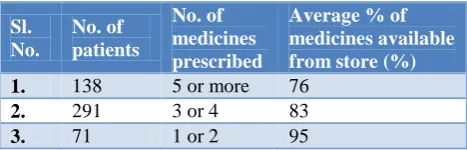
Tertiary care hospitals provide drugs or devices, prescribed to the patients, without charging any cost. This is a Government policy in West Bengal. Patients were therefore asked about the availability of medicines from the hospital free of cost. It was observed that 138 patients, prescribed with 5 or more medicines, received 76% of the medicines. 291 patients who prescribed 3 or 4 drugs obtained 83% of the drugs from the hospital. 71 patients prescribed with 1 or 2 drugs received 95% drugs from the hospital (Table 4). Thus it was evident that the patients prescribed with less number of medications, received more drugs from the store.
Table 4: Response of patients towards availability of medicines from hospital (n=500).
Sl. No.
No. of patients
No. of medicines prescribed
Average % of medicines available from store (%)
1. 138 5 or more 76
2. 291 3 or 4 83
3. 71 1 or 2 95
Patients were asked about the informant who informed or guided him/her for effective use of prescriptions. It was observed that 61% of the patients was advised efficaciously by the physicians, 22.4% were informed by the nursing staffs, whereas, 15.4% were informed effectively by both the physicians and nursing staffs (Table 5).
Table 5: Response of patients towards effective communication with healthcare professionals (n=500).
Sl. No. Informants No. of patients Percentage of patients (%)
1. Doctors 305 61
2. Nursing staffs 112 22.4
3. Doctors and Nursing staffs 77 15.4
4. Others 06 1.2
Table 6: Response of patients towards cleanliness of OPD toilets (n=500).
Sl. No. Toilet used or not Number of patients Response
1. Used 372 Very dirty Dirty Ok
289 66 17
2. Unused 128 No comments
DISCUSSION
In the present society, patients have a number of options to choose hospitals for health issues. Thus hospitals need to be aware of the patients‟ needs and comforts. Patient satisfaction surveys are thus useful for an understanding of user‟s needs and their perception of the service received. It is an important indicator in evaluating the quality of the patient care. Present study comprised of 500 patients visiting a tertiary care hospital, in the five major outpatient departments namely Medicine, Surgery, Gynaecology and Obstetrics, Eye and ENT and Orthopaedics, for their health problems. 100 responses were collected from each of these departments. Among the responders 59.2% (296) were male and 40.8% (204) female. A patient satisfaction study conducted by Mohd et al, in South India also revealed predominance of male (56%) over females (47%).10 However, similar study by Iloh et al, in Nigeria showed that the female prevalence was 54.7% and male was 45.3%.11 Age distribution of the study population showed maximum (32%) belonged to the age group of 51-60 years, followed by 41-50 years (23%). Another national study showed 34% belonged to the age group of 15-29 years.12 Study in Nigeria also revealed, majority (67.7%) of the respondents were middle-aged adults (40-60 years).11
Level of satisfaction is an important measurement according to World Health Organization (WHO), as far as patient care is concerned.13 Present study reported that 78% of the patients were satisfied about the services they received from the hospitals. Similar results were seen in a study by Sharma et al, in India, where 73% of the respondents were satisfied with the availability of services, professional care, behaviour of the healthcare professionals.14 On the contrary, international study conducted by March et al, in a hospital in Germany, revealed patients were highly satisfied with care, follow-up care at home and participation in decision-making. Only 3.6% of patients were found to be dissatisfied.15 Another study from Nigeria revealed the overall level of satisfaction was 66.8%. This was attributed to good relation with the healthcare providers and less waiting
time for the patients.11 A US-based study documented that patient were satisfied with the quality of surgical care provided to them. Therefore, the overall level of satisfaction was 69.5%.16
Timely and convenient access to health services are key determinants of patient satisfaction. Thus the time gap between attending the centre and getting proper medical treatment is essential. Long waiting time generates frustration and dissatisfaction among the patients. Present study showed 42% of the patients complained that the waiting was too long. Similar study in Lucknow also revealed 33.3% of the patients were unsatisfied with the waiting time.17 Study in Euthopia also reported dissatisfaction with waiting time by patients.18 81% of the present study population were satisfied with the cleanliness of the health care facility. However, a study in Kerala revealed that 50% were highly satisfied with the cleanliness of the facility whereas 15.5% opined that the cleanliness can be improved.19
Privacy was felt to be necessary among almost all women coming for family planning, maternal care or female care services. In the present study, 49% of the population expressed their problem due to inadequate privacy during checkup. A study on client satisfaction by Aldana et al, in rural Bangladesh showed 45.1% of the patients were dissatisfied with the privacy.20 Privacy, being an essential part of healthcare facility, specially for woman, should be ensured in order to improve patient satisfaction.
satisfied with the services received from the pharmacy. A study in Ethopia showed that the patients were satisfied with the location of the pharmacy however, there was dissatisfaction regarding the availability of waiting chairs and services provided by the pharmacist. The overall satisfaction regarding services obtained from the pharmacy accounted to 51.9%.22
CONCLUSION
Patients attending hospital are messenger of spreading good image of the hospital and therefore patients‟ satisfaction is equally important for hospital management to improve the health care quality. In the present study majority of the patients were satisfied with the services provided, therefore they also admired to recommend these hospitals to others. The patients‟ feedback also revealed many insights regarding various aspects, which may improve the quality of services provided to the society.
Funding: No funding sources Conflict of interest: None declared
Ethical approval: The study was approved by the Institutional Ethics Committee
REFERENCES
1. Fisher AW. Patients‟ Evaluation of Outpatient Medical Care. J Med Educ. 1971;46(3):238–44. 2. Barnett B. Women's views influence choice.
Network. 1995;16(1):14–8.
3. Mosadeghrad AM. Factors influencing healthcare service quality. International Journal of Health Policy and Management. 2014;3(2):77-89.
4. Newsome PRH, Wright GH. A review of patient satisfaction:1. Concepts of satisfaction. Br Dent J. 1999;186(4 Spec):161-5.
5. Ntabaye MK, Scheutz F, Poulsen S. Patient satisfaction with emergency oral healthcare in rural Tanzania. Community Dent Oral Epidemiol. 1998;26(5):289-95.
6. Laurent B, Patrice F, Elisabeth D, Georges W, Jose L. Perception and use of the results of patient satisfaction surveys by care providers in a French teaching hospital. International J Quality Health Care. 2006;18(5):359–64.
7. Agarwal A, Garg S, Pareek U. A study assessing patient satisfaction in a tertiary care hospital in India:the changing healthcare scenario. J Commun Dis. 2009;41(2):109-12.
8. White B. Measuring Patient Satisfaction: How to Do It and Why to Bother Family Practice Management. 1999. Available at: http://www.aafp.org/fpm/ 990100fm/40.html. Accessed on 17 August 2015. 9. Di Paula A, Long R, Wiener DE. Are your patients
satisfied? Marketing Health Services. 2002;22(3):28–32.
10. Mohd A, Chakravarty A. Patient satisfaction with services of the outpatient department. Medical Journal, Armed Forces India. 2014;70(3):237-42. 11. Iloh G, Ofoedu JN, Njoku PU, Odu FU, Ifedigbo
CV, Iwuamanam KD. Evaluation of patients' satisfaction with quality of care provided at the National Health Insurance Scheme clinic of a tertiary hospital in South- Eastern Nigeria. Niger J Clin Pract. 2012;15:469-74.
12. Prasanna K, Bashith M, Sucharitha S. Consumer Satisfaction about Hospital Services: A Study from the Outpatient Department of a Private Medical College Hospital at Mangalore. Indian J Community Med. 2009;34(2):156-9.
13. Bleich SN, Özaltin E, Murray CJ. How does satisfaction with the health-care system relate to patient experience? Bulletin of the World Health Organization. 2009;87(4):271-8.
14. Sharma A, Kasar PK, Sharma R. Patient Satisfaction About Hospital Services: A Study From The Outpatient Department Of Tertiary Care Hospital, Jabalpur, Madhya Pradesh, India. National J Community Med. 2014;5(2):199-203.
15. March S, Swart E, Robra B. Patient satisfaction with outpatient/short stay operations in a practice clinic. Gesundheitswesen. 2006;68(6):376-82.
16. Tsai TC, Orav EJ, Jha AK. Patient Satisfaction and Quality of Surgical Care in US Hospitals. Annals Surg. 2015;261(1):2-8.
17. Kumari R, Idris MZ, Bhushan V, Khanna A, Agarwal M, Singh SK. Study on patient satisfaction in the government allopathic health facilities of Lucknow district, India. Indian J Community Med. 2009;34:35-42.
18. Abdosh B. The quality of hospital services in eastern Ethiopia:Patients' perspective. Ethiop J Health Dev. 2006;20:199-200.
19. Jawahar SK. A Study on Out Patient Satisfaction at a Super Specialty Hospital in India. Internet J Med Update. 2007;2(2):13-7.
20. Aldana JM, Piechulek H, Al-Sabir A. Client satisfaction and quality of health care in rural Bangladesh. Bull World Health Organization. 2001;79 (6):512-7.
21. Mishra PH, Gupta S. Study of patient satisfaction in a surgical unit of a tertiary care teaching hospital. J Clin Orthop Trauma. 2012;3(1):43-7.
22. Ayalew MB, Taye K, Asfaw D, Lemma B, Dadi F, Solomon H, et al. Patients‟/Clients‟ Expectation Toward and Satisfaction from Pharmacy Services. J Res Pharmacy Pract. 2017;6(1):21-6.