Original Research Article
Prevalence of self-medication practices among the residents of urban
slums located near govt. medical college, Jabalpur
Shubham Jain
1, Aditya Thakur
2*, Kunal Peepre
2, Shivika Kaushal
1, Pradeep Kasar
2INTRODUCTION
Self-medication is defined as medication taken on the patient’s own initiative or on the advice of pharmacist or any other lay person. The World Health Organization (WHO) has defined self-medication as the practice whereby individuals treat their ailments and conditions
with medicines that are approved and available without prescription, and which are safe and effective when used as directed.1 But self-medication can be described as a double edged sword for its users, because it has both beneficial and harmful effects.2 Antibiotic resistance is rising to dangerously high levels in all parts of the world. New resistance mechanisms are emerging and spreading
ABSTRACT
Background: Self-medication is defined as medication taken on the patient’s own initiative or on the advice of pharmacist or any other lay person. Self-medication can be described as a double edged sword for its users, because it has both beneficial and harmful effects. According to recent community based study in 2016 prevalence of self-medication in developing countries varies from 12% to as high as 73% in different communities. The objectives of the study were to assess the prevalence of self-medication among the residents of urban slums located near Govt. medical college, Jabalpur and to identify the factors associated with the practice of self-medication.
Methods: It was a descriptive cross sectional study conducted in 412 families residing in slum areas around the medical college for duration of 2 months [1st July to 31st august 2017]. One participant from each family was interviewed. Data on socio demographic details (age, gender, education, occupation, and income), practice of self-medication, and reasons for use of self-medication were collected.
Results: Among the total 412 participants, 176 (42.7%) practiced self-medication out of which 43.6% were Females. Highest prevalence of 58.1% amongst 18-40 years of age group, 69.3% was literates. Major reason for self-medication being disease is simple (56.5%). Majority took self-self-medication occasionally (72.5%) and most common source were Pharmacists (87.42%) through OTC (81.14%). Most widely used drugs were Analgesics (66.28%) and main indications were headache, body ache and other pains (25.2%). Associations were compared with chi-square test Socio economic status of participants and Vicinity distance from hospital revealed statistically significant result. Socio-economically upper class (p꞊0.018) and participants living more than 500 m away from hospital (p=0.010) tends to take more self medication.
Conclusions: There was a heterogeneous spread in the practices. Easy availability of over the counter (OTC) drugs is a major factor responsible for irrational drug use. Community awareness programme, educational interventions should be conducted about side effects of self-medication.
Keywords: Slums, Self-medication, Practice, Reason
1Netaji Subhash Chandra Bose Medical College, Jabalpur, M.P., India 2
Department of Community Medicine, Netaji Subhash Chandra Bose Medical College, Jabalpur, M.P., India
Received: 22 December 2017
Accepted: 11 January 2018
*Correspondence:
Dr. Aditya Thakur,
E-mail: [email protected]
Copyright: © the author(s), publisher and licensee Medip Academy. This is an open-access article distributed under the terms of the Creative Commons Attribution Non-Commercial License, which permits unrestricted non-commercial use, distribution, and reproduction in any medium, provided the original work is properly cited.
globally, threatening our ability to treat common infectious diseases.3 According to recent community based study in 2016 prevalence of self-medication in developing countries varies from 12% to as high as 73% in different communities and prevalence had increased from 31% in 1997 to 71% in 2011.2 The prevalence among Asian countries, like Nepal 59%, Pakistan 51%, Sri Lanka 64%, Bangladesh 80%.3
In India self-medication is highly prevalent and it is one of the important factors attributed to the development of antimicrobial resistance and also serious health hazards such as adverse reaction and prolong suffering. In coastal regions of south India, the prevalence was 71%, while in Delhi the prevalence was 92.8%.4,5 Self-medication is associated with risks such as misdiagnosis, use of excessive drug dosage, mixing medications that are not safe to mix, which may result in legal cost or health concerns, risk of abuse, risk of developing addictions, masking symptoms of serious condition, delaying medical advice prolonged duration of use, drug interactions and poly pharmacy.6 In India, the most common reasons for self-medication were common cold (61.6%), and fever (51.8%). Analgesics and cough syrups were the most commonly used class of drugs in India which can be easily available over the counter.4-8 In addition, lax medical regulation has resulted in the proliferation of counter free drugs that are in high demand for the treatment of highly prevalent diseases. Therefore, with an aim to find out the prevalence of self medication and factors contributing in the increase to it, the present study had been carried out.
METHODS
It was a descriptive cross sectional study done in duration of two months i.e. 1st august 2017 to 30th September 2017 in the slum area near Govt. medical college Jabalpur. A sample of 412 was obtained for determining the prevalence of self medication using the formula ZPQ/L2 (where p=63% from previous studies, L= absolute precision of 5%).7-11 One ward from each direction of medical college i.e. north, east, south, west were selected randomly for the study. From each ward 103 houses in slums were randomly selected for the survey. One member from each household was selected for the study. Individual residing in the area and willing to participate in the study were included in the study. Severely ill Individuals, individual below 18 years of age and above 60 years of age were excluded. Patients were also excluded from the study. If no participant above 18 year of age is found during the time of survey in the house. The next adjacent house was selected for the survey. Data was collected by interview using semi- structured pretested questionnaire which was administered to the participant from each of the households available at the time of the visit. Data on socio demographic details (age, gender, education, occupation, and income), practice of self-medication, and reasons for use of self-medication was collected. The data were coded and validated.
Data entry and analysis were using EPI info (version 7) and MS Excel 2007 software. Generation of descriptive Statistics was done. Chi-square test was used to identify factor associated with self-medication. Ethical clearance was taken from the ethical committee of the Institution. The study was done according to world Helsinki declaration and informed oral consent was obtained from the participants before administrating questionnaire. Anonymity of participants was maintained by avoiding any information revealing the identity of the participants in the questionnaire.
RESULTS
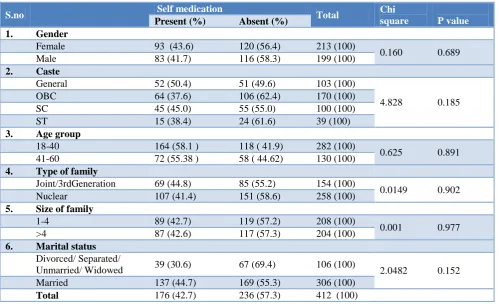
A total of 412 household in the slum near medical college were surveyed and one participant from each house was interviewed and prevalence of self medication was determined. Prevalence of self-medication in urban slum was 42.7%, while respondents not taking self-medication constitute 57.3%. Table 1 shows the distribution in gender regarding self medication. Prevalence of self medication was higher in female i.e. 43.6% when compared with male i.e. 41.7%. Frequency distribution was almost similar. When this distribution was compared for association with chi square test it was found statistically not significant. Another variable caste was also compared for association with self medication. Although it shows that participant belonging to general category and SC category takes self medication more when compared with OBC and ST category. Association was tested by chi square test was found to be statistically insignificant. Participant of age group of 18-40 year when compared with 41-60 year for self medication it was found that participant in 18-40 year takes more self medication i.e. 58.1% when compared with 41-60 year i.e. 55.38%. No statistically significant difference was found among them. Joint family/3rd generation family has the prevalence of self medication of 44.8% when compared with nuclear family which had 41.4% prevalence. No statistically significant difference was found among them. Size of family when compared for self medication almost same distribution was found i.e. 42.7% for 1-4 size family and 42.6% for >4 size family. Insignificant association was found. Marital status was also compared between married and divorce/ single/widowed participant. Married participant was found to take more self medication when compared with divorce/ single/widowed participant though the significant difference was not found among them.
Figure 1: Prevalence of self-medication.
42.7% YES
Figure 2: Reasons for self medication.
Figure 3: Sources of self medication.
Figure 4: Drugs mainly used as self medication.
Figure 5: Most common symptoms for which drugs were taken as self medication.
Table 1: Association between socio demographic variables and self medication.
S.no Self medication Total Chi
square P value
Present (%) Absent (%) 1. Gender
Female 93 (43.6) 120 (56.4) 213 (100)
0.160 0.689 Male 83 (41.7) 116 (58.3) 199 (100)
2. Caste
General 52 (50.4) 51 (49.6) 103 (100)
4.828 0.185 OBC 64 (37.6) 106 (62.4) 170 (100)
SC 45 (45.0) 55 (55.0) 100 (100)
ST 15 (38.4) 24 (61.6) 39 (100)
3. Age group
18-40 164 (58.1 ) 118 ( 41.9) 282 (100)
0.625 0.891 41-60 72 (55.38 ) 58 ( 44.62) 130 (100)
4. Type of family
Joint/3rdGeneration 69 (44.8) 85 (55.2) 154 (100)
0.0149 0.902 Nuclear 107 (41.4) 151 (58.6) 258 (100)
5. Size of family
1-4 89 (42.7) 119 (57.2) 208 (100)
0.001 0.977
>4 87 (42.6) 117 (57.3) 204 (100)
6. Marital status
Divorced/ Separated/
Unmarried/ Widowed 39 (30.6) 67 (69.4) 106 (100) 2.0482 0.152 Married 137 (44.7) 169 (55.3) 306 (100)
Total 176 (42.7) 236 (57.3) 412 (100)
0% 10% 20% 30% 40% 50% 60% TIME SAVING
SELF-DECISION EASY AVAILABILITY DISEASE IS SIMPLE
56.50% 50.80% 31.40% 28.00%
0% 10% 20% 30% 40% 50% 60% 70% 80% 90%
Pharmacist Family previous
prescriptions 87.42%
9.71% 9.40%
66.20% 53.40% 29.50%
17.10%
0% 20% 40% 60% 80%
Anti-pyretics
Anti-allergics
Antibiotics
59% 53.40%
39.20%
0% 10% 20% 30% 40% 50% 60% 70%
Fever Cough & cold Headache, bodyache & other
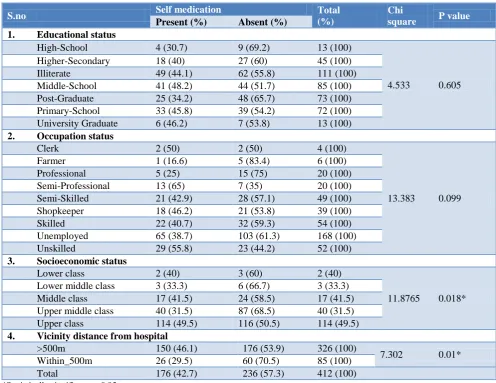
Table 2: Association between self-medication and socio demographic variables.
S.no Self medication Total
(%)
Chi
square P value
Present (%) Absent (%) 1. Educational status
High-School 4 (30.7) 9 (69.2) 13 (100)
4.533 0.605 Higher-Secondary 18 (40) 27 (60) 45 (100)
Illiterate 49 (44.1) 62 (55.8) 111 (100) Middle-School 41 (48.2) 44 (51.7) 85 (100) Post-Graduate 25 (34.2) 48 (65.7) 73 (100) Primary-School 33 (45.8) 39 (54.2) 72 (100) University Graduate 6 (46.2) 7 (53.8) 13 (100)
2. Occupation status
Clerk 2 (50) 2 (50) 4 (100)
13.383 0.099
Farmer 1 (16.6) 5 (83.4) 6 (100)
Professional 5 (25) 15 (75) 20 (100) Semi-Professional 13 (65) 7 (35) 20 (100) Semi-Skilled 21 (42.9) 28 (57.1) 49 (100) Shopkeeper 18 (46.2) 21 (53.8) 39 (100) Skilled 22 (40.7) 32 (59.3) 54 (100) Unemployed 65 (38.7) 103 (61.3) 168 (100) Unskilled 29 (55.8) 23 (44.2) 52 (100)
3. Socioeconomic status
Lower class 2 (40) 3 (60) 2 (40)
11.8765 0.018* Lower middle class 3 (33.3) 6 (66.7) 3 (33.3)
Middle class 17 (41.5) 24 (58.5) 17 (41.5) Upper middle class 40 (31.5) 87 (68.5) 40 (31.5) Upper class 114 (49.5) 116 (50.5) 114 (49.5)
4. Vicinity distance from hospital
>500m 150 (46.1) 176 (53.9) 326 (100)
7.302 0.01* Within_500m 26 (29.5) 60 (70.5) 85 (100)
Total 176 (42.7) 236 (57.3) 412 (100)
*Statistically significant p<0.05.
Table 2 shows education status of participant in slums and their distribution regarding self medication. Maximum number of the participant belongs to the illiterate group and those participants who have the education status up to middle school. Self medication was higher among the participant who has studied up to middle school i.e. 48.2%. Least self medication prevalence was found among post graduates and participant who studied up to high school. No significant difference was found among them. Occupational status of the participant was compared for self medication among them. Semi professional and clerk participant has the higher prevalence of self medication i.e. 65% and 50% respectively. Least was found in farmer and professionals i.e. 25% and 16.6% respectively though no significant association was found among them. Socio economic status of participants shows that the maximum number of the participants from upper class takes the self medication i.e. 49.5%. While the least prevalence was found in lower and lower middle class. When association was compared with Chi square test. Statistically significant result was found with p=0.018, which means there is an association between upper class and self medication. Distance of
participants who takes self medication said they had taken self medication for headache, body ache and other pain; similarly 53.4% population uses self medication for cold and cough. While only 39.04% uses self-medication for fever.
DISCUSSION
The study has been done in slums near medical college Jabalpur in 412 household. One participant from each house was interviewed. Data was collected from the participants between age group 18 to 60 years. Prevalence of self-medication was 42.7% which is very high this could be due to the reason that health care services are getting costlier now a days in most of the cities in India. Other reasons might be lack of time, financial constraint, ignorance etc. which is most common now days. Similar findings were also reported by Saba et al and Pranav et al where they found prevalence of 40.5% and 47% respectively.7-9 Studies done by Katkuri and Vargese in urban slums found self medication prevalence of about 73% and 68% respectively.8-10 Self-medication is not only a problem of India but also in neighboring country like Pakistan, Aqeel et alreported prevalence of 61.2% among urban and rural population of Islamabad.12
The mean age of the participants in the study was 36.33 yrs with SD ±13.60. Self medication was 58% among 18-40 yrs of age group similar findings were found in the study by Keshari and Vargese where as Kumar reported 96.3% of self medication prevalence amongst age group of 20-29 years.4,8,10
The prevalence was comparatively higher in females than males. The above finding may be due to the reasons that female were comparatively more in number in the study and females remain occupied in their household chores thus finding less time to visit health centers similar finding were found in studies of Katkuri et al, Gupta et al and Marak et al.2,8,13
The prevalence of self medication was highest among joint family. This is because with increase in family members the per capita income decreases; which increases the socio economic burden among family. Contrast finding was found in study done by Divya et al and De Silva et al where they found higher prevalence in nuclear families.14,15
The prevalence of self medication is highest among general category. The above finding may be due to greater awareness towards health amongst Brahmin these finding corroborates with the findings of Shankar in Pokhara Nepal.16 Saba et al also reported 97% of the Hindu were taking self medication, this may be due to maximum participants in their studies were hindu.7
The prevalence of self medication was highest among married. Similarly Pranav et al and Jain et al also find the same finding of self medication highest among married.9,17 In our study female constitute the higher proportions and also females experience high workload in household chores, family tensions, reproductive health issues etc. which might make them vulnerable towards self medication.
The prevalence of self medication was highest among literates (educated at least upto high school). This may be due to greater knowledge of brands of drugs than illiterates. Similar finding were found in the studies of Katkuri et al in Hyderabad, Marak et al in Meghalaya and Gupta et al in Bangalore.8,2,13 Prevalence of self medication in present study is found to be highest among respondents belonging to upper class of socio economic status according to modified Prasad scale. The association between upper class and self medication was statistically significant, as population of higher socio economic status more frequently remain in touch with pharmacist and also they had habit of keeping drugs for symptomatic relief. Katkuri in 2016 among urban slum dwellers in Hyderabad, India also has the similar finding of self medication in upper class.8
Majority of them assume that the disease is curable by taking self medication rather than consulting a physician. The finding of this study was similar to study of Katkuri et al in Hyderabad.8 In contrast study done by Keshari et al in 2014 in rural area of Barabanki, UP found most common reason for self medication to be time saving 45.2%.11
Since the population of slums works in unorganized sectors which involves strenuous physical activity compared to organized sector which sometimes results in body ache, pain and headache.
When compared with other studies done in India a contrast finding is acquired. Study by Selvaraj et al in 2014 in urban Pondicherry found most common illness associated with self medication to be fever (31%).18 A higher percentage of self medication in fever i.e. 72.6% was reported by study done by Gupta et al. On other hand Awad et al in 2006 in Khartoum state, Sudan found most common indication for self-medication to be cough (15.9%) followed by common cold (10.8%).13,19
CONCLUSION
Self-medication is prevalent in slums near medical college Jabalpur. People residing in slums prefer using self-medication than consulting a physician despite of their vicinity to tertiary health care center and medical college which provides free drugs and health services. Over the counter drugs available through pharmacists are preferred due to abundance of medical shops nearby. Easy availability of over the counter (OTC) drugs is a major factor responsible for irrational use of drugs in self-medication. So, strict legislation is required to prevent drug distribution without prescription. Community awareness programs, educational interventions should be conducted about side effects of self-medication. Periodic studies on knowledge, attitude of people may give an insight towards self-medication.
ACKNOWLEDGEMENTS
I want to express my thanks to Indian Council of Medical Research (ICMR), New Delhi for providing me scholarship for this research task under Short Term Studentship Programme 2017 and made it an unforgettable experience for me. I will be indebted and take this opportunity to extend cordial thanks to all who directly or indirectly helped me in timely completion of the work.
Funding: Funds was granted by ICMR New Delhi under Short term studentship programme
Conflict of interest: None declared
Ethical approval: The study was approved by the Institutional Ethics Committee
REFERENCES
1. World Health Organization. Guidelines for the Regulatory Assessment of Medicinal Products for Use in Self-Medication. Geneva, Switzerland: WHO, 2000.
2. Marak A, Borah M, Bhattacharyya H, Talukdar K. A cross sectional study on self-medication practices among the rural population of Meghalaya; 2015; International J Med Sci Public Health. 2016;5(6):1134-8.
3. Wijesinghe PR, Jayakody RL, Senevirante RA. Prevalence and predictors of self-medication in a selected urban and rural district of Sri Lanka; WHO South-East Asia J Public Health. 2012;1(1):28-41. 4. Kumar V, Mangal A, Yadav G, Raut D, Singh S.
Prevalence and pattern of self-medication practices in an urban area of Delhi,India. Medical J Dr. D. Y. Patil Univ. 2015;8(1):16-20.
5. Kulkarni PK, Khan M, Chandrashekhar A. Self-medication among urban slum dwellers in South Indian cities; 2012.
6. Chari HS, Kadeangadi DM, Malapur MD. Practice of self-medication among urban households. National J Community Med. 2015;6(2):226-9.
7. Saba H, Shivananda KS, Jayan M, Hussain A. Prevalence of self-medication practices and its association factors in rural Bengaluru, Karnataka, India. Int J Community Med Public Health. 2016;3(6):1481-6.
8. Katkuri S, Chauhan P, Kokiwar P, Gaiki V. Prevalence of self-medication practices among urban slum dwellers in Hyderabad, India; 2016; Int J Community Med Public Health. 2016;3(7):1816-9. 9. Pranav V, Narayanan P, Guddattu V. Self-medication practice among urban slum dwellers in Udupi Taluk, Karnataka, India; 2017. Int J Pharmacy Pharmaceutical Sci. 2017;9(6):19-23. 10. Vargese SS, Durgawale PM, Mathew P. Prevalence
of self-medication in an urban slum area in Maharastra. J Krishna Institute Med Sci Univ. 2013;2:108-10.
11. Keshari SS, Kesarwani P, Mishra M. Prevalence and pattern of self-medication practices in rural area of Barabanki, UP. Indian J Clin Pract. 2014;25(7):636-9.
12. Akeel T, Shabbir A, Basharat H, Bukhari M, Mobin S, Shahid H, Waqar SA. Prevalence of self medication among urban and rural population of Islamabad, Pakistan. Trop J Pharm Res. 2014;13(4):627
13. Gupta P, Bobhate PS, Shrivastava SR. Self-medication practice in an urabn slum community. Asian J Pharm Clin Res. 2011;4:54-7.
14. Divya M, Bharatesh S, Vasudeva G, Varalakshmi C. Self-Medication Among Adults in Urban Udupi Taluk, Southern India. J Med Public Health. 2016;6(3):126-9.
15. De silva, Hussain FH, Ginige G, Kulthunge A, Kannangara H, Goonawardane S, Gamage M. Self-medication practices and missuse of medicine among mothers of young children attending a teaching hospital in Srilanka. Sri Lanka J Child Health. 2017;46(2):122-7.
16. Shankar PR, Partha P, Shenoy N. Self-medication and non doctor prescription practices in pokhara valley, western Nepal; 2002;3:17.
17. Jain P, Sachan A, Singla RK, Agrawal P. Statistical study on self-medication pattern in Haryana, India. Indo Global J Pharma Sci. 2012;2(1):21-35.
18. Selvaraj K, Kumar SG, Ramalingam A. Prevalance of self medication practices and its associated factors in urban Puducherry. Perspect Clin Res. 2014;5(1):32-6.
19. Awad AI, Eltayeb IB, Capps PA. Self-medication practices in Khartoum state, Sudan. Eur J Clin Pharmacol. 2006;62:317-24.
20. Kumar N, Kanchan T, Unnikrishnan B, Rekha T, Mithra P, Kulkarni V. Perceptions in practices of self medication among medical students in coastal south India. PLoS ONE. 2013;8(8):e72247.
22. Durgawale PM, Shinde MB, Durgawale PP, Agarwal N. Practices of Self-Medication among Tribal Population North Maharashtra (Khandesh). Int J Sci Res. 2014;3(3):211-5.
Cite this article as: Jain S, Thakur A, Peepre K, Kaushal S, Kasar P.Prevalence of self-medication practices among the residents of urban slums located near govt. medical college, Jabalpur. Int J