The ESF scientific programme Experimental and Theoretical Investigation of Complex
Polymer Structures (SUPERNET)
addresses the current key questions in
polymer science:
.
What are the relationships between macromolecular structure, supramolecularstructure, supermolecular structure and the
physical properties of materials?
.
In what way can the combination of experiments and molecular modelling helpThe European Science Foundation acts as a catalyst for the development of science by bringing together leading scientists and funding agencies to debate, plan and implement pan-European
us to understand the phenomena that govern
polymer behaviour?
The programme will investigate a variety of
functional polymers, copolymers, networks,
branched polymers and liquid crystalline
polymers in order to better understand the
formation of complex topological structures.
The SUPERNET programme was established
in 1999 by ESF. Member Organisations
contribute to the programme over a five year
period. The programme offers different types
of grants to both young and senior scientists
to foster exchange and joint experiments, and
organises workshops and conferences
rel-evant to the programme.
The Steering Committee guiding the
programme is composed of expert scientists
nominated by the ESF Member
Organisations contributing to the
programme.
Experimental and Theoretical Investigation
of Complex Polymer Structures (SUPERNET)
Polymer materials today
In the search for more effective ways to create new engineering and
special-ity polymer materials vast activities have been undertaken and
develop-ment costs spent on blending and
making compatible different
compo-nents in order to improve materials properties. The application of
multi-component copolymers and
interpen-etrating polymer networks allows the
combination of different properties of incompatible polymers. Depending on
reaction conditions and the choice of
component monomers, polymer
materials with structures in the range of nanometers to micrometers can be
prepared. Such multicomponent
copolymers and networks can
com-bine the classical properties of polymers with new functionalities for
novel high technology applications.
Scientific aims of SUPERNET
The aim of the project is to combine experimental and theoretical studies
of block copolymers, networks,
branched polymers and liquid crystal-line polymers to gain a deeper
under-standing of two fundamental aspects
of polymer science.
The first is the process of formation
of complex topological structures such
as branched polymers and
multicom-ponent or interpenetrating networks and ordered polymers.
The second is the correlation between
the materials properties and the chemi-cal structure of the constituent
mono-mers or polymer blocks.
The ultimate goals of this project will
be the study of the influence of polymerisation conditions on the
morphology and typology of the
materials, and the composition and
compatibility of the components on the physical properties of the
products.
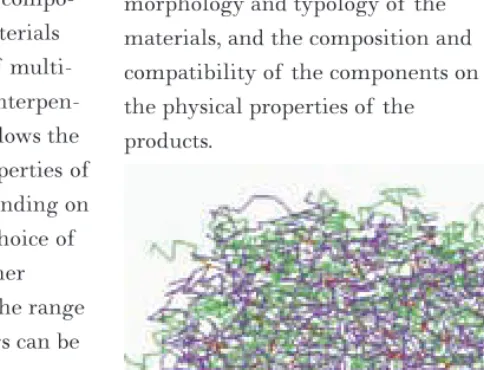
A model for simulation of two component interpenetrating networks has been elaborated. The figure shows the configuration of two
A polycation, poly(methacryloylethyl
trimethylammonium methyl sulfate), with <Mw> =
25x106 g mol-1 shows interesting solvent dependent
conformational changes. A coil - globule transition has been shown to occur in mixtures of acetone and water containing a small amount of sodium hydroxide. The upper part of the scheme represents changes in the coil size distribution as a function of polymer concentration. Probable polymer conforma-tions in solution; a) a transient network, b) single coils, c) partially globulised and, d) fully globulised polymers. Light scattering data obtained at a scattering angle of 900 represent average maximum and
minimum values of the radius of gyration, Rh,
respectively, and the highest value of distribution. The lower part of the scheme shows the concentra-tion dependence of 1) the reduced viscosity, 2) the light scattering intensity and, 3) the angular dissymmetry parameter. The viscosity data are in dl g-1, while the
intensity is given in counts of photons per s, ‘10-4
cps. Insert: a micrograph of a polymer globule. The research project will involve
methods of specific polymer synthesis
and copolymer synthesis. Block copolymers consisting of blocks with
different physical and chemical
properties will be prepared and
characterised. Copolymers which form nanostructures based on the
electrostatic attraction-repulsion
between the blocks will be
investi-gated. Advanced spectroscopic, scattering and calorimetric methods
will be used in the characterisation. A
very important part of the project is
the modelling and the development of theory. This work will involve
atomistic modelling, molecular
mechanics, molecular dynamics and
stochastic methods to determine the conformational mobility of single
chains and assemblies of chains. The
theory of relaxation in polymer
brushes, oriented polymers and in polymer networks will be developed.
New computer codes for parallel
computers will be worked out since
the group has access to powerful parallel computers in the UK and in
Finland.
Advanced experimental methods are available within the network for the
characterisation of multicomponent
polymers and networks. Wide
experience of application of NMR relaxation methods, ultrasonic and
dielectric relaxation methods,
measurements of rheological and
mechanical properties, neutron, X-ray and laser light scattering analysis
form the basis of the experimental
work on complex polymer structures.
Atomistic molecular modelling, molecular mechanics studies and
molecular dynamics simulations are
accomplished. At the same time new
highly efficient algorithms of computer simulation both for
branched polymers and polymer
networks consisting of flexible
polymer chains, and for linear
polymer chains with strong orientational interactions are
elaborated by the participants.
Dynamic theory both for polymer
networks consisting of flexible chains and for linear polymer chains with
strong orientational interactions is
The experience of all participating
groups in preparation and
characterisation as well as in theoretical description of polymer
systems will be combined to develop
novel approaches for syntheses of
multicomponent materials with new functionalities.
The greatest emphasis is on polymer
systems with outstanding mechanical, electrical and optical properties as
well as environmental response.
Control of the influence of
polymerisation conditions on the
Computational methods have been introduced to gain a better understanding of the molecular level processes governing the transport and distribution of small molecules in polymer networks. The incorporation of small molecules in an extended polymer network system is shown. The model allows the study of both the network and the diffusion of the small molecules inside it.
SUPERNET activities
Workshops and conferences
The Steering Committee organises international workshops which are
held about once a year. An initial
meeting with around 35 participants was held in Strasbourg, France, at the
ESF headquarters on 19-21 November
1999. The next workshop will be held
at the same venue on 17-19 November 2000. In addition a large international
EURESCO Conference will be held in morphology and topology of the products, and also control of the
influence on the composition and the
phase behaviour of the polymers, will
be the ultimate goal in this project. New advanced methods of polymer
synthesis and analysis of molecular,
supramolecular and supermolecular
assemblies will be designed. Theory and simulation methods for complex
polymer structures will be developed.
New efficient computer codes for
Finland in 2001. Workshops are
planned on specific aspects of the
SUPERNET programme, such as specific polymer synthesis, relaxation
measurements or theoretical
model-ling. The Steering Committee invites
proposals from potential organisers, in particular in the countries
participat-ing in the SUPERNET, on topics with
a clear connection to the scientific
goals and the working programme of the SUPERNET programme.
Short-term fellowships
These are for young scientists, who
need further training and expertise in
new experimental and modelling
methods for a fruitful continuation and broadening of their research
scopes. Short term fellowships are
intended to facilitate the transfer of
knowledge and techniques relevant to research from one laboratory to
another within Europe (at least one
Funding
ESF scientific programmes are princi-pally financed by the Foundation’s Member Organisations on an à la
carte basis. SUPERNET is supported
by:
Fonds voor Wetenschappelijk Onderzoek – Vlaanderen, Fonds
National de la Recherche
Scientifique, Belgium; Statens
Naturvidenskabelige Forskningsråd, Denmark; Suomen Akatemia/
Finlands Akademi, Finland; Centre
National de la Recherche
Scientifique, France; Deutsche Forschungsgemeinschaft, Germany;
Slovenska Znanstvena Fundacija,
Slovenia; Teknikvetenskapliga
Forskningsrådet, Sweden; Engineering and Physical Sciences Research
Council, United Kingdom. contributing country should be
involved). The grants are for periods
up to six months and the amount will be between 1 070 and 1 375 Euros per
month plus travel expenses. Selection
rounds are 15 April and 15 November
each year. Applications should reach the ESF office prior to the relevant
date.
Short scientific visit grants
These cover the costs of short visits of
senior researchers working in the area
of the SUPERNET programme, in order to carry out joint experimental
or theoretical work primarily in one
of the SUPERNET participating
laboratories. Applications for short scientific visit grants are treated in
the same way as the short-term
fellowship applications, and should
SUPERNET Steering Committee
Dr. Hans U. Karow
ESF Senior Scientific Secretary
Ms. Chantal Durant
ESF Administrator
European Science Foundation
1 quai Lezay-Marnésia 67080 Strasbourg Cedex France
WWW Home Page: http://www.esf.org
Tel: +33 (0)3 88 76 71 27 Fax: +33 (0)3 88 37 05 32 E-mail: [email protected]
Professor Franciska Sundholm (Chair)
University of Helsinki
Department of Polymer Chemistry
PB 55
A.I. Virtasen Aukio 1 00014 HY Helsinki Finland
Tel: +358 9 191 40 336 Fax: +358 9 191 40 330 E-mail: [email protected]
Dr. David B. Adolf (Year 2 to 5)
University of Leeds
IRC in Polymer Science & Technology Dept. of Physics & Astronomy
Woodhouse Lane Leeds LS2 9JT United Kingdom
Tel: +44 113 233 3812 Fax: +44 113 233 3846 E-mail: [email protected]
Dr. Ingo Alig
Physical Department Deutsches Kunststoff-Institut
Schlogartenstr. 6 64289 Darmstadt Germany
Tel: +49 6151 162 404 Fax: +49 6151 292855 E-mail: [email protected]
Professor Julian H.R. Clarke (Year 1)
Chemistry Department UMIST
M60 1QD Manchester United Kingdom
Tel: +44 161 200 45 26 Fax: +44 161 200 44 83 E-mail: [email protected]
Professor Igor Emri
University of Ljubljana
Centre for Experimental Mechanics
Cesta na Brdo 49 1125 Ljubljana Slovenia
Tel: +386 61 123 7430 Fax: +386 61 123 24 71 E-mail: [email protected]
Professor Ulf W. Gedde
Department of Polymer Technology Royal Institute of Technology
100 44 Stockholm Sweden
Tel: +46 8 790 76 40 Fax: +46 8 790 69 46 E-mail: [email protected]
Professor Eric Goethals
University of Gent
Department of Organic Chemistry Polymer Division
Krijgslaan 281 (S4-bis) 9000 Gent
Belgium
Tel: +32 9 264 44 98 Fax: +32 9 264 49 72 E-mail: [email protected]
Dr. Jean-François Gohy
Université de Liège
Center for Education and Research on Macromolecules (CERM)
Sart-Tilman – B6 4000 Liège Belgium
Tel: +32 4 366 94 61 Fax: +32 4 366 34 97 E-mail: [email protected]
Professor Soeren Hvilsted
Danish Polymer Centre
Department of Chemical Engineering Building 229
Technical University of Denmark
2800 Lyngby Denmark
Tel: +45 45 25 29 65 Fax: +45 45 93 29 06 E-mail: [email protected]
Professor Françoise Lauprêtre
Laboratoire de Recherche sur les Polymères
2 à 8 rue Henri Dunant 94320 Thiais
France
Tel: +33 1 49 78 12 86 Fax: +33 1 49 78 12 08
E-mail: [email protected]
Guest member:
Professor Kurt Binder
Johannes Gutenberg - Universität Condensed Matter Group Institut für Physik
Staudingerweg 10 55099 Mainz Germany
Tel: +49 6131 393348 Fax: +49 6131 395 441 E-mail: [email protected]
Associated member:
Professor Anatoly Darinskii
Russian Academy of Sciences Institute of Macromolecular Compounds
199004 Bolshoi pr. 31 St. Petersburg Russia
Tel: +7 812 328 56 01 Fax: +7 812 328 68 69 E-mail: [email protected]
Cover picture:
Core and shell structure of an AB diblock copolymer consisting of an unsaturated polyester block and a poly(ehylene glycol) block.The poly-ester chain forms the core.
For the latest information on this programme consult the SUPERNET home page:
www.esf.org/supernet
November 2000
© European Science Foundation IREG Strasbourg - D
épôt léga
l:
novembre 2000 - N
°
d’ordre