http://www.ijcmph.com pISSN 2394-6032 | eISSN 2394-6040
Original Research Article
Infant feeding practices of a tribal community in a mandal of
Khammam district, Telangana
Rajeshwar Rao Alwala
1, Shankar Reddy Dudala
2*,
Chandrasekhar Reddy Bolla
1,
Manoj B. Patki
3, B. P. Ravi Kumar
4INTRODUCTION
Infant feeding practices differ from place to place and between different ethnic groups and communities. Breast feeding their infants is an integral part of the reproductive cycle in all mammalian species not just humans. Mother’s milk is the ideal food for all infants which provides adequate nutritional requirements early during infancy and no wonder it is considered nature’s gift to the baby. Breastfeeding which is an ancient social custom has immense benefits to both mother and the infant
because of its nutrients and immunoglobulin contents. It is the safest food for vulnerable newborns since it is free of contamination. Early initiation and exclusive breast feeding helps the infants to achieve optimal growth and development in the future. Breastfeeding also benefits the mother by helping to improve her health and acts as a natural contraception.1 Further, ensuring adequate and timely introduction of supplementary feeding along with continued breast feeding could benefit the nation in reducing an important nutritional disorder among child, ‘stunting’.2
ABSTRACT
Background: Breast milk is the best, safest and most nutritious food for infants. Though breast feeding is almost universal, there are yet some myths and false beliefs surrounding the practice due to various cultures and traditions in India. In the present study an attempt was made to understand various aspects of infant feeding practices among the Sugali tribes of Khammam district, Telangana state.
Methods: A cross sectional study was conducted among Sugali community in Khammam mandal of Khammam district in Telangana from March to June 2010. In which 314 families with pre-school children were interviewed using a pre–designed semi-structured questionnaire.
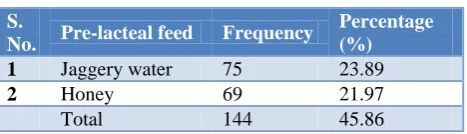
Results: Nearly 80% (251) of the mothers had said that they initiate breast feeding after one hour of delivery, while only 6% initiated breastfeeding within one hour delivery. About 54% of the mothers were giving colostrum to their newborns, while others (45.86%) were giving pre-lacteal feeding to the infants including jaggery water and honey. It was observed that most (71.65%) of the mothers were continuing to breastfeed their children more than 18 months. Only 11.78% of the mothers started weaning before 6 months of age. Socio-economic status, literacy rate and working status of the mothers were some of the influencing factors.
Conclusions: The study identified the practices of infant feeding, their determinants among the sugali tribes and recommendations to improve their practices. False beliefs and difficulties regarding breast feeding need to be addressed through heath education and family support.
Keywords: Sugali, Breastfeeding, Khammam Department of Community Medicine, 1
Mahavir Institute of Medical Sciences, Vikarabad, Telangana, 2Rajiv Gandhi Institute of Medical Sciences, Kadapa, Andhra Pradesh, 4Mamata Medical College, Khammam, Telangana, India
3
Public Heath consultant, Mumbai, India
Received: 29 October 2018 Accepted: 15 November 2018 *Correspondence:
Dr. Shankar Reddy Dudala,
E-mail: [email protected]
Copyright: © the author(s), publisher and licensee Medip Academy. This is an open-access article distributed under the terms of the Creative Commons Attribution Non-Commercial License, which permits unrestricted non-commercial use, distribution, and reproduction in any medium, provided the original work is properly cited.
Several factors affect breastfeeding including socioeconomic status, ethnicity, maternal education and employment, maternal age, attitude and confidence, residence and type of family, the influence of urbanization.
The attitudes and practices of breastfeeding vary in various sections of society due to different cultures, taboos, knowledge and attitudes of the mothers and their family members. From time immemorial, many tribes living in isolated pockets in the mountainous areas have been practicing a distinctive way of feeding their babies due to their ignorance and underlying cultural beliefs and practices.3
Lack of proper education and health facilities, faulty feeding habits, certain irrational belief systems and special tribal chores are likely to aggravate their health and nutritional status. Improper infants feeding practices could result in under nutrition, impaired cognitive development, poor school performance and reduced productivity influence.4
Child born in the tribal belt is one and half times more likely to die before the fifth birthday than children in other groups. Children below three years of age in scheduled tribes and scheduled castes are twice as likely to be malnourished than children in other groups. Malnutrition is a public health problem among tribals.5
The Sugalis are one of the few multilingual nomadic tribal communities, found throughout India. They are the largest notified scheduled tribe of Andhra Pradesh. They are also known as Lambadi, Lambani, Banjari and Brinjari in various parts of India.6
Various ethnic groups exhibit dissimilar beliefs, attitudes, and practices in terms of nutrition and breastfeeding although they reside in the same area. Understanding of culture and beliefs are important for health-care providers which are needed to provide culturally sensitive care specific to the needs of such populations.
The present study was undertaken to explore the infant feeding practices among Sugali community of Khammam district, Telangana. In view of the fast changing customs and traditions due to industrialization and urbanization the study was done with the objective to explore various aspects of infant feeding practices including use of colostrum, time of initiation of breast milk, use of pre lacteal feeds, period of exclusive breast feeding, age at which weaning was started, so that specific intervention measures can be recommended as observed, for promoting and supporting early and exclusive breast feeding of newborns.
METHODS
The study is a community based, cross sectional, descriptive study done in Khammam mandal of
Khammam district in Telangana, since this is one of the districts with highest tribal population in the state. The sugali community was chosen as they are one of the largest tribal community in the state, living in the plain areas migrating to peri-urban areas.
Multi- stage sampling technique was adopted for the selection of samples. The criterion for selection of mothers was that the family should have a mother with at least one child below six years of age. The study included 314 families with preschool children from the selected mandal of Khammam district, which was closer to the district head-quarters.
The data were collected during March to June 2010. The mothers were interviewed with the help of pre-designed and pre-tested schedules in local language. The questions were framed to elicit information in line with the objectives of the study.
The data collected was entered in Microsoft Office Excel 2007 and data analysis was done by using SPSS software, version 17. Descriptive statistics were calculated, and χ2-test was used to χ2-test the statistical association of data.
RESULTS
The study included 314 families with preschool children and the mean age of the participating mothers was 26.45 years ranging from 17 to 39 years.
It was observed that nearly 80% (251) of the mothers had said that they initiate breast feeding after one hour of delivery, while only 6% initiated breastfeeding within one hour of delivery. The rest (14%) of them said that they initiate breast feeding after a day or two after delivery, which is not good for the new-borns. Hence this practice has to be changed by health education during pregnancy during antenatal check-ups and support following delivery (Table 1).
Table 1: Time of initiation of breastfeeding.
S.
No. Time of initiation Frequency
Percentage (%)
1 Within one hour of
birth 19 6.1
2 One hour after birth 251 79.9 3 After one day 40 12.7 4 After two days 4 1.3
Total 314 100.0
Table 2: Pre-lacteal feeds.
S.
No. Pre-lacteal feed Frequency
Percentage (%)
1 Jaggery water 75 23.89
2 Honey 69 21.97
Total 144 45.86
Nearly two thirds of the mothers fed their babies six times or more a day and rest 3-4 times a day.
Breast-feeding of children seemed universal amongst Sugalis, and was continued up to two years of age. Most of the families i.e. 225 (71.65%) preferred to continue breast beyond 18 months, while only 2 (0.64%) families replied that they breast feed their infants for less than six months (Table 3).
Table 3: Distributions of respondents according to duration of breastfeeding.
S.
No. Duration Frequency
Percentage (%)
1 <6 months 2 0.64 2 6-12 months 7 2.23 3 13-18 months 80 25.48 4 >18 months 225 71.65
Total 314 100
Table 4: Weaning practices.
S. No.
Initiation of
weaning Frequency
Percentage (%)
1 <6 months 37 11.78 2 6-9 months 207 66 3 9-12 months 58 18.5 4 >12 months 12 3.82
Although duration of breastfeeding was higher, up to 18 months or more amongst the Sugali families, about 88% of the mothers replied that they start weaning their infants after 6 months though they were not aware of exclusive breastfeeding. While 11.78% of them said they start solid foods within 6 months saying that their milk is not sufficient for their growing infants (Table 4).
Table 5: Distribution of families according to socio-economic status (SES) based on monthly per capita
income (B.G. Prasad’s August 2010).7
SES Income Frequency Percentage (%)
I 4063 and
above 0 0
II 2031-4062 4 1.27 III 1219-2030 28 8.92 IV 610-1218 167 53.18 V ≤609 115 36.62 Total 314 100
Most of the families (nearly 90%) belonged to lower or lower middle classes of SES, which appeared to significantly influence weaning practices (p<0.005) and practice of pre-lacteal feeding (p>0.05) and exclusive breastfeeding (p>0.05) to some extent, though not significant.
Literacy rate was 49.32% among the study population and only 16.69% of them had attended high school or above and apparently didn’t show much influence on breastfeeding and weaning practices in the present study (p>0.05).
About 57.42% of the participant mothers were working which probably influenced their breastfeeding patterns (p<0.05).
DISCUSSION
Breastfeeding is the customary way of offering new born babies with the nutrients, which are essential for proper growth and development. This study was undertaken to explore the infant feeding practices and their influencing factors among Sugali community of Khammam district, Telangana. In this study among the 314 mothers who had atleast one pre-school child, about 62.4% were from the age group of 22-27 years, and mean age was 26.45 years similar to the 63.6% who were from 20 to 25 years in a study done by Bobhate and Shrivastava andcloser to the two-thirds belonging to 21-25 years as observed by Garje et al in their study.8,9
Colostrum, the first breast milk is highly nutritious and possesses antibodies that protect the newborn from many diseases. Delay in initiation of breastfeeding deprives the child from valuable components of colostrum, and worst still prelacteal feeding may cause adverse health effect and also delay in stimulation normally provided by suckling which could lead to decreased lactation.10
In our study only 6% initiated breastfeeding within one hour of delivery, contrary to this 25% of Indian population has been reported to start breast- feeding within an hour of birth in NFHS-3.11 Early initiation of breast feeding was noted among 80% of the participant mothers, which was higher than the reported 70.1% in a study done in Nashik, Maharashtraand 76% reported by Vijayakumari and Ramana in their study.4,9
Fifty four percent mothers in the study said that they gave colostrum to their infants, less than the 60% as reported by Neog et al, and more than the 40% observed by Dakshayani and Gangadhar and much more than and 26% reported by Nisha et al.10,12,13
study.12,14 Jaggery water (24%) seemed to be popular choice of preacteal food followed by honey (22%).
Practically colostrums alone is sufficient to maintain the nutritional demand of the newborns during first few days of birth without any type of prelacteal feeds.15 Many women reported that, these prelacteal feeds were given as cleaning agents. These prelacteal feeds actually interfere with the suckling stimulation and prolactin production and can also be the source of infection to the newborns.
About 71.65% of mother said that they continue breastfeed their children for more than 18 months of age, which is a good practice and though lower than the 76% mothers who continued breastfeeding upto one year and above as was seen in Andhra.4
It was observed that 88% of the mothers replied that they start weaning their infants after 6 months, while 11.78% of them said they start solid foods within 6 months which was higher than 48 percent initiating supplementary feeding during 6th to 9th month, but less than the 26.4% who started weaning in 4th to 6th month as found in a study done in Ananthapuramu district of Andhra Pradesh.4 The reasons for early weaning as mentioned by them were that their milk is not sufficient for their growing infants, child is old enough to take solid food etc. Gupta et al reported introduction of supplementary food at 6-9 months of age.2
The influencing factors for the breastfeeding practices among the study population seemed to be their socio-economic status (p<0.005), education level (p>0.05) and work of the mothers (p<0.05) similar to those summarized in a review by Srikanth et al.16
CONCLUSION
It was found that although women of Sugali community of Khammam were following good practices of breast feeding, yet there were instances harmful feeding practices like delay in initiation, giving pre-lacteal feeds instead of colostrum, early weaning are still prevailing among the tribes due to misconceptions. Certain delays in introducing supplementary feeding after one year can have deleterious consequences, as mother’s milk is not sufficient to meet the nutritional requirements of the growing infant beyond six months.
While there have been situations of good infant feeding practices amongst the Sugali women, due because of increased education levels and awareness by various health programs, there are negative consequences of women going for work observed as early weaning and shorter duration of breastfeeding in some.
Proper counselling of the mothers on the infant feeding practices by healthcare workers and motivation, and support from family would help in a great way in reducing the serious menace like child under- nutrition,
infant mortality amongst these communities. Special welfare programs by governments for the socially under-privileged communities who are unable to access the healthcare due to geographical, social or economic related distances are needed.
ACKNOWLEDGEMENTS
The authors gratefully acknowledge the cooperation of the participant mothers and local leaders of the villages surveyed.
Funding: No funding sources Conflict of interest: None declared
Ethical approval: The study was approved by the Institutional Ethics Committee at Mamata Medical College, Khammam
REFERENCES
1. Garje RR, Thitame SK, Somasundaram KV, Gautam L, Gite MS. Infant feeding beliefs and practices among tribal mothers in Nashik district, Maharashtra. Int J Med Sci Public Health. 2016;5:2203-8
2. Gupta A, Dadhich JP, Faridi MMA. Breast feeding and complementary feeding as a public health intervention for child survival in India. Ind J Pediatr. 2010;7(4):412-7.
3. Morose JM. Symposium of the cultural context of infant feeding in Fiji. Ecol Food Nutr. 1984;14: 287. 4. Vijayakumari G. Breast Feeding Practices Among The Sugali Community: A Study In A Tribal Population of Ananthapuramu District, Andhra Pradesh. IOSR Journal Of Humanities And Social Science 2018;9(23):23-5.
5. Deogaonkar M. Socio-economic inequality and its effect on healthcare delivery in India: Inequality and health care. Electronic journal of Sociology 2004. Available at http://www.sociology.org/content/vol 8.1/deogaonkar.html. Accessed 20 October 2018. 6. Reddy PPYB, Rao AP. Dietary habits, food
consumption and nutrient intake among the Sugali, a tribal population of Andhra Pradesh, India. Asia Pacific J Clin Nutr. 2000;9(1):12–7.
7. Prasad BG. Social classification of Indian families. J Indian Med Assoc. 1961;37:250-1.
8. Bobhate PK, Shrivastava SR. Breastfeeding practice and factors associated with it: a cross sectional study among tribal women in Khardi primary health centre, Thane, India. Int J Public Health Res. 2012;2(1):115–21.
9. Garje RR, Thitame SK, Somasundaram KV, Gautam L, Gite MS. Infant feeding beliefs and practices among tribal mothers in Nashik district, Maharashtra. Int J Med Sci Public Health. 2016;5:2203-8.
population of Mysore District, Karnataka. Ethno-Med. 2008;2(2):127-9.
11. International Institute for Population Sciences (IIPS) and Macro International. 2007. National Family Health Survey (NFHS-3), 2005–06: India: Volume I. Mumbai: IIPS. Available at http://rchiips.org/ nfhs/NFHS-3%20Data/VOL-1/India_volume_I_ corrected_17oct08.pdf. Accessed on 20 October 2018.
12. Neog N, Baruah DK. Prevalent infant feeding practices of infants among the missing tribes of Jorhat District, Assam. Food Sci Res J. 2012;3(1):9-13.
13. Nisha C, Suguna A, Surekha A, Suleka T. Infant and child feeding practices among tribal population in Bangalore district, Karnataka. NJRCM. 2015;4(4):370-3.
14. Karunamurthy KS, Chakravarthy BK, Kolli B. A comparative study on maternal care practices in tribal area and urban slums. J of Evolution of Medl and Dent Sci. 2015;4(43):7477-82.
15. Talukdar MK, Kabit SM. Problems in Breast feeding and their management. Bangladesh J Child Health. 1992;16 (1/2):37–48.
16. Srikanth L, Subbiah K, Srinivasan S. Beliefs and practices of newborn feeding in tribal areas of India: a decennary review. Int J Community Med Public Health. 2017;4:281-5.