Infogain Publication (Infogainpublication.com) ISSN : 2454-1311
www.ijaems.com Page
|
228Factors Affecting the Utilization or
Non-Utilization of the Portfolio Assessment in
Evaluating Performance of High School and
College Mathematics Students in De La Salle
Lipa
Maria Theresa B. Kalaw
Mathematics Department of College of Education, Arts and Sciences, De La Salle Lipa, Philippines
Abstract—This study involved an investigation of the factors that affect the utilization or non-utilization of portfolio assessment in evaluating performance in mathematics of both college and high school students from De La Salle Lipa. Thirty-five teachers were asked to accomplish two validated brief surveys – one is for gathering information about their profile and the other is for probing into the different assessment tools they are using to evaluate the performance of their students in mathematics. Out of the 35 respondents, only 9 were using portfolio assessment either in the form of report of group project, open-ended questions, or draft, revised and final versions of students work on a complex mathematical problem. The demand for considerable time in planning instructional activities and development of grading rubrics or criteria were among the limiting factors identified by the 26 respondents for not using portfolio assessment. Among the alternative forms of assessment used by these teachers were KPUP (Knowledge, Process, Understanding and Product) Oriented, UbD (Understanding by Design) approach, and online assessment tools.
Keywords—Mathematics Education, Portfolio assessment, Descriptive-survey, Philippines.
I. INTRODUCTION
One of the critical functions of a teacher along with imparting wisdom and developing the skills of their students is to ascertain how effectively they have achieved the knowledge, expertise and ideals intrinsic in the lessons. This necessitates teachers to compose a repertory of efficient approaches for them to successfully measure, assess and evaluate student learning.
An essential authentic assessment principle views that a more effective way to gauge students’ knowledge is for them to exhibit what they understand and can perform
instead of simply explaining or being probed about it [6]. Portfolio, which is a compendium of student output providing proof of learning, is considered as one form of reliable assessment and has special characteristics, including multiple entries, self-reflection, on-going creation, student involvement, and uses with multiple audiences [8].
Portfolio in mathematics can be defined by students’ folders containing the records of their reflective self-evaluation, teachers’ comments about examples of their work, problem-solving activities, performing mathematical projects. By portfolio assessment, students can make sense of the process of their intellectual growth, strengths and weaknesses, sincerity, and latent possibility of development. Teachers can not only grasp the cognitive situation of what the learner was and what he is, but also suggest professional advice for his cognitive development.
1.1 Objectives of the Study
This study is aimed at determining the factors that affect the utilization or non-utilization of portfolio assessment in evaluating performance in mathematics of both college and high school students in De La Salle Lipa.
Specifically, this study sought to answer the following questions:
1.1.1 What is the profile of teachers in terms of age, gender, years of teaching experience, educational
attainment, and seminars and trainings attended on the use of assessment methods?
1.1.2 What assessment tools are being used by the teachers in their classes?
1.1.3 To what extent do the teachers use the portfolio as an assessment tool?
Infogain Publication (Infogainpublication.com) ISSN : 2454-1311
www.ijaems.com Page
|
2291.1.5 Is there a significant difference in the use of the
different assessment tools by the high school and college teachers?
1.1.6 Is there a significant difference in the use of portfolio assessment between high school and college teachers?
1.1.7 Is there a significant relationship between the profile of the teachers and the extent of their use of portfolio assessment?
1.2 Review of Related Literature
Assessment of learning is an integrated process for determining the nature and extent of student development [9]. Attending to students’ learning by using a variety of assessment strategies has always been a trademark of good teaching. Teachers who have embraced twenty-first century, state-of-the-art assessment practices have been recharged and become more effective and strategic in their teaching and assessment methods.
Due to certain constraints on the use of traditional assessment tools, many educators have been obligated to try out alternate methods of student evaluation and have appreciated the advantages of utilizing portfolio assessments.
A portfolio is a developmental assessment that evaluates student’s improvement along with his strong points and weaknesses. An excellent portfolio serves not only as a collection of a wide range of students’ output but also as a medium to express metacognitive reflection of their own learning and self-recommended suggestions for development. In addition, portfolios provide another means for dialog between teacher and students, thus allowing the teacher to become a better supporter of student’s needs in both the affective and cognitive realms. Among the types of portfolios that are especially useful as assessment methods are best-work, memorabilia, growth, skills, and assessment, proficiency, or promotion portfolios [4].
A major benefit of the portfolio process is its ability to merge instruction with assessment and thereby improve teaching. As teachers observe children and meet with them to discuss and reflect on their work, they receive valuable information about how each child is progressing [5].
Portfolios can also be used to communicate student achievement to parents and others. Bringing together students and family members to review portfolios provides the family-school connection, and this connection is vital to student success [2].
Parents are very curious about their child’s progress, and portfolios allow them the opportunity to see progress over time. Assessment results should find their way to the parents’ or guardians’ knowledge and understanding. These give them direction on how to help their children
maintain and/or improve class standings. Cooperation and coordination with parents can easily be sought if they know what the school is doing [9].
Students should be provided with mathematics classrooms in which they can recognize mathematical power by doing mathematics as a valuable subject. Mathematical culture should have such values as rationalism and objectivism in the ideological dimension, control and progress in the emotional dimension, openness and mystery in the sociological dimension, which should be in harmony with each other. These values of mathematical culture will be fulfilled by revolutionizing mathematics classrooms through the use of portfolio assessment.
In the US, Vermont was the first state to introduce portfolios as the primary state assessment. Portfolios in mathematics and writing were collected statewide for students in grades 4 and 8. The mathematics portfolios required students to pick five to seven “best” pieces of work. The portfolios were sent to a central location where they were rated by volunteer teachers on a 4-point scale for each of seven different dimensions. The criteria used for rating the mathematics portfolios included four aspects of problem solving (understanding the problem, how the problem was solved, decisions made by the students in doing the solutions, and the outcomes of the activities) and three aspects of communication (mathematical language, mathematical representation, and presentation) [11].
Mathematics portfolio is a collection of students’ work that demonstrates effort, progress, and their proficiency in mathematics subject. Portfolio is suitable to know the development of students’ work, by assessing a collection of tasks done by students. These tasks are selected and assessed, in order to see the development of students' abilities. Therefore, the portfolio is useful for both teachers and students in the assessment of process and results [1].
The product of the study of Abidin & El Walida is a set of mathematics e-portfolio assessment completed with teachers’and students’guide. It was designed and developed using Adobe Flash program and it was packaged CD form. The results of the tryout showed that the product is valid, practical, and effective making it a useful evaluation tool.
Birgin and Baki [3] support the notion of utilizing a combination of the traditional and the alternative methods which has been proven to be more effective in assessing the overall performance of students.
Infogain Publication (Infogainpublication.com) ISSN : 2454-1311
www.ijaems.com Page
|
230curriculum designed for this purpose. In order to tackle
the drawbacks of standardized tests and traditional assessment methods, wide-range research focusing on the effectiveness of portfolio assessment should be conducted to validate its efficacy. This would enable curriculum developers to integrate portfolio assessment as an alternate approach in student evaluation to be adopted by the teachers [13].
Results of the researches presented in the review all point out to the inevitable need for teachers to equip themselves with the necessary skills to effectively use portfolio assessment as an alternate method of evaluating their students’ over-all performance.
1.3 Research Framework
Several researches on assessment recommend that teachers should use a variety of evaluation schemes to measure a wider range of students’ attributes and verify if their expected meaning concur with the student’s constructed meaning. Jan de Lange (1999) proposed a framework for classroom assessment in mathematics (Fig. 1) which emphasizes the necessity for teachers to discern their students’ difficulties while learning, the level at which they are performing, and the progress they are making in order to adjust their teaching methodologies to meet their students’ needs [7].
Fig.1: Assessment Pyramid (de Lange, 1999)
Formative classroom assessment makes use of information gathered by the teacher through varied means ranging from observations and consultations to multi-step undertakings and assignments, from self-evaluation and homework to spoken demonstrations for the purpose of adapting teaching strategies to fulfill the students’ learning needs.
A basic principle for classroom assessment holds that “a balanced assessment plan should include multiple and varied opportunities (formats) for students to display and document their achievements” (Wiggins, 1992). This is the fundamental theory behind the conduct of portfolio
assessment as an effective evaluation tool to measure the students’ over-all performance.
This study looked into the factors affecting the utilization or non-utilization of the portfolio assessment in evaluating high school and college mathematics students in De La Salle Lipa. The key variables studied are the type of assessment tools used and the level of the teacher. Following is the research framework used in the study:
Fig.2: Teachers’ Use of Portfolio Assessment
II. METHODS
This research is descriptive in nature with data collected from high school and college mathematics teachers in De La Salle Lipa during the second semester of school year 2012- 2013. Participants were asked to accomplish two brief validated surveys – one for gathering information about their profile and the other for probing into the different assessment tools they are using to evaluate the performance of their students in mathematics. The survey also elicited information about the extent of the teachers’ use of portfolio assessment and the factors affecting the utilization or non-utilization of this type of assessment. Interviews were also conducted to further validate the responses of the teachers regarding the assessment tools they use in evaluating their students’ performance in mathematics.
III. RESULTS AND DISCUSSIONS
Majority of the faculty respondents are female aged 31 - 40 years old who have been teaching in the institution for fifteen to twenty years. Most of them are teaching in the college unit and have finished their MA/MS degrees.
Table 1 Teachers’ Profile
Profile Frequency Percentage
Years of teaching
Below 5 8 22.9
5-9 7 20.0
10-14 4 11.4
15-20 10 28.6
Above 20 6 17.1
Age Below 31 9 25.7
31-40 14 40.0
Profile - Years of teaching experience
- Educational attainment - Seminars and trainings on assessment methods
Extent of use of portfolio assessment of high school and college
teachers
Profile • Age
Infogain Publication (Infogainpublication.com) ISSN : 2454-1311
www.ijaems.com Page
|
231Above 40 12 34.3
Gender Male 8 22.9
Female 27 77.1
Education Attainment
BS 9 25.7
MA/MS units
6 17.1
MA/M 14 40.0
PhD units 1 2.9
PhD 5 14.3
Unit IS 14 40.0
College 21 60.0
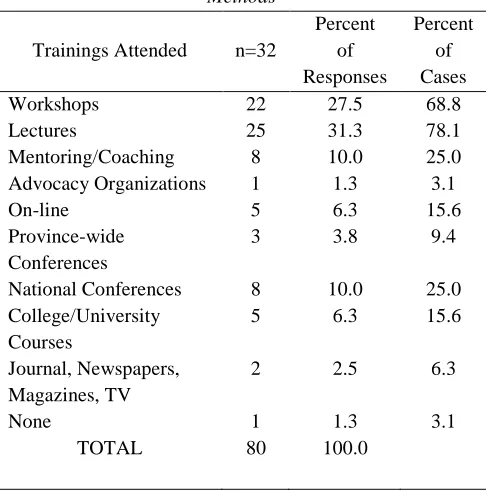
As seen in table 2, in terms of the trainings attended, multiple response analysis shows that 32 out of the 35 teachers have marked 80 boxes which is approximately 2-3 boxes per teacher where 78% of them indicated that assessment methods were discussed during lectures. Among the topics mentioned were assessment using KPUP (Knowledge, Process, Understanding, Performance), UbD (Understanding by Design), accounting updates on standards, basic statistics, measurement and test construction, item analysis, guidelines in conducting portfolio assessment in class, creating rubrics and formulating objectives, performance task making and constructing A-M-T (Acquisition-Meaning-Transfer) aligned questions.
Table 2 Trainings Attended on the use of Assessment Methods
Trainings Attended n=32
Percent of Responses
Percent of Cases
Workshops 22 27.5 68.8
Lectures 25 31.3 78.1
Mentoring/Coaching 8 10.0 25.0
Advocacy Organizations 1 1.3 3.1
On-line 5 6.3 15.6
Province-wide Conferences
3 3.8 9.4
National Conferences 8 10.0 25.0 College/University
Courses
5 6.3 15.6
Journal, Newspapers, Magazines, TV
2 2.5 6.3
None 1 1.3 3.1
TOTAL 80 100.0
As shown in table 3, multiple response analysis reveals that the 34 out of the 35 teachers have marked 144 boxes which is approximately 4 boxes per teacher where all of them indicated that they use seatwork as an assessment
tool in their classes. Moreover, it can be seen that aside from seatwork, 94% of them use quizzes. Further, only a smaller percentage of 35% utilizes portfolio assessment.
Table 3. Assessment Tools Used by the Teachers
Assessment Tools n=34
Percent of Responses
Percent of Cases
Quizzes 32 22.2 94.1
Graded Recitation 22 15.3 64.7
Seatwork 34 23.6 100.0
Performance based Assessment
21 14.6 61.8
Product based Assessment
23 16.0 67.6
Portfolio Assessment 12 8.3 35.3
TOTAL 144 100.0
From the 35 total number of respondents, only 9 signified using portfolio assessment. Table 4 shows that “A report of group project’ is type of portfolio assessment which the majority 89% of the 9 uses, immediately followed by ‘Open-ended questions’, and ‘Draft, revised and final versions of student work on a complex mathematical problem’ with both 67%.
Table 4 Use of portfolio assessment
Portfolio Assessment n=9
Percent of Responses
Percent of Cases Open-ended questions 6 11.3 66.7 A report of group project 8 15.1 88.9 Work from another
subject area
2 3.8 22.2
Problems posed by student
3 5.7 33.3
Art projects 3 5.7 33.3
A book review 2 3.8 22.2
Excerpts from a student’s daily journal
3 5.7 33.3
Draft, revised and final versions of student work on a complex mathematical problem
6 11.3 66.7
A description by the teacher of a student activity that displayed
understanding of a
Infogain Publication (Infogainpublication.com) ISSN : 2454-1311
www.ijaems.com Page
|
232mathematical
concept Newspaper and
magazine articles
3 5.7 33.3
Papers that show the student’s correction of errors or
misconceptions
4 7.5 44.4
Notes from an interview by the teacher or another student
2 3.8 22.2
Sample journal entries 4 7.5 44.4 A mathematical
autobiography
3 5.7 33.3
TOTAL 53 100.0
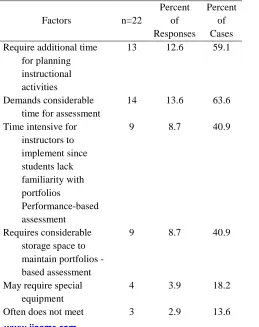
Responses were tabulated for the 22 teachers who answered the items out of the 26 respondents who were not using portfolio assessment. Table 5 indicates that 63.6% or 14 out of 22 teachers consider “Demands considerable time for assessment” as the leading limiting factor they consider for not using portfolio assessment. This was immediately followed by “Requires additional time for planning instructional activities” with 59.1% and “Development of grading rubrics or criteria takes a considerable amount of time” with a 54.5% affirmation.
Table 5 Factors that limit the use of portfolio assessment
Factors n=22
Percent of Responses
Percent of Cases Require additional time
for planning instructional activities
13 12.6 59.1
Demands considerable time for assessment
14 13.6 63.6
Time intensive for instructors to implement since students lack familiarity with portfolios
Performance-based assessment
9 8.7 40.9
Requires considerable storage space to maintain portfolios -based assessment
9 8.7 40.9
May require special equipment
4 3.9 18.2
Often does not meet 3 2.9 13.6
requirements for state or national standards Subjective nature of
grading may be less reliable
10 9.7 45.5
May have limited
acceptance by parents or administrators
1 1.0 4.5
Does not provide standardized
numerical scores that are often needed for institutional reports or accreditation
11 10.7 50.0
Students may need traditional scores or evidence of learning for admission criteria, job placement, or similar events
6 5.8 27.3
Development of grading rubrics or criteria takes a considerable amount of time
12 11.7 54.5
Performance data from portfolios is difficult to analyze or aggregate
11 10.7 50.0
TOTAL 103 100.0
Chi-square test was used to determine if the use of assessment tools is associated with the unit they belong. Since some of the expected counts are relatively small, the corrected chi-square values were reported in Table 6. Results indicate no significant association on the use of assessment tools by unit.
Table 6 Relationship between the use of assessment tools and the unit the teachers belong
Assessment Tools
IS n1=14
College n2=21
2
χ
pQuizzes Yes 13 19 .000 1.000
No 1 2
Graded Recitation
Yes 7
15 .862 .353
No 7 6
Seatwork Yes 14 21 .000 1.000
No 0 1
Performance based
Assessment
Yes 9
12 .005 .944
Infogain Publication (Infogainpublication.com) ISSN : 2454-1311
www.ijaems.com Page
|
233Product
based Assessment
Yes 10
13 .048 .827
No 4 8
Portfolio Assessment
Yes 4
8 .048 .827
No 10 13
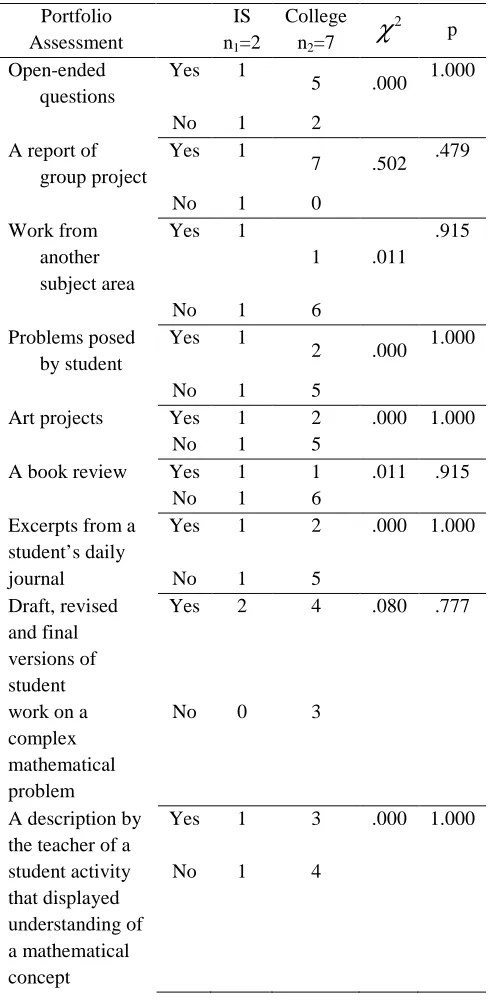
For the 9 faculty members who utilized portfolio assessment, no significant relationship was found in the unit where they belong to the use of the said form of evaluation.
Table 7 Relationship in the use of portfolio assessment and unit
Portfolio Assessment
IS n1=2
College n2=7
2
χ
p Open-endedquestions
Yes 1
5 .000 1.000
No 1 2
A report of group project
Yes 1
7 .502 .479
No 1 0
Work from another subject area
Yes 1
1 .011 .915
No 1 6
Problems posed by student
Yes 1
2 .000 1.000
No 1 5
Art projects Yes 1 2 .000 1.000
No 1 5
A book review Yes 1 1 .011 .915
No 1 6
Excerpts from a student’s daily
Yes 1 2 .000 1.000
journal No 1 5
Draft, revised and final versions of student
Yes 2 4 .080 .777
work on a complex mathematical problem
No 0 3
A description by the teacher of a
Yes 1 3 .000 1.000
student activity that displayed understanding of a mathematical concept
No 1 4
Newspaper and magazine articles
Yes 1 2 .000 1.000
No 1 5
Papers that show the student’s
Yes 2 2 .972 .324
correction of errors or misconceptions
No 0 5
Notes from an interview by the
Yes 1 1 .011 .915
teacher or another student
No 1 6
Sample journal entries
Yes 1 3 .000 1.000
No 1 4
A mathematical autobiograph y
Yes 1 2 .000 1.000
No 1 5
Relationship is not significant (two-tailed).
Table 8 shows the following significant relationships in terms of profile and extent of use of portfolio assessment: age and a description by the teacher of a student activity that displayed understanding of a mathematical concept; gender with work from another subject area, art projects, book review, newspaper and magazine articles, notes from an interview by the teacher or another student, and a mathematical autobiography; and education with papers that show the student’s correction of errors or misconceptions.
This implies that male teachers are associated with the use of work from another subject area, art projects, book review, newspaper and magazine articles, notes from an interview by the teacher or another student, and a mathematical autobiography for more or less once a semester. Also, younger faculty members tend to utilize description by the teacher of a student activity that displayed understanding of a mathematical concept while those with BS degree or has MA/MS units preferred to use papers that show the student’s correction of errors or misconceptions.
Table 8 Relationship between profile and extent of use of portfolio assessment
Profile
Extent of Use year s age
gender educatio
n unit
Open-ended questions
-.424 -.216
Infogain Publication (Infogainpublication.com) ISSN : 2454-1311
www.ijaems.com Page
|
234A report of
group project
-.233 -.141
.081 .208 .44 3
Work from another subject area.
-.407
-.247
-1.00** -.434 -.35
7
Problems posed by student
-.571 -.379
-.532 -.250 .12 1
Art projects -.584 -.416
-.756* -.401 -.18 9 A book review -.407
-.247
-1.00** -.434 -.357
Excerpts from a student’s daily
-.557 -.423
-.434 -.289 -.04 3 journal
Draft, revised and final versions of
.408 .247 -.189 -.358 -.61 4 student work
on a complex mathematical problem A description by the teacher of a
.280 .769 *
-.097 .411 .12 1
student activity that displayed understanding of a
mathematical concept Newspaper and magazine articles
-.031
.387 -.756* -.057 -.18 9 Papers that
show the student’s correction
-.231
-.223
-.567 -.803** -.378
of errors or misconception s
Notes from an interview by the
-.407
-.247
-1.000*
*
-.434 -.35 7 teacher or
another student
Sample - - -.347 -.066 .04
journal entries .268 .329 3
A
mathematical autobiography
.062 -.082
-.756* -.057 -.18 9 *. Correlation is significant at the 0.05 level (2-tailed). **. Correlation is significant at the 0.01 level (2-tailed).
IV. CONCLUSIONS AND RECOMMENDATIONS
Assessment consists of collecting, interpreting, and using information in decision making to improve instruction and enhance learning as well as to document student performance [10]. Portfolio assessment as utilized by a minority of mathematics faculty in De La Salle Lipa proved to be useful in evaluating the authentic performance of the students. Although there were several drawbacks identified such as the demand for considerable time in planning instructional activities and development of grading rubrics.
Among the alternative forms of assessment used by the teachers who did not utilize portfolio in class were KPUP (Knowledge, Process, Understanding and Product) Oriented, UbD (Understanding by Design) approach, and online assessment tools. Other forms of assessment used by the faculty are performance-tasks and outcomes-based activities that were designed to indicate successful achievement of their learning objectives.
Chi-square test results indicated no significant association on the use of assessment tools by unit and no significant relationship in the use of portfolio assessment to the unit where the teachers belong. Significant relationships in terms of profile and extent of use of portfolio assessment were found. Male teachers are associated with the use of work from another subject area, art projects, book review, newspaper and magazine articles, notes from an interview by the teacher or another student, and a mathematical autobiography for more or less once a semester. Younger faculty members tend to utilize description by the teacher of a student activity that displayed understanding of a mathematical concept while those with BS degree or has MA/MS units preferred to use papers that show the student’s correction of errors or misconceptions. Other forms of assessment used by the faculty are performance-tasks and outcomes-based activities that were designed to indicate successful achievement of their learning objectives.
Infogain Publication (Infogainpublication.com) ISSN : 2454-1311
www.ijaems.com Page
|
235activities" (p.36) in Assessment Standards for School
Mathematics [12].
To this end, the school administration should promote the proper use of portfolio assessment in evaluating students’ performance in mathematics by providing adequate and up-to-date training for faculty. Among the topics that the faculty wished they had additional trainings on are understanding types of assessment, formulating questions that test understanding, making rubric or scoring guide, online assessment, and training about book writing on a research basis.
REFERENCES
[1] Z. Abidin and S. El Walida, “The Model of Mathematics E-Portfolio Assessment for Senior High School,” vol. 4, no. 10, October 2014, ARPN Journal of Science and Technology. Retrieved from http://www.ejournalofscience.org
[2] S. Banks, “Classroom Assessment: Issues and Practices,” Pearson Education, Inc. USA, 2005. [3] O. Birgin and A. Baki, “The Use of Portfolio to
Assess Student’s Performance,” Journal of Turkish Science Education, Volume 4, Issue 2, September
2007. Retrieved from
http://www.tused.org/internet/tused/default13.asp [4] S. Butler and N. McMunn, N. “A Teacher’s Guide to
Classroom Assessment: Understanding and Using Assessment to Improve Student Learning,” Wiley & Sons, Inc. San Francisco, CA, 2006.
[5] J. Cohen and R. Wiener, “Literacy Portfolios: Improving Assessment, Teaching, and Learning (Second Edition),” Pearson Education, Inc. New Jersey, USA, 2003
[6] D. Cole, C. Ryan, F. Kick and B. Mathies, “Portfolios Across the Curriculum and Beyond (2nd Ed.),” Thousand Oaks, CA: Corwin, 2000.
[7] J. De Lange, “Framework for Classroom assessment in Mathematics,” Freudenthal Institute & National Center for Improving Student Learning and Achievement in Mathematics and Science, 1999. Retrieved
http://www.fi.uu.nl/catch/products/framework/de_lan ge_frameworkfinal.pdf
[8] T. Hogan, “Educational Assessment: A Practical Introduction,” John Wiley & Sons: USA, 2007. [9] M. Macarandang and V. Vega, “Assessment of
Learning”. Philippines, 2009.
[10]J. McMillan, “Essential Assessment Concepts for Teachers and Administrators,” Thousand Oaks, CA: Corwin, 2001.
[11]D. Miller, R. Linn and N. Gronlund, “Measurement and Assessment in Teaching (Tenth Edition),” Pearson Education, Inc. New Jersey, USA, 2009.
[12]National Council of Teachers of Mathematics (NCTM), “Curriculum and Evaluation standards for school mathematics” Reston, VA, 1989.