Breast meat quality of broilers fed fermented red
ginseng marc powder mixed with red-koji during
storage
S. C. Kim1, G. D. Lee2, I. H. Choi3*
1Division of Applied Life Science (BK21Plus, Insti. of Agri. & Life Sci.), Gyeongsang National University, Jinju, South Korea, 2Department of Food Science and Biotechnology, Joongbu University, Geumsan-gun, South Korea, 3Department of Companion Animal & Animal Resources Science, Joongbu University, Geumsan-gun, South Korea
*Corresponding author:
In Hag Choi, Department of Companion Animal & Animal Resources Science, Joongbu University, Geumsan-gun, South Korea. Tel: +82-41-750-6284, E-mail: [email protected]
Received: 23 January 2015; Revised: 27 February 2016; Accepted: 28 February 2016; Published Online: 11 March 2016
INTRODUCTION
Ginseng (Panax ginseng Meyer) is a slow-growing perennial plant (4 to 6 years), and it is distributed mainly in Korea, Japan, China, and the Maritime Province of Siberia and usually in subarctic and temperate regions (Choi et al., 2007; Zhuravlev et al., 2008). Ginseng has been used as an herbal medicine for thousands of years (Choi et al., 2011). Recently, many ginseng products to which a functional food or food flavor is added to enhance its effectiveness (health and body vigor) have appeared in the local or global market (Ryu et al., 2012). Ginseng roots can be divided into three types on the basis of the method of processing: fresh ginseng (less than 4 years of age), white ginseng (4–6 years of age; roots are dried after peeling), and red ginseng (Yun, 2001). Red ginseng is harvested when it is 6 years of age, and the roots are dried after steaming in water vapor at 98–100°C. A previous study revealed that ginseng has saponins, phenolics, polysaccharides, alkaloids, and lignans (Palazon et al., 2003). In addition, a review on the various
properties of saponins, which are regarded as important bioactive ingredients, had been published (Francis et al., 2002). Interest in red ginseng has increased in the past two decades as a result of its potential beneficial effects (antioxidant activity and immunostimulatory, antistress, and vasorelaxing effects), as confirmed by Yildirim et al. (2013).
An alternate approach for improving animal diet and meat quality is to use red ginseng marc or red koji prepared by fermentation with species that belong to the genus
Monascus. Red ginseng marc is a fibrous and insoluble byproduct obtained after the extraction process of ginseng. It was believed to be a waste product,but studies showed that red ginseng marc powder or fermented red ginseng marc has pharmacological properties and strong antioxidant effects (Jung et al., 2010; Lim et al., 2004). In a study to apply poultry diets (3%), Kim et al. (2014) reported the potential effects of red ginseng marc on antioxidant activity.
The breast meat quality of broilers fed four different types of red ginseng marc (DTRG) during storage at 4°C was investigated in this study. The experiment had a completely randomized design with four groups and four replicates; 240 Arbor Acres broiler chicks (160 males and 80 females) were used. The groups consisted of the control, 2% red ginseng marc, 1% fermented red ginseng marc with red-koji, and 2% liquid red ginseng. No remarkable effects on pH values of breast meat were observed in groups fed DTRG during storage (but
not the group fed 1% fermented red ginseng combined with red-koji). Both groups and storage had a significant effect (p < 0.05) on
lightness (L*), redness (a*), and yellowness (b*) values (but not L* values at 7 days, a* values at 1 day, and b* values at 7 days or L* values in T3 groups and a* values in T1 groups over storage). 1,1-diphenyl-2-picrylhydrazyl (DPPH) radical-scavenging activity showed
significant differences (p < 0.05) between groups and storage days. In conclusion, diets supplemented with 1% fermented red ginseng
powder combined with red-koji is helpful in improving DPPH radical-scavenging activity (antioxidant effect) in broiler breast meat, possibly
because of the saponins, flavonoids and polyphenols present in red ginseng marc.
Keywords: Fermented red ginseng marc powder; Red-koji; Red ginseng marc; Meat color; DPPH radical-scavenging activity
A B S T R A C T
http://www.ejfa.me/
Red-koji (Monascus species) has been traditionally used as a medicinal food and a fermentation source for other herbs in East Asia (Kim et al., 2013). For example, a product fermented using Monascus was gradually considered to be a functional food because monacolin K (anti-hypercholesterolemic agent), γ-aminobutyric acid (hypotensive agent), and dimerumic acid (antioxidant) were present (Aniya et al., 2000; Su et al., 2003). However, to the best of our knowledge, there are no studies on the effects of fermented red ginseng marc powder combined with red-koji on the meat quality (antioxidative properties) of broilers. It is therefore essential to study the physiological activities and antioxidative properties of fermented red ginseng marc powder combined with red-koji. This study was performed to investigate the breast meat quality of broilers fed fermented red ginseng marc powder mixed with red-koji during hypothermic storage.
MATERIALS AND METHODS
Birds and experimental design
Red ginseng marc, fermented red ginseng marc, red-koji, and liquid red ginseng were purchased from Ginseng Organic Co. (Seoul, Korea). Fermented red ginseng marc and red-koji were mixed at a ratio of 9:1. All samples were quickly prepared for the experiments. The animal care protocol used in this study was according to the guidelinesof the Dansan Farm (Yeongju, South Korea). A total of 240 broiler chicks (160 males and 80 females, Arbor acres, and 1 day of age) were randomly allotted to one of the following four dietary groups: control (basal diet), T1 (basal diet with 2% red ginseng marc), T2 (basal diet with 1% fermented red ginseng marc combined with red-koji), and T3 (basal diet with 2% liquid red ginseng). The experiment had a completely randomized design with four replicate pens of 10 male and 5 female birds per group. The trial was performed in two phases: a starter phase (day 1 to 21, 12.97 MJ/kg ME, 22% crude protein, 6% crude fat, 7% crude fiber, 10% crude ash, 0.9% Ca, and 1% P) and a finisher phase (day 22 to 28, 12.97 MJ/kg ME, 19% crude protein, 6% crude fat, 7% crude fiber, 10% crude ash, 0.8% Ca, and 0.9% P). The chicks were reared in an environmentally controlled room in 1.1 × 1.2-m pens with a tube feeder and a hanging bell drinker. They were maintained on a 24-h light schedule (14-h/10-h light/dark cycle), and feed and water were provided ad libitum throughout the 28-day experimental period. Ambient temperature was maintained at 35°C for the first week, after which the temperature was gradually reduced to 24°C and maintained during the four-week trials; ventilation was automatically regulated. In the 28-day trial, the following litter materials were used: wood shavings and rice hulls (an approximately 6-cm layer). At the end of the feeding trials, the birds were fasted for 6 h. Three birds per
pen were randomly selected, moved to the slaughterhouse, and electrically stunned. The birds were killed using a full ventral neck cut and exsanguinated, according to conventional slaughter procedures. Breast meat samples were excised and immediately packed in sealable plastic bags. Meat quality was analyzed during storage at 4°C on the postmortem days 1, 3, and 7.
Measurement of meat quality
pH
The pH of ground meat was determined in triplicate by using the method described by Kim et al. (2014). About 10 g of ground breast meat was homogenized in 90 mL of distilled water by using a blender (HM-3000; Hyundai Electronic Industry Co., Incheon, South Korea) for 1 min, and pH of the homogenate was determined using a digital pH meter (691 pH meter; Metrohm, Swiss) calibrated at pH 4.0 and 7.0.
Meat color
Color values of the breast meat samples were measured using a Minolta colorimeter (Minolta Co. CR 301, Japan) calibrated against a standard white tile (reference number 12633117, Y = 93.5, x = 0.3132, and y = 0.3198). Lightness (L*), redness (a*), and yellowness (b*) values were obtained using the average value of three repeated measurements taken from different locations on the surface of the meat samples.
1,1-Diphenyl-2-picrylhydrazyl (DPPH) radical-scavenging assay
Ability of the samples to scavenge 1,1-diphenyl-2-picrylhydrazyl (DPPH) radicals was estimated in triplicate using the aqueous supernatant obtained from breast meat, according to the method of Blois (1958) with slight modifications. Ascorbic acid was used as the standard solution. The extract (1 mL) was added to 4 mL of ethanolic DPPH solution (100 μM) and vortexed. The mixture was allowed to stand for 30 min at room temperature, and then absorbance was measured at 517 nm by using a UV-Vis spectrophotometer (Shimadzu, Japan). The percentage of DPPH free radical-scavenging activity was calculated using the following equation:
DPPH radical scavenging (%) = [1 − (absorbance of sample solution/absorbance of control)] × 100
Statistical analysis
RESULTS AND DISCUSSION
pH and meat color
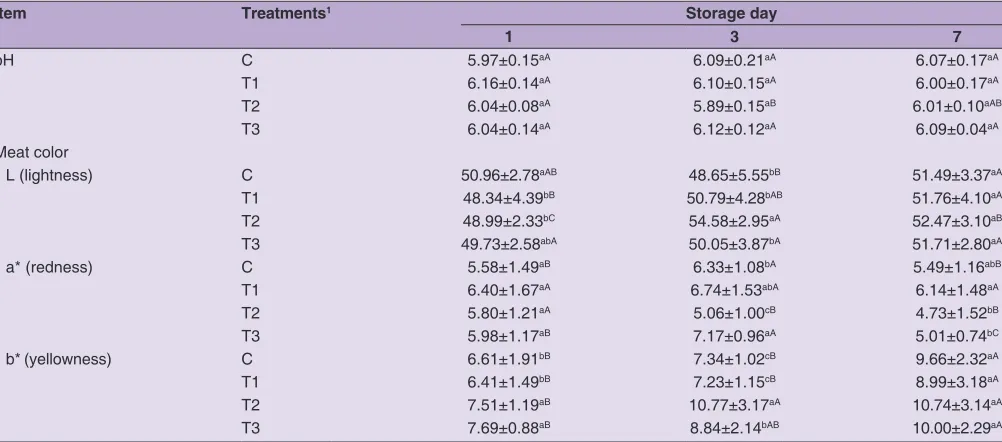
The pH and meat color of the broilers fed diets with DTRG are listed in Table 1. Overall, pH values in all groups were similar during storage. No remarkable effects of DTRG on pH values of breast meat were observed in the groups when compared with the control (p> 0.05). However, the T2 group showed a minor significant (p< 0.05) effect on pH as the number of storage days increased.
With respect to meat color, an increase and a decrease (p< 0.05) in L* and a* values were observed in both groups and storage. All groups had a significant effect (p< 0.05) on b* values, which tended to increase with storage days. However, no significant differences in L* values at 7 days, a* values at 1 day, and b* values at 7 days were found in all groups, including L* values in T3 groups and a* values in T1 groups over storage. The highest values of L* and b* and the lowest values of a* were observed in the T2 group (Table 1). Even though our result indicated that meat color was significantly different among groups fed DTRG, it seems that the different types of red ginseng did not have an antioxidant effect on meat color. In particular, fermented or red ginseng marc has been shown to be a biologically active compound with antioxidant effectiveness (Jung et al., 2010). In addition, red-koji is used as a food colorant, flavoring agent, and preservative and widely used for its antioxidant or medicinal properties (Arunachalam and Narmadhapriya, 2011). Nevertheless, our findings did not support those of Fernandez-Lopez
et al. (2005), who claimed that using natural extracts applied to beef meatballs during storage had significant advantages. Previous studies have shown that the presence of natural antioxidants could retard the formation of metmyoglobin and have highly suppressive effects and decrease L* or increase a* values (Fernandez-Lopez et al., 2005; Velasco and Williams, 2011). In contrast, Kim et al. (2014) suggested that the color of the thigh muscle was not affected by supplementation of broiler diets with increased levels of red ginseng marc.
In general, meat pH and color are considered as important criteria that influence antioxidant effectiveness and consumer preference. In the current study, pH values in the groups with DTRG were not the determining factor for breast meat color. According to Xiong et al. (1993), improvement in meat quality may be partially due to the fact that the effectiveness of an antioxidant agents such as polyphenols or flavonoids is based on pH; however, phenolic compounds do not always respond to a reduction in pH. Currently, the mechanism underlying this difference between pH and meat color for the different types of red ginseng is still unclear.
DPPH radical-scavenging assay
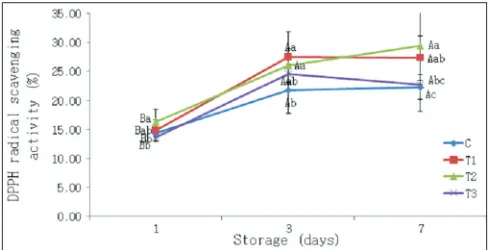
DPPH radical-scavenging activity showed significant differences (p< 0.05) between all groups and storage days (Fig. 1). In the present study, DPPH radical-scavenging activity was observed in the following order: T2 > T1 > T3 > Control. This result implies that the combination of fermented red ginseng marc and red-koji or red
Table 1: Effect of the addition of fermented red ginseng marc with red‑koji to poultry diets on pH and meat color of breast muscle of broiler during storage at 4°C
Item Treatments1 Storage day
1 3 7
pH C 5.97±0.15aA 6.09±0.21aA 6.07±0.17aA
T1 6.16±0.14aA 6.10±0.15aA 6.00±0.17aA
T2 6.04±0.08aA 5.89±0.15aB 6.01±0.10aAB
T3 6.04±0.14aA 6.12±0.12aA 6.09±0.04aA
Meat color
L (lightness) C 50.96±2.78aAB 48.65±5.55bB 51.49±3.37aA
T1 48.34±4.39bB 50.79±4.28bAB 51.76±4.10aA
T2 48.99±2.33bC 54.58±2.95aA 52.47±3.10aB
T3 49.73±2.58abA 50.05±3.87bA 51.71±2.80aA
a* (redness) C 5.58±1.49aB 6.33±1.08bA 5.49±1.16abB
T1 6.40±1.67aA 6.74±1.53abA 6.14±1.48aA
T2 5.80±1.21aA 5.06±1.00cB 4.73±1.52bB
T3 5.98±1.17aB 7.17±0.96aA 5.01±0.74bC
b* (yellowness) C 6.61±1.91bB 7.34±1.02cB 9.66±2.32aA
T1 6.41±1.49bB 7.23±1.15cB 8.99±3.18aA
T2 7.51±1.19aB 10.77±3.17aA 10.74±3.14aA
T3 7.69±0.88aB 8.84±2.14bAB 10.00±2.29aA
A-CMeans in the same row with different superscripts are significantly different (P<0.05). a-cMeans in the same column with different superscripts are significantly
different (P<0.05). Mean values are expressed as means±SEM. 1C=Control (no treatment); T1=2% red ginseng marc; T2=1% fermented red ginseng marc with
ginseng marc may be important for improving antioxidant properties during storage. In other words, an increase in DPPH radical-scavenging activity has a positive impact on meat quality, possibly because of the saponins present in red ginseng marc and the ability to serve as efficient free-radical scavengers (Kim et al., 2014). Kim et al. (2014) showed that DPPH radical-scavenging activity in thigh meat increased significantly with increasing levels of red ginseng marc.
CONCLUSION
Our findings revealed that the antioxidant potential of DPPH radical-scavenging activity in broiler breast meat can be improved by supplementation with different types of red ginseng. DPPH radical-scavenging activity was higher in the group fed 1% fermented red ginseng marc combined with red- koji. However, no remarkable effects on pH values and meat color of breast meat were observed in the groups during storage. Furthermore, pH values in the groups fed DTRG were not the determining factor for breast meat quality.
ACKNOWLEDGEMENTS
The authors are grateful to the Small and Medium Business Administration funded by the Korean Government (grant No. C0150527) for their support to carry out this research.
Authors’ Contributions
Sam Churl Kim and Gee Dong Lee contributed equally to this work in chemical analyzes and review for the manuscript as first author. In Hag Choi designed and performed research, wrote and revised the manuscript. All authors have read and approved the final version of the paper.
REFERENCES
Aniya, Y., II. Ohtani, T. Higa, C. Miyagi, H. Gibo, M. Shimabukuro, H. Nakanish and J. Taira. 2000. Dimerumic acid as an antioxidant of the mold, Monascus anka. Free Radic. Biol. Med. 286(6): 999-1004.
Arunachalam, C. and D. Narmadhapriya. 2011. Monascus fermented rice and its beneficial aspects: A new review. Asian J. Pharm. Clin. Res. 1: 29-31.
Blois, M.S. 1958. Antioxidant determination by the use of a stable free radical. Nature. 181(4617): 1199-2000.
Choi, S.Y., H.D. Hong, H.M. Bae, C. Choi and K.T. Kim. 2011. Phytochemical characteristics of coffee bean treated by coating of ginseng extract. J. Ginseng. Res. 35(4): 436-441.
Choi, Y.E., Y.S. Kim, M.J. Yi, W.G. Park, J.S. Yi, S.R. Chun, S.S. Han and S.J. Lee. 2007. Physiological and chemical characteristics of field and mountain cultivated ginseng roots. J. Plant Biol. 50(2): 198-205.
Duncan, D.B. 1955. Multiple range and multiple F-test. Biometrics. 11: 1-42.
Fernandez-Lopez, J., N. Zhi, L. Aleson-Carbonell, J.A. Perez-Alvarez and V. Kuri. 2005. Antioxidant and antibacterial activities of natural extracts: Application in beef meatballs. Meat Sci. 69(3): 371-380.
Francis, G., Z. Kerem, H.P.S. Makkar and K. Becker. 2002. The biological action of saponins in animal system: A review. Br. J. Nutr. 88(6): 587-605.
Jung, H.W., J.E. Kim, J.H. Seo and S.P. Lee. 2010. Physicochemical and antioxidant properties of red ginseng marc fermented by
Bacillus subtilis HA with Mugwort powder addition. J. Korean Soc. Food Sci. Nutr. 39(9): 1391-1398.
Kim, C.M., S.J. Yi, I.J. Cho and S.K. Ku. 2013. Red-Koji fermented red ginseng ameliorates high fat diet-induced metabolic disorders in mice. Nutrients. 5(11): 4316-4332.
Kim, Y.J., G.D. Lee and I.H. Choi. 2014. Effects of dietary supplementation of red ginseng marc and α-tocopherol on the growth performance and meat quality of broiler chicken. J. Sci
Food. Agric. 94(9): 1816-1821.
Lim, T.S., K. Na, E.M. Choi, J.Y. Chung and J.K. Hwang. 2004. Immunomodulating activities of polysaccharides isolated from
Panax ginseng. J. Med. Food. 7(1): 1-6.
Palazon, J., R.M. Cusido, M. Bonfil, A. Mallol, E. Moyamo, C. Marales and M.T. Pinol. 2003. Elicitation of different Panax ginseng transformed root phenotypes for an improvement ginsenoside production. Plant Physiol. Biochem. 41(11-12): 1019-1025.
Ryu, K.R., M.H. Yeom, S.S. Kwon, H.S, Rho, D.H. Kim, H.K. Kim and K.W. Yun. 2012. Influence of air temperature on the histological characteristics of ginseng (Panax ginseng C. A. Meyer) in six regions of Korea. Aust. J. Crop Sci. 6(12): 1637-1641.
SAS Institute. 2002. SAS/STAT User’s Guide: Version 8.2. SAS Institute, Cary, NC.
Su, Y.C., J.J. Wang, T.T. Lin and T.M. Pan. 2003. Production of the secondary metabolites γ-aminobutyric acid and monacolin K by
Monascus. J. Ind. Microbiol. Biotechnol. 30(1): 40-46.
Velasco, V. and P. Williams. 2011. Review: Improving meat quality through natural antioxidants. Chilean. J. Agric. Res. 71(2): 313-322.
Xiong, Y.L., E.A. Decker, G.H. Robe and W.G. Moody. 1993. Gelation of crude myofibrillar protein isolated from beef heart under antioxidative conditions. J. Food Sci. 58(6): 1241-1244.
Fig 1. Effect of the addition of fermented red ginseng marc with red
koji to poultry diets on DPPH radical scavenging of breast muscle of
broiler during storage at 4°C. A-B (row) and a-c (colomn) Bars with
same letters are not significantly different at P < 0.05. Treatments
Yildirim. A., A. Şekeroglu, H. Eleroglu, M.I. Şen and M. Duman. 2013. Effects of Korean (Panaxginseng C.A. Meyer) root extract on egg production performance and egg quality of laying hens. S. Afr. J. Anim Sci. 43(2): 194-207.
Yun, T.K. 2001. Panax ginseng – A non-organ-specific cancer
preventive? Lancet Oncol. 2(1): 49-55.