R E S E A R C H A R T I C L E
Open Access
Enhancement of student perceptions of
learner-centeredness and community of
inquiry in flipped classrooms
Young Hwan Lee
1and Kyong-Jee Kim
2*Abstract
Background:Flipped classrooms (FC) are expected to create a more student-centered, active learning environment
than traditional lectures. This study assessed the effectiveness of FC in promoting a student-centered, active learning environment by examining the changes in student perceptions of the learning environment of FC in terms of student-centeredness and sense of community of inquiry (COI), which represents the elements of a successful learning environment.
Methods:Questionnaires were given to a cohort of Year 2 students in a six-year undergraduate medical education
program, who had taken an introduction to medicine course in a FC format. The questionnaire included 7 items on the teaching orientation (i.e., teacher-centered vs. student-centered) and 34 items from the Community of Inquiry Survey Instrument, which consisted of three sub-scales–teaching, social, and cognitive presences. The
questionnaires were administered in pre- and post-test format during the first and last week of the semester.
Results:A total of 55 students returned the questionnaires (100% response rate). The student perceptions of student-centeredness of FC increased significantly over time (p< 0.001), and their perceptions of COI in FC also increased significantly in all three presences (p< 0.001). The student perceptions of student-centeredness and sense of COI in FC increased significantly in both high-achieving and low-achieving students (p< 0.01).
Conclusions:This study indicates that the flipped classroom model is an effective approach to fostering a learner-centered learning environment and developing a community of inquiry among medical students.
Background
With the rapid increase in medical knowledge nowadays, there have been concerns over passively transferring know-ledge to learners using traditional lectures in medical edu-cation. Hence, there is increasing pressure for medical education to move toward more student-centered, active learning [1–3]. The fourth industrial revolution and the rapidly changing technologies call for reforms in how med-ical students learn so they can keep up with the healthcare environment for the coming decades. In doing so, medical schools need to offer learning environments that promote students’active learning to help them develop the compe-tencies required for tomorrow’s doctors. Accordingly, there
has been increasing attention to the flipped classroom model to create a more student-centered learning environ-ment in medical education [1–3].
In flipped classrooms, which is also referred as the inverted classroom model [4], the in-class and out-of-class activities in conventional lectures are‘flipped,’in which stu-dents acquire knowledge by engaging in pre-assignments by using the learning contents are delivered to the students using technology, such as video lectures, before they meet in the classroom, and then they engage in active learning in the classroom instead of lectures [5]. Evidence indi-cating the effectiveness of flipped classrooms in higher education has been provided [6], and there is a growing body of literature in medical education indicating that flipped classrooms is an effective approach to learning and teaching [7–12].
Still, a systematic review study of flipped classrooms in medical education shows there is no solid evidence yet * Correspondence:[email protected]
2Department of Medical Education, School of Medicine, Dongguk University,
32 Dongguk-ro, Ilsandong-gu, Goyang-si, Gyeonggi-do, Goyang 10326, South Korea
Full list of author information is available at the end of the article
about the effectiveness of the flipped classroom [13]. Moreover, previous studies have focused on knowledge acquisition, and there is little information on student per-ceptions of the effectiveness of its learning environment. Active learning approaches, like flipped classrooms, can cultivate a student-centered learning environment that promotes collaborative interaction for deep and mean-ingful learning [14]. Such learning experiences are fun-damental for building the capacity for lifelong learning [15], which are necessary skills for tomorrow’s doctors [16]. Still, there is little evidence showing that the students’ experience with flipped classrooms contrib-utes to building such learning environments. This study examined the effectiveness of flipped classrooms in promoting a student-centered, active learning environ-ment that fosters collaborative interaction for deep and meaningful learning.
Methods
The study participants and setting
The study participants were a cohort of 2nd year stu-dents (N= 55) in the six-year basic medical education program at a private urban medical school in South Korea. The students were enrolled in an introductory medicine course in the fall of 2017. This course was de-signed in a flipped classroom model with the aim of pro-moting student-centered learning. This was a two-credit hour course offered for a duration of 15 weeks through-out the semester and covered a variety of ethical or social issues in the practice of medicine. Out of a total of 30 h of in-class instruction time in this course, 24 h (80%) were delivered in flipped classroom format and the remaining six hours were taught by conventional lectures.
In this flipped classroom format, the students were given pre-class assignments of reading materials and video lectures that would help them acquire knowledge relevant to the issues to be covered in the class. Students spent 1–3 h in these out-of-class activities for each flipped classroom unit at their own pace in preparation for in-class activities. During the class, the students took quizzes on the knowledge acquired from the out-of-class activities and then debated on the issues using the class-room debate method. In this classclass-room debate, students were assigned to eight teams and two teams participated in a structured academic debate in each session. Those two teams were assigned to present the pro or con and to research background information about the issues and the other students assessed the debate teams as the audience. At the end of the debate, the students submit-ted reports that summarized how their opinions had changed after the debate. The report also included stu-dent self-assessment of his or her overall performance in the debate.
Study design and procedures
A questionnaire was designed and implemented to investi-gate the participants’perceptions of the learning environ-ment in flipped classrooms. This questionnaire consisted of three sections: (1) participant demographics, (2) teach-ing orientation, and (3) Revised Community of Inquiry.
The ‘teaching orientation questionnaire’ was developed by Kim et al. [17] and consisted of 7 items to assess the ex-tent to which the classroom activities are student-centered. This instrument used a bipolar scale to rate the design and implementation of the classroom activities, which ranged from teacher-centered (highly structured, direct in-struction) to student-centered (mostly unstructured, open-ended learning) [17]. Kim et al. [17] reported that the reliability score of the teaching orientation questionnaire was 0.72. This instrument was trans-lated into Korean by the authors and pilot tested with three premed medical students to evaluate the clarity of the items. They were asked to think aloud while they completed the questionnaire and to make com-ments on any words or phrases not clear or unfamil-iar to them. The students commented there were no items unclear for them.
The items in the third section in the questionnaire for this study were adapted from the‘Revised Community of Inquiry’instrument [18,19]. This instrument is based on the theoretical framework of the community of inquiry, which represents elements of a successful learning envir-onment by creating a collaborative-constructivist learning experience [18]. This framework was comprised of three elements - teaching, social, and cognitive presence. The teaching presence refers to the design and facilitation of learning experiences by the instructor. Social presence refers to the level of interaction and cohesiveness of the participants in the class. Cognitive presence is the extent to which students can construct meaning through sus-tained communication. Based on this framework, the Revised Community of Inquiry instrument consisted of 34 items: 13 items on teaching presence, 9 on social presence, and 12 on cognitive presence. Those items were drawn from 10 sub-scales, three on the teaching presence (design & organization, facilitation, and direct instruction), three on the social presence (affective expression, open commu-nication, and group cohesion), and four on the cognitive presence (triggering event, exploration, integration, and resolution). This instrument has been used in many stud-ies across various settings and found to be valid and reli-able [20]. A Korean version of the Community of Inquiry instrument translated and validated by Yu and Richardson [21] was used for this study. This Korean instrument dem-onstrated acceptable internal consistency, where Cron-bach’sαfor all three presences were 0.91 or higher [21].
semester in fall, 2017 to investigate the changes in stu-dent perceptions of the learning environment over time by comparing student perceptions assessed by the pre-and post-questionnaires. Participation in the study was voluntary and consent was implied with the return of the survey as the responses were collected anonymously. An ethical review was conducted and informed consent was exempted by the institutional review board of Dongguk University, Gyeongju (IRB approval number: DGU IRB 20170020).
Data analysis
Reliability analysis of each component in the question-naire was performed to check for its internal consistency. A paired t-test was conducted on the student responses in pre- and post- questionnaires to compare their percep-tions of flipped classrooms over time. Moreover, the par-ticipant perceptions were compared between the groups who were high performers and those who were low achievers in terms of their cumulative GPA. The cutoff scores for categorizing the students into the high- and low- performers groups were set using their median GPAs, which was 3.0 out of 4.5. An independent sample t-test was conducted for between-group comparisons of the students’ responses between the low-performing and high-performing groups.
Statistical analysis was performed using the IBM-SPSS version 22 for Windows. A p value less than 0.05 was considered significant.
Results
Participant demographics
In total, 55 students completed both the pre- and post-questionnaire (a 100% response rate): 67% (n= 37) were male and 33% (n= 18) were female. Their ages ranged from 19 to 24 years (M = 19.76 ± 1.30).
Reliability analysis
The Cronbach’s alpha coefficient for the seven items in the teaching orientation questionnaire was 0.79, demon-strating reliable internal consistency. The reliability for the three sub-scales in the community of inquiry instru-ment was also at acceptable levels, where the Cronbach’s alpha coefficients ranged from 0.81 to 0.93.
Student-centeredness of flipped classrooms
Table 1 lists the participant responses on the teaching orientation of the flipped classrooms. The student percep-tions of the student-centeredness of flipped classrooms increased significantly over time (p< .001). The participant perceptions of student-centeredness of flipped classrooms measured in the pre-course survey did not differ between higher- and lower-performing students (t= 1.18, p= .08), and their perceived student-centeredness increased signifi-cantly in both groups over time (p< .01) as seen in Table1.
Community of Inquiry in flipped classrooms
Table2shows participant perceptions of the community of inquiry in flipped classrooms in pre- and post-course surveys. The participants’sense of community of inquiry increased significantly over time in all three presences. Moreover, Table 2 illustrates group comparisons of stu-dent perceptions between higher- and lower-performing students. There were no differences in student percep-tions of community of inquiry in all three presences in neither pre-course nor post-course surveys between the two groups.
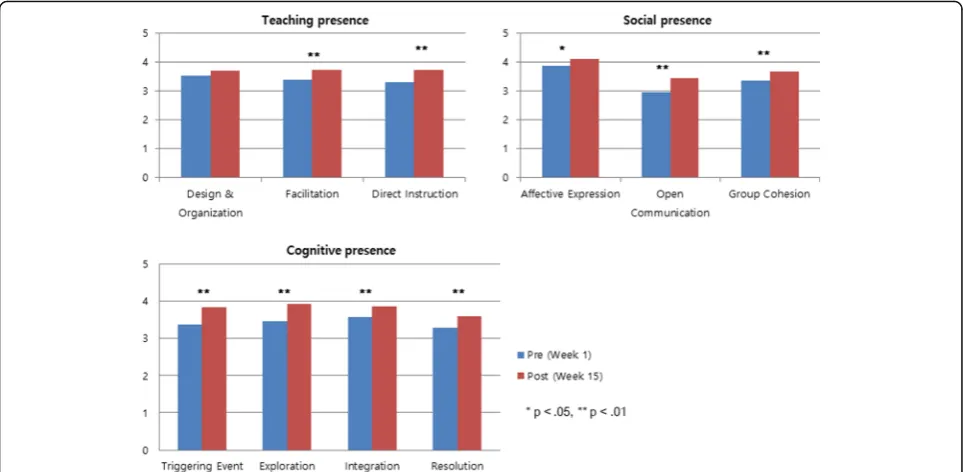
Figure 1 illustrates the changes in participant percep-tions of the community of inquiry in flipped classrooms in each sub-scale of three presences in the community of inquiry framework. The students’sense of community of inquiry increased significantly in nine out of 10 sub-scales of the three presences. No significant changes
Table 1Student perceptions of teaching orientation in flipped classroomsa
High achievers (n= 26) Low achievers (n= 29) Total (n= 55)
M (SD) t (p) M (SD) t (p) M (SD) t (p)
Pre Post Pre Post Pre Post
2.95 (.38) 3.64 (.57) 5.69 (<.001) 2.79 (.44) 3.26 (.50) 3.68 (<.001) 2.89 (.42) 3.43 (.56) 6.38 (<.001)
a
1 =“teacher-centered,”5 =“student-centered”
Table 2Student perceptions of the Community of Inquiry in flipped classrooms in the pre- and post-course surveysa(n= 55)
Sub-scales Pre-course survey Post-course survey Total
M (SD) t (p) M (SD) t (p) M (SD) t (p)
High performers Low performers High performers Low performers Pre Post
Teaching presence 3.51 (.57) 3.29 (.67) 1.32 (.19) 3.69 (.66) 3.76 (.47) .50 (.62) 3.39 (.63) 3.73 (.57) 3.70 (<.001)
Social presence 3.26 (.47) 3.41 (.62) .95 (.34) 3.61 (.69) 3.77 (.59) .92 (.36) 3.34 (.55) 3.70 (.64) 5.23 (<.001)
Cognitive presence 3.16 (.47) 3.12 (.57) .29 (.77) 3.78 (.61) 3.82 (.50) .21 (.84) 3.14 (.52) 3.80 (.55) 8.82 (<.001) a
were observed in student perceptions in the design and organization of instruction, which was a sub-scale of the teaching presence (t= 1.83,p= 0.07).
A within-group comparison of changes in student per-ceptions of community of inquiry in flipped classrooms observed in higher and lower performing groups is pro-vided in Table3. Significant changes were observed in both higher and lower performing students in terms of their sense of social and cognitive presences in flipped class-rooms (p< 0.01). No significant change in the sense of teaching presence was observed among higher performing students (t= 1.01, p= 0.32), but it increased significantly among lower performing students (t= 4.79,p< 0.001).
Discussion
This study shows that flipped classrooms promote student-centered learning and are conducive to develop-ing a sense of teachdevelop-ing, social, and cognitive presence in the learning environment. Moreover, student percep-tions of the learning environment in flipped classrooms changed more positively in both higher and lower
performing students. In particular, changes in the stu-dents’sense of teaching presence were more significant among the lower performing students than their higher performing peers. This finding suggests that flipped classrooms are more beneficial for lower performing stu-dents than higher performers in enhancing their sense of teaching presence. This finding is in line with that of other previous studies that the flipped classroom may benefit lower performing students than higher perform-ing students in medical and college courses [22,23].
This study had several limitations. First, this study was conducted of a relatively small sample, which may affect the generalizability of the study. Yet, it can be argued that the sample was fairly representative of demograph-ics of Korean medical students. Second, this was not an experimental study and a convenience sampling method was used; thus, a comparison of the student perceptions of flipped classrooms with conventional lectures was not available in this study. Therefore, this study does not give direct evidence as to how effective flipped class-rooms are in creating a community of inquiry compared
Fig. 1Changes in student perceived sense of Community of Inquiry in flipped classrooms (n= 55)§.§1 =“strongly disagree,”5 =“strongly agree”
Table 3Student perceptions of the Community of Inquiry in flipped classrooms in lower and higher performing groupsa
Sub-scales High-performers (n= 26) Low-performers (n= 29)
M (SD) t (p) M (SD) t (p)
Pre Post Pre Post
Teaching presence 3.51 (.57) 3.69 (.66) 1.01 (.32) 3.29 (.67) 3.76 (.47) 4.79 (<.001)
Social presence 3.26 (.47) 3.61 (.69) 3.43 (<.01) 3.41 (.62) 3.77 (.59) 3.89 (<.01)
Cognitive presence 3.16 (.47) 3.78 (.61) 6.21 (<.001) 3.12 (.57) 3.82 (.50) 6.27 (<.001)
a
to traditional lectures. Third, as various learning ap-proaches are viable for in-class and out-of-class activities in flipped classrooms, student experience and percep-tions of learning may differ across such learning activ-ities. Therefore, it needs to be taken into account to what extent the student learning experience with class-room debates implemented for in-class activities in this study affected their perceptions of the learning environ-ment compared to other in-class learning activities.
Although this study found student perceptions of the learning environment were enhanced when they experi-enced flipped classrooms, it did not explore what influ-enced these changes. Future study is warranted to analyze student perceptions by using more various sources of data, in particular using qualitative research methods, for better understanding of the factors that influenced their learning experiences. Such understanding of factors that influence students’ perceptions of teaching orientation and the development of sense of teaching, social, and cogni-tive presence will have implications for understanding design principles for flipped classrooms that promote a student-centered learning environment and develop sense of community of inquiry.
Conclusions
The flipped classroom model is an effective approach to fostering a learner-centered learning environment and to developing a community of inquiry among medical stu-dents. In particular, flipped classrooms appear to have a positive influence to a greater degree on low achievers.
Abbreviations
COI:Community of Inquiry; FC: Flipped Classrooms
Acknowledgements
A previous version of this study has been presented at the Korean Medical Education Conference in June 1, 2018, in Changwon, South Korea.
Funding
This study was supported by the Ministry of Education of the Republic of Korea and the National Research Foundation of Korea
(NRF-2015S1A5A8014050).
Availability of data and materials
Not applicable.
Authors’contributions
YHL contributed to the design of the study, data collection and interpretation. KJK designed the study, contributed to data analysis and interpretation and drafted the manuscript. Both authors read and approved the final manuscript.
Ethics approval and consent to participate
An ethical review was conducted and informed consent was exempted by the institutional review board of Dongguk University, Gyeongju (IRB approval number: DGU IRB 20170020).
Consent for publication
Not applicable.
Competing interests
The authors have no competing interests.
Publisher’s Note
Springer Nature remains neutral with regard to jurisdictional claims in published maps and institutional affiliations.
Author details
1Department of Medical Humanities, College of Medicine, Yeungnam
University, Daegu, South Korea.2Department of Medical Education, School of Medicine, Dongguk University, 32 Dongguk-ro, Ilsandong-gu, Goyang-si, Gyeonggi-do, Goyang 10326, South Korea.
Received: 26 July 2018 Accepted: 12 October 2018
References
1. Prober CG, Heath C. Lecture halls without lectures--a proposal for medical education. N Engl J Med. 2012;366(18):1657–9.https://doi.org/10.1056/ NEJMp1202451PubMed PMID: 22551125.
2. Prober CG, Khan S. Medical education reimagined: a call to action. Acad Med. 2013;88(10):1407–10.https://doi.org/10.1097/ACM.0b013e3182a368bd
PubMed PMID: 23969367.
3. Schwartzstein RM, Roberts DH. Saying goodbye to lectures in medical school - paradigm shift or passing fad? N Engl J Med. 2017;377(7):605–7.
https://doi.org/10.1056/NEJMp1706474PubMed PMID: 28813217. 4. Lage MJ, Platt GJ, Treglia M. Inverting the classroom: a gateway to creating
an inclusive learning environment. J of Econ Educ. 2000;31(1):30–43.https:// doi.org/10.2307/1183338PubMed PMID: WOS:000084204900007. 5. Bergmann J, Sams A. Before you flip, consider this. Phi Delta Kappan. 2012;
94(2):25 PubMed PMID: WOS:000309637000005.
6. O'Flaherty J, Phillips C. The use of flipped classrooms in higher education: a scoping review. Internet High Educ. 2015;25:85–95.https://doi.org/10.1016/j. iheduc.2015.02.002PubMed PMID: WOS:000351980800011.
7. McLaughlin JE, Roth MT, Glatt DM, Gharkholonarehe N, Davidson CA, Griffin LM, et al. The flipped classroom: a course redesign to foster learning and engagement in a health professions school. Acad Med. 2014;89(2):236–43.
https://doi.org/10.1097/ACM.0000000000000086PubMed PMID: 24270916. 8. Khanova J, Roth MT, Rodgers JE, McLaughlin JE. Student experiences across
multiple flipped courses in a single curriculum. Med Educ. 2015;49(10):1038– 48.https://doi.org/10.1111/medu.12807PubMed PMID: 26383075. 9. Khandelwal A, Nugus P, Elkoushy MA, Cruess RL, Cruess SR, Smilovitch M, et
al. How we made professionalism relevant to twenty-first century residents. Med Teach. 2015;37(6):538–42.https://doi.org/10.3109/0142159X.2014. 990878PubMed PMID: 25594336.
10. Sharma N, Lau CS, Doherty I, Harbutt D. How we flipped the medical classroom. Med Teach. 2015;37(4):327–30.https://doi.org/10.3109/0142159X. 2014.923821PubMed PMID: 24934251.
11. Kalaian SA, Kasim RM. Effectiveness of various innovative learning methods in health science classrooms: a meta-analysis. Adv Health Sci Educ Theory Pract. 2017;22(5):1151–67.https://doi.org/10.1007/s10459-017-9753-6
PubMed PMID: 28091976.
12. Hew KF, Lo CK. Flipped classroom improves student learning in health professions education: a meta-analysis. BMC Med Educ. 2018;18(1):38.
https://doi.org/10.1186/s12909-018-1144-zPubMed PMID: 29544495; PubMed Central PMCID: PMCPMC5855972.
13. Chen F, Lui AM, Martinelli SM. A systematic review of the effectiveness of flipped classrooms in medical education. Med Educ. 2017;51(6):585–97.
https://doi.org/10.1111/medu.13272PubMed PMID: 28488303. 14. Harden RM, Laidlaw JM. Be FAIR to students: four principles that lead to
more effective learning. Med Teach. 2013;35(1):27–31.https://doi.org/10. 3109/0142159X.2012.732717PubMed PMID: 23121246.
15. Collins J. Education techniques for lifelong learning: principles of adult learning. Radiographics. 2004;24(5):1483–9.https://doi.org/10.1148/rg. 245045020PubMed PMID: 15371622.
16. Cooke M, Irby DM, O'Brien BC. Educating physicians: a call for reform of medical school and residency. San Francisco, CA: Jossey-Bass; 2010. 17. Kim MK, Kim SM, Khera O, Getman J. The experience of three flipped
classrooms in an urban university: an exploration of design principles. Internet High Educ. 2014;22:37–50.https://doi.org/10.1016/j.iheduc.2014.04. 003PubMed PMID: WOS:000338413500004.
18. Garrison DR, Arbaugh JB. Researching the community of inquiry framework: review, issues, and future directions. Internet High Educ. 2007;10(3):157–72.
19. Garrison DR, Anderson T, Archer W. The first decade of the community of inquiry framework: a retrospective. Internet High Educ. 2010;13(1–2):5–9.
https://doi.org/10.1016/j.iheduc.2009.10.003PubMed PMID: WOS: 000275765500002.
20. Swan K, Richardson J, Ice P, Garrison DR, Cleveland-Innes M, Arbaugh JB. Validating a measurement tool of presence in online communities of inquiry. E-Mentor. 2008;2(24):1–12.
21. Yu T, Richardson JC. Examining reliability and validity of a Korean version of the Community of Inquiry instrument using exploratory and confirmatory factor analysis. Internet High Educ. 2015;25:45–52.https://doi.org/10.1016/j. iheduc.2014.12.004PubMed PMID: WOS:000351980800006.
22. Day LJ. A gross anatomy flipped classroom effects performance, retention, and higher-level thinking in lower performing students. Anat Sci Educ. 2018. Epub 2018/01/22.https://doi.org/10.1002/ase.1772PubMed PMID: 29356452. 23. Nouri J. The flipped classroom: for active, effective and increased learning
-especially for low achievers. Int J of EducTechnol in High Educ. 2016;13:33.