Priority Queueing with Multiple Packet
Characteristics
Pavel Chuprikov
St. Petersburg Academic University, St. Petersburg, Russia
Sergey Nikolenko
‡§ ‡National Research UniversityHigher School of Economics, St. Petersburg, Russia §Steklov Mathematical Institute
at St. Petersburg, Russia
Kirill Kogan
IMDEA Networks Institute, Madrid, Spain
Abstract—Modern network elements are increasingly required to deal with heterogeneous traffic. Recent works consider process-ing policies for buffers that hold packets with different processprocess-ing requirement (number of processing cycles needed before a packet can be transmitted out) but uniform value, aiming to maximize the throughput, i.e., the number of transmitted packets. Other developments deal with packets of varying value but uniform processing requirement (each packet requires one processing cycle); the objective here is to maximize the total transmitted value. In this work, we consider a more general problem, com-bining packets with both nonuniform processing and nonuniform values in the same queue. We study the properties of various processing orders in this setting. We show that in the general case natural processing policies have poor performance guarantees, with linear lower bounds on their competitive ratio. Moreover, we show an adversarial lower bound that holds for every online policy. On the positive side, in the special case when only two different values are allowed, 1andV, we present a policy that achieves competitive ratio 1 +WV+2, whereW is the maximal number of required processing cycles. We also consider copying costs during admission.
I. INTRODUCTION
Modern networks require implementation of advanced eco-nomic models that can be represented by desired objectives, network topology, buffering architecture, and its management policy. The current Internet architecture is mostly built for fairness, while consideration of other objectives such as net-work utilization, throughput, profit and others is required [23], [26]. For a given network topology and buffering architecture, design of management policies that optimize a desired objec-tive is extremely important; a management policy of a single network element includes admission control and scheduling policies. Admission control is one of the critical elements of management policy. Most admission control policies are based on a simple characteristic such as buffer occupancy, whereas traffic has additional important characteristics such as processing requirements or value that are either not taken into account at all or a separate queue is allocated per traffic type. Incorporation of new characteristics (e.g., required processing per packet) in admission decisions and implementation of additional objectives beyond fairness lead to new challenges in design and implementation of traditional network elements. In this work, we consider a single-queue switch where a
buffer of sizeBis shared among all types of traffic. We do not assume any specific traffic distribution but rather analyze our switching policies against adversarial traffic using competitive analysis [6], [28], which provides a uniform throughput guar-antee for online algorithms under all possible traffic patterns. An online algorithm ALG is α-competitive for some α≥1
if for any arrival sequence σ the total value transmitted by
ALG is at least 1/α times the total value transmitted in an optimal solution obtained by an offline clairvoyant algorithm (denoted OPT). Note that a lower bound on the competitive ratio can be proven with a specific hard example while an
upper bound represents a general statement that should hold over all possible inputs. In practice, the choices of processing order, implementation of push-out mechanisms etc. are likely to be made at design time. From this point of view, our study of worst-case behaviour aims to provide a robust estimate on the settings that can handle all possible loads.
cycles isW. In our main result, we present a policy based on a priority queue that achieves competitive ratio 1 + W+2
V
. Note that while it may appear suspicious to compare packet values with required processing, in fact we are comparing ratios of the most valuable (resp., heaviest) packet to the least valuable (resp., lightest) packet because the minimal required processing and minimal value are always set to 1. In Section VII, we consider the β-push-out case, which takes copying cost into account by introducing additional penalties for push-out. Section VIII presents simulation results where the proposed algorithms are evaluated with synthesized traces. Section IX concludes the paper.
II. MODELDESCRIPTION
We use a model similar to the one introduced in [1], [17] and subsequently used in [12]–[14], [20]–[22]. Consider a single queue of size B that handles the arrival of a sequence of unit-sized packets. A new part of the problem setting in this work is to combine two different characteristics of a packet. Namely, we assume that each arriving packet p is branded with: (1) the number of required processing cycles (work) w(p) ∈ {1, . . . , W} and (2) its processing value
v(p) ∈ {1, . . . , V}. These numbers are known for every
arriving packet; for a motivation of why required processing may be available see [29], and values are usually defined externally. Although the values of W and V will play a fundamental role in our analysis, our algorithms will not need to know W or V in advance. Note that for W = 1 the model degenerates into a single queue of uniform packets with nonuinform value, as considered in, e.g., [5], [30], while for V = 1 it becomes a single queue of unit-valued packets with different required processing, as considered, e.g., in [19]– [21]. We will denote a packet with required processingwand valuevby(w|v), and a sequence ofnpackets with the same parametersw andv by n×(w|v).
The queue performs three main tasks, namely: (1) buffer management, i.e., admission control of newly arrived packets; (2) processing, i.e., deciding which of the currently stored packets will be processed; (3) transmission, i.e., deciding if already processed packets should be transmitted and trans-mitting those that should. A packet is fully processed if the processing unit has scheduled the packet for processing for at least its required number of cycles.
We assume discrete slotted time, where each time slot con-sists of three phases (see Fig. 1 for an illustration): (i)arrival: new packets arrive, and admission control decides if a packet should be dropped or, possibly, an already admitted packet should be pushed out; (ii) processing: one packet is selected for processing by the scheduling unit; (iii) transmission: at most one fully processed packet is selected for transmission and leaves the queue. If a packet is dropped prior to being transmitted (while it still has a positive number of required processing cycles), it is lost. A packet may be dropped either upon arrival or due to a push-out decision while it is stored in the buffer. A packet contributes its value to the objective function only upon being successfully transmitted; note that
only one packet may be transmitted per time slot. The goal is to devise buffer management algorithms that maximize the overall throughput, i.e., the total value of all packets transmitted out of the queue.
For an algorithmALGand time slott, we denote byIBALGt
the set of packets stored inALG’s buffer at time slott after arrival but before processing (i.e., the buffer state shown in the second row of Fig. 1). For every time slot t and every packetpcurrently stored in the queue, its number ofresidual processing cycles, denotedwt(p), is defined to be the number of processing cycles it requires before it can be successfully transmitted, and its value, denoted v(p), is the number it contributes to the objective function upon transmission.
Three fundamental properties are often used in online algo-rithms. First, a policy is called greedy if it always accepts packets in the queue whenever it has free space. Greedy algorithms are usually amenable to efficient implementation and transmit everything if there is no congestion. Second, a policy is calledwork-conserving if it is always processing as long as it has packets with nonzero required processing in the buffer. Third, a policy is called push-out if it is allowed to drop packets that already reside in its queue; note that it does not make sense for a push-out policy to be non-greedy (it may be reasonable only with non-zero copying costs). In what follows, we will assume that all push-out policies are greedy and all policies are work-conserving.
III. RELATEDWORK
Rich literature has been devoted to special cases of our model where one characteristic is assumed to be uniform. In particular, admission control policies for the case of single-queued buffers where packets with uniform processing and varying intrinsic value arrive have been thoroughly studied. In the case of two values (1andV) and First-In-First-Out (FIFO) processing order, the works [5], [30] present a deterministic non-push-out policy with competitive ratio (2 − 1
V), i.e., bounded by a constant. For the more general case, when packet values vary between1andV, the works [5], [30] prove that the competitive ratio cannot be better thanΘ(logV). In [4], this upper bound was improved to2 + lnV +O(ln2V /B). In the push-out case with two packet values, the greedy policy was shown in [15] to be at least1.282 and at most2-competitive. Later, the upper bound on the greedy policy was improved to
1.894[16]; this work also considers the β-push-out case and proves that the greedy policy is at least 1.544-competitive. Policies with memory have been considered in [3], [7], [24].
competitive algorithms for management of bounded buffers. Initiated in [2], [15], [25], this line of research has received tremendous attention over the past decade. A survey by Goldwasser [10] provides an excellent overview of this field. Pruhs [27] provides a comprehensive overview of a related field of competitive online scheduling for server systems; however, scheduling for server systems usually concentrates on average response time and does not allow jobs to be dropped, while we focus mostly on throughput and allow push-out.
Another very interesting class of results in competitive analysis are adversarial lower bounds that hold over all al-gorithms. Such bounds, when they can be proven, indicate that one cannot hope to get an optimal online algorithm, and a clairvoyant offline algorithm will always be able to outperform it. One well-known example of such a bound is the lower bound of 43 on the competitive ratio of any algorithm in the model with multiple queues in a shared memory buffer and uniform packets (i.e., packets with identical value and required processing) [1], [11]. For the case of a single queue, previous works have considered two cases: variable value with uniform processing and variable processing with uniform values. In both cases, a single priority queue that sorts packets with respect to the variable characteristic (largest value and smallest required processing first, respectively) is optimal, so there can be no nontrivial general lower bound regardless of transmission order. In the FIFO model, for the case of variable values and uniform processing there has been a line of adversarial lower bounds culminating in the lower bound of 1.419 that applies to all algorithms [18], with a stronger bound of 1.434 for the special case when B = 2
if all possible values are admissible [5], [30]. In the two-valued case, tight bound are known: an adversarial lower bound of r = 12(√13−1) ≈ 1.303 for any B ≥ 2 and
r∞ =
√
2−1
2(
p
5 + 4√2−3)≈1.282 for B → ∞and an
online algorithm that achieves competitive ratiorfor arbitrary
B andr∞for B→ ∞[7]. In the case of variable processing
with uniform values, no general lower bounds for FIFO order are known apart from a simple lower bound of 12(k+ 1) for greedy non-push-out policies [21].
IV. ALGORITHMS ANDLOWERBOUNDS
Previous research indicates that priority queueswith push-out are the best tools that often lead to good competitive ratios. In particular, Keslassy et al. showed that a single priority queue with push-out is optimal for packets with varying required processing and unit value [12]. Therefore, our usual suspects are priority queues; in case of multiple characteristics, there can be different priority queues that sort packets in different orders. We introduce the following definition.
Definition 4.1:Letf be a function of packets,f(w, v)∈R, with the intuition that better packets have larger values of f. Then the PQf processing policy is defined as follows:
• PQf is greedy;
• PQf sorts and processes packets in its queue in the order of decreasing values of f;
• PQf pushes out a packetpand adds a new packetp0 to the queue at time slottif the buffer is full,pis currently the worst packet in the buffer and p0 is better than p:
f(p) = minq∈IBPQff(q), andf(p0)> f(p).
In other words,PQf sorts and processes packets according to the function f. In particular, we consider three specific priority queues (here wdenotes the current residual work): (1) PQ−w,v = PQ−w+v/(V+1)sorts packets in the increasing
order of their required processing, breaking ties by value; (2) PQv,−w= PQv−w/(W+1)sorts packets in the decreasing order of their value, breaking ties by required processing; (3) PQv/w sorts packets in the decreasing order of their value-to-work ratio, i.e., it prioritizes packets that yield the best value per one time slot of processing. Here we also have two possibilities for breaking ties,PQv/w,−w= PQv/w−w/(W2+1) and PQv/w,v = PQv/w+v/(W V+1), but in this case the tie-breakers will be irrelevant for all our statements, so we will unite them under the same notation. Fig. 1 shows a sample time slot of these priority queues; all policies start with (5|2),(4|3), and(1|1) in their queues,
B= 3, and a(6|3)packet arrives.PQ−w,vrejects the(6|3)
since it has the largest processing requirement,PQ−v,wpushes out(1|1)since it has the smallest value, andPQv/w pushes out(5|2) since it has the worstv/w ratio of2/5.
Our main result in this section is that priority queues fail to provide constant or even logarithmic competitiveness with two packet characteristics, as they do in simpler cases. We show linear (inV and/orW) lower bounds on the competitive ratio of all three PQ policies. This is an interesting and somewhat discouraging result since priority queues have proven to be efficient (often with constant upper bounds on the competitive ratio) in other contexts. For a lower bound, it suffices to present a hard sequence of packets on which the optimal algorithm outperforms the one in question; we show the first proof as an example but omit the others due to space constraints.
Theorem 1:For a buffer of sizeB, maximal packet required processing W, and maximal packet value V, PQ−w,v is at least V-competitive and at mostV-competitive.
Proof: First, there arrive B ×(1|1) (B packets with required processing 1 and value 1); PQ−w,v accepts them while OPTdoes not. Then there arrive B×(2|V) packets accepted byOPT;PQ−w,v skips them since they have larger required processing than already admitted. No more packets arrive, so in 2B steps PQ−w,v processes packets with total value B; OPT, with total value V B. The same sequence is repeated to get the asymptotic bound. The upper bound follows sincePQis optimal for uniform values and variable required processing; this means thatPQ−w,v processes as many packets as OPT, so it cannot lose by a factor of more thanV.
Theorem 2:For a buffer of sizeB, maximal packet required processing W, and maximal packet value V, PQv,−w is at
least (VV−1)W −o(1)-competitive.
Theorem 3:For a buffer of sizeB, maximal packet required processingW, and maximal packet valueV,PQv/wis at least
Fig. 1. A sample time slot ofPQ−w,v,PQv,−w, andPQv/w.
V. GENERAL LOWER BOUND
We have already mentioned related general lower bounds for online algorithms in Section III. It turns out that in our case, when both required processing and value are allowed to vary, it becomes possible again to prove an adversarial lower bound on all online policies. We first show it for general values and then consider the two-valued case (which in this case turns out to be a generalization).
Theorem 4:For a buffer of sizeB, maximal packet required processingW, and maximal packet valueV ≥2, every online algorithm ALGis at least 54−O(1/W)-competitive.
Proof: To show a lower bound, we present the cor-responding hard instance. On the first step, there arrive
B×(1|1) andB×(W |2). ALG is forced to choose how many packets of each kind it accepts. Denote the number of
(W |2)packets accepted byALGbyn. There are two cases.
• n< 35B : in this case, OPT chooses to accept B ×
(W |2), and no new packets arrive. AfterBW time slots,
OPT has processed packets with total value 2B, and
ALGhas processed at most(B−n)+2n. The competitive ratio thus becomes B2+Bn = 1+n/B2 ≥ 5
4 for
n B <
3 5.
• Bn ≥35 : in this case, OPT accepts B×(1|1). After B time slots,OPThas processed all of its packets with total value B, whileALG has not been able to process more than (B−n)×(1|1) (by assumption) and no more than B/W ×(W |2) (by the time constraint). At this point, B×(1|2) arrive and then no more packets; regardless of whether ALG accepts any of them, after all buffers have been emptiedOPTgets2B more value and ALG no more than 2B. The ratio is thus at least
B+2B
(B−n)+2B/W+2B =
3
3−n/B−O(1/W)≥
5
4−O(1/W)
for Bn ≥ 3 5.
In the two-valued case, the bound becomes worse; note that the bound depends on the minimal available packet value larger than1; it does not matter what values more thanV may be available.
Theorem 5:For a buffer of sizeB, maximal packet required processing W, and available packet values 1 and V > 1,
every online algorithmALGis at least 1 +VV−21−O
1
W
-competitive.
Proof:Similar to Theorem 4, on the first step there arrive
B×(1|1)andB×(W |V). Suppose that ALG has accepted
nof (W |2) packets. Again, there are two cases.
• n<VV2+2V−1−1B : in this case, OPT chooses to accept B×(W |V), and no new packets arrive. AfterBW time slots, OPThas processed packets with total value V B, andALGhas processed at most (B−n) +V n, yielding competitive ratio B−V Bn+V n = 1+(VV−1)n
B
≥ V2+V−1
V2 for n
B < V2−1
V2+V−15.
• n≥ V 2−1
V2+V−1B:in this case,OPTacceptsB×(1|1).
AfterB time slots, OPThas transmitted total value B, whileALGhas processed at most(B−n)×(1|1)and
B/W×(W |V). Now B×(1|V)arrive and then no more packets; after all buffers have been emptied OPT
gets V B more value and ALG at most V B, which gives us the ratio (B−n)+BV B/W+V B +V B = V+1V−+1n/B − O(1/W)≥V2+V−1
V2 −O(1/W)for n B ≥
V2−1 V2+V−1. In the next section, we look at the case of two possible values, 1 and V, in more detail. In the main result of this work, we show that in this special case some priority queues do admit an interesting upper bound on their competitive ratio.
VI. UPPER BOUND FOR THE TWO-VALUED CASE
Theorem 6 provides matching tight lower bounds for the main result that follows; again, proofs of lower bounds are omitted due to lack of space.
Theorem 6: Consider a buffer of size B with maximal required processing W and possible packet values 1 or V. Then:
(1) PQ−w,v is at leastV-competitive;
(2) if W ≥V thenPQv/w is at leastV-competitive; (3) PQv,−w is at least WV +o(1)
-competitive.
In the next theorem, we show the main result of this work, an upper bound on the competitive ratio of PQv,−w.
Theorem 7: Consider a buffer of size B with maximal required processing W and possible packet values 1 or V. ThenPQv,−w is at most 1 +W+2
V
-competitive.
Proof:By the definition of thePQv,−wqueue, any packet with valueV pushes out any packet with value 1. This is the crucial property that we need to prove this upper bound. For brevity, throughout this proof we denote PQ = PQv,−w. We define the following sets of packets:
(1) IBALGv ={p∈ IB
ALG
: value(p) =v} contains packets
with valuev inIBALG;
(2) TransALGv = {ptransmitted by ALG : value(p) = v}
is the set of packets with value v transmitted by ALG;
TransALG =S
vTrans
ALG
v ; (3) IBTALGv = IB
ALG
v ∪Trans
ALG
v is the set of packets with value v either already transmitted by ALG or currently residing in its buffer;IBTALGv =S
vIBT
ALG
v . We also defineΦALG
v (l) = Pl
i=1w(pi), wherepi is theith packet from IBTALGv inPQorder. Herew(p)is the residual processing time of a packet at the current time moment; in particular, we let w(p) = 0 for already transmitted packets.
In the proof, we will sometimes let OPTtransmit certain packets immediately, “for free”, thus improving its throughput. These packets do not fall intoTransOPT but comprise a sep-arate setFree(OPT). Throughout the proof, we will preserve the property that ∀p ∈ Free(OPT) value(p) = 1, i.e., we only give out packets of value 1 for free. We begin with a technical statement (proof omitted due to space constraints).
Lemma 8: Let a1, a2, . . . , am and b1, b2, . . . , bm be two sequences of numbers in nondecreasing order, and, moreover, suppose that∀l∈ {1, . . . , m}Pli=1ai≥
Pl
i=1bi. Let alsoa∗
andb∗ be any two numbers, such thata∗≥b∗. Consider two
sequences: a01, a02, . . . , a0m+1 andb01, b02, . . . , b0m+1, that result after insertion of a∗ and b∗ into a1, . . . , am and b1, . . . , bm respectively (nondecreasing order preserved). Then we have, that ∀l∈ {1, . . . , m+ 1} Pli=1a0i ≥Pli=1b0i.
We now prove the crucial lemma of this upper bound.
Lemma 9: There exists an algorithm OPT that works no worse than the optimal algorithm on any sequence of inputs for which on every sequence of inputs at every time moment it holds that:
(1) for all l∈ {1, . . . ,|IBTOPT1 |}Φ1OPT(l)≥ΦPQ1 (l); (2) for all l∈ {1, . . . ,|IBTOPTV |}ΦOPTV (l)≥Φ
PQ
V (l);
(3) |Free(OPT)| ≤(W + 2)|TransV(PQ)|.
Proof: We prove these estimates by induction on the number of “events” such as receiving, processing, or transmit-ting a packet. At the initial time moment all conditions hold trivially. Note that whenever conditions (1) and (2) hold, it also necessarily holds that|Transv(OPT)| ≤ |Transv(PQ)| since ΦOPT
v (l) = 0 for all l < |Transv(OPT)| and
con-sequently ΦPQ
v (l) = 0; moreover, |IBT
OPT
v | ≤ |IBT
PQ
v | since Φv must be defined. We now remove from IBTPQv the (|IBTPQv | − |IBTOPTv |)packets with the highest priority, denoting the resulting set by IBTg
PQ
v and the corresponding set of packets in the buffer by IBf
PQ
. Then all of the above implies that|IBOPTv | ≥ |IBf
PQ
v |.
Upon acceptance we may mark a packet admitted toOPT
buffer as “causing overflow”. The set of such packets is denoted as overflow(OPT), and it does not contribute to
IBTOPT. The induction step will guarantee that every packet
inoverflow(OPT)is moved eventually toFree(OPT)and the
following invariant holds:
|overflow(OPT)| ≤ |IBPQV | − |IBf
PQ
V |.
Let us now consider all possible events one by one and show that none of them violates the conditions of the theorem.
Arrival of a new packet p. There are two subcases.
value(p) =V. If PQhas accepted the packet and has pushed out a packet from IBPQ1 , we move the largest packet fromIBOPT1 (if it is nonempty) toFree(OPT). Thus, inequalities for Φ1 are not violated since we
have removed largest elements from both IBOPT1 and
IBPQ1 . Further, ifOPTacceptsp, thenB >|IBOPTV | ≥ |IBf
PQ
V |, so the sequenceIBT
PQ
V will receive the small-est of packets(IBPQV \IBf
PQ
V )∪ {p}(according to the push-out rules). Therefore, by Lemma 8 inequalities for
ΦV still hold. Note, that(|IBPQV |−|IBf
PQ
V |)could only increase.
value(p) =1. We consider two subcases separately.
(i) |IBPQV |+|IBf
PQ
1 |<B. In this case, we add to
f
IBPQ1 the smallest packet from(IBPQ1 \IBf
PQ 1 )∪ {p}
(according to push-out rules), and by Lemma 8 the
inequalities are preserved. (ii)|IBPQV |+|IBf
PQ
1 |=B.
Then, since |IBOPT| ≥ |IBf
PQ
| and |IBOPT| +
|overflow(OPT)|< B, we get that|IBPQV |−|IBf
PQ
V |>
|overflow(OPT)|. Now, if OPT accepts p then p is
added to theoverflow(OPT).
Processing of packetpby OPT. In this case, there are three subcases.
value(p) =V. This is a simple case. IfIBPQV 6=∅then each nonzero term inΦPQV (l)reduces exactly by one, while each nonzero term in ΦOPT
V (l) reduces by at most one, so the inequalities are obviously preserved. If otherwiseIBPQV =∅ then allΦPQV = 0.
value(p) =1andIBVPQv/w6=∅. In this case, the packet p being processed is sent to Free(OPT). It remains to show that in this case ΦOPT
1 (l) do not
decrease since we have merely removed an element from an ordered sequence.
Transmitting a packet. Inequalities on Φ obviously remain unchanged upon transmission. However, during
transmis-sion the value (|IBPQV | − |IBf
PQ
V |)may decrease by one. In order to preserve the invariant onoverflow(OPT), we move an arbitrary packet from overflow(OPT) (if it is nonempty) toFree(OPT).
To see the last statement of the lemma, it suffices to note that a packet may fall into Free(OPT) only when PQ receives, processes, or transmits a packet with valueV.
Now, after bothOPTandPQhave processed the entire se-quence of packets, the total value of packets transmitted byPQ
equals|IBTPQ1 |+V|IBTPQV |. The total value of packets trans-mitted by OPT is |IBTOPT1 |+V|IBTOPTV |+|Free(OPT)|. Thus,
α= |IBT
OPT
1 |+V|IBT OPT
V |+|Free(OPT)|
|IBTPQ1 |+V|IBTPQV |
≤1 + |Free(OPT)|
|IBTPQ1 |+V|IBTPQV | ≤1 +
|Free(OPT)|
V|IBTPQV | ≤1 +(W + 2)|IBT
PQ
V |
V|IBTPQV | ≤1 +
W + 2
V .
Corollary 10: IfW < V,PQv,−wandPQv/w are at most
2 + V2-competitive.
Proof: Since (W |V) pushes out (1|1) in the PQv/w queue, any packet with value V pushes out any packet with value 1, so forW < V PQv/w is equivalent toPQv,−w.
VII. THEβ-PUSH-OUT CASE
In some systems it is important to control the number of pushed out packets, for at least two reasons: each admitted packet incurs somecopying costα, and pushing a packet out is not a simple operation. The addition of a copying costαcovers both cases. As a result, [12] introduced the notion of copying cost in the performance of transmission algorithms for packets with heterogeneous processing requirements but uniform val-ues: if an algorithm accepts A packets and transmits packets with total value T, its transmitted value ismax(0, T −αA). Thus, in extreme cases, the transmitted value of a push-out policy may even go down to zero, and copying cost provides an additional control on the number of pushed out packets. To implement such a control mechanism, Keslassy et al. [12] introduced the greedy push-out work-conserving policyP Qβ that processes a packet with minimal required work first and in the case of congestion such a policy pushes out only if a new arrival has at leastβtimes less work then the maximal residual work inPQβ. In our context, we extendPQf toPQβf and then show several lower bounds for β-push-out counterparts of our
policies. Unfortunately, the proof of Theorem 7 does not go through forβ-push-out policies; it remains an open problem to show nontrivial (less than linear) upper bounds forβ-push-out policies with two packet characteristics.
Definition 7.1:Letf be a function of packets,f(w, v)∈R, with better packets corresponding to larger values of f. The
PQβf processing policy forβ >1is defined asPQf with the following difference:PQβf can push out a packetpand add a new packetp0 to the queue at time slott ifpis currently the worst packet in the buffer andp0 is better thanpat least by a factor of β:f(p) = minq∈IBPQf f(q), andf(p0)> βf(p).
Theorem 11: Consider a buffer of size B with maximal required processingW and maximal packet valueV. Then: (1) PQβ−w,v is at least V-competitive in both in the case of
arbitrary packet values and in the two-valued case; (2) PQβv/w is at least min(V, W)-competitive in the case of
arbitrary packet values;
(3) in the two-valued case, ifβW ≥V thenPQβv/wis at least
V-competitive;
(4) PQβv,−w is at least(VV−1)W −o(1)-competitive in the case of arbitrary packet values and at least WV +o(1) -competitive in the two-valued case.
Proof: (1) In the construction from Theorem 1, packets are never pushed out fromPQ−w,v buffer, so the result still holds for PQβ−w,v. (2) Construction from Theorem 3 also works because packets are never pushed out from PQv/w
buffer in tnis construction. (3) This result can be seen as a relaxation of the second part of Theorem 6 since β > 1. The same construction works: PQv/w fills its buffer with
B×(1|1)and then drops incomingB×(W |V).PQβv/walso drops them since WV ≤ βV
V =β. (4) Again, the constructions from Theorem 2 and Theorem 6 work since they do not force packets to be pushed out fromPQ−v,w buffer.
VIII. SIMULATIONS
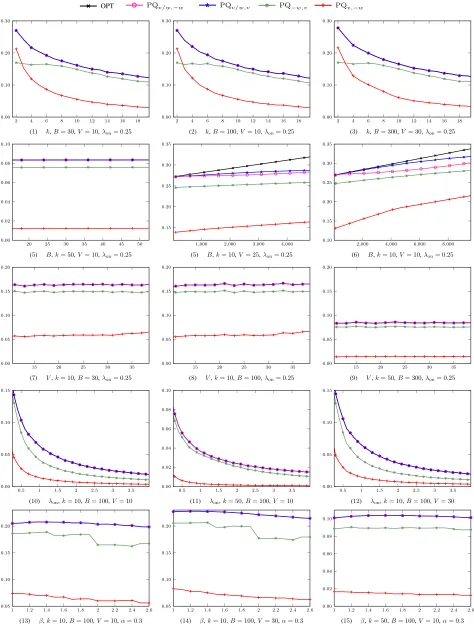
In this section, we present the results of a comprehensive simulation study intended to validate our theoretical results. Naturally, it would be desirable to compare the proposed algorithms on real life network traces. Unfortunately, available datasets such as CAIDA [9] are of little use for our model. They cannot provide information on required processing and time scale (i.e., which packets go in the same time slot) since this information is heavily dependent on a specific network processor. Therefore, in our experiments we have used synthetic traces.
We have conducted five series of experiments on syn-thetic traces, studying how performance depends on max-imal required processing k, buffer size B, maximal value
V, intensity λon, and β (in the model with copying cost).
been proven optimal in the single queue model, so in our model, where some queues may be congested and others idle, it performs even better than optimal. In our experiments, synthetic traffic was generated by 500 independent sources, where each source was a Markov-modulated Poisson process (MMPP) with packet rate λon in the “on” state and 0 in
the “off” state; the probability of switching the state from “off” to “on” was0.02(a source switches on with probability
1/50 on each tick), and the probability of switching from “on” to “off” was set to 0.2. The values and processing ratios of packets were chosen uniformly from{1, . . . , k}and
{1, . . . , V} respectively. We ran all experiments for 5·105
time slots with periodic “flushouts” (wait for all queues to finish their packets and then continue from an empty state), which in our experiments has proven to be sufficient for stable results. We have also performed simulations without flushouts; since the results are very close to the ones with flushouts in all settings, we do not show them separately. Note that all of our experiments venture into the values of parameters that yield high system load with large dropout rates for all algorithms; these are precisely the situations where we would like to compare performance since without heavy load and frequent congestion all reasonable algorithms perform identically.
As the OPT algorithm, we used a single priority queue of size B that holds all packets regardless of their queue and makes n processing steps per time slot; this algorithm is obviously better than the optimal algorithm in our model.
Figure 2 shows simulation results presented in terms of the fraction of successfully transmitted packets: each graph shows the “better than optimal” reference algorithm in black alongside with the ratio of transmitted packets for other poli-cies. There are five sets of experiments corresponding to the rows of Fig. 2 that will be described in subsections below; we have tested the four algorithms used in this work: PQv/w,−w,
PQv/w,v,PQ−w,v, andPQv,−w. Note that in all cases, OPT,
PQv/w,−w, and PQv/w,v are virtually indistiguishable: the competitive ratio of both PQv/w,−wandPQv/w,v was below
1.01 (that is, they stayed within one percent of OPT) across all settings we have tried in the experiments except at very large buffer sizes.
A. Maximal required processing
In the first set of simulations (Fig. 2(1-3)), we study perfor-mance as a function of the maximal required processingk. As
k grows, all algorithms deteriorate (packets become heavier), but it is clear that PQ−w,v, which pays more attention to required processing, fares better and becomes closer to OPT while PQv,−w loses badly. We see that PQv/w is uniformly the best policy, virtually indistinguishable from OPT.
B. Buffer size B
In the second set of simulations (Fig. 2(4-6)), we study performance as a function of the buffer size B. For relatively small sized buffers, PQv/w,−w and PQv/w,v remain indis-tinguishable. However, as B grows larger, PQv/w,v stars to overcome PQv/w,−w, and for very large buffers, especially
for low values ofV, the difference becomes significant; also, both ratio-based priority queues start to lose somewhat to the fractional OPT algorithm. Thus, for large buffers we recommendPQv/w,v.
C. Maximal valueV
In the third set of experiments (Fig. 2(7-9)), we look at performance as a function of the maximal value V. It turns out that the performance level of all our algorithms does not significantly depend on V in realistic cases; there is only a slight improvement in performance asV increases, noticeable only forPQv,−w, as expected sincePQv,−wemphasizes value over required processing. The relative order of algorithms remains unchanged.
D. Incoming stream intensity
The fourth set of experiments (Fig. 2(10-12)) shows how performance depends on the intensity λon of switched on
incoming packet sources. Here, we see that all algorithms, including OPT, show approximately the same rate of decline under higher and higher input intensities, and their relative standings remain the same across all intensities.
E. β forβ-push-out policies
The last, fifth set of experiments (Fig. 2(13-15)) studies a different situation; here, we have introduced nonzero copying cost α (on all three graphs, α= 0.3) and have studied how performance depends onβfor β-push-out counterparts of our policies (as introduced in Section VII); since the number of admitted packets is not well defined for our fractional OPT, OPT did not participate in these experiments. On the graphs for
PQv/w, we see that in each case, performance is maximized at some β∗ >1; in these three cases, β∗ ∈ [1.2,1.5]. Thus,
β-push-out policies indeed provide an improved alternative for regular policies in the model with copying cost.
To summarize, in this section we have shown a comprehen-sive simulations study on synthetic traces. The main result is that the PQv/w policy that we have introduced in this work is uniformly the best policy across all tested settings. Another interesting result is that β-push-out policies do have an advantage (albeit slight) in settings with nonzero copying cost.
IX. CONCLUSION
In this work, we have considered a single queue pro-cessing packets with two different characteristics: propro-cessing requirement and value. We have investigated various packet processing orders and found that they have linear lower bounds on the competitive ratio, which makes them unattractive. However, we have provided positive results in the special case of two different values, 1 andV. Namely, we have shown a
(1+(W+2)/V)upper bound for a priority queuePQv,−wthat sorts packets first by value and then by required processing.
For W < V, this also becomes a constant upper bound on
General case Two-valued case
Processing policy Lower bound Lower bound Upper bound
Any 5/4 1 +VV−12 −O
1
W PQ−w,v,PQ
β
−w,v V V V
PQv,−w,PQ β v,−w
(V−1)
V W−o(1)
W
V +o(1) 1 + W+2
V PQv/w,PQ
β
v/w,βW≥V V V
PQv/w,W < V W WV +o(1) 2 +
2
V
TABLE I
RESULTS SUMMARY:LOWER AND UPPER BOUNDS.
introduced a general lower bound of5/4(in case when value
2 is available) that holds for all online policies; this lower bound distinguishes the model considered in this work from previously studied models with uniform processing or uniform values, where certain online policies have been proven to be optimal. Results of this work are summarized in Table I; note that all algorithms in the table employ push-out and use different heuristics for it.
For the two-valued case, we have proven tightly matching lower and upper bounds on the competitive ratio (they differ by1+o(1)). It still remains a very interesting open problem to prove upper bounds for the general case of multiple possible values, and another interesting problem would be to prove upper bounds for β-push-out policies. However, the really crucial question here is whether it is possible to devise a processing policy with better than linear competitive ratio for the general case of two characteristics. We suggest this problem for further study.
Acknowledgements: This work was partially supported by the Government of the Russian Federation (grant 14.Z50.31.0030).
REFERENCES
[1] William Aiello, Alexander Kesselman, and Yishay Mansour. Competi-tive buffer management for shared-memory switches.ACM Transactions on Algorithms, 5(1), 2008.
[2] William Aiello, Yishay Mansour, S. Rajagopolan, and Adi Ros´en. Competitive queue policies for differentiated services. InINFOCOM, pages 431–440, 2000.
[3] Nir Andelman. Randomized queue management for diffserv. InSPAA, pages 1–10, 2005.
[4] Nir Andelman and Yishay Mansour. Competitive management of non-preemptive queues with multiple values. InDISC, pages 166–180, 2003. [5] Nir Andelman, Yishay Mansour, and An Zhu. Competitive queueing
policies for QoS switches. InSODA, pages 761–770, 2003.
[6] Allan Borodin and Ran El-Yaniv.Online Computation and Competitive Analysis. Cambridge University Press, 1998.
[7] Matthias Englert and Matthias Westermann. Lower and upper bounds on FIFO buffer management in QoS switches.Algorithmica, 53(4):523– 548, 2009.
[8] Patrick Th. Eugster, Kirill Kogan, Sergey I. Nikolenko, and Alexander Sirotkin. Shared memory buffer management for heterogeneous packet processing. In IEEE 34th International Conference on Distributed Computing Systems, ICDCS 2014, Madrid, Spain, June 30 - July 3, 2014, pages 471–480, 2014.
[9] CAIDA The Cooperative Association for Internet Data Analysis. [On-line] http://www.caida.org/.
[10] Michael Goldwasser. A survey of buffer management policies for packet switches.SIGACT News, 41(1):100–128, 2010.
[11] Ellen L. Hahne, Alexander Kesselman, and Yishay Mansour. Compet-itive buffer management for shared-memory switches. InSPAA, pages 53–58, 2001.
[12] Isaac Keslassy, Kirill Kogan, Gabriel Scalosub, and Michael Segal. Providing performance guarantees in multipass network processors. IEEE/ACM Trans. Netw., 20(6):1895–1909, 2012.
[13] Alexander Kesselman, Kirill Kogan, and Michael Segal. Improved competitive performance bounds for CIOQ switches. In ESA, pages 577–588, 2008.
[14] Alexander Kesselman, Kirill Kogan, and Michael Segal. Packet mode and QoS algorithms for buffered crossbar switches with FIFO queuing. Distributed Computing, 23(3):163–175, 2010.
[15] Alexander Kesselman, Zvi Lotker, Yishay Mansour, Boaz Patt-Shamir, Baruch Schieber, and Maxim Sviridenko. Buffer overflow management in QoS switches. SIAM Journal on Computing, 33(3):563–583, 2004. [16] Alexander Kesselman and Yishay Mansour. Loss-bounded analysis for
differentiated services. J. Algorithms, 46(1):79–95, 2003.
[17] Alexander Kesselman and Yishay Mansour. Harmonic buffer manage-ment policy for shared memory switches. Theor. Comput. Sci., 324(2-3):161–182, 2004.
[18] Alexander Kesselman, Yishay Mansour, and Rob van Stee. Improved competitive guarantees for QoS buffering.Algorithmica, 43(1-2):63–80, 2005.
[19] Kirill Kogan, Alejandro L´opez-Ortiz, Sergey I. Nikolenko, Gabriel Scalosub, and Michael Segal. Balancing work and size with bounded buffers. InSixth International Conference on Communication Systems and Networks, COMSNETS 2014, Bangalore, India, January 6-10, 2014, pages 1–8, 2014.
[20] Kirill Kogan, Alejandro L´opez-Ortiz, Sergey I. Nikolenko, and Alexan-der Sirotkin. Multi-queued network processors for packets with hetero-geneous processing requirements. InProceedings of the5thInternational
Conference on Communication Systems and Networks (COMSNETS 2013), pages 1–10, 2013.
[21] Kirill Kogan, Alejandro L´opez-Ortiz, Sergey I. Nikolenko, and Alexan-der V. Sirotkin. A taxonomy of semi-FIFO policies. InProceedings of the31stIEEE International Performance Computing and
Communica-tions Conference (IPCCC 2012), pages 295–304, 2012.
[22] Kirill Kogan, Alejandro L´opez-Ortiz, Sergey I. Nikolenko, Alexander V. Sirotkin, and Denis Tugaryov. FIFO queueing policies for packets with heterogeneous processing. In Proceedings of the 1st Mediterranean
Conference on Algorithms (MedAlg 2012), Lecture Notes in Computer Science, volume 7659, pages 248–260, 2012. arXiv:1204.5443 [cs.NI]. [23] Hongqiang Harry Liu, Xin Wu, Ming Zhang, Lihua Yuan, Roger Wat-tenhofer, and David A. Maltz. zupdate: updating data center networks with zero loss. InSIGCOMM, pages 411–422, 2013.
[24] Zvi Lotker and Boaz Patt-Shamir. Nearly optimal FIFO buffer man-agement for two packet classes. Computer Networks, 42(4):481–492, 2003.
[25] Yishay Mansour, Boaz Patt-Shamir, and Ofer Lapid. Optimal smoothing schedules for real-time streams. Distributed Computing, 17(1):77–89, 2004.
[26] George Porter, Richard D. Strong, Nathan Farrington, Alex Forencich, Pang-Chen Sun, Tajana Rosing, Yeshaiahu Fainman, George Papen, and Amin Vahdat. Integrating microsecond circuit switching into the data center. InSIGCOMM, pages 447–458, 2013.
[27] Kirk Pruhs. Competitive online scheduling for server systems. SIG-METRICS Performance Evaluation Review, 34(4):52–58, 2007. [28] Daniel Dominic Sleator and Robert Endre Tarjan. Amortized efficiency
of list update and paging rules.Communications of the ACM, 28(2):202– 208, 1985.
[29] Tilman Wolf, Prashanth Pappu, and Mark A. Franklin. Predictive scheduling of network processors. Computer Networks, 41(5):601–621, 2003.
OPT PQv/w,−w PQv/w,v PQ−w,v PQv,−w
2 4 6 8 10 12 14 16 18 0.00
0.10 0.20 0.30
(1) k,B= 30,V= 10,λon= 0.25
2 4 6 8 10 12 14 16 18 0.00
0.10 0.20 0.30
(2) k,B= 100,V= 10,λon= 0.25
2 4 6 8 10 12 14 16 18 0.00
0.10 0.20 0.30
(3) k,B= 300,V= 30,λon= 0.25
20 25 30 35 40 45 50 0.00
0.02 0.04 0.06 0.08 0.10
(5) B,k= 50,V= 10,λon= 0.25
1,000 2,000 3,000 4,000 0.15
0.20 0.25 0.30 0.35
(5) B,k= 10,V= 25,λon= 0.25
2,000 4,000 6,000 8,000 0.10
0.15 0.20 0.25 0.30 0.35
(6) B,k= 10,V= 10,λon= 0.25
15 20 25 30 35 0.00
0.05 0.10 0.15 0.20
(7) V,k= 10,B= 30,λon= 0.25
15 20 25 30 35 0.00
0.05 0.10 0.15 0.20
(8) V,k= 10,B= 100,λon= 0.25
15 20 25 30 35 0.00
0.05 0.10 0.15 0.20
(9) V,k= 50,B= 300,λon= 0.25
0.5 1 1.5 2 2.5 3 3.5 0.00
0.05 0.10 0.15
(10) λon,k= 10,B= 100,V= 10
0.5 1 1.5 2 2.5 3 3.5 0.00
0.02 0.04 0.06 0.08 0.10
(11) λon,k= 50,B= 100,V= 10
0.5 1 1.5 2 2.5 3 3.5 0.00
0.05 0.10 0.15
(12) λon,k= 10,B= 100,V= 30
1 1.2 1.4 1.6 1.8 2 2.2 2.4 2.6 0.05
0.10 0.15 0.20
(13) β,k= 10,B= 100,V= 10,α= 0.3
1 1.2 1.4 1.6 1.8 2 2.2 2.4 2.6 0.05
0.10 0.15 0.20
(14) β,k= 10,B= 100,V= 30,α= 0.3
1 1.2 1.4 1.6 1.8 2 2.2 2.4 2.6 0.00
0.02 0.04 0.06 0.08 0.10
(15) β,k= 50,B= 100,V= 10,α= 0.3