
Failure Detectors in Homonymous Distributed Systems
(with an Application to Consensus)
Sergio Ar´evaloa, Antonio Fern´andez Antab, Damien Imbsc, Ernesto Jim´eneza, Michel Raynald aEUI, Universidad Polit´ecnica de Madrid, 28031 Madrid, Spain
bInstitute IMDEA Networks, 28918 Madrid, Spain cInstituto de Matem´aticas, UNAM, D.F. 04510, M´exico
dInstitut Universitaire de France and IRISA, Universit´e de Rennes I, Campus de Beaulieu, 35042 Rennes, France
Abstract
This paper is on homonymous distributed systems where processes are prone to crash failures and have no initial knowledge of the system membership (“homonymous” means that several processes may have the same identifier). New classes of failure detectors suited to these systems are first defined. Among them, the classesHΩandHΣare introduced that are the homonymous counterparts of the classesΩandΣ, respectively. (Recall that the pairhΩ,Σi defines the weakest failure detector to solve consensus.) Then, the paper shows howHΩandHΣcan be implemented in homonymous systems without membership knowledge (under different synchrony requirements). Finally, two algorithms are presented that use these failure detectors to solve consensus in homonymous asynchronous systems where there is no initial knowledge of the membership. One algorithm solves consensus withhHΩ, HΣi, while the other uses onlyHΩ, but needs a majority of correct processes.
Observe that the systems with unique identifiers and anonymous systems are extreme cases of homonymous sys-tems from which follows that all these results also apply to these syssys-tems. Interestingly, the new failure detector classHΩcan be implemented with partial synchrony1, while the analogous classAΩdefined for anonymous systems
can not be implemented (even in synchronous systems). Hence, the paper provides the first consensus algorithm for anonymous systems with this model of partial synchrony and a majority of correct processes.
Keywords: Agreement problem, Asynchrony, Consensus, Distributed computability, Failure detector, Homonymous systems, Message-passing, Process crash
1. Introduction
Homonymous systems Distributed computing is on mastering uncertainty created by adversaries. The first adversary is of course the fact that the processes are geographically distributed which makes impossible to instantaneously obtain
Email addresses:[email protected](Sergio Ar´evalo),[email protected](Antonio Fern´andez Anta), [email protected](Damien Imbs),[email protected](Ernesto Jim´enez),[email protected](Michel Raynal)
a global state of the system. An adversary can be static (e.g., synchrony or anonymity) or dynamic (e.g., asynchrony, mobility, etc.). The net effect of asynchrony and failures is the most studied pair of adversaries.
This paper is on agreement in crash-prone message-passing distributed systems. While this topic has been deeply investigated in the past in the context of asynchrony and process failures (e.g., [18, 20]), we additionally consider here that several processes can have the same identity, i.e., the additional static adversary that ishomonymy. Systems that work well in the presence of homonymy can be useful in a number of practical situations. For instance, they can tolerate misconfigurations of the processes that result in multiple processes with the same id. Moreover, homonymy can be included in the system design, for instance simply using a default identifier in all processes (which leads to an anonymous system) or using independently randomly generated values as processes id (so that the same id can be chosen by more than one process). In large systems (like peer-to-peer), avoiding the burden of guaranteeing unique identifiers may compensate the cost of dealing with homonymy. One more application example is provided in [14] where users keep their privacy by taking their domain as their identifier (the same identifier is then assigned to all the users of the same domain).
Observe that homonymy is a generalization of two cases: (1) having unique identifiers and (2) having the same identifier for all the processes (anonymity), which are the two extremes of homonymy. However, most algorithms proposed for classical systems with unique identifiers do not work correctly in the presence of id collisions. On the other hand, it has been shown [14, 7] that systems with enough different process identifiers may solve more problems or may have better performance than anonymous systems (where implicitly all identifiers are the same).
We also assume that the distributed system has to face another static adversary, which is the fact that, initially, each process only knows its own identity. This is what is meant by saying that the system has to workwithout initial knowledge of the membership. This static adversary has been recently identified as of significant relevance in certain distributed contexts [17].
How to face adversaries It is well-known that lots of problems cannot be solved in presence of some adversaries (e.g., [1, 2, 15, 21]). When considering process crash failures, thefailure detectorapproach introduced in [9, 10] (see [19] for an introductory presentation) has proved to be very attractive. It allows to enrich an otherwise too poor distributed system to solve a given problemP, in order to obtain a more powerful system in whichPcan be solved.
Aim of the paper Agreement problems are central as soon as one wants to capture the essence of distributed computing. (If processes do not have to agree in one way or another, the problem we have to solve is not a distributed computing problem!) The aim of this paper is consequently to understand the type of information on failures that is needed when one has to solve an agreement problem in presence of asynchrony, process crashes, homonymy, and lack of initial knowledge of the membership. As consensus is the most central agreement problem we focus on it.
Related work As far as we know, consensus in anonymous networks has been addressed first in [5, 13] ([13] considers different synchrony assumptions while [5] considers systems enriched with failure detectors). Connectivity requirements for agreement in anonymous networks is addressed in [16].
To the best of our knowledge, up to now agreement in homonymous systems has been addressed only in [14] and [7]. In the former paper the authors consider that, among thenprocesses, up to tof them can commit Byzantine failures. The system is homonymous in the sense that there are`,1≤`≤n, different authenticated identities, each process has one identity, and several processes can share the same identity. It is shown in that paper that` >3tand` >
3t+n
2 are necessary and sufficient conditions for solving consensus in synchronous systems and partially synchronous
systems, respectively. The latter paper [7] mainly explores consensus in a shared memory system with anonymous processes, and bounds the complexity (namely, individual write and step complexities) of solving consensus with the aid of an anonymous leader electorAΩ(see below). They show that if the system is homonymous instead of purely anonymous these bounds can be improved.
The consensus problem in anonymous asynchronous crash-prone message-passing systems has been recently addressed in [5] (for the first time to our knowledge). In such systems, processes have no identity at all1. This paper
introduces an anonymous counterpart2(denotedAP later in [6]) of the perfect failure detectorP introduced in [10].
A failure detector of classAP returns an upper bound (that eventually becomes tight) of the current number of alive processes. The paper then shows that there is an inherent price associated with anonymous consensus, namely, while the lower bound on the number of rounds in a non-anonymous system enriched withPist+1(wheretis the maximum number of faulty processes), it is2t+ 1in an anonymous system enriched withAP. The algorithm proposed assumes knowledge of the parametert.
More general failure detectors suited to anonymous distributed systems are presented in [6]. Among other results, this paper introduces the anonymous counterpartAΣof the quorum failure detector classΣ[12] and the anonymous counterpartAΩof the eventual leader failure detector classΩ[9]. It also presents the failure detector classAPwhich is the complement ofAP. An important result of [6] is the fact that relations linking failure detector classes are not the
1They must also execute the same program, because otherwise they could use the program (or a hash of it) as their identity. We consider that it
is the same if processes have no identity or they have the same identity for all processes, since a process that lacks an identity can choose a default value (e.g.,⊥) as its identifier.
2In this paper, when we say that a failure detectorAis thecounterpartof a failure detectorBwe mean that, in a classical asynchronous
same in non-anonymous systems and anonymous systems. This is also the case if processes do not know the numbern of processes in the system (unknown membership in anonymous systems). Ifnis unknown, the equivalence between
AP andAP, shown in [6], does not hold anymore.
Regarding implementability, it is stated in [6] thatAΩis notrealistic(i.e., it can not be implemented in an anony-mous synchronous system [11]). If the membership is unknown, it is not hard to show thatAPis not realistic either, applying similar techniques as those in [17]. On the other hand, whileAP can be implemented in an anonymous synchronous system, it is easy to show that it cannot be implemented in most partially synchronous systems (e.g., in particular, in those with all links eventually timely).
Recently, in [8] two new failure detectors for anonymous systems have been proposed, calledAΩ0andAΣ0, which combined are claimed to be the weakest failure detector to solve consensus in anonymous systems.
Contributions As mentioned, we explore the consensus problem in homonymous systems. Additional adversaries considered are asynchrony, process crashes, and lack of initial knowledge of the membership. We can summarize the main contributions of this paper as follows.
First, the paper defines new classes of failure detectors suited to homonymous systems. These classes, denoted HΩandHΣ, are shown to be homonymous counterparts ofΩandΣ, respectively. The interest on the latter classes is motivated by the fact thathΣ,Ωiis the weakest failure detector to solve consensus in crash prone asynchronous message-passing systems for any number of process failures [12]. The paper also investigates the relations linking
HΣ,AΣ andΣ, and shows that bothHΩandHΣcan be obtained fromAP in asynchronous anonymous systems. As a byproduct, we also introduce a new failure detector class denoted3HP, that is the homonymous counterpart of
3P(the complement of3P[10]), which we consider of independent interest.
Then, the paper explores the implementability of these classes of failure detectors. It presents an implementa-tion of3HP in homonymous message-passing systems with partially synchronous processes and eventually timely links. This algorithm does not require that the processes know the system membership. SinceHΩcan be trivially implemented from3HP without communication, HΩis realistic and can also be implemented in a partially syn-chronous homonymous system without membership knowledge. The paper also presents an implementation ofHΣin a synchronous homonymous message-passing system without membership knowledge.
Finally, the paper presents two consensus algorithms for asynchronous homonymous systems enriched withHΩ. Both algorithms are derived from consensus algorithms for anonymous systems proposed in [4] and [6], respectively. The main challenge, and hence, the main contribution of our algorithms, is to modify the original algorithms that used AΩto useHΩinstead. In the second algorithm, also the use ofAΣhas been replaced by the use ofHΣ.
The first algorithm assumes that each process knows the valuenand that a majority of processes is correct in all executions3. Since, as mentioned,HΩcan be implemented with partial synchrony, the combination of the algorithms
3The knowledge ofncan be replaced by the knowledge of a parameterαsuch that,α > n/2and, in all executions, at leastαprocesses are
presented (to implementHΩand to solve consensus with HΩ) form a distributed algorithm that solves consensus in any homonymous system with partially synchronous processes, eventually timely links, and a majority of correct processes. When the system is anonymous, this result relaxes the known conditions to solve consensus, since pre-vious algorithms were based on unrealistic failure detectors (AΩ) or failure detectors that require a larger degree of synchrony (AP).
The second consensus algorithm presented works for any number of process crashes, and does not need to know n, but assumes that the system is enriched with the pair of failure detectorshHΣ, HΩi. This algorithm, combined
with the algorithms to implementHΣandHΩ, shows that the consensus problem can be solved insynchronous homonymous systems subject to any number of crash failures without the initial knowledge neither of the parameter tnor of the membership. Applied to anonymous systems, this result relaxes the known conditions to solve consensus under any number of failures, since previous algorithms used unrealistic detectors (AΩ) or required to knowtor an upper bound on it.
Roadmap The paper is made up of 5 sections. Section 2 presents the system model. Section 3 introduces failure de-tector classes suited to homonymous systems, and explores their relation with other classes and their implementability. Finally, Section 5 presents failure detector-based homonymous consensus algorithms.
2. System Model
Homonymous processes We consider a distributed system withnprocesses. LetΠ denote the set of processes with|Π|=n. We useid(p)to denote the identity of processp∈Π. The system ishomonymous,which means that different processes may have the same identity. More formally,p6=q;id(p)6=id(q). Two processes with the same identity are said to behomonymous.LetS⊆Πbe any subset of processes. We defineI(S)as themultiset(sometimes also calledbag) of process identities inS,I(S) = {id(p) : p ∈ S}. Let us remember that, differently from a set, an element of a multiset can appear more than once. Hence, asI(S)may contain several times the same identity, we always have|I(S)| = |S|. Themultiplicity(number of instances) of identityiin a multisetIis denotedmultI(i).
WhenIis clear from the context we will use simplymult(i).P(I)⊆Πis used to denote the processes whose identity is in the multisetI, i.e.,P(I) = {p:p∈Π∧id(p)∈I}. We assume that two homonymous processes execute the same program, because otherwise they could use the program (or a hash of it) as a way to differentiate their identities. We assume that the system works without initial knowledge of the membership. This formally means that an algorithm executed by a processp ∈ Πcan only initially use its own identityid(p), and cannot use the identity of any other process nor the system membershipI(Π), unless learned during its execution (by exchanging messages). Moreover, only in Subsection 5.2 it is assumed that the system sizenand an upper boundton the number of faulty processes are initially known. Observe that the setΠis a formalization tool that is not known by the set of processes of the system.
a global clock whose values are the positive natural numbers, but processes cannot access it. Processes can fail by crashing, i.e., stop taking steps. A process that crashes in a run is said to befaultyand a process that is not faulty in a run is said to becorrect. The set of correct processes is denoted byCorrect⊆Π. A process that has not crashed (yet) at a given timeτisaliveat that time. Note that a correct process is always alive.
Communication The processes can invoke the primitivebroadcast(m)to send a messagemto all processes of the system (including itself). This communication primitive is modeled in the following way. The network is assumed to have a directed link from processpto processqfor each pair of processesp, q ∈Π(pdoes not need to be different fromq). Then,broadcast(m)invoked at processpsends one copy of messagemalong the link fromptoq, for each q∈Π. The receiving processqcannot identify the link through which a message was received.
Unless otherwise stated, links are asynchronous and reliable, i.e., links neither lose messages nor duplicate mes-sages nor corrupt mesmes-sages nor generate spurious mesmes-sages. If a process crashes while broadcasting a message, the message is received by an arbitrary subset of processes.
Notation and time-related definitions The previous model is denotedHAS[∅](Homonymous Asynchronous Sys-tem). We use HPS[∅] to denote a homonymous system where processes are partially synchronous and links are eventually timely. A process ispartially synchronousif the time to execute a step is bounded, but the bound is un-known. A link iseventually timelyif there is an unknown global stabilization time (denotedGST) after which all messages sent across the link are delivered in a boundedδtime, whereδis unknown. Messages sent beforeGSTcan be lost or delivered after an arbitrary (but finite) time. Finally, we useHSS[∅]to denote a Homonymous Synchronous System, which is one in which links are reliable, there are bounds on the time to execute a step and the latency of every message, and these bounds are known.
AS[∅]denotes the classical asynchronous system with unique identities and reliable channels. Finally, AAS[∅]
denotes the Anonymous Asynchronous System model [6]. Observe thatAS[∅]andAAS[∅]are special cases (actually extreme cases with respect to homonymy) ofHAS[∅](an anonymous system can be seen as a homonymous system where all processes have the same default identifier⊥).
3. Failure Detectors
In this section we define failure detectors previously proposed and the ones proposed here for homonymous sys-tems. Then, relationships between these detectors are derived, and their implementability is explored.
3.1. Failure detectors for classical and anonymous systems
We briefly describe here some failure detector previously proposed. We start with the classes that have been defined forAS[∅]. (Observe that a variableX that is local to a processpis marked withpas subindex,Xp. If the variable has
A failure detector of classΣ[12] provides each processp∈Πwith a variabletrustedpwhich contains a multiset4
of process identifiers. The properties that are satisfied by these multisets are [Liveness]∀p∈Correct,∃τ∈N:∀τ0≥ τ, trustedτ0
p ⊆I(Correct), and [Safety]∀p, q∈Π,∀τ, τ0∈N, trustedτp∩trustedτ 0 q 6=∅.
A failure detector of classΩ[9] provides each processp∈Πwith a variableleaderpsuch that [Election] eventually
all these variables contain the same process identifier of a correct process.
The following failure detector classes have been defined for anonymous systemsAAS[∅].
A failure detector of classAΩ[6] provides each processp ∈ Πwith a variablea leaderp, such that [Election]
there is a time after which, permanently, (1) there is a correct process whose Boolean variable is true, and (2) the Boolean variables of the other correct processes are false.
A failure detector of classAP [5] provides each processp ∈ Πwith a variableanappsuch that, ifanapτp and Correctτ denote the value of this variable and the number of alive processes at timeτ, respectively, then [Safety] ∀p∈Π,∀τ ∈N, anapτp ≥ |Correct
τ
|, and [Liveness]∃τ ∈N,∀p∈Correct,∀τ0 ≥τ, anapτ
0
p =|Correct|.
A failure detector of classAΣ[6] provides each processp ∈Πwith a variablea sigmap that contains a set of
pairs of the form(x, y). The parameterxis a label provided by the failure detector, andyis an integer. Let us denote a sigmaτ
p the value of variablea sigmapat timeτ. LetSA(x) ={p∈Π| ∃τ ∈ N: (x,−)∈ a sigmaτp}. Any
failure detector of classAΣmust satisfy the following properties:
• Validity. No seta sigmapever contains simultaneously two pairs with the same label.
• Monotonicity.∀p∈Π,∀τ ∈N: (((x, y)∈a sigmaτp) =⇒ (∀τ0≥τ:∃y0≤y: (x, y0)∈a sigma τ0 p ).
• Liveness.∀p∈Correct,∃τ∈N:∀τ0≥τ :∃(x, y)∈a sigmaτ
0
p : (|SA(x)∩Correct| ≥y).
• Safety.∀p1, p2∈Π, ∀τ1, τ2∈N, ∀(x1, y1) ∈a sigmaτp11:∀(x2, y2)∈a sigma τ2
p2 :∀T1⊆SA(x1) :∀T2⊆
SA(x2) : ((|T1|=y1)∧(|T2|=y2)) =⇒ (T1∩T26=∅).
3.2. Failure detectors for homonymous systems
Classical failures detectors [10] output a set of processes’ identifiers. Our failures detectors extend this output to a multiset of processes’ identifiers, due to the homonymy nature of the system. The following are the new failure detectors proposed for homonymous systems.
A failure detector of class3HP eventually outputs forever the multiset with the identifiers of the correct processes. More formally, a failure detector of class3HP provides each processp∈ Πwith a variableh trustedp, such that
[Liveness]∀p∈Correct,∃τ∈N:∀τ0 ≥τ,h trustedτ0
p =I(Correct). This failure detector3HPis the counterpart
of3P.
4Note thatΣwas originally defined for systems without homonymy, wheretrusted
pis a set. In a homonymous system, the natural
A failure detector of classHΩeventually outputs the same identifier`and numbercat all processes, such that`is the identifier of some correct process, andcis the number of correct processes that have this identifier`. More formally, a failure detector of classHΩprovides each processp∈Πwith two variablesh leaderpandh multiplicityp, such
that [Election] ∃` ∈ I(Correct),∃τ ∈ N : ∀τ0 ≥ τ,∀p ∈ Correct, h leaderτ0
p = `, andh multiplicity τ0
p =
multI(Correct)(`).
Any correct processpsuch thatid(p) =`is called aleader. Note that this failure detector does not choose only one leader, like inΩor inAΩ, but a set of leaders with the same identifier. When all identifiers are different, the class HΩis equivalent to Ω(i.e., any detector inHΩcan be trivially transformed into a detector inΩ, and vice versa). Furthermore, we have the following observation.
Observation 1. A failure detector of classHΩcan be obtained from any detector D of class3HP without any communication.
The transformation from3HPtoHΩcan be done by, for instance, setting at each processpperiodicallyh leaderp
to the smallest element inD.h trustedp, andh multiplicityp← multD.h trustedp(h leaderp).
A failure detector of classHΣprovides each processp∈ Πwith two variablesh quorapandh labelsp, where h quorap is a set of pairs of the form(x, m)(xis a label, andmis a multiset such thatm ⊆ I(Π)) andh labelsp
is a set of labels. Roughly speaking, each pair(x, m)determines a set of quora, and the seth labelsp of a process
pdetermines in which of these sets it participates. More formal, let us denoteh quoraτpandh labelsτp the values of variablesh quorapandh labelspat timeτ, respectively. LetS(x) ={p∈Π| ∃τ ∈N:x∈h labelsτp}. Any failure
detector of classHΣmust satisfy the following properties:
• Validity. No seth quorapever contains simultaneously two pairs with the same label.
• Monotonicity. ∀p ∈ Π,∀τ ∈ N,∀τ0 ≥ τ: (1)h labelsτp ⊆ h labels τ0
p, and (2) ((x, m) ∈ h quora τ p) =⇒
∃m0⊆m: (x, m0)∈h quoraτ0 p.
• Liveness.∀p∈Correct,∃τ∈N:∀τ0≥τ,∃(x, m)∈h quoraτ0
p :m⊆I(S(x)∩Correct).
• Safety. ∀p1, p2 ∈ Π,∀τ1, τ2 ∈ N, ∀(x1, m1) ∈ h quoraτp11 : ∀(x2, m2) ∈ h quora τ2
p2 : ∀Q1 ⊆ S(x1),
∀Q2⊆S(x2),(I(Q1) =m1∧I(Q2) =m2) =⇒ (Q1∩Q26=∅).
Example ofHΣ. For instance, consider a system with process setΠ ={1,2,3}, whose identifiers areid(1) =A, id(2) =A, andid(3) =B. (Observe thatI(Π) ={A, A, B}.) Assume that at timeτthe processes haveh labelsτ1=
{la, lc}, h labelsτ2 = {la, lb}, andh labels
τ
3 = {lb, lc}, wherela,lb, andlc are labels. If these variables do not
1 Init
2 h labelsp← {s: (s⊆I(Π))∧(id(p)∈s)};
3 h quorap← ∅;
4 repeat forever
5 q←D.trustedp;
6 h quorap←h quorap∪ {(q, q)}
7 end repeat.
Figure 1: Algorithm to transformD∈ΣtoHΣwith initial knowledge of membership (code for processp).
Assume that process2is faulty. The liveness property must ensure that processes1and3eventually have appropri-ate values in variablesh quora. SinceI(S(la)∩Correct) =A5,I(S(lb)∩Correct) =B, andI(S(lc)∩Correct) =
AB, all the pairs(la, A),(lb, B),(lc, AB),(lc, A), and(lc, B)satisfy the predicate of the liveness property defined over pairs(x, m). Hence, if for instanceh quora1 ={(lb, B)}andh quora3 ={(la, AB),(lc, AB)}, the liveness property is satisfied. (Note that the monotonicity property guarantees that(lb, B)will always be inh quora1and that one of(lc, AB),(lc, A)or(lc, B)will always be inh quora3.)
The safety property also holds between these two particular instances ofh quora1andh quora3. For pair(lb, B)
the onlyQ1 ⊆ S(lb)such thatI(Q1) =B is setQ1 = {3}. For pair(la, AB)there is noQ2 ⊆S(la)such that
I(Q2) = AB. For pair(lc, AB)the only appropriateQ2 is setQ2 = S(lc) = {1,3}. ObviouslyQ1∩Q2 6= ∅.
Note that this is necessary but not sufficient for the safety property to hold, since all the values of variablesh quora1,
h quora2, andh quora3at all times must be considered.
ComparingHΣandAΣ, one can observe thatHΣhas pairs(x, m)in whichmis a multiset of identifiers, while AΣuses pairs(x, y)in whichyis an integer. However, a more important difference is that, inHΣ, each process has two variables. Then, the labels that a processphas inh quorapcan be disconnected from those it has inh labelsp.
For instance, in the above example, the pair(lb, B)is inh quora1while process1is not in the quorumS(lb). This is not possible inAΣ, where a process that has pair(x, y)always belongs to the quorum identified byx.
3.3. Reductions between failure detectors
In this section we claim that it can be shown, via reductions, the relation of the newly defined failure detector classes with the previously defined classes. We use the standard form of comparing the relative power of failure detector classes of [10]. A failure detector classXisstrongerthan classX0in systemY[∅]if there is an algorithmA that emulates the output of a failure detector of classX0inY[X](i.e., systemY[∅]enhanced with a failure detectorD of classX). We also say thatX0can be obtained fromX inY[∅]. Two classes are equivalent if this property can be shown in both directions.
3.3.1. FromΣtoHΣ
We prove that, if identifiers are unique, a detector of classHΣcan be obtained from any detectorDof classΣ.
1 Init
2 h labelsp← ∅;
3 h quorap← ∅;
4 mshipp← ∅;
5 starttasks T1andT2; 6 TaskT1
7 repeat forever
8 broadcast(IDENT, id(p)); 9 q←D.trustedp;
10 h quorap←h quorap∪ {(q, q)} 11 end repeat.
12 13TaskT2
14 upon receptionof(IDENT, i)do
15 mshipp←mshipp∪ {i};
16 h labelsp← {s: (s⊆mshipp)∧(id(p)∈s)}.
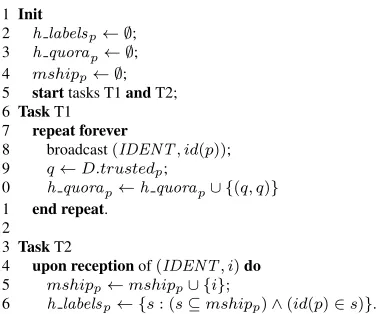
Figure 2: Algorithm to transformD∈ΣtoHΣwithout initial knowledge of membership (code for processp).
Theorem 1. A failure detector of classHΣcan be obtained from any detectorDof classΣin a system with unique identifiers, under either one of the following conditions:
1. without any communication if every process initially knows the membershipI(Π), or 2. in systemAS[Σ](the membership does not need to be known initially).
Proof:LetD.trustedpbe the variable ofΣfailure detectorDat processp. Figures 1 and 2 present the algorithms to
transformDinto a failure detector of classHΣin Cases 1 and 2, respectively. In both cases, at each processpinitially
h quorap ← ∅, and infinitely often this variable is updated with the following sentences: q ← D.trustedp, and h quorap←h quorap∪{(q, q)}. In Case 1, initially every processpsetsh labelsp← {s: (s⊆I(Π))∧(id(p)∈s)}
and it never changes it in the run. In Case 2, every processpinitially setsh labelsp ← ∅, and repeatedly broadcasts a
messageIDENT(id(p)). Processpalso has a variablemshippinitially set tomshipp← ∅. After receiving a message IDENT(i), processpupdatesmshipp←mshipp∪ {i}, andh labelsp← {s: (s⊆mshipp)∧(id(p)∈s)}.
We prove now the properties ofHΣ:
• Validity. Sinceh quorapis a set, and the elements included in it are of the form(q, q)(see Line 5 in Figure 1,
and Line 10 in Figure 2) there can not be two pairs with the same label.
• Monotonicity. The monotonicity ofh labelspin Figure 1 is obvious because it is initialized in Line 2 and never
changes. With respect to Figure 2,h labelspis initially empty, and it is related with the setmshipp, such that
ifmshippgrows thenh labelsp either grows or remains the same. Henceh labelspnever decreases because
mshippnever decreases (see Line 15 in Figure 2). The monotonicity ofh quorapin Figures 1 and 2 follows
from the fact thath quorapis initially empty, and any element(q, q)included in it is never removed.
• Liveness. Consider any correct processp. In Figure 2, eventually,Correct ⊆mshipppermanently (from the
1 Init
2 alivep←empty list;
3 startTasks T1andT2;
4 TaskT1
5 repeat forever
6 broadcast(ALIVE, id(p)) 7 end repeat.
8 9 TaskT2
10 upon receptionof(ALIVE, i)do
11 ifi∈alivepthenmoveito the first position ofalivep
12 elseinsertiin the first position ofalivep
13 end if.
Figure 3: Algorithm to implement a failure detector of classΞwithout initial knowledge of membership in AS[∅] (code for processp).
I(Correct))∧(id(p) ∈ s)} ⊆ h labelsp permanently (from Line 2 in Figure 1, and Line 16 in Figure 2).
Hence, there is a timeτafter which, for every set s ⊆ I(Correct),I(S(s)) =sandS(s)⊆Correct. The Liveness property ofΣguarantees that, at some timeτ0 ≥τ, the variableqis assigned a setsthat contains only correct processes and(s, s)will be included inh quorapafter that. Therefore, there is a time after which
h quorapcontains(s, s)permanently (from monotonicity). Sinces⊆I(S(s)∩Correct) =I(S(s)) =s, the property follows.
• Safety. Consider two pairs (x1, m1) ∈ h quorapτ11 and(x2, m2) ∈ h quora τ2
p2, for anyp1, p2 ∈ Πand any
τ1, τ2∈N. From the management of theh quoravariables (Lines 3, 5, and 6 in Figure 1, and Lines 3, 9, and 10 in Figure 2), we have thatm1andm2are values taken fromD.trustedp1andD.trustedp2, respectively. Hence,
the setsm1andm2must intersect from the Safety property of theΣfailure detectorD. Then, ifI(Q1) =m1
andI(Q2) =m2, given that we are in a system with unique identifiers,Q1andQ2must intersect.
3.3.2. FromHΣtoΣ
We define now a new class of failure detector that will be used for reductions between the above failure detector classes. While the service provided by this detector has been already used [22, 6], it was never formally defined. The new failure detector class, denotedΞ, will only be defined for systems with unique identifiers, i.e., non homonymous.
Definition 1. A failure detector of classΞprovides each processp∈Π, in a system with unique process identifiers, with a variablealivepwhich contains a sequence of process identifiers. Any failure detector of classΞmust satisfy
the following property:
• Liveness. Eventually, the identifiers of the correct processes are permanently in the prefix ofalivep. More
1 Init
2 startTasks T1andT2;
3 TaskT1
4 repeat forever
5 broadcast(LABELS, id(p), D.h labelsp);
6 if∃(x, m)∈D.h quorap: (identsp[x]has been created)∧(m⊆identsp[x])then
7 letcandidatesp={m: ((x, m)∈D.h quorap)∧(identsp[x]has been created)∧(m⊆identsp[x])};
8 trustedp←anym∈candidatespwith smallestmaxi∈mrank(i, X.alivep)
9 end if
10 end repeat. 11
12TaskT2
13 upon receptionof(LABELS, i, `)do
14 foreachx∈`do
15 ifidentsp[x]has not been createdthencreateidentsp[x]← ∅end if;
16 identsp[x]←identsp[x]∪ {i}
17 end foreach.
Figure 4: Algorithm to transformD∈HΣtoΣin a system with unique identifiers, but without initial knowledge of membership (code for process p). The algorithm uses a failure detectorXof classΞ.
∞if i /∈ aliveτp). Then, ∀p ∈Correct, ∃τ ∈ N : ∀τ0 ≥ τ, ∀q ∈ Correct, rank(id(q), aliveτ 0 p ) ≤
|Correct|.
Observe that the position of the same identifier can be different at different processes, and can vary over time in the same process. From the algorithm of Figure 3, we obtain the following lemma.
Lemma 1. A failure detector of classΞcan be implemented in AS[∅] (an asynchronous system with unique identifiers), even when the membership is not known initially.
Proof: For each process q ∈ Correct, eventually some messageALIVE(id(q))will be received at each process p ∈ Correct. Then id(q) will be included in alivep and never removed after that. Given any faulty process
r, pwill stop receiving messages fromr by some time τ. Then, after τ process pwill never receive a message
ALIVE(id(r))andid(r)will never be moved to (inserted in) the first position ofalivep. However, afterτ,
eventu-allypwill receive messagesALIVE(id(q))from each processq∈Correct, and each identifierid(q)will be moved to (or inserted in) the first position of alivep. Then, there is some time τ0 > τ such that, at all times τ00 > τ0,
rank(id(q), aliveτ00
p )< rank(id(r), aliveτ 00
p ). Since this holds for allp, q∈Correct and allr /∈Correct, the claim
follows.
We now show, using the algorithm of Figure 4, thatΣcan be obtained fromHΣwithout initial knowledge of the membership. The logic of the algorithm of Figure 4 is somewhat similar to that of the algorithm in Figure 2 in [6]. Theorem 2. A failure detector of classΣcan be obtained from any detectorD of classHΣin AS[HΣ] (an
asyn-chronous system with unique identifiers), even when the membership is not known initially.
qwhose identifier is inmhasxin its seth labelsq (from the management of the setsidentsp). Combining this
condi-tion with the safety property ofHΣwe guarantee the safety property ofΣ. The liveness property ofΣholds from the liveness property ofHΣ, the choice ofmdone in Line 8, and the properties of the failure detector classΞas follows. Ifp∈Correct, from the liveness ofHΣ, eventually every time Line 8 is executed, there is somem∈candidatesp
with only correct processes. If the failure detectorXof classΞhas already all the correct processes in the lowest ranks ofX.alivep(which eventually happens from its liveness property), then any setmincandidatesp, whose largest rank
inX.alivepis minimal, contains only correct processes (which yields the liveness ofΣ).
The following result shows that, in classical systems with unique identifiers,Σ,HΣ, andAΣare equivalent.
Corollary 1. Failure detector classesΣ,HΣ, andAΣare equivalent inAS[∅].
Proof: From Theorems 1 and 2 we have thatΣandHΣare equivalent. The equivalence betweenΣandAΣwas shown in [6].
3.3.3. FromAΣtoHΣ
In anonymous systems we have the following properties. Recall that an anonymous system is assumed to be a homonymous system in which every process has a default identifier⊥6.
We show now how to obtain a failure detector of classHΣfrom a detector of classAΣ.
Theorem 3. ClassHΣcan be obtained from classAΣinAAS[∅]without communication.
Proof: LetDbe a detector of classAΣ. The transformation can be done as follows. Let⊥be the “default” identi-fier. Let us denote with⊥ra multiset ofridentifiers⊥. Each processpperiodically does as follows. For each pair
(x, y)∈D.a sigmap, the labelxis included inh labelspand the pair(x,⊥y)is included inh quorap(replacing any
pair(x,−)thath quorapmay contain). The properties ofHΣfollow trivially from the properties ofAΣ.
3.3.4. FromAPto3HP andHΣ
We show here how failure detectors of the classes3HP andHΣcan be obtained for a failure detector of class
AP without communication.
Lemma 2. A failure detector of class3HP can be obtained from any detectorDof classAP inAAS[∅](an anony-mous asynchronous system) without communication.
Proof: The transformation can be done as follows. Let⊥be the “default” identifier. Each processpperiodically up-datesh trustedpto a multiset ofD.anappidentifiers⊥. The liveness property ofDguarantees the liveness property
of3HP.
Lemma 3. A failure detector of classHΣcan be obtained from any detectorDof classAPinAAS[∅](an anonymous asynchronous system) without communication.
Proof:The transformation can be done as follows. Let⊥be the “default” identifier. Let us denote with⊥ra multiset
ofridentifiers⊥. Each processpperiodically does as follows. After obtaining a valueyfromD.anapp, the label⊥yis
included inh labelspand the pair(⊥y,⊥y)is included inh quorap. The Validity and Monotonicity ofHΣhold
triv-ially. Liveness follows since, from the safety ofAP, only correct processes see an output ofD.anap=c=|Correct|, and from the liveness property all of them do it. Then, every correct processpeventually inserts⊥cinh labels
pand
(⊥c,⊥c)inh quora
p, and only those processes. Safety ofHΣcomes from the safety property ofAP: if, for anyy
andy0withy≥y0,|S(⊥y)|=yand|S(⊥y0)|=y0(none can be larger), thenS(⊥y)⊆S(⊥y0).
Theorem 4. Classes3HP andHΣcan be obtained from classAPinAAS[∅]without communication.
Proof:The proof of Theorem 4 follows from the two previous lemmas 2 and 3.
Ob.1
3HP 3HP
Σ HΣ
AΣ
HΩ Ω
AΩ AP
AS[∅]system model
AΣ HΣ
HΩ
AAS[∅]system model
AP Th.5
Th.5 Th.4
Th.2 Th.1
Ob.1
Figure 5: Relations between failure detector classes in the modelsAS[∅]andAAS[∅]. There is an arrow from classXtoX0ifXis stronger that
X0. Solid arrows are relations shown by Bonnet and Raynal in [6]. Dotted arrows are trivial relations. Dashed arrows are relations shown here (the
arrow label shows the theorem or observation where the relation is proven).
4. Implementing Failure Detectors in Homonymous Systems
In this section, we show that there are algorithms that implement the failure detectors classes 3HP and HΩ
inHP S[∅](homonymous partially synchronous system). We also implement the failure detector HΣ inHSS[∅]
1 Init
2 h trustedp← ∅; // multiset of process identifiers
3 mshipp← ∅; // set of process identifiers
4 rp←1;
5 timeoutp←1;
6 startTasks T1andT2;
7 8 TaskT1
9 repeat forever
10 broadcast(POLLING, rp, id(p));
11 waittimeoutptime;
12 tmpp← ∅; //tmppis an auxiliary multiset
13 for each(P REPLY, r, r0, id(p), id(q))received
14 with(r≤rp≤r0)do
15 add one instance ofid(q)totmpp
16 end for;
17 h trustedp←tmpp;
18 rp←rp+ 1
19 end repeat. 20
21TaskT2
22 upon receptionof(POLLING, rq, id(q))do
23 ifid(q)∈/mshippthen
24 mshipp←mshipp∪ {id(q)};
25 createlatest rp[id(q)];
26 latest rp[id(q)]←0
27 end if;
28 iflatest rp[id(q)]< rqthen
29 broadcast(P REPLY, latest rp[id(q)] + 1, rq, id(q), id(p))
30 end if;
31 latest rp[id(q)]←max(latest rp[id(q)], rq).
32
33 upon receptionof(P REPLY, r, r0, id(p),−)with (r < r p)do
34 timeoutp←timeoutp+ 1.
4.1. Implementation of3HP andHΩ
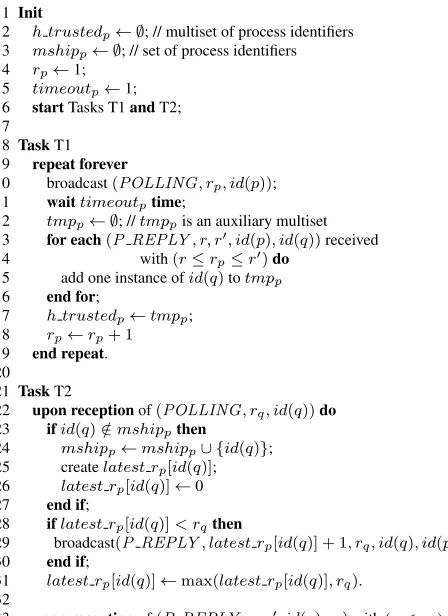
The algorithm of Figure 6 implements 3HP (and HΩwith trivial changes) in HPS[∅] where processes are partially synchronous, links are eventually timely, and membership is not known.
Brief description of the algorithm: It is a polling-based algorithm that executes in rounds. At every roundr, the Task 1 of each process p broadcasts (P OLLIN G, r, id(p))messages. After a time timeoutp, it gathers in
the variable tmpp (and, hence, also in h trustedp) a multiset with the senders’ identifiers ids of processes from
(P REP LY, r0, r00, id(p), ids)messages received withr0≤r≤r00.
Task 2 is related with the reception ofP OLLIN GandP REP LY messages. When a processp receives a(P OLLIN G, r, id(q))message from processq, processphas to respond with as manyP REP LY as processq needs to receive up to roundr, and not previously sent by processp(Lines 28-30). Note that theP REP LY messages are piggybacked in only one message (Line 29). Also note that is in variablelatest rp[id(q)]wherepholds the latest
round broadcast toid(q). If it is the first time that processpreceives a(P OLLIN G,−, id)message from a process with identifierid, then variablelatest rp[id]is created and initialized to zero (Lines 23-27).
It is important to remark that, for each different identifierid, only one(P REP LY,−,−, id(q), id)message is broadcast by each processq. So, if processesv andwwithid(v) = id(w) = xbroadcast two(P OLLIN G, r, x)
messages, then each processponly broadcast one(P REP LY, r0, r00, x, q)message withr0 ≤r ≤ r00. Note that eventually (at least after GST time) eachP REP LY message sent by any process has to be received by all correct processes. Hence, eventually processesvandwwill receive allP REP LY messages generated due toP OLLIN G messages.
Finally, Lines 33-34 of Task 2 allow processpto adapt the variabletimeoutpto the communication latency and
process speed. When processpreceives an outdated(P REP LY, r,−, id(p),−)message (i.e., a message with roundrless than current roundrp), then it increases its variabletimeoutp.
Lemma 4. Given processesp∈ Correct andq /∈ Correct, there is a roundrsuch thatpdoes not receive any
(P REPLY, ρ, ρ0, id(p), id(q))message fromqwithρ0 ≥r.
Proof: There is a timeτ at whichq stops taking steps. Ifqever sent a(P REPLY,−,−, id(p), id(q))message, consider the largestxsuch thatqsent message(P REPLY,−, x, id(p), id(q)). Otherwise, letx = 0. Then, the claim holds forr=x+ 1.
Lemma 5. Given processesp, q ∈Correct, there is a roundrsuch that, for all roundsr0 ≥r, whenpexecutes the loop of Lines 14-16 withrp=r0, it has received a message(P REPLY, ρ, ρ0, id(p), id(q))fromqwithρ≤r0 ≤ρ0.
Proof:Observe that, sincepis correct, it will repeat forever the loop of Lines 9-19, with the value ofrpincreasing in
id(p), id(q))messages afterGST, with increasing round numbers. Let(P REPLY, x,−, id(p), id(q))be the first such message sent byqafterGST. Then, for each round numbery ≥x, there is some message(P REPLY, ρ, ρ0,
id(p), id(q))sent byqwithρ≤y≤ρ0, and these messages are delivered atpat mostδtime after being sent. Now, assume for contradiction that for each roundy ≥ x, there is a round y0 ≥ y such that, whenpexecutes the loop of Lines 14-16 withrp = y0, it has not received the message(P REPLY, ρ, ρ0, id(p), id(q))fromqwith
ρ≤y0 ≤ρ0. But, every time this happens, when the message is finally received,rphas been incremented in Line 18
and, hence,timeoutpis incremented (in Lines 33-34). Then, eventually, by some roundr, the value oftimeoutpwill
be greater than2δ+γ, whereγis the maximum time thatqtakes to execute Lines 22-31. Then,pwill receive message
(P REPLY, ρ, ρ0, id(p), id(q))withρ ≤ r0 ≤ ρ0 before executing the loop of Lines 14-16 with rp = r0, for all
r0 ≥r. We have reached a contradiction and the claim of the lemma follows.
Theorem 5. The algorithm of Figure 6 implements a failure detector of the class3HP in a systemHPS[∅]
(homony-mous system where processes are partially synchronous and links are eventually timely), even if the membership is not known initially.
Proof:Consider a correct processp. From Lemma 4, there is a roundrsuch thatpdoes not receive any(P REPLY, ρ, ρ0, −,−)message withρ0 ≥ r from any faulty process. From Lemma 5, there is a roundr0 such that for all rounds r00 ≥r0, whenpexecutes the loop of Lines 14-16 withrp =r00, it has received a(P REPLY, ρ, ρ0,−,−)message
withρ≤r00 ≤ρ0 from each correct process. Hence, for every roundr00 ≥max(r, r0)when the Line 17 is executed withrp=r00, the variableh trustedpis updated with the multisetI(Correct).
We can obtainHΩfrom the algorithm of Fig. 6 without additional communication. This can be done by simply including, immediately after Line 17, h leaderp←min(h trustedp)(i.e., the smallest identifier inh trustedp) and h multiplicityp←multh trustedp(h leaderp).
Corollary 2. The algorithm of Figure 6 can be changed to implement a failure detector of the classHΩin a system
HPS[∅](homonymous system where processes are partially synchronous and links are eventually timely), even if the membership is not known initially.
4.2. Implementation ofHΣ
Figure 7 implementsHΣinHSS[∅]] where processes are synchronous, links are timely, and membership is not known.
1 h labelsp← ∅;
2 h quorap← ∅;
3 for eachsynchronous stepdo
4 broadcast(IDENT, id(p));
5 wait forthe messages sent in this synchronous step;
6 msetp←multiset of identifiers received in(IDENT,−)msgs;
7 h quorap←h quorap∪ {(msetp, msetp)};
8 h labelsp←h labelsp∪ {msetp}
9 end for.
Figure 7: Algorithm to implementHΣwithout knowledge of membership (code for processp)
received. At the end of this step, variablesh quorapandh labelspare updated with the value ofmsetp. Note that for
processpthe labelxof a quorum(x, m)is formed by the multisetmsetp(i.e,x=m=msetp).
Theorem 6. The algorithm of Figure 7 implements a failure detector of the classHΣin a systemHSS[∅] (homony-mous synchronous systems), even if the membership is not known initially.
Proof:From the definition ofHΣ, it is enough to prove the following properties.
Validity. Sinceh quorap is a set, and the elements included in it are of the form (mset, mset)(see Line 7 in Figure 7) there cannot be two pairs with the same label.
Monotonicity.The monotonicity ofh labelspin Figure 7 holds becauseh labelspis initially empty, and each step, h labelspeither grows or remains the same (see Line 8 in Figure 7). Similarly, the monotonicity ofh quorapin Figure
7 follows from the fact thath quorapis initially empty, and any element(mset, mset)included in it is never removed
(see Line 7 in Figure 7).
Liveness.Letsbe the synchronous step in which the last faulty process crashed. Then, in every steps0aftersonly correct processes will execute. Consider any processp∈Correct. In steps0will receive messages from all correct
processes, and, hence,msetp =I(Correct). Then, processpincludes(I(Correct), I(Correct))inh quorap, and
I(Correct)inh labelsp. Therefore, each correct processpis inS(I(Correct)). So, after steps, for each correct
processp, the pair(I(Correct), I(Correct))is inh quorap, andI(Correct) =I(S(I(Correct))∩Correct). Safety.Consider two pairs(x1, x1)∈h quorapτ11and(x2, x2)∈h quora
τ2
p2, for anyp1, p2∈Πand anyτ1, τ2∈N.
LetM1be the set of processes from whichp1received(IDENT,−)messages in the synchronous step in which (x1, x1) was inserted for the first time in h quorap1. Observe that Correct ⊆ M1. Furthermore, any process
p ∈ S(x1)must also be inM1 (i.e., S(x1) ⊆ M1). Also, x1 = I(M1), and, hence, |x1| = |M1|. Therefore,
the only setQ1 ⊆S(x1)such thatI(Q1) =x1isQ1 =M1. We defineM2similarly, and conclude that the only set
1 operation propose(vp):
2 est1p←vp;rp←0;
3 startTasks T1andT2;
4 5 TaskT1
6 repeat forever
7 rp←rp+ 1;
8 // Leaders’ Coordination Phase 9 broadcast(COORD, id(p), rp, est1p);
10 wait until(D.h leaderp6=id(p))∨
11 (D.h multiplicitypmessages(COORD, id(p), rp,−)received);
12 if(some message(COORD, id(p), rp,−)received)then
13 est1p←min{estq:id(p) =id(q)∧
14 (COORD, id(q), rp, estq)received}end if;
15 // Phase 0
16 wait until(D.h leaderp=id(p)∨((P H0, rp, v)received);
17 if((P H0, rp, v)received)thenest1p←vend if;
18 broadcast(P H0, rp, est1p);
19 // Phase 1
20 broadcast(P H1, rp, est1p);
21 wait until(P H1, rp,−)received fromn−tprocesses;
22 if(the same estimatevreceived from> n/2processes)then
23 est2p←v
24 else
25 est2p← ⊥
26 end if;
27 // Phase 2
28 broadcast(P H2, rp, est2p);
29 wait until(P H2, rp,−)received fromn−tprocesses;
30 letrecp={est2 :message(P H2, rp, est2)received};
31 if((recp={v})∧(v6=⊥))then
32 broadcast(DECIDE, v);return(v)end if; 33 if((recp={v,⊥})∧(v6=⊥))thenest1p←vend if;
34 if(recp={⊥})thenskipend if
35 end repeat. 36
37TaskT2
38 upon receptionof(DECIDE, v)do
39 broadcast(DECIDE, v);return(v).
5. Solving Consensus in Homonymous Systems
We present in this section two algorithms. One algorithm implements Consensus inHAS[t < n/2, HΩ], that is, in an homonymous asynchronous system with reliable links, using the failure detectorHΩ, and when a majority of processes are correct. The other algorithm implements Consensus inHAS[HΩ, HΣ], that is, in an homonymous asynchronous system with reliable links, using the failure detectorHΩandHΣ.
The main difficulty to solve in the two algorithms proposed is how to deal with the possibility of having multiple leaders, which is allowed byHΩ. This is solved by adding to each round a preliminary phase in which homonymous leaders eventually “agree” in a common estimation of the value to propose. We call this additional phase Leaders’ Coordination Phase.
5.1. The Consensus Problem
In the Consensus problem, every processpproposes a valuevpand has to decide one valuevp∗, in such a way that
the following properties are satisfied.
• Termination. Every correct process eventually decides.
• Validity. The valuevp∗decided by any processpis one of the proposed values.
• Agreement. All decided values are the same.
Each processpparticipates in the Consensus invoking the operation propose(vp). This operation returns to processp
the valuevp∗it has decided.
5.2. Implementing Consensus inHAS[t < n/2, HΩ]
Let us considerHAS[t < n/2, HΩ]where membership is unknown, but the number of processes is known (that is,n). Let us assume a majority of correct processes (i.e.,t < n/2). We say that a processpis a leader, if it is correct and, after some finite time,D.h leaderq =id(p)permanently for each correct processq. By definition ofHΩ, there
has to be at least one leader.
Brief explanation of the algorithm. The algorithm of Figure 8 is derived from the algorithm in Figure 4 of [4], pro-posed for anonymous systems. This algorithm has been adapted for homonymous systems. The algorithm of Figure 8 uses a failure detector of classHΩ(instead ofAΩ), and a new initial leaders’ coordination phase has been added. The purpose of this initial phase is to guarantee that, after a given round, all leaders propose the same value in each round. The algorithm works in rounds, and it has four phases (Leaders’ Coordination Phase, Phase 0, Phase 1 and Phase 2). Every processpbegins the Leaders’ Coordination phase of roundrbroadcasting a message(COORD, id(p), r, est1p).
among all its homonymous. Note that if pis a leader eventually all its homonymous will be leaders too. Hence, eventually all leaders will also choose the same minimal value inest1.
In Phase 0, if processpconsiders itself a leader (querying the failure detectorDof classHΩ) (Line 16), it broadcast a message(P H0, r, est1p)with its estimate inest1p. Otherwise, processphas to wait until a message(P H0, r, est1l)
is received from one of the leaders processesl, and update its variableest1p with the value received (Lines 16-17).
Note that after the Leaders’ Coordination Phase, eventually each leaderlbroadcasts messages(P H0, r, est1l)with
the same value inest1l.
In Phase 1, every processpbroadcasts a message(P H1, r, est1p)with its estimate inest1p. Then, it waits until
the reception of messages(P H1, r, est1)from a majority of processes. If the valuesest1of all the received messages are equal (for examplev), processpwill adopt it, updating its variableest2ptov(Line 22). Otherwise, processpwill
update its variableest2pto⊥(Line 24). Note that when this Phase 1 finishes, the number of possible different values
in the variablesest2pof all processes are only two:vor⊥.
In Phase 2, every processpbroadcasts a message(P H2, r, est2p)with its estimate inest2p. Then, it waits until
the reception of messages(P H2, r, est2)from a majority of processes. If the valueest2of all the received messages is the same valuevdifferent from⊥, processpwill decidev(Line 30). Otherwise, if some valueest2received is the valuevdifferent from⊥, processpwill adopt it updating its variableest1ptov(Line 31) in order to propose it in the
next roundr+ 1. With this, if a majority of processes (pnot included) decides in this roundra valuev, it will ensure that the processpwill propose this same valuevin the next roundr+ 1. Finally, if all the valuesest2received from messages are the value⊥, nothing is performed.
Finally, Task 2 implements a reliable broadcast needed to propagate a decided valuevfrom one process to the rest of processes of the system.
Correctness. The following lemmas are the key of the correctness of the algorithm. They show that, even having multiple leaders, these will eventually converge to propose the same value at each round.
Lemma 6. No correct process blocks forever in anywaitinstruction in the algorithm of Figure 8.
Proof:Let us consider by way of contradiction that the statement of the lemma is not correct. Hence, in some run of the algorithm of Figure 8 some correct process blocks forever in somewaitinstruction. Let us consider the smallest roundrin which some correct process blocks permanently. Then, let us consider thewaitinstruction with the smallest number in which some correct processpblocks permanently in roundr. Since there are fourwaitinstructions in the algorithm, one in each phase, there are four cases to consider.
• Processpblocks forever in Lines 10-11 of the Leaders’ Coordination Phase. Observe thatphas to be a leader, because otherwise the first part of the wait condition is eventually satisfied and pwould not block forever. Then, by definition of r, each leader q eventually reaches round r, and (even if it blocks in r) broadcasts
messages in Line 9, even if they do not consider themselves as leaders.) Eventually,D.h multiplicityp holds
permanently the number of leaders. Also eventually, all the(COORD, id(q), r,−)messages sent by the leaders are delivered top. Hence, the second part of the wait condition (Line 11) is satisfied. Thus,pis not blocked anymore, and, therefore, we reach a contradiction.
• Processpblocks forever in Line 16 of Phase 0. Observe thatpcannot be a leader, because otherwise the first part of the wait condition is eventually satisfied andpwould not block forever. For the same reason, no leader blocks forever in Line 16. Then, by definition ofrand the fact that the first line in which any process blocks in roundris Line 16, each leaderqeventually reaches Line 18 where it broadcasts(P H0, r,−). Since there is at least one leader, at least one process sends such a message. Hence,pwill eventually receive this message and the second part of the wait condition (Line 16) is satisfied. Thus,pis not blocked anymore, and, therefore, we reach a contradiction.
• Process pblocks forever in Line 21 of Phase 1. By definition ofr and the fact that the first line in which any process blocks in round r is Line 21, each correct process q reaches Line 20 in round r. Then, each correct processqbroadcasts(P H1, r,−). Since there are at leastn−tcorrect processes by assumption,pwill eventually receiven−tmessages(P H1, r,−)and the condition of the wait instruction is satisfied. Thus,pis not blocked anymore, and, therefore, we reach a contradiction.
• Processpblocks forever in Line 29 of Phase 2. This case is similar to the previous one.
Lemma 7. There is a round rsuch that at every roundr0 > rall leaders broadcast the same value in Phase 0 of
roundr0, or there has been a decision in a round smaller thanr0.
Proof: Consider a timeτ when all faulty processes have crashed and the failure detectorD is stable (i.e., ∀τ0 ≥
τ,∀p∈ Correct,D.h leaderpτ0 = `, being` ∈I(Correct), andD.h multiplicityτp0 =multI(C)(`)). Letrbe the
largest round reached by any process at timeτ. Then, we show that for any roundr0 > r, all leadersphave the same estimateest1pat the beginning of the Phase 0 of roundr0(Line 16), or there has been a decision in a round smaller
thanr0. To prove this, let us assume that no decision is reached in a round smaller thanr0. Then, since the leaders do not block forever in any round (Lemma 6), they execute Line 9 in roundr0. Since the failure detector is stable, they also wait for the second part of the wait condition of Lines 10-11 (since the first part is not satisfied). When any leaderpexecutes the Leaders’ Coordination Phase ofr0, it blocks in Lines 10-11 until it receivesD.h multiplicity
p
messages from the other leaders. By the stability of theHΩfailure detector,D.h multiplicitypis the exact number of leaders. Also, from the definition ofτ andr, no faulty process with identifierD.h leaderp is alive and all the
the other leaders and will setest1pto the minimum from the same set of values (Line 14).
Using these lemmas and reusing some of the results in [4], we can conclude the correctness of the algorithm of Figure 8 in the following theorem.
Theorem 7. The algorithm of Figure 8 solves consensus inHAS[t < n/2, HΩ].
Proof:From the definition of Consensus, it is enough to prove the following properties.
Validity. The variableest1is initialized with a value proposed by its process (Line 2). The value ofest1may be updated in Lines 14 or 17 with values ofest1broadcasted by other processes. The variableest2is initialized and updated withest1(Line 23) or⊥(Line 25). The value ofest1may be updated in Line 33 with values ofest2(different from⊥) broadcasted by other processes. The value decided in Line 32 is the value ofest2that was broadcasted by some process. As it is not possible to decide the value⊥(Line 32), then the value decided has to be one of the values proposed by the processes. Then, the validity property holds.
Agreement.Identical to the agreement property of Figure 4 of [4],
Termination. From Lemmas 6 and 7, after some roundr, all leaders hold the same value vinest1when they start executing Phase 0 of roundr0 (Line 16), and they broadcast this same valuev(Line 18). Note that it is the same situation as having only one leader with valuevstored inest1when Phase 0 is reached. Hence, as Phase 0 starts in the same conditions as in the algorithm of Figure 4 of [4], the same proof can be used to prove the termination property.
5.3. Implementing Consensus inHAS[HΩ, HΣ]
Figure 9 presents an algorithm that implements Consensus in HAS[HΩ, HΣ]. Note that it is derived from the algorithm of Figure 4 of [3]7 where, like in the previous case, we have added a preliminary phase as a barrier such
that homonymous leaders eventually “agree” in the same estimation valueest1to propose. Once this issue has been solved (as was proven for the previous algorithm), the use that this algorithm makes of the failure detectorHΣis very similar to the use the algorithm of Figure 4 of [3] makes of theAΣfailure detector.
Brief explanation of the algorithm. The algorithm of Figure 9 uses a failure detector of classHΩ(instead ofAΩ), a failure detector of classHΣ(instead ofAΣ), and a new initial leaders’ coordination Phase has been added. The purpose of this initial phase is to guarantee that, after a given round, all leaders propose the same value in each round. Note that this initial phase is analogous to the same phase used in the algorithm of Figure 8.
The algorithm works in rounds, and it has four phases (Leaders’ Coordination Phase, Phase 0, Phase 1 and Phase 2). Every processpbegins the Leaders’ Coordination phase broadcasting a(COORD, id(p), r, est1p)message. If
process pconsiders itself a leader (querying the failure detectorD1 of class HΩ), it has to wait until to receive
(COORD, id(p), r, est1)messages sent by all its homonymous processes (also querying the failure detectorD1of classHΩ)(Line 10). After that, processpupdates its estimateest1p with the minimal value proposed among all its
homonymous. Note that eventually all its homonymous will be leaders too. Hence, eventually all leaders will also choose the same minimal value inest1.
In Phase 0, if process pconsiders itself a leader (querying the failure detector D1 of classHΩ) (Line 14), it broadcast a(P H0, r, est1p)message with its estimate inest1p. Otherwise, processphas to update itsest1pwaiting
until a(P H0, r, est1l)message is received from one of the leaders processesl (Lines 14-15). Note that after the
Leaders’ Coordination Phase, eventually each leaderlbroadcast(P H0,−, est1l)messages with the same value in
est1l.
In Phase 1, every processpbroadcasts a(P H1, id(p), r, sr, current labelsp, est1p)message, beingris the
cur-rent round for processp,sris the sub-round inside of Phase 1,current labelspare the labels known by processpup
to now. Processpwaits for messages from some quorum of processes. Processpknows quora by reading the value of the variableD2.h quorap of the failure detectorD2of class HΣ(Line 22). The messages that form a quorum must satisfy the conditions of Lines 22-23. If when processpis building a quorum (i.e., whenpis executing Lines 22-23) its failure detector variableD2.h labelspinsrchanges, thencurrent labelspis updated an a new sub-round
starts, and processpbroadcasts this new knowledge of labels. The same actions are taken if processpknows that another process has changed to an upper sub-round ofsr(Lines 26-29). Phase 1 finishes when the messages that form a quorum finally satisfy the conditions of Lines 22-23. When this happens, if all the estimate values in the messages are equal (for examplev), the variableest2pmust be updated with this valuev. Otherwise,est2p will be set to⊥
(Lines 24-25).
In Phase 2, every processpbroadcasts a(P H2, id(p), r, sr, current labelsp, est2p)message with its estimate in
est2p. Then, processpwaits for messages from some quorum of processes to take a decision. This Phase 2 is very
similar to Phase 1 (it runs in sub-rounds, which are increased when processpknows that its variableD2.h labelsp
changes). Similarly to Phase 1, when the messages that form a quorum finally satisfy the conditions of Lines 37-38, if all the estimate values in the messages are equal (for examplev6=⊥), processpwill decidev(Line 40). Otherwise, if some of the estimateest2received from messages are the valuevdifferent from⊥, processpwill take it updating its variableest1ptov(Line 41) in order to propose it in the next roundr+ 1. Finally, if all estimateest2received from
messages are the value⊥, nothing is performed.
Task 2 implements a reliable broadcast needed to propagate a decided value v from one process to the rest of processes of the system.
Correctness. In order to prove the correctness of the algorithm we start by proving the following lemmas.
1 operation propose(vp):
2 est1p←vp;rp←0;
3 startTasks T1andT2; 4
5 TaskT1
6 repeat forever
7 rp←rp+ 1;
8 // Leaders’ Coordination Phase 9 broadcast(COORD, id(p), rp, est1p);
10 wait until(D1.h leaderp6=id(p))∨
11 (D1.h multiplicitypmessages(COORD, id(p), rp,−)received);
12 if(some message(COORD, id(p), rp,−)received)then
13 est1p←min{estq:id(p) =id(q)∧
14 (COORD, id(q), rp, estq)received}end if;
15 // Phase 0
16 wait until(D1.h leaderp=id(p)∨((P H0, rp, v)received);
17 if((P H0, rp, v)received)thenest1p←vend if;
18 broadcast(P H0, rp, est1p);
19 // Phase 1
20 srp←1;current labelsp←D2.h labelsp;
21 broadcast(P H1, id(p), rp, srp, current labelsp, est1p);
22 repeat
23 if((P H2,−, rp,−,−, est2)received)then
24 est2p←est2;exitinnerrepeat loop end if;
25 if((∃(x, mset)∈D2.h quorap)∧(∃sr∈N)∧
26 (∃setMof messages(P H1,−, rp, sr,−,−)), such that,
27 (∀(P H1,−,−,−, cl,−)∈M, x∈cl)∧ 28 (mset={i: (P H1, i,−,−,−,−)∈M}))then
29 if(all msgs inMcontain the same estimatev)then
30 est2p←velseest2p← ⊥end if;
31 exitinnerrepeat loop;
32 else if(current labelsp6=D2.h labelsp)∨
33 ((P H1,−, rp, sr,−,−)recvd withsr > srp)then
34 srp←srp+ 1;current labelsp←D2.h labelsp;
35 broadcast(P H1, id(p), rp, srp, current labelsp, est1p)
36 end if
37 end if
38 end repeat;
39 // Phase 2
40 srp←1;current labelsp←D2.h labelsp;
41 broadcast(P H2, id(p), rp, srp, current labelsp, est2p);
42 repeat
43 if((COORD,−, rp+ 1,−)received)then
44 exitinnerrepeat loop end if;
45 if((∃(x, mset)∈D2.h quorap)∧(∃sr∈N)∧
46 (∃setMof messages(P H2,−, rp, sr,−,−)), such that,
47 (∀(P H2,−,−,−, cl,−)∈M, x∈cl)∧ 48 (mset={i: (P H2, i,−,−,−,−)∈M}))then
49 letrecp= the set of estimates contained inM;
50 if((recp={v})∧(v6=⊥))then
51 broadcast(DECIDE, v);return(v)end if; 52 if((recp={v,⊥})∧(v6=⊥))thenest1p←vend if;
53 if(recp={⊥})thenskipend if;
54 exitinnerrepeat loop
55 else if((current labelsp6=D2.h labelsp)∨
56 ((P H2,−, rp, sr,−,−)received withsr > srp))then
57 srp←srp+ 1;current labelsp←D2.h labelsp;
58 broadcast(P H2, id(p), rp, srp, current labelsp, est2p)
59 end if
60 end if
61 end repeat
62 end repeat. 63
64 TaskT2
65 upon receptionof(DECIDE, v)do
Proof:Note that if a correct process decides (Line 51), then the claims follows. Consider the repeat loop of Phase 1 (Lines 22-38). Let us assume that some correct process is blocked forever in this loop. Then, let us consider the first roundrin which a correct process blocks forever inr. Hence, all correct processes must block forever in the same loop in roundr. Otherwise some process broadcasts a message(P H2,−, r,−,−,−), and from Line 24 no correct process would block forever in this loop of roundr. Let us consider a correct processp, and the pair(x, m)that guar-antees the liveness property forp. Then, there is a time in which(x, m)∈ D2.h quorap and every correct process qinS(x)∩Correct hasx∈D2.h labelsq. Note that, from Lines 32-36, every change in the variableD2.h labels
of a process creates a new sub-round, and that all processes broadcast their current value ofD2.h labelsin each new sub-round. Therefore, eventually,pwill receive messages(P H1,−, r, sr, cl,−)from all these processes such that x∈ cl. Hence, the condition of Lines 25-28 is satisfied, and pwill exit the loop of Phase 1. The argument for the repeat loop of Phase 2 is verbatim.
Lemma 9. No two processes decide different values in the same round.
Proof:Let us assume that processesp1andp2decide valuesv1andv2in sub-roundssr1andsr2, respectively, of the
same roundr(in Line 51). Let(x1, m1)andM1be the pair inD2.h quorap1and the set of messages that satisfy the
condition of Lines 45-48 forp1. Since for each message(P H2,−, r, sr1, cl,−)∈M1, it holds thatx1∈cl, ifQ1is
the set of senders of the messages inM1, we have thatQ1⊆S(x1). Additionally,m1={i: (P H2, i,−,−,−,−)∈
M1} = I(Q1). We can define (x2, m2) andM2 analogously for p2. Then, from the Safety Property of HΣ,
Q1∩Q2 6= ∅. Let pl ∈ Q1 ∩Q2. Then, processpl must have broadcast messages(P H2, id(pl), r, sr1,−, v1)
and(P H2, id(pl), r, sr2,−, v2)(Lines 41 and 58). Since the estimateest2pl ofpldoes not change between
sub-rounds (inner repeat loop, Lines 42-61), it must hold thatv1 =v2. From the condition of Line 51,recp1 ={v1}in
sub-roundsr1andrecp2 ={v2}in sub-roundsr2, and both processes decide the same value. Hence, no two processes
decide different values in the same round.
Using the above lemmas and reusing some of the results from [3] the correctness of the algorithm of Figure 9 can be shown.
Theorem 8. The algorithm of Figure 9 solves consensus inHAS[HΩ, HΣ].
Observe that the algorithm of Figure 9 can be easily transformed into an algorithm that solves consensus in
AAS[AΩ, HΣ](an anonymous system with detectorsAΩandHΣ). For that, given a failure detectorD3 ∈ AΩ, it is enough to remove the Leaders’ Coordination Phase, and in Phase 0 to replace (D1.h leaderp = id(p))by
(D3.a leaderp). The resulting Phase 0 is the same as Phase 1 in the algorithm of Figure 3 of [6], and has the same
properties.
6. Conclusion
This paper studied the Consensus problem in a new distributed environment with homonymous processes. New failure detectors have been defined for this homonymous model (called HΩ, 3HP andHΣ). We have studied the relations among the failure detector classesΣand its versions for homonymous systems (denoted byHΣ), and for anonymous systems (denoted byAΣ). It has also been shown thatHΩ,3HP andHΣcan be implemented in homonymous systems with different synchrony requirements (and in all cases without initial knowledge of the membership). Interestingly, our classHΩcan be implemented with partial synchrony, while the analogous classAΩ
defined for anonymous systems can not be implemented (even in synchronous systems). Finally, we have shown that HΩ(and a majority of correct processes), andhHΩ, HΣifailure detectors can be used to implement Consensus in homonymous asynchronous systems (even without initial knowledge of the membership).
References
[1] D. Angluin. Local and global properties in networks of processors (extended abstract). InProceedings of the 12th Annual ACM Symposium on Theory of Computing (STOC), 28-30 April, Los Angeles, California, pages 82–93. ACM, 1980.
[2] H. Attiya, M. Snir, and M. Warmuth. Computing on an anonymous ring. J. ACM, 35(4):845–875, 1988.
[3] F. Bonnet and M. Raynal. Anonymous asynchronous systems: The case of failure detectors. Technical Report PI 1945, IRISA, Rennes, France, January 2010.
[4] F. Bonnet and M. Raynal. Consensus in anonymous distributed systems: Is there a weakest failure detector? InProceedings of 24th IEEE International Conference on Advanced Information Networking and Applications (AINA), 2010, Perth, Australia, 20-13 April 2010, pages 206–213. IEEE Computer Society, 2010.
[5] F. Bonnet and M. Raynal. The price of anonymity: Optimal consensus despite asynchrony, crash, and anonymity. ACM Transactions on Autonomous and Adaptative Systems, TAAS, 6(4):23, 2011.

![Figure 5: Relations between failure detector classes in the models AS[∅] and AAS[∅]. There is an arrow from class X to X′ if X is stronger thatX′](https://thumb-us.123doks.com/thumbv2/123dok_us/1112146.1612520/14.612.198.418.419.532/figure-relations-failure-detector-classes-models-arrow-stronger.webp)
![Figure 9: Consensus algorithm in HAS[HΩ, HΣ] (code for process25 p). It uses detectors D1 ∈ HΩ and D2 ∈ HΣ.](https://thumb-us.123doks.com/thumbv2/123dok_us/1112146.1612520/25.612.77.390.41.706/figure-consensus-algorithm-h-hs-process-detectors-h.webp)
