A Local Enumeration Protocol in Spite of
Corrupted Data
Brahim Hamid and Mohamed Mosbah
LaBRI-Universit´e Bordeaux-1, 351, cours de la lib´eration,
33405 Talence, France, Email:{hamid,mosbah}@labri.fr
Abstract— We present a novel self-stabilizing version of Mazurkiewicz enumeration algorithm [1]. The initial version is based on local rules to enumerate nodes on an anonymous network. [2] presented the first self-stabilizing version of this algorithm which tolerates transient failures with an extension of messages complexity. Our version is based on local detection and correction of transient failures. There-fore, it ensures the fault-tolerance property without adding messages or reduces the messages’ number of other version. In addition, we have developed an interface based on the Visidia platform to simulate faults through a graphical user interface. The implementation of the presented algorithm in this platform shows its dynamic execution and validates its correction. The asynchronous message passing version of the presented protocol shows the transformation of distributed algorithms encoded in local computations model, as a high model, to message passing model, as a weaker model. The transformation is given in spite of corrupted information with simple changes.
I. INTRODUCTION
Distributed computing systems are becoming larger and larger, heterogeneous and complex. Since the applications running on these systems require the cooperation of many components, they are prone to failures and errors of many different types, leading to inconsistent executions. Hence, a desirable feature of a computation in a distributed system is fault-tolerance. A particularly suitable approach to deal with such a feature is to design self-stabilizing algorithms [3], [4]. Since it has many applications in dynamic networks, distributed naming or enumeration of a graph has gained much attention recently. In fact, many distributed applications are based on names to share resources, to uniquely identify entities, to refer to location, and so on. Theoretically, enumeration may be used to draw and to quantify a border between possibility and impossibility of some tasks in distributed computing. The naming problem belongs to the family of coordination problems. In such a problem, a set of processes of size
N should decide on distinct values from set of size N.
This paper is based on “A Local Self-Stabilizing Enumeration Algo-rithm,” by B. hamid and M. Mosbah, which appeared in the Proceedings of the Distributed Applications and Interoperable Systems, 6th IFIP WG 6.1 International Conference, DAIS 2006, Bologna, Italy, June 14-16, 2006. c2006 Springer.
In this paper, we propose a general approach based on graph relabeling systems and its extension to message passing system to preserve the global enumeration of a graph using only local information.
The concept of self-stabilization [5] is introduced to design a system which tolerates transient failures. Infor-mally, self-stabilizing algorithms ensure that after any failure, the system will automatically recover to reach a correct configuration in a finite time. In general, self-stabilizing algorithms are constructed in such a way that a given process will continue to function correctly in spite of intermittent faults. The stabilizing algorithms are optimistic, they guarantee a return to a correct behavior within a finite time after all faulty behaviors cease. Self-stabilizing algorithms protect against transient failures, since they can automatically repair any fault in the system. The term fault refers to failure.
A distributed system is represented as a connected, undirected graphGdenoted by(V, E). NodesV represent processes and edgesE represent bidirectional communi-cation links. In this work, we use a model based on local computations, and particularly graph relabeling systems, to encode distributed algorithms. Local computations in graphs are powerful models which provide general tools for studying distributed algorithms. In the following, the notion of relabeling sequences corresponds to a sequential execution. For a local computations we can define equiv-alent parallel rewritings, when two consecutive relabeling steps concerning non-overlapping balls may be applied in any order. They also can be applied concurrently. Proto-cols presented in this study use forms of computations near to cellular automata or transition state models [5]. At each step of the computation, labels are modified for a given ball composed of some node and its neighbors. The modification is given according to rules depending only on the labels of nodes composing this ball. In this work we are interested in formalizing and studying enumeration problem using means of local computations. The study of such a problem in high model allows us to deduce some properties on weaker models.
the links. There is no assumption about the relative speed of processes or message transfer delay, the networks are asynchronous. Each node communicates only with its neighbors. The links are reliable and the process can fail and recover in a finite time. The failures that are tolerated in such a system are the transient failures of processes.
An anonymous network is a network where all nodes execute the same algorithm without a unique identity for each node. In general, the task solved by an enumeration algorithm is the assignement of a different name to each node of an anonymous network. So, such an algorithm may be used as a preprocessing task of many algo-rithms based on the identities. As it is well-known, many problems have no solutions in anonymous networks. The motivations of this work are on the one hand to design an enumeration protocol in anonymous networks using only local computations [1]. On the other hand, we show the adaptation of our developed framework [6] to enumeration algorithm in the presence of transient failures.
We are interested in the study of the Mazurkiewicz’s enumeration algorithm [1] based on local computations. Mazurkiewicz’s algorithm is a distributed algorithm to enumerate nodes in an anonymous minimal-covering graph when its size is known. A distributed enumeration algorithm on a graph G is a distributed algorithm such that the result of any computation is a labeling of the nodes that is a bijection from V(G) to 1,2, ...,|V(G)|. [2] proposed a version of self-stabilizing enumeration algorithm with a final stage in which each node computes locally the set of final names from the final mailbox. Before this stage the node can choose a name which is greater than the size of the graph.
Many self-stabilizing algorithms have been already designed [7], [8]. However, most of these works propose global solutions which require to involve the entire sys-tem. As networks grow fast, detecting and correcting er-rors globally is no longer feasible. The solutions that deal locally with detection and correction are rather essential because they are scalable and can be deployed even for large and evolving networks. Moreover, it is useful to have the correct (non faulty) parts of the network operating normally while recovering locally the faulty components. Few general approaches providing local solutions to self-stabilization have been proposed in [9]–[11].
In [6], we consider the problem of designing algorithms encoded by local computations in a distributed system with transient failures. The developed formal framework allows to design and prove fault-tolerant distributed al-gorithms. We introduce correction rules which can be applied by faulty nodes or by their neighbors in order to self repair the incorrect states. Such rules have higher priorities than the main rules of the algorithm which ensure that the failures are repaired before continuing the computation. Of course, we deal only with prede-fined faulty local configurations. A tool called Visidia [12], validating the local computations model has been implemented. The distributed system of Visidia is based on asynchronous message passing model. However, it has
been assumed that components of such a system do not fail. In this work, we show a simulation of fault-tolerant enumeration algorithm using this platform.
The rest of the paper is organized as follows. Models of distributed systems including some element of graph theory, graph relabeling systems and message passing system are presented in Section 2. We start the Section 3 with our framework to design self-stabilizing systems, then we describe our solution to encode self-stabilizing enumeration algorithm. Section 4 shows its proofs of cor-rectness and its complexity analysis and Section 5 shows an implementation of our protocol on the Visidia platform. Since previous protocol is based on local information, we present in Section 6 an asynchronous message passing version of this protocol. A short analysis is also given. Finally Section 7 concludes the paper with discussions about future works.
II. PRELIMINARIES
A. Graphs
We introduce some terminologies and definitions about graphs. A graph is a collection of points called the nodes of the graph where some of them are connected by lines (adjacent) called the edges.
In each class of graphs we can use the following structure (V, E) to design a graph G, where V is the set of nodes and E ⊆ V2 is the set of edges. We use sometimes the notations VG, EG to denote respectively
V, E whereG= (V, E). Let(u, v)∈E, we say thatuis a neighbor ofv. A pathpinGis a sequence(v0, ...., vl)
of nodes such that for each i < l, (vi, vi+1) ∈ E.
The integer l is called the length of p. Then, a path
p= (v0, v1, ..., vk)of non-zero length through the graph
such that v0 = vk, is called a cycle of the graph. A path P = (v0, ...., vl) is simple if it does not contain cycles. The set of neighbors of node u is denoted by
N(u) = {v ∈V /(u, v)∈E}. A ball center on u with radius l is the setBl(u) ={u} ∪ {vj∈V / there exists
a path(v0, ...., vj)inGwithv0=uandj≤l}. We will say that v∈VG is an l−neighbor of uif v is in Bl(u).
We say that the graph G = (V, E)is a subgraph of the graph G= (V, E), if V⊆V andE⊆E. A graph is connected if for any pair of its nodes, there exists a path between them. Let V⊆V, we denote byG|V the restriction ofGto the subgraph(V,{(u, v)∈E∩V2}).
We also denote by G\V the graph G|(V\V). When
V is a singleton V ={v}, by abuse, we will use the notationsG|v and G\v.
A graph morphismϕbetween two graphsG= (V, E)
and G = (V, E) is a surjective mapping ϕ : V → V such that ∀ (u, v) ∈ E: (ϕ(u), ϕ(v)) ∈ E and ∀
(u, v) ∈ E, ∃(u, v) ∈ E such that u = ϕ(u) and
v=ϕ(v).
The cardinality of set V(G)(which is also the size of the corresponding network) is denoted by |V(G)|, and we assume that | V(G) |=N. For any set A, we write
(resp. the set of alln-tuples, forn∈ N of element ofA), whereN is the set of all positives integers.
The set NG(v) (resp.Nh(w)) is composed of all the neighbors of v in the graphG(resp. the neighbors ofw
in the graphH). We say that a graph Gis a covering of a graphH if there exists a surjective homomorphismϕ
fromGontoH such that for every nodev of V(G)the restriction ofϕtoNG(v)is a bijection ontoNH(ϕ(v)). In particular,(ϕ(v), ϕ(u))∈E(H)implies(v, u)∈E(G). The covering is proper ifGandH are not isomorphic. It is called connected ifG(and thus alsoH) is connected. A graphG is called minimal-covering if every covering fromGto someH is a bijection.
B. Graph Relabeling Systems (GRS) to Encode Dis-tributed Algorithms
In [13], the authors proposed a powerful model to encode distributed algorithms. This model is based on the use of graph relabeling systems. It offers general tools to encode distributed algorithms, to prove their correctness and to understand their powers.
Let Σ be an alphabet. A labeled graph is a couple
(G, L)whereGis a graph andLis a labeling function i.e. a mapping from VG toΣ. In the sequel, we assume that all the used labeling functions share the same alphabet. The labeled graph(H, L)is a sublabeled graph of(G, L)
, ifH is a subgraph ofGandL is the restriction ofLto
VH. A labeled graph morphismϕ: (G, L) −→ (G, L)
is a graph morphism fromG toG which preserves the labeling, that is, for any x ∈ VG, L(ϕ(x)) = L(x). A labeled subgraph (G, L)of (G, L) is an occurrence of (H, LH) in (G, L) if there exists an isomorphism
ϕ between H and G such that ∀x ∈ VH, LH(x) = L(ϕ(x)).
A graph relabeling rule is a triple R = (H, L, LH)
such that (H, L) and (H, LH) are two labeled graphs. The labeled graph (H, L) is the precondition part of
R and the labeled graph (H, LH) is its relabeling part. Given a labeled graph (G, Li), an algorithm R is a finite set of relabeling rules. An R-computing step is a couple of label functions(Li, Li+1)such that there exists a sublabeled graph (G, L) of (G, Li) and a rule R= (H, L, LH) ∈ R satisfying : (G, L) is an occurrence of(H, LH)in (G, Li), ∀x∈VG\VH, Li+1(x) =Li(x)
and ∀x ∈VH, Li+1(x) =LH(x). In other words, the labeling Li+1 is obtained from Li by modifying all the labels of the elements ofGaccording to the labelingLH. Such a computing step will be denoted byLi−→
R Li+1.
We say that the computations in G are local if a node
u∈VG can only act on the set of itsl−neighbors in a ball
of a fixed radius l .Formally, this is equivalent to fix the diameter of the graphs H of the relabeling rules R∈ R
to 2l. Any computation in G is a relabeling sequence
(L0, L1,· · ·, Ln) such that ∀0≤i < n, (Li, Li+1) is a computing step. We use the notation L −−−→
R,p L
to
say that there exists a local computations of length p
starting from the label L to the label L i.e. there exists
a computation(L0, L1, · · ·Ln) such that L0=L, Ln= L.
A computation in G is finished if no relabeling rule can be applied on the current labeling. In this case, the corresponding labeled graph (G, L) is a result of the algorithm. We denote by RESR(G) the set of all the results of the algorithm R(G). The execution time of a computation is the length of the corresponding relabeling sequence. Thus, a measure of the time complexity of a distributed algorithm, or of a graph relabeling system, will be the execution time of the longest computation of the algorithm. A measure of a space complexity of a distributed algorithm is the size of the label of a node of the graph. Obviously, the used concrete memory is the size of all the labels in the graph.
In this work, we consider only relabeling in ball of radius 1. That is, each one of them, may change its label according to rules depending only on labels of all nodes composing this ball. We assume that each node distinguishes its neighbors and knows their labels. In the sequel we use the set B(v) to denote the set of (locally) ordered immediate neighbors of v which is an input data.
C. Example of a Spanning tree Computation
Consider the following graph relabeling system used to compute a distributed spanning tree of a given graph
G = (V, E). Every process v ∈ V has for label the quadruple :
• B(v): the set of immediate neighbors of v which is an initial data,
• St(v): the state of v that can have only 2 values: A to mean thatvhas been included in the tree orN when it is not yet in the tree,
• father(v)is the father ofvin the spanning-tree.
• Sons(v): the ordered list of its sons in the tree.
When starting the algorithm, we choose a node v0 as the root of the tree. The initial label functionL0is defined by :
• St(v0) =A, f ather(v0) =⊥, Sons(v0) =∅; • ∀v=v0, St(v) =N, Sons(v) =∅, f ather(v) =⊥. Here, when f ather(v) =⊥ this means that v has no defined father.
The algorithm is described by a relabeling system R with one ruleR1defined onΣ ={2N×{N, A}×VG∪{⊥
} ×2N}:
Distributed Computation of a Spanning tree in Local Computations Model
R1 : Spanning rule acting on 2 nodes v, u
Precondition :
– St(u) =N
– ∃v∈B(u),St(v) =A
Relabeling :
– St(u) :=A
– f ather(u) :=v
– u is added to Sons(v).
At any step of the computation, when aN-labeled node
A. Moreover, f ather(u) is set to v and the node v
adds u in its sons list. So at each computation step, the number ofN-labeled nodes decreases of 1.
The computation finishes when all the nodes v are such that St(v) =A. And obviously we have a spanning tree of G rooted at v0 defined by the third components (or the fourth components) of the labels of the nodes.
Property 2.1: If v the elected node of the graph
G= (V, E) initiates the execution of the Spanning Tree Module, eventually after the application of #V rules all the nodes u of G are labeled Stage(u) = A and a spanning tree T rooted at v of G is built.
D. Message Passing Model
Contrary to the local computations model where com-munications are abstracted, in a message passing system, processors communicate by sending messages through bidirectional communication links. The network is also represented by an undirected graph in which each node represents a processor, and each edge is present between two nodes if their corresponding processors may commu-nicate. An algorithm in such a system consists of a local program at each node. The program encodes the local actions that processor may make. They include modifi-cation of local variables, send messages to and receive messages from each of its neighbors in the corresponding graph topology.
More formally, each processor pi is modeled using
a set of state. Since the processor is identified with a particular node in the graph, edges incident to pi are labeled using arbitrary set of numbers in the set 1· · ·r
where r is the degree of pi. Processor pi ’s action takes as input a value of some states of pi, messages sent by the neighbors. Then, it produces as output a new value of some states and also at most one message for each link between 1· · ·r. Messages previously sent by pi and not
yet delivered cannot influence pi current step. At any time, a configuration or a global state of the system is a vector C composed of the states of all the processors at this time. An initial configuration is a vector of the initial states of all the processors.
To model a computation in a message passing system, we introduce two kinds of events. The computation event, representing a computation step of a processorpiin which it applies action to its current accessible states. The other event is denoted by the delivery event responsible of the deliverance of messagemfrom processorpi to processor pj.
So an execution shows the behavior of a system, which is a set of sequence of configurations and events. Such sequences depend of the task assigned to the system being modeled. Thus, they must satisfy some properties according to the tasks.
In the message passing model, a system is said to be asynchronous if there is no fixed upper bound on the duration of both computation and delivery events. In spite of many distributed applications use usual upper bounds on message delays and processor step times, it
often suitable to design algorithms that are independent of any particular timing parameters, namely asynchronous algorithms.
In the asynchronous message passing model, an exe-cution is said to, be admissible if each processor may take an infinite number of computations events, and every message sent is eventually delivered. Such requirements model the fact that processors do not fail and commu-nication links are also reliable. It does not imply that the processors programs must contain an infinite loop. In this point of view, the termination of an algorithm is reached when actions not change the processor states after a certain point.
Complexity measures in the message passing model are related to the number of messages and the amount of time as the local computations model. We will fo-cused on the worst-case. Such measures depend on the notion of the algorithm terminating or when algorithm reaches son specific configuration. So, we assume that each processor’s state includes a subset of states to denote terminated states. After the reach of such states, actions of the program maps terminated states only to terminated states. Thus, we say that the algorithm has terminated when all processors are in the terminated states and no all messages are delivered.
The message complexity of an algorithm encoded in the message passing model is the maximum of the total number of message sent during all admissible executions of this algorithm. For the time complexity, we adopt the common approach assuming that the maximum message delay in any execution is one unit of time. Note such a measure is not used to prove the correctness of such algorithms. Then, to calculate the time complexity of an algorithm it suffices to take the running time until the termination.
Distributed computation of a spanning tree in message passing model var f ather: integer init0;
root, in-tree: boolean initf alse; Sons: set of integer initemptyset; i, q: integer;
I: {For the initiatorronly, execute once:}
in-tree:=true; root:=true;
for (i:= 1todeg(r)) do send<tok>via porti
T: {A message<tok>has arrived atv0from portq}
if(not in-tree) f ather:=q; in-tree:=true;
send<son>via portq;
for (i:= 1todeg(v0)) do send<tok>via porti
S: {A message<son>has arrived atv0from portq} Sons:=Sons∪ {q}
Property 2.2: Given a graph G = (V, E) and en elected node v0. The execution of the spanning tree algorithm involves, in the worst case, the send of∆×#V
tok messages and #V−1 son messages and uses at most
III. THELOCALSTABILIZINGENUMERATION ALGORITHM
A. Self-stabilizing Graph Relabeling Systems
We quote from E.Dijkstra [5] the following definition: ‘a system is a self-stabilizing system if independently of the starting configuration the system will reach a legitimate configuration after a finite time’. An algorithm is therefore called self-stabilizing if it eventually starts to behave correctly regardless of the initial configuration.
A local configuration of a process is composed by its state, the states of its neighbors and the states of its communication links. In this work we use the notion of local illegitimate configurations encoded by local compu-tations [6]. For a labeled graph(G, λ), we say that a local configurationf = (Bf, λf) is illegitimate for (G, λ), if there is no subgraph in(G, λ)which is isomorphic tof. In other words, there is no ball (neither sub-ball) of radius
1inGwhich has the same labeling as f. Such labels are not used when the system runs in a correct manner.
Transient failures cause processes to change their states yielding illegitimate local configurations and therefore an illegitimate global configuration. A self-stabilizing system will be able to destroy such a fault by eventually stabilizing into a correct global configuration without restarting the system. A local stabilizing graph relabeling system is a triple = (L,P,F) where L is a set of labels, P a finite set of relabeling rules and F is a set of illegitimate local configurations [6]. Let GL be the set of labeled graphs (G, λ) and h : GL −→ IN be an application associating to each labeled graph(G, λ), the number of its illegitimate configurations at this stage of the computation. Therefore, we denote by h(G, λ,F)
the current number of illegitimate configurations of the labeled graph(G, λ). A local stabilizing graph relabeling system must satisfy the two following properties:
• Closure:∀ (G, λ)∈ GL such thath(G, λ,F) = 0, ∀(G, λ)/(G, λ)−→∗
(G, λ
): h(G, λ,F) = 0.
• Convergence:∀(G, λ)∈ GL,∃an integerk, such that(G, λ)−→k
(G, λ
)andh(G, λ,F) = 0.
As for self-stabilizing algorithms, the closure property stipulates the correctness of the relabeling system. A com-putation beginning in a correct state remains correct until the terminal state. The convergence however provides the ability of the relabeling system to recover automatically within a finite time (finite sequence of relabeling steps).
In [6] we state the following result:
Theorem 3.1: if= (L, I, P,F)is a graph relabeling system with illegitimate configurations F, then it can be transformed into an equivalent local stabilizing graph relabeling systems= (L, Ps,F).
The setPs is composed of setP and some correction
rules to detect and eliminate each illegitimate configura-tion ofF. The correction rules have higher priority than the rules inP.
Definitions 3.2:
• A configuration (G, L) is reached from the config-uration(G, L)during the execution of the algorithm
Riff ∃p≥0 such that L−−−→
R,p L
,
• Let CR (resp. CRs) be the set of all configurations
reached during the execution of R (resp. Rs).
• An algorithmRstabilizes to another algorithmRsif
the following hold: In each relabeling chain induced by the execution of R, there is a finite suffix after which all the configurations reached are in CRs.
• The stabilization time is the length of the relabeling sequence corresponding to this suffix. So a measure of the stabilization time complexity of a distributed algorithm, or of a graph relabeling system, will be the stabilization time of the longest suffix of the algorithm.
B. The Mazurkiewicz’s Enumeration Algorithm
An enumeration algorithm on a graphGis a distributed algorithm such that the result of any computation is a labeling of the nodes that is a bijection from V(G) to
1,2, ...,|V(G)|. First, we give a description of the initial enumeration algorithm [1]. Every node attempts to get its own name, which shall be an integer between 1 and |V(G)|. A node chooses a name and broadcasts it with its neighbor-hood (i.e. the list of the name of its neighbors) all over the network. If a node udiscovers the existence of another nodev with the same name, then it compares its local view, i.e. the labeled ball of center u, with the local view of its rivalv. If the local viewv is “Stronger”, thenuchooses another name. Each new name is broadcast with the local view again over the network. At the end of the computation it is not guaranteed that every node has a unique name, unless the graph is non ambiguous. However, all nodes with the same name will have the same local view.
The crucial property of the algorithm is based on a total order on local views such that the “Strength” of the local view of any node cannot decrease during the computation. To describe this local view we use the following notation: if v has degree d and its neighbors have names n1, n2, ...nd with n1 ≥ .... ≥ nd, then
LV(v), the local view, is the d-tuple(n1, n2, ...nd). Let LV be the set of such ordered tuples. The alphabetic order defines a total order on LV. The nodes v are labeled by triples of the form (n, LV, GV) representing during the computation :
• n(v)∈IN is the name of the nodev, • LV(v)∈ LV is the latest view ofv,
• GV(v) ⊂ IN× LV is the mailbox of v and con-tains all the information received at this step of the computation. We call this set the global view of the
v.
We define the list sub(LV, n, n): the copy of LV
where any occurrence of n is replaced byn if n exists or addsntoLV otherwise. Let LV ∈ LV and(n, n)∈
node which is center of ballB(v0)and let{v1, v1· · · , vd}
be the set of its neighbors. Let(n(vi), LV(vi), GV(vi))
the triple associated to the node vi with 0 ≤ i ≤ d. We call the ball of the center v and we write B(v) the set composed of v and its neighbors. Now we present Mazurkiewicz’s enumeration algorithm:
Mazurkiewicz’s Enumeration Algorithm
R1 : Transmitting rule
Precondition :
– ∃vi∈B(v0), GV(vi)=GV(v0)
Relabeling :
– ∀vi∈B(v0), GV(vi) := [ vj∈B(v0)
GV(vj)
R2 : Renaming rule
Precondition :
– ∀vi∈B(v0), GV(vi) =GV(v0)
– n(v0) = 0or
n(v0) > 0 and (∃ LV1|(n(v0), LV1) ∈ GV(v0) and
LV(v0)≺LV1)
Relabeling :
– n(v0) := 1 +max{n|(n, LV)∈GV(v0)}
– ∀ vi ∈ B(v0)\{v0}, LV(vi) := sub(LV(vi), n(v0), n(v0))
– ∀ vi ∈ B(v0), GV(vi) := GV(vi) [
vj∈B(v0 )
{(n(vj), LV(vj))}
C. A Local Stabilizing Enumeration Algorithm
We present in the sequel a new enumeration algorithm encoded by local stabilizing relabeling systems. This protocol is optimal compared to the version presented in [2]. We will refer to this protocol as EN L algorithm.
In a correct behavior, when a name of v0 is already chosen by another nodevi,v0(resp.vi) will receive this information and change its name if the local view of v0
(resp.vi) contains the older modifications (see Figure 1). In a corrupted behavior, when a name of v0 is cor-rupted, it detects this corruption, changes its name to −1 and initializes its states, then one of its neighbors
vi detects this change, corrects some of the state of v0. After that,v0chooses another number to rename itself as shown in Figure 2.
8
9 5 7
4
3
(1, LV, GV) (1, LV, GV) v0 vi
Figure 1. Example of a safe running
8
9 5 7
4
3
(1, LV, GV) (−1, φ, φ)
v0 vi
Figure 2. Example of a run starting from corrupted state
FunctionδL(n)gives the number of occurrences of a namenin the listLV. We start by defining some illegiti-mate configurations to construct a setF, then we improve
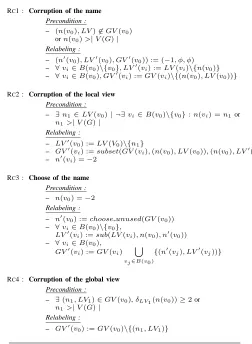
the system by adding the correction rules to detect and to eliminate these configurations. The nodev0 is said to be corrupted or in the illegitimate configuration, if one of its components is changed using extra relabeling. This relabeling does not correspond to those of the previous rules. We can define the following predicates to denote theses behaviors.
1) Corruption of the name:(n(v0), LV)∈GV(v0)or
n(v0)>|V(G)|.
2) Corruption of the local view:∃ n1 ∈LV(v0)| ¬∃ vi ∈B(v0)\{v0}:n(vi) =n1 or n1>|V(G)|.
3) Corruption of the global view:∃ (n1, LV1) ∈ GV(v0),δLV1(n(v0))≥2or n1>|V(G)|.
The functionchoose unused(GV)chooses one unused name in the set of global viewGV ⊂IN×LV. We use the list subset(GV,(n, LV),(n, LV)) to denote the copy of GV where any occurrence of (n, LV)is replaced by
(n, LV)if(n, LV)∈GV or adds(n, LV)toGV. For the present system, we deal with the following set F = {f1, f2, f3} encoding the previous behaviors’ predicates. Therefore, the correction rules are:
Detection and Correction Rules
RC1 : Corruption of the name
Precondition :
– (n(v0), LV)∈GV(v0) orn(v0)>|V(G)|
Relabeling :
– (n(v0), LV(v0), GV(v0)) := (−1, φ, φ)
– ∀vi∈B(v0)\{v0}, LV(vi) :=LV(vi)\{n(v0)}
– ∀vi∈B(v0), GV(vi) :=GV(vi)\{(n(v0), LV(v0))}
RC2 : Corruption of the local view
Precondition :
– ∃n1∈LV(v0)| ¬∃vi∈B(v0)\{v0}:n(vi) =n1or
n1>|V(G)|
Relabeling :
– LV(v0) :=LV(V0)\{n1}
– GV(vi) :=subset(GV(vi),(n(v0), LV(v0)),(n(v0), LV(v0)))
– n(vi) =−2
RC3 : Choose of the name
Precondition :
– n(v0) =−2
Relabeling :
– n(v0) :=choose unused(GV(v0))
– ∀vi∈B(v0)\{v0},
LV(vi) :=sub(LV(vi), n(v0), n(v0))
– ∀vi∈B(v0),
GV(vi) :=GV(vi) [
vj∈B(v0)
{(n(vj), LV(vj))}
RC4 : Corruption of the global view
Precondition :
– ∃(n1, LV1)∈GV(v0),δLV1(n(v0))≥2or
n1>|V(G)|
Relabeling :
– GV(v0) :=GV(v0)\{(n1, LV1)}
IV. PROOF OFCORRECTNESS ANDCOMPLEXITY ANALYSIS
protocol according to the starting configuration. First, we deal with a configuration without illegal configurations. Then, we prove that for a computation which starts from a configuration with corruptions, our protocol reaches a configuration without illegal configuration in a finite time. Finally, we show that the protocol satisfies its task in spite of corrupted data. The analysis is closed with time complexity measures.
A. Proof of Correctness
We define the relabeling system s = (L, Ps,F),
where L = {{N ∪ {0,−1,−2}} ×2N ×2N ×2N} and
Ps={R1, R2, Rc1, Rc2, Rc3, Rc4}such thatRcj> Ri. We now state the main results.
Lemma 4.1: The systems= (L, Ps,F)satisfies the
closure property.
Proof. We prove this Lemma by induction on the size of
relabeling sequences. Let(G, λ)any labeled graph where
h(G, λ,F) = 0. Let (G, λk) a labeled graph obtained from(G, λ) by applyingk rules only from the setP =
{R1, R2}. From the definition of correction rules, they are applied when some illegitimate configurations are intro-duced. Whenk= 0the Lemma istrue. We suppose that the lemma remainstrue after applyingk rules. Now we show that the lemma remains true after the application of
k+1rules. From the induction hypothesis,h(G, λk,F) = 0. At this step, the only possible application rules areR1
andR2. By definition, such rules do not introduce illegit-imate configurations, thenh(G, λk+1,F) = 0. Therefore, all the labeled graphs(G, λ)obtained from(G, λ)verify the property. Formally, ifh(G, λ,F) = 0then∀(G, λ),
(G, λ)−→∗
(G, λ
):h(G, λ,F) = 0.
The proof of termination presented in [1] is based on the fact that no state can occur twice in the same run of the protocol. In the self-stabilization context when a system is subject to corruption, this fact is not automatically satis-fied. Recall that [1] proposed an extension of its algorithm to deal with any graph (including ambiguous graphs). Therefore, this extension may be used to treat the case of corruption [2]. Another way consists to treat locally the corruptions, then the corrections’ actions are executed during the execution of the enumeration algorithm. Our solution satisfies the last way, its correction is shown in the following Lemma.
Lemma 4.2: The systems= (L, Ps,F)satisfies the
convergence property.
Proof. We study the case of each illegitimate
configura-tion.
1) ∃ v0 ∈ V(G) labeled such that:(n(v0), LV) ∈ GV(v0) or n(v0) >| V(G) |. The corrupted node
v0applies ruleRC1to change its name to−1, then
RC2 is executed by one of its neighborsvi, after
thatv0 executesRC3to choose an unused number to rename itself. Let vi one of its neighbors. The new state ofvi,after the application of rule RC2, is such that the name (resp. the local view) of v0
does not appear in the local view (resp. in the global view) ofvi. Then, the Transmitting rule allows to
diffuse this novel state in all the graph.
2) ∃ v0 ∈V(G) labeled such that: ∃ n1 ∈LV(v0)|
¬∃ vi ∈ B(v0)\{v0} : n(vi) = n1 or n1 >| V(G)|. Correction ruleRC2detects and eliminates such configuration.
3) ∃ v0 ∈ V(G) labeled such as: ∃ (n1, LV1) ∈ GV(v0),δLV1(n(v0))≥2 or n1 >|V(G)|. Also, with the same reasoning, rule RC4 is applied to detect and eliminate this corrupted configuration.
The size of the relabeling sequence required, to elimi-nate all the illegitimate configurations and also to termi-nate the execution of the algorithm, is given in the section related to the complexity analysis. Formally, we have the following properties:
• The application of a correction rule decreases
h(G, λ,F)and induces the execution of the ruleR1. • The application of a rule in P does not increase
h(G, λ,F).
• ∀ (G, λ)∈ GL,∃an integer k,
(G, λ)−→k
(G, λ
):h(G, λ,F) = 0
Lemma 4.3: The system s = (L, Ps,F)encodes an
enumeration algorithm.
Proof. To show that the result is an enumeration, we use
the same properties as those used in [1], [2]. LetGbe a graph, to explain how this protocol denoted by P works, we introduce some notations. We denote byσ the state of the network which is composed of the local configurations of all the nodes. Ifσ(v) = (n, LV, GV), then,n, LV, GV
refer to the name, the local view and the mailbox ofvat state σ. Thus,γ(σ(v))is the name of the nodev at state
σ. Elements of mailbox are called messages; messagem
is sent byna ifm= (na, LV) for someLV. Namena
is known to nodev at stateσ, ifσ(v) = (n, LV, GV)for somen, LV, GV andGV contains a message sent byna. We denote byσk = (nk(v), LVk(v), GVk(v))the label of
each nodev∈V(G)after thekthstep of the computation
ofP. ProtocolP satisfies the following properties whose proofs can follow the scheme of the one used in [1]. (I1) ∀ k ≥0,v ∈V(G): LVk(v) =LVk(B(v)\{v})−
{0,−1,−2},
(I2) ∀ k≥0,v ∈V(G): u, w ∈B(v): nk(u) =nk(w)
⇒u=w,
(I3) ∀k≥0,v∈V(G):nk(v)≤nk+1(v)andLVk(v) LVk+1(v)andGVk(v)⊆GVk+1(v),
(I4) ∀ k≥0,v ∈V(G),∀(na, LV)∈GVk(v): ∃ u∈ V(G),nk(u) =na,
(I5) ∀k≥0,v∈V(G),nk(v)= 0:∀na, na,na≤na,
v knownna ⇒v knownna,
(I6) ProtocolP is terminating for any graph,
(I7) The result of any run ofP for any graphGis locally bijective,
(I8) P is an enumeration protocol for any unambiguous graph.
From the proofs of the three previous lemmas, we can state:
Corollary 4.4: Starting from any labeled graphs, the systems= (L, Ps,F)terminates.
Corollary 4.5: The relabeling systemsis local
stabi-lizing. It encodes a self-stabilizing enumeration algorithm for any unambiguous graph.
B. Complexity Analysis
In this section, we consider the model of distributed system described in Section 2.B and we compute the complexity of our protocol in terms of relabeling rules or steps. The number of steps when the system does not contain any failure component is denoted by M, the number of steps with failures is denoted by Σ. The complexity of the Mazurkiewicz enumeration algorithm is M = θ(| V(G) |3). The time of stabilization of the algorithm proposed in [2] isθ(t× |V(G)|2)steps, where
tis the sum of the number of nodes and the highest name initially known. We use the following properties to give the stabilization time of our protocol:
1) Each node applies one rule in the set of correction rules to correct itself.
2) The application of the correction rules does not add illegitimate configurations. The application of the ruleRC1provokes the application of the rules
RC2,RC3and soR1.
3) In the worst case, forf1 corruptions of names, f2
corruptions of local view, f3 corruptions of global view, the nodes apply3f1+f2+f3correction rules. Therefore, the stabilization time is θ(5× |V(G)|3 ), when ruleR1is applied|V(G)|2 times. The worst case corresponds to the case of f1. Let
f = 3f1, then the time of stabilization isθ(9f |V(G)|2). So, the time for the enumeration algorithm subject to f
corruptions is Σ =θ(9f | V(G)|2 +(| V(G) | −f)3). Starting from a configuration without corruptions, we obtain θ(| V(G) |3). See that in [2], the parameter t is unbounded, and in our versionf is bounded by|V(G)|.
V. ANIMPLEMENTATION ON THEVISIDIATOOL
Visidia [12] is a tool to implement, to simulate, to test and to visualize distributed algorithms. It is motivated by the important theoretical results on the use of graph relabeling systems to encode distributed algorithms and to prove their correctness. Visidia provides a library together with an easy interface to implement distributed algorithms described by means of local computations. The distributed system of Visidia is based on asynchronous message passing model. However, it has been assumed that components of such a system do not fail. The threads representing the processes of the computation are created on the same machine.
A stage of computation [14] in Visidia is carried out after some synchronization, which can be achieved by using probabilistic procedures [15]. The processes are simulated by Java threads. The high level primitives
including the synchronization procedures allows the user to implement local computations.
There are three types of local computations. To im-plement these local computations in an asynchronous message passing system, a randomized synchronization procedure is associated to each type, which are given in the following:
1) Rendez-vous(RV): in a computation step, the labels attached to nodes ofK2 (the complete graph with
2 nodes) are modified according to some rules depending on the labels appearing onK2.
2) Local Computation 1(LC1): in a computation step, the label attached to the center of a ball is modified according to some rules depending on the labels of the ball, labels of the leaves are not modified. 3) Local Computation 2(LC2): in a computation step,
the labels attached to the center and to the leaves of a ball may be modified according to some rules depending on the labels of the ball.
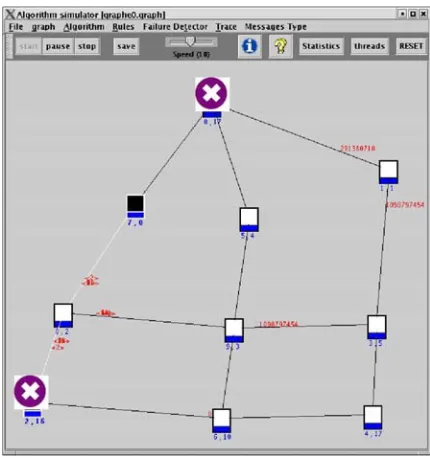
Figure 3. The beginning of the simulation with transient failures
To simulate transient failures [16], the user can simulate the faulty of a process with the graphical user interface before the beginning of the simulation or during the simulation. For the enumeration algorithm, we show an execution by starting the algorithm with a randomized value of the name (labels). In the following figures, we present an execution of a local self-stabilizing enumer-ation algorithm on Visidia starting with faulty values as shown in Figure 3. For a graph of 10 nodes, each node is represented by two labels(number, name)where
numberis a number used to indicate and distinguish the nodes on the graphical interface and name is a value used by the enumeration algorithm. The maximum chosen value doesn’t upper to10, there are two nodes numbered
Figure 4. The beginning of the simulation with transient failures
number is4and has a neighbor8named2. In Figure 5, the faulty node2 (resp. 0) correct himself to 8 (resp. to
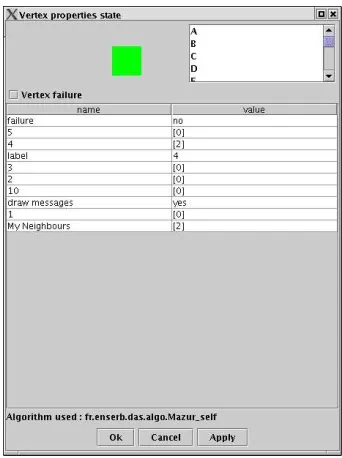
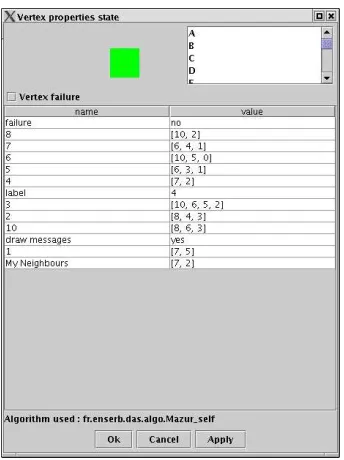
7). Then, the local view of the node7contains the correct named neighbor 0 (see Figure 6). Finally, Figure 7 and Figure 8 show the end of the execution of the enumeration algorithm. In the first one, the graph is totally named and in the second one we show the final local view of the node7.
Figure 5. Local correction of the transient failures
VI. MESSAGEPASSINGMODEL
In this section we present a self-stabilizing enumeration protocol in message passing model. We use a model as
Figure 6. Local correction of the transient failures
Figure 7. The end of enumeration and the local views
Figure 8. The end of enumeration and the local views
works about self-stabilizing in a message passing model are not terminating. It means that, periodically processors exchange information to check the legality of the local then the global configuration or they assumed to receive information about the state of the neighbors infinitely often [19]. In this work we adopt the same concept of silency introduced in [19] as the ability of a system to converge to a global silent state. In such a state, processors still exchange messages to check and confirm the legality of this states and the the values of the local variables of processors are not altered. We can imagine unreliable failure detectors [20] to announce corruption of some process. Implementation of such a service is not explained in this work because it’s another field of research.
A. The Protocol
The algorithm is based on those of [21] which is a simple translation of the Mazurkiewicz’s algorithm in the message passing model. So, we use the same variables (name, local view, global view) to encode the states of processes. In the following we use the three type of messages:
1) request: asking for a local variables of neighbors, 2) response: responding to a request messages and containing the request information such as the value of the own name, local view and global view, 3) new knowledge: a message containing for each
neighbor a novel affectation of the name and the update version of the local view of each of them. Such a message is transmitted to all the neighbors of the process that previously requested information of them.
For a better readability, we use the following proce-dures:
• We denote by deg(v)the size of the set of outgoing port numbers ofv.
• renaming condition: is the renaming condition as presented in the local computations model. When
name = 0 or the received knowledge contains an element named as the node but with “stronger” set of known names.
• all responded : store the received knowledge to be used to renaming and to build a new knowledge. Also, it detects when all responses arrived from neighbors.
• maxname(): is the greater name known to neigh-bors,
• new know(maxn) : unifies the knowledge of all neighbors,
• actualizes knowledge() : it updates its current knowledge, includingLV andGV, according to the received knowledge.
In the following, we assume that the hide of sent data (packet), which is the type of the message, is detected by the receiver at the reception of packet without added operation.
In a normal behavior, each node has the following variables: name, LV, GV as presented in the previous sections andstageto denote the stage of the computation in which the processor is. So, we distinguish three stages: ⊥, waitR for wait response and waitK for wait new knowledge. Starting from the normal configuration such that ∀v, stage(v) =⊥, name(v) = 0, LV =∅, GV =∅,
each node broadcasts request to all its neighbors about their local variables and then waits for their responses (the
stagevariable is set towaitR). At the reception of such a message atv0from a neighborvi,v0responses sending the current values of its local variables. If the stage of v0
is⊥then it will be changed towaitK. The reception of the responses allows to build knowledge about neighbors and then about all the nodes after the distribution of such knowledge. So, after the reception of a response from all the neighbors (thestageof such a process iswaitR), the processor checks its local name and those of the received knowledge. Thus, if the renaming condition is satisfied (as presented in the local computations model) it changes its name, then it updates its current knowledge according to the received knowledge. After that the new knowledge are transmitted to neighbors and changes itsstageto⊥. Finally, at the reception of knowledge at v0 such that
stage(v0) =waitK, it modifies its local variables to take into account the received values and changes itsstageto ⊥. At any step, processor set it stage to terminate if its local variables contains a node named with a number which is the size of the graph to be enumerated.
communication links are empty and the result of the computation is not correct.
As presented in the sections focused on the local computations model, we use the same predicates to denote the set of illegal configurations. We avoid some technical aspects to present correction rules associated to each cor-ruption. The application of each correction rule generates exchange of message corrupt to unify knowledge of all the neighbors according to each kind of corruption.
Self-stabilizing Enumeration Algorithm in Message Passing Model var state∈ {⊥, waitR, waitK, terminate};
name: integer;
LV : set of integer;
GV : set of knowledge;
i, p, q: integer;
I: {Init rule at each nodev0:}
for (i:= 1todeg(v0)) do send<reqR>via porti stage:=waitR;
QR: {A message<reqR>has arrived atv0from portq}
send<respR,name,LV,GV>via portq; stage:=waitK;
RR: {A message<respR>has arrived atv0from portq}
if(all respondedandstage=waitR)
if(name= 0orrenaming condition) maxn=maxname();
new know(maxn); name:=maxn+ 1;
for (i:= 1todeg(v0)) do send<newK,GV>via porti; stage=⊥;
RK: {A message<newK>has arrived atv0from portq}
if(stage=waitK) actualizes knowledge(); stage=⊥;
CK: {for each nodev0,at the reach of the timeout:}
if(f1) RC1();
if(f2) RC2();
if(f3)
RC4();
RC1 : {A message<corrupt>has arrived atv0from portq} actualizes knowledge bis();
stage=⊥;
B. Proof of Correctness ans Analysis
Now, we show the correctness of the EN M algo-rithm using the same scheme as the proofs given in the local computations model. First, we prove that EN M algorithm is self-stabilizing. Then, we prove that the EN Msatisfies its task. The proofs are based on the same techniques as such used in the local computations model. The analysis is closed with some complexity analysis.
Starting from a configuration without illegal configu-ration, the CK action doesn’t change the states of any node. So, the closure property is satisfied. Starting from a configuration with illegal configuration, after the reach of some time out, node affected by the corruption detects such a configuration, applies adequate correction rule. The number of steps needed to correct each kind of corruption is the same as such used in the local computations model. Then, following each of the possible illegal configuration, the algorithm detects and corrects himself. Since the
protocol, as described in [21], satisfies its task, we claim that,
Corollary 6.1: The EN M algorithm is local stabiliz-ing. It encodes a self-stabilizing enumeration algorithm for any unambiguous graph.
Corollary 6.2: In a correct behavior, the cost of the EN M algorithm is in O(| V |3) messages. In the presence of f corruptions, the cost of the EN M is extended by the send of c×f corrupt messages, for
some constantc. Thus, the algorithm is delayed according to the used time out.
VII. CONCLUSION
In this paper, we have presented a method to encode self-stabilizing enumeration algorithm with local compu-tations. We have adapted the method given in [6] to create an easy self-stabilizing Mazurkiewicz’s enumeration algo-rithm. This kind of algorithm can be used to implement a system which tolerates transient failures. The method is based on defining a set of illegitimate configurations and adding correction rules to the initial graph rewriting systems. The resulting protocol encoded by local compu-tations is able to detect and correct transient failures by applying correction rules.
This protocol is easy to understand and its translation from the initial algorithm requires little changes. The proof is decomposed into two steps. First the proof of self-stabilization which is based on our developed framework. Second the proof that this protocol does its expected task which is based on the same as [1]. For the complexity study, we show that our protocol is better than [2]. In this work, we had also shown that self-stabilization meets global detection of termination such as [22].
The simulation phase allows us to prove and to show the convergence of our protocol in the presence of tran-sient failures. We show this by starting the execution of the algorithm with faulty labels. Therefore, the system detects and corrects these transient failures by applying correction rules.
The enumeration protocol presented in this work in the message passing model allows to enforce the relation between local computations as high model and message passing model as a weaker model to deal with self-stabilization. This is an illustration of the use of intuitions of high model to encode easily protocols in weaker models as message passing model. Our work may be used on the study of solvable problems. Now we describe some of the key developments.
protocols behind theirs implementations. There are many applications that are based on the knowledge of a distinct identifier of each processor of a network. We will study the case of renaming problem as presented in [24], including crash failures, space of names and applications.
ACKNOWLEDGMENT
We thank anonymous reviewers of the DAIS06 confer-nce for their comments.
REFERENCES
[1] A. Mazurkiewicz, “Distributed enumeration,” Inf. Process-ing Letters, vol. 61, no. 5, pp. 233–239, 1997.
[2] E. Godard, “A self-stabilizing enumeration algorithm,” Inf. Process. Lett., vol. 82, no. 6, pp. 299–305, 2002. [3] S. Dolev, Self-stabilization. MIT Press, 2000.
[4] M. Schneider, “Self-stabilization,” ACM Computing Sur-veys, vol. 25, no. 1, pp. 45–67, 1993.
[5] E. Dijkstra, “Self stabilizing systems in spite of distributed control,” Communications of the ACM, vol. 17, no. 11, pp. 643–644, 1974.
[6] B. Hamid and M. Mosbah, “An automatic approach to self-stabilization,” in 6th ACIS International Conference on Software Engineering, Artifi cial Intelligence, Networking, and Parallel/Distributed Computing (SNPD2005), Balti-more, USA. IEEE Computer Society, May 2005, pp. 123– 128.
[7] A. Cournier, A. Datta, F. Petit, and V. Villain, “Self-stabilizing pif algorithms in arbitrary network,” 21th In-ternational Conference on Distributed Computing Systems (ICDCS 2001), pp. 91–98, April 2001.
[8] S. Ghosh, A. Gupta, T. Herman, and S. V. Pemmaraju, “Fault-containing self-stabilizing algorithms,” in PODC ’96: Proceedings of the fi fteenth annual ACM symposium on Principles of distributed computing. ACM Press, 1996, pp. 45–54.
[9] B. Awerbuch, B. Patt-Shamir, and G. Varghese, “Self-stabilization by local checking and correction (extended abstract),” in Proceedings of the 32nd annual symposium on Foundations of computer science. IEEE Computer Society Press, 1991, pp. 268–277.
[10] Y. Afek and S. Dolev, “Local stabilizer,” in ISTCS ’97: Proceedings of the Fifth Israel Symposium on the Theory of Computing Systems (ISTCS ’97). IEEE Computer Society, 1997, p. 74.
[11] Y. Afek, S. Kutten, and M. Yung, “The local detection paradigm and its applications to self-stabilization,” Theor. Comput. Sci., vol. 186, no. 1-2, pp. 199–229, 1997. [12] M. Mosbah and A. Sellami, “Visidia: A tool for the
VIsial-ization and SImulation of DIstributed Algorithms(2003),” http://www.labri.fr/visidia/.
[13] I. Litovsky, Y. M´etivier, and E. Sopena, “Graph relabeling systems and distributed algorithms,” in Handbook of graph grammars and computing by graph transformation, W. S. Publishing, Ed., vol. Vol. III, Eds. H. Ehrig, H.J. Kreowski, U. Montanari and G. Rozenberg, 1999, pp. 1–56. [14] M. Bauderon, Y. M´etivier, M. Mosbah, and A.
Sell-ami, “Graph relabeling systems : A tool for encoding, proving, studying and visualizing distributed algorithms,” Electronic Notes in Theoretical Computer Science, vol. 51, 2001.
[15] Y. M´etivier, N. Saheb, and A. Zemmari, “Randomized rendezvous,” in Colloquium on mathematics and computer science: algorithms, trees, combinatorics and probabili-ties, ser. Trends in mathematics, Birkhauser, Ed., 2000, pp. 183–194.
[16] B. Hamid and M. Mosbah, “Visualization of self-stabilizing distributed algorithms,” in 9th International conference information visualization IV 2005, London, UK. IEEE Computer Society, 2005, pp. 550–555. [17] G. Tel, Introduction to distributed algorithms, 2nd ed.
Cambridge University Press, 2000.
[18] M. G. Gouda and N. Multari, “Stabilizing communication protocols,” IEEE Trans. Comput., vol. 40, no. 4, pp. 448– 458, 1991.
[19] S. Dolev, M. G. Gouda, and M. Schneider, “Memory re-quirements for silent stabilization,” in PODC ’96: Proceed-ings of the fi fteenth annual ACM symposium on Principles of distributed computing. New York, NY, USA: ACM Press, 1996, pp. 27–34.
[20] T. Chandra and S. Toueg, “Unreliable failure detectors for reliable distributed system,” Journal of the ACM, vol. 43, no. 2, pp. 225–267, July 1996.
[21] P. Dembinski, “Enumeration protocol in estelle: an exercise in stepwise development,” in FORTE XI / PSTV XVIII ’98: Proceedings of the FIP TC6 WG6.1 Joint International Conference on Formal Description Techniques for Dis-tributed Systems and Communication Protocols (FORTE XI) and Protocol Specifi cation, Testing and Verifi cation (PSTV XVIII). Deventer, The Netherlands, The Nether-lands: Kluwer, B.V., 1998, pp. 147–162.
[22] A. Arora and M. Nesterenko, “Unifying stabilization and termination in message-passing systems,” in ICDCS ’01: Proceedings of the The 21st International Conference on Distributed Computing Systems. Washington, DC, USA: IEEE Computer Society, 2001, p. 99.
[23] K. Wada and W. Chen, “Optimal fault-tolerant routings with small routing tables for k-connected graphs.” J. Discrete Algorithms, vol. 2, no. 4, pp. 517–530, 2004. [24] H. Attiya, A. Bar-Noy, D. Dolev, D. Peleg, and R.
Reis-chuk, “Renaming in an asynchronous environment,” J. ACM, vol. 37, no. 3, pp. 524–548, 1990.
B. Hamid He received his Master degree in computer science from the University of Jules Vernes in 2003. He is currently an PhD Student at the University of Bordeaux-1, France. His current research interests include models and algorithms and simulation platform for distributed computing systems, failure detection and self-stabilization.