(UDC: 547.62:544.424.032.1)
Local aromaticity in benzo- and benzocyclobutadieno-annelated perylenes
S. Marković1*, I. Gutman1, N. Simić1
1
Faculty of Science, University of Kragujevac, P. O. Box 60, 34000 Kragujevac (Serbia) [email protected]
*Corresponding author
Abstract
The effects of benzo- and benzocyclobutadieno- (BCBD-) annelation on the local aromaticity of the central ring X of perylene were examined. The local aromaticity of the ring X was estimated using a graph-theory based index, ef, and two geometry-based indices, HOMA and . The findings resulting from the application of the ef index are to some extent contradictory to those obtained on the basis of HOMA and . Namely, the geometry-based indices indicate that the
effect of benzo-annelation is opposite to that of BCBD-annelation, whereas ef predicts that angular BCBD-annelation has very little influence to the local aromaticity of the central ring of perylene. Since the geometry-based indices are more sophisticated than the graph-theory-based index, one should conclude that the predictions emanating from the application of HOMA and
are more reliable.
Keywords: Aromaticity, molecular geometry, benzo-annelated perylenes, benzocyclobutadieno-annelated perylenes, DFT calculations
1. Introduction
Aromaticity is an important concept in modern organic chemistry. This term is related either to some typical properties or to a specific structure. It has been almost generally accepted that aromaticity is associated with the ground-state properties of polycyclic π-electron compounds which are more stable than their chain analogues, have bond lengths between those typical for single and double ones, and have a π-electron ring current that is induced when the system is exposed to external magnetic fields, leading to increased values of the magnetic susceptibility and specific values of 1H NMR chemical shifts. These properties are easily measurable and concern molecules in their ground electronic state. Thus, they can be readily transformed into the numerical parameters describing the aromatic character (aromaticity indices) of molecules or their fragments.
A more subtle problem is that what one calls “aromaticity”, needs not be (as is usually not) uniformly distributed over the entire conjugated π-electron system. To overcome this difficulty, so-called local aromaticity indices have been introduced, capable of measuring the extent of aromaticity in some pertinently selected domains of the underlying π-electron system.
Krygowski and Cyranski 2001), and Σ (Balaban et al. 2011a; Balaban et al. 2011b) are well suited for studies of the dependence of local aromaticity on the environment of the molecule or its fragment. They have been used in several recent papers (Gutman 2005b; Đurđević et al. 2009; Balaban et al. 2010; Balaban et al. 2011a; Balaban et al. 2011b; Balaban et al. 2011c; Gutman et al. 2011a; Gutman et al. 2011b; Gutman 2011; Gutman and Stojanovska 2011; Gutman and Balaban 2011; Marković et al. 2012) to investigate the effects of benzo- and benzocyclobutadieno- (BCBD-) annelation on local aromaticity of a particular six-membered ring in benzenoid hydrocarbons. In Fig. 1, diagrams 2 and 3 illustrate linear and angular benzo-annelation of an arbitrary benzenoid hydrocarbon (diagram 1), whereas diagrams 4 and 5 illustrate linear and angular BCBD-annelation of the same hydrocarbon. The six-membered ring whose local aromaticity is under investigation is marked by X.
Fig. 1. A benzenoid molecule (1), its benzo-annelated congeners (2 and 3), and its BCBD-annelated congeners (4 and 5).
Perylene was the first benzenoid hydrocarbon on which the effects of benzo-annelation were considered using the ef index (Gutman et al. 2004). The analogous effects of benzocyclobutadieno-annelation were examined only recently (Gutman and Stojanovska 2011). The results obtained by means of the ef-method could be summarized as follows:
Rule 1. Benzo-annelation in angular position to the central six-membered ring increases the intensity of cyclic conjugation in this ring.
Rule 2. Benzo-annelation in linear position to the central six-membered ring decreases the intensity of cyclic conjugation in this ring.
Rule 3. The effects specified in Rules 1 and 2 are proportional to the number of benzo-annelated rings.
Rule 1*. BCBD-annelation in angular position to the central six-membered ring has almost no effect on the intensity of cyclic conjugation in this ring.
Rule 2*. BCBD-annelation in linear position to the central six-membered ring increases the intensity of cyclic conjugation in this ring.
Rule 4*. The intensity of cyclic conjugation in the central six-membered ring is almost completely determined by the number of linear BCBD-annelations, and is almost independent on both the number of angular annelations and on the position of the annelated BCBD-fragments.
In a series of recent studies (Balaban et al. 2010; Jeremić et al. 2010a; Jeremić et al. 2010b; Balaban et al. 2011b; Balaban et al. 2011c; Gutman and Balaban 2011; Gutman et al. 2011b; Gutman 2011; Marković et al. 2012), it was established that the above rules seem to be quite general and to be applicable to the majority of polycyclic aromatic molecules.
Returning to perylene congeners, we note that rules 1-3 indicate a remarkable variation of the magnitude of cyclic conjugation in its central ring. Note that, according to the standard theoretical approaches based solely on Kekulé or Clar structures (Clar 1972; Gutman and Cyvin 1989; Randić 2003), in this ring there would be no cyclic conjugation at all. In addition, rules 1* - 4* are quite surprising. Namely, comparison of rules 1-3 to rules 1*-4* reveals that the two types of annelation influence the cyclic conjugation in the rings of perylene in profoundly different manner. What readily comes to mind is that these differences are caused by the 4-membered rings, known to have a destabilizing (antiaromatic) effect and negative-valued energy effect. In order to further test (and possibly corroborate) these somewhat unusual findings, in this paper we approach the local-aromaticity problem from another direction, based on the geometry of the benzo- and BCBD-annelated perylene congeners, as determined by means of advanced DFT calculations.
2. Numerical work
Calculations of the ef-values of the ring X were performed by means of the formula (2) using our in-house software. Before we introduce the energy effect, we need to recall a seminal result of Coulson, concerning the total π-electron energy (Coulson 1940; Li et al. 2012):
' , 1 ( ) , G ixE G n ix dx
G ix (1)
In Eq. (1), E(G) stands for the total π-electron energy of the conjugated molecule whose molecular graph is G, possessing n vertices. In formula (1),
( , )
G x
and
'( , )
G x
denote the characteristic polynomial of G and its first derivative, whereas i is the imaginary unit. Taking into account the Sachs theorem (Graovac et al. 1972; Gutman 2003), it is possible to express the energy effect ef(X) of a particular ring X, contained in the molecular graph G, on the respectiveE value, resulting in Eq. (2) (Bosanac and Gutman 1977; Gutman and Bosanac 1977):
1
,
ln
, 2 ,
G ix
ef X dx
G ix G X ix
(2)
in which G-X is the subgraph obtained by deleting the ring X from the graph G. The ef values are expressed in the units of the HMO resonance integral , whose recommended value for thermochemical purposes amounts -137 kJ/mol. Positive ef values indicate that the cycle X stabilizes the molecule, whereas negative ef values imply destabilization.
addition to the d functions and diffuse functions on carbon atoms. As previously documented (see e. g. (Balaban et al. 2011a; Balaban et al. 2011b), this theoretical model yields reliable molecular geometries for such stable, singlet ground state species as those studied in the present work. The details of the calculated geometries of perylene and its annelated congeners can be obtained from an author (S. M.) upon request.
The HOMA index values were calculated using the formula (Kruszewski and Krygowski 1972; Krygowski 1993; Krygowski and Cyranski 2001):
21 opt i
i
HOMA X R R
n
(3)
where n is the number of bonds taken into the summation (6 in this case), and α is an empirical constant (α = 25.77∙10-3) chosen to give HOMA = 0 for a hypothetical Kekulé structure of an aromatic system (with the lengths for C-C bonds as in 1,3-butadiene) and 1 for the system with all bonds equal to the optimal value Ropt. In this work, Ropt was taken to be equal to the calculated length of the C-C bonds in an ideal aromatic system – benzene (Ropt = 139.4 pm). The individual bond lengths are denoted by Ri. Positive HOMA values indicate that the cycle X stabilizes the molecule, whereas negative HOMA values imply destabilization.
The Σ index was simply calculated as the sum of the lengths (in picometers) of the six C-C bonds of the ring X (Balaban et al. 2011a, Balaban et al. 2011b).
ii
X R
(4)
It is supposed that if cyclic conjugation in a ring increases (resp. decreases), then the double-bond character of the involved C-C double-bonds increases (resp. decreases), causing in average a shortening (resp. extension) of the C-C bonds of X. Such an assumption was confirmed in the investigation of the anthracene and phenanthrene congeners (Balaban et al. 2011a; Balaban et al. 2011b).
3. Results and discussion
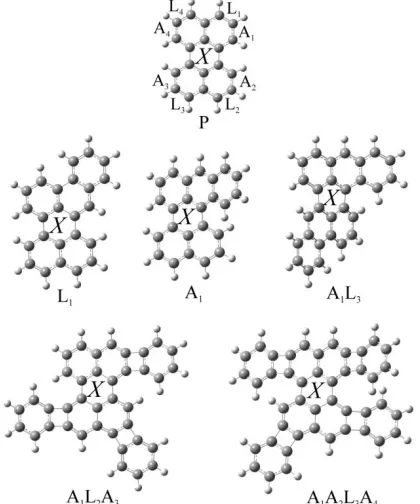
The considerations in this paper pertain to benzo- and BCBD-annelated perylenes. In order to simplify our notation, the sites of annelation in perylene are labeled as indicated in Fig. 2. The labeling of the BCBD-derivatives is analogous to that of the benzo-annelated congeners, and should be evident from the examples depicted in Fig. 2. Perylene is a relatively small molecule of Cs symmetry, but the majority of its 26 benzo-annelated and 26 BCBD-annelated congeners
Fig. 2. Perylene (P) and the labeling of its annelation sites (A = angular, L = linear with regard to the central ring X). The benzo- and BCBD-annelated congeners of perylene are denoted by
molecule Δef (benzo)
Δef
(BCBD)
ΔHOMA
(benzo)
ΔHOMA
(BCBD) ΔΣ (benzo) ΔΣ (BCBD) L1 -0.0011 +0.0029 -0.0596 +0.0120 +1.180 (P) -0.046 (P)
L1L2 -0.0021 +0.0067 -0.1242 +0.0313 +2.485 (P) -0.121 (P)
L1L3 -0.0021 +0.0068 -0.1156 +0.0327 +2.302 (P) -0.240 (P)
L1L4 -0.0025 +0.0067 -0.0795 +0.0228 +1.904 (NP) -0.036 (P)
L1L2L3 -0.0034 +0.0121 -0.1090 +0.0494 +2.613 (NP) -0.257 (P)
L1L2L3L4 -0.0045 +0.0197 -0.1391 +0.1201 +3.640 (NP) -1.449 (NP)
A1 +0.0045 +0.0004 +0.0811 -0.0443 -1.934 (NP) +1.028 (P)
A1A2 +0.0104 +0.0007 +0.1381 -0.0680 -3.399 (NP) +1.541 (NP)
A1A3 +0.0106 +0.0007 +0.1282 -0.0538 -3.461 (NP) +1.464 (NP)
A1A4 +0.0107 +0.0004 +0.1567 -0.0442 -3.198 (NP) +1.818 (NP)
A1A2A3 +0.0189 +0.0008 +0.2070 -0.0793 -4.762 (NP) +2.723 (NP)
A1A2A3A4 +0.0304 +0.0009 +0.2870 -0.1123 -6.330 (NP) +4.334 (NP)
A1L2 +0.0030 +0.0031 +0.0406 -0.0136 -1.162 (NP) +0.526 (NP)
A1L3 +0.0030 +0.0032 +0.0365 -0.0195 -0.951 (NP) +0.853 (NP)
A1L4 +0.0029 +0.0029 +0.0251 -0.0172 -1.238 (NP) +0.363 (NP)
A1A2L3 +0.0082 +0.0033 +0.0771 -0.0404 -2.601 (NP) +1.003 (NP)
A1L2A3 +0.0084 +0.0032 +0.0726 -0.0355 -2.780 (NP) +0.901 (NP)
A1L2A4 +0.0086 +0.0029 +0.1154 -0.0197 -2.329 (NP) +1.564 (NP)
A1L2L3 +0.0009 +0.0069 -0.0516 +0.0163 +0.194 (NP) +0.286 (NP)
A1L2L4 +0.0016 +0.0066 -0.0121 -0.0241 -0.472 (NP) +0.644 (P)
A1L3L4 +0.0016 +0.0066 -0.0150 +0.0180 -0.299 (NP) +0.109 (NP)
A1A2A3L4 +0.0158 +0.0031 +0.1459 -0.0569 -3.932 (NP) +2.185 (NP)
A1A2L3L4 +0.0063 +0.0065 +0.0170 -0.0050 -1.822 (NP) +0.443 (NP)
A1L2A3L4 +0.0065 +0.0066 +0.0184 -0.0133 -2.105 (NP) +0.268 (NP)
A1L2L3A4 +0.0056 +0.0062 +0.0631 +0.0513 -0.966 (NP) -0.421 (NP)
A1L2L3L4 -0.0002 +0.0116 -0.0431 +0.0102 +0.664 (NP) +1.248 (NP)
1 The ef values were taken from Ref. (Gutman et al. 2004). The same holds for Fig. 3. 2
The ef values were taken from Ref.(Gutman and Stojanovska 2011). The same holds for Fig. 3
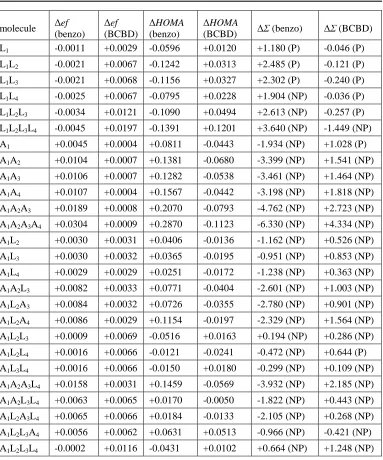
Table 1. The change of the ef (β), HOMA and Σ (pm) indices of the ring X caused by benzo- and BCBD-annelation. Δef(benzo) is the difference between the ef value of the ring X of the benzo-annelated congener and the ef value of the same ring in perylene. The meanings of Δef(BCBD), ΔHOMA(benzo), ΔHOMA(BCBD), ΔΣ(benzo), and ΔΣ(BCBD) are analogous. The labeling of the compounds is presented in Fig. 2. The ef, HOMA, and Σ values of perylene
amount 0.0218 β, 0.1898, and 867.712 pm, respectively. The symbols P and NP in the ΔΣ(benzo) and ΔΣ(BCBD) columns indicate planarity/non-planarity of the molecule in
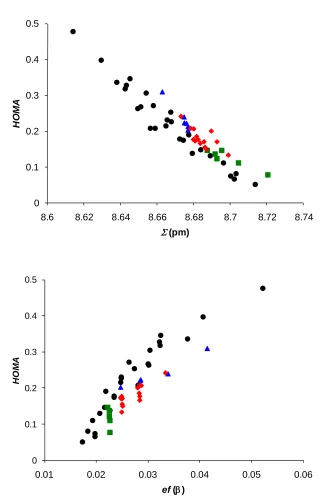
Fig. 3. Correlation between the HOMA and values (top), and HOMA and ef values (bottom) of the ring X of perylene and its benzo- and BCBD-annelated derivatives. Circles denote all
benzo-annelated perylenes, whereas triangles, rectangles, and squares stand for linearly, angularly, and medley BCBD-annelated derivatives, respectively.
0 0.1 0.2 0.3 0.4 0.5
8.6 8.62 8.64 8.66 8.68 8.7 8.72 8.74
H
O
M
A
(pm)
0 0.1 0.2 0.3 0.4 0.5
0.01 0.02 0.03 0.04 0.05 0.06
H
O
M
A
As expected, linear correlation between the HOMA and values is reasonably good, with the
correlation coefficient of -0.95 (Fig. 3). The data points pertaining to both benzo- and BCBD-annelation form a single correlation line, without visible separation between the points associated to two different annelation modes. This result confirms our earlier findings (Balaban et al. 2011a; Balaban et al. 2011b) that HOMA and reproduce very similar π-electron properties of the ring X, which can be considered as its local aromaticity. As in the case of the phenanthrene congeners (Balaban et al. 2011b) the fact that many perylene derivatives are nonplanar does not affect the effects of annelation. Obviously, the deviation from planarity allows the bonds to take the lengths close to their optimal values.
Consider now the HOMA and values of the molecules obtained by linear and angular annelation (first 12 pairs of molecules in Table 1). In this case the two indices are in agreement (the sign of the HOMA value is opposite to the sign of the Σ value), and their values indicate that the effect of benzo-annelation is opposite to that of BCBD-annelation. Furthermore, the
HOMA values decrease (resp. increase) with increasing number of linear (resp. angular) benzo-annelations, and the Σ values increase (resp. decrease) with increasing number of linear (resp. angular) benzo-annelations. The situation with BCBD-annelation is completely opposite. Namely, the HOMA values increase (resp. decrease) with increasing number of linear (resp. angular) BCBD-annelations, and Σ values decrease (resp. increase) with increasing number of linear (resp. angular) BCBD-annelations. In addition, one can observe that the effects of angular annelation are stronger, so that the local aromaticity of the ring X is the highest in benzo-annelated A1A2A3A4, and lowest in BCBD-benzo-annelated A1A2A3A4. As a consequence of the competition between the stabilizing and destabilizing modes of annelation, the values of the HOMA and Σ indices of the pairs of molecules where both linearly and angularly annelated fragments are involved lie between those for linearly and angularly annelated molecules. In the majority of cases, HOMA and take positive and negative values, respectively, for the benzo-annelated molecules, whereas the situation is opposite in the case of the annelation. This finding again confirms the stronger effect of both benzo- and BCBD-annelations in angular position. These facts imply that HOMA and obey the rules 1-3 and 2*, but not the rules 1*, 3*, and 4*.
The ef values of the benzo-annelated perylenes obey the rules 1-3, implying that they show very similar behavior to that of the HOMA values (Table 1). The only negative ef value among the medley annelated molecules is that for the congener containing three linear fragments. The dependence of HOMA of the benzo-annelated perylene derivatives on ef is curvilinear, without significant deviations from curvilinearity (Fig. 3). On the other hand, the ef values of the BCBD-annelated derivatives conform to the rules 1*-4*, implying that angular annelation has very weak influence to the local aromaticity of the central ring. Such behavior of the ef values of the BCBD-annelated perylenes is quite contradictory to those of the HOMA and indices.
Namely, the ef values are almost identical for a certain number of angular annelations, while the ranges of the HOMA and Σ values are much wider. This fact explains the appearance of “vertical lines” in the HOMA vs. ef plot (Fig. 3). The correlation between and ef is of similar quality (except that the values increase with the increasing ef values), and is not presented here.
4. Conclusions
contradictory conclusions has been recognized many times (see e. g. (Krygowski 1993; Schaad and Hess 2001; Stanger 2009)). As the presently used DFT-method provides a far more accurate description of the electronic structure of polycyclic conjugated molecules than a graph-theory-based approach, we are inclined to conclude that the predictions concerning the angular BCBD-annelation, made by means of the ef-method, should be taken and interpreted with due caution.
Acknowledgements
S. M. acknowledges support of the Ministry of Education, Science and Technological Development of Serbia (Grant No. 172016).
Извод
Локална ароматичност код бензо- и бензоциклобутадиено-анелираних
перилена
С. Марковић1*, И. Гутман1, Н. Симић1
1Природно-математички факултет, Универзитет у Крагујевцу, 34000 Крагујевац (Србија)
*Аутор за кореспонденцију
Резиме
Испитани су ефекти бензо- и бензоциклобутадиено- (BCBD-) анелације на локалну ароматичност централног прстена X перилена. Локална ароматичност прстена X је процењена помоћу индекса ef, заснованог на теорији графова, и помоћу два индекса који се заснивају на геометрији молекула, HOMA и . Резултати настали применом индекса ef
са једне стране и индекса HOMA и са друге стране су донекле контрадикторни. Наиме,
индекси засновани на геометрији показују да је ефекат бензо-анелације супротан ефекту BCBD-анелације, док ef предвиђа да ангуларна BCBD-анелација има веома мали утицај на локалну ароматичност централног прстена перилена. Пошто су индекси засновани на молекулској геометрији софистициранији у односу на индекс који се заснива на теорији графова, може се закључити да су поузданија предвиђања проистекла из примене индекса HOMA и .
References
Balaban A. T., Đurđević J., Gutman I., Jeremić S., Radenković S., (2010). Correlations between local aromaticity indices of bipartite conjugated hydrocarbons, J. Phys. Chem. A, 114, 5870-5877.
Balaban, A. T., Gutman I., Marković S., Simijonović D., (2011a). Local aromaticity in benzo- and benzocyclobutadieno-annelated anthracenes, Monatsh. Chem., 142, 797-800.
Balaban A. T., Gutman I., Marković S., Simijonović D., Đurđević J., (2011b). Local aromaticity in benzo- and benzocyclobutadieno-annelated phenanthrenes, Polycyc. Arom. Comp., 31, 339-349.
Balaban A. T., Gutman I., Jeremić S., Đurđević J., (2011c). Effect of benzo-annelation on cyclic conjugation, Monatsh. Chem., 142, 53-57.
Becke A. D., (1993). Density-functional thermochemistry. III. The role of exact exchange, J. Chem. Phys., 98, 5648-5652.
Bosanac S., Gutman I., (1977). Effect of a ring on the stability of polycyclic conjugated molecules, Z. Naturforsch., 32a, 10-12.
Clar E., (1972). The Aromatic Sextet. Wiley, London.
Coulson C. A., (1940). Calculation of the energy in unsaturated hydrocarbon molecules, Proc. Cambridge Phil. Soc., 36, 201-203.
Đurđević J., Radenković S., Gutman I., Marković S., (2009). Testing the PCP-rule, Monatsh. Chem., 140, 1305-1309.
Frisch M. J., Trucks G. W., Schlegel H. B., Scuseria G. E., Robb M. A., Cheeseman J. R., Scalmani G., Barone V., Mennucci B., Petersson G. A., Nakatsuji H., Caricato M., Li X., Hratchian H. P., Izmaylov A. F., Bloino J., Zheng G., Sonnenberg J. L., Hada M., Ehara M., Toyota K., Fukuda R., Hasegawa J., Ishida M., Nakajima T., Honda Y., Kitao O., Nakai H., Vreven T., Montgomery J. A. Jr., Peralta J. E., Ogliaro F., Bearpark M., Heyd J. J., Brothers E., Kudin K. N., Staroverov V. N., Kobayashi R., Normand J., Raghavachari K., Rendell A., Burant J. C., Iyengar S. S., Tomasi J., Cossi M., Rega N., Millam J. M., Klene M., Knox J. E., Cross J. B., Bakken V., Adamo C., Jaramillo J., Gomperts R., Stratmann R. E., Yazyev O., Austin A. J., Cammi R., Pomelli C., Ochterski J. W., Martin R. L., Morokuma K., Zakrzewski V. G., Voth G. A., Salvador P., Dannenberg J. J., Dapprich S., Daniels A. D., Farkas O., Foresman J. B., Ortiz J. V., Cioslowski J., Fox D. J. (2009). Gaussian 09, Rev A.01 Gaussian Inc, Wallingford.
Graovac A., Gutman I., Trinajstić N., Živković T., (1972). Graph theory and molecular orbitals. Application of Sachs theorem, Theor. Chim. Acta, 26, 67-78.
Gutman I., Bosanac S., (1977). Quantitative approach to Hückel rule. The relations between the cycles of a molecular graph and the thermodynamic stability of a conjugated molecule, Tetrahedron, 33, 1809-1812.
Gutman I., Cyvin S. J., (1989). Introduction to the Theory of Benzenoid Hydrocarbons. Springer, Berlin.
Gutman I., (2003). Impact of the Sachs theorem on theoretical chemistry: a participant's testimony, MATCH Commun. Math. Comput. Chem., 48, 17-34.
Gutman I., Turković N., Jovičić J., (2004). Cyclic conjugation in benzo-annelated perylenes: How empty is the “empty” ring?, Monatsh. Chem., 135, 1389-1394.
Gutman I., (2005a). Cyclic conjugation energy effects in polycyclic π-electron systems, Monatsh. Chem., 136, 1055-1069.
Gutman I., (2005b). Cyclic conjugation energy effects in polycyclic π-electron systems, Monatsh. Chem., 136, 1055-1069.
Gutman I., Stojanovska B., (2011). Effect of benzocyclobutadieno-annelation on cyclic conjugation in perylene, Maced. J. Chem. Chem. Engin., 30, 235-240.
Gutman I., Balaban A. T., (2011). Simple mathematical model for the effect of benzo-annelation on cyclic conjugation, J. Serb. Chem. Soc., 76, 1505-1511.
Gutman I., Janošević M., Radenković S., (2011b). Effect of benzocyclobutadieno-annelation on cyclic conjugation in coronene, Kragujevac J. Sci., 33, 45-53.
Gutman I., (2011). Effect of benzocyclobutadieno-annelation on cyclic conjugation, Indian J. Chem., 50A, 670-673.
Jeremić S., Radenković S., Gutman I,. (2010a). Cyclic conjugation in benzo-annelated coronenes, Maced. J. Chem. Chem. Engin., 29, 63-69.
Jeremić S., Radenković S., Gutman I., (2010b). Cyclic conjugation in benzo-annelated triphenylenes, J. Serb. Chem. Soc., 75, 943-950.
Kruszewski J., Krygowski T. M., (1972). Definition of aromaticity basing on the harmonic oscillator model, Tetrahedron Lett., 13, 3839-3842.
Krygowski T. M., (1993). Crystallographic studies of inter- and intramolecular interactions reflected in aromatic character of π-electron systems, J. Chem. Inf. Comput. Sci., 33, 70-78.
Krygowski T. M., Cyranski M. K., (2001). Structural aspects of aromaticity, Chem. Rev., 101, 1385-1419.
Lee C., Yang W., Parr R. G., (1988). Development of the Colle-Salvetti correlation-energy formula into a functional of the electron density, Phys. Rev B, 37, 785-789.
Li X., Shi Y., Gutman I., (2012). Graph Energy. Springer, New York.
Marković M., Đurđević J., Gutman I., (2012). Cyclic conjugation in benzo- and benzocyclobutadieno-annelated terrylenes and higher rylenes, J. Serb. Chem. Soc., 77, 751-759.
Minkin V. I., Glukhovtsev M. N., Simkin B. Y., (1994). Aromaticity and Antiaromaticity. Electronic and Structuraл Aspects. Wiley, New York.
Randić M., (2003). Aromaticity of polycyclic conjugated hydrocarbons, Chem. Rev., 103, 3449-3606.
Schaad L. J., Hess B. A., (2001). Dewar resonance energy, Chem. Rev., 101, 1465-1476. Stanger A., (2009). What is aromaticity: A critique of the concept of aromaticity - can it really