Many Perceptions, One Landscape
JANET STEPHENSON
H
ERITAGE LANDSCAPES IS AN INCLUSIVE CONCEPT, as attested by thebroad range of disciplines and interest groups attending the Looking Forward to Heritage Landscapes conference that gave rise to this and other papers in this issue of Landscape Review.! The presentations made it clear that the 'heritage value' of a landscape includes its significance to a variety of disciplines (e.g., historians, landscape architects, archaeologists, ecologists), its value to various groups (e.g., heritage agencies, nature conservation organisations), and its value to associated communities (e.g., tangata whenua,2 residents). The concept, thus, has enormous potential to encourage cross-fertilisation between disciplines, and between these
and the groups and communities for whom specific landscapes have significance. So far, however, we are still feeling our way as to how to make this inclusive
concept a reality. In New Zealand, as elsewhere in the world, there is more written about the potential for an integrated approach than about its realisation. This was borne out by the very different ways in which the heritage value of landscapes was conceived at two earlier conferences held in New Zealand in 2003: one hosted by the New Zealand Historic Places Trust entitled Heritage Landscapes Think Tank and the other hosted by the Environmental Defence Society entitled Reclaiming Our Heritage: The New Zealand Landscape Conference. At the former conference there was general agreement that heritage landscapes were:
... those landscapes, or networks of sites, which deserve special recognition or protection because of their heritage significance to communities, tangata whenua or the nation. They encompass physical structures and changes made to the environment by people, natural landforms modified by human action, the meanings given to places and the stories told about them (Stephenson,
2003, p 2).
The latter conference was primarily focused on the heritage value of the indigenous
biodiversity and 'naturalness' of landscapes, and was:
... prompted by a growing sense of general unease, ofloss and regret, engendered by the nature, rate and scale of some of the changes that are occurring in coastal and high country landscapes [and) also in places like the Waitakere Ranges (Smale, 2003, p 227).
The perceived 'heritage value' of landscapes was in the first case predominantly represented by history, meaning and stories in the land, and in the second
Dr lanet Stephenson is a Professional
Practice Fellow in the Geography
Department at Otago University, Dunedin, Aotearoa New Zealand Telephone: +64-3-4798779 Fax: +64-3-479 9037
email [email protected]
KEY WORDS
He11tage landscape
Cultural values model Integrated approach
Embedded values
In a sense, this was a classic example of the nature/culture split that still permeates 'landscape' thinking, and that strongly influences how we identify, protect and
manage significant landscapes.
Such divided thinking is challenged by the heritage landscapes concept. The US ICOMOS Natchitoches Declaration on Heritage Landscapes, for example, stresses the need (amongst other things) to:
Pursue an inter-disciplinary approach within the cultural heritage field, in
concert with natural heritage professionals and organizations, to identify,
document, designate and manage heritage landscapes, using a holistic model
[and tol
Recognize that multi-values are present in heritage landscapes and that multiple
voices, including strong community engagement, need to be brought to their
protection and management (ICOMOS USA, 2004).
The European Landscape Convention similarly notes the need to develop multi-disciplinary approaches to landscape policy, protection, management and planning (Council of Europe, 2000). Here, though, it is acknowledged that all landscapes (not just 'heritage' or other value typologies) contribute to wellbeing and cultural identity, and that landscapes are 'an essential component of people's surround-ings, an expression of the diversity of their shared cultural and natural heritage' (Article 5).
These international instruments highlight one of the key challenges in recognising and managing the values of heritage landscapes (or valued landscapes
generally) - that is, the need to develop an integrated understanding of values that may be expressed in very different ways by the diverse disciplines, groups and communities that have an interest in them. This challenge is as real in New Zealand as it is in the northern hemisphere (e.g., Coffin, 1997; Parliamentary Commissioner for the Environment, 2001; Parliamentary Commissioner for the Environment, 2003; Peart, 2004).
A serious barrier to achieving a more integrated approach is the multiplicity of ways of perceiving landscape value - both at an experiential level (various personal and cultural 'ways of seeing') and at a conceptual level (e.g., adopting a stance on one side or other of the natural! cultural dualism). These barriers are reinforced by methods of landscape assessment that focus on a narrow range of attributes, and produce useful but largely exclusionary typologies such as 'natural landscapes', 'cultural landscapes', 'historic landscapes'. Yet, as Scazzosi (2004) notes: ' ... any place can be read for its cultural, natural and environmental meanings ... it does not make sense, theoretically, to distinguish" cultural" landscapes (but also historic landscapes, anthropic landscapes, etc) from "natural" landscapes, as they all can be read for their cultural and natural meanings - they are all landscapes' (pp 337 -8).
This paper relates an attempt to develop an integrated understanding of landscape values in the Akaroa Basin, in the South Island of New Zealand, as part of the author's PhD research. This case study sought to understand the landscape through the eyes of people who had close associations with the place. The research sought to engage with the multiplicity of values present in the landscape, and to find a way of presenting these values that was not reliant on typologies or dualisms.
A brief explanation of the use of the term 'value' in this context is necessary. Influenced by postmodernism, the idea of 'value' has changed from something that is intrinsic and universal to an understanding that values are a social construction created out of the cultural contexts of a time and place (Avrami, Mason et al, 2000). In the context of resource allocation choices, Thomas Brown (1984) usefully defines values as 'an enduring conception of the preferable which influences choice and action' (p 232). Such preferences involve both a valuer and an object of value: Greg Brown et al (2002) suggest that people hold certain 'values' but also express 'value' for certain objects. In this sense, an understanding of how a landscape is valued involves understanding both the nature of the valued 'object' (or aspect of
landscape), and the nature of the expressed value/ s for that object. These values do not speak for themselves: they can only be identified when they are expressed by those who are part of the cultural context, or those who are in a position to
observe and understand it. Accordingly, the research process sought to 'observe and understand' the range and nature of values, and the aspects of the landscape that were thus valued, through in-depth interviews of tangata whenua and residents of the Akaroa Basin.
The case study took place in the later part of the overall research process, and aimed in part to test the usefulness of an integrating model,3 which had been
developed by the author earlier in the research process. As the model's propositions provide the framework for the analysis that follows, I will outline some of the theoretical background to its conceptual features prior to moving on to describe the Akaroa case study and findings.
THEORETICAL INFLUENCES
Landscape is of theoretical interest to many disciplines - geographers, landscape architects, anthropologists and landscape ecologists, to name just a few - and the theoretical literature on landscape is abundant and ever-evolving. While it is not possible to condense easily the nature of such a lively and many-sided debate, one overwhelming impression is that 'landscape' is a notion that has been claimed by both scientists and humanists, who approach it differentially as either 'abstract space' or 'humanised space' (Tilley, 1994), sometimes to the detriment of its being understood as both. In relation to landscape, Ingold compares 'the sterile opposition between the naturalistic view of the landscape as a neutral, external backdrop to human activities and the culturalistic view that every landscape is a particular cognitive or symbolic ordering of space' (2000, p 189).
hard-edged dualisms and towards more multi-layered and inclusive understandings. Within the geographic literature, for example, understandings of landscape have broadened from Sauer's rationalist analysis of landscape as a 'product of human actions' (Sauer, 1963) to an interest in its subjective and experiential aspects (e.g., Tuan, 1979; Meinig, 1979; Cosgrove, 1988; Jackson, 1989), including the 'bodily experiences of the land and the co-fabrication between humans and the earth' (Thrift, 2004, p 12). Cross-fertilisations have also occurred between concepts of place, space and landscape. The work of geographer Edward Relph is of particular interest here as an early attempt to theorise the experience of place in phenomenological and inclusive terms. He drew inspiration from Heidegger's belief that '[sjpaces receive their being from places and not from "the space" ... Man's essential relationship to places, and through them to space, consists in dwelling ... the essential property of
human existence' (cited in Relph, 1976, p 28). Through his examination of human experience of place, Relph concluded that the identity of a place is 'comprised of
three interrelated components, each irreducible to the other - physical features or appearance, observable activities and functions, and meanings or symbols ... every identifiable place has unique content and patterns of relationship that are expressed and endure in the spirit of that place' (Relph, 1976, p 61). Relph's three components of 'place' - the static physical setting, the activities occurring there, and their meanings - are inseparably interwoven in the experience of place.
The interweaving of people and place has more recently been coined by Ingold (2000) as a 'dwelling perspective', whereby the mutual engagement of the human and non-human components of landscape continuously generates both cultural knowledge and bodily substance. The landscape is thus constituted as 'an enduring record of - and testimony to - the lives and works of past generations who have
dwelt within it and in so doing, have left there something of themselves' (Ingold, 2000, p 189).
A further relevant development of geographic thought has been an exploration of time in a spatial context. When considered together, time and space have traditionally been seen as a dualism - space as stasis, and time as the domain of
dynamism and progress. The thrust of geographic literature on space-time is to offer understandings of space that are dynamic rather than static. Geography's traditional focus on mapping had resulted in 'a geography of traces of actions, rather than the beat of living footfalls' (Crang, 2001, p 194). Re-thinking the nature of space-time requires a sense of the events and processes of time in space, whereby 'present and past coexist in a virtual order' (Crang and Travlou, 2001, p 169). In making sense of space and time together, it is necessary to be inclusive of social practice (May and Thrift, 2001) and pay attention to the phenomenological experience of the moving body - 'not just bodies moving through space but making it' (Crang, 2001, p 194).
than seeking explanatory power through the fundamental dichotomies of western thought (nature/culture, objective/subjective), these concepts offer dynamic models of human-spatial interaction.
These ideas were heavily influential in the development of the Cultural Values Model, which attempted to posit some key conceptual devices that would capture the dynamic, time-laden and interactive aspects of landscape. A review of existing models of landscape showed that there have been a number of attempts from within a variety of disciplines to transcend landscape dualisms, and to offer an inclusive approach. Despite the spread of time and disciplines, strong synergies were evident among a number of these (e.g., Lynch, 1960; Relph, 1976; Spirn, 1998; Darvill, 1999; Soini, 2001; Terkenli, 2001). Relph's 'three interrelated components' (described above), for example, have strong similarities to Terkenli's 'three interlocking facets' of landscape: the visual (form), the cognitive (meaning) and the experiential (functions, processes and human experiences).
But do these models bear any relationship to how people value landscape? A pilot study carried out by the author and others in Bannockburn (Stephenson, Bauchop, et aI, 2004) had revealed that the landscape's significance to its residents consisted 'not only of the physical environment (both its natural and human-created elements) but also cultural perceptions, practices, traditions, and stories, and the relationships between people and the land' (p 87). The study also suggested that significance was enhanced by the dynamic linkages between these aspects, over
time and space.
The Cultural Values Model emerged from the author's consideration of these
findings and the theoretical streams described above, and suggested that landscape significance can be clustered around three fundamental components - forms, practices and relationships.
The term forms captures the physical, tangible or objective aspects oflandscape. It includes natural features (landforms, vegetation, etc), landscape forms created by or resulting from human intervention (buildings, structures, etc), and features that are a result of both human and natural processes (farms, gardens, constructed wetlands, etc).
Practices captures activities and processes that are associated with a landscape. Mindful of Ingold's 'dwelling perspective', this term is used to encompass the actions and interactions of humans and natural processes, whereby humans are not 'apart' but are seen as organisms acting within a continuum of natural/cultural influences. These influences may include traditional· practices, contemporary activities and even ecological/natural processes.
The term relationships is used to encompass the located meanings generated between people and their surroundings. These may be evidenced through means such as stories, aesthetics, genealogies, spirituality, art, naming and myths.
follows the contour of the hill). Forms generate relationships (the mountain peak is considered to be beautiful; or it possibly embodies an ancestor), and relationships may determine practices (a sacred place will require certain behaviours). The three components can be considered separately, but in reality each component influences the others, is inseparable from the other, and they are in continual dynamic interchange.
Such dynamism is continuous over time. The landscape of the present reflects past interchanges between forms, practices and relationships, and these influence how the landscape is 'dwelled in', perceived and, ultimately, how it is valued.
A landscape's significance may thus include its current and historic forms, the practices that occur or have occurred there, and the relationships that exist or have existed in that landscape. Put another way, values are also generated by the
time-depth of people's experience of landscape. Accordingly, the Cultural Values Model suggests that a landscape's surface values arise from a response to what is tangibly present, while its embedded values arise from knowledge or experience of a landscape's past. These latter concepts ensure that the values arising from the 'beat of the living footfalls' (Crang, 2001, p 194) and the 'enduring record' of
landscape (Ingold, 2000, p 189) can each be accounted for.
In summary, the Cultural Values Model proposes that the landscapes can be understood in an integrated way through consideration of forms, practices and relationships; the dynamic interactions between these; and how these interactions have continued over time. Their significance to people can be founded in any or all
of these aspects of the landscape. The model further suggests that values arise both from immediate responses to the 'surface landscape', and fTOm associations with and knowledge of the 'embedded landscape'. These concepts were used as the basis
for analysis of the Akaroa case study.
THE AKAROA CASE STUDY
The Akaroa case study sought to understand how the Akaroa landscape was perceived and valued, with a particular focus on the perceptions of those who live in and associate with the landscape. Given that the primary role of the case study was to test the usefulness of the Cultural Values Model in understanding landscape significance in an integrated way, the focus of this part of the research was to capture the range of values implicit in landscape, rather than to try and understand exhaustively the full complement of values present and/or their relative significance.
A brief synopsis of the area's rich history will set the context for the interview materiaL Renowned for its rich resources, the area was first settled by Maori from around 750-800 years ago. Maori village sites were located near the water around the harbour and stations for signalling between the two sides of the harbour are recorded in place-names such as Mairaki, Otahukolca and Te Ahi Taraiti. For times of war or unrest, pa (fortified sites) were constructed. There are many burial places, and places where bodies were prepared for burial. These are still tapu (sacred) and only a few are in the public record. The misty peaks and rocky pinnacles of the hills
around the harbour were home to the patupaiarehe (mythical fair-skinned people; fairies). Today, two main hapu (sub-tribes) are associated with the study area.
European interest in the area began with sealers and whalers plying the offshore
coastal waters from the 1790s. Maori traded with the whalers and also worked as whalers themselves. The first notable influx of Europeans was the establishment of several shore-based whaling stations in the coastal bays from the late 1830s. At
this point there were already some Europeans living in Akaroa Harbour, but the Figllre 1: The Akaroa stlldy area.
first organised group of settlers was a group of French and German settlers in 1840. English settlement began in earnest from 1850, and the pressure for land led to a complex series of land sales, some of dubious legitimacy, which ultimately resulted in almost all land in the Akaroa Basin becoming owned by Europeans or by the Crown. Two small 'native reserves' at Onuku and Opukutahi were granted to local Maori after they strongly protested through the courts that they had been left no land with which to support themselves. The loss of land, on top of inter-tribal massacres of the 1830s and poor resistance to new diseases, led to a much-reduced Maori presence in the area (Evison, 1993).
The clearing of the forest was largely complete by 1900, and dairy farms were
the main land use until the 1960s when sheep and beef farming became dominant (Pawson, 1987). Akaroa remained relatively isolated for most of this period, the
only road access being unsealed until the late 1960s. Over the past two decades, a national decline in the viability of smaller farms has coincided with increased mobility and affluence, and the area's attractions have drawn in many new residents.
The small harbour-edge settlements have grown, and rural lifestyle blocks and new horticultural activities have begun to change the face of the rural hinterlands. The area has become popular as a retirement haven and holiday resort. Tourism, always a feature, has increased markedly, with the area's appeals including the spectacular landscape, safe harbour and the quasi-French identity and colonial charm of the township of Alcaroa.
Case study methodology
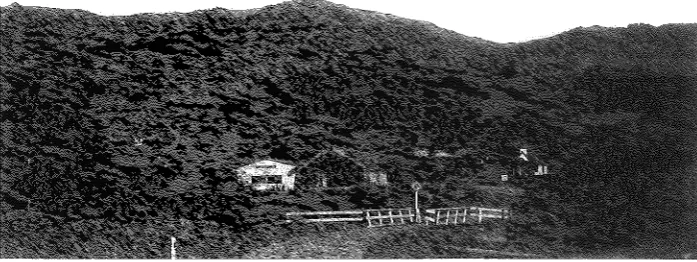
Figure 2: The photograph used during the third stage of the interviews. The image, from the western side of the harbour, shows a relatively typical view of the eastern side of the Alwroa basin, with its rim of steep hills, dropping to rolling farmland and to the harbotlr's edge. Part of A1<aroa township is visible at the left hand side of the photograph, and Greens Point, Takapuneke and Red House Bay are in the centre foreground. 171e peahs on the skyline include Te Pild a te Ake (PHrple Peak), Taraterehu (Stony Bay Peak) and Oteaaheke (Brase nose). (Author's collection.)
asking open-ended questions about what was important about the landscape of the study area. The term 'landscape' was not defined by the interviewer - this was left to the interviewee to define through the nature of his or her responses. However, it was explained that the ridgeline of the basin's encircling hills was the extent of the study area.
Each interview lasted for between half an hour to one-and-a-half hours. The interview format was in three parts. At the beginning, the purpose of the interview was explained, and the interviewee was invited to state how long they had lived in or been associated with the area, and what they did for a living. The interviewee was then asked to describe what was important to them about the landscape of the area. A topographical map of the study area was available so that interviewees could refer to the map when describing places of significance. The map was not the primary focus of the interview, but it was used to ensure that the interviewer could be clear about what places were being referred to (particularly important as many places have more than one name). When the interviewee ran out of steam they were prompted by the use of phrases such as 'Is there any other aspect that is important to you?' or 'What else is special about the landscape?'. When no more
comments were forthcoming, the final stage was to produce a photograph of part of the landscape (Figure 2).
The photograph was taken by the author from the western side of the harbour, near Wainui, looking across to the eastern side (see Figure 1 for location). The photograph encompasses part of Akaroa settlement (at left) and extends from the
The interviews were preceded by the author's background research on the physical, historic and social context of the area. This material proved to be essential to the author's understanding of comments made by community members during the interviews, particularly when (as frequently occurred) reference was made to
past history.
Because the research aim was to gain an understanding of the range of cultural values in landscapes, rather than a statistically representative sample of values, interviewees were sought to represent a range of potential viewpoints. The methods of selection differed for Maori and non-Maori. The six Maori interviewees were recommended by the two relevant runanga (tribal authorities) for the study area,
for their local knowledge and their genealogical connections to the area. The other interviewees were chosen from people who lived in the study area, selected to represent a range of possible views, including for example long- and
short-term residents, retired and employed people, farmers and urban workers, both conservation and development oriented, and originating from both New Zealand
and overseas.
Findings
Analysis of the interview results took place in two stages. Initially, the interview notes were combed through for common patterns of response. The second stage of analysis was to apply the conceptual framework of the Cultural Values Model to the interview results. This was done with two intentions: first, testing whether the model 'worked' in the sense of adequately representing the nature and range of values expressed at Akaroa, and secondly assessing whether the application of the
model offered an enriched and integrated understanding of the data. The findings from the second stage of the analysis are reported below.
Forms
The physical forms of the landscape were important to almost all Akaroa interviewees. These extended from the general (the harbour, the surrounding hills, the skyline, native vegetation, historic farming patterns) to the particular (specific structures, historic settlements, current and historic walking trails, certain natural features, sacred places, viewing points).
Landscape as a whole
The form of the landscape as a whole was valued in many different ways. Some respondents made specific reference to the beauty or aesthetics of the landscape, and most referred to the vista or view, either of a particular part of the landscape or of the landscape as a whole. Many references were to the spectacular skyline or ridgeline of the Akaroa Basin. The view of the harbour and surrounding hills from Hill Top (where the main road first allows a glimpse of the basin) received special mention. The open space of the basin was valued, as was its sense of containment or enclosure.
itself was also valued, for a variety of reasons, including its visual quality, ambience, shape and colour, views from the harbour, its history, the underwater landscape, fishing, and the harbour's role in access to settlements around it. The harbour was also important for its delineation of the separate rohe (tribal areas) of the Wairewa and Onuku hapu.
Places within the landscape
Frequent reference was made to certain places in the landscape. The most common were to Onawe (see Figure 3), Onuku (a very small settlement, also called the Kaik), and to Takapuneke (a bay and the land immediately behind, also called Red House Bay). Reasons for their significance were varied, and there were often multiple reasons for valuing the same place. For Onawe, for example, most references were to the historic defensive pa built by tangata whenua in anticipation ofTe Rauparaha's attack, to the ensuing battle in 1832, and/or to the subsequent death or enslavery of many tribal members. Yet Onawe was also significant because of its unique visual appearance, its geological origin, and the 'feeling' of the place.
Some special places had a subset of important features - for example at Onuku, the church, meeting house, dining hall, old school, old school house, urupa (burial places), and a certain tree received special mention by different respondents.
Some important places were not necessarily individually located or named, such as references to urupa, wahi tapu (sacred places), battle sites or fishing places.
Networks
Roads and tracks were important in the landscape, both in their own right and also
as a means to move through the land. An historic Maori foot trail from Wainui over the hill to Little River was referred to several times, as was a similar trail over to Birdlings Flat. Certain early European tracks or roads were also mentioned, some
of which are still in use. Contemporary walking tracks - such as ones that run along the ridgelines - were also considered to be important parts of the landscape.
Practices
Interviewees referred to a variety of practices in the context of describing the landscape's significance. These included contemporary activities, historic events and traditions, and certain natural and ecological process.
Contemporary practices
Currently valued practices included walking through the landscape, exploration of the landscape, personal or family activities in the landscape (e.g., farming, fishing) and nature conservation work. Some contemporary practices had long traditions, and in some instances were associated with particular places within the landscape. Examples here include fishing or gathering seafood, and kaitiakitanga (the exercise of guardianship by tangata whenua in accordance with Maori traditions).
Past practices
for walking and trading. Practices associated with European settlement included
land clearance, sawmilling, settlement, and traditional farming activities including dairying, beef and sheep faming, and growing grass for seed.
Processes
Interviewees also referred to processes in the landscape that were either the result of human/nature interaction, or purely 'natural' in origin. For example, many enjoyed seeing the regeneration of bush on certain properties. Some respondents with a farming background were less positive about regeneration - considering this a result of poor farming practices - but most of these felt that bush was an
important part of the landscape as long as it was in its place. Other more naturally influenced processes that were valued included seasonal changes, weather patterns
and geological processes such as the volcanic origins of the Akaroa Basin.
Past events
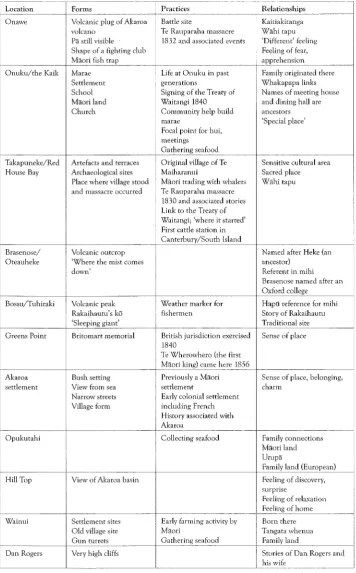
The historic aspects of the landscape were important to many respondents, and most referred to events of significance embedded in the landscape - historic ones such as its volcanic history, clearance of bush, whaling, and the massacres by Te Rauparaha, and contemporary ones such as the recent building of Onuku Marae (traditional communal buildings and meeting space). Many events that related to specific locations were described by interviewees. Some of these are summarised in the 'practices' column in Table
1.
Relationships
Statements that expressed valued relationships with the landscape fell into a
number of overlapping clusters.
Feelings
A number of respondents, both Maori and European, referred to a sense of place, a feeling of belonging, or a spiritual connection with the landscape. Landscape
Figllre 3: The upper A/wroa Harbollr.
values were also expressed in terms of sensory responses, such as enjoyment of colour, light, visual patterns, pristine-ness, naturalness and beauty. The landscape as a whole was considered variously to be dramatic, enfolding, full of vitality and soul-refreshing.
Rootedness
Almost all interviewees, regardless of their origins or length of residence, referred to feelings of belonging or rootedness in the landscape. This was expressed in a variety of ways. Interactions with the landscape over time led to a detailed knowledge of the physical landscape and an awareness of how things 'used to be'. Farming traditions and community traditions in the landscape were mentioned frequently, as were family genealogical associations with places within the landscape.
Stories
When asked what was important about the landscape, many interviewees told stories that expressed much about the relationship between people and their landscape. There are a number of overlaps between events listed under 'practices' and stories described here, but 'stories' is used here in an inclusive sense, spanning the broad continuum between history and myth, which can reveal particular relationships between the teller and the landscape.
Stories were recounted by both European and Maori respondents. They included myths (e.g., Rakaihautu and the creation of Tuhiraki - see Figure 4), historic events (e.g., Te Rauparaha's attack and massacre at Takapuneke; the
hoisting of the British flag at Greens Point), and the recounting of personal or family histories (e.g., Dr Baker's school at French Farm, or a family member's death
from exposure). What the stories had in common was explanatory power as to why a certain aspect of the landscape had heightened significance for a person or group. There was considerable cross-cultural flow in story-telling - some of the
stories recounted by Europeans were of Maori origin, and some stories told by Maori related to European or bicultural experiences. Stories were often clustered around place names. An example is 'French Farm' which refers to an area that was farmed to supply the needs of the permanently stationed French warship in the early 1840s.
In all, some 27 different stories were recounted or referred to. Sometimes, several people would refer to the same story but there was not necessarily a high level of consistency between them. For example, three different versions were offered of how the cliff named 'Dan Rogers' received its name. One version was that it was named after a robber who rode over the cliff when being pursued; another that it was named after a Sydney publican whose arguments with his wife sounded like the waves beating on the cliff; and a third that the foam of the breaking waves was like the exposed petticoat of the same publican's wife when she arose in a bad mood and was seen walking down the stairs.
Maori
cultural relationshipsthere were additional relationship values that were expressed only by Maori respondents. Although two of these respondents had never lived in the study area, they nevertheless expressed strong relationships with the landscape.
All tangata whenua interviewees made reference to belonging to the landscape through whakapapa, both in the sense of family genealogy and in the sense of the spiritual origins of Maori in the land itself. Whakapapa provided direct links to ancestors, to their past actions, to the land and landscape, and to personal and tribal identity. Connections were expressed, for example, through ritual statements of belonging, such as the mihi (greeting) used by tangata whenua of Onuku to establish tribal identity, which refers to the peak Tuhiraki and the stream Awa-iti. Ancestral figures were part of the landscape, such as in the story of Rakaihautu, and in the names of places and marae buildings. The actions of ancestors in significant events in the landscape were also recalled, such as Te Maiharanui's trading with whalers and sealers, and the signing of the Treaty of Waitangi at Onuku. Intimate knowledge of the landscape was held to be particularly important, with reference made to tribal knowledge of sacred places within the landscape, and about the land, sea and their resources.
Relationships with the two areas of Maori land at Opukutahi and Onuku were also significant, particularly as these areas represent the only places in the study area where Maori have had continuity of ownership. Onuku Marae was important
as a core focus of identity, meeting and community. Reference was also made in various ways to the kaitiaki (guardianship) role of tangata whenua, expressed
through such things as management of the marae, the management of Onawe, and concern about development proposals for Takapuneke.
Figure 4: Tuhiraki (Mount Bossu) - the location of one of the stories of this landscape. In Maori mythology, the great
explorer Te Rakaihawll travelled along the coast, marking trails, identifying key places and resources, and lealling place names
on many coastal features. At Tuhiraki,
Te Rakaihautu plunged his ko (digging
European cultural relationships
A number of aspects of the landscape that relate strongly to Maori tradition were valued by European respondents, such as community involvement in the recent building of Onuku Marae, its visual appearance and its welcoming quality. It was difficult to identify a solely 'European' set of relationships except perhaps those arising from early European ancestors. Some interviewees who had descended from families that had lived in the area since the 1850s conveyed a deep knowledge of past events and practices in the landscape, and a strong awareness of continuity and change in the landscape. For many longer-established Europeans, these family links to the landscape, or to particular parts of the landscape, were highly important.
Given that the first influx of European settlers were French and German, it was expected that there would be some mention of these traditions in the landscape context, but there was surprisingly little. This may be because the 'Frenchness' of the area is largely confined to Akaroa township, and that this element was not considered to be part of the wider landscape.
Landscape dynamics: interactions between forms, practices and relationships
The next stage of analysis of the interview results examined dynamic links between valued forms, practices and relationships. Table 1 summarises people's expressions in relation to some key landscape features. It pans across values expressed in relation to the forms, practices and relationships of the most frequently mentioned places in the landscape.
Table 1 suggests that those parts of the landscape that were most frequently nominated as being valued tended to be important for a cluster of reasons. Some
respondents referred only to a single aspect of value, but for others the forms, practices and relationships were all important, and often interrelated. Onawe's
significance, for example, combined the physical remains of battle fortifications, Te Rauparaha's raids, feelings of fear and apprehension, and its status with tangata whenua as a wahi tapu, and a place for which they had kaitialci responsibilities. A similar dynamism can be seen with the next two most regularly mentioned places - Onulcu and Talcapuneke, and many of the others in the table. This may suggest that values are maintained more strongly where forms, practices and relationships all have currency and interact dynamically, or that, conversely, where these components are all present, it generates a greater sense of value.
Landscape temporality: surface and embedded values
The Cultural Values Model suggests that the temporal dimension of the landscape is an important part of its value. As has been illustrated already, many of the references made by community members arose from a sense of the time-depth
of the landscape. These can be differentiated from perceptions that arose from people's responses to the physically experienced landscape.
Table 1: Some values associated with key Akaroa landscape features
:
L~cation---- - - --~ --- ~--- -~-~~~~~
Forms Practices Relationships
I Onawe Volcanic plug of Akaroa Battle site Kaitiakitanga i volcano Te Rauparaha massacre Wahi tapu
i Pa still visible 1832 and associated events 'Different' feeling
1
Shape of a fighting club Feeling of fear,
Maori fish trap apprehension
Onuku/the Kaik Marae Life at Onuku in past Family originated there
Settlement generations Whakapapa links
School Signing of the Treaty of Names of meeting house Maori land Waitangi 1840 and dining hall are Church Community help build ancestors
n1arae 'Special place' Focal point for hui,
meetings Gathering seafood
Takapuneke/Red Artefacts and terraces Original village ofTe Sensitive cultural area House Bay Archaeological sites Maiharanui Sacred place
Place where village stood Maori trading with whalers Wahi tapu and massacre occurred Te Rauparaha massacre
1830 and associated stories Link to the Treaty of Waitangi; 'where it started' First cattle station in Canterbury/South Island
Brasenose/ Volcanic outcrop Named after Heke (an
Oteauheke 'Where the mist comes ancestor)
down , Referent in mihi
Brasenose named after an Oxford college
Bossu/Tuhiraki Volcanic peak Weather marker for Hapu reference for mihi !
Rakaihautu's ko fishermen Story of Rakaihautu
'Sleeping giant' Traditional site
Greens Point Britomart memorial British jurisdiction exercised Sense of place 1840
Te Wherowhero (the first Maori king) came here 1856
Akaroa Bush setting Previously a Maori Sense of place, belonging,
settlement View from sea settlement charm
Narrow streets Early colonial settlement Village form including French
History associated with Alearoa
Opukutahi Collecting seafood Family connections
Maori land Urupa
i Family land (European)
HillTop View of Alearoa basin Feeling of discovery,
surprise
Feeling of relaxation Feeling of home
Wainui Settlement sites Early farming activity by Born there
Old village site Maori Tangata whenua
Gun turrets Gathering seafood Family land
Dan Rogers Very high cliffs Stories of Dan Rogers and
Figure 5: Onu/w Marae (two buildings
at left) and church (right, rear),
and lengthy. This does not necessarily mean that embedded values were more important; it could be that interviewees were more comfortable or eloquent in telling stories than in expressing concepts of beauty.
Interestingly, three tangata whenua respondents made no reference to surface
values whatsoever - all of their comments referred to embedded values. In contrast, one interview (of a couple, who had lived in the area only a year) referred only to
surface values.
Table 2 differentiates between surface and embedded values expressed in relation to a few of the more frequently mentioned locations.
As Table 2 reveals, surface values primarily relate to the visual appearance or sensory experience of parts or all of the landscape. Embedded values relate to the past, either in terms of the visual effects of the past, relationships arising through personal or genealogical associations, or knowledge of the past.
Some embedded values related to continuity between past and present. Continuity of family connections to the area was important to both Maori and European respondents. The continuity of certain practices and traditions was also spoken of, such as walking through the landscape, collecting seafood, farming the
land, and kaitiakitanga. Continuity of some aspects of the landscape, therefore, may generate values that arise from a sense of local tradition.
The interview data also revealed that many of the embedded values were
associated with the establishment of landscape forms, practices or relationships during certain key periods of the past. Table 3 shows schematically these key periods and how often they were referred to by interviewees.
It is apparent from Table 3 that the past periods or events that were collectively most significant to the interviewees were the pre-European Maori period and Te
Table 2: Some surface and embedded values in the Akaroa landscape
_
..---.~.~-- " " - - - _._---_. __ .
__
.Surface values Embedded values
Onawe Shape of landform protruding Meaning of name of highest point
into the harbour Site of battle
Plug of volcano Wahi tapu
Visible pa remains
Wairewa and Onuku kaitiaki
Onuku View of marae and church 'Heart' of hapu
buildings Sense of community
Personal histories Whakapapa links
Signing of Treaty ofWaitangi
Tracks Walking through landscape Historic routes (Maori and early
Sense of discovery European)
Hills and skyline Views Changing over time (e.g., regeneration)
Colours Memories of child self
Patterns Memories of activities (working,
exploring, fishing, playing) Sense of community Whakapapa Spiritual connections Ancestral links
Historic farming patterns Personal attachment; feeling of belonging
A long association with the landscape did not appear to be a necessary precondition for perceiving embedded values. In Table 4, the array in Table 3 is overlain by a series of bars that indicate the length of interviewee association with the landscape. In this table, 'length of association' includes personal, family and genealogical associations with the landscape. The arrowed 'length of association' bars are for Maori interviewees whose lineage links them to the area over many generations.
Table 4 indicates that the embedded values of the landscape can be important to relative newcomers to an area, as well as to those who have a long association with a place. Embedded meaning is not limited to events that were part of interviewees' personal history. Interestingly, a number of European interviewees expressed values relating to Maori cultural components of landscape. On the other hand, most Maori respondents did not refer to the period between 1840 and 1900, perhaps understandably, given the massive reduction in Maori population and associated physical dislocations at this time.
Discussion
Table 3: Key eras giving rise to embedded values Table 4: Length of association cotnpared to key eras
Era that values are generated by:
Era that values are generated by:
Pre-European Maori • • • • •
••
••••
Pre-European Maori••
•
•••
Early contact period, sealers, whalers
Te Rauparaha raids 1830s
First FrenchlGerman settlers 1840
Start of organised European settlement 1850s-60s
Major land clearances 1860s-1900
Classic farming era 1900-1990
INTERVIEWEE
•
•
•• • •
••
Early contact period,sealers, whalers
••
•
•
••••••••
•
•
••••
Te Rauparaha raids1830s
••••
•
• •
•
••
• ••••
•
•
••
••
•••••
•
•
First FrenchlGerman settlers 1840Start of organised European settlement 1850s-60s
Major land clearances 1860s-1900
Classic farming era 1900-1990
•
• •
•
•••• •
•
CEHIJNGOPKALRFOQBSMT
t
I ICEHIJNGOPKALRFOQBSMT
• = era referred to by interviewee INTERVIEWEE
• = era referred to by interviewee
... :;:: length of association with landscape
The analysis in terms of forms showed that people value specific places, networks and more extensive spaces such as the skyline, bush and harbour. The same form may attract multiple values, including, for example, visual appearance, stories, geological origins, feelings and spirituality. The findings also suggest that there may be a greater tendency to attribute surface values to the broader landscape, and embedded values to localised places and networks. This would be an interesting area for further study.
Respondents frequently referred to practices when describing the landscape's significance to them. Some practices referred to no longer occur (e.g., whaling, sawmilling), some are recent (e.g., nature conservation work) but some provide continuity between past and present, such as fishing, fanning and kaitiakitanga. Processes were referred to less often, although the regeneration of native vegetation on the hills was valued, as were seasonal changes and other natural phenomena. A variety of past events gave shared significance to the landscape.
While some aspects of relationships were particular to individuals, a number of aspects were shared. A sense of belonging to the landscape was almost universally
respondents, in addition, expressed particular values arising from a Maori cultural world-view and from the whakapapa that bound them to the area. Sonle European respondents with long family histories in the area also shared particular values
arising from their length of association with the area. Shared stories also linked people to the landscape.
The analysis confirms that forms, practices and relationships are all important aspects of what is valued about landscapes. These aspects may be expressed differently - for example, while interviewees F and P both valued walking through the landscape, for F it is linked to smells, sounds and sights; and for P it provides associations with ancestors.
Some outcomes of the interviews were not easily categorised under one or another of the three components - for example, stories express something of the relationships between the person and place, but also could be categorised as events or practices. However, the study's analysis of cultural values through each of the three components provided a more dynamic understanding of the nature of values in the landscape than would have been realised through simply focusing on one component such as the physical landscape.
The findings also confirm the interactions of forms, practices and relationships in the landscape. While each of these aspects can be considered separately, the places most often mentioned as being of value in the landscape were where more than one of these aspects was significant. This suggests that multiple aspects of value reinforce one another; for example, practices may reinforce the value of forms, generating stronger relationships. Further research into this would be valuable,
particularly in relation to the development of appropriate management strategies for valued places.
Temporal aspects of the landscape strongly influence how it is valued. While some values relate to sensory responses to present forms, many responses were generated by an awareness of the time-depth of the landscape. As discussed earlier, most respondents expressed both surface and embedded values; but three tangata whenua expressed only embedded values. This suggests that landscape evaluations that focus on surface values (e.g., aesthetic values) will fall short of addressing the full significance of a landscape to its inhabitants. On the other hand, a study of the historic features of a landscape would not record surface values - and may not capture the practices and relationships associated with those features. Attention needs to be paid to forms, practices and relationships at both a surface level and an embedded level in order to gain a full appreciation of the range of values present in any given landscape.
does not immediately provide the means of determining relative significance of one aspect of the landscape over another, it does offer some insights into how different aspects of value may interact and compound.
Further testing of the model would be beneficial. Because the model has been derived and tested in two largely rural New Zealand landscapes, it would be useful to test its reliability in other situations such as urban landscapes, 'ordinary' landscapes, and highly valued landscapes, as well as in different cultural contexts.
CONCLUSION
In the introduction, it was posited that 'landscape' is an inclusive concept, but that its integrating potential is challenged by the many different disciplinary and
typological approaches, and the deeply ingrained dualisms of Western thought. The application of the Cultural Values Model to the Akaroa case study suggests that, through the eyes of its inhabitants at least, landscape significance is founded neither in just 'natural' nor in 'cultural' attributes but in a seamless experience of the interweaving of people and place. For those with close associations with the landscape, these experiences include what it looks like, how it feels, how the inhabitants physically interact with the landscape, what occurs and has occurred there, their embedded histories and family connections, and knowledge of the past.
The Cultural Values Model is an attempt to express and integrate the many potential facets of landscape significance through a set of inter-related concepts. While further testing of its propositions has yet to occur, the model may be of some assistance in framing more integrated inquiries into landscape significance,
in order that the multiplicity of perceptions of value can be better understood as a dynamic whole. It is only through the development and refinement of such integrative approaches that the full 'heritage value' of landscapes
will
be able to beacknowledged.
NOTES
1 New Zealand Institute of Landscape Architects' national conference, Dunedin, 28-30 April 2005.
2 Maori 'people of the land'.
3 The development of the model is described in 'The Cultural Values Model - A unifying framework for considering landscapes and their significance' (Stephenson, 2006, in press).
REFERENCES
Avrami, E, Mason, R, et al (2000) Values and Heritage Conservation - Research Report, Los Angeles: The Getty Conservation Institute.
Brown, G, Reed, P, et al (2002) Testing a place-based theory for environmental evaluation: an Alaska case study, Applied Geography 22, pp 49- 76.
Brown, T (1984) The concept of value in resource allocation, Land Economics 60(3), pp 231-246.
Coffin, A (1997) Evaluation of Cultural Heritage Landscape -Te Awa 0 Wairoa/Ngati ICahu, Tauranga,
Cosgrove, D and Daniels, S (eds) (1988) The Iconography of Landscape, Cambridge: Cambridge
University Press.
Council of Europe (2000) European Landscape Convention, US/ICOMOS Scientific lournal, 2(1),
pp 88-92.
Crang, M (2001) Rhythms of the city: temporalised space and motion. In TimeSpace: Geographies of temporality, J May and N Thrift (eds) London and New York: Routledge.
Crang, M and Travlou, PS (2001) The city and topologies of memory, Environment & Planning D:
Society and Space 19, pp 161-1
n
Darvill, T (1999) The historic environment, historic landscapes, and space-time-action models in landscape archaeology. In P Ucko and R Layton (eds) The Archaeology and Anthropology of Landcape,
London, New York: Routledge, pp 104-118.
Evison, HC (1993) Te Wai Pounamu - The Greenstone Island, Christchurch: Aoraki Press.
ICOMOS USA (2004) Natchitoches Declaration on Heritage Landscapes, http://www.icomos.org/ usicomos, United States Committee, International Council on Monuments and Sites.
Ingold, T (2000) The Perception of the Environment: Essays on livelihood, dwelling and skill, London and
New York: Routledge.
Jackson, P (1989) Maps of Meaning, London, New York: Routledge.
Lynch, K (1960) The Image of the City, Cambridge, Mass: Technology Press.
May, J and Thrift, N (eds) (2001) TimeSpace: Geographies of temporality, London and New York:
Routledge.
Meinig, DW (1979) Symbolic Landscapes. In The Interpretation of Ordinary Landscapes, DW Meinig
(ed) New York, Oxford: Oxford University Press.
Parliamentary Commissioner for the Environment (2001) Managing Change in Paradise: Sustainable Development in Peri-urban Areas, Wellington.
Parliamentary Commissioner for the Environment (2003) Superb or Suburb? International Case Studies
in Management of Icon Landscapes, Wellington.
Pawson, E (1987) The European Impact, The Natural and Human History of Akaroa and Wairewa Counties, Christchurch: Queen Elizabeth II National Trust.
Peart, R (2004) A Place to Stand: the protection of New Zealand's natural and wlturallandscapes,
Auckland: Environmental Defence Society.
Relph, E (1976) Place and Placelessness, London: Pion.
Sauer, C (1963) Land and Life - a selection from the writings of Carl Ortwin Saller, Berkley, Los Angeles:
University of California Press.
Scazzosi, L (2004) Reading and Assessing the Landscape as Cultural and Historic Heritage,
Landscape Research 29(4) pp 335-355.
Smale, S (2003) Concluding Comments, Reclaiming Our Heritage: The New Zealand Landscape Conference,
Auckland, New Zealand, July.
Soini, K (2001) Exploring human dimensions of multifunctional landscapes through mapping and map-making, Landscape and Urban Planning 57 pp 225-239.
Spirn, AW (1998) The Langlwge of Landscape, New Haven and London: Yale University Press.
Statistics New Zealand (2001) 2001 Census of Population and Dwellings, Wellington.
Stephenson, J (2003) Heritage Landscapes in Aotearoa/New Zealand - Briefing Paper, Wellington: NZ
Historic Places Trust.
Stephenson, J, Bauchop, H, et al (2004) Bannockburn Heritage Landscape Study, Wellington:
Terkenli, TS (2001) Towards a theory of the landscape: the Aegean landscape as a cultural irnage,
Landscape and Urban Planning 57, pp 197-208.
Thrift, Nand Whatmore, S (eds) (2004) Caltllral Geography: Critical concepts in the social sciences, London and New York: Routledge.
Tilley, C (1994) A Phenomenology of Landscape, Oxford UK: Providence RI, Berg.
Tuan, YF (1979) Thought and Landscape - the Eye and the Mind's Eye, In TIle Interpretation of