Volume-7 Issue-2
International Journal of Intellectual Advancements
and Research in Engineering Computations
An experimental study on strength property of concrete by partial
replacement of coarse aggregate with seashell and cement with fly ASH
S. Manikandasamy
1,
N. Gowsalya
1, R.Gobi
1, R. Alageswaran
1, P.Karthika
21
UG Students, Department of Civil Engineering, Nandha Engineering College, Erode.
2
Assistant Professor, Department of Civil Engineering, Nandha Engineering College, Erode.
ABSTRACT
The growing concern of resource depletion and global pollution has lead to the development of new materials relying on renewable resources. Many by- products are used as aggregate for concrete. Seashell waste which is a major financial and operational burden on the shellfish industry is used as an ingredient in concrete thus offering alternatives to preserve natural coarse aggregate for future generation. Seashell is mainly composed of calcium and the rough texture make it suitable to be used as partial coarse aggregate replacement which provides an economic alternative to the conventional materials such as gravel. Experimental studies were performed on conventional concrete and mixtures of seashell with concrete. The percentage of seashell is varied from 10%, 20% and 30%. Also the cement is replaced for 15% of flyash. The mech anical properties of concrete such as compressive strength, tensile strength, flexural strength, and workability are evaluated. This research helps to access the behavior of concrete mixed with seashell and determination of optimum percentage of combined mixture which can be recommended as suitable alternative construction material in low cost housing delivery especially in coastal areas and near fresh water where they are found as waste.
Keywords:
Seashell, Fly Ash, Compressive strength, Tensile strength, Flexural strength, Workability.INTRODUCTION
Civil engineering practice and construction works in India depend to a very large extent on concrete. Concrete is one of the major building materials that can be delivered to the job site in a plastic state and can be moulded insitu or precast to virtually any form or shape. Concrete basic constituents are cement, fine aggregate (sand), coarse aggregate (granite chippings) and water. Hence, the overall cost of concrete production depends largely on the availability of the constituents (and selected additives). Water reacts chemically with cement to form the cement paste, acts as binder holding the aggregate together which is an exothermic hydration reaction. Aggregates are usually described as inert "filler" material of either the fine (sand) or coarse (gravel) variety. It tends to represent a relatively high volume
aggregates. One such waste is the seashells obtained from coastal areas, freshwater lakes, and riverine areas. Seashell is a hard, protective layer, a calcareous exoskeleton which encloses, supports and protects the soft parts of an animal (molluscs). As they grow, the shells increases in size which becomes a strong compact casing for the mollusc inside. The major molluscan seashell includes, bivalves such as clams, scallops, and cockle. The hard shells are regarded as waste, which are accumulated in many parts of the country, when dumped and left untreated may cause unpleasant odour and disturbing view to the surrounding. Also the aggregate surface texture influences the bond between aggregate and cement paste in hardened concrete. Thus it opens an investigation into its
potential as a partial replacement of coarse aggregate. [1-5]
PROJECT WORK
Materials used and its Properties
Cement
The Cement used in this study was Ordinary Portland cement (OPC) which is the most important type of cement. OPC cement of 53grade of cement use in this experimental work. Conforming weight of each cement bag was 50kg.The property of cement is shown in Table 1 [6-10]
Table 1: Properties of Cement
Physical Properties Value observed in investigation Standard value for OPC
Specific gravity 2.85 -
Initial setting time (minutes) 112 > 30 Final setting time (minutes) 540 < 600
Fine aggregate
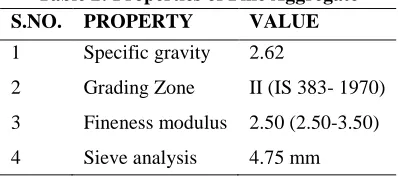
M-sand was used as Fine aggregate with fineness modulus of 2.85 and it should passing through IS Sieve 4.75mm. It should have fineness
modulus 2.50- 3.50 and silt content should not be more than 4.The properties of Fine aggregate are shown below in Table 2.
Table 2: Properties of Fine Aggregate
S.NO. PROPERTY VALUE
1 Specific gravity 2.62
2 Grading Zone II (IS 383- 1970)
3 Fineness modulus 2.50 (2.50-3.50)
4 Sieve analysis 4.75 mm
Coarse aggregate
The coarse aggregate are the blue granite stone of which particles greater than 4.75mm they should be hard, strong, dense, durable and clean.
It should be conical shape. Flaky pieces should be avoided. It creates much better bond between cement paste and the Aggregates. The properties of Coarse aggregate are shown below in Table 3.
Table 3: Properties of Coarse Aggregate
S.NO PROPERTY VALUE
1 Sieve analysis 4.75 mm
2 Specific gravity 2.53
Super plasticizers
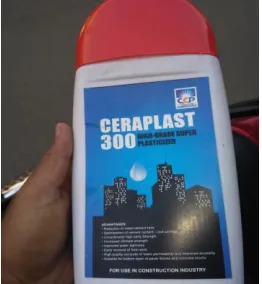
Super plasticizers are known as high range water reducers are chemical admixtures used where well dispersed particle suspension is
required. ceraplast300 conforms depending on the dosages used. The properties of Super plasticizers is shown below in Table 4.
Table 4: Physical Properties of Super plasticizer
S.NO PROPERTIES DESCRIPTION
1 Colour Brown
2 Specific gravity 1.220 to 1.225 at 300C
3 Air Entrainment Approx 1% additional air is entrained
Seashell
Seashell is a waste obtained from Kaveri river at Bhavani formed as the result of disintegration of dead animals. Seashell consists of three layers outer, intermediate and inner layer. Outer layer is made up of calcite material whereas inner layer is
otherwise known as nacre which is made up of calcium carbonate. Since 95% of calcium carbonate present in seashell, it has the strength nearly equal to coarse aggregate. The seashells of 20 mm size were sieved and used in Table 5.
Table 5: Properties of Seashell
S.NO PROPERTY VALUE
1 Sieve analysis 2.62
2 Specific gravity 2.34
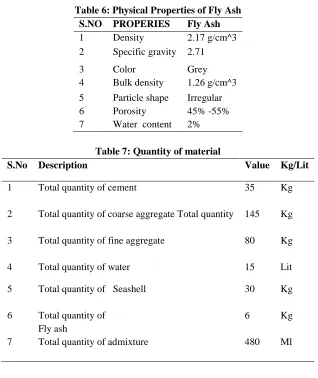
Table 6: Physical Properties of Fly Ash S.NO PROPERIES Fly Ash 1 Density 2.17 g/cm^3 2 Specific gravity 2.71
3 Color Grey
4 Bulk density 1.26 g/cm^3
5 Particle shape Irregular 6 Porosity 45% -55% 7 Water content 2%
Table 7: Quantity of material
S.No Description Value Kg/Lit
1 Total quantity of cement 35 Kg
2 Total quantity of coarse aggregate Total quantity 145 Kg
3 Total quantity of fine aggregate 80 Kg
4 Total quantity of water 15 Lit
5 Total quantity of Seashell
30 Kg
6 Total quantity of Fly ash
6 Kg
7 Total quantity of admixture 480 Ml
RESULT AND DISCUSSION
Workability of fresh concrete
Influence of seashell content on the workability of fresh concrete. The slump test was used to measure workability as a function of seashell content for constant w/c ratio, the effect of seashell content on the slump. The slump value seems to decrease with higher percentage of limestone filler content, this result is related to the relatively high water absorption capability which is attributed mainly to the large specific surface of seashell.
Compressive strength test
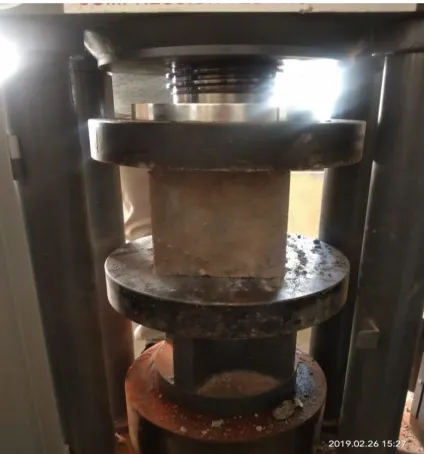
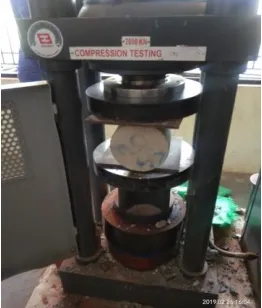
The testing of cube under compression was shown in figure
Table 8: Test results for compression strength
Mix
COMPRESSIVE STRENGTH N/MM^2
7DAYS 14DAYS
1. Mix 1 (0%) 20.22 32.132
2. Mix 2 (10%) 18.6 30.7
3. Mix 3 (20%) 24.8 38.8
4. Mix 4 (30%) 15.4 24.6
Graph 1: Compression strength Test
Split tensile strength test
For tensile strength test, cylindrical specimens of dimension 150 mm diameter and 300 mm length were cast. In this test three cylinders were tested and their average value was reported. The split
tension test was conducted by using digital compression machine having 2000 kN capacity. Split tensile strength was calculated as follows: Spilt Tensile strength (MPa) = 2P / π DL Where, P = Failure Load (kN)
D = Diameter of Specimen (150 mm)
0 10 20 30 40 50
MIX 0 Mix 1 Mix 2 Mix 3
7days
L = Length of Specimen (300 mm)
Test Results of splitting tensile strength for M60 grade of concrete shown in table 8
Three cylinder specimens were casted in each percentage, in order to find the average value of
split tensile strength. These cylinder specimens were left for 28days curing in a curing tank. After the course of curing, the specimens were ready for testing. All the cylinders were tested.
Table 9: Test results for Split Tensile strength test
Mix
SPLIT TENSILE STRENGTH TEST
N/mm^2
7DAYS 14DAYS
5. Mix 1 (0%) 2 3.2
6. Mix 2 (10%) 4.5 7.2
7. Mix 3 (20%) 7.3 11.68
8. Mix 4 (30%) 3.39 5.424
Graph 2: Split Tensile Strength Test
Flexural strength test
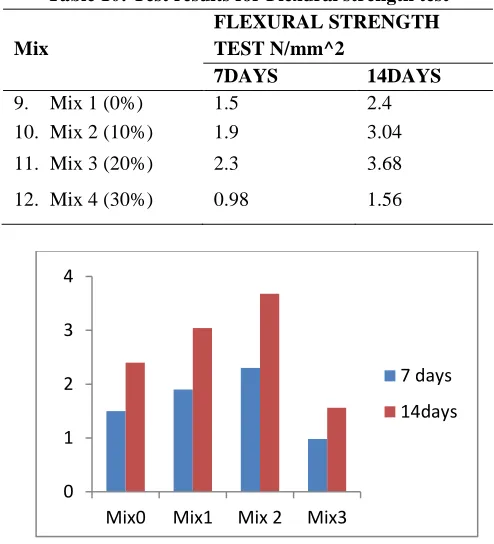
For Flexural strength test, specimen of 150 mm X 200 mm X 1500 mm was casted. A beam specimen is placed in the ultimate testing machine of 2000kN capacity for testing. Rollers are placed at a centre to centre distance of the beam
specimen. The load is increased until the specimen fails and the maximum load applied to the specimen during the test is recorded.
The Flexural strength is calculated by using the formula
σ = P l/ bh2 Where,
0 5 10 15
Mix 0 Mix 1 Mix 2 Mix 3
7days
P = load in Newton shown in dial gauge
l = length of rectangular prism in mm i.e. 500 mm
b = breadth of rectangular prism i.e. 100 mm h = height of rectangular prism i.e. 100 mm.
Test Results of flexural strength for M40 grade of concrete is shown in table 10.
Table 10: Test results for Flexural strength test
Mix
FLEXURAL STRENGTH TEST N/mm^2
7DAYS 14DAYS
9. Mix 1 (0%) 1.5 2.4
10. Mix 2 (10%) 1.9 3.04
11. Mix 3 (20%) 2.3 3.68
12. Mix 4 (30%) 0.98 1.56
Graph 3: Flexural strength test
CONCLUSIONS
In summary of the above investigations, the following conclusions are made from the experimental results indicated following:
The maximum compressive strength of Cubes are attained at 20% replaced by coarse aggregate
The Split Tensile strength of Cylinders are attained at 20% replaced by Coarse Aggregate.
The flexural strength of Prism are attained at 20% replaced by coarse aggregate.
We found out the optimum percentage for replacement of Seashell with coarse aggregate and it is 20% for all Cubes, Cylinders& Prisms.
REFERENCES
[1]. Benjamin R. Etuk, Idongesit F.Etuk and,” probability of using Sea Shells Ash as addition of admixture for Concrete” in Journal of Environmental Science and Engineering 2012, 121-127.
[2]. Dang Hanh Nguyen, Nassim Sebaibi, Mohamed Boutouil, Lydia Leleyter, Fabienne Baraud,” “The Use of Seashell by-product in Pervious ConcretePavers” in World Academy of Science, Engineering and Technology International Journal of Civil Science and Engineering 7(11), 2013.
[3]. Eun-Ik Yang , Myung-Yu Kim , Hae- Geun Park , Seong-Tae Yi, “Effect of partial replacement of sand with dry oyster shell on the long- standing concert of concrete” in Construction and Building Materials 2010, 758– 765.
[4]. Eun-Ik Yang, Seong-Tae Yi, Young-Moon Leem “concrete characteristics are found by the effect of oyster shell substituted for fine aggregate on concrete” in Cement and Concrete Research 35, 2005, 2175 – 2182. [5]. Falade F. An Investigation of Periwinkle Shells as Coarse Aggregate in Concrete. Building and Environment.
0 1 2 3 4
Mix0 Mix1 Mix 2 Mix3
7 days
[6]. Nakatani, N.; Takamori, H.; Takeda, K.; and Sakugawa, H. Transesterification of soybean oil using combusted oyster shell waste as a catalyst. Bioresource Technology, 100(3), 2009, 1510- 1513
[7]. Yang E.I., Yi S.T. & Leem Y.M. Effect of Oyster Shell Substituted for Fine Aggregate on Concrete Characteristics: Part 1. Fundamental Properties: Journal of Cement & Concrete Research, 35, 2005, 2175-2182.
[8]. Muthusamy K. and Sabri N.A. Cockle Shell: A Potential Partial Coarse Aggregate Replacement in Concrete: International Journal of Science, Environment & Technology, 1(4), 2012, 260-267.
[9]. N.H. Othman, B.H.A. Bakar, M.M. Don, M.A.M. Johari, Cockle shell ash replacement for cement and filler in concrete, Malaysian Journal of Civil Engineering 25, 2013, 201-211.