ISSN: 2334-2382 (Print), 2334-2390 (Online) Copyright © The Author(s). All Rights Reserved. Published by American Research Institute for Policy Development DOI: 10.15640/jeds.v4n2a5 URL: https://doi.org/10.15640/jeds.v4n2a5
Inflation Targeting and Macro-Economic Performance: The Case of Emerging Countries
Houda JENDOUBI
1Abstract
This study aims to examine the effect of an inflation targeting strategy on the macroeconomic performance notably inflation and growth in the context of emerging countries. Empirically, our research based on two samples of emerging countries, one is composed of 17 non-targeted countries and the other is composed of 11 targeted countries, over the 1985- 2012 period. The comparisons of the means between these two samples and between the pre-and post- targeting two periods reveal that the strategy of inflation targeting can provide a slight improvement for economic growth and a good inflation control for the targeted countries compared to the countries that are not targeted. However, the estimate of the effect of inflation targeting on growth and inflation for all the samples, targeted countries and not targeted, reveal that the strategy of targeting can curb inflation but its impact on growth is not obvious.
Key words: targeting inflation, inflation, growth, emerging countries.
JEL Classification: E31-F31- F43.
Introduction
The monetary policy is at the heart of the economic debate on strategies to stabilize prices and increase growth. Indeed, a high inflation disrupts the decisions of economic agents and affects economic growth. In turn, the monetary authorities are obliged not to accept high inflation rates and embark on a research program which is an ideal framework for the implementation of a monetary policy based on the achievement of sustainable growth and maintaining a low and stable inflation.Achieving these two objectives can motivate the authorities to proceed with inflation targeting. To do so, several countries have chosen the direct inflation targeting as a policy solution.
However, empirical studies showed conflicting results, divided between two components: the supporters of the strategy of inflation targeting which approved the effectiveness of inflation targeting on the macroeconomic performance, with low inflation and stable growth (Posen and Mishkin, 1998; Bernake and al 1999;. Landerreche and al 2001; Johnson, 2002; Da Silva and Portugal, 2002; Neuman and Von Hagen, 2002; Choi and al. 2003; Levin and al. 2004; Ghosh and al. 2014). These economists noted that inflation targeting ensures the clarity and credibility of the commitment of the Central Bank towards its goal of minimizing the rate of inflation and keeping its rate low and close to the target level. In addition, inflation targeting aligns the inflation expectations of the monetary authorities, reducing the inflationary impact of economic shocks and creates a better allocation of the monetary resources. Thus, the strategy of inflation targeting provides the countries adopting this regime a marked improvement in economic performance as measured by the trend of inflation and growth.
Other economists have suggested that inflation targeting has no effect on the macroeconomic performance (Dueker and Fisher, 1996; Cecchelli and Ehrmann, 2000; Ball and Sheridan, 2003; Petursson, 2004; Gertler, 2005; Gernc and al. 2007; Petersson, 2009 and Rose, 2014).
1 PhD Student, Faculty of Economics and Management of Tunis, Adresse: Résidence Noura –Appartement F2.2, rue des
Nevertheless, it seems that the results yielded cannot be generalized because they depend on the selected sample, the reporting period, the econometric method used and the delayed effects of the variables approximating growth and inflation.
Therefore, our work fits into this context as it focuses on the relationship between inflation targeting, growth and inflation rates. Specifically, our work aims to answer the question: does it allow the adoption of inflation targeting to improve economic performance in terms of inflation level and economic growth?
Our ultimate objective is to evaluate the involvement of the monetary policy on growth and inflation i.e. for a monetary policy based on inflation targeting in the context of emerging countries. In this chapter, we want to contribute to the existing literature in several axes. First, our sample is made up of emerging countries that have already begun to adopt the targeting strategy. Indeed, this strategy was adopted by the developed countries since the 90s, and then it was adopted by other emerging countries. As a matter of fact, in 2010, it reflects twenty emerging countries adopting this strategy. Secondly, the implementation of this policy in the latter is a bit tricky because of their specificity, such as; weak financial and fiscal institutions, non-credible monetary institutions, anchoring their currencies to the local currency and also a high vulnerability to international capital movements. The third axis is to consider a broad study period which runs from (1985 to 2012), and which captures all the random disturbances affecting the economy. This period allows us to compare the levels of growth and inflation before and after the adoption of the inflation- targeting strategy. The fourth priority is the consideration of the variables reflecting the lagged effects of inflation and growth. Indeed, the integration of delayed or shifted variables by period can capture their persistence in time.
Our paper is structured as follows; in the first section, we present our literature review. In the second section, we explain our empirical methodology. The third section shall be devoted to discussion of the empirical results and the last section concludes our work.
I. Literature Review
The empirical literature could not clearly explain the effect of the inflation targeting strategy in emerging markets. Some studies retain the benefits of the implementation of this strategy, and some others manage to confirm its adverse and removed effects. These fuzzy empirical results can be accounted for by the small number of countries that have adopted the inflation targeting regime and the very short history of its implementation.
The debate on the effectiveness of the strategy of inflation targeting on economic performance led to controversial conclusions. Indeed, many empirical studies have endorsed the effectiveness of inflation targeting on economic performance with low inflation and a stable production growth, (Posen and Mishkin 1998; Bernake and al. , 1999 ; Landerret and al 2001. Da silva and Portugal, 2002; Neumann and von Hagen, 2002 and Johnson, 2002; Choi and al. 2003; Levin and al 2004. Ghosh and al., 2014).
Other works yielded no significant evidence of inflation targeting on macroeconomic performance and the effect of the adoption of inflation targeting remains inconclusive (Dueker and Fisher, 1996; Bernank and Mihov 1998; Lane and Den Heuvel, 1998; Cecchelli and Ehrmann, 2000; Ball and Sheridan, 2003; Petursson, 2004; Gertler, 2005: Gernc and al. 2007; Schmidt-Hebbel and Mishkin, 2007; Pétursson, 2009 and Rose, 2014).Based on this economic debate about the performance of the inflation targeting policy, we will conduct an empirical study of the effectiveness of this strategy in emerging countries.
Some scholars (Hyvonen, 2004; Vega and Winkerlried, 2005; Batini and Laxton, 2007) found a significant and positive effect of adopting inflation targeting in emerging countries with a lower level of inflation than in the countries which did not adopt it.
Others (Ball and Sheridan, 2003) studied the factors that affect inflation. They concluded that inflation targeting negatively impacts the dynamics of inflation.However, Angeris and Arestis, (2007) adopt a method that solves the inflation targeting effect on inflation for a group of emerging countries. This strategy positively influences inflation.Levinand al. (2004) also attempts to study the effect of inflation targeting on the economy.
They forecast in a first stage the level of expected inflation by comparing the two groups of targeted countries (Canada, New Zealand, Sweden and England and not targeting (Denmark, euro area, Japan, Eats the US). They conclude that the inflation rate is lower in the targeted countries than in the non- targeted countries. In a second step they determined the sensitivity of inflation early compared to real inflation.
Eduardos, and al. (2008) study the implication of inflation targeting on economic performance for 36 developing countries including 13 countries adopting inflation targeting and the remainder of non-target inflation during the period (1980-2005). They used the Dif-in-Dif estimation of Ball and Sheridan (2003), to consider the level of inflation and the volatility of output growth. They found that the level of inflation has decreased in both sample groups. The results of the estimate are significant and negative, so inflation targeting is beneficial to the level of inflation. In addition, they revealed a decrease in growth volatility for both country groups; so found that the results are significant for the effect of inflation targeting on the volatility of growth. Indeed, the adoption of inflation targeting has reduced the volatility of the average growth at a low level for emerging countries using targeting inflation and thus provides them with an economic stability. According to Gonçalves and rooms, (2008), inflation targeting is beneficial for the emerging countries adopting this policy. Indeed, it generates an improvement in economic performance starting from the fall in inflation and growth volatility.
Batini and Laxton (2006) examine the macroeconomic impact of inflation targeting on inflation, the volatility of inflation and the growth volatility in 35 emerging countries (13 countries adopting inflation targeting and 22 countries non- inflation targeting) during the (1985-2004) period and based on the Ball Sheridan’s method of difference- (2003). The results of the estimate of the inflation targeting effect on the inflation trend are negative and significant. So the emerging countries adopting inflation targeting record a decrease in the average inflation and its volatility. However, there is no significant evidence between inflation targeting and output growth.
Sevenson (1997) concluded that the inflation strategy targeting leads to a stable growth of production. Mishkin, (1999) mention's that the countries that have practiced inflation targeting have achieved significant results in minimizing inflation and inflation forecast. King (2002) suggests that inflation and inflation volatility have been lower since the adoption of inflation targeting. WU, (2004) examines the effectiveness of inflation targeting on the dynamics of inflation targeting countries. He concluded that inflation targeting is more beneficial for the countries adopting inflation targeting.
To ensure an effective inflation targeting, certain pre-requisites must be met, such as the independence of the Central Bank, fiscal and financial stability, the effectiveness of the instruments of the monetary policy and a developed infrastructure; so many authors argue that owing to fragile specificities in emerging countries, the latter cannot adopt inflation targeting. It is in this sense that Ball and Sheridan (2003) studied the case of twenty OECD countries with seven countries targeting and the rest non-targeting inflation. They recorded an ambiguous effect of inflation targeting effect on the macroeconomic performance .They conclude that the targeting strategy is an endogenous decision.
Willard (2006 and 2012) compares an average inflation before and after inflation targeting. Yet, he finds as Ball and Sheridan (2003) that the strategy of inflation targeting has no significant effect on the inflation dynamics.
Levin and al. (2004) are interested in the emerging countries that have adopted the inflation targeting policy. They examine the short- and long-term inflation. They conclude that for both anticipated inflation rates, inflation targeting has no significant effect on expected inflation. Other authors (Ball and Sheridan, 2003; Gonçlves and Carvalho, 2009) also detect a confusing effect of inflation targeting on the macroeconomic performance in emerging markets.
Pétursson (2004) analyze the macroeconomic effect of the strategy of inflation targeting on the dynamics of inflation, using the average inflation rate for 21 industrialized and emerging countries that have adopted inflation targeting, and 6 countries not targeting inflation during the (1981- 2002) period. The estimation method applied is that of Seemingly Unrelated Regression (SUR), and he concludes that inflation targeting is not a statically significant inflation. Peterson subsequently re-estimates this model by adding two countries targeted in the sample with a polynomial trend according to the time-period. He deduced the existence of a long-term effect on all samples.Rose (2014) also examined the effect of inflation targeting on growth during the 2007-2011 period and did not find a significant relationship between these two variables.
II. Empirical Methodology
II.1. Hypotheses development
The relationship between inflation targeting and the macroeconomic performance has raised a great economic debate that is divided between two main components:
Some (Pose and Mishkin, 1998; Bernanke and al 1999; Landerreche and al 2001. Johnson, 2002; Da Silva and Portugal, 2002; Neuman and Von Hagen, 2002; Choie and al. 2003; Levin and al. 2004; Ghosh and al. 2014) have demonstrated the effectiveness of inflation targeting on the macroeconomic performance, starting from low inflation and high growth. Other economists (Dueker and Fisher, 1996; Cecchelli and Ehrmann, 2000; Ball and Sheridan, 2003; Petursson, 2004; Gertler, 2005; Gernc and al 2007; Petersson, 2009 and Rose, 2014) have shown that the strategy of inflation targeting does not affect the macroeconomic performance in terms of inflation and growth.
However, in the context of emerging countries, characterized by a fragile economic system that creates a hyperinflationary environment, it would be difficult to determine the effect of inflation targeting on economic performance. Therefore, a positive or negative effect between inflation targeting and macroeconomic performance is expected. Hence, our working hypothesis is formulated as follows: The adoption of inflation targeting affects the macroeconomic performance.
II.2. Sample selection
Our sample comprises 28 emerging countries including:
11 countries adopting inflation targeting: Brazil, Columbia, Hungary, Mexico, Peru, Philippines, Poland, South Africa, Thailand, Czech Republic, and Turkey.
17 Non -adopting inflation targeting countries: Argentina, Botswana, Bolivia, Bulgaria, Costa Rica, Cote d'Ivoire, Dominican Republic, Ecuador, El Salvador, Egypt, India, Malaysia, Morocco, Pakistan, Tunisia, Uruguay and Venezuela.
The data are issued by the "International financial statistics" database or statistic of the World Bank (World Bank indicator CD ROM 2012). The period of our study extends between 1985 and 2012.
III. Econometric Approach
Our econometric approach consists of two major empirical stages:
The first is to consider the sample of the targeted countries by comparing between the level of growth and inflation before and after the targeting, pre-targeting period (85- Date of inflation targeting) and another post-targeting period (date of inflation post-targeting-2012).
For the non-targeting countries, the date separating the post-targeting and pre-targeting period is set for 2000 which corresponds to the average dates of targeting- inflation adoption by other emerging countries adopting inflation targeting.. Thus, the average dates of adoption of inflation targeting for the countries targeted, fits in according to Ball and Sheridan (2003) and in our sample [Rep Tch (97) Plg + (98) + Bre (99) Colombia + (99) + ELFA South (2000) + Tha (2000) + MXE (2001) + Hgr (2001) + Peru (2002) + Phil (2002) + Trq (2006)] / 11 = 2000.
Thereby, to better understand the effect of inflation targeting on growth and inflation we shall perform a comparison in terms of a mean of these two economic variables between the two periods, pre-targeting and post-targeting, as well as 'between a first group of countries adopting inflation targeting and a second group of non- targeting inflation countries.The second step is to rely on a model in which the variables to be explained are: the level of inflation (CPI) and the level of economic growth (GDP) and the explanatory variables are: For inflation: the inflation lagged value of a variable by a period and dummy variable.
In addition, for Growth: GDP lagged value of a variable by a period and dummy countries.In this model of a dynamic panel, each endogenous variable necessarily depends on its own past, which allows us to track the potential endogeneity in the variables measuring the macroeconomic performance. Both lagged variables from one period measure the long-term effect of inflation targeting on growth and inflation.
Both models are set as follows:
= (1)
= (2)
With:
: The level of inflation in country (i) at time (t). : The level of inflation delayed by a period
: The level of growth in country i at time t : The level of growth delayed by a period constant = a dummy variable that takes the value (1) if the country adopts inflation targeting and (0) if not. : The coefficient on the dummy variable that captures the true effect of inflation targeting, respectively, on the level of inflation in model (1) and the level of growth in model (2)
The delay on the variable coefficient that measures the real effect on inflation persistence respectively on the level of inflation in model(1) and the level of growth in model (2) i = 1,2... I: countries and t =1.2...T...it's time.
it = Error term III.1. Variables Measurement
- Variable Targeting: is a binary variable that takes the value 1 if the country adopts inflation targeting and 0 if not. This variable determines the impact of the strategy of inflation targeting on inflation in model (1) and growth in model (2).
- Inflation: is measured by the consumer price index "CPI" which is the official measure of inflation better known by economic agents as it may be calculated monthly and published quickly, which facilitates control. - Economic growth: This is the annual growth rate of real gross annual product per capita, expressed in %.
This variable is decisive in the context of an inflation targeting regime for the decision of The Central Banks towards lower inflation. In addition, it captures the real impact of inflation targeting on the development of growth.
- Delayed variable: Each endogenous necessarily depends on its own past, which allows us to track the potential endogeneity of the variables by measuring macroeconomic performance. This lagged variable of a long-term measurement period gauges the effect of inflation targeting on growth and inflation.
IV. Empirical Results
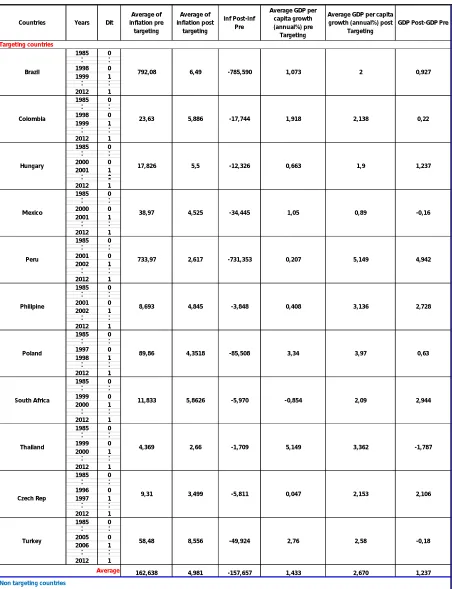
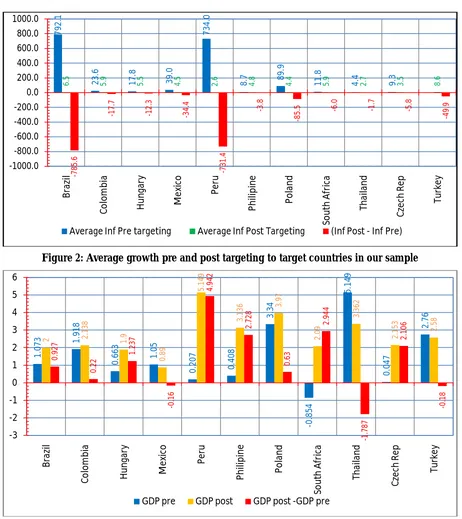
In the following table (1) are displayed the averages of inflation and growth for the targeting countries. These averages are also presented by period: pre and post targeting. They are also shown schematically n Figures (1) and (2).
Table 1: Average inflation and post pre targeting and targeting growth for countries in our sample
1985. 0.
. .
1998 0
1999. 1.
. .
2012 1
1985. 0.
. .
1998 0
1999. 1.
. .
2012 1
1985. 0.
. .
2000 0
2001. 11
. 1
2012 1
1985. 0.
. .
2000 0
2001. 1.
. .
2012 1
1985. 0.
. .
2001 0
2002. 1.
. .
2012 1
1985. 0.
. .
2001 0
2002. 1.
. .
2012 1
1985 0
. .
. .
1997 0
1998. 1.
. .
2012 1
1985. 0.
. .
1999 0
2000. 1.
. .
2012 1
1985. 0.
. .
1999 0
2000. 1.
. .
2012 1
1985 0
. .
. .
1996 0
1997. 1.
. .
2012 1
1985. 0.
. .
2005 0
2006. 1.
. .
2012 1
162,638 4,981 -157,657 1,433 2,670 1,237
Countries Years Dit
Average of inflation pre
targeting
Average of inflation post
targeting
Inf Post-Inf Pre
Average GDP per capita growth (annual%) pre
Targeting
Average GDP per capita growth (annual%) post
Targeting
GDP Post-GDP Pre
Targeting countries
Brazil 792,08 6,49 -785,590 1,073 2 0,927
0,22
Hungary 17,826 5,5 -12,326 0,663 1,9 1,237
Colombia 23,63 5,886 -17,744 1,918 2,138
-0,16
Peru 733,97 2,617 -731,353 0,207 5,149 4,942
Mexico 38,97 4,525 -34,445 1,05 0,89
2,728
Poland 89,86 4,3518 -85,508 3,34 3,97 0,63
Philipine 8,693 4,845 -3,848 0,408 3,136
2,944
Thailand 4,369 2,66 -1,709 5,149 3,362 -1,787
South Africa 11,833 5,8626 -5,970 -0,854 2,09
2,106
Turkey 58,48 8,556 -49,924 2,76 2,58 -0,18
Czech Rep 9,31 3,499 -5,811 0,047 2,153
Average
Figure 1: Average inflation targeting pre and post target for countries in our sample
Figure 2: Average growth pre and post targeting to target countries in our sample
Table (2) shows the levels of the average annual inflation in percentage change in the CPI for the emerging countries adopting inflation targeting. For the targeting countries, the average inflation rate is 162,638% during the period before inflation targeting, and 4.981% for the period after inflation targeting. There is therefore a decrease of 157 657% in terms of inflation.
From this table, it appears that the average growth in countries targeting rose from 1.433% before inflation targeting to 2.667% after inflation targeting, so there is an improvement in terms of economic growth by 1.237 %.
79 2. 1 2 3. 6 17 .8 39 .0 73 4. 0 8.
7 89.9
11 .8 4. 4 9. 3 6
.5 5.9 5.5 4.5 2.6 .84 4.4 5.9 2.7 3.5 8.6
-7 8 5 .6 -1 7 .7 -1 2 .3 -3 4 .4 -7 3 1 .4 -3 .8 -8 5
.5 -6.0 -1.7 -5.8
-4 9 .9 -1000.0 -800.0 -600.0 -400.0 -200.0 0.0 200.0 400.0 600.0 800.0 1000.0 B ra zi l C o lo m b ia H u n ga ry M ex ic o P er u P h ili p in e P o la n d So u th A fr ic a Th ai la n d C ze ch R ep Tu rk ey
Average Inf Pre targeting Average Inf Post Targeting (Inf Post - Inf Pre)
1
.0
7
3 1.9
1 8 0 .6 6 3 1 .0 5 0 .2 0 7 0 .4 0 8 3 .3 4 -0 .8 5 4 5 .1 4 9 0 .0 4 7 2 .7 6
2 2.1
3 8 1 .9 0 .8 9 5 .1 4 9 3 .1 3
6 3.9
7 2 .0 9 3 .3 6 2 2 .1 5 3 2 .5 8 0 .9 2 7 0 .2 2 1 .2 3 7 -0 .1 6 4 .9 4 2 2 .7 2 8 0 .6 3 2 .9 4 4 -1 .7 8 7 2 .1 0 6 -0 .1 8 -3 -2 -1 0 1 2 3 4 5 6 B ra zi l C o lo m b ia H u n ga ry M e xi co P er u P h ili p in e P o la n d So u th A fr ic a Th ai la n d C ze ch R ep Tu rk ey
IV.2. Inflation and growth levels for the non-targeting countries
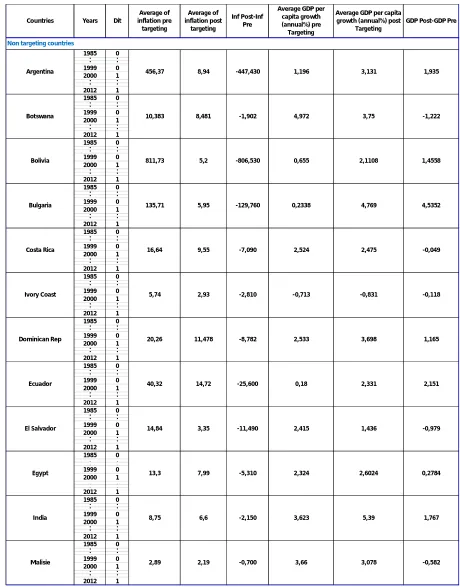
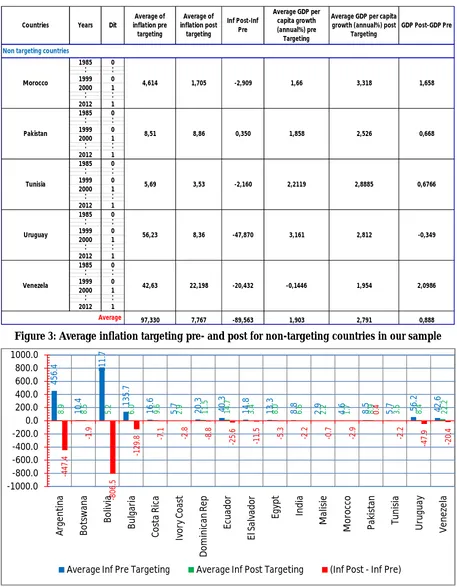
In the following table, we find the average inflation and growth for non-targeting countries. These averages are also displayed as data over time: pre and post targeting. They are also shown schematically in the figures (3) and (4).
Table 2: Average pre and post targeting growth and inflation for non-targeting countries in our sample
1985. 0.
. .
1999 0 2000. 1.
. .
2012 1 1985. 0.
. .
1999 0 2000. 1.
. .
2012 1 1985. 0.
. .
1999 0 2000 1
. .
. .
2012 1 1985. 0.
. .
1999 0 2000. 1.
. .
2012 1 1985. 0.
. .
1999 0 2000. 1.
. .
2012 1 1985. 0.
. .
1999 0 2000. 1.
. .
2012 1 1985. 0.
. .
1999 0 2000. 1.
. .
2012 1 1985. 0.
. .
1999 0 2000. 1.
. .
2012 1 1985. 0.
. .
1999 0 2000. 1.
. .
2012 1 1985 0
. .
. .
1999 0 2000 1
. .
. .
2012 1 1985. 0.
. .
1999 0 2000. 1.
. .
2012 1 1985. 0.
. .
1999 0 2000. 1.
. .
2012 1 Countries Years Dit
Average of inflation pre
targeting
Average of inflation post
targeting
Inf Post-Inf Pre
Average GDP per capita growth (annual%) pre
Targeting
Average GDP per capita growth (annual%) post
Targeting
GDP Post-GDP Pre
Non targeting countries
Argentina 456,37 8,94 -447,430 1,196 3,131 1,935
-1,222
Bolivia 811,73 5,2 -806,530 0,655 2,1108 1,4558
Botswana 10,383 8,481 -1,902 4,972 3,75
4,5352
Costa Rica 16,64 9,55 -7,090 2,524 2,475 -0,049
Bulgaria 135,71 5,95 -129,760 0,2338 4,769
-0,118
Dominican Rep 20,26 11,478 -8,782 2,533 3,698 1,165
Ivory Coast 5,74 2,93 -2,810 -0,713 -0,831
2,151
El Salvador 14,84 3,35 -11,490 2,415 1,436 -0,979
Ecuador 40,32 14,72 -25,600 0,18 2,331
0,2784
India 8,75 6,6 -2,150 3,623 5,39 1,767
Egypt 13,3 7,99 -5,310 2,324 2,6024
-0,582
Figure 3: Average inflation targeting pre- and post for non-targeting countries in our sample
1985. 0.
. .
1999 0
2000. 1.
. . 2012 1 1985 0 . . . . 1999 0
2000. 1.
. . 2012 1 1985 0 . . . . 1999 0
2000. 1.
. .
2012 1
1985. 0.
. .
1999 0
2000. 1.
. .
2012 1
1985. 0.
. .
1999 0
2000. 1.
. .
2012 1
97,330 7,767 -89,563 1,903 2,791 0,888
Countries Years Dit
Average of inflation pre targeting Average of inflation post targeting Inf Post-Inf Pre
Average GDP per capita growth (annual%) pre
Targeting
Average GDP per capita growth (annual%) post
Targeting
GDP Post-GDP Pre
Non targeting countries
Morocco 4,614 1,705 -2,909 1,66 3,318 1,658
0,668
Tunisia 5,69 3,53 -2,160 2,2119 2,8885 0,6766
Pakistan 8,51 8,86 0,350 1,858 2,526
Average
-0,349
Venezela 42,63 22,198 -20,432 -0,1446 1,954 2,0986
Uruguay 56,23 8,36 -47,870 3,161 2,812
4 5 6 .4 1 0 .4 8 1 1 .7 1 3 5 .7 1 6 .6 5
.7 20.3 40.3
1 4 .8 1 3 .3 8 .8 2
.9 4.6 8.5 5.7 56.2 42.6
8
.9 8.5
5
.2 6.0 9.6
2
.9 11.5 14.7
3
.4 8.0
6
.6 2.2 1.7 8.9
3
.5 8.4 22.2
-4 4 7 .4 -1 .9 -8 0 6 .5 -1 2 9
.8 -7.1 -2.8 -8.8
-2 5 .6 -1 1 .5 -5 .3 -2 .2 -0 .7 -2 .9 0 .4 -2 .2 -4 7 .9 -2 0 .4 -1000.0 -800.0 -600.0 -400.0 -200.0 0.0 200.0 400.0 600.0 800.0 1000.0 A rg e n ti n a B o ts wa n a B o livi a B u lg ar ia C o st a R ic a Ivo ry C o as t D o m in ic an R e p Ec u ad o r El S al va d o r E gyp t In d ia M al is ie M o ro cc o P ak is ta n Tu n is ia Ur u gu ay V en ez el a
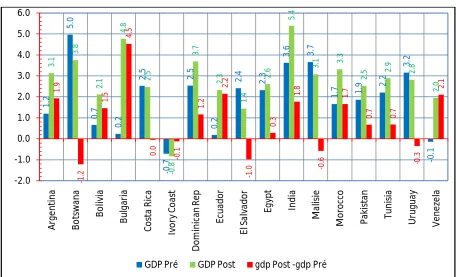
Figure 4: Average growth pre and post targeting to non-targeting countries in our sample
For the emerging countries not adopting inflation targeting, there was a drop of the average inflation rate from 97.33% to 7.767%. Thus, there is a decrease in the average rate of inflation (89,563%). Table (2) shows that the average growth rate for the non-targeting countries shifted from. 903% to 2.79%, thus an improvement in growth by 0.888%.
If we try to make comparisons between the targeting and the non-targeting countries, it first appears that the inflation targeting regime is more effective in terms of improving the average inflation in emerging countries adopting the targeting of inflation compared with other countries that use other monetary strategies.
So, countries that adopt inflation targeting policy were better able to control the evolution of inflation than other non- targeting countries.
In addition, the strategy of inflation targeting can offer a slight improvement in terms of economic growth for the targeting countries versus the non-targeting ones. It is worth noting that these two groups of samples converge to the same level of average growth.
Thus, the inflation targeting policy guarantees to emerging countries the improvement of their performance in terms of inflation and growth. The adoption of this policy is considered a success for our sample component countries. From these findings, we can conclude that the countries that adopt inflation targeting achieved a net improvement in their macroeconomic performance in terms of inflation and growth.
IV.3. Results of the effect of inflation targeting
Table (4) presents the results of the estimation .This estimate covers the three models in (85-2012); the first focuses on the total sample of emerging countries and non- targeting inflation; the second model is only related to the countries adopting inflation targeting and the third to the countries that are non-targeting.
1. 2 5 .0 0 .7 0 .2 2 .5 -0 .7 2 .5 0. 2 2 .4 2. 3 3. 6 3 .7 1
.7 1.9 2.
2 3. 2 -0 .1 3 .1 3 .8 2 .1 4 .8 2 .5 -0 .8 3 .7 2 .3 1 .4 2 .6 5 .4 3
.1 3.3
2
.5 2.9 2.8
2 .0 1 .9 -1 .2 1 .5 4 .5 0 .0 -0 .1 1 .2 2 .2 -1 .0 0 .3 1 .8 -0 .6 1 .7 0
.7 0.7
-0 .3 2 .1 -2.0 -1.0 0.0 1.0 2.0 3.0 4.0 5.0 6.0 A rg e n ti n a B o ts wa n a B o livi a B u lg ar ia C o st a R ic a Ivo ry C o as t D o m in ic an R ep E cu ad o r El S al va d o r E gyp t In d ia M al is ie M o ro cc o P ak is ta n Tu n is ia Ur u gu ay V e n ez el a
Table 4: Table 4 Results of the estimation of the effect of inflation targeting on inflation for the Countries targeted and / or non-targeting model of our sample
Model(1): Country targeting and not-targeting countries
Model(2): country targeting
Model(3): countries not targeted
Constant 100.147
(5.75)***
110.9691 (2.68) ***
53.57613 (5.67) *** Inflation delayed 0.18079
(9.33) ***
0.4122 (7.71) ***
0.06471 (5.91) ***
Dummy variable -120.1529
(-4.26) ***
-115.2094 (-1.86) *
-56.59415 (-3.87) *** Observation
per group :
Min 17 17 25
Avg 25.6486 25.181 25.94118
Max 26 26 26
Prob>chi2 0.000 0.000 0.000
Number of observation 718 277 441
Number of group 28 11 17
Number of instrument 353 232 308
Wald chi 2(2) 120.35 70.27 55.17
(***) Significant at% level-(*): Significant at%
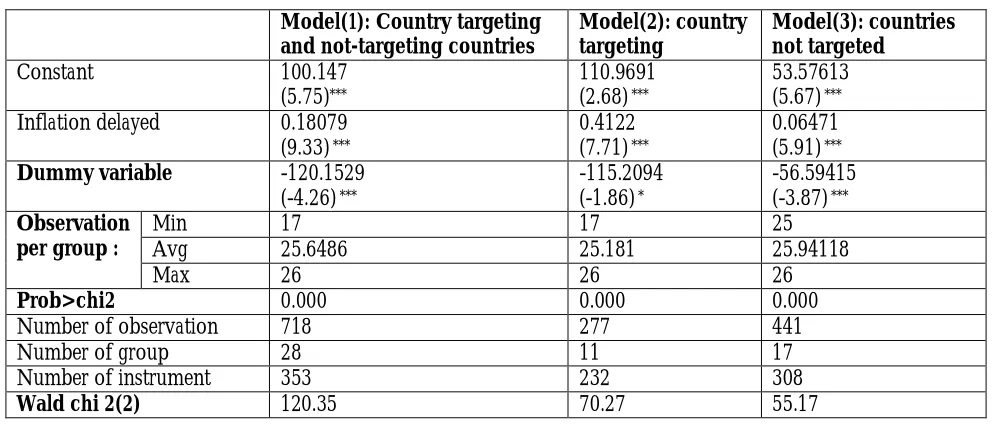
This table shows the results of the estimate of the effect of inflation targeting on the level of inflation, using the generalized method of moments "GMM". The model is globally significant Prob> Chi 2 = 0.000 is below the 10% threshold.
The coefficient of inflation targeting on the binary variable in the three models is statistically significant and has a negative effect on the level of inflation. In model (1) which interests our entire sample, the binary variable is statically significant (-4.26) at the 1% and negative sign. So we can say that the strategy of inflation targeting reduces the overall level of inflation in emerging countries by 120.15% per year.
In model (2), the significance of inflation targeting is the threshold (10%) and the negative sign of the binary variable, indicates that direct inflation targeting is associated with an annual decrease in the level of inflation by 115.2094% per year. In model (3), this coefficient is also significant at a 1% negative sign. This indicates that the level of inflation in a country that does not adopt the strategy of inflation targeting is 56,594 of the percentage point of the annual decline in the level of inflation.
Therefore, it turns out that countries adopting inflation targeting outperformed the other non-targeting countries to minimize the inflationary impact. The strategy of inflation targeting ensures the improvement of performance on inflation in the emerging countries. The strategy of inflation targeting has been successful in emerging countries in terms of inflation. As for the coefficient of the "delayed inflation" variable, it is significant in all the three models at a 1% and positive sign.
Thus, the long-term effect of inflation targeting helps to increase the level of annual inflation by 0.4% for the targeting countries and 0.06% for the non-targeting countries.
IV.4. Results of the targeting effect on growth
Table 5: Results of the estimation of the effect of inflation targeting on the level of growth in our sample for the countries targeted and / no-targeting
Model(1): Countries targeting and non-targeting countries
Model(2): Countries target
Model(3):
countries not targeted
Constant 1.287002
(5.67)***
1.210042 (3.9) ***
1.5114 (5.35) ***
GDP delayed 0.26378
(7.16) ***
0.3019 (5.48) ***
0.219236 (4.64) ***
Dummy variable 0.91669
(2.68) ***
0.6858 (1.49)
0.8064 (1.99) ** Observation per
group :
Min 20 20 24
avg 25.5 24.90909 25.88235
Max 26 26 26
Prob>chi2 0.000 0.000 0.000
Number of observation 714 274 440
Number of group 28 11 17
Wald chi 2(2) 57.05 34.83 24.74
(***) Significant at 1% level- (**) Significant at 5%
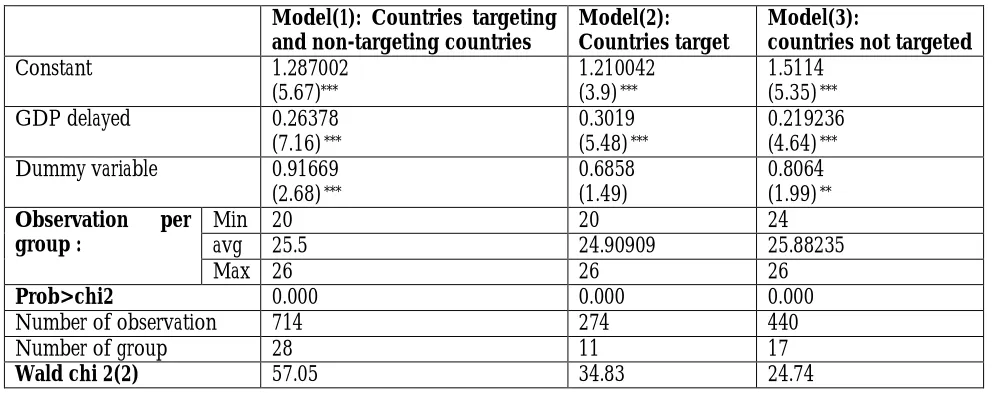
The model is globally significant (Prob Chi 2) = 0.000 is below the threshold of 10% In model (1), the coefficient on the dummy variable is significant (2.68) at the 1% and positive coefficient, which leads us to say that the regime of inflation targeting increases the general level of economic growth by 0.9% per year in the developing countries.
In model (2), this variable becomes insignificant, which allows us to infer that inflation targeting is the cause of the increased growth level as in model (3), this variable is significant at (5%) with an increase in the annual growth level of 0.8%. So we can deduce from the above-stated figures that the strategy of inflation targeting helps to increase the level of growth but in reality this strategy has not caused this improvement. This increase is accounted for by other monetary strategies other than inflation targeting.
One drawback of the fixed inflation targeting regime is that it achieves one goal and neglects other objectives such as the development and stability of economic growth; the fact that The Central Banks under this system, give more importance to the reduction of inflation and ignore economic stability. So the monetary authorities make a choice between monitoring inflation and economic growth.
As for the coefficient of the lagged growth, it is statistically significant at 1% for the inflation -targeting countries and non-targeting ones. So, the long-term inflation targeting effect increases the level of growth by 0.3% per year for the countries that target and 0.2% for the non-targeting countries.
Conclusion
The aim of this paper is to examine the effects of the strategy of inflation targeting on macroeconomic performance notably inflation and growth in the emerging countries.
Empirically, we relied on a sample of 28 emerging countries, made up of inflation- targeting countries and non- targeting ones during the (1985-2012) period. In this regard, we used a dynamic panel GMM model in which the dependent variables are the inflation levels and the levels of economic growth and the independent variables are the lagged level of inflation and delayed growth and the dummy variables on the adoption of inflation targeting. The estimation is the generalized method of moments.
In fact, these countries since the establishment of the targeting of Inflation recorded an improvement over non-targeting counties .From the econometric test carried out, to study the effectiveness of inflation targeting on growth we recorded increase in the growth rate for all the emerging countries. Confirming whether this strategy has caused this improvement and stability or there are other monetary strategies rather than inflation targeting that would be the reason of is another issue.
Therefore, the strategy of inflation targeting has recorded an improvement in macroeconomic performance in inflationary anticipation, but it is not beneficial for growth. Thus, it is necessary to consider the strategy of inflation targeting in a more developed technological and institutional context.
The strategy of inflation targeting seems beneficial for the emerging countries adopting this inflation policy since it provides operational benefits, urging the monetary authorities to lay out financial reforms and enhance transparency and ensure even well a forecast convergence towards the target inflation levels.
References
Angeris A., Arestis P. (2007) Assessing the performance of inflation targeting lite’ countries, The World Economy, pp. 1621-1645.
Ball L., Sheridan N. (2003) Does inflation targeting matter? National Bureau of Economic Research, Working Paper, 9577.
Batini, N. & Laxton, D. (2007). “Under What Conditions Can Inflation Targeting Be Adopted? The Experience of Emerging Markets”. Working Papers Central Bank of Chile, 406.
Bernanke B.S., Laubach T., Mishkin F.S., Posen, A.S. (1999) Inflation Targeting: Lessons from the international experience, Princeton University Press: New Jersey.
Brito, R.D. & Bystedt, B. (2010). “Inflation targeting in emerging economies: Panel evidence.”? Journal of Development Economics, 91 (2), pp. 198–210.
Cecchetti S., Ehrmann M. (2000) Does inflation targeting increase output volatility? An international comparison of policy maker’s preferences and outcomes, Working Paper, Central Bank of Chile.
Choi K., Jung Ch., Shalbora W. (2003) Macroeconomics effect of inflation targeting policy in New Zealand, Economic Bulletin, 5, 17, pp. 1-6.
Da Silva M.E.A, Portugal M. (2002), Inflation targeting in Brazil: An empiricalEvaluation, Revista de Economia, 9, 2, pp. 85-122.
Dueker M., Fisher M.A. (1996). Do inflation targets Redefine Central Bank Inflation preferences? Results from an indicator model, Monetary policy in converging Europe, Kluwer, Boston, pp. 21-37.
Genc I.H., Lee M., Rodriguez C.O., Lutz S. (2007) Time series analysis on inflation targeting in selected countries, Journal of Economic Policy Reform, 10, 1, pp. 15-27.
Gertler, M. (2005). “Targeting versus instrument rules for monetary policy - discussion”. Board of Governors of the Federal Reserve System (U.S.), pp. 246–248.
Ghosh Atish R., Jonathan D. Ostry, and Mahvash S. Qureshi (2014)” Exchange Rate Management and Crisis Susceptibility: A Reassessment” IMF Working Paper- WP/14/11
Gonçalves, C.S. & Salles, J. M. (2008). “Inflation targeting in emerging economies: What do the data say?” Journal of
Development Economics, 85, p. 312 ˝U 318.
Gonçalves, Carlos Eduardo S. & Carvalho, Alexandre. (2009). “Inflation Targeting Matters: Evidence from OECD Economies’ Sacrifice Ratios”. Journal of Money, Credit and Banking, 41(1), pp. 233–243.
Hyvonen, M. (2004). Inflation Convergence Across Countries. Discussion Paper 2004-04. Sydney: Reserve Bank of Australia.
Johnson, D.R. (2002). “The Effect of Inflation Targeting on the Behavior of Expected Inflation: Evidence from an 11 Country Panel”. Journal of Monetary Economics, 49, pp. 1493–1519.
Lane, P. (1997). “Inflation in open economies”. Journal of International Economics, 42, pp. 327–347.
Levin A.T., Natalucci F.M., Piger J.M. (2004) The macroeconomic effects of inflation targeting, Federal Reserve Bank of St. Louis Review, July/August 2004, 86, 4, pp. 51-80.
Neumann, J.M. & Von Hagen, J. (2002). “Does inflation targeting matter?” Review, pp. 127 148.
Pétursson Thórarinn G. (20004) The effects of inflation targeting on macroeconomic performance, Central Bank of Iceland, Working Paper Series, 23.
Pétursson, Thórarinn G. (2009). “Inflation control around the world: Why are some countries more successful than others?” Central Bank of Iceland.
Posen, A.S. & Mishkin, F. (1998). “Inflation Targeting: Lessons from Four Countries”. NBER Working Papers, National Bureau of Economic Research, Inc, 6126.
Rose, Andrew K., (2014),“Surprising Similarities: Recent Monetary Regimes of Small Economies”, unpublished manuscript, University of California, Berkeley, CA.
Siklos, Pierre. [1999]. “Inflation Targets and the Yield Curve: New Zealand and Australia vs. the US”. Quantitative Finance Research Centre, University of Technology, Sydney, 25.
Svensson, L.E.O. (1997). Inflation forecast targeting: implementing and monitoring inflation targets. European Economic Review 41(6), 1111-1146.
Vega, M. & Winkelried, D. (2005). “Inflation Targeting and Inflation Behavior: A Successful Story?” EconWPA, 0502026.
Willard L. (2006) Does inflation targeting matter: a reassessment, CEPS Working paper, 120, Princeton University. Willard, L. (2012). Does inflation targeting matter? A reassessment. Applied Economics 44(17), 2231-2244.
Wu T. (2004a) Does inflation targeting reduce inflation? An analysis for the OECD industrial countries, Banco Central do Brazil Working Paper, 83.