2020
Work-integrated Learning and Skill Development in a Master of Public
Work-integrated Learning and Skill Development in a Master of Public
Health Program: Graduate Perspectives
Health Program: Graduate Perspectives
Sue Durham
The University of Melbourne, Australia, [email protected]
Helen Jordan
The University of Melbourne, Australia, [email protected]
Lucio Naccarella
The University of Melbourne, Australia, [email protected]
Melissa Russell
The University of Melbourne, Australia, [email protected]
Follow this and additional works at: https://ro.uow.edu.au/jutlp
Recommended Citation
Recommended Citation
Durham, Sue; Jordan, Helen; Naccarella, Lucio; and Russell, Melissa, Work-integrated Learning
and Skill Development in a Master of Public Health Program: Graduate Perspectives, Journal of
University Teaching & Learning Practice, 17(4), 2020.
operate in work environments. This is particularly relevant within degrees such as public health that cut across very diverse fields of practice. Little research has previously investigated student perceptions post-graduation of skill development within public health degrees. This investigation aimed to identify the range of skills gained within a Master of Public Health (MPH) degree which graduates felt assisted them to obtain employment, and to determine the teaching and learning approaches that contributed to the development of these skills. Graduates responding to a questionnaire self-reported that they had good levels of both technical and employability skills especially in the domains: Informed Decision Making, Professional Practice and Standards, Lifelong Learning and Collaboration. Students agreed that there were frequent opportunities for applied learning and enablers to employment within their degree.
However, graduates indicated that the employability domain: Commencement Readiness and confidence at point of graduation, could be strengthened. The implications of this research for the development of non-placement WIL experiences, capstone subjects, the overall curriculum and broader university student experience are discussed.
Keywords
Keywords
Non-placement work-integrated learning, graduate perspectives, employability skills, public health, career readiness
Introduction
There has been a growing expectation over the past two decades for universities to produce work-ready graduates(Patrick et al. 2009; Wilton 2012). Work-integrated learning (WIL) is an approach that has been recently embraced in the tertiary education sector whereby students are provided with the opportunity to apply their learning in real world settings. According to Jackson and Silva and colleagues WIL subjects are important in providing new graduates with employability skills that will allow them to perform effectively within a work environment (Jackson 2013, 2015; Silva et al. 2016). Within the University of Melbourne’s Master of Public Health (MPH) degree learning outcomes are closely aligned with two sets of relevant core public health competencies (ANAPHI 2009; ASPHER 2011). These and other skill-based competencies are integrated throughout the course curriculum and intensively applied within the culminating capstone experience.
Capstones refer to courses or experiences usually taken in a student’s final semester or year of study which aim to provide opportunities for students to apply the knowledge gained within their degree and integrates both graduate skills and employability skills (Holdsworth, Watty & Davies 2009). Capstone options within this MPH degree include a university supervised research project; a professional practice unit (PPU) involving a work-based placement experience; and a scenario based experiential learning subject called Public Health in Practice (PHiP). This classroom-based subject provides students with sector speakers and current public health problems which students then address.
Literature review
Whilst the idea of graduates having the required skills to perform and effectively obtain employment has been and still is a common expectation (Billet 2009; Bennett, Richardson & MacKinnon 2016), the changing landscape of career pathways for a graduate requires courses to be sufficiently agile and responsive to these changes. For instance, in Australia, job pathways increasingly comprise a series of short-term contracts and increased job mobility. Such trends are also changing internationally. Additionally, the impact of automation and virtual working conditions has impacted on the employment options available to graduates (CEDA 2015). This instability of career pathways necessitates an increased requirement for graduates to develop more transferable general employability skills along with discipline specific skills, particularly in jobs involving a mix of diverse fields, such as public health. Whether this is consistent with the experience of public health graduates remains unknown and the broad range of existing professional backgrounds of graduating students will obviously also influence this.However, clearly understanding the skill levels of public health graduates, alignment with employer needs and levels of work preparedness and/or readiness is important.
Research into the effect of WIL on graduate outcomes from a range of disciplines across a selection of Australian universities’ degrees has explored students’ preparedness for workplaces. Although much is not specific to public health, this exploration concluded that placement and simulation activities had an impact on graduate work readiness and positively influenced their employability capabilities (Smith, Burns & Russell 2014). Other research has looked at the development of leadership skills specifically within public health courses in Canada, Australia and the United States and the translation into applied work skills (Zakariasen 2009; Messum et al. 2016 Hermains-Henry et al. 2016). Findings in the Australian context concluded that recent graduates working in health services management rated generic skills rather than job specific skills as being more important (Messum et al. 2016). In the US when looking at MPH graduates working with local health
departments, although they were found to have discipline skills in areas of public health, they were lacking broader skills required for early career and management positions (Hermains-Henry et al. 2016).
Research gaps and study questions
While valuable, WIL program evaluations have primarily focussed on graduate outcomes rather than the underpinning variety of processes by which these skills are acquired (Jackson 2015; Coll et al. 2009). There remain large gaps in our understanding of the level of applicability of skills acquired within MPH courses (especially within targeted capstone experiences), the actual experiences that enable workplace related skill development and the translation of these skills into employability outcomes. The study aimed to identify the range of skills developed within the MPH degree that assisted graduates in their transition to public health employment within 1 – 2 years post-graduation. In particular, the specific research question were:
● what were the range of (1) sector based technical skills and (2) broader employability skills perceived to have been gained, in an MPH degree,bygraduates, who graduated within the years 2015 – 2018?
● what were the curriculum or extra-curricular experiences that graduates felt enabled them to gain these skills?
● what contributions did placement and non-placement WIL throughout the course make on graduates’ perceived work readiness?
This research provides graduate perspectives of elements within the MPH degree effective in facilitating skill development and employment preparation. The specific areas of employability related skill dimensions; employment confidence and readiness; capstone subjects, WIL and employability enablers will be examined. This paper will discuss methods used to explore these areas, findings and curriculum implications for MPH degrees.
Methods
Study design and Population
A cross sectional survey collecting quantitative and qualitative information was administered online with graduates from the University of Melbourne School of Population and Global Health MPH program, who graduated between 2015 and 2018. Email contact was made with all alumni during the 2015-2018 period (n=416) from email addresses obtained from a University held database to request participation in the self-administered online survey. An initial recruitment email was sent in early November 2018 with a follow up reminder email sent to the same group two weeks later. To increase recruitment, as not all alumni provided email addresses to university services, the survey was also promoted via an MPH graduate LinkedIn group and MPH student Facebook page. Ethical approval was obtained from the University of Melbourne School of Population and Global Health Human Ethics Advisory Group Ethics (ID:1852860: 1). Consent was sought from participants by the inclusion of a consent form and plain language statement within the survey
.
Survey Development
The development of the survey informed by Smith et al (2014) identified six employability skill dimensions as being predicted to be affected by course factors. From this they developed an
Employability Impact Survey (EIS) which looked at these areas including: employment readiness, employability skills, confidence in future work prospects, work-placement experiences, simulations and career development. Several components of this study have been replicated either wholly or in part from this EIS survey tool. Because some questions within the survey were specifically related only to work based placement experiences some adaptation of the survey was required to be transferrable to the different purpose and context of work. Additionally, some survey questions have been developed based on a previous internal survey (2017) looking at MPH graduate employment outcomes post the degree experience.
Survey Instrument
The survey instrument included five domains (listed below) and a total of 60 common questions for all respondents, with 20 to 40 additional questions specific to the capstone completed by the student (a university supervised research project, professional practice unit (PPU)-work based placement experience, and public health in practice (PHiP) a scenario based experiential learning subject). Most questions required responses using a 5-point Likert scale; while fewer required a simple check-box response with the opportunity for text responses.
Demographics
Demographic characteristics of participants were collected across eight items, including year of graduation, age group, working status and prior experience at start of degree, volunteering experience undertaken during the degree, area of MPH specialisation – specific areas of public health within the degree (12 options provided) and type of capstone completed (as above).
Frequency of opportunities to apply learning to practice
Within this dimension three items were included regarding the frequency of different opportunities to apply learning practice within the course overall. The items examined the participants’ perceptions of the frequency of opportunities to develop the technical skills and general work skills necessary for working in public health, and the frequency of simulations. These items used a 5-point Likert scale, ranging from 1=never to 5=always and were replicated from the EIS.
Frequency of opportunities to apply learning to practice across the capstone
Five items investigating the frequency of different opportunities to apply learning practice across the three different capstone options were included in the questionnaire. These items investigated participants’ perception of opportunities to work with responsibility/autonomy, apply public health theories, apply/develop skills learnt, critically evaluate workplace theories and reflect on application of knowledge. A 5-point Likert scale was used, ranging from 1=never to 5=always and the items were replicated from the EIS.
Range of employability skills gained throughout the degree
The original EIS measured forty-five individual items covering six employability dimensions. These independent variables, as defined by Smith et al (2014) were predicted to be affected by curriculum factors including: collaboration, informed decision making, commencement readiness, lifelong learning, integration of theory and practice, and professional practice and standards (Smith et al., 2014). In our survey forty-four items across six ‘employability dimensions’ were included. The
single item that was not included was an item on the applicability of knowledge gained in studies specifically to the workplace. It was not included because only the PPU capstone is directly work based. Forty-two of the included items used a 5- point Likert scale 1=very poor to 5=very good and two questions used a 5-point Likert scale 1=not at all confident to 5=very confident. The dimensions studied included Informed Decision Making, Professional Practice and Standards, Lifelong Learning, Collaboration, Integration of Theory to Practice and Confidence in Commencement Readiness. Two additional questions were added by the researchers to collect qualitative data about a) reasons for high confidence levels and b) reasons for low confidence levels. Otherwise all quantitative questions were replicated from the EIS.
Enablers for increased employment possibilities
Two additional items were replicated from a previous internal school survey which investigated MPH graduate views on enablers to employment opportunities. These included one question where participants were asked to select one or more of 12 potential factors that they felt have helped them in obtaining relevant employment. An ‘other’ option was provided with an open-ended explanatory response.
The other question asked about factors within the MPH which students felt would have been helpful for increasing employment possibilities. The item offered 12 options, including an ‘other’ category to obtain additional qualitative data.
Analysis
Summary data of the average rating of items across each broad skill dimension are presented with an extended list of individual item ratings included in the Appendix 1.
Results
Participants
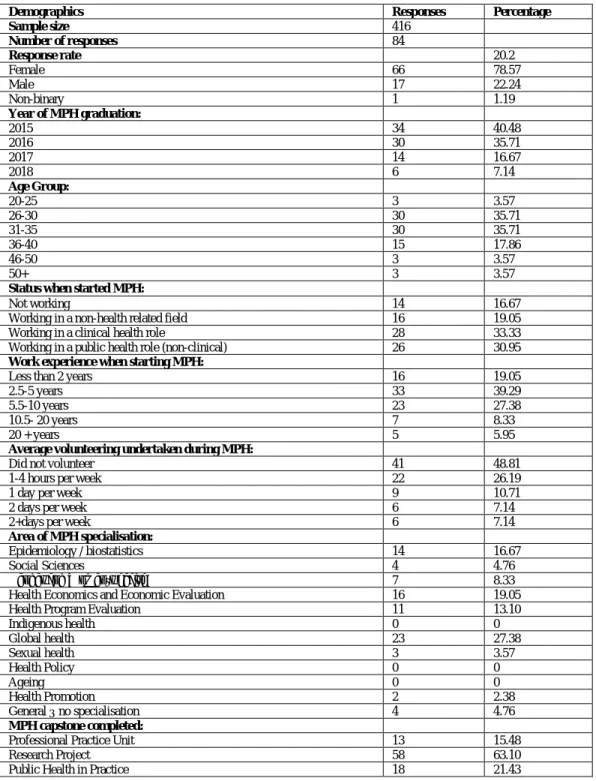
From the 416 graduates contacted 84 individuals completed the questionnaire (response rate of 20.2%). Sixty four per cent of MPH alumni respondents had either already been working in public health related fields or working in clinical roles when starting the MPH. Nineteen per cent were working in a non-health related field. A significant percentage had undertaken volunteer work during the course (51%). Within the data sample size, when considering capstone experience 63% (n = 53) of respondents had completed a research project, 18% (n = 18) had completed the PHiP subject and 15% (n = 13) had completed the PPU work placement; these proportions are representative of the overall average proportion of MPH students completing each capstone type. (Table 1).
Table 1. Demographic data from survey results
Demographics Responses Percentage
Sample size 416 Number of responses 84 Response rate 20.2 Female 66 78.57 Male 17 22.24 Non-binary 1 1.19 Year of MPH graduation: 2015 34 40.48 2016 30 35.71 2017 14 16.67 2018 6 7.14 Age Group: 20-25 3 3.57 26-30 30 35.71 31-35 30 35.71 36-40 15 17.86 46-50 3 3.57 50+ 3 3.57
Status when started MPH:
Not working 14 16.67
Working in a non-health related field 16 19.05
Working in a clinical health role 28 33.33
Working in a public health role (non-clinical) 26 30.95 Work experience when starting MPH:
Less than 2 years 16 19.05
2.5-5 years 33 39.29
5.5-10 years 23 27.38
10.5- 20 years 7 8.33
20 + years 5 5.95
Average volunteering undertaken during MPH:
Did not volunteer 41 48.81
1-4 hours per week 22 26.19
1 day per week 9 10.71
2 days per week 6 7.14
2+days per week 6 7.14
Area of MPH specialisation:
Epidemiology / biostatistics 14 16.67
Social Sciences 4 4.76
Gender and Women’s health 7 8.33
Health Economics and Economic Evaluation 16 19.05
Health Program Evaluation 11 13.10
Indigenous health 0 0 Global health 23 27.38 Sexual health 3 3.57 Health Policy 0 0 Ageing 0 0 Health Promotion 2 2.38 General – no specialisation 4 4.76 MPH capstone completed:
Professional Practice Unit 13 15.48
Research Project 58 63.10
Frequency of opportunities to apply learning to practice overall and across capstones
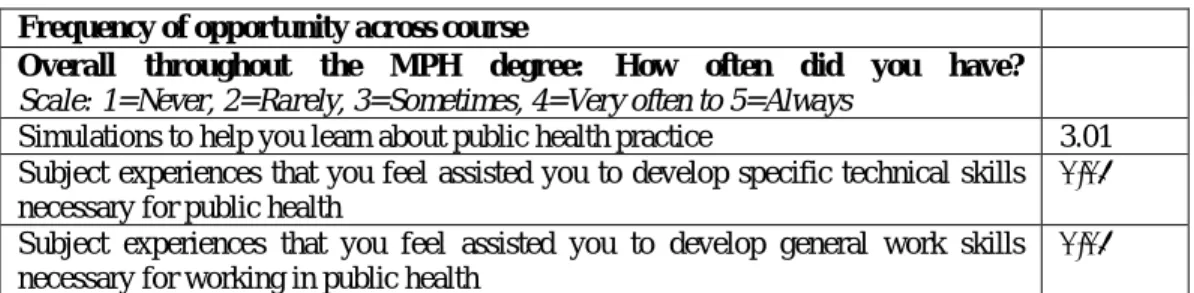
Respondents (within the 1-5 scale) reported a medium level (3.36) of frequency of opportunities equally for both the development of specific technical skills and general work skills. There was a lower rating for how frequently simulation tasks were offered to help them learn about public health practice (3.01) (Table 2).
Table 2. Frequency of Opportunities to Apply Learning to Practice Across course (n = 69)
Frequency of opportunity across course
Overall throughout the MPH degree: How often did you have? Scale: 1=Never, 2=Rarely, 3=Sometimes, 4=Very often to 5=Always
Simulations to help you learn about public health practice 3.01 Subject experiences that you feel assisted you to develop specific technical skills necessary for public health
3.36 Subject experiences that you feel assisted you to develop general work skills necessary for working in public health
3.36
This dimension was also explored across the different capstones, with the highest overall ratings obtained for the area: opportunities to work with responsibility and autonomy. These results ranged from public health in practice (3.71), the research project capstone (4.31) and the PPU (4.36). The research project capstone had the highest rating across most dimensions (Table 3)
.
Table 3. Frequency of opportunity to apply learning across capstone options (n = 77) Frequency of opportunity across capstone MPH capstone options Whilst completing your capstone how often did
you experience the following?
Scale: 1=Never, 2=Rarely, 3=Sometimes, 4=Very often to 5=Always Research (n = 49) 63.6% PPU (n = 11) 14.2% PHiP (n = 17) 21.5% Work with responsibility or autonomy 4.31 4.36 3.71 Apply public health theories and principles covered
during the degree
4.10 3.27 3.53
Apply or develop skills you had learned during the degree
4.12 3.36 3.24
Critically evaluate workplace theories and principles you had learned in your degree
4.08 2.55 3.00
Reflect on applying your public health knowledge in the experience
3.88 3.09 3.76
Range of employability skills gained throughout the degree
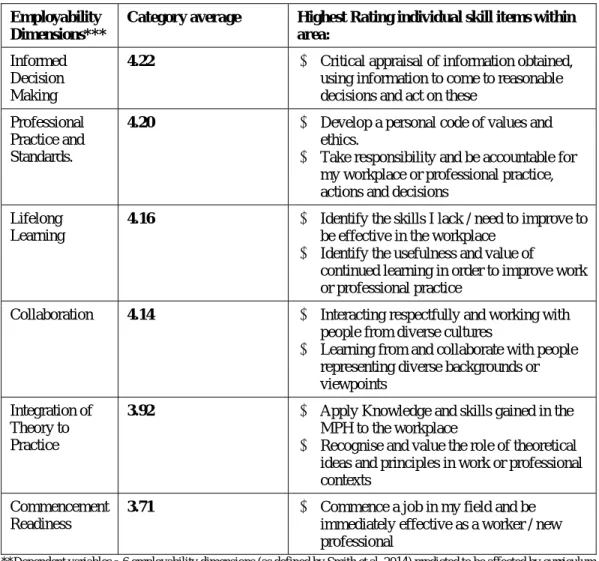
The strongest areas of skill development within the degree were in the areas of: Informed Decision Making (4.22), Professional Practice and Standards (4.20), Lifelong Learning (4.16) and Collaboration (4.14). The area of Integration of Theory to Practice was not quite as strongly self-rated as the other dimensions (3.92). The weakest areas of self-rating within the skill development
dimensions were inCommencement Readiness (3.71) (Table 4). See appendix (1) for an extended list of each individual item rating.
Table 4. Self-rated ability of skill dimensions** at the time of completing degree and seeking employment in public health.
Employability Dimensions***
Category average Highest Rating individual skill items within area:
Informed Decision Making
4.22 - Critical appraisal of information obtained, using information to come to reasonable decisions and act on these
Professional Practice and Standards.
4.20 - Develop a personal code of values and ethics.
- Take responsibility and be accountable for my workplace or professional practice, actions and decisions
Lifelong Learning
4.16 - Identify the skills I lack / need to improve to be effective in the workplace
- Identify the usefulness and value of
continued learning in order to improve work or professional practice
Collaboration 4.14 - Interacting respectfully and working with people from diverse cultures
- Learning from and collaborate with people representing diverse backgrounds or viewpoints
Integration of Theory to Practice
3.92 - Apply Knowledge and skills gained in the MPH to the workplace
- Recognise and value the role of theoretical ideas and principles in work or professional contexts
Commencement Readiness
3.71 - Commence a job in my field and be
immediately effective as a worker / new professional
**Dependent variables – 6 employability dimensions (as defined by Smith et al. 2014) predicted to be affected by curriculum factors. Expanded list of individual items in Appendix 1. ***Scale: 1=Never, 2=Rarely, 3=Sometimes, 4=Very often to 5=Always
Commencement Readiness
Respondents reported an overall rating of 3.44 on their perceived readiness at the time of graduation to commence work in their field or discipline within public health, and 3.34 for confidence in their own ability to obtain work relevant to their MPH studies (Table 5).
Within qualitative data (n = 32) related to levels of commencement readiness, graduates who reported either low or high confidence levels reported several individual and external factors they
perceived to either act as a barrier or enabler to work readiness and employability. Of those who responded with high confidence levels (n = 23, 27%) and of the limited number reporting no confidence (n = 9, 1.2%) their reasons for confidence levels were varied. Some emerging factors and illustrative quotes are presented in Table 6.
Table 5. Graduation levels of commencement readiness (n = 59)
Rating Scale:
1=Not at all confident, 2=Slightly Confident, 3=Somewhat confident, 4=Quite confident, 5=Very confident
1 2 3 4 5 Weighted
average
Question:
How confident are you / were you at the time of graduation – ready to commence work in your field or discipline within public health?
6 5 18 17 13 3.44
Question:
How confident are you / were you at the time of graduation - able to obtain work relevant to your MPH studies
6 10 15 14 14 3.34
Table 6. Perceived enablers and barriers to graduate readiness and confidence to obtain work within public health, with illustrative quotes (n = 32)
Perceived Enablers: Illustrative quotes: Pre-existing work experience Previous qualifications Background in a health profession Skills/Knowledge gained within course
‘I have developed excellent research skills and a sound understanding of the theoretical underpinnings of public health. I can combine this with my existing skill set in my clinical work to make the change to a public health career’ ‘I believe the MPH had equipped me with sufficient skills and knowledge to allow me to effectively execute job responsibilities’
‘I have now gained working experience in public health field …. and I have developed some valuable professional networking both domestically and internationally’
‘The skills and knowledge gained, the experiences as well as exposures I received’
Barriers:
External Job market Limited work experience Lack of confidence Lack of opportunities to develop practical skills Curriculum related factors
'The job market was more competitive than I realised’
‘I believe the MPH provided exceptional academic and theoretical skills, but I felt it lacked the practical experience that would’ve enabled me to feel confident to commence employment in the field’
‘Subjects which are skills based and essential should be consistently made available and put into the core, rather than making it optional. With a wide array of subjects to choose from, picking one when more than one subject is relevant is unfair’
‘Perhaps If I had been able to do a PPU, this may have given me a better chance of being more confident in real world as well as professional contacts’
Enablers for increased employment possibilities
Factors within the degree that helped to obtain relevant employment
Across all respondents to this question (n = 58) the most highly rated factor assisting students to obtain relevant employment was research experience (n = 39, 67%). Fifty-three of the total survey respondents (n = 84, 74%) had completed the research capstone. However, when comparing within the capstone completion groups, eight of the 13 (61.5%) students completing the PPU capstone identified the PPU as the most highly rated factor assisting them to obtain relevant employment. 29 (54.7%) of the 53 students within the research project capstone identified research experience and six of the 18 students (33.3%) within the PHiP capstone identified this capstone. It should be noted that the smaller sample size of these impacts on the capacity for meaningful comparison (Figure 1). Other factors nominated by graduates included the value of networking; with 40% reporting perceptions that networking with other students, and 22% reporting that networking with MSPGH staff, assisted in them obtaining employment. Additionally, 19% of students mentioned volunteering activities and15% mentioned university wide events / forums / activities as assisting them in finding employment after graduation.
What would have been helpful for increasing employment possibilities?
When asked what they felt could have improved employment possibilities most alumni respondents (64%) stated that they felt that more public health technical work skills opportunities would have assisted. They also believed career focussed seminars (40%), general employability skill development (38%), and mentoring opportunities (36 %) would have been helpful (Figure 2). Figure 1. Factors within the degree believed to have assisted graduates to obtain relevant employment (n=58)
0 10 20 30 40 50 60 70 80
Research Experience PPU Experience Public Health in Practice Experience Completion of an Internship Mentoring Opportunities Volunteering Opportunities Exchange Experience University wide events/ forums/ activities Networking with other MPH students Networking with MSPGH school staff MPSHA (student association) events Other
Response (percentage) What do you feel within your degree helped you to obtain relevent
Figure 2. Factors graduates believed would have been helpful for increasing employment possibilities n = 58
Discussion
To our knowledge, this is the first study to investigate MPH graduate perspectives of skill areas developed within the degree experience. We also examined assumptions that the majority of WIL occurs within placement subjects. We found graduates participating in this study felt that the overall MPH degree experience assisted them to develop a range of both technical public health skills and transferable employability skills. According to Bennett and colleagues it is important that graduates exit their degree experience having developed a range of skills across both technical and general employability areas, in order to position them strongly for employment in graduate positions and experience success in these roles (Bennett, Richardson & MacKinnon 2016).
Discipline specific skills alongside general employability skills such ascommunication, teamwork, problem-solving and interpersonal skills have been found to be key factors contributing to the securement of employment upon graduation (Deloitte 2017) and importantly to meet workforce needs. Australian research that explored graduate perspectives on employability across multiple disciplinary fields reported that for those for whom the transition into employment was particularly difficult, generic skills enabling them to navigate the work context rather than technical or discipline-specific skills were of high importance (Bennett, Richardson &MacKinnon 2016). This suggests that a balance of both technical and general employability skill development within degree experiences is important.
Whilst the development of these skills is often concentrated within specific subjects and the culminating ‘capstone’ experiences, we could consider how to further strengthen these throughout the degree. A study of Australian universities reported a range of WIL activity types being utilised (Universities Australia 2019). While work placements were the most frequently offered WIL activity (43%) of all career preparation activities, industry projects (23%), fieldwork (10%) and
0 10 20 30 40 50 60 70
More public health technical work skills opportunities
More general employability skills opportunities Mentoring possibilities More career focused seminars Other
Response (percentage)
Within your MPH what would have been helpful for increasing
simulations (13%) were also common. This study suggests that greater opportunities could be provided for students to identify and undertake public health related simulation tasks. Identifying where simulation-based activities currently exist within the MPH degree and how these and other WIL activities can be scaffolded and integrated into the curriculum would be useful. This would provide a greater spread of WIL opportunities, advance non placement WIL across degrees and reduce reliance on capstone subjects.
Employability Skill Dimensions
Graduates self-rated their ability at the time of graduation as good or very good across four of the six primary employability dimensions. These dimensions included: Informed Decision Making, Professional Practice and Standards, Lifelong Learning and Collaboration. The higher ratings in the area of Collaboration could be related to the substantial element of collaborative group work within subject assessment tasks. There is some evidence that public health education team-based learning can facilitate collaborative practice in the workplace (Lang et al. 2018). Students rated Integration of Theory to Practice less strongly and Commencement Readiness least strongly. We recommend further exploring individual items within the Theory to Practice dimension which would enable targeted improvement of these within different capstone and other subjects.While it is useful to have broadly identified the level of skill development graduates felt has occurred within the degree, it remains unknown which curriculum and other factors contribute to the development of each.
Employment Confidence and Readiness
Despite graduates rating themselves highly on many employability skill related dimensions there was a reduced rating in Commencement Readiness. This finding aligns with our results specifically measuring graduate levels of employability confidence (Table 5). When asked directly at the time of graduation how confident they felt about readiness to commence work in their field or discipline within public health and in their ability to obtain work relevant to their MPH Studies overall results are weak. However, it should be noted that a previous study Bennett, Richardson and MacKinnon (2016 p.17) found low confidence in employability common across a range of degree disciplines and cited this as an indicator for a broader need across universities to create opportunities in this area within the course curriculums. As the value of WIL activities has been recognised to be effective in the area of career preparedness (Jackson 2018) the development of an increased range or frequency of WIL activities throughout the degree, especially non-placement activities could strengthen these confidence and readiness outcomes.
Capstone Subjects
Within the MPH degree the role of capstone subjects is to provide opportunities for students to apply learned theory to practice (Jackson 2013). A key focus of these WIL related subjects is to provide transferable employability skill development alongside technical skill development. In addition to the overall course experience reported above, graduate respondents felt that all the MPH capstone options provided them with opportunities to develop a range of skills relevant to the Integration of Public Health Theory to Practice domain. Most graduates reported that capstone subjects provided frequent opportunities toapply or develop theories, principles and skills learnt during the degree and to critically evaluate their academic learning. Given the common capstone learning outcomes and expectations of students needing to work to demonstrate initiative, autonomy and organisation in applying their learning, it is not surprisingly the highest overall ratings were in the area of opportunities to work with responsibility and autonomy within the domain. These two areas are sought as general employability skills in the international job market context (OECD 2018).
Interestingly, the PPU, the most work focused WIL experience in the course, did not rate above the other capstone subjects regarding the frequency of opportunity to apply learning, and in three of the six items exploring this domain the PPU did not rate as highly as the other two capstone options. Although the sample size for this comparison was low, these results do provide some evidence that capstones other than the direct work placement (the PPU) can have important employment focused outcomes. Within the research project capstone or subjects less commonly identified as specific WIL experiences but including simulations, sector projects and field visits; these non-placement WIL activities elements may need increased recognition, profile and development. Importantly developing learning outcomes which articulate and integrate employability skills alongside technical skill development within these subjects may further encourage innovative teaching approaches to focus on these.
Employability Enablers
The MPH graduates identified a range of enablers to employability within the degree, the most highly rated was research experience. Networking opportunities with other students and staff, volunteering activities and university wide events / forums / activities were also strongly rated (Figure 1). This requires more exploration in order to comprehensively understand the range of possibilities that students perceive as being important to strengthening paths to relevant employment. When asked what they felt could have improved employability most graduates (64%) stated that they feel that more public health technical work skills opportunities and general employability skill opportunities (38%) would have assisted (Figure 2).
A range of non-subject based experiences within the MPH were also highly rated as factors which would have been helpful for increasing employment possibilities. Study participants also highly rated mentoring opportunities (an alumni mentoring program has since been implemented) as well as more career focussed seminars. Qualitative data identifying what graduates felt would have been helpful for increasing their employability provide some insight into an additional range of individual, external and course factors.Overall, it is evident from graduate perspectives that enablers to employability are both strongly influenced by curriculum factors as well as a broad range of other elements in the university experience. The results clearly highlight a need for diverse and innovative teaching and learning practices within and /or alongside subjects designed to build student career readiness. Morebroadly, universities may need to further consider both their role in employability preparation and resource allocation support within career services (Bennett, Richardson & MacKinnon 2016). Again, this is consistent with challenges faced by all university discipline areas in the preparation of graduates’ fitness for practice.
Limitations
This small-scale study relies on graduates’ perspectives of their own MPH degree learning experiences, levels of skill development and career pathway enablers within one institution. In this study a high proportion of respondents had work experience prior to starting the MPH degree, predominantly in public health or clinical related areas. A quarter had undertaken some level of volunteer work during their course of study. These work experiences, paid and voluntary, are likely to have contributed to the reported development of skills at the time of graduation, independent of and dependent on the course experience.
Due to the small number of participants having completed the PPU and PHiP capstone subjects we are cautious in our comparisons. Additionally, the term ‘simulation experiences’ is not widely used
within the course hence students may not have identified simulation style activities as such. This issue may contribute to the lower rating for the frequency of ‘simulation activities’ in comparison to other activities. However, despite these limitations, the data provide indications as to areas that would be valuable to explore further.
Conclusion
The research generated rich evidence about the complex dynamic interaction between MPH degree curricula and employability. Measuring the exact range and levels of skills acquired provides tangible confirmation of skill development and the experiences enabling this. The results provide evidence that the MPH degree curriculum and overall degree experience within the institution studied, is producing graduates who feel they have developed a range of both technical and general employability skills across a range of noted domains. It seems that WIL based capstones especially are creating opportunities for students to integrate theory into practice and for this successfully transferring to skill development. However, results regarding graduate confidence and readiness for entry into the public health workforce indicate further room for improvement. There is also evidence of the need for greater articulation of non-placement WIL and career development activities within a degree experience rather than heavy reliance on traditional placement subjects. Integration of an increased range of these non-placement WIL activities into subjects and evaluating graduate experiences of these should be further explored. Future research is also needed to understand any differences between the experiences and needs of international students and domestic students in terms of employability preparedness. With the rapidly changing world of employment widely recognised, there are implications for the design of future placement and non-placement based opportunities through MPH courses. In supporting the integration of theory into practice and transferring to skill development. Future MPH curricula will increasingly need to be responsive to student preparedness and employability skills development. Overall these research findings can inform WIL / capstone quality improvement, subject pedagogy and future curriculum development for degrees.
References
ANAPHI – see Australian Network of Academic Public Health Institutions ASPHER – see Association of Schools of Public Health in the European Region
Australian Network of Academic Public Health Institutions (ANAPHI) 2009, ‘Foundation Competencies for Master of Public Health Graduates in Australia’, viewed 27 July 2019, http://www.anaphi.org.au
Australian Network of Academic Public Health Institutions (ANAPHI) 2011, ‘Building Public
Health Workforce Capacity in Australia - Case studies of Academic Public Health
Education and Workforce Preparation’, viewed 2 August 2019,
http://caphia.com.au/documents/Building-PH-Workforce-Capacity-Australia.pdf
Association of Schools of Public Health in the European Region (ASPHER) 2011, ‘European Core Competencies for Public Health Professionals (ECCPHP)’,viewed 27 July 2019,
http://aphea.net/docs/research/ECCPHP.pdf
Australian Universities 2019, ‘Career Ready Gradates report’, viewed, 1 March 2019, https://www.universitiesaustralia.edu.au/wp-content/uploads/2019/06/Career-Ready-Graduates-FINAL.pdf
Bennett, D, Richardson. S & MacKinnon, P 2016, ‘Enacting strategies for graduate employability: How universities can best support students to develop generic skill Part A’,Canberra, ACT: Australian Government, Office for Learning and Teaching, Department of
Education and Training, viewed 3 August 2019, https://melbourne-
cshe.unimelb.edu.au/__data/assets/pdf_file/0011/1874774/SP13-3258_Curtin_Bennett_Graduate-Employability_Final-Report_Part-A_20163.pdf
Billett, S 2009, ‘Realising the educational worth of integrating work experiences in higher education’, Studies in Higher Education, vol. 34, no. 7, pp. 827–843.
Coll, R, Eames, C, Paku, L, Lay, M, Hodges, D, Bhat, R, Ram, S, Ayling, D, Fleming, J, Ferkins, L, Wiersma, C & Martin, A 2009, ‘An exploration of the pedagogies employed to integrate knowledge in work- integrated learning’, Journal of Cooperative Education & Internships, vol. 43, no. 1, pp. 14-35.
CEDA – see Committee for Economic Development of Australia
Committee for Economic Development of Australia (CEDA) 2015, ‘Australia's future workforce?’ Melbourne, Australia, viewed 3 August 2019,
https://www.ceda.com.au/CEDA/media/ResearchCatalogueDocuments/Research%20and %20Policy/PDF/26792-Futureworkforce_June2015.pdf
Deloitte Co. 2017, ‘Soft skills for Business Success’, viewed 3 August 2019,
https://www2.deloitte.com/au/en/pages/economics/articles/soft-skills-business-success.html
Hermains-Henry, C, Blake, J, Parton, H, Kappaka, R & Greene, C 2016, ‘Preparing Master of Public Health Graduates to Work in Local Health Departments’, Journal of Public Health Management Practice, vol. 22, no. 2, pp. 194–199.
Holdsworth, A, Watty, K, & Davies, M 2009, ‘Developing capstone experiences’, Melbourne: Centre for Study of Higher Education, University of Melbourne.
Jackson, D 2013, ‘The contribution of work-integrated learning to undergraduate employability skill outcomes’, Asia Pacific Journal of Cooperative Education, vol. 14, no. 2, pp. 99-115.
Jackson, D 2015, ‘Employability skill development in work-integrated learning: Barriers and Best Practice’, Studies in Higher education, vol, 40, no. 2, pp. 350-367.
Jackson, D 2018, ‘Developing graduate career readiness in Australia: Shifting from extra-curricular internships to work-integrated learning’, International Journal of Work-Integrated Learning, vol. 19, no 1, pp. 23-35.
Lang, D, Walker, E, Steiner, R, & Woodruff, R 2018, ‘Implementation and Mixed-Methods Evaluation of Team-Based Learning in a Graduate Public Health Research Methods Course, Pedagogy in Health Promotion’, The Scholarship of Teaching and Learning, vol. 4, no 2, pp. 140–150, Society for Public Health Education
Messum, D, Wilkes, L, Jackson, D & Peters, K 2016, ‘Employability Skills in Health Services Management: perceptions of recent graduates’, Pacific Journal of Health Management vol 11, no. 1, pp. 25-34.
OECD Organisation for Economic Co-operation and Development 2018,’The future of education and skills: Education 2030’, viewed 3 August 2019,
http://www.oecd.org/education/2030/E2030%20Position%20Paper%20(05.04.2018).pdf Patrick, C. J, Peach, D, Pocknee, C, Webb, F, Fletcher, M, & Pretto, G 2009, ‘The WIL (Work
Integrated learning) report: A national scoping study (Final Report)’, Office for Learning and Teaching, viewed 2 September 2019, <http//eprints.qut.edu.au/44065/1/WIL-Report-grants-project-jan09.pdf>
Silva, P, Lopes, B, Costa, M, Melo, A, Paiva Dias, G, Brito, E & Seabra, D 2016, ‘The million dollar question: Can internships boost employment?’, Studies in Higher Education. doi: 10.1080/03075079.2016.1144181
Smith, C, Ferns, S, & Russell, L 2014, ‘Assessing the impact of work integrated learning on student work-readiness: Final Report,’ Sydney, Australia: Office of Learning and Teaching, Department of Education, Sydney, Australia.
Wilton, N 2012, ‘The impact of work placements on skills development and career outcomes for business and management graduates’, Studies in Higher Education, 37:5,pp. 603-620, DOI: 10.1080/03075079.2010.532548
Zakariasen, K 2009, ‘Public Health Leadership: Building a Graduate Program and a Culture’, The International Journal of Learning, vol.16, no. 9, viewed 27th July, http://www.Learning-Journal.com, ISSN 1447-9494
Appendix 1
Expanded Table 3. Self rated ability of Employability Skills** at the time of completing degree and seeking employment in public health, Survey Questions: n= 84
When starting employment: Self-rated ability to: 5-point Likert scale, Very poor = 1 – Very good = 5 Dimension:
COMMENCEMENT READINESS
Weighted average 3.71
Effectively seek work relevant to my MPH studies 3.73
Present myself effectively in selection interviews and processes 3.81 Evaluate how well my skills and preferences ‘fit’ different employment opportunities I might consider in the future.
3.71 Identify the expectations employers have of new graduates. 3.36 Commence a job in my field and be immediately effective as a worker / new professional 3.93 Dimension:
INTEGRATION OF THEORY INTO PRACTICE
Weighted average 3.92 Apply Knowledge and skills gained in the MPH to the workplace 4.08 Recognise and value the role of theoretical ideas and principles in work or professional contexts 4.08 Link together different public health theoretical perspectives when working on a workplace or professional task or problem
3.90 Demonstrate an awareness of the legislative and regulatory context in which a public health approach operates.
3.59 Understand the key drivers for success in public health practice 3.93 Dimension:
INFORMED DECISION MAKING
Weighted average 4.22 Appraise the quality of information I obtain e.g. From the web, books or from other people 4.41 Use information and my professional or workplace knowledge to come to reasonable decisions and then act on these.
4.46 Weigh up risks, evaluate alternatives, make predictions for data and apply evaluation criteria to options. 3.98
Collect, analyse and organise information. 4.03
Dimension: COLLABORATION
Weighted average 4.14 Work towards a compromise between opposing views when it is the best thing for the enterprise / organisation.
3.78 Interact appropriately with people from different levels of management / leadership / seniority in a workplace
4.15
Recognise the politics of a work environment 3.76
Interact effectively and respectfully with people from other cultures 4.42 Learn from and collaborate with people representing diverse backgrounds or viewpoints 4.42 Continue to develop my work- related skills and knowledge independently 4.20 Listen empathetically, sympathetically and with compassion to colleagues in the workplace 4.32 Expanded Table 3. continued over page
Expanded Table 3. continued Self rated ability of Employability Skills** at the time of completing degree and seeking employment in public health, Survey Questions: n= 84
When starting employment: Self-rated ability to: 5-point Likert scale, Very poor = 1 – Very good = 5
Take responsibility and act alone with autonomy appropriate to my role and level of training 4.14 Seek out opportunities for further learning to develop my workplace or professional skills and / or knowledge
4.08
Recognise ethical practice in the workplace 4.22
Identify the standards of performance or practice expected in the workplace / within public health 4.10
Develop a personal code of values and ethics 4.34
Interpret and follow workplace procedures 4.25
Seek clarification when I do not understand an instruction 4.27 Take responsibility and be accountable for my workplace or professional practice, actions and decisions 4.31 Effectively manage multiple and different priorities to achieve a range of workplace or professional goals (multi – tasking) to agreed timeframes
4.12 Dimension: LIFELONG LEARNING Weighted average 4.16 Identify the usefulness and value of continued learning in order to improve work or professional practice 4.20 Identify the knowledge I lack / need to improve to be effective in the workplace 4.22 Identify the skills I lack / need to improve to be effective in the workplace 4.31 Be prepared to invest time and effort in learning new skills 4.17 Understand the theories and principles in the discipline of public health 4.07 Understand the practices and methods used I the discipline of public health 3.97