Improving Symbolic Language Comprehension
Montserrat Alsina and Jordi BonetDepartment de Matemàtica Aplicada III,
Department Disseny i Programació de Sistemes Electrònics, Universitat Politècnica de Catalunya Barcelona-Tech (UPC) Abstract
We focus on the goal of “Handling mathematical symbols and formalism” through the methodology of Content and Language Integrated Learning. The use of foreign language highlights, and possibly increases, the difficulties in the point of mathematical competence, but it can also be used to fix them. That is, making explicit the equivalence between formal and verbal language could improve symbolic language comprehension.
Multilingual Formulae, an on-line resource at http://mformulae.epsem.upc.edu, is designed to give support in that direction, as equivalence is not found explicitly in textbooks or research papers. It contains sets of formulas with the corresponding written and oral version in several languages. The project, conducted by professors at the UPC Engineering School at Manresa Campus, is addressed to lecturers and students as a support to ensure effective communication when both Symbolic and Foreign language are used.
1. The challenge to enhance multilingualism at EHEA
From the Bologna Declaration, the institutions involved in the European Higher Education Area (EHEA) are adapting their curricula according to the basic principles of quality, mobility, diversity and competitiveness. In that landscape, it is clear that the full command of at least one other language is a core competence, in order to be internationally competitive and culturally aware.
Among the principal recommendations given by the European Commission to enhance multilingual competence, one of the most promising alternatives is teaching curricular subjects in a foreign language (Council of Europe, 1995), in a similar way to what is called Content and Language Integrated Learning (CLIL or AICLE) at other educational levels. Even different terminology is used, as for example Enseignement d’une Matière par l’Integration d’une Langue Étrangère (EMILE) in French, and there are related but different systems (Immersion, Language in Content Instruction), all of them show contact between language and discipline. This contact works as a good motivation for learning, and the universities in the Vives Network considered it as one of the main ways to achieve linguistic competence. For example the Linguistic Plan of the Universitat Politècnica de Catalunya-Barcelona Tech (UPC), approved in 2010, deals with the third language competence, taking in account the good command of Catalan and Spanish of their members. Check Lasagabaster-Zarobe (2010) and Lasagabaster (2008) for a general overview of CLIL in Spain and Europe.
However, maximal quality in the achievement of other competences needs to be guaranteed, so translation of contents is not the only thing to be done. Concretely, in the framework for the Mathematics curricula in Engineering Education, it is important to deal with the implications of the use of foreign language on the development of mathematical competence. We need to make arrangements in order to keep in parallel
the achievement of both competences: not allowing foreign language competence to improve at the expense of mathematical competence.
English courses for encouraging and training teachers were organised by the Institut de Ciències de l’Educació (ICE) of the UPC to promote CLIL through English, considered as lingua franca. In that context, the authors with a team of professors teaching different engineering subjects at the Escola Politècnica Superior d’Enginyeria de Manresa (EPSEM) were involved in projects analysing the current situation.
To counter envisaged language difficulties, our first step to ensure good communication between teachers and students was to create Class-Talk, an on-line trilingual university teaching phrasebook, in collaboration of the Language and Terminology Service of the UPC. The aim of this phrasebook, available at http://www.upc.edu/slt/classtalk/, is to help university teaching staff and students to communicate more effectively in a generic university classroom in a language that is not their mother tongue. It contains around 600 expressions classified according to the situation (starting the lecture, exams, etc.). Audio files are provided to improve listening and speaking skills.
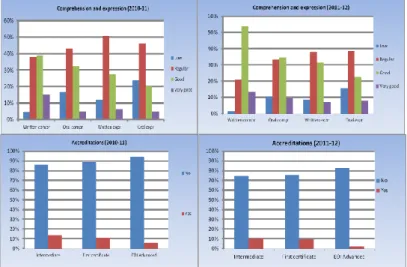
Questionnaires were designed to collected incoming students’ English language level, taking into account their certification needs. Figure 1 shows the results for a sample of 400 students enrolled in the new degrees.
Figure 1. Data representing English level and certification of students.
The conclusion of the analysis was that scaffolding and support material was necessary for teaching content through English. With this aim the research group Linguatech-Rima (Research group on Scientific and Technological Communication) was created, with more than 20 professors from different areas involved in Engineering Education (as Mathematics, Electronics, Electricity, ICT, Chemistry, Mechanics). Members of this group are currently working on the Multilingual Formulae website, presented in this paper.
In section 2 we focus our attention on the parallelism between mathematical symbols and usual language, to stress difficulties, and why support resources are needed. In section 3, the open access resource Multilingual Formulae is presented, to deal with the verbal expression for the mathematical symbols, as a tool to give support to lecturers and students. Section 4 contains some final remarks.
2. Parallelism between languages
There is a widespread agreement that mathematics is the language of the universe, as it was stated by Galileo (Opere VI, 232): “... questo grandissimo libro che continuament ci sta aperto innanzi a gli occhi (io dico l'universo), ma non si può intendere se prima non s'impara a intender la lingua e conoscer i caratteri, ne' quali è scritto. Egli è scritto in lingua matematica, e i caratteri son triangoli, cerchi, ed altre figure geometriche, senza i quali mezzi è impossibile a intenderne umanamente parola; senza questi è un aggirarsi vanamente per un oscuro laberinto.”
Commonly this is used to note the value of mathematics as a problem-modeling tool. But note that it also uses the parallelism between mathematics and usual language, and states that without the characters no word of the language can be understood. This can be applied to both mathematics and foreign language. Thus, might mathematics or symbolic language – rather than the communication bridge – become a barrier?
From now, we focus our attention on the competence of Handling mathematical symbols and formalism, n.6 at KOM project, by Niss (2003). However, it is obviously tied in with the others: n.5 Representing mathematical entities, n. 7 Communicating in, with, and about mathematics, n.8 making use of aids and tools. All of them are concerned with “the ability to deal with and manage mathematical language and tools”, used in problem solving and mathematical thinking in general.
The ability to understand symbolic and formal mathematical language seems to be inherent to the translation process between formal and natural language, which is included in the reflection dimension of the competence, in the Report of Mathematic Working Group. Usually, thoughts are formulated through language. This is the reason we use the natural language when reading symbolic language.
Writing and talking at the board uses this equivalence explicitly, in order to learn. But what is happening when a foreign language is used? On the one hand, verbal understanding is not so direct; difficulties can increase, so we need to be more careful to make explicit the equivalence. On the other hand, we need to use suitable expressions native to the foreign language that are not found explicitly in mathematical textbooks or research papers, and of course not studied in language courses.
In the context of engineering degrees, formulas and algebraic expressions are widely used in almost all subjects, not only Mathematics. Teaching any subject in English could be a problem if students and teachers are not fluent enough to read the
mathematical language. From our point of view, the lack of language fluency may become a useful tool for improving mathematical competence. Let us remark that this equivalence is also used in benefit of handling the symbolic language. Advice on mathematical writing (Halmos (1970) or Tomforde (2007)) states that mathematical expressions are no different from the words they represent, so they should be punctuated accordingly. Also, they need to be complete sentences, thereby preventing meaningless expressions.
Questionnaires with linked audio files were designed to check the real oral comprehension of formulas read in English. They were implemented in the digital campus of our university, based on Moodle. The result was the confirmation of difficulties of teachers and students, varying according to speed, gender of the speaker, native or non-native, and its power as a self-learning tool, as stated by Alsina et al (2012b). Our next step was to elaborate a suitable resource for learning how to read symbolic language, related with engineering education. Details are outlined below.
3. Multilingual Formulae
In this section we describe main characteristics of Multilingual Formulae resource, elaborated with the collaboration of the authors in the research group Linguatech.
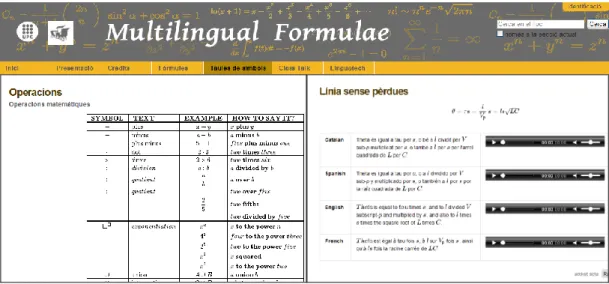
Multilingual Formulae is an open access on-line collaborative resource available at http://mformulae.epsem.upc.edu. The main content includes tables of symbols with English support and sets of formulas for different topics. More concretely it contains tables to support English speech of symbolic language such as binary relations, symbols, scientific notation, and so on, including examples and audio files. Additionally, more than 600 formulas from different areas of engineering have been introduced. Each formula is expressed in terms of symbolic language, and text and audio corresponding to its speech form in several languages (Catalan, Spanish, English and some in French). Examples are showed in Figure 2.
The project has been developed using Plone and TeX. It is the result of the teamwork of professors from different areas in EPSEM, who were in charge of designing the application, and suggesting and reviewing formulas for the different subjects. It cannot be considered finished as new formulas are being added after technical and linguistic revision.
The resource is addressed to lecturers and students as a support for the lack of fluency, to ensure effective communication when symbolic language is used. It also highlights the mathematical part of the formulas, improving content learning. Furthermore, it can also be helpful to increase self-confidence when oral presentations in a foreign language at professional or research level are involved.
4. Final remarks
The introduction of linguistic competence in addition to mathematical competence, motivated the analysis of context: the level of incoming students and difficulties reading symbolic language. But the parallelism between symbolic and natural languages becomes a learning tool when a foreign language is used, since it highlights the language equivalence. Indeed, language-aware positively supports content-aware. Furthermore, support resources are needed to avoid excessive pressure and assure quality learning. Consequently, the Multilingual Formulae resource is being developed to improve the natural reading of symbolic language in a foreign language.
Despite the focus of this paper being the handling symbolic language, we stress that it is just a tool, and we need to be aware not to trivialise mathematics, in the same way that an English curriculum would be impoverished if it focused largely on grammar issues (Schoenfeld (1992)).
Coming back to the parallelism between mathematics and language learning, let us add that besides handling language, recommendations for CLIL and mathematics have a lot in common: paraphrasing, reformulating, decrease speed of speech, etc. to make the discourse more understandable.
Finally, let us turn to attitude. It is well known that attitude significantly affects learning in general. In particular, the attitude a student has towards mathematics has a strong influence on the achievement of the mathematical competence and the mathematical behaviour of students. Moreover, the attitude of students towards mathematics is more positive when the environment provided by universities is perceived as being supportive (Shaw & Shaw (1999)). In that sense, the resources and support material built for scaffolding, with the excuse of foreign language, can have a double positive effect on mathematic learning. This is very encouraging for our Research group Linguatech.
References
Alsina, M., Soler, M. (2012) “Multilinguistic verbalization of symbolic language, a learning tool”. In N. Evnitskaya et al eds. Proceedings of II International Round Table on Clil programes, VI Colloquium on Clil in Catalonia, TRICLIL-2012,pp.148-152. Alsina, M., Argelaguet, R., Martinez, I. and Vicente, J. (2012) "Material didáctico para el aprendizaje en inglés en el campo de la Electrónica”. Proceedings of International Symposium on Innovation and Quality in Engineering Education (to appear).
Council of Europe (1995), “Teaching and Learning, towards the learning Society”, White Paper on Education and Training, COM(95) 590.
Lasagabaster, D. and Ruiz de Zarobe, Y. (2010) “CLIL in Spain”: Implementation, Results and Teacher Training. Cambridge Scholar Publishing.
Lasagabaster, D. (2008) “Foreign Language Competence in Content and Language Integrated Courses”. The Open Applied Linguistics Journal Vol.1:31-42.
Niss, M. (2003).”Mathematical competencies and the learning of mathematics:The Danish KOM project. In A. Gagatsis and S. Papastravidis eds. 3rd Mediterranean Conference on Mathematics Education, Hellenic Math. Soc. And Cyprus Math. Soc. pp.115-124.
Halmos, P.R. (1970) “How to write mathematics”, L’enseignement Mathématiques, Vol. 16 (No. 2):123-152.
Tomforde, M. (2007) "Mathemathical writing: a brief guide”, University of Houson. Accessed via http://www.math.uh.edu/~tomforde/MathWriting.pdf (february 2012). Schoenfeld, A. H. (1992). Learning to think mathematically: Problem solving, metacognition, and sense-making in mathematics. In D. Grouws (Ed.), Handbook for Research on Mathematics Teaching and Learning.MacMillan pp. 334-370.
Shaw, C.T. and Shaw, V.F. (1999) “Attitudes of engineering students to mathematics – a comparison across universities”. International Journal of Mathematica Education in Science and Technology, Vol. 30 (No. 1):47-63.
Acknowledgements
The authors are members of the research group Linguatech, supported by RIMA-ICE and the grant CAPMD-UPC-2011. Multilingual Formulae has been possible thanks to the grant 2010MQD00189, from the government of Catalunya, and the collaboration of the Computer Center of Escola Politècnica Superior d’Enginyeria de Manresa.