5
A quality framework for Open and Distance Higher Education
Magda Fonte
Laboratório de Educação a Distância e eLearning (LE@D), [email protected]
António Teixeira,
Universidade Aberta,
Abstract
In view of the absence of a regulatory and normative framework in Portugal, in the context
of Open and Distance Education (ODE) in Higher Education (HE), and in view of the
emphasis that international guidelines have placed on this domain, it was considered
important to create a quality reference framework that supports the Higher Education
Institutions (HEI) and all those involved in the creation and monitoring of open and distance
courses in HE. The purpose of this paper is to describe the process of creating a quality
reference for ODE, carried out within the scope of the PhD in Education at the Open
University of Portugal. Here are described the process of identifying and analysing 40
international quality models in the area of ODE, which led to the preliminary version of the
framework; and the Delphi study that was carried out with a panel of ODE specialists, in
order to validate the preliminary version. The results of the first Round of the Delphi Study
are presented and some considerations for the next steps of the research are outlined.
Keywords:
Open and Distance Education, Quality Assurance, Higher Education, Formal
Education, Non-formal Education.
Resumo
Face à ausência de um enquadramento regulamentar e normativo em Portugal, no contexto
da Educação Aberta e a Distância (EAD) no Ensino Superior (ES), e atendendo à ênfase que
as diretrizes internacionais têm colocado neste domínio, considerou-se importante a criação
de um referencial de qualidade que suporte as Instituições de Ensino Superior (IES) e todos
os envolvidos na criação e monitorização de cursos abertos e a distância no ES. Neste
sentido, o presente artigo descreve o processo de criação de um referencial de qualidade
para a EAD, realizado no âmbito do doutoramento em Educação na Universidade Aberta.
São descritos o processo de identificação e análise de 40 modelos internacionais de
qualidade na área da EAD, que conduziu à versão preliminar do referencial; e o estudo
Delphi que foi realizado com um painel de especialistas em EAD, por forma a validar a versão
preliminar do referencial. São apresentados os resultados da primeira Ronda do Estudo
Delphi e delineadas algumas considerações para os próximos passos da investigação.
Palavras-chave:
Educação Aberta e a Distância, Garantia da Qualidade, Ensino Superior,
Educação Formal, Educação Não-formal.
INTRODUCTION
In Portugal there is no regulatory and normative framework in the context of Open and
Distance Education (ODE) in Higher Education (HE), making it difficult for Higher Education
Institutions (HEI) to monitor the quality of ODE practices. In light of this, the HEI need an
instrument in order to evaluate and monitor the quality assurance of ODE courses, involving
them actively in the development of a continuous improvement strategy. This paper
describes the process of creation of the reference framework, based on the ongoing
research entitled “Quality assurance of Open and Distance Higher Education: creating an
evaluation framework”. The research is divided into three steps: the Step 1 is related to the
process of selection and analysis of international quality models in the ODE area in order to
create the preliminary version of the framework. The Step 2 is a Delphi Study toward the
validation of the framework and the Step 3 is the process of translation of the framework
from Portuguese to English.
This paper addresses some literature reviews where the state of art in the ODE area and
some definitions of main concepts, such as Formal and Non-Formal Education, Open and
Distance Education, Open Educational Resources, Massive Open Online Courses and Quality
Assurance are presented and discussed.
Subsequently, the research problem is explained in detail, some methodological procedures
related to the Step 1 and 2 are presented and some results related to the first Round of the
Delphi study are discussed.
BACKGROUND
According to some national and international guidance documents, the web-based
technologies have been gaining great prominence in HE context, fostering new forms of
communication and interaction between teachers, students and institutions (Ramos &
Moreira, 2014; Ministério da Educação e Ciência, 2014). The openness to the world is now
a strategic option for HEI, arising from the need to go beyond borders to attract new
audiences and to become more international. Faced with this reality, HEI should increase
focus on the development of ODE, both formal and non-formal.
There are fewer and fewer students who do not seek open-access online training, whether
formal or non-formal, to complement their studies or just for simple curiosity or driven by
the will to learn freely. On the other hand, teachers seek to adapt to the new trends of
online learning; and even HEI are taking significant steps towards developing appropriate
policies for online learning. It is, therefore, a global phenomenon (Butcher &
Wilson-Strydom, 2013).
Formal and non-formal education
Formal Education takes place in an organized and structured context (like an educational
institution or in the workplace), referred as learning, where objectives, duration and
resources are clearly defined. Formal education culminates, in general, in validation and
certification (Cedefop 2012; Eurydice, 2011).
Non-formal education can take place inside and outside educational institutions where
people of any age are welcome. Non-formal learning is planned but adaptable within
institutions / organizations. Non-formal education shares much of the principles of formal
education, although the motivation to learn is intrinsic to the student. Another aspect to
consider in the definition of non-formal education relates to the intentionality of knowledge
sharing among the participants, and may or may not exist specialized content in the subject
under study (Cedefop, 2012; Eshach, 2007; Schwier & Seaton, 2013). This research follows
this approach and the researchers argue that within the non-formal open and distance
education are included the Massive Open Online Courses (MOOC) and the Open Educational
Resources (OER), created or offered by HEI.
Open and Distance Education (ODE)
ODE is defined by the Open Education Consortium (2018) as a combination of the traditions
of knowledge sharing and the 21st century technology, in order to create a vast pool of
openly shared educational resources, while harnessing today’s collaborative spirit to develop
educational approaches that are more responsive to learner’s needs. According to the
Consortium, ODE
(...) encompasses resources, tools and practices that employ a framework of open sharing to improve educational access and effectiveness worldwide (...); and “(...) seeks to scale educational opportunities by taking advantage of the power of the internet, allowing rapid and essentially free dissemination, and enabling people around the world to access knowledge, connect and collaborate”.
Starting from this definition and complementing with a definition presented by
Ossiannilsson, Altinay & Altinay (2016), also based on the Open Education Consortium, in
this research the ODE is seen as
“(...) a mode of realizing education enabled by digital
technologies that are accessible to as many people as possible. It offers multiple ways of
learning and sharing knowledge and a variety of access routes to both formal and
non-formal education”
(p.162). The ODE can be a bridge to the gap between formal and
non-formal education, reducing barriers to increase access to HE and create many opportunities
to HEI, practitioners and students.
It is really important to encourage the HEI to establish ODE strategies and policies to support
students, attract new audiences and collaborate with other institutions in order to achieve
the lifelong learning framework, where the learning process is learner-centred and not
teacher-centred. At this point, Stagg & Bossu (2016, p.128) defend that ODE, at an
institutional level, has the potential to:
Increase institutional reputation through showcasing of educational content and
learning and teaching innovations;
Create opportunities for national and international collaboration with other
institutions;
Increase access to education by assisting the alignment of an institution’s agenda
for social inclusion and widening participation;
Create economies of scale by developing more effective ways to create, use, re-use
and remix open content;
Promote innovations and quality in teaching and learning.
Related to the students’ opportunities, the adoption of ODE could contribute to:
Enhance learning through networked and collaborative learning;
Promote richer learning experiences through access to learning resources available
outside institutional boundaries;
Meet students’ different needs and learning styles;
Promote and enhance lifelong learning.
The ODE has an important role in lowering the costs of education and increasing the access,
equity and adequacy to learners, allowing the access to resources anytime and anywhere.
Moreover, provides opportunities to improve the quality of learning and teaching and to
establish an equitable and sustainable education system (Ossianilson et al., 2016; Stagg et
al., 2016). Conole & Alevizou (2010) argue that openness is a trend, in terms of the
production and sharing of educational materials, making them freely available.
Open Educational Resources (OER) and Massive Open Online Courses (MOOC)
Associated to the scalability of ODE, some concepts have emerged, such as OER and MOOC,
sharing a common characteristic - open access – making education accessible to all (Corrall
& Pinfield, 2014, Ossianilson et al., 2016). The OER are
(...) learning and research materials in any medium, digital or otherwise, that reside in the public domain or have been released under an open license that permits no-cost access, use, adaptation and redistribution by others with no or limited restrictions (UNESCO, 2012, p.1).
They include textbooks, lecture notes, assignments, tests, projects, audio, video and
animation (UNESCO, 2018).
(…) are courses designed for large numbers of participants, that can be accessed by anyone anywhere as long as they have an internet connection, are open to everyone without entry qualifications, and offer a full/complete course experience online for free (OpenupEd, 2015, p.1).
They are led by subject matter experts from higher education or industry and hosted by learning management systems or dedicated MOOC platforms (Witthaus, Inamorato dos Santos, Childs, Tannhäuser, Conole, Nkuyubwatsi & Punie, 2016, p.10).
Quality Assurance in Portuguese Open and Distance Higher Education
Despite criticism by some people and some tensions between the two main roles of quality
assurance - the means of accountability and the route to quality improvement (Butcher &
Wilson-Strydom, 2013) - there are two common denominators in the definition of the
concept of quality. According to Gaskells & Mills (2014) these two denominators are always
related to (i) the quality of teaching and learning; and (ii) the quality of qualification.
The concern with quality assurance, whether it is teaching, learning or qualification, is
increasingly present in HEI, due to, among other factors, the growing massification, to the
increase of educational offer and to the loss of confidence in HEI. Therefore, it is essential
to ensure the improvement of HEI quality through a systematic, critical and continuous
analysis in order to gain the confidence of students, stakeholders and society.
Currently a large number of countries have a national system, body and / or agency that
monitors and guarantees the quality of HE. In Portugal, it is the Agency of Evaluation and
Accreditation of Higher Education (A3ES) that assumes this responsibility. The A3ES was
established by the Portuguese State in 2007, and the institution is competent to evaluate
and accredit HEI and their programmes/courses. This Agency is an independent institution
and aims to promote and ensure quality in HE (DGES, 2018). The A3ES assumes as functions
(A3ES, 2018):
The definition and guarantee of the quality standards of the system;
The evaluation and accreditation of programmes/courses and HEI;
The public disclosure of evaluation and accreditation results;
The promotion of the internationalization of the Portuguese HE system;
The advice on quality assurance in HE;
The carrying out of studies and opinions, either on its own initiative or at the request
of the State;
Participation in the European system of quality assurance in HE (EQAR);
The coordination of evaluation and accreditation activities in Portugal with
international evaluation institutions and mechanisms.
In order to evaluate the quality of an educational system or program it matters to clarify
what is meant by quality in HE, some definitions that help to better understand the concept
and to frame the research problem that follows.
According to the A3ES quality assurance is:
A multidimensional, multilevel and dynamic concept that relates to the context of an educational model, with the institutional mission and objectives, as well as with the norms and specific terms of reference of a particular system, institution, course, program or disciplinary unit. The quality can thus take on different meanings, sometimes conflicting, depending on: (i) the perspective of different stakeholders in higher education (e.g. students, teachers, disciplinary areas, labor market, society, government); (ii) their references (inputs, processes, outputs, missions, objectives, etc.); (iii) attributes or characteristics of the academic world to be evaluated; and (iv) the historical period in the development of higher education "(A3ES, s.d., p.12).
In another complementary perspective, the European Association for Quality Assurance in
Higher Education (ENQA) combines the concept of quality with excellence:
Excellence can be defined fundamentally as exhibiting characteristics that are exceptional. In the explanatory context, excellence enshrines one aspect of quality, and, according to the traditional view, it links quality with the exceptional. From this point of view, quality is a measure of something special that is not always achieved. Quality refers to something distinctive and, in educational terms, it is linked to notions of excellence, of the standard is high, it is rarely attained; it represents something to which most institutions or scholars can aspire (Brussoni, Damian, Sauri, Jackson, Kömürcügil, Malmedy, Matveeva, Motova, Pisarz, Pol, Rostlund, Soboleva, Tavares & Zobel, 2014, pp. 21-22).
ISSUES, CONTROVERSIES, PROBLEMS
The research carried out in recent years on quality in ODE in HE in Portugal has focused on
very specific contexts, institutions or courses, not allowing the construction of a more
comprehensive vision of the national reality (Casanova, 2014, Dias, 2006, Ubachs, 2012).
On the other hand, the regulatory framework in the national context in this area is quite
rare, making it difficult for HEI to monitor ODE practices. Among the existing regulations in
the ODE area, although not exclusively dedicated to HE, it is important to mention the Order
No. 17035/2001, which establishes the distance education in the training sector (Dias,
Rocha, Correia, Neves, & Feliciano, 2014); the Standard NP 4512/2012, integrated in the
Portuguese Quality Institute (IPQ), which refers to quality for the management of vocational
training, including learning enriched by technology (Dias, et al., 2014); and the first
Portuguese Standard for the certification of modules and courses with a strong component
in e-Learning - the NP4545. This Standard is also integrated in the IPQ and comes from an
adaptation of the ECBCheck model, used until 2014 by the European Foundation for Quality
in e-learning (EFQUEL) and currently managed by GIZ and United Nation University. There
is yet another document that needs to be explored, as it was an important contribute for
the creation of the reference framework: the report Reforming Distance Learning Higher
Education in Portugal. In 2009 the Ministry of Science, Technology and Higher Education of
Portugal set up a working group composed of international experts in the field of ODE and
specialists from several Portuguese HEI, including the Open University. The purpose of this
working group was to discuss and align a proposed legislation for the ODE in HE, and for
the first time was demonstrated a concern of the governmental entities with the problem of
ODE in HE (Monteiro, 2016). According to the report, Portugal was a country where
traditional classroom teaching predominated, presenting a considerable delay in the
adoption of ODE practices when compared to other European countries. The ODE in HE in
Portugal had a low enrolment rate, compared to the total enrolment in the HE (less than
3%), with approximately 90% of these registrations corresponding to the Open University,
the only public HEI in Portugal with full distance education offer. At the same time other
HEI had already begun the process of adopting the ODE, but this adoption was based on a
more technological character rather than pedagogical, constituting a way of complementing
face-to-face activities through content repositories and pedagogical materials (Magano,
Castro, & Carvalho, 2008).
Nowadays, the reality is somehow different, and there has been an increase in the number
of online courses, although this increase is insignificant in terms of graduate and
postgraduate courses (Monteiro, 2016). In recent years, HEI has also been investing in the
creation and offering of MOOC, and there are currently 25 courses (MOOC List, 2018).
According to Monteiro (2016) it is evident the slow evolution of the ODE in HE, not having
seen significant changes from 2009 until the present day. Thus, as a way of boosting ODE
in Portugal, the author recommends, among other things, an international and national
promotion of ODE in a way to increase the number of students in this type of teaching and
learning and the implementation of a formal accreditation mechanism for ODE courses.
SOLUTIONS AND RECOMMENDATIONS
The quality management and assurance system is a fundamental tool in supporting HEI as
it ensures the correspondence between the students' qualifications and its missions,
promoting trust and transparency between them, their stakeholders and society. Quality
assurance helps institutions responding to changes and challenges by ensuring that the
qualifications obtained by students and their learning experiences remain in the vanguard
of institutional missions (Ministério da Educação e Ciência, 2014; ESG, 2015). The quality
management and assurance should be interpreted as a process established in the
organizational culture that involves the entire educational organization and not only certain
areas (McGhee, 2003).
Considering the issues, controversies and problems presented previously, there was a need
to define research questions and objectives:
Table 1: Research questions, general goals and specific goals
Research questions General Goals Specific Goals
1. What dimensions, criteria and quality indicators are included in the models and international frameworks?
1.1 Develop the preliminary version of the quality framework for ODL in HE in Portugal
1.1.1 Select international models and frameworks.
1.1.2. Analyse the previously selected international models and frameworks. 1.1.3. Identify the dimensions, criteria and quality indicators contained in international models and frameworks.
1.1.4. Create the preliminary version of the quality framework for ODE in HE in Portugal, based on the analysis made to international models and frameworks.
2. What is the point of view of national and international experts in the area of ODE in HE regarding the dimensions, criteria and indicators established?
2.1 Develop the final version of the quality framework for ODE in HE in Portugal.
2.1.1 Collect views on quality dimensions, criteria and indicators established, by inquiry to a panel of experts from the various Portuguese HEI.
2.1.2 Introduce improvements in the framework, based on feedback from national experts until an acceptable consensus is reached.
2.1.3 Translate the framework to English and validate it with international experts.
2.1.4 Provide the final version of the framework in an online format.
It should be noted that the research is divided into three steps:
Step 1 – analysis of international models and frameworks in order to create the first
version of the framework, based on quality dimensions, criteria and indicators
identified.
Step 2 - creation of a panel of national experts in ODE area and subsequent analysis
of the framework established in Step 1.
Step 3 - translation of the framework to English language, final validation by
international experts and release on the web.
In the Figure 1 is demonstrated the workflow of the investigation with indication of the 3
steps previously descripted.
Figure 1. Workflow of the research
Firstly, two documents were analysed in order to help to define the areas of reference: the
Standards and Guidelines for Quality Assurance in the European Higher Education Area
(ENQA, 2015) and the Standards for Internal Quality Assurance Systems in Portuguese HEI
(A3ES, 2016). The Standards and Guidelines for Quality Assurance in the European Higher
Education Area (ESG) has a main goal of
“(...) contribute to the common understanding of quality assurance for learning and teaching across borders and among all stakeholders. They have played and will continue to play an important role in the development of national and institutional quality assurance systems across the European Higher Education Area (EHEA) and cross-border cooperation. Engagement with quality assurance processes, particularly the external ones, allows European higher education systems to demonstrate quality and increase transparency, thus helping to build mutual trust and better recognition of their qualifications, programs and other provision” (p.4).
The Standards for Internal Quality Assurance Systems in Portuguese HEI (RSIGQ) are an
adaptation of the ESG (2015) and aim to provide a framework that can support HEI in the
design and implementation of their quality systems, as well as serve as a benchmark in the
application of audit criteria for the certification of internal quality assurance systems of
institutions. After a careful analysis of ESG and RSIGQ and based on a review of the literature
up to the ODE area, the following areas of the framework were established:
Area 1: Policy for quality assurance
Area 2: Design, development, and approval of courses
Area 3: Student-centred learning, teaching and assessment
Area 4: Student admission, recognition, and certification
Area 5: Staff (teacher and non-teacher)
Area 6: Student support
Area 7: Information management
Area 8: Public information
Area 9: On-going monitoring and continuous improvement
Area 10: External quality assurance
Subsequently, were identified 40 documents in the ODE area, through a web-based search.
The search focused on ODE entities and bodies around the world, identifying a set of entities
/ bodies that had developed ODE quality models:
African Virtual University
American Distance Education Consortium
Asian Association of Open Universities
Australasian Council on Open, Distance and e-Learning
Benchmarking of virtual campuses
British Accreditation Council for Independent Further and Higher Education
California County Superintendents Educational Services Association
Commonwealth of Learning
Council for Higher Education Accreditation
Deutsche Gesellschaft fur Internationale Zusammenarbeit GmbH
Distance Education Accrediting Commission
eduQua
European Association of Distance Teaching Universities
European Foundation for Management Development
Flexible Education Norway
Instituto Latinoamericano y del Caribe de Calidad en Educación Superior a Distancia
Instituto Nacional de Educação à Distância
International Organization for Standardization
Learning Agency Network
Matic Media Lda.
MENON Network
Ministry of Education, Brazil
National Centre for Tertiary Teaching Excellence
National Education Association (NEA), Institute for Higher Education Policy (IHEP) &
Blackboard.
National University Commission Nigeria
Online Learning Consortium
Open & Distance Learning Quality Council
Open Education Europa
QualitE-learning Assurance Inc.
Quality Matters
Supporting Excellence in E-Learning
Te Toi Tupu / Ministry of Education of New Zealand
The National Association of Distance Education and Open Learning in South Africa
Three models were also identified that were not directly linked to any organism / entity:
Eight Dimensional E-Learning Framework by Khan
CHIRON
eMM - e-Learning Maturity Model
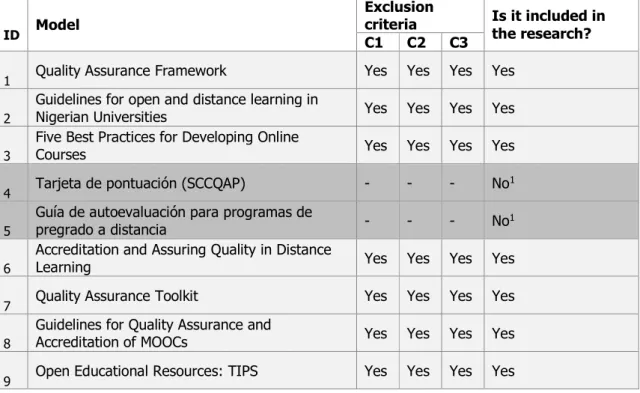
In order to reduce the corpus of analysis, a selection of the identified documents was carried
out, based on three exclusion criteria, reaching a selection of 23 final documents, as shown
in the Table 2:
C1 – Is the model active?
C2 – Is the model applicable in HE context?
C3 – is the model exclusively dedicated to Open Education (including Open Learning)
or Distance Education (including Distance Learning and/or Online Education)?
Table 2. Selected models
ID Model
Exclusion
criteria Is it included in the research? C1 C2 C3
1 Quality Assurance Framework Yes Yes Yes Yes 2
Guidelines for open and distance learning in
Nigerian Universities Yes Yes Yes Yes
3
Five Best Practices for Developing Online
Courses Yes Yes Yes Yes
4 Tarjeta de pontuación (SCCQAP) - - - No1
5
Guía de autoevaluación para programas de
pregrado a distancia - - - No1
6
Accreditation and Assuring Quality in Distance
Learning Yes Yes Yes Yes
7 Quality Assurance Toolkit Yes Yes Yes Yes
8
Guidelines for Quality Assurance and
Accreditation of MOOCs Yes Yes Yes Yes
9 Open Educational Resources: TIPS Yes Yes Yes Yes
1 These documents could not be accessed. After several attempts of contact there was no response from the authors/entities and therefore were excluded from the research.
10
Quality Assurance Toolkit for Open and Distance
Non-formal Education Yes No - No
11 OLC Quality Scorecard Yes Yes Yes Yes
12 Quality Matters Standards for HE Yes Yes Yes Yes
13 eQcheck Yes No - No
14 MEC Yes Yes Yes Yes
15
BAC - Online, Distance and blended learning
scheme document Yes Yes Yes Yes
16 California eLearning Framework Yes No - No
17 QUALITY ON the LINE No - - No
18
Eight Dimensional E-Learning Framework by
Khan Yes Yes Yes Yes
19 E-xcellence Yes Yes Yes Yes
20 OpenupEd Framework Yes Yes Yes Yes
21 Quality Standards for Online Education Yes Yes Yes Yes
22 Benvic Benchmarking Indicators Yes No - No
23 Open ECBCheck Yes Yes Yes Yes
24 eduQua Label No - - No
25 UNIQUe Framework No - - No
26 SEEQUEL No - - No
27 EPPROBATE No - - No
28 SEVAQ+ Yes No - No
29 SEEL e-Learning Quality Guidelines No - - No
30 Pick&Mix No - - No
31 ISO/IEC 19796-1 - - - No
2
2The access to this document is only possible through payment, which is the reason it has been excluded from the research.
32 EFMD - CEL Yes Yes Yes Yes
33 CHIRON No - - No
34
ACODE Benchmarks for Technology Enhanced
Learning Yes Yes Yes Yes
35 e-Learning Planning Framework Yes No - No 36 eLG - e-Learning Guidelines Yes Yes Yes Yes
37 eMM - e-Learning Maturity Model Yes Yes Yes Yes 38
Acreditação de Instituições e de Cursos de
Educação à Distância (EAD) em Moçambique Yes Yes Yes Yes
39 ODLQC Standards Yes Yes Yes Yes
40
NADEOSA Quality Criteria for Distance Education
in South Africa Yes Yes Yes Yes
A detailed analysis of the selected models allowed us to verify that although all of them
have very particular specificities, given the geographic and cultural contexts, they present
very similar orientations, namely:
Development and valorisation of the ODE in the institutional culture, particularly
through its integration in the strategic plan.
Continuous monitoring of the quality of the courses / programs (internal evaluation).
Special attention to Learning Management Systems (LMS) and other ODE systems
in terms of robustness, design and architecture.
Adequacy of the courses / programs to the target public, namely through the active
involvement of stakeholders throughout the process, from design to evaluation.
Flexibility of learning materials and student autonomy, allowing them to manage
their own learning.
Detailed, current and clear description of learning methodologies and e-tutoring
skills.
Prior definition of the evaluation procedures, focusing on the moments in which it
occurs and prioritizing processes of self-assessment, peer evaluation and
personalized feedback.
Support and training of staff.
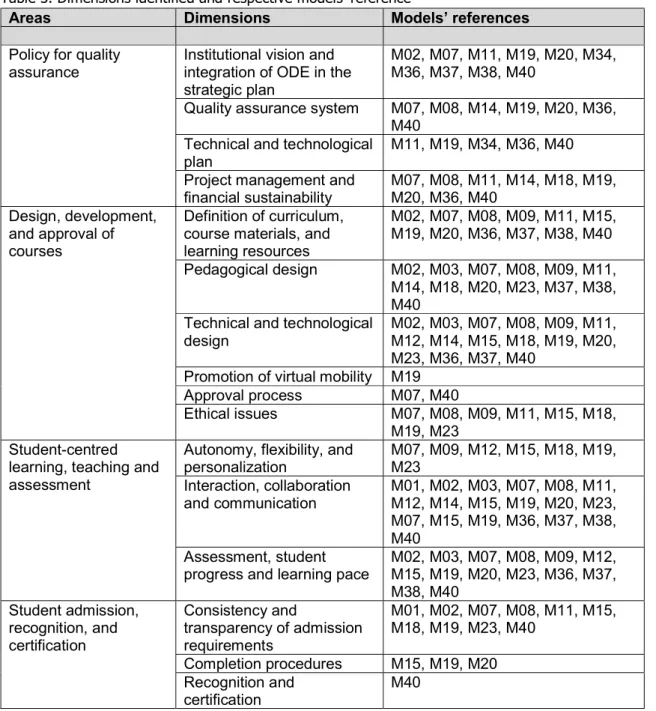
After the analysis of all documents previously mentioned, the preliminary version of the
framework, constituted by 10 areas, 33 dimensions, 47 criteria and 125 indicators was
created. In the Table 3, the dimensions identified and the reference to the models that
support them, with the respective ID are presented in more detail.
Table 3. Dimensions identified and respective models’ reference
Areas Dimensions Models’ references
Policy for quality
assurance Institutional vision and integration of ODE in the strategic plan
M02, M07, M11, M19, M20, M34, M36, M37, M38, M40
Quality assurance system M07, M08, M14, M19, M20, M36,
M40 Technical and technological plan
M11, M19, M34, M36, M40 Project management and
financial sustainability M07, M08, M11, M14, M18, M19, M20, M36, M40 Design, development, and approval of courses Definition of curriculum, course materials, and learning resources M02, M07, M08, M09, M11, M15, M19, M20, M36, M37, M38, M40 Pedagogical design M02, M03, M07, M08, M09, M11, M14, M18, M20, M23, M37, M38, M40
Technical and technological design
M02, M03, M07, M08, M09, M11, M12, M14, M15, M18, M19, M20, M23, M36, M37, M40
Promotion of virtual mobility M19
Approval process M07, M40
Ethical issues M07, M08, M09, M11, M15, M18,
M19, M23 Student-centred
learning, teaching and assessment
Autonomy, flexibility, and
personalization M07, M09, M12, M15, M18, M19, M23 Interaction, collaboration and communication M01, M02, M03, M07, M08, M11, M12, M14, M15, M19, M20, M23, M07, M15, M19, M36, M37, M38, M40 Assessment, student progress and learning pace
M02, M03, M07, M08, M09, M12, M15, M19, M20, M23, M36, M37, M38, M40 Student admission, recognition, and certification Consistency and transparency of admission requirements M01, M02, M07, M08, M11, M15, M18, M19, M23, M40 Completion procedures M15, M19, M20 Recognition and certification M40
In the Chart 1 is possible to have a perception of the number of references per model. The
framework is based on a total of 967 references from 23 different models. In the Chart can
be verified the models that contributed most to the framework, taking into account the
number of references:
M19. E-xcellence, from EADTU (147 references)
M07. Quality Assurance Toolkit, from Commonwealth of Learning (143 references)
M37. eMM or e-Learning Maturity Model (79 references)
M40. Quality Criteria for Distance Education in South Africa, from National
Association of Distance Education and Open Learning in South Africa (77 references)
Areas Dimensions Models’ references
Staff (teacher and non-teacher)
Recruitment and conditions of employment M07, M11, M15, M19, M40 Non-teacher staff - qualifications and competences M02, M03, M07, M11, M14, M15, M19, M34, M36, M38, M40
Teacher and tutor staff - qualifications and competences
M02, M03, M07, M11, M14, M15, M19, M34, M36, M38, M40
Training and professional development
M02, M07, M11, M14, M15, M19, M20, M34, M36, M37, M38, M40
Technical and administrative support
M07, M08, M11, M12, M19, M34, M36, M37, M40
Teams dimension M02, M07, M15, M38, M40
Student support Course induction M07, M11, M15, M18, M19,
M34, M36, M37, M38 Guidance and academic and
administrative support M02, M07, M08, M11, M15, M18, M19, M23, M37, M40 Technical support M08, M11, M12, M15, M18, M19, M36, M37, M40 Complaints M11, M15, M19, M23, M37
Information management Collection and use of data M07, M14, M15, M18, M19,
M23, M34, M36, M40
Public information Dissemination of information M07, M08, M11, M12, M15,
M18, M19, M23, M38, M40 On-going monitoring and
continuous improvement Monitoring of quality assurance policy M07, M11, M19, M37, M40 Monitoring of course design
and approval process M07, M08, M11, M15, M18, M19, M20, M36, M37, M40 Monitoring of teaching and
learning process M01, M02, M07, M09, M11, M15, M18, M19, M34, M36, M37, M40 Continuous improvement process M02, M03, M07, M11, M15, M19, M23, M34, M36, M37 External quality assurance Cyclical external quality
assurance
M15. Online, Distance and blended learning scheme document, from British
Accreditation Council for Independent Further and Higher Education (59 references).
M11. OLC Quality Scorecard, from Online Learning Consortium (57 references)
Chart 1 - Number of references per model
After the development of the preliminary version of the framework, followed the validation
by international experts (speaking the Portuguese language) and after that the Delphi Study
was carried out. Initially, a panel of experts was formed, and four profiles were defined to
help select the specialists:
Profile A - integrates senior leaders whose functions are directly related to the
definition of ODE policies and strategies within the institution (e.g., rectors,
vice-rectors, presidents, vice-presidents, divice-rectors, etc.)
Profile B - integrates intermediate leaders whose functions are to coordinate units
(or similar structures) where ODE courses are developed.
Profile C - integrates technicians whose functions include the planning, development,
offer and evaluation of ODE courses (e.g. instructional designers, e-Learning
developers, multimedia technicians, etc.).
The process of identification of specialists began with the identification of all Public HEI in
Portugal, based on the information available on the website of the General Direction of
Higher Education (DGES, 2017). After this identification, a search was made on the
institutional sites of each HEI, trying to obtain information regarding ODE units or analogous
structures. In some cases, it was not possible to obtain information through the institutional
website, so emails were sent to the general contact of the institution and, in some cases,
after no response, a telephone contact was established. In this more direct contact, it was
sought to find out if there was a unit of ODE or similar structure in the institution, the name
and contact of the responsible person (rector, vice-rector, president, vice-president, etc.)
the names and contacts of the remaining team allocated to the unit, including coordination
and instructional designers or those responsible for the didactic-pedagogical component.
After several attempts of contact, it was not possible to obtain information regarding some
HEI. In this regard, 102 people from 15 Portuguese HEI were identified and invited.
The first Round of the Delphi Study took place between October 11 and November 20, 2017,
with the participation of 49 experts from the 15 HEI invited. A response rate of 48% was
obtained in relation to the number of addressed invitations (N = 102).
The questionnaire was organized in two parts. The first part was intended to collect
characterization data from the experts. In the second one, it was asked to indicate the
degree of agreement regarding the integration of the previously established dimensions,
criteria and indicators in the final version of the framework, with a 5-level Likert scale: 1 =
Totally Disagree, 2 = Disagree, 3 = Do not Agree or Disagree, 4 = Agree, 5 = Totally Agree.
At the end of each dimension, it was also possible to change the formulation of the items
presented and to add new items, through an open-ended question. At the end of the
questionnaire, there was still a free space for general comments and suggestions. The
response process was individual and totally confidential and the estimated response time
was 1 hour.
Concerning the panel of experts in Round 1, 49% are male and 51% female, aged between
30 and 70 years, as can be seen in the Table 4.
Table 4. Experts’ Age – Round 1
Age N %
<30 2 4%
30-50 25 51%
51-70 22 45%
The experts’ profiles are also quite variable, as can be seen in the Table 5. It should be
noted that specialists could select more than one profile, if there was accumulation of more
than one function (e.g. vice-rector responsible for the ODE area in the institution,
coordinator of the ODE unit and teacher of an ODE course).
Table 5. Experts’ Profiles – Round 1 Profiles N % Profile A 7 14 Profile B 6 12 Profile C 12 25 Profile D 9 19 Profiles A e B 2 4 Profiles A e D 1 2 Profiles A, B e D 1 2 Profiles A, B, C e D 3 6 Profiles B e D 1 2 Profiles B, C e D 5 10 Profiles C e D 2 4 Total 49 100
The time of experience of the experts is also variable, with 39% being under 5 years, 31%
between 5 and 10 years, 20% between 11 and 20 years and 10% claiming to have more
than 20 years of experience (see Table 6).
Table 6. Experts’ Years of Experience – Round 1
Years N % <5 19 39 5-10 15 31 11-20 10 20 >20 5 10 Total 49 100
According to the results obtained in the first Round, there is some variability in the
responses, as can be seen in Chart 2 where is shown the values of the mean, median, mode,
standard deviation and variance for each dimension.
Chart 2 – Results of the Delphi Study 1st Round
From these results and the suggestions and comments made by the panel of experts were
introduced changes and added new items (criteria and indicators). In the Table 7 is possible
to see the Areas and Dimensions where changes were made and new items added.
Table 7 - Summary of suggestions and comments made in Round 1
Areas Dimensions Changes New items
A1 Dimension 1 Dimension 3 A2 Dimension 1 Dimension 2 Dimension 3 Dimension 4 Dimension 5 A3 Dimension 2 Dimension 3 A4 Dimension 1 Dimension 2 A5 Dimension 1 Dimension 4 Dimension 6 A6 Dimension 1 Dimension 2 Dimension 4 A7 Dimension 1 A8 Dimension 1 A9 Dimension 3
A10 Dimension 1
Number of items 41 18