PERFORMANCE OF BUILD-OPERATE-TRANSFER PROJECTS: RISKS’ COST
IMPLICATIONS FROM PROFESSIONALS AND CONCESSIONAIRES
PERSPECTIVE
Amusan Lekan*
Murtala Building Technology Department College of Science and Technology, Covenant University, Cannanland, PMB 1023 Ota. Nigeria
([email protected]) 234-(0) 8030743025
Joshua Opeyemi
Building Technology Department College of Science and Technology, Covenant University, Cannanland, Ota. Nigeria
Oloke C. Olayinka
Estate Management Department Department College of Science and Technology, Covenant University, Cannanland, Ota. Nigeria
*Correspondence Author
Abstract
Determining cost implication of risk factors on performance of Build Operate Transfer (BOT) projects is a major focus of this study. One-hundred and seventeen structured questionnaires were used to collect information randomly from the respondents which made up of professionals such as Builder, Architect, Quantity surveyor and Civil engineer. Content analysis was carried out on the responses for validation; data were further analyzed with Mean Item Score using Risk Mean Index and validated with regression analysis. Meanwhile, the most common risk to all the projects executed are inflation, variation to works, change in government policy and fluctuating nature of foreign exchange with inflation being the highest on rating scale of 0.1 to 1.0 with corresponding cost implications and years. Against the background of the research outcome therefore, cost and time is used in this context as a model typifying the extent of risk implication experienced on the projects.
Keywords: Performance, Concession, Risk, Transfer, Concessionaire
1.1 INTRODUCTION
One of the major emerging projects financing system is Build-Operate-Transfer (BOT). It enables client to have access to fund for construction on event of fund insufficiency. It involves financing partnership between a private and government with parties involved receiving concession on design, planning, funding, execution and management of a project. The system provides an opportunity for a project to be managed after completions to enable the proponents recover the sum invested in the project. The need to execute project effectively and given the high cost of execution of environmental projects necessitates government sourcing of private initiative. In the case of this type of arrangement, private undertakes the project funding before being transfer to the government (Chege and Rwelamila(2000), Zhang 2005).
The complex nature of BOT is therefore responsible for the uniqueness of the risk involved. The risk is often spread among the concerned parties, while management of the risk is often left to the party that can effectively control the risks. However, the nature of the risk borne by individual will definitely affect the project execution especially if it tends to the negative side. The first step is risk identification; determine the probability of risk occurrence, the risk sharing among the concerned parties and risk implication determination on the project. It is against this back -ground that this research work is geared towards studying implication of risk factors on cost performance of Build-operate-Transfer projects using projects executed in Nigeria.
1.2 CONCEPT OF BUILD-OPERATE TRANSFER PROJECTS (BOT)
Build-Operate-Transfer is a concept used to describe an aspect of public-private initiative in executing capital intensive projects. It is a process whereby public can partner with private sector in executing capital project and infrastructure. Also, this could be referred to as a form of project financing mechanism that helps a private entity to obtain a concession from public to finance, design, construct and manage a facility. On a typical BOT project, the financier looks primarily to the project as only means of loan repayment in case loan facility is accessed in the project financing; this is usually premised on the credit worthiness assessment of the project at feasibility stage. So also, it involves security assurance, security taken on a typical BOT project which is often restricted within the project portfolio. BOT mechanism is a complex structure comprising multiple, inter-dependent agreements among various parties. Some of such parties includes: government, private company (concessionaire), lenders (banks), equity investors, contractors, suppliers, operators and financial advisers. Government grants concession to the private sector (concessionaire), through concession agreement. The concessionaire is responsible for design, finance, construction, and operation of the facility. According to Akintoye, Hardcastle, Beck, Chinyo, and Assenova (2003), the concessionaire retains the title of ownership during the concessionary period, which is normally between 10-50 years, after which the title of ownership is transferred back to the government’’. The submission states further that the following agreements subsist in a typical BOT agreement: concession agreement, loan agreement, shareholders agreement, construction contract, supply contract, off-take agreement, operation and maintenance agreement
The shareholder agreement is the type that exists between the equity investors and the concessionaire. The construction contract on the other hand exists between the constructor and the concessionaire of the contract, and the contract is usually left under fixed price turnkey deal. However, supply contract could be described as an agreement between the supplier and the concessionaire, the supplier in a supply contract is often government agency that supplies raw material such as coal to power plant and oil. Similarly, a take-off agreement is the one brokered between the government and the concessionaire to purchase minimum quantity of services such as electricity, water at fixed price for fixed term.
1.3 CHARACTERISTICS OF BUILD-OPERATE TRANSFER PROJECTS RISKS
Understanding a project configuration and component and risk classification is an important step in structuring the risk pattern obtainable on a project. Researches had been conducted in aspect of risk classification and associated issues. Akintoye et al.,( 2005); Chapman and Ward (2001) classified risk liable to be incurred by contractors, consultants and clients according to their nature and magnitude. Risks were grouped into two major categories as primary and secondary risks. Also further attempt was made by Garry and Creedy (2006) by using risk-breakdown structure to classify risks according to their origin and the area of their impact in the project. Consequently in Doeg (2008) synergistic combination of the approaches of Chapman and Ward (2001) and that of Akintoye et al., (2005), was adopted, and the study concluded with
classifying risk generally into natural and human risks, and an hierarchical risk breakdown structure (HRBS) was created as illustrated in Table 1.1. HRBS allows risks to be classified into internal managed risk and external environment related risks. External risks are those, which are relatively uncontrollable, and due to their nature there is a need for the continual scanning and forecasting of those risks Akintoye et al., (2005). Internal factors are relatively more controllable and vary between projects. Some of these risk factors are local to individual work packages or categories within a project, whereas the other global to an individual project and cannot be associated with any particular work package. Since no two-work packages have the same level of risk and each should be treated separately.
1.4CATEGORIES OF RISKS:
There are different types of risks often associated with BOT projects, this includes among others: social economic risk, operational and technological risk, health and safety related risks, environmental and physical risks (Odeyinka, Oladapo and Akindele (2006). Socio-economic risk encompasses fluctuating social service demand toll and change in stakeholder expectation. This often affects the psycho-social awareness of workers. Economic risks border about risk induced by impact of global economy, unstable exchange rates among others that affect fund flow on a project. Health and safety related risk is another type of risk that are health-condition induced. Noise pollution, emission of poisonous substance, vibration, biological hazards and stress are regarded as health induced risks. So also, BOT projects can be influenced by operational and technological risks. Operational risks include building delivery and maintenance related issues that constitute risks while technological based risk entails obsolescence of current systems, cost of procuring best technology and implications. However, despite the array of associated risk there is often a level of success incurred on BOT project which is determined by success factor associated with BOT projects.
1.5 SUCCESS FACTORS IN BUILD-OPERATE-TRANFER PROJECTS EXECUTION
Build-Operate-Transfer method has been successfully deployed in the execution of capital projects in countries like United States of America, Japan, Indonesia, Malaysia, Singapore, India, Canada, and United Kingdom among others, and most recent in Nigeria in Power, Energy, Telecommunication and Transportation projects. However, Tiong et al., (1997) identified six critical success factors (CSF) that are vital for project promoters in winning a BOT contract. These factors includes: entrepreneurship and leadership, right project identification, strength of consortium, technical solution advantage, financial package differentiation and differentiation in guarantees (Garry and Creedy 2006, and Grubb 1998). These factors were valued and cost implications considered alongside with other risk portfolio and recommendation was synthesized there-from for policy formulation in this study.
1.6 RESEARCH METHODOLOGY
Major objective of this study is to carry out a study on selected build-own-transfer (BOT) projects executed in Nigeria with a view to explore the cost implication of risks on them, looking at it from the point of view of professionals involved in the projects and the concessionaires. Random survey technique was used in this study; projects executed through BOT system and professionals that have taken part in the execution of the BOT projects were systematically selected for study. Seventy-two (72) structured questionnaires were used to collect information on issues of the research. The questionnaires were administered on professionals such as Builder, Architect, Quantity surveyor and Civil engineer and response scheduled in the tables as presented. The content is divided into sections, some of the sections cover risk factors associated with BOT projects, attributes that qualifies BOT system, cost implication of risk factors on BOT projects sampled and
the associated risk factors with BOT projects. Cross tabulation was carried out on the response of the professionals to identify point of interest among them. Further cross validation with regression analysis was carried out, in order to validate the research reports and existing pattern of relationship between measured variables.
1.7 ANALYSIS OF DATA AND RESULTS
There are risks often associated with BOT projects, the risks were structured in Likert Scale 1 to 5, and professionals like Builder, Architect, Quantity surveyor, Civil engineering, and Client formed the crux of the respondents. Associated mean index was calculated for each risk parameters, the associated risk mean index values collated from professional were scheduled in Table 1.1. It should be noted here that the risk scale are commonly measured on scale 1 to 10 or 1 to 5 as applicable. The scale used in this context is 0.1 to 1. The reason lies in the fact that the risk probability estimate was used in this context. This refers to ratio of probable-favorable outcome and equi-probable favorable outcome which should sum up to 1.0. Risk probability often takes lower and upper boundary, the lower boundary in this context is 0.1 while upper boundary is 1.0.
Variation to work was rated first by Builders, Architect, Civil engineer and Client except the Quantity surveyor. Builder rated variation to work as first (1st) of the variables, thus highest in Builder hierarchy, with associated mean index value (ARMIS) value 0.92, delay in claim settlement scored 2nd highest with mean index value 0.88 while inflation inflation and Shortage in key materials were ranked 3rd and 4th respectively.
Architects ranked variation to work as first with associated risk mean index score(ARMIS) of 0.92, delay in settling claim, second with ARMIS value 0.88, estimation error ARMIS value 0.85 while shortage in key plant item was ranked fourth with ARMIS value 0.84.
Also, Quantity surveyor subscribed to changes in government policy and delay in settling claims as first with ARMIS value 0.99, labour shortage and site archeological remains were ranked second with ARMIS score 0.96 respectively, variation to work and change in government policy were ranked third respectively. Similarly, Civil engineer ranked variation to work first with ARMIS value of 0.97 followed by shortage of key plant items which was ranked second with ARMIS value 0.88 while flaw in contractual documentation was ranked third with ARMIS value 0.87.
Moreover, Client ranked variation to work as being the highest with associated risk mean index score ARMIS value of 0.99 followed by estimation error and shortage in key plant items which were ranked second with ARMIS value 0.89 respectively, shortage in key materials and flaw in contractual documentation were ranked third with ARMIS value 0.88 respectively.
Interestingly, variation to work was ranked highest by four groups of the professionals and client. Reason for this trend could be traced to multicultural and multi-lingual dimension often associate with a typical BOT project in Nigeria. Individual context often tends to introduce their interest which could affect negatively the initial project structure and configuration. Meanwhile, every introduction of extraneous idea always goes with cost implications. The negative perception of quantity surveyor in rating variation to work as first may be due to the fact that quantity surveyors are sometimes responsible for cost variation resulting from poor measurement of work which could result in claim and variations.
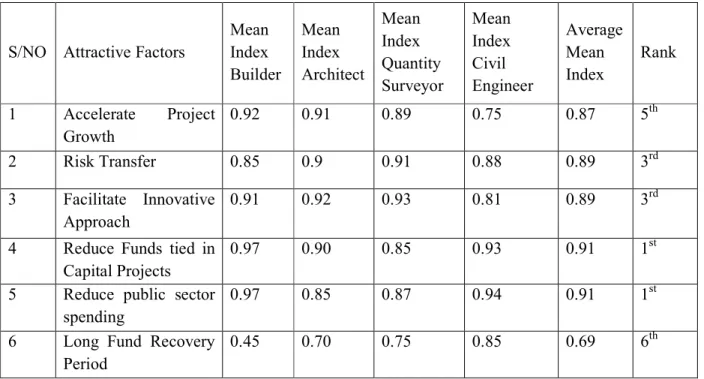
Data that relates to parameters considered is presented in Tables 1.2 to 1.14. Build Operate Transfer (BOT) is a unique system of procurement which is gradually replacing other procurement systems in use. However, there are factors that give it an edge over other means of procurement. Some of the factors include risk transfer, technological and innovation transfer, reduction of fund tied in project, reduction in public spending, long fund recovery period and project growth acceleration among others. Analysis of respondent
view is presented in Table 1.2. Some respondents opined that reduction in public sector spending is the highest thus ranked it as 1st , reduction in fund tied to projects is ranked 2nd, while risk transfer and facilitating innovation and technological transfer were ranked 3rd . There is always possibility of reduction in public spending when adopting BOT approach, given the background of shared responsibility agreement. Also, fund tied into capital project would be reduced since execution does not involve only one party. As a result of multi-active participative nature of the system, diverse methods and innovation are bound to occur, thus BOT facilitates innovative approach (Leiringer 2006).
However, in recent times, Singaporean, Malaysian and German construction industry are coming up with diverse methodologies in concrete work formation, for instance the art of proprietary form- work, precast elements formation, simulated networks among others usually comes along with projects executed by the companies from those countries while introduction of the methodology would without doubts add value to the projects. Therefore, multi-dimensional participative nature of the BOT projects encourages risk transfer. Virtually all the participants on projects often have one or more risk to bear, therefore, sharing of the risk as often peculiar to individuals will engender provision of soft landing in risk bearing, and thus BOT encourages risk sharing, especially between the client and professionals. The risks are often shared in a way that the burden will be less that should be borne by individuals on the projects.
1.8 IMPLICATION OF RISK COST ON BOT PROJECTS
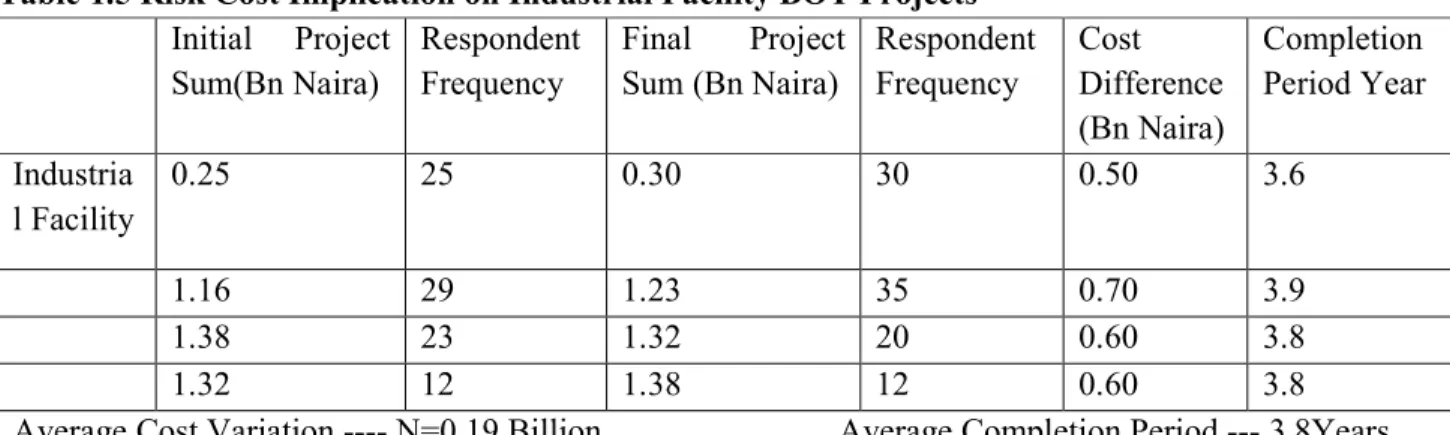
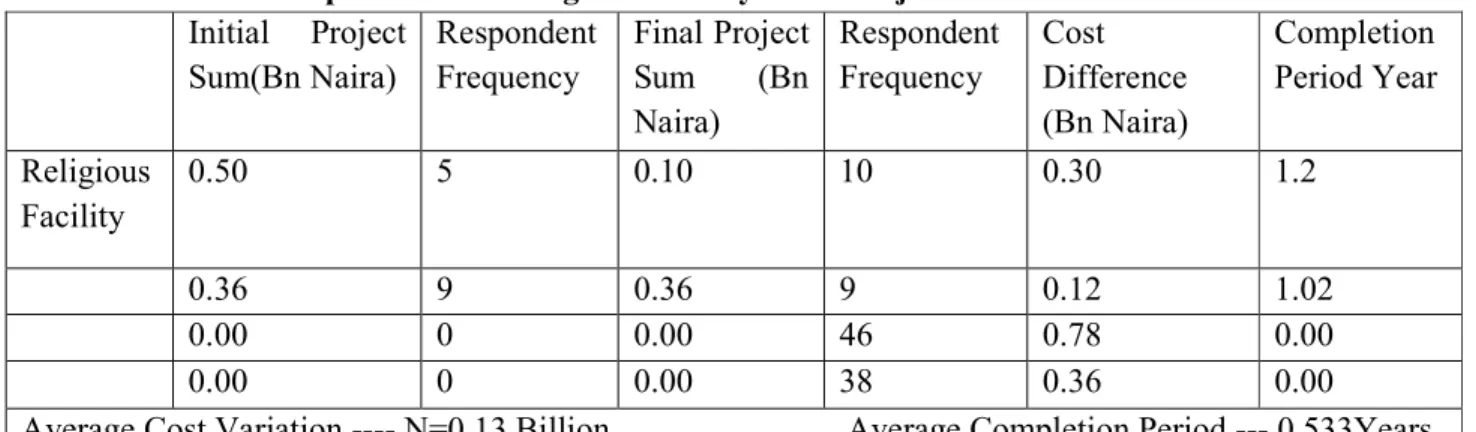
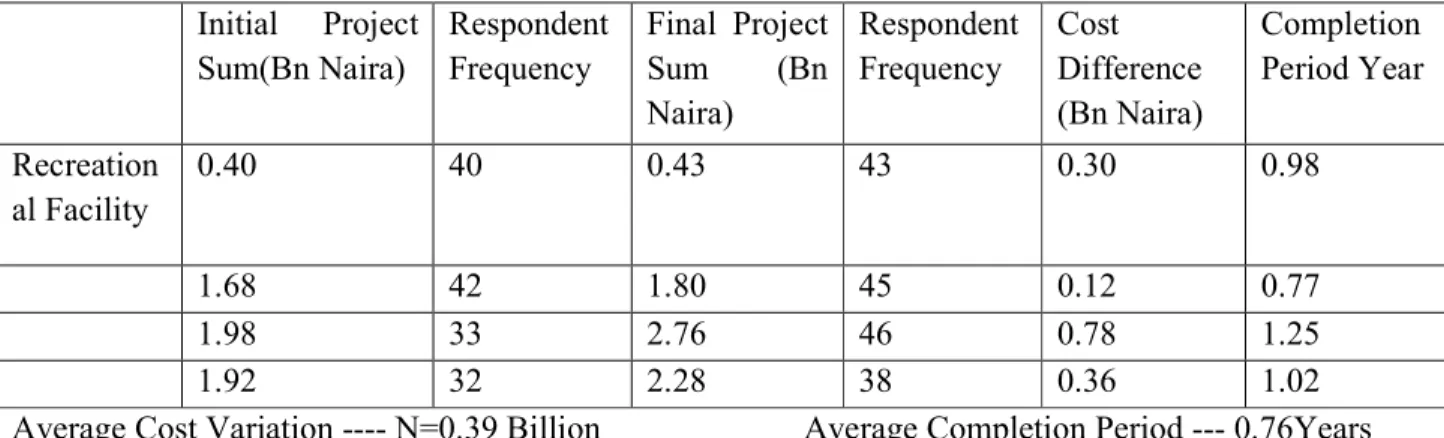
One of the core activities in this work includes establishing the risk associated with BOT projects alongside with severity of the cost impact. The cost implication was evaluated considering parameters like initial and final cost of the projects sampled. The outcome for each of the project types is presented in Tables 1.4 to 1.12.
1.9 DATA ANALYSIS AND DISCUSSION
A concessionaire assessment of the associated risk on BOT project was carried out on seventy-two projects executed through BOT method. Analysis presented in Tables 1.3 reveals inflation and project complexity as the most high of the risks with mean risk index of 0.90; contractor insolvency, currency exchange rate, civil disturbance and inflation were indexed as 0.86, 0.87, 0.80 and 0.83 respectively. Inflation is one of the economic indicators that have potential of causing overrun on project cost; it is regarded in construction parlance as one of the factors that could barely be controlled on project work. This factor when scaled on the formulated risk impact rating scale. Inflation as presented in Table 1.3 is rated 0.83 on scale 0.1 to 1 rating scale. Complexity of the project which often characterizes complex project executed through BOT is rated 0.9 on the scale; this is adjudged as a factor that is often responsible for exceeding production target and project delivery time. Furthermore, contractor insolvency, inflation, fluctuating exchange rate are rated high, which signals the need for adequate provision in order to forestall occurrence of one or all of the factors. However, some risk factors are considered as not likely to produce a meaningful impact on the project even when occurred. Production target overrun which is scaled as 0.41 is considered low in term of its effect, likewise Archeological remains and changes to initial design. Archeological remains and changes to initial design often features at preliminary stage, thus effect on the project would have been ascertained and taken into consideration, this accounts for the low rating. Finally, inflation, project complexity, force majeure, change in currency exchange rate, are considered as critical risk factors to be considered at planning stage of BOT projects’ execution in order to ensure good value for money invested.
Cost implications of residential project that experience risk impact is presented in Table 1.4. The initial project sum range from N= 0.30 Billion to N= 0.920 Billion while final project sum runs from
N= 0.125Billion to N= 0.930 Billion average cost disparity. Cost implication of risk factors are scheduled in Tables 1.1 to 1.12. The highest average cost difference for all categories of project sampled is N=0.67 Billion with average completion period of 0.64 year found on constructed BOT Tourism facilities. Recreational facilities have an average cost of N=0.39 Billion with average completion period of 0.755 years. Office and Religious facilities had the least average cost of N=0.103Billion and N=0.13 Billion with average completion period of 0.886 years and 0.533 years respectively.
Implication of the analysis result is that the most affected of the BOT projects by the risk factors identified as peculiar to the projects are the Residential facility projects, Tourism facility projects and Recreational facility projects. This indicates that the project professionals on the projects sampled experienced risk impact and such risks identified with them on the projects are presented in Table 1.3. Some of such risks includes: inflation, variation to works, change in government policy and fluctuating nature of foreign exchange with inflation being the highest. Reason for inflation being rated as first could be linked to unstable world economic situation which results in an unstable foreign exchange rate, and this tends to induce an increased cost of materials and services on project works.
Moreover, effective project supervision epitomized with having qualified and specialized professional is essential on BOT projects, due to their peculiar nature. It has however been established in this work that there is linear relationship between an effective project supervision and completing projects on scheduled time. Sixty (60) BOT projects were sampled in this regard and response presented in Table 1.13. Certain number of respondents accepts the existence of professionals and completion time as directly related, the validity test yields Chi-square (X2 ) value of 11.3 at 1(one) degree of freedom and P-value of 0.001. Similarly, relationship between timely supply of material and plant items and scheduled completion time of the projects was validated with the aid of regression analysis. Outcome of the analysis indicates exisistence of linear relationship between timely supply of materials and plant versus scheduled project time with Chi Square (X2) value of 13.45 at 1 (one) degree of freedom and P-value of 0.001. The analysis results are presented in Table 1.14.
1.9 CONCLUSION
The complex nature of BOT as a procurement system is responsible for the uniqueness of the risks often associated with BOT projects. According to Peter (2008) and Flanagan and Norman (2003) the risk is often spread among the concerned parties as demonstrated through the respondent’s perspective in this work, while management of the risk is often left to the party that can effectively control them. However, the nature of the risk borne by individual will definitely affect the project execution especially if it tends to the negative side. The study first identified the risks peculiar to BOT projects sampled, next, the probability of risk occurrence was determined, and later the risk sharing among the concerned parties and risk implication determination on the project. Generally, the most common risk to all the projects executed are inflation, variation to works, change in government policy and fluctuating nature of foreign exchange with inflation being the highest on rating scale of 0.1 to 1.0. Maximum risk variation on the project is N=0.167 Billion with minimum cost variation of N=0.100 Billion, likewise, maximum completion time of 3.8 years was obtained on the projects with least completion period of 0.533 years. These cost and time is therefore used as a model typifying the extent of risk implication experienced on the sampled BOT projects.
Relationship between project supervision versus project completion time was analyzed on one hand and timely supply of material versus scheduled project time on the other it was validated through results that they all linearly co-related. It is against this back -ground that this research studied implication of risk factors on cost performance of projects executed through Build -Operate-Transfer procurement system.
Table
Table 1.1 B.O.T Projects Associated Risk Factors
S/N O Risk Factors Weighted Score Associated Risk Mean Score Builder Associated Risk Mean Score Architect Associated Risk Mean Score Quantity Surveyor Associated Risk Mean Score Civil Engineer Associated Risk Mean Score Client 1 Production target slippage 0.65 0.75 0.85 0.75 0.73 2 Labor shortage 0.76 0.76 0.96 0.78 0.82 3 Changes in government policy 0.59 0.73 0.93(1st ) 0.92(2nd ) 0.88 (3rd ) 4 Inflation 0.89 (2nd ) 0.86 0.82 0.76 0.87
5 Delay in settling claims 0.82 0.88(2nd ) 0.99 (1st ) 0.76 0.72 6 Sites-archaeological remains 0.86 (3rd ) 0.82 0.96 0.89(3rd ) 0.88 (3rd ) 7 Problems with foundation 0.69 0.59 0.45 0.43 0.29
8 Changes to initial design 0.79 0.79 0.88 0.79 0.87
9 Delay in agreeing variation/ day works
0.75 0.75 0.78 0.79 0.87
10 Delay in payment from client 0.76 0.76 0.88 0.80 0.87 11 Shortage in key materials 0.82 0.82 0.81 0.82 0.88(3rd ) 12 Changes in government policy 0.45 0.45 0.87 (3rd ) 0.86 0.79 13 Under valuation 0.64 0.64 0.87(3rd) 0.75 (4th) 0.77 14 Estimating error 0.85 (4th ) 0.85(3rd) 0.82 0.85 0.89 (2nd ) 15 Inclement weather 0.43 0.43 0.33 0.45 0.50 16 Flaws in contractual documentation 0.63 0.63 0.78 0.87 (3rd ) 0.88 (3rd) 17 Shortage of key plant
items 0.84 0.84 (4th) 0.85 (4th) 0.88(2nd ) 0.89(2nd ) 18 Variation to work 0.92 (1st ) 0.92 (1st ) 0.93 (2nd) 0.97 (1st ) 0.99 (1st ) 19 Changes in currency exchange rate 0.67 0.67 0.77 0.77 0.66 20 Difficulty in 0.37 0.57 0.32 0.35 0.55
understanding project complexities
21 Labor strikes 0.63 0.63 0.68 0.69 0.67
22 Contractor’s insolvency 0.57 0.57 0.58 0.60 0.59
23 Civil strikes 0.69 0.69 0.68 0.65 0.66
24 Delay in issuing interim certificates
0.73 0.73 0.74 0.75 0.74
Table 1.2 Prequalify Factors for Adoption of BOT System
S/NO Attractive Factors
Mean Index Builder Mean Index Architect Mean Index Quantity Surveyor Mean Index Civil Engineer Average Mean Index Rank 1 Accelerate Project Growth 0.92 0.91 0.89 0.75 0.87 5th 2 Risk Transfer 0.85 0.9 0.91 0.88 0.89 3rd 3 Facilitate Innovative Approach 0.91 0.92 0.93 0.81 0.89 3rd
4 Reduce Funds tied in Capital Projects
0.97 0.90 0.85 0.93 0.91 1st
5 Reduce public sector spending
0.97 0.85 0.87 0.94 0.91 1st
6 Long Fund Recovery Period
0.45 0.70 0.75 0.85 0.69 6th
Table 1.3 On-The-Site Assessment of Associated Risk Factors on Sampled BOT Projects
S/N O Risk Factors Weighted Score Risk Mean Index
Severity of Risk [ 0.1-1.0 Rating Scale] Low(1
)
Most Likely(2) High(3) 1 Production target slippage 0.57 25 - - 0.73 2 Labor shortage 0.55 - 32 - 0.53 3 Changes in government policy 0.65 - 32 - 0.53 4 Inflation 0.87 - - 50 0.90
5 Delay in settling claims 0.75 - 32 - 0.53
6 Sites-archaeological remains 0.72 - 26 - 0.43 8 Changes to initial design 0.84 - 43 - 0.42
9 Delay in agreeing variation/ day works
0.75 - 39 - 0.65
10 Delay in payment from client 0.71 - 35 - 0.58 11 Shortage in key materials 0.82 - - 47 0.78 12 Flaws in contractual documentation 0.76 - - 40 0.67
13 Shortage of key plant items 0.75 - - 35 0.58 14 Variation to works 0.84 - - 25 0.42 15 Changes in currency exchange rate 0.85 - - 52 0.87 16 Project complexity 0.75 - 58 - 0.89 17 Labor strikes 0.69 - - 45 0.75 18 Force majeure 0.86 - - 45 0.75 19 Contractor’s insolvency 0.75 - - 52 0.86
Table 1.4 Risk Cost Implication on Residential Facility BOT Projects
Initial Project Sum(Bn Naira) Respondent Frequency Final Project Sum (BnNaira) Respondent Frequency Cost Difference (Bn Naira) Completion Period Year Resident ial Facility 0.34 34 0.30 30 0.40 3.4 0.92 23 0.93 35 0.10 2.4 0.12 22 0.13 20 0.50 2.0 0.30 5 0.40 12 0.10 3.4
Average Cost Variation ---- N=0.17Billion Average Completion Period --- 2.8Years
Table 1.5 Risk Cost Implication on Industrial Facility BOT Projects
Initial Project Sum(Bn Naira) Respondent Frequency Final Project Sum (Bn Naira) Respondent Frequency Cost Difference (Bn Naira) Completion Period Year Industria l Facility 0.25 25 0.30 30 0.50 3.6 1.16 29 1.23 35 0.70 3.9 1.38 23 1.32 20 0.60 3.8 1.32 12 1.38 12 0.60 3.8
Table 1.6 Risk Cost Implication on Office Facility BOT Projects Initial Project Sum(Bn Naira) Respondent Frequency Final Project Sum (Bn Naira) Respondent Frequency Cost Difference (Bn Naira) Completion Period Year Office Facility 0.34 34 0.00 34 0.34 0.78 1.40 35 0.12 32 1.28 0.77 1.92 32 -0.23 36 2.15 0.92 1.98 33 -0.30 38 2.28 0.98
Average Cost Variation ---- N=0.103 Billion Average Completion Period --- 0.86 Years
Table 1.7 Risk Cost Implication on Recreational Facility BOT Projects
Initial Project Sum(Bn Naira) Respondent Frequency Final Project Sum (Bn Naira) Respondent Frequency Cost Difference (Bn Naira) Completion Period Year Recreatio nal Facility 0.40 40 0.43 43 0.30 0.98 1.68 42 1.80 45 0.12 0.77 1.98 33 2.76 46 0.78 1.25 1.92 32 2.28 38 0.36 1.02
Average Cost Variation ---- N=0.39 Billion Average Completion Period --- 0.76Years
Table 1.8 Risk Cost Implication on Tourism Facility BOT Projects
Initial Project Sum(Bn Naira) Respondent Frequency Final Project Sum (Bn Naira) Respondent Frequency Cost Difference (Bn Naira) Completion Period Year Tourism Facility 0.22 22 0.45 45 0.33 0.92 0.96 24 1.68 42 0.72 1.22 2.28 38 2.58 43 0.30 0.98 1.26 21 2.70 45 1.44 1.46
Average Cost Variation ---- N=0.67 Billion Average Completion Period --- 1.15Years
Table 1.9 Risk Cost Implication on Religious Facility BOT Projects
Initial Project Sum(Bn Naira) Respondent Frequency Final Project Sum (Bn Naira) Respondent Frequency Cost Difference (Bn Naira) Completion Period Year Religious Facility 0.50 5 0.10 10 0.30 1.2 0.36 9 0.36 9 0.12 1.02 0.00 0 0.00 46 0.78 0.00 0.00 0 0.00 38 0.36 0.00
Table 1.10 Risk Cost Implication on Health Facility BOT Projects Initial Project Sum(Bn Naira) Respondent Frequency Final Project Sum (Bn Naira) Respondent Frequency Cost Difference (Bn Naira) Completion Period Year Health Facility 0.10 10 -0.20 8 0.80 0.88 0.36 9 -0.40 8 0.32 1.05 0.54 9 0.00 9 0.54 0.00 0.60 1 0.60 0 0.00 1.17
Average Cost Variation ---- N=0.21 Billion Average Completion Period --- 0.78 Years
Table 1.11 Risk Cost Implication on Recreational Facility BOT Projects
Initial Project Sum(Bn Naira) Respondent Frequency Final Project Sum (Bn Naira) Respondent Frequency Cost Difference (Bn Naira) Completion Period Year Recreation al Facility 0.40 40 0.43 43 0.30 0.98 1.68 42 1.80 45 0.12 0.77 1.98 33 2.76 46 0.78 1.25 1.92 32 2.28 38 0.36 1.02
Average Cost Variation ---- N=0.39 Billion Average Completion Period --- 0.76Years
Table 1.12 Risk Cost Implication on Infrastructural Facility BOT Projects
Initial Project Sum(Bn Naira) Respondent Frequency Final Project Sum (Bn Naira) Respondent Frequency Cost Difference (Bn Naira) Completion Period Year Infrastructural Facility 0.45 45 0.46 46 0.10 0.73 1.60 40 1.88 47 0.28 0.96 1.92 32 2.58 43 -0.66 1.19 2.70 45 2.52 42 0.18 0.86
Average Cost Variation ---- N=0.10 Billion Average Completion Period --- 0.93Years
Table 1.13 Impact of Supervising Professional on Timely Completion of Sampled Projects
Q1: Did you have a Supervising Professional?
Q2: Projects Completed on Scheduled Time?
Yes [%] No [%]
Yes [%] 53 55 53 55
No [%] 32 28 32 28
Table 1.14 Material / Plant Items on Scheduled Activity Time
Q3: Material and Plant Items Delivered on Scheduled Time?
Yes [%] Partly [%] No [%]
Yes [%] 60 32 22
No [%] 42 44 38
X2 = 13.45, d.f = 1 P < 0.001
1.10 REFERENCE
Akintoye, A; Bing, L; Edwards, P.J and Hardcastle, C. (2005) Critical Success Factors for PPP/PFI Projects in the UK Construction Industry. Construction Management and Economics, 23,459-71.
Akintoye, A.S and Macleod, M.J (2003): Risk Analysis and Management in Construction. International Journal of Project Management.Vol.15 No .1 PP 31- 38
Chapman, C.B and Ward, S.C (2001). Project Risk Management Processes, Techniques and Insights, John Wiley and Sons, Chichester.
Chege, L and Rwelamila P.D. (2000). Risk Management and Procurement Systems – An Imperative Approach. Proceedings of the CIB W92 Symposium, Santiago, Chile, April 2000.
Doeg, J.M (2008) Risk Engineering Approach to Project Risk Management, International Journal of Project Management. 8 Feb .Pp 5-16
Flanagan, R and Norman, G. (2003): Risk Management and Construction, Blackwell, London. Fong, S.W (1989): Risk Management. The Cost Engineer. Vol.25, 12-16
Garry, D; Creedy, D. (2006): “Risk Factors Leading To Cost Overrun in The Delivery of Highway Construction Projects”, PhD. Thesis, Queens Land University of Technology.
Grubb, S. R. T. (1998): The Private Finance Initiative –Public Private Partnership, Proceedings of The Institute of Civil Engineers, Vol 126 (8), Pp 133-136.
Leiringer, R. (2006) Technological Innovation in PPPs: Incentives, Opportunities and Actions. Construction Management and Economics, 4,301-8.
Odeyinka, H.A; Oladapo, A.A and Akindele, A. (2006): “Assessing Risk Impacts on Construction Costs’’. Proceedings of the Annual Research Conference of the Royal Institute of Chartered Surveyors.
Peter, R. (2008) Perceptions of Architectural Design and Project Risk: Understanding the Architects Role in a PPP project. Construction Management and Economics 6. 1145-57
Tiong, R.L.K. and Alum, J (1997):‘‘Evaluation of Proposals for B.O.T Projects’’, International Journal of Project Management, 15 (2),67-72.
Zhang, X. (2005) Criteria for Selecting the Private Sector Partner in Public-Private Partnership. Journal of Construction Engineering and Management 13, (6) 631-44