Calhoun: The NPS Institutional Archive
Theses and Dissertations Thesis Collection
2012-03
The Sea of Simulation : Improving Naval
Shiphandling Training and Readiness
through Game-Based Learning
Reber, Ethan A.
Monterey, California. Naval Postgraduate School
NAVAL
POSTGRADUATE
SCHOOL
MONTEREY, CALIFORNIA
THESIS
THE SEA OF SIMULATION: IMPROVING NAVAL SHIPHANDLING TRAINING AND READINESS THROUGH
GAME-BASED LEARNING
by
Ethan A. Reber Benjamin J. Bernard
March 2012
Thesis Advisor: Perry McDowell
REPORT DOCUMENTATION PAGE Form Approved OMB No. 0704–0188
Public reporting burden for this collection of information is estimated to average 1 hour per response, including the time for reviewing instruction, searching existing data sources, gathering and maintaining the data needed, and completing and reviewing the collection of information. Send comments regarding this burden estimate or any other aspect of this collection of information, including suggestions for reducing this burden, to Washington headquarters Services, Directorate for Information Operations and Reports, 1215 Jefferson Davis Highway, Suite 1204, Arlington, VA 22202–4302, and to the Office of Management and Budget, Paperwork Reduction Project (0704–0188) Washington DC 20503.
1. AGENCY USE ONLY (Leave blank) 2. REPORT DATE March 2012
3. REPORT TYPE AND DATES COVERED Master’s Thesis
4. TITLE AND SUBTITLE The Sea of Simulation: Improving Naval Shiphandling Training and Readiness through Game-Based Learning
5. FUNDING NUMBERS
6. AUTHOR(S) Ethan A. Reber, Benjamin J. Bernard
7. PERFORMING ORGANIZATION NAME(S) AND ADDRESS(ES) Naval Postgraduate School
Monterey, CA 93943–5000
8. PERFORMING ORGANIZATION REPORT NUMBER
9. SPONSORING /MONITORING AGENCY NAME(S) AND ADDRESS(ES) N/A
10. SPONSORING/MONITORING AGENCY REPORT NUMBER
11. SUPPLEMENTARY NOTES The views expressed in this thesis are those of the author and do not reflect the official policy or position of the Department of Defense or the U.S. Government. IRB Protocol number NPS.2011.0101-IR-EP7-A.
12a. DISTRIBUTION / AVAILABILITY STATEMENT Approved for public release; distribution is unlimited
12b. DISTRIBUTION CODE
13. ABSTRACT (maximum 200 words)
Currently, a gap exists between seminar-style shiphandling training and higher fidelity simulations available to the U.S. Navy Surface Warfare Officer (SWO). There is currently no individually accessible, low cost, intermediate level, interactive modality shiphandling resource that would allow SWOs to practice shiphandling skills without requiring instructor oversight. A student research team from the Naval Postgraduate School’s MOVES Institute exposed newly commissioned SWO students at the Surface Warfare Officers School to basic task scenarios designed to be complementary to material covered in their introductory course of instruction utilizing VSTEP’s “Ship Simulator Extremes” game. The students completed the treatment task trainer protocol utilizing a Coast Guard High Endurance Cutter model and continued with the standard introductory course curriculum where they utilized the fully immersive Conning Officer Virtual Environment (COVE) shiphandling trainer. Students were later evaluated in COVE on their ability to maneuver a Guided Missile Destroyer, a similarly configured but larger ship, underway from a San Diego pier. The students exposed to the game-based scenarios performed at a statistically significantly higher level in the categories of “Standard Commands” and “Margins of Safety Maintained”—two key indicators of shiphandling proficiency—following their normal course of instruction, than the control group. Also of note, the novice level students encountered difficulty in unlearning the handling characteristics of one model and learning a new one through the course of their instruction. Our findings suggest that an individually accessible, game based, shiphandling task trainer with ship models matching those found in the COVE and Full Mission Bridge would benefit newly commissioned SWOs by reinforcing classroom instruction. This trainer could potentially be used by SWOs of all skill levels as a self-study tool prior to participation in high level, fully immersive, and manpower intensive, naval shiphandling simulators.
14. SUBJECT TERMS Game Based Learning, Shiphandling Training, Shiphandling Simulation 15. NUMBER OF PAGES 188 16. PRICE CODE 17. SECURITY CLASSIFICATION OF REPORT 18. SECURITY CLASSIFICATION OF THIS PAGE 19. SECURITY CLASSIFICATION OF ABSTRACT 20. LIMITATION OF ABSTRACT
Approved for public release; distribution is unlimited
THE SEA OF SIMULATION: IMPROVING NAVAL SHIPHANDLING TRAINING AND READINESS THROUGH GAME-BASED LEARNING
Ethan A. Reber
Lieutenant, United States Navy B.S., University of Florida, 2005
Benjamin J. Bernard Lieutenant, United States Navy B.S., Jacksonville University, 2005
Submitted in partial fulfillment of the requirements for the degree of
MASTER OF SCIENCE IN
MODELING, VIRTUAL ENVIRONMENTS AND SIMULATION (MOVES)
from the
NAVAL POSTGRADUATE SCHOOL March 2012
Author: Ethan A. Reber
Benjamin J. Bernard
Approved by: Perry McDowell Thesis Advisor
Joseph Sullivan Thesis Co-Advisor
ABSTRACT
Currently, a gap exists between seminar-style shiphandling training and higher fidelity simulations available to the U.S. Navy Surface Warfare Officer (SWO). There is currently no individually accessible, low cost, intermediate level, interactive modality shiphandling resource that would allow SWOs to practice shiphandling skills without requiring instructor oversight. A student research team from the Naval Postgraduate School’s MOVES Institute exposed newly commissioned SWO students at the Surface Warfare Officers School to basic task scenarios designed to be complementary to material covered in their introductory course of instruction utilizing VSTEP’s “Ship Simulator Extremes” game. The students completed the treatment task trainer protocol utilizing a Coast Guard High Endurance Cutter model and continued with the standard introductory course curriculum where they utilized the fully immersive Conning Officer Virtual Environment (COVE) shiphandling trainer. Students were later evaluated in COVE on their ability to maneuver a Guided Missile Destroyer, a similarly configured but larger ship, underway from a San Diego pier. The students exposed to the game-based scenarios performed at a statistically significantly higher level in the categories of “Standard Commands” and “Margins of Safety Maintained”—two key indicators of shiphandling proficiency—following their normal course of instruction, than the control group. Also of note, the novice level students encountered difficulty in unlearning the handling characteristics of one model and learning a new one through the course of their instruction. Our findings suggest that an individually accessible, game based, shiphandling task trainer with ship models matching those found in the COVE and Full Mission Bridge would benefit newly commissioned SWOs by reinforcing classroom instruction. This trainer could potentially be used by SWOs of all skill levels as a self-study tool prior to participation in high level, fully immersive, and manpower intensive, naval shiphandling simulators.
TABLE OF CONTENTS
I. INTRODUCTION ... 1
A. PROBLEM STATEMENT ... 1
B. RESEARCH QUESTIONS ... 2
C. HYPOTHESIS ... 3
D. OTHER EXPLORATORY QUESTIONS ... 4
E. SCOPE ... 4
F. DEFINITION OF TERMS ... 4
G. MOTIVATION FOR RESEARCH ... 5
H. BENEFITS OF STUDY ... 6
I. THESIS ORGANIZATION AND TABLE OF CONTENTS ... 6
II. BACKGROUND ... 9
A. INTRODUCTION ... 9
B. USE OF VIDEO GAMES FOR TRAINING ... 9
1. Video Game Experience ... 10
2. Orientation Periods ... 10
3. Ease of Use and Familiarity with Input Devices ... 11
4. Semi-Immersive vs. Fully Immersive Environment ... 11
C. CURRENT U.S. NAVY SURFACE SHIPHANDLING TRAINING RESOURCES ... 12
D. CURRENT GAME-BASED SIMULATIONS ... 14
1. Seminar-Style Training ... 14
2. Kongsberg V1 and V2 ... 14
3. Conning Officer Virtual Environment (COVE) ... 15
4. Full Mission Bridge ... 17
E. SURFACE FORCE TRAINING MANUAL SHIPHANDLING TRAINING PROFICIENCY REQUIREMENTS ... 18
F. FLEET SHIPHANDLING TRAINING OPPORTUNITIES ... 18
1. Falling through the Cracks ... 19
G. EVALUATION OF SHIPHANDLING EVOLUTIONS ... 22
H. TRAINING CONSIDERATIONS ... 22
III. METHODOLOGY ... 25
A. INTRODUCTION ... 25
1. Tasks ... 25
2. Simulator: Choosing a Desktop Virtual Environment ... 26
3. Scenarios... 26
B. PARTICIPANTS ... 27
1. Recruiting ... 27
2. Randomization ... 27
2. During the Treatment ... 29
3. After the Treatment ... 30
4. Researcher Interaction During Treatments ... 30
5. SWOS COVE Training Sessions ... 31
6. Final COVE Evaluation Session ... 31
E. MATERIALS ... 32
1. Hardware and Software ... 32
2. Data Collection ... 32
3. Exit Survey ... 32
IV. RESULTS AND DISCUSSION ... 33
A. DEMOGRAPHICS ... 33
B. ANALYSIS OF FINAL COVE EVALUATION ... 34
1. Analysis of Margins of Safety Maintained Scores ... 34
2. Analysis of Use of Rudders, Propulsion, and Tugs Scores ... 36
3. Analysis of Anticipates and Evaluates Ship Responsiveness Scores... 38
4. Analysis of Standard Commands Scores ... 41
5. Analysis of Aggregate Maneuver Scores ... 43
C. EXIT SURVEY ... 45
1. Participant Quantitative-Subjective Responses ... 45
2. Participant Qualitative-Subjective Responses ... 50
V. CONCLUSIONS ... 55
A OVERVIEW ... 55
B. ANSWERS ... 56
C. OVERALL ASSESSMENT ... 59
D. LIMITATIONS AND LESSONS LEARNED ... 59
1. Coordination ... 59
2. Sample Population ... 59
3. Tasks ... 60
E. RECOMMENDATIONS ... 60
1. Utility of Game-Based Shiphandling Tool for Surface Warfare Officers ... 60
2. Instructor Scoring Reliability ... 60
3. Future Work ... 61
a. Implement an Intelligent Tutoring System with Game-Based Simulation ... 61
b. Implement a True Voice Control Software Interface ... 61
c. Development of a Zero Fidelity Standard Commands Trainer ... 61
APPENDIX A. PRE-EXPERIMENT INSTRUCTIONS AND MATERIALS ... 63
1. CHARTS ... 63
3. SWOS STANDARD COMMANDS LECTURE ... 94
4. PARTICIPANT IN-BRIEF ... 102
APPENDIX B. CLASSROOM FACILITY SETUP ... 105
WHITE BOARD: ... 105
APPENDIX C. RECRUITING TOOLS AND DOCUMENTS ... 107
APPENDIX D. CRESST STANDARD SURFACE FORCE SHIPHANDLING ASSESSMENT ... 125
A. COSA CRESST SSFSAS ... 125
APPENDIX E. RAW DEMOGRAPHIC SURVEY DATA BY QUESTION ... 127
APPENDIX F. JMP RAW COVE DATA BY PARTICIPANT ... 131
APPENDIX G. COGNITIVE TASK ANALYSIS (CTA) (FROM GRASSI, 2000) ... 133
1. HIERARCHICAL TASK ANALYSIS (HTA) ... 133
a. HTA for Getting Ship Underway from a Pier ... 133
b. HTA for Mooring Ship to a Pier ... 134
2. CRITICAL CUE INVENTORY (CCI) ... 135
a. CCI for Getting Ship Underway and Mooring to a Pier ... 135
APPENDIX H. CRESST SHIPHANDLING TASK DESCRIPTION AND GRADING CRITERIA ... 137
APPENDIX I. CRESST SHIPHANDLING TASKS, STANDARDS, AND CONDITIONS ... 143
APPENDIX J. SHIP SIMULATOR EXTREMES TASK SCENARIO USAGE, DESIGN PHILOSOPHY, AND PERIPHERAL SETUP ... 145
A. SOFTWARE INSTALLATION AND ACCESS TO MISSION EDITOR ... 145
B. DOWNLOADING AND INSTALLING THE TASK SCENARIO MISSION FILES ... 146
C. SCENARIO ONE DESIGN ... 147
D. SCENARIO TWO DESIGN ... 148
E. SCENARIO THREE DESIGN ... 152
F. SCENARIO FOUR DESIGN ... 154
G. PERIPHERAL SETUP: SHIP CONSOLE ... 158
H. PERIPHERAL SETUP: WIRELESS 3 BUTTON USB MOUSE ... 160
LIST OF REFERENCES ... 163
LIST OF FIGURES
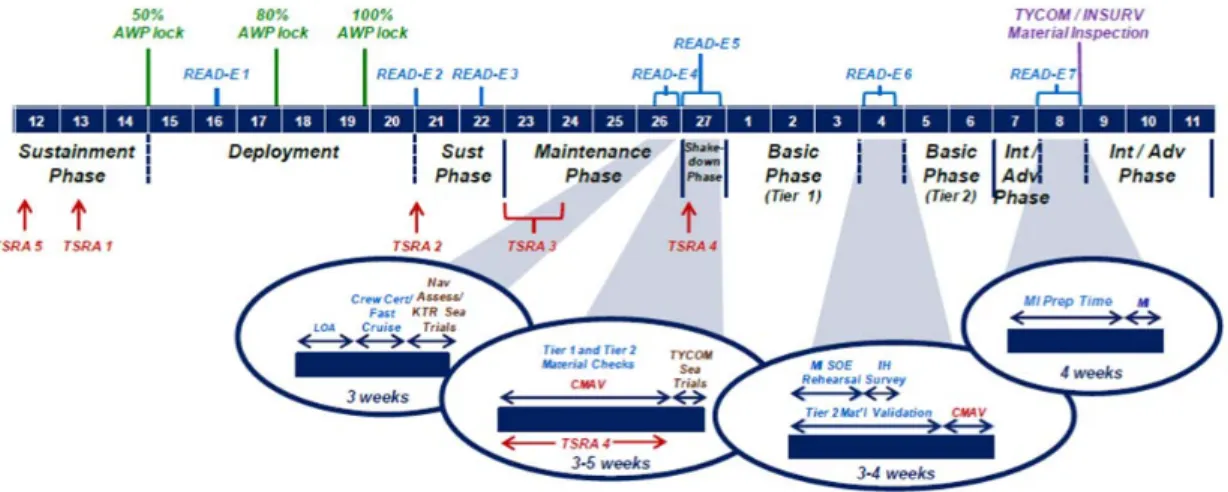
Figure 1. Fleet Response Training Plan ... 20
Figure 2. Histogram of Treatment Margins of Safety Maintained Scores ... 35
Figure 3. Comparative Means Whisker Plot of Margins of Safety Maintained Mean Scores Treatment versus Control with 95% CI ... 36
Figure 4. Histogram of Treatment Use of Rudder, Propulsion, and Tugs Scores ... 37
Figure 5. Comparative Whisker Plot of Use of Rudder, Propulsion, and Tugs Mean Scores Treatment versus Control with 95% CI ... 38
Figure 6. Histogram of Treatment Anticipates and Evaluates Ship Responsiveness Scores ... 39
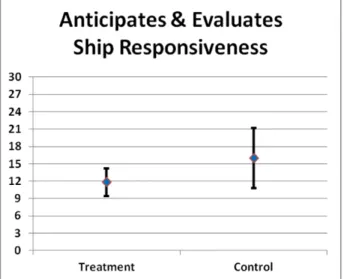
Figure 7. Comparative Whisker Plot of Anticipates and Evaluates Ship Responsiveness Mean Scores Treatment versus Control with 95% CI ... 40
Figure 8. Histogram of Treatment Standard Commands Scores ... 41
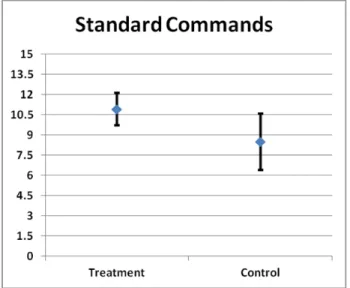
Figure 9. Comparative Whisker Plot of Standard Commands Mean Scores Treatment versus Control with 95% CI ... 42
Figure 10. Histogram of Treatment Aggregate Maneuver Scores ... 43
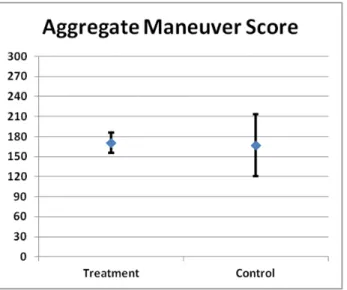
Figure 11. Comparative Whisker Plot of Aggregate Maneuver Mean Scores Treatment versus Control with 95% CI ... 44
Figure 12. Participant Exit Survey Question One Summary Responses ... 45
Figure 13. Participant Exit Survey Question Two Summary Responses ... 46
Figure 14. Participant Exit Survey Question Three Summary Responses ... 46
Figure 15. Participant Exit Survey Question Four Summary Responses ... 47
Figure 16. Participant Exit Survey Question Five Summary Responses ... 47
Figure 17. Participant Exit Survey Question Seven Summary Responses ... 48
Figure 18. Participant Exit Survey Question Eight Summary Responses ... 48
Figure 19. Participant Exit Survey Question Nine Summary Responses ... 49
Figure 20. Participant Exit Survey Question Ten Summary Responses ... 50
Figure 21. Participant Exit Survey Question Six Summary Responses ... 50
Figure 22. Participant Exit Survey Question Eleven Summary Responses ... 51
Figure 23. Participant Exit Survey Question Twelve Summary Responses ... 51
Figure 24. Participant Exit Survey Question Thirteen Summary Responses ... 52
Figure 25. Participant Exit Survey Question Fourteen Summary Responses ... 52
Figure 26. Participant Exit Survey Question Fifteen Summary Responses ... 53
Figure 27. Participant Exit Survey Question Sixteen Summary Responses ... 53
Figure 28. Mission One Participant Harbor Chart ... 63
Figure 29. Mission Two Participant Harbor Chart ... 63
Figure 30. Mission Three Participant Harbor Chart ... 64
Figure 31. Mission Four Participant Harbor Chart ... 64
Figure 33. CRESST Shiphandling Task Description and Grading Criteria page
two ... 138
Figure 34. CRESST Shiphandling Task Description and Grading Criteria page three ... 139
Figure 35. CRESST Shiphandling Task Description and Grading Criteria page four ... 140
Figure 36. CRESST Shiphandling Task Description and Grading Criteria page five ... 141
Figure 37. CRESST Tasks, Standards, and Conditions for Conn the ship underway from a pier ... 143
Figure 38. Ship Simulator Extremes Main Menu Screen ... 145
Figure 39. Ship Simulator Extremes Mission Editor GUI ... 146
Figure 40. Cutter Starting Position Mission One ... 147
Figure 41. Task Scenario One Logic Editor Logic Chain ... 148
Figure 42. Cutter Starting Position Mission Two ... 149
Figure 43. Mission Two Further Directions Trigger Waypoint ... 150
Figure 44. Mission Two End of Mission Mooring Area ... 151
Figure 45. Task Scenario Two Logic Editor Logic Chain ... 152
Figure 46. Cutter Starting Position Mission Three ... 153
Figure 47. Task Scenario Three Logic Editor Logic Chain ... 154
Figure 48. Cutter Starting Position Mission Four ... 155
Figure 49. Mission Four Starboard Turn to Navy Pier ... 156
Figure 50. Mission Four End of Mission Mooring Area ... 157
Figure 51. Task Scenario Four Logic Editor Logic Chain ... 158
Figure 52. Ship Console by VR Insight ... 158
LIST OF TABLES
Table 1. Demographic data by survey question ... 33
Table 2. Treatment vs. Control Descriptive Statistics for Margins of Safety Maintained ... 34
Table 3. JMP Output for Margins of Safety Maintained Scores One-Tailed Z-Test and Wilcoxon Signed Rank Test ... 35
Table 4. Treatment vs. Control Descriptive Statistics for Use of Rudder, Propulsion, and Tugs ... 36
Table 5. JMP Output for Use of Rudder, Propulsion, and Tugs Scores One-Tailed Z-Test and Wilcoxon Signed Rank Test ... 37
Table 6. Treatment vs. Control Descriptive Statistics for Anticipates and Evaluates Ship Responsiveness ... 38
Table 7. JMP Output for Anticipates and Evaluates Ship Responsiveness Scores One-Tailed Z-Test and Wilcoxon Signed Rank Test ... 40
Table 8. Treatment vs. Control Descriptive Statistics for Standard Commands ... 41
Table 9. JMP Output for Standard Commands Scores One-Tailed Z-Test and Wilcoxon Signed Rank Test ... 42
Table 10. Treatment vs. Control Descriptive Statistics for Aggregate Maneuver Score ... 43
Table 11. JMP Output for Aggregate Maneuver Scores One-Tailed Z-Test and Wilcoxon Signed Rank Test ... 44
Table 12. Interface Key Bindings ... 159
Table 13. Ship Controls Key Bindings ... 160
LIST OF ACRONYMS AND ABBREVIATIONS
ATG Afloat Training Group
ARPA Automatic Radar Plotting Aid
BRM Bridge Resource Management course BSH Basic Ship Handling course
CG Ticonderoga Class Guided Missile Cruiser CI Confidence Interval
CNSF Commander Naval Surface Forces CODAG Combined Diesel and Gas
CO Commanding Officer
COGAG Combined Gas and Gas COTS Commercial Off-the-Shelf
COVE Conning Officer Virtual Environment
CRESST Center for Research on Evaluation, Standards, and Student Testing DDG Arleigh Burke Class Guided Missile Destroyer
DIVTACS Division Tactics
ECDIS Electronic Chart Display and Information System FCAs Fleet Concentration Areas
FMB Full Mission Bridge FOM Freedom of Movement FOV Field of View
FRTP Fleet Response Training Plan GUI Graphical User Interface
IMO International Maritime Organization
ID Identification
IRB Institutional Review Board
ISIC Immediate Superior in Command ITS Intelligent Tutoring System
MOVES Modeling, Virtual Environment, and Simulation NAWCTSD Naval Air Warfare Center,Training Systems Division NPS Naval Postgraduate School
NROTC Naval Reserve Officers Training Corps
NSST Navigation Seamanship and Shiphandling Training NVGP Non-Video Game Player
OCS Officer Candidate’s School OOD Officer of the Deck
PC Personal Computer
POV Point of View
SA Situational Awareness SD Standard Deviation SET Special Evolutions Trainer SFTM Surface Force Training Manual SME Subject Matter Expert
SOG Speed Over Ground STA-21 Seaman to Admiral-21 SWO Surface Warfare Officer
SWOI Surface Warfare Officer Introduction SWOS Surface Warfare Officers School
TFT Thin Film Transistor ULTRA Unit Level Training UNREP Underway Replenishment U.S. United States
USB Universal Serial Bus
USCG United States Coast Guard USNA United States Naval Academy USN United States Navy
VE Virtual Environment(s) VESUB Virtual Environment Submarine VGP Video Game Players
WHEC High Endurance Cutter XO Executive Officer
ACKNOWLEDGMENTS
The authors would like to thank our thesis advisors, Professor Perry McDowell and Dr. Joseph Sullivan of the MOVES Institute. We appreciate all of the insight and support you provided to us throughout this research effort. You always found the time to listen, to suggest new directions, to share your experiences at sea, and to ensure we had funding to pursue something we believe in. Thank you.
We thank the officers and staff of Surface Warfare Officers School Command for opening their doors to us, providing research space, and making this thesis concept a reality. This effort would not have succeeded without the willing support and time of the consummate professionals of Fleet Training (N72) and Trainers and Simulation (N71) who bent over backwards to ensure we had whatever we needed. Thank you.
We thank Dr. Stanley Peters, of the Center for the Study of Language and Information, and Dr. Susan Kirschenbaum, of Naval Undersea Warfare Command. Your willingness to share your COVE ITS findings, research lessons learned, and comment on our experimental design was invaluable. Thank you.
We thank the students of the Surface Warfare Officer Introduction course who volunteered for our study. Your participation and feedback made our time worthwhile. Thank you.
Ethan would like to thank the following people who were critical to his success at NPS. To my beautiful wife, Nicole, for her love, patience, and understanding. Your support never wavered or faltered during my tour at NPS or numerous weeks away in support of research. I could not have made this journey on my own. I love you.
To my Mom, Sherry; my Dad, Rick; my mother-in-law, Victoria; and sister-in-law, Alyea; you were always there to support us in any way we needed, usually flying out before we could even ask. We would not have beat cancer without you. We love and value you always, and do not ever forget it.
Ben would like to thank his family for their support during the process of earning his master’s degree. To my wife, Wendy, who put up with me cranky and stressed and never complained, for sixteen years you have always been there for me when I needed you. You are the best wife, friend, and companion I could have hoped for. I love you!
To my daughters, Alyssa and Alexis, thanks for understanding when I missed games, gymnastic viewings, and when I was just too busy to listen. Your laughter and love gave me the strength to achieve more than I ever thought I would. I love you girls!
I. INTRODUCTION
A. PROBLEM STATEMENT
There is currently no readily accessible, low cost, intermediate level, interactive modality, shiphandling resource to fill the existing gap between seminar-style shiphandling training and the higher fidelity simulations currently available to United States Navy (USN) Officers.
This presents a significant problem vis-à-vis U.S. Naval Officers reporting to the fleet, especially those from commissioning sources other than the United States Naval Academy (USNA) and other maritime specific institutions (e.g., United States Merchant Marine Academy), to whom watercraft and high quality shiphandling simulations are not available. Some leveling of the playing field can occur for the Naval Reserve Officers Training Corps (NROTC) First Class Midshipmen who participate in four weeks of Summer Cruise training, where, based on the ship’s operational schedule, they may stand watch on the Bridge as a Conning Officer. However, officers commissioned via Seaman to Admiral-21 (STA-21), Officer Candidate’s School (OCS), and Direct Commissioning programs such as Limited Duty Officers (LDOs) and Chief Warrant Officers (CWOs) are not afforded these same opportunities, and as a direct result, can show up to their first assignment significantly behind the shiphandling learning curve when compared to their peers.
Surface Warfare Officer’s School (SWOS) in Newport, RI, has taken steps to ensure entry-level junior officers are exposed to common shiphandling evolutions prior reporting aboard their first ship through the implementation in December 2007 of the Surface Warfare Officer Introduction (SWOI) course. During this three-week course of instruction, the students are exposed to, among other topics, seamanship and shiphandling instruction. This shiphandling instruction includes four sessions in the Conning Officer Virtual Environment
(COVE), a fully immersive virtual environment used to simulate shiphandling tasks where a qualified instructor mentors the student.
The practice of providing entry-level training to junior officers prior to reporting aboard their first ship is a welcome change from the practice that existed between 2003 and the implementation of SWOI course. Until the implementation of SWOI course, junior officers were provided solely with a self-study course immediately prior to, and in some cases after, reporting to their ship. The course included lectures on shiphandling physics and videos of shiphandling tasks, but no environment where shiphandling evolutions could be rehearsed or practiced.
While the exposure of junior officers to shiphandling instruction and simulations in the COVE is certainly a step in the right direction, there is no real guarantee that the graduates of the SWOI course will be provided an opportunity to practice shiphandling evolutions upon reporting to their ships at the frequency necessary to develop competency. These limited training opportunities are a function of reduced operating budgets for the ships, the infrequency of evolutions for officers to conn the ship during (e.g., mooring to a buoy), and limited throughput of the Fleet Concentration Area (FCA) shiphandling simulators relative to the number of officers stationed there.
A low cost, individually accessible, desktop shiphandling simulator would be highly beneficial to these entry-level officers, filling the existing gap between seminar style training and higher fidelity simulations. The benefits of such a simulation would not be restricted to this group alone, but could be used by the whole officer corps as a valuable virtual reality training aid to fill the gap in fleet shiphandling training resources.
B. RESEARCH QUESTIONS
1. Do SWOI course students who use semi-immersive, voice interactive, shiphandling game to practice tasks covered in classroom shiphandling theory,
prior to using the COVE, perform at a higher level than those not currently using shiphandling games? In which assessment categories will they perform better?
2. Do SWOI students who use a semi-immersive, voice interactive, shiphandling game to practice standard commands covered in classroom lecture, prior to using the COVE, perform their standard commands at a higher level than those not currently using shiphandling games?
C. HYPOTHESIS
1. Participants will perform at a higher level in the “Aggregate Maneuver” score category. The Maneuver score category for this study is composed of four subcategories:
Margins of Safety Maintained
Use of Rudder, Propulsion, and Tugs
Anticipates and Evaluates Ship Responsiveness
Standard Commands
2. Participants will perform at a higher level in the “Standard Commands” assessment subcategory in the COVE.
3. Participants will perform at a level consistent with the control group in the “Use of Rudder, Propulsion, and Tugs” subcategory. We expect this result due to the lack of representation of verbal tugboat control in the game-based task trainer.
4. Participants will perform at a higher level in the “Margins of Safety Maintained” subcategory.
5. Participants will perform at a level consistent with the control group in the “Anticipates & Evaluates Ship Responsiveness” subcategory. We expect the dissimilarity between the ship models in the game-based task trainer and the COVE to have a negligible effect on student performance.
D. OTHER EXPLORATORY QUESTIONS
Do the participants believe the game-based simulation helped prepared them for their use of the COVE?
Are the participants likely to use a tool of this type in the future and/or recommend it to their peers?
E. SCOPE
The scope of our thesis focuses on answering these research and exploratory questions. The research team developed five hypotheses to guide the experiment and ultimately answer the research questions. This research endeavor developed four prototype task trainer scenarios using Ship Simulator Extremes. The team then exposed a sample population of USN ensigns over the period of two evenings to the task scenarios. The ensigns then completed their normal SWOI course, after which they were evaluated in a standardized pier side shiphandling scenario. After the evaluation, the team analyzed the data, identified trends and explained the results. Finally, the report concludes with recommended future work.
F. DEFINITION OF TERMS
Modality: One of the main avenues of sensation (as vision) (Merriam-Webster, 2012).
Presence: defined as the subjective experience of being in one place or environment, even when one is physically situated in another (Witmer & Singer, 1998).
Semi-Immersive: Modalities are manipulated to induce the appropriate degree of presence required to achieve a task (Sanchez-Vives & Slater, 2005).
Fully Immersive: 360-degree displays and sound, with possible ceiling and floor displays, that affect the modalities of the environment change. Often incorporated with haptic modalities to increase presence (Sanchez-Vives & Slater, 2005).
Individually Accessible: Being able to be accessed and utilized by one individual at whatever interval that individual requires.
Interactive Modality: A mode that has both input and output activity to influence the user to believe something exists or is experienced or expressed.
Intermediate Level: a level that is in between two extremes; in the application of this study- having a simulation between the low level seminar style environment and high level fully immersive environment of the COVE.
Standard Commands: A set of consistent commands used by naval vessels to direct the use of rudders and engines.
G. MOTIVATION FOR RESEARCH
The study began with the question of whether or not a desktop computer game-based simulation could help a Surface Warfare Officer (SWO) maintain proficiency while he or she was not on a sea tour. As SWOs, we are judged on our ability to competently handle a ship through a range of evolutions. While assigned to duties ashore, there is a paucity of opportunities to exercise this skill set.
After playing and experimenting with the commercially available shiphandling computer games, we began to ask the question, “What if this had been available to us when we were brand new ensigns preparing to join the Fleet? Would this have made a difference in our shiphandling learning experience?” We believed that the answer to the question was an emphatic “Yes,” and polled other SWOs at NPS who concurred with us. It was at this point that we down selected a game to work with and began constructing our task trainer scenarios.
As previously discussed, there have been significant improvements already in shiphandling training methodology during our brief careers. Our motivation towards this research topic is not to reinvent the wheel when it comes to naval shiphandling training, just do our small part to improve it for our fellow and future officers and ourselves.
H. BENEFITS OF STUDY
We believe that by demonstrating that basic shiphandling skills trained in a desktop part task trainer will transfer to the COVE, this research has the potential to make shiphandling training more accessible to the individual user. By highlighting the capabilities of a tool of this type, we hope to provide an additional resource for SWOs of all levels to practice and maintain their shiphandling skills and ultimately move our service closer toward a comprehensive shiphandling training continuum.
I. THESIS ORGANIZATION AND TABLE OF CONTENTS
Chapter I: Introduction. This chapter defines the problem, lists the research questions, presents the hypothesis, and defines the scope and benefits of this study.
Chapter II: Background. This chapter provides a literature review for the study. This review includes current literature on video game use for training, current USN shiphandling training opportunities, current simulations available to USN shiphandlers, shiphandling proficiency requirements, fleet shiphandling training opportunities, fleet shiphandler evaluation, and naval training considerations.
Chapter III: Methodology. This chapter describes how the research team designed the experiment, including participants, procedures, facilities selection, and materials.
Chapter IV: Results and Discussion. This chapter contains the results of experimentation and an interpretation of those results.
Chapter V: Conclusions. This chapter provides an overall assessment of qualitative and quantitative data and recommends future work toward the design and implementation of a readily accessible, low cost, intermediate level, interactive modality, shiphandling game.
Appendix A: Pre-Experiment Instruction and Materials. This appendix contains the protocol followed in order to inbrief student participants and all reference materials provided to the students during the experiment.
Appendix B: Classroom Facility Setup. This appendix describes how the classroom, laptop computer, and audiovisual display equipment was set up in support of the simulation runs.
Appendix C: Approved IRB Protocol. This appendix contains the Institutional Review Board protocol for experimentation with human subjects. This includes approved Informed Consent forms, Demographic Survey, and Exit Survey.
Appendix D: CRESST Standard Surface Force Shiphandling Assessment. This appendix shows the Standard Surface Force Shiphandling Assessment developed by the National Center for Research on Evaluation, Standards, and Student Testing and used by Surface Warfare Officer’s School Command for evaluation of students in the Conning Officer Virtual Environment (COVE).
Appendix E: Raw Demographic Survey Data by Question. This appendix displays the raw data in table format of the response to each question by participant.
Appendix F: JMP Raw COVE Data by Participant. This appendix displays the raw data from the instructor evaluated final COVE session for each participant.
Appendix G: Cognitive Task Analysis (CTA). This appendix displays the Hierarchical Task Analysis used in validating the suitability of the tasks developed in Ship Simulator Extremes, including a Critical Cues Inventory for each respective task.
Appendix H: CRESST Shiphandling Task Description and Grading Criteria. This appendix, developed by the National Center for Research on
Officer’s School Command, displays the description of each task in the COVE and associated grading thresholds.
Appendix I: CRESST Shiphandling Tasks, Standards, and Conditions. This appendix, developed by the National Center for Research on Evaluation, Standards, and Student Testing and used by Surface Warfare Officer’s School Command, contains the necessary standards, tasks, and conditions to Conn a ship underway from a pier.
Appendix J: Ship Simulator Extremes Scenario Construction. This appendix displays a systematic tutorial for constructing the four task scenarios used in this study.
II. BACKGROUND
A. INTRODUCTION
The military community has long embraced simulation. In 1931, Edwin Link patented the “Link Flight Trainer,” which he had designed to teach himself how to fly. The trainer went on to be produced in the thousands and was used by many countries during World War II to train pilots. As simulation has improved, more services have decided to take advantage of it as a training tool. The Air Force has been the biggest user of simulation in the military services with flight trainers. These trainers were expensive and focused on the individual pilot. The Army has also used simulation, like the Advanced Gunnery Training System, to allow tank crews to practice vital communications skills prior to live fire events (Morgan, 2011). With improved technology resulting in better graphics, Artificial Intelligence, and miniaturization, the Army and Marine Corps have begun to embrace simulation for infantry personnel as well (Brown, 2010). The Marine Corps and Army both use Virtual Battlespace 2 (VBS2) as a tool for training (Robson, 2009) (Bohemia International, 2006). The Navy has embraced simulation (Nguyen et al., 2001) with the development of Virtual Environment Submarine (VESUB) for submarine officers to practice surface conning, an event too rare to provide the desired training opportunities. The most recent naval simulation suite, COVE, was developed directly from experience with VESUB (Nguyen et al., 2001). Simulation is vital in reducing cost and enabling multiple units to share a single wargaming experience, whether live, virtual, or constructive.
B. USE OF VIDEO GAMES FOR TRAINING
The term “Serious Game” was introduced in the simulation industry to distinguish between games designed primarily for training and secondarily for entertainment. Examples of serious games developed for use by the U.S. Army
have examined the application of games for training and reported varying measures of effectiveness (Brown, 2010) (Stinchfield & Caldwell, 2011). Researchers have used measures to determine the effectiveness such as user experience, orientation of user, ease of use, familiarity with input devices, and semi vs. fully immersive environments (Green & Bavelier, 2003).
1. Video Game Experience
A study by Green & Bavelier (2003, Nature, p. 534) showed “action video game playing is capable of altering a range of visual skills.” An experiment in the study showed that “non- players trained on an action video game showed marked improvement from their pre-training abilities, thereby establishing the role of playing in this [visual attention] effect.” Experienced video gamers have an advantage using serious games for training. The experienced gamers will have an increased capacity of their visual attention system and possess “enhanced attentional capacity,” “enhance(ed) number of visual items that can be unerringly apprehended,” and “enhanc(ed) task-switching abilities.” Together, these newfound abilities could affect the speed of perception and the increased ability to manage several visual tasks (Green & Bavelier, 2003).
2. Orientation Periods
Organizations commonly hold orientation periods where they instruct new members in the organization’s goals, methods, and ethos. Institutions of higher learning implement an orientation period that allows students to become accustomed to the location of important buildings and living facilities. These locations are “tools” that the student will need to be successful at the institution and the orientation is provided as a form of pre-training. The training allows students to embrace the main purpose of attending, education, and not worry about how to get to around. The same is true of computer tools that a simulation would use for training. Trying to complete a task in a software package without knowing how to navigate could lead to immense frustration and derail the trainee from the main purpose. Unless the study is examining the ability of learning the
software, the basic implementations of input and manipulation of the software should be covered, at least to the point of basic understanding.
3. Ease of Use and Familiarity with Input Devices
Marc Prensky described in his book Digital Game-Based Learning that by the time today’s average teenager enters the workforce he or she will have “played over ten thousand hours of videogames.” He also describes, with a median age of 39, the “oldest employees [from the upper 50 percent of our workforce]- those between the age of 30 and 39, have been able to play, and for the most part have been playing, video games since junior high.” He goes on to say, “the newest employee hires, just out of high school or college, have never known a world without video games.” The new officers entering the U.S. Navy today have never known a world without input devices of some type (Prensky, 2000). With thousands of hours playing video games and using a personal computer, common input devices, such as a mouse, will be extremely familiar to the average ensign.
4. Semi-Immersive vs. Fully Immersive Environment
A person is in a fully immersive environment when he or she is completely surrounded by a device or devices that affect the modalities of the environment change. An example is a CAVE (Cave Automatic Virtual Environment) type of simulation in which a person would enter a room and be surrounded by screens displaying the new environment, along with sound, smell, and perhaps haptic (touch) feedback (VRS, 2011). A semi-immersive environment would refer to one that would display the environment to the appropriate degree of presence required to achieve the task. This varies depending on the application. A flight trainer with a complete mock cockpit with a concave projection of only 270 degrees is an example. The trainee is not fully immersed; however, the screen encompasses enough of his or her vision to be effective at training the required
C. CURRENT U.S. NAVY SURFACE SHIPHANDLING TRAINING RESOURCES
Through our experience as Surface Warfare Officers, and from the knowledge gained from the Surface Warfare Officer School Command website, we will describe the process and application of simulation in a Surface Warfare Officers career.
The U.S. Navy currently trains shiphandling through lecture and high-level simulation. The pipeline for surface warrior training begins at the commissioning source. Midshipmen will receive basic instruction in navigation and shiphandling at the institution they are attending. Depending on the school, midshipmen may pilot a small sailboat (e.g., Laser) and have the opportunity to go on summer cruise aboard ships, or, in the case of Naval Academy midshipmen, on yard patrol craft. Following commissioning, ensigns attend a Surface Warfare Officer Introduction (SWOI) course developed by SWOS. The course is in Newport, RI for OCS graduates and in ATG centers at FCAs for ensigns sent to the fleet from other commissioning sources. The SWOI course shiphandling training consists of a lecture followed by COVE sessions designed to initiate the students on standard commands, basic maneuvers, and pier work.
Ensigns complete the SWOI course and return to their ships and continue shiphandling training as a member of the wardroom.The training includes utilizing Navigation Seamanship and Shiphandling Training (NSST) facilities established in FCAs. Each ship is allotted a specific number of hours for using the NSST resource. Within a 24-month cycle, the command has opportunities to train officers via the U.S. Navy’s Navigation, Seamanship, and Shiphandling Training (NSST) program (see CH2-E, F). NSST provides classroom and Kongsberg V2 system simulator instruction in the form of three main courses: Bridge Resource Management (BRM), Basic Ship Handling (BSH), and Special Evolutions Trainer (SET). A number of ships have also received a shipboard installed Kongsberg V1 system to utilize for training.
Upon completion of division officer tours, officers will typically have no shiphandling training exposure until they attend the SWOS Department Head Course. An evolution of the original Destroyer School, the Department Head Course is a demanding and in-depth professional course Surface Warfare Officers attend in preparation for their department head tours. The intensive 24-week course prepares officers for duty as Engineering, Combat Systems, Operations, and Deck department heads on all classes of Navy ships. The course is divided into the Tactical Action Officer module and the SHIPTRAIN module, where students will receive shiphandling training. During SHIPTRAIN, students will attend several COVE sessions focused on improving shiphandling skills. SWOS has established a high standard of shiphandling expertise and all Department Head Course students are required to pass a rigorous shiphandling evaluation.
During a department head tour, an officer’s shiphandling exposure will vary depending upon the type of ship they serve on. Normally, department heads stand watch in Combat Information Centers (CIC) and staff watch centers rather than the bridge. Department heads are generally the primary source of training for new officers as they directly supervise the first and second tour division officers assigned to the ship.
After the department head tours are complete, the majority of surface warriors will have another gap in shiphandling experience until they report to SWOS for the “Command at Sea” courses. Command at Sea courses and curricula are designed to prepare prospective Commanding Officers (COs) and Executive Officers (XOs) with the tactical, operational, material management, and personnel skills to excel in command. The Surface Warfare Officer core competencies of navigation, seamanship, material readiness, and warfighting are reinforced through interactive lectures, seminars, simulators, case studies, and group discussion with subject matter experts (SMEs).
D. CURRENT GAME-BASED SIMULATIONS 1. Seminar-Style Training
Seminar training is the oldest form of shiphandling training. Typically, the Training Officer or Operations Officer provides a shiphandling lecture for the wardroom as part of the ship’s continuing training plan. Several topics are discussed, and although each ship will have a slightly different version, the brief will be very similar to the SWOI course PowerPoint presentation (see Appendix J). The first instinct when trying to instruct about the nuances of shiphandling is to take a pen out of a pocket to demonstrate the basic concepts of forces affecting the ship, e.g., how the ship’s stern is affected during a turn by controllable forces. For introductory lessons, it is enough for new officers to understand that the ship moves differently depending on the forces that are acting on it. Holistically all the senior members of a wardroom train junior officers through weekly training, occasionally conducting “table top” demonstrations to demonstrate how the ship is expected to behave during various evolutions from man overboard drills to underway replenishments (UNREP). Some ships have gone as far as having scale models made for this purpose.
2. Kongsberg V1 and V2
In 2004, the United States Navy commissioned bridge simulators at forward deployed naval forces bases. This effort represented the start of the USN’s NSST program. The result of the NSST project was two PC-based systems, the Kongsberg Version 1 and Version 2, using emulation of shipboard equipment (Meers, 2011).
The Version 1 system or “V1” has been deployed on surface combatants. The V1 system is composed of two workstation PCs installed in a half-rack, an instructor laptop, helm, three Thin Film Transistor (TFT) displays, and sound system. Shore based systems alter this configuration by using a bigger
42” plasma display in lieu of the TFT displays. For ships with more space there is an “extended” version of the V1 that adds four control panels in lieu of two (Meers, 2011).
The V2 system is installed at FCAs and other central training locations. The system is comprised of a generic bridge mockup with 240 degrees of horizontal field of view from projection monitors. V2 measures approximately 15 x 18 feet and has the following equipment: bridge instrumentation console, a centerline pelorus, chart table, ARPA display, and a helm console. If required an ECDIS display can be added near the chart table (Meers, 2011).
Both V1 and V2 are capable of supporting individual officer and bridge team training. Nearly all aspects of general seamanship and navy specific shiphandling, maneuvering, and navigational training can be effectively conducted (Meers, 2011).
3. Conning Officer Virtual Environment (COVE)
In 1996, the Navy funded a multi disciplinary, multi institution research initiative called the Virtual Environment Technology for Training (VETT) program. The VETT program was established to provide submarine officers with a simulator to practice conning while surfaced. With funding from the Office of Naval Research (ONR) and the Naval Air Warfare Center Training Systems Division (NAWCTSD), MIT developed a prototype simulator to train Navy Fast Attack submarine OODs (Nguyen et al., 2001).
SMEs used the prototype created the VETT initiative to develop system requirements for a fully developed simulator. After a list of requirements was developed, Nichols / Advanced Marine developed the software and hardware integration of what is now known as VESUB (Virtual Environment Submarine) Simulator. The VESUB system uses a high-resolution head mounted display (HMD) to provide the trainee with a simulated 360 degree representation of the
environmental conditions. Voice recognition and synthesis provide communications training. A Training Effectiveness Evaluation (TEE), consisting of a survey of 41 naval trainees of various experience levels, verified the efficacy of the system. The system was acquired in 1999 and distributed to five major submarine training facilities where it is still in use (Zeltzer & Pioch, 1996).
VESUB’s success in training submarine officers caused NAWCTSD to realize its potential to train surface officers as well. Having already developed the VESUB simulator, NAWCTSD proposed an evolution of VESUB, developed a list of requirements based on its use thus far and corrected also three specific VESUB limitations that needed to be addressed in a next generation simulator: instructor intensiveness, high cost, and “transfer of VE-based training to the real world task” (Nguyen et al., 2001). This improved shiphandling trainer would be known as Conning Officer Virtual Environment (COVE).
COVE was designed to correct the three main limitations of VESUB. Development focused on reducing instructor involvement and increasing capability of supporting the following tasks: basic navigation, shiphandling, seamanship, harbor and strait transits, contact management, pier and tug work, DIVTACs, stationing, plane guard, signals, flags, lights, and day shapes. COVE is also capable of supporting the following special evolutions: anchoring, mooring to a buoy, towing, UNREP, Man Overboard, and Engineering Casualties (NAWCTSD, 2010).
In addition to supporting ships evolutions COVE can be used for tactical operations training such as tactical maneuvering (shouldering, HVU Escort, VBSS approach, etc.), Anti-Terrorism/Force Protection (Anchored, Moored, and Underway), small vessel detect to engage (threat determination, escalation of force, deterrence, etc.), weapons management (M-60, .50 cal, 25mm, 5 inch), multi-ship coordinated tactics, techniques, and procedures (TTPs) (NAWCTSD, 2010).
Due to its purpose built scalability, COVE can train for individuals, bridge teams, or even multiple ships interacting together. COVE integrates several technologies such as the Integrated Technology Head Mounted Display featuring a 360-degree display, tactical and emulated hardware, and speech recognition (NAWCTSD, 2010).
Several FCAs have COVEs installed, SWOS in Newport, RI has twelve COVE 1 stations, six COVE 3 stations, a Full Mission Bridge simulator, and a reconfigurable LCS-1 or LCS-2 Full Mission Bridge simulator (NAWCTSD, 2010). Two stand-alone LCS-1 and LCS-2 simulators are in LCS shore based training facility, San Diego. For the training of pre-commissioning units, there are COVE 1 simulators provided at shipyards in Bath, ME and Pascagoula, MS. NSWC Panama City has installed a COVE RMV/USV Launch and Recovery Trainer. COVE 1 has also been used in some NROTC units for Midshipman Training. Variants of COVE are in use by the U.S. Navy Submarine Fleet, U.S. Coast Guard, and U.S. Army (NAWCTSD, 2010).
The COVE software package incorporates 56 harbor databases of strategic naval ports and operational areas around the world. 27 high-fidelity hydrodynamic ship models of USN warships and various ships and boats of tactical significance are also provided. In addition to USN and threat models, 36 low fidelity models of common ship traffic, target ships, aircraft and personnel models are available. Models are capable of displaying fire, smoke, weapons, and damage effects. The COVE hardware package depends on the required configuration (NAWCTSD, 2010).
4. Full Mission Bridge
The Full Mission Bridge (FMB) is an expansion of COVE that can train an entire watch team instead of focusing on a single officer. The FMB is a mock bridge, similar to Kongsberg V2, which is made up in the same general configuration as a bridge on a ship having a bridge instrumentation console, a
different from V2 in that it is displayed in a CAVE with the “bridge” being placed in the center giving the proper perspective. Trainees can move freely from bridge wing to bridge wing without a change in perspective. The trainer is capable of the full range of COVE scenarios and is equipped with virtual binoculars to simulate binoculars used by bridge watchstanders. The only existing FMB is located at SWOS in Newport, RI (Surface Warfare Officer School Command, 2011).
E. SURFACE FORCE TRAINING MANUAL SHIPHANDLING TRAINING PROFICIENCY REQUIREMENTS
Commander Naval Surface Forces (COMNAVSURFOR) directs shiphandling training via the Surface Force Training Manual (SURFORTRAMAN). The common mission area Navigation Certification Criteria requires a ship to maintain a Continuous Certification Requirement (CCR) called Bridge Resource Management (BRM). In order to accomplish this requirement the command must attend a 40-hour BRM course given at NSST locations in FCAs every 24 months. In addition to BRM, each ship is required to complete 28 hours of special evolutions training (SET) and attend a basic ship handling (BSH) course every 24 months (Commander, COMNAVSURFOR INSTRUCTION 3505.1A, 2010).
F. FLEET SHIPHANDLING TRAINING OPPORTUNITIES
To accomplish the requirements directed by COMNAVSURFOR, each commissioned U.S. Navy ship is allotted time in FCA NSST trainers (Kongsberg V1, V2, and Bridge Wing trainer; depending on location). Every ship has an annual allotment of up to 100 hours to include one formal course, BRM or BSH, plus up to an additional 32 hours of SET, (Commander, COMNAVSURFOR INSTRUCTION 3505.1A, 2010).
For the BRM course, ships are required to send three watch teams. Each team must consist of an Officer of the Deck and Conning Officer, plus a senior observer such as the CO, XO, or Senior Watch Officer. The ship may send junior
bridge watch standers for training as well up to a maximum of ten total students (Commander, COMNAVSURFOR INSTRUCTION 3505.1A, 2010).
Ships can request one BSH course every 24 months; however, the ship must be greater than 6 months from completing a BRM and 6 months from the end of periodicity of the 24-month BRM requirement. The BSH course is a five day, 40 hour, simulator intensive course of instruction, designed for the newly commissioned officers and bridge watch standers. The course provides a valuable opportunity for elementary evolutions training, including classroom lecture and instruction, but focusing on and weighted towards simulator time. During the course students address forces on the ship, basic Rules of the Road, standard commands, tugs, getting underway, making a landing, transiting a channel, underway replenishment, man overboard, anchoring and tactical maneuvers. Class size is limited to six students (Commander, COMNAVSURFOR INSTRUCTION 3505.1A, 2010).
Special Evolution Training gives ships the opportunity to train in any evolution(s) the commanding officer believes will benefit his or her watch standers. Ships decide what combination of special evolutions topics and scenarios to schedule. The special evolutions modules are presented in four-hour sessions (approximately 45 minutes of instruction followed by three plus hours in the simulator) (Commander, COMNAVSURFOR INSTRUCTION 3505.1A, 2010).
1. Falling through the Cracks
A key differentiator between the surface navy and naval aviation communities is how the officers are prepared to enter the fleet and where the focus of preparation sits. New officers in the former will report to the fleet with some conceptual knowledge and limited time in the simulator while the latter report to their units knowing how to fly and ready to do so. Typically, without as much experience as their seniors, these pilots are still certified to have the skills.
aviation platform type constant; they can still accomplish their mission irrespective of the “side number” of the aircraft they fly. In the case of SWOs, it is and always must be “the ship” that is the focus of preparation. “The ship” performs the mission, “the ship” must be ready for tasking, thus the schedule of all crew members, officer and enlisted, revolves around “the ship.” This holistic team preparation concept must be grasped if one is to move forward in understanding how a newly reporting SWO integrates with their career assignment timing into this picture.
A ship adheres to a 27-month timeline, referred to as the Fleet Response Training Plan (FRTP), to prepare for deployment. It is within this framework that a ship conducts training, scheduled repairs, shipyard maintenance, and fleet exercises in order to be ready for the next deployment. Figure 1 graphically represents a generic ship FRTP timeline. A newly commissioned SWO ensign, upon reporting to their first ship will generally complete a tour of 30 months before rotating to their next afloat assignment. The timelines of the FRTP and a SWO ensign’s reporting and detaching are independent of each other. This could place the new officer, ideally, onboard as the ship prepares for a deployment, thereby ensuring they are exposed to all of the training opportunities previously described. Conversely, this new officer could report after the ship has already completed all of their allotted simulator time.
The 27-month FRTP cycle and the 24-month NSST time allotment roughly coincide. A command usually attends the BRM course prior to the basic phase and the BSH course a year later, after the ship returns from deployment. If an officer were to report to the ship after completion of advanced phase qualifications, or at the beginning of a deployment, it is likely that the ship has already expended its time allotted for BRM. In the year the officer is onboard he or she will be trained during watchstanding evolutions at sea, with perhaps only one or two pier side shiphandling evolutions.
As the cycle progresses, new officers will arrive and begin to train onboard. When the ship returns and the training cycle recommences, the ship will select who will attend the upcoming BSH. In order to take the most capable withstanders on the next deployment, the command will typically choose the officers who most recently reported. By this time in the training cycle the officer that reported just after completion of the last training cycle will likely be a qualified Officer of the Deck (OOD) and the command may not see the benefit in his attending BSH as he or she is close to transferring before or during the next deployment.
Though much effort has been expended in the attempt to ensure that each ship has fair and equitable access to simulation training facilities, the fact remains that they are a constrained resource in any given FCA. The possibility exists, as in the case of the officer reporting after all pre-deployment ship training has concluded, that individual officers may not receive as much NSST simulator time as their peers. The officer that has less NSST simulation time is at a disadvantage when compared to officers trained in BSH or BRM. The NSST BSH and BRM courses are more capable training environments due to the smaller class sizes and much larger body of knowledge of the highly experienced (most are former ship commanders) instructors. It is possible that an officer will depart from his first ship with his SWO qualification having attended only the SWOI
While the hypothetical example given above is certainly the exception to the rule, it is worth illustrating that under the right circumstances, with respect to report date and FRTP phase, an officer could miss most if not all allotted FCA shiphandling simulator opportunities with no checks in place across the surface force to alert command leadership. If such checks existed, they would likely be tracked locally at the individual command level.
G. EVALUATION OF SHIPHANDLING EVOLUTIONS
Evaluations of shiphandling evolutions are conducted during a ship’s preparation for deployment. These evaluations are part of a group of ship wide inspections called ULTRA (Unit Level TRAining). While a majority of the evaluations involve seamanship, the majority of shiphandling evaluation is done in the Navigation (Tab M/ MOB-N) and Seamanship (Tab N/ MOB-S) mission areas, which are typically reviewed by the Afloat Training Group (ATG) during ULTRA-C (Commander, SURFACE FORCE TRAINING MANUAL, 2007)
ATG is an organization that exists to support DESRONs (Destroyer Squadrons), surface major commands, and individual ships in the preparation and execution of training and evaluation events (Commander, SURFACE FORCE TRAINING MANUAL, 2007).
During the course of ULTRA-C, ATG will assess how well the ship has completed CCRs. Once the ship has met all of the CCRs to ATG’s satisfaction, the organization will inform the ship’s DESRON or Immediate Superior in Command (ISIC) that it is ready to deploy. If there are any discrepancies in the evaluations, the ship will receive remediation to meet standards (Commander, SURFACE FORCE TRAINING MANUAL, 2007).
H. TRAINING CONSIDERATIONS
In the Navigation portion of ULTRA-C, ATG will examine the proper completion of the NSST BRM course and the completion of the SURFOR prescribed SET hours. NSST resources are limited and each ship must be ready
to take advantage of the time they are allotted in the trainer. The ship does not get another opportunity in the trainer once the allotted hours are used. To make the best of the simulation training opportunity the ships senior department head or “Senior Watch Officer” will determine who will form the watch sections underway. Typically the men and women that form these watch sections will attend the trainer and complete the BRM requirement. Nominally, all officers will utilize the SET hours as organized by the Senior Watch Officer. The men and woman attending NSST training probably have not conducted the evolutions they will perform in the trainer since last deployment or perhaps never have in the case of a newly commissioned officer. Depending on when an officer reports to a ship, and the need to train qualified watchstanders, he or she may never get simulation training with the ship prior to qualification. Practicing the evolutions with a game based trainer onboard ship prior to high-level simulation training would be ideal in order to maximize the limited amount of training available.
III. METHODOLOGY
A. INTRODUCTION
This study uses a quasi-experimental design (Mitchell & Jolley, 2007) based on the simple experiment. The treatment design utilizes a test group and control group with the test group receiving a treatment. The design differs from the simple experiment in that the researchers used data from a previous study as the control group data due to time, resources, and SWO Introduction class size restraints.
The research team was able to make three visits to SWOSCOLCOM, Newport, RI in order to conduct a preliminary fact finding visit and recruit participants from two SWOI classes. The design focused on giving student volunteers a treatment and then measuring its effect on their total learning experience.
The researchers asked SWOI student participants to sign up for a time after class in which to participate in the treatment. The times were staggered based on the 45-minute length of the treatment. The participants would be required to complete two 45-minute treatment sessions broken down into three parts, introduction, familiarization, and task scenario.
1. Tasks
Participants performed the role of conning officer, or conn, aboard a ship. The conn gives orders to control ship’s engines, rudders, and ground tackle (Barber, 2005). The participants familiarized themselves with the ship’s handling characteristics by issuing orders and assessing responses of the ship in a game. The participants used available controllable forces to get the ship underway from a pier and make a landing on a different pier further down the channel.
2. Simulator: Choosing a Desktop Virtual Environment
The researcher team searched extensively for available COTS game based shiphandling software to be used for this study. After compiling a list of candidates, the team decided to evaluate three games that fit best the study: Ship Simulator Extremes by VSTEP, Ports of Call Simulator 3D II, and Virtual Sailor. The criteria for selecting the game were ease of use, graphics, manipulation of camera viewpoint, robust mission editor, apparent physics, environmental effects, and variety of ports available for use. Based upon these criteria, Ship Simulator Extremes by VSTEP stood out against the rest due to above average scores in all criteria and having an extremely comprehensive mission editor required to create customized scenarios for participants.
3. Scenarios
Researchers used two types of scenarios in the study, a familiarization scenario and a task scenario. They chose a section of the New York City harbor map which was relatively void of distracting or confusing landmarks. In the familiarization scenario, the ship model started in the middle of the channel during mid-day, with the rudder centerline, the engines generating no thrust and no environmental forces affecting the ship. The scenario provided participants an opportunity to practice controlling the movement of the ship using standard commands and to familiarize themselves with the available visual range of the third person camera, controlled by wireless mouse. A researcher, acting as the helmsman, converted the verbal commands given by the participant to orders to the software. The familiarization scenario for the second day of treatment was the same with the time of day advanced to civil twilight in order to slightly change the scenario aesthetics and keep the participant challenged.
In task scenario one, given on the first day of treatment immediately after the familiarization scenario, participants started with a Coast Guard High Endurance Cutter (WHEC) moored to a long straight pier with no obstructions. The participant began by reading written instructions in-scenario called “Captains
Orders” to maneuver the ship off the pier and proceed to a berth further down the channel. Once the participant maneuvered the ship to within approximately 100 ft from the ordered pier and below 1-knot speed over ground (SOG) he participant would order the helmsman-researcher to “Put over all lines.” When Line 2 was fast to the bollard, the scenario would end. During the second treatment session, which occurred after the second familiarization scenario, the student completed task scenario two. The scenario time of day and environmental forces are the same as scenario one. In scenario two, the captain’s order instructed the participant to pull into a berth after transiting the channel a short distance. The assigned berth had a ship moored aft and on the inboard positions of the berths on the adjacent pier. This required the participant to maneuver between two moored ships and then attempt a landing on the limited area ahead of the ship moored on the participant’s starboard side.
B. PARTICIPANTS 1. Recruiting
The researchers coordinated with SWOS N72 staff and SWOI instructors to present the opportunity to volunteer for the study to the students. The research team spoke to the students, absent of instructor staff, in a classroom with the aid of a PowerPoint presentation. At the end of the presentation, the research team provided sign-up sheets the students could fill out if they wanted to participate.
2. Randomization
There was no group randomization since all received part the treatment and the treatment was the same for every participant. The third visit by the research team resulted in the need to use randomization to choose participants due to having more volunteers than time allowed. In that case, a random sample of seven participants was selected using the random numbers method (Mitchell & Jolley, 2007; Peters, Bratt, & Kirschenbaum, 2011).