The Malaysian Cataract Surgery Registry: Cataract
Surgery Practice Pattern
Ming-Yueh Lee, MD, MS, Pik-Pin Goh, MS, MPH,* Mohamad Aziz Salowi, MS,
Þ
Tassha Hilda Adnan, BSc,
þ
and Mariam Ismail, MS
Þ
§
Purpose:To present the cataract surgery practice pattern among the oph-thalmic surgeons in hospitals managed by the Ministry of Health (MOH) in Malaysia.
Design:Secondary data analysis on Malaysian Cataract Surgery Reg-istry (CSR).
Methods:The Malaysian CSR collected data on cataract surgeries done at all the ophthalmology departments in MOH from year 2002 to 2004 (paper-based) and 2007 to 2011 (web-based). Data collected include type of admission, surgical techniques, type of anesthesia, and intraocular lens (IOL). Descriptive and inferential analysis was performed.
Results:Of the 185,388 cataract surgeries done over 8 years, 171,482 (91.5%) were captured in CSR. There was a steep rise in phacoemul-sification cataract surgery from 39.7% in 2002 to 78.0% in 2011 with a corresponding fall in extracapsular cataract extraction from 54.0% to 17.3% in the respective years. This explained the surge in the use of foldable IOL from 26.5% in 2002 to 88.3% in 2011. The proportion of cataract surgery with IOL implantation was 97.5% in 2012 and 98.2% in 2011. The proportion of day-care cataract surgery was low, with 39.3% in 2002 to 52.3% in 2011. Vitreoretinal surgery was the commonest type of combined surgery performed.
Conclusions: Although phacoemulsification was performed in two thirds of the patients who presented to MOH hospitals in Malaysia, extracapsular cataract extraction was still being performed because of a significant proportion of cataract that were brunescent and limited ac-cess to phacoemulsification machines and consumables. There is a need to increase day-care cataract surgery as it will eventually save cost. Key Words:cataract surgery, cataract surgery registry, practice pattern (Asia-Pac J Ophthalmol2014;3: 343Y347)
C
ataract causes 51% of global blindness, affecting around 18 million people who are needlessly blind.1 Being the only effective way to treat visually impaired cataract, cataract surgery is thus the most common ocular procedures performed in the world. Surgical technique has evolved from manual cata-ract extcata-raction such as intracapsular catacata-ract extcata-raction, extra-capsular cataract extraction (ECCE), and small incision cataractsurgery, to phacoemulsification using ultrasonic technique and the latest femtosecond laser-assisted cataract surgery. The ad-vancement in technology brings more precise incision, lesser complication, and better visual outcome, but it also demands more skill, longer learning curves, and higher cost.2The incre-mental cost-effectiveness ratios of femtosecond laser-assisted cataract surgery were $20,000, which made it not cost-effective when compared with phacoemulsification.3A cost-effectiveness study on cataract surgery done in 2003 at Ministry of Health (MOH) hospitals in Malaysia showed that extracapsular cataract surgery with intraocular lens (IOL) implantation costs Malaysian ringgit (RM) 3442 (US $905.79), and phacoemulsification with IOL implantation costs RM 4288 (US $1128.42).4
When Charles Kelman introduced phacoemulsification technique in 1967,5with smaller incision and more controlled lens removal, he has revolutionary changed the way cataract sur-gery was conventionally done. The conversion from phaco-emulsification to ECCE has changed the type of anesthesia used, from retrobulbar injection to subtenon or topical anesthesia and from rigid IOL to foldable IOL. As the corneal incision is small and wound can be closed tightly with hydration, there is no need to suture, resulting in less surgical induced astigmatism and re-duced risk of postoperative endophthalmitis.6
Advancement in surgical technique has also allowed patients to be treated as day care instead of inpatient cataract surgery. A recent Cochrane review concluded that day-care cataract surgeries saved cost and has no significant difference in terms of outcome or risk of postoperative complication.7However, there are con-siderable variations in different socioeconomic regions, from universal acceptance of day-care surgery in developed countries to limitations and challenges faced in its implementation in devel-oping countries.8Y15
The evolution of cataract surgery practice pattern does not only reflect technology advancement, but is also closely influenced by the surgeons’ preference, reimbursement pattern of health care services, and patients’ ability to pay.16Y18Malaysia is a developing country located in the heart of Southeast Asia. It has a gross do-mestic product per capita of US $10,380.54. The health care service is heavily subsidized by the government. Patients who had cataract surgery at MOH hospitals bought their own IOL and viscoelastic agent and paid only US $57 for surgical charges.
This article presents the trend in cataract surgery practice pattern among ophthalmic surgeons practicing at MOH hospi-tals in Malaysia with regard to the type of cataract surgical technique, day-care surgery, choice of IOL, and anesthesia use from 2002 to 2011.
MATERIALS AND METHODS
The materials and methods of Malaysian Cataract Surgery Registry (CSR) have been published elsewhere.19
In brief, all cataract surgeries performed have their data en-tered into 3 forms, that is, preclerking record, operative record,
From the *Department of Ophthalmology and†Clinical Research Centre, Kuala Lumpur Hospital, Kuala Lumpur;‡Department of Ophthalmol-ogy, Sarawak General Hospital, Sarawak; and §Department of Ophthal-mology, Selayang Hospital, Selangor, Malaysia.
Received for publication June 28, 2013; accepted December 10, 2013. Ethic approval was obtained from Medical Research Ethic Committee,
Ministry of Health Malaysia.
The research was funded by the Clinical Research Center, Ministry of Health of Malaysia.
The authors have no conflicts of interest to declare.
Reprints: Pik-Pin Goh, MS, MPH, Clinical Research Centre, Kuala Lumpur Hospital, Kuala Lumpur, Malaysia. E-mail: [email protected]. Copyright*2014 by Asia Pacific Academy of Ophthalmology ISSN: 2162-0989
and outcome record forms. Data on practice pattern were captured in the operative record forms by the medical officers and other staff working in the operating theaters (OTs). The data captured contained identity of patient, date of surgery, name and grade of surgeon, either day care or inpatient, type of surgical technique, whether it was done as single procedure or in combination with other ophthalmic surgeries, anesthesia used, and type and mate-rial of IOL being implanted. The designated staff would enter the data directly to the Web-based registry if the OTs have Internet connection or would fill in the operative record forms in the OT soon after the surgery, and data would be entered by des-ignated staff at the ophthalmology departments, usually the optometrists later.
Statistical analysis was performed using Stata Statistical Software, Release 8.0.20Continuous variables were presented by mean and SD for normally distributed data, and categorical data were presented in frequency and percentage. The Mann-Kendall test (a nonparametric rank-based test) was conducted for assessing the significance of the trend in the time series of proportions of cataract surgery patients with phacoemulsification and ECCE.
This study was funded by the MOH research grant, and the study protocol was reviewed and approved by the Medical Re-search and Ethics Committee of the MOH.
RESULTS
Surgery Volumes and Surgeon Status
The number of participating centers and cataract surgery performed and that was reported to CSR has increased over the years. The trend in increasing numbers of cataract surgery is a result of investment in increasing surgical capacity in the MOH hospitals.
Most hospitals performed between 100 and 501 surgeries a year, although the number that performed more than 1000 sur-geries a year increased from 4 in 2002 to 10 in 2011 (Table 1). Most of the surgery was done by specialists (Fig. 1).
Type of Cataract Surgery and Combined Surgery
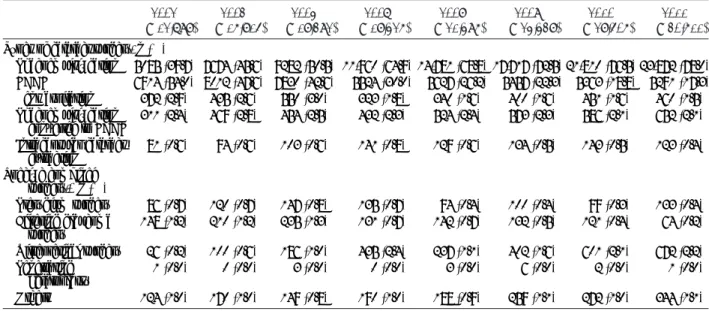
Table 2 shows the distribution of type of cataract surgery by surgical technique and combined surgery. Data for the year 2005 and 2006 were obtained from service census. Manual extraction using ECCE technique was more common in 2002
and 2003, but from 2005 phacoemulsification surplus ECCE. The difference became more apparent in 2006, and since then, phacoemulsification has become the preferred surgical tech-nique contributing to 78.0% in 2011 (Fig. 2). The increment of phacoemulsification was statistically significant with Mann-Kendall test showing an upward trend withP= 0.0008 and a significant downward trend (P= 0.008) in the number of ECCE. The CSR also captured data for cataract surgery that began as phacoemulsification but needed to be converted to ECCE, the percentage remained around 2% for the past 10 years (Table 2).
The overall percentage of cataract surgery performed in combination with other surgeries from year 2002 to 2004 and 2007 to 2011 was 3.7% (n = 6391). Vitreoretinal surgery was the commonest combined surgery performed, and it demon-strated an upward trend from 0.2% in year 2002 to 2.2% in year 2011. On the other hand, combined cataract surgery with glaucoma filtering surgery decreased from 1.2% in 2002 to 0.2% in 2011. The percentage of combined cataract and pte-rygium surgery stayed the same over the years (Fig. 3).
Intraocular Lens
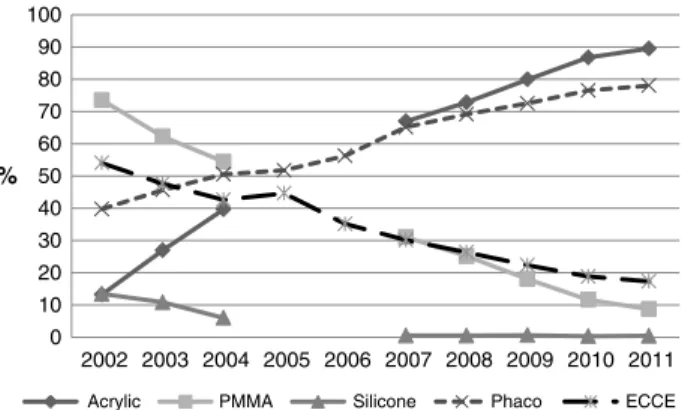
Most patients (97.5% in 2002 to 98.2% in 2011) had pri-mary IOL implantation at the time of surgery, and more than 96% of them had posterior chamber IOL. The use of foldable IOL increased from 26.5% in 2002 to more than 50% in 2007 and reached 88.3% in 2011. The change in material of IOL, from polymethylmethacrylate, which contributed to 73.5% in 2002, to silicon oil (13.4% in 2002) and later acrylic (89.5% in 2011). The change in preference of type and materials of IOL mirrored the change in surgical technique from ECCE to phacoemulsification cataract surgery (Fig. 4). The implantation of silicone IOL had shown a significant decline over the years with less than 1% from 2007 (Fig. 4).
Anesthesia During Cataract Surgery
The majority of eyes were operated under local anesthesia, and percentage stayed at greater than 90% (93.6% in 2002, 93.5% in 2011). Subtenon injection was the preferred technique since 2002 but was surpassed by tropical anesthesia in 2010 (49.6%) and 2011 (58.8%). The change of preference toward topical anesthesia mirrored the change toward phacoemulsifi-cation (Fig. 5).
TABLE 1. Frequency of Surgery Done Among Participating Centers in Malaysian CSR
No. (%) Participating Centers
Total Participating Center Total Surgery Reported to CSR % Reported to CSR Year
No. Cataract Surgery Done in a Year
G100 100Y500 501Y1000 91000 n (%) n (%) n (%) n (%) n n % 2002 1 (4.0) 15 (60.0) 5 (20.0) 4 (16.0) 25 12,798 87.6 2003 5 (15.6) 10 (31.3) 14 (43.8) 3 (9.4) 32 16,815 97.2 2004 4 (12.1) 15 (45.5) 9 (27.3) 5 (15.2) 33 18,392 92.9 2007 1 (2.8) 10 (27.8) 14 (38.9) 11 (30.6) 36 18,426 83.6 2008 1 (2.8) 15 (41.7) 11 (30.6) 9 (25.0) 36 21,496 84.6 2009 1 (2.8) 15 (41.7) 12 (33.3) 8 (22.2) 36 24,438 93.0 2010 1 (2.8) 13 (36.1) 12 (33.3) 10 (27.8) 36 28,506 95.4 2011 1 (2.8) 9 (25.0) 16 (44.4) 10 (27.8) 36 30,611 95.4
Day Care Versus Hospital Admission
The number of cataract surgeries performed as day care increased from 4887 (39.3%) in year 2002 to 14,842 (52.3%) in 2011 (Fig. 6). However, there was much variation among hos-pitals, from no day-care surgery (3 hospitals in 2011) at all to 100% (1 hospital) performed as day-care surgery.
DISCUSSION
The key findings on cataract surgery practice pattern among eye surgeons working at MOH hospitals from 2002 to 2011 were the conversion of surgical technique from ECCE to phacoemul-sification, with more than 50% done as phacoemulsification in 2005 (Fig. 2). The change in surgical technique from large inci-sion ECCE to small inciinci-sion phacoemulsification brought along a parallel change of preferred IOL types and material, from rigid polymethylmethacrylate to foldable acrylic IOL (Fig. 4), as well as the change in type of anesthesia, from subtenon in-jection to topical anesthesia (Fig. 5). Although there was more
phacoemulsification being done, the proportion of day-care sur-gery performed at MOH hospitals remained lower than desired (52% in 2011).
Most MOH hospitals performed around 501 to1000 cataract surgeries a year, and surgeries were mainly done by specialists. This reflects a need to review the work process so as to optimize physical and human resources at MOH hospitals.
Phacoemulsification is now the preferred choice of cata-ract surgery by most ophthalmologists. It was performed in 98% of the cataract surgery in Swedish National Cataract Register16 in 2000 and 99.5% from the European Registry of Quality outcome for cataract and refractive surgery,21 and by almost all respondents in questionnaire surveys done in New Zealand in 2007,22 among all respondents of a survey on American Society of Cataract and Refractive Surgeons members23 in 2003, 94% of Japanese ophthalmologists24in 1999, and 92% among ophthalmologists who responded to a nationwide survey in Singapore.25
The conversion from ECCE to phacoemulsification among doctors at MOH hospitals happened rather late, about 30 years after Charles Kelman introduced phacoemulsification in 1967. Even in 2011, phacoemulsification contributed only two thirds of the total cataract surgery done at MOH hospitals. There were multiple factors that contributed to low uptake of phacoemul-sification. The main reasons were financial cost, where a sig-nificant number of hospitals did not have phacoemulsification machine in the early 2000s, and in 2011, there were only 63 phacoemulsification machines in the 36 ophthalmology de-partments at MOH hospitals.26 Furthermore, the high cost of consumables required for phacoemulsification may limit the volume of phacoemulsification. There is still a need to perform ECCE as almost half of the patients who presented with unaided vision of worse than 2/60 and one fifth of patients who presented with refracted vision of worse than 2/60 at the time of surgery may indicate they had brunescent cataracts, which may not be suitable for phacoemulsification.
TABLE 2. Distribution of Types of Cataract Surgery and Combined Surgery
2002 (n = 12,798) 2003 (n = 16,815) 2004 (n = 18,392) 2007 (n = 18,426) 2008 (n = 21,496) 2009 (n = 24,438) 2010 (n = 28,506) 2011 (n = 30,611)
Types of cataract surgery, n (%)
Phacoemulsification 5085 (39.7) 7674 (45.6) 9282 (50.5) 11,960 (64.9) 14,781 (68.8) 17,717 (72.5) 21,810 (76.5) 23,872 (78.0) ECCE 6914 (54.0) 8012 (47.6) 7830 (42.6) 5524 (30.0) 5627 (26.2) 5457 (22.3) 5363 (18.8) 5291 (17.3) Lens aspiration 372 (2.9) 435 (2.6) 550 (3.0) 323 (1.8) 340 (1.6) 400 (1.6) 451 (1.6) 460 (1.5) Phacoemulsification converted to ECCE 311 (2.4) 469 (2.8) 454 (2.5) 432 (2.3) 524 (2.4) 573 (2.3) 586 (2.1) 652 (2.1) Intracapsular cataract extraction 81 (0.6) 94 (0.6) 103 (0.6) 141 (0.8) 129 (0.6) 134 (0.5) 143 (0.5) 123 (0.4) Specific combined surgery,* n (%) Pterygium surgery 86 (0.7) 120 (0.7) 147 (0.8) 135 (0.7) 94 (0.4) 100 (0.4) 99 (0.3) 133 (0.4) Filtering glaucoma surgery 148 (1.2) 210 (1.2) 235 (1.3) 131 (0.7) 142 (0.7) 132 (0.5) 121 (0.4) 64 (0.2) Vitreoretinal surgery 26 (0.2) 100 (0.6) 186 (1.0) 435 (2.4) 237 (1.1) 402 (1.6) 601 (2.1) 672 (2.2) Penetrating keratoplasty 1 (0.0) 0 (0.0) 3 (0.0) 0 (0.0) 3 (0.0) 6 (0.0) 2 (0.0) 1 (0.0) Others 124 (1.0) 170 (1.0) 149 (0.8) 190 (1.0) 188 (0.9) 259 (1.1) 272 (1.0) 344 (1.1) Number is based on available data. Denominator for calculation of the percentage (%) was derived from the total cases of each year. Data were not available from 2005 to 2006.
*Total number or percentage may be more than total or 100% as patients might have more than 1 combined surgery. FIGURE 1. Status of surgeon who performed the cataract
Foldable IOL has become the preferred IOL type in con-junction with the surge in phacoemulsification surgery. The Swedish National Cataract Register reported use of 92.7% fold-able IOL16and 93.1% of acrylic IOL in EUREQUO database.21 Acrylic hydrophobic is the most favored optic material probably because of its advantages with reference to less postoperative posterior capsular opacity and less Nd:YAG laser capsulotomy-related complications.27
The number of vitreoretinal surgery performed at MOH hospitals has increased more than 3-fold, from 1366 in 2002 to 4515 in 2011.28This may reflect the increase in the cataract surgery combined with vitreoretinal surgery. The downward trend of combined cataract surgery with filtering surgery could be explained by the less favorable outcomes in combined sur-gery.29This practice pattern is in line with the Swedish National Cataract Registry, which reported a decrease from 2.0% to 0.7% of combined glaucoma surgery in its 9-year review.16Combined cataract and pterygium surgery cases were also decreasing, consistent with the practice of removing pterygium before cat-aract surgery for better refractive outcome.
The adoption of phacoemulsification by surgeons also brings the change of type of anesthesia. Among the consultant ophthalmologists in New Zealand who responded to a survey, 65% used subtenon routinely, and 20% used topical anesthe-sia.22Singaporean cataract surgeons used peribulbar anesthesia in 43%, topical anesthesia in 42%, and retrobulbar anesthesia in 13%.25 Topical anesthesia is becoming more popular among MOH doctors in Malaysia (58.8%), and subtenon anesthesia, which used to be most popular in 2002 (47.1%), has become second choice (36.7%). Although topical anesthesia reduced the risk of injection-related complication, it does not provide pain relief as well as regional anesthesia.30
Day-care cataract surgery has been proven to be cost-effective and is practiced worldwide.7Y15Although it is gaining popularity in the MOH hospitals, the percentage of cases per-formed as day care is still low (52% in 2011). The variation in day-care surgery at MOH hospitals reflected more of surgeons’ preference and hospital facilities such as unavailability of day-care OTs and day-care ward rather than geographical location of the hospital or individual patient’s choice. For example, in 2011, Hos-pital Miri, located in the state of Sarawak in Borneo Island in East Malaysia, performed 100% surgery as day care, whereas 3 other hospitals, all located in Sabah state in Borneo Island in East Malaysia, did not perform any case as day care. Besides, up to 72% of patients had a systemic comorbidity and may need to be admitted for monitoring of their medical conditions.
The principal strength of this article is that it reported data from Malaysian CSR with 100% participation of all ophthal-mology departments in MOH, large number of cataract surgery, and good coverage over consecutive years from 2002 to 2004, and 2007 to 2011. The trend observed in the change in prac-tice pattern provides reliable information when compared with articles, which reported findings from questionnaire-based sur-veys with low response rate.22Y25The limitations in this article are that it does not have information on cataract surgery per-formed by doctors in the 3 university hospitals, which have performed 2664 cataract surgery in 2011, and 15819 cataract FIGURE 2. Frequency of phacoemulsification and ECCE. Data for
2005 and 2006 were obtained from service census.
FIGURE 3. Frequency of combined cataract surgery from 2002Y2004, and from 2007 to 2011. Data were not available from 2005Y2006.
FIGURE 4. Frequency on type of intraocular lens implanted and surgical technique. PMMA=polymethlmethacrylate. Data were not available from 2005 to 2006.
FIGURE 5. Frequency on types of anesthesia used during cataract surgery and type of surgical technique. Data for type of anesthesia were not available from 2005 to 2006. Data for type of surgery for 2005 and 2006 were obtained from service census.
surgeries done by 164 private eye care providers (no data). Thus, the practice pattern presented probably reflects only the MOH hospital ophthalmology practice and not representative of the ophthalmology practice in the country.
ACKNOWLEDGMENT
The authors thank the Director General of Health for the permission to conduct the study and for providing the research grant. They also thank the participating hospitals, the site co-ordinators, the optometrists, and the paramedics for data entry.
REFERENCES
1. Pascolini D, Mariotti SP. Global estimates of visual impairment: 2010. Br J Ophthalmol. 2012;96:614Y618.
2. Trikha S, Turnbull AMJ, Morris RJ, et al. The journey to femtosecond laser-assisted cataract surgery. New beginnings or a false dawn? Eye. 2013;27:461Y473.
3. Abell RG, Vote BJ. Cost-effectiveness of femtosecond laser-assisted cataract surgery versus phacoemulsification cataract surgery [published online ahead of print].Ophthalmology. 2013. 4. Loo CY, Kandiah M, Arumugam G, et al. Cost efficiency and cost
effectiveness of cataract surgery at the Malaysian Ministry of Health ophthalmic services.Int Ophthalmol. 2004;25:81Y87.
5. Suresh KP, Milverton EJ, Maloof AJ. Charles David Kelman, MD: father of phacoemulsification, fame inventor and one of the great ophthalmologists of the 20th century.DOS Time. 10:77Y79. 6. Xavier C, Merce C, Miguel C, et al. Clinical outcome and costs of
cataract surgery performed by planned ECCE and phacoemulsification. Int Ophthalmol. 1998;22:363Y367.
7. Fedorowicz Z, Lawrence D, Gutierrez P, et al. Day care versus in-patient surgery for age-related cataract.Cochrane Database Syst Rev. 2011;6:CD004242.
8. Tufail A, Foss AJE, Hamilton AMP. Is the first day postoperative review necessary after cataract extraction?Br J Ophthalmol. 1995;79:646Y648.
9. Atalla ML, Wells KK, Peucker N, et al. Cataract extraction in a major ophthalmic hospital: day-case or overnight stay?BMC Health Serv Res. 2007;1:16.
10. Bloom B, Krueger N. Cost and quality effects of outpatient cataract removal.Inquiry. 1998;25:383Y387.
11. Cooper JM. Day case cataract surgery in the UK and USA: a comparative study.Br J Nurs. 1997;6:39Y43.
12. Watts MT, Pearce JL. Day-case cataract surgery.Br J Ophthalmol. 1988;72:897Y899.
13. Strong NP, Wigmore W, Smithson S, et al. Day-case cataract surgery. Br J Ophthalmol. 1991;75:731Y733.
14. Mojon-Azzi SM, Mojon DS. The rate of outpatient cataract surgery in ten European countries: an analysis using data from the SHARE survey.Graefes Arch Clin Exp Ophthalmol. 2007;245:1041Y1044. 15. Prakash G, Jhanji V, Sharma N, et al. Day care vs. inpatient cataract
surgery: factors governing choices of patients and surgeons in the developing world.Eye. 2007;21:999.
16. Lundstro¨m M, Stenevi U, Thorburn W. The Swedish National Cataract Register: a 9-year review.Acta Ophthalmol. Scand. 2002;80:248Y257.
17. Schein OD, Cassard SD, Tielsch JM, et al. Cataract surgery among Medicare beneficiaries.Ophthalmic Epidemiol. 2012;19:257Y264. 18. Greenberg PB, Havnaer A, Oetting TA, et al. Cataract surgery practice
patterns in the United States Veterans Health Administration. J Cataract Refract Surg. 2012;38:705Y709.
19. Goh PP, Elias H, Nor Fariza N, et al. National Eye DatabaseYA Web Based Surveillance System.Med J Malaysia. 2008;
63(suppl C):20Y23.
20. Stata Statistical Software. Release 8.0. College Station, TX: Stata Corp; 2003.
21. Lundstro¨m M, Barry P, Leite E. 1998 European Cataract Outcome Study. Report from the European Cataract Outcome Study Group. J Cataract Refract Surg. 2001;27:1176Y1184.
22. Pick ZS, Leaming DV, Elder MJ. The fourth New Zealand cataract and refractive surgery survey: 2007.Clin Exp Ophthalmol. 2008;36:591.
23. Leaming DV. Practice styles and preferences of ASCRS
membersV2003 survey.J Cataract Refract Surg. 2004;30:892Y900. 24. Oshika T, Amano S, Araie M, et al. Current Trends in cataract and
refractive surgery in Japan: 1999 survey.Jpn J Ophthalmol. 2001;45:383Y387.
25. Wagle AA, Wagle AM, Bacsal K. Practice preferences of ophthalmic anaesthesia for cataract surgery in Singapore.Singapore Med J. 2007;48:287Y290.
26. Elias H, Arunah C, Mariam I, et al. Chapter 3. Ophthalmology services in Malaysian hospitals in 2011.The Fifth Report of the National Eye Database. 2011:83. Available at: http://www.crc.gov.my/documents/ report/The_Fifth%20Report_of_the_National_Eye_Database 2011.pdf. Accessed October 21, 2013.
27. Smith AF, Lafuma A, Berdeaux G, et al. Cost-effectiveness analysis of PMMA, silicone, or acrylic intra-ocular lenses in cataract surgery in four European countries.Ophthalmic Epidemiol. 2005;12:343Y351. 28. Mohamad Aziz S, Goh PP, eds.The Fifth Report of the National Eye
Database 2011. Available at: http://www.crc.gov.my/documents/report/ The_Fifth%20Report_of_the_National_Eye_Database2011.pdf. Accessed October 21, 2013.
29. Ruderman JM, Fundingsland B, Meyer MA. Combined
phacoemulsification and trabeculectomy with mitomycin-C.J Cataract Refract Surg. 1996;22:1085Y1090.
30. Zhao LQ, Zhu H, Zhao PQ, et al. Topical anesthesia versus regional anesthesia for cataract surgery: a meta-analysis of randomized controlled trials.Ophthalmology. 2012;19:659Y667. FIGURE 6. Percentage of day care cataract surgery done in the
MOH from 2002Y2004 and 2007Y2011. Data were not available from 2005 to 2006.