Volume 11 Issue 2 Article 5
Published online: 6-5-2017
Students’ and Teachers’ Experiences With the Implementation of
Students’ and Teachers’ Experiences With the Implementation of
Problem-Based Learning at a University Law School
Problem-Based Learning at a University Law School
Marit Wijnen
Erasmus University Rotterdam, [email protected] Sofie M. M. Loyens
Erasmus University Rotterdam; University College Roosevelt, Utrecht University, [email protected] Guus Smeets
Erasmus University Rotterdam, [email protected] Maarten J. Kroeze
Erasmus University Rotterdam, [email protected] Henk T. Van der Molen
Erasmus University Rotterdam, [email protected]
IJPBL is Published in Open Access Format through the Generous Support of the Teaching Academy at Purdue University, the School of Education at Indiana University, and the Jeannine Rainbolt College of Education at the University of Oklahoma.
Recommended Citation Recommended Citation
Wijnen, M. , Loyens, S. M. , Smeets, G. , Kroeze, M. J. , & Van der Molen, H. T. (2017). Students’ and Teachers’ Experiences With the Implementation of Problem-Based Learning at a University Law School. Interdisciplinary Journal of Problem-Based Learning, 11(2).
Available at: https://doi.org/10.7771/1541-5015.1681
This document has been made available through Purdue e-Pubs, a service of the Purdue University Libraries. Please contact [email protected] for additional information.
This is an Open Access journal. This means that it uses a funding model that does not charge readers or their institutions for access. Readers may freely read, download, copy, distribute, print, search, or link to the full texts of articles. This journal is covered under the CC BY-NC-ND license.
September 2017 | Volume 11 | Issue 2
The Interdisciplinary Journal of
Problem-based Learning
Special iSSue On cOmpetency OrientatiOn in prOblem-baSeD learning
Introduction
Study delay and student dropout are two major issues that universities in the Netherlands face. As little as 30% of Dutch university students graduate from their bachelor’s pro-grams in the targeted three years (Central Bureau for Statis-tics, 2014), and the average dropout rate during four years of study was 48% prior to 2010 (Educational Inspectorate, 2009). Remarkably, dropout rates tend to be higher in legal education compared to other disciplines (e.g., medical edu-cation, technical studies, and behavioral sciences). Around 60% of Dutch law students drop out during or after four years of study, of which 39% already quit the academic program
during or directly after the first year (Educational Inspector-ate, 2009). Clearly, these trends impact both the students and universities in a negative way.
The Erasmus School of Law is no exception with regard to study delay and student dropout. In an attempt to improve students’ learning quality and diminish study delay and drop-out, a curriculum-wide implementation of problem-based learning (PBL) in the bachelor’s program took place. PBL is a student-centered instructional method in which students collaboratively work on realistic problems under guidance of a tutor (Barrows, 1996; Hmelo-Silver, 2004; Schmidt, 1983; Loyens, Kirschner, & Paas, 2012). Research has shown that PBL students, compared to students of traditional,
Students’ and Teachers’ Experiences
With the Implementation of Problem-Based Learning
at a University Law School
Marit Wijnen,
1Sofie M. M. Loyens,
2,3Guus Smeets,
2Maarten J. Kroeze,
1and Henk T. Van der Molen
2 1Erasmus School of Law, Erasmus University Rotterdam
² Department of Psychology, Education, and Child Studies, Erasmus University Rotterdam
3
Roosevelt Center for Excellence in Education, University College Roosevelt, Utrecht University
Abstract
A few years ago, the Erasmus School of Law implemented problem-based learning (PBL) as an instructional method in the bachelor’s program. Transition to a PBL program often brings some difficulties for the teaching staff. To find out whether the implementation at the Erasmus School of Law has been successful, students and teachers were asked about their experi-ences with and perceptions of the PBL program. Both students and teachers reported positive study behaviors, such as regu-lar studying and active involvement of students as a result of PBL. However, some issues also arose after implementing PBL: staff members reported dissatisfaction regarding the PBL program and students reported feelings of insufficient preparation for the legal profession. Recommendations on how to address these issues are discussed.
Keywords: law students, implementation, problem-based learning, experiences
Author Note: Correspondence concerning this article should be addressed to Marit Wijnen, Erasmus School of Law, Erasmus University Rotterdam, Burgemeester Oudlaan 50, 3062 PA Rotterdam, Netherlands. E-mail: [email protected]
2 | www.ijpbl.org (ISSN 1541-5015) September 2017 | Volume 11 | Issue 2 lecture-based programs, retain more knowledge in the
long-term (Dochy, Segers, Van den Bossche, & Gijbels, 2003; Schmidt, Van der Molen, Te Winkel, & Wijnen, 2009; Stro-bel & Barneveld, 2009), are in general more satisfied with the program (Schmidt, Van der Molen, et al., 2009), and have less study delay and lower dropout rates (Iputo & Kwizera, 2005; Schmidt, Cohen-Schotanus, & Arends, 2009; Schmidt, Cohen-Schotanus, et al., 2009). As the origin of PBL lies in medical education (Barrows, 1996), the majority of studies concerning PBL are conducted within this discipline. How-ever, over the last decades, PBL has been implemented in dif-ferent fields of education (e.g., psychology, engineering, and pre-service teacher education; Savery, 2006). In the present article, we will describe the implementation of a PBL program in yet another discipline in higher education: law school.
Problem-Based Learning
at the Erasmus School of Law
The Erasmus School of Law started its PBL program in Sep-tember 2012. Students enroll in one of three fields of study: Dutch law, tax law, or criminology. All programs contain a three-year bachelor’s and a one-year master’s program. Only the bachelor’s program implemented the PBL method. Stu-dents who started before September 2012 were taught in a traditional, lectured-based way. The professors connected to the program were giving several lectures each week in which they provided students with instructions and information. In addition, some courses offered weekly work groups in which students discussed a specific law case with the teacher. Each academic year was divided into four ten-week periods. In each period, two courses were given in parallel (e.g., Dutch administrative law and philosophy of the law). Four exami-nation weeks per year were organized.
Students who entered the Erasmus School of Law from September 2012 on are enrolled in the new PBL program. In total, eight courses, each lasting five weeks, are offered sequentially each academic year, and all courses end with a written examination. Along with the implementation of PBL, the assessment system changed as well. From Septem-ber 2012 on, students are required to obtain all course credits in the first bachelor-year in order to continue the second- bachelor year (i.e., 60 ECTS). In the former program, stu-dents needed to obtain only a part of these credits (i.e., 40 out of 60 ECTS) in order to continue their study.
The study activities in the PBL program consist of tutorial meetings, self-study, practical courses, and a limited num-ber of lectures. The tutorial meetings (2.5 hours) take place twice a week in groups of approximately eleven students. In between the meetings, students have two to three days of self-study. During the meetings, students collaboratively discuss a
realistic problem in the presence of a tutor who acts as a facili-tator (Barrows, 1996; Hmelo-Silver, 2004; Schmidt, 1983; Loy-ens et al., 2012). In general, the PBL process can be divided into the initial discussion, a self-study phase, and the reporting phase. The “Seven Jump” method is applied to shape the PBL process (Schmidt, 1983), as depicted in Table 1 (next page).
In the initial phase, students receive a realistic, ill-defined problem (e.g., description of a realistic situation or news arti-cle), which is discussed based on own experiences and com-mon sense. A situation about a man who purposely seeks confrontation, gets attacked, and therefore shoots the attacker could serve as a PBL problem regarding self-defense during an introductory course in Dutch criminal law. The problem, a fic-tive news article used in the law program under study, is pre-sented in the Appendix. As the problem is the starting point of the learning process, prior knowledge is limited and students end up formulating questions about the topic of the problem (i.e., learning issues). The discussion in the first PBL phase follows the first five steps of the “Seven Jump” method (see Table 1). In the example problem on self-defense, students are likely to discuss, with help of these steps, whether what John did was justified. After the initial discussion, the self-study phase starts, which is the sixth step of the “Seven Jump” (Schmidt, 1983). Students individually search for and study relevant lit-erature sources (e.g., book chapters, articles, jurisprudence) to address the learning issues. After two or three days, students return to the group for the reporting phase (i.e., the final step of the “Seven Jump”). During this phase, students discuss studied literature sources and collaboratively formulate complete and coherent answers to the learning issues. Table 1 illustrates the steps of the “Seven Jump” method including examples of each step of the problem on self-defense.
The tutor is present as a facilitator during the initial discussion and the reporting phase. The tutor asks in-depth questions and helps them to get back on track when the discussion becomes focused on irrelevant information (Loyens et al., 2012).
Teacher Training
Considering the important role the tutor has in PBL (Azer, Mclean, Onishi, Tagawa, & Scherpbier, 2013), serious atten-tion is given to teacher training before the implementaatten-tion. Two connected training programs were offered to staff mem-bers and novice tutors. The first training was a tutor training that focused on the role a tutor should adopt in the PBL pro-cess during the meetings. Both senior staff members (those responsible for the content of the courses as course coordi-nators) and novice tutors followed this training. The second training focused on the design of courses and problems, and only applied to the course coordinators, who will be referred to as teachers from now on.
Wijnen, M., et al. Students’ and Teachers’ Experiences With PBL in Law School
3 | www.ijpbl.org (ISSN 1541-5015) September 2017 | Volume 11 | Issue 2 In the first three-day tutor training, tutors and teachers
were informed about the rationale of the PBL process, the seven steps of the “Seven Jump” method, and the role of the student in PBL. Participants were instructed on how to support students when students lead discussions, make notes, and paraphrase during the discussions. Tutors and teachers were informed how to adopt a guiding role in the PBL pro-cess, how to stimulate an active role for students, and how and when to intervene in discussions by asking, for exam-ple, in-depth questions. Further, instructions were given on how to provide students with feedback on their participation in the tutorial group. The content of this training is much in line with the recommendations given by Azer and colleagues (2013) to assure a successful PBL program.
In the second two-day training, a PBL expert gave instruc-tions to teachers about how to implement PBL. Teachers need to think about the topics they would like to address in their courses, so they were instructed on how to make clear,
understandable, and motivating problems. Example prob-lems were discussed and teachers practiced creating probprob-lems under guidance of the PBL expert. They were also instructed on how to make sufficient instructions for tutors (i.e., tutorial manuals) and how the assessment of their courses could be shaped. Guidance and support for teachers remained avail-able after this training. During creating and after finishing definitive versions of the problems for the courses, teachers received feedback from PBL experts. In addition, all prob-lems were tested in a simulated tutorial meeting (i.e., initial discussion) with students. Hence, the problems were tested on their effectiveness; for example, whether they elicited dis-cussion and were understandable for students, and whether the level of prior knowledge of students matched the prob-lems (Loyens et al., 2012).
Additionally, ongoing support for tutors remains avail-able throughout the academic year, and tutors’ functioning is monitored. A few weeks after guiding tutorial sessions,
Phases of the PBL process Steps of the “Seven Jump” method Example
Initial discussion 1. Clarification of the problem
2. Formulation of the problem statement
3. Brainstorm: All students give an answer to the problem statement 4. Problem analysis: A discussion of mentioned explanations in the brainstorm. The discussion should cover the different views that came up during the brainstorm with more depth.
5. Formulation of the learning issues
Addressing all difficulties with the formulation of the problem (e.g., difficult terms)
“Is John’s action justified?” Some students might think that
John was right to shoot the attacker; others may not.
“Why is what John did justified or not?”; “Which rules apply when you defend yourself?”
“What is self-defense?”; “Under which conditions does the right to self-defense apply?”
Self-study phase 6. Individual search for and study of relevant literature sources, guided by the learning issues
Book chapters, jurisprudence, and articles of the law on self-defense Reporting phase 7. Discussion of the studied literature
while addressing the learning issues All different literature sources on self-defense are discussed
4 | www.ijpbl.org (ISSN 1541-5015) September 2017 | Volume 11 | Issue 2 a PBL expert attends the tutorial meetings of all tutors and
plans a job evaluation conversation afterward. From then on, tutors are monitored every three to twelve months. During the job evaluation conversations, students’ evaluations of the tutor are discussed as well. Besides these planned meetings, there is always a possibility for tutors to meet the PBL experts when difficulties with students or with the PBL process in general are encountered. During each course, weekly meet-ings with all tutors and the course coordinator are held in which experiences are shared and discussed (e.g., difficulties students had with a specific problem of the course).
Student Training
When students enter the Erasmus School of Law an intro-duction to PBL is provided to them as well. At the start of the academic year, students attend a lecture about the rationale of PBL and their role in the PBL process. It is explained that an active role of students is required during meetings: stu-dents need to be prepared every meeting and actively partici-pate in the discussions. They are instructed about the roles of chair and scribe. During each tutorial meeting, one student acts as chair (i.e., guiding the discussion, summarizing the contributions of fellow students) and one as scribe (i.e., tak-ing notes of the discussion for all students in the group). The first tutorial meeting of the first course consists of two initial discussions. The first one is an exercise to practice with the steps of the “Seven Jump” method; the second discussion is the official first initial discussion of the first course.
Experiences with Problem-Based Learning
Implementation of PBL is a complex and time-consuming process, and the quality of the implementation is of great importance for student outcomes. Poor implementation
often holds that there is a discrepancy between the theory behind PBL and the reality. This can result in dysfunctional groups in PBL, which in turn is detrimental for students’ per-formances (Azer et al., 2013; Dolmans, De Grave, Wolfhagen, & Van der Vleuten, 2005). Examples of this are when tutors act either too directive (i.e., provide too much instruction) or too passive (i.e., barely intervene in discussion when this is actually necessary; Dolmans et al., 2005) or when students shortcut the PBL process (Azer et al., 2013). In order to shed light on the question of whether the implementation of PBL at the Erasmus School of Law has been successful, teachers and students were asked about their experiences.
Two short questionnaires, one for students and one for teachers about their experiences with and perceptions of the PBL program, were administered online. Questions concerned students’ behavior and satisfaction and teachers’ satisfaction with the PBL method. Both questionnaires were administered three years after the PBL implementation. Over these three years after implementation, no major changes in the curriculum took place, only minor changes (e.g., adap-tations of problems that did not work sufficiently for the year after). The questions were based on the questionnaire used by Kaufman and Holmes (1996). Their article describes teachers’ experiences and perceptions after the transition to PBL at a medical school.
Students’ Experiences
The questionnaire for students was administered online to all students in the PBL bachelor program at the Erasmus School of Law. Students were asked to rate six statements regarding PBL on a five-point scale (1 “Strongly disagree” to 5 “Strongly agree”). Questionnaire items are listed in Table 2, accompanied by frequencies and mean scores. Additionally, students had the opportunity to give concluding remarks on the PBL program.
1 2 3 4 5 Mean Score
1 Problem-based learning is a pleasant instruction type 17% 19% 16% 33% 17% 3.17 (1.34) 2 I have the feeling that I acquire a lot of knowledge by
problem-based learning 13% 13% 15% 43% 16% 3.35 (1.26)
3 I study on a regular basis in problem-based learning 9% 15% 15% 41% 20% 3.46 (1.23) 4 I acquire a lot of skills through problem-based
learning 12% 22% 29% 28% 9% 2.99 (1.17)
5 Problem-based learning helps me prepare for work in
the professional field 23% 27% 31% 15% 4% 2.51 (1.12)
6 I am satisfied with problem-based learning 20% 19% 19% 29% 13% 2.98 (1.35)
Table 2. Statements for students, frequencies, and mean scores (standard deviations in parentheses).
Note. Scores varied from 1 to 5: score of 1 “Strongly disagree,” 2 “Disagree,” 3 “Do not agree/do not disagree,” 4 “Agree,” and 5 “Strongly agree.”
Wijnen, M., et al. Students’ and Teachers’ Experiences With PBL in Law School
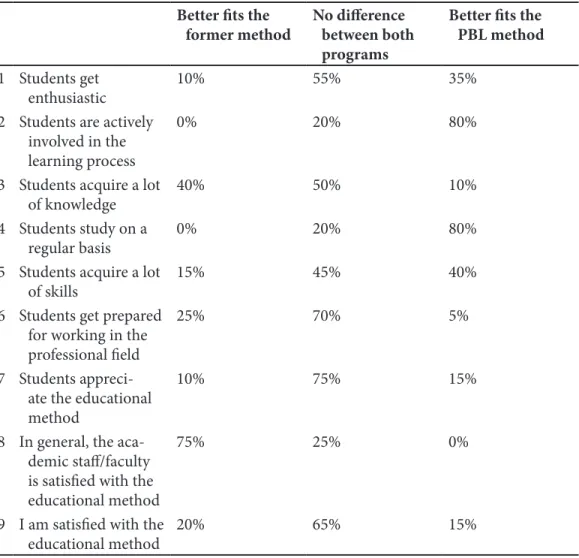
5 | www.ijpbl.org (ISSN 1541-5015) September 2017 | Volume 11 | Issue 2 A total of 20 teachers (30% male) filled out the question-naire (response rate was 52%). Teachers taught in different areas of law within the department (e.g., criminal law, com-pany law). Participants’ ages ranged from 27 to 62. In Table 3, the frequencies of responses for each of the three answer options for each item are given.
Results show that teachers identify a more active role of PBL students in the learning process, compared to stu-dents of the former method, and teachers notice that PBL students study on a regular basis more often than “traditional” students. This result is in line with what students reported. Further, teachers barely observe differences between stu-dents in both programs with regard to student enthusiasm and acquisition of skills. Moreover, teachers who filled out the questionnaire are about as equally satisfied with the old as with the new method of teaching. However, teachers do believe that students acquired more knowledge in the for-mer educational method than in PBL. Regarding preparation for the professional field, the majority of teachers reported no differences between both programs. Finally, teachers reported that the majority of the faculty is dissatisfied with PBL, and that the faculty was more satisfied with the educa-tional program before the PBL implementation. None of the teachers reported further remarks on the programs.
Challenges After the Implementation
Experiences and perceptions of students and teachers indi-cate some positive changes in students’ study behavior after the implementation of PBL at the Erasmus School of Law, but also some challenges that need attention.
A positive change in students’ study behavior and activi-ties is noticed by both teachers and students. Students seem to study on a more regular basis because of the PBL pro-cess. This can be explained by the required study activities in PBL compared to the former educational method. In the former program, lectures were an important source of information. During lectures teachers provided information and students received information and had a rather passive role. As a result, students were not required or stimulated to act on other study activities, such as self-study during the course, and they could postpone studying until right before the examination weeks. In contrast, in PBL tutorial meetings take place twice a week for which students need to prepare themselves. Students are stimulated to study on a regular basis this way. Due to the discussions in the tutorial meet-ings, students are more actively involved in their learning process. In order to discuss the material, students need to have studied course materials and have thought about argu-ments and different perspectives. Hence, students need to be actively engaged in study activities.
In total, 344 students (37% male) filled out the ques-tionnaire. Response rate was 10 to 15% of the total student population. Participating students were first-year (35%), sec-ond-year (29%), and third-year students (36%), of the three different fields of study within the Erasmus School of Law. The majority of them studied Dutch law (65%); the remain-ing students studied tax law (20%) or criminology (21%).1 This distribution is common at the Erasmus School of Law.
Results of the questionnaire show that regarding satisfaction of PBL and acquiring skills in PBL, students report a neutral score of 3 (i.e., “do not agree/do not disagree”). They experience PBL in general as a pleasant instruction type, but this score is only slightly above a neutral score. Many of the students agreed on the item regarding acquisition of knowledge in PBL, but the mean score was slightly above a neutral score. An interest-ing result is that almost half of the students agreed on the item concerning studying on a regular basis because of PBL. When rating the item regarding preparation of PBL for professional work, a mean score of below 3 came out: half of the students chose disagree or strongly disagree on this item. This shows that in general, students report the feeling that PBL does not sufficiently prepare them for work in the professional field.
There was an opportunity to give concluding remarks on PBL and about a third of the students provided comments. Students indicated that PBL makes them more actively involved in the learning process, helps them study on a regu-lar basis, and stimulates them to study. However, there were commentaries on the PBL program that the reporting phase sometimes was not considered helpful, because literature findings were simply summed up, and some tutors lacked in providing proper guidance during meetings. These seem to be issues in other PBL curricula as well (Azer et al., 2013).
Teachers’ Experience
The second questionnaire was administered online to teach-ers who had taught in both the former lecture-based curricu-lum and in the new PBL curricucurricu-lum. In this questionnaire, teachers were asked to compare students’ behavior before and after the implementation of PBL and about their own and their colleagues’ satisfaction with both programs (i.e., old and new). All questionnaire items are listed in Table 3 (next page). For each statement, teachers had to indicate whether the statement fit the former educational program (i.e., lec-ture-based) better, whether no differences were observed between both programs, or whether the statement fit the PBL program better. Additionally, teachers had the opportunity to give concluding remarks on the programs.
1. A small percentage of students within the faculty participate in two study programs, (e.g., Dutch law and tax law). Therefore, the percentages add up to a percentage over 100.
6 | www.ijpbl.org (ISSN 1541-5015) September 2017 | Volume 11 | Issue 2 Despite higher student engagements, some issues have
arisen after the implementation of PBL as well. First of all, students in PBL seem to have the feeling that they are not sufficiently prepared for work in the profession. This find-ing is more or less surprisfind-ing, as students in PBL work with authentic, complex problems. The problems in PBL aim to resemble real-life situations that students are confronted with later in their profession (Schmidt, 1983), in this case the legal profession. Remarks students made on the PBL program might offer an explanation for this. Some pointed out that often in the reporting phase, literature findings are simply summed up, but a connection to the problem of the initial discussion is missing. If there is not an optimal use of the problems, the initial discussion about the realistic situa-tion might feel useless to students and they will not see the relevance of the real-life context. This could contribute to the feeling that PBL does not prepare students for the pro-fessional field. Though some important remarks should be made regarding this finding. First, there is no comparison
with the experiences of students in the former, lecture-based curriculum. In fact, in the new PBL program, there is more focus on skill development and practice compared to the for-mer, lecture-based format. Second, students might not com-pletely be aware of what the legal profession entails and that postgraduate training is often required.
Another concern found in the questionnaire results is the dissatisfaction of faculty after the implementation of PBL. Results of the teacher questionnaire showed that teachers noticed their colleagues were more satisfied with the old educational program than they are with PBL. A possible reason for this is a required change in teacher style. In the old method, teachers passed on their knowledge through lectures, which made the transition to a more passive role in PBL as tutor a significant change. For example, teachers ought to not directly provide information, but let students lead the discussion. Changing teacher style is challenging for teachers (Ertmer & Simons, 2006; Kaufman & Holmes, 1996; Morss Clyne & Billiar, 2016) and could result in
Better fits the
former method No difference between both programs
Better fits the PBL method
1 Students get
enthusiastic 10% 55% 35%
2 Students are actively involved in the learning process
0% 20% 80%
3 Students acquire a lot
of knowledge 40% 50% 10%
4 Students study on a
regular basis 0% 20% 80%
5 Students acquire a lot
of skills 15% 45% 40%
6 Students get prepared for working in the professional field
25% 70% 5%
7 Students appreci-ate the educational method
10% 75% 15%
8 In general, the aca-demic staff/faculty is satisfied with the educational method
75% 25% 0%
9 I am satisfied with the
educational method 20% 65% 15%
Wijnen, M., et al. Students’ and Teachers’ Experiences With PBL in Law School
7 | www.ijpbl.org (ISSN 1541-5015) September 2017 | Volume 11 | Issue 2 dissatisfaction. Moreover, these changes in the activities of
the given courses require time and effort, which could also cause dissatisfaction.
Dissatisfaction within the faculty can have a large impact on the effectiveness of the implementation, as it can lead to insufficient application of the PBL process by tutors and teachers; for example, when teachers and tutors provide stu-dents with too much information and instructions during the tutorial meetings. On the other hand, teachers and tutors can act too passively and not intervene in the discussion at all, which leaves students frustrated. In both cases, there is a poor implementation of PBL, which can have detrimental effects on group functioning and student performance (Dol-mans et al., 2005).
Recommendations
In short, the implementation of PBL leaves the Erasmus School of Law with two issues: students’ belief of insufficient preparation for the legal profession and faculty dissatisfac-tion. Recommendations in order to overcome these difficul-ties will be discussed below.
Preparation for profession
Regarding students’ perceptions of PBL’s insufficient prepa-ration for the professional field, there are two ways of dealing with this. First, there should be a closer look at the existing problems and the use of these problems in the reporting phase. Dolmans and colleagues (2005) explain the impor-tance of problems for group functioning (e.g., when prob-lems are too well structured or do not relate to students’ prior knowledge, this could result in dysfunctional tutorial meetings). The problems within PBL aim to support learning in a realistic context and help students prepare for working with similar cases in the professional field (Schmidt, 1983). Important here is the focus on knowledge application during the reporting phase, which can help students see the connec-tion with real-life situaconnec-tions better. Students indicated that the reporting phase now sometimes exists of summing up lit-erature findings. However, the reporting phase should focus on answering the learning issues that are formulated in the initial discussion, integrating different literature sources, and applying the acquired knowledge to the problem at hand. A tutor can refer to the problem during the reporting phase or even come up with different scenarios related to the origi-nal problem. He or she can ask students how to handle these scenarios with the information they have studied and dis-cussed. To return to the example of self-defense mentioned in the introduction, tutors could let students discuss the jus-tification of John’s actions if John “only” mildly injured the man. Students then need to be able to understand that subtle
differences among scenarios can have a major impact on the rules and laws that need to be applied. The course coordi-nator could provide these kinds of problem scenarios in the tutorial manuals, so all tutors can address them. Directly applying the learned information will make students more aware of the connection between the problems used in PBL and practice.
A second method to deal with students’ perceptions of insufficient preparation has to do with creating awareness among students. As for almost all disciplines and university programs, after graduating from law school in the Nether-lands vocational training is a prerequisite for a job in the legal professional field. Students might not be completely aware of this and despite the fact that there is focus on skill development and practice within PBL, students feel their preparation is insufficient. Making students more aware that they need to acquire basic knowledge in order to apply it in practice might help them to adapt their expectations of the program.
To sum up, more attention could be paid to the applica-tion of knowledge in group discussions, and students need to be made aware of what the legal profession entails. Never-theless, as mentioned before, only PBL students filled out the questionnaire. At this point, it is hard to ascertain whether in the former program students had the idea they were bet-ter prepared for the professional field—especially since the majority of teachers reported no differences with regard to this item between both programs.
Dissatisfaction of teachers
The second issue, dissatisfaction of teachers, is perhaps a more difficult issue to address. Dissatisfaction could be a result of a change in teaching style or redesign of the course, which requires time and effort. In an attempt to make teach-ers more satisfied with the PBL program, teachteach-ers should be able to share their feeling of dissatisfaction toward the management of the PBL program. Their ideas, opinions, and remarks should be taken into account when creating and redesigning a course in PBL. It will be challenging, but not impossible, to compromise between both teachers’ wishes and PBL fundamentals.
Noteworthy from the findings of the teacher questionnaire is that the teachers who filled out the questionnaire reported to be as satisfied with PBL as they were with the lecture-based program. However, they reported that within the fac-ulty, dissatisfaction regarding PBL dominates. Teachers who filled out the questionnaire had taught in both the lecture-based and PBL method, and hence these teachers personally experienced changes in student behavior after implemen-tation. Other faculty members who are not involved in the PBL program (e.g., teachers of masters’ programs that are
8 | www.ijpbl.org (ISSN 1541-5015) September 2017 | Volume 11 | Issue 2 not problem-based) apparently often have a negative opinion
about PBL. Perhaps, if these teachers would actually teach in the PBL program, their perception of PBL might change as well. In retrospect, teachers who do observe students in PBL (those who filled out the questionnaire) perceived PBL students as more actively involved and studying on a regular basis, which probably influenced their satisfaction with PBL in a positive way.
Students’ Achievements
There are some important remarks to make regarding the findings reported in this study. First, the implementation of PBL took place recently. Therefore, some start-up problems still existed in the program, noticed by both students and teachers. Moreover, the third-year students who filled out the questionnaire were the very first students in the new PBL pro-gram—this group especially could have experienced start-up problems in the PBL program. Furthermore, the response rates of students and teachers were quite low. Perhaps those who did not participate were satisfied with the PBL program and did not feel the need to fill out the questionnaire.
Despite the PBL challenges mentioned, positive changes in study behavior are reported, and this is also reflected in students’ achievements, as will be outlined next. The num-ber of students passing the first bachelor year by obtaining all required credits shows a positive image of the educa-tional changes made in the program. On average, 43% and 46% of the students within Erasmus School of Law obtained all course credits over the first year before the implemen-tation of PBL in 2010 and 2011, respectively (traditional curriculum). This percentage increased extensively: About 68% of the students obtained all credits of the first year in 2012, after PBL was implemented (Baars, Van Wensveen, & Hermus, 2015). In addition, percentages of student drop-out during or after the first bachelor year within Erasmus School of Law showed a small decrease from 35% in 2011 (old method) to 30% (PBL method; Baars et al., 2015). In sum, although still preliminary, the positive changes in student behavior after the switch to PBL seem to pay off.
Conclusion
This article describes the implementation of PBL at the Eras-mus School of Law. Students’ and teachers’ experiences pro-vided an indication of whether the implementation has been successful. Even though some challenges remain, the imple-mentation of PBL at the Erasmus School of Law brought positive changes in students’ study activities—such as more active involvement of students and regular study behavior— and in academic achievements.
References
Azer, S. A., Mclean, M., Onishi, H., Tawaga, M. & Scherp-bier, A. (2013). Cracks in problem-based learning: What is your action plan? Medical Teacher, 35(10), 806–814. https://doi.org/10.3109/0142159X.2013.826792
Baars, G. J. A., Van Wensveen, P., & Hermus, P. (2015). Door-werking regeling “nominaal = normaal” aan de Erasmus Universiteit Rotterdam op de samenstelling van de instroom en doorstroom/uitval van (subgroepen) studenten in het eerste studiejaar en op de studievoortgang na twee jaar stu-deren, zowel van de hele groep als van de verschillende com-pensatiegroepen. [The effects of “nominal = normal” at the Erasmus University Rotterdam based on composition of students who enter and dropout in the first academic year, and study progress after two years of study, both on the complete group and the different compensation groups] Rotterdam: Erasmus Universiteit Rotterdam/Risbo. Barrows, H. S. (1996). Problem-based learning in medicine
and beyond: A brief overview. In W. H. Gijselaers (Ed.),
New Directions for Teaching and Learning (pp. 3–12). San Francisco, CA: Jossey-Bass. https://doi.org/10.1002 /tl.37219966804
Central Bureau for Statistics. (2014). WO; studievoortgang, voo-ropleiding, studierichting, herkomstgroepering [Academic Education; study progress, prior education, study field, origin grouping]. Retrieved from CBS StatLine: http://statline.cbs .nl/StatWeb/publication/?VW=T&DM=SLNL&PA=7119 9NED&D1=0-7,22-37&D2=0&D3=a&D4=0&D5=1&D6 =0&D7=7-16&HD=130516-0823&HDR=G5,G3,G1,G4, T&STB=G2,G6
Dochy, F., Segers, M., Van den Bossche, P., & Gijbels, D. (2003). Effects of problem-based learning: A meta- analysis. Learning and Instruction, 13, 533–568. https:// doi.org/10.1016/S0959-4752(02)00025-7
Dolmans, D. H. J. M., De Grave, W., Wolfhagen, I. H. A. P., & Van der Vleuten, C. P. M. (2005). Problem-based learning: Future challenges for educational practice and research. Medical Education, 39(7), 732–741. https://doi .org/10.1111/j.1365-2929.2005.02205.x
Educational Inspectorate. (2009). Uitval en rendement in hoger onderwijs: Achtergrondrapport bij ‘werken aan een beter rendement’ [Dropout and success rates in higher edu-cation: Back report on ‘working on better success rates’]. Zoetermeer, Netherlands: Educational Inspectorate. Ertmer, P. A., & Simons, K. D. (2006). Jumping the PBL
implementation hurdle: Supporting the efforts of K–12 teachers. Interdisciplinary Journal of Problem-Based Learning, 1(1), 40–54.
Hmelo-Silver, C. E. (2004). Problem-based learning: What and how do students learn? Educational Psychology
Wijnen, M., et al. Students’ and Teachers’ Experiences With PBL in Law School
9 | www.ijpbl.org (ISSN 1541-5015) September 2017 | Volume 11 | Issue 2
Review, 16(3), 235–266. https://doi.org/10.1023/B:EDPR .0000034022.16470.f3
Iputo, J. E. & Kwizera, E. (2005). Problem-based learn-ing improves the academic performance of medical stu-dents in South Africa. Medical Education, 39(4), 388–393. https://doi.org/10.1111/j.1365-2929.2005.02106.x
Kaufman, D. M., & Holmes, D. B. (1996). Tutoring in prob-lem-based learning: Perceptions of teachers and students.
Medical Education, 30(5), 371–377.
Loyens, S. M. M., Kirschner, P. A., & Paas, F. (2012). Problem-based learning. In K. R. Harris, S. Graham, & T. Urdan (Eds.), APA Educational Psychology Handbook (pp. 403– 425). Washington, DC: American Psychological Associa-tion. https://doi.org/10.1037/13275-016
Morss Clyne, A., & Billiar, K. L. (2016). Problem-based learning biomechanics: Advantages, challenges, and implementation strategies. Journal of Biomechanical Engi-neering, 138(7). https://doi.org/10.1115/1.4033671
Savery, J. R. (2006). Overview of problem-based learning: Definitions and distinctions. Interdisciplinary Journal of Problem-Based Learning, 1(1), 9–20.
Schmidt, H. G. (1983). Problem-based learning: Rationale and description. Medical Education, 17(1), 11–16. https:// doi.org/10.1111/j.1365-2923.1983.tb01086.x
Schmidt, H. G., Cohen-Schotanus, J., & Arends, L. R. (2009). Impact of problem-based, active learning on graduation rates for 10 generations of Dutch medical students. Medical Education, 43(3), 211–218. https://doi .org/10.1111/j.1365-2923.2008.03287.x
Schmidt, H. G., Van der Molen, H. T., Te Winkel, W. R., & Wijnen, W. H. F. W. (2009). Constructivist, problem-based learn-ing does work: A meta-analysis of curricular comparisons involving a single medical school. Educational Psychologist, 44(4), 227–249. https://doi.org/10.1080/00461520903213592 Strobel, J., & Van Barneveld, A. (2009). When is PBL more
effective? A meta-synthesis of meta-analyses comparing PBL to conventional classrooms. Interdisciplinary Journal of Problem-Based Learning, 3(1), 44–58.
Marit Wijnen obtained her MA degree in educational psy-chology at Erasmus University Rotterdam. After graduation, in 2013 she started her PhD project on the effectiveness of problem-based learning at the Erasmus School of Law, in collaboration with the Department of Psychology, Educa-tion, and Child Studies at Erasmus University Rotterdam. Prof. Dr. Sofie Loyens is a full professor of excellence in edu-cation and director of the Roosevelt Center for Excellence in Education at University College Roosevelt (part of Utrecht University) in Middelburg, Netherlands. Her main research theme is problem-based learning (PBL), investigating its effec-tiveness and empirical evidence for PBL’s goals. Other research themes are students’ learning processes (including motivation from a self-determination theory perspective and learning strategies) and the role of physical activity in education. Guus Smeets, professor of psychology, is appointed the department chair and director of education at the Depart-ment of Psychology, Education, and Child Studies of the Faculty of Social Sciences at Erasmus University Rotterdam. He is program manager of the Erasmus Research Agenda on Quality of Education and Study Success.
Maarten Kroeze is a professor of company law and former dean of the Erasmus School of Law. His research interests include corporate litigation and corporate governance. Maarten Kroeze is managing editor of the European Com-pany and Financial Law Review (ECFR) and chairman of the Dutch advisory committee on company law legislation. Prof. Dr. Henk T. van der Molen is currently dean of the Faculty of Social Sciences at Erasmus University Rotterdam, Netherlands. He is also a professor of psychology, and has extensive teaching and research experience in the fields of problem-based learning and professional communication skills training.
Wijnen, M., et al. Students’ and Teachers’ Experiences With PBL in Law School
10 | www.ijpbl.org (ISSN 1541-5015) September 2017 | Volume 11 | Issue 2
Appendix
Problem 1.
Thursday October 13th 2014 |
Failed drug deal
Last Tuesday, a drug deal went completely wrong in the city center of Rotterdam. ROTTERDAM – Drug dealer Matthew J. got caught up by surprise last Tuesday. Dan K., one of his buyers, robbed from Matthew J. his drugs and money and stabbed him in the arm with a knife during the robbery. Afterward, Matthew J. went to his
brother John J. Seeing his little brother bleeding, John J. got furious and he swore revenge. After calling an ambulance for Matthew J., John J. loaded his gun and left the house to find Dan K. In a club downtown, he saw Dan K. talking to a man. John J. walked toward him, pointing at his gun and shouted: “You see this? I’m coming for you after what you did to my brother!” Suddenly, and
with high speed, Dan K. ran up to John J. with a knife in his hand. John J. did not see a chance to run away and he grabbed his gun. Within a distance of three meters, he shot Dan K, who died instantly. John J. ran off. Thanks to witnesses, John J. was arrested the next morning. He is now prosecuted for manslaughter.
On account of the news article, John J.’s attorney states that he is certain John J. will not be pursued in court, as he was acting out of self-defense from Dan K.’s attack.
Problem 1.
On account of the news article, John J.’s attorney states that he is certain John J. will not be pursued in court, as he was acting out of self-defense from Dan K.’s attack.