ITS Data Archiving
Five-Year Program Description
March 2000
EXECUTIVE SUMMARY
The purpose of this document is to explain the need for and elements of a Federal program addressing the archiving and multi-agency use of data generated from Intelligent
Transportation Systems (ITS) applications. The development of this program builds from previous work done under the U.S. DOT ITS program, such as the development of a user service to support this concept (the Archived Data User Service or ADUS) and the addition of that service to the National ITS Architecture, and represents the next phase in fostering its deployment. This document describes the development of the Federal ADUS Five-Year Program (2000-2004) to support the implementation of ADUS.
A key feature of Intelligent Transportation Systems (ITS) is the use of information about transportation system conditions to improve overall system performance. ITS can generate massive amounts of data that are used primarily in managing system operations and providing information on system conditions and choices to the public. Increasing deployment of ITS throughout the nation has brought an awareness that ITS-generated data offer great promise for uses beyond the execution of ITS control strategies. Often, ITS-generated data provide similar information to data traditionally used in transportation planning, operations, administration, and research. In many instances, ITS-generated data have no current counterparts in these disciplines but offer the potential for new and extended applications. Therefore, archiving ITS-generated data after they have been used in ITS operations can provide a valuable resource for a variety of uses.
A vision statement was crafted for the Federal ADUS Five-Year Program based on input received from the stakeholder community that represents the needs and desires of the various stakeholder groups. The ADUS vision statement describes the ultimate archive data and retrieval system for transportation related information. The common vision for ADUS is to:
Improve transportation decisions through the archiving and sharing of ITS generated data.
Building upon this vision, a program plan was developed that includes goals and objectives to achieve the vision and the individual projects that are needed to meet these goals and
objectives. The projects are focused within several categories of activities including researching and resolving technical issues, understanding and overcoming institutional/organizational issues, deployment of ADUS systems, standards and architecture coordination, and
awareness/outreach activities. These activities are scheduled to be rolled out in one of three waves over the course of the five year program plan.
Table of Contents
Section Page
1
INTRODUCTION ... 1
2
BACKGROUND ... 2
2.1 ARCHIVED ITS DATA OVERVIEW
... 2
2.2 THE CURRENT STATE OF THE PRACTICE IN ITS DATA ARCHIVING... 4
2.3 ISSUES SURROUNDING THE IMPLEMENTATION OF ARCHIVED DATA SYSTEMS
... 5
2.4 SUMMARY... 8
3
ADUS VISION AND PROGRAM DESCRIPTION... 14
3.1 PROGRAM DEVELOPMENT APPROACH
... 14
3.2 ADUS VISION
... 15
3.3 PROGRAM DESCRIPTION... 16
4
REFERENCES ... 20
ADUS PROGRAM ELEMENTS (1999 – 2004)... 22
Tables
Table Page Table 2-1 Stakeholders for Archived ITS Data ... 9Table 2-2 Example Stakeholder Applications Supported by Archived ITS Data... 11
1 INTRODUCTION
The purpose of this document is to explain the need for and elements of a Federal program addressing the archiving and multi-agency use of data generated from Intelligent
Transportation Systems (ITS) applications. The development of this program builds from previous work done under the U.S. DOT ITS program, such as the development of a user service to support this concept (the Archived Data User Service or ADUS) and the addition of that service to the National ITS Architecture, and represents the next phase in fostering its deployment.
After this section, a background section is included to lay the context for the ITS Data Archiving program. This includes an overview of the ITS data archiving concept, a description of
previous and ongoing work, discussion of the current state of practice and implementation examples, and a presentation of issues that have been identified as potentially delaying or impeding the implementation of ITS data archiving systems across the country. The following section (Section 3) describes the long term vision for archiving and sharing of ITS data and the accompanying program goals to help achieve the vision. Consistent with these high-level goals, a series of objectives are then identified to provide focus and measurable outcomes for the program over the next 5 years (2000-2004). This is followed by an overview of the set of
program activities and milestones needed during that time frame to help meet those objectives. A set of important references is provided in Section 4. An appendix is also included which provides a graphical view of the program and a description of each program element.
2 BACKGROUND
2.1
Archived ITS Data Overview
Basic Concepts
A key feature of Intelligent Transportation Systems (ITS) is the use of information about transportation system conditions to improve overall system performance. ITS can generate massive amounts of data that are used primarily in managing system operations and providing information on system conditions and choices to the public. Examples include the adjustment of ramp meter timing based on freeway flow conditions and the use of variable message signs (VMSs) to communicate traffic conditions to travelers. Increasing deployment of ITS
throughout the nation has brought an awareness that ITS-generated data offer great promise for uses beyond the execution of ITS control strategies. Often, ITS-generated data provide similar information to data traditionally used in transportation planning, operations, administration, and research. In other instances, ITS-generated data have no current counterparts in these disciplines but offer the potential for new and extended applications. Therefore, archiving ITS-generated data after they have been used in ITS operations can provide a valuable resource for a variety of uses. Illustrative types of data available from ITS can be found in ITS As A Data Resource: Preliminary Requirements For A User Service (Margiotta, 1998).
Previous Efforts and Ongoing Work
The idea that real-time data from traffic and transit operations could be archived and used for planning and other secondary purposes has been expressed many times, but institutional and technical barriers have worked against it. As ITS has grown, the potential for ITS to provide such data has been voiced in various forums including:
• The Highway Performance Monitoring System (HPMS) Steering Committee on August 7, 1996.
• A conference March 2-5, 1997, in Irvine, CA, on “Information Needs to Support State and Local Transportation Decision Making into the 21st Century.”
• Technical reports sponsored by FHWA and the National Cooperative Highway Research Program.
Recognizing the potential of ITS-generated data for uses other than supporting real time operations, US DOT mounted an effort to promote the archiving of ITS data. The first step in the process was to revise the National ITS Architecture to include the functions necessary to archive ITS-generated data. New capabilities enter the National ITS Architecture through requiring existing User Service requirements or generating requirements for new User Services. Therefore, development of the Archived Data User Service (ADUS) was initiated.
• A preliminary requirements document was developed; • An addendum to the ITS Program Plan was prepared; • User Service Requirements were specified; and
• Subsequent workshops with stakeholders were held at key junctures to review the above documents.
Upon completion of the User Service Requirements, USDOT embarked on revising the National ITS Architecture to include ADUS. Additional stakeholder meetings were held at various points in the process. In September, 1999, the final ADUS-related revisions to the Architecture were made.
With the addition of ADUS to the National ITS Architecture, USDOT is now focusing on moving the principles of archiving ITS data into implementation. One of these efforts is the preparation of the Five-Year Program Plan for ITS Data Archiving, as described in this
document. Other US DOT-sponsored efforts currently underway include the reconciliation of data standards and definitions between ITS and existing data systems; case studies of how data are being used in four cities; Web collection and storage of urban travel time data from traffic information web sites; and demonstration of how ITS data may be used for traffic monitoring.
Stakeholders for Archived ITS Data
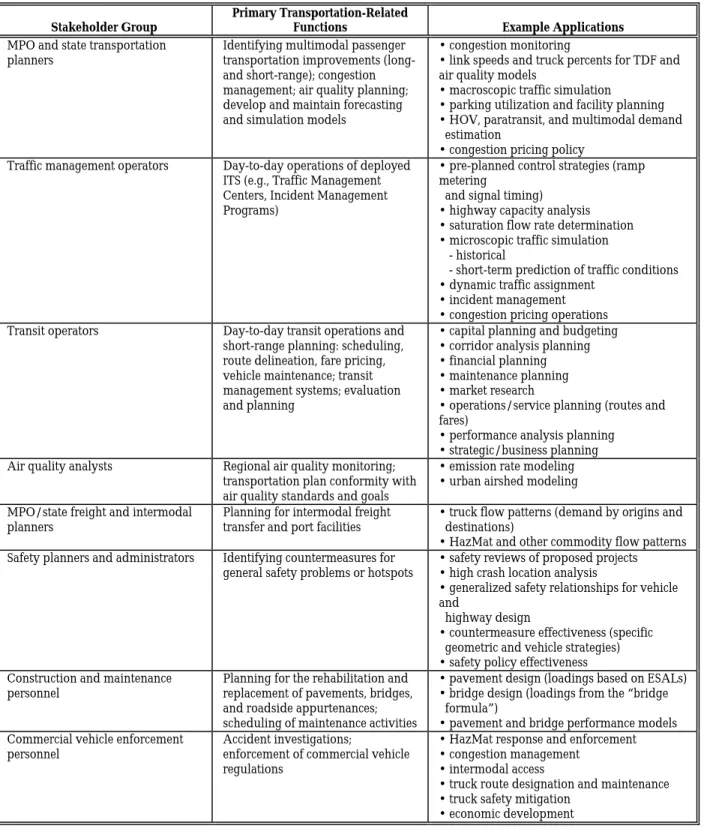
Fourteen stakeholder groups have been identified as having an interest in the use of data generated by ITS. Table 2.1 introduces these stakeholder groups along with their primary functions. It is noteworthy that significant beneficiaries of archived data are Traffic Management and Transit Operators, whose systems collect the data in the first place. In addition to aiding current operations by establishing pre-determined operation plans (e.g., ramp metering rates), use of archived data will allow Traffic Management operators to move to the next level of control strategies: proactive plans that intervene prior to conditions worsening. This next level of control is sometimes referred to as modeling support for traveler information and traffic management, and it is expected to take on greater significance to the transportation profession in the near future.
Likewise, Transit Operators who have implemented electronic fare payment systems or automatic passenger counters to improve efficiency are also able to make use of data for short-range planning activities such as route and schedule delineation.
Uses and Benefits of Archived ITS Data
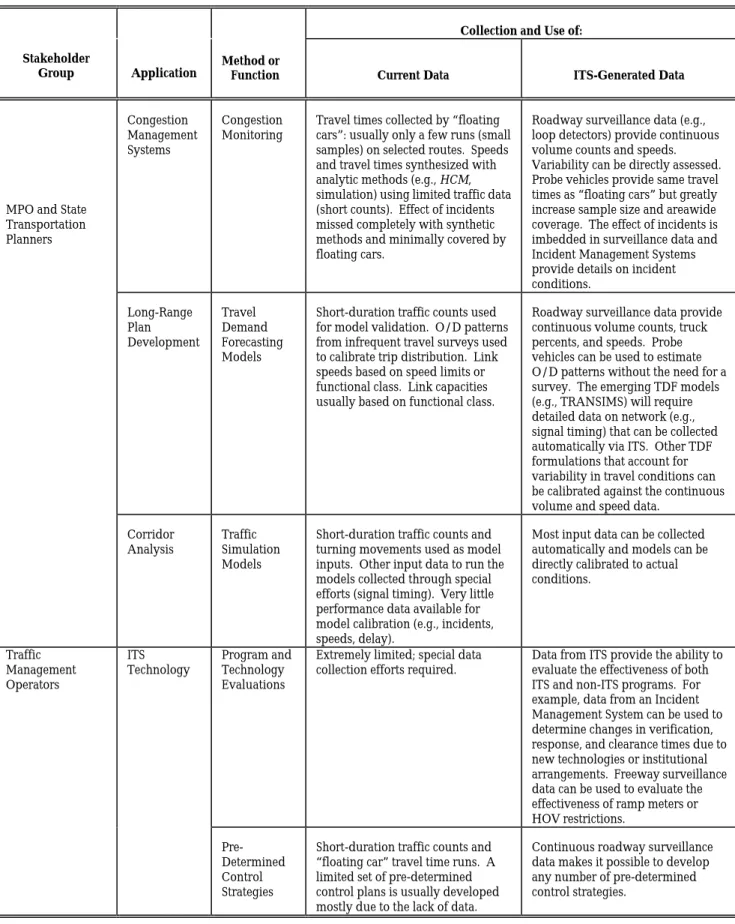
Table 2.2 displays some possible ways in which archived ITS data can be used in stakeholders’ applications. Archived ITS data can not only replace or supplement “traditional” data sources but, because of their high level of temporal and spatial detail, also allow new forms of analysis to develop. Because traditional data collection activities are expensive to undertake, they are typically based on taking samples; examples include: short-term (48-hour) traffic counts; household travel activity surveys; transit ridership counts; and commodity flow surveys. ITS-generated data are continuously collected, or nearly so, thus greatly reducing sampling bias. Also because of their continuous nature, variability in system performance and response can be studied. Finally, much ITS-generated data are available for very small time intervals, allowing for greater resolution in analyses and models.
2.2
The Current State of the Practice in ITS Data Archiving
That archived ITS-generated data is of great value is apparent in the number of transportation agencies that have already developed archival systems independent of US DOT guidance. Some agencies have been archiving ITS data for many years while others are just getting started. A thorough coverage of existing applications for traffic information can be found in Turner’s report (Turner, 1999); key findings of that study are summarized below.
Locations Now Archiving ITS Traffic Data or Developing Archival Systems
• Phoenix, Arizona – loop detector data1 from freeways and arterials are archived; plans
underway to archive all “relevant” data used by the Traffic Operations Center.
• Los Angeles, California – developing an archival system for freeway loop detector data. • Orange County, California – developing an archival system for arterial loop detector
data.
• Chicago, Illinois – loop detector data from selected freeways are archived. • Montgomery County, Maryland – loop detector data from selected arterials are
archived.
• Detroit, Michigan – loop detector data from freeways are archived.
• Minneapolis-St.Paul, Minnesota -- loop detector data from freeways are archived. • TRANSCOM, New York/New Jersey/Connecticut – travel times derived from
AVI-equipped vehicles are archived.
• Houston, TX -- travel times derived from AVI-equipped vehicles are archived. • San Antonio, TX – loop detector data from freeways, travel times derived from
AVI-equipped vehicles, and incident management data are archived. • Seattle, WA – loop detector data from freeways are archived
• State of Virginia – currently developing an archival system for ITS-generated data.
Existing Applications Using Archived ITS Traffic Data
• Freeway Performance Evaluation in Puget Sound Region, Washington. Loop detector data have been used to monitor congestion patterns, including variability in speeds and travel times.
• Evaluation of HOV Lanes in Houston, Texas. Probe vehicle data were used to compare travel times for HOV and non-HOV lanes.
• Traffic Statistics in Chicago, Illinois. Loop detector data has been used to produce an “atlas” of traffic statistics.
• Traffic Statistics and Congestion Monitoring, Montgomery County, Maryland. Arterial loop detector used to develop traffic statistics.
• Ramp Metering Evaluation, Minneapolis-St. Paul, Minnesota. Freeway and ramp loop detector data used to evaluate cycle lengths on ramps.
• Development of Travel Time Prediction Models, Texas. Data from probe vehicles being used to develop short-term travel time prediction models for traffic operations.
Common Themes and Recurring Issues in Current Archiving Activities
• Traffic surveillance data are the primary type of data being archived. Since the study focused on traffic management centers this result is not surprising. However, many transit systems that have instituted electronic fare payment and automatic vehicle location systems also routinely archive these data (including ridership counts by route segment and time of day, and station origin-destination patterns).
• Many existing traffic management centers are either currently archiving or plan to archive traffic surveillance data. However, archiving is often done on an informal basis with no storage guidelines and limited access capabilities. In some of these areas, where data are stored but are relatively inaccessible, data users have developed the tools required to access the data.
• Researchers and Planners have been the primary users of archived ITS traffic data to date. Transit planners, for instance, can use Automatic Passenger Counters (APC) to track where and when passengers come onto and exit the transit system. APC linked with Automatic Vehicle Location Systems can reduce the amount of person hours required to collect and properly display this information. There may be many other potential users of the data that have yet to be active users of archived ITS data such as safety analyzers.
•
Data quality and location referencing are the two most common problems encountered by archived ITS data users. There is no clear consensus on to what level the data should be aggregated.2.3
Issues Surrounding the Implementation of Archived Data Systems
Development of the ITS Data Archiving Program Plan is driven by the identifying the issues and developing strategies to address them. Several issues have been identified that must be addressed to achieve sucessful implementation of archived data systems in practice.
Technical Issues
1. Guidance on System Design. The National ITS Architecture presents several conceptual alternatives for archived data system design. Which designs are the most appropriate for different situations and user needs? What is the best way to implement the design concepts in practice?
2. Regional ITS Architectures. How can ADUS design principles be incorporated into the development of regional architectures?
3. Retrofitting Existing ITS Deployments. Much ITS has already been deployed with wither no or highly informal archiving functions. Can these systems be retrofitted to include formal archiving?
4. System Procurement and Implementation Process. What is the best way of influencing the purchasing and designing of archived data systems? How can ADUS features be incorporated into ITS RFP requirements and design documents?
5. Data Quality. What procedures and standards could be used to perform quality control? How are erroneous data detected? How should missing and erroneous data be handled (interpolated, based on historical patterns, not changed)? If nonoperations stakeholders identify data problems related to equipment, who is responsible for field equipment maintenance and calibration?
6. Data Standards. How can ITS data definitions be reconciled with “traditional” data counterparts? What metadata are required and who is responsible for collecting or assigning metadata? (Metadata is defined as information about data being collected.) How can conflicting geo-referencing systems be resolved?
7. Data Management. What ITS-generated data should be archived? Should data be sampled or aggregated before permanent storage or should all data be retained (data reduction cycles)? Should descriptive statistics be developed whenever data are aggregated to capture variability (e.g., standard deviation, percentiles of distribution)? What are alternative structures for online and offline data storage (archiving-on- demand, data “broadcasts”)?
8. Data Analysis. What analysis techniques are best suited to analyzing archived ITS data? What new types of analyses will ITS-generated data allow stakeholders to conduct? 9. Integration of ITS Equipment with Non-ITS Data Collection Systems. How can
nonoperations stakeholders take advantage of existing ITS equipment to achieve additional data coverage (e.g., probe readers for toll-tagged vehicles, video image processing of CCTV, O/D data from in-vehicle or personal devices)
10. Integration with Existing Transportation Information Systems. To what degree should an ITS data archive be directly or indirectly integrated into other transportation
information systems? Will local archives be stand-alone systems or will they be linked? What methods are available to provide linkages with “traditional” state and local
systems?
11. Data Reporting. How can the reporting of Federally-required data be automated? What will Federal agencies accept in terms of automatically-reported data (amount, structure, quality)?
Institutional and Organizational Issues
1. Stakeholder Involvement in the ITS Planning and Deployment Process. How can stakeholders/secondary users be involved in the early stages of project development (e.g., development of system requirements)?
2. Degree of Private Sector Involvement. Is it feasible to expect the emergence of ISPs for archived data (i.e., is there enough of a market to make entry profitable)? Can the archival function be part of an overall agreement with an ISP whose primary market is real-time data? Can ISP-collected data be incorporated into a public use archive? Are public agencies willing to buy data from ISPs?
3. System Access and Ownership. Should different stakeholders have different access restrictions? Who owns the information? Who maintains and cleans it? What rights transfer with data use/purchase?
4. Privacy of Individuals and Firms. What is the best way of preserving privacy while maintaining the ability for certain stakeholders to identify individuals or firms in the data?
5. Liability. Is there a possibility that archived ITS data may be used against
transportation agencies in either litigation or other adversarial efforts? If so, how can liability be managed?
6. Cost-Sharing Among Agencies. What share of funding are non-operation
stakeholders likely to provide? Are there ways to offset costs (e.g., selling data or products, in-kind services)?
Outreach/Awareness and Evaluation Issues
1. Basic Awareness of Stakeholders Regarding Intelligent Transportation Systems and Their Data. How do ITS-generated data track to traditional forms of data? How are the data collected? What standards exist for their communication and storage (e.g., ITS data dictionaries)?
2. Demonstration of Benefitsto Stakeholders. How do archived ITS data improve existing forms of analyses? Are archived ITS data more applicable to short-range activities (TIP development, transit/highway performance monitoring) than to long-range activities (20 year travel forecasts)? Can an ITS data archive reduce data collection costs and/or supplement existing data collection programs? Can archived ITS data improve the efficiency of mandatory data reporting (e.g., HPMS, NTD) and increase the accuracy of data that reside in these systems? Can archived ITS data be the basis for new forms of analyses (e.g., system reliability, performance measures) and how can they support the next generation of models (e.g., TRANSIMS, modal emissions models)?
3. Demonstration of Benefits to ITS Implementers. What incentives are there to
develop systems that primarily benefit other (nonoperation) interests? What are the benefits for operations planning?
4. Demonstration of benefits to Senior Transportation Agency Management. Is it worth the extra effort, in terms of increased customer satisfaction, to encourage ITS data archival systems? Can requiring cooperation among various units and agencies on archiving ITS data foster communications in general (i.e., are there spin-off benefits in addition to providing data for general use)?
5.
System Development, Operation, and Maintenance Costs. Identification anddocumentation of initial capital outlay and recurring costs is an activity that remains to be done as there are so few actual precedents. How much will data archiving systems cost?
6.
Funding Opportunities. Will USDOT allow flexible funding opportunities for building and operating an archive and will a targeted funding program be developed in the early stages of the ADUS life-cycle? Will future Federally-sponsored ITS deployments be required to implement ADUS features?2.4
Summary
A review of the state of the practice demonstrated the limited use of archiving of ITS
information and exchange of data between agencies. This section also identified a list of issues that must be addressed to further the development and widespread adoption of ITS data archiving practices. Section 3 describes the program vision and 5-year activities to address these issues and further the ADUS concept.
Table 2-1 Stakeholders for Archived ITS Data
Stakeholder Group Primary Transportation-Related Functions Example Applications
MPO and state transportation
planners Identifying multimodal passenger transportation improvements (long-
and short-range); congestion management; air quality planning; develop and maintain forecasting and simulation models
• congestion monitoring
• link speeds and truck percents for TDF and air quality models
• macroscopic traffic simulation
• parking utilization and facility planning • HOV, paratransit, and multimodal demand estimation
• congestion pricing policy
Traffic management operators Day-to-day operations of deployed
ITS (e.g., Traffic Management Centers, Incident Management Programs)
• pre-planned control strategies (ramp metering
and signal timing) • highway capacity analysis • saturation flow rate determination • microscopic traffic simulation
- historical
- short-term prediction of traffic conditions • dynamic traffic assignment
• incident management • congestion pricing operations
Transit operators Day-to-day transit operations and
short-range planning: scheduling, route delineation, fare pricing, vehicle maintenance; transit management systems; evaluation and planning
• capital planning and budgeting • corridor analysis planning • financial planning • maintenance planning • market research
• operations/service planning (routes and fares)
• performance analysis planning • strategic/business planning
Air quality analysts Regional air quality monitoring;
transportation plan conformity with air quality standards and goals
• emission rate modeling • urban airshed modeling MPO/state freight and intermodal
planners Planning for intermodal freight transfer and port facilities • truck flow patterns (demand by origins and destinations)
• HazMat and other commodity flow patterns
Safety planners and administrators Identifying countermeasures for
general safety problems or hotspots • safety reviews of proposed projects • high crash location analysis
• generalized safety relationships for vehicle and
highway design
• countermeasure effectiveness (specific geometric and vehicle strategies) • safety policy effectiveness Construction and maintenance
personnel Planning for the rehabilitation and replacement of pavements, bridges,
and roadside appurtenances; scheduling of maintenance activities
• pavement design (loadings based on ESALs) • bridge design (loadings from the “bridge formula”)
• pavement and bridge performance models Commercial vehicle enforcement
personnel Accident investigations; enforcement of commercial vehicle
regulations
• HazMat response and enforcement • congestion management
• intermodal access
• truck route designation and maintenance • truck safety mitigation
Stakeholder Group
Primary Transportation-Related
Functions Example Applications
Emergency management services personnel (local police, fire, and emergency medical)
Response to transportation
incidents; accident investigations • labor and patrol planning • route planning for emergency response
• emergency response time planning • crash data collection
Transportation system monitoring
personnel Data collection related to system conditions and performance Provide data for other stakeholders: • Traffic counts and travel times for
planners (AADT, K- and D-factor estimation; temporal distributions)
• Truck weights for maintenance personnel
• Performance metrics for administrators
Land use regulation and growth
management planners Development and monitoring of ordinances related to land
development
• Zoning regulations
• Comprehensive plan development
• Impact fees
• Taxation policies
Transportation researchers Development of forecasting and
simulation models and other analytic methods; improvements in data collection practices
• car-following and traffic flow theory development
• urban travel activity analysis
Private sector users Provision of traffic condition data and route guidance (Information Service Providers);
commercial trip planning to avoid congestion (carriers)
Federal government Maintain National databases related
to traffic operations, safety, transit, freight/CVO, etc.
§ HPMS
§ FARS
Table 2-2 Example Stakeholder Applications Supported by Archived ITS Data
Collection and Use of: Stakeholder
Group Application Method or Function Current Data ITS-Generated Data
MPO and State Transportation Planners Congestion Management Systems Congestion
Monitoring Travel times collected by “floating cars”: usually only a few runs (small
samples) on selected routes. Speeds and travel times synthesized with
analytic methods (e.g., HCM,
simulation) using limited traffic data (short counts). Effect of incidents missed completely with synthetic methods and minimally covered by floating cars.
Roadway surveillance data (e.g., loop detectors) provide continuous volume counts and speeds. Variability can be directly assessed. Probe vehicles provide same travel times as “floating cars” but greatly increase sample size and areawide coverage. The effect of incidents is imbedded in surveillance data and Incident Management Systems provide details on incident conditions. Long-Range Plan Development Travel Demand Forecasting Models
Short-duration traffic counts used for model validation. O/D patterns from infrequent travel surveys used to calibrate trip distribution. Link speeds based on speed limits or functional class. Link capacities usually based on functional class.
Roadway surveillance data provide continuous volume counts, truck percents, and speeds. Probe vehicles can be used to estimate O/D patterns without the need for a survey. The emerging TDF models (e.g., TRANSIMS) will require detailed data on network (e.g., signal timing) that can be collected automatically via ITS. Other TDF formulations that account for variability in travel conditions can be calibrated against the continuous volume and speed data.
Corridor
Analysis Traffic Simulation
Models
Short-duration traffic counts and turning movements used as model inputs. Other input data to run the models collected through special efforts (signal timing). Very little performance data available for model calibration (e.g., incidents, speeds, delay).
Most input data can be collected automatically and models can be directly calibrated to actual conditions.
Traffic Management Operators
ITS
Technology Program and Technology
Evaluations
Extremely limited; special data
collection efforts required. Data from ITS provide the ability to evaluate the effectiveness of both
ITS and non-ITS programs. For example, data from an Incident Management System can be used to determine changes in verification, response, and clearance times due to new technologies or institutional arrangements. Freeway surveillance data can be used to evaluate the effectiveness of ramp meters or HOV restrictions.
Pre-Determined Control Strategies
Short-duration traffic counts and “floating car” travel time runs. A limited set of pre-determined control plans is usually developed mostly due to the lack of data.
Continuous roadway surveillance data makes it possible to develop any number of pre-determined control strategies.
Collection and Use of: Stakeholder
Group Application
Method or
Function Current Data ITS-Generated Data
Traffic Management Operators (cont.) ITS Technology (cont.) Predictive Traffic Flow Algorithms
Extremely limited. Analysis of historical data form the
basis of predictive algorithms: "What will traffic conditions be in the next 15 minutes?" (Bayesian approach).
Transit Operators Operations
Planning Routing and Scheduling Manual travel demand and ridership surveys; special studies. Electronic Fare Payment System and Automatic Passenger Counters
allow continuous boardings to be collected. Computer-aided dispatch systems allow O/D patterns to be tracked. AVI on buses allows monitoring of schedule adherence and permits the accurate setting of schedules without field review. Air Quality
Analysts Conformity
Deter-minations
Analysis with the MOBILE Model
Areawide speed data taken from TDFs. VMT and vehicle classifications derived from short counts.
Roadway surveillance provides actual speeds, volumes, and truck mix by time of day. Modal emission models will require these data in even greater detail and ITS is the only practical source.
MPO/State Freight and Intermodal Planners Port and Intermodal Facilities Planning Freight Demand Models
Data collected through rare special surveys or implied from national data (e.g., Commodity Flow Survey).
Electronic credentialing and AVI allows tracking of truck travel patterns, sometimes including cargo. Improved tracking of congestion through the use of roadway surveillance data leads to improved assessments of intermodal access. Safety Planners and Administrators Safety Management Systems Areawide Safety Monitoring; Studies of Highway and Vehicle Safety Relationships
Exposure (typically VMT) derived from short-duration traffic and vehicle classification counts; traffic conditions under which crashes occurred must be inferred. Police investigations, the basis for most crash data sets, performed manually.
Roadway surveillance data provide continuous volume counts, truck percents, and speeds, leading to improved exposure estimation and measurement of the actual traffic conditions for crash studies. Incident management can identify unreported crashes. ITS
technologies also offer the possibility of automating field collection of crash data by police officers (e.g., GPS for location). Maintenance
Personnel Pavement and Bridge
Management
Historical and Forecasted Loadings
Volumes, vehicle classifications, and vehicle weights derived from short-duration counts (limited number of continuously operating sites).
Roadway surveillance data provide continuous volume counts, vehicle classifications, and vehicle weights, making more accurate loading data and growth forecasts available.
Collection and Use of: Stakeholder
Group Application
Method or
Function Current Data ITS-Generated Data
Emergency Management Services (local police, fire, and emergency medical)
Incident
Management Emergency Response Extremely limited. Electronic credentialing and AVI allows tracking of truck flows and
high incident locations, allowing better deployment of response personnel.
Transportation
Researchers Model Development
Travel Behavior Models
Mostly rely on infrequent and costly surveys: stated preference and some travel diary efforts (revealed preference).
Traveler response to system conditions can be measured through system detectors, probe vehicles, or monitoring in-vehicle and personal device use. Travel diaries can be imbedded in these technologies as well.
Traffic Flow
Models Detailed traffic data for model development must be collected
through special efforts.
Roadway surveillance data provide continuous volume counts, densities, truck percents, and speeds at very small time increments. GPS-instrumented vehicles can provide second-by second performance characteristics for microscopic model development and validation. Private Sector Users Truck Routing and Dispatching Congestion
Monitoring Current information on real-time or near real-time congestion is
extremely limited.
Roadway surveillance data and probe vehicles can identify existing congestion and can be used to show historical patterns of congestion by time-of-day. Incident location and status can be directly relayed. Information
Service Providers
Trip
Planning Information on historical congestion patterns is extremely limited. This
information could be used in developing pre-trip route and mode choices, either alone or in
combination with real-time data. Federal
Government National Transit
Database
Historical
ridership Information is typically collected using staff to collect number of
riders and origin/destination data.
Automatic Passenger Counting equipment along with AVL equipment buses can be used to collect these data more efficiently.
3 ADUS Vision and Program Description
As stated, the Archived Data User Service was formally incorporated into the National ITS Architecture in September 1999. ADUS, in the Architecture, identifies the sources of ITS data, logical data flows from the sources to the archives, functions required for archiving, different market packages and ways to implement ADUS, potential users and issues. Thus, while it marks the end of a major work effort it also marks the beginning of implementing ADUS
throughout the country. This section describes the development of the Federal ADUS Five-Year Program (2000-2004) to support the implementation of ADUS.
3.1
Program Development Approach
The development of the ADUS Five-Year Program began in August, 1999. It is being carried out in two phases: Phase I focused on the conceptual elements of the program and included: gathering input from stakeholders and other programs; refinement of the issues; development of the ADUS vision which is based on the needs and desires of all stakeholders; and definition of the Federal Program Goals, Objectives, and Focus Areas to further the vision. An ADUS Stakeholder Workshop was held in October 1999 to allow for feedback from the stakeholder community on Phase I activities and suggestions for the next phase. Phase II of the program development effort defines the specific Federal program activities around the concepts and program framework developed in Phase I. Phase II is expected be completed in early 2000; however, further development and refinement of the program is an on-going activity .
Two outputs of the development process will be provided. The first is the Program Description (this document) which provides the background, justification, and specifics of the overall program. The second is the ADUS Five-Year Program Roadmap which provides a graphical representation of the program. The roadmap is particularly useful in showing how the program elements are connected and how the program develops over time.
To determine the direction that ADUS will take over the long term, it was necessary to
understand the concerns and needs of the providers and users of archived ITS generated data. A review of early stakeholder meeting findings was conducted along with a brief review of the state of the practice. In addition, interviews were conducted within USDOT and with non-Federal stakeholders to discuss the following items:
• interviewees’ vision of ADUS • long term goals for ADUS • near term objectives
• suggested motivation to increase ADUS use • suggested methods to achieve program goals
the turn around time for data submission, reduce the cost of data collection and allow USDOT to react more quickly and efficiently to problems detected in the roadway system.
Using the information gathered in the review and interview process, a draft vision for ADUS and a draft set of goals were developed. The draft ADUS Five-Year Program Description was provided to the stakeholder group which participated in the October 21 stakeholder meeting. During the stakeholder meeting, breakout sessions were held in which the participants were asked to review the draft ADUS vision and goals and provide suggestions to ensure that the needs of the stakeholder community was represented. In addition, the participants were asked to develop a comprehensive list of issues and potential strategies that could be used to
overcome these issues related to implementing ITS data archiving systems nationwide. The suggestions and ideas gathered at the stakeholder workshop were used to refine the draft ADUS vision and goals and also used to generate a series of five-year program objectives.
3.2
ADUS Vision
A common ADUS vision statement is needed to represent the needs and desires of the various stakeholder groups including federal, state, local, private, etc. The ADUS vision statement is intended to describe the ultimate archive data and retrieval system for transportation related information that is believed to be achievable in the next 20-25 years. Based on the findings of the interview process and the review of materials generated from stakeholder meetings, the following vision statement has been crafted for ADUS:
Improve transportation decisions through the archiving and sharing of ITS generated data.
In order to achieve this vision, these principles are to be applied:
• Archiving of data is considered and encouraged for all ITS deployments • Data are archived to maximize integration of information with other data
sources/systems
• Data are archived to ease retrieval for those with access • Information provided is integral to the transportation practice
The vision statement characterizes the ultimate archived data management system. This system will allow for archiving of all data generated by ITS sources. In addition, data will be archived, in such a manner, as to allow for easy integration with other ITS and non-ITS data sources. The program plan will foster this vision by addressing issues associated with
• Single source/single user of data • Single source/multiple users of data • Multiple source/single user of data • Multiple source/multiple users of data
By addressing the issues associated with the simplest system through the most complex throughout the development stage of ADUS, program activities will be consistent with the vision of ADUS.
3.3 Program Description
While the vision statement for ADUS is a common vision among all stakeholder groups, the Program Plan for ADUS is a set of activities to be undertaken by USDOT to propel the use of archived data in the transportation industry. This section presents the ADUS Program goals, objectives, activities, and outcomes that have been developed.
3.3.1 ADUS Federal Goals
Building on the vision of ADUS, a series of program goals have been developed that focus on the steps necessary to achieve the vision of ADUS. These goals are to:
• Increase awareness of and professional capacity to implement ADUS • Advance and expand the application of the state of the practice of ADUS • Understand impacts (benefits/costs) of ADUS
• Resolve technical ADUS issues
• Resolve institutional/organizational ADUS issues • Advance and develop the state of the art of ADUS
• Promote use of archived data in making better transportation decisions • Promote use of archived data in streamlining federal reporting systems and
performance monitoring
These goals address the technical and institutional/organizational issues associated with implementing a successful archived data management system. In addition, the issues
associated with expanding the use of archived data management systems in transportation are captured in these draft goals. Achieving the vision of a fully integrated archived data
management system is captured in the ideas of propelling the state of the art and maximizing the use of archived information. Finally, understanding the achievable benefits and associated costs of an archived data management system is a goal of the ADUS program.
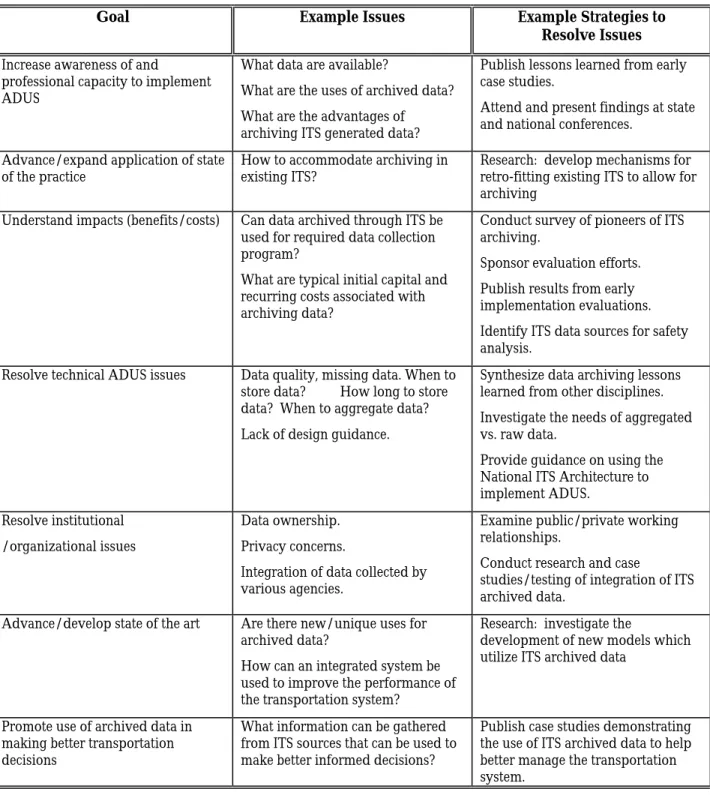
The goals identified can be related to the issues presented in Section 2 of this document. Along with these issues, possible strategies for solving these issues have been identified, as shown in Table 3.1.
Due to the diverse stakeholders, needs, and applications the use of “focus areas” with the ADUS program may be helpful in ensuring that unique perspectives, needs and issues are addressed. Many of the goals, issues, and strategies of Table 3.1 will be common to all ADUS applications. However, there are also instances where the ADUS implementation, stakeholders, and/or issues will be so different that they are not addressed under the general analysis. For example, research and recommendations carried out for large technology rich urban areas may not be applicable for small cities where there is only one traffic engineer, the MPO may have only one employee, or the resources are limited in many other ways. Possible dimensions along
• Environment and ADUS/Implementation (Large Urban, Small Urban, Rural/Statewide…)
• Stakeholder Users (Safety Community, CVO, Transit, Transportation Planning and Programming…)
• ITS Sources (Traffic Management Centers, Transit Management Centers, Incident Management…).
Table 3-1 Examples of Potential Strategies for Addressing ADUS Issues and Goals
Goal Example Issues Example Strategies to
Resolve Issues
Increase awareness of and
professional capacity to implement ADUS
What data are available?
What are the uses of archived data? What are the advantages of archiving ITS generated data?
Publish lessons learned from early case studies.
Attend and present findings at state and national conferences.
Advance/expand application of state
of the practice How to accommodate archiving in existing ITS? Research: develop mechanisms for retro-fitting existing ITS to allow for
archiving Understand impacts (benefits/costs) Can data archived through ITS be
used for required data collection program?
What are typical initial capital and recurring costs associated with archiving data?
Conduct survey of pioneers of ITS archiving.
Sponsor evaluation efforts. Publish results from early implementation evaluations. Identify ITS data sources for safety analysis.
Resolve technical ADUS issues Data quality, missing data. When to
store data? How long to store data? When to aggregate data? Lack of design guidance.
Synthesize data archiving lessons learned from other disciplines. Investigate the needs of aggregated vs. raw data.
Provide guidance on using the National ITS Architecture to implement ADUS.
Resolve institutional /organizational issues
Data ownership. Privacy concerns.
Integration of data collected by various agencies.
Examine public/private working relationships.
Conduct research and case
studies/testing of integration of ITS archived data.
Advance/develop state of the art Are there new/unique uses for
archived data?
How can an integrated system be used to improve the performance of the transportation system?
Research: investigate the
development of new models which utilize ITS archived data
Promote use of archived data in making better transportation decisions
What information can be gathered from ITS sources that can be used to make better informed decisions?
Publish case studies demonstrating the use of ITS archived data to help better manage the transportation
Any area where the stakeholders, concerns and implementation issues are sufficiently different as to warrant attention may be a candidate focus area. A focus area may also become the lead for an issue that is common to all applications but of particular importance to its stakeholders and/or central to its implementation. For example, privacy issues may be addressed
specifically in the CVO area and the recommendations/findings transferred to other areas. As the program advances and the ADUS implementations are connected/integrated, it is
anticipated that some of the short-term focus areas may also be merged.
The participants of the stakeholder workshop in October 1999 did not identify any particular focus areas along which the ADUS program should be developed; however, many stakeholders did stress that it may be too early in the program development to fully understand special needs of various user communities. Therefore, it has been determined that initially the ADUS program will be developed without focus areas but with the ability to accommodate focus areas if a need is identified at a later date. In order to determine the necessity of focus areas, six specialty areas have been chosen and included in the state of the practice review. The state of the practice review will be used to determine if the development of parallel research tracks is warranted in the future.
3.3.2 5-Year Program Objectives
Five-year program objectives have been developed based on comments received at the
stakeholder workshop in October 1999 and also from USDOT representatives. These five-year program objectives capture the essence of the Federal program goals while focusing on
achievable activities within the first five years of the program. These objectives are:
• Plan and implement one or more integrated systems that combine information from multiple ITS data sources
• Provide case studies to illustrate implementation issues, costs, quantitative benefits and uses for better decision making
• Quantify costs of various market packages and components necessary to build, operate, and maintain archive data systems (i.e., data marts, data warehouses, virtual
warehouse)
• Develop and provide multi-faceted ADUS awareness program • Conduct research and issue guidance on:
o Single stream data management (illustrate how to address technical issues) o Data integration across different ITS sources and organizations (illustrate how
technical and institutional issues can be overcome)
These five-year program objectives reflect the major activities to be accomplished within the first five years of the ADUS program in addressing program goals. To be able to measure the progression of the federal ADUS program, a number of program outcomes have been identified and are described in the following section.
3.3.3 5-Year Program Outcomes
To monitor the overall development growth of the ADUS federal program, a number of indicators of success have been identified. These indicators of success are intended to be achievable in the first five years of the program. If the program progresses as planned, these milestones should be achieved and the proliferation of ADUS programs across the nation should be witnessed. The indicators of a successful program are:
• Sharing of ITS generated data between and within agencies will be common
• Federal reporting system procedures allow for ITS generated data where appropriate • Regional architectures include data archiving functions and concept of operations (100%
of 78 Major Metro Areas)
• ITS projects consider and include data archiving
o All ITS projects that receive Federal funding consider archiving data o 50% of ITS-funded projects involve archiving
o 25 of 78 Major Metro areas actively archive
If the activities and projects identified in the federal program are successfully completed, within five years, data collected using ITS technologies should be provided by some instrumented regions to federal reporting systems. The inclusion of archiving functions and concepts of operations into regional architectures should be nearly automatic at the end of five years. Finally, due to the acceptance of ITS generated data into federal reporting systems and the inclusion of archiving functions into regional architectures, there will be an increase in the number of federally funded projects that include archiving of ITS generated data.
3.3.4 Program Activities
A series of program activities have been developed that will lead to the achievement of the five-year program objectives. The individual activities have been classified into one of three waves of activities. The waves range in time required for completion but it should be noted that the activities in the early waves, in many cases, feed activities in later waves. In general, the first wave of the program is intended to assess the state of the practice regarding the technical issues related to implementing ADUS. The second wave builds on the first wave of activities and focuses on resolving technical and institutional issues. The final wave focuses on integration of data sources, evaluating the costs associated with building an ADUS system and publishing deployment results. In addition, the program contains activities that will monitor the
deployment of ITS projects nationwide in order to streamline evaluation efforts. A complete list of program activities, along with a brief description and estimated time to completion, are included in Appendix A for the reader’s use. In addition, a visual interpretation of the program activities and their interaction, the ADUS Program Roadmap, is included in Appendix A.
4 References
Margiotta, Richard, ITS as a Data Resource: Preliminary Requirements for a User Service. Report FHWA-PL-98-031. Federal Highway Administration, Washington, DC, April 1998.
Turner, S.M., Eisele, W.L., Gajewski, B.J., Albert, L.P., and Benz, R.J., ITS Data Archiving: Case Study Analyses of San Antonio TransGuide® Data. Report No. FHWA-PL-99-024. Federal Highway Administration, Texas Transportation Institute, College Station, Texas, August 1999.
Appendix A
ADUS Roadmap and Program Element Descriptions
TECHNICAL ISSUES
Archived Data User Service Program (1999 - 2004)
INSTITUTIAL/
ISSUES
INTEGRATED SYSTEMS INTEGRATION Awareness &
Deployment Results & Best Practices
Benefits and Costs & New Uses of ADUS Data
Draft ADUS Standards
Integrated Archive Guidance and Awareness/Outreach
Program definition
Needs Analysis, Assess State-of-Practice
Technical & Institutional Issues Identification Program Awareness & Standards Coordination
STANDARDS/ ARCHITECTURE
Research Technical and Institutional Issues
Initiate Integrated Archive Pilots/Field Ops Tests
Meta
-Data and Other ADUS Specific Standards Efforts
Provide Training, and Issue Initial Guidance Documents
ADUS Added To Architecture Rural/ Statewide Freight
Safety Examine Federal Reporting Systems for ADUS Potential
Technical Synthesis Studies
Data Quality/Repair, Data Aggregation, Data Storage...
Research
Self Describing
Datasets
Meta
-Data, XML
Institutional Issues Synthesis Studies Ownership, Privacy, Integrity/liability
ADUS Awareness Federal Field Offices
ADUS Program Input & Development/Outreach
TRB 2000, ITE, ITSA Development ADUS Training
Architecture, Technical and Institutional
Provide ADUS Training
Management, Operations, Advanced Applications
Quantify Costs of ADUS Imp.
Market Packages Storage Technologies
Pilots/ Field Operational Tests For Integrated Archiving Systems
Federal Reporting Systems Changes to Accept ADUS
Inputs
Guidance Single Source
Data Management
Guidance Integrated Databases
Multiple Sources
Guidance
Benefits/Costs of ADUS
Case Studies
Federal Reporting Systems
TEST Cases on
Use Of ADUS Inputs
Federal Reporting Systems
Policy / Regulation
Modification
Research
Benefits/Impacts of ADUS Implementations
Research
Emergent Uses of ADUS Data
FY 2004
FY 1999
I.T.
Knowledge Survey
Transit
Roadway/Traffic State of Practice & Legacy
Sys
. Reviews
Research
Private Sector
ISPs
and ADUS Issues/Hurdles
ADUS Coordination and Input to Standards Activities
State-Of-Practice
Early Implementation Case Studies, Examples
Wave I
Wave II
Wave III
X-Cutting Studies
Innovative uses of ADUS Data
Track ADUS in ITS Earmarks and other Federal $ Projects
Earmark
Eval
. & ADUS “Piggyback” efforts (2-3) Leveraged With Other Projects
ITS Earmark Evaluations & “Piggyback” Efforts & Case Studies (What was learned)
Examine Other
Gov’t
. Reporting
Systems for ADUS Potential
ADUS Awareness & Outreach to Transportation Community
State & Local (AMPO, AASHTO, ITE, NACCO,
etc
. )
Research
ADUS within Enterprise Systems
Research :Data Extraction and Archiving of
Non Textual ITS Info. (
Vidio
, Audio, Remote Sensing)
ADUS Within Regional Arch.
Pilots/Case Studies
ADUS with Traditional Data
Source Comparison
ADUS Standards Development/Support (
Meta
-data)
ADUS Standards To Support
Gov’t
Reporting
Wave I
Wave II
Wave III
Priority Activities Activities Initiated Continued Effort
Emerging ITS
Technology Survey
MPO State of Practice
ADUS Program Elements (1999 – 2004)
Wave 1 Elements
1. Information Technology Knowledge Survey 0.5 Year Project
This project will provide a serious review of emerging Information Technology (IT) methods, software, and hardware with regards to its ADUS applicability. These include: methods for data warehousing, data mining, and data fusion and visualization; new approaches such as On-line Analytical Processing (OLAP) and
multi-dimensional data stores, and data storage technologies such as the use of banks of recordable CD-Roms, Re-Writable CD-Roms, RAIDS, or “flying disk” systems. The goal will be to sort through the confusing array of IT terms and technologies, determine promising items for use in ADUS systems, and the provide a lay person’s primer for transportation professionals, on their potential and use. The project should help professionals determine what types of systems and technologies are appropriate given the attributes of the ADUS system that they may be implementing. This project will also address project management trends in the IT field. This will provide background for the Wave II technical studies and training and guidance efforts.
2. Survey: Emerging ITS Technologies and Data Collection « 1 Year Project
Wireless personal electronic devices and telephonics, changing cell phone standards (grid size), toll tags, universal smart cards, DSRC, and local area wireless (“Blue Tooth”) all are emerging technologies used in ITS that offer new opportunities for data collection and performance monitoring. The potential for these technologies to help provide information previously collected by traditional means (flows, travel times) and/or new information never before available (travel patterns in time and space, system variability) and the issues associated with their use in data collection has not been explored. This project would provide a survey and forecast of emerging ITS technologies (within 5 years), their state of development, and the data collection opportunities that they may provide. New issues associated with the archiving and use of their data (e.g. privacy) would also be noted. The project’s results will be used to help define the technical and institutional issues research, and the Wave II and Wave III ADUS program details. It will also be a key component of the ADUS outreach and awareness efforts, especially as these technologies move from development into widespread deployment.
3. Cross Cutting Studies of Innovative uses of ADUS « 2 Year Project
Many ADUS applications are now ongoing, or in the process of being implemented. Some of these systems for traffic and highway monitoring have been recently reported in “ITS Data Archiving: Case Study Analyses of San Antonio TransGuide Data” by the Texas Transportation Institute (FHWA, 1999). However, the pioneering efforts for archiving and use of ITS data in other areas such as transit and safety have not been systematically examined. This project would seek out existing ADUS efforts in each area focusing on documenting both creative/innovative implementations and subsequent uses of the data. It will both provide input to, and receive information from each of the State-of-Practice and Legacy System Reviews. Its aim is to provide real world examples of existing practices where ADUS can provide benefits today (low hanging fruit) for use in the training and outreach efforts.
4. State of the Practice Review: Roadway/Traffic « 0.5 Year Project
A state of the practice review will be conducted to determine the use of ITS technologies in the roadway/traffic area with a focus on the uses of archived data generated with these technologies. Various systems will be identified that are in use to collect roadway/traffic data including vehicle sensors, image detection systems and the extent to which these data are being archived and used off-line. This project’s findings will be coordinated with the Wave I Cross Cutting Studies and will be used for inputs into the Technical and Institutional Synthesis Studies included in Wave II. Note, that work on the state of the practice for roadway/traffic is already underway or completed. This effort would summarize the research by the Texas Transportation Institute, Oak Ridge National Labs and others: build upon it and establish priorities. **Note, the five State of the Practice Review projects will need to be coordinated and may be combined to improve the output of the studies.
5. State of the Practice Review: Transit « 0.5 Year Project
A state of the practice review will be conducted to determine the use of ITS technologies in transit with a focus on the uses of archived data generated with these technologies. Various systems will be identified that are in use to collect transit related data including passenger measurement equipment, vehicle location devices, vehicle performance monitoring equipment and the extent to which these data are being archived and used off-line. This project’s findings will be coordinated with the Wave I Cross Cutting Studies and will be used for inputs into the Technical and Institutional Synthesis Studies included in Wave II.
6. State of the Practice Review: Safety « 0.5 Year Project
A state of the practice review will be conducted to determine the ITS technologies that may be generating and archiving data which is useful for safety purposes. The various ITS systems such as incident logs, in-vehicle monitoring systems, and traffic condition survellance systems, and their related types and uses of data and analyses, relevant for safety purposes will be identified. The coordination and uses of the ITS systems and data with other safety-related systems and data will also be determined. This project's findings will be used for inputs into the Technical and Institutional Synthesis Studies included in Wave II.
7. State of the Practice Review: Freight/CVO « 0.5 Year Project
A state of the practice review will be conducted to determine the use of ITS technologies in commercial vehicle operations with a focus on the uses of archived data generated with these technologies. Various systems will be identified that are in use to collect CVO related data including weight in motion equipment, vehicle location devices, vehicle performance monitoring and the extent to which these data are being archived and used off-line. This project’s findings will be coordinated with the Wave I Cross Cutting Studies and will be used for inputs into the Technical and Institutional Synthesis Studies included in Wave II.
8. State of the Practice Review: Rural/Statewide « 0.5 Year Project
A state of the practice review will be conducted to determine the use of ITS technologies in rural and statewide areas with a focus on the uses of archived data generated with these technologies. Various systems will be identified that are in use to collect rural/statewide related data including roadway weather information systems, traveler information systems and the extent to which these data are being archived and used off-line. This project’s findings will be coordinated with Wave I Cross Cutting Studies and will be used for inputs into the Technical and Institutional Synthesis Studies included in Wave II.
9. State of the Practice Review: Metropolitan Planning Process « 0.5 Year Project
A state of the practice review will be conducted to determine the use of data generated from ITS sources in the metropolitan planning process. Data used by planners are generated in several areas including traffic, transit and safety. The format and requirements of these data, to be used in the planning process, differ than the format and requirements of the original generators of the data. The necessary adjustments to these data needs to be explored along with emerging uses for new data in the planning process. This projects findings will be
coordinated with the Wave I Cross Cutting Studies and will be used for inputs into the Technical and Institutional Synthesis Studies included in Wave II.
10. Examine Federal Reporting Systems for ADUS Potential « 0.5 Year Project
This project will investigate the possible uses of data collected using ITS systems in the Federal Reporting System. A thorough review of the various Federal Reporting Systems such as the Federal Accident Reporting System (FARS) and the Highway Performance Monitoring System (HPMS), will be conducted to determine where data generated from ITS technologies can be used in place of traditionally collected data. The use of ITS generated data may also reduce the time lag between submission of data and publishing of findings. This project’s findings will be used for inputs into Wave II activities that are focused on making changes to Federal Reporting Systems to accept ADUS inputs.
11. Examine Other Reporting Systems for ADUS Potential 0.5 Year Project
may be collected using ITS technologies quicker and more efficiently than traditional methods. This project’s findings will be used for inputs into Wave II activities that are focused on making changes to reporting systems to accept ADUS inputs.
12. Track ADUS in ITS Earmarks & Other Federally Funded Projects « 4 Year Project
This project will be an on-going task to track the use of ADUS in ITS projects that receive funding through congressional earmarks or federal funds in general. By tracking where ADUS is being implemented,
opportunities for evaluating the impact of archiving data for off-line uses will be identified. Initial assessment of the FY 1999 ITS Earmarks has already been carried out, and the projects that include ADUS components identified. The findings from this effort will feed directly into efforts to begin to evaluate the success of
implementing ADUS around the country (proposed Wave I project). It is also anticipated that findings from this task will be used to target areas where pilots or field operational tests for integrated systems should logically be performed (proposed Wave II project).
13. Earmark Evaluations and ADUS Piggyback Efforts Leveraged with Other Projects 4 Year Project
This project will be an on-going task to track the evaluation of ADUS in ITS projects that receive funding through congressional earmarks or federal funds in general. Using the National Evaluation program to track the
challenges and opportunities provided by ADUS is a logical use of funds. This project will essentially promote the evaluation of ITS projects that include an archiving facet to gain additional information as to technical or institutional areas where additional challenges exist. This project will also feed into the awareness and technical assistance area of the program by providing case study examples as to how to best implement ADUS.
14. ADUS Within Regional Architecture Pilots/Case Studies 2 Year Project
This project will focus on identifying those regions in which a regional architecture is being developed and work with agencies to determine the challenges and opportunities provided by incorporating ADUS into a regional architecture. It is proposed that several regions representing rural, suburban and urban areas be identified and studied to give the user community a better understanding of why archiving of ITS generated data is essential.
15. Development of Program Plan for ADUS Standards 0.5 Year Project
In order for ADUS standards activities to be funded through the ITS Standards Program, an ADUS Standards Program Plan must be developed which further refines the ADUS standards efforts found in this overall program description. The ADUS Standards Program Plan will discuss the general needs for ADUS standards, identify potential areas where standards are warranted, and describe the activities leading ultimately to specific ADUS standards (refinement to specific items/requirements, coordination efforts, development efforts once the refined list is justified). The program plan will also incorporate additional inputs from stakeholders on their needs and priorities, the benefits and costs of specific standards, and lay out the overall standards development budget. The outcome of this project will define the subsequent standards activities shown here (Projects 16, 30, and 40).
16. ADUS Coordination and Input to Standards Activities « (Continuous) Project
There are a number of ongoing standards activities that impact the definitions and collection of ITS data including: NTCIP, TCIP, The ITS Data Registry, Location Reference Measurement Specifications, various data dictionaries (e.g. Traffic Management Data Dictionary), etc. Because these efforts are specifying data structures and definitions they are highly relevant to ADUS, and it would be advantageous if the potential needs of ADUS users were incorporated into their development. This project would provide the support and resources required to ensure that the ADUS concerns were met in various standards activities. Initially this will be a coordination effort primarily providing inputs to other activities. While large-scale development of ADUS standards is premature (see Phase II) this project would also provide support of the initial organizing activities for ADUS standards. Initial activities coordinating with other standards efforts and initiating the ASTM standards subcommittee on ADUS have already begun.