22
DAVID GAY
Intel Research, Berkeley PHILIP LEVIS
Stanford University and
DAVID CULLER
University of California, Berkeley
We present design patterns used by software components in the TinyOS sensor network oper-ating system. They differ significantly from traditional software design patterns because of the constraints of sensor networks and to TinyOS’s focus on static allocation and whole-program com-position. We describe how nesC has evolved to support these design patterns by including a few simple language primitives and optimizations.
Categories and Subject Descriptors: D.2.11 [Software Engineering]: Software Architectures—
Patterns
General Terms: Languages, Design
Additional Key Words and Phrases: Design Patterns, embedded systems, nesC, TinyOS
ACM Reference Format:
Gay, D., Levis, P., and Culler, D. 2007. Software design patterns for TinyOS. ACM Trans. Em-bedd. Comput. Syst. 6, 4, Article 22 (September 2007), 39 pages. DOI=10.1145/1274858.1274860 http://doi.acm.org/ 10.1145/1274858.1274860
1. INTRODUCTION
TinyOS [Hill et al. 2000] is an OS for wireless network embedded systems, with an emphasis on reacting to external events and extremely low-power operation. Rather than a monolithic OS, TinyOS is a set of components that are included as-needed in applications. A significant challenge in TinyOS development is designing and implementing flexible, reusable components. Programming ab-stractions for sensor networks, where TinyOS is the current OS-of-choice, are an area of active research and investigation [Levis et al. 2004]
Authors’ addresses: David Gay, Intel Research, Berkeley, California 94720; Philip Levis, Stanford University, Palo Alto, California 94305; David Culler, University of California, Berkeley, California 94720.
Permission to make digital or hard copies of part or all of this work for personal or classroom use is granted without fee provided that copies are not made or distributed for profit or direct commercial advantage and that copies show this notice on the first page or initial screen of a display along with the full citation. Copyrights for components of this work owned by others than ACM must be honored. Abstracting with credit is permitted. To copy otherwise, to republish, to post on servers, to redistribute to lists, or to use any component of this work in other works requires prior specific permission and/or a fee. Permissions may be requested from Publications Dept., ACM, Inc., 2 Penn Plaza, Suite 701, New York, NY 10121-0701 USA, fax+1 (212) 869-0481, or [email protected].
C
2007 ACM 1539-9087/2007/09-ART22 $5.00 DOI 10.1145/1274858.1274860 http://doi.acm.org/ 10.1145/1274858.1274860
Writing solid, reusable software components is hard. Doing so for sensor networks is even harder. Limited resources (e.g., 4 KB of RAM) and strict en-ergy budgets (e.g., averages below 1 mW) lead developers to write application-specific versions of many services. While specialized software solutions enable developers to build efficient systems, they are inherently at odds with reusable software.
Software design patterns are a well-accepted technique to promote code reuse [Gamma et al. 1995, p.1]:
These patterns solve specific design problems and make object-oriented de-signs more flexible, elegant, and ultimately reusable.
Design patterns identify sets of common and recurring requirements and define a pattern of object interactions that meet these requirements. However, these patterns are not directly applicable to TinyOS programming. Most design patterns focus on the problems faced by large, object-oriented programs; in sen-sor networks the challenges are quite different. These challenges include [Levis et al. 2004, Section 2.1]:
r Robustness: once deployed, a sensor network must run unattended for months or years.
r Low resource usage: sensor network nodes, colloquially known asmotes, in-clude very little RAM, and run off batteries.
r Diverse service implementations: applications should be able to choose be-tween multiple implementations of, e.g., multihop routing.
r Hardware evolution: mote hardware is in constant evolution; applications and most system services must be portable across hardware generations. r Adaptability to application requirements: applications have very different
requirements in terms of lifetime, communication, sensing, etc.
nesC [Gay et al. 2003]—TinyOS’s implementation language—was designed with these challenges in mind; it is a component-based language with an event-based execution model. nesC components have similarities to objects: they en-capsulate state and interact through well-defined interfaces. They also have significant differences: there is no inheritance, no dynamic dispatch, and no dy-namic object allocation—the set of components and their interactions are fixed at compile-time rather than at runtime. This promotes reliability and efficiency, but programmers cannot easily apply idioms or patterns from object-oriented languages, and, when they do, the results are rarely effective.
In this paper, we present a preliminary set of eight design patterns, which show how nesC can be used to build components that address TinyOS’s chal-lenges. These patterns are based on our experiences designing and writing TinyOS components and applications, and on our examination of code written by others. These patterns have driven, and continue to drive, the development of nesC. For instance, theuniqueCountfunction was introduced in nesC version 1.1 to support the ServiceInstance pattern; nesC version 1.2 (recently released) includes generic components, which simplify expression of some of the patterns presented here (see Section 4).
This paper contributes to embedded system programming in three ways. First, these design patterns provide insight on how programming network em-bedded systems is structurally different than traditional software and how these different factors motivate software design. We believe that these patterns have applicability beyond the sensor network space: TinyOS’s requirements are not radically different from those of many other embedded systems. Sec-ond, we explore how a few simple features of the nesC language and compiler, particularly parameterized interfaces, unique identifiers, and inlining, are nec-essary for concise and efficient expression of these patterns. Finally, this paper helps researchers working with TinyOS write effective programs. The youth of TinyOS precludes us from having a corpus of tens of millions of lines of code and decades of experience, as traditional design pattern researchers do: these patterns are an initial attempt to analyze and distill TinyOS programming.
Although prior work has explored object-oriented design patterns for embed-ded and real-time devices [PatternsW1 2001; PatternsW2 2002; PatternsW3 2002; Douglass 2002; Girod et al. 2004], they deal with platforms that have orders of magnitude more resources (e.g., a few mega bytes of RAM), and, cor-respondingly, more traditional programming models, including threads, instan-tiation, and dynamic allocation.
An alternative approach to building reusable services for sensor networks is offered by SNACK [Greenstein et al. 2004], which is composed of a library of configurable components; a SNACK program is a declarative specification of the components a program needs and their connections. SNACK relies on a compiler to figure out which services should be instantiated (compatible components are shared, e.g., two requests for a timer at the same rate), with what parameters and exactly how they should be connected. Effectively, SNACK aims to make it easy to build an application from an existing set of reusable services; our design patterns show ways of building services so that they are more reusable.
Section 2 provides background on the nesC language. Section 3 presents eight TinyOS design patterns, describing their motivation, consequences, and representation in nesC, as well as listing several TinyOS components that use them.1Section 4 discusses the patterns in the light of nesC and TinyOS devel-opment, and Section 5 concludes.
2. BACKGROUND
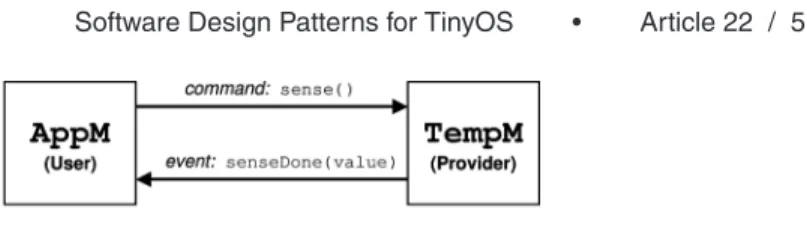
Using a running example of an application component that samples two sensors, we describe the aspects of nesC relevant to the patterns we present in Section 3. nesC [Gay et al. 2003] is a C-based language with two distinguishing fea-tures: a programming model where components interact via interfaces, and an event-based concurrency model with run-to-completion tasks and interrupt handlers. The run-to-completion model precludes blocking calls. Lengthy oper-ations and system services, such as sampling a sensor or sending a packet, are split-phase operations, where a command to start the operation returns imme-diately and a callback event indicates when the operation completes (Figure 2,
1These components can be found in the TinyOS distributions, available from http://www.
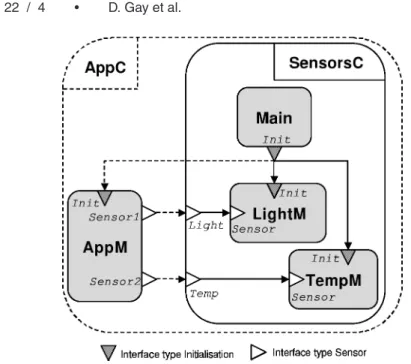
Fig. 1. Sample component assembly. Solid rectangles are modules; open rectangles are configura-tions. Triangles pointing into a rectangle are provided interfaces; triangles pointing out are used interfaces. Dotted lines are “wires” added by configurationAppC; full lines are “wires” added by configurationSensorsC. Component names are in bold.
see later). To promote reliability and analyzability, nesC does not support dy-namic memory allocation or function pointers; all component interactions are specified and known at compile-time.
2.1 Components and Interfaces
nesC programs are assemblies of components, connected (“wired”) via named interfaces that theyprovideoruse. Figure 1 graphically depicts the assembly of six components connected via interfaces of typeSenseandInitialize. Modules are components implemented with C code, while configurations are components implemented by wiring other components together. In the example figure,Main
(a “system boot” component),LightM,TempM, andAppMare modules, whileAppCand
SensorsCare configurations. The example shows that configurationAppC“wires” (i.e., connects)AppM’sSensor1interface toSensorsC’sLightinterface, etc.
Modules and configurations have a name, specification, and implementation: module AppM {
provides interface Initialize as Init; uses interface Sense as Sensor1; uses interface Sense as Sensor2; }
implementation { ... }
declares thatAppM(from Figure 1) is a module that provides an interface named
Fig. 2. Typical split-phase operation.
a type, in this case either Initializeor Sense. A component name denotes a unique, singleton component2: references to Main in different configurations
(see below) all refer to the same component.
An interface type specifies the interaction between a provider component and a user component as a set of named functions:
interface Initialize { // component initialization command void init();
}
interface Sense { // split-phase sensor read command void sense();
event void senseDone(int value); }
This interaction is bidirectional:commandsare invocations from the user to the provider, whileeventsare from the provider to the user. Interface typeSense
represents a typical split-phase operation: providers must implement thesense
command, which represents a request to read a sensor; users must implement thesenseDoneevent, which the provider signals when the sensor read completes. To make the two directions syntactically explicit, nesC events aresignaledwhile commands arecalled. In both cases, the actual interaction is a function call. Figure 2 shows this relationship forAppMandTempM.
As a module,AppMmust provide C implementations of commands in its pro-vided interfaces and of events in its used interfaces. It can call or signal any of its commands or events, andposttasks for later execution:
module AppM { ... } implementation {
int sum = 0;
task void startSensing() { call Sensor1.sense(); }
command void Init.init() { post startSensing(); }
event void Sensor1.senseDone(int val) { sum += val;
call Sensor2.sense(); }
event void Sensor2.senseDone(int val) { sum += val;
} }
As this example shows, a command or event f of an interfaceIis namedI.f and is similar to a C function except for the extra syntactic elements such as
command,eventandcall. Modules encapsulate their state: all of their variables (e.g., sum) are private. The Init.init command posts a task to defer the call toSensor1.senseas the sensor may not yet be initialized (see the discussion of multiple wiring below).
2.2 Configurations
A configuration implements its specification by wiring other components to-gether and equating its own interfaces with interfaces of those components. Two components can interact only if some configuration has wired them to-gether:
configuration SensorsC {
provides interface Sense as Light; provides interface Sense as Temp; }
implementation {
components Main, LightM, TempM; Main.Init -> LightM.Init; Main.Init -> TempM.Init; Light = LightM.Sensor; Temp = TempM.Sensor; }
SensorsC“assembles” componentsLightMandTempMinto a single component pro-viding an interface for each sensor:Tempis equated toTempM’sSensorinterface, andLightwithLightM’sSensorinterface. In addition,SensorsCwiresthe system’s initialization interface (Main.Init) to the initialization interfaces ofLightMand
TempM.
Finally,AppC, the configuration for the whole application, wires moduleAppM
(which uses two sensors) toSensorsC(which provides two sensors), and ensures thatAppMis initialized by wiring it toMain.Init:
configuration AppC { } implementation {
components Main, AppM, SensorsC; Main.Init -> AppM.Init;
AppM.Sensor1 -> SensorsC.Light; AppM.Sensor2 -> SensorsC.Temp; }
In this application, interface Main.Init is multiply wired. AppC connects it to AppM.Init, while SensorsC connects it to LightM.Init and TempM.Init. The call Init.init() in moduleMain compiles to an invocation of all threeinit()
commands,3in some unspecified order. Thus, it is possible that AppM.initwill
be called beforeLightM.init.Hence, the need for the deferred execution of the call toSensor1.senseinAppM.
2.3 Parameterized Interfaces
A parameterized interface is an interface array. For example, this module has a separate instance of interfaceAfor each value ofid:
module Example {
provides interface Initialize as Inits[int id]; uses interface Sense as Sensors[int id];
} ...
In a module, commands and events of parameterized interfaces have an extra argument:
command void Inits.init[int id1]() { call Sensors.sense[id1]();
}
event void Sensors.senseDone[int i](int v) { }
A configuration can wire a single interface by specifying its index: configuration ExampleC {
}
implementation {
components Main, Example; components TempM, LightM; Main.Init -> Example.Inits[42]; Example.Sensors[42] -> TempM.Sensor; Example.Sensors[43] -> LightM.Sensor; }
WhenMain’sInit.initcommand is called,Example’sInits.initcommand will be executed withid = 42. This will causeExampleto callSensor[42].sense, which connects toTempM.sense.
A configuration can wire or equate a parameterized interface to another parameterized interface. This equatesExample.Sensors[i]toADC[i]for all values ofi:
provides interface Sense as ADC[int id]; ...
Example.Sensors = ADC;
3If a multiply wired function has nonvoid result, nesC combines the results via a
2.4 unique and uniqueCount
In many cases, a programmer wants to use a single element of a parameterized interface and does not care which one, as long as no one else uses it. This functionality is supported by nesC’suniqueconstruction:
AppM.Timer1 -> TimerC.Timer[unique("Timer")]; AppM.Timer2 -> TimerC.Timer[unique("Timer")];
All uses ofuniquewith the same argument string (a constant) return different values, from a contiguous sequence starting at 0. It is also often useful to know the number of different values returned byunique(e.g., a service may wish to know how many clients it has). This number is returned by the uniqueCount
construction:
timer_t timers[uniqueCount("Timer")]; 2.5 Static Programming
The nesC language supports embedded programming by providing a compo-nent model, compile-time composition, a concurrency model, and two simple functions, which it resolves at compile time. Individually, each one changes programming methodologies, compiler techniques, and software structure in a small way. Together, however, these features lead to programs that differ greatly from their counterparts written in C or C-like object-oriented languages.
The principal difference is that nesC programs try to push as many de-cisions to compile-time as possible; we refer to this as a static program-ming model. This model has two main features: static call paths and static allocation. A nesC component preserves flexibility by referring to exter-nal functions via interfaces, but configurations bind callers and callees at compile-time, so complete call paths are defined statically. For example, the configuration
AppM.Sensor1 -> SensorsC.Light;
creates two bindings: the commandAppM.Sensor1.sensetoSensorsC.Light. sense
and the eventSensorsC.Light.sendDonetoAppM.Sensor1.senseDone.
C and C-like object-oriented languages that have a global namespace achieve similar binding flexibility through runtime mechanisms. For example, if a C program does not want to explicitly name its callee, it uses function point-ers (e.g., vnodes in the virtual file system [Kleiman 1986]). In C++, Java, and C# the standard technique is to use an interface or class. Static call paths allows the nesC compiler to optimize heavily across call boundaries (see Section 4.3).
The ability to count at compile-time leads to very different allocation strate-gies by allowing variably-sized allocation at compile-time: entities are “allo-cated” withunique, and space is reserved withuniqueCount(Section 2.4). For ex-ample, a program that writes four different logging files can, at compile-time, definitively state that it needs to allocate the state for four file handles. Pro-grammers do not have to guess the system’s resource usage, potentially wasting
space or risking runtime failure. This determinism and efficiency comes by sac-rificing flexibility: a nesC program cannot, e.g., readily implement a file server that can handle an unbounded number of clients and open files. However, such requirements are not typical for sensor networks (and similar embedded pro-gramming tasks): programs are designed for specific applications, with known worst-case resource requirements. The increased reliability and simpler pro-gramming of nesC’s static approach almost always outweigh the costs.
2.6 Summary
The basic unit of TinyOS/nesC programming is a component, which provides and uses interfaces. An application is a set of components whose interfaces have been wired together. Because all TinyOS services are components that follow a static programming paradigm, nesC can optimize call paths across components, eliminate dead code and variables, and provide support for efficient state allocation. This approach provides a great deal of structure to embedded programming and can support good software techniques. However, the resulting programs differ from those of other systems languages. These languages have a large number of accumulated idioms and software design patterns. What their analogs in the nesC programming model look like—flexible, reusable, and efficient components—is an interesting question. The next section provides the beginnings of an answer.
3. DESIGN PATTERNS
We present eight TinyOS design patterns: three behavioral (relating to compo-nent interaction): Dispatcher, Decorator, and Adapter, three structural (relating to how applications are structured): Service Instance, Placeholder, and Facade, and two namespace (management of identifiers such as message types): Keyset and Keymap. These patterns are also presented on our website [Levis and Gay 2004], which we will update as new patterns are discovered and documented. We follow the basic format used inDesign Patterns[Gamma et al. 1995], ab-breviated to fit in a research paper. Each pattern has anIntent, which briefly describes its purpose. A more in-depthMotivationfollows, providing an exam-ple drawn from TinyOS.Applicable Whenprovides a succinct list of conditions for use and a component diagram shows theStructure of how components in the pattern interact.4This diagram follows the same format as Figure 1, with
the addition of a folded subbox for showing source code (a floating folded box represents source code in some other, unnamed, component), and is followed by aParticipantslists, explaining the role of each component.Sample Codeshows an example nesC implementation andKnown Usespoints to some uses of the pattern in TinyOS.Consequencesdescribes how the pattern achieves its goals and notes issues to consider when using it. Finally,Related Patternscompares to other relevant patterns.
3.1 Behavioral: Dispatcher
3.1.1 Intent. Dynamically select between a set of operations based on an identifier. Provides a way to easily extend or modify a system by adding or changing operations.
3.1.2 Motivation. At a high level, sensor network applications execute op-erations in response to environmental input, such as sensor readings or net-work packets. The operation’s details are not important to the component that presents the input. We need to be able to easily extend and modify what inputs an application cares about, as well as the operation associated with an input.
For example, a node can receive many kinds of active messages (packets). Active messages (AM) have an 8-bit type field to distinguish between protocols. A flooding protocol uses one AM type, while an ad-hoc routing protocol uses another.AMStandard, the component that signals the arrival of a packet, should not need to know what processing a protocol performs or whether an appli-cation supports a protocol. AMStandardjust delivers packets, and higher level communication services respond to those they care about.
The traditional approach to this problem is to use function pointers or objects, which are dynamically registered as callbacks. In many cases, even though reg-istered at run time, the set of operations is known at compile time. Thus these callbacks can be replaced by a dispatch table compiled into the executable, with two benefits. First, this allows better cross-function analysis and optimization and, second, it conserves RAM, as no pointers or callback structures need to be stored.
Such a dispatch table could be built for the active message example by using a switch statement in AMStandard. However, this is very inflexible: any change to the protocols used in an application requires a change in a system component.
A better approach in TinyOS is to use the Dispatcher pattern. A Dispatcher invokes operations using a parameterized interface, based on a data identi-fier. In the case of AMStandard, the interface is ReceiveMsg and the identifier is the active message type field. AMStandardis independent of what messages the application handles, or what processing those handlers perform. Adding a new handler requires a single wiring to AMStandard. If an application does not wire a receive handler for a certain type, AMStandard defaults to a null operation.
Another example of a Dispatcher is the scheduler of the Mat´e virtual ma-chine. Each instruction is a separate component that provides theMateBytecode
interface. The scheduler executes a particular bytecode by dispatching to the instruction component using a parameterized MateBytecode interface. The in-struction set can be easily changed by altering the wiring of the scheduler.
3.1.3 Applicable When
r A component needs to support an externally customizable set of operations. r A primitive integer type can identify which operation to perform.
3.1.4 Structure.
3.1.5 Participants
r Dispatcher: invokes its parameterized interface based on an integer type. r Operation: implements the desired functionality and wires it to the
dis-patcher.
3.1.6 Sample Code.
AMStandardis the radio stack component that dispatches received messages: module AMStandard {
// Dispatcher interface for messages
uses interface ReceiveMsg as Recv[uint8_t id]; }
implementation {
TOS_MsgPtr received(TOS_MsgPtr packet) {
return signal Recv.receive[packet->type](packet); }
... }
and theAppconfiguration registersAppMto handle two kinds of messages: configuration App {}
implementation {
components AppM, AMStandard;
AppM.ClearIdMsg -> AMStandard.Receive[AM_CLEARIDMSG]; AppM.SetIdMsg -> AMStandard.Receive[AM_SETIDMSG]; }
3.1.7 Known Uses. The Active Messages networking layer (AMStandard,
AMPromiscuous) uses a dispatcher for packet reception. It also provides a pa-rameterized packet-sending interface; this ensures that packet types for sends and receives are specified in a uniform manner.
The Mat´e virtual machine uses a dispatcher to allow easy customization of instruction sets.
The Drip management protocol (described in Section 3.4) uses a Dispatcher to allow per-application configuration of management attributes.
3.1.8 Consequences. By leaving operation selection to nesC wirings, the dispatcher’s implementation remains independent of what an application sup-ports. However, finding the full set of supported operations can require looking at many files (using nesdoc, the nesC documentation tool, can help). Sloppy operation identifier management can lead to dispatch problems. If two op-erations are wired with the same identifier, then a dispatch will call both, which may lead to resource conflicts, data corruption, or memory leaks from lost pointers. For example, the ReceiveMsginterface uses a buffer swap mech-anism to pass buffers between the radio stack and network services, in which the higher component passes a new buffer in the return value of the event. If two services are wired to a given ReceiveMsg instance, only one of their pointers will be passed and the second will be lost. Wiring in this fashion is a compile-time warning in nesC, but it is still a common bug for novice TinyOS developers.
The current nesC compiler compiles parameterized interface dispatch to a Cswitchstatement. Thus, the code size and efficiency of a dispatcher will de-pend on the identifier space and on the C compiler. Good compilers should compile a compact identifier space to a bounds check, lookup in a table, and jump (slower than a function pointer, but still efficient). Using a large, sparse identifier space is likely to produce relatively large and slow dispatch. A benefit of using a switch statement over, e.g., a function pointer, is that the inlining performed by the nesC compiler (Section 4.3) may allow optimization across a dispatch call and between dispatch targets. The inlining also significantly re-duces the cost of fine-grained dispatching, as seen in the Mat´e virtual machine (Section 4.3.3).
The key aspects of the dispatcher pattern are:
r It allows you to easily extend or modify the functionality an application sup-ports: adding an operation requires a single wiring.
r It allows the elements of functionality to be independently implemented and reused. Because each operation is implemented in a component, it can be easily included in many applications. Keeping implementations separate can also simplify testing, as the components will be smaller, simpler, and easier to pinpoint faults in. The nesC compiler will automatically inline small op-erations, or you can explicitly request inlining; thus this decomposition has no performance cost.
r It requires the individual operations to follow a uniform interface. The dis-patcher is usually not well suited to operations that have a wide range of semantics. As all implementations have to meet the same interface, broad semantics leads to the interface being overly general, pushing error checks from compile-time to runtime. An implementor forgetting a runtime param-eter check can cause a hard to diagnose system failure.
The compile-time binding of the operation simplifies program analysis and puts dispatch tables in the compiled code, saving RAM. Dispatching pro-vides a simple way to develop programs that execute in reaction to their environment.
3.1.9 Related Patterns
r Service Instance: creates many instances of an implementation of an inter-face, while a dispatcher selects between different implementations of an in-terface.
r Placeholder: allows an application to select an implementation at compile-time, while a dispatcher allows it to select an implementation at runtime. r Keyset: the identifiers used to identify a Dispatcher’s operation typically form
a Global Keyset.
3.2 Structural: Service Instance
3.2.1 Intent. Allows multiple users to have separate instances of a particu-lar service, where the instances can collaborate efficiently. The basic mechanism for virtualizing services.
3.2.2 Motivation. Sometimes many components or subsystems need to use a system abstraction, but each user wants a separate instance of that service. We do not know how many users there will be until we build a complete appli-cation. Each instance requires maintaining some state and the service imple-mentation needs to access all of this state to make decisions.
For example, a wide range of TinyOS components need timers for everything from network timeouts to sensor sampling. Each timer appears independent, but they all operate on top of a single hardware clock. An efficient implementa-tion thus requires knowing the state of all of the timers. If the implementaimplementa-tion can easily determine which timer has to fire next, then it can schedule the underlying clock resource to fire as few interrupts as possible to meet this low-est timer’s requirement. Firing fewer interrupts allows the CPU to sleep more, saving energy and increasing lifetime.
The traditional object-oriented approach to this problem is to instantiate an object representing the service and use another class to coordinate state. This approach is not applicable in nesC, as we cannot have multiple copies of components,5and either requires sharing state across objects, which is contrary
to encapsulation, or it requires state copying, which uses additional RAM. Implementing each timer in a separate module leads to duplicated code and requires intermodule coordination in order to figure out how to set the under-lying hardware clock. Just setting it at a fixed rate and maintaining a counter for each Timer is inefficient: timer fidelity requires firing at a high rate, but it wastes energy to fire at 1 kHz if the next timer is in 4 seconds.
The Service Instance pattern provides a solution to these problems. Using this pattern, each user of a service can have its own (virtual) instance, but in-stances share code and can access each other’s state. A component following the Service Instance pattern provides its service in a parameterized interface; each user wires to a unique instance of the interface usingunique. The underlying component receives the unique identity of each client in each command and can use it to index into a state array. The component can determine at compile-time
how many instances exist using the uniqueCountfunction and dimension the state array accordingly.
3.2.3 Applicable When
r A component needs to provide multiple instances of a service, but does not know how many until compile time.
r Each service instance appears to its user to be independent of the others. r The service implementation needs to be able to easily access the state of every
instance.
3.2.4 Structure.
3.2.5 Participants
r ServiceProvider: allocates state for each instance of the service and coor-dinates underlying resources based on all of the instances.
r ResourceImpl: an underlying system resource that ServiceProvider multi-plexes and demultimulti-plexes service instances on.
3.2.6 Sample Code.
TimerCwiresTimerM, which contains the actual timer logic, to an underlying hardware clock and exports itsTimerinterfaces:
configuration TimerC {
provides interface Timer[uint8_t id]; }
implementation {
components TimerM, ClockC; Timer = TimerM.Timer;
TimerM.Clock -> ClockC.Clock; }
andTimerM usesuniqueCountto determine how many timers to allocate and accesses them using unique IDs:
module TimerM {
uses interface Clock; }
implementation { // per-client state
timer_t timers[uniqueCount("Timer")];
command result_t Timer.start[uint8_t clientId](...) { if (timers[clientId].busy)
... } }
Clients wanting a timer wire usingunique: C.Timer -> TimerC.Timer[unique("Timer")];
3.2.7 Known Uses. TimerC, as detailed above, uses a service instance pat-tern to manage various application timers.
The viral code propagation subsystem of the Mat´e virtual machine uses a service instance to manage version metadata for code capsules. As the virtual machine is customizable, the number of needed capsules is not known until the virtual machine is actually compiled.
In a similar vein, the epidemic dissemination protocol Drip uses the service instance pattern to maintain epidemic state for each disseminated value.
3.2.8 Consequences. The key aspects of the Service Instance pattern are: r It allows many components to request independent instances of a common
system service: adding an instance requires a single wiring.
r It controls state allocation, so the amount of RAM used is scaled to exactly the number of instances needed, conserving memory while preventing runtime failures because of many requests exhausting resources.
r It allows a single component to coordinate all of the instances, which enables efficient resource management and coordination.
Because the pattern scales to a variable number of instances, the cost of its operations may scale linearly with the number of users. For example, if setting the underlying clock interrupt rate depends on the timer with the shortest remaining duration, an implementation might determine this by scanning all of the timers, anO(n) operation.
If many users require an instance of a service, but each of those instances are rarely used, then allocating state for each one can be wasteful. The other option is to allocate a smaller amount of state and dynamically allocate it to users as need be. This can conserve RAM, but requires more RAM per real instance (client IDs need to be maintained), imposes a CPU overhead (alloca-tion and dealloca(alloca-tion), can fail at runtime (if there are too many simultaneous users), and assumes a reclamation strategy (misuse of which would lead to leaks). This long list of challenges makes the Service Instance an attractive— and more and more commonly used—way to efficiently support application
requirements. There are situations, however, when a component internally reuses a single service instance for several purposes: for example, the Mat´e code propagation component MVirus uses a single timer instance for several different timers, which never operate concurrently.
3.2.9 Related Patterns
r Dispatcher: a service instance creates many instances of an implementation of an interface, while a dispatcher selects between different implementations of an interface.
r Keyset: a Service Instance’s instance identifiers form a Local Keyset. 3.3 Namespace: Keysets
3.3.1 Intent. Provide namespaces for referring to protocols, structures, or other entities in a program.
3.3.2 Motivation. A typical sensor network program needs namespaces for the various entities it manages, such as protocols, data types, or structure in-stances. Limited resources mean names are usually stored as small integer keys.
For data types representing internal program structures, each instance must have a unique name, but as they are only relevant to a single mote, the names can be chosen freely. Theselocalnamespaces are usually dense, for efficiency. The Service Instance pattern (Section 3.2) uses a local namespace to identify instances. In contrast, communication requires a shared, global namespace: two motes/applications must agree on an element’s name. As a mote may only use a few elements, global namespaces are typically sparse. The Dispatcher pattern (Section 3.1) uses a global namespace to select operations.
The Keyset patterns provide solutions to these problems. Using these pat-terns, programs can refer to elements using identifiers optimized for their par-ticular use. Components using the Keyset patterns often take advantage of a parameterized interface, in which the parameter is an element in a Keyset. Local Keysets are designed for referring to local data structures (e.g., arrays) and are generated withunique; Global Keysets are designed for communication and use global constants.
The bytecodes of the Mat´e virtual machine form a Global Keyset. The Mat´e scheduler uses these in conjunction with a Dispatcher to execute individual instructions, each of which is implemented in a separate component. Mat´e also uses a Local Keyset to identify locks corresponding to resources used by Mat´e programs. These lock identifiers are allocated withuniqueas the Mat´e virtual machine can be compiled with varying sets of resources.
The file descriptors of the Matchbox flash filesystem form a Local Keyset. 3.3.3 Applicable When
r A program must keep track of a set of elements or data types. r The set is known and fixed at compile-time.
3.3.4 Sample Code. The Mat´e bytecodes are defined as global constants: typedef enum { OP_HALT = 0x0, OP_MADD = 0x1, OP_MBA3 = 0x2, OP_MBF3 = 0xa, ... } MateInstruction;
and used by the Mat´e scheduler to execute individual instructions: module MateEngineM {
uses interface MateBytecode[uint8_t bytecode]; ...
}
implementation {
void computeInstruction(MateContext* context) { MateOpcode instr = getOpcode(context);
context->pc += call MateBytecode.byteLength[instr](); call MateBytecode.execute[instr](context);
} ... }
The Mat´e lock subsystem identifies locks by small integers: module MLocks {
provides interface MateLocks as Locks; }
implementation {
MateLock locks[MATE_LOCK_COUNT];
command void Locks.lock(MateContext* uint8_t lockNum) { locks[lockNum].holder = context;
context->heldSet[lockNum / 8] |= 1 << (lockNum % 8); }
...
Locks are allocated in components providing shared resources: module OPgetsetvar1M { ... } // a shared variable
implementation { typedef enum { MATE_LOCK_1_0 = unique("MateLock"), MATE_LOCK_1_1 = unique("MateLock"), } LockNames; ...
implementation { typedef enum { MATE_BUF_LOCK_1_0 = unique("MateLock"), MATE_BUF_LOCK_1_1 = unique("MateLock"), } BufLockNames; ...
anduniqueCountis used to find the total number of locks: enum {
MATE_LOCK_COUNT = uniqueCount("MateLock") };
3.3.5 Known Uses. Many components use Local Keysets: they are a funda-mental part of the Service Instance pattern. See, for example, the timer service,
TimerC, or the Matchbox flash file system.
Mat´e uses a Local Keyset to keep track of Mat´e shared resource locks (see above).
Active Messages (AMStandard) uses a Global Keyset for Active Message types. The Drip management protocol uses a Global Keyset for referring to config-urable variables.
The TinyDB sensor-network-as-database application [Madden et al. 2002] uses a Global Keyset for its attributes; in this case, however, the keyset is composed of strings, which are then mapped to a Local Keyset using a table.
3.3.6 Consequences. Keysets allow a component to refer to data items or types through a parameterized interface. In a Local Keyset,uniqueensures that every element has a unique identifier. Global Keysets can also have unique identifiers, but this requires external namespace management.
As Local Keysets are generated withunique, mapping names to keys (e.g., for debugging purposes) is unobvious. The nesC constant generator,ncg, can be used to extract this information.
Keysets are rarely used in isolation; they support other patterns such as Dispatcher and Service Instance.
3.3.7 Related Patterns
r Keymap: two Keysets are often related, e.g., one Service Instance may be built on top of another, requiring a mapping between two Keysets. The Keymap pattern provides an efficient way of implementing such maps.
r Service Instance: the identifiers used to identify individual services form a Local Keyset.
r Dispatcher: the identifiers used by a dispatcher are typically taken from a Global Keyset.
3.4 Namespace: Keymap
3.4.1 Intent. Map keys from one keyset to another. Allows you to translate global, shared names to local, optimized names, or to efficiently subset another keyset.
3.4.2 Motivation. Mapping between namespaces is often useful: it allows motes to use a global, sparse namespace for easy cross-application communi-cation and an internal, compact namespace for efficiency.
The Drip management protocol uses the Keyset and Keymap patterns to allow a user to configure parameters at runtime. A component registers a pa-rameter with theDripCcomponent with a Global Keyset, so it can be named in an application-independent manner. The user modifies a parameter by send-ing a key-value pair ussend-ing an epidemic protocol, which distributes the change to every mote.DripCmaintains state for each configurable parameter with the Service Instance pattern, using a Local Keyset. A Keymap maps the global key to the local key.
Keymaps are also useful for mapping between two local keysets, when some service, based on the Service Instance pattern, accesses a subset of the resources provided by another service, also based on the Service Instance pattern.
For instance, in TinyOS 2.0, there are three storage abstractions with differ-ent interfaces: blocks, logs, and configuration data. Each of these is iddiffer-entified by keys from its own local keyset. However, all three are built upon a com-mon volume abstraction (provided by the StorageManagerC component) used to partition a mote’s flash chip into independent areas. The volumes used by an application are identified by a local keyset. Thus it is necessary to map a block’s identifier to its corresponding volume identifier.
Maps could be implemented using a table and some lookup code. How-ever, this has several problems. If we want to store this table in ROM, then it must be initialized in one place. However, this conflicts with the de-sire to specify keys in separate components (either with unique or with con-stants). If the table is stored in RAM, then keys can be specified in sepa-rate components, but RAM is in very short supply on motes. Finally, keys of Global Keysets are sparse, so the resulting tables would be large and waste space.
Instead, we can use nesC’s wiring to build Keymaps. By mapping a param-eterized interface indexed with one key to another paramparam-eterized interface indexed by a second key, we can have the nesC compiler generate the map at compile-time. In addition, as the map exists as an automatically generated switch statement, it uses no RAM.
3.4.3 Applicable When
r An application wants to connect services using different identifier spaces. For instance, the application wants to map global identifiers used for com-munication (or other purposes) to local identifiers for efficiency. Or, two services are implemented following the Service Instance pattern, and the first service needs an instance of the second service for each of its own instances.
r The identifiers are integer constants. r The map is known at compile-time.
3.4.4 Structure.
3.4.5 Participants
r Service1: service accessed via key 1, dependent on Service2. r Service2: service accessed via key 2.
3.4.6 Sample Code. TheDripCcomponent provides a parameterized inter-face for components to register configurable values with a Global Keyset:
enum { DRIP_GLOBAL = 0x20};
App.Drip -> DripC.Drip[DRIP_GLOBAL];
DripC uses another component to manage its internal state, DripStateM.
DripStateMuses a Local Keyset for the configurable values (an example of the Service Instance pattern, in Section 3.2), and a Keymap maps between the two:
enum { DRIP_LOCAL = unique("DripState")};
DripC.DripState[DRIP_GLOBAL] -> DripStateM.DripState[DRIP_LOCAL]; In this example, a user can generate a new value for App’s parameter and distribute it based on theDRIP GLOBALkey.DripCuses the global key to refer to the value, butDripStateMcan use a local key to refer to the state it maintains for that value. The wiring compiles down to a simple switch statement that calls
DripStateMwith the proper local key.
TheBlockStorageCcomponent follows the Service Instance pattern to provide access to blocks and theStorageManagerCuses the same pattern to provide access to volumes:
configuration BlockStorageC {
provides interface Block[int blockId]; } ...
configuration StorageManagerC {
provides interface Volume[int volumeId]; } ...
To use a block, you need to allocate unique block and volume identifiers and wireBlockStorageCtoStorageManagerCto form the Keymap:
enum {
MY_BLOCK = unique("Block"), MY_VOLUME = unique("Volume") };
configuration MyBlock { provides interface Block; }
implementation {
components BlockStorageC, StorageManagerC; Block = BlockStorageC.Block[MY_BLOCK];
BlockStorageC.Volume[MY_BLOCK] -> StorageManagerC.Volume[MY_VOLUME]; }
3.4.7 Known Uses. The Drip parameter configuration component, de-scribed above, uses a Keymap.
The TinyOS 2.0 storage system, also described above, uses a Keymap to map the different storage abstractions to the common volume abstraction.
3.4.8 Consequences. A Keymap uses nesC wiring to allow components to transparently map between different keysets. As with Keysets, the Keymap must be fixed at compile-time.
A Keymap translates into aswitchat compile-time. It thus does not use any RAM; its speed depends on the behavior of the C compiler used to compile nesC’s output.
Keymaps only support mapping between integers. If you need, e.g., to map from strings to a Local Keyset, you will need to build your own map.
3.4.9 Related Patterns
r Keyset: A Keymap establishes a map from one keyset to another. 3.5 Structural: Placeholder
3.5.1 Intent. Easily change which implementation of a service an en-tire application uses. Prevent inadvertent inclusion of multiple, incompatible implementations.
3.5.2 Motivation. Many TinyOS systems and abstractions have several implementations. For example, there are many ad-hoc tree routing protocols (Route, MintRoute, ReliableRoute), but they all expose the same interface,Send. The standardized interface allows applications to use any of the implementa-tions without code changes. Simpler abstracimplementa-tions can also have multiple imple-mentations. For example, theLedsCcomponent actually turns the LEDs on and off, while theNoLedsC component, which provides the same interface, has null operations. During testing,LedsCis useful for debugging, but in deployment it is a significant energy cost and usually replaced withNoLedsC.
Sometimes, the decision of which implementation to use needs to be uniform across an application. For example, if a network health-monitoring subsystem (HealthC) wires to MintRoute, while an application uses ReliableRoute, two rout-ing trees will be built, wastrout-ing resources. As every configuration that wires to a service names it, changing the choice of implementation in a large application could require changing many files. Some of these files, such asHealthC, are part of the system; an application writer should not have to modify them.
One option is for every implementation to use the same component name and put them in separate directories. Manipulating the nesC search order allows an application to select which version to use. This approach does not scale well: each implementation of each component needs a separate directory. Streamlin-ing this structure by bundlStreamlin-ing several implementations (e.g., the “safe” versions and the “optimized” ones) in a single directory requires all-or-nothing inclusion. This approach also precludes the possibility of including two implementations, even if they can interoperate.
The Placeholder pattern offers a solution. A placeholder configuration repre-sents the desired service through a level of naming indirection. All components that need to use the service wire to the placeholder. The placeholder itself is just “a pass through” of the service’s interfaces. A second configuration (typically provided by the application) wires the placeholder to the selected implementa-tion. This selection can then be changed centrally by editing a single file. As the level of indirection is solely in terms of names—there is no additional code generated—it imposes no CPU overhead.
3.5.3 Applicable When
r A component or service has multiple, mutually exclusive implementations. r Many subsystems and parts of your application need to use this component/
service.
r You need to easily switch between the implementations. 3.5.4 Structure.
3.5.5 Participants
r Placeholder: the component that all other components wire to. It encapsu-lates the implementation and exports its interfaces with pass-through wiring. It has the same signature as the implementation component.
3.5.6 Sample Code. Several parts of an application use ad-hoc collection routing to collect and aggregate sensor readings. However, the application de-sign is independent of a particular routing implementation, so that improve-ments or new algorithms can be easily incorporated. The routing subsystem is represented by a Placeholder, which provides a unified name for the underlying implementation and just exports its interfaces:
configuration CollectionRouter { provides interface StdControl as SC; uses interface StdControl as ActualSC; provides interface SendMsg as Send;
uses interface SendMsg as ActualSend; }
implementation {
SC = ActualSC; // Just "forward" the Send = ActualSend; // interfaces
}
Component using collection routing wire to CollectionRouter: SensingM.Send -> CollectionRouter.Send;
and the application must globally select its routing component by wiring the “Actual” interfaces of the Placeholder to the desired component:
configuration AppMain { } implementation {
components CollectionRouter, EWMARouter; CollectionRouter.ActualSC -> EWMARouter.SC; CollectionRouter.ActualSend -> EWMARouter.Send; ...
}
3.5.7 Known Uses. The Mat´e virtual machine uses Placeholders for all its major abstractions (stacks, type checking, locks, etc). The motlle (a Schemelike language) interpreter implemented in Mat´e replaces Mat´e’s default stack han-dler because it uses a different value representation—the replacement stack handler converts between the motlle and Mat´e value representations.
Hardware abstraction is supported in TinyOS by providing different versions of low-level components for each platform. In this case, implementations are selected by the platform choice rather than the application.
3.5.8 Consequences. The key aspects of the Placeholder pattern are: r Establishes a global name that users of a common service can wire to. r Allows you to specify the implementation of the service on an
application-wide basis.
By adding a level of naming indirection, a Placeholder provides a single point at which you can choose an implementation. Placeholders create a global namespace for implementation-independent users of common system services. As using the Placeholder pattern generally requires every component to wire to the Placeholder instead of a concrete instance, incorporating a Placeholder into an existing application can require modifying many components. However, the nesC compiler optimizes away the added level of wiring indirection, so a Placeholder imposes no runtime overhead. The Placeholder supports flexible composition and simplifies use of alternative service implementations.
3.5.9 Related Patterns
r Dispatcher: a Placeholder allows an application to select an implementation at compile-time, while a Dispatcher allows it to select an implementation at runtime.
r Facade: a Placeholder allows easy selection of the implementation of a group of interfaces, while a Facade allows easy use of a group of interfaces. An application may well connect a Placeholder to a Facade.
3.6 Structural: Facade
3.6.1 Intent. Provides a unified access point to a set of interrelated services and interfaces. Simplifies use, inclusion, and composition of the subservices.
3.6.2 Motivation. Complex system components, such as a filesystem or networking abstraction, are often implemented across many components. Higher-level operations may be based on lower-level ones, and a user needs ac-cess to both. Complex functionality may be spread across several components. Although implemented separately, these pieces of functionality are part of a cohesive whole that we want to present as a logical unit.
For example, the Matchbox filing system provides interfaces for reading and writing files, as well as for metadata operations, such as deleting and renam-ing. Separate modules implement each of the interfaces, depending on common underlying services, such as reading blocks.
One option would be to put all of the operations in a single, shared interface. This raises two problems. First, the nesC wiring rules mean that a component that wants to useanycommand in the interface has to handleallof its events. In the case of a file system, all the operations are split-phase; having to handle a half dozen events (readDone,writeDone,openDone, etc.) merely to be able to delete a file is hardly usable. Second, the implementation cannot be easily decomposed into separate components without introducing internal interfaces, as the top-level component will need to call out into the subcomponents. Implementing the entire subsystem as a single huge component is not easy to maintain.
Another option is to export each interface in a separate component (e.g., MatchboxRead, MatchboxWrite, MatchboxRename). This increases wiring complexity, making the abstraction more difficult to use. For a simple open, read and write sequence, the application would have to wire to three different components. In addition, each interface would need a separate configuration to
wire it to the subsystems it depends on, increasing clutter in the component namespace. The implementer needs to be careful with these configurations, to prevent inadvertent double-wirings.
The Facade pattern provides a better solution to this problem. The Facade pattern provides a uniform access point to interfaces provided by many com-ponents. A Facade is a nesC configuration that defines a coherent abstraction boundary by exporting the interfaces of several underlying components. In ad-dition, the Facade can wire the underlying components, simplifying dependency resolution.
A nesC Facade has strong resemblances to the object-oriented pattern of the same name [Gamma et al. 1995]. The distinction lies in nesC’s static model. An object-oriented Facade instantiates its subcomponents at runtime, storing pointers and resolving operations through another level of call indirection. In contrast, as a nesC Facade is defined through naming (pass through wiring) at compile time, there is no runtime cost.
3.6.3 Applicable When
r An abstraction, or series of related abstractions, is implemented across sev-eral separate components.
r It is preferable to present the abstraction as a whole rather than in parts. 3.6.4 Structure.
3.6.5 Participants
r Facade: the uniform presentation of a set of related services.
r SvcImpl: the separate implementations of each service composing the Facade.
3.6.6 Sample Code. The Matchbox filing system uses a Facade to present a uniform filesystem abstraction. File operations are all implemented in differ-ent compondiffer-ents, but the top-level Matchbox configuration provides them in a single place. Each of these components depends on a wide range of underlying abstractions, such as a block interface to nonvolatile storage;Matchbox wires them appropriately, resolving all of the dependencies.
configuration Matchbox { provides { interface FileRead[uint8_t fd]; interface FileWrite[uint8_t fd]; interface FileDir; interface FileRename; interface FileDelete; } } implementation {
// File operation implementations
components Read, Write, Dir, Rename, Delete; FileRead = Read.FileRead;
FileWrite = Write.FileWrite; FileDir = Dir.FileDir;
FileRename = Rename.FileRename; FileDelete = Delete.FileDelete;
// Wiring of operations to sub-services omitted }
3.6.7 Known Uses. Several stable, commonly used abstract boundaries have emerged in TinyOS [Levis et al. 2004], such asGenericComm(the network stack, combining radio and serial communication) andMatchbox(a file system), The presentation of these APIs is almost always a Facade.
3.6.8 Consequences. The key aspects of the Facade pattern are:
r Provides an abstraction boundary as a set of interfaces. A user can easily see the set of operations the abstraction supports, and only needs to include a single component to use the whole service.
r Presents the interfaces separately. A user can wire to only the needed parts of the abstraction, but be certain everything underneath is composed correctly. A Facade is not always without cost. Because the Facade names all of its subparts, they will all be included in the application. While the nesC compiler attempts to remove unreachable code, this analysis is necessarily conservative and may end up keeping much useless code. In particular, unused interrupt handlers are never removed, so all the code reachable from them will be included every time the Facade is used. If you expect applications to only use a very narrow part of an abstraction, then a Facade can be wasteful.
3.6.9 Related Patterns
r Placeholder: a placeholder allows easy selection of the implementation of a group of interfaces, while a facade allows easy use of a group of interfaces. An application may well connect a placeholder to a facade.
3.7 Behavioral: Decorator
3.7.1 Intent. Enhance or modify a component’s capabilities without modi-fying its implementation. Be able to apply these changes to any component that provides the interface.
3.7.2 Motivation. We often need to add extra functionality to an existing component, or to modify the way it works without changing its interfaces. For instance, the standard ByteEEPROMcomponent provides a LogData interface to log data to a region of flash memory. In some circumstances, we would like to introduce a RAM write buffer on top of the interface. This would reduce the number of actual writes to the EEPROM, conserving energy (writes to EEPROM are expensive) and the lifetime of the medium.
Adding a buffer to theByteEEPROMcomponent forces all logging applications to allocate the buffer. As some application may not able to spare the RAM, this is undesirable. Providing two versions, buffered and unbuffered, replicates code, reducing reuse and increasing the possibility of incomplete bug fixes. It is pos-sible that several implementers of the interface—any component that provides
LogData—may benefit from the added functionality. Having multiple copies of the buffering version, spread across several services, further replicates code.
There are two traditional object-oriented approaches to this problem: inheri-tance, which defines the relationship at compile time through a class hierarchy, and decorators [Gamma et al. 1995], which define the relationship at runtime through encapsulation. As nesC is not an object-oriented language, and has no notion of inheritance, the former option is not possible. Similarly, runtime encapsulation is not readily supported by nesC’s static component composition model and imposes overhead in terms of pointers and call forwarding. However, we can use nesC’s component composition and wiring to provide a compile-time version of the Decorator.
A Decorator component is typically a module that provides and uses the same interface type, such asLogData. The provided interface adds functionality on top of the used interface. For example, theBufferedLogcomponent sits on top of aLogDataprovider. It implements its additional functionality by aggregating severalBufferedLogwrites into a singleLogDatawrite.
Using a Decorator can have further benefits. In addition to augmenting ex-isting interfaces, they can introduce new ones that provide alternative abstrac-tions. For example,BufferedLogprovides a synchronous (not split-phase)FastLog
interface; a call toFastLogwrites directly into the buffer.
Finally, separating added functionality into a Decorator allows it to apply to any implementation. For example, a packet send queue Decorator can be interposed on top of any networking abstraction that provides theSend inter-face; this allows flexible interpositioning of queues and queueing policies in a networking system.
3.7.3 Applicable When
r You wish to extend the functionality of an existing component without chang-ing its implementation, or
r You wish to provide several variants of a component without having to im-plement each possible combination separately.
3.7.4 Structure.
3.7.5 Participants
r Original: the original service.
r Decorator: the extra functionality added to the service.
3.7.6 Sample Code. The standard LogData interface includes split-phase
erase,appendandsyncoperations.BufferedLogadds buffering to theLogData oper-ations, and, in addition, supports aFastLogDatainterface with a nonsplit-phase
appendoperation (for small writes only): module BufferedLog {
provides interface LogData as Log;
provides interface FastLogData as FastLog; uses interface LogData as UnbufferedLog; }
implementation {
uint8_t buffer1[BUFSIZE], buffer2[BUFSIZE]; uint8_t *buffer;
command result_t FastLog.append(data, n) { if (bufferFull()) {
call UnbufferedLog.append(buffer, offset); // ... switch to other buffer ...
}
// ... append to buffer ... }
TheSendQueueDecorator introduces a send queue on top of a split-phaseSend
interface:
module SendQueue {
provides interface Send;
uses interface Send as SubSend; }
implementation {
TOS_MsgPtr queue[QUEUE_SIZE]; uint8_t head, tail;
command result_t Send.send(TOS_MsgPtr msg) { if (!queueFull()) enqueue(msg);
if (!subSendBusy()) startSendRequest(); }
3.7.7 Known Uses. BufferedLogimproves split-phase logging interface by buffering small writes.
CRCFilterdecorates a ReceiveMsginterface by filtering packets that did not pass a CRC check: packets that pass are signaled up; those that do not are not.
QueuedSend decorates a SendMsg interface by enqueuing multiple requests, which it serializes onto an underlyingSendMsg, providing in-order transmission. 3.7.8 Consequences. Applying a Decorator allows you to extend or modify a component’s behavior though a separate component: the original implemen-tation can remain unchanged. In addition, the Decorator can be applied to any component that provides the interface.
In most cases, a decorated component should not be used directly, as the Decorator is already handling its events. The Placeholder pattern (Section 3.5) can be used to help ensure this.
Additional interfaces are likely to use the underlying component, creating dependencies between the original and extra interfaces of a Decorator. For in-stance, in BufferedLog, FastLog uses UnbufferedLog, so concurrent requests to
FastLogandLogare likely to conflict: only one can access theUnbufferedLogat once.
Decorating an existing component may consume more resources (code space, power, RAM) than writing a new special-purpose component.
Decorators are a lightweight, but flexible, way to extend component func-tionality. Interpositioning is a common technique in building networking stacks [Kohler et al. 2000] and Decorators enable this style of composition.
3.7.9 Related Patterns
r Adapter: An Adapter presents the existing functionality of a component with a different interface, rather than adding additional functionality and pre-serving the current interface.
3.8 Behavioral: Adapter
3.8.1 Intent. Convert the interface of a component into another interface, without modifying the original implementation. Allow two components with different interfaces to interoperate.
3.8.2 Motivation. Sometimes, a piece of functionality offered by a compo-nent with one interface needs to be accessed by another compocompo-nent via a dif-ferent interface. For instance, the TinyDB [Madden et al. 2002] application— which provides a database-like abstraction over a sensor network—accesses
the “database attributes” of the sensor network via theAttrRegisterinterface. These attributes represent, among other things, the sensors attached to the sensor network’s motes. However, in TinyOS, sensors are accessed via theADC
interface.
Modifying each sensor to provide an AttrRegisteras well, or instead of, its current interfaces is not desirable, asAttrRegisterprovides functionality, which is not desirable for all applications (named access to sensors) and does not provide necessary functionality (access to sensors from interrupt handlers). Instead, TinyDB uses Adapter components, which implement theAttrRegister
interface based on the functionality of the theADCinterface provided by sensors. An Adapter is a component that provides an interface of type A(for instance,
AttrRegister) and uses an interface of typeB(for instanceADC), and implements the operations of Ain terms of those of B. An Adapter may also need to im-plement functionality not provided by theBinterface, e.g.,AttrRegisterneeds to provide a name for the attribute. More generally, an Adapter may provide several interfaces A1,. . .,Anand implement them in terms of several used
in-terfaces B1,. . .,Bm.
3.8.3 Applicable When
r You wish to provide the functionality of an existing component with a differ-ent interface.
3.8.4 Structure.
3.8.5 Participants
r Original: the original service.
r Adapter: implements the new interface in terms of the functionality offered by the old.
3.8.6 Sample Code. TheAttrPhotoMcomponent adapts the standardPhoto
(light) sensor for use with TinyDB. It gives the attribute a name, implements getting the attribute using the underlying ADCinterface, and refuses requests to set the attribute:
module AttrPhotoM {
provides interface AttrRegister; uses interface ADC;
}
implementation { void *buffer;
command void StdControl.init() { // register the attribute’s name and size signal AttrRegister.registerAttr("light", 2);
}
command result_t AttrRegister.getAttr(void *result) { buffer = result;
return call ADC.getData(); }
event void ADC.dataReady(uint16_t data) { *(uint16_t*)buffer = data;
signal AttrRegister.getAttrDone(result); }
command result_t AttrRegister.setAttr(void *attrVal) { return FAIL; // cannot "set" a sensor
} }
3.8.7 Known Uses. Many TinyDB attributes are implemented using Adapters.
In TinyOS 2.0, hardware resources, such as A/D converters, are presented by a hardware abstraction layer (HAL), which offers high-level, but hardware-specific interfaces and a hardware-independent layer (HIL), which offers high-level, platform-independent interfaces. The HIL layer is typically an Adapter over the HAL layer. For example, see theAdcPA/D converter component for the ATmega128.
TinyOS 2.0 has two timing interfaces: Alarm signals timer events from an interrupt handler (immediately);Timersignals its events in a task (with some delay). TheAlarmToTimerCcomponent is an Adapter that converts between these interfaces.
3.8.8 Consequences. An Adapter allows a component to be reused in cir-cumstances other than initially planned for without changing the original implementation.
In many cases, a component used with an Adapter cannot be used indepen-dently in the same application, as the Adapter will already be handling its events. As with the Decorator, the Placeholder pattern (Section 3.5) can help ensure this.
An Adapter can be used to adapt many different implementations of its used interfaces if it does not embody assumptions or behavior specific to a particular adapted component. However, the singleton nature of nesC components means that a particular adapter can only be used once in a given application.
Adding an additional layer to convert between interfaces may increase the application’s resource consumption (ROM, RAM, and execution time).
3.8.9 Related Patterns
r Decorator: A Decorator adds functionality to an existing component while preserving its original interface. An Adapter presents existing (and possibly additional) functionality via a different interface.
4. DISCUSSION
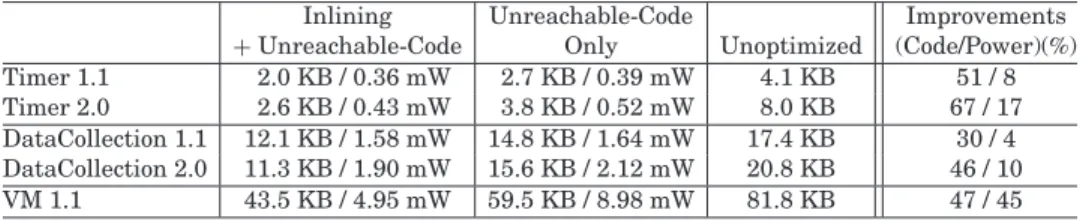
We compare our design patterns to standard object-oriented patterns and show how they support TinyOS’s design goals. We show that our patterns depend fundamentally on features of both the nesC language and compiler. In partic-ular, nesC’s optimizations have a major impact on the size and efficiency of pattern-based programs, reducing power use by up to 45% and code size by up to 67%. Finally, we discuss how these patterns have influenced the design of the nesC programming language and how recent changes to nesC address some of the limitations of our current patterns.
4.1 Comparison to Object-Oriented Patterns
The eight design patterns described in Section 3 can be separated into classes: Dispatcher, Service Instance, Keyset, and Keymap are specific to nesC, while Adapter, Decorator, Facade, and Placeholder have analogs in existing pat-terns [Gamma et al. 1995]. The differences from traditional object-oriented patterns stem from the design principles behind TinyOS [Levis et al. 2005b]. For example, TinyOS generally depends on static composition techniques to provide robust, unattended operation: function pointers or virtual functions can complicate program analysis, while dynamic allocation can fail at runtime if one allocator misbehaves. As a result, where many object-oriented patterns increase object flexibility and reusability by allowing behavior changes at run-time, our patterns require that most such decisions be taken by compile-time.
The nesC-specific patterns represent ways to make nesC’s static program-ming model more practical. Service Instance allow services (e.g., timers, file systems) to have a variable number of clients; it is the standard pattern for a stateful TinyOS service. Dispatcher supports application-configured dispatch-ing (e.g., message reception, user commands). The Keyset pattern both supports these two patterns and allows data structures to be sized according to a partic-ular application’s needs. Keymaps are a practical way of building components above Service Instances and of associating state with sparse identifier sets.
The TinyOS Adapter, Facade, and Decorator patterns have similar goals and structures to their identically named object-oriented analogs [Gamma et al. 1995, pp.139, 175, 185, respectively]. The Facade assembles a set of existing components and presents them as a single component to simplify use; the Decorator adds extra functionality to an existing component and the Adapter makes existing functionality available via a different interface. The differences lie in nesC’s model of static composition. In the case of the Facade, this means that all of the relationships are bound at compile-time; in addition, nesC pro-vides no way of making the internals of a Facade truly private (the internal components can always be referred to from elsewhere by name). Adapters and Decorators are more important than in an object-oriented context, as they