Copyright by
Kehinde Ibukunoluwa Olowoyeye 2018
The Dissertation Committee for Kehinde Ibukunoluwa Olowoyeye Certifies that this is the approved version of the following Dissertation:
HIGH SCHOOL LEADERS’ SENSEMAKING, ACTIONS, AND PRACTICES IN REDUCING THE OVERREPRESENTATION OF STUDENTS OF COLOR IN
DISCIPLINARY ALTERNATIVE EDUCATION PROGRAMS
Committee:
____________________________________
Terrance Green, Supervisor
____________________________________
Martha Ovando, Co-Supervisor
____________________________________ Joshua Childs
____________________________________ Jennifer Holme
____________________________________ Trinidad San Miguel
HIGH SCHOOL LEADERS’ SENSEMAKING, ACTIONS, AND PRACTICES IN REDUCING THE OVERREPRESENTATION OF STUDENTS OF COLOR IN
DISCIPLINARY ALTERNATIVE EDUCATION PROGRAMS
by
Kehinde Ibukunoluwa Olowoyeye
Dissertation
Presented to the Faculty of the Graduate School of The University of Texas at Austin
in Partial Fulfillment of the Requirements
for the Degree of
Doctor of Philosophy
The University of Texas at Austin December, 2018
Dedication
I dedicate this dissertation to the loving memories of my late father and mother, Emmanuel Oyedeji Fayemiwo and Victoria Mosun Fayemiwo, for their passion of education and their words that have kept me steadfast throughout my academic journey.
One of the many words they left me and my siblings with is “If you think education is expensive, try ignorance,”
v
Acknowledgements
I want to express my deepest gratitude and appreciation to my committee chair and co-chair, Drs. Green and Ovando, for their patience, support, and unwavering encouragement to complete my academic journey. I thank both of you for the
contribution of your expertise on the topic and thoughtful feedback. I am grateful for your time, energy, insight, and honesty. Without both your guidance and persistent help this dissertation would not have been possible.
I want to thank my committee members, Drs. Childs, Holmes, and San Miguel for your contributions and support. Your experiences, critical feedback, and insights have proved valuable to my study and the completion of my dissertation.
I want to acknowledge the unnamed principals and assistant principals who participated in this study. Thank you for your time, energy, insight, and honesty. I also thank my friends, Natalie Nichols, Sterling Scott, Denise Thompson, and Laurie Molis for the support and encouragement. Thanks to my University of Texas friends and cohort family, Andrene Castro, Aleks Malinowska, Edagar Torres, Sissi O’Reily, and Trent Sharp for your support.
I want to express my thanks and gratitude to my sister and my brother-in-law, Helen, and Churchill Kayode and my brothers, Taiye, Emmanuel, Samuel, Ife Fayemiwo for all the countless support, inspiration, and prayers. Each time my sister calls to ask about my progress, she would say, “No pressure is pressure. You need to complete the journey and not give up.”
To my beautiful, amazing, patient and loving children, I am forever grateful for the steadfast commitment and love you have shown to me as I struggled through this
vi
program and tried to be fully present as a mom. Ruthie and Joshua – You both mean the world to me, and I love you.
Above all, I give thanks to the Lord for providing me the strength and endurance to complete this journey.
vii
Abstract
HIGH SCHOOL LEADERS’ SENSEMAKING, ACTIONS, AND PRACTICES IN REDUCING THE OVERREPRESENTATION OF STUDENTS OF COLOR IN
DISCIPLINARY ALTERNATIVE EDUCATION PROGRAMS
Kehinde Ibukunoluwa Olowoyeye, Ph.D. The University of Texas at Austin, 2018
Supervisor: Terrance Green, Co-Supervisor: Martha Ovando
Scholarships about public schools’ exclusionary disciplinary practices consistently reveal the disproportionate representation of students of color amongst those suspended, expelled or removed to disciplinary alternative education programs (DAEPs) when compared to their White peers. Few studies have examined how school leaders make sense of discretionary removal of students of color to the DAEPs to disrupt the racial discipline gaps. The purpose of this study is to examine how high school leaders make sense of discretionary removal and implement discipline practices to reduce the disproportionate representation of students of color in DAEP. A qualitative approach was employed through a phenomenological study to examine the phenomenon of school leaders’ sensemaking of discretionary discipline and their actions. Specifically, the study draws on interviews, observation notes and document analysis. The findings of the study indicated the relational leadership orientation of the leaders influenced their non-punitive discipline approach,
viii
their challenges attempting to coach culturally incompetent teachers, and the structures and systems the leaders put in place in an effort to disrupt the racial discipline gap. This study concludes with implications for research and practice.
Keywords: discretionary removal; disproportionate; disrupt; non-punitive; overrepresentation; racial discipline gaps; sensemaking
ix
Table of Contents
List of Tables ... xvi
Chapter One ...1
Introduction ...1
Background ...3
Problem Statement ...5
Purpose Statement and Research Question ...6
Brief Overview of Theoretical Framework and Methodology ...7
Study Sites, Participants, and Data Sources ...8
Definition of Terms ...8
Chapter 37 Discipline ...8
Disciplinary Alternative Education Program (DAEP)...9
Discretionary Disciplinary Removal ...9
Expulsion ...9
Family Educational Rights and Privacy Act (FERPA) ...10
Gun-Free School Act (GFSA) ...10
Mandatory Disciplinary Removal ...10
Public Education Information Management Systems (PIEMS) ...11
Racial Discipline Disproportionality or Overrepresentation ...11
Referral ...11
Student Code of Conduct ...11
Zero Tolerance “Law and Order” ...11
x
Delimitations ...12
Assumptions...13
Significance of the Study ...13
Chapter Summary ...15
Chapter Two...16
Review of the Literature ...16
Historical Trends in National Racial Discipline Gaps ...19
Zero Tolerance and School Safety Concerns ...20
Exclusionary Discipline ...23
Texas DAEP and Racial Discipline Gaps ...26
Disciplinary Alternative Education Program (DAEP)...28
National Discipline Practices Reform Efforts ...32
School-wide Reform Efforts ...35
Restorative Discipline Practices ...35
Positive Behavioral Interventions and Supports (PBIS) ...36
School Leaders’ Role in Racial Discipline Gaps ...37
Theoretical Framework: Sensemaking Theory ...41
Seven Tenets of Weick’s Sensemaking ...43
Grounded in identity construction ...44
Retrospective...44
Enactive of the environment ...45
Social...45
xi
Focused on and by extracted cues ...46
Driven by plausibility rather than accuracy ...47
Chapter Summary ...49 Chapter Three...51 Methodology ...51 Research Questions ...51 Research Design ...51 Phenomenological Approach ...52 Site Selection ...54 Participant Selection ...54
Data Collection and Procedures ...55
Interviews ...56 Observations ...56 Documents ...57 Data Analysis ...58 Data quality ...60 Limitations ...61 Researcher’s Positionality ...62 Trustworthiness ...63 Chapter Summary ...64 Chapter Four ...66
Research Question Results...66
xii
Campus and District Setting ...68
District and Campus Demography Data and Discipline Matrix ...69
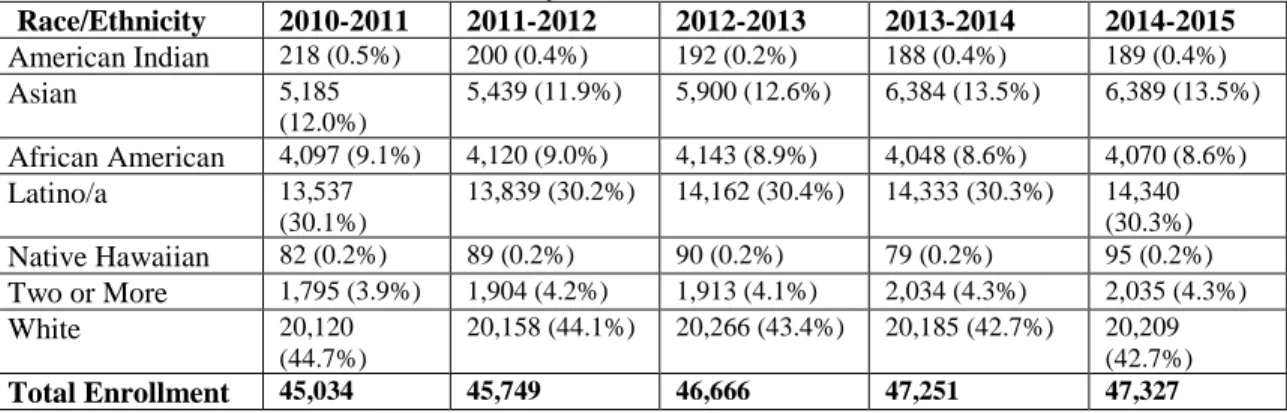
District student enrollment data ...69
Rover high school student enrollment data ...69
Spark high school student enrollment data ...70
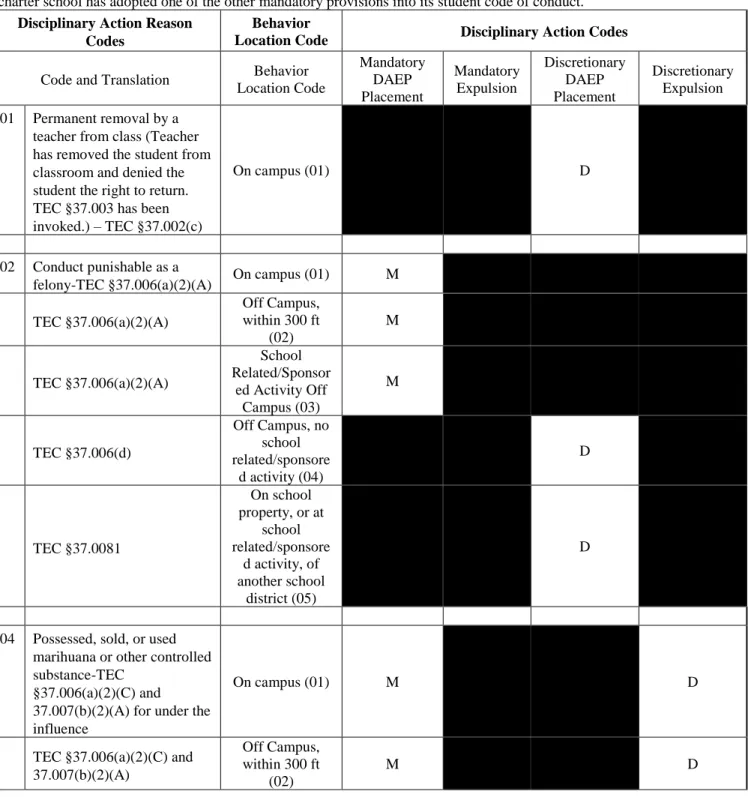
District school board approved mandatory/discretionary discipline matrix ...70
Campus Profile and Data on Discretionary Removal to the DAEP...71
Campus information on academy, program of study, and course sequence ...71
Extracurricular activities at Rover and Spark high school ...72
Staff information ...72
Participant’s Introductions/Profile ...73
Linda – Principal, Rover High School ...74
John – Assistant Principal, Rover High School ...75
Albert – Principal, Spark High School ...76
Jane – Assistant Principal, Spark High School ...77
Findings...78
Research Question One ...78
Leaders’ sensemaking sources of information ...78
Discretionary DAEP data ...79
Campus climate surveys ...82
Professional expectations and experiences ...82
xiii
Research Question Two ...85
High school leaders’ understanding of contexual factors informed informed by their sensemaking ...85
Deficit perspectives and cultural misconceptions ...86
Punitive discipline and loss of instructional time ...91
Leaders’roles as student advocates ...95
Research Question Three ...97
High school leaders’ actions to prevent the disproportionate representation of students of color removed discretionally to the DAEP ...98
Professional growth in cultural competency and initiatives enacted ..98
Campus-wide positive behavior intervention and support programs; and hiring of staff ...100
Rover high school: campus-wide positive behavior intervention and support programs; and hiring of staff ...101
Spark high school: campus-wide positive behavior intervention and support programs ...103
Building and cultivating relationships ...104
Teacher-student relationships ...104 Administrator-teacher relationships ...105 Administrator-student-parent relationships ...107 Chapter Summary ...111 Chapter Five ...113 Discussion ...113 Interpretation of Findings ...114
High school leaders’ sensemaking of discretionary removal of students of color to the DAEP ...114
xiv
Grounded in identity construction ...116
Focused on and extracted by cues ...117
High school leaders’ understanding of contexual factors informed by their sensemaking of discretionary removal to the DAEP ...119
Retrospective ...120
Ongoing...122
Driven by plausibility rather than accuracy ...123
High school leaders’ actions to prevent the disproportionate representation of students of color removed discretionally to the DAEP ...125
Social...125
Enactive of sensible environments ...127
Limitations of the Study ...130
Implications for Future Research ...130
Implications for Practice ...131
Conclusion ...132
Appendices ...134
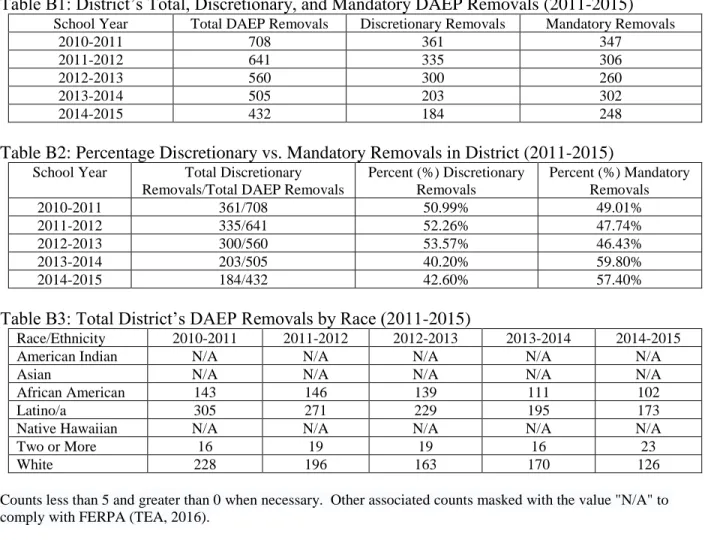
Appendix A: Texas Public School Discipline Data and Enrollment by Race ...134
Appendix B: School District’s Discipline Data and Student Enrollment by Race ...135
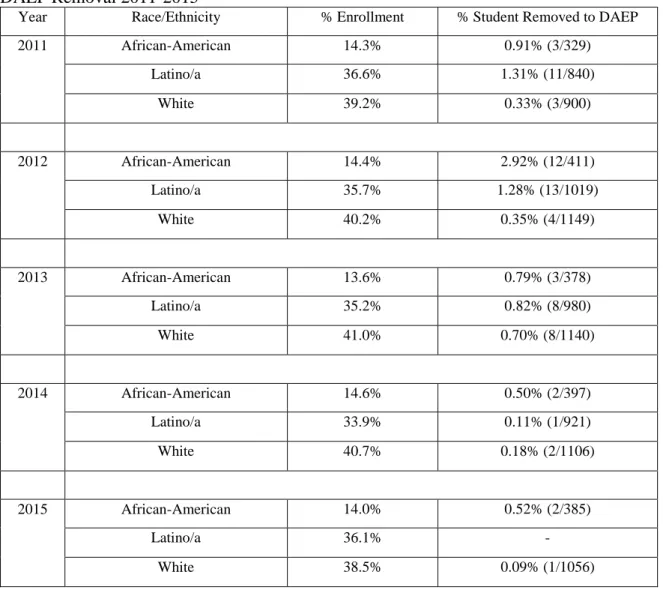
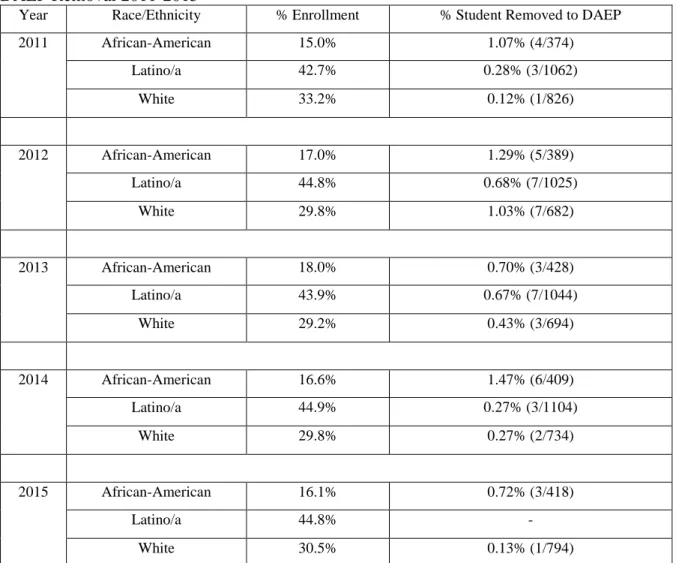
Appendix C: Rover and Spark’s High School Discipline Data ...136
Appendix D: Cover Letter, Study Information and Consent ...138
Appendix E: Interview Protocol ...141
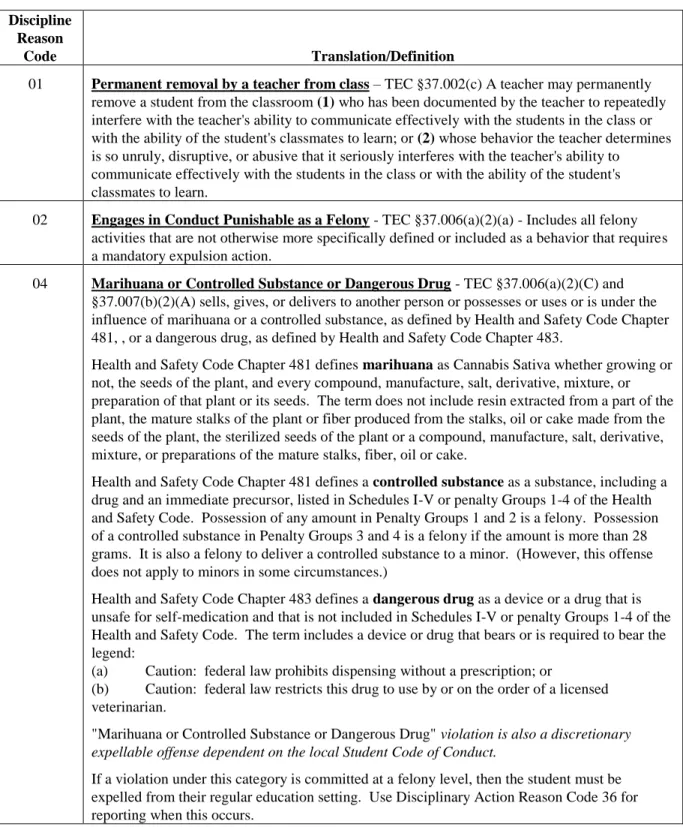
Appendix F: DAEP Texas Policy and Practice ...144
xv
Appendix H: Participants’ Profile, Campus Information, Discipline
Data, and Disciplinary Action Codes ...171 References ...177
xvi
List of Tables
Table 2.1: Strand 1 – Literature Reviewed on Disproportionate Racial Discipline Gaps ...18 Table 2.2: Strand 2 – Literature Reviewed on Texas DAEP and Racial Discipline
Gaps ...18 Table 2.3: Strand 3 – Literature Reviewed on National and Texas Discipline
Reform Efforts ...18 Table 2.4: Strand 4 – Literature Reviewed on School Leaders’ Roles in
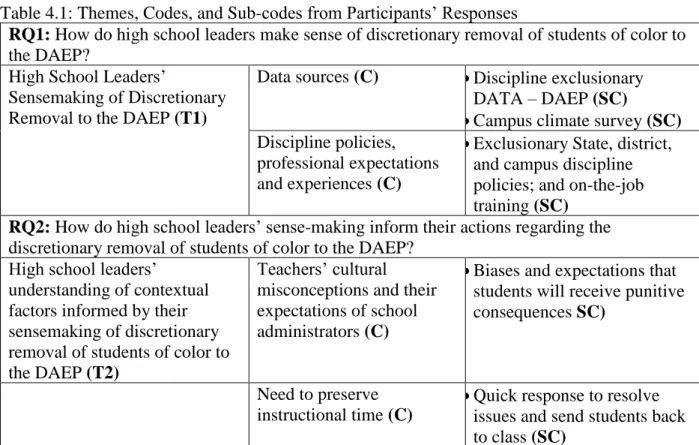
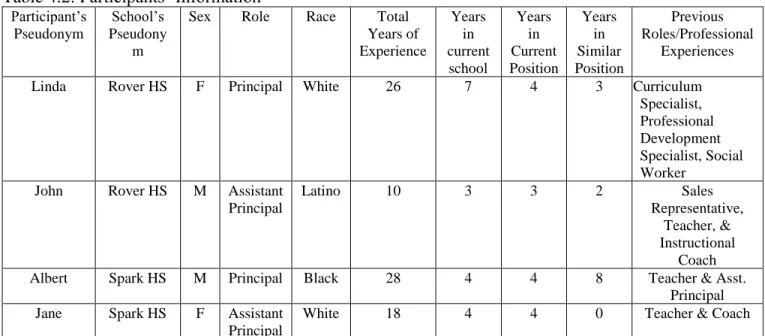
Discretionary Discipline ...18 Table 4.1: Themes, Codes, and Sub-codes from Participants’ Responses ...67 Table 4.2: Participants’ Profile/Imformation ...73
1
Chapter One Introduction
The overrepresentation of African-American and Latino/a students in suspensions, expulsions, and removals to Disciplinary Alternative Education Programs (DAEP) is inequitable compared to their White peers (DeMatthews, 2016a, 2016b; Hoffman, 2014; Lippa, 2016; Pane, Rocco, Miller, & Salmon, 2014; Skiba, Michael, Nardo, & Peterson, 2002). Studies on the discipline practices implemented in public schools continue to emphasize the disparity in disciplinary actions and consequences assigned to African-American and Latino/a students (Children’s Defense Fund (CDF), 1975; DeMatthews, 2016a; Fenning & Rose, 2007; Gregory, Skiba, & Noguera, 2010; Lippa, 2016; McCarthy & Hoge, 1987; Skiba, Michael, Nardo, & Peterson, 2002). Researchers have reported that there is no empirical evidence to support the notion that students of color exhibit misbehavior at higher rates when compared to their White peers to justify their disproportionate representation in suspensions, expulsions, and removal to the DAEP (Kelly, 2010; Losen & Skiba, 2010; Nicholson-Crotty, Birchmeier, & Valentine, 2009). However, students of color are more likely to get disciplined for less serious
“discretionary” offenses, such as, disrespect to staff or classroom disruption (Losen, & Gillespie, 2012; Skiba, Chung, Trachok, Baker, Sheya & Hughes, 2014), and school leaders have the authority to choose to address the behavior utilizing non-punitive approaches or otherwise. Studies on the discretionary removal of students to Disciplinary Alternative Education Programs (DAEPs) have also shown a similar disproportionate representation of students of color when compared to their White counterparts as a result of the discretionary decision making of school administrators (Booth et al., 2012; Homer, 2012; Losen, 2011; Marbley, Malott, Flaherty, & Frederick, 2011; Metze, 2012; Pitsch, 2016; Reyes, 2006). School leaders play a significant role
2
in the decision making process on the consequences assigned to a student for any behavior perceived to violate the student code of conduct.
Administrators, especially assistant principals, are charged with the responsibility of analyzing, investigating, and making decisions on the discipline referrals they receive from teachers. The discretionary removal of a student to the DAEP usually originates from the teachers based on their perception and interpretation of the student’s behavior characterized as inappropriate. The perceived misconduct may be addressed by the classroom teacher without a write-up to report the incident or could result in an office referral that documents the student’s offensive behavior perceived to violate the district’s student code of conduct. Various factors, such as their beliefs, attitudes, race, culture, background, and sensemaking influence the decision-making of school leaders (Evans, 2007b; Gregory, Skiba, & Noguera, 2010; Lippa, 2016; Skiba, Edl, & Rausch, 2007). Administrators investigate the incident reported by teachers on the referral by discussing the occurrence with the students and other witnesses if necessary before they make discretionary decisions. Given school leaders’ power to make such pivotal decisions, there is a need to focus on how school leaders make sense of and implement
discretionary discipline since they can determine whethere a student is removed and sent to the DAEP.
To this end, this chapter includes brief historical background on school discipline practices, the context that describes school leaders’ perspectives on discretionary discipline, the problem statement, the purpose of the study, including the research questions that guided the study. Also discussed are a brief overview of the methodology that was used to conduct the research, including the theoretical framework, and the definition of the terms used relative to this study.
3
Background
Over 40 years of research on exclusionary discipline practices and actions in public schools have consistently indicated that students of color have been represented
disproportionately among those suspended, expelled, or removed to alternative education programs in relation to their white peers (Children’s Defense Fund, 1975; Fenning & Rose, 2007; McCarthy & Hoge, 1987; Skiba, Michael, Nardo, & Peterson, 2002). Research has shown that school punitive discipline practices, along with the stereotypic notions held by school leaders regarding the behaviors of students of color, contributed to their disproportionate
representation amongst those disciplined in the nation (CDF, 1975; DeMatthews, 2016a; Fenning & Rose, 2007; Gregory, Skiba, & Noguera, 2010; McCarthy & Hoge, 1987; Skiba, Michael, Nardo, & Peterson, 2002).
The Children’s Defense Fund (CDF) (1975) was one of the first reported
disproportionality in school discipline practices in the mid 1970s. The report contained two significant findings, one of which pointed to suspensions in public schools nationwide during the 1972-73 academic school year that led to the suspension of over one-million students (CDF, 1975). The second finding of the CDF report, gathered from the national dataset of the United States Office of Civil Rights, consisted of over 2000 school districts. It indicated that one in every eight African-American students was suspended at least once in comparison to one in every 16 white students (CDF, 1975). The CDF findings prompted national awareness about disproportionate discipline practices. Further, it launched the appropriate platform through which researchers could also study race-based disproportionate school discipline practices. Some researchers have suggested that traditional school discipline practices that rely on the
4
removal of students from the classroom environment is fraught with problems and may even exacerbate student behavioral issues (Skiba & Rauch, 2006).
Specifically, Texas, like other states in the U.S., established DAEPs in public school districts in 1995 after the enactment of the zero-tolerance policy, which originated from the Gun-Free School Act passed by the federal government in 1994 (Cortez & Robledo Montecel, 1999). DAEPs are substitutes to the regular classroom and provide a learning environment for students who have violated the student code of conduct, or who have committed certain criminal offenses specified in Chapter 37 of the Texas Education Code (TEC)
(http://www.statutes.legis.state.tx.us/Docs/ED/htm/ED.37.htm#37.001). School leaders either remove a student to the DAEP mandatorily due to offenses, such as drugs and alcohol, that warrants the removal. Or, administrators can remove students discretionally to the DAEP for offenses that are less severe.
School leaders are obligated to respond to behavioral disruptions, and at the same time, they are held accountable for student academic achievement, sustaining positive stakeholder relationships, and meeting state and federal mandates (Garret, 2013). Given this broad range of responsibilities, school leaders’ beliefs, attitudes, and experiences could potentially impact the critical discretionary decisions they make to address “perceived” student inappropriate behavior to preserve an orderly learning environment. Their decision ultimately determines the number of disciplinary referrals that result in student suspensions, removal to the DAEP, and expulsion of students. Different factors, such as the administrator’s race, culture, background (Gregory, A., Skiba, & Noguera, 2010; Skiba, Horner, Chung, Rausch, May, & Tobin, 2011; Skiba, Michael, Nardo, & Peterson, 2002; Townsend, B. L. (2000), and their experiences on-the-job influence the
5
way they make sense of student behaviors and the actions they would take to address it based on the decisions made concerning the issue.
The disproportionality in the number of students of color removed to the DAEP
compared to their White counterparts perpetuates the school system as a result of the decisions made by school leaders daily. School leaders’ world-views can impact the lens through which they view the issue of discipline as it relates to race; which is shaped by their beliefs, attitudes, race, culture, and professional backgrounds and experiences (Gorski, 2013; Green, 2017). These factors, in turn, inform their sensemaking of any discipline occurrence.
Problem Statement
Several studies have focused on school leaders who have made efforts to reform discipline practices thereby disrupting the increasing rates of students of color’s discretionary suspension, expulsion, and removal to DAEPs from school (Armour, 2016; Losen, 2010; Green, 2009; Osher, Bear, Sprague, & Doyle, 2010; Sugai & Horner, 2002; Vincent, Tobin, Hawken, & Frank, 2012). Majority of the school leaders utilized different discipline intervention strategies, such as school-wide discipline intervention, restorative discipline, and positive behavioral interventions and support (Armour, 2016; Losen, 2010; Green, 2009; Osher, Bear, Sprague, & Doyle, 2010; Sugai & Horner, 2002; Vincent, Tobin, Hawken, & Frank, 2012). Researchers have also explored the discretionary disciplinary decisions made by school leaders and how they have contributed to the nation’s racial discipline gap (Bireda, 2002; Dupper, Theriot, & Craun, 2009; Hirschfield & Celinska, 2011; Losen, 2013; Morrison, Anthony, Storino, Cheng, Furlong, & Morrison, 2001; Morton, 2013; Skiba et al., 2014). Recent studies on office discipline
referrals have focused on conditions under which racial bias could likely influence school leaders’ discretionary decisions on discipline (McIntosh et al., 2014; Smolkowski, Girvan,
6
McIntosh, Nese, & Horner, 2016). Other studies have examined the sensemaking of school leaders around race and demographic changes (Evans, 2007b), including racial discipline gaps created by the discretionary decisions of school leaders identified as social justice leaders (Lippa, 2016), and school leaders’ perceptions on discretionary discipline (Pitsch, 2016).
The increasing demands on school administrators to improve student achievement and at the same time maintain a safe learning environment requires that they make equitable decisions thereby provide equal educational opportunities for all students. The sensemaking that school leaders engage in, regarding discretionary removal of students of color to the DAEPs is crucial to the disruption of the persistent disproportionate racial representation amongst those removed to the DAEPs. However, a dearth of research has examined how school leaders make sense of discretionary removal of students of color to the DAEPs that result in disproportionality (Lippa, 2016; Pitsch, 2016) and the disruption in the continued racial discipline gap or
overrepresentation of students of color. Understanding this is critically important because how principals make sense of discretionary discipline and the actions employed in high schools that contribute to reducing the overrepresentation of students of color in DAEPs can help disrupt the overrepresentation of students of color in these programs. This exploration of the leaders’ sensemaking of discretionary discipline might also provide information on the different structures and systems that are put in place by these leaders to in an attempt to reduce the disproportionality in the representation of students of color removed to the DAEP.
Purpose Statement and Research Questions
The purpose of this study is to examine how high school leaders make sense of
7
the overrepresentation of students of color.To achieve this purpose, this study addresses the following questions:
1. How do high school leaders make sense of discretionary removal of students of color to the DAEP?
2. How do high school leaders’ sense-making inform their actions regarding the discretionary removal of students of color to the DAEP?
3. What do high school leaders do to prevent the disproportionate representation of students of color amongst those removed discretionally to the DAEP?
Brief Overview of Theoretical Framework and Methodology
To theoretially frame this study, I draw on sensemaking theory (Weick, 1995). I specifically used the seven essential tenets of sensemaking to analyze this study, which are identity construction, retrospect, cues, plausibility, enactment, social contact, and ongoing events. Methodologically, I utilized a qualitative approach to gather information from
participants by conducting a phenomenological study design. A phenomenological study focuses on the subjective experiences of individuals and how they make meaning of the experience (Wertz, 2005). The information gathered from the school leaders enabled me to determine “the meaning, structure, and the essence of their lived experiences of the discipline practices
phenomenon” (Patton, 2002, p. 104). The phenomenological study provides information on participants’ experiences and understanding of the phenomenon within the context of the study. Also, the information helped me identify the contextual factors related to the phenomenon investigated and how participants interpreted these experiences (Johnson & Onwuegbuzie, 2004; Patton, 2002; Wertz, 2005). This phenomenological study consisted of two sessions of semi-structured individual interviews with the high school administrators.
8
Study Sites, Participants, and Data Sources
The study included two high schools, Rover and Spark High Schools (pseudonym), located in a suburban school district in Texas. Using purposive sampling (Creswell, 2014), I examined these two high schools because five-year longitudinal discipline data which indicated some reduction in the discretionary removal rates of students of color to the DAEP (See
Appendix C).
Additionally,four administrators, comprised of two principals and two assistant
principals, one of each from both campuses of study participated in this research. Participants in this study met the following criteria: (a) they were a principal or assistant principal (i.e., school leader), and (b) they have worked in the school for at least three of the five years of the discipline data collected. Pseudonyms were used to maintain the anonymity of all participants and study sites. Data gathered contained no identifying information that could associate their participation in the study. Finally,the sources of data for this research comprised contextual district and campus-level demographic and disciplinary data related to disproportionate discretionary DAEP removal of students and the participants’ responses to the in-depth semi-structured interviews.
Definition of Terms
The following terms are defined to provide clarity in the meanings of words used in this study. The articulation of the researcher’s selection of definition would help guide the readers as they make sense of the ideas since multiple definitions exist to explain concepts.
1. Chapter 37 Discipline – A student code of conduct mandated by state and local/district discipline policies, rules, regulations, and procedures to remove disruptive students or students unable to function in their home campuses to an alternative education setting.
9
2. Disciplinary Alternative Education Program (DAEP) – An alternative education program designed to meet the needs of students who act out with disruptive and violent behavior on the school campus. DAEPs can be held on- or off-campus and are required to incorporate approved instructional curriculum in English language arts, mathematics, science, history, and self-discipline, and provide counseling services. They are mandated to comply with the Four Public Academic Goals to ensure students succeed by
demonstrating exemplary performance in reading, writing, math, science, and social studies (TEC, 37.008).
3. Discretionary Disciplinary Removal – Disciplinary action left to the discretion of school/district administrators and categorized as discretionary according to the school district’s student code of conduct (TEC, 37.001). Although school districts are required to develop their categories of mandatory infractions, state policy may classify certain offenses as discretionary (TEC, 37.001). Students may, therefore, be removed from their home campuses and placed in a DAEP if one or more of the following felonies is
committed (Chapter 37.006 a):
a. The superintendent or designee has reasonable belief that the student has engaged in conduct defined as a felony offense apart from those specified in Title 5 of the Penal Code.
b. The continued presence of the student in the regular classroom threatens the safety of other students or teachers and is detrimental to the
educational learning process (TEC Annotate, 37.007).
4. Expulsion – The most severe student disciplinary action used when a student cannot be suspended or removed and placed in a DAEP. Students expelled are denied education at
10
their home campus for a period. The students get assigned to a JJAEP, based on the severity of their offense.
5. Family Educational Rights and Privacy Act (FERPA) – A law requiring all schools to protect the confidentiality of a student’s educational records; sometimes perceived as an obstacle to information sharing between child welfare and education agencies.
6. Gun-Free School Act (GFSA) – A law enacted in 1994 that requires each state receiving federal funding to have a state law in effect requiring local educational agencies to expel any student determined to have brought a weapon to school. Expulsion may be up to one year and is mandatory except when a chief administering officer of the agency modifies the decision on a case-by-case basis. Each state has enacted laws of their own, now known as zero tolerance laws.
7. Mandatory Disciplinary Removal – Inappropriate behaviors categorized as requiring the mandatory removal of a student from their home campus. Examples of such
inappropriate behaviors include: committing a felony or misdemeanor; committing an assault or making a terrorist threat; using, selling, providing, or possessing drugs; using, selling, providing or possessing alcohol, glue, or aerosol chemicals; public lewdness or indecent exposure; or committing a retaliatory offense against any school employee (Texas Education Code Annotated, 37.006). Mandatory removal of a student must take place when the student receives deferred prosecution for a felony; when the court or jury finds that a student was engaged in a felony; or when the superintendent reasonably believes that a student has committed murder, manslaughter, or criminally negligent homicide (TEC 37.006).
11
8. Public Education Information Management System (PEIMS) – The collection of data by TEA regarding all aspects of public education, including school personnel, financial status, and organizational information, as well as student demographics and academic performance.
9. Racial Discipline Disproportionality or Overrepresentation – Occurs when students of color get suspended or expelled at a higher frequency, 10% or more than the percentage their race represents within the school population.
10.Referral – Disciplinary documentation or a written report by a campus stakeholder describing the infraction committed in violation of school policy, and recommendations made by the campus administrator for removal of the student from the home campus to a DAEP.
11.Student Code of Conduct – A set of rules outlining student responsibilities and
expectations. Also described in the document are the schools’ responsibilities and proper practices for a school and district.
12.Zero Tolerance “Law and Order” – A public school discipline policy that applies
automatic, prescribed, mandatory sanctions on student discipline infractions with little or no consideration for conditions, circumstances, intent, or understanding of the individual committing the offense.
Limitations
This study only examined high school leaders’ sensemaking on discretionary DAEP removal and how they implemented discipline practices to reduce the racial discipline gaps since the disproportionate discretionary exclusionary discipline practices towards students of color result in several long-term adverse effects that are more prominent in high schools. Examples of
12
these negative outcomes are low academic achievement; increased student dropout rates (Skiba & Sprague, 2008; Triplett, Allen, & Lewis, 2014), disengagement from the educational setting (Skiba et al., 2011), and the school to prison pipeline (Heitzeg, 2009; Townsend Walker, 2012). Therefore, consumers of this research study would decide on the connections of the findings to elementary and middle school leaders within a similar context. The goal of this research was to produce rich findings to understand the nuances of this work that could inform the work of leaders at other campuses. As a result, this study includes a smaller sample size.
The disciplinary data provided by the district on “Rover and Spark” high schools
involved in this study did not contain student gender. Therefore, this study did not include data on the rates of discretionary removals to the DAEP based on student gender. It is an expectation that data collection and analyses will be time-consuming and the researcher’s personal biases could easily influence the results (Johnson & Onwuegbuzie, 2004). Therefore, I was mindful of my own biases as I collected and analyzed the data.
Delimitations
The research focused solely on the sensemaking, actions, and practices used to reduce the overrepresentation of students of color in DAEPs. This study only included four school leaders, two principals, and two assistant principals at the high school level. This study did not include the perspectives of secondary and elementary teachers, elementary and middle school
administrators’ and other school disciplinarians. This research did not include parents or students since they do not make decisions on disciplinary actions that are appropriate for any form of misbehavior; therefore, no parents or students participated in the study.
13
Assumptions
Since this study addressed how high school leaders made sense of discretionary removal to the DAEP and how they implemented their campus discipline practices to reduce
disproportionality in racial representation at the DAEP, my assumption is that the participants have the authority to remove students discretionally to the DAEP and are familiar with discipline practices used on their campuses. I also believed the participants gave honest responses no matter how difficult.
Another assumption was that the selected schools used discipline practices that contributed to a decrease in the percentages of students of color removed to the DAEP. Although the reduction in the number was evident across all student races, African-American and Hispanic students were represented at higher rates when compared with their White peers. Also, the reductions in the number of students were not significant enough to disrupt the disproportionality and sustain it (See Appendix C). Therefore, I assume the school leaders would continue to make conscious efforts to disrupt the discipline gaps.
Significance of the Study
The findings of this study will add to the body of literature regarding the actions school leaders perform to reduce the overrepresentation of students of color amongst those removed discretionary to the DAEP. As expressed by Townsend (2000), school leaders should use suspension and expulsion data to address the differential use of exclusionary discipline with students of color to ensure equity in the context of ethnicity, gender, ability, socioeconomic status, or an intersection of any of these variables.
The findings will inform school leaders and districts on how the process of the
14
removal could potentially contribute to or disrupt the discipline gap. The results of this study will also have implications for the training of school leaders.
Several school districts are making efforts to address the issue of race through the
creation of different committees that focus on race-based issues, such as the Equity Task Force. These districts also provide professional development opportunities and workshops on race-related topics including culturally responsive teaching. However, the is a need to explore at a deeper level the concept of how the school leaders make sense of the learning and information gathered from the training and how they process them to take the desired actions in reducing discipline gaps.
Therefore, the findings of this study will inform school leaders and districts on how to make available targeted professional developments to their teachers and campus leaders. It will also inform them on how individual school leader’s reflection and understanding of their
worldview and the lens through which they make sense of the issue of discipline around race impact the decisions they make on a daily basis.
The findings will inform campus leaders on the types of systems and structures that they need to establish on their campuses according to the context of their school to initiate the reduction process in the discipline gaps. Also, the findings will inform school districts on the different ways they can provide support to the campus leaders, aside from the professional development opportunities, including how the progress made by the school leaders can be monitored with fidelity to sustain the system. Furthermore, the research may also inform policy development and enactment regarding discretionary removal of students of color to the DAEP.
15
Chapter Summary
This chapter briefly described the context of this study that includes background
information on DAEP removals, brief explanations of the problem statement and the purpose of the study. Also discussed was a brief overview of methodology that consisted of the qualitative approach, an outline of the research questions used, and the theoretical lenses through which I analyzed the qualitative data collected from this study. Similarly addressed were the limitations, delimitations, assumptions, and significance of the research. In chapter two, I will discuss the reviewed literature and conceptual framework that I used for this study.
16
Chapter Two
Review of the Literature
This study examined how four school leaders in two high schools made sense of
discretionary removal and what they did to make progress in reducing the disproportionate rates at which African-American and Latino/a students were removed to the disciplinary alternative education programs (DAEPs) when compared to their White peers. This chapter presents the body of literature on the punitive school disciplinary practices that have perpetuated the racial discipline gaps and the roles of school leaders as it relates to how they implemented different discipline practices and make discretionary decisions regarding student behaviors perceived as inappropriate. Specific attention was on the discretionary removal of students of color to DAEPs.
In this chapter, I reviewed four strands of literature. The first strand examines the literature on disproportionate racial discipline gaps inherent in the punitive discipline practices used in U.S. public schools, including literature on the Texas public schools’ disciplinary data that are parallel to the national data. The third strand of literature examines national discipline reform efforts through the enactment of zero-tolerance policies and the establishment of DAEPs to reduce perceived widespread school violence. In addition, I reviewed literature on different discipline reform efforts, besides the national reforms implemented by schools. The fourth strand of literature reviewed focused on school leaders’ roles in discretionary discipline and its implementation.
The four strands present previous studies conducted to examine the disproportionate discipline practices in public schools, as well as the mandates placed on school leaders to
17
improve student achievement and at the same time maintain a safe learning environment by implementing different discipline reforms.
In reviewing literature for this study, I analyzed peer-reviewed journal articles, empirical studies on disproportionate public school discipline practices, school leaders’ roles in
implementing the punitive discipline policies, and students’ removal to the DAEPs using
different conceptual frameworks, including the Sensemaking theoretical framework. I reviewed policy briefs and dissertations published within the last eight years to show the alignment between most recent studies and the historical trends in the racial discipline gaps. I utilized four search engines through the University of Texas at Austin Library website: JSTOR, EBSCO, Educational Administration Abstract, and ERIC. Also, I used the Google Scholar Database. The first search terms - “disproportionate discipline of African American and Latino/a students” generated over 40,000 literature. I narrowed the search by selecting literature published within 2007-2017, which produced over 10,537 literature. I selected scholarly, and peer-review articles and the search produced about 1,059 literature. Of the 10,537 initially generated, 2,059 were dissertations, of which 221 related to the education field. I also explored the term “Discretionary Discipline Alternative Education Program.” The search generated 26 dissertations through the University of Texas at Austin Library website and over 50,000 literature produced on the Google Scholar. I selected the most relevant and reviewed other related articles including journals that cited them. This process enabled me to study research that showed the trends in discipline practices and the roles of school leaders discretionary decisions concerning behaviors perceived as inappropriate that relates to students of color. I reviewed scholarships from the 1970s to date to better understand previous studies on the historical patterns in the national disproportionate discipline data.
18
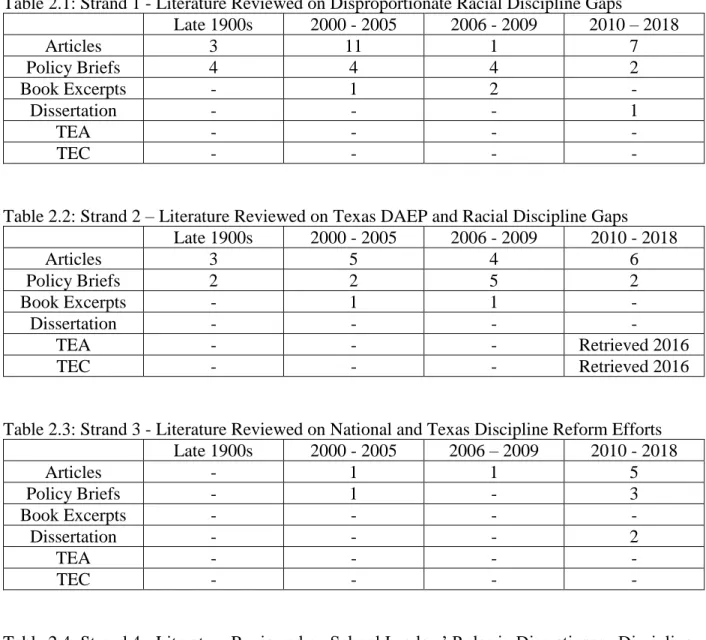
Specifically, I reviewed articles, policy briefs, and book excerpts. I also reviewed the Texas Education Code (TEC) Chapter 37 and Texas Education Agency information on discipline. Likewise, I reviewed two recently published dissertations: Lippa (2016) –
sensemaking of aspiring leaders that identified themselves as social justice leaders; and Saltrick (2010) focused on how school leaders make sense of accountability to help teachers develop their instructional practices. The tables below (Table 2.1 – 2.4) show the types and number of literatures reviewed for each of the four strands.
Table 2.1: Strand 1 - Literature Reviewed on Disproportionate Racial Discipline Gaps
Late 1900s 2000 - 2005 2006 - 2009 2010 – 2018 Articles 3 11 1 7 Policy Briefs 4 4 4 2 Book Excerpts - 1 2 - Dissertation - - - 1 TEA - - - - TEC - - - -
Table 2.2: Strand 2 – Literature Reviewed on Texas DAEP and Racial Discipline Gaps Late 1900s 2000 - 2005 2006 - 2009 2010 - 2018 Articles 3 5 4 6 Policy Briefs 2 2 5 2 Book Excerpts - 1 1 - Dissertation - - - - TEA - - - Retrieved 2016 TEC - - - Retrieved 2016
Table 2.3: Strand 3 - Literature Reviewed on National and Texas Discipline Reform Efforts Late 1900s 2000 - 2005 2006 – 2009 2010 - 2018 Articles - 1 1 5 Policy Briefs - 1 - 3 Book Excerpts - - - - Dissertation - - - 2 TEA - - - - TEC - - - -
Table 2.4: Strand 4 - Literature Reviewed on School Leaders’ Roles in Discretionary Discipline Late 1900s 2000 - 2005 2006 – 2009 2010 - 2018
19 Articles - 5 - 5 Policy Briefs - 1 - 2 Book Excerpts - - 1 1 Dissertation - - - 2 TEA - - - - TEC - - - -
The first strand of literature reviewed for Research on Disproportionate Racial Discipline Gaps, is composed of two subsections: zero tolerance and school safety concern; as well as exclusionary discipline. Table 2.1 above shows the number of articles, policy briefs, book excerpts reviewed for this strand. Likewise, I reviewed a Dissertation written by Lippa in 2016.
Historical Trends in National Racial Discipline Gaps
Scholarships have shown that students of color get assigned a differential school
disciplinary consequences that range from office disciplinary referrals to suspension, removal to the DAEP, and expulsion. The variation in the disciplinary actions taken by school leaders results in the overrepresentation of students of color when matched to their White peers (Fenning & Rose, 2007; DeMatthews, Carey, Olivarez, & Moussavi Saeedi, 2017). Disproportionate student discipline was defined by Harry and Anderson (1995) as the expectation that African-American students would get suspended or expelled at a higher frequency, 10% or more, than the percentage their race represents within the school population.
Presumably, the intent of implementing school discipline policies is to maintain order and safety by removing students who violate school rules and disrupt the learning environment. Also, school disciplinary actions are intended or used to set an example of those punished students, to discourage other students from violating the student code of conduct. However, schools tend to rely heavily on exclusionary discipline as the primary discipline strategy which involves the removal of students from the instructional classroom setting (Gregory, Skiba, &
20
Noguera, 2010). Unfortunately, this practice every so often has a disproportionate effect on African-American and Latino/a students. Discipline practices in the nation’s public schools are punitive (Tyack, 1974, Skiba et al., 2002) and are influenced by the zero-tolerance policies discussed in the subsection below.
Zero Tolerance and School Safety Concerns
Zero-tolerance policies evolved as a result of the Gun-Free Schools Act (GFSA), which was passed by Congress in 1994 to combat widespread perceived school violence. The GFSA policies were administrative rules to address specific problems connected to school safety and discipline (McAndrews, 2001). School districts in different states were compelled to implement zero-tolerance policies and establish disciplinary alternative school models to provide and maintain safe, conducive learning environments, to eliminate school violence and increase student achievement on test scores (Gregg, 1998). Regardless of the different arguments that school violence has considerably reduced, the media was focused intensely on school violence until the 1990s when legislators were forced to combat weapons in schools with the passage of zero-tolerance policies (McAndrews, 2001). The impact of the perceived heightened school disruption and violence across the nation on student academic achievement, since the mid-1960s, necessitated the need for stricter discipline policies; it prompted the government to enact zero-tolerance policy in 1994 as a means to counter the perceived student violence. The policy did not specify how school leaders should address inappropriate student behaviors in contrast to mandatory offenses and they, therefore, default to make subjective discretionary decisions. Research suggests that the discretionary decisions made by school leaders contributed to the racial discipline gap (Bireda, 2002; Dupper, Theriot, & Craun, 2009; Hirschfield & Celinska,
21
2011; Losen, 2013; Morrison, Anthony, Storino, Cheng, Furlong, & Morrison, 2001; Morton, 2013; Skiba et al., 2014).
The hugely publicized school shootings during the 1990s spawned significant public concern and promoted a prevalent impression about safety concerns for students in schools (Borum, Cornell, Modzeleski, & Jimerson, 2010). However, researchers such as Borum et al. (2010) disrupted these misconceptions. They conducted an empirical study on the trends of school and community violence and provided evidence on best practices that could prevent school shootings. They also stated that schools had responded to shootings by using safety and security measures that lacked sound research support and the use of strategies commonly
criticized as unsound practices, such as zero-tolerance discipline and student profiling (Borum et al., 2010). Examples of the unrealistic school safety measures cited included the
recommendation to arm teachers with guns after the killings of five girls in 2006 by a gunman who invaded a one-room Pennsylvania Amish school (Associated Press, 2006b). Also
considered was the provision of Kevlar-coated textbooks to students to use as bullet shields (Associated Press, 2006a). Another example of the safety measures employed by schools was the hiring of a former military officer in a Texas school division to train students on how to collectively attack and subdue a gunman (“Burleson Changes Stance,” 2006). The
implementation of new security and prevention-oriented initiatives, particularly the zero-tolerance discipline practices, outpaced evidence of their effectiveness (Brooks, Schiraldi, & Ziedenberg, 2000).
The extensive publicity of school shooting incidents heightened people’s perceptions of danger (Cornell, 2006). A Gallup poll conducted after the Columbine shooting indicated that two-thirds of Americans responded stating that similar episode was “very likely” or “somewhat
22
likely” to occur in their community (Saad, 1999). The poll also showed that more than one-third of high school students knew students in their school who were “potentially violent enough to repeat the incident that occurred at Columbine High School” (Gallup, 1999). Another poll conducted a year after the Columbine shooting (Nagy & Danitz, 2000) found that 71% of parents had changed their view on their children’s safety at school. About 40% of parents regarded their children as “very safe” at school, and only 50% considered their children “somewhat safe.” Paradoxically, the report also showed that in the same year the Columbine shooting occurred, 17 students got killed in the nation’s schools in contrast to the more than 2,500 young people (ages 5–19) murdered outside of school and the more than 9,700 young people killed in accidents (Anderson, 2001). The fear of school shootings was greatly exaggerated in comparison with other risks, such as riding in a car (Borum et al., 2010).
Nevertheless, all states were mandated to develop and enact zero tolerance laws in schools so as not to forfeit their federal funding (Martin, 2000). The attachment of federal funds to such mandates left the majority of states and school districts no choice but to enact and
implement the policies. Ashford (2000) reported that funds disbursed by the Elementary and Secondary Education Act (ESEA) were contingent on a state’s enactment of the policies to produce gun-free schools. Several states, counties, and school districts developed their policies within the guidelines of GFSA that addressed unique problems specific to their local needs (McAndrews, 2001). Some researchers examined different parts of the zero-tolerance policies that were adopted and enacted by various schools, based on their unique needs (Kaufman, Chen, Choy, Ruddy, Miller, Fleury, Chandler, Rand, Klaus, & Planty, 2000; Skiba & Peterson, 1999).
The majority of schools in the United States approved the enactment of different parts of the policy and implemented them by the time the National Center for Education Statistics
23
published their 2000 report, “Indicators of School Crime Safety” (Kaufman et al., 2000). Based on national data, 94% of schools implemented the firearms policy, while 90% applied the policy on weapons other than firearms. Additionally, 87% of schools implemented the zero-tolerance policies against alcohol, and 79% implemented policies against violence and tobacco (Kaufman et al., 2000). Some administrators, on the other hand, declined to apply the policy in this
manner, given the fact that GFSA provided some flexibility in the wordings of the policy, which permitted schools to review infractions on a case-by-case basis (Skiba and Peterson, 1999). These administrators perceived this provision as a means to deal with disruptive students, thereby sending a message to potential violators (Skiba & Peterson, 1999). Also, school leaders targeted both severe and mild behaviors when disciplining students, to serve as a deterrent and send a strong message to potential troublemakers that such actions were unacceptable (Skiba & Knesting, 2001). The punitive nature of the zero tolerance policy involve the exclusion of students from the classroom, discussed in the subsection below.
Exclusionary Discipline
School leaders assigned stricter consequences to less severe behaviors because the zero-tolerance policy did not state which offenses were serious and which were less severe (McCord, Hager, & Mattocks, 2007). The lack of clarity gave many states an opportunity to broaden their zero-tolerance policy. As a result, they included mandatory suspensions and/or expulsions of students involved in fighting; possession of drugs, alcohol, or tobacco; excessive absences; defiance of authority; and disruptive or disorderly conduct (McCord et al., 2007; Skiba, 2000a). Other researchers, such as Advancement Project (2005), Justice Policy Institute (2009), Skiba and Peterson (2000) stated that zero-tolerance policies for other schools included certain objects
24
considered harmless outside of the school environment. These objects include cough drops, aspirin, or Midol regarded as drugs by the schools and nail clippers or paper clips as weapons.
The data on the national out-of-school suspension for the 2009-2010 school year
investigated by Losen and Gillespie (2012) accounted for the suspension of 3.3 million students. Of those suspended, Black students were more likely to be suspended from school three times than their non-Black peers. African-American students suspended at least once were 17%, which was 1 in every 6 Black students when compared to 1 in 13 or 8 % Native Americans; 1 in 13 or 7% Hispanics; 1 in 20 or 5% Whites; and 1 in 50 or 2% Asian Americans (Losen & Gillespie, 2012). Researchers have challenged the notion that the higher rate of suspension of African-American students was due to their behavior. The argument that student behavior is worse among African-Americans is unsubstantiated and, therefore, lacks an adequate explanation for their overrepresentation in school discipline data (Butler, Lewis, Moore, & Scott, 2012). It is, therefore, necessary to examine if schools apply differential discipline to any group of
students as a result of their race, gender, ability, socioeconomic status, or a combination of these variables (Townsend, 2000). Also, there is a need to understand how school leaders make sense of student behaviors as they make disciplinary decisions that relate to students of color.
From the integrated literature review I conducted, the NCES (1998) surveyed a sample of 1,234 school principals that represented the national elementary, middle, and high school levels population to determine how they would rate different student behaviors. The most frequently cited misconducts at all levels were the less violent behaviors, such as tardiness that occurred 40% of the time, absenteeism at 25% occurrence, and physical fights between students, 21%. Conversely, severe misconducts relating more to school safety were cited as "moderate
25
problems,” since they rarely occurred – drug use (9%), gangs (5%), possession of weapons (2%), and physical abuse of teachers (2%).
Likewise, in 2000, the Harvard Civil Rights Project published a report, titled
“Opportunities Suspended.” The report analyzed the impact of disproportionate zero-tolerance policies on students of color that required strict and severe punitive sanctioning of all offenses, regardless of the severity of the misconduct. Also, approximately 32% of African-American students were suspended that year even though their numbers only accounted for roughly 17% of U.S. public school enrollment (Harvard CRP, 2000). African-American students were often being referred to the principal’s office more for subjectively defined offenses when compared to their white peers (Harvard CRP, 2000).
Researchers, such as Skiba and colleagues (2002), conducted empirical studies to explain racial biases and discrimination that contribute to disproportional discipline practices. They used discriminant analyses and found substantial statistical significant differences between the rate of office referrals and race. Other researchers have reported racial disparities in the rates of
exclusionary discipline for students of color and noted the differences being most pronounced for African-American students in particular (Losen & Gillespie, 2012; Losen, Hodson, Keith,
Morrison, & Belway, 2015).
From the literature review conducted on DAEP, Levin (2006) reported that the stringent implementation of the zero-tolerance policy necessitated the need for disciplinary alternative education programs (DAEPs), where students, impacted by the violation of the policy, could continue their education. DAEPs emerged as sites that would serve both the educational and disciplinary needs of these students (Levin, 2006). The inconsistency in the interpretation of the zero-tolerance policy and the discretionary power of school leaders to make decisions on the
26
removal of students call for an examination on how they make sense of the behaviors relating to students of color that result in the racial discipline gap and their disproportional representation in the nation’s DAEPs. There is, therefore, need to examine the way school leaders make sense of the behaviors of students of color and make decisions that could potentially perpetuate or disrupt the trend in the nation’s discipline data.
For the Texas DAEP and racial discipline gaps, the second strand, I reviewed literatures on DAEP establishments in Texas, as well as the disproportionality in the removal of students of color to the DAEPs to comapre it with the trends in the nation’s disproportionate DAEP removal of students of color since this study is on school leaders of two high schools in Southwestern U.S.. Also discussed in Strand two is the subsection on disciplinary alternative education
program (DAEP) that highlights the two conflicting views regarding the advocates of DAEP and those that are against its establishment. Table 2.2 above shows the number of articles, policy briefs, book excerpts reviewed for this strand. Likewise, I retrieved discipline policies and reports from the Texas Education Code (TEC) and Texas Education Agency (TEA).
Texas DAEP and Racial Discipline Gaps
Studies on Texas schools discipline data have indicated that African-American and Latino/a students are represented at disproportionate rates when compared with their White peers. School discipline was described by Cameron (2006) as policies and actions school personnel take to prevent or intervene with unwanted student behaviors (p.219). Disciplinary practices have multiple purposes; they can discourage and restrain or prevent future misconduct and encourage appropriate behavior (Duke, 2002). The locally adopted discipline management plan sometimes referred to as a code of conduct, is the most common form of authority
27
implemented to ensure student discipline (Kajs, 2006). A blending of federal, state, and local laws which include the local school district policy govern the code of conduct (Kajs, 2006).
For instance, the Texas Education Code (TEC) 37.001 necessitates public schools board members to develop a student code of conduct that stipulates misconduct and comparable
consequences (Chapter 37, Texas Education, 2016). The TEC 37 mandates specific penalties for specific wrongdoing, and at the same time, it permits local districts to define consequences for other misconducts within specific parameters. Texas school law, like other states, defined mandatory removal offenses and how school leaders should address these inappropriate student behaviors. However, subjective behaviors that require discretionary decision making were not clearly defined. According to DeMatthews (2016a & 2016b) “the lack of detail on what constitutes persistent misbehavior allows school leaders to suspend students for minor offenses and leaves room for interpretation and bias” (pg. 83). Researchers have expressed concerns that a minimal portion of the overall number of students removed to the DAEPs in Texas schools was due to mandatory offenses. Discretionary offenses accounted for a more substantial part, and students of color represented a disproportionate percentage of all the students removed to the DAEPs when compared to their White peers (Booker & Mitchell, 2001; Levin, 2006; Reyes, 2001).
The nation’s 2006-2007 discipline data examined by Dupper and Dingus (2008) indicated that of the 223,190 students disciplined with corporal punishment, 49,197 of those students attended Texas schools. The finding also showed that Texas had the most significant number of children subjected to corporal punishment in the United States and that the schools indicated high preferences to use punitive discipline approaches. Statistical data related to Texas’ school-to-prison pipeline research showed that the harsh discipline approach employed in Texas schools
28
act as a catalyst that eventually exposes a student to the juvenile justice system, especially students of color (Texas Appleseed, 2007 & 2009). Also, the report showed that Texas school districts suspend, expel or refer at-risk students of color to alternative disciplinary schools at disproportionately higher rates compared to the overall population (Booker & Mitchell, 2001; Cole & Heilig, 2011; Texas Appleseed, 2009).
The socioeconomic status of a school community influences the rate the students receive office discipline referrals. Researchers reported that in Texas schools, the likelihood of a student receiving a disciplinary referral depends more on if the student attend poor and minority schools than the nature of the offensive behavior (Cole & Heilig, 2011). Also, Texas public schools removed over 100,000 students from their regular classrooms to DAEPs in 2007-2008 (Cole & Heilig, 2011). School administrators and local districts removed two-thirds of the students on discretionary grounds and not for behavior which mandated their removal by law, and most were students of color (Cole & Heilig, 2011). The subsection below highlights DAEP establishment in Texas including the benefits and downsides of DAEP expressed by different scholars.
Disciplinary Alternative Education Program (DAEP)
DAEPs were introduced by The Texas Legislature in 1995 through the Safe Schools Act, after the enactment of zero-tolerance policy by the federal government in 1994 (Cortez & Robledo Montecel, 1999) in response to the perceived school violence. Levin (2006) described DAEPs as substitute schools providing alternative classroom settings for students removed from their home schools for violating the student code of conduct. Students removed to DAEPs included those who committed certain criminal offenses as listed in the state’s education code, such as those detailed in Chapter 37 of the Texas Education Code. The location of DAEPs within school districts varied; some were operated on one of the district’s regular school
29
campuses, while others were self-contained (Levin, 2006) to ensure isolation of a student from peers in the regular school setting. The purpose of DAEPs was to correct or manage the disruptive behavior of students with low academic achievements or those identified as undesirables (Aron, 2006; Thusi, 2011), and, at the same time, meet their educational needs without suspending or expelling them from school (Johnson, 2014). However, due to unclear stipulations in the zero-tolerance policies regarding disciplinary actions by school leaders, students of color are discretionarily removed to DAEPs for minor offenses at a rate higher than their white counterparts (Skiba, 2000b). The vague stipulations in the zero-tolerance policies gave school leaders the latitude to make discretionary disciplinary decisions, which could be subjective (Wertz, 2005) due to the school leaders’ sensemaking (Evans, 2007b; Lippa, 2016; Weick, 1995) as they interact with the situation and the student involved. The discretionary decisions have contributed to the disproportionate representation of students of color amongst those removed to the DAEPs.
Advocates of DAEPs have argued that unique characteristics make the program a good fit for students with disruptive behaviors by (a) providing an avenue for the district to create a conducive educational environment similar to the regular school setting (Duke & Griesdorn, 1999), (b) placing a student in an environment with an established culture that is focused on respect and high expectations (Renihan & Renihan, 1995), (c) providing a smaller supportive environment that allows for supplementary attention and counseling to address behavioral reform (Cable, Plucker, & Spradlin, 2009), (d) creating an environment that supports the discipline process yet enables the student to benefit from academic instruction rather than being excluded (Raywid, 1995), (e) holding students accountable for their behaviors by helping them learn
30
consequences (Raywid, 1995), and (f) providing close supervision and counseling for students requiring such services (Renihan & Renihan, 1995).
In contrast to the viewpoints of supporters of DAEPs, others such as, Cable et al. (2009) and Gregg (1998) have argued that removal of students to DAEPs result in unintended
consequences that impact the students assigned to these alternative settings. The Institute for the Study of Students at Risk (2001) stated that the home schools of students regarded as difficult to teach or those that exhibit disruptive behaviors remove them to DAEPs. Hadderman (2002) reaffirmed, schools often use DAEPs as “warehouses” for students considered difficult (p. 6). Researchers that oppose the removal of students from traditional schools suggested that some of the disruptive behaviors exhibited by students may not be due entirely to the student’s fault, but instead may be caused partly by the teachers’ actions (Cable et al., 2009; and Gregg, 1998).
Some researchers linked students’ increased dropout and crime rates to exclusionary and punitive disciplinary measures, such as the removal of students from traditional schools, were related to the increased dropout and crime rates (Leone, Christle, Nelson, Skiba, Frey, &
Jolivette, 2003). Similarly, Texas Appleseed (2007) reported that exclusion of students from the general school environment acts as a catalyst that impels students to become involved in the juvenile justice system eventually. Also, students removed to DAEPs are more susceptible to criminal behavior and more likely to become incarcerated (Juszkiewicz, Ferreira, Feldman, Jaffe, & Davis, 2000; Thusi, 2011), thus increasing the possibility of the school-to-prison pipeline phenomenon.
The discretionary removal of students to the DAEP is dependent on the decision of school administrators. They determine if a student’s inappropriate behavior violates the district’s student code of conduct (TEC, 37.001) and qualifies him/her for discretionary removal. The
31
state’s education agency may recognize some infractions that are categorized as mandatory in the district’s student code of conduct handbook as discretionary (TEC, 37.001). However, unclear classification of these offenses could lead to a loose interpretation of policy at the state and district levels. If discipline policy interpretation by district administrators do not align with the way the state categorizes them, then campuses, which assign students discretionary removals, would be significantly impacted. It is essential to consider the possibility that each administrator could interpret infractions differently, which could create a set of complex dynamics in the implementation of policies. Data have suggested that the loose interpretation of discipline policy related to discretionary decision-making negatively impact students of color. According to Booker and Mitchell (2011), the discretionary removal of students to DAEPs contributes to the disproportionate representation of African-American and Latino/a students in most school districts.
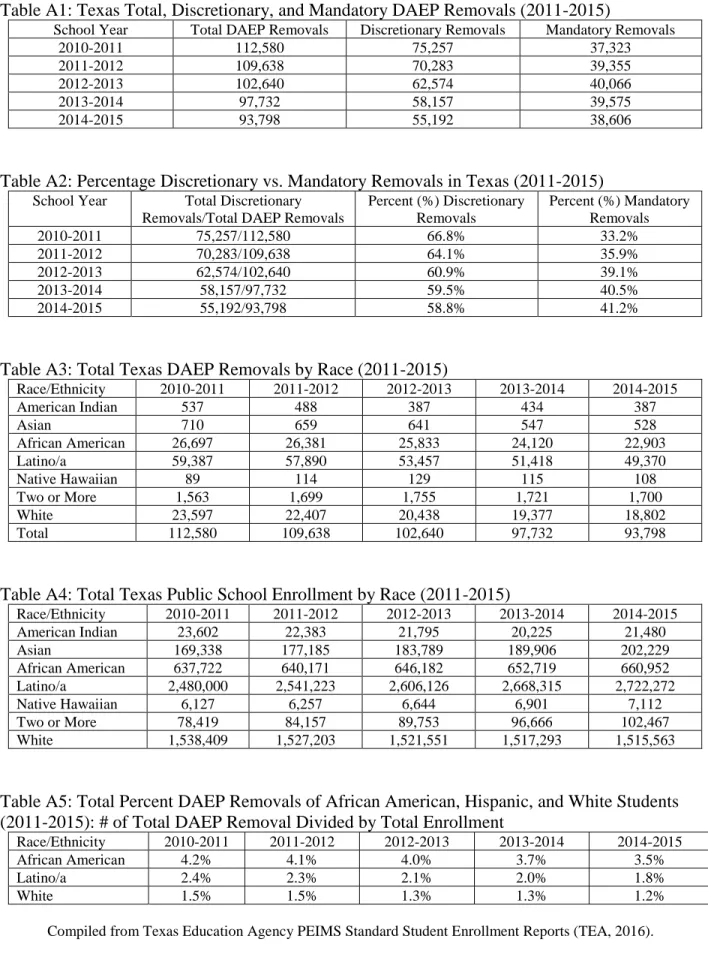
The Texas Public Education Information Management System (PEIMS) data released by Texas Education Agency (TEA), for academic years 2011-2015, confirmed the disproportionate number of students of color removed to DAEPs in comparison to their White peers. The results consistently showed that African-American students had the highest rates of removal, followed by Latino/a students. To determine these percentages from the PEIMS data, I divided the number of discretionary DAEP removals per racial group by the total number of students (in each ethnic group) enrolled in Texas public schools. The rates at which public schools
discretionarily removed students to DAEPs by race in the state of Texas, between 2011 and 2015 were 4.2%, 4.1%, 4.0%, 3.7%, and 3.5% respectively for African-American students; and 2.4%, 2.3%, 2.1%, 2.0%, and 1.8% respectively for Latino/a students. In contrast, the rates of removal of White students were 1.5%, 1.5%, 1.3%, 1.3%, and 1.2% respectively (see Tables A3, A4 &