Calhoun: The NPS Institutional Archive
Theses and Dissertations Thesis Collection
2008-03
U.S. Army Special Forces and homeland security operations
O'Connell, Douglas K.
Monterey, California. Naval Postgraduate School http://hdl.handle.net/10945/4201
NAVAL
POSTGRADUATE
SCHOOL
MONTEREY, CALIFORNIA
THESIS
Approved for public release; distribution is unlimited U.S. ARMY SPECIAL FORCES AND HOMELAND
SECURITY OPERATIONS
by
Douglas K. O'Connell March 2008
Thesis Advisor: Stanley Supinski
REPORT DOCUMENTATION PAGE Form Approved OMB No. 0704-0188
Public reporting burden for this collection of information is estimated to average 1 hour per response, including the time for reviewing instruction, searching existing data sources, gathering and maintaining the data needed, and completing and reviewing the collection of information. Send comments regarding this burden estimate or any other aspect of this collection of information, including suggestions for reducing this burden, to Washington headquarters Services, Directorate for Information Operations and Reports, 1215 Jefferson Davis Highway, Suite 1204, Arlington, VA 22202-4302, and to the Office of Management and Budget, Paperwork Reduction Project (0704-0188) Washington DC 20503.
1. AGENCY USE ONLY (Leave blank) 2. REPORT DATE March 2008
3. REPORT TYPE AND DATES COVERED Master’s Thesis
4. TITLE AND SUBTITLE U.S. Army Special Forces and Homeland Security Operations
6. AUTHOR(S) Douglas K. O'Connell
5. FUNDING NUMBERS
7. PERFORMING ORGANIZATION NAME(S) AND ADDRESS(ES) Naval Postgraduate School
Monterey, CA 93943-5000
8. PERFORMING ORGANIZATION REPORT NUMBER
9. SPONSORING /MONITORING AGENCY NAME(S) AND ADDRESS(ES) N/A
10. SPONSORING/MONITORING AGENCY REPORT NUMBER
11. SUPPLEMENTARY NOTES The views expressed in this thesis are those of the author and do not reflect the official policy or position of the Department of Defense or the U.S. Government.
12a. DISTRIBUTION / AVAILABILITY STATEMENT Approved for public release; distribution is unlimited
12b. DISTRIBUTION CODE
13. ABSTRACT (maximum 200 words)
Army Special Forces units are trained to conduct sensitive special operations including unconventional warfare, counterterrorism, direct action and strategic reconnaissance missions. Many of the unique skills and capabilities found in Special Forces units have potential applications to homeland security operations. Despite an absence of doctrine for domestic operations, Special Forces — especially Army National Guard Special Forces — are likely to be employed in future homeland security operations. This thesis examines potential homeland security missions for Special Forces. Additionally, given the unique first-responder role of the National Guard, this thesis analyzes potential policy changes needed to enhance National Guard Special Forces contributions to homeland security. The absence of doctrine for domestic Special Forces operations potentially adversely impacts Army National Guard Special Forces. Given the unique constitutionally mandated nature of the National Guard, state governors have the ability to activate their forces, including Army National Guard Special Forces, for homeland security operations. The absence of doctrine for domestic Special Forces operations can potentially lead to the misuse, overuse or illegal use of these strategic assets. Enhancing the National Guard’s capacity to correctly use Special Forces in domestic operations will enhance the country’s overall security posture.
15. NUMBER OF PAGES
91 14. SUBJECT TERMS
Special Forces, Special Operations, Special Operations Forces, Homeland Security, Homeland Defense, National Guard, Army National Guard
16. PRICE CODE 17. SECURITY CLASSIFICATION OF REPORT Unclassified 18. SECURITY CLASSIFICATION OF THIS PAGE Unclassified 19. SECURITY CLASSIFICATION OF ABSTRACT Unclassified 20. LIMITATION OF ABSTRACT UU
NSN 7540-01-280-5500 Standard Form 298 (Rev. 2-89)
Approved for public release; distribution is unlimited
U.S. ARMY SPECIAL FORCES AND HOMELAND SECURITY OPERATIONS Douglas K. O'Connell
Lieutenant Colonel, Texas National Guard
B.S., Slippery Rock University of Pennsylvania, 1987 J.D., Wake Forest University School of Law, 1994
Submitted in partial fulfillment of the requirements for the degree of
MASTER OF ARTS IN SECURITY STUDIES (HOMELAND SECURITY AND DEFENSE)
from the
NAVAL POSTGRADUATE SCHOOL March 2008
Author: Douglas O’Connell
Approved by: Stanley Supinski, Ph.D. Thesis Advisor
Colonel Brian Greenshields Second Reader
Harold Trinkunas
ABSTRACT
Army Special Forces units are trained to conduct sensitive special operations including unconventional warfare, counterterrorism, direct action and strategic reconnaissance missions. Many of the unique skills and capabilities found in Special Forces units have potential applications to homeland security operations. Despite an absence of doctrine for domestic operations, Special Forces — especially Army National Guard Special Forces — are likely to be employed in future homeland security operations. This thesis examines potential homeland security missions for Special Forces. Additionally, given the unique first-responder role of the National Guard, this thesis analyzes potential policy changes needed to enhance National Guard Special Forces contributions to homeland security. The absence of doctrine for domestic Special Forces operations potentially adversely impacts Army National Guard Special Forces. Given the unique constitutionally mandated nature of the National Guard, state governors have the ability to activate their forces, including Army National Guard Special Forces, for homeland security operations. The absence of doctrine for domestic Special Forces operations can potentially lead to the misuse, overuse or illegal use of these strategic assets. Enhancing the National Guard’s capacity to correctly use Special Forces in domestic operations will enhance the country’s overall security posture.
TABLE OF CONTENTS
I. INTRODUCTION...1
A. DESCRIPTION AND SIGNIFICANCE OF THE PROBLEM ...1
B. LITERATURE REVIEW. ...2
C. METHODOLOGY ...5
II. OVERVIEW OF U.S. ARMY SPECIAL FORCES ...7
A. CORE COMPETENCIES OF THE SPECIAL FORCES SOLDIER ...7
B. ORGANIZATION AND STRUCTURE OF SPECIAL FORCES...9
C. NATIONAL GUARD SPECIAL FORCES...10
D. CORE TASKS...11
1. Unconventional Warfare (UW) ...11
2. Foreign Internal Defense (FID) ...11
3. Direct Action (DA) ...12
4. Special Reconnaissance (SR)...12
5. Counterterrorism (CT)...12
6. Counterproliferation of Weapons of Mass Destruction (CP) ...13
7. Support to Information Operations (SIO)...13
E. COLLATERAL ACTIVITIES ...13
1. Coalition Support / Special Forces Liaison Element (SFLE)...14
2. Combat Search and Rescue (CSAR) ...15
3. Counterdrug Activities (CD)...15
4. Humanitarian Demining Activities (HD)...16
5. Foreign Humanitarian Assistance (HA) ...16
6. Security Assistance (SA)...16
7. Special Activities (SA)...17
F. SPECIAL FORCES EMPLOYMENT CRITERIA ...17
III. CASE STUDIES — U.S. SPECIAL FORCES IN HOMELAND SECURITY OPERATIONS ...21
A. FLORIDA ARMY NATIONAL GUARD HOMELAND SECURITY OPERATIONS. ...21
1. Special Reconnaissance — The Rapid Impact Assessment Team...22
2. Exemplar — Hurricane Charley — August 9-14, 2004...24
3. Special Reconnaissance — The Counterdrug Operational Detachment Alpha ...25
4. Training — Counderdrug Training Academy ...26
5. Analysis ...28
6. Special Forces Employment Criteria ...29
B. SPECIAL FORCES TASK FORCE — HURRICANE KATRINA...31
1. Search and Rescue Operations in New Orleans...34
2. Coalition Support/Special Forces Liaison Element—Law Enforcement Coordination ...36
3. Security Operations ...38
4. Analysis ...38
5. Special Forces Employment Criteria ...40
IV. LEGAL AND POLICY CONSIDERATIONS...43
A. LEGAL AND POLICY RESTRICTIONS ...43
1. Restriction on Providing Advanced Military Training to Civilian Law Enforcement ...43
2. Restriction on Providing Expert Advice ...44
3. Restriction on Direct Participation or Direct Assistance in Civilian Law Enforcement Operations ...44
4. Restriction on Collecting Information Concerning U.S. Persons..46
B. LEGAL CONSIDERATIONS UNIQUE TO THE NATIONAL GUARD...47
1. Legal Status of the National Guard...47
a. Title 10 Status — Federal Funding and Control ...47
b. Title 32 Status — Federal Funding; State Control. ...48
c. State Active Duty — State Funding; State Control. ...48
2. Mobilization / Activation Authorities...48
3. Crossing State Borders ...51
4. Fiscal Law Constraints ...51
V. POTENTIAL HOMELAND SECURITY MISSIONS FOR U.S. ARMY SPECIAL FORCES ...53
A. HOMELAND SECURITY DOCTRINAL FRAMEWORK...53
B. POTENTIAL HOMELAND DEFENSE MISSIONS. ...56
1. Random Anti Terrorism Measures (RAM)...56
2. Vulnerability Assessments / Red Teaming ...56
3. Special Reconnaissance in Support of Homeland Defense...57
4. Security Operations ...58
5. Enabling Force for National Assets Conducting Counterterrorism or Counterproliferation Missions ...59
6. Direct Action...59
C. POTENTIAL DEFENSE SUPPORT OF CIVIL AUTHORITIES MISSIONS ...60
1. Training and Advice to Interagency Partners...60
2. Humanitarian Assistance ...61
3. Special Reconnaissance for DSCA Operations ...61
4. Interagency Liaison Teams (SF Liaison Element)...62
5. Communications Support to Interagency Partners...62
6. Search and Rescue Operations ...63
VI. POLICY RECOMMENDATIONS AND CONCLUSION. ...65
A. PUBLISH DOCTRINE FOR SPECIAL FORCES HOMELAND SECURITY OPERATIONS ...65
B. AUTHORIZE AND ESTABLISH FULL-TIME NATIONAL GUARD DUTY SPECIAL FORCES DETACHMENTS ...67
C. ISSUES FOR FURTHER STUDY ...69
D. CONCLUSION ...71
LIST OF REFERENCES ...73
LIST OF TABLES
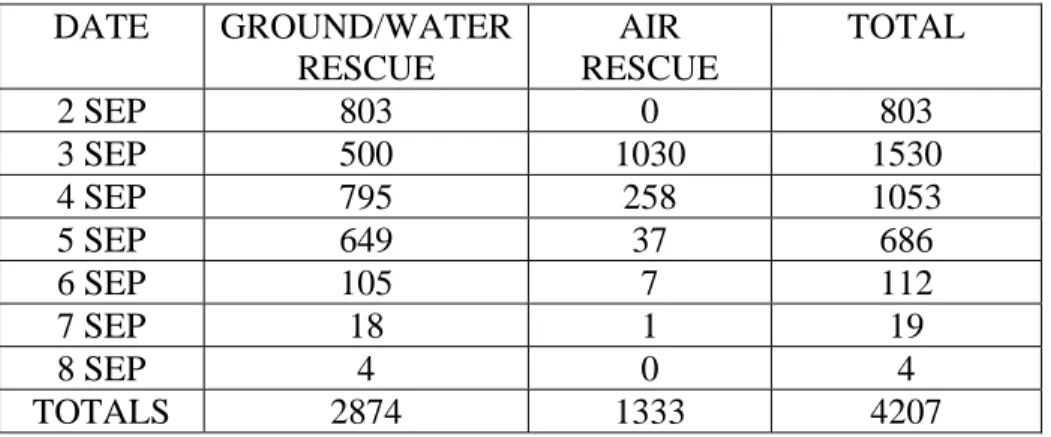
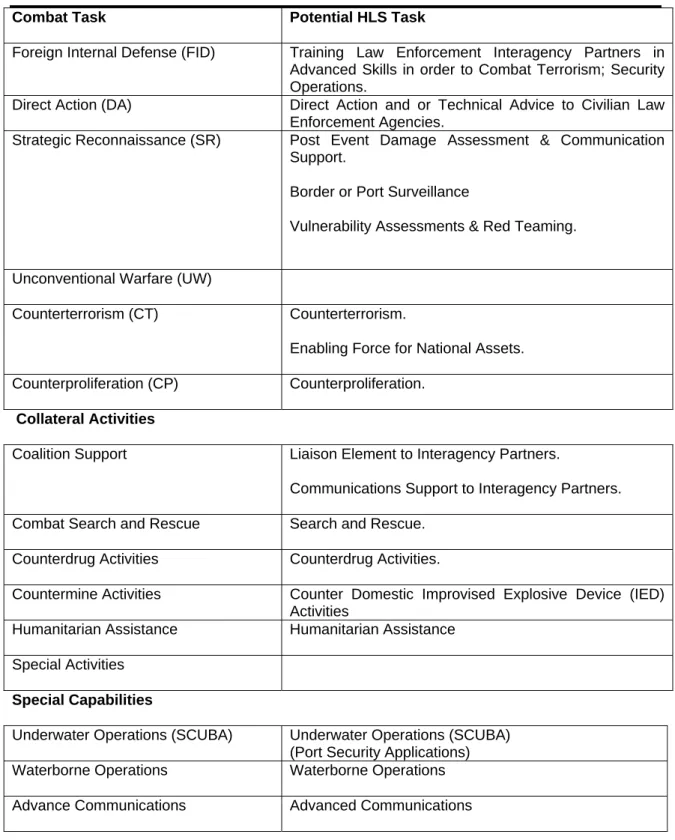
Table 1. Summary of Special Forces Task Force Search and Rescue Operations in New Orleans...35 Table 2. Potential Homeland Security Missions for Special Forces...55 Table 3. Special Forces Doctrine ...66
I. INTRODUCTION
Army Special Forces units are trained to conduct sensitive special operations including unconventional warfare, counterterrorism, direct action and strategic reconnaissance missions. Many of the unique skills and capabilities found in Special Forces units have potential applications to homeland security operations. Despite an absence of doctrine for domestic operations, Special Forces — especially Army National Guard Special Forces — are likely to be employed in future homeland security operations. This thesis examines potential homeland security missions for Special Forces. Additionally, given the unique first-responder role of the National Guard, this thesis analyzes potential policy changes needed to enhance National Guard Special Forces contributions to homeland security.
A. DESCRIPTION AND SIGNIFICANCE OF THE PROBLEM
Current doctrine for Special Forces fails to anticipate or even contemplate the use of Special Forces in domestic operations. This lack of strategic vision is apparently reinforced by a leadership emphasis that is focused solely on the use of Special Forces in the overseas war fight. Killing or capturing terrorists before they can attack the homeland is likely a defensible and prudent resource allocation; assuming that Special Forces will never conduct domestic operations, however, is a flawed proposition.
Equally troubling, the absence of doctrine for domestic Special Forces operations potentially adversely impacts Army National Guard Special Forces. Given the unique constitutionally mandated nature of the National Guard, state governors have the ability to activate their forces, including Army National Guard Special Forces, for homeland security operations. The absence of doctrine for domestic Special Forces operations can potentially lead to the misuse, overuse or illegal use of these strategic assets.
Given its dual nature as both a federal and state asset, Army National Guard Special Forces units are well situated to provide specialized capabilities in both homeland
defense and civil support operations. Enhancing the National Guard’s capacity to correctly use Special Forces in domestic operations will enhance the country’s overall security posture.
B. LITERATURE REVIEW
Very little academic literature relates to the use of Army Special Forces in homeland security operations. The modest amount of literature that does exist fails to address the use of National Guard Special Forces in Title 32 (state) status. The lack of literature may be an indication that Special Forces have not been fully integrated into homeland security planning and operations.
In April 2002, Dr. Jacquelyn Davis and Dr. Charles Perry issued a workshop report entitled Homeland Security and Special Operations, Sorting out Procedures, Capabilities, and Operational Issues.1 While the report cannot be considered literature, it does offer key insight into the views of high-level, federal policy makers. This report summarizes the consensus of the participants in a January 2002 workshop conducted by the Institute for Foreign Policy Analysis (IFPA) on behalf of the Defense Threat Reduction Agency (DTRA). Among others, the participants included the commander of U.S. Special Operations Command, the commander of U.S. Joint Forces Command, the principal deputy assistant of defense for Special Operations and Low Intensity Conflict (SOLIC), the director of operations for the Joint Staff, and the assistant to the chairman of the Joint Chiefs for National Guard matters.
The overwhelming sense of the conference participants was that, given the operational requirements of the Global War on Terror, additional homeland security responsibilities for Special Operations Forces (SOF)2 were untenable. In short, the participants felt that the optimum use of SOF warriors was not in the United States, but overseas — to go after terrorists where they live and plan their activities. According to
1 Dr. Jacquelyn K. Davis, “Homeland Security and Special Operations; Sorting Out Procedures, Capabilities and Operational Issues.” Workshop Report (April 2002).
2 The term Special Operations Forces describes active and reserve component personnel from all services ultimately assigned to the U.S. Special Operations Command. Within the Army, this includes Special Forces. See also 10 USC 167.
the workshop report, the participants did discuss, in very broad terms, the concept of using National Guard forces in Title 32 status to respond to domestic emergencies. However, it seems they did not specifically address the use of National Guard Special Forces. In fact, the report states that the participants recognized that active SOF (as opposed to reserve component forces) should be employed in order to defeat the use of weapons of mass destruction in the United States. The report also concedes that SOF may be utilized to train law enforcement and other national agencies in WMD specific-mission tasks. The only significant discussion regarding reserve component forces dealt with Army Reserve Civil Affairs units. The participants apparently did not address the significant difficulties in mobilizing and deploying Army Reserve forces (as opposed to National Guard forces) to respond to homeland security situations.
In addition, while the current doctrine for Army Special Operations Forces acknowledges the possibility of domestic operations, it neither elaborates on potential missions nor discusses the potential use of National Guard Special Forces units in a domestic capacity. For example, Army Field Manual (FM) 3-05, Army Special Operations Forces, simply notes that civil support operations are one of the four missions within full spectrum operations that Special Operations Forces (SOF) must be prepared to conduct.3
Apparent in the limited research that exists is an overwhelming bias toward Title 10 (federal) forces. Research to date fails to even contemplate the use of National Guard Special Forces for homeland security operations. For instance, the available literature includes a significant discussion on the limitations imposed on military forces via the Posse Comitatus Act (PCA).4 Stated simply, the PCA prohibits the use of federal military forces to enforce civil laws. One of the potential advantages to National Guard Special Forces, however, is the fact that the PCA is not applicable to the National Guard in Title 32 (state) status. Despite the bias toward federal forces, some literature discusses
3 Department of the Army, U.S. Army Field Manual (FM) 3-05, Army Special Operations Forces, September 20, 2006.
4 Colonel Steven G. Buteau, “The Role of Special Operations Forces in U.S. Homeland Security and Homeland Defense,” United States Army War College (March 2005).
possible roles for Special Forces.5 Since the literature is focused only on active duty, federal forces, however, the roles and potential contributions are limited. Thus far, the possible functions identified include:
• Intelligence and Early Warning. Special Forces can contribute through “Red Team” analysis. In other words, Special Forces could provide analysis from the perspective of the terrorist, and provide valuable feedback to the homeland security community.
• Vulnerability Assessments. Special Forces can assess the vulnerability of critical infrastructure sites and assist in developing tactics, techniques and procedures to defend critical infrastructure.
• Counterterrorism Operations. In extreme circumstances, Special Forces can be employed to apprehend or attack terrorists.
• Counterproliferation Operations. In the event a weapon of mass destruction is located within the United States, Special Forces could be dispatched to seize or secure the weapon.
More recently, Colonel Chris Sorenson of U.S. Northern Command “introduced the question of whether Special Operations Forces should operate in the homeland to defeat an enemy that intends to fight us on our soil.”6 This publication contemplates an improvised explosive device (IED) campaign in the homeland, and suggests that “an asymmetrical campaign in the homeland may entail the appropriate use of Special Operations Forces.”7 Colonel Sorenson further advocates that the time to determine the appropriate role for SOF in the homeland is now, before any attack. Notably, Colonel Sorenson, echoing the workshop results above, concludes that the initial reaction of civilian and military leaders will be to attempt to engage the enemy in the foreign environment, saving “its limited SOF resources to attack a presumed foreign-based center of gravity (COG).”8
5 Buteau, “The Role of Special Operations Forces,” 7.
6 Chris Sorenson, Preparing for the End Game-SOF in the Homeland? Hurlburt Field, Florida: Joint Special Operations University Press, June 2007.
7 Ibid., 1. 8 Ibid., 5.
The collected works of literature and doctrine addressing the use of Special Forces in domestic operations is almost non-existent. Therefore, researching the use of these forces for homeland security operations will make a new contribution to the body of homeland security literature.
C. METHODOLOGY
The research contained in this thesis examines potential Special Forces roles, missions and tasks for homeland security. While the potential Special Forces missions identified will be doctrinally based and thus applicable to all Special Forces, this research recognizes that given their unique nature, National Guard Special Forces are more likely to be called upon to conduct homeland security operations. First, the doctrinal missions and roles of Special Forces will be analyzed in order to determine existing capabilities of value to homeland defense and security. This is critical, considering the overwhelming demands of the Global War on Terror leave no additional training time or spare forces in which to develop new capabilities. This doctrinal framework will be applied to analyze case studies involving the use of National Guard Special Forces in homeland security operations. This result will be compared to existing policies, laws and regulations in order to determine what changes are required to facilitate an enhanced role for National Guard Special Forces in homeland security.
II.
OVERVIEW OF U.S. ARMY SPECIAL FORCES
This chapter will provide a brief overview of Army Special Forces, and will summarize some of the unique attributes that make Special Forces well suited to conduct a number of homeland security missions. In part, this chapter will attempt to explain what makes Special Forces “special.” The core competencies expected of Special Forces soldiers will be addressed, including how these competencies may be applicable to homeland security operations. Additionally, the organization and structure of Special Forces will be described in order to conceptualize how these forces might be rapidly deployed in domestic operations. Finally, this chapter will explain the core tasks and collateral activities of Special Forces.
A. CORE COMPETENCIES OF THE SPECIAL FORCES SOLDIER
Since most Special Forces soldiers serve in another military occupational specialty before becoming Special Forces, they are older and generally more mature than the average soldier. On average, it takes about a full year or more to produce a Special Forces soldier, not including basic military training or advanced Special Forces skills training. As a result of this maturity and training, more is expected from Special Forces operators than the average soldier. Every Special Forces soldier is expected to be a master of the core competencies listed in the Army field manual Special Forces Operations,9 as described below.
Warfighting. “SF soldiers are tactically competent and have advanced training in operations, intelligence, medical skills, engineering, communications, and heavy and light weapons.10” They have the capability to conduct light infantry operations unilaterally, or combined with other U.S. or allied forces.
Development of Human Infrastructure. Special Forces soldiers use locals in their area of operation to facilitate intelligence collection and to support other activities.
9 Department of the Army, Army Field Manual (FM) 3-05.20, Special Forces Operations, 2006. 10 Ibid., 1-6.
Training. Teaching and training others is a hallmark of Special Forces operations. Special Forces soldiers are expected to be fully competent to assess training requirements, plan, execute and evaluate training courses for U.S. and friendly forces.
Interagency, Joint, Combined and Multinational Operations. Special Forces operations are inherently joint and interagency affairs. SF soldiers are expected to “understand the requirements of other agencies, services or nations to accomplish the mission.”11 Ambiguous missions with conflicting agendas and goals are to be expected.
Physical Fitness. Due to the demands of operating in austere and hostile environments, Special Forces soldiers are expected to maintain high levels of fitness.
Interpersonal and Cross-Cultural Communications. Special Forces soldiers are capable of sizing up situations, building rapport and influencing people in order to obtain a desired result. Often, this relationship building will take place in foreign lands. Cross-cultural communications are essential to working with host nations or indigenous forces. Special Forces soldiers are trained to be proficient in another language targeted to their assigned area of operation. Additionally, cross-cultural communications skills and an understanding of native populations are essential to cultivating personal and professional relationships.
Problem Solving. Special Forces soldiers are conditioned to look for innovative solutions to complex problems. This “thinking outside the box” mentality is a point of pride to the Special Forces community. “SF soldiers analyze a situation and then adapt and apply doctrine, techniques, and methods in a culturally sensitive and suitable manner to resolve difficult issues in nonstandard situations.”12 By approaching challenges in a flexible manner, Special Forces soldiers more easily adapt to uncertain situations.
Clandestine Infiltration and Exfiltration. Special Forces maintain capabilities in underwater SCUBA operations, military free-fall parachuting and other specialized skill sets needed to enter or exit an area of operation without drawing attention. All Special Forces soldiers are military parachutists.
11 Department of the Army, Army Field Manual (FM) 3-05.20, Special Forces Operations, 2006 12 Ibid.
Political Awareness. Special Forces soldiers strive to understand the political implications in any given situation. They consider not only the implications to U.S. foreign policy, but also the political dynamics in the country in which they are operating.
Austere or Hostile Environments. “SF Soldiers maintain the ability to operate for extended periods in hostile, remote, and austere environments with little or no external support.”13
These core competencies, infused into a mature soldier through some of the most demanding training in the Army, produces an operator capable of using cross-cultural communications to produce results in ambiguous, austere environments. Many of these core competencies are advantageous to homeland security operations. For example, the nature of homeland security dictates that operations will take place within an interagency setting. As with any military domestic operation, political dynamics will likely impact operational realities. Within this environment, mature Special Forces soldiers, using their interpersonal skills and problem-solving abilities, can be expected to apply flexible, innovative techniques in order to accomplish the mission.
B. ORGANIZATION AND STRUCTURE OF SPECIAL FORCES
By design, Special Forces operate in small units. The basic Special Forces element is the Special Forces Operational Detachment Alpha (SFODA) or “A Team.” In military terms, the SFODA is a combined arms team, meaning multiple capabilities are found within the unit. Specifically, each twelve-man SFODA has two communications sergeants, two medical sergeants, two engineers and two weapons sergeants. Based on the extensive training they receive in the Special Forces qualification course, each of these soldiers is considered an expert in their field. Rounding out the team is an intelligence sergeant, an operations sergeant, a warrant officer and a captain who commands the detachment. These Special Forces detachments are organized into companies and, in turn, battalions and groups. Given the nature of Special Operations, however, most missions are planned and executed in a manner where the SFODA is
operating largely independent from a higher headquarters. It is very possible that the SFODA could be the only representatives of the United States in a given area. Consistent in any mission is the expectation that the SFODA will serve as a “force multiplier.” In other words, ideal Special Forces operations are designed to enable the SFODA to apply their capabilities indirectly, working through a host nation or local forces. In the unconventional warfare arena, “the primary role of SF is to advise, train, and assist indigenous military and paramilitary forces.”14 Due to the small size and limited logistical requirements, Special Forces teams are able to rapidly deploy, both domestically and during overseas combat operations. Other similarly sized conventional Army units share this advantage, but do not possess the same combined arms capabilities or advanced skills as a Special Forces detachment.
C. NATIONAL GUARD SPECIAL FORCES
Fifteen states have Special Forces within their Army National Guard force structure. Collectively, two entire Special Forces groups, fielding 108 SFODAs, reside within the Army National Guard. National Guard soldiers serving in these units complete the same Special Forces qualification course as their active duty counterparts. Like all National Guard units, Army National Guard Special Forces units assemble once a month for training. Unlike other guard units, however, Special Forces generally require a greater time commitment from guardsmen. For example, instead of a two-week annual training period, Guard Special Forces soldiers normally complete a three-week annual training period. This annual training often takes place overseas while conducting real-world missions to train military forces from allied or friendly nations. Additionally, it is not uncommon for National Guard Special Forces to perform additional duty throughout the year in order to acquire or maintain language fluency, advanced skills such as military free-fall parachuting or military SCUBA courses, or to participate in training such as the Special Forces Advanced Urban Combat course. Like all Special Forces, Army National
14 Department of the Army, Army Field Manual (FM) 3-05.20, Special Forces Operations, 2006, 1-13.
Guard Special Forces units deploy in support of the Global War on Terror. When not deployed, they remain under the command of their home state governor.
D. CORE TASKS
Seven core tasks constitute the basic functions of Special Forces. Like most all other military doctrine, the core tasks below are framed purely in terms of combat operations and do not consider domestic operations. Chapter VI details how some of these core tasks have potential homeland security applications.
1. Unconventional Warfare (UW)
UW is defined as “a broad range of military and or paramilitary operations and activities, normally of long duration, conducted through, with, or by indigenous or other surrogate forces that are organized, trained, equipped, supported, and otherwise directed in varying degrees by an external source.”15 UW operations can be conducted across the range of conflict against regular and irregular forces. These forces may or may not be state sponsored.”16 The best contemporary example of UW performed by Special Forces is the initial stages of Operation Enduring Freedom. Special Forces infiltrated into Afghanistan where they trained, advised and led Northern Alliance forces in defeating the Taliban.
2. Foreign Internal Defense (FID)
“FID is participation by civilian and military agencies of the government in any of the action programs taken by another government or other designated organization to free and protect its society from subversion, lawlessness, and insurgency.”17 Current operations in Iraq constitute a FID mission, but also have overlapping elements of other core tasks. More specifically, Special Forces are involved with organizing, training and mentoring Iraqi Special Operations elements.
15 Department of the Army, Army Field Manual (FM) 3-05.20, Special Forces Operations, 2006, 3-1. 16 Ibid.
3. Direct Action (DA)
“DA operations are short-duration strikes and other small-scale offensive actions conducted as a special operation in hostile, denied, or politically sensitive environments and that employ specialized military capabilities to seize, destroy, capture, exploit, recover, or damage designated targets. DA differs from conventional offensive actions in the level of physical and political risk, operational techniques, and the degree of discriminate and precise use of force to achieve specific objectives.”18 Killing or capturing high-value terrorist in Iraq or Afghanistan would be considered a direct action mission.
4. Special Reconnaissance (SR)
“SR operations are reconnaissance and surveillance actions conducted as a special operation in hostile, denied, or politically sensitive environments to collect or verify information of strategic or operational significance, employing military capabilities not normally found in conventional forces. These actions provide an added capability for commanders and supplement other conventional reconnaissance and surveillance actions.”19 The most often cited SR mission is the use of Special Forces during the first Gulf War to monitor and report on Iraqi troop movements in the days prior to ground combat operations.
5. Counterterrorism (CT)
“CT is the full range of operations that include the offensive measures taken to prevent, deter, preempt, and respond to terrorism. There are three categories of CT operations: hostage rescue, recovery of sensitive material from terrorist organizations, and attacks against terrorist infrastructure.”20
18 Department of the Army, Army Field Manual (FM) 3-05.20, Special Forces Operations, 2006. 19 Ibid., 3-2.
6. Counterproliferation of Weapons of Mass Destruction (CP)
CP may involve the seizing of weapons of mass destruction at their origin, during transport or at any other time before employment. This is a highly “specialized mission assigned to designated Special Operations Forces. Special Forces participation in CP is through the conduct of UW, SR, and DA. Special Forces operational detachments designated in national and theater contingency plans to participate in CP may be specially task organized, trained, and equipped. These designated Special Forces operational detachments respond as directed by the president, secretary of defense, or the geographic combatant commander to resolve specific situations arising from a proliferation incident. When a SFOD is tasked to perform a CP mission, it is strategic in nature.”21
7. Support to Information Operations (SIO)
“SF supports IO core capabilities of electronic warfare, computer network operations, psychological operations, military deception, and operations security, in concert with specified supporting and related capabilities, to affect or defend information and information systems, and to influence decision making.”22
E. COLLATERAL ACTIVITIES
Historically, in addition to the core tasks, Special Forces perform collateral activities, many which have homeland security applications. The most recent version of
Special Forces Operations, the principal doctrinal guidance for SF, omitted any discussion of collateral activities.23 Previous versions, as recent as June 2001, made it clear that the collateral activities discussed below were designed primarily for military operations other than war (MOOTW) and take advantage of the core competencies of Special Forces. “SF units conduct collateral activities in MOOTW using these inherent capabilities in performing their primary missions.”24 The current version of Special
21 Department of the Army, Army Field Manual (FM) 3-05.20, Special Forces Operations, 2006. 22 Ibid.
23 Ibid.
Forces Operations does not appear to limit SF missions to the core task. Rather, this doctrinal change appears to reflect the contemporary operating environment and demands of the Global War on Terror (GWOT). In other words, Special Forces are currently committed conducting GWOT missions related to their core tasks, and thus a doctrinal discussion of collateral activities is irrelevant. Professors David Tucker and Christopher Lamb discuss this omission in their recent book, United States Special Operations Forces.25 In fact, Professors Tucker and Lamb suggest that the omission of collateral tasks relates to issues of supply and demand, and trace a trend toward expanding the domestic use Special Operations Forces prior to September 11, 2001.26 As previously noted, however, all military doctrine is active component oriented; National Guard Special Forces will be used, at a minimum, by governors for state homeland security operations — if not as a broader, regional response force. Traditionally, Special Forces collateral activities included coalition support, combat search and rescue, counterdrug activities, humanitarian demining activities, foreign humanitarian assistance, security assistance and special activities.27 These same collateral activities are some of the most likely homeland security missions for Special Forces; whether active component or National Guard. Chapter VI discusses how these collateral activities may be utilized in domestic operations.
1. Coalition Support / Special Forces Liaison Element (SFLE)
This mission is designed to improve “the interaction and interoperability of coalition partners and U.S. military forces” during combat operations.28 Special Forces are embedded with foreign armies in the combat theater and assist the coalition partner
with communicating and synchronizing with adjacent U.S. forces. “SF personnel are well-suited for carrying out coalition support because of the skills they hone in the conduct of UW
25 David Tucker and Christopher J. Lamb, United States Special Operations Forces, New York: Columbia University Press, 2007, 164-168.
26 Ibid., 165. 27 Ibid.
operations, and because of their regional orientation and cultural awareness.29 The Special Forces Liaison Elements “advise their foreign counterparts on U.S. military intentions and capabilities, provide training, provide global positioning system downlinks, and secure communications between the supported forces.”30
2. Combat Search and Rescue (CSAR)
Combat Search and Rescue consists of “reporting, locating, identifying, and recovering and repatriating isolated personnel to friendly control.”31 During combat operations, Special Forces have the capability to conduct CSAR due to their expertise in the core SF tasks.32 Similarly, during homeland security operations, specifically DSCA events, Special Forces can provide teams to conduct search and rescue. Since most all Army formations can conduct rudimentary search and rescue, SF are best utilized for missions requiring specialized skills, such as operating in a maritime environment in boats or subsurface (SCUBA), wilderness or mountainous terrain requiring mountaineering skills, or situations where rapid deployment of small teams with organic communications equipment is advantageous.
3. Counterdrug Activities (CD)
“CD activities are measures taken to detect, monitor, and counter the production, trafficking, and use of illegal drugs.”33 For Special Forces, this generally means training a foreign nations’ military, or police forces, on critical skills required to conduct small unit CD operations in order to stop narcotics at their source, or before they enter the United States.34
In domestic operations, National Guard Special Forces may take a more direct role by
conducting SR in support of civilian police narcotics investigations. (see infra).
29 Department of the Army, Army Field Manual (FM) 3-05.30, Special Forces Operations, 2001. 30 Ibid.
31 Ibid. 32 Ibid. 33 Ibid. 34 Ibid.
4. Humanitarian Demining Activities (HD)
Special Forces are sometimes employed to train host nation cadre in techniques to locate, identify, and destroy land mines and unexploded battlefield ordinance from previous conflicts. The Special Forces core competencies of training and cross-cultural communications make SF a logical choice for this mission. As previously noted, however, the operational demands of prosecuting the Global War on Terror have likely made this mission unfeasible for Special Forces.
5. Foreign Humanitarian Assistance (HA)
Foreign HA involves the use of military “personnel, equipment, and supplies to promote human welfare; to reduce pain, suffering, and hardship; and to prevent loss of life or destruction of property from the aftermath of natural or man made disasters.”35 Special Forces are “uniquely suited to render rapid, effective HA in remote areas, particularly in an uncertain or hostile environment.”36 Likewise, in the domestic realm, “ability to deploy on short notice to remote regions, familiarity with multi-agency operations, and limited logistics support requirements, all favor SF involvement in disaster relief operations.”37
6. Security Assistance (SA)
Security assistance missions are designed to enhance the capabilities of allied or friendly countries in order achieve U.S. goals in the particular area or region. The primary role of SF is to provide mobile training teams and other forms of training assistance tailored to meet the specific requirements of the nation requesting the assistance. The training provided by Special Forces may be to the host nation’s military, police or other governmental agency. Training interagency partners, especially civilian law enforcement agencies, is the domestic, homeland security corollary to foreign
35 Department of the Army, Army Field Manual (FM) 3-05.30, Special Forces Operations, 2001. 36 Ibid.
security assistance missions. Special Forces can train civilian law enforcement agencies in order to enhance their ability to prevent, disrupt and respond to terrorist and terrorist attacks.
7. Special Activities (SA)
SA missions are classified operations performed at the direction of the president, with congressional oversight. Generally, the legal parameters are defined by Executive Order 12333, United States Intelligence Activities. “When directed by the President, the Department of Defense performs special activities during war declared by Congress or during any period covered by a Presidential report under the War Powers Act.”38
F. SPECIAL FORCES EMPLOYMENT CRITERIA
Special Operations Forces, including Army Special Forces, conduct two types of tasks. “First, they perform tasks that no other forces in DoD conduct, and second, they perform tasks that are conducted by DoD forces, but do so to a unique set of conditions and standards.”39 Special Operations Forces are small in number and cannot be mass produced. Considering the time and resources involved in producing special operators, mission criteria attempts to prevent the misuse of Special Operations Forces. In short, the doctrinal criteria discussed below attempts to provide a checklist in order to assist commanders in determining if some other element rather than Special Forces should be conducting the mission. If conventional forces possess the capability to conduct the mission, then the proposed mission is not generally considered appropriate for Special Forces. Likewise, in order to avoid mission failure due to the assumption that Special Forces can do anything, the criteria attempts to force a realistic comprehension of the inherent limitations found in Special Forces units. While the doctrinal mission criteria below are designed to evaluate proposed missions during combat operations, the framework is still applicable in homeland security scenarios.
38 Department of the Army, Army Field Manual (FM) 3-05.30, Special Forces Operations, 2001. 39 Special Operations Forces Reference Manual, Joint Special Operations University (JSOU), Hurlburt Field, Florida: The JSOU Press, June 2005 (Revised July 2006), 1-3.
Criteria for Employing Special Forces
Current military doctrine dictates specific criteria to evaluate if a mission is suitable, feasible and acceptable for Special Forces.
1. Is this an appropriate mission for Special Forces? In other words, does the proposed mission require Special Forces unique skills and abilities in order to produce the desired effect? Normally, Special Forces are arrayed against vital strategic or operational targets. “Commanders should not use Army Special Operations Forces as a substitute for other forces.”40
2. Does the mission support the theater campaign plan? “If the mission does not support the theater campaign plan, more appropriate missions are probably available for Army Special Operations Forces.”41
3. Is the mission operationally feasible? Is the proposed mission realistically within the capabilities of Special Forces? “Army Special Forces are not structured for force on force warfare. They should not assign missions that are beyond SOF capabilities, limitations, and vulnerabilities.”42
4. Are the required resources available to conduct the mission? Due to the small size of Special Forces units, some missions may require support from conventional forces.
5. Does the expected outcome justify the risk? Commanders must recognize the “high value and limited resources of Army Special Operations Forces.”43 These factors must be weighed against any proposed mission to ensure the potential strategic or operational gain is balanced against the risk of any proposed mission. The risk may involve negative impact to U.S. diplomatic or political interest.44
40 Department of the Army, U.S. Army Field Manual (FM) 3-05.20, Special Forces Operations, 2006, 1-14.
41 Ibid. 42 Ibid. 43 Ibid. 44 Ibid.
Employment Criteria Applied to Homeland Security Missions
As the case studies below demonstrate, Army Special Forces, particularly National Guard Special Forces, will be employed in homeland security missions. Like any military mission, therefore, the potential exists for the misuse of Special Forces. The domestic use of military forces, especially in an armed role, is extremely politically sensitive. Given that fact, a mission that would normally be assigned to a conventional force unit may be suitable for Special Forces. However, considering the small size of Special Forces, performing routine security force missions is unrealistic. Likewise, the limited resources found in Special Forces, especially in terms of vehicles, may render Special Forces unsuitable for certain homeland security missions. Thus, as demonstrated below in the case studies, the employment of Special Forces in homeland security missions, like combat operations, should be limited to missions that require specialized capabilities, or missions undertaken in unique environments or where precise standards are required.
III.
CASE STUDIES — U.S. SPECIAL FORCES IN HOMELAND
SECURITY OPERATIONS
This chapter highlights two examples of Special Forces support to homeland security. The first case study examines how the Florida Army National Guard uses Special Forces in domestic operations. The second example, from Hurricane Katrina, describes what could be Special Forces’ finest hour in terms of domestic operations. In each case study, the uses of Special Forces are analyzed and evaluated against the doctrinal employment criteria for Special Forces.
A. FLORIDA ARMY NATIONAL GUARD HOMELAND SECURITY
OPERATIONS.
The Florida Army National Guard provides a good example of potential homeland security roles and missions for Special Forces. The National Guard leadership in Florida utilizes its Army National Guard Special Forces for both domestic special reconnaissance missions and for training interagency law enforcement partners. Florida also uses Special Forces to conduct search and rescue. However, this case study will focus on special reconnaissance and training. The Hurricane Katrina case study below describes search and rescue operations.
Florida is the home to the 3rd Battalion, 20th Special Forces Group (Airborne). The Florida Army National Guard force structure contains the 3rd Battalion Headquarters, the Battalion Support Company and two Special Forces line companies. Florida’s experience with hurricanes has required the National Guard to take an active role in civil support operations. Florida also contends with floods, tropical storms, wildfires and other natural disasters requiring National Guard support.45 Additionally, like other states, Florida conducts National Guard counterdrug support operations. Unlike other states, however, Florida executes a large part of their counterdrug support mission as a Special Forces operation.
45 Florida Division of Emergency Management. http://www.floridadisaster.org/index.asp (accessed December 2, 2007).
Consistent with doctrine for combat operations, during emergency or contingency operations, the Special Forces personnel are maintained as a strategic asset managed by the Florida National Guard Joint Force Headquarters, rather than assigned to a subordinate task force.46 Special reconnaissance is one of the primary missions assigned to SF by the Florida National Guard Joint Force Headquarters.
1. Special Reconnaissance — The Rapid Impact Assessment Team
Florida’s National Guard Special Forces are fully integrated into all-hazards planning through Florida Emergency Support Function (ESF) 13 – Military Support. Specifically, Florida’s ESF 13 directs the Florida Adjutant General to field Rapid Impact Assessment Teams (RIAT) in direct support of the Division of Emergency Management.47 “The RIAT teams deploy prior to a disaster, when possible, or immediately following a disaster.” 48 “The Rapid Impact Assessment Team (RIAT) concept was developed by the State of Florida in the aftermath of Hurricane Andrew.”49 Andrew stuck South Florida on August 24, 1992, and resulted in one of the worse natural disasters in U.S. history.50 “The mission of the RIAT team is to rapidly mobilize and deploy to a disaster area and jointly, with local officials, determine and report immediate victim needs (food, water, shelter, medical, security) and assess and report the associated loss of, or damage to supporting infrastructure (utilities, communications, transportation, medical facilities, emergency services) following a major or catastrophic disaster.”51 The RIAT mission is an interagency operation. The actual mission is conducted under the authority of the Florida Department of Emergency Management.52 Team members come
46 John Pelleriti, Lieutenant Colonel, Assistant Operations Officer, J3, Florida National Guard Joint Force Headquarters. Interview by author, December 3, 2007.
47 Florida Comprehensive Emergency Management Plan 2004, Appendix XIII: Emergency Support Function 13 – Military Support. February 1, 2004, 2.
48 Ibid.
49 Florida Army National Guard, Special Forces Missions.
http://www.floridaguard.army.mil/careers/sf.aspx?id=46 (accessed December 3, 2007). 50 Ibid.
51 Ibid. 52 Ibid.
from the Florida Army National Guard Special Forces Battalion and other governmental agencies.53 The Florida Special Forces soldiers excel at Defense Support to Civil Authorities in large part due to their abilities to build rapport in the interagency environment.54 For example, SF soldiers work hand in hand with the Florida State Fire Marshal’s office — specifically, personnel from the State Bureau of Fire Prevention — when assigned to RIAT teams.55 “Upon activation, these personnel report to a pre-designated staging area and report to a team leader from the Florida National Guard” (SF Personnel).56 The interagency RIAT responsibilities of the fire marshal’s personnel include “assessing and evaluating the status of emergency services such as fire apparatus, fire stations and facilities, personnel and needs assessment associated with the fire service in a stricken area.”57 The fire marshal personnel anticipate deployments of up to 96 hours in length.”58 “The ability of Special Forces personnel to rapidly deploy by aircraft or other means is the key to accomplishing the RIAT mission.”59 “Special Forces personnel employ high-frequency and satellite communications devices to establish and maintain communication during the mission.”60 “This allows the rapid, “real time” reporting on the ground conditions at the disaster or emergency site.”61 In addition to the communications specialist found on a Special Forces detachment, the engineers and medics can also provide expertise to the interagency venture. Likewise, the overall capabilities of the Special Forces detachment provide security for the collective RIAT team during contingency and emergency operations.
53 Florida Army National Guard, Special Forces Missions. 54 Pelleriti, Interview by author, December 3, 2007.
55 Florida State Fire Marshal. http://www.fldfs.com/sfm/esf/esf49.htm (accessed December 3, 2007). 56 Ibid.
57 Ibid. 58 Ibid.
59 Florida Army National Guard, Special Forces Missions.
http://www.floridaguard.army.mil/careers/sf.aspx?id=46 (accessed December 3, 2007). 60 Ibid.
2. Exemplar — Hurricane Charley — August 9-14, 2004
Hurricane Charley struck the Southwest coast of Florida as a category 4 hurricane on August 13, 2004. 62 “The hurricane traversed the Florida peninsula, resulting in a swath of destruction across the state.”63 Charley’s 75 knot winds caused an estimated $6.755 billion in damages in Florida.64 At least nine people in Florida died as a direct result of Hurricane Charley, in addition to another twenty deaths in Florida indirectly caused by the hurricane.65 This was the worst hurricane to hit Florida since Hurricane Andrew in 1992.66 By 7:00 a.m. on the morning of August 14, a RIAT team under the leadership of National Guard Special Forces, and consisting of state interagency communications officials and others deployed to the impact area in Charlotte County, Florida, to assess the severity of Charley’s impact. 67 In Charlotte County alone, four fire stations were destroyed; three hospitals were knocked out of service, while two airport hangers, the county emergency operations center and two shelters were destroyed.68 Five additional reconnaissance teams comprised of National Guard Special Forces soldiers deployed in the aftermath of Charley.69
62 Richard J. Pasch, Daniel P. Brown, and Eric S. Blake, National Weather Service, National Hurricane Center Tropical Cyclone Report. Hurricane Charley. October 18, 2004, Revised January 5, 2005.
63 Ibid. 64 Ibid. 65 Ibid. 66 Ibid.
67 Hurricane Charley Situation Report # 7. Florida State Emergency Response Team, State Operations Center, August 14, 2004, and State Operations Center Briefing Slides, August 13, 2004.
68 Ibid. 69 Ibid.
3. Special Reconnaissance — The Counterdrug Operational Detachment Alpha
Each state’s National Guard is congressionally authorized to provide counterdrug support to civilian law enforcement agencies.70 This program “provides skilled personnel, specialized equipment, and facilities to support law enforcement agencies and community-based programs in response to the drug threat.”71
At least two of the program areas within the counterdrug program are ideally suited for Special Forces: Reconnaissance/Observation and Subsurface/Diver Support. The reconnaissance mission involves
observation by land or water to detect and report illegal drug activities that include, but are not limited to, cultivating marijuana, suspected isolated drug trafficking airstrips, drug drop zones, drug trafficking corridors, illegal laboratories, suspicious aircraft, watercraft or motor vehicles.72
Since successful reconnaissance and/or observation is often dependant on concealment, many of the tactics, techniques and procedures employed in Special Forces Special Reconnaissance missions are used in this program. The ability to report the activity at the target site is a critical component of both SF Special Reconnaissance missions and the counterdrug ground reconnaissance program. Similarly, the Subsurface/Diver Support mission is designed to conduct “inspections of commercial vessel hulls within the U.S. territorial waters or U.S. maritime ports of entry (POE) through the use of sidescan radar or divers to detect alien devices or containers attached to the vessel hulls, or other underwater activities.”73 Since Special Forces units include combat divers, it was only logical for Florida to turn to Special Forces to conduct this underwater special reconnaissance mission.
70 32 USC 112.
71 Joint Chiefs of Staff, Joint Counterdrug Operations, Joint Publication 3-07.4. (Washington, DC: Joint Chiefs of Staff, June 13, 2007), II-19 [Publication on-line]; available from
http://www.dtic.mil/doctrine/jpoperationsseriespubs.htm (accessed December 1, 2007).
72 National Guard Bureau, National Guard Counterdrug Support, National Guard Regulation 500-2/Air National Guard Instruction 10-801 (Arlington, VA: Secretaries of the Army and Air Force), 10
http://www.ngbpdc.ngb.army.mil/pubs/500/ngr500_2.pdf (accessed December 1, 2007). 73 Ibid.
The Florida National Guard apparently has recognized these critical similarities and has organized their counterdrug reconnaissance and dive program around a “Counterdrug Operational Detachment Alpha,” mirroring the standard configuration of a SF Detachment.74 This unit is made up of Special Forces soldiers, who volunteer for full-time National Guard duty in addition to their traditional National Guard unit requirements.75
Florida’s Counterdrug Operational Detachment Alpha (CDODA) has conducted successful dive operations in support of civilian law enforcement since 1990.76 For example, in December 2005, members of the Florida National Guard CDODA conducted a week-long dive operation in support of the U.S. Customs and Border Protection Agency. The mission was to search “cruise and cargo ships’ bottoms for parasitic devices used to transport illegal drugs into the United States.”77 The counterdrug dive operation was an interagency operation that allowed the SF soldiers to work with Customs and Border Protection, the Florida Fish and Wildlife Commission and Miami Dade firefighters.78
4. Training — Counderdrug Training Academy
Florida’s Special Forces soldiers also conduct training for civilian law enforcement training under the auspices of the counterdrug program. As previously discussed, training other military, paramilitary or law enforcement agencies is a core competency of Special Forces. The curriculum is “designed to teach military skills to law enforcement officers so that they may more safely and efficiently conduct
74 Shawn Keen, Master Sergeant, Detachment Operations Sergeant, Counter Drug Operational Detachment Alpha, Florida National Guard Joint Force Headquarters. Interview by author, December 4, 2007.
75 Keen, Interview.
76 National Guard Bureau, The Catalyst, Second Quarter 2006 (Arlington, VA: Secretaries of the Army and Air Force).
77 Ibid. 78 Ibid.
counterdrug operations in demanding rural environments.”79 The training academy is located at the Camp Blanding Military Reservation. Camp Blanding is a state-owned military facility encompassing 72,000 acres in Northeast Florida.80 The training courses currently conducted by the Florida Counterdrug Training Academy include:81
Tactical Three-Gun Marksmanship. During a five-day program, police officers receive instruction on pistol, shotgun and carbine marksmanship. This course is designed for SWAT officers, but is open to all law enforcement officers. The training includes both classroom instruction and live-fire ranges.
Rural Operations. This course is conducted in either a “basic” or “advanced” format and is designed for law enforcement officers working in rural environments. The rural operations course includes training in land navigation, tracking and countertracking, booby traps, camouflage, movement techniques and mission planning. The course concludes with a practical exercise in the field.
Maritime Operations. Designed to teach law enforcement officers to conduct operations on or in maritime environments, this course is conducted over a five-day period. Class subjects include: Zodiac boat driving, beach landings, water survival, surface swimming, maritime hazards, harbor surveillance, and helo-cast operations.
Tactical Medic. “This course is specifically designed for EMTs or paramedics assigned or attached to tactical teams.” The instruction includes combat casualty care, field medicine, medical evacuation, tourniquets, and decompression.
79 Florida National Guard Counterdrug Training Academy, “Course Descriptions,” available from http://www.floridacounterdrug.com/fcta/fcta_home.htm (accessed December 3, 2007).
80 Florida National Guard, Training Sites. Available from
http://www.floridaguard.army.mil/read.asp?did=539 (accessed December 3, 2007). 81 Florida National Guard, Florida Counterdrug Training Academy.
In addition to the standard courses discussed above, the Florida Counterdrug Training Academy offers custom-designed courses for law enforcement agencies.82 Like all other aspects of the counterdrug program, a nexus must exist between the training and narcotics enforcement.83
5. Analysis
This case study demonstrates a limited, but almost ideal usage of Special Forces in domestic operations. The Florida National Guard’s pattern and practice adheres closely to Army doctrine, despite the dearth of specific domestic operational doctrine. When employed, the Special Forces are used in a manner that parallels and complements their wartime missions. These tasks do not drain precious resources or training time away from training for wartime or federal missions. Florida utilizes Special Forces in operations playing to the strengths of Special Forces. Not only does the Florida National Guard employ Special Forces to conduct the core SF task of special reconnaissance, but, by maintaining control of their Special Forces elements at the Joint Force Headquarters level, they ensure this versatile asset is engaged at the strategic or operational level of domestic operations as intended. Likewise, leveraging Special Forces to conduct training of interagency law enforcement partners takes advantage of a core competency of Special Forces. The training curriculum exploits the skills and capabilities of Special Forces soldiers. For example, all SF soldiers have significant experience operating in rural environments prior to graduating from the Special Forces Qualification Course. Special Forces weapons sergeants are trained to be proficient in small arms used in this training program. Likewise, Special Forces combat divers are adept at conducting the skills covered in the maritime operations course, and Special Forces medical sergeants possess the skills required to instruct the tactical medic course. Further, by training interagency law enforcement partners, Florida not only enhances interagency relationships, but they
82 Florida National Guard Counterdrug Training Academy, “Course Descriptions.” 83 32 USC 112.
serve to multiply the overall state homeland security capabilities. This training role may have the additional benefit of minimizing the necessity of using National Guard forces in a law enforcement role.
6. Special Forces Employment Criteria
While the doctrinal employment criteria is designed to evaluate potential wartime combat operations, an examination of Florida’s use of Special Forces may still be helpful in determining the proper roles and missions for Special Forces in domestic operations. The evaluation below discusses each of the five employment criteria for Special Forces.
Is this an appropriate mission for Special Forces? In other words, does the proposed mission require Special Forces unique skills and abilities in order to produce the desired effect?
• As discussed herein, Special Forces are ideally suited for the missions assigned by the Florida National Guard. The SF soldiers bring a rapid response and specialized skills sets that complement interagency partners. The familiarization with interagency environments, and emphasis on rapport building found in Special Forces, enable these domestic missions. In addition, since training others is a core capability for Special Forces, they are ideally suited to conduct training for law enforcement agencies. This training may save lives or, at a minimum, enhance interagency operations during actual times of crisis.
Does the mission support the theater campaign plan?
• Florida’s use of Special Forces to conduct special reconnaissance in emergency and contingency operations is in support of the Florida Comprehensive Emergency Management Plan. Likewise, federal law requires governors submit an annual state drug interdiction and
counterdrug activities plan before any federal funds may be used to place National Guard service members on counterdrug duty.84
Is the mission operationally feasible? Is the proposed mission realistically within the capabilities of Special Forces?
• In the case at hand, assuming the SF battalion is not deployed for an overseas, federal mission, the Florida Special Forces units have the capability to accomplish special reconnaissance during most emergency and contingency operations. Given a weapon of mass destruction (WMD) event, a more technical reconnaissance would be required from the state’s National Guard Civil Support Team.85 Both the counterdrug and training missions require SF personnel willing to volunteer to perform full-time National Guard duty. With these limitations in mind, it is fair to say that the domestic missions contemplated here are feasible for Special Forces.
Are the required resources available to conduct the mission?
• With the exception of vehicles, the organic equipment normally assigned to a Special Forces company is sufficient to undertake most domestic special reconnaissance missions. Tactical, high-mobility vehicles may be required for some missions. While not organic to a Special Forces company, these vehicles are found at the Special Forces battalion level. In any event, these could be temporarily allocated from another National Guard unit if unavailable to Special Forces. Experience has shown, however, during some maritime operations, normal watercraft assigned to Special Forces is inadequate. Florida has augmented the rubber tactical
84 32 USC 112(C).
85 For information on the National Guard Civil Support Team, See: