WPx>s
11
4
(o
Policy Research'WORKING PAPERS"
L
Poverty and Human ResourcesPolicy Research Department The World Bank
June 1993 WPS 1146
Is Poverty Increasing
in the Developing World?
Shaohua Chen
Gaurav Datt
and
Martin Ravallion
New data suggest that the aggregate number of poor is increasing at roughly the rate of population growth. Poverty measures are highest in either South Asia or Sub-Saharan Africa, depending on the poverty line used. The only regions with falling poverty measures are South and East Asia.
Public Disclosure Authorized
Public Disclosure Authorized
Public Disclosure Authorized
I ~~Policy Research
WPS 1146
This paper - a product of the Poverty and Human Resources Division, Policy Research
Department-is part of a larger effort in the department to monitor progress in reducing poverty in the developing world. Copies of the paper are available free from the World Bank, 1818 H Street NW, Washington, DC 20433. Please contact Patricia Cook, room S 13-064, extension 33902 (June 1993, 41 pages).
Chen, Datt, and Ravallion assess the developing They find that the incidence of aggregate world's progress in reducing absolute-consump- poverty changed little. The number of poor tion poverty during 1981-91, using new data on increased at the rate of population growth. The the distribution of household consumption or region with the greatest aggregate poverty is income per capita for 40 countries (at two points either South Asia or Sub-Saharan Africa, de-in time for 18 of the countries). They apply pending on the poverty line used.
dominance tests to the distributions after
adjust-ing to purchasadjust-ing-power parity. The experience was diverse across regions and countries. The only regions with falling poverty measures are South and East Asia.
The Policy Research Working PaperSeries disseminates the fndings of work under way in theBank. An objective oftie series is to get these findings out quickly, even if presentations are less than fully polished. The findings, interpretations, and
Is Poverty Increasing In the Developing
World?
Shaohua Chen, Gaurav Datt, and Martin Ravallion World Bank
1 Introduction
The question in our title is surprisingly difficult to address convincingly from existing data sources, not least because little effort has gone into compiling and analyzing the available distributional data on a reasonably comparable basis.' Yet the need to do so is evident, both to help monitor progress in reducing poverty, and as a first step toward understanding the causes and offects of changing distribution.
This paper offers an assessment of progress In reducing aggregate poverty during the 1980s using a consistent compilation of recent distributional data, done for this purpose. This is of interest in its own right - particularly given that the 1980s have been a difflcult decade for much of the developing world - but it also offers hope of laying a reasonably firm foundation for future poverty monitoring.
While estimates of various poverty measures are available from numerous studies at the country level, we do not use them here. The main difference between our estimates and those available in the literature is undoubtedly our attempt to use the same real poverty line across
countries (though allowing that line to span a wide range). Past work at the country level has naturally used poverty lines appropriate to each country. There is, however, a marked tendency for the real value of local poverty lines to increase with the average income of a country
(Ravallion et al., 1991). This fact clouds attempts to compare and aggregate across countries using the poverty data available in standard (secondary) sources. Why should one treat two individuals with an identical standard of living (by some agreed measure) differendy according to where they, happen to live? Here we turn instead to the primary data sources and re-esdmate all poverty measures on a consistent basis.
However, the comparability of distributional data across countries and over time remains an issue. Household-survey methods differ, and there are difficulties in comparing monetary units over time and space. We do not pretend to solve all these problems here, though improvements in data and methods allow us to address some. For exnample, the UN's
International Comparisons Project has greatly improved our knowledge about differences In the consumption purchasing-power of incomes denominated in local currencies. Also, there has been substantial improvement and standatdization in household-survey methodologies over the last decade or so; the comparability problems that have plagued interpretations of the data from
1950-1970 are still there, but are almost certainly less worrying. Nonetheless, we shy away from comparing our results with those in the various compilations done 20-plus years ago (Paukert,
1973; Jain, 1975). The long-term comparison is certainly of interest. However, to do so convincingly would be a major under-taking. Here we confine ourselves solely to the short-tenn comparison over the 1980s, for which data are of higher quality, and we can at least iron out some of the comparability problems by screening potendal data sources, and estimating consistently from the available source-data at the country level.
Quite possibly the best way to avoid the pitfalls arising from differences in survey
methods, and effors in price data, is to aggregat across countries. Thus we focus mainly on our aggregt results here. However, we will risk making a limited regional disaggregation of our results, and we do present our estimates for individual countries in an Appendix, with relevant details on the differences between the surveys we have used. Ihis will help readers form their own judgemnnts about the comparability problems, and (if deemed desirable) to fiuther screen results for some countries in forming regional or global aggregates.
In the following section we review the methodological issues, and the strengths and drawbacks of the approach we have adopted. Section 3 presents our new estimates of the
cumulative distribution of consumption around 1985-90. Our conclusions are found in section 4.
2 Methodological issues
International comparisons of poverty statistics are plagued with both conceptual and practical problems. There are comparability problems across countries in the underlying household surveys, though these problems are becoming less worrying over time, as survey methodologies are both improving and becoming more standardized, particularly under the auspices of the development agencies.2 All of the primary data sets used here are nationally representative household surveys and use the same living standards indicator - either expenditure or income per person - over time. For the income-based surveys, we re-scale the mean
according to national-accounts data on the average propensity to consume. In cases where we know of a serious comparability problem between two surveys for the same country, we have d.eleted one. in all cases we have estimated poverty Incidence from the primary data source (tabulations or household level data), rather than relying on existing estimates. We end up with a data set covering 40 countries between 1981 and 1991, 18 of which have observations for two points in time witiin this period. The data set is considerably expanded over the 22 country data set used in Ravallion et al. (1991), though otherwise the methodology is consistent.' This
2.1
Internadonal
comparlsons
of povery
Comparisons of 'absolute poverty' should ideally use a poverty line which Is fixed in terms of the living-standards indicator being used.' It Is not clear what meaning can be attached to absolute-poverty comparisons across countries in which the real value of the poverty line varies widely. Yet that is almost certainly the case In the poverty statistics reported In standard sources, including the various issues of Social Indicators of Develogment (for example, World Bank, 1992a), the HuMan Develome Report (for example, UNDP, 1991), and the
compendium of estimates from diverse secondary sources by Tabatabal and Fouad (1993) (for the 1LO). The potential anomalies are plain. We give two examples: i) Tyler et al. (1993) quote and compare estimates from existing sources indicating far higher poverty incidence in Brazil than India, although at a constant real poverty line the reverse Is almost certaiWy true [Datt and Ravallion (1992)1. ii) If one were to rely on the official poverty estimates for (say) the U.S.A. and Inonesia one would conclude that the proportion who are poor around 1990 is about the same, namely 15% in each. But it Is plainly the case that at any given real poverty line -constant in terms of the goods and services that it allows one to command - the proportion who are poor is higher in Indonesia.
Confining attention to developing countries, it might be argued that an adequate degree of comparability I assured by the fact that local poverty lines are (typically) anchored to a similar nutritional cut-off point; a food-energy intake around 2100 calories per person per day is
common. However, the common methodologies used to map the caloric cut-off point into the consumption or income space do not assure that the resulting poverty lines are comparable in terms of command over (say) basic consumption needs (Ravallion, 1993a; Ravallion and Bidani,
poverty lines used, with a marked tendency for countries with higher average Incomes to have higher poverty lines (Ravallion, et al., 1991).
There is thus a compelling case for ignoring the poverty lines of individual countries when attempting to make "global" comparisons and aggregations. But then whose poverty line should be used in making comparisons? Poverty lines app.opriate to the poorest countries, such as India, have been a popular choice in past work [Ahluwalia (1974), Ahluwalia, Carter and Chenery (1979), Kakwani (1980a), World Bank (1980, 1990), Ravallion et al. (1991)]. The slightly higher poverty line of "SUS1 per day' at 1985 purchasing power parity used by World Bank (1990) and discussed further in Ravallion et al. (1991) is just as defensible. The more important issue is achieving comparability across countries. Here there is a compelling case for using the same level of real consumption to define the poverty line. But how can that be
assured?
Tme Interational Comparisons Project (ICP) of the U.N. has helped here, by facilitatlng the construction of the implicit exchange rates which assure purchasing power parity (PPP) exchange rates
[Kravis
et
al. (1975), Summers and Heston (1988, 1991)].6lhough
designed for comparing national accounts, tbhe PPP rates also appear to be the best available method of setting internationally comparable poverty lines, and they have been used for this purpose by Ahluwalia, Carter and Chenery (1979), Kakwani (1980a), World Bank (1980, 1990), and Ravallion et al. (1991). International comparisons of absolute poverty are known to be sensitive to errors In the PPP rates used for converting different national currency consumption values into a common denomination; for example, Ravallion et al. (1991) fund that the aggregate estimates of poverty are particularly sensitive to errors in the PPP for China. Nonetheless, the PPP rates appear to be a far better option than official exchange rates for international currency convesions whenaiming to compare standards of living. We shall continue using the PPL' rates in this studs, notably the latest estimates for consumption reported In Summers and Heston (1991).
2.2 Poverty measwres
There is now a large literature on poverty measures. Rathsr than discuss all of the measures tha: have been used or proposed, we shall follow Atkinson (1987) In focusing on a broad class of additively separable measures, encompassing many of those found in the literature.
As we have seen, there is uncertainty about a number of aspects of the poverty comparisons we shall be making below. There are likely to be errors in our living standards data, unknown differences in needs between households at similar consumption levels, uncertainty and arbitrariness about both the povewy line and precise poverty measure. Given these problems kt is important to ask: how robust are our poverty comparisons? Would they alter if we made alternative assumptions? A recent strand of research in poverty analysis has shown how we can answer such questions, drawing on and developing results from the theory of stochastic
dominance. We shall give an elementary exposition of the approach, as required for understanding the later results.7
Imgine the curve which Is traced out as one plots the proportion of the population (p) (on the vertical axis) consuming less than any given level (z) (on the horizontal); this is simply the cumulative distribution function p=F(z), which can be thought of as the "poverty incidence
curve" (PIC) - each point on the curve gives the 'head-count Index" of poverty, i.e., the
proportion of the population consuming less than the particular poverty line on the horizontal axis. If one calculates the area under this curve up to each point then one traces out the 'poverty defcit curve", D(z). If one again calculates the area under the poverty deficit curve at each point
then one obtair s a new curve, which can be termed the "poverty severity curve" S(z) (Ravallion, 1993a).
Suppose we do not know the poverty line z, but we can be sure that it does not exceed
ze. Nor do we know the poverty measure, but we can identify some desirable properties for
such a measure, Including the aforementioned additivity property.' Then it can be shown that poverty cannot have increased between two dates If the PIC for the latter date lies nowhere above that for the former date, up to z"a [Atkinson (1987)J. This Is called first-order dominance. If the curves cross each other (and they may intersect more than once), then the ranking is
ambiguous; some poverty lines and some poverty measures will rank the distributions differently to others. We need more information. One can restrict the range of poverty lines, or one can
impose more structure on the poverty measure. If one restricts attention to additive measures which are strictly decreasing in incomes of the poor (unlike the head-count Index) then we can use a second-order dominance condition. Then poverty cannot have risen if D(z) is nowhere higher for the second date than the first at all points up to the maximum poverty line, and at least somewhere higher. When this test is inconclusive, one can further restrict the range of
admissible poverty measures. If one is content to rely solely on "distribution-sensitive measures' which increase when Inequality increases amongst the poor then a third-order dominance
condition can be tested; poverty cannot have increased if S(z) is nowhere higher at the second date. These tests are *nested" in that first-order dominance implies second-order dominance, which implies third-order dominance.
Dominance tests can also allow robust poverty comparisons in the presence of certain types of measurement error in the underlying distributions. Suppose, in particular, that the measurement errors in the PPPs generate random errors in the poverty lines In local currencies,
and that those errors are identically distributed in each of the countries or regions being
compared. Then it can be readily shown that first-order dominance over the range of obierved consumptIon5 implies an unambiguous poverty ordering in terms of the true poverty lines, whatever the underlying distribution of the measurement errors (Ravallion, 1993b).
2.3 Esanon from survey data
We will take household consumption expenditure per persun to be the prererred indicator of Individual living standard.' The per-capiia normalizatio.; implicitly makes the quite special assumption that each person (whatever their age or gender, or how many other people live In the household) should have the same weight. Ihere are a number of arguments that can be made for and against that assumption (Ravallion, 1993a). But, given the nature of data available to us for most of the countries, we have no choice.
Our methodology of constructing the poverty incidence curves is based on parameterized Lorenz acrves. We use the fact that, for any Lorenz curve L(p) giving the share of total
consunption by the poorest p proportion of the population, the slope of the Lorenz curve is L'(p)
= x/t which is sinply the inverse of the PIC, p = F(x) (Gastwirth, 1971). Two different specifications of the Lorenz curve are tried, viz. the general quadratic (GQ) Lorenz curve (Villasenor and Arnold, 1984, 1989) and the Beta Lorenz curve (Kakwani, 1980b).'° The functional forms for these Lorenz curves are discussed in Datt and Ravallion (1992) where the formulae for various poverty measures for both specifications of the Lorenz curve are also derived. The choice between the two specifications of the Lorenz curve Is governed by two criteria. First, we check if the estimated parameters satisfy the '-onditiotis for a valid Lorenz curve." If both specifications are found to be valid, choice between them is made using a
restricted goodness-of-flt criterion; we select the specification with the lower sum of squared errors up to that point on the PlC.'2
While the estimation of the Lorenz parameters Is relatively straightforward, we have had to make further assumptions in the construction of poverty measures, owing to the diverse nature of the distributional data available to us. Here we have followed the practice outlined in
Ravallion et al. (1991). The assumptions have to do with three dimensions of data diversity: (i) the standard of living Indicator used in the survey, (ii) the unit of counting and the ranking variable, and (iii) the date of the survey.
(i) The standard of iving Indicator. Not all household surveys use consumptlon
expenditure as the living standard indicator. For 29 of the 58 surveys, the available distributional data pertain to inceme rather than consumption expenditure. Poverty assessments for these
countries are thus based on an income Lorenz curve and an estinate of mean consumption; there seems no satisfactory way of adjusting the data for differences between income and consumption distribudons. The estimate of nean consumption is constructed by multiplying the mean income from the survey by the ratio of private consumption to the GNP for the year of the survey. U The latter are obtained from the national accounts estimates compiled in World Bank (1992b).
(i) The unltfor counting and the ranking variable. National surveys also differ in using
the household or the individual as their unit for counting, and In terms of the variable they use in ranking (per person or per household). In all but three of the 58 surveys we have used, the counting unit is persons (so that we have percentages of persons in each expenditure or income group) and the ranking variable (used in defining those groups) is income or expenditure per person. In the three odd cases, we have no choice but to use the household Lorenz curve (though adjusted for differences in household size in all except one case), but combined with an
estimate of mean consumption per capita (obtained by dividing the mean household consumption reported in the survey by the average hout.hold size).
(iii) The date of the survey and price adjustment. The dates of the national surveys span the period 1981 te 1991. Even for the countries where we have surveys at more than one date, the survey dates rarely coincide with the years 1985 and 1990, on which we decided to anchor our poverty estimates. In all estimates for these two dates, we have assumed the Lorenz curve at the nearest survey date to be oar best estimate of the Lorenz curve for 1985 or 1990. We thus make adjustments only to the mean consumption per capita for changes between the survey date and 1985, and similarly for 1990. The adjustment involves multiplying the mean per capita consu aon as reported in the survey by the ratio of private consumption per capita in 1985 (or 1990) to that at the survey date, as obtained from the national accounts (World Bank, 1992b). All nominal values of mean per capita consumption are finally expressed in 1985 PPP-adjusted U.S. dollars. Ihis conversion is based on Summers and Heston (1991) PPPs for private consumption in 1985,'4 and data on country-specific consumer price indices from the
International Financial Statistics compiled by the IMF (1991). No attempt Is made to adjust for cost-of-living differences within countries; there are few cases where the data (on both
distributions and prices) are adequate for that purpose."5
2.4 CrIteria for ncluson In the data set
We only cover low- and middle-income countries (as classified by Wo:ld Bank, 1992c). We have not included all available distributional data sets for the 1980s; several considerations with regard to quality and comparability have guided the selection. An important consideration has been whether the household survey had national-level coverage. Thus, a number of surveys,
particularly in Africa (Angola, Burundi, Chad, Mauritania, Zaire) and Latin America (Argentina, Ecuador, El Salvador, Paraguay, Uruguay), were not Included In this study because of their
limited (sub-national) coverage. (In Latin America alone one could add six or more countries to the data set if one were willing to use surveys for urban areas only.) Other considerations related to the quality of the data available. For example, survey data are available for Nigeria 1985-86, and this would have greatly increased our population coverage in Sub-Saharan Africa. However, that data had to be excluded because of the tabulation plan; the published tables (the only form in which these data were available to us) reported the size distribution of household income over only five income groups with the first group accounting for 52 per cent of all households; nor do the tables provide mean household incomes within the five income groups, and furthermore, only cash income is used in ranking."' Given the nature of the data, estimation of the distribution function for Nigeria would have been subject to an unacceptably high margin of error in our view. There were also some cases in which a second survey was available, but was not used because of a significant change in survey methodology, or the tabulation plan; for example, a second survey was available for Pakistan, but comparable tabulations were not available.
Such screening choices are matters of both knowledge and judgement. Certainly some of those surveys we have included could reasonably be questioned. One which we were worried about including was the 1984/85 survey for Morocco; though this was similar in most re,pects to the 1990/91 survey (they were done by he same statistics office, and distributiont of consumption per person are available for both) their sample sizes were quite different, and there were also some differences in the questionnaire and interviewing. This was the most marginal case in the set of 18. But amongst the 40 countries there are even larger differences in methodology, such as between income and consumption as the indicator of living standards.
The countries of Eastern/Central Europe and the ex-USSR pose a number of further problems. While there is a good deal of distributional data now available, PPP rates are either unavailable or unreliable. We Include data for Eastern Europe when the PPP rates are available from Sumners and Heston (1991), though we present estimates with and without this region.
Since we provide detail on the surveys we have used in an Appendix, and our estimates for each country, interested readers may further screen the set of countries included in the aggregate results, to test the robustness of our conclusions.
Table 1 summarizes the countries in the data set by region. We have compiled all the appropriate survey data sets for the 1980s that we could find, mostly from governmental statistical agencies and World Bank data files, subject to the quality criteria described above. Overall the 40 countries represent 80% of the population of low- and middle-income countries in
1990, while the 18 countries represent 67%. However, there is marked regional variation in the coverage, ranging from 24% in Middle-East and North Africa to 96% in South Asia.
The following countries are included. In East Asia: China (1985 and 1990), Indonesia (1984 and 1990), Malaysia (1984 and 1989), Philippines (1985 and 1988), and Thailand (1988). In South Asia: Bangladesh (1985/86 and 1988/89), India (1983 and 1989/90), Nepal (1984/85), Pakistan (1991), Sri Lanka (1985). In Sub-Saharan Africa: Botswana (1985/86), Cote d'Ivoire (1985, 1988), Ethiopia (1981/82), Ghana (1987/88 and 1988/89), Kenya (1981/83), Lesotho (1986/87), Rwanda (1983/85), Tanzania (1991), Uganda (1989/90), Zimbabwe (1990/91). In North Africa and the Middle-East: Algeria (1988), Jordan (1991), Morocco (1984/85 and 1990/91), Tunisia (1985 and 1990). In Central/Eastern Europe: Hungary (1989), Poland (1985, 1989), Yugoslavia (1985, 1989). In Latin America: Bolivia (1990), Brazil (1985, 1989), Chile (1989), Colombia (1988), Costa Rica (1981, 1989), Dominican Republic (1989), Guatemala
(1986/87 and 1989), Honduras (1989), Jamaica (1988, 1990), Mexico (1984), Panama (1989), Peru (1985/86), Venezuela (1987, 1989).
3
The
results
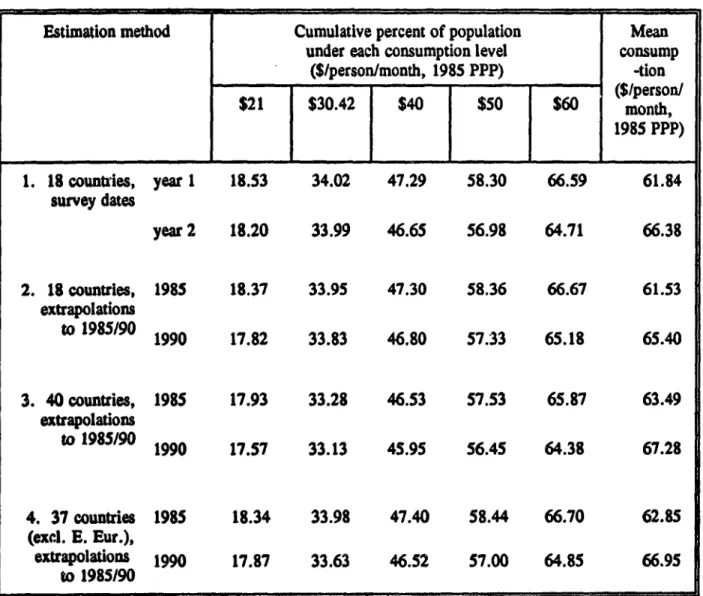
Table 2 gives our estimates of five points on the aggregate PIC (the cumulative percentage of the population of the developing world as a whole consuming less than various amounts) including the '$1 per day' poverty line described in section 2. Four sets of estimates are given. The first relies solely on the sub-set of 18 countries for which we have observations at two points In time, and are based on the survey year. The second is obtained by extrapolating to either 1985 or 1990, as described In section 2, though still relying solely on the 1 country sub-set. The third extends the method of the second to all 40 countrles (including the 22 cases in which the same survey data are used to estimate the Lorenz curve at both 1985 and 1990). The fourth is the same as the third except that it excludes the three countries in Eastern Europe (as noted above).
The four sets of estimates agree closely, and all indicate first-order dominance, implying
an unambiguous fall in poverty, no matter which poverty line or poverty measure is used (section 2.2). However, the quantitative differences over time are very small. On the basis of the results in Table 2, we conclude that there was a negligible change in the aggregate PIC during the latter half of the 1980s. With negligible change in poverty incidence, the numbers of poor have tius been growing at close to the rate of population growth, about 2% per year.
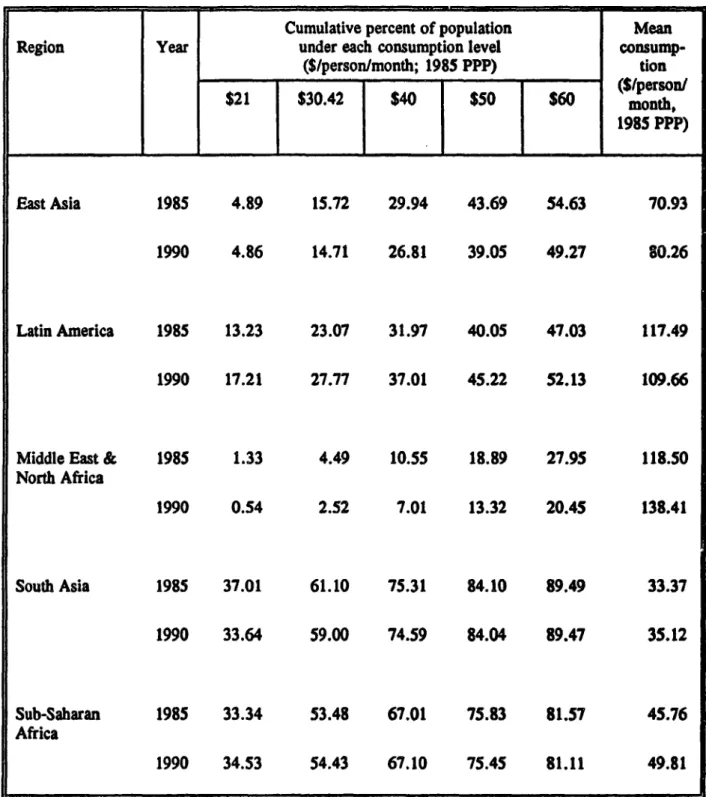
However, the aggregates hide some diversity between regions. Table 3 gives a
breakdown of the results for the four regions Sub-Saharan Africa, South and East Asia, and Latin America; Figures 1 to 4 plot the cumulative distributions for the four regions in both datea, each
of which is compared to the aggregate PIC. Poverty fell in both East and South Asia, and there Is first-order dominance, so the conclusion is robust to the choice of poverty line or measure. Poverty increased in both Latin America ana Sub-Saharan Africa, though in the latter case the conclusion is only robust for all poverty measures if one restricts the poverty line to $50 per month. The poverty deficit curves for this region show an increase in poverty for poverty lines up to a high level (above $60 per month).
Despite these differences in progress in reducing poverty, the poverty ranking of regions is generally stable; poverty is highest in South Asia, followed by Sub-Saharan Africa, Latin America and the Caribbean, East Asia, and Middle-East/North-Africa, in that order. The one exception to this ranking is for 1990, when there is a reversal between Sub-Saharan Africa and South Asia at the lower poverty line, though the difference is small.
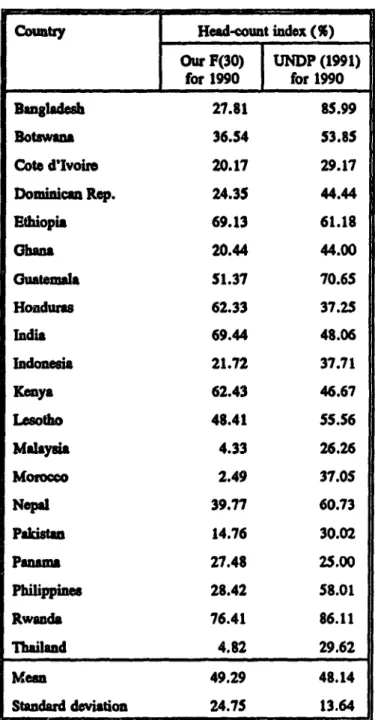
The Appendix gives the detailed results by country. In making comparisons over time, we find that PICs do not intersect up to a poverty lines over $60 per month in 14 out of the 18 countries with observations at two points in time; for 10 of these poverty decreased, while it increased in 4. Second-order dominance (an increase in poverty) holds for two of the remainder (up to about $55 per month). Only in two cases is the poverty comparison ambiguous over time. There are a number of surprises in the individual country estimates when compared with the more familiar estimates found in standard sources. Table 4 reproduces the estimates of the incidence of poverty for 1990 quoted in UNDP (1991) for the 20 countries which are also in our set of 40. We also give our estimate of F(30) for 1990, from Table A4 in the Appendix. This poverty line gives a similar estimate of the mean head-count index for these 20 countries to UNDP (1991). Given the use of country-specific poverty lines which tend to be positively correlated with the mean, the considerably lower variance in estimates of the head-count index
revealed in Table 4 is to be expected. The more interesting question is how the two methods rank countries.
The two series of individual-country estimates are positively correlated; the overall rank correlation coefficient is 0.71. However, there are some marked discrepancies, for which Bangladesh is the most striking; while we estimate that 28% of Bangladesh's population in 1990 were consuming less than $1 per day, the head-count index of poverty quoted in UNDP (1991) is 86%. Possibly this discrepancy is deceptive, for the UNDP figure is actually far higher than the Government of Bangladesh's own estimates, and also those of independent researchers, which yield estimates of the head-count index around 40% for the late 1980s using a local poverty line (see the survey by Hossain and Sen, 1991). If we dr,p this country then the rank correlation goes up to 0.74. Nonetheless, there is still a good deal of re-ranking.
In addition to the fact that we are attempting to use a consistent methodology across all countries, the use of purchasing power parity conversions is known to produce similar
re-rankings In terms of national incomes (Stern, 1989; Mazumdar ct al., 1992). Possibly one
should not be too surprised at these disctepancies. Yet we would agree that some are surprising; we would suspect, for exnample, that many casual observers of the differences in living standards between Bangladesh and India would find it hard to accept that poverty is that much higher in
India. Possibly there are errors in the PPP rates, or differences in survey methodologies, which could account for this finding. That speaks again for the need to be cautious about such cross-country comparisons. However, we can be more confident about the regional and global aggregates.
4 Conclusions
We would not want to present these results as definitive; indeed we think that there is considerable scope for improvement. The ongoing efforts of governments and agencies to eihance the quality and quantity of household-level surveys and price data for international compariaons will allow continued future improvements in this type of poverty monitoring. However, the estimates we have made do appear to be about the best one can do with the existing data. They suggest that the incidence of absolute poverty in the developing world as a whole has remained static during the latter half of the 1980s, with one-in-three persons
consuming less than $1 per day. With the cumulative distribution of consumption changing only negligibly, the numbers of poor - by any consumption standard for defining what 'poor' means -has been growing at the same rate as the aggregate population of tie developing world, about 2% per year. There is, however, some marked variation between regions and countries, with
generally rising poverty incidence in both Latin America and Africa, and generally falling incidence in Asia. Poverty increased in about one-third of the countries.
Notes
1. The work of Paukert (1973), Adelman and Morris (1973), and Jain (1975) brought together data for a number of countries for the 1950s up to the early 1970s. These have been the main source of cross-country distributional data In subsequent research. [See, for example, Berry et al. (1983, 1989), Lecaillon et al., (1984), Grosh and Nafziger (1986), Fields (1989), Yotopoulos (1989), Sundrum (1990), Waldmann (1992) and Anand and Kanbur (1993)]. Estimates of the world distribution of income have typically assumed that relative inequalities within countries are unchanged over time when up-dating estimates, and used only growth rates in each country's mMan income, as derived from national accounts (for example, Berry et al., 1983, 1989; Grosh and Nafziger, 1986; Yotopoulos, 1989). There have been compilations of independent estimates of poverty measures by country, such as in World Bank (1992a), UNDP (1991), and for the ILO by Tabatabai and Fouad (1993). However (as we shall argue below), the comparability of these estimates (both between countries and over time) is questionable. None of these sources appear then to offer a sound foundation for monitoring poverty.
2. Substantial efforts at improving data quality and country coverage have been made by the United Nations (un',er the Household Survey Capability Programme) and the World Bank (the Living Standards Measurement Study and the Social Dimensions of Adjustment in Sub-Saharan Africa Project). For a discussion of the comparability problems across household surveys see Deaton (1993).
3. The main difference in methodologies between this study and Ravallion et ai. (1991) Is that the latter study used distributional data for fewer countries (22, instead of our 40), and relied instead on econometric extrapolations for 64 countries. We have only used extrapolations over time when we do have at least one survey observation of the distribution. Nonetheless, our estimate of the percentage of the population consuming less than $1 per day in 1985 accords closely with Ravallion
et al. (1991); both are in the interval 33-34%. However, our use of the recent Summers and Heston (1991) revisions to the 1985 PPP rates has entailed some changes at the country level, particularly for India and China. The new estimates of the PPPs imply a large increase in the estimate of India's head-count index for $1 per day and a sizable decrease for China. These two changes are
off-setting.
4. For a review of alternative concepts of poverty found in the literature and policy discussions see Ravallion (1993a).
5. Ravallion and Bidani (1993) compare the regional profile of poverty within one country (Indonesia) obtained by the two most common methods used to set poverty lines, both anchored to the same nutritional cut-off point; the two poverty profiles are virtually un-correlated (the rank correlation coefficient across 35 regions in 1990 is 0.15).
6. The PPP rate for a country is given by the value of the mean outputs of that country evaluated at domestic prices relative to their value at the (output-weighted) mean international prices. The latter in turn depend on the PPP rates, and so a set of simultaneous equations are solved to obtain the PPP rates (Kravis et al., 1982). The main empirical problem is obtaining a consistent set of prices for goods and services for all countries.
7. On the use of dominance conditions in ranking distributions in terms of poverty see Atkinson (1987), and Foster and Shorrocks (1988). The following treatment draws on the exposition in Ravallion (1993).
8. More precisely, attention is restricted to poverty measures which are additively separable between the individual poverty measures, or can be written as a monotonic transformation of an additive measure. Atkinson (1987) characterizes the set of admissible poverty measures and gives other examples from the literature.
9. Ravallion (1993) surveys the arguments for and against this choice.
10. In our experience, we have found these two specifications of the Lorenz curve to track the distributional data extremely well; they easily out-perform many other functional forms discussed in the literature, particularly those in the two-parameter family.
11. A theoretically valid Lorenz curve L = L(p), where L is the share of the bottom p percent of the population in aggregate consumption, should meet the following four conditions: L(O)=O,
L(1)=1, L'(O0)0, and L"(p) 0 for 0<p< 1. See Datt (1992) for the parametric restrictions
implied by these conditions.
12. See Chen et al (1992) for a user-friendly computer programn POVCAL, for use on any PC with the DOS operating system, which implements these methods.
13. While this adjusts the mean, there is nothing one can do about the Lorenz curve. One would expect income to be more unequally distributed than consumption, though the impact on the estimated PIC is unclear. Ravallion et al. (1991) test for possible bias due to this adjustment, by including a dummy variable for whether the survey is one of incomes or consumptions in a regression of the poverty measure against a range of social indicators and national accounts data; the dummy variable did not have a significant coefficient.
14. Sumners and Heston (1991) provide the PPPs for 1988 for most countries, and for an earlier year between 1985 and 1987 for some other countries where estimates for 1988 could not be constructed. The complete Penn World Table (Mark 5), which is available on computer disks from the authors, provides the full time series of PPP estimates for all countries. The PPPs we use are taken from this source. We decided to use PPPs for 1985 since this turns out to be the most recent year for which PPPs are available for all countries.
15. In some cases (including China, Indonesia, and most countries in South Asia), distributions are available which distinguish urban from rural areas. Some regional data are also readily available (including Ind;a rnd Indonesia). The more serious problem is making a consistent allowance for cost-of-living differinces. Past estimates of poverty lines by region or sector are subject to the same criticism that we have made already about cross-ountry comparisons, namely that the methods used are unlikely to yield the same real poverty line across space (Ravallion, 1993a). One experiment for Inconesia suggested to us that these ?roblems should not be taken lightly, and that a better approach may actually be to ignore spatial differences within countries (Ravallion and Bidani, 1993).
16. Ibis could entail a slzable bias to the Lorenz curve since rural areas (which also tend to be poorer) tend to use cash less.
References
Adelman, Irma and C.T. Morris (1973) Ecgnoicrc h and Social EgUGI_ In DeeinI Counae Stanford: Stanford University Press.
Ahluwalia, Montek S., (1974) 'Income Inequality: Some Dimensions of the Problem', fnn 1 3-7.
Ahluwalia, Montek S., Nicholas G. Carter, and Hollis B. Chenery (1979) 'Growth and Poverty in Developing Countries', n g 6:299-341. Anand, Sudhir and S.M. Ravi Kanbur (1993) '>he Kuznets Process and the
Inequality-Development Relationship', lournal of Development Economics 40:25-52.
Atkinson, Anthony B. (1987) 'On the Meamurement of Poverty', Econometica 55:749-64.
(1991)
'Comparlng Poverty Rates Intemationally: Lessons from Recent Studies in Developed Countries', World Bank Eomic Review 5:3-22. Berry, A., Bourguignon, F., and C. Morrisson (1983) 'The Level of World hIequality: HowMuch Can we Say?' The Review of Income and Wealth 29: 217-214.
_ _ __ and (1989) 'The World Distribution of
Income: Evolution over the Recent Period and Effects of Population Growth.' Paper presented at a conference on 'Consequences of Rapid Population Growth', United Nations, New York.
Chen, Shaohua, Gaurav Datt and Martin Ravallion (1992) 'POVCAL: A Computer Program for Calculating Poverty Measures from Grouped Data', Policy Research Departnent,
Datt, Gaurav (1992) 'Computational Tools for Poverty Measurement and Analysis', Population and Human Resources Division, Policy Research Department, World Bank, Washington D.C.
Datt, Gaurav and Martin Ravallion (1992) 'Growth and redistribution components of changes in poverty measures: a decomposition with applications to Brazil and India in the
1980s', lgumaLof Development Economica 38: 275-295.
Deaton, Angus (1993) 'Data and Econometric Tools for Development Economics', in Jere Behrman and T.N. Srinivasan (eds) Handbook of Deeloment Economics
Vjoju 3 Amsterdan: North-Holland, forthfcoming.
Fields, Gary (1989) 'Changes in Poverty and bIequality in Developing Countries', VlQdd Bank &Warch Obsee, 4:167-186.
Foser, James, and A. F. Shorrocks (1988) 'Poverty Orderings', Ecnometiica 56:173-177. Gastwirth, J.L.(1971) 'A general defmnition of the Lorenz curve', Econom=rca 39:1037-39. Grosh, Margaret E., and E. W. Nafziger (1986) 'The Computation of World lncome
Distribution', Economic Develgpment and Cultural Chmnge 34: 347-360. Hossain, Mahabub and Binayak Sen (1992), 'Rural Poverty in Bangladesh: Trends and
Determinants, Asian Development Review 10: 1-34.
International Monetary Fund (IMF) (1992) International Financial Statistics Yearbook Washington DC: International Monetary Fund.
Jain, Shall (1975) Size Disribution of Income: A omilation of Dat, Baltimore: Johns Hopkis University Press.
Kakwanl, N. (1980a) In IMaliy ad
Erty. Methos of Estimation
and Policy(1980b) 'On a Class of Poverty Measures', cona=ic 48: 437-446. Kravis, I.B., A. Heston and L. Sunumers (1982), World P_ouct and Incomeinternailonal
Comparisons of Ral Gross Product, Baltimore: Johns Hopkins.
Lecaillon, Jacques, Felix Paukert, Christian Morrisson, and Dimitri Germidis (1984), Income Disriution ad EgonoMic Develomnt. And Analtical Sure, Geneva,
International Labour Office.
Lipton, Michael and Martin Ravallion (19)2) 'Poverty and Policy' In Jere Behrman and T.N. Srinivasan (eds) Handbook of Development Economics Volume 3 Amsterdam: North-Holland, forthcoming.
Mazumdar, Dipak, Lee Travers, and Cheena Trikha (1992) 'International Comparisons and ONP Measures', Economic and Political Weekly October 24-31, pp: 2367-2371. Pa.-rt, Felix (1973) 'Income Distribution of Different Levels of Development: A Survey of
Evidence',
In=e ignallabor.keir
108: 97-125.Ravallion, Martin (1993a) =ei
Comparisnh
Fundamentals In Pure and Applied Economics, New York: Harwood Academic Press.(1993b) 'Welfare Measurement Errors and Consistency in Poverty Comparisons', mimeo, Poverty and Human Resources Division, Policy Research Department, World Bank, Washington DC.
Ravallion, Martin and Benu Bidani (1993) 'How Robust Is a Poverty Profile?', mimeo, Poverty and Human Resources Division, Policy Research Department, World Bank, Washington DC.
Ravallion,
Martin, Gaurav
Datt, and Dominique
van de Walle (1991) 'Quantifying
Absolute
Stern, Nicholas (1989) 'The Economics of Development: A Survey', be Economic Journal 99: 597-685.
Summers, Robert and Alan Heston (1988) 'A New Set of International Comparisons of Real Product and Price Levels for 130 Countries 1950-1985', Review of Income and Wealh 34: 1-26.
_____ and (1911)
'The
Penn World Table (Mark 5): an ExtendedSet of International Comparisons, 1950-1988', Ouarterly Journal of Economics 106:327-368.
Sundrum, R.M. (1990) Income Distribution in LDCs London: Routledge.
Tabatabai, Hamid with Manal Fouad (1993) The Incidence of Poverq in Developing_ Countries! An ILO Compendium of Data. Geneva: International Labour Office. Tyler, Godfrey J., R. El-Ghonemy, and Y. Couvreur (1 '93) 'Alleviating Rural Poverty
rough Agricultural Growth', Journal of Development Studies 29: 358-364. United Nations (1989) 'Household Income and Expenditure Surveys: A Technical Study',
United Nations Department of Technical Co-Operation for Development and Statistical Office, United Nations, New York.
United Nations Development Program (UNDP) (1991) Human Deelopme Report 1991 New York: Oxford University Press.
Villasenor, J. and B. C. Arnold (1984) 'The General Quadratic Lorenz Curve', Technical report, Colegio de Postgraduados, Mexico.
(1989) 'Elliptical Lorenz Curves',
J.umalof
Ecor 40: 327-338.Waldmann (1992) 'Income Distribution and Infant Mortality', Quarterly Journal Qf Economics 107: 1283-1302.
World Bank (1980) World Development Report 1980. New York: Oxford University Press for the World Bank.
(1990) World Develooment Report 199Q. Poverty. New York: Oxford
University Press for the World Bank.
__ (1992a) Social Indicators of Development 1991-92. Baltimore: Johns Hopkins
University Press for the World Bank.
(1992b) WorldTabl_s 1992. Baltimore: The Johns Hopkhi University Press
for theWorld Bank.
(1992c) YAgld Develope=nt Meort 1992. New York: Oxford University Press for
the World Bank.
Yotopoulos, P.A., (1989) 'Distributions of Real Income: Within Countries and by World Income Classes", Review of IcoMe and Wealth 35: 357-376.
Table 1: Number of countries Included
Region Number Percent of Number of Percent of
of population countries population
countries represented with two represented
data sets
East Asia 5 91.75 4 88.21
Eastern Europe 3 58.64 2 50.15
Latin America 13 83.04 6 50.08
Middle East & North Africa 4 23.92 2 12.94
South Asia 5 96.23 2 83.31
Sub-Salran Africa 10 32.90 2 5.4
Total 40 79.54 18 66.60
Percent of the population of all low- and middle-income countries in that region represented by the surveys.
Table 2: Aggregate poverty Incidence curves for the developing world
Estimation method Cumulative percent of population Mean
under each consumption level consump
(S/person/month, 1985 PPP) -tion (S/person/ $21 $30.42 $40 $50 $60 month, 1985 PPP) 1. 18 countries, year 1 18.53 34.02 47.29 58.30 66.59 61.84 survey dates year 2 18.20 33.99 46.65 56.98 64.71 66.38 2. 18 countries, 1985 18.37 33.95 47.30 58.36 66.67 61.53 extrapolations to 1985/90 1990 17.82 33.83 46.80 57.33 65.18 65.40 3. 40 counties, 1985 17.93 33.28 46.53 57.53 65.87 63.49 extrapolations to 1985/90 1990 17.57 33.13 45.95 56.45 64.38 67.28 4. 37 countries 1985 18.34 33.98 47.40 58.44 66.70 62.85 (ecxl. E. Eur.), extrapolations 1990 17.87 33.63 46.52 57.00 64.85 66.95 to 1985/90
Table 3: Poverty Inddence curves by region
Cumulative percent of population Mean Region Year under each consumption level
consump-($/person/month; 1985 PPP) tion ($/personl $21 $30.42 $40 $50 $60 month, 1985 PPP) East Asia 1985 4.89 15.72 29.94 43.69 54.63 70.93 1990 4.86 14.71 26.81 39.05 49.27 80.26 Latin America 1985 13.23 23.07 31.97 40.05 47.03 117.49 1990 17.21 27.77 37.01 45.22 52.13 109.66
Middle East & 1985 1.33 4.49 10.55 18.89 27.95 118.50 North Africa 1990 0.54 2.52 7.01 13.32 20.45 138.41 South Asia 1985 37.01 61.10 75.31 84.10 89.49 33.37 1990 33.64 59.00 74.59 84.04 89.47 35.12 Sub-Saharan 1985 33.34 53.48 67.01 75.83 81.57 45.76 Africa 1990 34.53 54.43 67.10 75.45 81.11 49.81
Table 4: Alternatve estimates of the head-count
Index of poverty for 1990
Country Head-count index (%)
Our F(30)
i
UJNDP (1991) for 1990 for 19 Bangladesh 27.81 8S.99 Botawana 36.54 53.85 Cote d'Ivoire 20.17 29.17 Dominican Rep. 24.35 44.44 Ethiopia 69.13 61.18 bhanz 20.44 44.00 Guatemala S1.37 70.65 Honduras 62.33 37.25 India 69.44 48.06 Indonesia 21.72 37.71 Kenya 62.43 46.67 Lasotho 48.41 S5.56 Malaysda 4.33 26.26 Morocco 2.49 37.05 Nepal 39.77 60.73 Pakistan 14.76 30.02 PanakMa 27.48 25.00 Pbilippines 28.42 S8.01 Rwmndda 76.41 86.11 Thailand 4.82 29.62 mean 49.29 48.14 Standard devation 24.7S 13.64Appendix: Details by Country
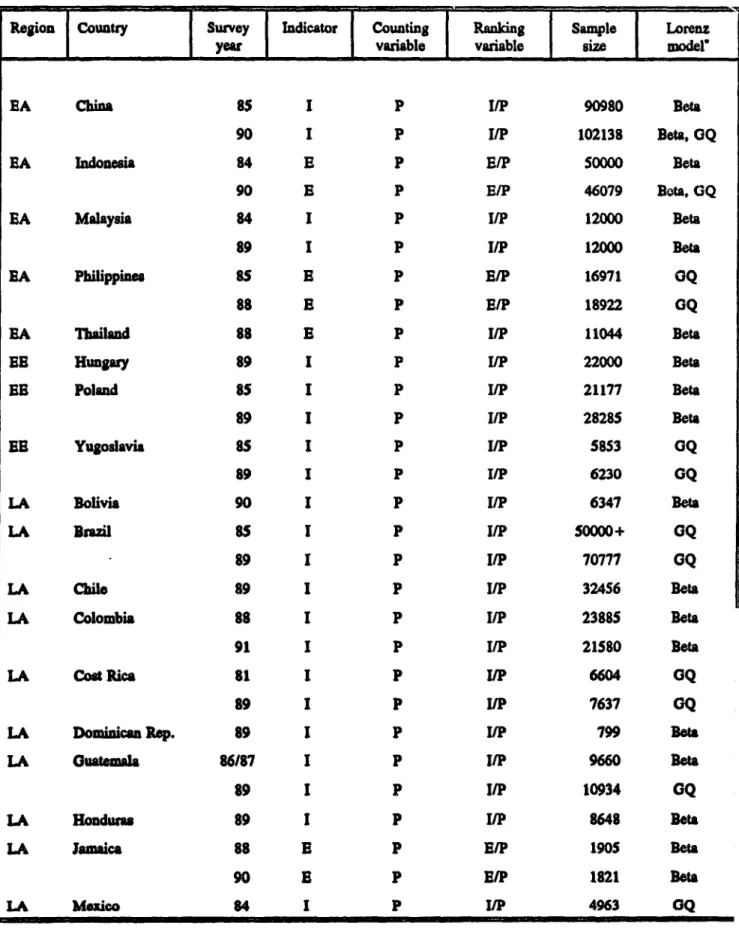
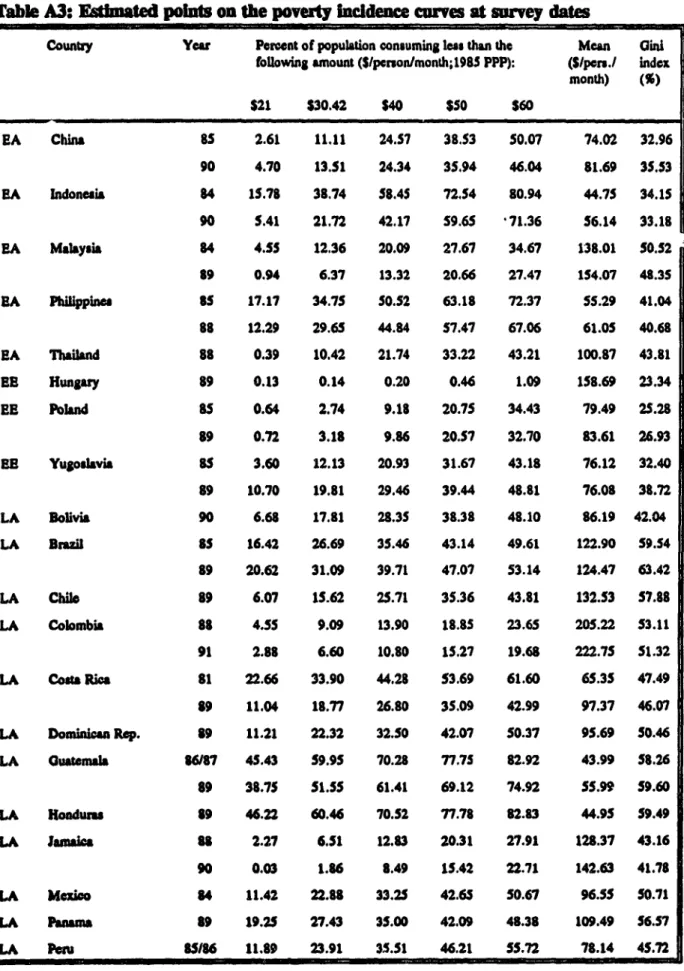
Ihis Appendix gives the country-level estimates underlying the aggregate results reported In the paper. Table Al gives details on the data for each country, and estimation methods. The estimated slopes of the Lorenz curves across selected intervals are then given in Table A2. Table A3 gives the estimates of selected points on the PIC by country at each survey date, while Table A4 gives the estimates obtained when we extrapolate to 1985 and 1990 using the closest available survey date. It should be noted that the estimates of the propoktions of these countries'
populations below a given poverty line need not accord closely (either absolutely or relatively) with the estimates in standard sources. The latter do not attempt to assure comparability of the poverty lines across countries in terms of their purchasing power, and differ in other respects related to the nature of the data and the estimations methods used (see sections 2 and 3 for further discussion).
The following abbreviations are used: EA= East Asia, EE= Eastern Europe, LA= Ladtin America and the Caribbean, SA= South Asia, MN=Middle East and North Africa, SS=
Sub-Saharan Africa; I=income, E=expeiiditure; P=person, H- household; lIP-income per person, E/P=expenditure per person, E/H-expenditure per household, I/H=income per household; Beta=Beta specification, GQ=general quadratic specification.
Table Al: Country level details on the distributional data used
Region Couny Survey Indicator Counting Ranling Sample Lorenz
. year variable variable size model
EA China 85 I P I/P 90980 Beta
90 I P I/P 102138 Beta, OQ
EA Indonesia 84 E P E/P 50000 Beta
90 E P E/P 46079 Boa, GQ
EA Malaysia 84 I P I/P 12000 Beta
89 I P I/P 12000 Beta
BA Philippine 85 E P E/P 16971 GQ
88 E P E/P 18922 GQ
EA Thailand 88 E P l/P 11044 Beta
EE Hungazy 89 I P I/P 22000 Beta
EE Poland 85 I P I/P 21177 Beta
89 I P I/P 28285 Beta
EE Yugoslavia 85 I P I/P 5853 GQ
89 I P I/P 6230 GQ
LA Bolivia 90 I P I/P 6347 Beta
LA Brau 85 I P I/P 50000+ GQ
89 I P I/P 70777 GQ
LA Chile 89 1 P I/P 32456 Beta
LA Colombia 88 I P lIP 23885 Beta
91 I P I/P 21580 Beta
LA Cost Rica 81 I P VP 6604 GQ
89 I P IAP 7637 GQ
LA Dominican Rep. 89 I P I/P 799 Beta
LA ouatem_a 86/87 I P I/P 9660 Beta
89 I P I/P 10934 GQ
LA Hoodura 89 I P I/P 8648 BetA
Region Country Survey Indicator Counting Ranldng Sample Lorenz
-year variable variable size todel
LA Panama 89 I P I/P 8593 GQ
LA Peru 85186 E P B/P 5000 Beta
LA Venezuela 87 I P I/P 38000 Bdt
89 I P I/P 61385 Beta
MN Algeria 88 E P E/P 10368 Beta
MN Jordan 91 B P E/P 47719 Beta
MN Morocco 84/85 E P B/P 14500 Bea 90/91 E P B/P 3400 Beta MN Tunisia 85 E P J/P 7000 Beta 90 E P B/P 7000 Beta SA Bangladesh 85/86 E P B/P 3800 Beta 88/89 E P E/P 5675 GQ
SA India 83 E P E/P 117896 Beta, OQ
89/90 E P E/P 28744 Beta
SA Nepal 84/85 1 P VP 3662 OQ
SA Pakistan 91 E P E/P 4800 Beta
SA SriTanks 85 I P I/P 11897 Beta
SS Botswana 85/86 E P E/H 2077 GQ
SS Cote d'Ivoire 85 E P E/P 1600 Beta
88 E P E/P 1600 GQ
SS Ethiopia 81/82 E P E/H 3082 Beta
SS Ghana 87/88 E P E/P 14938 OQ
88/89 E P E/P 14965 Beta
SS Kenya 81/83 I H I/H Beta, GQ
SS Lesotho 86/87 I P I/P 7680 GQ
SS Rwanda 83/85 E P E/P 567 GQ
SS Tanzania 91 E P E/P 1200 GQ
SS Uganda 89/90 B P E/P 4598 GQ
SS Zimbabwe 90 E P E/P 13780 GQ
Table A2: Consumption/lncome shares by country
Loet Loweat Second Thir Fourth Highet Highest
Co>untr Survey I e 10% 20% quintilo quintle quntiloe 20% 10%
PA China 8S 1 3.33 7.67 11.76 16.51 23.35 40.71 24.46 90 1 2.68 6.44 10.96 16.42 24.35 41.83 24.61 EA Indonesia 84 B 3.47 7.98 11.90 15.97 21.62 42.53 27.71 90 B 3.87 8.65 12.13 15.85 21.12 42.25 27.90 EA Malaysia 84 1 1.58 4.02 7.75 12.55 20.26 55.42 39.27 89 1 1.85 4.58 8.33 12.99 20.37 53.73 37.8, EA PhFiippines 85 B 2.77 6.44 10.11 14.41 20.95 48.09 32.7A 88 B 2.83 6.50 10.06 14.43 21.20 47.81 32.0 EA Thiland 88 B 2.69 6.12 9.37 13.53 20.28 50.70 35.3 EP. Hungpry 89 1 4.84 10.87 14.7S 17.98 21.97 34.43 20.8 ES Poland 85 I 4.14 9.84 14.29 18.06 22.73 35.08 20.9 89 1 3.84 9.22 13.82 17.90 22.98 36.06 21.6 EE Yugoslavia 8S I 2.88 7.33 12.38 17.23 23.44 39.62 24.2 89 1 1.92 5.27 10.66 16.20 23.66 44.21 27.3 LA Bsolvia 90 E 2.32 5.62 9.66 14.53 21.96 48.23 31.7 LA Boezil 85 I 1.00 2.61 5.57 10.00 18.25 63.57 47.3 89 1 0.70 2.10 4.90 8.90 16.80 67.50 51.3 LA Chik 89 1 1.40 3.70 6.80 10.30 16.20 62.90 48.Z LA Colombia 8S 1 1.22 3.33 7.21 12.12 20.00 57.34 41.2 91 1 1.34 3.61 7.59 12.58 20.44 55.78 39.A LA Costa Rica 81 1 1.00 3.30 8.40 14.10 22.80 51.40 33._ 89 1 1.20 4.00 9.10 14.30 21.90 50.80 34.1 LA Dominican 89 1 1.60 4.20 7.90 12.50 19.70 55.60 39. LA Guatemala 86/87 1 0.90 2.70 6.30 10.70 18.20 62.00 46. 89 1 0.60 2.10 5.80 10.50 18.60 63.00 46. LA Hondurmn 89 1 0.90 2.70 6.00 10.20 17.60 63.50 47. LA Jamaia 8 B 2.14 5.41 9.78 14.49 21.19 49.13 33. 90 B 2.51 5.98 9.88 14.45 21.32 48.37 32. LA Mexico 84 1 1.60 4.10 7.80 12.30 19.90 55.90 39.
I I
~~~~~~~LowestILowcat
Second Third FourthIHishoat
Highiat County Survey lOff 10% 20% quinleo quindle quintal 20% 10%LA Poru 85/86 a 1.80 4.87 9.18 13.65 20.95 51.36 35.36 LA Venezuela 87 1 1.70 4.73 9.22 13.95 21.49 50.61 34.21 89 1 1.70 4.80 9.50 14.40 21.90 49.50 33.20 MN Aga 88 H 2.76 6.86 10.97 14.94 20.74 46.49 31.74 MN Jordan 91 E 2.75 6.47 10.29 14.61 20.94 47.69 32.56 MN Morocco 84/85 B 2.66 6.S8 11.07 15.31 20.89 46.15 31.84 90/91 1 2.81 6.57 10.45 14.97 21.71 46.30 30.49 MN Tunisa 85 E 2.26 S.54 9.63 14.24 21.02 49.57 34.08 90 B 2.28 5.86 10.41 1S.27 22.13 46.33 30.69 SA Ia,Ideah 85186 B 4.47 10.04 13.82 17.25 21.65 37.24 23.41 88/89 B 4.16 9.45 13.36 16.96 21.63 38.60 24.58 SA Idia 83 B 3.69 8.47 12.47 16.39 21.63 41.04 26.56 89/90 e 3.79 8.7S 12.46 16.1S 21.34 41.30 27.08 SA Nepal 84/85 I 4.04 9.11 12.89 16.68 21.82 39.50 25.00 SA Paatan 91 2 3.43 8.40 12.87 16.87 22.16 39.70 25.21 SA Sd Lanka 85 1 1.99 4.86 8.40 12.38 18.1S S6.21 43.01 Ss Dotwan 85186 B 0.37 1.42 4.59 9.37 18.24 66.38 49.61 SS Coto d'voile 8S E 1.96 5.14 9.53 13.79 21.01 S0.53 34.60 88 B 3.01 7.28 11.87 16.34 22.34 42.17 26.U8 SS lthiopia 81/82 E 3.68 8.56 12.67 16.36 21.10 41.31 27.S2 88 Ghan 87/88 B 2.81 6.94 11.64 16.12 22.07 43.23 28.09 88/89 H 2.89 6.97 11.34 15.76 21.79 44.14 28.99 S8 Knya 81/83 1 0.96 2.74 6.37 11.11 18.86 60.92 45.37 SS Leodio W87 1 2.07 4.52 6.S3 10.04 17.64 61.27 45.03 SS Rwud 83/85 2 4.41 9.70 13.09 16.65 21.64 38.92 24.58 SS Tanzna 91 H 0.86 2.44 5.73 10.43 18.70 62.70 46.45 SS Ugad 89/90 E 3.80 8.52 12.09 15.97 21.49 41.93 27.20 SS ZIubmbaw 90 H 1.75 3.98 6.29 10.01 17.38 \62.34 46.94
Not.: Ih table gives the soha of total bousehold consumption or incom accuig to persons in ea group,
aked by per capita housebold consumption or income. ho Lorenz curve is obtained by forming cumulative
Table A3: Eihated polnt on the poverty incdence curves at urvey dates
country Yea, Percent of populaton consuming less than the Mean Gini following amount (Slpersonlmonth;1985 PPP): (S/pern./ index
month) (%) $21 $30.42 $40 $50 S60 EA China 85 2.61 11.11 24.57 38.53 50.07 74.02 32.96 90 4.70 13.51 24.34 35.94 46.04 81.69 35.53 EA Indonesia 84 15.78 38.74 58.45 72.54 80.94 44.75 34.15 90 5.41 21.72 42.17 S9.65 71.36 56.14 33.18 HA Malaysia 84 4.55 12.36 20.09 27.67 34.67 138.01 50.52 89 0.94 6.37 13.32 20.66 27.47 154.07 48.3S EA PhilWpine 8S 17.17 34.75 50.52 63.18 72.37 55.29 41.04 88 12.29 29.65 44.84 57.47 67.06 61.05 40.68 HA Thailnd 88 0.39 10.42 21.74 33.22 43.21 100.87 43.81 HE Hungary 89 0.13 0.14 0.20 0.46 1.09 158.69 23.34 EE Poland 85 0.64 2.74 9.18 20.75 34.43 79.49 25.28 89 0.72 3.18 9.86 20.57 32.70 83.61 26.93 HE Yugoslvia 8S 3.60 12.13 20.93 31.67 43.18 76.12 32.40 89 10.70 19.81 29.46 39.44 48.81 76.08 38.72 LA Dolivis 90 6.68 17.81 28.3S 38.38 48.10 86.19 42.04 LA Brazil 85 16.42 26.69 35.46 43.14 49.61 122.90 S9.54 89 20.62 31.09 39.71 47.07 S3.14 124.47 63.42 LA Chile 89 6.07 1S.62 2S.71 35.36 43.81 132.S3 57.88 LA Colombia 88 4.SS 9.09 13.90 18.85 23.6S 20S.22 53.11 91 2.88 6.60 10.80 15.27 19.68 222.75 S1.32 LA Costa Rica 81 22.66 33.90 44.28 53.69 61.60 6S.35 47.49 89 11.04 18.77 26.80 35.09 42.99 97.37 46.07 LA Dominican Rep. 89 11.21 22.32 32.50 42.07 50.37 9S.69 50.46 LA Guaemala W87 45.43 59.95 70.28 77.75 82.92 43.99 58.26 89 38.7S 51.55 61.41 69.12 74.92 SS.99 59.60 LA Hondurs 89 46.22 60.46 70.52 77.78 82.83 44.9S 59.49 LA lJamdca 88 2.27 6.51 12.83 20.31 27.91 128.37 43.16 90 0.03 1.86 8.49 15.42 22.71 142.63 41.78 LA Mexico 84 11.42 22.88 33.25 42.65 50.67 96.SS 50.71
Country Yea" Percent of population consumingl less tha the Mean Gini
following amount (Slperson/month;1985 PPP): (SOp/P.r IndWx month) (f) S21 530.42 S40 5S0 S60 LA Venezuela 87 2.20 6.60 12.31 18.62 24.89 150.60 4U.17 89 10.36 20.49 30.75 40.68 49.74 83.64 44.0S MN Algeria 88 0.50 1.47 3.93 8.68 15.21 144.83 38.73 MN Jordan 91 5.70 18.25 31.88 44.67 55.46 74.87 40.66 MN Moooco 84/85 2.25 7.11 15.88 27.04 38.25 95.42 39.19 90/91 0.18 1.79 7.12 14.81 22.93 131.20 39.20 MN Tunisa 85 1.02 4.63 10.86 18.34 25.89 136.39 43.43 90 0.79 2.89 7.02 12.66 18.84 149.98 40.24 SA Bangladesh 85/86 2.20 17.00 38.40 59.57 74.57 52.52 26.92 88/89 7.80 28.49 51.63 70.30 81.64 46.42 28.85 SA India 83 46.79 73.48 86.12 92.09 95.06 26.83 32.20 89/90 43.29 70.92 84.82 91.62 94.62 28.38 32.27 SA Nepal 84/85 17.53 44.28 65.89 79.34 86.76 39.52 30.06 SA Pakstan 91 2.91 11.41 25.S6 41.41 55.58 66.42 31.15 SA Sri Lanka 8S 26.16 46.S6 61.94 72.76 79.88 53.13 51.01 SS Botawaa 85/86 42.62 52.1S 62.48 69.17 74.26 58.09 63.44 SS Cote d'lvoire 85 5.37 14.28 24.10 33.89 43.01 98.67 44.63 88 4.88 15.65 28.01 41.28 53.55 69.91 34.55 SS Ethiopia 81/82 9.13 31.63 54.20 70.87 81.24 47.35 32.42 SS Ghana 87/88 4.66 15.30 26.87 39.54 51.55 72.96 35.90 88/89 4.47 15.11 28.30 41.53 53.07 72.93 36.74 SS Kenya 81/83 48.65 62.97 72.72 79.57 84.26 40.26 57.25 SS Lesotho 86/87 35.46 52.30 62.80 70.14 75.34 58.22 54.88 SS Rwanda 83/85 26.44 57.49 76.74 86.82 91.89 33.50 28.90 SS Tanzania 91 30.48 42.60 52.34 60.34 66.65 72.80 59.01 SS Uganda 89/90 46.94 72.32 84.93 91.17 94.36 27.51 33.00 SS Zimbabwe 90 23.28 39.71 51.37 60.18 66.73 78.30 56.83
Table A4: _dbtd poitsl an pot ludd e curve earkpohtod to 190 and 1990
Prent of populalon consuming Is than the Mean Gini
Counry year folowing amouna (Slpearon,month; 1985 PPP): (S/peM./ hdcx month) S21 $30.42 $40 $50 S60 ( EA c as 2.61 11.11 24.57 38.S3 S0.07 74.02 32.96 90 4.70 13.51 24.34 35.94 46.04 81.69 35.53 EA bidonuua as 16.19 39.33 59.02 72.97 81.26 44.38 34.15 90 5.41 21.72 42.17 59.65 71.36 56.14 33.18 EA Malysia 85 4.77 12.69 20.49 28.13 35.19 136.26 S0.52 90 0.40 4.33 10.43 17.02 23.48 170.94 48.35 BA Pilp a5 17.17 34.75 50.52 63.18 72.37 55.?9 41.04 90 11.35 28.42 43.49 56.17 6S.89 62.50 40.68 BA ThaInd 8 2.71 15.62 28.34 40.36 50.45 88.50 43.81 90 0.57 4.82 14.75 24.67 34.21 118.83 43.81 BE Hunar 85 0.12 0.16 0.24 0.58 1.43 150.85 23.34 90 0.12 0.16 0.24 0.57 1.41 151.37 23.34 BE Poan Ss 0.64 2.74 9.18 20.75 34.43 79.49 25.28 90 1.95 9.27 22.6S 38.41 53.14 64.62 26.93 BE YugolavI 85 3.60 12.13 20.93 31.67 43.18 76.12 32.40 gO 10.36 19.28 28.7S 38.59 47.88 77.43 38.72 LA SolF S 2.04 10.70 19.69 28.43 36.91 107.55 42.04 90 6.68 17.81 28.35 38.83 48.10 86.19 42.04 LA Bail 85 16.42 26.69 35.46 43.14 49.61 122.90 59.54 90 24.31 35.34 44.21 51.64 57.6S 108.52 63.42 LA Chile SS 10.58 22.78 34.32 44.64 53.22 108.30 57.88 90 6.24 15.91 26.07 35.75 44.22 131.37 57.88 LA Colombia 85 5.80 11.05 16.45 21.95 27.26 181.91 53.11 90 3.03 6.87 11.17 15.73 20.23 218.19 51.32 LA Cost Rica 85 23.38 34.87 45.41 54.89 62.78 63.57 47.49 90 10.65 18.19 26.03 34.15 41.94 99.65 46.07 LA Dominican 85 12.67 24.28 34.80 44.58 52.94 90.50 50.46 90 12.73 24.35 34.89 44.67 53.03 90.32 50.46 LA Guatanla 85 45.14 59.64 70.01 77.51 82.72 44.33 58.26 90 38.58 51.37 61.23 68.95 74.76 56.27 59.60 LA Hondun 85 44.47 58.67 68.88 76.36 81.62 47.10 59.49 90 48.09 62.33 72.21 79.23 84.05 42.79 59.49 LA halma is 1.59 4.58 9.51 15.79 22.47 145.83 43.16 90 0.03 1.86 8.49 15.42 22.71 142.63 41.78 LA Moeico 85 10.84 22.13 32.38 41.71 49.72 98.65 50.71 90 11.21 22.61 32.93 42.31 50.33 97.30 50.71 LA Panama 85 17.51 25.11 32.22 38.97 45.05 120.41 56.57 90 19.29 27.48 35.06 42.15 48.45 109.27 56.57 LA Peru 85 6.35 15.23 24.75 34.18 42.77 100.57 45.72
Perent of populsaon conauming leun an tho Mean
Cm
Country yea followingsaounta(Slparon/moanth; 1985 PPP): (Spen.I indexS21 830.42 540 550 S60 (° LA Vnezuela 8 2.50 7.27 13.30 19.87 26.34 144.88 4S.l7 90 10.45 20.62 30.91 40.87 49.94 83.31 44.08 MN Alead 85 0.59 1.83 4.94 10.63 18.01 136.06 38.73 90 0.43 1.16 3.01 6.78 12.32 155.67 38.73 MN Joran 8S 0.68 4.16 11.48 20.60 29.74 116.U3 40.66 90 3.09 12.60 24.54 36.52 47.17 86.12 40.66 MN Motweo a1 2.25 7.11 15.88 27.04 38.25 95.42 39.19 90 0.24 2.49 8.78 17.14 25.70 124.07 39.20 MN TunisIa 85 1.02 4.63 10.86 18.34 25.89 136.39 43.43 90 0.79 2.89 7.02 12.66 18.84 149.91 40.24 SA Bangadeah 85 2.15 16.77 38.09 59.26 74.33 52.7n 26.92 90 7.42 27.81 50.80 69.62 81.17 46.85 21.85 SA India 85 46.09 72.96 85.81 91.91 94.94 27.07 32.20 90 41.45 69.44 83.91 91.0* 94.50 29.04 32.27 SA Nepu1 B5 19.16 46.53 67.99 80.95 87.95 38.18 30.06 90 14.29 39.77 61.80 76.45 84.80 41.77 30.06 SA Pakistan a5 4.21 15.61 32.19 49.03 63.04 60.20 31.15 90 3.91 14.76 30.82 47.51 61.59 61.39 31.15 SA Sti Lnka 85 26.16 46.56 61.94 72.76 79.88 53.13 51.01 90 26.11 46.51 61.89 72.71 79.85 53.18 51.01 SS Dotana 85 42.46 53.78 62.32 69.02 74.12 58.39 63.44 90 27.25 36.54 44.39 51.22 56.92 104.20 63.44 SS Coae d'lvoo es 5.37 14.28 24.10 33.89 43.01 98.67 44.63 90 7.55 20.17 34.3 48.73 61.10 62.52 34.55 8 Ehiopia 85 28.46 58.68 77.33 87.23 92.1* 34.06 32.42 90 39.78 69.13 84.15 91.26 94.64 29.57 32.42 88 Ohna 85 8.01 21.73 35.93 $0.32 62.57 61.91 35.90 90 6.99 20.44 35.27 49.20 60.97 64.62 36.74 SS Kenya 85 58.94 72.27 80.39 85.68 89.13 31.62 57.2S 90 48.44 62.43 71.92 78.S9 83.22 42.17 57.2S SS Lestho U5 33.19 50.39 61.17 68.73 74.10 60.94 S4.8 90 30.W 48.41 59.48 67.26 72.82 63.80 S4.U SS Rwanda a5 25.24 56.19 75.84 86.26 91.54 34.04 28.90 90 48.86 76.41 U8.29 93.57 96.10 25.63 28.90 8S Tanzania 85 42.23 55.45 65.11 72.39 77.73 50.79 59.01 90 31.85 44.16 53.95 61.92 68.14 69.61 59.01 S8 Uganda a5 48.S5 69.99 82.50 89.36 93.07 27.33 33.00 90 47.70 69.17 81.92 38.98 92.82 27.75 33.00 SS Zimbabwe *5 24.04 40.46 52.08 60.82 67.32 76.96 56.,3
Figure 1: Poverty Incidence Curves for South Asia 1985-1990
Cumulative
percent
of population
100
80-60
40-~Total(1 985)
20
+
Total (1 990)
X
South Asia (1985)
,
,
,,South
Aia (1990)
15
20
25
30
35
40
45
50
55
60
Figure
2: Poverty
Incidence
Curves
for Sub-Saharan
Africa 1
Cumulative
percent of population
100
80-
60-
40-~Total(1 985)
20
-
+
Total
(1990)
+S-S.
Africa
(1985)
0
l
lS-S.
Afripa
(1990)
15
20
25
30
35
40
45
50
55
60
Figure 3: Poverty Incidence Curves for Latin America 1985-1990
Cumulative
percent of population
70
60-50
40-
30-
20-'Total (1 985)
10
~~~~~~~~~~~~~~~~~+Total (1 990)
10
,
Lat. Am. (1985)
0
,
Lat. Amn.
(1990)
15
20
25
30
35
40
45
50
55
60
Figure 4: Poverty Incidence Curves for East Asia 1985-1990
Cumulative
percent of population
70
60-
50-40
30-20
-
-*-~~~~~~~~~~~~~~Total
(1985)
10
~~~~~~~~~~~~~~~+Total
(19-90)
10
X-* East Asia (1985)
0
|
t
,
|
l
,
EEast
A*ia
(1990)
15
20
25
30
35
40
45
50
55
60
Policy Research Working Paper Series
Contact
Title Author Date for paper
WPS1 123 Social Development is Economic Nancy Birdsall April 1993 S. Rothschild
Development 37460
WPS1 124 A New Database on Human Capital Vikram Nehru April 1993 M. Coleridge-Stock: Sources, Methodology, and Eric Swanson Taylor
Results Ashutosh Dubey 33704
WPS1 125 Industrial Development and the Adriaan Ten Kate April 1993 C. Jones
Environment in Mexico 37699
WPS1 126 The Costs and Benefits of Slovenian Milan Ovikl April 1993 S. Moussa
Independence Evan Kraft 39019
Milan Vodopivec
WPS1 127 How International Economic Links Vikram Nehru April 1993 M.
Coleridge-Affect East Asia Taylor
33704 WPS1 128 The International Ocean Transport Hans JOrgen Peters April 1993 J.
Lucas-Industry in Crisis: Assessing the Walker
Reasons and Outlook 31078
WPS1 129 How Policy Changes Affected Cocoa Jonathan R. Coleman April 1993 G. Ilogon Sectors in Sub-Saharan African Takamasa Akiyama 33732
Countries Panos N. Varangis
WPSI 130 Poverty and Policy Michael Lipton April 1993 P.Cook
Martin Ravallion 33902
WPS1 131 Prices and Protocols in Public Jeffrey S. Hammer April 1993 J. S. Yang
Health Care 81418
WPS1 132 An Analysis of Repressed Inflation Andrew Feltenstein April 1993 E. Zamora
in Three Transitional Economies Jiming Ha 33706
WPS1 133 Macroeconomic Framework for an Ibrahim Elbadawi April 1993 A. Maranon
Oil-Based Economy: The Case of Nader Maid 31450
Bahrain
WPS1 134 Managing a Nonrenewable Resource: Ibrahim A. Elbadawi April 1993 A. Maranon
Savings and Exchange-Rate Policies Nader Majd 31450
in Bahrain
WPS1 135 Inflation in Czechoslovakia, 1985-91 Zdenek Drabek May 1993 E. Zamora
Kamil Janacek 33706
Policy Research Working Paper Series
Contact
Title Author Date for paper
WPS1 137 Railway Reform in the Central and Philip W. Blackshaw May 1993 TWUTD
Eastern European Economies Louis S. Thompson 31005
WPS1 138 The Economic Impact of Military Daniel Landau May 1993 C. Jones
Expenditures 37699
WPS1 139 Should Sub-Saharan Africa Expand Jonathan R. Coleman May 1993 G. llogon
Cotton Exports? M. Elton Thigpen 33732
WPS1 140 How Retail Food Markets Responded Bruce Gardner May 1993 C. Spooner to Price Liberalization in Russia Karen M. Brooks 32116 after January 1992
WPS1 141 Foreign Direct Investment in a Maxwell J. Fry May 1993 R. Vo
Macroeconomic Framework: Finance, 31047
Efficiency, Incentives, and Distortions
WPS1 142 Rent-Seeking Trade Policy: A Time- Martin Rama May 1993 D. Ballantyne
Series Approach 37947
WPS1 143 Tariff Rates, Tariff Revenue, and Lant Pritchett May 1993 M. Fernandez
Tariff Reform: Some New Facts Geeta Sethi 33766
WPS1 144 The Foreign Trade Dimension of the Bartlomiej Kaminski June 1993 P. Kokila
Market Transition in Poland: The 33716
Surprising Export Performance and Its Sustainability
WPS1 145 The Simple(r) Algebra of Pension Dimitri Vittas June1993 P. Infante
Plans 37664
WPS1 146 Is Poverty Increasing in the Shaohua Chen June 1993 P. Cook
Developing World? Gaurav Datt 33902
Martin Ravallion
WPS1 147 Interest Rates, Growth, and External Stijn Claessens June 1993 R. Vo Debt: The Macroeconomic Impact of Daniel Oks 33722 Maxico's Brady Deal Sweder van Wijnbergen