The Center for Satellite and Hybrid Communication Networks is a NASA-sponsored Commercial Space Center also supported by the Department of Defense (DOD), industry, the State of Maryland, the University of Maryland and the Institute for Systems Research. This document is a technical report in
the CSHCN series originating at the University of Maryland. Web site http://www.isr.umd.edu/CSHCN/
T
ECHNICAL
R
ESEARCH
R
EPORT
Next Generation Network Management Technology
by G. Atallah, M. Ball, J. Baras, S. Goli, R. Karne,
S. Kelley, H. Kumar, C. Plaisant, N. Roussopoulos,
B. Shneiderman, M. Srinivasarao, K. Stathatos,
M. Teittinen, D. Whitefield
CSHCN T.R. 94-3
(ISR T.R. 94-42)
NEXT GENERATION NETWORK MANAGEMENT TECHNOLOGY John S. Baras, George C. Atallah, Mike Ball, Shravan Goli, Ramesh Karne, Steve Kelley, Harsha Kumar, Catherine Plaisant, Nick Roussopoulos, Ben Shneiderman, Mulugu Srinivasarao, Kostas Stathatos, and
Marko Teittinen Center for the
Commercial Development of Space for
Satellite and Hybrid Communication Networks Institute for Systems Research
University of Maryland College Park, MD 20742
(301) 405-7900
David Whitefield Hughes Network Systems
11717 Exploration Lane Germantown, MD 20876
(301) 428-2849
Abstract
Today's telecommunications networks are becoming increasingly large, complex, mission critical and heterogeneous in several dimensions. For example, the underlying physical transmission facilities of a given network may be "mixed media" (copper, fiber-optic, radio, and satellite); the sub networks may be acquired from different vendors due to economic, performance, or general availability reasons; the information being transmitted over the network may be "multimedia" (video, data, voice, and images) and, finally, varying performance criteria may be imposed e.g. data transfer may require high throughput while the others, whose concern is voice communications, may require low call blocking probability. For these reasons, future telecommunications networks are expected to be highly complex in their services and operations. Due to this growing complexity and the disparity among management systems for individual sub networks, efficient network management systems have become critical to the current and future success of telecommunications companies. This paper addresses a research and development effort which focuses on prototyping configuration management, since that is the central process of network management and all other network management functions must be built upon it. Our prototype incorporates ergonomically designed graphical user interfaces tailored to the network configuration management subsystem and to the proposed advanced object-oriented database structure. The resulting design concept follows open standards such as Open Systems Interconnection (OSI) and incorporates object oriented programming methodology to associate data with functions, permit customization, and provide an open architecture environment.
INTRODUCTION
The size, complexity and heterogeneity of today's networks makes network management one of the most critical elements in the successful provision of telecommunications network services. Industry leaders, universities, and government research centers have recognized the magnitude and
the importance of network management problems. They have been investing millions of dollars for research and develop network management solutions. For example, Hughes Network Systems (HNS) is well aware of the importance of network management in their overall product strategies. Because of this, they have long been a leader in providing innovative network management products. They are now embarking on an effort to develop a next generation of network management systems. As part of this effort, HNS together with a team from the Institute for Systems Research (ISR) at the University of Maryland at College Park, developed a prototype system for managing HNS Integrated Satellite Business System (ISBN) systems. The team at the ISR, which is comprised of faculty, research scientists and students from Electrical Engineering, Computer Science, Operations Research and Business and Management, was drawn from a research group dedicated to the development of advanced technology for network management. This research effort is supported by HNS, Maryland Industrial Partnership Programs (MIPS), and by NASA grant #NAGW-2777S for the establishment of a NASA Center for the Commercial Development of Space (CCDS).
A network management system is a hardware/software system for planning, coordinating, operating, monitoring and controlling a telecommunications system. The recently developed prototype network management system generally addresses ISBN network management and is specifically oriented to the configuration of LANAdvantage systems (Figure 1).
FIGURE 1. LANAdvantage Network Configuration.TM
ISBN is a Wide Area Network (WAN) solution which employs a "star" network topology. Using this system, multiple geographically-dispersed remote sites can communicate over a satellite link through a central hub. In a traditional WAN environment, inter-Local Area Network (LAN) communication has been supported by gateways or routers which convert LAN protocols to WAN protocols. LANAdvantage eliminates the need for a gateway or router, allowing LAN users to communicate directly to an ISBN Personal Earth Station (PES). The hub and each remote site consist of a complex hierarchy of hardware and software objects. A remote has many Data Port Clusters (DPCs), each DPC has many Line Interface Modules (LIMs) and each LIM has many
ports. Similarly, the hub hardware has a similar but larger containment hierarchy consisting of many network groups, many networks, many DPCs, many LIMs and many ports. Sessions are established between a hub port and a port at a remote site via Inroute and Outroute satellite channels. Inroutes are the satellite channels that are used by the remote sites to communicate with the hub. Outroutes are the satellite channels that are used by the hub to communicate with the remote sites.
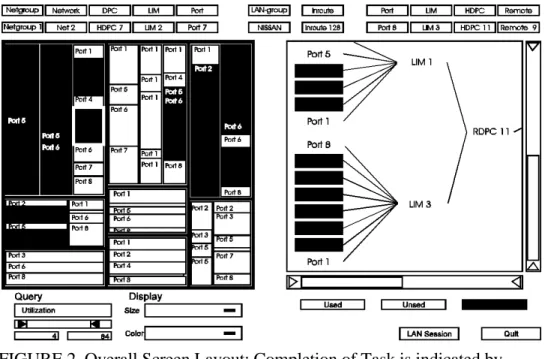
The system developed by the HNS/ISR/CCDS team (Figure 2) allows the user to view and access information about both the hub and remote site in a variety of ways.
FIGURE 2. Overall Screen Layout: Completion of Task is indicated by All Buttons in Check-List Being Green.
It integrates both query and data update capabilities within a single user interface. Two advanced techniques are used for representing and manipulating hierarchical data: a treemap and treebrowser. The primary function addressed by the system is the setup of a hub-to-remote site session. To accomplish this task, a set of sub tasks must be carried out. The sub tasks involve the specification of a network, DPC, LIM and port, as well as related parameter values for both the hub and remote. A set of buttons is displayed across the top of the screen. The buttons represent a sub task check is. This checklist orientation allows the operator to maintain a global perspective relative to the accomplishment of the ultimate task, namely, the specification of a hub-to-remote site session. All data accessed by the system is stored within an object oriented database system.
Network Management Technologies for the 9 0 ' s
The HNS/ISR/CCDS prototype system embodies innovative research carried out into two key network management technologies:
• object oriented (OO) databases
It is now generally accepted that the OO paradigm is the database technology of choice for future network management products. Success with the use of OO techniques and databases within Computer Aided Design (CAD) systems provides ample evidence that this approach should provide significant advantages within network management as well. Furthermore, standards bodies have committed to the OO model for telecommunications network management.
The ease with which an operator interacts with a computer system clearly depends most critically on the structure of the user interface. By developing new graphical user interface techniques the team hoped to address many of the negative characteristics of current configuration management systems. The use of informative, intuitive graphical displays should provide the user with a better understanding of the configuration tasks being addressed which in turn will lead to faster task completion and higher quality decisions. Proper graphical representation of the overall problem to be solved will allow the user to see "the big picture" and make it less likely that the user will become confused when navigating through the list of tasks. By integrating flexible query facilities within the data entry environment, the user will be able to gather decision enhancing information to make faster, higher quality decisions.
RESULTS AND ANALYSIS
This research and development effort resulted in a new data model for network management, a technique for embedding rules and constraints within OO database systems, and in a two graphical user interface techniques for representing and manipulating hierarchies. These results are now summarized.
A New Object Model for Network Management
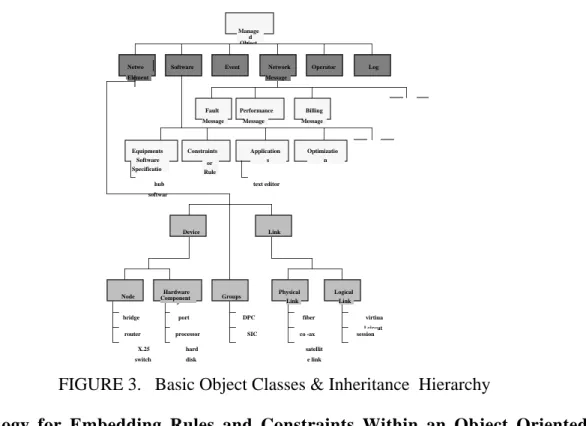
Prior to the creation of any database, a data model must be developed. The construction of a data model is part art and part science -- the “essence" of a real-life system must be captured in a set of formal data modeling constructs. In the case of telecommunications networks, the construction of an appropriate model for representing all relevant data is a challenging problem (Datta 1993 and Harista 1993) whose solution can greatly impact the overall quality of the system both in terms of the efficiency of carrying out database operations and in terms of the manner in which data can be presented to the user. A comprehensive model (Figure 3) was developed which captures not only configuration management data but also data to be used in carrying out other network management functions. Some specific features of this model are:
• a very general link model that allows for the representation within a common framework of a wide range of link types, including satellite links, to-point physical terrestrial links and point-to-point virtual links such as calls and sessions;
• a flexible approach to handling protocol layers within heterogeneous networks, in other words, this methodology allows for the ready analysis of complex calls that are routed partially over a satellite network and partially over a terrestrial ATM network;
• support for the management of network software, allowing for the tracking of software downloads and reboots, distribution of updates and versions, etc.
Since the OO database system is the string that will tie all network management systems together, it is essential to have a solid, well-designed data model upon which to develop all applications.
FIGURE 3. Basic Object Classes & Inheritance Hierarchy Manage d Object Netwo rk Element
Software Event Network Message Operator Log Fault Message Message Performance Message Billing Constraints or Rule Equipments Software Specificatio Application s Optimizatio n hub softwar text editor Device Link Node bridge router X.25 switch Hardware Component s port processor hard disk Groups DPC SIC Physical Link Link Logical fiber co -ax satellit e link virtiua l circut session
Methodology for Embedding Rules and Constraints Within an Object Oriented
Database System
Network configuration data must satisfy a wide variety of consistency constraints. These can range from simple single field checks such as, "the valid line speeds for attribute SPD are 4800, 9600, 19200" to more complex conditions involving multiple objects such as, "the protocols employed by the devices at either end of communication link must match," to even more complex conditions that might involve extensive computations. Typically these constraints and the actions to be taken if they are violated, are embedded within the code that controls the user interface. OO database systems provide for the possibility of formulating and storing both the conditions and the related actions within the database. This has a number of advantages most notably relative to the software development and software maintenance processes. A very comprehensive, general purpose approach to embedding rules and constraints within OO database systems was developed. This approach which is based on (Anwar, Maugis, Chakravarthy 1993) provides a number of advantages to the resultant systems. In particular, a rule or constraint need only be defined once. Afterwards it is automatically invoked at any place within the overall software system when appropriate. This allows for consistency in the application of the rule or constraint and for more efficient software development. A second advantage is that the resultant systems are much more flexible and easier to maintain. In a "traditional" software system, the modification or addition of a rule involves a code change and a required regeneration of the system. Using the techniques developed within this project, rule changes or additions become database updates and are thus much less disruptive to the operation of the system.
Application to Network Management of Advanced Graphical User Interface
Techniques
The task of configuring telecommunications network elements generally involves the input of large amounts of numerical data. Some of this data consists of values transferred in an obvious way from their source, for example, workstation I.D.and communications link protocol, whereas the determination of other data values might require decision making on the part of the operator which impacts network performance, for example, buffer sizes, assignment of sessions to satellite
in- and out-routes. Generally, the process can be quite time-consuming, tedious and error-prone. A key objective of the R & D effort was to develop innovative user interface technology that would enhance substantially both the quality of the operator inputs and decisions and the efficiency with which the operators carried out their decisions.
Several techniques developed in recent years within the Human-Computer Interaction Laboratory at the University of Maryland were adopted to the configuration management problem. In addition, certain new constructs were specifically developed and enhanced for this application. Some of the specific features embedded into the graphical user interface are:
• All sub tasks required to complete a single major task are organized and summarized on a single
screen. A set of buttons displayed across the top of the screen represents a check list of sub tasks to be completed. Each sub task requires the selection of a component within the sub category and the specification of various parameters associated with that component. After the component is selected, the name of the selected component appears in the check list (on the button) and after all the parameters are specified the button turns green. It is felt that this screen design will aid the operator in maintaining a global view of the tasks to be carried out.
• Flexible, dynamic query capabilities are provided within the data entry screens. At a variety of places within the task completion screens the operator is provided access to database query capabilities. Furthermore, in some cases so-called dynamic access is provided. As an example, the operator can move a "slider bar" between a high and low utilization value. As the bar moves from the lower value to a higher value the components with utilization below the value touched by the bar are colored red.
• The operator can view hierarchically structured information using either a rectangular treemap
display or a node-link diagram provided by a treebrowser. Hierarchies or tree structures occur widely in a variety of complex systems, most notably within telecommunications networks. For example, a set of ports could be grouped together into a line interface module (LIM), a set of LIMs grouped into a data port cluster (DPC) and a set of DPCs grouped onto a switch. Many configuration management tasks require the efficient traversal through such hierarchies. This is of particular importance in the HNS setting. Both the treemap and the treebrowser provide access to network nodes and links which provide access to the forms and parameters. The treemap (Figure 4) visualization method maps hierarchical information to a rectangular 2-D display in a space-filling manner; 100 % of the designated display space is utilized.
FIGURE 4.
The strengths of treemaps are that they provide access to detail while keeping the global context. Screen space utilization is maximized and scrolling and panning are not required. The number of nodes that can be displayed by a treemap is an order of magnitude greater than traditional node-link
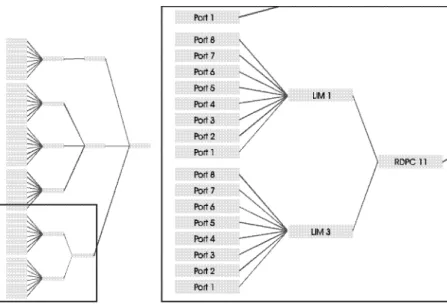
diagrams. Users can query on any attribute (numerical or textual) of nodes and the treemap is updated in real-time. Operators can either change the color or size attribute of each node or specify a query with slider-bars to filter out parts of the network. The treebrowser (Figure 5) provides a more classical fanned-out view of hierarchical data using a node link diagram. It provides the user with a clear view of the path through the hierarchy from any lower level element to a higher level superior element. Within the tree-browser the user is also provided with query and real-time update capabilities. These techniques were organized to produce an effective screen organization for configuration management. In addition, the basic ideas can be applied much more broadly with a general network management system.
FIGURE 5. Tree-Browser with Overview and Detail View Tightly Coupled.
CURRENT RESEARCH TOPICS
Currently, our research and development effort focuses on three main areas described as follows:
Object Oriented Data Model
We are extending and enhancing the OODM and constraints capabilities developed during phase I. Specifically, we are advancing the OODM design concept and implementation to incorporate the capability to model hybrid network, that is the integration of terrestrial and celestial networks. This hybrid configuration network will result in technology capable of providing services to handle a heterogeneous workload or transactions. The terrestrial network of choice to be connected with the HNS PES is a high data rate terrestrial network at T1, T3 and E1 rates, employing the Asynchronous Transfer Mode (ATM) concept and including a frame relay or X.25 over ATM. Logically the database is a centralized repository of all network management data, its physical implementation in large networks will have to be distributed in order to provide high performance. We are addressing design issues and investigating both the migration of objects in the database and the engineering of a distributed database system.
Performance and Statistics for Configuration Management
We are developing and implementing performance management objects which are incorporated in the OODM. Utilization of devices, links, nodes, error rates and packet rates are candidates for such
objects. Emphasis is placed on performance measures and statistics currently used in HNS Networks. In collaboration with HNS engineers, we have selected specific performance measures and statistics from information bytes, information packets, supervisory packets, lost information packets, CRC errors received, re-transmissions, ready/busy transition, memory full lost packets, ODLC link downs, and Inroute/Outroute Buffers.
Design of the Graphical User Interface
We are examining the implications of distributed OO databases and object migration on the GUI design. We are designing and developing an extendible TreeBrowser. We are developing novel visualizations of Inroute and Outroute attributes along with performance information to indicate how changing a configuration attribute affects the performance of the device.
CONCLUSIONS
The HNS/University of Maryland team set out to define the concepts and methodology to be used in building the next generation of HNS telecommunications network management systems. The prototype system has given a clear indication of the value of the results of this research and development effort. HNS is now in the process of integrating the technology contained in the prototype system into several of its commercial products.
Acknowledgements
ICON: A System for Implementing Constraints in Object-based Networks, to be published. MOON: A Data Model for Object-oriented Network Management, to be published.
Plaisant, Catherine; Kumar, Harsha; Teittinen, Marko; and Ben Shneiderman, Visual Information Management for Network Configuration, to be published.
References
Anwar, E.; Maugis, L. and Chakravarthy, S. (1993) "A New Perspective on Rule Support for Object-Oriented Databases,” in ACM SIGMOD: 99-108.
Datta, A., (1993) Database Environments for Decision Support and Network Management Systems, Ph.D. Dissertation, University of Maryland, College Park, Maryland, 1993.
Harista, J.; Ball, M.; Roussopoulos, N. and Datta, A. (1993) “Design of the MANDATE MIB,” In H. G Hegering and Y. Yemini, Integrated Network Management III, North Holland:85-96. Johnson, B., Shneiderman, B.(1992), “Tree Maps: A Space-Filling Approach to the Visualization of Hierarchical Information Structures,” Proc. of IEEE Visualization' 91, San Diego, CA,:
284-291.
LANAdvantage Reference Manual, Release 7.6B, Hughes Network Systems, Germantown, MD. Shneiderman, B.(1992), “Tree Visualization with Treemaps: 2-d Space-Filling Approach,” ACM Transactions on Graphics: 92-99.
Shneiderman, B.(1994), Dynamic Queries for Visual Information Seeking. IEEE Software, in press.