Research Results Digest
352
April 2011 C O N T E N T S Section 1 Introduction, 1 Section 2 Overview of Cost/Benefit Analysis, 3 Section 3 Categories of Benefits and Costs Considered, 5 Section 4 Illustrative Analysis, 6 Section 5 Sensitivity Analysis of Cost/Benefit Ratio, 12 Section 6 Conclusions, 14 References, 16Appendix A: Review of Relevant Cost/Benefit Analysis Models, 17 Appendix B: Analysis
Spreadsheet, 25
SECTION 1 INTRODUCTION Overview
Bus Rapid Transit (BRT) has emerged as a viable option to enhance transporta-tion capacity and provide increased levels of mobility and accessibility. BRT systems vary from one application to another but all provide a higher level of service than tradi-tional bus transportation. Service on BRT systems is generally faster than regular bus service because the buses make fewer stops and may run as often as comparable rail systems during peak travel times. BRT lines can transport large numbers of people effi-ciently and cost-effectively and can be an attractive way to get drivers out of their cars and onto transit.
BRT systems are characterized by a broad range of running ways which deter-mine the speed and overall performance of the system. Table 1 shows the range of BRT facilities characterized by type of access control, ranging from grade-separated bus-ways at one end of the spectrum to opera-tion in mixed traffic at the other. BRT lanes that have a high degree of right-of-way seg-regation provide the fastest and most reli-able BRT service and are most attractive for travelers. In addition to user benefits, they are likely to induce land and economic development benefits (Kittelson 2007).
However, they cost more than BRT that operates in mixed traffic or reserved on-street bus lanes.
Levels of service vary for the different types of bus lanes on arterial streets. Bus lanes can help improve transit speed and reli-ability on urban streets. BRT lanes are most effective and reliable when the buses oper-ate in conditions that are free from delays caused by other vehicles including autos and trucks. Separate bus lanes are also known to have a positive effect on ridership because they increase the visibility and identity of the BRT system. On an arterial street, bus lanes may operate in the same direction of general traffic (concurrent flow) or in the opposite direction (contraflow) along one-way streets.
While BRT in an exclusive ROW pro-vides the highest level of service, such systems are often challenging to develop in urban areas. Yet BRT operating in mixed flow lanes may not be able to achieve the improvement in travel time and reliability necessary to attract significant new rider-ship. One solution is to convert a mixed flow arterial lane to exclusive BRT use. Such a conversion has pros and cons. While the exclusive bus lane helps to ensure a high transit level of service, the loss of capacity for mixed flow traffic could cause a sig-nificant increase in vehicle delay. This
COST/BENEFIT ANALYSIS OF CONVERTING A LANE FOR BUS RAPID TRANSIT—PHASE II EVALUATION AND METHODOLOGY
This digest summarizes the results of NCHRP Project 20-65, Task 22, Cost/ Benefit Analysis of Converting a Lane for Bus Rapid Transit-Phase II Evaluation
and Methodology.The research was conducted by Jeffrey Ang-Olson,
Principal, and Anjali Mahendra, Senior Associate, ICF International.
Responsible Senior Program Officer: Gwen Chisholm-Smith
NATIONAL COOPERATIVE HIGHWAY RESEARCH PROGRAM
study explores these trade-offs by performing a cost/benefit analysis for a hypothetical lane con-version BRT project.
Purpose of Project and Intended Audience
This research builds off NCHRP Project 20-65, Task 21, which focused on reviewing existing BRT projects and the methods used to evaluate their costs and benefits. NCHRP Project 20-65, Task 22 is intended to provide transportation agencies with a methodology and a guide for evaluating the potential benefits of converting a mixed-flow lane to exclusive BRT use.
The benefits and costs of converting a lane to a BRT lane will depend heavily on how such a project affects traffic speed, delay, and vehicle miles trav-eled, both in the mixed flow lanes and the BRT lane. The benefits will also depend on the extent to which improved transit service results in mode shift to tran-sit. Thus, a critical section of the report is the descrip-tion of the analytical methods and assumpdescrip-tions used for these calculations.
From a review of 11 models that can be used for cost/benefit analysis (see Appendix A), the research
team found that most existing models do not allow consideration of both transit and auto modes at the same time in a single analysis. Therefore, analysts often need to apply alternative or off-model tech-niques to evaluate this special case.
This project required demonstration of a method-ology that captures all the benefits (and disbenefits) across transit riders and auto drivers. The intended audience for this report includes transportation plan-ners and modelers, consultants, professionals involved in economic, social, and environmental impact analy-sis, and others involved in evaluating projects, as well as decision makers who use the results of the analysis. The report is intended for those who have some knowledge of cost/benefit analysis and would like more information about how to apply it when converting a lane for the use of transit at a corridor, local, or regional scale.
How to Use the Illustrative Analysis
The illustrative analysis described in this report is intended as a reference for analysts considering the option of converting a mixed flow lane to a BRT lane. The hypothetical example involves an 8-mile
Table 1 Types of BRT facilities with level of access control.
Facility Type Access Control Examples
Busways
Bus tunnel Uninterrupted flow—full control of access Boston, Seattle
Grade-separated busway Uninterrupted flow—full control of access Ottawa, Pittsburgh
At-grade busway Partial control of access Miami, Hartford, Los Angeles
Freeway lanes
Concurrent flow lanes Uninterrupted flow—full control of access Ottawa, Phoenix
Contraflow lanes Uninterrupted flow—full control of access New Jersey approach to Lincoln Tunnel
Bus-only or bus Uninterrupted flow—full control of access Los Angeles
priority ramps
Arterial streets
Arterial median busway Physically separated lanes w/in street ROW Curitiba, Vancouver, Cleveland
Curb bus lane Exclusive/semi-exclusive lanes Rouen (France), Vancouver, Las Vegas
Dual curb lanes Exclusive/semi-exclusive lanes New York City (Madison Ave)
Interior bus lanes Exclusive/semi-exclusive lanes Boston
Median bus lane Exclusive/semi-exclusive lanes Cleveland
Contraflow bus lane Exclusive/semi-exclusive lanes Los Angeles, Pittsburgh
Bus-only street Exclusive/semi-exclusive lanes Portland (OR)
Queue jump/bypass lane Mixed traffic operations Leeds (UK), Vancouver
Transit signal priority Mixed traffic operations Los Angeles, Oakland
long corridor with a BRT link to the central business district of a city, using assumptions for the peak hours and peak direction of traffic. It assumes a set of typi-cal BRT features, including busway profiles, stations, vehicles, fare collection systems, and other safety and passenger information systems.
Accordingly, the costs of the hypothetical BRT system are calculated. The analysis assumes reason-able values for transit and auto modes shares, travel speeds, and vehicle occupancies on the corridor, and average values for traveler wage rates, auto oper-ating costs, bus transit fares, and other conditions required to set up the scenario. These values can be altered to reflect locally-specific values. Net bene-fits and costs are calculated on an annual basis over the lifetime of the project. Also included is a sen-sitivity analysis that shows how the net benefits, costs, and final cost/benefit ratio of the project vary when the assumed values are altered. This report pro-vides information on how the hypothetical analysis was conducted, thus providing a methodology that planners can use as a reference. Additionally, a sen-sitivity analysis shows the conditions under which converting an arterial lane to BRT may and may not be favorable.
A printout of the base case analysis spreadsheet is included as Appendix B.
SECTION 2 OVERVIEW OF COST/BENEFIT ANALYSIS
Cost/benefit analysis (also called benefit-cost analysis) is a method used to evaluate public expen-diture decisions. The analysis involves identifying and quantifying all the benefits and costs that will accrue to society if a project is undertaken. Cost/ benefit analysis thus helps determine the economi-cally efficient investment alternative, i.e., one that maximizes the net benefit to society from an allo-cation of resources. For transportation projects, this involves estimating a dollar value for benefits to users of the facility, a value for social benefits, and comparing these benefits to project capital, opera-tions, and maintenance costs. Total costs are sub-tracted from total benefits to calculate net benefit.
Purpose of Analysis and Steps
The purpose of a cost/benefit analysis is to deter-mine the project alternative that would provide the
greatest net benefit to the local area, region, or nation, by comparing the monetary value of benefits and costs of each alternative (U.S. GAO 2005). The benefits and costs will depend on the features of the project, estimates of future travel demand, and characteristics of the local area or region, such as the local economic and transportation conditions. Transportation agen-cies are typically required to do a detailed cost/benefit analysis to justify investment in a particular project. Such an analysis compares project alternatives with the “no build” base case, to determine a locally pre-ferred alternative.
To enable comparison of alternatives, it is nec-essary to standardize the categories of benefits and costs that are considered and the methodology that is used to calculate them. Direct benefits to users of the transportation system include travel time sav-ings, vehicle operating expenses and out-of-pocket expenses, and reduced crash costs. Other direct ben-efits can accrue to users and non-users, such as reduc-tions in emissions, noise, and other environmental impacts. While these impacts can be relatively simple to estimate, much variation exists in how benefits are monetized. Indirect benefits can arise from increased economic development and land development; these are often difficult to estimate, and therefore are often omitted in transportation cost/benefit analyses. The costs against which these benefits are weighed are also similarly varied. The construction, operation, and maintenance costs of a project are relatively easier to estimate than the costs of traffic delays during con-struction or the costs of long-term environmental impacts.
The most critical component of a cost/benefit analysis for a BRT project is likely to be the esti-mation of impacts on vehicle delay and transit rider-ship. While the calculation of these impacts will differ with every project, it is possible to evaluate hypothetical projects using plausible ranges for key parameters (such as traffic volume and transit rider-ship) so as to illustrate how these parameters influence the outcome. The calculation of benefits is particularly important and will depend on assumptions about the study area of the project, the monetary values assumed for the benefits and costs, and the duration over which the different costs and benefits will occur (i.e., short term or long term). Costs and benefits are usually cal-culated cumulatively over a project period that rep-resents some reasonable planning horizon, depend-ing on the nature of the project; 10 to 30 years is most commonly used (ITE 2009).
Since benefits and costs often occur at differ-ent times over the lifespan of a project, they must be adjusted according to when they occur. Because many costs usually occur in the early stages of a project, while benefits are spread out over a number of years, discounting is used to bring all monetary streams (both costs and benefits) to the same year, i.e., usually the year in which the analysis is being done. Due to the time cost of money and the value placed on immediate consumption, future benefits and costs are worth less than those incurred imme-diately. To account for this, future benefits and costs are discounted and then summed to arrive at a pres-ent value. A project decision is then made by com-paring the present value of the discounted stream of benefits to the present value of the discounted stream of costs. The discount rate is applied to the benefits and costs incurred in each year of the project’s life cycle.
Cost/benefit analysis typically involves com-paring project alternatives with a No-Build base-line scenario that assumes no action. The steps in conducting such an analysis include the following (ECONorthwest 2002):
1. Define the baseline and project scenarios in terms of facility features and operational characteristics
2. Set analysis period and define study area (single roadway segment or entire network) 3. Determine relevant categories of benefits and costs that will be measured or monetized in a way that avoids double-counting
4. Analyze changes in travel activity resulting from the project in terms of trips and vehicle miles traveled, by mode
5. Monetize travel activity impacts to estimate benefits and costs relative to the baseline scenario.
6. Decide on an appropriate discount rate and discount future steam of benefits and costs to present value
7. Estimate net benefits and cost/benefit ratios 8. Measure or discuss those project impacts that cannot be monetized due to uncertainties in monetary values or measurement
9. Conduct sensitivity analysis to assess changes in net benefits based on values of key input variables such as traffic volume
10. Evaluate and make recommendations to pur-sue project or not
Appropriate Measures for Cost/Benefit Analysis
There are several measures to compare benefits to costs in a cost/benefit analysis. The Federal Highway Administration recommends the use of either the Net Present Value (NPV) measure or the Benefit-Cost Ratio (BCR) to compare benefits to costs (FHWA 2003). These two most widely used measures have been used in the illustrative analysis in this project and are described herein.
NPV:All benefits and costs over the project’s life-cycle are discounted to present values and the costs are subtracted from the benefits to obtain the NPV, which must be a positive number for the project to be justified. When multiple project alternatives exist, the alternative with the largest NPV of net benefits is typically the preferred alternative, though sometimes, other factors including project risks and funding avail-ability may play a role in the selection of an alterna-tive with a lower, posialterna-tive NPV (FHWA 2003).
BCR:The BCR is a ratio where the present value of benefits (including negative benefits or disbenefits) is divided by the present value of the initial agency investment cost. When benefits exceed costs, the ratio is greater than 1 and implies that the project is worth pursuing.
Limitations of Cost/Benefit Analysis
Despite its many advantages, there are limitations to conducting a cost/benefit analysis in the context of converting a highway lane to a BRT lane. Transit projects often have several impacts that cannot be easily measured or expressed in dollars and are thus, omitted from the analysis. For example, future eco-nomic development impacts and spillover impacts in other jurisdictions are often not taken into account by an agency focusing only on local costs and benefits. Additionally, the distribution of benefits may sometimes be as or more important than the actual values of calculated benefits. For example, transit projects often bring benefits by providing mobility to people with low incomes, disabilities, or with other-wise limited access to transportation options. The ben-efits to these groups may be as important to consider as travel time savings.
Another limitation is that the results of a cost/ benefit analysis depend on assumptions for which justifiable alternative assumptions are always pos-sible causing the final results to sometimes vary
substantially. A sensitivity analysis must therefore always be done to illustrate the change in results with alternative values of inputs and assumptions.
SECTION 3 CATEGORIES OF BENEFITS AND COSTS CONSIDERED
This analysis includes the direct costs and ben-efits that will accrue to users of the corridor and to society at large. Commonly used measures of user benefit (or disbenefit) include changes in travel time, vehicle operating costs, fares for transit riders, and crash costs. The social benefits typically include reduction in damage costs caused by air pollutant emissions and changes in noise costs. Transit projects may also have indirect benefits that do not directly arise from travel activity but rather, arise from a redistribution of user benefits in the economy. The costs and benefits quantified in this analysis are listed in Table 2.
When enumerating benefits in a cost/benefit analysis framework, it is important to count only real increases in public welfare. Thus, reductions in travel time or crashes are counted as benefits because they are not offset by any losses elsewhere. The impact of construction on the local economy is not counted as a benefit because it does not change the underly-ing productivity of the local economy. Any increase in local economic activity would be considered a transfer, offset elsewhere by a reduction in economic activity due to the taxes necessary to fund the project. Similarly, the cost/benefit analysis does not explic-itly count non-user benefits if they are assumed to be
captured in the value of the user benefits. For exam-ple, the benefits to a business of reduced freight or commuter travel times are assumed to be captured in the commercial and passenger vehicle travel time benefits. Similarly, the increase in property values near BRT stations that may result from construction of a BRT project actually captures the benefit reaped from travel time savings to users and therefore, to avoid double-counting, must not be included in an analysis that already includes travel time savings.
Costs
Capital Costs
Capital costs include the one-time costs to the tran-sit or funding agency of acquiring right-of way, con-structing the BRT corridor and stations, procuring vehicles, and installing supporting systems such as fare collection, security, and passenger information systems. They include costs of design, engineering, and project management and exclude the out-year costs of reconstruction or replacement of facilities (ITE 2009).
Operation and Maintenance Costs
These are recurring costs related to the operations, maintenance, and administration of the BRT facility, stations, and service. Because these costs tend to rise over time, it is important to estimate them in constant or inflation-adjusted dollars. Since these costs are typ-ically derived from historic data, they must be con-verted to current values (the research team reports costs in constant 2009 dollars using the Consumer Price Index for urban consumers from the Bureau of Labor Statistics).
Benefits and Disbenefits
The benefits of the BRT project can be catego-rized as direct and indirect. Direct benefits (and dis-benefits) include changes in travel time, safety, and vehicle operating costs, as well as direct environ-mental impacts such as savings in costs associated with emissions. Indirect benefits can include benefits from increased economic activity, business agglom-eration, higher property values resulting from tran-sit investment, growth in employment, and savings to the transit agency from savings in transit operat-ing costs.
Table 2 Categories of costs and benefits considered.
Benefits/Disbenefits • Change in travel time for drivers, transit users
• Change in vehicle operating costs for drivers, fares for transit users
• Change in emissions of criteria pollutants and greenhouse gases
• Change in crash costs
Costs • Capital costs of materials, equipment, infrastructure construction, new buses
• Operations and maintenance costs
Direct User Benefits or Disbenefits
Travel time changes:Travel time savings would arise from a project that converts an arterial lane to BRT due to the reduction in travel time for transit pas-sengers who originally used the existing bus service. Auto drivers would also likely see a change in travel time due to a reduction in arterial capacity and also a reduction in traffic volume (due to some auto mode shift to transit). Travel time benefits are valued in terms of the hourly wage rate, under the assumption that time not spent in travel can be used for other activ-ities having economic value.
Travel cost savings: Savings or increases in travel costs include out-of pocket vehicle operat-ing and ownership costs and are directly related to the change in the number of vehicle miles traveled by auto drivers. Vehicle operating costs include the costs of fuel, oil, maintenance, insurance, and depre-ciation associated with vehicle wear. Travel costs also include the fares paid by transit riders on the exist-ing bus service and the new BRT service.
Crash costs: If some auto drivers switch their travel mode to the new BRT service, costs related to vehicle crashes will decline. While some part of crash costs are perceived by travelers and included in their calculation of travel cost through insurance, the costs to other drivers and the costs to state and municipal governments of responding to crashes are typically not perceived by travelers when making travel decisions and must be calculated separately (ECONorthwest 2002).
Direct Social Benefits
Environmental impacts or externalities, includ-ing savinclud-ings in emissions damage costs and noise costs experienced by those not using the BRT facil-ity, are considered the direct social benefits of the project.
Emission reduction:The change in emissions cost damages are directly related to the change in the number of trips and vehicle miles traveled by auto drivers. To the extent that the new BRT corridor can encourage drivers to take transit, emissions are likely to decline. However, a BRT conversion could have a negative impact on total vehicle emissions if con-gestion on the remaining mixed-flow travel lanes increases significantly.
Noise Reduction:Motor vehicle noise imposes an economic cost on those living or working in close proximity to the facility. For this hypothetical project,
noise impacts are likely to be insignificant because existing bus service is being replaced by a BRT ser-vice. Therefore, the research team ignores noise costs in this analysis.
Indirect Benefits
A BRT project is likely to have other benefits that are not directly related to the amount of travel on the facility, but arise as an indirect effect. These could include the following:
• Land development impacts involving a change in the use and value of properties located near the new BRT corridor.
• Savings in parking costs for drivers who switch modes from auto to the new BRT service and/or reduction in the need to provide vehicle park-ing in the CBD.
• Savings in reliability that would accrue to BRT riders.
• Economic impacts from enhanced accessibil-ity to employment.
• Savings in operating costs for the transit agency due to the higher efficiency of the BRT service. Quantification of indirect benefits is challeng-ing for a cost/benefit analysis focused on a schalleng-ingle BRT project. In this study, the research team does not quantify indirect benefits of the BRT project for two reasons. First, it would be difficult to isolate the impacts of the BRT project alone since these indirect benefits are influenced by several external factors. Second, the business and employment benefits are typically not included in project-level analyses since they are assumed to be transfers from other regions or from parts of the same region.
SECTION 4 ILLUSTRATIVE ANALYSIS
The most critical component of a cost/benefit analysis for a BRT project is the estimation of impacts on vehicle delay and transit ridership. While the calculation of these impacts will differ with every project, it is possible to evaluate hypothetical proj-ects using plausible ranges for key parameters so as to illustrate how these parameters influence the outcome.
In this section we describe a cost/benefit analysis for a hypothetical BRT project to illustrate how the benefits of such a project are affected by key param-eters such as traffic volume, change in travel time,
and baseline mode shares. The results of this analysis are expected to help transportation agencies under-stand the types of conditions under which convert-ing a lane to a BRT lane is likely or not likely to have net benefits.
Methodology
Our analysis compares a No Build baseline alter-native with a BRT alteralter-native that involves taking a mixed flow lane from a three-lane arterial and using it for dedicated BRT. The analysis involves defining a number of assumptions regarding the physical char-acteristics of the facility, its traffic controls, traffic volume, and baseline travel characteristics. We con-sider ranges of values for several key variables that would cover the range of conditions likely to be expe-rienced by transportation agencies.
We begin with an assumption for baseline daily person throughput—equivalent to the number of per-sons traveling in the corridor by automobile or bus service. From this assumption we calculate peak hour and peak direction vehicle volume and transit riders. The total person throughput is assumed to remain constant. Benefits and costs accrue due to changes in travel time and mode shift.
We use the Highway Capacity Software to calcu-late automobile speed and delay for the No Build and BRT project, for each combination of input variables. To determine the likely change in transit ridership due to improved transit service, we used elasticity values from the literature to estimate the following:
• Ridership increase from travel time savings: range assumed is −0.5 to −0.7 for work trips and lower for general trips (Kittelson 2007, Cam-bridge Systematics 2009). To add in the effect of increased reliability, −0.1 may be added (Cambridge Systematics 2009). The research team used −0.6 in this analysis.
• Ridership increase from reduced transit head-ways (increased frequency): range assumed is
−0.4 to −0.5 (TRB, 2005; Kittelson 2007). The research team used −0.4 in this analysis. These additional riders are assumed to shift their travel mode from auto to transit, thus keeping the total number of travelers in the corridor the same before and after the BRT project. Based on the increase in transit ridership, the research team calculated the change in traffic volumes on the remaining general purpose lanes and the corresponding change in speed
using the HCS. The research team also estimated the number of additional buses that would be required to accommodate the increased ridership from the mode shift. Using assumptions for transit and auto speeds before and after the BRT project, the research team estimated the change in travel time in vehicle hours traveled (VHT) for drivers and transit users, com-paring No Build with a BRT Dedicated Lane Alter-native. We multiplied that change by value of time parameters to monetize the delay benefit/disbenefit.
Based on the change in ridership and the number of auto drivers that shift to transit, we calculate the change in vehicle miles traveled (VMT) for the No Build case and the BRT case. This is used to estimate the changes in vehicle operating costs for users. Esti-mates of change in VMT were also used to calculate change in emissions damage costs and crash costs.
The research team used a discount rate of 7% to discount the costs and future stream of benefits, per guidance from the Office of Management and Bud-get (OMB 2003). The OMB guidance states that a real discount rate of 7% should be used as a discount rate “as a default position.” The 7% rate is an esti-mate of the average before-tax rate of return to pri-vate capital in the U.S. economy. The guidance also recommends that analysts use other discount rates to show the sensitivity of the estimates to the discount rate assumption. For instance, lower discount rates are appropriate in cases where the project or policy does not primarily impact the allocation of capital, rather it directly affects private consumption. The alternative most often used is sometimes called the “social rate of time preference.” This simply means the rate at which society discounts future consump-tion flows to their present value and has averaged around 3% in real terms on a pre-tax basis. The OMB therefore recommends providing estimates of net benefits using both 3% and 7% discount rates; the research team applied a 3% discount rate as part of the sensitivity analysis. Table 3 lists some of the fixed assumptions, variables, and calculated parameters in the analysis.
Finally, the research team conducted a sensitiv-ity analysis by altering the values of key variables, including mode shares, average daily traffic, BRT headway, and BRT speed. Altering the user costs for autos and transit will also lead to a change in benefits; however, the research team did not include this in the sensitivity analysis. Fares on transit were assumed to be the same in the existing bus service and in the new BRT service.
To assess the costs, the research team gathered data regarding assumptions for BRT costs as a func-tion of physical characteristics of the facility and sta-tions, vehicle type, and operational characteristics (Kittelson 2007). All costs and benefits are reported in constant 2009 dollars.
Assumptions and Sources for Data Inputs Overall Assumptions
The cost/benefit analysis described in this report is for an urban BRT line created on a three-lane arte-rial by taking one lane, leaving two general purpose lanes in the corridor. The analysis considers traffic volumes and speeds in the peak periods and peak direction of traffic. The peak traffic period is assumed to be 6 hours in duration, including three AM and three PM hours. The percentage of traffic volume assumed to be in a single peak hour is 10% of the average annual daily traffic (AADT), with 60% of the peak volume assumed to be in the peak direction. Because we are considering a BRT line into the CBD, it is reasonable to assume that there is minimal traffic congestion and work travel in the reverse direction. Therefore, we do not calculate benefits in the reverse commute direction. The research team also assumed that benefits would be minimal during off-peak peri-ods, and did not calculate any off-peak benefits. The research team assumed benefits occur for 300 days per year, based on a range of 250–365 as seen in the literature.
The analysis also assumes that all existing transit riders will transfer to the new BRT service, implying that all existing transit buses on the corridor will be replaced by BRT. For the Base Case analysis, the pre-project auto and transit mode shares in the corridor are assumed to be 85% and 15%, respectively. Exam-ples of pre-project mode shares on arterial BRT cor-ridors are difficult to find, but we believe this assump-tion for mode shares in corridors where BRT is being considered is likely to be conservative. For instance, the feasibility study for the proposed BRT corridor on Geary Boulevard in San Francisco estimates that buses serve as much as 25% of the trips made in the Geary corridor during the PM peak hour (SFCTA, 2007).
Arterial Speed and Volume Assumptions
The Highway Capacity Software, which applies methods defined in the Highway Capacity Manual (Transportation Research Board 2000), was used to estimate the relationship between hourly traffic vol-ume and speed. As defined in the Highway Capac-ity Manual, the research team selected the Class III arterial for the analysis.
The research team made assumptions for road-way characteristics, signal characteristics, and traffic characteristics. Road characteristics include arterial class, free flow speed, number of through lanes, and median treatment. Signal characteristics include sig-nal density, vehicle arrival type, sigsig-nal type, sigsig-nal cycle length, and green-to-cycle length ratio. Traffic
Table 3 Assumptions, variables, and calculated parameters.
Calculated Parameters
Fixed Assumptions Variables (both mixed flow and BRT lanes)
Capital, operating, and maintenance costs Urban Street Class III Discount rate
Number of lanes
Signal timing and spacing Average vehicle occupancy
(autos and transit)
Transit ridership growth rate Auto ridership growth rate Transit ridership elasticity
wrt travel time
Transit ridership elasticity wrt bus frequency Average wage rates
Average vehicle miles traveled (VMT) Vehicle delay, LOS
Person delay Average auto speed Vehicle throughput Person throughput Total auto and transit travel
demand in a corridor (persons) Mode shares
User costs for autos and transit Average BRT speed
characteristics include the directional distribution fac-tor, adjusted saturation flow rate, planning analysis hour factor, peak hour factor, and percent turns from exclusive lanes.
The input values for these characteristics were determined based on the range of values suggested in
the Highway Capacity Manual, as well as professional experience and observation. The average travel speed during the peak hour was calculated based on the spec-ified volume and road characteristics. Table 4 lists the assumptions used in the HCS analysis. The analy-sis was done for an 8-mile segment of the corridor; both transit riders and auto drivers are assumed to travel this length in a single trip.
Capital Costs
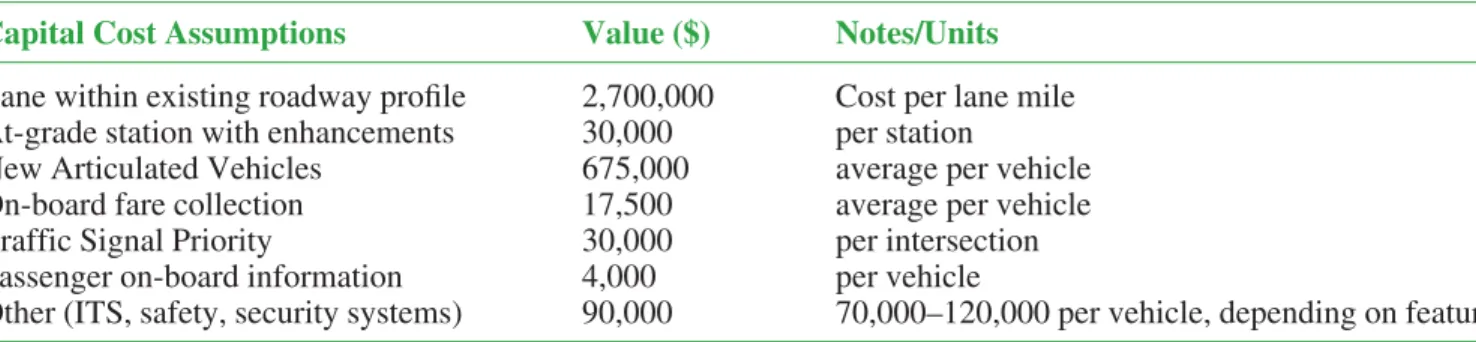
TCRP Report 118 presents a range of capital costs for BRT systems, depending on facility type, station type, vehicle type, fare collection system, and other information and safety systems. We used this source to estimate capital costs for the hypo-thetical example. For the illustrative analysis, the research team assumed the scenario of a lane within the existing roadway profile, at-grade typical sta-tions (enhanced), standard vehicles, off-board fare collection, the availability of traffic signal priority, passenger on-board information, and other standard ITS, safety, and security systems. Table 5 shows the assumptions for capital costs that were used in the analysis, along with the full range of costs for different BRT features. Lane construction costs are for unfinished pavements and exclude right-of-way acquisition costs, but include engineering and design costs. Capital costs are assumed to be spent over 2 years, starting in 2011.
BRT Operations and Maintenance Costs
Annual BRT operation and maintenance costs were assumed to be $10,000 per lane mile (in 2004 dollars), assuming minor reconfiguration or widen-ing of the arterial, based on figures provided in TCRP Report 118.These were converted to constant 2009 dollars for use in the analysis.
Table 4 Input assumptions for HCS arterial planning analysis.
Urban Street Class III
Street Type Urban Principal Arterial
Intermediate Minor Arterial
Free Flow Speed (mph) 35
Left-Turn Bays Yes
Median Yes
Segment Length (mile) 8
Signals per mile 6
Arrival Type 5
Operational A highly favorable
Characteristics progression on an
urban street, which receives high priority in signal timing.
Signal Type Actuated
Cycle Length (sec) 80
Effective Green Ratio 0.5
Directional Distribution 0.5
Factor
Adjusted Saturation 1750
Flow Rate (passenger cars per hour of green per lane)
Planning Analysis 0.1
Hour Factor
Peak Hour Factor 0.9
% turns from Exclusive 20
Lanes
Table 5 Capital cost assumptions.
Capital Cost Assumptions Value ($) Notes/Units
Lane within existing roadway profile 2,700,000 Cost per lane mile
At-grade station with enhancements 30,000 per station
New Articulated Vehicles 675,000 average per vehicle
On-board fare collection 17,500 average per vehicle
Traffic Signal Priority 30,000 per intersection
Passenger on-board information 4,000 per vehicle
Other (ITS, safety, security systems) 90,000 70,000–120,000 per vehicle, depending on features
Source: TCRP Report 118: BRT Practitioner’s Guide,2007
BRT Operational Characteristics
The results of the cost/benefit analysis are highly dependent on how the project changes travel time and wait time for transit riders. Numerous existing BRT systems have demonstrated substantial reduc-tions in travel time and headways compared to con-ventional bus service. For the purposes of the base case example, the research team relied on the average bus speeds presented in the FTA’s Characteristics of Bus Rapid Transit for Decision-Making(2009). We assume an average stop spacing of 0.2 miles and average dwell time of 30 seconds. In this situation, bus speeds on general purpose traffic lanes (No Build alternative) are estimated to be 7 mph. Bus speeds on dedicated arterial street bus lanes (BRT alterna-tive) are estimated to be 11 mph. This reflects a 36% improvement in transit travel time.
The research team assumed an average bus head-way of 10 minutes under the No Build alternative. Using 60-foot articulated buses with a maximum capacity of 80 passengers, this headway implies a maximum transit throughput of 480 riders per hour in the peak direction. For the BRT alternative, the research team assumed an average bus headway of 6 minutes, or a maximum transit throughput of 800 riders per hour in the peak direction. This capacity is sufficient to accommodate the transit demand under all the BRT scenarios analyzed in this report.
Value of Travel Time
The research team assumed value of time esti-mates of 50% of wage rate for in-vehicle time and 100% of wage rate for access, waiting, and trans-fer time (ECONorthwest 2002). The average wage rate in constant 2009 dollars was assumed to be $26.29 per hour for transit riders and auto drivers (U.S. DOT 2003).
Note that auto drivers who shift to BRT are likely to incur an increasein travel time, and thus an increase in travel costs. Therefore, these travelers would expe-rience a net travel time disbenefit. Consistent with other literature, the travel time disbenefit to auto drivers is not assigned a negative cost, but rather is assumed to be zero. This is because, while auto drivers diverting to BRT experience this travel time disbenefit, it is clear there must be benefits other than travel time that cause drivers to switch to BRT. These can include benefits such as the convenience of not driving, increased productivity due to the use of travel time for doing other work, less stress, and so on. Since these benefits cannot be captured in this
analysis, it is more realistic to assume a zero value for the change in travel time costs rather than a neg-ative value.
Auto Operating Costs
These costs include ownership costs and were assumed to be 54 cents per mile using figures from the American Automobile Association (AAA 2009) that include costs of fuel, maintenance, tires, insur-ance, license, registration and taxes, depreciation, and financing and are based on an assumed 15,000 miles driven per year.
Transit Fare
The research team assumed the average adult sin-gle trip bus fare to be $1.30, based on statistics avail-able from the American Public Transport Association (APTA 2007).
Vehicle Occupancies
Average auto occupancy during peak hours was assumed to be 1.2 and transit occupancy was assumed to be 80 passengers for both standard existing articu-lated buses and BRT buses.
Emissions Rates and Emissions Damage Costs
Emissions rates for light duty vehicles were avail-able from the EPA (2005) and damage costs were EPA figures assumed in the National Highway Traf-fic Safety Administration’s (NHTSA) Corporate Average Fuel Economy for MY 2012-MY 2016, Passenger Cars and Light Trucks(NHTSA 2009), reported in 2007 dollars (see Table 6). These costs were converted to constant 2009 dollars for calcu-lating the cost/benefit ratio. The change in emissions for buses has not been taken into account. While the emissions per bus-mile will remain constant, bus emissions are likely to be higher in the BRT case
Table 6 Emission rates and emission damage costs assumed.
Emission Rates Emissions Damage (grams/mile) Costs ($/ton)
VOCs 1.36 1,300
NOx 0.95 5,300
SOx 0.008 31,000
Particulates 0.01 290,000
because bus VMT will be higher. However, this increase in bus emissions due to increase frequency has a negligible effect on the net benefits of the project.
Crash Costs
Crash costs per vehicle mile traveled for light duty vehicles was available from the EPA and was assumed to be $0.023, as referenced by NHTSA (NHTSA 2009) and reported in 2007 dollars. These costs were converted to constant 2009 dollars for calculating the cost/benefit ratio.
Results
The research team calculated costs and benefits for all categories over a period of 22 years, assum-ing initial construction costs over a period of 2 years and discounting future benefits and Operation and Maintenance (O&M) costs over a period of 20 years after construction.
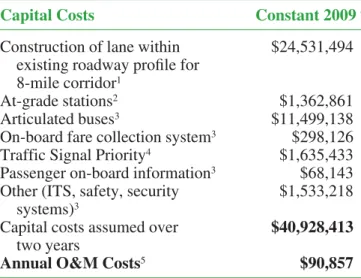
Table 7 shows the total capital costs under vari-ous cost categories and the O&M costs incurred every
year over the life of the project in constant 2009 dol-lars. Costs of infrastructure and station construction, on-board fare collection, vehicles, traffic signal pri-ority, as well as other on-board information, safety, and security systems constitute the total capital costs. The research team estimated these costs based on the assumption of a bus lane on an urban arterial constructed within the roadway profile. The largest proportion of costs (60%) is for construction of a BRT lane within the existing right-of-way, followed by purchase of new articulated buses (28%). Our analysis for the hypothetical case shows that fifteen new buses would be required to accommodate the increased ridership. The increase in ridership is within the bounds of the maximum peak hour peak direction BRT capacity in the assumed corridor.
Table 8 shows the different categories of bene-fits (and disbenebene-fits) that accrue to users and non-users of the arterial under in the base case scenario (40,000 daily person throughput). A project of this nature that involves reducing capacity for autos while creating a BRT lane is unique from other stand-alone transit projects in that it results in a substantial dis-benefit to auto users, while bringing substantial ben-efits to transit riders. This reduces the net user benefit in terms of travel time and out-of pocket cost savings that can be expected from the project. Based on the research team’s assumptions, the analysis shows that the benefits to transit riders exceed the disbenefits to auto drivers by a factor of approximately 3.5. Smaller savings occur due to the reduction in crash costs and emissions, which depend on the reduction in VMT by auto drivers diverting to BRT. The sensitivity analy-sis in the next section shows how these benefits vary under alternate assumptions.
Table 7 Costs of converting an arterial lane to a BRT lane for hypothetical corridor*.
Capital Costs Constant 2009 $
Construction of lane within $24,531,494
existing roadway profile for 8-mile corridor1
At-grade stations2 $1,362,861
Articulated buses3 $11,499,138
On-board fare collection system3 $298,126
Traffic Signal Priority4 $1,635,433
Passenger on-board information3 $68,143
Other (ITS, safety, security $1,533,218
systems)3
Capital costs assumed over $40,928,413
two years
Annual O&M Costs5 $90,857 *Costs above based on unit costs in Table 5, converted to constant 2009 dollars.
1: Costs are for unfinished pavement, exclude right of way costs, and include engineering and design costs.
2: Total costs for 40 stations, assuming 5 stations per mile on 8-mile corridor.
3: Total costs for 15 vehicles.
4: Total costs for traffic signal priority on 48 intersections, assuming 6 intersections per mile on 8-mile corridor. 5: Includes costs of street lighting and routine maintenance.
Table 8 Annual peak period benefits of converting an arterial lane to BRT (40,000 daily person throughput). Annual Peak Period Benefits Constant 2009 $
Benefits for transit riders $4,107,426
continuing to use transit
Disbenefits for auto drivers −$1,189,190
continuing to drive
Savings in crash costs $425,733
Savings in emissions $321,014
damage costs
Total Annual Peak Period $3,664,982
The above benefits were estimated for each of 20 years that the BRT project is expected to be in oper-ation. The results of the analysis show that under our base case assumptions, converting an arterial lane to a BRT lane is likely to show a favorable cost/ benefit ratio or a positive NPV, because the net ben-efits exceed the total costs of providing the BRT system. However, the results are highly sensitive to the assumptions for pre-project traffic volume and mode share, as well as the travel time and frequency improvements provided by the BRT system.
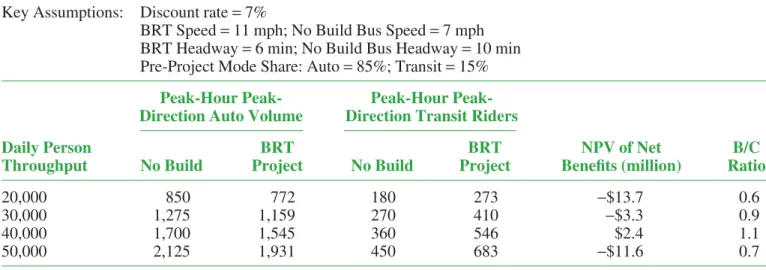
Table 9 shows the results for four values of daily person throughput, ranging from 20,000 to 50,000. These results illustrate that while the project shows a positive net benefit at 40,000 daily person through-put, the net benefits become negative at lower and higher volumes.
• At lower volumes (20,000 and 30,000), the number of transit riders is too low to generate sufficient travel time benefits to offset the proj-ect costs and the (small) travel time disbenefit experienced by auto drivers.
• At a daily throughput of 50,000 persons, the travel time benefit to transit riders is large, but the automobile volume is large enough that going from three mixed lanes to two results in a significant drop in automobile speed. The value of the travel time disbenefit experienced by auto drivers is nearly equivalent to the value of the benefit to transit riders. Thus, the net ben-efits are significantly less than project costs. The next section presents a sensitivity analysis to better understand the effect of key variables on cost/benefit analysis results.
SECTION 5 SENSITIVITY ANALYSIS OF COST/BENEFIT RATIO
This section describes the results of a sensitivity analysis to show the effects of different assumptions for the following four key variables:
• Pre-project auto-transit mode share,
• Corridor length,
• Discount rate, and
• BRT speed improvement.
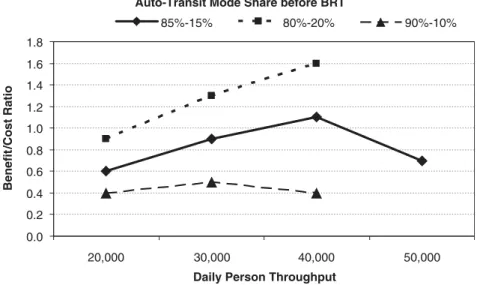
Figure 1 shows the effect of pre-project mode share on the resulting cost/benefit ratio for four lev-els of daily person throughput. All other variables are unchanged from the scenario presented in Section 4. The solid line with diamonds is the base case scenario presented in Section 4.
The dotted line with squares shows that a higher pre-project transit mode share (20%) leads to a favor-able cost/benefit ratio for values of person throughput greater than 25,000. At very high levels of through-put (50,000 and more), the number of transit riders in the No Build alternative is too large to be served under our assumption of 60-foot articulated buses with 10 minute headways.
The dashed line with triangles shows that a lower pre-project transit mode share (10%) always results in a cost/benefit ratio less than one. In these cases, the number of transit riders is too small to generate travel time benefits sufficient to offset the project costs and the (small) travel time disbenefit experi-enced by auto drivers.
Figure 2 shows that the cost/benefit ratio is fairly constant in relation to corridor length. These calcu-lations assume that all auto and transit users travel the
Table 9 Base case results for different values of passenger throughput. Key Assumptions: Discount rate =7%
BRT Speed =11 mph; No Build Bus Speed =7 mph BRT Headway =6 min; No Build Bus Headway =10 min Pre-Project Mode Share: Auto =85%; Transit =15%
Peak-Hour Peak- Hour
Peak-Direction Auto Volume Direction Transit Riders
Daily Person BRT BRT NPV of Net B/C
Throughput No Build Project No Build Project Benefits (million) Ratio
20,000 850 772 180 273 −$13.7 0.6
30,000 1,275 1,159 270 410 −$3.3 0.9
40,000 1,700 1,545 360 546 $2.4 1.1
Figure 1 Sensitivity analysis for values of pre-project auto-transit mode share.
Auto-Transit Mode Share before BRT
0.0 0.2 0.4 0.6 0.8 1.0 1.2 1.4 1.6 1.8 20,000 30,000 40,000 50,000
Daily Person Throughput
Benefit
/Cost Ratio
85%-15% 80%-20% 90%-10%
Figure 2 Sensitivity analysis for values of corridor length.
0 0.2 0.4 0.6 0.8 1 1.2 1.4 5 8 11 14 17
BRT Corridor Length (miles)
Benefit
/Cost Ratio
full length of the corridor, and all other variables are unchanged from the scenario presented in Section 4. Most of the costs and benefits are directly proportional to the corridor length, so the ratio does not change sig-nificantly. The disbenefit of transit wait time does not vary with corridor length, and its contribution to the total net benefit diminishes with trip length. This leads to a slight increase in the cost/benefit ratio for longer trips. At a corridor length of 17 miles, the cost/benefit ratio is 1.22.
Table 10 shows the results using a discount rate of 3% compared to 7%. Because most of the costs occur in the first 2 years while the benefits are spread over the subsequent 20 years, a lower discount rate has the effect of maintaining higher benefits relative to costs. Holding all other variables unchanged from the scenario presented in Section 4, these results show
that, with a 3% discount rate, the hypothetical BRT project would achieve a positive net benefit if the daily person throughput is 30,000, 40,000, or 50,000. Table 11 shows results for alternative values of BRT average speed. The base case analysis presented in Section 4 assumed a BRT speed of 11 mph, which results in a 36% reduction in transit travel time com-pared to the No Build alternative (with a bus speed of 7 mph).
If the BRT average speed was only 9 mph, result-ing in a 22% transit travel time reduction, total costs exceed total benefits for all values of throughput (Cost/Benefit ratio is always less than 1.0). If the BRT average speed were 13 mph, resulting in a 46% tran-sit travel time reduction, the project produces potran-sitive net benefits for a range of throughput values (30,000 to 50,000).
Figure 3 shows these results graphically. This analysis illustrates the importance of transit travel time savings to the calculation of BRT net benefits.
SECTION 6 CONCLUSIONS
This analysis of a hypothetical project shows that converting an arterial traffic lane for BRT can result in positive net benefits under certain conditions. The analysis also shows that the cost/benefit ratio and net benefits of this project are highly sensitive to the input assumptions. The net benefits expected from a BRT project are a function of multiple variables, including the following:
• Total corridor person throughput,
• Pre-project mode share,
• BRT travel time savings, and
• Discount rate.
There are trade-offs between these variables that affect the estimated net benefits. For instance, a higher than average BRT speed may result in a favorable cost/benefit ratio even with relatively lower passenger throughput, but if transit mode share is low, even a high BRT speed may not result in a favor-able project. Tfavor-able 12 summarizes the effect of the above key input variables that have a strong effect on the cost/benefit ratio, highlighting the conditions under which the ratio is likely to be greater than one. As may be expected, the best corridors for con-verting a lane for BRT are those with relatively high person throughput (at least 40,000 per day) and rel-atively high pre-project transit mode share (at least 15%). In corridors with person throughput of 20,000 or less, or with a pre-project transit mode share of 10% or less, converting a lane to BRT is unlikely to result in positive net benefits.
Table 11 Sensitivity analysis for values of BRT speed. Key Assumptions: Discount rate =7%
No Build Bus Speed =7 mph
BRT Headway =6 min; No Build Bus Headway =10 min Pre-Project Mode Share: Auto =85%; Transit =15%
BRT Speed ⴝ11 mph BRT Speed ⴝ9 mph BRT Speed ⴝ13 mph
(36% travel time (22% travel time (46% travel time
reduction) reduction) reduction)
Daily Person Net Benefits Net Benefits Net Benefits
Throughput (million) C/B Ratio (million) C/B Ratio (million) C/B Ratio
20,000 −$13.7 0.6 −$22.0 0.4 −$7.5 0.8
30,000 −$3.3 0.9 −$16.4 0.6 $5.3 1.1
40,000 $2.4 1.1 −$15.3 0.6 $14.0 1.4
50,000 −$11.6 0.7 −$50.6 −0.3 $10.3 1.3
Table 10 Sensitivity analysis for alternative discount rate.
Key Assumptions: BRT Speed =11 mph; No Build Bus Speed =7 mph BRT Headway =6 min; No Build Bus Headway =10 min Pre-Project Mode Share: Auto =85%; Transit =15%
7% Discount Rate 3% Discount Rate
Daily Person NPV of Net NPV of Net
Throughput Benefits (million) C/B Ratio Benefits (million) C/B Ratio
20,000 −$13.7 0.6 −$2.9 0.9
30,000 −$3.3 0.9 $13.2 1.3
40,000 $2.4 1.1 $22.0 1.5
Table 12 Conditions resulting in favorable cost/benefit ratio.
Variables Daily Person Throughput Cost/Benefit Ratio >11
BRT Average Speed2
9 mph (22% travel time reduction) 20,000 No
30,000 No
40,000 No
50,000 No
11 mph (36% travel time reduction) 20,000 No
30,000 No
40,000 Yes
50,000 No
13 mph (46% travel time reduction) 20,000 No
30,000 Yes
40,000 Yes
50,000 Yes
Auto-Transit Mode Share Pre-Project3
80%–20% 20,000 No 30,000 Yes 40,000 Yes 85%–15% 20,000 No 30,000 No 40,000 Yes 90%–10% 20,000 No 30,000 No 40,000 No BRT Corridor Length4 5 miles 40,000 Yes 8 miles 40,000 Yes 11 miles 40,000 Yes 14 miles 40,000 Yes 17 miles 40,000 Yes
Note 1: At 7% discount rate
Note 2: Assumes base case transit speed of 7 mph and auto-transit mode share (pre-project) of 85%–15% Note 3: Assumes average BRT speed of 11 mph
Note 4: Assumes average BRT speed of 11 mph and auto-transit mode share (pre-project) of 85%–15%
Figure 3 Sensitivity analysis for values of BRT speed.
-0.4 -0.2 0.0 0.2 0.4 0.6 0.8 1.0 1.2 1.4 1.6 20,000 30,000 40,000 50,000
Daily Person Throughput
Benefit/Cost Ratio
The travel time savings for transit riders is a key factor driving the net benefits of a BRT lane conver-sion project. When new BRT service improves tran-sit travel time by 40% or more, converting a lane for BRT is likely to product positive net benefits under a range of throughput values. Conversely, if BRT improves transit travel time by 20% or less, a proj-ect is unlikely to result in positive net benefits.
The length of the corridor does not make a sig-nificant difference to the resulting cost/benefit ratio. In the hypothetical example considered in this study, a relatively high person throughput of 40,000 per day is likely to result in positive net benefits, regard-less of corridor length.
It should be noted that some benefits of a BRT project were not incorporated into this analysis because they are difficult to quantify. These include indirect positive impacts on land and economic development and savings associated with use and supply of parking for auto drivers. If these types of benefits were included, more of the scenarios analyzed in this study would produce a favorable cost/benefit ratio.
While cost/benefit analysis is a useful tool for public investment decisions, this study also highlights some of its shortcomings. The fact that the results are so sensitive to multiple input variables makes it challenging to draw conclusions about which types of projects are the best public investments. Although the research conducted a sensitivity analysis for a number of these input variables, there are many more variables that were not tested. Some of these other variables could significantly change the results if they differ from our assumptions. Thus, it is impor-tant to recognize cost/benefit analysis as just one tool to use in transportation decision making, to be complemented with other analyses and decision-making criteria.
REFERENCES
American Automobile Association (2009). Your Driving
Costs,2009 Edition.
APTA (2007). Adult single trip bus fares, American
pub-lic Transport Association (Table 9).Available at:
http://www.apta.com/resources/aboutpt/Documents/ 07report_iiia_table9_adult_single_trip_base_fares. pdf. Accessed on July 28, 2010.
Cambridge Systematics, Inc., (2009), Technical Appen-dices to Moving Cooler: An Analysis of
Transporta-tion Strategies for Reducing Greenhouse Gas
Emis-sions,prepared for Urban Land Institute, Washington,
D.C. Available at: http://www.movingcooler.info/ Library/Documents/Moving%20Cooler_Appendices_ Complete_102209.pdf. Accessed on July 28, 2010. Federal Highway Administration (1997). Federal
High-way Cost Allocation Study,Tables V-22, V-23, and
V-24. Available at: http://www.fhwa.dot.gov/policy/ hcas/final/index.htm. Accessed on July 28, 2010. Federal Highway Administration (2003). Economic
Analy-sis Primer.Federal Highways Administration Office
of Asset Management, U.S. Department of Trans-portation. Available at: http://www.fhwa.dot.gov/ infrastructure/asstmgmt/primer.cfm. Accessed on July 28, 2010.
Federal Transit Administration (2009). Characteristics
of Bus Rapid Transit for Decision-Making.
Avail-able at: http://www.fta.dot.gov/assistance/technology/ research_4285.html. Accessed on July 28, 2010. National Highway Traffic Safety Administration (2009).
Corporate Average Fuel Economy for MY 2012-MY
2016, Passenger Cars and Light Trucks.Preliminary
Regulatory Impact Analysis, Appendix D.
Institute of Transportation Engineers (ITE) (2009).
Trans-portation Planning Handbook, 3rd Edition.Institute
of Transportation Engineers, Washington, D.C. Office of Management and Budget (2003). Circular A-4,
“Regulatory Analysis,” September 17, 2003, 33. Available at: http://www.whitehouse.gov/omb/ circulars/a004/a-4.pdf. Accessed on July 28, 2010. San Francisco County Transportation Authority (SFCTA) (2007). Geary Corridor Bus Rapid Transit (BRT) Study.
Transportation Research Board (2000). Special Report
209: Highway Capacity Manual.,National Research
Council. Washington, DC.
ECONorthwest and Parsons Brinckerhoff Quade & Douglas Inc., (2002). TCRP Report 78: Estimating the Benefits and Costs of Public Transit Projects: A
Guidebook for Practitioners.Transportation Research
Board of the National Academies. Washington, D.C. Available at:http://onlinepubs.trb.org/onlinepubs/tcrp/ tcrp78/guidebook/tcrp78.pdf.
Transportation Research Board (2003). Volume 1: Case
Studies in Bus Rapid Transit.TCRP Report 90,
Vol-ume 1, National Research Council, Washington, D.C. Available at: http://onlinepubs.trb.org/onlinepubs/ tcrp/tcrp_rpt_90v1.pdf.
Kittelson and Associates, Inc., Herbert S. Levinson Trans-portation Consultants, and DMJM+Harris (2007).
TCRP Report 18: Bus Rapid Transit Practitioner’s
Guide.Transportation Research Board of the National
Academies. Washington, D.C. Available at: http:// onlinepubs.trb.org/onlinepubs/tcrp/tcrp_rpt_118.pdf.
Transportation Research Board (2005). Traveler Response
to Transportation System Changes.TCRP Report 95.
Washington DC. 2005, p. 9-5.
U.S. Government Accountability Office (2005). Highway and Transit Investments: Options for Improving Infor-mation on Projects’ Benefits and Costs and
Increas-ing Accountability of Results.GAO Report 05-172.
U.S. Department of Transportation (2003). Revision to 1997 Memorandum titled “Departmental Guidance for the Valuation of Travel Time in Economic Analysis.” Available at: http://ostpxweb.dot.gov/policy/Data/ VOTrevision1_2-11-03.pdf.
APPENDIX A: REVIEW OF RELEVANT COST/BENEFIT ANALYSIS MODELS
The research team reviewed 11 models that are used by agencies to conduct cost/benefit analyses for transportation projects.
1. California Life-Cycle Cost/benefit Analysis Model (Cal-B/C)
2. Highway Economic Requirements System for State Use (HERS-ST)
3. Transit Economic Requirements Model (TERM)
4. Florida Interstate Highway System: Multi-Modal Corridor Level of Service Analysis (MMCLOS)
5. StratBENCOST: Strategic Decision Support Tool for Highway Planning and Budgeting 6. MicroBENCOST
7. STEAM: Surface Transportation Efficiency Analysis Model
8. SPASM: Sketch Planning Analysis Spread-sheet Model
9. NET_BC 10. BCA.Net 11. IMPACTS
Summary
• Models either fall in the category of sketch-planning models or network-based models. Sketch-planning models are typically used to analyze a single corridor without consid-ering impacts beyond the immediate project area; e.g., Cal B/C, SPASM and IMPACTS. Network-based models evaluate benefits and costs for the entire highway network, using
out-puts from a network travel demand model; e.g., HERS (national) and HERS-ST (state version), NET_BC, StratBENCOST, and STEAM. For our purpose, a framework that leads to the development of a sketch planning model is preferable since such models are more user-friendly, adaptable across agencies, and can be easily updated.
• Most existing models do not allow considera-tion of both transit and highway modes; the subset of models that can thus be used for ana-lyzing conversion of a highway lane a BRT lanes is thus very small. STEAM, Cal-B/C, SPASM, and IMPACTS are the four models that allow this. Of these, the latter three are the more easily usable spreadsheet-based models that can inform the development of a frame-work. Cal-B/C is the most recent of these, although it is only applicable for California.
• Many of the models use economic values from very old data sources that have not been updated. Considering that about 60–80% of user benefits are due to travel time savings, the most recent data sources and methodolo-gies for calculating value of time parameters must be used. Cal B/C is the most recent model in the list; however the parameters used are specific to California.
• Several existing models use default param-eters from old sources, and user editing of parameters is often not available; if it is, it is difficult or not recommended because of com-plex relationships embedded in the model as a black box. Spreadsheet-based sketch plan-ning models are more transparent and flexi-ble because the user can enter all the input parameters; however, they can be limited in cases where detailed analysis is required and where impacts of improvements on one facil-ity or on other parallel or surrounding facili-ties must be assessed.
• Benefit and cost categories are mostly com-mon across models. Benefits typically include direct user benefits in the form of travel time savings, accident cost savings (safety benefits), and vehicle operating cost savings; social ben-efits include emissions and energy savings; costs include capital, O&M costs to the agency constructing the project. However, since several of the models do not consider multiple modes
simultaneously, additional benefit and cost cat-egories may need to be considered for the spe-cific case of lane conversion to BRT, where new users of the BRT are involved.
1. California Life-Cycle Benefit/Cost Analysis Model (Cal-B/C)
Model Purpose
Economic evaluation of prospective highway and transit improvement projects within the State of California. The model can handle specific high-way projects such as HOV lane construction and new intersections and is capable of handling multi-ple modes, including transit.
Data Requirements
For highway projects, data required are highway design and traffic data including the number of gen-eral purpose and HOV lanes, estimated speed, length of highway segment, average daily traffic, and acci-dent data for facility. For transit projects, data required are annual person trips, average travel time, annual passenger miles, percent trips occurring during peak periods, transit accident reduction, and the percent of trips occurring on a parallel highway
Format and Year
Microsoft Excel spreadsheet format; 2004
Timeframe of Evaluation
20-year project life cycle
Relevance to Project Objective
• Many input requirements related to new pave-ment construction can be reduced for the case of converting an existing lane for transit.
• Highway or transit components are separate, and it is not clear if both can be evaluated as part of a single project.
Cost and Benefit Categories Considered
Benefits:Travel time savings, vehicle operating cost savings, safety benefits (accident cost savings), and emissions reductions (CO, NOx, PM10and VOC).
Costs:Project-specific construction, operations and maintenance, and mitigation costs to the agency, entered for each year.
Noteworthy Features and Usable Parameters
• Rather than cross-sectional data for one year only, the model allows cost inputs for each year, based on analyses done by agencies using their own discount rates.
• The model can analyze benefits and costs even if the user does not have access to a regional travel demand model, as long as project-specific data are available.
• Excel worksheet with all inputs and param-eters visible to the user; therefore not a “black box” model.
Limitations
• Only applicable to California, with use of state-wide parameters.
• No consideration of transit user costs.
• Fixed real discount rate of 6%. Model should allow user to do a sensitivity analysis using dif-ferent rates. Similarly, vehicle operating costs calculated in terms of fuel costs and non-fuel costs for autos and trucks are fixed values from the year 2004.
• Fixed values of time for auto, truck and transit passengers from 2004.
• Emissions factors used are from 2004.
• GDP deflator used to convert 2004 values to the year of analysis.
• Accident cost data is from the year 2000.
2. Highway Economic Requirements System for State Use (HERS-ST)
Model Purpose
The Federal Highway Administration (FHWA) developed the state-level HERS-ST model as a direct extension of the national-level HERS model. The model applies BCA to section-level highway data to predict the investment required to achieve certain highway system performance levels. HERS-ST con-siders capital improvements directed at correcting pavement, geometric, or capacity deficiencies.
Data Requirements
The agency must input highway capacity and traffic count records in the Highway Performance Monitoring System format at the state level. For each highway section, the model predicts future condition and capacity deficiencies based on section-specific information.
Format and Year
Microsoft Windows based application with built-in graphical mappbuilt-ing ability; 2000
Timeframe of Evaluation
Single year; cross-sectional
Relevance to Project Objective
• Not relevant because model provides a system-wide perspective of transportation improve-ments across the state; however, some back-ground relationships for user costs may be useful.
• No capability to analyze transit investments
Cost and Benefit Categories Considered
Travel time, safety, vehicle operating, emissions, and highway agency costs
Limitations
• No local economic inputs accepted; state level highway inputs only
3. Transit Economic Requirements Model (TERM)
Model Purpose
TERM provides estimates of the total annual capital expenditures required in all urbanized areas by federal, State, and local governments to maintain or improve the physical condition of transit systems and the level of service they provide. TERM also determines the allocation of projected investment among transit asset categories over a 20-year period and the sensitivity of the investment projections to variations in the rate of future growth in the demand for transit services. The model also generates esti-mates of current transit conditions and evaluates the impact of varying levels and types of investment on future conditions and performance. Cost/Benefit analysis is one of four modules in the TERM model.
Data Requirements
The model uses data on transit fleet, track mileage, number of stations, and number of maintenance facil-ities from the 2002 National Transit Database and from surveys by the Federal Transit Administration.
Asset data including useful life, condition, current age of the asset, and investments in transit enhancements must be input by each agency.
Format and Year
Unknown; 2004
Timeframe of Evaluation
20-year period
Relevance to Project Objective
• Not relevant because model primarily evaluates transit investments, not combined transit and highway investments as the project requires.
Cost and Benefit Categories Considered
Transportation system user benefits including travel time savings, reduced highway congestion, reduced automobile costs (fuel, insurance, mainte-nance, depreciation, and parking), and taxi expenses; social benefits including reduced air and noise emis-sions, roadway wear, and transportation system administration; and transit agency benefits including reductions in operating and maintenance costs.
Limitations
• No inclusion of transit supply and demand elas-ticities that translate transit service improve-ments into changes in transit ridership
• No linkage with the HERS model and no cross-elasticities to estimate the effects of highway investments on transit ridership.
4. Florida Interstate Highway System: Multi-Modal Corridor Level of Service Analysis (MMCLOS)
Model Purpose
The Multimodal Corridor Level of Service (MMCLOS) methodology was developed to enable FDOT planners to evaluate the impacts of projects and project alternatives on the quality of service per-ceived by users of all modes of travel in the corri-dor. The methodology was developed to provide the Department with a transportation corridor level of service analysis technique from a multimodal per-spective that would reflect the automobile, bicycle, pedestrian, truck and transit modes in sufficient detail