
Developing a Web server in Ada
with AWS
J-P. Rosen
Adalog
• Introduction
• Internet
• AWS basics
• The templates parser
• AWS advanced
• Distributed applications with AWS
• AWS in practice
AWS
• Ada Web Server
+
Authors: Pascal Obry, Dmitriy Anisimkov.
• History and availability
+
Project started on January 2000
+
Free Software (GMGPL)
+
100% Ada (except SSL based on OpenSSL and LDAP based
on OpenLDAP/MS LDAP)
+
Windows - GNU/Linux - FreeBSD...
+
Download:
• http://libre.act-europe/aws/ (english)
What is AWS?
• A set of packages for managing protocols
+
http/https, SOAP, LDAP, Jabber, SMTP, POP…
+
Server side
+
Client side
• Facilities for managing pages (dispatchers)
• Facilities for building pages (templates parser)
• Facilities for making distributed applications
• Other facilities (Resources, WSDL…)
82 (u
ser)
pack
Architecture
• AWS - UNIX, Windows, ...
OS
Socket
ENST-Unix
Obry/Anisimkov-Win32
Florist-Unix
POSIX
Win32POSIX-Win32
AWS (HTTP / HTTPS / SMTP / LDAP / Jabber)
GNAT
Win32
OS Lib
• Introduction
• Internet
• AWS basics
• The templates parser
• AWS advanced
• Distributed applications with AWS
• AWS in practice
Internet
• Internet protocol suite
• Communication needs a stack of protocols
+
For example: HTTP over TCP/IP over Ethernet
Application layer HTTP
SMTP
FTP
LDAP
…
Transport layer
TCP
UDP
SCTP ICMP
…
Network layer
IP
IPv6
IPX
ARP
…
HTTP, HTTPS
• A protocol for exchanging information between
a client and a server (RFC 2616)
+
HTTP is
not secure
(all messages are readable)
+
HTTPS is
secured
HTTP.
• HTTP over SSL. SSL uses a 40-bit key size for the RC4 stream
encryption algorithm, which is considered an adequate degree of
encryption for commercial exchange.
• HTTP defines the form of messages exchanged
between client and server
HTTP Fundamentals
• A server provides a response to a request applied
to a URI
+
Uniform Resource Identifier
• Structure of a URI:
http://www.site.com:8650/page-dir/page-name?Param1=Value1&Param2=Value2
Protocol
Site
Port
Page
Parameters
Handled
Your
AWS
Provided by
AWS to
Provided by
AWS to
Response Code
• Each response has a code to explain what it
means:
+
1xx codes: Informational, request received, continuing.
+
2xx codes: Action accepted
• 200: OK
+
3xx codes: Redirection
• 301: Moved permanently
+
4xx codes: Client error
• 404: Not found
+
5xx codes: Server error
• 500: Internal server error
HTML
• A standard for representing information
+
based on
tags
<b> bold text </b>
<applet codebase=… code=… >
<param name="param1" value="…"> <param name="param1" value="…">
Your browser does not support JAVA! </applet>
+
Line breaks, spaces are
irrelevant
Interactive HTML
• How can the user interact with the server?
• Links
+
Leads to another page
+
Not parameterizable by the user
• Forms
+
A request (URI) parameterized from user input
+
Entry fields : Text , Password, Textarea, Radio, Checkbox, Select, File
+
Buttons: Submit, Resest, Image, Button (effect defined in JavaScript)
+
Hidden fields
HTML Forms
• Result:
<form method="POST" action="my_page.html">
<input type="hidden" name="Hid" value="Hidden field"> <input type="text" name="Txt" value="Text entry"> <input type="submit" name="Btn" value="Send">
</form>
Form tag
Field’s name
Field's kind
Field’s default value
URL
Form Methods
• Define the effect of the submission to the server
• In practice:
+
Use GET for URIs
+
Use POST for forms
+
Forget others
GET
Request does not change the state of the server
POST
Request changes the state of the server and returns new
state.
PUT
Request changes the state of the server and does not
(necessarily) return new state.
URI Encoding
• Since the response may be part of the created
URI, it can contain any character…
• But some characters have special meaning in
URIs
• Spaces are encoded as '+'
• Other special characters are encoded in Hex:
+
%hh
JavaScript (ECMAScript)
• A scripting language
+
source embedded in HTML page
+
interpreted by the browser
+
script functions can be linked to forms events
+
useful for
• checking data in forms, …
• Dynamic menus
• Displaying (foldable) trees
• Controlling the browser
Java
• A compiled language for a virtual machine
+
HTML page contains a link to the byte-code file
+
The byte code needs not be generated from the Java language
• http://grunge.cs.tu-berlin.de/~tolk/vmlanguages.html: 186 compilers!
• Virtual machine emulated by the browser
PHP, ASP, JSP…
• Server Side Inserts languages
+
Code is included in a page template
+
Interpreted by the server
+
Builds the page dynamically before it is returned
• Introduction
• Internet
• AWS basics
• The templates parser
• AWS advanced
• Distributed applications with AWS
• AWS in practice
Web Development
• Standard (old) model
Apache
Web Server
CGI
DB
Template
HTML
Browser
1 2 3 4 5 6Web Development
• Scripting model (Server side inserts)
Apache
Web Server
Template
DB
Browser
1 2 5 4 3 6Page
Server
Web Development
• AWS based model
procedure
DB
Template
HTML
Browser
1 2 3 4HTTP
callbacksExample: Adalog's Gesem
• Managing the registration to training sessions
+
Several persons in charge
+
In various locations,
not available at the same times
+
Must answer the phone immediately!
• Pinging people
+
Prepare hand-outs
+
Reserve restaurant
+
…
• Managing mailing
Fabienne Catherine JPR MariaThe Solution
Intranet
Regular Webbrowser Database + Web server Local GUI Regular Web browser Regular Web browser E-mail notifications
Basic Behaviour
• AWS :
+
opens the HTTP(S) message
+
Gets answer using the user’s callback procedure
+
Encapsulates answer and sends it back to browser
procedure Start(Web_Server : in out HTTP;
Callback : in Response.Callback; Config : in AWS.Config.Object); type Callback is access
function (Request : Status.Data) return Response.Data;
The callback is the “script”,
but the language is full Ada.
Using AWS (1)
• User:
+
Declare server to handle the HTTP protocol.
+
Start the server (several overloaded
Start
procedures)
procedure Demo is WS : Server.HTTP; begin
Server.Start (WS, "demo server", Service’Access, 3, "/Admin-Page", 1024,
Security => True, Session => True);
Simultaneous connections Port Callback procedure Session handling HTTPS Status page
Using AWS (2)
• Do not exit from the main program
...
Server.Wait (Server.Q_Key_Pressed); -- Wait for the Q key to be pressed Server.Wait (Server.Forever);
-- Wait forever, the server must be killed Server.Wait (Server.No_Server);
-- Exit when there is no server running (all of them -- have been stopped)
Using AWS (3)
procedure Demo is WS : Server.HTTP; begin … Server.Shutdown (WS);• Stopping the server
Shutdown can be called from a call-back
function while the main program is on wait
Using AWS (4)
• Develop the callback procedure which is
called by the server.
+
Used to provide answer for the requested URI.
function Service (Request : in Status.Data) return Response.Data is
URI : constant String := Status.URI (Request); begin
if URI = "/givemethat" then
return Response.Build (Content_Type => "text/html";
Message_Body => "<p>Hello there !"); elsif ...
Using AWS (5)
•The form’s parameters
function Service (Request : in Status.Data) return Response.Data is P_List : constant Parameters.List := Status.Parameters (Request); -- List of parameters
N : constant Natural := Natural'Value
(Parameters.Get (P_List, "count"); -- Numbers is a list with multiple selections enabled
V1 : constant String := Parameters.Get (P_List, "numbers", 1) V2 : constant String := Parameters.Get (P_List, "numbers", 2) begin
Using AWS (6)
• A response is built with one of the AWS.Response
constructors.
+
From a string :
function Build
(Content_Type : in String; Message_Body : in String;
Status_Code : in Messages.Status_Code := Messages.S200;
Cache_Control : in Messages.Cache_Option := Messages.No_Cache) return Data;
+
From a file:
function File
(Content_Type : in String; Filename : in String;
Status_Code : in Messages.Status_Code := Messages.S200) return Data;
Object Oriented AWS (1)
• A tagged type can be used instead of a call-back
function
package AWS.Dispatchers is
type Handler is abstract new Ada.Finalization.Controlled with private;
procedure Initialize (Dispatcher : in out Handler); procedure Adjust (Dispatcher : in out Handler); procedure Finalize (Dispatcher : in out Handler); function Dispatch (Dispatcher : in Handler;
Request : in Status.Data) return Response.Data is abstract;
…
procedure Start (Web_Server : in out HTTP;
Dispatcher : in Dispatchers.Handler'Class); …
Object Oriented AWS (2)
• Benefit: the dispatcher can be extended
+
For example, a function to register a call-back (or another
dispatcher) for pages matching a given pattern
+
An ordered set of rules with the corresponding action.
+
Helps manage the complexity of large projects.
• Provided: AWS.Dispatchers.Callback
+
A simple wrapper around the regular callback procedure
+
Adds:
function Create (Callback : in Response.Callback) return Handler;
Example : Hello_World
with AWS.Response; with AWS.Server; with AWS.Status; procedure Hello_World is WS : AWS.Server.HTTP;function Service (Request : in AWS.Status.Data) return AWS.Response.Data is
begin
return AWS.Response.Build ("text/html", "<p>Hello world !"); end Service;
begin
AWS.Server.Start (WS, "Hello World",
Callback => Service'Unrestricted_Access); AWS.Server.Wait (AWS.Server.Q_Key_Pressed);
end Hello_World;
Example : A Static Page Server
function Service (Request : in AWS.Status.Data)return AWS.Response.Data is
URI : constant String := AWS.Status.URI (Request); Filename : constant String := URI (2 .. URI'Last);
begin
if OS_Lib.Is_Regular_File (Filename) then return AWS.Response.File
(Content_Type => AWS.MIME.Content_Type (Filename), Filename => Filename);
else
return AWS.Response.Acknowledge
(Messages.S404, "<p>Page '" & URI & "' Not found."); end if;
• Introduction
• Internet
• AWS basics
• The templates parser
• AWS advanced
• Distributed applications with AWS
• AWS in practice
Templates Parser: Why?
• 100% code and design separation.
• Other projects : WebMacro, FreeMarker, PHP,
JSP, ASP…(scripting in HTML pages).
• Velocity : W3C Project (code/design separation,
based on Java introspection).
• Java Struts (maturing project...)
Ada for the code, some HTML tags to layout
the data. No scripting in the HTML.
The Templates Parser
• An independent component…
+
but extremely useful with AWS!
• The template: a text file (or a string)
parameterized with
+
Commands
+
Variables (tags)
• The parser replaces tags with their values and
executes commands.
+
Templates parser engine is very fast
• Templates are “compiled” in memory (semantic tree)
• More than 20 times faster than JSP, ASP…
Special characters
for commands
and tags can be changed
Tags
• A tag is a named variable
+
appears in template as
@_NAME_@
• A translation table is an array of associations
+
Name => Value
• Associations have constructors for:
+
Scalar
• String, Unbounded_String, Integer, Boolean (True, False)
+
Vector
• One-dimensional array
Setting Tags
procedure Tags isuse type Vector_Tag; use type Matrix_Tag;
B : constant Boolean := True;
V : constant Vector_Tag := +"10" & "30" & "5"; M : constant Matrix_Tag := +V & V;
S : constant String := "a value"; Translations : constant Translate_Table
:= (1 => Assoc ("TEST", B), 2 => Assoc ("VECT", V), 3 => Assoc ("MAT", M), 4 => Assoc ("VAL", S));
Tag Substitution
Template file simple.tmplt):@@-- A simple template @@-- NAME : User’s name <HTML>
<P>Hello @_NAME_@</P> </HTML>
procedure Simple is
Translations : Translate_Table
:= (1 => Assoc ("NAME", "Bill")); begin
Put_Line (Parse ("simple.tmplt", Translations)); end Simple; Resulting HTML: <HTML> <P>Hello Bill</P> </HTML>
Vector and Matrix Substitution
Template file simple.tmplt):@@-- A simple template <HTML> <P>Hello @_VECT_@ <P>Hello @_MAT_@ </HTML> procedure Simple is
V : constant Vector_Tag := +"Jean" & "John" & "Hans"; M : constant Matrix_Tag := +V & V; Translations : Translate_Table
:= (Assoc ("VECT", V), Assoc ("MAT", M)); begin
Put_Line (Parse ("simple.tmplt", Translations));
end Simple; Resulting HTML:
<HTML>
<P>Hello Jean, John, Hans <P>Hello Jean, John, Hans Jean, John, Hans
Tag Modifiers
@_{FILTER:}Tag['ATTRIBUTE]_@
• Filters:
+
@_UPPER:VAR_@
+
@_ADD(3):VAR_@
+
@_EXIST:VAR_@
+
@_MATCH("Adalog.*"):VAR_@
+
@_FORMAT_DATE("%H-%M-%S"):NOW_@
+
@_YES_NO:VAR_@
+
@_WEB_ESCAPE:WEB_NBSP:CAPITALIZE:TRIM:VAR_@
• Attributes:
+
@_VECT'LENGTH_@
+
@_MAT'LINE_@
+
@_MAT'MIN_COLUMN_@
And
man
y m
ore
Predefined Tags
• These tags are always defined:
+
NOW
+
YEAR
+
MONTH
+
DAY
+
HOUR
+
MINUTE
+
SECOND
+
MONTH_NAME
• January .. December
+
DAY_NAME
• Monday .. Sunday
Templates Commands
• Comments
@@-- Any text
• Conditions
@@IF@@ <expression>
…
@@ELSIF@@ <expression>
…
@@ELSE@@
…
@@END_IF@@
• Table
• Include
Expressions in "IF" Command
• Comparisons
+
=, /=, <, <=, >, >=
• Logical
+
and, or, xor, not
• Parentheses
@@IF@@ @_A_@ = "This chain" or (@_B_@ = 3 and @_C_@ /= 0)
Expressions must fit on one line
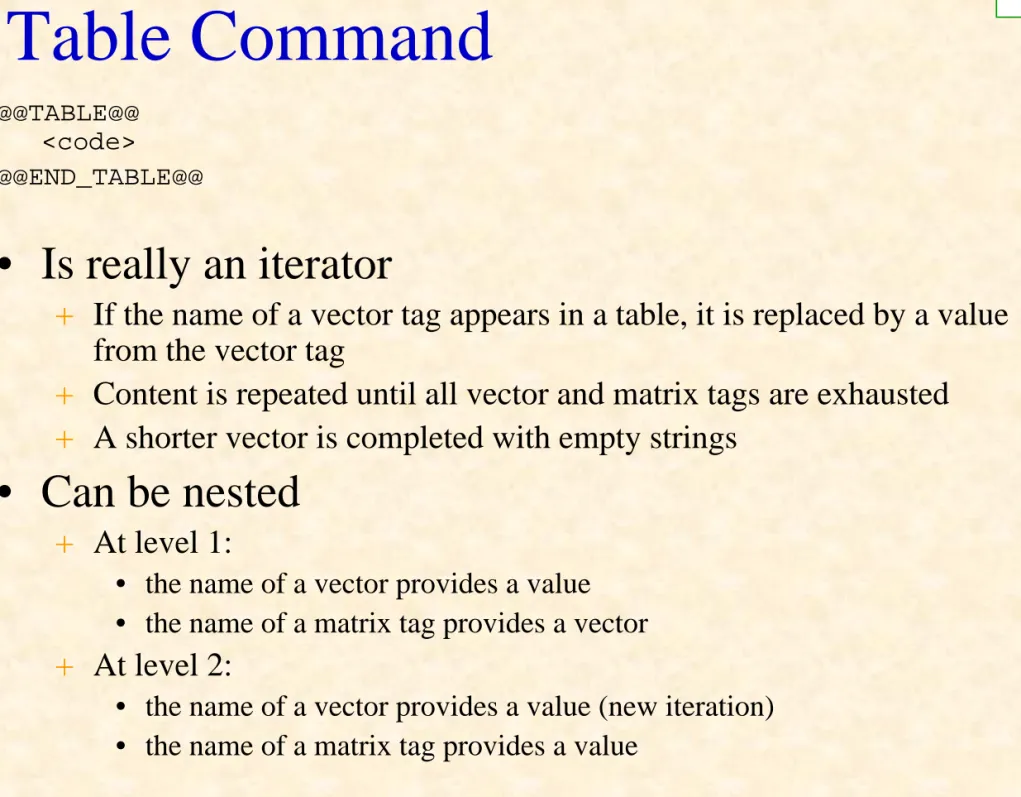
Table Command
@@TABLE@@<code>
@@END_TABLE@@
• Is really an iterator
+
If the name of a vector tag appears in a table, it is replaced by a value
from the vector tag
+
Content is repeated until all vector and matrix tags are exhausted
+
A shorter vector is completed with empty strings
• Can be nested
+
At level 1:
• the name of a vector provides a value
• the name of a matrix tag provides a vector
+
At level 2:
Tables and Vector Tags (1)
procedure Table isuse type Vector_Tag;
Names : constant Vector_Tag := +"Jean" & "John" & "Hans"; Ages : constant Vector_Tag := +"10" & "30" & "5";
Translations : constant Translate_Table := (1 => Assoc ("NAME", Names),
2 => Assoc ("AGE", Ages)); begin
Put_Line (Parse ("table.tmplt", Translations)); end Table;
Tables and Vector Tags (2)
Template file (table.tmplt):<TABLE border=2> @@TABLE@@ <TR> <TD>@_NAME_@</TD> <TD>@_AGE_@</TD> </TR> @@END_TABLE@@ </TABLE> Resulting HTML: <TABLE border=2> <TR> <TD>Bob</TD> <TD>10</TD> </TR> <TR> <TD>Bill</TD> <TD>30</TD> </TR> <TR> <TD>Toto</TD> <TD>5 </TD> </TR> </TABLE>
Table Sections
@@TABLE@@ [@@TERMINATE_SECTION@@] <code> {@@SECTION@@ <code>} @@END_TABLE@@• Each iteration uses one section in round-robin order.
• if
@@TERMINATE_SECTION@@
is specified, iteration will
continue until the last section is reached
+
Matrix and vector tags are completed as necessary with
empty strings
Special Tags in Tables
• @_TABLE_LINE_@
+
Current line number
• @_UP_TABLE_LINE_@
+
Line number of enclosing table
• @_NUMBER_LINE_@
+
Total number of lines in table
• @_TABLE_LEVEL_@
+
Current table depth
@@TABLE@@ <p>@_TABLE_LINE_@/@_NUMBER_LINE_@ : @_VECT_@ @@END_TABLE@@ 1/3 : 10 2/3 : 30 3/3 : 5
Includes
@@INCLUDE@@ filename
[parameters]
• Reads from another file
+
Useful for headers and other repetitive elements
• In an included file:
+
@_0_@ is the file name
+
@_1_@ .. @_n_@ is the n
thparameter
footer.thtml :Copyright @_$1_@ 2004
@@INCLUDE@@ footer.thtml Adalog @@INCLUDE@@ footer.thtml Axlog
Copyright Adalog 2004 Copyright Axlog 2004
• Introduction
• Internet
• AWS basics
• The templates parser
• AWS advanced
• Distributed applications with AWS
• AWS in practice
Transient pages
• Pages that do not have to stay forever
• Pages that expire after a given delay has elapsed
+
AWS.Services.Transient_Pages
• Pages are kept in memory
• Get a "special" URI: Get_URI
• Build the response in a stream, and associate it to the URI, giving the
lifetime: Register
• Get the associated stream from the URI: Get
• Pages that expire after being sent
+
Set parameter "Once" to True in Response.File
Split pages
• Pages may be very big…
+
Google can return
millions
of results
+
The result of a query may have to be split over several pages
• AWS.Services.Split_Pages
+
Parse a template with
two
translation tables
• One for tags common to all pages
• One for tags used by tables split over several pages
• Extra tags added (NEXT, PREVIOUS, PAGE_INDEX,
NUMBER_PAGES, OFFSET, HREFS_V, INDEXES_V)
+
Creates transient pages for all pages and returns a
Response.Data object for the first page.
Sessions
• Session support is a parameter of
Start
• Each user has a session
+
A cookie is sent to the client = session number
• Allows storing user-specific data
+
a name/value table is associated to each session
function Service (Request : in Status.Data) return Response.Data is Session_ID : constant Session.ID := Status.Session (Request);
C : Natural := 0; begin
if Session.Exist (Session_ID, "counter") then C := Session.Get (Session_ID, "counter"); end if;
C := C + 1;
Provided Dispatchers (1)
• URI dispatcher
+
Dispatches to other functions according to the URI
+
Adds the methods:
procedure Register (Dispatcher: in out Handler; URI : in String;
Action : in Response.Callback); procedure Register_Regexp (Dispatcher: in out Handler;
URI : in String;
Action : in Response.Callback);
+
similar methods with a Dispatcher parameter
procedure Register_Default_Callback
(Dispatcher: in out Handler;
Action : in AWS.Dispatchers.Handler'Class); procedure Unregister (Dispatcher: in out Handler;
Provided Dispatchers (2)
• Page dispatcher
+
Considers the URI as a file name and returns the
corresponding file. Parses 404.thtml if not found.
• Method dispatcher
+
Dispatches to other functions according to the HTTP method.
+
Use: ???
• Virtual host dispatcher
+
Dispatches to other functions according to the host name
• Time dispatcher
+
Associates various functions to different periods of time, and
dispatches according to the time of the request.
Provided Dispatchers (3)
• Transient pages dispatcher
+
Linked to another dispatcher
+
If the other dispatcher replies "404", tries to interpret the URI
as a transient page.
• SOAP dispatcher
+
Provides two call-backs, one for HTTP requests, one for
SOAP requests.
More on Building Responses
• Other
Build
functions
+
From Unbounded_String
+
From a Stream_Element_Array (Allows stream attributes)
• Other URL
+
Redirection (Tells the browser to request another page)
AWS.Response.URL (<new URI>);
+
New location (Tells the user that the page has moved (301)
AWS.Response.Moved (<new URI>, <Message>);
• Acknowledge
+
Can be used to return a message with any code
• In practice, used for error messages
AWS Streams
• A type derived from
Resources.Streams.Stream_Type
+
NOT
an
Ada.Streams.Root_Stream_Type
!
• How to use it:
+
Declare your type, implement primitive operations:
type SQL_Stream is new Resources.Streams.Stream_Type; procedure Read (...) is ...
function End_Of_File (...) return Boolean is ... procedure Close (...) is ...
+
Add operations to build data into the stream
+
Return response:
return Response.Stream (MIME.Text_HTML, Stream_Object);
• Predefined streams:
File Upload
•Sending a file from the client to the server
+
Include a form with a "FILE" entry:
<FORM enctype="multipart/form-data" action="/whatever" method=POST>
File to process: <INPUT type=FILE name=filename >
<INPUT type=SUBMIT name=go value="Send file"> </FORM>
•AWS:
+
Transfers the file into the upload directory
+
Gives it a (local) unique name
+
Makes
two
"filename" parameters:
•Get (P, "filename", 1) => Full local (server) pathname
•Get (P, "filename", 2) => Full remote (client) pathname
Push
• A word of caution:
+
Push is updating client data without client request
+
Push keeps an open socket for each client
+
In general, it is better to use a refresh (client pull)
• Principle:
+
Instantiate
AWS.Server.Push
with the data types to send
+
Declare an
Push.Object
object
+
Register clients
+
Send data to clients when needed
Status Page
• There is a special status page which is processed
directly by AWS.
+
Its name can be chosen or configured
+
Response is built by parsing the template "aws_status.thtml"
(redefinable)
+
Provides information about the state of AWS itself
Configuration
• Many things can be configured…
+
Important parameters can be given in the Start procedure
+
An alternate Start procedure uses a configuration object
(
AWS.Config.Object
)
• All parameters in a configuration object can be set or queried
• There are defaults for everything
• Configuration is initialized from:
+
aws.ini: for all applications started from the same directory
+
<progname>.ini: for application <progname>
Configuration data
• Some examples of what can be configured:
+
Admin_URI: the status page name
+
Certificate: name of certificate file for secure servers
+
Down_Image: Name of the "down" image in the status page
+
Log_File_Directory: where to store log files
+
Max_Connection: number of simultaneous connections
+
Server_Port: the port to connect to
+
Upload_Directory: where to store uploaded files
Authentication
• Identify a user with a Name/Password
• If a page requires authentication:
+
Check if request includes authentication data
• User name not empty (function
Authorization_Name
)
+
If not:
• return a 401 response (function
Response.Authenticate
)
• the response includes a "realm" (a root URL)
• browser will show a login box and resubmit request
+
All subsequent requests under the "realm" will include
authentication data
Two Kinds of Authentication
• Basic (insecure), HTTP 1.0
+
passwords are transmitted without encryption
+
can be considered secure with HTTPS
+
functions
Authorization_Name
and
Authorization_Password
• Digest (secure), HTTP 1.1
+
passwords are not transmitted
+
an MD5 checksum of Name, Password (and other fields) is
transmitted
Logging
• package AWS.Log
+
facilities for logging Status and Response data
+
Start, Stop, Flush (or use Auto_Flush)
+
Modes: None, Each_Run, Daily, Monthly
+
File <prefix>-Y-M-D.log
• package AWS.Server.Log
+
Used to automatically log AWS requests
• Log file format
<client IP> - <auth name> - [date-time] "<request>" <code> <size>
+
For example:
Secure Server (HTTPS)
• Just set Security to True in the call to "Start"
+
Uses a default certificate
+
To use another certificate:
AWS.Server.Set_Security (Certificate_Filename => "/xyz/aws.cert"
• Protocols
+
Supported : SSLv2, SSLv3
+
Unsupported : TLSv1
• Why use HTTP?
+
HTTPS is slightly slower
Mailing (SMTP)
• Packages AWS.SMTP, AWS.SMTP.Client
+
Declare server to handle the SMTP protocol.
+
Send the mail
My_Mailer : SMTP.Receiver := SMTP.Client.Initialize ("mailhost.axlog.fr"); Result : SMTP.Status; begin SMTP.Client.Send (Server => My_Mailer,
From => SMTP.E_Mail ("Rosen", "[email protected]"), To => SMTP.E_Mail ("Obry", "[email protected]"), Subject => "Latest AWS news",
Message => "The tutorial is doing fine!", Status => Result);
Mailing (POP)
• Package AWS.POP
+
Declare a Mailbox object (initialize function to set server, user
name and password)
+
Various operations to:
• Get the number of messages, total size of messages
• Get an message by number (with/without deleting)
• Delete a message from server
• Iterate (passive iterators) over all messages, all headers.
• Get attachments (individually, passive iterator)
• Get various parts of a message (Header, Content, From, CC…)
• A simple Webmail server is provided as an AWS
callback
Miscellaneous Services
• Directory browser
(
Services.Directory
)
+
Builds a translate table
containing directory information
+
Builds a page containing
directory information
• A template must be specified
• A default template is provided
• URL
+
Operations to parse the various
parts of a URI
+
URI encoding
• MIME
+
Constants for common MIME
types.
+
Function to guess the MIME type
of a file name (from extension)
• Translator
+
Base 64 Encode/Decode
+
zlib Compress/Decompress
• Exceptions
+
Call-back for unexpected
exceptions caught by AWS
Deploying an AWS Server
• Resources
+
It is possible to include any file (HTML, Images, icons,
templates…) used by the Web server into the server
executable.
+
Resources are compiled with awsres.
• Creates a hierarchy of packages, one for each resource
• Resources can be compressed
• Just "with" the root package
• No Web server is easier to distribute, install
and launch !
• Introduction
• Internet
• AWS basics
• The templates parser
• AWS advanced
• Distributed applications with AWS
• AWS in practice
• Conclusion
AWS for Distributed Computing
• Exchanging simple data:
+
Simple communication
+
HTTP
• Distributed server:
+
Hotplugs
• Remote services:
+
SOAP
+
LDAP
+
JABBER
Simple Communication (1)
• Simple exchange of (string) data over
HTTP/GET
• Client side (AWS.Communication.Client):
function Send_Message
(Server : in String; Port : in Positive; Name : in String;
Parameters : in Parameter_Set := Null_Parameter_Set) return Response.Data;
• Sends a message like:
http://<Server>:<Port>/AWS_Com?HOST=<host>&NAME=<name>
Simple Communication (2)
• Server side (AWS.Communication.Server):
+
Instantiate:
with AWS.Response; generic
type T (<>) is limited private; type T_Access is access T;
with function Callback(Server : in String; Name : in String; Context : in T_Access;
Parameters : in Parameter_Set) return Response.Data;
package AWS.Communication.Server is
procedure Start (Port : in Positive; Context : in T_Access); procedure Shutdown;
end AWS.Communication.Server;
Hotplugs (1)
• A way to have a Web server split on multiple
machines.
+
Managing several databases
+
Load balancing…
AWS Server
Browser
AWS
Hotplug
Register "/webcom*"
/toto
/webcom/something
proxy
Hotplugs (2)
• Server side:
+
Activate the functionality
AWS.Server.Hotplug.Activate(WS'Access, 2222);
• Client side:
+
Register by sending a message with the simple communication
Response := AWS.Communication.Client.Send_Message ("The_Server", 2222,
AWS.Server.Hotplug.Register_Message, AWS.Communication.Parameters
("/webcom*", "http://The_Client:1235"));
+
It is possible to Unregister at any time:
Response := AWS.Communication.Client.Send_Message ("The_Server", 2222,
AWS.Server.Hotplug.Unregister_Message,
AWS.Communication.Parameters ("/webcom*"));
Port used for
communication
HTTP Client
• AWS.Client
function
Get (…) return
Response.Data;
function
Head (…) return
Response.Data;
function
Put (…) return
Response.Data;
function
Post (…) return
Response.Data;
function
Upload (…) return
Response.Data;
• Authentication parameters can be passed
+
Only basic authentication supported currently
• Facilities for Keep_Alive
+
Define an HTTP_Connection object
SOAP
• Simple Object Access Protocol
• Provide Request/Response protocol
+
Typically a client/server protocol
+
SOAP 1.1 implementation
+
HTTP protocol for transport
+
Validation via
http://validator.soapware.org/
• Message is in XML format
+
We don't care, AWS does the job for us
• SOAP is simple, binding is not !
AWS/SOAP Inside
• A SOAP message is sent to a URI
• An HTTP header identifies a SOAPAction
• A SOAP message includes a payload
+
a procedure name
+
parameters.
SOAP Payload
SOAP
Parameters
Constructor (Proc name, Parameters)
API to set/get parameters
Constructors (+ &)
Supported SOAP Types
• Support all base types
+
xsd:int, xsd:float, xsd:string, xsd:boolean, xsd:timeInstant,
xsd:null
• Support base64 type
+
SOAP-ENC:Base64
• Support Struct
• Support Array
SOAP Parameters
• Constructors in SOAP.Types
I (value, "name")
to build a xsd:int
F (value, "name")
to build a xsd:float
…
• SOAP.Parameters.List
+
Operator "+" to convert a type to a list
SOAP Example
• Ada function :
function
This_Proc(P1 : in
Integer;
P2 : in
Integer;
P3 : in
Float)
return
Integer;
• Translated to :
+
A SOAP Message
+
A SOAP Response
SOAP Message
POST /examples HTTP/1.1User-Agent: Radio UserLand/7.0 (WinNT) Host: localhost:81
Content-Type: text/xml; charset=utf-8 Content-length: 474 SOAPAction: "/examples" <?xml version="1.0"?> <SOAP-ENV:Envelope SOAP-ENV:encodingStyle=http://schemas.xmlsoap.org/soap/encoding/ xmlns:SOAP-ENC=http://schemas.xmlsoap.org/soap/encoding/ xmlns:SOAP-ENV="http://schemas.xmlsoap.org/soap/envelope/" xmlns:xsd="http://www.w3.org/1999/XMLSchema" xmlns:xsi="http://www.w3.org/1999/XMLSchema-instance"> <SOAP-ENV:Body> <m:This_Proc xmlns:m="http://www.soapware.org/"> <p1 xsi:type="xsd:int">10</p1> <p2 xsi:type="xsd:int">32</p2> <p3 xsi:type="xsd:float">12.4</p3> </m:This_Proc>
procedure name
parameters
SOAP Message Response
HTTP/1.1 200 OKConnection: close
Content-Type: text/xml; charset=utf-8 Content-length: 420
Date: Wed, 28 Mar 2001 05:05:04 GMT Server: UserLand Frontier/7.0-WinNT <?xml version="1.0"?> <SOAP-ENV:Envelope SOAP-ENV:encodingStyle=http://schemas.xmlsoap.org/soap/encoding/ xmlns:SOAP-ENC=http://schemas.xmlsoap.org/soap/encoding/ xmlns:SOAP-ENV="http://schemas.xmlsoap.org/soap/envelope/" xmlns:xsd="http://www.w3.org/1999/XMLSchema" xmlns:xsi="http://www.w3.org/1999/XMLSchema-instance"> <SOAP-ENV:Body> <m:This_ProcResponse xmlns:m="http://www.soapware.org/"> <myres xsi:type="xsd:int">42</myres> </m:This_ProcResponse> </SOAP-ENV:Body> </SOAP-ENV:Envelope>
result
SOAP Client
P_Set : Parameters.List := +I (10, "p1") & I (32, "p2") & F (12.4, "p3"); P : Message.Payload.Object;
begin
P := Message.Payload.Build ("This_Proc", P_Set); declare
R : constant Message.Response.Object'Class
:= SOAP.Client.Call ("http://host:8080/soapdemo", P);
P : constant Parameters.List := SOAP.Message.Parameters (R); My_Res : constant Integer := SOAP.Parameters.Get (P, "myres");
Default value for SOAPAction is
URL#PROC
SOAP Server
function SOAP_CB (Request : in AWS.Status.Data) return AWS.Response.Data
is
use SOAP, SOAP.Types, SOAP.Parameters; PL : constant Message.Payload.Object
:= Message.XML.Load_Payload (AWS.Status.Payload (Request)); P : constant Parameters.List := Message.Parameters (PL);
R : Message.Response.Object; RP : Parameters.List;
begin
R := Message.Response.From (PL); declare
P1 : constant Integer := SOAP.Parameters.Get (P, "p1"); P2 : constant Integer := SOAP.Parameters.Get (P, "p2"); begin
RP := +I (P1 + P2, "myres"); end;
SOAP.Message.Set_Parameters (R, RP); return Message.Response.Build (R);
SOAP dispatching
• Many degrees of freedom!
+
It is not necessary to consider all of them…
Request
HTTP
SOAP
URI
SOAPAction
Procedure
Parameters
URI
URI
SOAPAction
Procedure
Parameters
SOAP Server dispatching
1.
Determine that it is a SOAP request
¾
can use the SOAP dispatcher
2.
Dispatch according to URI
¾
can use a regular URI dispatcher
3.
Get the SOAPAction from the status object and dispatch.
SOAPAction : constant String := Status.SOAPAction (Request);
¾
SOAPAction can be interpreted as an "object" name
4.
In the SOAP routine, retrieve the SOAP procedure name and
dispatch to the appropriate routine.
Payload : constant SOAP.Message.Payload.Object
:= SOAP.Message.XML.Load_Payload(Status.Payload (Request)); Proc : constant String
:= SOAP.Message.Payload.Procedure_Name (Payload);
5.
The routine deals with the parameters
Often not necessary
Often not necessary
WSDL Interface
• WSDL
+
An XML based document describing a SOAP service
+
Developed jointly by Microsoft and IBM.
• To be endorsed (not yet) by W3C
+
Binding to SOAP 1.1, HTTP GET/POST, and MIME
• wsdl2aws
+
Automatically generates client stubs to provide access to a
service.
+
Automatically generates server skeletons to create a service.
• aws2wsdl
Writing a SOAP/WSDL server
• aws2wsdl and wsdl2aws work together!
Ada specification
WSDL document
Complete server
ada2wsdl
LDAP (1)
• Lightweight Directory Access Protocol
+
A lightweight subset of DAP (X.500)
+
A means of serving data on individuals, system users,
network devices and systems over the network
+
Example: DNS
• A remotely callable database interface
+
Based on
entries
:
cn = test entry
cn = another commonName value for test entry
mail = [email protected]
LDAP (2)
• A hierarchical database:
• Entries are retrieved by giving the value of an
attribute: the DN (Distinguished Name)
+
"cn=rosen, ou=people, dc=adalog, dc=fr"
dc=fr
dc=adalog
ou=people
cn=…
cn=Rosen
[email protected]
cn=…
dc=axlog
LDAP Client
• AWS implementation:
+
Client only, no modification or deleting of data
+
If someone volunteers to provide more functionalities…
• Usage summary:
Directory : LDAP.Client.Directory := Init (Host); begin
Bind (Directory, "", ""); declare
Response_Set := Search (Directory, Base_DN, Filter,
LDAP_Scope_Subtree,
Attributes ("cn", "mail")); begin
-- Iterate through responses
JABBER
• A "chat" protocol (immediate messaging)
+
Exchange messages between users connected to a JABBER
server
• AWS implementation:
+
Check presence of a user
procedure Check_Presence (Server : in Jabber.Server; JID : in String;
Status : out Presence_Status);
+
Send message to a user
procedure Send_Message (Server : in Jabber.Server; JID : in String;
Subject : in String; Content : in String);
+
If someone volunteers to provide more functionalities…
Sufficient to sen
d alerts
to a connected u
ser
• Introduction
• Internet
• AWS basics
• The templates parser
• AWS advanced
• Distributed applications with AWS
• AWS in practice
What Can AWS Be Used For?
• HTTP services
+
Lightweight page server
• A full web server is another story…
+
Virtual site
• HTML as a Graphical User Interface
• Regular application with Web access
+
Remotely monitoring a process, an experiment…
• Client-server applications
+
HTTP communication
Why a Single Server ?
• It is possible to have more than one server
in the same program.
Programme
HTTP
1
HTTP
2
HTTPS
Browser
Browser
Browser
Browser
Maintaining User State (1)
State as page parameters
+
Each "page" has a different URI
+
Pages can be bookmarked
+
"Back" button works
+
Allows direct links
+
No global state in the program
+
But
• Data not really hidden
• User can provide "bad" URIs
• URI can become too long
Maintaining User State (2)
• State as session data
+
Only one URI appears in the browser
+
Better control over user's behaviour
+
Session data can be kept when the server is restarted
• "Hot" restart
+
But
• Client must accept cookies
Gesem's Implementation
• Unusual constraints:
+
Use free software
+
User interface usable by casual users
+
Availability on Windows and Linux
+
Independent of any particular DBMS
+
Easily modifiable
+
Deal with concurrent accesses
+
Efficiency
is not
a concern
Gesem Filters and Dispatchers
Access control filter
URI dispatcher
Page dispatcher
Access allowed ?
Associated Ada
function ?
Associated page ?
“Not allowed”
Ada function
Regular page
yes no no yes yes noRequest
"Engine"
package
Transient Page dispatcher
Transient page ?
Transient page
no
The Page Design Pattern
with AWS.Response;package Pages.Some_Page is
function URI (<parameters>)return String; end Pages.Some_Page;
package body Pages.Some_Page is
My_Name : constant String := "some_page"; function Build (<Parameters>)
return Response.Data is ...
function Buttons (Request : in AWS.Status.Data) return Response.Data is ...
function Page (Request : in AWS.Status.Data) return Response.Data is ...
function URI (<parameters>)return String is ... begin
Engine.Register(My_Name, (Root => Page'Access,
Buttons => Buttons'Access)); end Pages.Some_Page;
some_page.html
Reliability
•Every page has an exception handler:
exception
when Occur : others =>
return URL (Pages.Error.Build
(Unit => "pages." & My_Name, Subprogram => “Name of subprogram", Occur => Occur));
Concurrency
• Concurrent access is extremely unlikely, but possible
+
Recognize users from their IP address
+
Use a global lock:
• Only one user can modify at any one time
• "Modify" button on each page to grab the lock
• But beware of "back" button
+
Display a page
+
Modify it (get lock)
+
Validate (release lock)
+
Back page: the page is modifiable, but the user doesn't own the lock !
Local Interface
• Manages the application
+
Stop, lock database…
+
Shows uncommitted transactions
• Monitors requests
+
Clear window
+
Save content to
file
•Plain GTK
•Generated automatically
with GLADE
Objects Design Pattern
with Globals, Data_Manager, AWS.Templates;
use Globals; package Objects.Abstraction is end Objects.Abstraction; type Data is record … end record; -- Operations on Abstraction.Data
Ada
view
function Image (Item : Data)return Array_Of_Unbounded;
function Value (Item : Array_Of_Unbounded)return Data;
package Manager is new Data_Manager (Data => Data,
Data_Name => "my_data",
Columns => "col1, col2, col3");
subtype Handle is Manager.Handle;
type List is array (Positive range <>)of Handle;
Database
view
function Associations (Item : Handle) return Translate_Table;
function Associations (Item : List) return Translate_Table;
function Extract (Param : AWS.Parameters.List) return Data;
Templates
(HTML) view
Lessons learned (1)
• Separate concerns
• Reliability
+
Exceptions are great!
• AWS is powerful enough
+
No Javascript, no Java
+
The template parser is great!
Pages Content management Objects DB_Interface Data management User_interface Local GUI management HTTP management Engine
![Table Sections @@TABLE@@ [@@TERMINATE_SECTION@@] <code> {@@SECTION@@ <code>} @@END_TABLE@@](https://thumb-us.123doks.com/thumbv2/123dok_us/10237601.2927841/50.1188.96.1109.59.863/table-sections-table-terminate-section-code-section-table.webp)
