IJSRR, 8(2) April. – June., 2019 Page 3217
Research article Available online www.ijsrr.org
ISSN: 2279–0543
International Journal of Scientific Research and Reviews
Fiber Optic Humidity Sensor Using a Novel Polymer Complex
Bindu Krishnan
1*, Ramiz Ahmad
21
Department of Physics, Sree Kerala Varma College, Thrissur, Kerala, India.680011
2
Department of Physics and Astronomy, University of Delaware Newark, DE-19716, IIST, Thiruvananthapuram, Kerala, India (Address at the time of work)
ABSTRACT
A simple fiber optic humidity sensor is fabricated based on novel polyelectrolyte complex film of the
polymers, Chitosan and Carboxy Methyl Cellulose. A small portion of the cladding of the optical fiber is
removed and is coated with the hydrogel polymer film. Coating is done using layer by layer technique. This
portion is inserted into the region where the humidity has to be monitored. The sensor makes use of the
intensity variation of guided light through the plastic optical fiber due to scattering and the phenomenon
refractive index variation of the coated hydrogel film. The output power variation is found to be linear, and
without hysteresis.
KEYWORDS: Humidity sensor, Evanescent wave, Optical fiber, Hydrogel, polymer composite
*Corresponding author:
Bindu Krishnan
Department of Physics,
Sree Kerala Varma College, Thrissur, Kerala, India. PIN 680011
IJSRR, 8(2) April. – June., 2019 Page 3218
1. INTRODUCTION
Fiber optic humidity sensors have certain advantages over other types of humidity sensors
like its immunity to electromagnetic interference, lightness, smallness, high sensitivity, and ease in
implementing multiplexed or distributed systems. Many methods are used in fiber optic humidity
sensors which include direct spectroscopy, evanescent wave method and fiber grating method to
mention a few. In the evanescent wave technique, sensors have been made using changes that are
susceptible to changes in humidity of surroundings such as the scattering, the absorption as well as
the refractive index in the modified cladding material.1 The technique of using hydrogels for altering
the evanescent wave and hence the intensity of the guided light is a relatively simple and common
technique.2,3 Here instead of using a single hydrogel, we report the use of a polyelectrolyte complex
made of two natural polymers, cationic Chitosan (CS) and anionic Carboxy Methyl Cellulose
(CMC).The coulomb interaction between the oppositely charged polymer molecules is more
effective than the usual chemical activation during chemisorption process. Hence the multilayer film
using layer by layer (LBL) self-assembly technique gives thin films of better adhesion and stability.4
Chitosan is an abundant but underused biopolymer. Chitosan hydrogel shows properties like
reversible water absorbing capacity and excellent swelling effect, good film forming ability,
biodegradability and transparency. Silica core fibers are often used in fiber optic humidity sensors.
We have used plastic fiber, which is relatively more cost-effective.
2. EXPERIMENTAL SECTION
We used commercial plastic fiber to develop the sensor (HOLMARC). About 4 cm of the cladding
was removed and was coated with the poly electrolytes by LBL technique. The CS used was 2%
solution in acetic acid and CMC was prepared by dissolving 1g of commercially available Na-CMC
(Merck). The stripped fiber was dipped into the two solutions alternatively 5 times. The rate of
ascent and descent into the solution was controlled using a dip coating machine (HOLMARC, model
no. HO-TH-01). After the dipping, the set-up was left undisturbed to dry for a day. A semiconductor
diode laser having a power output of 5mW at 630 nm was used as power source and a photodiode
IJSRR, 8(2) April. – June., 2019 Page 3219 chamber (Model Challenger 340, ACS), where RH was varied from 20 to 90 %.The temperature was
kept constant at 25oC.
3. RESULTS AND DISCUSSION
An evanescent field is created whenever light undergoes total internal reflection at the boundary
between two dielectric media, exhibiting exponentially decaying amplitude given by the expression:
E (x, t ) = E0 exp(−z/dp)
The depth of penetration dp will depend on the refractive indices of the core and cladding. In
EW sensors, we make use of the interaction of the evanescent wave in the modified cladding region
with the surroundings. In the present sensor, the intensity of the leaky modes changes with water
absorption in the hydrogel.
Figure.1 . Evanescent field formation in the cladding region.
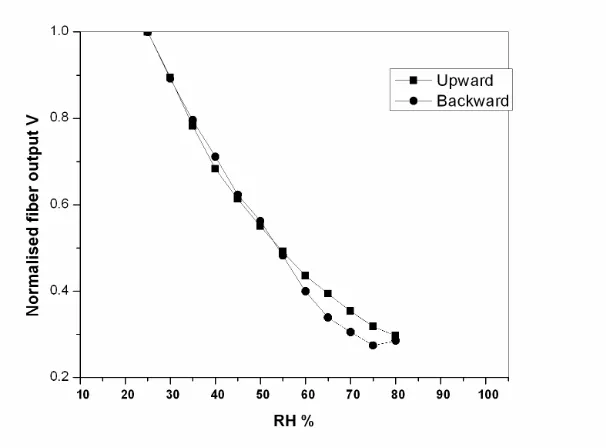
Two essential characteristics of any sensor are linearity of the output and lack of hysteresis
while increasing and decreasing the sensing variable, in the present case, humidity. Figure 2 shows
the variation of fiber output with humidity change. One can see that the output optical power varies
IJSRR, 8(2) April. – June., 2019 Page 3220 Figure. 2. Variation of normalized fiber output with change in relative humidity
To measure response time of sensor, it should be exposed to fast humidity changes. Human
breath has enough water content to do this testing. Hence the sensor was exposed to mouthfuls of
rapid exhalation. It was found that after each exposure, the sensor reached a fast equilibrium with
atmospheric moisture in less than 1 min. (Figure 3).
Figure. 3. Response time of the sensor to human breathing
The core refractive index of the PMMA fiber we have used is 1.47. Chitosan films in dry
state are reported to have refractive index 1.52-1.59 in the dry state while CMC usually has
1.51-1.58. Hence the modified cladding converts the light in the sensing region into leaky modes to begin
IJSRR, 8(2) April. – June., 2019 Page 3221 the increase in RH, the refractive index (n) of the film becomes smaller and the thickness (L)
becomes larger.5 For the light propagation, it is effective optical path length, given by L*n, which is
important. The net variation in this quantity will affect the light propagation and hence the light
output when such a film is used as cladding in optical fiber. The action of water absorption in the
layer by layer assembly of chitosan and CMC will be more complex and will be the synergetic effect
of refractive index variation and change in the optical path length due to swelling. The net effect is
found to be increased light coupled into the cladding mode as the humidity increases up to 80%. This
results in decrease in the light output in the fiber, the decrease being almost linear and without
hysteresis.
5. CONCLUSION
Alow cost, low complexity fiber optic humidity sensor is fabricated using a plastic fiber. The
sensor is based on evanescent waveabsorption spectroscopy and utilizes a film of two hydrogels,
Chitosan and CMC, coated on the unclad sensing region of the fiber. Thesensor is found to be
sensitive to RH ranging from 20 to ~80 %, exhibiting good linearity, fast response time and
extremely good degree of reversibility.
6. ACKNOWLEDGEMENTS
Authors sincerely thank Dr Rajendran, QRMG, VSSC, Thiruvanthapuram for lending the
climatic chamber facility and Director, IIST for all the support given where the authors were
affiliated to, during the time of this work.
REFERENCES
1. T.L. Yeo, T. Sun, K.T.V. Grattan. Fiber-optic sensor technologies for humidity and moisture
measurent. Sensors and Actuators A. 2008; 144:280-295.
2. F. J. Arregui, Zuri Ciaurriz, Maria Oneca, et al. An experimental study about hydrogels for
the fabrication of optical fiber humidity sensors. Sensors and Actuators B. 2003; 96:165-172.
3. Jinesh Mathew, K.J. Thomas, V.P.N. Nampoori, et al. A comparative study of fiber optic
humidity sensors based on Chitosan and Agarose. Sensors and Transducer Journal. 2007;
IJSRR, 8(2) April. – June., 2019 Page 3222
4. R.K.Iler. Multilayers of Colloidal Particles. Journal of Colloid Interface Science.1996; 6:
569-594.
5. Christopher A. Murray and John R. Dutcher. Effect of Changes in Relative Humidity and