Architectures:
Partitioning versus Replication
Omid Shahmirzadi, Thomas Ropars, André Schiper École Polytechnique Fédérale de Lausanne (EPFL), Switzerland
Abstract
The advent of manycore architectures raises new scalability challenges for concurrent applications. Implementing scalable data structures is one of them. Several manycore architectures provide hardware message passing as a means to efficiently exchange data between cores. In this paper, we study the implementation of high-throughput concurrent maps in message-passing manycores. Partitioning and replication are the two approaches to achieve high throughput in a message-passing system. Our paper presents and compares different strongly-consistent map algorithms based on partitioning and replica-tion. To assess the performance of these algorithms independently of architecture-specific features, we propose a communication model of message-passing manycores to express the throughput of each algo-rithm. The model is validated through experiments on a 36-core TILE-Gx8036 processor. Evaluations show that replication outperforms partitioning only in a narrow domain.
1
Introduction
Manycore architectures, featuring tens if not hundreds of cores, are becoming available. Taking advantage of the high degree of parallelism provided by such architectures is challenging and raises questions about the programming model to be used [26, 19]. Most existing architectures are still based on cache-coherent shared memory but some provide message passing, through a highly efficient network-on-chip (NoC), as a basic means to communicate between cores [17, 5, 2]. Designing a scalable concurrent algorithm for cache-coherent architectures is a difficult task because it requires understanding the subtleties of the underlying cache coherence protocol [10]. On the other hand, message passing looks appealing because it provides the programmer with explicit control of the communication between cores. However, compared to the vast literature on concurrent programming in shared-memory systems [16], programming message-passing processors is not yet a mature research topic.
Implementing scalable data structures is one of the basic problems in concurrent programming. To increase the throughput of data structures in shared memory architectures, several well-known techniques can be used including fine-grained locking, optimistic synchronization and lazy synchronization [16]. In the case of message-passing systems, partitioning and replication are the two main approaches to improve the throughput of concurrent data structures [13]. Using partitioning, a data structure is partitioned among a set of servers that answer clients requests. Using replication, each client has a local copy of data structure in its private memory. Both have been considered in recent work on message-passing manycores [7, 29, 9], but performance comparisons are lacking. In this paper we present a performance comparison of these two approaches for the implementation of high-throughput concurrent objects in message-passing manycores, considering the case of a linearizable map. Note that existing studies made in distributed message-passing systems are only of little help because the high performance of NoCs provides a completely different ratio between computation and communication costs compared to large scale distributed systems.
Maps are used in many systems ranging from operating systems [7, 29] to key-value stores [9]. Their performance is often crucial to the systems using them. A map is an interesting case study because it is a good candidate to apply both partitioning and replication techniques. Since operations on different keys are independent, maps are easily partitionable [9]. Because a large majority of operations are usually lookup operations [6], replication can help handling a large number of local lookup requests concurrently.
Since message-passing manycores are a new technology, only few algorithms targeting this kind of architectures are available. Thus, to compare partitioning and replication in this context, we devise simple map algorithms that have been chosen to be representative of the design space. To compare our algorithms, we present a model of the communication in message-passing manycores, and express the throughput of our algorithms in this model. Using a performance model allows us to compare the algorithms independently of platform-specific features and to cover a large scope of manycore architectures. We use a 36-core Tilera TILE-Gx8036 processor to validate our model. Evaluations on the TILE-Gx shows an extremely poor performance for replication compare to partitioning. However some limitations of this platform,i.e. costly interrupt handling and lack of broadcast service, can be blamed for the poor performance of replication. Our model allows us to come up with a hypothetical platform based on the TILE-Gx, which does not suffer form its limitations. Our evaluations on this idealplatform show that even in the best setting in favor of replication,i.e.having highly efficient interrupt handling and hardware-based broadcast service, replication can outperform partitioning only when update operations are rare and replicas are located in the cache system of the cores.
This paper is organized as follows. Section 3 specifies the underlying assumptions and goal of the study. Section 4 presents the algorithms, modeling methodology and its validation on the TILE-Gx processor. Section 5 studies performance of the algorithms on different architectures. Related work and conclusion are presented in Sections 6 and 7.
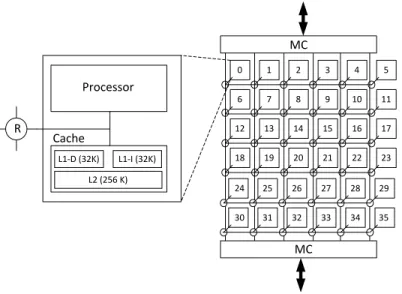
Processor Cache R 18 19 20 21 22 23 12 13 14 15 16 17 6 7 8 9 10 11 0 1 2 3 4 5 31 32 33 34 25 26 27 28 24 29 30 35 MC L1-D (32K) L2 (256 K) L1-I (32K)
Figure 1: TILE-Gx8036 architecture
2
The Tilera TILE-Gx8036
The TILE-Gx8036 is a general-purpose manycore developed by TILERA Corporation [5]. We use this platform as the baseline architecture for our studies. In this section we describe the high level TILE-Gx8036 architecture and inter-core communication.
2.1 Architecture
The cores and the NoC of the TILE-Gx8036 are depicted in Figure 1. There are 36 full-fledged 1.2 Ghz, 64-bit processor cores with local cache, connected through a 2D mesh NoC. Each tile is connected to a router. The NoC uses high-throughput, low-latency links as well as deterministic X-Y routing. Cores and mesh operate at the same frequency.
Memory components are divided into (i) L1 data and instruction cache (32 KB each), (ii) 256 KB of L2 cache, and (iii) off-chip global memory. There is full hardware cache coherence among the L1 and L2 caches of different cores. Each core has access to the off-chip global memory through one of the two memory controllers, denoted byM Cin Figure 1. Regions of the global memory can be declared private or shared (a page is a unit of granularity). We see this platform as a pure message-passing manycore, where each thread binds to a specific core and has its own private memory space.
2.2 Inter-core communication
Each core has a dedicated hardware message buffer, capable of storing up to 118 64-bit words. The message buffer of each core is 4-way multiplexed, which means that every per-core buffer can host up to four inde-pendent hardware FIFO queues, containing incoming messages. The User Dynamic Network (UDN) allows applications to exchange messages directly through the mesh interconnect, without OS intervention, using special instructions. When a thread wants to exchange messages, it must be pinned to a core and registered to use the UDN (but it can unregister and freely migrate afterwards). When a message is sent from core A to coreB, it is stored in the specified hardware queue of core B. Thesend operation is asynchronous and does not block, except in the following case. Since messages are never dropped, if a hardware queue is full, subsequent incoming messages back up into the network and may cause the sender to block. It is the
programmer’s responsibility to avoid deadlocks that can occur in such situations. When a core executes the
receiveinstruction on one of the four local queues, the first message from the queue is returned. If there are no messages, the core blocks. The user can send and receive messages consisting of one or multiple words. Moreover a core upon receipt of a new message in either of its incoming buffers, has the option of being notified by an inter core interrupt followed by executing an interrupt handler routine.
3
Assumptions and Goal
The study assumes a fault-free manycore architecture where a large set of single-threaded cores are con-nected through a network on chip. We assume that each core executes a single thread and that threads do not migrate between cores. Cores have their own private memory and can only communicate through message passing. Communication channels are asynchronous and FIFO. Messages are composed of a set of words and can have various size.
Three operations are available to send messages:send,broadcastandmulticast. Operationsend(m, i) sends messagemto threadi. Operationbroadcast(m)sendsmto all threads. Operationmulticast(m, list) sendsmto all threads inlist. Messages can be received using asynchronousreceivefunction. Operation receive(m)blocks until messagemcan be received. Alternatively, threads can be interrupted when a new message is available.
This chapter studies the implementation of a concurrent map with strong consistency criteria, i.e. lin-earizability and sequential consistency. A map is a set of items indexed by unique keys that provideslookup, updateanddelete operations. Operationupdate(key, val) associateskey with the valueval. Operation lookup(key) returns the last value associated with key (ornull if no value is associated withkey). We assume thatdelete(key)is implemented usingupdate(key, null).
4
Algorithms and Analytical Modeling
This section describes the algorithms studied in this chapter and presents their performance model. We start by describing our methodology for performance modeling followed by describing and modeling the linearizable and sequential consistent map algorithms. The main reason to use an analytical model is to be able to compare replication and partitioning in a general case so that the final conclusions are not biased towards features of an existing platforms,e.g. TILE-Gx. However, as we will see in Section 5, analytical modeling also helps us to concretely understand the performance bottlenecks and to be able to assess the al-gorithms under different architectures, configurations and load distributions. Moreover it can help manycore programmers to decide about their implementation choice on different platforms.
4.1 Performance modeling
Manycore processors are usually provided with a highly efficient NoC. Therefore, we assume that the throughput of the algorithms presented in this section is limited by the performance of the cores. This assumption is validated by the experimental results presented in Section 5.2. Hence, to obtain themaximum
obtainable throughput of one algorithm executed on a given number of cores, we need to computeTlupand Tupd, the total number of CPU cycles1required to execute alookupand anupdateoperation respectively.
All algorithms make the difference between cores that execute asclients,i.e., cores executing the user code and issuing operations on the concurrent map, andservers, i.e., cores that are earmarked to execute map-related and/or protocol code. Depending on the numbercof cores that execute the client code and the
1
c number of clients
s number of servers
osend overhead ofsend(m)
obcast overhead ofbroadcast(m) omcast overhead ofmulticast(m, list)
orcv overhead of asynchronousreceive
oarcv overhead of anasynchronousreceive
Trtt(s_op, r_op) round-trip time withs_opandr_op
opre computation done before a map access
olup access to the data structure for alookup oupd access to the data structure for anupdate
osel server selection overhead
p probability of alookupoperation
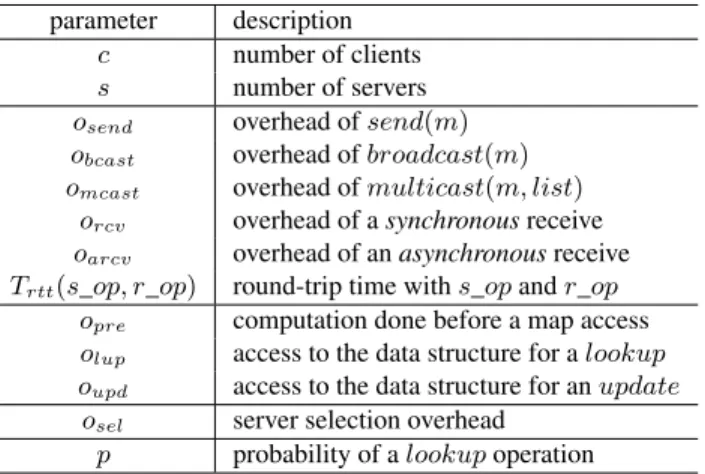
Table 1: Model parameters
numbersof cores that execute as server, clients or servers can be the bottleneck for the system throughput. Thus, for each operationop, we actually have to compute the number of CPU cycles it takes on the client (Topc) and on the server (Tops). Considering a load where the probability of having a lookup operation isp, and assuming that the load is evenly distributed among clients, the maximum throughputTcachievable by clients is: Tc = c p·Tc lup+ (1−p)·Tupdc (1)
An equivalent formula applies to servers. Hence, the maximum throughputT of an algorithm is:
T =min(Tc,Ts) (2)
Table 1 lists the parameters that we use to describe the performance of our algorithms. To model the op-erations on the map, we consider a generic map implementation defined by three parametersopre,olupand oupd. The underlying data structure used to implement the map is not the focus of the study. Parameteropre corresponds to the computation that a client has to do before accessing the map,e.g., executing a hash func-tion if a hash table is used to implement the map. Parametersolupandoupdare the overheads corresponding to accessing the underlying data structure during alookupand anupdateoperation respectively.
We associate an overhead (i.e., duration) in CPU cycles with each of the communication primitives introduced in Section 3. Additionally, we introduce the parameterTrtt, representing round-trip time. More precisely,Trtt(send_op, rcv_op)is the round-trip time for messages sent with thesend_opoperation (i.e., send,broadcastormulticast) and received with thercv_opoperation (i.e., rcvorarcv)2. If the round trip is initiated withbroadcast ormulticast, it finishes when the answer from all destinations have been received.
Finally, in a configuration that uses multiple servers, a client needs to decide which server to contact for a given operation. In all our algorithms, the server selection depends on the key the operation applies to. Typically, it is based on a modulo operation that can have a non-negligible cost. Thus, oselstands for the server selection overhead. We assume that all other computational costs related to the execution of the algorithms are negligible.
In the following, we describe the different algorithms studied in this chapter, considering linearizable maps and sequential consistent maps respectively. For each algorithm, we provide a figure describing the
2
communication patterns where all CPU overheads appear. We deduce the performance models directly from these figures.
4.2 Linearizable map
Our goal is to propose linearizable map algorithms that are representative of the design space in a message-passing manycore. Hence, as a basic solution based on partitioning, we consider the approach proposed in [9]: the map is partitioned among a set of servers that clients access for every requests. A typical im-provement of such a client/server approach is to introduce cache on client side [27]. We study a second algorithm based on this solution. Regarding replication, the solutions used in distributed systems cannot be directly applied to message-passing manycore: In a distributed system, a server is typically replicated to reduce the latency observed by clients by placing the replicas closer to the clients. In a manycore chip, the NoC provides very low latency between cores. Creating a few replicas of a server hosting a map is not an interesting approach. The only advantage it provides is to allow processing multiple lookup operations in parallel. However, this cannot make replication attractive compared to partitioning since partitioning pro-vides the same advantage without the complexity of ensuring replica consistency during update. Thus, the only way for replication to provide benefits in the context of manycores, is to have a replica of the map on each core, so that clients can lookup the keys locally. We study three replication algorithms based on this idea. The first is based on the traditional approach consisting in using atomic broadcast to implement update operations. With such a solution, lookups require remote synchronization to ensure linearizability. Hence, one can argue that the goal of replication is not achieved. That is why we propose a second algorithm where lookups do not require any remote synchronization. In this case, update operations have to be made more complex to ensure linearizability. However both of the former replication solutions, need sequencer servers to provide total order. To come up with a server-less protocol, we bring a variant of two phase commit protocol in which the lookups are purely local without any remote synchronization. However getting rid of the servers, comes up with a price: the issuer of the update needs to abort the operation and issue it again in case of another conflicting update.
We describe now the five algorithms and model their throughput. We present first the simple partitioning algorithm, then the three replication ones, and finally the one based on partitioning with caching. They are presented is this order to gradually introduce the techniques we use to model their throughput.
4.2.1 Partitioned map (PART_SIMPLE)
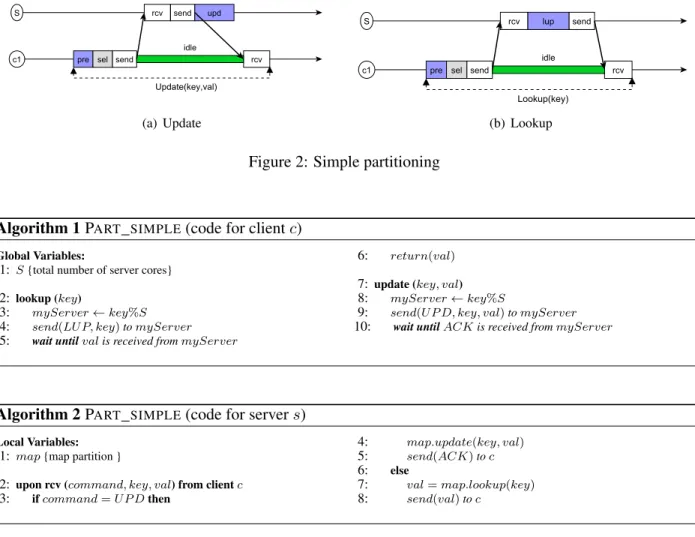
In this approach called PART_SIMPLE, each server handles a subset of the keys. In this algorithm each client contacts a corresponding server to perform lookup and update on a key. Both operations block until the client receives a response from the server, which trivially ensures linearizability. The pseudocode of this algorithm is given in Figure 33. The communication pattern is described in Figure 2. It is the same for a lookupand anupdateoperation. The only difference is that applying the update can be removed from the critical path of the client (see Figure 2(a)). ComputingTops (whereopisupdorlup),Tlupc andTupdc based on Figure 2 is trivial:
Tops =orcv+oop+osend (3)
Tlupc =opre+osel+Trtt(send, rcv) +olup (4) Tupdc =opre+osel+Trtt(send, rcv) (5)
3
Figure 2: Simple partitioning
Algorithm 1PART_SIMPLE(code for clientc) Global Variables:
1: S{total number of server cores}
2: lookup (key)
3: myServer←key%S 4: send(LU P, key)tomyServer 5: wait untilvalis received frommyServer
6: return(val)
7: update (key, val) 8: myServer←key%S
9: send(U P D, key, val)tomyServer 10: wait untilACKis received frommyServer
Algorithm 2PART_SIMPLE(code for servers) Local Variables:
1: map{map partition }
2: upon rcv (command, key, val) from clientc 3: ifcommand=U P Dthen
4: map.update(key, val)
5: send(ACK)toc
6: else
7: val=map.lookup(key)
8: send(val)toc
Figure 3: Linearizable partitioned map without caching
4.2.2 Replicated map – Lookups with remote synchronization (REP_REMOTE)
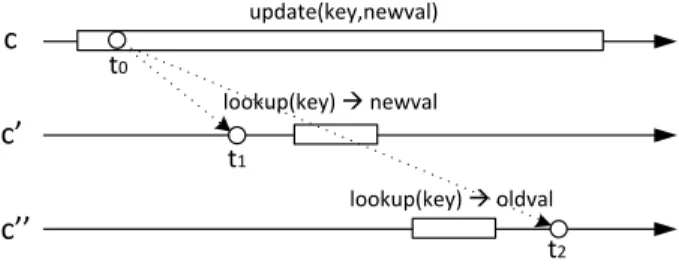
In replication approaches, lookups should be synchronized with updates to avoid violating linearizability as illustrated by Figure 4, where lookups return locally with no synchronization. Moreover all updates should be applied in total order in all replicas. The first two replication solutions provide total order among updates using atomic broadcast while the third solution ensures it using a variant of two phase commit protocol. In the first replication algorithm, called REP_REMOTE, lookups are totally ordered with respect to update operations.
Before detailing the algorithm, we need to discuss the atomic broadcast (abcast) implementation. To choose among the five classes of atomic broadcast algorithms presented in [12], we use three criteria. First, the number of messages exchanged duringabcast should be minimized to limit the CPU cycles used for communication. This implies that solutions relying on multiple calls to broadcast should be avoided. Sec-ond, the solution should allow to increase the throughput by instantiating multiple instances of theabcast
algorithm. Indeed, to obtain a linearizable map, only the operations on the same key have to be ordered. Thus, ifabcastis the bottleneck, being able to use multiple instances ofabcast, each associated with a subset of the keys, can increase the system throughput. Finally, the performance of the algorithm should not be impacted if some processes do not have messages to broadcast. Indeed, if multiple instances ofabcastare used, we cannot assume that all processes will always have requests toabcastfor each subset of keys. Only
c c’ c’’ t0 t2 t1 update(key,newval) lookup(key) à newval lookup(key) à oldval
Figure 4: Non-linearizable execution with a replicated map
fixed-sequencer-based algorithms meet all the criteria.
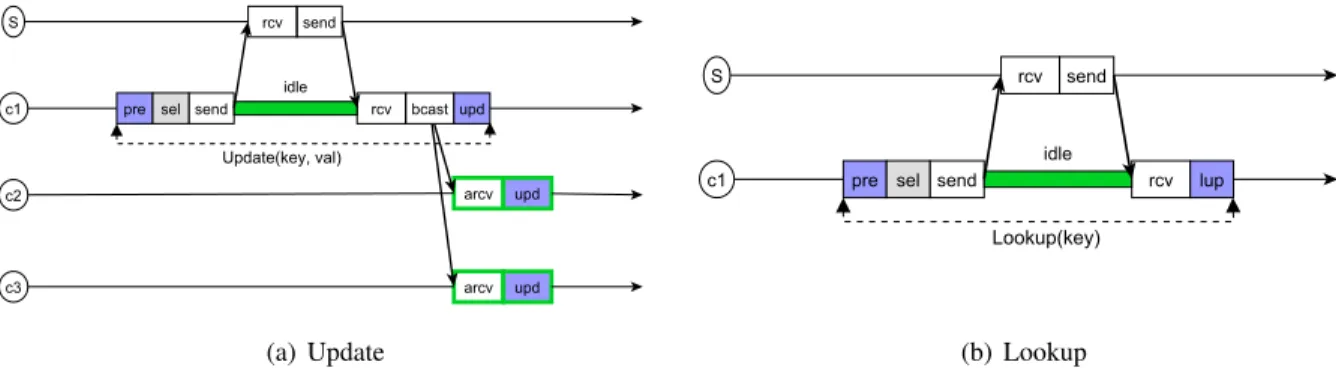
In a fixed sequencer atomic broadcast algorithm, one process (called server in the following) is in charge of assigning sequence numbers to messages. After contacting the sequencer, the thread callingabcastcan broadcast the message and the sequence number. The communication pattern of REP_REMOTEfor an update issued by clientcis shown in Figure 5(a). For each lookup, the client has to contact the server in charge of the key to know the sequence numbersnof the last update ordered by this server (see Figure 5(b)). Then, the lookup terminates once the client has delivered the update with sequence numbersn. Pseudecode of this algorithm is given in Figure 6 and its correctness trivially follows. Note that in this algorithms delegating the task of broadcast to the server could lead to violation of linearizability: if an update on a key finishes on the issuing client before the corresponding value on the server is updated, a later lookup could still return the old value.
In this algorithm, interrupts are used to notify a client that it has a new update message to deliver. An alternative to avoid interrupts would be to buffer updates until the client tries to execute an operation on the map. At this time the client would deliver all pending updates before executing its own operation. However, such a solution would potentially require large hardware buffers to store pending updates. Relying on interrupts avoids this issue. Moreover receiving a batch of messages instead of one, upon raising an interrupt, could be translated into lower cost for asynchronous receives.
Computing the throughput of clients in this algorithm is complex because clients can be interrupted to deliver updates. But handling the interrupts is not always on the critical path of the clients. Indeed, one can notice that clients are idle during an operation while waiting for an answer from the server. An interrupt handled during this period would not be on the critical path. We define Oc as the maximum amount of time spent in interrupts handling that can be removed from the critical path of clients execution and update formula 57 in the following way:
Tc = c p·Tc lup+ (1−p)·T c upd−Oc (6)
We deduce the cost of an update and a lookup operation from Figure 5.
Tops =orcv+osend (7)
Tlupc =opre+osel+olup+Trtt(send, rcv) (8) Tupdc =opre+osel+oupd+Trtt(send, rcv) +obcast+ (c−1)·(oarcv+oupd) (9) Ocdepends onTidle, the idle time on a client during one operation, nidle, the average number of idle periods per operation,Tint, the time required to handle an interrupt (green-border rectangles in Figure 5(a)),
Figure 5: Replication with remote synchronization for lookups
andnint, the average number of asynchronous requests per operation:
Tidle=Trtt(send, rcv)−osend−orcv (10)
nidle= 1 (11)
Tint=oarcv+oupd (12)
nint= (c−1)·(1−p) (13)
We computeOcin three steps. We first compute the number of asynchronous requests that can be fully handled during one idle period (k), then the number of interrupts that can be fully overlapped with idle time on one client (nf ull), and finally, the number of interrupts that can be partially overlapped with idle time on one client (Npartial).
k=bTidle
Tint
c (14)
nf ull=min(k·nidle, nint) (15) npartial=min(nint−nf ull, nidle) (16)
Oc
=nf ull·Tint+npartial·(Tidle−k·Tint) (17)
4.2.3 Replicated map – Lookups without remote synchronization (REP_LOCAL)
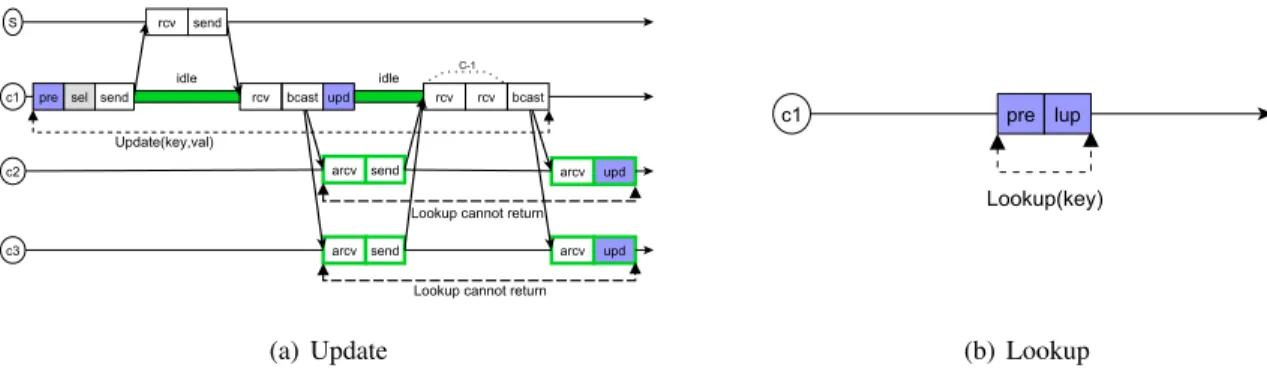
In REP_LOCAL, lookups do not require any remote synchronization (Figure 7(b)) but updates are more
complex than in REP_REMOTE(Figure 7(a)). To provide linearizability, this algorithm ensures that during an update, no lookup can return the new value if a lookup by another client can return an older value. To do so, the update operation includes two phases of communication as shown in Figure 7(a). When clientc runs an update, it first atomically broadcasts the update message to all clients. Then it waits until all clients acknowledge the reception of this message. Finally, it broadcasts a second message to validate the update. If a client tries to lookup the key after it has received the update message, the lookup cannot return until the validation has been received. This way a lookup that returns the new value always finishes after all clients have received the update message, which is enough to ensure linearizability4. The pseudocode of this algorithm is given in Figure 8. Theorem 4.1 proves the correctness of this algorithm.
Theorem 4.1 Algorithm 8 ensures linearizability with respect to the map operations. 4
Update messages can be also received synchronously. In this case the time between sending the ACK back to the issuer and receiving the update from the issuer cannot be used to perform some other useful task, while on the positive side it avoids the cost of asynchronous receive. Our evaluations show that this trade-off is not in favor of the algorithm throughput, especially at scale. The main reason is that the length of waiting periods increases linearly with the increase in the number of replicas.
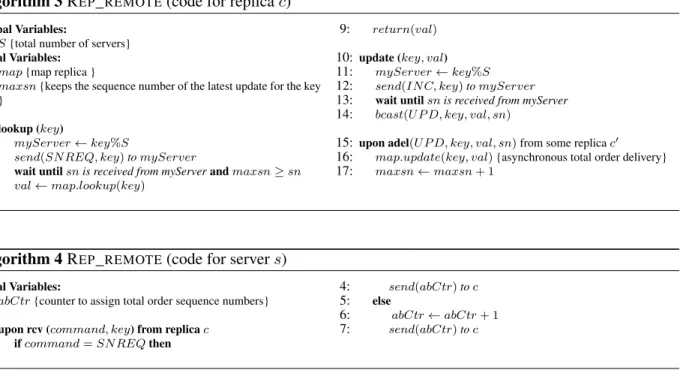
Algorithm 3REP_REMOTE(code for replicac) Global Variables:
1: S{total number of servers} Local Variables:
2: map{map replica }
3: maxsn{keeps the sequence number of the latest update for the key }
4: lookup (key)
5: myServer←key%S
6: send(SN REQ, key)tomyServer
7: wait untilsnis received from myServerandmaxsn≥sn 8: val←map.lookup(key)
9: return(val)
10: update (key, val) 11: myServer←key%S 12: send(IN C, key)tomyServer 13: wait untilsnis received from myServer 14: bcast(U P D, key, val, sn)
15: upon adel(U P D, key, val, sn)from some replicac0
16: map.update(key, val){asynchronous total order delivery}
17: maxsn←maxsn+ 1
Algorithm 4REP_REMOTE(code for servers) Local Variables:
1: abCtr{counter to assign total order sequence numbers}
2: upon rcv (command, key) from replicac 3: ifcommand=SN REQthen
4: send(abCtr)toc
5: else
6: abCtr←abCtr+ 1
7: send(abCtr)toc
Figure 6: Linearizable replicated map with local lookups with remote synchronization
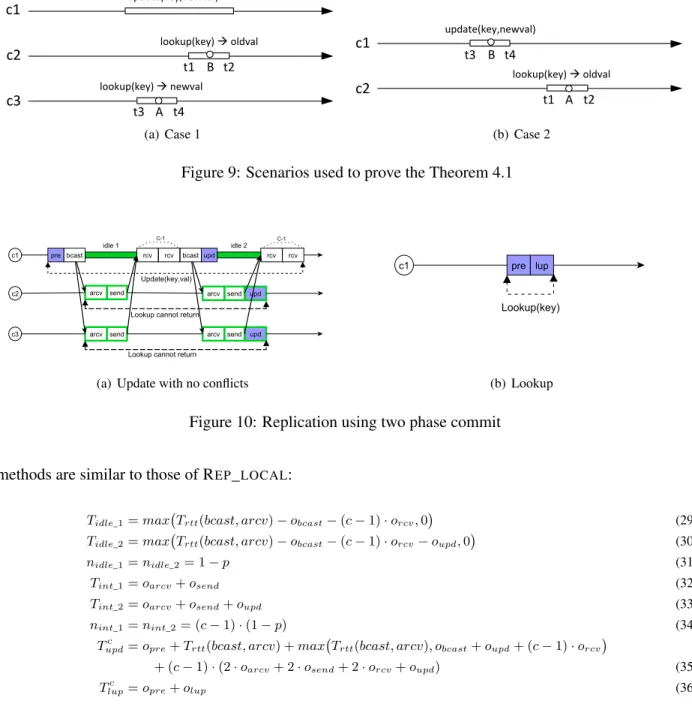
Proof. If we prove that a map with only a single key is linearizable, due to the composability of linearizabil-ity, the whole map, which is composed of a set of independent key entries, is linearizable too. Considering only one key, the total order of updates is trivially ensured. Moreover if two updates on a key are exe-cuted with no timing overlap, in the global history of updates the second update is placed after the first one, since the first one is assigned with a smaller sequence number. Considering lookups, we show that the two following scenarios are not possible: (1) having two non-overlapping lookups, where the former one returns the new value and the latter one returns the old value, as it is shown in Figure 9(a); and (2) having a non-overlapping update and lookup, where the update happens before the lookup and lookup returns the old value, as it is shown in Figure 9(b). Apart from these two cases, all other scenarios, with respect to the relative position of two operations, are safe with respect to linearizability,i.e. a linearizable history can be made.
Case (1): suppose this scenario happens according to Figure 9(a). In this case, we assume replica c1
updates the new value. Assumet1andt2are the beginning and the end of the lookup operation onc2andt3
andt4 are the beginning and the end of the lookup operation onc3 andt1 > t4. Replicac3 should receive
theACKALLfor this update at some point beforet4, calledA(execution of line 18). However replicac1
should have sent this update to the replicac2at some point after t1, calledB (execution of line 13). Note
thatB is not necessarily beforet2. This means that B → A since replicac2 should have sent theACK
message to the replicac1 (execution of line 23), before replica c1 could send theACKALLmessage to
replicac3 (execution of line 16). Thereforet1 →B ,B → A,A → t4, and sot1 → t4. This means that
t1 ≤t4, a contradiction.
Case (2): Suppose this scenario happens according to Figure 9(b). Assumet1andt2 are the beginning
and the end of the lookup operation onc2andt3andt4are the beginning and the end of the update operation
onc1andt1 > t4. It means that replicac2 receives the update from replicac1at some point aftert1, called
Figure 7: Replication with no remote synchronization for lookups
at some point beforet4, calledB(execution of line 15). Therefore we havet1 →A,A→B,B→t4, and
sot1→t4. This meanst1 ≤t4, a contradiction. ut ut
Since this algorithm introduces idle time on clients and uses interrupts, computing the throughput of clients is based on Formula 6. But it can be noticed that update operations introduce two idle periods with different durations as well as two different costs for handling interrupts:
Tidle_1=Trtt(send, rcv)−osend−orcv (18) Tidle_2=max Trtt(bcast, arcv)−obcast−(c−1)·orcv−oupd,0
(19)
nidle_1=nidle_2= 1−p (20)
Tint_1=oarcv+osend (21)
Tint_2=oarcv+oupd (22)
nint_1=nint_2= (c−1)·(1−p) (23)
Hereint_1andint_2correspond to the delivery of the first and second broadcast message respectively. Note thatTidle_2 needs to consider the maximum between the actual computation and0to account for the
fact that ifoupdis large, there might not be any idle time.
Computing the exact value ofOcin this case is a complex problem. Instead, we approximate this value using Formulas 14-17 with weighted averages forTidleandTint. For instance, here are the values we use fornidleandTidle:
nidle=nidle_1+nidle_2 (24)
Tidle=
Tidle_1·nidle_1+Tidle_2·nidle_2
nidle
(25)
Finally, we deduce the cost of lookups and updates from Figure 7:
Tupds =orcv+osend (26)
Tupdc =opre+osel+Trtt(send, rcv) +max Trtt(bcast, arcv), obcast+oupd+ (c−1)·orcv+obcast
+ (c−1)·(2·oarcv+osend+oupd) (27)
Tlupc =opre+olup (28)
4.2.4 Replicated map – Based on two phase commit (REP_2PC)
Previous replicated solutions rely on some dedicated servers to assign the sequence numbers to the messages, in order to ensure total order delivery of updates. However one might save these dedicated servers, by
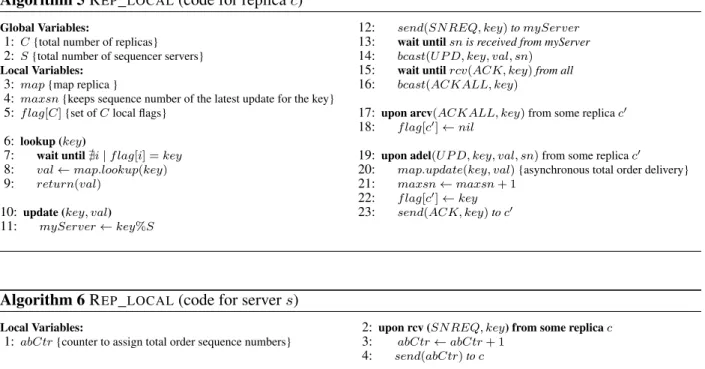
Algorithm 5REP_LOCAL(code for replicac) Global Variables:
1: C{total number of replicas} 2: S{total number of sequencer servers} Local Variables:
3: map{map replica }
4: maxsn{keeps sequence number of the latest update for the key} 5: f lag[C]{set ofClocal flags}
6: lookup (key)
7: wait until@i|f lag[i] =key
8: val←map.lookup(key)
9: return(val)
10: update (key, val) 11: myServer←key%S
12: send(SN REQ, key)tomyServer 13: wait untilsnis received from myServer 14: bcast(U P D, key, val, sn)
15: wait untilrcv(ACK, key)from all 16: bcast(ACKALL, key)
17: upon arcv(ACKALL, key)from some replicac0 18: f lag[c0]←nil
19: upon adel(U P D, key, val, sn)from some replicac0
20: map.update(key, val){asynchronous total order delivery}
21: maxsn←maxsn+ 1
22: f lag[c0]←key 23: send(ACK, key)toc0
Algorithm 6REP_LOCAL(code for servers) Local Variables:
1: abCtr{counter to assign total order sequence numbers}
2: upon rcv (SN REQ, key) from some replicac 3: abCtr←abCtr+ 1
4: send(abCtr)toc
Figure 8: Linearizable replicated map with local lookups with no remote synchronization
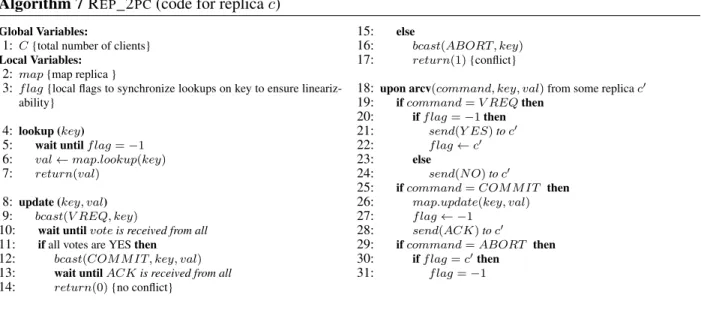
applying an atomic commit protocol. In this way the solution does not rely on any sequencer, but upon detecting another update on the same key the current update should be aborted. Therefore in REP_2PC, lookups do not require any remote synchronization (Figure 10(b)), but updates are more complex compared
to REP_LOCAL(Figure 10(a)).
Two phase commit provides total order of updates since as far as an update on a key is executing, other conflicting updates on that key will abort. To be more precise, upon issuing an update, aV REQmessage is broadcasted to all the replicas and the issuer is blocked until it receives a vote from all. AY ES vote from replicacmeans that another update on that key is executing on replicac. In this case, the issuer broadcasts an ABORT message to all replicas to abort the current update and returns unsuccessfully. Otherwise it sends a commit message to all other replicas, meaning that it is safe for them to apply the update on that key. Each replica after applying the update sends anACKback. Upon receiving theACKfrom all, the issuing replica terminates the update successfully. However lookups still need to use a similar synchronization technique which is used in REP_LOCALto ensure linearizability: as far asf lag is not equal to−1, meaning that an update is pending on akey, the lookup is not allowed to return the value of that key. The pseudocode of this algorithm is given in Figure 11. Correctness of this algorithm can be proved similarly to the proof of Theorem 4.1.
The parameters needed to obtain the maximum throughput of this algorithm are computed using Fig-ure 10. Note that in this algorithm there is no notion of server, and so server selection cost. The calculation
c1 c2 c3 A B lookup(key) à oldval lookup(key) à newval t3 t4 t1 t2 (a) Case 1 c1 c2 A B update(key,newval) lookup(key) à oldval t1 t2 t3 t4 (b) Case 2
Figure 9: Scenarios used to prove the Theorem 4.1
(a) Update with no conflicts (b) Lookup
Figure 10: Replication using two phase commit
methods are similar to those of REP_LOCAL:
Tidle_1=max Trtt(bcast, arcv)−obcast−(c−1)·orcv,0 (29) Tidle_2=max Trtt(bcast, arcv)−obcast−(c−1)·orcv−oupd,0 (30)
nidle_1=nidle_2= 1−p (31)
Tint_1=oarcv+osend (32)
Tint_2=oarcv+osend+oupd (33)
nint_1=nint_2= (c−1)·(1−p) (34)
Tupdc =opre+Trtt(bcast, arcv) +max Trtt(bcast, arcv), obcast+oupd+ (c−1)·orcv
+ (c−1)·(2·oarcv+ 2·osend+ 2·orcv+oupd) (35)
Tlupc =opre+olup (36)
4.2.5 Partitioned map - With local caches (PART_CACHING)
The PART_CACHINGalgorithm extends PART_SIMPLEto introduce caching on client side. If a lookup hits the cache, the pattern is the same as the one in Figure 7(b). Otherwise, the communication pattern is shown in Figure 12(b). It includes a first local lookup that fails and an update of the local cache once the value has been retrieved from the server.
When a key is updated, local copies of the associated value need to be invalidated. As shown in Fig-ure 12(a), the server invalidates local copies using multicast. Once the server has received an acknowledg-ment from all clients involved, the operation can terminate. This algorithm could also be viewed as a hybrid solution between partitioning and replication, since the local caches arereplicatedon different clients and
Algorithm 7REP_2PC(code for replicac) Global Variables:
1: C{total number of clients} Local Variables:
2: map{map replica }
3: f lag{local flags to synchronize lookups on key to ensure lineariz-ability}
4: lookup (key)
5: wait untilf lag=−1
6: val←map.lookup(key)
7: return(val)
8: update (key, val) 9: bcast(V REQ, key)
10: wait untilvoteis received from all 11: ifall votes are YESthen 12: bcast(COM M IT , key, val)
13: wait untilACKis received from all 14: return(0){no conflict}
15: else
16: bcast(ABORT , key)
17: return(1){conflict}
18: upon arcv(command, key, val)from some replicac0
19: ifcommand=V REQthen 20: iff lag=−1then
21: send(Y ES)toc0
22: f lag←c0
23: else
24: send(N O)toc0
25: ifcommand=COM M IT then 26: map.update(key, val)
27: f lag← −1
28: send(ACK)toc0
29: ifcommand=ABORT then
30: iff lag=c0then
31: f lag=−1
Figure 11: Linearizable replicated map with local lookups using two phase commit
(a) Update with invalidation of local caches (b) Lookup with cache miss
Figure 12: Partitioning with local caches
need to remain consistent among each other using invalidations. The pseudocode of this algorithm is given in Figure 13. Theorem 4.2 proves the correctness of this algorithm.
Theorem 4.2 Algorithm 13 ensures linearizability with respect to the map operations.
Proof. Similarly to the proof of Theorem 4.1, we consider the two cases of Figures 14(a) and 14(b), and show that they cannot happen:
Case (1): Suppose that the scenario of Figure 14(a) happens. Assumet1 andt2 are the beginning and
the end of lookup operation onc1andt3andt4are the beginning and the end of lookup operation onc2and
t1 > t4. There are four different subcases considering these two lookup operations. (i) Both lookups are
remote: in this case the mentioned scenario in Figure 14(a) is not possible clearly since the second lookup returns a value which is not older than thenewval. (ii) The first lookup is remote and the second lookup is local: this means that clientc1 receives the invalidation at some point aftert1, calledB (not necessarily
beforet2). Moreover assume that update of the new value at serversfinished at pointC(execution of line 6
Global Variables:
1: S{total number of servers} Local Variables:
2: map{map local cache }
3: lookup (key)
4: val←map.lookup(key)
5: ifkeyis in the local cachethen 6: return(val)
7: else
8: myServer←key%S
9: send(LU P, key)tomyServer
10: wait untilvalis received frommyServer 11: map.update(key, val)
12: return(val)
13: update (key, val) 14: myServer←key%S 15: send(U P D, key)tomyServer
16: wait until (ACK) is received frommyServer
17: upon rcv (IN V, key, c0) from some servers0
18: map.update(key, nil)
19: send(ACKIN V)tos0
Algorithm 9PART_CACHING(code for servers) Local Variables:
1: map{map partition}
2: upon rcv (command, key, val) from clientc 3: ifcommand=U P Dthen
4: bcast(IN V, key, c)to invalidation set ofkey
5: wait until rcv(ACKIN V) from all clients in invalidation set ofkey
6: map.update(key, val)
7: send(ACK)toc
8: else
9: val=map.lookup(key)
10: addcto invalidation set ofkey 11: send(val)toc
Figure 13: Linearizable partitioned map with caching
(iii) The first lookup is local and the second lookup is remote: this means that clientc2 updates its local
value to the newvalat some point beforet4 which is called A(execution of line 11 of the client code).
Assume serverssends the new value to clientc2 at pointC (execution of line 11 of the server code) andB
is the point when the clientc1executes line 9 of the client code. This means thatC →A, where pointAis
the time when the clientc2 receives the new value from the server. Therefore we havet1 → B , B → C
,C → AandA → t4 which impliest1 →t4, a contradiction. (iv) Both lookups are local: assumeCand
C0are the times on the server when it sends to the clientsc1 andc2the old and the new values respectively
by execution of line 11 of the server code. ClearlyCshould be beforeC0. Therefore we haveC0 →t4and
t1 →C, and sot1→t4, a contradiction.
Case (2): Suppose this scenario happens according to Figure 14(b), where clientc1issues an update with
new value and clientc2issues a lookup which returns the old value. Assumet1andt2are the beginning and
the end of lookup operation onc2andt3andt4are the beginning and the end of the update operation onc1
andt1 > t4. Assume that clientc2returns the lookup value at timeA. In this case the invalidation will be
received after pointAon clientc2. Thereforet1→AandA→t4, and sot1→t4, a contradiction. ut
u t To model the performance of this algorithm, we need to introduce two additional parameters: pll is the probability that a lookup hits the local cache; ninv is the average number of copies that needs to be invalidated when a key is updated. Note that the two parameters are correlated:
ninv= p
s c1 c2 A B lookup(key) à oldval lookup(key) à newval t3 t4 t1 t2 C C’ (a) Case 1 c1 c2 A update(key,newval) lookup(key) à oldval t1 t2 t3 t4 (b) Case 2
Figure 14: Scenarios used to prove the Theorem 4.2
Indeed, the number of lookups on a key that requires an access to the server correspond to the number of copies that will have to be invalidated during the next update of that key. Thus,ninv is equal to the average number of lookups between two updates (1−pp) multiplied by the probability for lookups to require accessing the server.
The probability that a lookup hits the cache depends on the distribution of the accesses to one key among the clients: If some clients access a key much more often than others, the number of cache hits will be high. For a given probability distribution, we can use its probability mass functionpmfkey(c)to computepll. For a cache hit to occur, a client should lookup a key two times and the key should not be updated in the meantime. Thus, we compute the probability that a lookup onkeyby clientkis preceded by a sequence oficonsecutive lookups made by other clients and by one lookup made byk, that isp·pmfkey(k)·(p·(1−pmfkey(k)))i. To obtainpll, we need then to consider all possible values ofiand to compute a weighted average among all clients: Pll= c−1 X k=0 pmfkey(k)· ∞ X i=0 p·pmfkey(k)· p· 1−pmfkey(k) i (38)
For a uniform distribution of the key accesses,i.e.all the clients have the same probability of accessing a given key (pmfkey(k) = C1), the general formula simplifies as follows:
Pll= ∞ X i=0 p C· p·(C−1) C i = p p+C·(1−p) (39)
Since the communication patterns for this algorithm includes two idle periods of different duration, we apply Formula 24-25 to computeOcwith:
Tidle_1=olup+Trtt(send, rcv)−osend−orcv (40)
nidle_1=p·(1−pll) (41)
Tidle_2=max 0, Trtt(send, rcv)−osend−orcv+Trtt(mcast, arcv)−oupd
(42)
nidle_2= 1−p (43)
Tint=oarcv+osend+oupd (44)
nint= (1−p)·ninv (45)
Note that the formula forTidle_2assumes that the cost ofTrtt(mcast, arcv)depends onninv. Ifninv = 0, thenTrtt(mcast, arcv) = 0.
The cost of a lookup depends whether there is a cache hit or a cache miss. The cost of a cache hit is the same as a lookup with REP_LOCAL(Formula 56). Otherwise, the cost is given by Figure 12(b). Together
Figure 15: Sequential consistent replication
we get:
Tlupc =pll·(opre+olup) + (1−pll)· opre+ 2·olup+osel+Trtt(send, rcv) +oupd (46) Tlups = (1−pll)·(orcv+olup+osend) (47)
The cost of updates is computed based on Figure 12(a). To compute the cost on the server, we do not consider the time it waits for acknowledgments of the invalidation messages as idle time. We assume that the server would always have requests from other clients to handle during this time:
Tupdc =opre+osel+max oupd+osend+orcv, Trtt(send, rcv) +Trtt(mcast, arcv)
+ninv·(oarcv+osend+oupd) (48)
Tupds = (ninv+ 1)·orcv+omcast+osend+oupd (49)
4.3 Sequential consistent map
To be able to assess the affect of consistency criteria on the relative performance of different algorithms, we consider a weaker consistency criteria. Sequential consistency is weaker than linearizability since providing a global history of operations as well as keeping the local order of operations are enough to provide sequen-tial consistency. Weaker consistency criteria such as fifo consistency and eventual consistency could also be useful, however they come up with a much broader design space for the algorithms, which is out of the scope of this chapter. In this subsection, we try to exploit sequential consistency in favor of our linearizable algorithms.
4.3.1 Replicated map
Considering replication, providing a total order of updates is enough to satisfy sequential consistency. Lookups can return immediately with no synchronization, and they can be freely placed in the global his-tory of update operations to create a global hishis-tory. Therefore replication algorithms which used a fixed sequencer to create a total order of updates,i.e. REP_REMOTEand REP_LOCAL, can be weakened to the algorithm depicted in the Figure 16 (We call this algorithm REP_SCfor short). In this algorithm, updates are propagated using atomic broadcast (based on fixed sequencer) and lookups return local values immediately. The communication pattern of this algorithm only includes one idle time, as is shown in Figure 15(a). The
Algorithm 10REP_SC(code for replicac) Global Variables:
1: S{total number of sequencer servers} Local Variables:
2: map{map replica }
3: maxsn{keeps sequence number of the latest update for the key}
4: lookup (key)
5: val←map.lookup(key)
6: return(val)
7: update (key, val) 8: myServer←key%S
9: send(SN REQ, key)tomyServer 10: wait untilsnis received from myServer 11: bcast(U P D, key, val, sn)
12: upon adel(U P D, key, val, sn)from some replicac0 13: map.update(key, val){asynchronous total order delivery}
14: maxsn←maxsn+ 1
Algorithm 11REP_SC(code for servers) Local Variables:
1: abCtr{counter to assign total order sequence numbers}
2: upon rcv (SN REQ, key) from some replicac 3: abCtr←abCtr+ 1
4: send(abCtr)toc
Figure 16: Sequential consistent replicated map
parameters of this algorithm are calculated as follows:
Tidle=max Trtt(send, rcv)−osend−orcv−oupd,0 (50)
nidle= 1−p (51)
Tint=oarcv+oupd (52)
nint= (c−1)·(1−p) (53)
Tupds =orcv+osend (54)
Tupdc =opre+osel+max Trtt(send, rcv), osend+orcv+oupd
+obcast+ (c−1)·(oarcv+oupd) (55)
Tlupc =opre+olup (56)
The replication algorithm based on two phase commit cannot exploit the sequential consistency for update operations: still a two phase commit protocol is needed to avoid conflicts and to provide a total order among updates. However lookups can return immediately. Since in our analysis, we are interested in the maximum throughput of each algorithm, the variant of replication based on two phase commit cannot provide better throughput compared to the linearizable one. Therefore we ignore sequentially consistent variant of this protocol.
4.3.2 Partitioned map
To exploit sequential consistency for partitioning solutions, one can think of two optimizations: (1) To make the clients return immediately after sending the update message to the server (which applies to both
PART_SIMPLEand PART_CACHING), and (2) to make the server to return immediately after broadcasting
invalidation messages to the invalidation set of a key (which only applies to PART_CACHING). In case of having only one server, both optimizations can be applied and resulting algorithms are sequentially consis-tent. However since sequential consistency is not compositional, having more than one server can break sequential consistency in both cases as they are shown in Figures 17(a) and 17(b). In the first case, consider
s2 c1 c2 update(key2,newval) lookup(key1) à newval lookup(key2) à oldval update(key1,newval) (a) Case 1 s2 c1 c2 update(key2,newval) lookup(key1) à newval lookup(key2) à oldval update(key1,newval) (b) Case 2
Figure 17: Impossibility of exploiting sequential consistency for partitioning algorithms
the PART_SIMPLEor PART_CACHINGin a scenario mentioned in Figure 17(a). The issued update by client c1 on key2 arrives to the corresponding server after a long delay. After returning from the first update, it
issues another update onkey1to servers2. Afterwards clientc2 issues a lookup onkey1, which arrives at
s2after updating the local value ofkey1tonewV al, as well as a lookup onkey2which arrives ats1before
updating the local value ofkey2tonewV al. Since the first lookup onkey1 returnsnewvaland the second
lookup on key2 returns oldval, it is not possible to create a global history of operations complying with
the returned values. In the second case, consider PART_CACHINGin a scenario mentioned in Figure 17(b). Assume servers2needs to invalidate clientc2upon receiving an update message onkey2fromc1. Suppose
it takes a long time for this invalidation message to arrive atc2. Clientc1 issues another update after the
first one, which updates the value ofkey1on servers1 tonewval. Later clientc2 issues a lookup onkey1
to servers1, which returnsnewval, while the second lookup onkey2 is done from the local cache, sincec2
has not yet received the invalidation message from servers2. In this case also it is not possible to create a
valid global history of these operations.
To apply those optimizations to the partitioning algorithms with more than one server, one might come up with solutions which need extra communication, the case we want to avoid. Therefore these two opti-mizations can be applied only in the case of having one server. Even in the case of having only one server, these optimizations in practice require some flow control mechanisms to avoid buffers to overflow when updates and invalidations are sent repeatedly to the servers and the clients. Implementing a flow control mechanism to avoid buffer overflow can decrease the anticipated performance. We conclude that there is no way to exploit sequential consistency for partitioning solutions to obtain a better maximum throughput compared to their linearizable counterparts.
5
Evaluation
In this section, we first model the communication performance of a Tilera TILE-Gx processor. Then we validate the model of our map algorithms on this platform. Finally, using this model, we conduct a detailed study of the performance of the partitioning and replication algorithms in a message-passing manycore. Throughout this section, we consider a map implemented using a hash table. This is representative of most map implementations [9, 18].
5.1 Modeling TILE-Gx8036
We run experiments on a Tilera TILE-Gx8036 processor. We use it as a representative of current message-passing manycore architectures [5]. Experiments are run with version 2.6.40.38-MDE-4.1.0.148119 of
p0 N I0 N I1 p1 h w w w w osend L l orecv send(m) recv(m)
Figure 18: Point-to-point communication on the TILE-Gx for a 2-word messagem(N I: network interface)
Tilera’s custom Linux kernel. Applications are compiled using GCC 4.4.6 with O3 flag. To implement our algorithms, we use the User Dynamic Network (UDN). In our experiments, we dedicate one queue to
asynchronousmessages: An interrupt in generated each time a new message is available in this queue. Note that the TILE-Gx8036 processor does not provide support for collective operations. Hence, we implement broadcastandmulticastas a set ofsendoperations.
Figure 18 describes how we model a point-to-point communication on the TILE-Gx processor. The figure illustrates the case of a 2-word message transmission using send andrecv. This model is solely based on our evaluations of the communication performance and is only valid for small-sized messages. We do not claim that Figure 18 describes the way communication are actually implemented in the processor.
The overhead osend of a message ofnwords includes a fix cost of8cycles associated with issuing a header packet, plus a variable cost of1cycles per word. The overheadorecvis equal to2cycles per word. The header packet is not received at the application level. The transmission delayLbetween the sender and the receiver includes some fix overhead at the network engines on both the sender and the receiver, plus the latencylassociated with network traversal. The fix overhead is10 cycles in total. The latencyldepends on the number of routers on the path from the source to the destination: 1 cycle per router. However, on a 36-core mesh the distance between processes has little impact on the performance. Thus, to simplify the study we assume thatlis constant and is equal to the average distance between cores, i.e.,l = 6. Finally, note that there is nogapbetween two consecutive messages sent by the same core.
The first column of Table 2 details the value of the model parameters for the TILE-Gx processor. Our measurements show that the cost of invoking an interrupt handler and restoring the previous context account for138cycles. As previously mentioned, we implementbroadcastandmulticastoperations as a sequence ofsendoperations. When the round-trip time is initiated with a collective operation, its duration corresponds to the time required to send all messages plus the time to receive the answer to the last message sent. Finally, we implement the server selection operation using the modulo operation. Its cost osel varies depending whether the number of server is2x(in this casemodulois implemented with a bit-wiseAN D) or not.
5.2 Model validation
To validate our model, we run our algorithms on the TILE-Gx processor and compare the achieved through-put to the one predicted by the model. The experiment considers a hash table with keys of 36 bytes and values of 8 bytes. The DJB hash function, which generates 4 bytes long hash-keys, is used: opre = 156 cycles. The processes manipulate 100 keys, and so, we assume that the hash table fits into the L1 cache of the cores. Also, in all experiments we assume a collision free scenario. Thus, assuming that an access to the L1 cache is negligible, we haveolup=oupd= 0.
Threads are pinned to cores in ascending order: thread ti is pinned to corei. Note that the size of the messages depends on the algorithms specification. For instance, in PART_SIMPLE, update requests sent to a
osend 8 +|m| -
-orcv 2· |m| -
-oarcv 138 +orcv 4 +orcv 4 +orcv
obcast c·osend - osend
omcast |list| ·osend - osend
Trtt(send, rcv) 2·(osend+orcv+L) -
-Trtt(send, arcv) 2·(osend+oarcv+L) -
-Trtt(bcast, arcv) obcast+oarcv+
osend+orcv+ 2·L -
-Trtt(mcast, arcv) omcast+oarcv+
osend+orcv+ 2·L -
-osel 17ifs= 2x,90otherwise -
-L 16 -
-Table 2: Parameters value in cycles (A "-" means that the value is the same as on TILE-Gx)
0 50 100 150 200 1 10 20 30 35 Throughput (Mops/sec) Number of servers Part-simple (model) Part-simple (exp)
(a) Part-simple on 36 cores
0 50 100 150 200 4 8 12 16 20 24 28 32 36 Throughput (Mops/sec) Number of cores Part-simp (mod) Part-simp (exp) Rep-rem (mod) Rep-rem (exp) Rep-loc (mod) Rep-loc (exp) Rep-2pc (mod) Rep-2pc (exp) Rep-sc (mod) Rep-sc (exp) Part-cach (mod) Part-cach (exp) (b) Algorithms performance
Figure 19: Model validation on Tilera TILE-Gx processor (90% of lookup operations)
server include 4 words: theidof the sender, the operationid, the hash-key, and the value. The answer is a one-word message containing simply the acknowledgment. The messages size is taken into account for the modeling.
The results presented in Figure 19 assume a load of 90% of lookups (p = 0.9). Each point is the average throughput of 6 runs, where in each run every core issues 10000 operations repeatedly on the map. Client threads randomly choose the next operation to execute with a uniform distribution. Keys are distributed among the servers uniformly. Similarly, clients randomly select the key for the next operation with a uniform distribution,i.e.,pmfkey(k) = 1/c. Figure 19(a) shows the variation of the throughput with
PART_SIMPLEwhen the total number of threads is 36 and when the number of server threads varies from 1
to 35. It compares the performance obtained through experiments (dots) and predicted by the model (line). It first shows that the model manages to precisely estimate the performance of the algorithm. Thehiccups
that can be observed are due to the cost of themodulofunction used for server selection, and correspond to cases where the number of servers is2x. Both the experiments and the model show that the optimal configuration in this case is with 2 servers.
num-ber of threads. To obtain this graph, for each case we run the same test as described by Figure 19(a), and we take the best configuration. This figure shows that we manage to correctly model the performance trends of the algorithms executing on the TILE-Gx processor. Also, it shows that the throughput obtained with the model is always higher than the experimental one. This is expected since the model ignores some computa-tional costs (e.g., operations on private variables) related to the implementation of the algorithms. Addition-ally, the model considers the maximumoverlappingOcbetween idle periods and interrupts handling, which is most probably less during experiments. Hence, the model provides an upper bound on the performance of the algorithms, which is at the same time not far from the actual performance. PART_CACHING is the algorithm for which the difference between the model and the experiments is the highest. But even in this case, the difference is at most 12%. Finally, note that in this experiment PART_SIMPLEalways outperforms the other solutions. This might be due to the high cost of interrupt handling as well as non-efficient broadcast service which penalizes the other algorithms. Hence these results could not be generalized.
5.3 Analysis of the map algorithms
Analytical modeling helps us to do the comparative study of different algorithms under different settings and loads,e.g.where the target platform has different architectural features or the load distributions are not uniform. Moreover it helps us to concretely understand the performance bottlenecks of different algorithms. Using our model, we analyze the performance of partitioning and replication algorithms under different set-tings. To assess the performance on current and future platforms, we consider two features, not provided by the TILE-Gx processor, that can be blamed for the poor performance of applying the replication paradigm.
The first feature is non-efficient broadcast service on Tile-Gx. Due to the lack of a hardware-based broadcast service on this platform, broadcasting to n participants consumes cpu time of n sends and n receives. Note that even the most efficient software implementation of broadcast on top of send and receive primitives, leads to the consumption of the mentioned amount of cpu time 5. Some recent architectures implement the broadcast service in hardware,e.g. Kalray MPPA [2], Adapteva Epiphany [1] and Picochip DSP [4]. To model this feature on these platforms, we assume that the overhead ofbroadcastandmulticast is the same as the overhead of asend, which would be the ideal case. Second, even if interrupt handling on the TILE-Gx is rather efficient, its overhead remains high compared to other cpu costs. Solutions have been proposed to save and restore an execution context very efficiently using different architectural and compilation techniques [23, 30, 14, 25]: More specifically in [23], a solution with a constant 4 cycles cost is presented. Hence the second feature we consider is efficient interrupt handling with a cost of 4 cycles.
In order to assess the affect of the mentioned features on the comparative performance of different algorithms, we incrementally define two platforms which do not suffer from them. First we define an
intermediate platform that has the same characteristics as the TILE-Gx processor but provides efficient asynchronous receives (see Table 2,intermediateplatform). Second we define anidealplatform that has the same characteristics as theintermediateplatform but also provides hardware-based broadcast service (see Table 2,idealplatform).
Considering a hash table implementation of a map, we compare the algorithms on the mentioned three platforms for different ratio of lookup operations. We assume a collision free scenario in order to not to deal with other orthogonal issues. First under the same consistency criteria,i.e. linearizability, we compare the performance of different algorithms on the three platforms for a given use case,i.e., we fix the cost of the hash function and the cost of accessing the hash table. Second, we study how the cost of the hash function and of the hash table accesses impact the performance. Third, we focus on the PART_CACHINGalgorithm and analyze how the probability distribution of client access to the keys affects its performance. Fourth, we study how weakening the consistency criteria to sequential consistency could be in favor of replication. 5When broadcast is implemented using asynchronous communication, the throughput of the system is independent from the
0 200 400 600 800 1000 16 32 48 64 80 96 112 128 Throughput (Mops/sec) Number of cores Rep-remote Rep-local Rep-2pc Part-caching
(a) TILE-GX, 90% of lookups
0 200 400 600 800 1000 16 32 48 64 80 96 112 128 Throughput (Mops/sec) Number of cores (b) Intermediate, 90% of lookups 0 200 400 600 800 1000 16 32 48 64 80 96 112 128 Throughput (Mops/sec) Number of cores (c) Ideal, 90% of lookups 0 200 400 600 800 1000 1200 16 32 48 64 80 96 112 128 Throughput (Mops/sec) Number of cores (d) TILE-GX, 99% of lookups 0 200 400 600 800 1000 1200 1400 1600 16 32 48 64 80 96 112 128 Throughput (Mops/sec) Number of cores
(e) Intrmediate, 99% of lookups
0 500 1000 1500 2000 2500 16 32 48 64 80 96 112 128 Throughput (Mops/sec) Number of cores (f) Ideal, 99% of lookups
Figure 20: Performance on the three platforms (opre= 12,oop= 11)
Fifth, we assess the effects of collocating clients and servers on the same core on the performance of the algorithms. Finally we calculate how non-uniform load distribution on the servers can impair the maximum obtainable throughput.
5.3.1 Comparison of the three platforms
Figure 20 shows the performance of different linearizable algorithms as a function of the total number of cores when the percentage of lookups is 90% and 99%, representative loads of many map use-cases [16, 6]. The assumptions made in this evaluation are: i) keys are integers and a simple shift-add hash function is used,i.e.,opre = 12; ii) the hash table is small enough to fit into the L2 cache of one core,i.e., we assume that accesses to the hash table cost one L2 access (oop = 11)6; iii) clients randomly select the key for the next operation with a uniform distribution,i.e.,pmfkey(k) = 1/c. Note that the uniform distribution can be considered as a worst case for PART_CACHINGsince it implies that the probability that one core issues many lookups on the same key is low. Later we see that a non-uniform key access distribution can improve the performance of PART_CACHING. The two first assumptions are representative of the use of maps in an operating system [18].
Three conclusions that can be drawn from Figure 20. First, if the ratio of lookups is not very high, then partitioning approaches outperforms replication at scale on all platforms (see Figures 20(a) to 20(c)). On theidealplatform, REP_LOCALprovides the best performance for 128 cores with 99% of lookups, but the minimum ratio of lookups for REP_LOCAL to be the most efficient in this case is actually 98%. However its throughput reaches a plateau if the total number of cores increases indefinitely. Second, on the TILE-Gx processor, partitioning outperforms replication even if the ratio of lookups is very high (see Figures 20(a)
6
0 100 200 300 400 500 600 700 800 16 32 48 64 80 96 112 128 Throughput (Mops/sec) Number of cores Part-simple Rep-remote Rep-local Rep-2pc Part-caching (a)opre= 156,oop= 11 0 100 200 300 400 500 16 32 48 64 80 96 112 128 Throughput (Mops/sec) Number of cores (b)opre= 156,oop= 88
Figure 21: Impact of the computational costs (idealplatform, 99% of lookups)
and 20(d)). Replication can outperform partitioning on TILE-Gx only if the lookups are less than 0.1% of the total number of operations. Third, the affect of having broadcast in hardware in comparative performance of different algorithms is much less than providing efficient asynchronous receives. Additional experiments (not presented here) show that these three results remain valid for other values ofopreandoop.
We explain now the shape of the curves with the partitioning algorithms. One can see plateau in the throughput of PART_SIMPLE. This is due to the variable cost of the modulo function used to select a server. At the beginning of a plateau, the optimal configuration requires2x servers. Then servers become the system bottleneck, and so, the number of servers should be increased. However, adding one server dramatically increases the cost of the modulo function and makes clients again the bottleneck. Hence, the maximum throughput remains constant despite the increase of the number of cores because the number of servers remains2x as long as there are not enough clients to afford having a more costly modulo function. The same phenomenon exists with PART_CACHING, but in this case it is even worse because adding more clients increase the cost of updates on the server (more invalidation messages are needed on average), leading to a performance decrease.
5.3.2 Impact of the computational costs
One might wonder if the results displayed in Figure 20 depend on the assumptions made on the map. Fig-ure 21 shows the performance of the linearizable algorithms for other values ofopreandoop. To better assess the impact of these changes, we consider the ideal platform because the relative cost of these parameters is then higher compared to the communication costs. Additionally, we assume a load with 99% of lookups.
Figure 21(a) presents the performance when the hash function cost is 156 cycles, which is a typical cost for a hash function operating on strings. A comparison with Figure 20(f) shows that the maximum throughput of all algorithms decreases but that their relative performance does not change. Figure 21(b) presents the performance when the cost of the operations on the hash table is also increased to88cycles. It corresponds to the cost of an access to the main memory. This setting is representative of an in-memory key-value store [3]. In this case, the algorithms based on replication are mainly impacted because the cost of updating the hash table is higher. As a result, compared to Figure 20(f) where REP_LOCALwas providing the best results, PART_CACHING is now the most efficient algorithm. Note that we do not present results for a configuration with a low hash function cost and a high operation cost because we could not find any corresponding use case.
0 200 400 600 800 1000 1200 16 32 48 64 80 96 112 128 Throughput (Mops/sec) Number of cores Rep-remote Rep-local Rep-2pc Part-caching
(a) Tilera, 90% of lookups
0 1000 2000 16 32 48 64 80 96 112 128 Throughput (Mops/sec) Number of cores (b) Ideal, 99% of lookups
Figure 22: Impact of the access pattern (opre = 12,oop= 11)
5.3.3 Performance of PART_CACHINGwith non-uniform client key access
All evaluations until now assume a uniform distribution of the probability for clients to access one key. This distribution has a negative impact on PART_CACHINGsince all clients may access a key, which minimizes the probability of local lookups. Moreover, it is not representative of many use cases where only on small number of clients issue most operations on a given key. To evaluate the performance of PART_CACHINGin such a scenario, we define another distribution function where a fix number of clientsckeyissuer% of the operations on a key.
Figure 22 shows the performance withckey = 4andr = 80. It considers TILE-Gx with 90% of lookups and theidealplatform with 99% of lookups. In both cases, the performance of PART_CACHINGis greatly improved. In Figure 22(b), PART_CACHINGeven outperforms REP_LOCAL.
5.3.4 Impact of weakening consistency criteria to sequential consistency
As we discussed earlier, unlike partitioning solutions, replication solutions are able to exploit sequential consistency. As we saw earlier in comparing linearizable solutions, partitioning is the best approach unless three conditions are met: (i) the percentage of lookups are extremely high; (ii) the cost of asynchronous receives are extremely low; and (iii) the map is located in the cache system of the cores. Provided that these conditions are met, replication can outperform partitioning. In order to understand up to which extent a weaker consistency criteria could be in favor of replication, we compare the performance of REP_SCwith other linearizable solutions on theidealplatform, whereopre = 12,oop = 11, for both 90 and 99 percent of lookup workload. As you see in Figure 23(a), with 90 percent of lookups operations REP_SCstill cannot beat partitioning solutions at scale, although it outperforms other replication solutions as expected. However as you see in 23(b), with 99 percent of lookups REP_SCoutperforms all other solutions significantly. The threshold for percentage of lookup operations in which after that REP_SCoutperforms all other algorithm at all scales, is around 95%. This threshold for REP_LOCAL is around 98%, which was mentioned earlier too. Therefore weakening consistency criteria although improves the performance of replication, but still the three conditions are necessary for replication to outperform partitioning, even though partitioning solutions are not able to exploit sequential consistency in their favor.
5.3.5 Collocating clients and servers on the same core
Our evaluations are based on the assumption that clients and servers are located on different cores. One can argue that placing clients and servers on the same core might lead to a better maximum throughput. In this case a core, while playing the role of a server, can receive the requests asynchronously. This strategy does
0 200 400 600 800 1000 1200 16 32 48 64 80 96 112 128 Throughput (Mops/sec) Number of cores Part-simple Rep-remote Rep-local Rep-2pc Rep-sc Part-caching
(a) ideal, 90% of lookups
0 500 1000 1500 2000 2500 3000 3500 16 32 48 64 80 96 112 128 Throughput (Mops/sec) Number of cores (b) Ideal, 99% of lookups
Figure 23: Impact of weakening consistency criteria (opre = 12,oop= 11)
not make sense on the TILE-Gx architecture since relative high cost of asynchronous receive is added to the critical path of all operations. However considering the ideal platform, where the cost of asynchronous and synchronous receives are in the same order, it is not clear how this strategy can affect the maximum through-put. Therefore we use our model to obtain the maximum throughput in this case. For the sake of simplicity, we consider the simple partitioning algorithm, PART_SIMPLE. To obtain the maximum throughput of this algorithm, one can consider a total number ofCcores partitioned into two sets: the first setS1, with the size
ofC−S, are those who are purely clients and the second setS2, with the size ofS, are those who collocate
clients and servers. To compute the maximum throughput, we obtain the maximum throughput of each set and sum them up. The maximum throughput ofS1is calculated in the same way as before:
TS1 =min C−S p·Tc lup+ (1−p)·Tupdc , S p·Ts lup+ (1−p)·Tupds (57)
Assuming that there is no request from theS1to theS2, the obtainable throughput fromS2is equal to:
TS2∗= S p·(Tc lup+T s lup) + (1−p)·(T c upd, T s upd)−Oc (58)
However this throughput cannot be obtained from S2, since a portion of each cpu time during one
second is devoted to serve the requests which were received from the cores inS17. This means thatTS2 =
(1−L)·TS2∗, whereL is the portion of cpu time of each core inS
2, is devoted to serve the requests
received from the cores inS1. L can be calculated fromTS1 as follows:
L = T
S1· p·Ts
lup+ (1−p)·Tupds
S (59)
Considering the above formula, we obtained the maximum achievable throughput of PART_SIMPLEwith collocating clients and server in Figure 24. Considering all three use cases, the performance improvement is at most 20 percent. Analysis of other algorithms show that their performance improvement by collocating clients and servers does not exceed 20 percent.
5.3.6 Non-uniform load distribution on the servers
In calculating throughput of all algorithms, we assumed that the clients uniformly access the servers. How-ever non-uniform distribution of the keys among servers can affect the maximum obtainable throughput.
7For simplicity, this calculation assumes the idle time during each request issued by the clients inS
2, cannot be used to serve