A CORRELATION ANALYSIS OF FACULTY INTERACTION WITH UNDERGRADUATE STUDENTS IN ONLINE COURSES AND STUDENT COURSE COMPLETION RATES
by
Claudia T. Restiano Liberty University
A Dissertation Presented in Partial Fulfillment Of the Requirements for the Degree
Doctor of Education
Liberty University September 2015
A CORRELATION ANALYSIS OF FACULTY INTERACTION WITH UNDERGRADUATE STUDENTS IN ONLINE COURSES AND STUDENT COURSE COMPLETION RATES
by Claudia T. Restiano
A Dissertation Presented in Partial Fulfillment Of the Requirements for the Degree
Doctor of Education
Liberty University, Lynchburg, VA September 2015
APPROVED BY: Beth Ackerman Ed.D., Committee Chair Amanda Dunnagan Ed.D., Committee Member Travis H. Bradshaw Ph.D., Committee Member Scott Watson, Ph.D., Associate Dean, Graduate Programs
ABSTRACT
The extent in which a teacher communicates with his or her students in an online setting may affect student course completion rates. The increased use of online courses and degree programs at the post-secondary level has fundamentally changed the way faculty members and students interact, and ultimately may impact student course completion rates. Course completion is an aspect of student retention. The purpose of this quantitative correlational research study was to analyze the correlation between faculty interaction with online undergraduate students in
required introductory English composition courses and student completion rates in those courses. Blackboard is a learning management system used for interaction between teachers and students in online courses. The number of interactions a teacher has with students on Blackboard may affect the retention rates of students in a particular course. This study examined and compared the data from faculty Blackboard interaction and student completion rates using SPSS. There was a positive correlation between the amount of times faculty accessed Blackboard and student course completion rates. However, there was no statistically significant correlation between the amount of times a faculty member responded to students’ discussion board posts on Blackboard and the students’ course completion rates. Suggestions for further research are included.
Keywords: course completion, retention rates, online education, teacher interaction, Blackboard activity, undergraduate online students
ACKNOWLEDGEMENTS
I would like to acknowledge my family, my friends, and my God who have helped me through this doctoral degree process.
To my mother, honestly, if it weren’t for you pushing me, standing by my side through all of life’s up and downs, I would not have gotten this far and would not have been so
successful. You are truly the most inspiring and supportive person I have ever met, and I look up to you on a day-to-day basis.
To my children, Scarlett and Marcello, you two are the reasons I wake up happy each day. I am not only trying to better my life through higher education, but I want to be a model for you that shows how important education is and what hard work and dedication can bring to you. I work hard to provide the best life for the two of you and love you very much.
To Tim, my love, my support, my partner for life, you and I took awhile to find each other, but you have stood by me every step at the end of this journey. It was the hardest part and you were my rock through it all. Thank you for being there for me and for our family, I love you.
To Christina, really the best of all friends, you actually saved me many times from giving up. You helped me get through very trying times in my life and gave me the strength and ideas to move forward in this process. I am truly grateful for having you in my life.
To Dr. Ackerman, thank you for all your hard work, constructive feedback, and direction through my doctoral program. You were the one that got me back on my feet after I fell in the first few stages of this dissertation process. You pushed me in such a positive, supportive way, which gave me the encouragement and guidance I needed to finish.
To Dr. Dunnagan and Dr. Bradshaw, thank you for providing me with positive feedback and support as wonderful committee members. It really takes a strong support system of encouraging and intelligent people to help one through this process.
To Dr. Watson, thank you for your unwavering help and guidance through my time at Liberty. I remember one of your intensive courses that I took on campus and how helpful you were. Now, six years later, and many ups and downs throughout this process, you were the one that directed me and guided me to this point of completion. I almost didn’t make it, but because of you, your dedication to education, and your belief in students such as myself, I made it!
Table of Contents ABSTRACT……….………3 ACKNOWLEDGEMENTS………..………...………....4 CHAPTER 1: INTRODUCTION………..…11 Background…....………...….11 Problem Statement……..………...14 Purpose Statement………...………...15
Significance of the Study………...15
Research Questions………16
Null Hypotheses……….16
Definitions……….………….16
CHAPTER 2: LITERATURE REVIEW………...18
Introduction………18 Theoretical Framework………..19 Review of Literature………..28 Summary………56 CHAPTER 3: METHODS……….………59 Design…………...……….60 Research Questions………61 Null Hypotheses……….61
Participants and Setting.……….61
Instrumentation………..65
Data Analysis……….68
Summary………68
CHAPTER FOUR: FINDINGS……….70
Research Questions………70
Null Hypotheses……….70
Descriptive Statistics………..71
Results………71
Null Hypothesis One………..71
Null Hypothesis Two……….73
Summary………76
CHAPTER FIVE: DISCUSSION………..76
Discussion………..77
Conclusions………84
Implications………85
Limitations……….86
Recommendations for Future Research……….89
REFERENCES………..91
List of Tables
Table 1. Gender of Sample Size Compared to the Overall Online Undergraduate
University………..…………..63 Table 2. Age of Sample Size Compared to the Overall Online Undergraduate University…….63 Table 3. Ethnicity of Sample Size Compared to the Overall Online Undergraduate
University………64 Table 4. Descriptive Statistics for Faculty that Accessed Blackboard and Students
Retained……….………….72 Table 5. Correlations for Faculty that Accessed Blackboard and Students Retained…………...72 Table 6. Descriptive Statistics of Faculty Responses on Blackboard and Students
Retained……….………….74 Table 7. Correlations of Faculty Responses on Blackboard and Students Retained………75
List of Figures
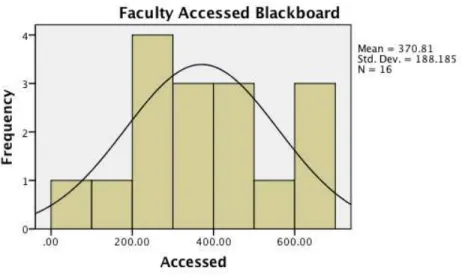
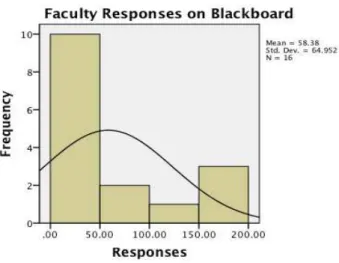
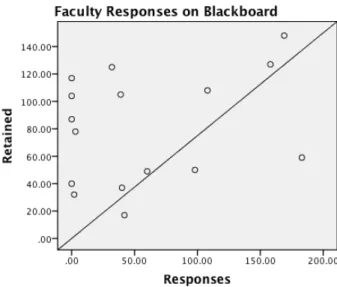
Figure 1. Population Distribution of Faculty that Accessed Blackboard………...….73 Figure 2. Scatterplot of Faculty that Accessed Blackboard and Students Retained……….73 Figure 3. Population Distribution of Faculty Responses on Blackboard………....…..75 Figure 4. Scatterplot of Faculty responses on Blackboard and Students Retained………….…..76
List of Abbreviations Administration Information Management (AIM)
Institutional Review Board (IRB) Information Technology (IT)
Statistical Package for the Social Sciences (SPSS) Structured Query Language (SQL)
CHAPTER ONE: INTRODUCTION
This chapter introduces the topic of the study and presents the background information used to support the purpose of this study. Included is the problem statement, purpose statement, significance of the study, research questions, null hypotheses, and definitions.
Background
Educators across the nation have embraced the fact that virtual learning environments are growing increasingly popular. According to Faja (2012), a recent survey indicated that six million students have participated in an online course. The push by the Obama administration for more college graduates has increased the demand for affordable and accessible education, which has resulted in an increase in online education enrollment. However, the percentage of students that complete courses or even complete degree programs may be influenced by a number of factors. Research has shown that prior online success, student efficacy, student-to-student collaboration, and teacher-to-student-to-student collaboration may influence student-to-student ability to complete a course. There is little research on faculty interactions with students in online courses and how they might influence student ability to complete a course.
The way students and teachers communicate online is through course management systems. A course management system is a software program or an integrated online platform that contains various web-based tools to support a number of activities, online interactions, and management procedures (Tella, 2012). Blackboard, Inc. is an example of a course management system. Through online Blackboard collaboration, to-student interactions and student-to-teacher interactions can be managed and documented. The degree of online collaborative interaction may have the ability to increase student engagement and develop a sense of
community by using teamwork skills (Faja, 2012). Students that are engaged and feel that they are part of a learning community will have a better chance of succeeding in an online program.
In addition, the 2010 Horizon Report (Johnson, Smith, Levine, & Haywood, 2010) claimed that due to an increasingly busy world in which the student lives, the demands of home, work, school, and family make it difficult for the student to manage schoolwork and may also play a deciding factor in course completion. However, the multitude of “browser-based software” has helped ease the burden of schoolwork, allowing for “device-independent
programs” and a great deal of readily available knowledge on the web (Johnson et al., 2010). As technology dominates this changing world, students are able to increase communication with peers, faculty, and others from all over the world. If this type of communication is channeled in an academic setting with specific goals and strong faculty interaction, learning can be successful, comfortable, and enjoyable for the contemporary student. Specifically, interactions between students and faculty on course management systems such as Blackboard can influence retention rates, or course completion rates, of online students in a particular course.
Course management systems are designed to develop, support, and enhance online learning. The organization, creation, storage, retrieval, transfer, delivery, and communication of material are managed easily through one interface (Tella, 2012). The number of interactions between those involved in an online course may influence various success factors. The ability for instructors to provide links, videos, text, discussion boards, and support materials in one place can positively or negatively affect the success of the student’s course completion. Furthermore, the online instructor needs to develop pedagogical practices that are slightly different than traditional face-to-face classroom practices. According to Meyer and McNeal (2011), the most effective pedagogical practices for effective teaching online are fostering
relationships, engaging students, timely responses, communicating regularly, providing
feedback, effective course organization, flexibility, effective use of technology, and having high expectations. These practices can be a major influence on the student’s quality of work, overall perceptions, and completion rates of a particular online course or degree program. Additionally, online classes and degree programs provide flexible scheduling, self-pacing, and a variety of programs that traditional settings may not provide at such a convenience. These factors may provide enough of an incentive for students to complete courses.
Faculty interaction plays a significant role in the success of online students. At the undergraduate level, it is beneficial to have online support systems or services where students can seek help to ensure their success. If the faculty member is unavailable, students should be directed to a forum, or a student support center, to seek guidance through the online course or degree program. In a recent study conducted by Russo-Gleicher (2013), most faculty members did not refer students to support services, which contributed to the retention problems of students in online courses at a community college. If there is an option for support, the faculty member must be instructed to be more diligent in identifying risk factors that may influence the success of students. If these students are identified and directed to a place for support, there may be an increase in retention. In addition, faculty members need to realize that their roles in student retention are equally as important as the administration and registrar. Their attitudes towards utilizing support services can greatly impact student retention (Russo-Gleicher, 2013).
Student retention in an online learning environment may be increased if certain factors that affect retention are utilized, such as early identification and effective intervention formulas (Liu, Gomez, & Yen, 2009). Research has shown that having online students complete a learner assessment early in a particular course can help identify students at risk for dropping that course.
Analysis of this information can target at-risk students and provide them with an intervention program such as supportive peer groups (Liu et al., 2009). The role of the educator is also crucial in improving the likelihood of student success in an online learning environment. Not only does the quality of the interactions among classmates affect retention rates of online
students, but the number of interactions between faculty and students may also greatly influence student course completion.
Collaboration online may support online learning and therefore contribute to successful retention. The greater the frequency in which online students interact with teachers and peers, the more their social integration and readiness will increase, which should improve course
retention (Liu et al., 2013). Effective communication should be practiced and each student needs multiple opportunities to develop the necessary intercultural skills that come along with effective communication (Lee, Poch, Shaw, & Williams, 2012).
Online learning lends itself to experimental discovery, interactivity, collaboration, and assessment, with less emphasis on rote learning (Subramaniam & Kandasamy, 2011). Most virtual learning environments provide features such as support services, grading, examinations, emails, instant messages, chat rooms, discussion boards, and file transfers that provide the learner with the tools necessary to communicate (Subramaniam & Kandasamy, 2011). Effective online collaboration with students may be a positive factor influencing student completion rates.
Problem Statement
The interactions between faculty and students in an online class can influence many aspects of a student’s success. The problem with online education is the multiple factors that can affect student retention. Researchers Liu et al. (2013) identified that there is a lack of
between faculty and students, may result in higher course completion rates in online courses. Results of this study will help post-secondary institutions identify factors influencing the retention rates of their online students.
Purpose Statement
This study examined the correlation between faculty interactions with students in a post-secondary online course and student retention rates. Due to the increase in online courses, online course management systems were designed to manage interactions between faculty and students. Blackboard is one such online system that provides an interface that allows for these interactions. The number of interactions between instructors and students on Blackboard can affect student completion rates. After examination of the online student completion rates and faculty interactions on Blackboard, a correlation between the number of faculty interactions and the completion rates of students in online courses was significant in one respect. Specifically, the number of times faculty members accessed or checked Blackboard simply by logging on and the number of times they responded to student discussion board posts were analyzed to determine if there was a correlation with that data and online student course completion rates. As the
demands of higher education increase, the degree at which faculty and students interact can influence the course completion rates of online students.
Significance of the Study
The recent push for more college graduates and greater educational requirements in the job market has increased post-secondary online enrollment (Meyer & McNeal, 2011). Online education is a growing trend due to its convenience and self-directed learning. Online students can balance a job, family, and the daily demands of life in addition to gaining an education. However, the retention rates of online students are influenced by many factors. Particularly,
faculty interactions with students can influence retention rates. In this study, faculty interaction with students in a required online post-secondary introductory English composition course were analyzed to see if there was a correlation between that data and online course completion rates.
Research Questions
RQ1: Does the number of times a faculty member accesses Blackboard by logging on affect the course completion rates of online undergraduate students required to take an
introductory English composition course?
RQ2: Does the number of times a faculty member responds to a discussion board post of online undergraduate students required to take an introductory English composition course affect the course completion rates of those students?
Null Hypotheses
H01: There is no significant correlation between the number of times a faculty member
accesses Blackboard and the course completion rates of online undergraduate students required to take introductory English composition.
H02: There is no significant correlation between the number of times a faculty member
responds to discussion board posts of online undergraduate students required to take introductory English composition and the course completion rates of those students.
Definitions
1. Asynchronous - correspondence between students working on a collaborative activity that has significant time-delays.
2. Attrition - reduction in number of students completing a course or degree program.
3. Blackboard - a specific course management system where faculty and students communicate in online courses.
4. Collaboration - means of promoting learning by participating in groups with peers to develop shared ideas, online or traditionally (Sainsbury & Walker, 2008).
5. Course completion - student completion of a course.
6. Discussion board post - tool that teachers and students use in an online course to communicate.
7. Face-to-face - instructor and students interacting in a classroom setting.
8. In-person - collaborating in front of one another, such as in traditional collaboration. 9. Real-time - correspondence that happens instantaneously, whether face-to-face, face-time online, or on the phone.
10. Retention - student completion of a course and enrollment in another course the following semester.
11. Self-efficacy – the ability of the student to be effective and produce a desired result.
12. Self-regulation – the ability of the student to control the learning pace and desired outcome. 13. Synchronous - correspondence between students working on a collaborative activity that has no delays; live interaction with a web-based tool using a web-cam.
14. SPSS (Statistical Package for the Social Sciences) – a specific statistical analysis software. 15. Virtual - using the Internet for collaboration.
16. Web-based collaboration - process that describes how students communicate and collaborate online.
17. Wiki – interactive online collaborative tool that allows users to edit, add, modify, and share information.
CHAPTER TWO: LITERATURE REVIEW
This chapter presents the practical and empirical data used as the foundation for this study. The theoretical framework and literature review provided the proper documentation and evidence needed for this body of research.
Introduction
Distance learning in the form of online education has been a major contributor to 21st century education (Subramaniam & Kandasamy, 2011). As technology advances, education must adapt. According to the 2010 Horizon Report: K-12 Edition (Johnson et al., 2010), one of the major trends in education includes online course management systems. Online course management systems are virtual spaces where work can be done collaboratively with students and teachers.
The correct use of online course management systems such as Blackboard may have positive or negative effects on students depending on the quality of teacher interaction. According to Tella (2012), Blackboard can be used correctly as a pedagogical tool where teachers can promote the development of student communication, organization, and time-management skills. The amount of teacher interaction through Blackboard may influence the student’s motivation level to participate in the course and may even influence the student’s desire to remain in the course. Ultimately, the number of teacher interactions, including “hits” on Blackboard, responses, collaboration, and positive feedback can affect student course completion rates.
In 2009, President Obama announced the American Graduation Initiative, which included a goal for America to have the highest proportion of college graduates in the world by 2020 (“President Obama,” 2009). As a result, universities across the United States have exploded with
more low-cost online education programs (Hachey, Wladis, & Conway, 2012). The popularity of online education has pushed the growth rates of online education higher than overall higher education (Hachey et al., 2012). With this increase of online education, student retention may become a factor. The flexibility and the self-directed pace of online education may initially appeal to the prospective student, but the reality may prove to be different. Student retention rates can be influenced by many factors. Specifically, faculty interaction through a course
management system such as Blackboard may affect course completion rates of online students. Theoretical Framework
The government has taken steps to ensure that higher education is available to any U.S. citizen. This trend towards higher education for all Americans has increased the amount of online degree programs available. Along with providing access to online classes and degree programs, higher education institutions are grappling with retaining online students (Seidman, 2012). The reasons students drop out, or fail to complete a degree, are varied. One bad
experience could cause an individual to leave higher education and never go back. One factor that may decrease student retention in online programs is teacher involvement in online courses. The degree at which faculty members are involved may directly affect student course completion rates.
The theories developed by Tinto, Bandura, and Vygotsky will be used to support this study. Tinto (1987) researched and developed a theory of student retention over many years. According to Seidman (2012), the most important factor that Tinto identified affecting student retention rates was integration. Integration can be defined as a student’s experience within the college; the more integrated into the academics and social aspects of the school, the more likely the student is to succeed in completing academic goals (Seidman, 2012).
Vincent Tinto is a noted theorist in student retention in higher education (2005). Tinto stated that student retention has been associated with social interaction of students. For instance, some students need to be connected to their communities, families, and churches to feel they belong. Each institution has a different feeling or connection to the student whether residential, nonresidential, or online. The classroom plays a vital role in a student’s feelings of engagement and connection (Tinto, 2005). The key concept throughout all institutions that have implemented retention programs or have adopted different models of retention is that the most influential aspect of student retention is engagement (Tinto, 2005). Tinto stated that moving forward, all institutions have created or adopted some sort of program to address student retention, but often have difficulty implementing them, following through with them, and integrating them into campus life. Tinto found that one of the major problems institutions face is convincing the faculty taking part in helping retain students. Tinto’s research showed that the faculty seemed to blame the institutions for giving them unmotivated or weaker students, and if they were better students, they would be able to retain them. Tinto suggested that one way to tackle the issue of student retention is to organize institutional restructuring where the institutions, programs, faculty, and students work together to engage students and create a community where everyone takes part in the success of the whole. Tinto proposed a method to integrate successful retention programs. One of the facets of the method focused on cooperative learning environments or communities where students and teachers work together as a cohort (Tinto, 2005).
Tinto’s theory of social integration contains three stages: separation, transition, and incorporation (Seidman, 2012). The second stage, transition between communities, is the
integration into a fairly new community. This can be particularly difficult if the new community is an online learning community. Additionally, Tinto (1987) suggested that contact between
students and faculty members was not as important as the social integration between students. However, if there was a lack of faculty interaction, that could contribute to the attrition of students. Tinto discussed the scope, pattern, and roots of student departure. To decrease the amount of student departure, social integration needs to be addressed (Seidman, 2012). Social integration, which involves psychological, social, and organization influences, may be influenced by teacher involvement.
Furthermore, according to Seidman (2012), instead of studying how students learn and academic rigor as separate factors effecting student retention, studying their combined effects may have a better impact on student retention. The dynamics of online courses allow for Tinto’s theory of social integration to be practiced student-to-student and student-to-teacher using an online interface. Social integration can contribute to the retention rates of students in an online course depending on the degree of interaction between peers and faculty. Specifically,
integrating faculty involvement and a student’s learning style in the social setting can positively impact the retention rates of students.
According to Bowmen, Chingos, and McPherson (2009), student retention rates are a combination of weak motivation or interest of the student and the universities’ ability to target those students and try to intervene before they drop out. The specific intervention programs available are unique to the college or university and dependent on setting. However, Tinto’s theory helps explain the complexity of student retention and how students can be motivated to stay enrolled at college or university (Bowmen et al., 2009). Tinto’s research reinforces the theory that most retention can be linked to factors such as “intention, commitment, adjustment, difficulty, congruence, isolation, obligations, and finances” (Bowmen et al., 2009, p.221).
Effective retention involves engagement and interaction between students and peers and students and educators.
Furthermore, institutions should take ownership for changes to the campus and how they might influence the students that attend (Bowmen et al., 2009). One recent change in higher education is the demand for online education. If institutions are looking to increase enrollment, increase the amount of course offerings, and increase the amount of online degree programs, there should be effective policies to increase retention or to at least target students that may be at risk of dropping out (Tinto, 1987). Tinto’s principles are much easier to discuss than to actually implement, but Tinto’s theories have been researched and applied for nearly three decades and continue to show success when considered (Bowmen et al., 2009). Social integration by means of engaging the student in the social community is a constant struggle for the online equation. However, it is a strong factor in determining retention of online students. One factor in student retention and social integration is interaction with faculty. The feeling that the student belongs to the class community via Blackboard discussions and online postings can make the student
become more engaged and willing to complete the course.
Social integration has taken a new meaning in today’s society. When Tinto first
researched student retention and discovered the need for social integration, student engagement, belonging to the campus community culture, and interacting with peers and faculty, the social media aspect that has become the normal social interaction among the overwhelming majority of individuals in American colleges was not taken into consideration. There has been rapid growth in the general use of social media, mostly for recreational purposes, but many educators believe that these social networking tools “offer new educational affordances and avenues for students to interact with each other and with their teachers” (Poellhuber & Anderson, 2011, p. 102).
Specifically, these tools may be an integral part of online education with the use of these tools possibly taking a part in the social integration aspect of student retention (Poellhuber & Anderson, 2011).
Bandura’s (1977) social learning theory stated that behavior is learned from observations in one’s surrounding environment. Bandura’s career at Stanford University opened up many opportunities to develop this theory and led Bandura to the conclusion that modeling through various experiences gives people “structure, meaning, and continuity to their lives” (Zimmerman & Schunk, 2003, p. 437). Environment directly affects human behavior by the way in which people observe, analyze, and model those individuals in their immediate environment. Educators that are engaging, modeling positive behaviors, and active in a learning environment will
positively affect students. Students will tend to stay motivated, engaged, and willing to complete a course with an instructor that is able to cultivate a strong positive learning environment. However, it is challenging for educators to model, engage, motivate, and create online environments that motivate and sustain students.
Bandura’s social learning theory involves the integration of three determinants: personal, behavioral, and environmental factors (Zimmerman & Schunk, 2003). Teachers can use aspects of these three determinants to develop a student’s ability to self-regulate and self-motivate. Since online education is mostly self-regulated and self-motivated, this portion of Bandura’s theory involving self-regulation is fitting for this correlational study. Fostering the personal, behavioral, and environmental components to self-regulation can be “highly effective in
improving students’ motivation, strategies, and academic achievement” (Zimmerman & Schunk, 2003, p. 446). The highly motivated and self-regulated student will most likely complete a course and/or a degree program.
Self-efficacy is the term used to describe the ability of an individual to control, motivate, and execute behaviors to obtain certain goals in one’s environment (Bandura, 1977). Self-efficacy requires confidence and strong personal beliefs for a student to attain desired objectives. Educators need to be supportive of students’ differences in learning and attuned to what
motivates each student personally, behaviorally, and environmentally. Teachers can motivate students to monitor their activities and environment to become more effective in their personal education (Zimmerman & Schunk, 2003). In addition, educators’ self-efficacy in teaching can be a motivational factor in the students’ self-efficacy. The teacher that devotes more time to instruction, provides guidance to students, and praises his or her students’ accomplishments, is more likely to motivate students to have greater academic achievement (Zimmerman & Schunk, 2003). The online instructor with more self-efficacy may encourage the online student to develop more self-efficacy.
Educational programs that incorporate aspects of Bandura’s theory, specifically self-regulation, have been shown to highly motivate and effectively influence academic achievement (Zimmerman & Schunk, 2003). Bandura’s influence on education has triggered a widespread awareness of how modeling, self-efficacy, and self-regulation can greatly effect students’ coping skills, frustration levels, academic stressors, and ultimately their failure in personal academic achievement (Zimmerman & Schunk, 2003). In addition, Bandura stated that teacher’s that have a strong instructional efficacy create classroom environments that are mastery experiences for their students (1997). A strong instructional self-efficacy may be difficult to create in an online environment. Institutions need to provide professional development and training to ensure that teachers are prepared to create the proper environment to support student self-efficacy. The teacher will demonstrate the appropriate modeling for student success. Bandura (1997) also
believed that a collective self-efficacy was necessary to reach certain goals; “a group’s shared belief in its conjoint capabilities to organize and execute the course of action required will produce given levels of attainments” (p. 477). Therefore, it is not only the teacher and the students that will create the best learning environment, but the school, as a whole, needs to promote self-efficacy. Teachers are knowledgeable, but they need to look beyond pure content. Students need help to translate knowledge into proficient performance. They often cannot get themselves motivated to put in the necessary effort to complete difficult task demands that lead to student success and achievement (Bandura, 1997). Teachers that consider their students’ self-efficacy and self-regulatory needs, in addition to enhancing their overall academic knowledge, are preparing students for success in their education (Zimmerman & Schunk, 2003). These skills and support from educators can give students the tools they need to complete their college
courses and degree programs.
Vygotsky’s theory relies on the interrelatedness between the following three factors: interpersonal, cultural-historical, and individual factors (Tudge & Scrimsher, 2003). The individual student brings personal interaction to the cultural-historical setting in which interaction between students and teachers takes place. A child’s social development will contribute to the degree of interaction between students and teachers. Positive student-teacher interactions will support Vygotsky’s social theory of education. Vygotsky believed that students need to be actively involved in their teaching/learning relationships (Tudge & Scrimsher, 2003). It is necessary for the individual to feel accepted to be a complete member of the cultural world (Tudge & Scrimsher, 2003).
Environmental influences and the interrelations of individuals, such as students with teachers and other students, change with their environmental experiences (Tudge & Scrimsher,
2003). Vygotsky believed that through the interactions with others, an individual can have self-discovery (Vygotsky, 1997c). The environment in education involves students and teachers. In a traditional classroom setting, the environment can also be the actual classroom structure, the location of the school, the materials the students work with, etc. However, in an online class, the environment for learning can be the student’s physical environment while they are online
(library, home, or even a coffee shop), and the online environment. It is the responsibility of the educator to provide an online environment that is supportive and conducive to learning.
Although the interaction with the online student is important, the online environment is equally important in encouraging learning and retention.
Eun (2008) presented Vygotsky’s developmental theories and stated, “the foundations of Vygotsky’s theoretical framework are built upon the social origin and cultural mechanisms of development” (p. 135). There are certain key concepts that are necessary to understanding Vygotsky’s theories. These concepts involve mental functioning that arises from specific social interactions. Vygotsky believed that higher mental functioning was reached through social interaction (Eun, 2008). In addition, through Vygotsky's work other researchers discovered that social interaction in the material world with other individuals can help people develop a better sense of reality (Eun, 2008). This social interaction in the material world can be accomplished through online classes. The material world involves the Internet and the access of online courses allows for social interaction in a very modern and material social setting.
Vygotsky believed that social interaction was the core to human development (Eun, 2008). The link between social interaction and higher mental functioning is mediation, or the transformation of external forms of social interaction to internal forms of mental functioning (Eun, 2008). Vygotsky believed that the transformation between social behavior and mental
functioning does not happen automatically and requires engagement of two or more people on a practical activity (Eun, 2008). Furthermore, the activity needs to be goal-directed, “for social interaction to lead to development, it has to be situated in activities that have a clear goal, such as joint problem-solving activities” (Eun, 2008, p. 139). The contexts as to which the students interact, participate, and socially connect with teachers and peers in activities will contribute to the intellectual development of the student (Eun, 2008). This intellectual development or higher mental functioning is what students need to decide whether or not to stay enrolled in courses and retain the course or drop out. Vygotsky’s social development theories are focused on how the environment influences the social, behavioral, and mental abilities of the student. These theories can be used in the online environment to help explain why it is crucial for the students to be engaged, interact with other students and teachers, and have clear paths to communicate and achieve their goals. The correct online environment is necessary for students to achieve higher mental functioning and to make the correct choices in their future undergraduate degree courses and programs. Through the social interaction between teachers and students, this can be
accomplished.
Most students are interacting socially in network environments using technological interfaces, such as Facebook, Twitter, and Instagram. The addition of programs used in online courses, such as Blackboard, have changed the students’ perceptions of learning, specifically in the area of collaboration and communication with teachers. In positive teaching/learning relationships, teachers must be willing to foster successful interactions between themselves and their students in order to build on their students’ strengths (Tudge & Scrimsher, 2003). A strong student with positive teacher interactions online will increase the chances of that student to remains enrolled in the class and ultimately completing his or her course and degree program.
Review of Literature
Higher education has become increasingly important in today’s society. Distance learning promotes more accessibility for individuals to achieve a higher education. Online courses and degree programs have allowed institutions to provide quality instruction at a reduced cost (Crawford-Ferre & Wiest, 2012). In addition, the flexibility and instructional delivery of online instruction has made it appealing to individuals that have constraints in their lives that prevent them from attending a face-to-face course or program (Crawford-Ferre & Wiest, 2012). As a result, enrollment in online classes and degree programs has skyrocketed since the start of online education. Actually, online course offerings have increased faster than traditional course offerings (Crawford-Ferre & Wiest, 2012). According to Beck (2010), the amount of online higher education courses almost tripled between 1995 and 2003. With this increase in online education, educators must be prepared to handle a different type of student than the one often found in a traditional classroom setting. Faculty must be trained on the pedagogy of online instruction to be effective teachers of online education (Crawford-Ferre & Wiest, 2012).
Another facet of learning needed to ensure the success of online education is collaboration among students and instructors. Since the nature of online education is asynchronous, teachers and students will be unable to receive immediate feedback and
consequently rely on communication or collaboration among peers (Crawford-Ferre & Wiest, 2012). Effective teacher interaction and collaboration online can affect the success of the student enrolled in a post-secondary online course and/or degree program. Success can be measured in the retention rates of students and course completion. Retention rates of online students in a class or particular degree program are a challenge for many institutions.
According to Seidman (2012), past research on the retention of the distance learner has focused on retention in a particular online class; consequently, more research should be
conducted on persistence towards an online degree. The aspect of online education that deals with teacher and student communication can be researched to determine if there is a correlation between the amount of interaction online and retention rate or course completion rates. Online instruction has created pressure for teachers since the skepticism of the quality of online
instruction remains strong and retention rates for online courses remain low (Hachey, Wladis, & Conway, 2012; Ter-Stepanian, 2012). In a study conducted by Horspool and Lange (2012), student perceptions of success in online or face-to-face instruction of the same course indicated that students found success in both learning environments when there was high-quality
interaction with the instructor.
Stepanian (2012) discussed the benefits of a well-designed online course. Ter-Stepanian presented strategies for successful online instruction, which included improved learning outcomes, peer-interaction, and knowledge construction. Ter-Stepanian taught art history and designed twenty online courses. The means to which the online art history students interacted with faculty and peers was through discussion forum message boards. According to Ter-Stepanian, the theory of instructional design used in the courses offered to the online art history students was modeled after Keller. “According to Keller’s model of motivational design, among the methods of grabbing the learner’s attention are games, role playing, humor, and inquiry” (Ter-Stepanian, 2012, p. 43). Discussion board interaction stimulates active learning, causing intensive inquiry and curiosity that motivates students (Ter-Stepanian, 2012). If the online course is designed in such a way as to create engaging, intellectually stimulating, and
imaginative scenarios that motivate students to write and engage with the instructor and their peers, the success rate of the students to complete that course will increase.
Additionally, Ter-Stepanian (2012) stated that since distance learning can cause fear in novice online learners, the instructor should design the course to include introductions for teachers and students to share a bit about themselves to create an informal communication that, in turn, will encourage the student to be an active participant in the class. If students are more engaged and active in online courses, they are more likely to succeed and complete the course.
The flexibility and non-restricted nature of online education has made the industry grow significantly. According to Lee and Choi (2011), online enrollment continues to increase each year; however, online courses have higher dropout rates than traditional courses. In addition, failure to complete a course online might lower a student’s self-confidence and discourage him or her from registering for additional online courses (Lee & Choi, 2011).
A 2011 study conducted by Lee and Choi supported Tinto’s theory of social integration. Student are more likely to drop out of a class or degree program if they are unable to establish themselves in the college community (Lee & Choi, 2011). Lee and Choi analyzed empirical studies on online education from 1999 to 2009 that were published in peer-reviewed journals. The 35 studies were categorized as correlational, descriptive, experimental qualitative, and/or mixed method.
According to the research findings, the researchers in each study did not provide a clear definition of dropout from an online course. In some cases, a “dropout” was a non-completer of a course or a student that received an incomplete or F for the course (Lee & Choi, 2011). Retention was seen in some cases as completing a course with a grade between a C and an A or dropping out with a grade lower than a C.
Also, if students did not register for another course next semester, they were considered dropouts (Lee & Choi, 2011). Lee and Choi (2011) targeted 44 dropout factors after analyzing past studies. These factors were put into three main categories: student factors, course program factors, and environmental factors (Lee & Choi, 2011). Two factors that affected dropout rates were SAT scores and GPAs; students who had lower SAT scores and GPAs had higher dropout rates (Lee & Choi, 2011). In addition, Lee and Choi reported that “students with less academic aptitude and a history of poor academic performance are more likely to enroll in online rather than conventional courses, but less likely to persist in them” (p. 607). Moreover, relevant experiences relating to the courses and relevant skill related to the courses were factors affecting dropout rates.
Lastly, psychological attributes of student factors affecting dropout rates were analyzed. Lee and Choi (2011) described psychological attributes as students’ attitudes towards learning, interaction with their instructors, and interaction with other students. This study provided evidence to support the theory that students’ self-efficacy, motivation satisfaction with the course, and interaction between students and instructors can influence the likelihood for students to complete a course.
Furthermore, Lee and Choi (2011) discussed the aspect of course/program dropout factors involving course design in terms of interactivity. They reported that the instructors’ efforts to increase interactions and involvement with students and between students would increase retention rates. Consequently, if instructors gave appropriate and timely feedback through discussion boards, emails, and interactive activities, as well as provided support, the students were more likely to complete an online course (Lee & Choi, 2011). Therefore, an
increase in faculty interaction or involvement with students in online courses may in fact increase the course completion rates for those students.
Online education depends heavily on computer self-efficacy and technology literacy. The success of online students may be affected by computer anxiety or weakness in technology literacy and self-efficacy. The following study examined the relationships between computer self-efficacy and computer anxiety in both online and face-to-face educational environments (Hauser, Paul, Bradley, & Jeffrey, 2012). The researchers in this study presented one of the challenges of online education as a complex educational environment that is devoid of the
personal presence of an educator (Hauser et al., 2012). The expectation of students is for them to perform at the same level as they would in a face-to-face class, but since there is a lack of the physical classroom, the communication between students and between students and teachers should be structured differently (Hauser et al., 2012).
According to Hauser et al. (2012), empirical evidence regarding online education has identified two main factors in student performance—computer self-efficacy and anxiety. Hauser et al. defined computer self-efficacy as “an individual’s belief in his or her ability to apply computer skills to a wider range of tasks” (2012, p. 143). Anxiety regarding online education can directly affect computer self-efficacy. As anxiety increases, computer self-efficacy decreases (Hauser et al., 2012).
The participants from this study were undergraduate students from a public university in the southeastern United States. A questionnaire was given to face-to-face classes and online classes over two semesters and the data yielded 129 male and 111 female responses (Hauser et al., 2012). The data was collected in two phases: questionnaires and then a test on Microsoft Access to measure performance. Computer self-efficacy was broken into general self-efficacy
and specific self-efficacy. Hauser et al. (2012) reported that higher computer self-efficacy resulted in higher performance scores. General self-efficacy was also positively correlated with specific computer self-efficacy, which positively affected student performance (Hauser et al., 2012). Student anxiety had a negative effect on both general and specific self-efficacy in a face-to-face environment, but only the specific self-efficacy was negatively affected in the online environment (Hauser et al., 2012).
Moreover, the findings from this study concluded that online students must reach the expectations of a traditional class without the interaction of the teacher and face-to-face instruction. Due to this fact, students must rely heavily on organizational skills and the
completing of class material (Hauser et al., 2012). These necessary skills will reduce anxiety and increase computer self-efficacy online. Educators should aim to have more positive interactions with students online to help create a successful online environment and therefore increase course completion rates.
Engaging online students is key to student success in an online course or setting. A recent study conducted by Beaudoin, Kurtz, and Eden (2009) attempted to better understand interactions and engagement of online students with learning mediums, materials, and instructors and peers. This survey study provided an insight into what students felt were the most effective and least effective practices for success in online courses (Beaudoin et al., 2009). This study assessed student engagement in the online learning environment and aimed to identify factors about students and online learning that past studies have missed (Beaudoin et al., 2009).
The participants in Beaudoin et al.’s (2009) study were from the United States, Israel, Mexico, and Japan. A questionnaire was given to higher education online learners of various ages, both male and female. The 428 “respondents were asked to identify up to three online
learning experiences and to indicate their level of satisfaction with each” (Beaudoin et al., 2009, p. 280). Another series of questions asked the respondents to identify what elements of the online experience had most influenced their level of satisfaction (Beaudoin et al., 2009). Additionally, the questionnaire asked the respondents to rank 10 items that would be considered ‘critical elements for successful online learning.’ The students listed the following:
self-motivation, ability to manage time, limited support, relationships with online facilitators, enjoying the challenge of learning, confidence to be able to achieve a goal, ability to express one’s ideas, ability to cope with non-structured settings, relationship with other online learners, and familiarity with technology (Beaudoin et al., 2009). This cross-cultural study reported that the majority of online learners rated their satisfaction with the online experience as ‘Very Good to Good’ (Beaudoin et al., 2009). The report of the findings for the elements influencing satisfaction was the course itself, meaning how it was organized and the content of the course. This was followed by the “quality of instruction, interaction, convenience, and flexibility” of the online experience (Beaudoin et al., 2009, p. 285). The online experience has many factors and elements that influence student success, including interaction with the faculty and interaction online. The greater the quality of interaction with faculty and the more frequent the interactions with other students, the greater success a student will experience in an online course. Ensuring that the student is engaged and that the overall online experience is successful should encourage students to complete a course.
Online education can be difficult due to the lack of physical contact between students and their professors (Benson & Samarawickrema, 2009). Benson and Samarawickrema (2009) presented a study of six different cases regarding the separation of teachers and students and between students in e-learning and distance education. The study addressed concerns regarding
the distance involved in online education. The advances in e-learning have to take into consideration the variety of learning contexts the students are engaged in such as home-based learning, “access issues, pedagogical support, and the skills and responses of staff and students to the use of various technologies” (Benson & Samarawickrema, 2009, p. 7). It may be difficult to account for all of these issues, but most can be addressed in the design of the course. In addition, Benson and Samarawickrema discussed transactional distance theory, the psychological distance between students and teachers, which can be addressed and bridged through equal amounts of dialogue, course design, and student autonomy.
The analysis of the cases in this study discussed the management of transactional distance using balance of dialogue, structure, and student autonomy incorporated in the course design (Benson & Samarawickrema, 2009). The six cases in this study ranged from a variety of e– learning environments: face-to-face, blended, and strictly online. The analysis of the various cases resulted in the determination that transactional distance can be reduced with high levels of dialogue and structure for the students (Benson & Samarawickrema, 2009). Teachers have a direct influence on the dialogue and structure of an online course and can affect the learners’ success. Success of students in online courses is mostly related to the interaction of the faculty. The more active the faculty are with their online students, the more likely the students will be to complete the course.
Retention rates for online students have been the subject of many reports since the early 1990s and the birth of the first online classes (Aversa & MacCall, 2013). There are many findings that have been reported to describe the best ways to retain students, but a recent case study by Aversa and MacCall (2013) looked at the attributes of a successful online program that already had a high retention rate. In this study, the nature of the class was a virtual classroom
that met twice a week with live lectures, discussions among students, guest lecturers, and group work (Aversa & MacCall, 2013). In addition, the course management system, Blackboard Vista, was used to provide materials, discussion, links to resources, and additional documents.
Students could also use email, Facebook, and other social media to interact with peers and faculty. Students were encouraged to communicate and interact with faculty and peers during the semester (Aversa & MacCall, 2013).
The results of this case study showed that the students enrolled in the Master of Library and Information Studies degree program at the University of Alabama had higher than usual retention rates due to many factors, including that the program design was deliberately made to mirror a face-to-face program. The students reported the following positive experiences: faculty and students interacted regularly, individualized attention was available to each student, the faculty understood the issues confronting students that were employed and had adult
responsibilities, and each student enjoyed being part of a close-knit community (Aversa & MacCall, 2013).
Faculty interaction, specifically, was one of the leading factors in the high retention rates of this degree program. On the contrary, other online programs do not have the live or
synchronous interaction this program does. Most online programs are asynchronous. The delivery of the instruction can affect the social interaction between students and faculty. According to this case study by Aversa and MacCall (2013), the increase in positive interaction between students and teachers may be one of the major factors in increasing student retention.
Educators have a distinct role in the retention rates of students. Specifically, the interaction or involvement of an instructor of an online course can impact course completion rates. A qualitative study was conducted by Russo-Gleicher (2013) that provided insight into
ways faculty members could impact the retention rates of online students. This qualitative study was undertaken by interviewing faculty members from a community college in a metropolitan area in the northeastern United States. The faculty members were asked to discuss themes about online students. These included “behaviors that make faculty concerned about online students, faculty communication with online students identified as having behavior problems, and faculty utilization of student support and services with online students having problems”
(Russo-Gleicher, 2013, p. 9).
Some of the behaviors that students would display that were a cause for concern involved missing postings on the discussion board, poor quality assignments, missing assignments, and low-test scores (Russo-Gleicher, 2013). The faculty members’ responses to the students that exhibited troubled behaviors varied. Faculty members were unclear about their responses to the students because they were all so different. The timing of the semester also had a great impact on retention rates. Teachers tried to reach at-risk students by using the Blackboard
announcements page (Russo-Gleicher, 2013). In addition, students in need of extra help were referred to student support services by their instructors. Most faculty members in this study admitted that they were not diligent about recommending or referring students to academic support services. Most faculty members were not even aware of the types or amounts of student support services available to them (Russo-Gleicher, 2013). Overall, Russo-Gleicher (2013) concluded that the lack of knowledge and attitudes towards student support services negatively affected online students, consequently impacting the college’s retention rates. Faculty attitudes play a significant role in online student course retention.
The amount of teacher involvement in an online course can promote learning productivity. In turn, if the student is productive and successful, he or she is more likely to
continue and complete the online course or degree. Meyer and McNeal (2011) conducted a qualitative study that explored the different ways faculty can improve student learning in an online course. This particular study used interviews, blogs, discussion groups, and journaling to gather data from 10 full-time faculty members from the University of Memphis. The results of these findings included six themes that the experienced online faculty utilized to improve student-learning productivity. These six themes included “increasing student access to content, changing the role of faculty by increasing access, increasing interaction with students,
emphasizing the importance of student effort, connecting to the ‘real world,’ and changing conceptions of time” (Meyer & McNeal, 2011, p 41-42).
Faculty access and increasing interaction with students plays a role in retaining students enrolled in an online course. Faculty members should adopt a policy where they answer emails within 24 hours. Announcements posted on a course management system such as Blackboard foster open communication and faculty access (Meyer & McNeal, 2011). Increased interaction with students on course management systems encourages communication between faculty members and the students’ peers. The ability of the students to share their experiences with others involved in the course in an online discussion board is different than face-to-face. The online interface allows for otherwise shy and withdrawn students to feel they can express themselves without judgment (Meyer & McNeal, 2011). Increasing faculty access and
interaction with students can provide the necessary self-efficacy that online students need to feel successful and remain in the online course.
The role of the instructor is crucial to any learning environment. Face-to-face instruction and online instruction both have their strengths and weaknesses. One possible explanation for the difference in instruction may be the way the instructor was trained for each learning
environment. Many educators are taught to teach in the classroom and not how to teach online. One study used a mixed methods approach and focused on identifying possible risks and
strengths of each type of instruction, along with ways the teacher could improve how he or she facilitated learning (Diaz and Blazquez, 2009). Regardless of the type of instruction, if the teacher was trained in the specific instructional design, he or she should be successful. Another element of online instruction that may affect the success of this type of education is the kind of student receiving the instruction. Online instruction often attracts the student that has restraints in life that may restrict the ability for the student to attend a face-to-face course.
Focusing on the instructor’s role, Diaz and Blazquez (2009) conducted a combined study to analyze the differences between face-to-face instruction and online instruction in order to determine if there was a difference in the tasks carried out by instructors. The researchers focused on four aspects of teaching: theoretical content, practical content or activities, interaction, and design (Diaz & Blazquez, 2009). Theoretical content involved the content, training action, and structure of the online component; practical content or activities involved the actual activities that were used to understand the theoretical content; interaction involved the relationship between teachers and students; design involved the managerial and administrative aspects of teaching and included time, technical aspects, and instructions (Diaz & Blazquez, 2009).
The study’s 255 participants included 250 students and five instructors/experts in the field of distance education (Diaz & Blazquez, 2009). The data collection involved closed
questionnaires, semi-structured interviews, and discussion groups (Diaz & Blazquez, 2009). The aim of the study was to identify points that may improve teaching methods in both face-to-face and online instruction. The results showed that occasionally, the online theoretical or program
design and structure was more satisfactory to students than face-to-face instruction and design. One possible explanation for this is that the instructor prepared the course content and structured framework prior to teaching and the conceptual map and scheme of the course was presented upfront to keep students on track. Often that specific or structured framework of course design is not as rigid and defined in traditional teaching methods (Diaz & Blazquez, 2009). The activities in the online learning environment were seen as more satisfactory than the activities in the
traditional, face-to-face environment, possibly due to the fact that online courses often emphasize activities (Diaz & Blazquez, 2009). In the traditional, face-to-face environment, the explanation of concepts often takes precedence over learning activities (Diaz & Blazquez, 2009).
As noted, interaction between instructor and students can be more effective with face-to-face instruction due to the visual content and useful resources available in person to motivate students. Online interaction can be limited by how the instructor and students communicate (Diaz & Blazquez, 2009). The more each party is involved, the more positive the experience will be. Lastly, regardless of the study design or teaching environment, the instructor needs to consider the pedagogical theoretical grounds for the course, technology, organization, and support (Diaz & Blazquez, 2009). However, most institutions that train teachers in online education concentrate more on planning than pedagogy (Diaz and Blazquez (2009). In
conclusion, this study showed no significant difference “between the functions of teachers in the two teaching modes, online and face-to-face; and if these differences do exist, they are likely to be due to the teacher’s involvement and the institution’s commitment in the programming of the learning process” (Diaz & Blazquez, 2009, p. 342).
Consequently, this study reinforces the importance of teacher involvement. In most online teaching programs, universities should train and guide instructors in their interactions with
online students. Involvement and interaction of teachers in online courses can positively influence student satisfaction and engagement and ultimately affect the rate at which students complete a course.
Positive interactions between students and teachers are key to successful online education. Garrison, Anderson, and Archer designed the concept of Community of Inquiry (CoI), a constructivist learner concept developed for online students (2000). Hosler and Arend (2012) used this conceptual framework to support their study about the interactions between online students and teachers. Hosler and Arend described the CoI as the convergence of social presences, teaching presence, and cognitive presence to ensure success of the post-secondary student. In the online environment, the student exhibits social presence when he or she presents himself or herself as an actual person, both socially and emotionally (Hosler & Arend, 2012). Teaching presence is described as the meaningful design of the course, organization of the
course, and direct instruction of course material (Hosler & Arend, 2012). Teaching presence was key to “establishing and maintaining social and cognitive presence” (Hosler & Arend, 2012, p. 219).
Lastly, cognitive presence is defined as critical thinking in the form of conceptualization, examination, and differentiation of learning levels (Hosler & Arend, 2012). Additionally,
cognitive presence involves collaboration and reflection between students by exploring, creating, solving, and confirming their ideas. The purpose of the CoI framework is to provide a guide for teachers to support critical thinking in higher education (Hosler & Arend, 2012). Hosler and Arend (2012) looked specifically at student perceptions of the elements of teaching presence and cognitive presence and compared face-to-face and online classes. The participants of the study were 208 post-secondary students from a university in the Rocky Mountain region. One hundred
thirty-two of the participants were online students, and 76 were traditional, face-to-face students (Hosler & Arend, 2012). The survey administered was a CoI survey consisting of 34 statements designed to assess student perceptions of the three presences: teaching, social, and cognitive; each response was based on the Likert scale (Hosler & Arend, 2012). There was also a qualitative component to this study that presented the thoughts and descriptions about the relationship between cognitive and teaching presence to help explain the quantitative results of the survey (Hosler & Arend, 2012).
Hosler and Arend (2012) found that student satisfaction was dependent on cognitive and teaching presence, with a great emphasis on cognitive presence. According to this research, students want to be challenged to think more critically if their teachers direct, encourage, and support a high level of critical thinking (Hosler & Arend, 2012). Based on the qualitative results of this study, students related critical thinking to three aspects of teaching presence. The first aspect of teaching presence the students related critical thinking to was course goals,
organization, and purpose of assignments. Secondly, students that were provided direct, timely, encouraging, and specific feedback from instructors felt their critical thinking was positively impacted. Lastly, the way instructors facilitated discussions, focused, and encouraged students positively impacted critical thinking (Hosler & Arend, 2012).
In conclusion, “students in online classes and face-to-face classes do not differ in their perceptions of teaching presence and cognitive presence” (Hosler & Arend, 2012, p. 226). A strong teaching presence can foster a strong cognitive presence and positively influence learning online. This particular study shed light on the structure of the online course and the involvement of the teacher. The research showed that students benefitted from positive, timely feedback from instructors with encouraging responses and strong discussions. This support in an online course