Centre for
Technology Management
Centre for Technology Management working paper series
ISSN 2058-8887
No. 4
June 2020
Scenarios and roadmapping - how
to navigate an uncertain future
https://doi:10.17863/CAM.54145
Gill Ringland (SAMI Consulting) *
Imoh Ilevbare(Institute for Manufacturing, University of Cambridge)
Nikoletta Athanassopoulou(Institute for Manufacturing, University of Cambridge)
Anna-Marie Greenaway (BP)
Robert Phaal (Institute for Manufacturing, University of Cambridge)
* Please contact the corresponding author for feedback:
1
Scenarios and roadmapping - how to navigate
an uncertain future
Gill Ringland1, Imoh Ilevbare2, Nikoletta Athanassopoulou3, Anna-Marie Greenaway4, and Robert
Phaal5 1[email protected] 2[email protected] 3[email protected] 4[email protected] 5[email protected]
1 at SAMI Consulting, The Rectory, 1 Toomers' Wharf, Canal Walk, Newbury, RG14 1DY, United Kingdom
2,3,5 at the Institute for Manufacturing, University of Cambridge, 17 Charles Babbage Road, Cambridge, CB3 0FS, United Kingdom
4 at BP, 1, St. James's Square, London, SW1Y 4PD and BP Institute, Bullard Laboratories, Madingley Rise, Cambridge, CB3 OEZ, United Kingdom
Author biographies
Gill Ringland is well known as an author, consultant and trainer on foresight, scenario-planning and strategy. From 2002
to 2017 she was CEO of SAMI Consulting, which specialises in decision-making, based on views of the future, “robust decisions in uncertain times”: she became Fellow Emeritus in 2017. SAMI has a core team of 20, has completed over 250 assignments globally and is a corporate member of the Association of Professional Futurists. Gill is a Fellow of the World Academy of Arts and Sciences and the British Computer Society. Her scenario books are used on many MBA courses.
Dr Imoh Ilevbare works at Institute for Manufacturing Education and Consultancy Services University of Cambridge as
a Product Manager for its Innovation and Technology Management services. He is also part of the team that develops and delivers new management tools and services for industry. Prior to this, he got his PhD from University of Cambridge studying risk management within roadmapping in its application to early stage innovation planning. Imoh has a First Class Honours degree in Mechanical Engineering, and worked in the oilfield servicing and FMCG industries.
Dr Nikoletta Athanassopoulou is a Senior Industrial Fellow based in the Institute for Manufacturing at the University of
Cambridge. Nicky is a member of a team that is responsible for developing innovative services to help small- and medium-sized companies develop their strategy, innovation, technology and product development processes. She has held a number of new- product development, project management, and business development roles. She has a BSc in physics from Athens University and an MPhil and PhD in solid state physics from the University of Cambridge.
Anna-Marie Greenaway is Director, International University Relations, at BP. This is a global role encompassing
technical and policy research to support BP's strategic objectives, recruitment, executive education and international research partnerships. Prior to this she was BP's VP Science and Technology at the University of Cambridge and still retains accountability for this strategic partnership. She is a member of the Board of the BP Institute and sits on the Advisory Board of the Scott Polar Institute and the Clean Energy Centre at Tsinghua University, Beijing. Previously, Anna-Marie spent four years in BP's Group Strategy team where she led the 2030 Energy Pathways research programme covering the US, EU, China, India and Brazil. Earlier roles at BP have spanned special assignments to support Group Technology and Safety & Operations, Head of Downstream Change Leadership Capability and leading the Technical & Commercial Partnership between BMW & Castrol across Western Europe. Prior to BP, Anna-Marie spent 10 years in retail operations, advertising and corporate communications with Exxon after joining their graduate programme in 1989 as a capital investment analyst. She holds a BRc from the Dept of Earth Science RHBNC University of London, and a Masters degree in Sustainability Leadership from the Department of Engineering, University of Cambridge.
2
Dr Robert Phaal joined the Centre for Technology Management at the University of Cambridge in 1997. As a Principal
Research Associate he conducts research in the field of strategic technology management. Areas of interest include the emergence of technology-based industry and the development of practical management tools. Rob has a mechanical engineering background, with a PhD in computational mechanics from Cambridge (1990). He is a Chartered Engineer, with industrial experience in technical consulting, contract research and software development at TWI, a leading UK research and technology organisation.
Abstract
Scenario planning and roadmapping are both well established processes for exploring possible futures. Roadmapping for technology foresight provides a framework for investigating technology developments, interrelationships and critical timescales. However it is increasingly important when new technologies and consumer adoption co-evolve that paradigm changes in the wider social and economic environment are taken into account. A strength of scenario planning is in exploring social and economic factors and hence scenarios can provide the futures context for a roadmapping exercise. Both processes are often used in group work modes over days or months, which allows for stakeholder consensus to develop. This paper describes how scenario planning and roadmapping were combined within a workshop to gather a wide range of external and internal inputs and to challenge organisational thinking. The paper discusses how the process was achieved in one day, the benefits of this arrangement and also its limitations and how to mitigate them.
1. Introduction 1.1 Background
BP is one of the world's leading integrated oil and gas companies. It provides customers with fuel for transportation, energy for heat and light, lubricants to keep engines moving, and the petrochemical products used to make everyday items such as paints, clothes and packaging. BP currently operates in more than 70 countries and employs nearly 80,000 people globally. In the past 50 years, Europe has experienced some important demographic, societal and economic changes, such as increasing life expectancy, falling fertility, migration and globalisation. BP wanted to capture and explore different perspectives on future technology emergence and deployment models for mobility in Europe, and to derive a list of key technology indicators that they could monitor. Monitoring these technologies would help them better predict when the external environment might deviate from the current assumptions.
To help achieve this, BP commissioned the Institute for Manufacturing, University of Cambridge to facilitate a pilot workshop with the aim of developing and exploring different possible future scenarios for mobility in Europe. Specialist knowledge and experience in the development of required scenarios was supplied by SAMI Consulting. The workshop was designed to capture different perspectives from the point of view of users, freight, policy, technology, youth, diversity and risk. It brought together 16 academic and industrial experts outside of BP’s normal networks in order to obtain divergent and alternative views of how mobility in Europe might develop by 2040, and it specifically explored land, water and air (including space) transport.
The specific objectives of the workshop were to:
- Capture insights from world-leading experts into how the transport sector might develop in Europe by
2040
- Understand the most important drivers that will shape transport in Europe,
- Identify the highest-priority emerging technologies and understand how they could be developed and
adopted by 2040 within the transport sector in Europe.
1.2 Integration of two methodologies
The workshop integrated and used two different methods: scenario planning and roadmapping. Scenario planning traces its history back to just after the Second World War, when Hermann Kahn pioneered the technique of ‘future-now’ thinking. He used detailed analysis and imagination to produce a report as it might be written by people living in the future, and to promote debate on nuclear weapons. Since then the method has
3
been used extensively for creating future mental models to improve the quality of decision-making (Schwartz, 1991; Ringland, 2006). Roadmapping is a powerful technique that is used by companies, government organisations and academic institutions to establish and support strategy and innovation. It explores, manages and communicates the linkages between technology and product development to commercial objectives and market opportunities through a structured visual framework. S-Plan (strategic plan) roadmapping has been developed by the IfM over a period of several years and successfully applied several times across multiple
industries (Phaal et al., 2001 and 2007). This framework was configured to elicit the emerging technology
implications from each scenario developed, and to evaluate which technologies might be important across several scenarios.
1.3 Paper layout
In the next section on methodologies, we revisit the purpose of foresight, review the literature on scenarios, roadmapping and the ways in which they have been combined, and present the rationale for a more practical
and useful combination of both methods. In Section 3, we then describe the new process combining the methods
(including the workshop agenda and templates), which was built on specific principles for developing industry-relevant strategy solutions. We conclude the paper in Section 4 with the lessons learnt over the course of developing and delivering the process.
2. Methodologies
2.1 Rationale for strategic foresight
Strategic foresight is not new, and the principles on which it is based have been ingrained in planning and management for a long while:
- “Planning is, in essence, the exercise of foresight. Specifically, it consists in adjusting the relations of things before they happen” (Church, 1914).
- “The maxim, ‘managing means looking ahead’, gives some idea of the importance attached to planning in the business world, and it is true that if foresight is not the whole of management, it is an essential part of it. To foresee, in this context, means to assess the future and make provision for it” (Fayol, 1949).
While these, especially Fayol (1949), appear to provide some insight into the nature of foresight, Yuan et al.
(2010) note that specific definitions of foresight are diverse, and this is understandable given the vast range of renewed interest in the field. Nevertheless, two more contemporary and more commonly cited definitions are as follows:
- Foresight is “the process involved in systematically attempting to look at the longer-term future […]
with the aim of identifying the areas of strategic research and emerging generic technologies likely to yield the greatest economic and social benefits” (Irvine & Martin, 1984).
- Foresight is “a process by which one comes to a fuller understanding of the forces shaping the
long-term future which should be taken into account in policy formulation, planning and decision-making…. Foresight is, therefore, closely tied to planning, it is not planning – merely a step in planning” (Coates, 1985).
Unlike preceding decades, much of the 21st century so far has been laced with socio-political and economic
unpredictability. As a result, organisations are increasingly looking for ways to adapt and adjust their strategies to cope and make the best of these prevailing circumstances. It has been clear for a while now that traditional methods of formulating strategy, which build on a predictable future, fall short of what is necessary to develop strategies that are appropriate for these conditions (Ringland, 2010).
There are various types of foresight (see Martin, 1995; and Porter et al., 2010). For example, it can be different
4
industry bodies, and further down to corporate and business unit levels. Corporate foresight, in particular, provides valuable input for strategic planning, technology development and innovation. It can be very helpful in lifting the view of senior management away from daily pressures to develop clear perspectives regarding strategic matters that are critical to long term sustainability and survival of the firm. With improved clarity derived from the identification of new and relevant trends as well as foreseeable structural changes in science and society, a business is able to identify and develop new and future markets and reorientate itself for new developments (Oner & Beser, 2011; Ringland, 2010).
Foresight methods seek to understand the factors that affect the business environment and prepare decision-makers for the emerging trends and surprises by raising awareness on the organisation’s present and future. While an exhaustive list and description of methods will not be provided here (for a comprehensive list see
Porter et al., 2004, and Gordon & Glenn, 2004) these methods can be used individually or in combination
across the foresight process. One key approach that caters to the process steps is scenarios – i.e. across Popper’s
(2008) foresight process of exploration, analysis, anticipation.
2.2 Scenarios
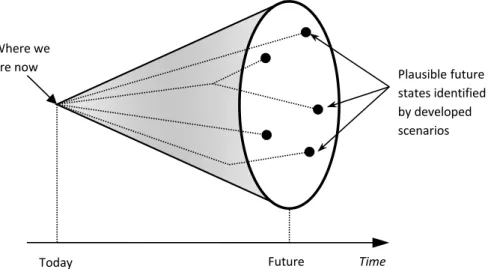
Scenarios are a set of descriptions of coherent, possible and plausible future situations and how those situations might evolve out of present-day conditions. They are not predictions, but rather the set of descriptions or stories provide the overall scope or bounds of the uncertain and complex outlook, as illustrated by the scenario funnel depiction of Timpe & Scheepers (2003) in Figure 1. Scenarios are most effective in conditions characterised by future uncertainty, unpredictability and complexity (Schoemaker (1991). They help organisations make sense of the future and develop appropriate action plans.
Figure 1 - Scenario funnel (Timpe & Scheepers, 2003)
Within this context, scenarios are able to act as a catalyst for creativity and innovation. De Smedt et al. (2013),
demonstrated how scenarios help inspire actions and structures that can be used to mobilise and orientate science and technology to respond to ‘grand challenges’. A seminal illustration of such in the corporate context was its application at Royal Dutch Shell, helping the organisation cope with the oil shock and uncertain events the late 1970s and emerge from them in a much better shape than its competitors (Schoemaker & van der Heidjen, 1992).
2.2.1 Scenario building process
The methods for developing scenarios are classified into two broad types:
- Probability-based methods, using quantitative approaches (Bradfield et al., 2005)
- Intuitive logics method, using qualitative approaches (Millett, 2003)
There are two widely recognised probability-based methods – trend-impact analysis (TIA) and cross-impact analysis (CIA). Both involve assigning probabilities to express the likelihood of occurrence of events. This family of approaches was not applied in this study, and so will not be discussed further here.
Plausible future states identified by developed scenarios
Today Future Time
Where we are now
5
The intuitive logics method develops scenarios based on the intuition and logical perspective of the planners. This method was popularised by Royal Dutch Shell (Kleiner, 1996), assuming decisions are influenced by the interaction of social, technological, economic, environmental, political, legal and ethical (STEEPLE) factors in the macro-environment. While variations exist, the core of this family of approaches remains the same. This
core is the definition and application of the scenario logics – the organising themes that provide the scenarios
with their consistent and rational basis.
The main steps of the approach according to Schwartz (1991) are:
- Identify and understand the focal issue and strategic concerns
- Identify key factors and stakeholders in the local environment
- Identify the key STEEPLE factors
- Analyse the environmental factors and rank them by importance and uncertainty
- Select scenario logics (axes) from the most important and uncertain factors and plausible end points
- Flesh out the scenarios, with storylines and characteristics.
Sections 3.2 to 3.4 provide greater detail on how these steps have been followed in the workshop process described in this paper.
2.2.2 Using scenarios in planning
The specific manner in which scenarios are applied is summed up by Wright et al. (2013) based on views across
literature, and this relates to how it catalyses innovation:
- Enhancing understanding of causal processes, logical sequences and, as a result, how a future state of
the world may unfold, thus opening the eyes in new ways to new opportunities
- Challenging conventional thinking to reframe perceptions and mindsets, and thus breaking cognitive
boundaries
- Improving decision making and informing innovation strategy.
Wright et al. (2013) suggested extensions to the Schwartz approach and one of them, is the use of dialectical
inquiry to critique and flesh out the scenarios. The purpose of using dialectical inquiry is to introduce debate and enrich the discussion around the scenarios and their implications. In applying dialectical inquiry, the group developing and applying the scenarios is broken into four sub-groups. Once the scenario logics are identified, each scenario is fleshed out by one of the subgroups. Each subgroup develops implications for their assigned scenario, and subsequently all the groups later come together to critique and debate the implications of the three other scenarios. This approach (of breaking into subgroups) is followed in the workshop process described in Section 3.2.
The drawing up of implications of scenarios for the purpose of decision making or strategic planning is not as widely discussed in the literature as the well-defiined processes for building scenarios. Nevertheless, the structured scenario building process needs to be followed by other well-structured processes that can translate the outputs of scenario building into decisions. Ringland (2002) described the strategy formulation method of
SCMI, and Ringland et al. (2010) suggested a number of tools for generating and comparing strategic options.
One such method is roadmapping, which can readily assimilate the outputs of a scenario building exercise, translate them into strategic options, and explore their timelines and the linkages across them.
2.3 Roadmapping
Roadmapping could be described simply as the process of creating roadmaps (Garcia & Bray, 1997), and the development of the method is generally attributed to Motorola’s application of the process in the 1970s for
supporting its product development strategy (Willyard & McClees, 1987)1. Since then, roadmapping has been
used as an important approach for strategy and foresight across companies, industries and governments.
A roadmap itself is a visual method, providing “an extended look at the future of a chosen field of inquiry
drawn from the collective knowledge and imagination of the individuals driving change in that field” (Galvin,
6
2004). Roadmaps were conventionally applied in science and technology in identifying technological solutions
in response to market demands (de Laat & McKibbin, 2003). As a result, the term technology roadmapping
has been dominant in the literature. However, Phaal et al. (2004) explained that technology is only one aspect
of the roadmapping process, and that the terms ‘strategic roadmapping’, or ‘innovation roadmapping’ may be more appropriate. This is because the association of roadmapping with technology alone limits its adoption, which may be why it is seldom included in standard management education programs or textbooks. The flexibility of the roadmapping process and roadmap structure promotes its application in various contexts
Probert et al. (2003), including its application for foresight, tracking the evolution of markets and technologies,
and providing coordination and alignment between business objectives and technology development within organisations (Lee & Park, 2005).
2.3.1 Roadmapping principles
Roadmaps seek to help organisations answer three questions:
- Where are we going?
- Where are we now?
- How can we get there? [i.e. to where we are going]
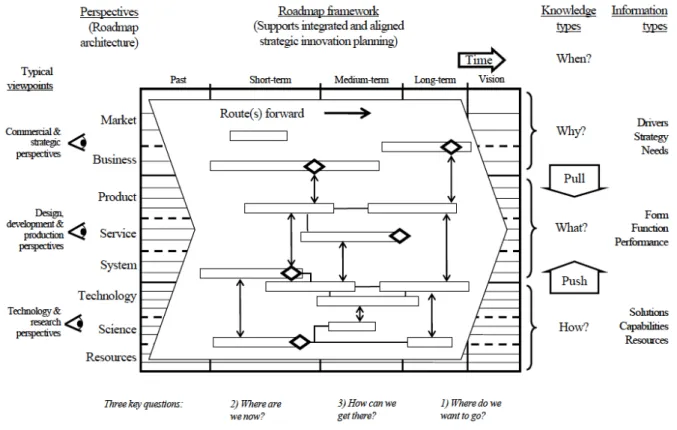
These three questions are further made explicit by a clear timeframe that is often hidden and absent in other strategy approaches. On the roadmap framework, this timeline runs along the horizontal axis (see Figure 2).
Figure 2 – Roadmap framework (Phaal & Muller, 2009)
The content or strategic perspectives included in the roadmap to help answer the above questions are typically structured into three broad categories, arranged as layers down the vertical axis (and stretching along the horizontal timeline axis in Figure 2):
- ‘Know-why’
- ‘Know-what’
- ‘Know-how’.
‘Know-why’ provides the rationale for the core strategic issue explored by the roadmap. This rationale would normally deliver an understanding or description of the future external organisational environment (perhaps in the form of future external trends and drivers) and may also include internal drivers such as organisational goals and targets. This layer normally would benefit the greatest from any clarification provided by scenarios. The
7
‘know-what’ layer is the heart of the roadmap, and it is here that the strategic issue of concern is explored and analysed. This might be in the form of value propositions such as products and services to be developed, or specific courses of action, i.e. processes, activities, systems, which are to be developed in response to in the ‘know-why’ layer. The ‘know-how’ layer carries the resources and capabilities that would be marshalled to make the value items in the ‘know-what’ layer reality.
Together, these categories, along with the timeline, create the roadmap framework (Figure 2) for the logical examination of complex issues, such as the grand challenge of ‘the future of mobility’.
2.4 Previous combinations of scenarios and roadmapping and observed shortcomings
There have been multiple instances of scenarios-roadmapping integration. The general premise of these attempts has been to combine them into an approach that maximises the strengths of the individual methods while overcoming their weaknesses. There are generally two ways in which scenarios and roadmapping might
be integrated according to Phaal et al. (2010). The first is ‘scenario-led roadmapping’, where roadmaps (often
multiple roadmaps) are developed in response to a set of scenarios, and ‘roadmapping-led scenarios’, where scenarios are used to test the validity of a roadmap. Both these integration modes fall under the ‘improving
decision making and informing innovation strategy’ purpose of scenario application identified by Wright et al.
(2013) (see Section 2.2.2).
There are both conceptual and practical scenario-roadmapping integrations available through the literature. Strauss & Radnor (2004) proposed a 14-step conceptual process, called multi-scenario roadmapping, developed to improve the ability of roadmapping to cope with dynamic and uncertain environments. In this scenario-led roadmapping process ‘flex points’, ‘windows’, and ‘forks’ would be clearly identifiable and trackable on the final roadmap. These flex points are indicative of flexibility and transition possibilities and options between multiple strategic decision pathways. Lizaso & Reger (2004) developed another (6-step) conceptual scenario-led roadmapping process, with the benefit of helping managers acquire useful information and awareness of
the future and potential contingencies to keep in mind and prepare for. Ilevbare et al. (2010) also defined a
9-step integration of scenario planning and roadmapping with the inclusion of real options thinking, which was included to provide a structured means of managing the various strategic options that emerge from the scenario-roadmapping combination. The obvious shortcomings of these processes are that they are conceptual proposals, and are not known to have not been tested and proven in real-life strategic challenges.
Most known practical cases of scenario-roadmapping integration are at the industry rather than corporate level (which tend to be highly confidential). In a study of scenario applications in roadmapping by Ilevbare (2017), all 11 cases of scenario-roadmapping combination identified were carried out at either a sectoral or national
level. Similarly, analysis of scenario-roadmapping instances by Cheng et al. (2016) identified 11 practical
cases, of which 10 were carried out at industry level. Nevertheless, examples of organisational level (or
corporate) application are found in Passey et al. (2006),and Abe et al., (2009), and more recently in Lee et al.
(2015), Cheng et al. (2016) and Hussain et al. (2017).
Regarding the practical cases, Hussain et al. (2017) indicated the following shortcomings in the methodologies:
- only a partial use of the scenario development method, e.g. in the case of Abe et al. (2009), and
- insufficient guidance on how to build and integrate scenarios within the intervention, or the
non-generalisability of the methodologies used, e.g. in Passey et al. (2006).
While attempting to overcome these shortcomings, the method proposed by Hussain et al. (2017) is not, by any
means, without its own deficiencies. A critical one is the practicality of the approach, given that its application took 16 months – a length of time that is vastly beyond the available resource and attention span of many
organisations. Both the approach of Cheng et al. (2016) and Lee et al. (2015) are very detailed, with the latter
making use of Bayesian network modelling. These approaches most likely require a significant amount of time
and a high level of sophistication to complete. Abe et al. (2009), records a 3-month application period, which
is still a considerable amount of time. The time-intensiveness of these methodologies will, from the experience of the authors, act as significant deterrent to their adoption by most organisations. There is also the danger that by the time the process is completed the environmental and business conditions have shifted – a more efficient agile approach is required. In addition, and perhaps not unrelated to the time-intensiveness, is that these approaches may, as a matter-of-fact, be regarded as semi-conceptual, given that their respective applications
8
all appear to be initial case studies to test the respective researchers’ integration ideas. It is often the case that such procedures require further testing before they are fully ready for real-world deployment (Platts, 1993). The approach discussed in this paper is one that has been delivered under real-life conditions and is needs-driven rather than ‘researcher-pushed’. The approach was developed based on well-researched principles for developing industrially-relevant management toolkits.
3. Designing and running the workshop
3.1 Guiding principles for developing the scenario-roadmapping combination
To ensure that the scenario-roadmapping combination followed best practice, we developed the process
following the principles set out by Kerr et al. (2013) for developing strategic technology management toolkits
and processes that are relevant, useful and can be implemented within organisational systems. These principles are as follows:
- Human-centric: the process should provide an opportunity for individuals to collaborate with one another to deliver a co-created solution. This principle fosters the identification and integration of different viewpoints and knowledge, which leads to the creation of new knowledge (Nonaka, 1994). - Workshop-based: this is the recommended mode for deploying a process and engaging multiple
individuals and stakeholders in the process, and fostering group interaction.
- Neutrally facilitated: the workshops should be facilitated from a neutral point of view. The facilitator should not be involved in the content on the discussion. Rather, the facilitator should focus on the smooth running of the procedures to enable stakeholders have meaningful discussion. A key part of the facilitator’s role is to ensure the tools, templates or charts applied during the workshop are properly designed and well-structured.
- Lightly processed: tools and processes used within the workshop should be applied in a light-weight manner as much as possible. This key premise behind this is that strategy tools and processes should drive conversation, as this is considered fundamental to strategy-making.
- Modular: the process should be built from individual tools, where each one serves a distinct function, such that the process can be broken down, reconfigured and recombined, to suite the particular needs or deliver the particular outputs desired by the user.
- Scalable: the tools should allow usage at different levels within an organisation, such that it lends itself to multiple levels of organisational complexity and analysis
- Visual: the tools should have a visual form in application and output. The visual aspect both a powerful enabler of the planning process, and can also facilitate effective communication of outputs (Eppler & Platts, 2009)
3.2 The process tailored to the objectives
The above principles were used as guidelines to create useful and relevant combination of scenarios and roadmapping in workshop format to meet the objectives described in Section 1.1.
3.2.1 Preparation: pre-workshop
In order to capture insights into how transport might develop in Europe by 2040, we invited world-leading experts from diverse backgrounds. They included engineers and transport experts from the University of Cambridge and other academic institutions in the BP network. Others were from think tanks across Europe. We also engaged a number of futurists.We considered the time of these participants to be extremely valuable and therefore needed to make best use of their expertise and intellect. As such, they were briefed before the workshop with a collection of prompts to prepare them for the workshop discussions.
In addition, before the workshop, two steps of Schwartz’s (1991) scenario building process were completed:
- Identify and understand the focal issue and strategic concerns: the key question was “what mobility
might look like in Europe by 2040 for both people and goods” and in particular which emerging technologies maybe important in the future. This was clarified with the company
- Identify key factors and stakeholders in the local environment: the importance of the range and quality
9
3.2.2 The workshop process
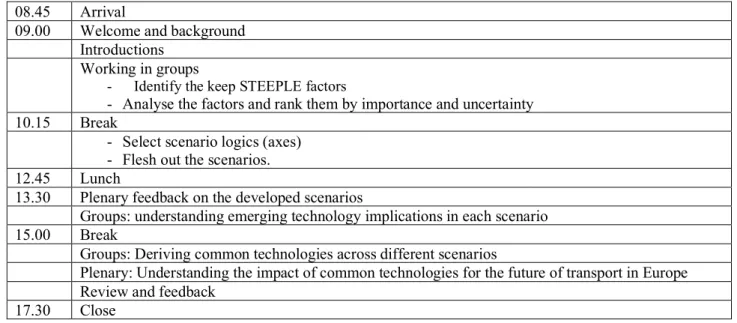
The workshop process was carried out in a day. The proceedings are summarised by the agenda followed as shown in Table 1. The workshop was organised so that much of the discussion was in groups of 4 to 6 participants from different backgrounds, with a total of four groups. Discussions were facilitated by neutral facilitators aided by specially designed (and pre-printed) templates, which were used to drive discussions within and across groups and capture outputs of those discussions. The combination of facilitation and pre-designed templates enabled time-efficiency of discussions.
08.45 Arrival
09.00 Welcome and background
Introductions Working in groups
- Identify the keep STEEPLE factors
- Analyse the factors and rank them by importance and uncertainty
10.15 Break
- Select scenario logics (axes)
- Flesh out the scenarios.
12.45 Lunch
13.30 Plenary feedback on the developed scenarios
Groups: understanding emerging technology implications in each scenario
15.00 Break
Groups: Deriving common technologies across different scenarios
Plenary: Understanding the impact of common technologies for the future of transport in Europe Review and feedback
17.30 Close
Table 1 – Workshop agenda
As can be seen from the agenda, the morning sessions focused on completeing Shwartz’s (1991) steps for scenario building (resulting in the development of four scenarios):
- Identify the key STEEPLE factors
- Analyse the factors and rank them by importance and uncertainty
- Select scenario logics (axes)
- Flesh out the scenarios, with storylines and characteristics.
In the afternoon (following Wright et al’s (2013) dialectical inquiry approach), each of the four groups adopted a scenario to understand its implications for emerging technologies. Each group then reviewed the other three groups’ implications to highlight common technologies across scenarios. Afterwards, in a plenary session, all groups discussed the impact of the common technologies for the future of transport in Europe,
Identifying the STEEPLE factors
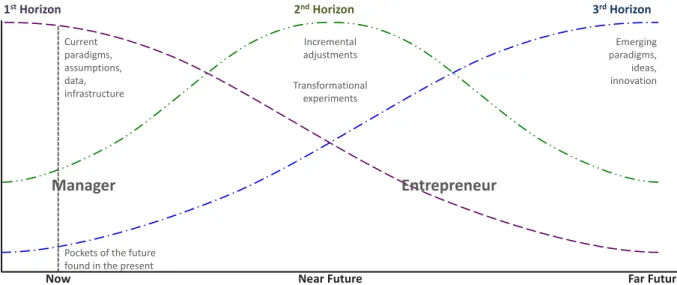
To idenitfy the most important factors (i.e. drivers of change) that will shape transport in Europe by 2040, the discussion was structured using a Three Horizons approach (Sharpe, 2013) – see Figure 3. Each group brainstormed STEEPLE factors that would change transport, noting whether they were societal, technological, economic, environmental, political, legal or ethical, and described them in terms of Horizon 1, 2 or 3. These horizons are generally characterised as follows:
- Horizon 1 drivers of change, which are presently being experienced – managers ought to be building
these into their strategy as part of ‘business as usual’
- Horizon 2 drivers of change, which we can see now are going to have an effect but do not yet how
know the full impact will play out – entrepreneurs are planning how to take advantage of potential improvements on current system
- Horizon 3 drivers of change, which are not yet forecastable but early signs are appearing, maybe as
10
Figure 3 – Three Horizons (adapted from Sharpe, 2013)
The results of the brainstorm were captured on sticky notes and placed on a large Three Horizons wall chart. A rich range of drivers about mobility up to year 2040 was generated. These included air pollution and climate change, which are typically expected from the oil and gas sector, as well as more obscure ones such as data ownership and interconnectivity of assets.
Ranking the factors and deriving scenario axes
To deliver the workshop in a time-efficient manner, only Horizon 3 drivers of change were focused on to identify and choose factors that were most important and uncertain. These drivers of change were dominated by social and economic questions, even though they also ranged across a number of technological issues. The questions were clustered into two broad questions:
- Is governance local or centralised?
- Is mobility paid for at the point of use or does everybody pay (e.g. through taxation, a national mobility
service etc.)?
These questions offered challenging but plausible endpoints that could serve as the scenario axes. The four
scenarios that emerged from the extremes of these two axes are shown in Figure 4.
Centralised governance
Pay at the point of use
Scenario A: Bus pass
Governments or big corporates are at the centre of decision-making and policy formation.
Poor people benefit if governments make decisions; wealthy people benefit if corporates make decisions.
Scenario D: Scarce mobility
People travel only when necessary. Air and water pollution improves, and there is better utilisation of space and assets. There is time optimisation using advanced technologies such as artificial intelligence.
Everybody pays
Scenario B: Fruber
A community transport model, Fruber, where every citizen gets a universal basic service provision of travel.
Scenario C: Chauffeur
GPS chips will be used for both individuals and transport modules to track road/city usage, and pay per centimetres used. There will be micro-charging for road use in cities.
Local governance
Figure 4 – Mobility 2040 scenarios
1stHorizon 2ndHorizon 3rdHorizon
Current paradigms, assumptions, data, infrastructure Incremental adjustments Transformational experiments Emerging paradigms, ideas, innovation
Pockets of the future found in the present
Now Near Future Far Future
11
Fleshing out the scenarios, the storylines and their characteristics
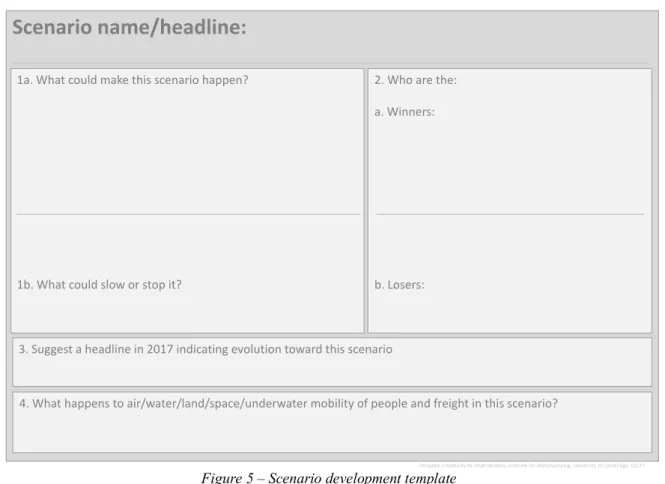
Each of the groups adopted a scenario and used a template (shown in Figure 5) to develop the storyline. This template helped participants elaborate and describe their particular scenario, identify the different key players within it, agree on indicators e.g. ‘headlines’ that could show the realisation of this scenario and explore the
implications for the topic in question, namely “what mobility might look like in Europe by 2040 for both people
and goods (i.e. freight)”.
Figure 5 – Scenario development template Decision-making based on developed scenarios - using roadmapping
Discussions to identify highest priority emerging technologies and their and their development and adoption by 2040 (based on the scenarios) were approached as follows:
1. Identify the functionalities and performance characteristics for each dominant mobility option of each
scenario.
2. Derive the key technologies required to deliver the main mobility system functionality for each
scenario.
3. Assess the impact and probability of each key technology across all different scenarios.
4. Identify technologies that are expected to have a large impact across scenarios and indicators for
monitoring their adoption by the mobility sector.
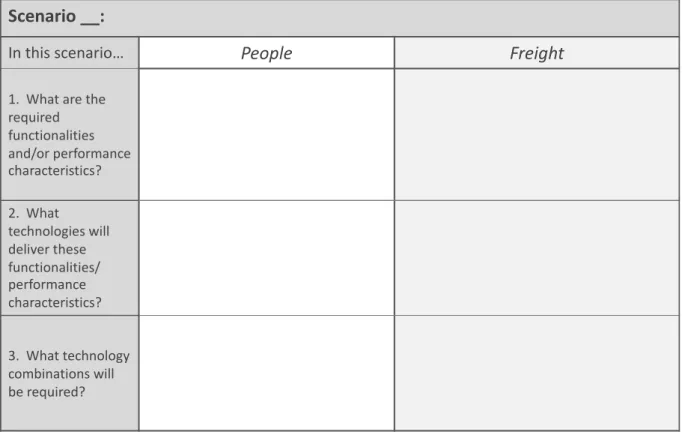
The template (shown in Figure 6) is a modified roadmap template exploring only the long-term timeframe examined by the scenarios, (i.e. ~ 2040). It links the outputs from the final question in the scenario development
template (Figure 5): “what happens to air/water/land/space/underwater mobility of people and freight in this
scenario” with a other strategic perspectives. Figure 6, taken together with the last part of Figure 5, can be seen as a simplified version of the generic roadmap template (Figure 2). The ‘know why’ perspectives are supplied by responses to the final question in the scenario template, and the ‘know-what’ and ‘know-why’ perpsectives are supplied by responses to Figure 6’s first question and second (including the third) question, i.e. the desired functionalities and system performance characteristics, and the technologies and/or combinations of technologies required to deliver those functionalities) respectively. As such, this simplified template (Figure 6) applies key roadmapping principles outlined in Section 2.3.1 by linking multiple strategic perspectives over a determined timeframe.
Template created by Dr.Imoh Ilevbare, Institute for Manufacturing, University of Cambridge. 02/17
Scenario name/headline:
2. Who are the: a. Winners:
b. Losers: 1a. What could make this scenario happen?
1b. What could slow or stop it?
3. Suggest a headline in 2017 indicating evolution toward this scenario
12
Elaborating the behavior of the future mobility system through its expected future functionality is of particular importance as a means of value exchange between different actors and stakeholders. Specific system functionality examples used during the workshop to aid the participants were ‘traffic efficiency; safety, social inclusion and land use; pollution reduction; business model’. Each scenario group identified several technologies of interest and agreed on the five most important technologies for their specific scenario.
Figure 6 – Modified roadmapping template to assist with convergence of different ideas
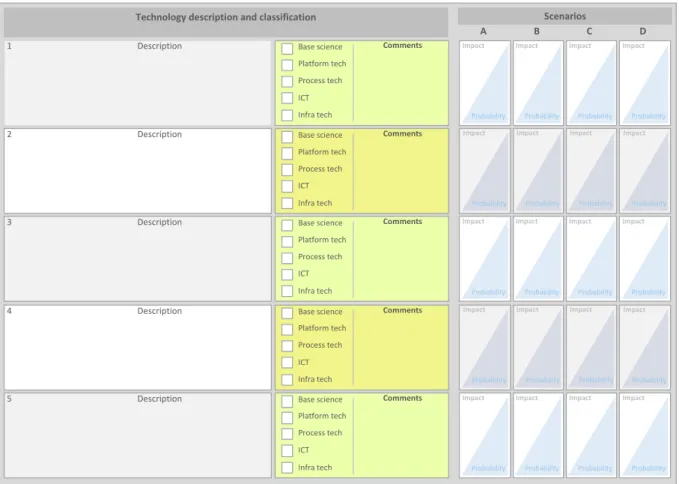
Each of the five key technologies identified from each scenario was then assessed across all different scenarios in terms of its potential impact and probability of realisation using a Likert scale of -3 to +3 for negative to positive impact and 1 to 3 for low to high probability. This was carried out using the template showin in Figure 7. This technique allowed the workshop participants to identify the seven technologies considered relevant across the scenarios and therefore most important for the future mobility sector.
Discussions that followed in a plenary session focused on understanding how these highest priority technologies could be developed and adopted by 2040 within the European transport sector. Specific indicators for monitoring their adoption and/or integration were also idenitified and discussed.
Scenario __:
In this scenario…
People
Freight
1. What are the required functionalities and/or performance characteristics? 2. What technologies will deliver these functionalities/ performance characteristics? 3. What technology combinations will be required?
13
Figure 7 – Template to assess the potential impact and probability of realisation of the most important common technologies identified across each scenario.
4. Insights and lessons learned 4.1 Outcomes
The process helped the participants identify over 20 unique features of the potential future mobility systems and derive collectively over 30 divergent and emerging technologies, ranging from harnessing (human) kinetic energy and night vision to electrified highways.
Several key insights were elicited. These include the increasing power that new entrant companies into the mobility sector (e.g. Amazon/Uber), the development and implementation of self-organising mobility solutions, the access and use of the diverse data generated by the digitalisation of transport from the passengers and freight as well as the vehicle, and the importance of data management capabilities (access, analyzing, visualizing, etc.) for any organisation operating within the transport sector. The role that smart cities are anticipated to play in the future of transport was also identified to be particularly important especially in India and China, where smart city initiatives are seen as an important basis for sustainable urbanisation, poverty alleviation, employment generation and a focus for national innovation capability.
The future transport service providers are likely to be diverse, include many niche players that cater for different customer segments, such as lowest costs, shortest timescales or greatest privacy and luxury With portable technology advancing rapidly, being able to link via any transport vehicle rather than IT being built into a single vehicle is more likely. Importantly, this diversity will include the introduction of solutions for freight, which may have been dismissed for passengers.
4.2 Limitations of a one-day workshop
Identifying common technologies
1 Description Base science
Platform tech Process tech Infra tech ICT Comments Impact Probability Impact Probability Impact Probability Impact Probability
2 Description Base science
Platform tech Process tech Infra tech ICT Comments Impact Probability Impact Probability Impact Probability Impact Probability
3 Description Base science
Platform tech Process tech Infra tech ICT Comments Impact Probability Impact Probability Impact Probability Impact Probability
4 Description Base science
Platform tech Process tech Infra tech ICT Comments Impact Probability Impact Probability Impact Probability Impact Probability
5 Description Base science
Platform tech Process tech Infra tech ICT Comments Impact Probability Impact Probability Impact Probability Impact Probability Scenarios A B C D
Technology description and classification
14
The workshop provided a coordinated way to transition from very divergent thinking (enabled via the scenario development), into commonly agreed key and important themes (enabled via application of roadmapping principles). It helped derive new insights on the emerging technologies that would play a critical role in the future in the mobility sector in Europe. The workshop provided a practical framework to bring together very diverse and different ideas from multiple perspectives and sectors. Essential to its success were four factors:
- Pre workshop preparation, including briefing materials, selection of participants, design of process and
templates.
- Efficient workshop process completed in one day, which was all the time that could be asked of senior
participants, in which we found that many insights and new thoughts could be generated. However, we were conscious that we had taken about 20% of the time often taken for this type of process and thinking, and that we had perhaps elicited 80% of the potential insights.
- This was tested through follow up interviews which allowed participants to draw out deeper insights
after the event, and captured these ideas too.
- The very rich set of factors brainstormed in the Three Horizons was not ordered during the day, but
taken away and structured by the BP team: it would have been a waste to lose these.
4.3 Using templates for scenario description
Templates are widely used in roadmapping, but are more foreign in the scenario process. Their use for scenario descriptions (Figure 5) was critical in generating consistency in data collection between different groups and enabling cross-referencing of ideas between different groups. This allowed groups to quickly understand what other groups had developed.
4.4 Conclusions and further work
First, the integrated process worked – the BP team gained new insights on emerging technologies from the outcomes, and also from the Three Horizons brainstorm that threw up outliers as well as factors that emerged in the top twenty.
Second, in repeating the workshop process with a similar aim, group and scope, we would try to brainstorm drivers of change in Three Horizons before the one-day workshop (pehaps prior to a dinner event that will bring participants together the day before), so that the facilitators could structure and cluster ideas for use in preparation for the workshop. Extending the workshop to two part-days, while more of a time commitment for participants, is expected to have considerable process benefits.
Finally, in a time of uncertainty, the ability to discuss potential futures in a time- and resource-efficient manner is of increasing importance.
5 References
Abe, H., Ashiki, T., Suzuki, A., Jinno, F., & Sakuma, H. (2009). Integrating business modeling and
roadmapping methods–The Innovation Support Technology (IST) approach. Technological Forecasting
and Social Change, 76(1), 80-90.
Beeton, D. A. (2007). Exploratory roadmapping for sector foresight (Doctoral dissertation, University of
Cambridge).
Bradfield, R., Wright, G., Burt, G., Cairns, G., & Van Der Heijden, K. (2005). The origins and evolution of
scenario techniques in long range business planning. Futures, 37(8), 795-812.
Bray, O. H., & Garcia, M. L. (1997). Technology roadmapping: the integration of strategic and technology
planning for competitiveness. In Innovation in Technology Management-The Key to Global Leadership.
PICMET'97: Portland International Conference on Management and Technology (pp. 25-28). IEEE. Cheng, M. N., Wong, J. W., Cheung, C. F., & Leung, K. H. (2016). A scenario-based roadmapping method
for strategic planning and forecasting: A case study in a testing, inspection and certification
company. Technological forecasting and social change, 111, 44-62.
15
Stark S. (1961) Executive fresight; definitions, illustrations, importance. The Journal of Business 36(1),
31-44.
de Laat, B., & McKibbin, S. (2003). The Effectiveness of Technology Road Mapping: Building a Strategic
Vision. Dutch Ministry of Economic Affairs.
De Smedt, P., Borch, K., & Fuller, T. (2013). Future scenarios to inspire innovation. Technological
forecasting and social change, 80(3), 432-443.
Eppler, M. J., & Platts, K.W. (2009). Visual Strategizing – The systematic use of visualization in the
strategic-planning process. Long Range Planning, 42, 42-74.
Fayol, H. (1949). General and Industrial Management. London: Pitman Publishing Corp. (original publication
date 1916), cited by Stark S. (1961) Executive foresight; definitions, illustrations, importance. The
Journal of Business 36(1), 31-44.
Galvin, R. (2004). "Roadmapping—a practitioner's update." Technological Forecasting and Social
Change 71 (1-2), 101-103.
Gordon, T. J., & Glenn, J. C. (2004). Integration, Comparisons, and Frontier of Futures Research Methods.
Paper presented at the EU-US Seminar: New Technology Foresight, Forecasting & Assessment Methods.
Hussain, M., Tapinos, E., & Knight, L. (2017). Scenario-driven roadmapping for technology
foresight. Technological Forecasting and Social Change, 124, 160-177.
Irvine, J., & Martin, B. R. (1984). Foresight in science: Picking the winners. London: Pinter.
Ilevbare, I. M., Probert, D., & Phaal, R. (2010). Strategic planning for uncertain futures: a framework
integrating scenario planning, roadmapping, and options thinking. In Proceedings of the R&D
Management Conference, Manchester, United Kingdom.
Ilevbare, I. M. (2017). An examination of the role and practical application of scenarios within strategic planning. R&D Management Conference, Leuven, Belgium. July 2017.
Kerr, C., Farrukh, C., Phaal, R., & Probert, D. (2013). Key principles for developing industrially relevant
strategic technology management toolkits. Technological Forecasting and Social Change, 80(6),
1050-1070.
Kleiner, Art, (1996), The Age of the Heretics, Doubleday
Lee, S., & Park, Y. (2005). Customization of technology roadmaps according to roadmapping purposes:
Overall process and detailed modules. Technological Forecasting and Social Change, 72(5), 567-583.
Lee, C., Song, B., & Park, Y. (2015). An instrument for scenario-based technology roadmapping: How to
assess the impacts of future changes on organisational plans. Technological Forecasting and Social
Change, 90, 285-301.
Lizaso, R., & Reger, G. (2004). Scenario-based Roadmapping – A conceptual view. Paper presented at the EU-US Scientific Seminar of New Technology Foresight, Forecasting & Assessment Methods.
Martin, B. R. (1995). Foresight in science and technology. Technology analysis & strategic
management, 7(2), 139-168.
Millett, S. M. (2003). The future of scenarios: challenges ad opportunities. Strategy & Leadeship, 31(2),
16-24.
Nonaka, I. (1994). Dynamic theory of organisational knowledge creation. Organization Science, 5 (1), 14-37
Öner, M. A., & Beşer, S. G. (2011). Assessment of corporate foresight project results: case of a multinational
company in Turkey. Foresight, 13(2), 49-63.
Passey, S. J., Goh, N., & Kil, P. (2006, June). Targeting the innovation roadmap event horizon: Product
concept visioning & scenario building. In Management of Innovation and Technology, 2006 IEEE
International Conference on (Vol. 2, pp. 604-607). IEEE.
Phaal, R., Farrukh, C.J.P. and Probert, D.R. (2001), “T-Plan: The fast start to Technology roadmapping - planning your route to success.” ISBN 978-1-902546-09
Phaal, R., Farrukh, C.J.P. and Probert, D.R. (2004), ‘Customizing roadmapping’, Research-Technology
Management, 47(2), 26-37.
Phaal, R., Farrukh, C. J. P., & Probert, D. R. (2007). Strategic Roadmapping: A Workshopbased Approach for Identifying and Exploring Strategic Issues and Opportunities. Engineering Management Journal, 19(1), 3-12.
Phaal, R., Farrukh, C., & Probert, D. (2010). Roadmapping for Strategy and Innovation: Aligning technology and markets in a dynamic world. Cambridge: Institute of Manufacturing, University of Cambridge. Phaal, R. and Muller, G. (2009), ‘An architectural framework for roadmapping: towards visual strategy’,
Technological Forecasting & Social Change, 76(1), 39-49.
16
Porter, A. L. (2010). Technology foresight: Types and Methods. Int. J. Foresight and Innovation Policy, 6
(1-3), 36-45.
Porter, A. L. et al (Technology Futures Analysis Methods Working Group) (2004). Technology futures
analysis: Toward integration of the field and new methods. Technological Forecasting & Social Change,
71, 287-303.
Ringland, Gill (2002), Scenarios in Business, John Wiley
Ringland, Gill (2006), Scenario Planning, republished by Choir Press in 2014
Ringland, G. (2010). The role of scenarios in strategic foresight. Technological Forecasting and Social
Change, 77(9), 1493-1498.
Ringland, Gill et al (2010) Beyond Crisis, John Wiley
Schoemaker, P. J. (1991). When and how to use scenario planning: a heuristic approach with
illustration. Journal of forecasting, 10(6), 549-564.
Schoemaker, P. J., & van der Heijden, C. A. (1992). Integrating scenarios into strategic planning at Royal
Dutch/Shell. Planning Review, 20(3), 41-46.
Schoemaker, P. J. H. (1993). Multiple Scenario Development: Its Conceptual and Behavioural Foundation.
Strategic Management Journal, 14 193-213
Schwartz, P. (1991). The Art of the Long View – Planning for the Futur ein an Uncertain World: Currency Doubleday.
Sharpe, B. (2013). Three Horizons: the patterning of hope. Triarchy Press.
Strauss, J. D., & Radnor, M. (2004). Roadmapping for dynamic and uncertain environments.
Research-Technology Management, 47(2), 51-58.
Timpe, C., & Scheepers, M. J. J. (2003). A look into the future: Scenarios for distributed generation in Europe:
Energy research Centre of the Netherlands (ECN).
Wilson, I. (2000). From Scenario Thinking to Strategic Action. Technological Forecasting & Social Change,
65, 23-29.
Willyard, C. H., & McClees, C. W. (1987). Motorola's technology roadmap process. Research
management, 30(5), 13-19.
Wright, G., Bradfield, R., & Cairns, G. (2013). Does the intuitive logics method–and its recent
enhancements–produce “effective” scenarios? Technological Forecasting and Social Change, 80(4),