ARCHITECTURAL SITE INTIMACY
NURTURING THE RELATIONSHIP
BETWEEN ARCHITECTURE, HUMANS AND LAND
A DARCH PROJECT SUBMITTED TO THE GRADUATE DIVISION OF THE UNIVERSITY OF HAWAI‘I AT MĀNOA IN PARTIAL FULFILLMENT OF THE
REQUIREMENTS FOR THE DEGREE OF DOCTOR OF ARCHITECTURE
MAY 2015
By: Dane M. Teves
DArch Project Committee: Spencer Leineweber, Chairperson
Judith Stilgenbauer Jonathan Ching
Keywords:
DEDICATION
This degree is dedicated to my grandfather, Rudy Brilhante. Architecture was one of his many passions, along with sports, poetry, history, painting, Hawai‘i, Bani (my grandmother) and God. He lived a life of influence. He instilled in me commitment, confidence, respect and a love for seeking knowledge. I am grateful to fulfill his dream of architecture, and live in his legacy.
ACKNOWLEDGEMENTS
There is hardly anything that could bring more joy and love into my life than my family. I want to thank my family for all their prayers; you embedded the fire in me to strive for success.
Mahalo nui loa to my mentors who took me in and treated me like family. I am forever thankful for everything you taught me. You shared with me your knowledge, and I now humbly stand beside you. Jonathan Ching, Kamakana Ferreira,
Ma Ry Kim Johnson, ‘Anakala Ike Ka‘aihue, Blake “Brutus” La Benz, Spencer Leineweber, Ikaika Nakahashi, Judith Stilgenbauer and Kaiwi Nui Yoon.
My heart felt gratitude to the leaders of industry in Hawai‘i; you took time out of your schedule to be interviewed. Rick Barbosa, Daniel Chun, Rueben Chock, Sam ‘Ohukani‘ōhi‘a Gon, Ray Higa, Malia Ka‘aihue, Francis Oda.
ABSTRACT
Indigenous thought process can influence current trends of creative problem solving via architecture and landscape design. This doctoral project contextualizes a method of design, as a way to address a global paradigm shift in understanding the relationship between God, land and humans. “Architectural Site Intimacy,” enables a design (especially at significant sites) the opportunity to connect visitors physically, spiritually and intellectually to the place and to God. Blending traditional and contemporary knowledge, both story and science, allows for social, physical and psychological benefits. By connecting to place, culture and history; I developed a framework to increase human awareness of the natural environment through architectural design. The experience I gained included working with the community in participatory planning, and then incorporating the community input by integrating cultural concepts in a design.
“The Mamo Process” is a methodology which uses Hawaiian culture and site understanding to enable a meaningful connection between man and nature through architecture. This creates a meaningful interaction between the place, culture, and history that gives back to the place in a way that respects its’ past and transmits it to the future; with authentic cultural representation. By focusing on different realms, including the earth below and the heavens above, the cultural relationship between man and place is fully realized.
By establishing a base of cultural influences and incorporating trans-cultural values of such as pono (righteous) and lōkahi (balance), we can reach interconnectivity between sea, land, people, and sky. The end objective is to harmoniously tune the different realms of influence through the power of design.
The designer’s kuleana is to bring together the best practices of traditional and contemporary design strategies to choreograph an architectural environment and landscape that encourages a culturally appropriate experience. The design aims to educate visitors about the site mo‘olelo. The design for the Kūkaniloko Center of Culture is part of a greater cultural revival initiative.
TABLE OF CONTENTS
ACKNOWLEDGEMENTS ... III
ABSTRACT ... IV
TABLE OF FIGURES ... X
PREFACE:SCIENCE AND STORY ... XII
CHAPTER 1:HAWAI‘I HUMAN TO LAND RELATIONSHIP ... 1
1.0HAWAI‘I ENVIRONMENT ... 1
1.0.1GEOGRAPHIC LOCATION ... 1
1.0.2PELE ... 2
1.0.3WATER SOURCE AND AQUIFERS ... 3
1.1KĀNĀWAI AS LAW ... 4
1.1.1VULNERABILITY OF ECOLOGY ... 5
1.2HISTORY OF HAWAIIAN RELATIONSHIP WITH LAND AND VOYAGING ... 5
1.2.1ISLAND MIGRATION PATTERNS ... 7
1.2.2PLANTS:PHYSICAL AND PSYCHOLOGICAL STRENGTH ... 8
1.2.3KUMULIPO:GENEALOGICAL CONNECTION TO LAND ... 9
1.2.4HAWAIIAN VALUE SYSTEM ...11
1.3HAWAIIAN SOCIETY AND ECONOMY ...12
1.3.1SETTLEMENT &MANAGEMENT:COLONIZATION PERIOD (800-1100AD) ...12
1.3.2FOOD RESOURCES ...13
1.3.3PRESSURES OF POPULATION:EXPANSION PERIOD (1100-1650AD) ...14
1.3.4TECHNOLOGY ADVANCEMENT:PROTO-HISTORIC PERIOD (1650-1795AD) ...15
1.3.5GOVERNMENT COORDINATED WORKFORCE ...17
1.4TRADITIONAL HAWAIIAN SPIRITUALITY ...17
1.4.1ENO‘ONO‘O HAWAI‘I (THINK HAWAIIAN) ...18
1.4.2KUHIKUHIPU‘UONE ...19
1.4.3CELESTIAL IMPORTANCE...19
1.5‘ŌLELO MAKUAHINE (MOTHER LANGUAGE) ...20
1.5.1MEANS OF SHARING:MO‘OLELO (STORIES) ...21
1.5.2INOA (NAMES) ...21
1.6LESSONS FROM TRADITIONAL RESEARCH...22
CHAPTER 2:APPLICATION OF RELATIONSHIP IN HIERARCHICAL SETTING ...23
2.0.1HIERARCHY OF MAN ...23
2.0.2HIERARCHY OF “PLACE” IS RELEVANT TO TIME ...24
2.0.3WAHI PANA ...24
2.1APPROPRIATE LAND MANAGEMENT ...26
2.1.1NAVIGATOR IDEOLOGY ...27
2.1.2HEAVENS INFORM FORM AND FUNCTION ...27
2.1.3ASSET-BASED PLANNING ON EARTH ...29
2.2HAWAIIAN NATURAL AND ARTIFICIAL LAND DIVISIONS ...30
2.2.1MOKU ...31 2.2.2AHUPUA‘A ...31 2.3ECOLOGICAL BOUNDARIES ...33 2.3.1TOPOGRAPHICAL STRATUM ...33 2.3.2WAO AKUA ...34 2.3.3WAO KANAKA ...35
2.3.4VERTICAL SPATIAL BOUNDARIES ...36
2.4WAHI KAPU ...38
2.4.1FUNCTION ...38
2.4.2FORM ...39
2.5WORKING FACTORS IN LOCATING WAHI KAPU ...40
2.5.1PAPAHULILANI:HEAVENS (COSMIC) ...40
2.5.2VISUAL GEOGRAPHIC GEOMETRY ...40
2.5.3AO (CLOUDS) ...41
2.6PAPAHULIHONUA:EARTH ECOLOGY ...41
2.6.1MAUNA (MOUNTAINS) ...41
2.6.2UA (RAIN) ...41
2.6.3WAI (WATER) ...42
2.6.4KAHAWAI (STREAMS) ...42
2.6.5LĀ‘AU LAPA‘AU (PLANTS/MEDICINAL) ...43
2.6.6ALA HELE (ACCESS) ...43
2.6.7KAI (OCEAN) ...43
2.6.8MAKANI (WIND)/ACOUSTICS ...43
2.7LESSONS LEARNED FROM TRADITIONAL HIERARCHICAL RESEARCH ...44
3.0READDRESSING THE GLOBAL PARADIGM ...45
3.1WHY IS CULTURAL INTEGRATION IMPORTANT? ...46
3.2ANALYSIS OF CONTEMPORARY PROCESS &PHILOSOPHY ...48
3.2.1COMPANY A ...48 3.2.1.1GOALS ...48 3.2.1.2PHILOSOPHY ...48 3.2.1.3PROCESS ...48 3.2.1.4CRITIQUE ...49 3.2.2COMPANY B ...49 3.2.2.1GOALS ...49 3.2.2.2PHILOSOPHY ...50 3.2.2.3PROCESS ...51 3.2.2.4CRITIQUE ...52 3.2.3COMPANY C ...52 3.2.3.1GOALS ...52 3.2.3.2PHILOSOPHY ...53 3.2.3.2PROCESS ...55 3.2.3.5CRITIQUE ...56 3.2.4 PBR ...56 3.2.4.1GOALS ...56 3.2.4.2PHILOSOPHY ...57 3.2.4.3PROCESS ...57 3.2.4.4CRITIQUE ...58 3.2.5THE NATURE CONSERVANCY ...58 3.1.5.1GOALS +PHILOSOPHY ...58 3.2.5.2PROCESS ...59 3.2.5.3CRITIQUE ...59
3.2.6HUI KU MAOLI OLA PLANT NURSERY ...60
3.2.6.1GOALS ...60
3.2.6.2PHILOSOPHY ...60
3.2.6.3PROCESS ...61
3.2.6.4CRITIQUE ...61
CHAPTER 4:CONTEMPORARY EVIDENCE BASED SUSTAINABLE DESIGN ...64
4.0INTRO +PHILOSOPHY ...64
4.1POWER,EFFICIENCY AND INFLUENCE OF NATURE ...65
4.2SEVEN PERFORMANCE AREAS (“PETALS”) ...65
4.2.1SITE ...66 4.2.2WATER ...67 4.2.3ENERGY ...67 5.2.4HEALTH ...68 4.2.5MATERIALS ...69 4.2.6EQUITY ...69 4.2.7BEAUTY ...70
4.3LESSONS LEARNED FROM LIVING BUILDING CHALLENGE ...70
CHAPTER 5:THE “MAMO PROCESS”OUTLINE ...72
5.0“MAMO PROCESS” ...72
5.1MAMO PROCESS DESCRIPTION ...74
5.2PASSION PHASE ...76
5.2.1ESTABLISH THE VISION ...76
5.3LOGIC PHASE...77
5.3.1DETERMINING THE PURPOSE AND SIGNIFICANCE ...77
5.4ETHICS PHASE ...78 5.4.1APPLIED KULEANA ...78 5.5TRANSLATION PHASE ...79 5.5.1ENGAGEMENT ...79 5.5.2THRESHOLD ...80 5.5.3CONNECTION ...80
5.6BENEFITS:THE FRUIT OF THE MAMO PROCESS TREE ...80
5.7WAYS TO MEASURE SUCCESS ...81
6.0PASSION PHASE ...83
6.0.1ESTABLISH THE VISION ...83
6.1 LOGIC PHASE ...84
6.1.1DETERMINING THE PURPOSE AND SIGNIFICANCE ...84
6.1.2CLIENT OVERVIEW...85
6.2FORMAL SITE ANALYSIS ...85
6.2.00GENEALOGY ...86
6.2.01THE NAME:“KŪKANILOKO” AND ITS MEANING ...88
6.2.02ACOUSTICS ...89
6.2.03HEKILI (THUNDERSTORMS) ...89
6.2.04MOUNTAINS ...90
6.2.05NA LĀ‘AU (PLANTS) ...91
6.2.06VISUAL GEOGRAPHIC GEOMETRY ...92
6.2.07ACCESS ...93
6.2.08PŌHAKU (STONES) ...94
6.2.09WAI (WATER) ...96
6.2.10UA (RAIN) ...96
6.2.11MAKANI (WINDS) ...97
6.3UNDERSTAND TRADITIONAL PROGRAM ...97
6.3.1BIRTHING SITE ...97
6.3.2ASTRONOMICAL ALIGNMENTS &CONNECTIONS ...98
6.3.3CHIEFLY SCHOOL ...99
6.4CONTEMPORARY WAHI PANA ... 101
6.5CONCLUSION OF SITE LOGIC PHASE ... 103
6.6ETHICS PHASE ... 105
6.6.1APPLIED KULEANA ... 105
6.6.2DESIGN GOALS ... 106
6.7TRANSLATION PHASE (DESIGN ELEMENTS) ... 108
6.7.1ENGAGE ... 108
6.7.2THRESHOLDS ... 112
6.7.3CONNECT ... 126
WORKS CITED ... 129 APPENDICES... A1 A1:APPLICATION MATRIX ... A1 A2:VOCABULARY LIST ... A6
TABLE OF FIGURES
Figure 1: Areal perspective of O‘ahu ... 2
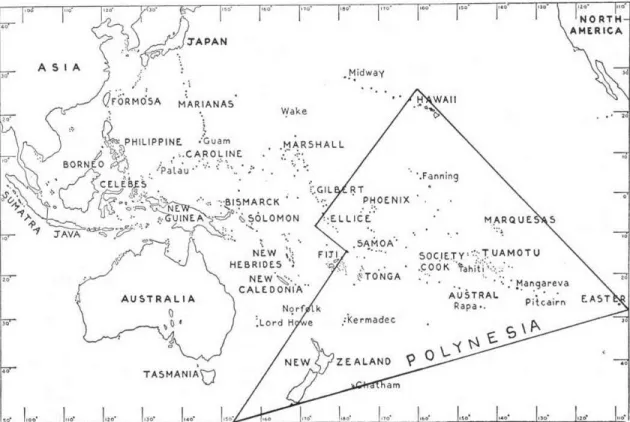
Figure 2: Map of Pacific showing Polynesian Triangle ... 7
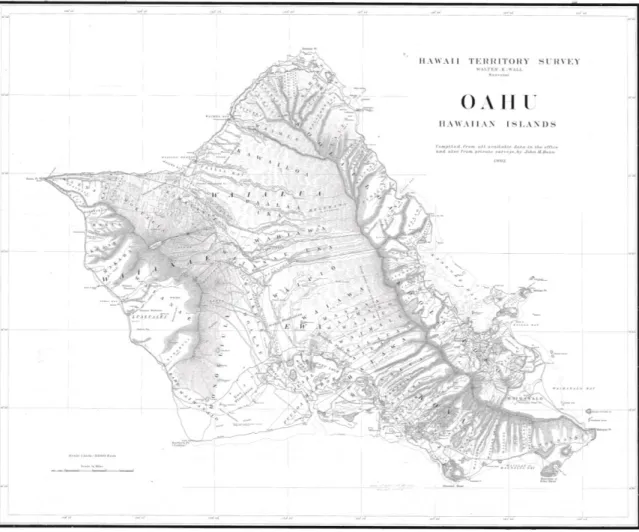
Figure 3: Hawai‘i territory map ... 30
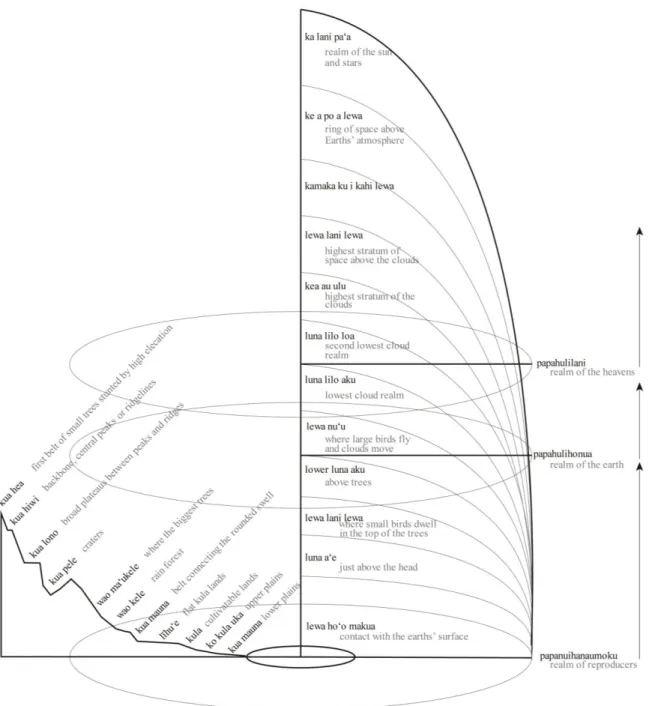
Figure 4: Spatial strata diagram ... 37
Figure 5: Black Honey Creeper; Safflower; Sergeant Fish ... 73
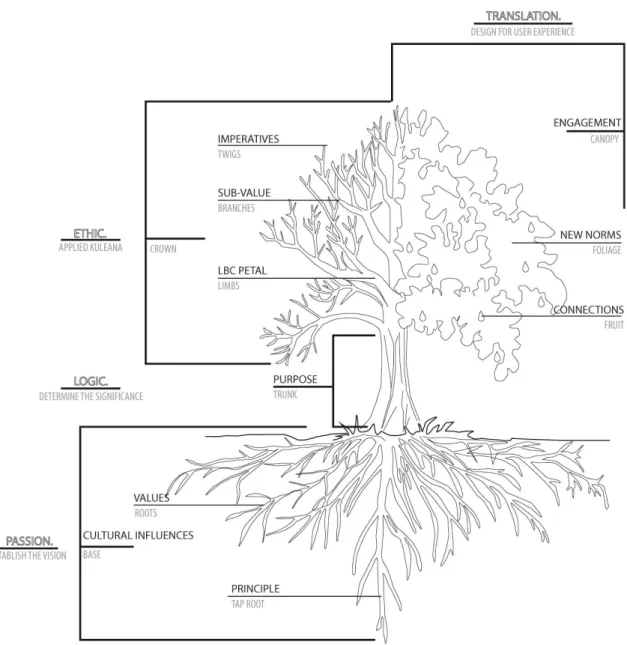
Figure 6: Author created Mamo Tree Process ... 75
Figure 7: Passion Stage of Mamo Process ... 76
Figure 8: Logic Phase ... 77
Figure 9: Ethics Phase ... 78
Figure 10: Translation Phase ... 79
Figure 11: Benefits of the Mamo Process ... 82
Figure 12: The Seed: Ho‘omana Kūkaniloko ... 83
Figure 13: Kūkaniloko is the trunk of the Mamo Tree Process ... 84
Figure 14: Historical Significance ... 86
Figure 15: O‘ahu geographic analysis ... 91
Figure 16: View of Sun location and Wai‘anae Range ... 93
Figure 17: Piko Stone ... 94
Figure 18: Keanianileihuaokalani Stone on Display in Stone Monument. ... 96
Figure 19: Cultural Boundary Map ... 101
Figure 20: Tax Map Key map of adjacent properties. ... 102
Figure 21: 500 acre property showing location of stones and significant heiau ... 103
Figure 22: Mana is found at the intersection of Akua and ‘Āina. ... 104
Figure 23: Ethics Phase: ... 105
Figure 24: Protocol Gateways ... 107
Figure 25: The different types of spaces ... 107
Figure 26: Conceptual adjacencies diagram ... 109
Figure 27: Conceptual adjacencies relative to site ... 110
Figure 28: Master Plan ... 111
Figure 29: Author created rendition of the entrance to the Wahi Kapu. ... 112
Figure 30: Author created rendition of the Commerce Area ... 113
Figure 31: Author created rendering of the Bridge, Path and Creek. ... 114
Figure 32: Conceptual Massing Diagram ... 117
Figure 33: Cultural Awareness Center Floor Plan ... 118
Figure 34: Author created Interior Perspective of the Hale Pahu. ... 119
Figure 35: Reflecting Pool used to study the Stars. ... 120
Figure 36: Distance diagram ... 121
Figure 37: Site Plan with Solar Alignments ... 122
Figure 38: Sustainability Strategies Plan. ... 123
Figure 39: Building section and site section. ... 124
Figure 40: Plan of inspiration space ... 125
‘A‘OHE PAU KE ‘IKE I KA HĀLAU HO‘OKAHI.
ALL KNOWLEDGE IS NOT TAUGHT IN THE SAME SCHOOL.
PREFACE: SCIENCE AND STORY
Hawaiian ‘ōlelo no‘eau or traditional proverbs support the development of identity as they are handed down from generation to generation. Through poetic wisdom, one can begin to understand deeper layers of meaning to, reveal unique characteristics of Hawai‘i and humanity. The ‘ōlelo no‘eau on page xi, is pertinent to numerous examples, however it is used in this dissertation as a guiding principle to incorporate traditional and contemporary evidence-based knowledge. This combines two ways of knowing in order to enable meaningful connections between man and nature through architecture in Hawai‘i.
I believe modern evidence-based understanding when combined with a cultural understanding provides a comprehensive and more authentic base for architectural design methodology. This dissertation uses Hawaiian culture and site as a mechanism for developing a (design process) methodology. Based on my research, the outcome of this process will foster:
1. The ability to create a meaningful interaction between place, culture and history;
2. Enabling of authentic cultural representation;
3. Preserving the historical story of place, landscape and building, while respectfully advancing the storyline for the future generations.
My research will first analyze traditional Hawaiian kanaka (human beings) to ‘āina (land) relationships, cultural history and ecology. The second part of this process covers interviews conducted with current industry leaders of Hawaiian cultural integration in architecture and landscape design to understand their philosophies and processes of design. Finally, I analyze contemporary global leaders in evidence based sustainable practices through a case study of the Living Building Challenge and the application of related applied sciences. Each chapter will aim to provide the views of both scientific and cultural ways of knowing.
I believe archaeology, ancient architecture, legends, and place names add a rich and fascinating dimension to historical, geological, and ecological data of the cultural
landscape.1 Perhaps greater than the individual facets of culture and landscape, is how they all function together. This defines the unique synchronicity that indigenous peoples have with their homes. This understanding is important for designers today to project cultural values into the architecture of tomorrow.
I have observed that architecture in Hawai‘i today does not provide culturally and site responsive design. The issue stems from a global paradigm shift that has disconnected itself from traditional global world views. Indigenous world views have been re-oriented according to capitalist beliefs of modern needs. Changing societies are caused by pressures of over-population, economy, society, and politics. These impacts cause a re-evaluation in beliefs that influence changes in the value construct. My work looks into how an indigenous culture can influence a contemporary planning process. This has the potential to increase the standards of design for Hawaiian legacy lands and cultural heritage landscapes. By blending traditional cultural knowledge, contemporary technology and practices, we can potentially allow for social, physical, ecological, and psychological benefits and change.
The goal of my work is to create a framework that increases humanity’s awareness of their natural environment through architectural design and land management. The Hawaiian world view supported and maintained an intimate connection to the spiritual, cultural and ecological factors of a site. Through the integration of analytical research of traditional knowledge and contemporary design methods, we can maximize our relationship with the land and all of its relevant cycles.
Planners and architects should start from a basis of cultural understanding. The site selected for this dissertation is the birthing stones of Kūkaniloko. Kūkaniloko (“the sound that resounds from within”) is known as the birthing place of many high chiefs and considered one of the most sacred sites on O‘ahu. The traditional measure of social structure and chiefly lineage was embedded in cosmology and landscape markers at Kūkaniloko. As such, Kūkaniloko has been compared by some to Stonehenge2 because of its astronomical alignments and possible function as a center for chiefly learning.
1
Edward Kanahele, A Guide to Hawaiian Archaeological Places of Interest. Bishop Museum Press. 1991, xii.
2
“Kūkaniloko –a Hawaiian Stonehenge?” accessed Jan. 7, 2015, http://www.ifa.hawaii.edu/tops/kukaniloko.html
My process can be used by architects and planners working in Hawai‘i and the Pacific. The understanding of cultural values, beliefs and their relationship to the land is very important to maintain cultural identity for Native peoples. In order to remodel the contemporary design methodology, traditional knowledge and value base must be added to the thought process framework. My hope is that energizing this movement will lead to trends of architecture and planning process in Hawai‘i to that in which it once was -- derived from the land itself.
CHAPTER 1:
HAWAI‘I HUMAN TO LAND RELATIONSHIP
1.0HAWAI‘I ENVIRONMENT
Although all humans stem from the same hominid ancestors, belief systems tend to develop differently. To understand the indigenous Hawaiian kanaka ‘āina relationship, one must first understand the physical setting in which the relationship has developed.
1.0.1GEOGRAPHIC LOCATION
Formed from the shifting of the Pacific Plate over a geologic hot spot, the islands in the Pacific Ocean have been in perpetual creation for the past 80 million years.3 Molten basalt flows through volcanic lava tubes under the sea floor, over time breaking the surface of the sea and creating the island chain. As the Pacific Plate moves across the hot spot, the original volcano becomes extinct and a new volcano is formed in the area of the hot spot.4
As the lava underground heats the top of the rock above, the top of the volcano may collapse and form a caldera crater at the center. New lava ponds in the caldera to create a thick erosion resistant base formed from the slow cooling horizontal layers of basalt. Landslides, collapse, erosion and streams cut and recut the valleys shaping the islands into the geographic formations that are visible today. Referenced in the locational map (Fig. 1), the Wai‘anae volcano first rose over the sea 4 million years ago, followed by the Ko‘olau volcano 2.7 million years ago.5
Together, they make up the island of O‘ahu.
3
Chuck Blay and Robert Siemers. Kauai's Geologic History (TEOK Productions 2004), 30
4 Macdonald, Abbott, Peterson. Volcanoes in the Sea: The Geology of Hawai‘i (Honolulu: University of
Hawai‘i Press. 1983), 98-113
Figure 1: Areal perspective of O‘ahu
(Map highlights the two main mountain ranges and project site.)
1.0.2PELE
The oral history and the stories of the goddess Pele used by Polynesians to pass on ecological knowledge are remarkably close to the scientific understanding of the geological creation of the islands. When Polynesians arrived in Hawai‘i, the land was much different than the smaller islands they had known in the South Pacific. The fiery volcanoes and earthquakes on the Hawai‘i island were a force that could destroy and create. The personification of natural phenomenology as akua (gods) began the understanding of the Hawaiian world view. Pele was created in a world where the natural forces were regarded as life forces and personified as gods.6 Human beings are
intertwined with these natural forces, familial gods and the natural cycles. The connections of the human race to the gods will be explained in Chapter 1.2.3 page 9.
In the Hawaiian understanding, different forms or variations of the gods were related specifically to different intricacies of the perceived natural systems. Pelehonuamea, “Pele of the sacred land”, or Pele‘aihonua, “Pele the eater of land”, is recognized as the goddess of fire, lightning, wind and volcanos -- she is respected for her power, passion, purpose and immense love. She is the embodiment of both creator and destroyer. The story of Pele explains how she followed her older brother, Kamohoali‘i, in a canoe from Tahiti to Hawai‘i along with her siblings Kanehekili, spirit of thunder, and Kapohoikahiola, spirit of explosion. Her fire through volcanic activity developed and reshaped the islands through transformation, cleansing and rebuilding. Angered by Pele's actions, some say that her older sister Namako O Kaha‘i, goddess of sea and water, would put out every crater that Pele dug with her o‘o7
stick by flooding it with water. The significance of water and other natural elements in Hawaiian culture stem from stories dealing with the gods.
1.0.3WATER SOURCE AND AQUIFERS
Wai‘anae and Ko‘olau Mountain Ranges are the two principle volcanic rock aquifers on the island of O‘ahu. Cool trade winds blow over the windward side of the Ko‘olau Mountain Range which bring the abundant rain, and create perennial streams, springs, lush interior valleys, and well-watered low lands and harbor areas.8 This natural process is what enables life to be sustained on an isolated island in the center of the Pacific.
Layer upon layer of porous volcanic rock create aquifers that supply a subsurface water system for the islands. Sub-vertical dikes compartmentalize areas of permeable volcanic rock located near the caldera of a volcano. Dikes bring fresh water 1,600 feet
7
Refer to Appendix A2: vocabulary table: Mary Pukui, and Samuel Elbert, Hawaiian Dictionary
(Honolulu: University of Hawai‘i Press, 2008)
8 “Ground Water Atlas of the United States: Alaska, Hawai‘i, Puerto Rico and the U.S. Virgin Islands HA
above the sea level on O‘ahu.9 When erosion creates fractures in the dikes on the surface, a spring is formed. Fresh ground water flows from high elevations down towards the ocean. The word for water in Hawaiian is wai.10 Waiwai is wealth. Back when the economy of Hawai‘i was based on subsistence living, one who has access to fresh water could afford to feed his family and have surplus to trade.11 Hindrances to the natural cycles which provide the resources such as fresh water would impact the competence for survival on the Hawaiian Islands.
1.1KĀNĀWAI AS LAW
Kānāwai “belonging to the water”, the word for law, is derived from the managing practices governing the use of fresh water.12 Fresh water resources were very significant in regards to human needs. This system of law was created to ensure the balance of nature and its relative cycles. In later time periods, a kapu (taboo) system was designed to create an ordered management program over resources and sacred areas. The laws were created where the natural resources defined the use and the significance of the land. Some kapu if broken were punishable by death; therefore emphasizing that the balance of the natural world was a greater importance than individual human life.13 These practices were not only important for survival, but also defined Hawaiian spirituality. Hawaiian spirituality and identity is an expression of an inherent relationship with the land. The core Hawaiian values guided their spiritual beliefs, social and economic system; land use and settlement patterns; and natural resources acquisition. Necessary for subsistent living, the harmonious relationship between humans and the environment drove cultural practices and rituals. These philosophies linked human interaction with the environment. The human role in ecology is a mutualistic approach. When the land is treated properly, the result is a healthy harvest.
9 C.D. Hunt, “Geohydrology of the island of O‘ahu, Hawai‘i.” (U.S. Geological Survey Professional Paper
14212-B, 1996), 54
10 Refer to Appendix A2: vocabulary table: Pukui, and Elbert, Hawaiian Dictionary, 2004,
11 Mary Pukui, ‘Ōlelo No'eau: Hawaiian Proverbs and Poetical Sayings, (Honolulu: Bishop Museum
Press,1983),
12 J.S. Williams. From the Mountains to the Sea: Early Hawaiian Life. (Honolulu: Kamehameha Schools
Press, 1997),
This has been recognized by cultures around the world for centuries (ie: Aborigines in Australia, Eskimos in Alaska, Native American Indians and more).
1.1.1VULNERABILITY OF ECOLOGY
The impacts of humans on a fragile ecology such as Hawai‘i determine the success of survival for Hawaiian society. The cultural lifeline was carried out in the ability to harmoniously integrate oneself with the natural world. The natural cycles of the environment were of such significance to the Hawaiian people that not only were they perceived as direct correlation to the akua, but significant aspects were embedded in the language of governing.
Being isolated in the middle of the Pacific, Hawai‘i’s resources are very limited and greatly impacted by human management. In Hawaiian society, adhering to cultural traditions and practices were important for survival. As a cultural practitioner has stated:
“If we consider what it took to get here to Hawai‘i (people and resources) and the culmination of insight and expertise gained along the way, then what level of care and energy should we place in our decisions? Especially as it relates to our natural resources; whether decisions take place then or now.14”
If we acknowledge the perspective of the navigators (not knowing if one will need to return home), then we acknowledge the significance of culture and resources and the need for protection. Hawaiians were mindful about decisions regarding planning and architecture that might affect their future.
1.2HISTORY OF HAWAIIAN RELATIONSHIP WITH LAND AND VOYAGING Polynesian navigators who arrived on the shores of Hawai‘i brought with them cultural values which set the foundation for the Hawaiian relationship with the land. The study of human behavioral history reveals inherent values which are passed on from
14 Kaiwi Nui Yoon. “Architecture Landscape” (presentation, Architecture 451, University of Hawai‘i,
generation to generation and how they are maintained and used to inform the actions of daily life.
As societies around the world developed, the societies with higher capabilities of food production could spend less time focused on sustenance and invest more time in art, science, and military. The changing societal format resulted in developing hierarchical social classes. The benefits of having strong military force could allow conquest of new lands and new resources. The aspiring greed drove some developed societies to an even greater lust for self-advancement.
On the other hand, some societies, where their geographic location was less capable of providing for a large population, developed a different attitude towards the landscape. Societies that spent more time working the land in order to provide food established a mutual relationship with the environment and realized the importance of harmony among human and land. 15 The land provides for people; therefore, humans need the land. The impacts of humans on the land effect the survival of all.
15 Jared Diamond. Guns, Germs, and Steel: The Fates of Human Societies. (New York: W.W. Norton &
Figure 2: Map of Pacific showing Polynesian Triangle16
1.2.1ISLAND MIGRATION PATTERNS
Polynesian voyagers navigated the Pacific Ocean by triangulation and astronomy. Polynesian voyages were purposeful and well executed with the intention of exploration and discovery. Some archeologists believe the voyages originated in Taiwan, north of the Philippines, and then island hopped outward from near Oceania to remote Oceania. Figure 2, shows the relation between the Polynesian Triangle to Asia. Reaching the Hawaiian archipelago demonstrates the prowess of Polynesian sailors. There is some scientific evidence that suggest Polynesians even got as far as South America.17 The Pacific Ocean is roughly 70 Million square miles and consists of 100 islands. The Hawaiian archipelago is 2,467 miles from California, 5,280 miles from the Philippines, 4,900 miles from China, and 3,850 miles from Japan. By 1380 AD, Polynesians using celestial navigation, traveled and discovered islands in the remote
16 “Map of the Pacific.” Accessed Sept. 9, 2014,
http://nzetc.victoria.ac.nz/etexts/BucExpl/BucExpl010a.jpg.
17 "Did the Polynesian Discover America?” Mar 20, 2012,
Pacific.18 The geographic isolation was the reason Hawai‘i was one of the last parcels of land found by people. This alone sets the precedent for how unique their geological system is.
1.2.2PLANTS:PHYSICAL AND PSYCHOLOGICAL STRENGTH
Plants were physical representations of historic beliefs and provided mental and physical security for the dangerous voyages. It took months to prepare for these voyages and vast amounts of resources. The Polynesians used 60-foot long double-hulled outrigger canoes made from Koa trees caulked with breadfruit sap. The sails were made from weaved lauhala (Pandanus tectorius) leaves tied to the canoe with over 1500 feet of lashings made of coconut fibers. Looking at the construction of the canoes, one can see how important plants were in Polynesian voyaging. These plants not only dictated the survival of the Hawaiian people, but held physical and spiritual ties to their past.19 Millennium old understandings of the natural elements and their functions of various natural resources (whether for utilitarian, medicinal or ceremonial), were established in the land and culture in which they voyaged from.
The ancient Polynesian voyagers also took with them not only supplies for the voyage but also provisions that would be essential to them upon arrival on new land. Today, the Hōkūle‘a, “Our star of gladness,” is a recreated double-hulled sailing canoe which retraces the journey across the Pacific.20 According to Hōkūle‘a crew members, Na‘alehu Anthony and Ka‘iulani Murphy, only the daily essentials (such as fresh drinking water, fishing tackle, coconuts, dried fish, and fruits) are taken on board.21 The ancient navigators brought with them plants and animal pairs so that upon arrival in a new land, the Polynesians could start a new population.
18 Patrick Kirch, Feathered Gods and Fishhooks: An Introduction to Hawaiian Archaeology and
Prehistory, (Honolulu: University of Hawai‘i Press, 1985), 126.
19 E.S. Craighill Handy, Elizabeth Green Handy and Mary Pukui, Native Planters in Old Hawaii: Their
Life, Lore, and Environment, (Honolulu: Bishop Museum Press, 1991)
20“The Story of Hokule‘a,” accessed Jan. 7, 2015, http://www.hokulea.com/voyages/our-story/
21 Na‘alehu Anthony and Ka‘iulani Murphy. “Voyaging” (presentation, Architecture 451, University of
The plants that were brought had their own uses as well; be it for their utilitarian, medicinal, or food and dietary needs.22 The exact number of plant species that were taken on board the canoe remains uncertain. Many experts believe that about two-dozen plants were introduced to Hawai‘i via the Polynesian voyages.23
There are many different theories that question whether the plants were brought purposefully or accidentally and whether the plants were indigenous or if humans played a role in their introduction. One plant that was introduced is the ʻohe (Schizostachyum glaucifolium); though to many, the true origin is unknown. Other plants that Polynesians brought with them that were already indigenous to the Hawaiian Islands include: hala (Pandanus tectorius), hau (Hibiscus tiliaceus), kou (Cordia subcordata), and niu (Cocos nucifera). All of these species are used for their fibrous qualities. Some ferns and grasses were brought to Hawai‘i by accident. Some of them are the ʻihiʻai (Oxalis stricta), kāmole (Ludwigia alata), and neke (Adiantum pedatum).24 Most of the plants that were brought to Hawai‘i by the Polynesians grew without human assistance. However, there are a few plants that required human assistance in order to grow; such as the ipu (Lagenaria siceraria) and ʻuala (Ipomoea batatas).
The Polynesians were uncertain of the conditions and availability of natural resources in the new lands in which they arrived upon. The canoe plants not only served utilitarian but they were also physical ties back to ancient ideology and cultural values. The Hawaiian spirituality and identity stems from the land, going back to creation by Papa (Earth Mother) and Wākea (Sky Father), as mentioned in the Kumulipo.
1.2.3KUMULIPO:GENEALOGICAL CONNECTION TO LAND
Hawaiian spirituality and identity is an expression of an inherent relationship with the land. One interpretation of Hawaiian identity is derived from the Kumulipo, a cosmological /genealogical chant passed on from the ka po‘e kahiko (the people of old) illuminating the inherent relationship of the people with the land. Genealogy is a
22Anne Gross, Lāʻau Lapaʻau: An Introductory Guide to Hawaiian Medicinal Plants. (Honolulu:
University of Hawai‘i Press, 1998).
23P.A. Cox. Wild plants as food and medicine in Polynesia. (Tuscan, AZ: University of Arizona Press,
1994) 102
spiritual, lineal connection originating with the mating of Wākea (Sky Father) and Papa (Earth Mother). That Papa and Wākea bore the Hawaiian Islands. Hawai‘i and Maui came first and then their daughter, Ho‘ohōkūkalani. Ho‘ohōkūkalani grew to become a great beauty that Wākea, her father, desired. He went to a kahuna (priest) to come up with a solution because he did not want Papa to find out. ‘Aikapu “sacred eating” (a religious act that separates males from females in the act of eating) was the solution.25 The kahuna set aside four nights of worship of the akua. On such nights, men were forbidden to sleep with their wāhine (women). On one of these nights, Wākea and Ho‘ohōkūkalani mated. From them, two sons were born: Hāloanakalaukapalili and Hāloa. Hāloanakalaukapalili, the elder of the two, was a still born and placed in the earth. From there, a kalo plant (Colocasia esculenta) grew.26 A bonding responsibility (Kuleana) of the elder brother is to feed and protect the younger; in return, the kuleana of the younger is to obey, respect and take care of the elder. The kalo plant is a kinolau or a physical manifestation of the akuas, and a genealogical tie of Hawaiians to the environment. This stems an interdependent connection with land.27 Thus, plants were not only necessary for survival, but a link to the past as being part of the familial unit.
The word for family in Hawaiian is ‘Ohana. The prefix ‘oha means the sprout or bud of the Kalo plant. Kalo is seen in the same manner as part of the Hawaiian extended family.28 Although farming of the land was for utilitarian purposes, it also served a greater importance of caring for the spiritual and familial connection to the land. Every act was accompanied with prayers to the deities and akua to ensure what was being done was in the best interest of the land. The importance of the interaction with the environment is recognized in the people of the land. Connection allows for the establishment of symbiotic and nurturing relationships which are inherent in Hawaiian culture.
25Lilikala Kame‘eleihiwa, Traditional Hawaiian Metaphors, (Honolulu: XanEdu Custom Publishing,
2008), 14.
26
D.L Plucknett, Taxonomy of the genus Colocasia. (Honolulu: University of Hawai‘i Press, 1983), 14-19.
27 Samuel Kamakau, The Works of the People of Old. (Honolulu: Bishop Museum Press, 1987) 28 E.S. Craighill Handy and Mary Pukui, Native Planters in Old Hawai’i. Their Life, Lore and
1.2.4HAWAIIAN VALUE SYSTEM
The general guiding values regarding human relation with land have evolved over time, but continue to maintain the core traditional ideology. Culture is also a dynamic structure. Although behavior is learned and passed to new generations, culture has the potential to change through time. Culture is learned and transmitted in a social context and modifiable. It is dependent on an infinite interacting matrix of individual personalities and their choices; thus, culture changes as it is passed down generation to generation.29 It includes sets of traditions, practices, and customs that govern the behavior and beliefs of the people. This system consists of expressive elements and means of communication that help people understand how to relate to the universe and how to operate within their natural and social environment.
These cultural philosophies thus manage a person’s role in the natural environment. A cultural-environmental relationship was perhaps essential for the survival of the population in a remote island location such as Hawai‘i. Although there was a common ancestral link and traditions which united them all, the Hawaiian islanders expressed unique differences found on each island. Variations in governance, language, tattooing and cultivation are examples of these differences. A blend of guiding values found on all the islands can be formed together to create a list which influence cultural philosophies today. In Hawai‘i these guiding values include: 30
Aloha: to love unconditionally without expectation
Aloha ‘Āina: to maintain an intimate relationship with the land and all of its interactive elements. Loving the land as a family member (Kūpuna) and treating it accordingly.
Aloha Kekahi I Kekahi: to care for another with love and kindness without the expectation of compensation.
Ha‘aha‘a: Humility, to humble oneself, realizing ones role as a small element within the environment.
29 Conrad Kottack, “Mirror of Humanity. A Concise Introduction to Cultural Anthropology.” (Boston:
McGraw-Hill Higher Education, 2007), 42-48.
30 Hokulani Cleveland.‘Ōlelo ‘Ōiwi, (Hawaiian Language Fundamentals, 1994); Pukui, Mary Kawena,
Samuel H. Elbert. Hawaiian Dictionary, 1986. Lilikala Kame‘eleihiwa. Traditional Hawaiian Metaphors. 2008, 16.
Hō‘ihi: to respect all things, as everything has significance.
Kōkua: to offer and provide aid without expecting reciprocity.
Kuleana: a bonding responsibility, relationship or occupation.
Laulima: working together as a cohesive group toward a shared goal.
Lōkahi: working harmoniously in a unit.
Lokomaika‘i: the kindhearted way of being and considering all things.
Malama ‘Āina: to care for, maintain, preserve and protect the land through unconditional service and supporting its health through human action.
Pono: doing the right thing, at the right time, for the right reason, without expectation of compensation.
Human actions were guided by these values in order to create a social order. Extraction of resources meant considering your neighbor, the ecology and future generations.
1.3HAWAIIAN SOCIETY AND ECONOMY
The needs of early Hawaiians were focused on acquiring food, water, shelter and protection. As the needs of society were met, the physical and spiritual relationship to land was changed.
1.3.1SETTLEMENT &MANAGEMENT:COLONIZATION PERIOD
(800-1100AD)
Settlement was based around existing fresh water resources. During the development period of Hawaiian culture (800-1100AD) Hawaiians established residences within the valleys of the windward side of the island.31 The windward side is typically the wet side due to the steep mountains that collect the clouds and rain. Each
31 Patrick Kirch, When Did the Polynesians settle Hawai‘i? A Review of 150 Years of Scholarly Inequity
and a Tentative Answer. (Based on a Keynote Address delivered to the Society for Hawaiian Archaeology at the 2010 Annual Meeting at Waialua, Kaua‘i, University of California, Berkeley, 2011) 3
valley becomes its own watershed complete with multiple ecosystems. Typically one valley or ahupua’a (sector of land) would be settled by an ‘Ohana. Based on topography, natural resource location, and available food production area, the ahupua'a system was established. The water determined the settlement patterns in an ahupua‘a. The population was directly related to the carrying capacity of the land. People lived in close relation with the land they worked, getting to know the intricacies of the place. A portion of the family lived upland, cultivating lo‘i (taro patches) which followed the river, while other settlements were near the coast accessing the ocean resources. Housing complexes were designed to maximize the use of the land with little negative effects on the ecological cycles. Complete trails extended from mountain to ocean to connect dispersed settlement and aid in the barter system between farming in the valley and fishing near the sea. The barter system was the basis of the Hawaiian economy. As the middle generations worked the land, the kūpuna (grandparents) passed down the traditional ecological knowledge to the keiki (children).
1.3.2FOOD RESOURCES
The success of farming societies around the world relied primarily on geographical location and availability of native resources. Some areas were better equipped to maintain large populations due to their available selection of native species. The traditional landscape in the Pacific had native plants that were less supportive in providing for a large population. A native flora could enable a society to prosper if it had high nutritional value and low input energy required for harvest. Well managed storage facilities allowed Hawaiians to provide higher yields on returns and maintain sustenance during draught periods.
The Hawaiian diet was based on agricultural carbohydrates and vitamins, supplemented with protein from fish and other marine biota. The main staple of the Hawaiian diet was kalo and ‘uala.32 These two plants were brought to the islands as canoe plants. The canoe plants provided nutritional value, medicinal functions, and
32
Isabella Abbot. Lāʻau Hawaiʻi: Traditional Hawaiian Uses of Plants. (Honolulu: Bishop Museum Press, 1992). 74
utilitarian material resource. Once settled into the ahupua‘a, plants were chosen based on their usefulness and ability to survive the natural conditions. For instance, the entire kalo plant could be eaten. The huli or the crown of the kalo, would then be replanted to bear new roots.33 Although these plants provided the nutritional value needed to survive, the labor input required was high. Most of the farming was done at middle elevations as Hawaiians recognized the importance of maintaining a balance ecosystem to benefit the thriving society.
The forest was one of the most important resources for Hawaiians. They worked with the forest to maintain a well-balanced ecosystem. A harmonious relationship with the forest would aid the water cycle. Compared to a cut forest, a lush forest helps gather cloud formations to transport water to different parts of the island. These clouds collect and transfer moisture into the ground through precipitation, and fill the rivers that run down the valley. This surface water is transferred through percolation and filtration of the soils to refill the underground supply of water in the aquifers, which is then carried back to the surface and out of the springs. Streams flow into fresh water bodies, and make their way out to the ocean. Out in the ocean, evaporation brings the water molecules back up to form clouds where the cycle is repeated.34
1.3.3PRESSURES OF POPULATION:EXPANSION PERIOD (1100-1650AD)
As people became more sedentary in Hawai‘i (1100-1650AD), the population on the islands increased.35 With later migrations brought new religions which contrasted the relationship the earlier Hawaiians had with the land. A high priest class from Tahiti was introduced that brought the heiau concept (temple), feathered images, and human sacrifice. The core values of mans’ role in the environment would remain the same; however, population expansion and environment limits added pressures on society that caused them to reevaluate their beliefs. This influenced a change in the value construct. With the high chiefs, came the birth of the Ali‘i Nui Class, or ruling chiefs. These were
33 Potgieter. Taro (Colocasia esculenta) (Dietetic Association, 1940), 16:536–540. 34
Jonathan Ching, Hawaiian Ahupua‘a Planning Approach (H.A.P.A) for Rural Communities in Hawai‘i:
Modern Culturally-Based Sustainable Living Through Planning for Architecture. (DArch thesis, 2010)
35Kirch, When Did the Polynesians settle Hawai‘i? A Review of 150 Years of Scholarly Inequity and a
believed to be direct descendants of the gods. There were two paths to power at this time. One path through the god Lono allowed for increased political power through marriage. The other path through the god Kū allowed mana to be gained by violence and warfare.36 Although the islands were under new authority, the protection of the existing ahupua‘a system remained and the land was still stewarded by the maka‘ainana (commoners). Living on the land, the maka’ainana were tied to the land which they had created a relationship with, rather than to the chief. At any point, the families could move to a new ahupua‘a under a new chief; however, this was avoided due to the value systems Hawaiians had tying them to their familial lands. In return for political protection from the Ali‘i Nui and his koa (warriors), the ‘ohana would provide food and natural resources from their respected ahupua‘a to the chief and warriors. Pressures of population lead to advances in food production.
1.3.4TECHNOLOGY ADVANCEMENT: PROTO-HISTORIC PERIOD
(1650-1795AD)
The new hierarchical society enabled the coordination of larger communal projects that included expanding existing ‘auwai irrigation ditches to provide cool water to flow from terrace to terrace in the lo‘i patches. Kalo is best grown in about two feet of non-stagnant water to keep it from scorching in the sun. The irrigation ditches needed to be engineered to avoid erosion of the ditches themselves and the terrace walls.37 The architecture of these terrace walls are fascinating in that they are unique to each ahupua‘a, built from the stones of the area and constructed for the intricacies of the location. They were dependent on the slope of the land and designed to bring water into the terraces from upland springs or rivers.38 The soil of the actual terrace pond fields needed to be impermeable to allow as much water as possible to replenish the river downstream. The water could again be used downstream by other farmers or to feed into
36 Lilikala Kame‘eleihiwa, Native Land and Foreign Desires Pehea La E Pono Ai. (Honolulu: Bishop
Museum Press,1992).
37
Marion Kelly. “Dynamics of Production Intensification in Pre-contact Hawai‘i.” What’s New? A Closer
Look at the Process of Innovation. (London: 1989)
38 Allen-Wheeler, J. Luluku: sit upland agricultural system in Kāne‘ohe, Ko‘olaupoko. (Honolulu:
fishponds. One acre of kalo can feed twenty to thirty people. If cared for properly, lo‘i would not need to lay fallow and continually be in production for many years.39
Walled fish ponds were located at the river mouth where the nutrient rich fresh water mixed with ocean water tides. This process fed herbivorous fish algae on the bottom of a walled fish pond; inherently short circuiting the food chain to increase protein source 100 fold.40 The fresh water which flowed down stream, absorbed all the nitrogen from the lo‘i and stream bed to produce high amounts of algae as it mixed with the salt water. The fish ponds captured grey mullet and milk fish to capitalize on their spawning patterns as they moved in and out with the tides. However, completion of large scale projects was only possible with the coordination of labor by the chiefly class.41
As the population continued to increase, so did the advancements of food production. The encroachment into new land pushed settlement to the leeward (dryer) side of the island.42 A new style of farming technology was developed and dry land kalo patches and other types of vegetables were now farmed.43 Systematic dry land fields which grew crops with higher drought tolerances were created in the new vegetation zones.44 Just before European contact (1795 AD) the Hawaiian civilization was highly developed in agriculture as well as aquaculture.45
In order to maintain the highest efficiency, all built environments and natural structures of a cultural landscape had significant value and specific functions. From walls, terraces, bridges, dams, housing structures to temples, the placement and layouts were important to the landscape. This usually supported the surrounding environment. The infrastructure needed to support large populations often required the coordination of lots of people through some sort of governmental effort.
39
R.C Wyllie “Answers to Questions. Proposed to His Excellency,”(Honolulu: Bishop Museum , 1848), 82.
40 Marion Kelly. “Dynamics of Production Intensification in Pre-contact Hawai‘i,” What’s New? A Closer
Look at the Process of Innovation, 1989. 84
41
Kamakau. The Works of the People of Old: Na Hāna a ka Po‘e Kahiko. 1976, 47-48.
42 Samuel Kamakau. Ruling Chiefs of Hawai‘i. (Honolulu: Kamehameha Schools, 1961) 78 43 Kelly. Dynamics of Production Intensification in Pre-contact Hawai‘i. What’s New?
A Closer Look at the Process of Innovation. 1989, 87
44 Newman. Aboriginal Hawaiian agriculture: the archaeological evidence. 1983, 18
45 Kirch, When Did the Polynesians settle Hawai‘i? A Review of 150 Years of Scholarly Inequity and a
1.3.5GOVERNMENT COORDINATED WORKFORCE
Technological advancements such as irrigated terraced pond fields and aquaculture provided more efficient ways of food production. These large scale projects required organization and more developed hierarchical society. Instead of seeing a greater importance on self-advancement, Hawaiian society saw a government focus on tending to the environment and finding a seamless balance between human interactions with the landscape. Establishing a hierarchical society amongst the Hawaiians was a result of the new Ali‘i Nui ruling chief class. Once self-ruled ‘ohanas led by the advice of their po‘o (head of household) were now facing a new systemization. The Haku ‘Ohana (eldest male) was now using his generational knowledge and experience to assist the konohiki (appointed head of ahupua‘a).46 The konohiki worked closely with the haku ‘ohana because he understood the deep connections with the land and the intricacies of the environment. The konohiki, “was the appointed land steward who lived in the ahupua‘a, oversaw the chiefs’ interests, and was responsible for the daily management of its production system.”47 He was the middle man between the chief and the commoners. A healthy relationship among the system resulted in a productive ahupua‘a and strong military backing.
1.4TRADITIONAL HAWAIIAN SPIRITUALITY
At this refined state of Hawaiian society, the stable economic situation allowed more time to be invested in military, art, and religion. These developments in society embodied traditional Hawaiian spirituality and the Hawaiian world view. The belief that Hawaiians are an integrated part of the natural cycles of the universe prevailed through the genealogical origins of the akua as ancestral parents and the creation of land as elder siblings. The responsibility of Hawaiians to act in accordance with their ancestors needs codifies a certain behavior in the present. A special class of priests perpetuated Hawaiian
46 Lorrin Andrews. A dictionary of the Hawaiian language, to which is appended an English-Hawaiian vocabulary and a chronological table of remarkable events. (Rutland, Vt: C.E. Tuttle Co, 1974).
47 Department of Geography, “Contemporary Subsistence Lifestyles in Hawai‘i”. (Hilo: University of
spirituality with their holistic understanding of the natural cyclic truths. This special class of priests used this knowledge base to inform Ali‘i Nui on important action items.
1.4.1ENO‘ONO‘O HAWAI‘I (THINK HAWAIIAN)
Hawaiian culture felt so strongly about protecting resources, that a special class of priests was dedicated to advising the location and construction of structures. The kuhikuhipu‘uone (architect) needed an understanding of the landscapes natural resources and features (ie: ridgelines, coastlines, ecological zones, and watersheds) in order to define the purpose of the landscape.48 The role of the priest was to ensure that the presence of humans fit harmoniously in the natural processes of the environment. This required a very deep understanding of ecology and human needs, in order to tie them together with the foresight of future implications. The state of lōkahi describes the functioning relationship of every system (ecological and social) as being in unison. The management of natural resource quality and quantity put value on food, medicine, religion, war craft and utilitarian purposes required for the survival of the Hawaiian people.
The word lōkahi can be closely related to balance, or working harmoniously as a unit.49 This balance is created between the land and its caretaker. A person has a physical and spiritual kuleana to work harmoniously with the natural environment. The natural resources defined the use and significance of the land. The quality and quantity of the resources are valued in food, medicine, religious and utilitarian purposes. These natural resources were potentially a point of controversy; and were thus, access to them needed to be controlled. Asset-based planning is a large issue in Hawai‘i.
The goal of this paper is to realize that Hawaiians first studied the land and natural elements to become very familiar with the functions of its assets. In recognizing that traditional ecological knowledge was recorded and passed down through oral history by means of chants, legends, myths, genealogies and place
48 Refer to Appendix A2: vocabulary table : Pukui. Hawaiian Dictionary. 1986, 49 Kame‘eleihiwa. Traditional Hawaiian Metaphors. Center of the Pacific. 2008, 16.
names (ie: wind, rain, and particular features), this paper discusses how understanding ‘olelo (language) can influence site intimate architectural design. Hawaiians applied their expertise to take care of these assets. We must continue to react to the ebb and flow of both environmental and economic pressures.
1.4.2KUHIKUHIPU‘UONE
The Kuhikuhipu’uone, the “Hawaiian Architect”, was an elite class of people trained in the art of holistically understanding the environment and interacting elements. A comprehensive knowledge was the foundation required for informing the construction of any architectural structures of importance. The kuhikuhipu’uone was not only an architect, but an advisor to the Ali’i Aimoku, the highest chief who governs the land and military. Construction under the kuhikuhipu’uone was never done for individual purpose, but rather for a larger functioning matrix. Whether the structure was for military advantage or not, the location of built structures depended on celestial and natural elements, resource availability, and the relation to other natural and man-made markers. Construction of important structures was designed to increase human understanding and relationship with the natural world. The kuleana of the kuhikuhipu‘uone was to ensure pono. One ‘olelo no‘eau states:
Ka mana o kina ‘ole
“Do the right thing in the right way, at the right time, in the right place, to the right person, for the right reason, with the right feeling, the first time.”
Ethical advisory by the kuhikuhipu‘uone would be based on his interpretation of ancestral knowledge.
1.4.3CELESTIAL IMPORTANCE
Based on a history of wa‘a (canoe) navigation using the stars, celestial and natural alignments, inherent values would allow for efficient integration with the
surrounding environment. Aside from religious significance, the symbiotic interaction with the natural environment depended on the sun alignments, moon patterns, and celestial locations of a particular landscape. Celestial alignment is an elaborate system of way finding understood through a particular Hawaiian concept of direction. Transferred from navigating vast oceans, the Hawaiian sense of direction on land was definite. In accordance with the solstices, the moon was also carefully observed. In knowing how the moon’s gravitational pull controls the tide, on can understand the relation of water and nutrients within a plant. An organized planting cycle was centered on the cycles of the moon. These observations dictated the spatial construct and placement of various structures. Resource location, quality, and abundance together with accessibility are essential to the arrangement and location of buildings and structures. Land’s natural resources remain to be the central reason of arrangement. Accessibility to these natural resources are constructed and maintained to ensure a symbiotic balance between nature and human contact.50
1.5‘ŌLELO MAKUAHINE (MOTHER LANGUAGE)
The oral language holds a certain degree of power behind the words being selected. Often times, certain words can have precise meanings when used in certain context, however, the poetic nature of the language can enable certain words to disguise the meaning. The concept of kaona (multifaceted meaning) can provide cues to a wide variety of meanings. ‘Ōlelo Makuahine is another example of the holistic approach to understanding. It is thus necessary to learn as many kaona as possible when trying to formulate an understanding of a certain idea.
As Polynesians colonized the Pacific, they brought along with them food, animals and skill sets.51 Much of their language traveled with them and many of their stories are still being told today. During the time of Western contact, one of the big reactions to Hawaiian culture was that there was no written language. However,
50 Kirch, Subsistence and Ecology. (Honolulu: University of Hawai‘i Press, 1985), 126.
51 Kirch, When Did the Polynesians settle Hawai‘i? A Review of 150 Years of Scholarly Inequity and a
this was not a problem for Hawaiians. They were able to pass down traditional knowledge accurately without a written language.
1.5.1MEANS OF SHARING:MO‘OLELO (STORIES)
Mo‘olelo (stories) were the primary documentation sources of knowledge. The knowledge about genealogical lineage, ecological understanding, history of events, and cultural rituals were all passed down through oli (chant), pule (prayer), and hula (dance). The mo‘olelo tells of how Polynesians were able to adapt to their new natural environments. Stories carry the history of how human survival was made possible over the ocean and how the islands were “fished” up from the ocean.52
1.5.2INOA (NAMES)
David Malo describes that a person regardless of where he was on the land, knew how to orient themselves in accordance with cardinal directions and the path of the sun.53 Hawaiians were so in tune with their surroundings that they had an ideology known as ‘ikepapalua or a deeper “supernatural” for understanding of the landscape.54 This was done through observational knowledge gained through the experience of working the land over time. It enabled them to give specific names to the land and its natural features.55 Giving a place a name developed a personal connection with that place.
This information was passed down through an oral history of precise place, wind and rain names that often contained clues regarding a description of potential use or function. Names often demarcate the significance of available natural resources. The knowledge base acquired by indigenous people over hundreds of years through direct contact with the environment is referred to by the US Fish and Wildlife Service as the working definition of Traditional Ecological Knowledge
52 David Malo. Mo‘olelo Hawai‘i. Hawaiian Antiquities. (Honolulu: Bishop Museum Press, 1951) , 174. 53
Malo. Mo'olelo Hawai'i. Hawaiian Antiquities. 1951, 174
54 Samuel Elbert. Traditions of O‘ahu: Stories of an Ancient Island. (Honolulu: Bishop Museum Press,
1986) 23
(TEK). TEK is a cumulative body of knowledge, practices, beliefs, adapted and passed down over time concerning the relationship of beings with the natural environment.56
1.6LESSONS FROM TRADITIONAL RESEARCH
The Hawaiian man to land relationship was created prior to the arrival on the shores of Hawai‘i. The relationship continuously evolved based on societal, geographic, and economic needs. The fragile environment of Hawai‘i demanded mutualistic interaction between humans and the ecology. Hawaiians understood the diverse scales of the universal life cycles and the intricate relations one element would have with another. They saw themselves as part of the familial set of ecological cycles of the earth and the universe. The identification of the human role in the universe codified appropriate behavior in order to maintain balance across different scales. Isolated in the center of the Pacific, the impacts of man were largely felt in the ecology; thus, human impacts on the land were managed cautiously.
Evolving over time to a more refined state of land and social management, the relationship of man to land was also shaped by the Hawaiian economy. Food production aided by the barter system necessitated the reliance on the productivity of the land. Evidence based findings shows us that Hawaiians had a holistic understanding of the way the environment worked and how to maximize efficiencies to produce food and support society. Hawaiian spirituality and the religion emphasized a connection to the land and were used to pass on Hawaiian values to future generations. The values are poetically documented in the oral language.
56 US Fish and Wild life Services. “Traditional Ecological Knowledge for Application by Service
CHAPTER 2:
APPLICATION OF RELATIONSHIP IN HIERARCHICAL SETTING
2.0HIERARCHICAL SETTING
The Hawaiian societal developments that impacted religion and social structure were passed on to dictate the way people interacted with the land. Religion governed society so much that an act of disobedience to authority was considered an act of disobedience to the gods. Hawaiian ali‘i (chief) are believed to be direct descendants of the gods. The presence of gods in a particular place required a certain protocol prior to entry. Thus, Hawaiian spirituality was manifested in the societal hierarchy.
The flow of mana, or spiritual power, governed the social-political structure. Originating in the celestial heavens above, mana is mediated through the genealogical connections of the environment and ali‘i. The presence of mana can be experienced by the bringing together of heaven and earth in a way that resonates a feeling of empowerment.
2.0.1HIERARCHY OF MAN
In Hawaiian hierarchical society the ruling chief was at the top because they had the greatest concentration of mana provided by the gods from which they descended. Kirch states, “The chief is the mediator, receiving and transmitting the offerings of the people to the ancestral and tribal deities. It is he who, on behalf of his people, recites the appropriate ritual formula for securing rain, bountiful harvests, success in fishing, or victory in war.57” The chief’s mana was revealed upon the success of their achievements and the productivity of their lands; thus, they relied on the support of the maka‘ainana. The chiefly right to control the land was dependent on lineage. The flow of mana from first the gods was recorded in the chiefly genealogies. Mana was maintained by pono action, and marriage to someone of similar rank. Mana could be gained by marriage to a
57 Kirch, Patrick. Feathered Gods and Fishhooks: An Introduction to Hawaiian Archaeology and
person of higher rank and lost by marriage to a person of lower rank or by disobeying the gods.58
2.0.2HIERARCHY OF “PLACE” IS RELEVANT TO TIME
One of the definitions of the word Pana can be understood as a particular moment in time or location.59 This will be the working definition used to understand a Hawaiians connection to place. The Hawaiian sense of place is relevant to time,
genealogy or mo‘o kū‘auhau. The time frame provides a description of physical place. The early Hawaiian world view would classify all things associated with the gods to be sacred. This would in turn include all land, as it was created by God and has a spiritual essence. The groundwork of sacred places would be laid out by the initial inhabitants. Fresh water sources, observation points, and other natural phenomenon would become sacred for the perpetuation of life and culture. In the early days, the entire island chain was viewed as sacred as it was birthed by the gods. As time moved on and the relationship of man and land became refined, the emotional experiences with the akua were documented in story and law. Important sites were protected through the use of the kapu system in order to protect the ecological cycles.
2.0.3WAHI PANA
As discussed earlier, places were described with precise names. The idea of “place” in Hawai‘i thus holds a greater meaning than just a geographical spot. The wahi pana or legendary places of Hawai‘i were treated with great reverence. These places carried a spiritual power -- mana. The evidence of mana is exhibited in people through power, strength, prestige, reputation, skill, dynamic personality, intelligence, and in things of efficiency and accomplishment. Mana showcased itself in the, “focusing and transmission of the potency of nature.60” According to Edward Kanahele in Van James’
58
Samuel M. Kamakau. Ka Po‘e The Works of People of Old. Nā Mo‘olelo a ka Po‘e Kahiko. 1991, 26
59 Refer to Appendix A2: vocabulary table : Pukui. Hawaiian Dictionary. 1986,
60 ES Craighill Handy, Elizibeth Green Handy and Mary Pukui, Polynesian Religion. (Honolulu: