Maximum Satisfiability
Jeremias Berg[0000−0001−7660−8061] and Matti J¨arvisalo[0000−0003−2572−063X] HIIT, Department of Computer Science, University of Helsinki, Finland
{jeremias.berg,matti.jarvisalo}@helsinki.fi
Abstract. A central algorithmic paradigm in maximum satisfiability solving geared towards real-world optimization problems is the core-guided approach. Furthermore, recent progress on preprocessing tech-niques is bringing in additional reasoning techtech-niques to MaxSAT solving. Towards realizing their combined potential, understanding formal under-pinnings of interleavings of preprocessing-style reasoning and core-guided algorithms is important. It turns out that earlier proposed notions for establishing correctness of coguided algorithms and preprocessing, re-spectively, are not enough for capturing correctness of interleavings of the techniques. We provide an in-depth analysis of these and related MaxSAT instance transformations, and propose correction set reducibility as a no-tion that captures inprocessing MaxSAT solving within a state-transino-tion style abstract MaxSAT solving framework. Furthermore, we establish a general theorem of correctness for applications of SAT-based preprocess-ing techniques in MaxSAT. The results pave way for generic techniques for arguing about the formal correctness of MaxSAT algorithms.
Keywords: maximum satisfiability·core-guided reasoning· preprocess-ing·instance transformations·inprocessing
1
Introduction
Maximum satisfiability (MaxSAT), the optimization variant of Boolean satisfia-bility (SAT), provides a competitive approach to various real-world optimization problems arising from AI and industrial applications, see e.g. [18, 34, 25, 14, 33, 7, 6]. Most of the modern MaxSAT solvers are based on iteratively transforming an input problem instance in specific ways towards a representation from which an optimal solution is in some sense “easy” to compute. In particular, a central algorithmic paradigm in modern MaxSAT solving geared towards real-world op-timization problems is the so-called core-guided approach [2, 27]. Core-guided MaxSAT solvers reduce the search for an optimal solution to a sequence of SAT instances, forming the next instance in the sequence by transforming the cur-rent one based on an unsatisfiable core reported by a SAT solver until a solution is found. In addition to the core-guided approach, MaxSAT preprocessing [4, 5, 8, 19] also iteratively applies instance transformations through simplification (or reasoning) techniques which, however, significantly differ from core-guided transformations.
The formal underpinning of inprocessing SAT solving [17], a popular ap-proach to modern SAT solving based on interleaving preprocessing techniques with conflict-driven clause learning search, is today well-understood. In contrast, preprocessing for MaxSAT, including the realization of liftings of SAT prepro-cessing to MaxSAT [5], is a more recent line of development. In fact, so far only a few specific liftings of SAT preprocessing techniques have been shown to be correct for MaxSAT [5]. Furthermore, towards lifting the inprocessing SAT solving paradigm to the realm of MaxSAT, understanding how to interleave core-guided MaxSAT inferences and inference steps made by MaxSAT preprocessing techniques is important. While formal notions of instance transformations have been proposed for establishing correctness of core-guided algorithms and prepro-cessing, respectively, these notions in themselves are not expressive enough for capturing correctness of interleavings of the two types of transformations.
To address these shortcomings, we focus in this paper on providing further understanding of correct instance transformations for generic MaxSAT solving. To this end, we analyze both earlier proposed formal notions of instance trans-formations [2, 5], and explain why they are fundamentally different and therefore individually not enough to capture interleaving of core-guided and preprocessing-style instance transformations; both types of transformations are required in or-der to obtain a framework capable of modelling MaxSAT solving without relying on the correctness of SAT solvers. We propose correction set reducibility as a general notion of instance transformations that captures to a far extent transfor-mations applied in both core-guided solvers and MaxSAT preprocessing. We base our analysis on a formal framework as an abstract state transition system based on different sets of sequences of MaxSAT instances. This allows for reasoning about correctness of core-guided solving and MaxSAT preprocessing in a unified manner which can ease the development of new MaxSAT solving methods, in-cluding inprocessing. Furthermore, as a further form of instance transformation, we lift the notion of resolution asymmetric tautologies (RAT clauses), a simple yet powerful notion capturing SAT preprocessing techniques at large in a unified way [17], to MaxSAT. By doing so, we establish a general proof of correctness for natural liftings of SAT preprocessing techniques to MaxSAT, thereby signif-icantly generalizing the correctness proofs earlier presented for MaxSAT liftings of specific SAT preprocessing techniques [5]. The results pave way for generic techniques for arguing about the formal correctness of MaxSAT algorithms.
2
Maximum Satisfiability, MaxSAT Solving and
Preprocessing
A literall is a Boolean variablexor its negation¬x. For a setLof literals, the set¬Lcontains the negations of the literals inL;Lis consistent ifLand¬Lare disjoint. A clause is a disjunction (logical OR) of literals (represented as a set of its literals) and a CNF formulaF is a conjunction (logical AND) of clauses (represented as a set of its clauses). A clause C is a tautology if{x,¬x} ⊂C
or ¬x∈C. The set Var(F) of the variables of F is ∪C∈FVar(C) and the set Lit(F) is ∪C∈FC (each C seen as a set of literals). For a literal l ∈ Lit(F)
we useClF(l) to denote the set of clauses in F which contain l, dropping the subscript when clear from context.
A (truth) assignmentτis a consistent set of literals. A literallis true under
τ (τ(l) = 1) ifl∈τ and false (τ(l) = 0) if¬l∈τ. A literall true or false under
τ is assigned in (or assigned by)τ, and unassigned otherwise. An assignment τ
satisfies a clauseC(τ(C) = 1) ifτ(l) = 1 for some literallinC, i.e., ifτ∩C6=∅.
τ satisfies a formula F (τ(F) = 1) if it satisfies all clauses in it. A formula is satisfiable if there is an assignment that satisfies it, and else unsatisfiable. An assignment τ is a complete assignment to a CNF formula F if every literal
l∈Lit(F) is assigned inτ, else it is partial. The restrictionFτ of a formulaF under an assignmentτ is the CNF formula F∧V
l∈τ(l).
A (weighted partial) MaxSAT instance is a tripletF= (Fh, Fs, w) consisting of a setFhof hard clauses, a setFsof soft clauses and a weight functionw:Fs→
N. The instance is partial if Fh 6= ∅ and unweighted if w(C) = k for some constant k∈Nand all C ∈Fs. The core-guided MaxSAT algorithms we focus on in this work solve the most general case of weighted partial MaxSAT and do not treat any variant of it any differently (cf. Section 2.2). Hence we will refer to weighted partial MaxSAT simply by MaxSAT. The cost COST(F, τ) of a complete assignment toFh∧Fs is∞ ifτ(Fh) = 0 andPC∈Fs(1−τ(C))·
w(C) otherwise. We say that τ is a solution to F ifτ(Fh) = 1 and optimal if
COST(F, τ)≤COST(F, τ?) for all compete truth assignments τ? to Fh∧Fs. We denote the cost of the optimal solutions to F by COST(F). The cost of
a partial assignment τp to Fh∧Fs is the cost of an “optimal extension” of τp into a complete assignment, i.e., COST(F, τp) = COST(Fτp), where Fτp
= (Fh
τp, Fs, w).
A subsetκ⊂Fs is an unsatisfiable subset (or core) ofF ifFh∧κis unsat-isfiable and a minimal unsatunsat-isfiable subset (MUS) ifFh∧κs is satisfiable for all
κs(κ. A setH is a correction set (CS) ifFh∧(Fs\H) is satisfiable and a min-imal correction set (an MCS) ifFh∧(Fs\Hs) is unsatisfiable for all Hs (H.
The sets of MUSes and MCSes of F are denoted by MUS(F) and MCS(F), respectively. For a solution τ to F the setU(F, τ) ={C | τ(C) = 0} contains the soft clauses falsified by τ. We say that the solution τ corresponds to the correction setU(F, τ). Similarly, a correction setH corresponds to a solutionτ
if H =U(F, τ). A correction set H is optimal if it corresponds to an optimal solutionτtoF. It is easy to show that every solution corresponds to a correction set and every correction set corresponds to some solution.
2.1 Core-Guided MaxSAT Solving and MaxSAT-Reducibility When solving a MaxSAT instance F, a core-guided MaxSAT algorithm main-tains a working instanceFi= (Fi
h, F i
s, wi), initialized toF. During each iteration of the search, a SAT solver is queried for the satisfiability ofFi
h∧Fsi. If the for-mula is satisfiable, i.e., ifCOST(Fi) = 0, any assignmentτosatisfyingFi
h∧Fsi is an optimal solution toF. Otherwise, the SAT solver returns a coreκi of Fi.
The next working instance Fi+1 is then formed by transforming Fi in a way that rules outκias a source of unsatisfiability and lowers the optimal cost ofFi by min{wi(C)|C∈κi}. Many existing core-guided algorithms fit this high-level description and differ mainly in the the specific transformation used to form the next working instance [1, 15, 26, 3, 29, 26]. The correctness of such solvers, i.e., that the final assignment returned will indeed be an optimal solution to the in-put instance, is often established by proving thatFiis MaxSAT-reducible [2] to Fi+1.
Definition 1. An instance F is MaxSAT-reducible (or k-reducible) to the in-stance FR if
COST(F, τ) =COST(FR, τ) +k for some integer k and for all
complete assignments τ to F. The constant k can depend on F but not on the assignment τ.
An important motivation for the abstract model of MaxSAT solving we detail in Section 3 relates to the specifics of how cores are extracted with SAT solvers. In practice, a coreκof an instanceF= (Fh, Fs, w) is extracted by extending each soft clause Ci ∈Fs with an unique assumption variable ai to form the clause
Ci∨ai. Afterwards the so-called assumption interface of the SAT solver [28] is used to query the satisfiability of (Fh∧FsA)
¬A, whereF A
s is the set of extended soft clauses andAthe set of all assumption variables. If the result is satisfiable, the obtained assignment satisfies (Fh∧FsA)∧
V
a∈A(¬a) and hence also (Fh∧Fs). If the formula is unsatisfiable, the SAT solver instead returns a subsetAs⊂ Afor whichFh∧Fs
¬A
s is unsatisfiable as well. Indeed, as we illustrate in Example 1,
modern core-guided solvers represent cores in terms of the variables inAs[1, 26, 29].
2.2 MaxSAT Preprocessing and MCS-Equivalence
MaxSAT preprocessing refers to the application of different simplification and deduction rules to an instance F = (Fh, Fs, w), resulting in another instance Fp. A simple example is the so-called subsumption rule which allows removing a clauseD∈(Fh∧Fs) if there is a clauseC∈Fh for whichC⊂D. The goal of correct and effective preprocessing for MaxSAT is to make the time required to transformF, solveFpand reconstruct an optimal solution toF lower than the time required to solve F directly. The previously proposed notion for proving correctness of MaxSAT preprocessing requires the use of the following literal-based definition of MaxSAT [5]. In particular, for the remainder of this paper, we will apply the following literal-based definitions of MaxSAT.
A MaxSAT instanceF consists of a CNF formulaClauses(F) and a weight function wF: Var(Clauses(F)) → N, assigning a weight to each variable of
F. Whenever clear from context, we useFandClauses(F) interchangeably. A variable x∈Var(F) is soft in F ifwF(x)>0. The set S(F) contains all soft variables ofF. The complement Sc of aS⊂ S(F) isS(F)\S.
The other concepts related to MaxSAT discussed earlier are lifted from soft clauses to soft variables in a natural way. An assignmentτ is a solution toF if
τ(F) = 1 and has cost COST(F, τ) =P
x∈Var(F)τ(x)·w(x). A setκ⊂ S(F) is a a core of F ifF
¬κ is unsatisfiable. Similarly H ⊂ S(F) is a CS of F if F
¬(Hc)is satisfiable and an MCS if noHs(H is a CS ofF. Notice that under
the literal-based definitions, the set U(F, τ) is simply τ ∩ S(F). Using these definitions, the notion ofMCS-equivalence has been used as a basis for showing correctness of the liftings of four specific preprocessing rules proposed for SAT solving to MaxSAT [5].
Definition 2. The instance F is MCS-equivalent with the instance FR (and vice-versa) ifMCS(F) =MCS(FR)andwF(x) =wFR
(x)for allx∈Var(F)∩ Var(FR).
As we will demonstrate, defining MaxSAT based on soft variables instead of soft clauses allows reasoning about core-guided solving and MaxSAT prepro-cessing in a unified manner. We emphasize that the literal-based definition is equivalent to the clause-based one. Furthermore, the literal-based definitions correspond more closely with the representation of MaxSAT instances that core-guided solvers and MaxSAT preprocessors actually operate on. Given any MaxSAT instance (partial or not), a core-guided solver and similarly a MaxSAT preprocessor will add an explicit variable ai to each soft clause. During solv-ing and preprocesssolv-ing, the extended soft clauses and hard clauses are treated equally. Instead, special treatment is given to the added variables; for correct-ness, a preprocessor is restricted from resolving on them, and a core-guided solver extracts cores and applies transformations in terms of theai’s, instead of in terms of the soft clauses directly. The concept of a soft variable makes the role of these “special” variables explicit, highlighting the similarities of core-guided solving and preprocessing. Furthermore, applications of specific preprocessing techniques such as bounded variable elimination will result in clauses with several soft variables; the literal-based view also uniformly covers this. The literal-based definitions also allow describing the transformations used by modern core-guided solvers in a succinct manner.
Example 1. Let F be a MaxSAT instance, κ = {l1, . . . , ln} a core of F, and
wκ = minl∈κ{wF(l)}. The instance transformation used by the PMRES core-guided algorithm [29] forms the instanceFR =F ∧Vn−1
i=1(ci ↔(ci+1∨li+1))∧ Vn−1
i=1((¬ci∨ ¬li∨ri))∧(¬cn) with the equivalence expressed as clauses in the standard way. Each ci andri are new variables that do not appear inVar(F).
The weights of the variables FR are modified by (i) decreasing the weight of eachl∈κbywκ, (ii) setting the weight of each ci to 0, (iii) setting the weight of eachri to wκ and (iv) keeping the weights of all other variables the same as in F. The fact thatF is MaxSAT-reducible toFR was first shown in [29].
3
An Abstract MaxSAT Solving Framework
In the rest of this work we study MaxSAT-reducibility, MCS-equivalence and other notions of transformation properties in an abstract framework based on
sequences of MaxSAT instances (or sequences for short). For example, solv-ing an instance F with a core-guided MaxSAT solver is identified with a se-quence hF=F1, . . . ,Fni, where each instanceFi is MaxSAT-reducible toFi+1 and COST(Fn) = 0. Similarly, preprocessing F is identified with a sequence hF =F1, . . . ,Fni, where each Fi is MCS-equivalent withFi+1. The notion of MaxSAT-reducibility (MCS-equivalence) is lifted to sequences of instances by the setMSRED (MCSEQ) containing all sequenceshF1, . . . ,Fnifor whichFi is MaxSAT-reducible to (MCS-equivalent with)Fi+1 for alli= 1, . . . , n−1.
More generally, the framework captures MaxSAT solving techniques that iteratively transform an input MaxSAT instance toward a specific final instance, from which an optimal solution to the input instance can then be obtained based on an optimal solution to the final instance. As the final instance we use the (unique) MaxSAT instance FF =∅ that contains no clauses and to which any assignmentτis an optimal solution to. The following notion of a terminating sequence represents MaxSAT solving within the general framework.
Definition 3. A sequencehF, . . . ,Fniis terminating ifFn=FF.
An important observation to make regarding the sets of sequences that we work with is that the membership of a sequencehF1, . . . ,Fniin each set can be determined “locally” by checking if some property holds between Fi and Fi+1 for all i= 1, . . . , n−1. For example, hF1, . . . ,Fni ∈ MSRED can be checked by verifying that Fi is MaxSAT-reducible to Fi+1 for alli. More formally, we say that a setSof sequences is decomposable ifhF1, . . . ,Fni ∈Sif and only if hFi,Fi+1i ∈Sfor all i= 1, . . . , n−1. All sets of sequences that we consider in this work with are decomposable, including the already defined MSRED and
MCSEQ.
The following notion of allows for combining sets of sequences for modelling interleavings of different types of instance transformations.
Definition 4. The combination S1 ◦ S2 of two sets S1 and S2 of sequences contains all sequences hF1, . . . ,Fnifor whichhFi,Fi+1i ∈S1∪S2.
For example, the set MCSEQ ◦ MSRED contains all sequences hF1, . . . ,Fni whereFiis either MaxSAT-reducible to, or MCS equivalent with,Fi+1for alli. Informally speaking,MCSEQ◦MSREDmodels inprocessing MaxSAT solving, interleaving preprocessing and core-guided search.
When analyzing a set S of sequences, we focus on three central properties that are interesting in the context of MaxSAT solving. The first property is sufficiency: that for any instance F there is a terminating sequence inS that starts fromF.
Definition 5. Let F be a MaxSAT instance. A set Sof sequences is sufficient (for reaching the final state)if there is a terminating sequencehF, . . . ,FFi ∈S. The second property,effectiveness, captures the idea that for practical appli-cability, an optimal solutionτn to the last instanceFn in a sequencehF, . . . ,Fni should be applicable or “useful” for obtaining an optimal solutionτ toF. In the following, we say that a function that on input hF, . . . ,Fniandτn computesτ is a reconstruction function forhF, . . . ,Fni.
Definition 6. Let S be a set of sequences and hF,FTi ∈
S any sequence of
length two in S. The set S is effective (for MaxSAT solving) if there is a re-construction function forhF,FTicomputable in polynomial time with respect to |F |.
If the set Sis decomposable, as all of the sets we work with are, the ability to reconstruct optimal solutions is extended to sequences of arbitrary lengths. Observation 1 LetSbe an effective decomposable set of sequences and consider a sequence hF1, . . . ,Fni ∈ S. Assume that |Fi| is polynomial in |F1| for all
i. Then there is a reconstruction function for hF1, . . . ,Fni computable in time O(n×g(|F1|))for some polynomialg.
An alternative view of effectiveness is hence that a sequence hF1, . . . ,Fni ∈
S of an effective decomposable set S is one where each Fi+1 is formed from Fi by a transformation that preserves enough information to allow effective reconstruction of an optimal solution. For example, a set containinghF,FFifor all instances F is clearly sufficient. However, it is not effective as no “useful” information is preserved when transformingF toFF (in most cases).
Finally,generality allows for comparing sets of sequences in a natural way. Definition 7. Let S1andS2 be two sets of sequences of instances. We say that (i) S1 is at least as general as S2 ifS2⊂S1;
(ii) S2 is not as general asS1 if S1\S26=∅; and
(iii) S1 is more general than S2 if S1 is at least as general and S2 is not as general.
4
Overview of Results
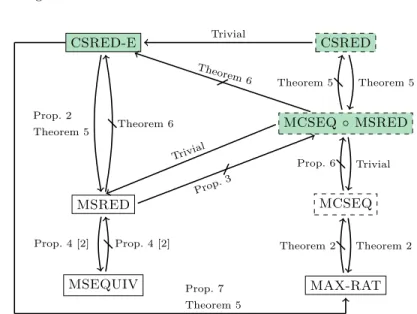
Figure 1 gives an overview of our main results. Considering previously pro-posed types of instance transformations, we establish that the sets MSRED and MCSEQ are individually not expressive enough to be sufficient within our generic framework, while their combination MSRED ◦ MCSEQ is. In-deed, MSRED and MCSEQ are orthogonal in the sense that neither one is as general as the other; we will give concrete examples of sequences hF,FRi ∈
MSRED\ MCSEQ and hF,FRi ∈
MCSEQ\ MSRED. Thus, neither one of these previously proposed formalisms for MaxSAT solving techniques is ex-pressive enough to capture hybrid forms of MaxSAT solving that combine the core-guided approach with preprocessing-style reasoning.
In addition toMSREDandMCSEQ, we will also consider several other sets of sequences. The setMSEQUIV in Figure 1 contains sequences where subse-quent instances are MaxSAT-equivalent with each other. MaxSAT-equivalence has previously been shown to be a special case of MaxSAT resolution [10, 2] and included in this work mainly for completeness. We also propose two new sets of sequences,MAX-RATandCSRED, with different motivations. As detailed in Section 6, we propose MAX-RAT as a natural lifting of the notion of resolu-tion asymmetric tautology, which has been shown to give a basis for formalizing
CSRED CSRED-E MCSEQ ◦MSRED MSRED MSEQUIV MCSEQ MAX-RAT Prop. 7 Theorem 5 Theorem 5 Theorem 5 Theorem 6 Trivial Prop. 6 Trivial
Prop. 4 [2] Prop. 4 [2] Theorem 2 Theorem 2 Prop. 2
Theorem 5 Theorem 6
Prop. 3 Trivial
Fig. 1.Relationships between sets of sequences. HereS1 →S2 denotes thatS1 is at least as general as S2,S1 6→S2 that S1 is not as general asS2. Transitive edges are not shown. The types of transformations that are sufficient for reaching the final state are coloured green, and effective transformations are drawn with continuous lines.
inprocessing SAT solving [17], to the context of MaxSAT. As a main result, we show that MAX-RAT yields a general proof of correctness of liftings of SAT preprocessing techniques to MaxSAT, noticeably generalizing earlier correctness proofs of liftings of specific SAT preprocessing techniques [5]. Towards more gen-eral instance transformations, we also propose the notion of correction-set re-ducibility,CSREDcontaining sequences in which each instance is correction-set reducible to the next one. We show thatCSRED surpasses the combination of
MSREDandMCSEQ; even its effective subsetCSRED-Ecaptures essentially
all current core-guided and preprocessing-style transformations we are aware of.
5
Analysis of Known Transformations
We begin the detailed analysis with MaxSAT-reducibility and MCS-equivalence, their combination, and MaxSAT-equivalence.
5.1 MaxSAT-Reducibility
First, we show thatMSREDis not sufficient for reaching the final state. Infor-mally, the result follows from the fact that MaxSAT-reducibility requires pre-serving all of the solutions to an instance while not being expressive enough to affect the cost of different solutions in different ways. Hence any instance F which has two solutionsτ1 and τ2 such that
not MaxSAT-reducible to the final instance FF to which all solutions have the same cost. We generalize this argument to sequences to establish the following. Proposition 1. MSRED is not sufficient for reaching the final state.
Note that in practice core-guided solvers that use MaxSAT-reducible transfor-mations terminate once the cost of the working instance becomes 0, which is not the same as the working instance beingFF. This “contrast” arises from the fact that core-guided solvers rely on a SAT solver for termination.
The effectiveness ofMSREDfollows by showing thatτ2, an optimal solution toF2inhF1,F2i ∈MSREDsatisfiesF1and assigns all variables inS(F1). Thus an optimal solution toF1can be obtained by i) restrictingτ2toLit(F1) and ii) assigning any unassigned variables ofVar(F1) arbitrarily.
Proposition 2. MSRED is effective.
The next proposition implies that MaxSAT-reducibility can not be used as basis for reasoning about the correctness of MaxSAT preprocessing.
Proposition 3. MSRED is not as general asMCSEQ.
Proof. Consider the sequencehF,FFi, whereF={(l∨x)}withwF(l) = 1 and
wF(x) = 0. SinceCOST(F) = 0 it follows that MCS(F) = {∅}=MCS(FF). This implies thathF,FFi ∈MCSEQ. To see thathF,FFi∈/ MSRED, consider the solutions τ1 = {l,¬x} and τ2 = {¬l, x} to F. Since
COST(F, τ1) = 1 =
0+1 =COST(FF, τ1)+1 whileCOST(F, τ2) = 0 = 0+0 =COST(FF, τ2)+0, it follows that F is not MaxSAT-reducible (for anyk) toFF. ut Finally,MaxSAT-equivalenceis a special case of MaxSAT-reducibility [10, 2]. Definition 8. The instance F is MaxSAT equivalent to the instance FR if
COST(F, τ) =COST(FR, τ) +kfor some positive integer k and all complete truth assignmentsτ for bothF andFR.
Again, the constant k may depend on F but not on the particular assign-mentτ. The setMSEQUIVcontains all sequences of MaxSAT instances where subsequent instances are MaxSAT equivalent. MaxSAT-reducibility subsumes MaxSAT-equivalence in terms of the generality of MSRED and MSEQUIV, which follows from comparing the definitions. The following result was first shown in [2] and included here for completeness.
Proposition 4 (Restated from [2]). The set MSRED is more general than the setMSEQUIV.
5.2 MCS-Equivalence
Similarly toMSRED,MCSEQis not sufficient for reaching the final state. The result follows by noting that any terminating sequence hF, . . . ,FFicontaining an instanceFi for whichMCS(Fi)6={∅}=MCS(FF) can not be inMCSEQ.
Proposition 5. MCSEQ is not sufficient for reaching the final state.
We expect MCSEQ not to be effective. For some intuition, consider a se-quencehF,F2i ∈MCSEQ. In the general case, the only information obtainable
from an optimal solution τ2 to F2 is an optimal MCS H ∈ MCS(F). In this
case, reconstructing an optimal solution to F requires computing a satisfying assignment toF
¬(Hc).
We show that MCS-equivalence can not be used in order to reason about the correctness of core-guided solving, i.e., that MCSEQ is not as general as
MSRED. Informally, the result follows by noting thatCOST(F) =COST(F2) for any MCS-equivalent instances F1 and F2. In contrast, there are sequences hF1, . . . ,Fni ∈MSREDfor whichCOST(F1)>COST(Fn).
Proposition 6. MCSEQ is not as general asMSRED.
5.3 Combining MSRED and MCSEQ
So far, we have established that neither MSRED nor MCSEQ is individu-ally sufficient for reaching the final state, and that neither one is as general as the other. The reasons for insufficiency, however, are in a sense orthogo-nal. While there are sequenceshF1, . . . ,Fni ∈MSREDfor whichCOST(F1)>
COST(Fn), any solution toF1is also a solution toFn. In other words, MaxSAT-reducibility can lower the optimal cost of instances but not rule out non-optimal solutions. In contrast, while COST(Fi) = COST(Fj) for any two instances in a sequencehF1, . . . ,Fni ∈ MCSEQ, there can be solutions to F1 that are not solutions toFn. More informally, MCS-equivalence can be used to rule out non-optimal solutions, but not to lower the optimal cost of instances. Since a terminating sequence starting from an arbitrary instanceF requires both lower-ing the optimal cost ofF to 0 and ruling out non-optimal solutions, using both
MSREDand MCSEQobtains a sufficient set of sequences.
Theorem 1. MSRED ◦ MCSEQ is sufficient for reaching the final state. Proof. (Sketch) LetFbe a MaxSAT instance. By correctness of the PMRES al-gorithm discussed in Example 1 [29], there is a sequencehF, . . . ,FSi ∈MSRED for which COST(FS) = 0 and hence MCS(FS) = {∅}. The terminating se-quence hF, . . . ,FS,FFi ∈MSRED ◦ MCSEQwitnesses the claim. ut
6
RAT Clauses in MaxSAT
We propose and analyze two novel notions for transforming MaxSAT instances and their corresponding sets of sequences, MAX-RAT andCSRED. First we adapt the idea of resolution asymmetric tautologies (RAT) to MaxSAT to obtain
MAX-RAT, an effective subset ofMCSEQ. RAT is a simple yet powerful
provides a basis for a general proof of correctness for natural liftings of SAT pre-processing techniques that can be expressed as sequences adding and removing RAT clauses.
Given two clausesC=l∨C0andD=¬l∨D0, the resolventC ./lD=C0∨D0 of C and D is obtained by resolving them onl. Resolution is extended to sets of clauses by Cl(l) ./l Cl(¬l) = {C ./l D | C ∈ Cl(l), D ∈ Cl(¬l)}. Let F be a MaxSAT instance and C a clause. Denote by ALA(F, C) (asymmetric literal addition) the unique clause resulting from repeating the following until fixpoint: if l1, . . . , lk ∈ C and there is a clause (l1∨ · · · ∨lk ∨l) ∈ F \ {C}, set C:=C∪ {¬l}. We say thatC hassolution resolution asymmetric tautology (SRAT) with respect toF if eitherC= (x∨ ¬x) for some variablexor there is a literall ∈C\ S(F) such thatALA(F, C ./lD) is a tautology for all clauses
D∈Cl(¬l). In the second case, we say thatChas SRAT onl. WhenFis clear from context, we say that C is an SRAT clause. We emphasize that the only restriction put onl is that it is not a soft variable. Specifically,lcan still be the negation of a soft variable. Notice also that any clause C that has SRAT with respect to to an instanceF also has RAT as defined in [17] with respect to to the CNF formulaClauses(F) but the converse is not true. We use the terms SRAT clause to refer to the concept for MaxSAT as defined here, and RAT clause to refer to the SAT-specific concept from [17].
Given a MaxSAT instanceFand an SRAT clauseC, the instanceADD(F, C) is obtained by (i) adding C to F and (ii) extending wF by setting the weight of each variable (if any) inVar(C)\Var(F) arbitrarily. Similarly, the instance
REMOVE(F, C) is obtained by (i) removingC fromF and (ii) restrictingwF
ontoVar(F \ {C}). These transformations are lifted to sequences of instances by the setMAX-RAT.
Definition 9. The set MAX-RAT contains all sequences hF1, . . . ,Fni, where Fi+1=ADD(Fi, C)orFi+1=REMOVE(Fi, C)for all i= 1, . . . , n−1.
While simple, the sequences inMAX-RATare fairly expressive. As discussed in [17], SAT solving techniques, including forms of preprocessing, can very gen-erally be viewed as sequences of adding and removing RAT clauses and can thus be easily lifted to MaxSAT with SRAT.
Example 2. Let F be an instance, x ∈ Var(F)\ S(F), Cl(x)∪Cl(¬x) = {C1, . . . , Cn} and Cl(x)./x Cl(¬x) ={D1, . . . , Dt}. The well-known variable elimination rule allows eliminating xfrom F by transforming it to FR =F \ (Cl(x)∪Cl(¬x))∪(Cl(x)./xCl(¬x)). This corresponds to the sequencehF= F0,F1, . . . ,Ft, . . . ,Ft+niwith Fi =ADD(Fi−1, Di) for i= 1, . . . , t and Fi =
REMOVE(Fi−1, Ci−t) fori=t+ 1, . . . , t+n. This sequence is inMAX-RAT.
BothADD(F, C) andREMOVE(F, C) are MCS-equivalent withF; this is because soft variables ofF contained only inC are not members of any MCSes ofF.
In addition, generalizing results from [17], we show that MAX-RAT is ef-fective. Given an instance F and a clause C that has SRAT with respect to a literal l, we show that if τ is a solution to F but not ADD(F, C), then
τR = τ\ {¬l} ∪ {l} is a solution to bothF and
ADD(F, C). While this also
holds for RAT clauses [17], the added assumption l /∈ S(F) of SRAT is needed to show COST(F, τ) ≥ COST(F, τR) =
COST(ADD(F, C), τR), which in
turn implies the existence of effective reconstruction functions for sequences in
MAX-RAT.
Proposition 7. MAX-RAT is effective.
More generally, MAX-RAT provides a natural way of correctly lifting all of the preprocessing rules proposed for SAT solving that can be modelled with RAT based transformations to MaxSAT; this noticeably generalizes correctness proofs of the four particular liftings considered in [5].
Theorem 3. LetF be a MaxSAT instance andFR the instance obtained by ap-plying a SAT preprocessing technique that can be viewed as a sequencehF, . . . ,FRi of RAT clause additions and deletions. Assume that all of the added and removed clauses also have SRAT. Then an optimal solution toF can be effectively com-puted based on an optimal solution to FR.
RAT and, by extension, SRAT are very powerful concepts, allowing for simulat-ing essentially all SAT preprocesssimulat-ing techniques, includsimulat-ing both resolution-based and clause elimination techniques [17]. Hence Theorem 3 gives a very general proof of correctness for natural liftings of SAT-based preprocessing techniques to MaxSAT.
TheMAX-RATsequences also detail the relationship between core-guided MaxSAT solvers and the abstract model of MaxSAT solving that we work with. Since the transformations in MAX-RAT can model SAT solving [17], the ab-stract state transition system models both the transformations employed by the outer core-guided MaxSAT algorithm, and the internal SAT solver used by it to extract cores and compute satisfying assignments. For example, the soundness of keeping learned clauses of the internal SAT solver between iterations follows easily from the fact that a SAT solver only learns clauses that have SRAT with respect to the current instance. Therefore the combination of MAX-RAT and
MSREDcaptures the correctness of core-guided algorithms and their
interleav-ings with liftinterleav-ings of SAT-based preprocessing techniques.
Theorem 4. MSRED◦MAX-RATis effective and sufficient for reaching the final state.
However, as we will discuss next, there are instance transformations, some of which arise from MaxSAT-specific preprocessing techniques without counter-parts in SAT preprocessing, that are not captured by MSRED ◦ MAX-RAT. This motivates the study of more expressive instance transformations.
7
Correction Set Reducible Transformations
The second novel notion for transforming MaxSAT instances that we propose is correction set reducibility (CS-reducibility). CS-reducibility is a more gen-eral form of instance transformations, surpassing the combination of MaxSAT-reducibility and MCS-equivalence, and thereby providing a wide basis for rea-soning about the correctness of MaxSAT solving.
Definition 10. The instanceF is correction set reducible (CS-reducible) to the instance FR if U(F, τR) =τR∩ S(F)is an optimal MCS ofF wheneverτR is an optimal solution to FR
Example 3. Let F = {(l1∨l2)} and FR = {(l1∨l2),(¬l2)} be two instances withwF(l1) =wF
R
(l1) = 1 andwF(l2) =wF
R
(l2) = 2. ThenF is CS reducible toFRwhich follows from τR={l
1,¬l2} being the only optimal solution ofFR andτR∩ S(F) ={l
1} being an optimal MCS ofF.
Similarly to other transformations, letCSRED be the set of sequences that contains all sequenceshF1, . . . ,Fnifor whichFi is CS-reducible toFi+1fori= 1, . . . , n−1. In contrast to MaxSAT-reducibility, CS-reducibility does not require uniformly changing costs of all assignments. This allows transformations that rule out non-optimal solutions. In contrast to MCS-equivalence, CS-reducibility only requires that an optimal solution to the transformed instance corresponds to an optimal MCS of the original instance; an optimal MCS of the original instance does not have to be an MCS of the transformed instance nor do all MCSes of the instance need to be preserved. This allows transformations that lower the optimal cost of instances.
Theorem 5. CSRED is more general thanMSRED ◦ MCSEQ.
Notice that Theorem 5 also implies that CSRED is sufficient for reaching the final state.
AsCSREDis at least as general asMCSEQwe do not expect it to be effec-tive. However,CSRED-E, the effective subset ofCSRED, is in itself relatively expressive.
Theorem 6. CSRED-Eis sufficient for reaching the final state. Furthermore,
MSRED ◦ MCSEQ, is not as general asCSRED-E.
Proof. The first claim follows directly from Theorems 4 and 5. For the second claim, consider the sequencehF,FRiformed by the instances defined in Exam-ple 3. The claim hF,FRi ∈
CSRED-E follows from the fact that the sets of
optimal solutions of F andFR are equal. To show thathF,FRi∈/
MSRED ◦ MCSEQ we demonstrate that F is neither MaxSAT-reducible to, or
MCS-equivalent with,FR. The former follows by considering the solutionτ={l 2,¬l1} toF and the latter fromMCS(F) ={{l1},{l2}} 6={{l1}}=MCS(FR). ut
Note that Theorem 6 implies thatMSRED◦MAX-RATis not as general as
CSRED-Eand that the sequencehF,FRicorresponds to applying the
MaxSAT-specific preprocessing of subsumed label elimination [8] onF. Thus effective CS-reducibility captures existing MaxSAT preprocessing techniques not captured byMSRED◦MAX-RAT.
8
Related Work
In terms of previously proposed formal systems for MaxSAT, MaxSAT resolu-tion [10, 20] was proposed as a generalizaresolu-tion of the resoluresolu-tion proof system. It is a complete rule for MaxSAT in that iteratively applying MaxSAT resolution to the clauses of a MaxSAT instance F gives another instanceFRESsuch that
COST(FRES) = 0 and any satisfying assignment toFS
¬S(FS) is an optimal
solution to F. The correctness of MaxSAT resolution was shown by establish-ing that F is MaxSAT-equivalent to FRES. As implied by our analysis, this means that MaxSAT resolution can be used to determine the optimal cost of an instance, but finding an optimal solution requires computing a satisfying as-signment to a satisfiable CNF formula. While MaxSAT resolution and its restric-tions give rise to simplification rules used in conjunction with branch-and-bound MaxSAT solvers [4, 16, 21, 22] (and also yields a proof system for SAT [9]), we focus on the current state-of-the-art core-guided approaches and central SAT-based preprocessing techniques. (The recent clause tableaux proof system for MaxSAT [23] does not capture core-guided transformations or MaxSAT prepro-cessing, either.) The recent formalization of implicit hitting set (IHS) algorithms for optimization modulo theories of [13] captures solely extensions of the IHS approach [12, 32], extending the DPLL(T) [31] which has also earlier been ex-tended to optimization modulo theories [30] and adapted for formalizing answer set solvers [11, 24] (without optimization statements).
9
Conclusions
We studied the formal underpinnings of unifying preprocessing-style reason-ing and core-guided transformations for MaxSAT. To this end, we formalized a generic framework for MaxSAT solving based on sequences of MaxSAT in-stances, and analyzed previously proposed notions of instance transformations underlying core-guided search and SAT-based preprocessing for MaxSAT within the framework. We showed that these notions individually do not capture each other (i.e., inprocessing core-guided MaxSAT solving), and therefore neither can be used for arguing about the correctness of the other. We proposed correction set reducibility as a new type of MaxSAT instance transformation which unifies core-guided MaxSAT solving and MaxSAT preprocessing, including SAT-based preprocessing lifted to MaxSAT. Furthermore, we generalized the concept of res-olution asymmetric tautologies from SAT solving to MaxSAT solving, thereby
obtaining a very general proof of correctness for lifting SAT preprocessing tech-niques to MaxSAT. All in all, the results build ground for generic techtech-niques for arguing about the formal correctness of MaxSAT algorithms.
Acknowledgments
The work has been financially supported by Academy of Finland (grants 276412 and 312662) and University of Helsinki Doctoral Programme in Computer Sci-ence.
References
1. Alviano, M., Dodaro, C., Ricca, F.: A MaxSAT algorithm using cardinality con-straints of bounded size. In: Proc. IJCAI. pp. 2677–2683. AAAI Press (2015) 2. Ans´otegui, C., Bonet, M., Levy, J.: SAT-based MaxSAT algorithms. Artificial
In-telligence196, 77–105 (2013)
3. Ans´otegui, C., Didier, F., Gab`as, J.: Exploiting the Structure of Unsatisfiable Cores in MaxSAT. In: Proc. IJCAI. pp. 283–289. AAAI Press (2015)
4. Argelich, J., Li, C.M., Many`a, F.: A preprocessor for Max-SAT solvers. In: Proc. SAT. Lecture Notes in Computer Science, vol. 4996, pp. 15–20. Springer (2008)
5. Belov, A., Morgado, A., Marques-Silva, J.: SAT-based preprocessing for MaxSAT. In: Proc. LPAR-19. Lecture Notes in Computer Science, vol. 8312, pp. 96–111. Springer (2013)
6. Benedetti, M., Mori, M.: Parametric RBAC maintenance via Max-SAT. In: Proc. SACMAT. pp. 15–25. ACM (2018)
7. Berg, J., J¨arvisalo, M.: Cost-optimal constrained correlation clustering via weighted partial maximum satisfiability. Artificial Intelligence244, 110–143 (2017) 8. Berg, J., Saikko, P., J¨arvisalo, M.: Subsumed label elimination for maximum sat-isfiability. In: Proc. ECAI. Frontiers in Artificial Intelligence and Applications, vol. 285, pp. 630–638. IOS Press (2016)
9. Bonet, M.L., Buss, S., Ignatiev, A., Marques-Silva, J., Morgado, A.: MaxSAT res-olution with the dual rail encoding. In: AAAI. AAAI Press (2018)
10. Bonet, M.L., Levy, J., Many`a, F.: Resolution for Max-SAT. Artificial Intelligence
171(8-9), 606–618 (2007)
11. Brochenin, R., Maratea, M., Lierler, Y.: Disjunctive answer set solvers via tem-plates. Theory and Practice of Logic Programming16(4), 465–497 (2016) 12. Davies, J., Bacchus, F.: Exploiting the power of MIP solvers in MaxSAT. In:
Proc. SAT. Lecture Notes in Computer Science, vol. 7962, pp. 166–181. Springer (2013)
13. Fazekas, K., Bacchus, F., Biere, A.: Implicit hitting set algorithms for maximum satisfiability modulo theories. In: Proc. IJCAR. Lecture Notes in Computer Sci-ence, vol. 10900, pp. 134–151. Springer (2018)
14. Feng, Y., Bastani, O., Martins, R., Dillig, I., Anand, S.: Automated synthesis of semantic malware signatures using maximum satisfiability. In: Proc. NDSS. The Internet Society (2017)
15. Heras, F., Morgado, A., Marques-Silva, J.: Core-Guided Binary Search Algorithms for Maximum Satisfiability. In: Proc. AAAI. AAAI Press (2011)
16. Heras, F., Larrosa, J., Oliveras, A.: MiniMaxSAT: An efficient weighted Max-SAT solver. Journal of Artificial Intelligence Research31, 1–32 (2008)
17. J¨arvisalo, M., Heule, M., Biere, A.: Inprocessing rules. In: Proc. IJCAR. Lecture Notes in Computer Science, vol. 7364, pp. 355–370. Springer (2012)
18. Jose, M., Majumdar, R.: Cause clue clauses: error localization using maximum satisfiability. In: Proc. PLDI. pp. 437–446. ACM (2011)
19. Korhonen, T., Berg, J., Saikko, P., J¨arvisalo, M.: MaxPre: An extended MaxSAT preprocessor. In: Proc. SAT. Lecture Notes in Computer Science, vol. 10491, pp. 449–456 (2017)
20. Larrosa, J., Heras, F.: Resolution in Max-SAT and its relation to local consistency in weighted CSPs. In: Proc. IJCAI. pp. 193–198. Professional Book Center (2005) 21. Larrosa, J., Heras, F., de Givry, S.: A logical approach to efficient Max-SAT solving.
Artificial Intelligence172(2-3), 204–233 (2008)
22. Li, C.M., Many`a, F., Mohamedou, N.O., Planes, J.: Resolution-based lower bounds in MaxSAT. Constraints15(4), 456–484 (2010)
23. Li, C.M., Many`a, F., Soler, J.R.: A clause tableau calculus for MinSAT. In: Proc. CCIA. Frontiers in Artificial Intelligence and Applications, vol. 288, pp. 88–97. IOS Press (2016)
24. Lierler, Y., Truszczynski, M.: On abstract modular inference systems and solvers. Artificial Intelligence236, 65 – 89 (2016)
25. Marques-Silva, J., Janota, M., Ignatiev, A., Morgado, A.: Efficient model based diagnosis with maximum satisfiability. In: Proc. IJCAI. pp. 1966–1972. AAAI Press (2015)
26. Morgado, A., Dodaro, C., Marques-Silva, J.: Core-Guided MaxSAT with Soft Car-dinality Constraints. In: Proc. CP. Lecture Notes in Computer Science, vol. 8656, pp. 564–573. Springer (2014)
27. Morgado, A., Heras, F., Liffiton, M., Planes, J., Marques-Silva, J.: Iterative and core-guided MaxSAT solving: A survey and assessment. Constraints18(4), 478–534 (2013)
28. Nadel, A., Ryvchin, V.: Efficient SAT solving under assumptions. In: Proc. SAT. LNCS, vol. 7317, pp. 242–255. Springer (2012)
29. Narodytska, N., Bacchus, F.: Maximum satisfiability using core-guided MaxSAT resolution. In: Proc. AAAI. pp. 2717–2723. AAAI Press (2014)
30. Nieuwenhuis, R., Oliveras, A.: On SAT modulo theories and optimization problems. In: Biere, A., Gomes, C.P. (eds.) Proc. SAT. LNCS, vol. 4121, pp. 156–169. Springer (2006)
31. Nieuwenhuis, R., Oliveras, A., Tinelli, C.: Solving sat and sat modulo theories: From an abstract davis-putnam-logemann-loveland procedure to dpll(t). Journal of the ACM53, 2006 (2006)
32. Saikko, P., Berg, J., J¨arvisalo, M.: LMHS: A SAT-IP hybrid MaxSAT solver. In: Proc. SAT. Lecture Notes in Computer Science, vol. 9710, pp. 539–546. Springer (2016)
33. Wallner, J.P., Niskanen, A., J¨arvisalo, M.: Complexity results and algorithms for extension enforcement in abstract argumentation. Journal Artificial Intelligence Research60, 1–40 (2017)
34. Zhu, C., Weissenbacher, G., Malik, S.: Post-silicon fault localisation using max-imum satisfiability and backbones. In: Proc. FMCAD. pp. 63–66. FMCAD Inc. (2011)