Comparing the Transfer of
CSR Principles by Western
and Chinese Extractive
Industry Firms to Promote
African Development: A
Co-evolutionary Approach.
S. M. Kort
A thesis submitted in partial fulfilment of
the University’s requirements for the
Degree of Doctor of Philosophy
2012
i
A ... firm-centred perspective will ... enable an approach to institutional change that is more dynamic” (Jackson and Deeg, 2008: 541-542).
Abstract.
In regarding corporate social responsibility (CSR), this thesis has moved beyond the stakeholder theory of the firm and adopted the evolutionary theory of the firm, together with recognising the link between corporate governance and CSR. This thesis has considered the historical development of the essential principles of corporate governance (embraced within the concept of CSR) of a Multinational Corporation (MNC), namely British Petroleum (BP), and assessed the transfer of these evolved principles for promoting development in Africa. To effectively apply evolutionary theory, one must also recognise that firms are part of a co-evolutionary process. Recent academic contributions by co-evolutionary theorists have paid attention to MNCs as change agents at the sector level. However, this thesis has taken this further and
considered BP attempting to engage in institutional co-evolution where a MNC acts as a change agent to the wider institutional regime to promote development. Cantwell et al
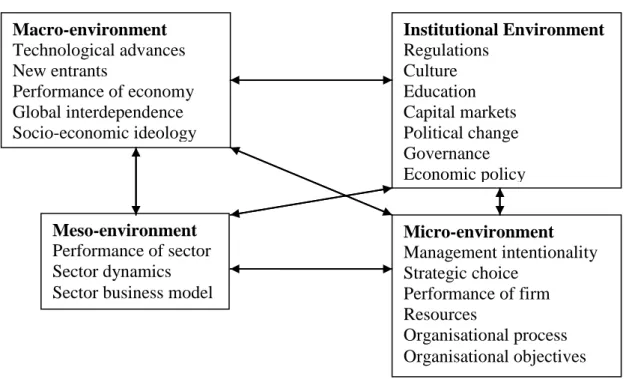
(2010) suggested that MNCs can have a significant influence upon the institutional regime, and presented a framework for firm-level adaptation by MNCs influencing the wider institutional environment in the host countries where they operate. They
developed a co-evolutionary framework linking historical changes in the character of MNC activities to changes in the institutional environment, focusing upon the scope for firm-level creativity and institutional entrepreneurship leading to successful institutional co-evolution. Therefore, this thesis has followed on from this and investigated whether BP can be an agent for change in Africa, using the example of Angola to highlight the process.
A comparison was made with the new entrants into the market, China, to judge whether this influences BP’s ability to engage in institutional co-evolution. In addition, a comparative study of mining giant Anglo American was engaged in to highlight the appropriateness of BP’s CSR principles to the African setting. The thesis found that BP cannot successfully engage in institutional co-evolution because of an ineffective transparency initiative, whilst Chinese involvement has further diminished the ability to
ii
transfer sound corporate governance and CSR principles, particularly because Chinese resource-seeking investment comes with ‘no conditions attached’ concerning
governance in host countries. In addition, the competitive nature of securing licences to operate forces oil MNCs to use their CSR packages strategically, and furthermore, the social consequences of environmental degradation due to oil sector operations means that local communities cannot sustain their livelihoods, which is a lesson that has not been learnt from historical evolution.
Keywords: institutional co-evolution, corporate governance, corporate social responsibility, strategic choice, path dependence.
iii
Contents.
Abstract. i
List of figures and tables. xii
List of boxes. xiii
List of abbreviations. xv
Map of Angola. xix
Acknowledgements. xx
Chapter 1: Introduction.
1
1.1: The nature of the inquiry. 1
1.2: A new ‘scramble’ for Africa. 2
1.3: Embed, cooperate, and act. 5
1.4: Choosing Angola. 7
1.5: Structure of the thesis. 8
Part 1.
Chapter 2: Theoretical framework for
the study.
14
2.1: Introduction. 14
2.2: The eclectic paradigm and the evolutionary
theory of the firm. 14
2.3: From evolution to co-evolution. 16
2.4: Institutional co-evolution. 20
2.5: The limitations of the shareholding and
stakeholding paradigms. 26
iv 2.6.1: Criticisms and the inappropriateness of
stakeholder theory. 31
2.6.2: Moving beyond stakeholder issues. 34
2.7: Discussion. 36
Chapter 3: Methodology.
38
3.1: Introduction. 38
3.2: The literature review. 38
3.3: Choosing a case study design. 39
3.4: Company reports. 40
3.5: Choosing a qualitative research strategy. 44
3.6: The four-point strategy to seek people’s views. 45
3.7: The first point: defining the population. 45
3.8: The second point: deciding who to speak to. 46
3.8.1: Sampling expert witnesses. 46
3.8.2: Expert testimony. 48
3.8.3: Sampling the academic community. 49
3.8.4: The reason for selecting expert witnesses. 49
3.8.5: Sampling key informants. 53
3.9: The third point: formulating the questions to ask. 57
3.10: An ethical outcome in interviewing: what is
right and good. 59
3.10.1 Face-to-face versus online interviewing. 62
3.11: The fourth point: analysis of the responses. 63
3.11.1: Interview analysis as bricolage. 63
v
3.11.3: Analysing narratives. 66
3.12: Summary. 67
Part 2.
Chapter 4: The resource curse and business
principles.
70
4.1: Introduction. 70
4.2: What the resource curse is. 70
4.2.1: Impacts of the resource curse. 71
4.2.2: Discussing the resource curse: the role of institutions. 71
4.2.3: Civil conflict resolution. 75
4.3: The origins of CSR. 76
4.3.1: The resource curse and CSR. 78
4.3.2: Defining CSR. 78
4.4: Making the business case for CSR. 81
4.5: CSR: from Friedman to the triple bottom line for the
extractive industry in the West. 85
4.6: Introducing corporate governance. 89
4.7: CSR converging with corporate governance. 90
4.7.1: CSR: the principles of corporate governance. 93
4.8: Summary. 96
Chapter 5: The history of BP’s and Anglo
American’s corporate
governance and corporate
responsibility.
99
vi
5.2: The role and structure of the board. 99
5.3: Board composition and CSR. 100
5.4: BP: a history of board composition issues. 102
5.5: The first generation of BP’s CSR. 106
5.6: The second generation of BP’s CSR. 111
5.7: The third generation of BP’s CSR. 112
5.8: The evolution of the CSR agenda for Royal Dutch
Shell and Chevron. 114
5.9: BP’s endorsement of global initiatives. 116
5.10: The global initiatives compared. 117
5.10.1: The OECD Guidelines. 118
5.10.2: The UN Global Compact. 122
5.10.3: The Global Sullivan Principles. 123
5.10.4: The Global Reporting Initiative. 125
5.11: Endorsing the principles of sustainable development. 128
5.12: Anglo American. 130
5.13: Anglo American: corporate responsibility today. 135
5.14: CSR for Anglo American. 138
5.15: Anglo American: measuring impacts. 139
5.16: Discussion. 140
Chapter 6: China as the new entrants:
how they will behave.
144
6.1: Introduction. 144
6.2: Chinese corporate governance: background. 146
6.3: Early business institutions in China: state
vii 6.4: The China Merchants’ Steamship Navigation
Company. 150
6.5: Early business institutions in China: Liu Hongsheng
adapting Western business practices. 151
6.6: The Chinese Company Legislation of 1904. 153
6.6.1: The limited effect of the 1904 code. 155
6.6.2: The importance of a legal system. 156
6.7: Chinese government interference in the corporate
governance of the early corporation and SOEs. 158
6.8: Modern Chinese corporate governance. 159
6.9: Government control in Chinese corporate
governance. 160
6.9.2: Grasping the large: the corporatisation of
Chinese state-owned enterprises. 161
6.9.2: The Code of Corporate Governance for Listed
Companies in China. 163
6.9.3: Other issues in Chinese corporate governance. 163
6.9.4: The advantages of, and justifying, government
control in Chinese corporate governance. 165 6.10: CNOOC and Sinopec’s sustainability reporting. 168
6.10.1: Global initiatives. 170
6.10.2: Higher national goals and symbolic relationships. 172
6.11: Discussion. 173
Part 3.
Chapter 7: Angola’s developmental needs.
180
7.1: Introduction. 180
viii
7.3: The colonial legacy. 182
7.4: Angola’s institutional capacity. 184
7.5: The civil war. 186
7.6: The destroyed transportation infrastructure. 189
7.7: Angola’s oil sector: what international oil corporations
can do to promote development. 190
7.8: Discussion. 195
Chapter 8: Oil MNCs acting as change agents:
analysis of the Angolan case and Africa
in general.
196
8.1: Introduction. 196
8.2: The context: learning from experience. 197
8.3: BP’s implementation of CSR principles today:
measuring impacts. 200
8.4: Disappointing stakeholder expectations. 201
8.5: Revenue transparency. 206
8.6: Liability of foreignness. 211
8.7: Contributing to social projects. 213
8.8: The importance of environmental issues. 216
8.8.1: Answering an audience in developed countries. 224
8.9: Strategic CSR. 226
8.10: Discussion: institutional co-evolution. 229
Chapter 9: The influence of China and
comparison with Western firms.
233
9.1: Introduction. 233
ix
9.3 Summit diplomacy. 236
9.3.1: The Forum on China-Africa Cooperation (FOCAC). 237
9.4: Chinese activity in Africa generally: the importance of oil. 240
9.5: Western perceptions on Chinese involvement in Africa. 241
9.6: China as a development partner. 246
9.7: Africans preferring Chinese investment. 248
9.8: Chinese investment: ‘no conditions attached’. 251
9.9: The role of the Chinese state: complimentary investment. 252
9.9.1: The nature of the complimentary investment. 253
9.9.2: Building infrastructure. 256
9.10: Chinese labour. 258
9.11: Social and environmental issues. 263
9.12: Liability of foreignness. 265
9.13: The Western response to Chinese involvement. 265
9.14: Discussion. 267
Part 4.
Chapter 10: Conclusion.
272
10.1: The findings and the implications of the study. 272
10.2: The applicability of co-evolutionary insights. 278
10.3: Limitations of the study. 281
x
Appendices and References.
Appendix 1: The United Nations Global Compact. 283
Appendix 2: Legislation. 285
Appendix 3: The Origins of BP. 287
Appendix 4: The Origins of Anglo American. 289
Appendix 5: The EITI Principles and Criteria. 291
Appendix 6: The Evolution of Chinese SOEs. 293
Appendix 7: The Development of Chinese SOEs. 297
Appendix 8: The Semi-Structured Interview Plan. 299
Appendix 9: Semi-Structured Interview with Professor John Child of the University of Birmingham Business
School, 25th November, 2010. 302
Appendix 10: Semi-Structured Interview with an Anonymous Expert Witness from within the CORE Coalition,
2nd November, 2010. 315
Appendix 11: Semi-Structured Interview with Professor Jedrzej George Frynas of the Middlesex University Department of Business and Management, 20th
December, 2010. 324
Appendix 12: Semi-Structured Interview with Doctor Gbola Gbadamosi of the University of Worcester
Business School, 30th September, 2010. 333
Appendix 13: Follow-up Email Questioning with Doctor Gbola Gbadamosi of the University of Worcester
Business School, 4th October, 2011. 355
Appendix 14: Semi-Structured Interview with Doctor Andrew Hale of the University of Worcester Business
School, 22nd November, 2010. 356
Appendix 15: Email Interview with Jonathan Samuel, the Social and Community Development Manager
xi
Appendix 16: Follow-up Email Questioning with Jonathan Samuel, the Social and Community Development
Manager at Anglo American 26th February, 2011. 374
xii
Figures and Tables.
Figure 1.1: Angola’s Oil Exports by Destination, 2009. 9
Figure 1.2: OPEC Oil Production by Barrels per Day. 10
Figure 2.1: The Institutional Regime: Co-evolution as
Interdependent Cycles. 25
Figure 2.2: The Institutional Regime: BP as Potential
Change Agent. 25
Table 3.1: Reporting of Core Environmental Indicators
(Selected Companies) in 2006. 43
Figure 4.1: The Seven Sustainability Revolutions. 86
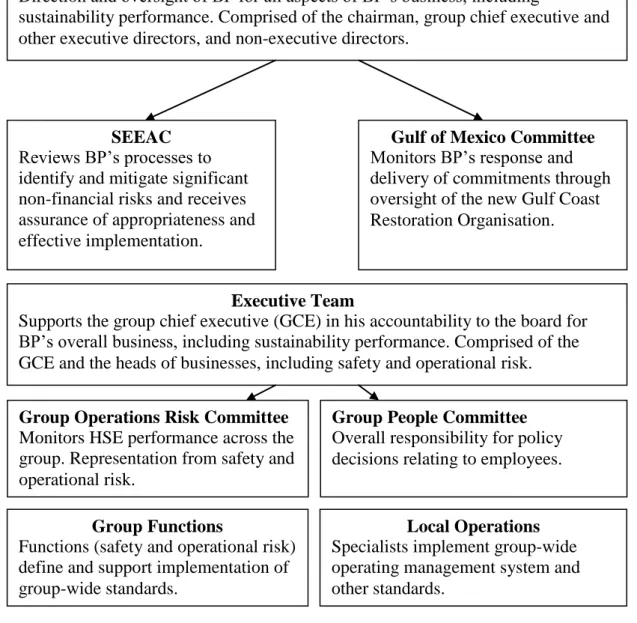
Figure 5.1: BP’s Organisational Structure to Manage
Sustainability Issues. 107
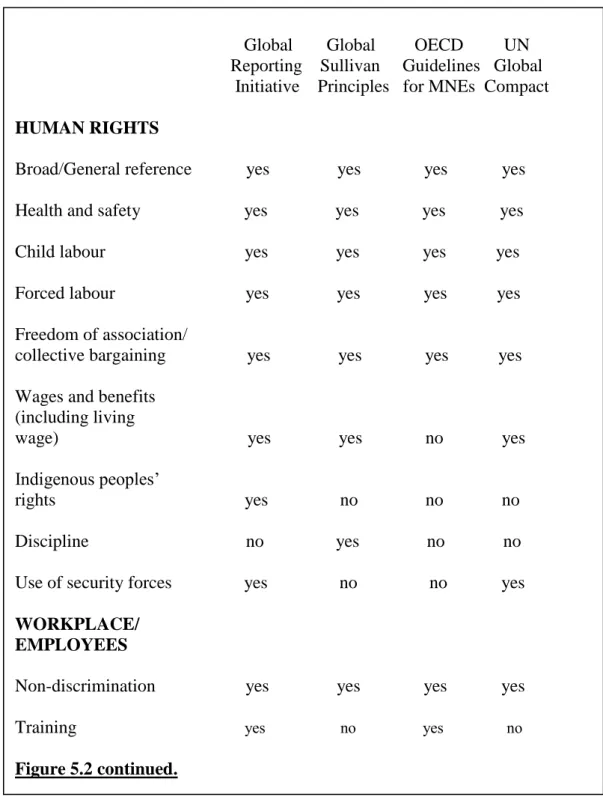
Figure 5.2: CSR Issues to be Referenced. 120
Figure 8.1: Stakes in Angola’s Offshore Oil Fields,
as of 25th May 2011. 215
Figure 10.1: The Institutional Regime: BP as Active
xiii
Boxes.
Box 1.1: The Chinese Presence and Activity in Angolan
Oil Blocks, as of the 25th May, 2011. 8
Box 2.1: The Shareholding Perspectives. 27
Box 2.2: The Stakeholding Perspectives. 29
Box 2.3: The Behavioural Theory of the Firm. 33
Box 3.1: Different Types of Cases. 41
Box 3.2: Probes Utilised during the Interviews. 51
Box 3.3: Professor John Child. 54
Box 3.4: Professor Jedrzej George Frynas. 55
Box 3.5: Doctor Gbola Gbadamosi. 56
Box 3.6: Doctor Andrew Hale. 57
Box 3.7: Low-inference Descriptors. 61
Box 4.1: The Three Principle Negative Effects of
Natural Resource Abundance. 72
Box 4.2: The Oil-related Conflict in the Niger Delta. 77
xiv Box 5.1: The Initiatives from the Global
Institutional Environment. 119
Box 5.2: The Sullivan Principles. 124
Box 5.3: The Global Sullivan Principles. 126
Box 5.4: Anglo American’s Approach to Sustainable
Development. 136
Box 6.1: Some Stipulations of the Code of Corporate
Governance for Listed Companies. 164
Box 6.2: The Anglo-Saxon and German-Japanese
Model of Corporate Governance. 166
Box 6.3: The Duties of Directors, Supervisors, and
Managers under the Company Law. 167
Box 8.1: The Deepwater Horizon Oil Spill. 219
Box 9.1: The Forum on China-Africa Cooperation (FOCAC). 238
Box 9.2: Chinese Oil Sector Activity in Gabon. 242
Box 9.3: Chinese Oil Sector Activity in Kenya. 242
Box 9.4: Chinese Oil Sector Activity in Nigeria. 243
xv
List of abbreviations.
AMAX American Metal Climax
ANC African National Congress
B/D Barrels per Day
BP British Petroleum
BRIC Brazil, Russia, India, and China
CABGOC Cabinda Gulf Oil Company
CAGR Compound Annual Growth Rate
CCGLC Code of Corporate Governance for Listed Companies
CEO Chief Executive Officer
CERES Coalition of Environmentally Responsible Economies
CFA Chartered Financial Analysts
CFB Companhia de Caminho de Ferro de Benguela
CFL Empresa de Caminhos de Ferro de Luanda
CFM Companhia de Caminho de Ferro de Mocamedes
CICMA Chinese Industry and Commerce Management Association
CMSNC China Merchants’ Steamship Navigation Company CNN Cable News Network
CNOOC China National Offshore Oil Corporation
CNPC China National Petroleum Corporation
CORE Corporate Responsibility Coalition
CSI Corporate Social Investment
CSP Corporate Social Performance
xvi
CSRC China Securities Regulatory Commission
DRC Democratic Republic of Congo
EITI Extractive Industries Transparency Initiative
EMC Emerging Market Company
ERNP Environmental Requirements for New Projects
FOCAC Forum on China-Africa Cooperation
FDI Foreign Direct Investment
FESA Fundação Eduardo dos Santos
FLEC Front for the Liberation of the Enclave of Cabinda
FLNA National Liberation Front of Angola
FTSE Financial Times Share Index
GB Great Britain
GCE Group Chief Executive
GDP Gross Domestic Product
GRI Global Reporting Initiative
HSE Health and Safety Executive
IFC International Financial Corporation
ILO International Labour Office
IMF International Monetary Fund
INEA Angola Roads National Institute
KMA Kailan Mining Administration
MEND Movement for the Emancipation of the Niger Delta
MNC Multi-National Corporation
xvii MOF Ministry of Finance
MOP Ministry of Petroleum
MOU Memorandum of Understanding
MP Member of Parliament
MPLA People’s Movement for the Liberation of Angola MVPE Monetary Valuation to Physical Effects
MWCC Marine Well Containment Company
NGO Non-Governmental Organisation
NNPC Nigerian National Petroleum Corporation
NOC National Oil Company
NSOE Non-State-Owned Enterprise
OECD Organisation for Economic Co-operation and Development
OLI Ownership, Location and Internalisation
OPEC Organisation of Petroleum Exporting Countries
PLC Public Limited Company
PSA Production Sharing Agreements
R&D Research and Development
SAM Sustainability Assessment Model
SEAT Socio-Economic Assessment Toolbox
SEC Securities and Exchange Commission
SEEAC Safety, Ethics and Environment Assurance Committee
SHE Safety, Health, and Environment
SOE State-Owned Enterprise
xviii UAE United Arab Emirates
UK United Kingdom
UN United Nations
UNCTAD United Nations Conference on Trade and Development
UNDP United Nations Development Programme
UNITA National Union for the Total Independence of Angola
US United States
USA United States of America
USAID United States Agency for International Development
WBCSD World Business Council on Sustainable Development
WTO World Trade Organisation
xix
Map of Angola.
(NOT TO SCALE).
).
Source: Adapted from Google maps (accessed 06/06/2011).
N
Congo (Brazzaville) Luanda Luena Soyo Menongue Namibe CABINDA Namibia Zambia Democratic Republic of CongoANGOLA
Atlantic
Ocean
Lobito Benguela
xx
Acknowledgements.
I am extremely grateful to Professor Howard Cox for his support throughout this PhD study. Without his support and guidance it is unlikely that this research project would ever have been completed. In addition, I would also like to thank Doctor Hantang Qi who has provided significant guidance; Doctor Catharine Ross who has provided specific guidance on methodology; and Doctor Gbola Gbadamosi who has not only provided guidance, but has also been a valuable interviewee. Furthermore, I would like to stress appreciation to all of the other interviewees for finding time within their busy schedules to grant interviews. Finally, I would like to give a special note of thanks to an African insider, who cannot be named, for the advice that he/she has given me.
1
Chapter 1: Introduction.
1.1: The nature of the inquiry.
The nature of the inquiry in this thesis is, essentially, to discover whether the emergence over time of the business principles of BP can provide insights into their corporate social responsibility (CSR) package that has evolved which is being implemented today in the oil sector in Angola and in African oil-producing countries in general. This is in order to answer the research question, which is whether the competition for Africa’s natural resources between Chinese firms (as the new entrants into the market) and Western firms (focusing upon BP) has negative implications for the governance climate in the region. Assuming that good governance is necessary for economic development (Wilkin, 2011: 61), one must consider the objective and subjective nature of this
question. The objective function defines the problem (Fonseca and Fleming, 1996: 585). In this context, it is the developmental needs of Africa. Economists tend to ascribe well-being to such objective measures (McBride, 2001: 253), and the subjective element is what these firms should be doing to promote good governance, and in turn, economic development which should enhance the well-being of the people of Africa.
Blowfield and Frynas (2005: 504, 506-507) feel that despite the wide interpretations and uses of CSR,1 the current research agenda fails to tackle key
questions because this agenda remains surprisingly narrow. For example, as they argue, in business schools much CSR research focuses upon limited issues related to the stakeholder theory of the firm,2 and as a result, vital questions are not being asked. Blowfield and Frynas call for more profound questions related to the role of CSR in international development because we know very little about the impact of CSR initiatives in developing countries, and what we do know raises questions about the efficiency of CSR approaches. Therefore, relating to the nature of this inquiry, and to answer the research question, this thesis has attempted to assess:
1 See section 4.8.
2 The inappropriateness of the stakeholder theory of the firm will be discussed in section 2.6.
1. whether a major international oil corporation (BP) has learnt how to
embrace the CSR agenda from long-term experience of engaging in operations in developing countries,
2
This introductory chapter will outline in which chapters these aims and objectives were considered, but to begin with, the context for this inquiry will be discussed.
1.2: A new ‘scramble’ for Africa.
Africa is often perceived as the loser in the globalisation process.3 However, the oil sector in the region is currently the exception to this perceived economic insignificance of Africa. Today, oil is one of the world’s most vital strategic resources, and African oil reserves are increasingly being tapped by multi-national corporations (MNCs) because of growing global demand, suggesting that the continent is experiencing a ‘new
scramble’ (Frynas and Paulo, 2007: 229-230). Indeed, Klare and Volman (2006: 297) highlight that this new scramble for Africa is due to the fact that the continent ‘is the final frontier as far as the world’s supplies of energy are concerned’, meaning that this new scramble is ‘becoming just as intense - if not even more so - than the former’. Nevertheless, terming this phenomenon as a new scramble does not accurately describe what is currently happening for two reasons.
Firstly, the original scramble for Africa was a very different process, in which, during the 1880s and 1890s, European colonial powers including Belgium, Britain,
3 For example, Strange (1998: 116) stressed that the important economic interests in Africa are not greatly
affected by the process of globalisation.
2. what CSR principles are applicable to the African setting,
3. de jure convergence to the Anglo-Saxon model of corporate governance (China) versus actual adherence to a version of the Anglo-Saxon model of corporate governance (the UK),
4. whether major international oil corporations can positively influence the institutional environment in the host countries where they operate,
5. whether China’s attempts to engage in resource-seeking foreign direct investment (FDI) is more likely to be successful in gaining licences to operate than the attempts of the West to engage in resource-seeking FDI,
6. how or if Chinese resource-seeking FDI is influencing the way that the West transfers CSR principles,
7. whether CSR is used merely as a strategic tool in order to receive licences to operate.
3
France, and Germany turned African territories into colonies. This followed the formal partition of the continent at the Berlin Conference between 1884 and 1885, providing these powers with the legitimacy to govern these African colonies economically, militarily, and politically under their spheres of control. Therefore, access to oil was dictated by the colonial power that provided the capital, expertise, and technology to fuel the resulting oil boom.
Secondly, the first real scramble for Africa’s oil began just prior to and after decolonisation. Algeria had been producing small amounts of oil from 1918, but began producing a significant output from their Edjeleh and Hassi Messaoud oil fields when they began operations in 1957. Also in 1957, the first tanker exporting oil from Gabon set sail, and in December, Nigeria embarked upon oil production. Between 1960 and 1970 the continent’s oil output increased more than twenty times over, and later international events such as the Yom Kippur war4and the Iranian revolution,5 both of which threatened global oil supplies, were to set the stage for Africa’s increasing importance as an oil-producing region.
Certain characteristics of these original scrambles are absent from the new scramble. Considering the scramble by European powers to establish colonies, there were clear spheres of control which do not exist today, and foreign investment was relatively insignificant both prior to the Berlin Conference in 1884 and during the immediate period afterwards. Contrastingly, the current expansion in the region’s oil sector is driven by foreign investment. Furthermore, Africans did not have a role to play in this original scramble because the process was dictated by European colonial powers. However, today African leaders do have a decision-making role. When considering the first scramble for Africa’s oil prior to and after decolonisation, the first oil-driven scramble was of greater significance in comparison with the current one.
The first scramble for Africa’s oil led to major political, economic, and social transformations in oil-producing states, especially Nigeria. Nigeria produced 20,000 barrels per day (b/d) in 1960. By 1973, this output had increased to over 2 million b/d. Currently Nigeria’s oil production is only slightly higher than the levels achieved in the
4 The Yom Kippur war occurred in 1973 when Egypt and Syria made a surprise attack on Israel
(Bronfeld, 2007: 465).
5 The Iranian revolution occurred in 1979 when religion engineered profound political change (Akhavi,
4
1970s. The contribution of the oil industry to Nigeria’s total government revenue increased between 1970 and 1974 from 26.3% to 82.1%, and compared with the deep transformations that took place in this period, the impact of the current scramble in countries such as Nigeria and Angola will be relatively insignificant (Frynas and Paulo, 2007: 230, 232-235). Therefore, the fundamental question that this raises is why should the impact of today’s oil driven scramble in countries such as Nigeria and Angola be considered relatively insignificant?
Lipumba (1994: 88) considered this question by asking whether African governments could establish developmental states that allocate resources and pursue policies that encourage investment in order to generate economic growth. This notion that good governance can spur economic growth is a framing assumption for a host of academic analyses (Kurtz and Schrank, 2007: 538), due to convincing evidence.6 Therefore, good governance is essential for economically transforming Africa (Amoako, 2000: 155). Although real per capita income grew rapidly in the 1960s in much of Africa, it faltered through the 1970s to the early 1990s as the implications of the authoritarian rule which swept the continent in the 1960s and early 1970s took effect, namely political elites sacrificing the general interest to extract rents and retain power. However, the political landscape since 1990 has changed, with greater pluralism and democracy, and Africa has enjoyed a return to experiencing rapid growth after 1995 as these changes took effect. Nevertheless, where civil conflict has persisted, this has not always been the case (Ndulu and O’Connell, 1999: 41), and rent-seeking behaviour in oil-producing states may continue the hamper development, which is part of the phenomenon known as the resource curse.7 Therefore, such previous studies have shaped the nature of this inquiry. If civil conflict and rent-seeking behaviour continue to have negative influences upon the governance climate in African oil-producing states, what can Western actors do to make a positive contribution to change this situation?
6 For example, Hope (2005: 284) noted that ‘good governance, in all its facets, has been demonstrated to
be positively correlated with the achievement of better growth rates, particularly through the building of institutions’, and the African Development Bank emphasises that ‘good governance is not only a worthy goal per se but also a prerequisite for sustainable development and poverty reduction in the longer term’ (Kabbaj, 2003: 7).
7
5
1.3: Embed, cooperate, and act.
The most immediate Western actors that can make a positive contribution to the
governance climate in African oil-producing states are the oil MNCs that are engaged in operations there. Oil MNCs can adopt three strategies to contribute to peace, security, and economic development in the host countries where they operate, and these are embed, cooperate, and act. Adapted from Milton and Stoner (2008: 127), who suggested these strategies for moving towards environmental sustainability at the meso-level, firstly, oil MNCs should embed thinking into their corporate mentality. Whilst Milton and Stoner largely limited this to environmental sustainability thinking, this could be enlarged to embrace transparency and wider social issues into corporate decision- making. Secondly, there is cooperate, which in the context of this thesis means engaging with host country institutions. Finally, there is act, which involves going beyond pondering about whether such bold steps are possible, and actually engaging in activities that could contribute to peace and security.
By adopting this idea, this thesis has firstly and importantly, considered whether oil MNCs embed thinking into their corporate mentality, using BP as the example. Corporate culture is a phenomenon that emerges over time, and consequently, the historical evolution of corporate culture highlights the ability to embed thinking.
Embedding thinking can be assessed by a MNC’s ability to learn from past experiences, and an in-depth study of BP assessed this capacity to learn from experience. Secondly, BP’s ability to cooperate and act, two concepts that are linked, was assessed. This was investigated by considering BP’s ability to engage in institutional co-evolution.8
This follows on from the work of Cantwell et al (2010), who believed that recent academic contributions have paid attention to change processes, with MNCs as agents of change, but more particularly at the meso-level. This thesis will take this further and consider the MNC as a change agent to the wider institutional regime. It can then be seen what sort of approach BP, and the Chinese, adopt in engaging with the wider institutional regime.
The first potential approach is that they could be firms that engage in
institutional avoidance, where they take an external weak institutional environment as a
6
given. When engaging in resource-seeking FDI, where alternative investment locations may be limited, firms may be willing to accept a weak institutional environment rather than adopting an exit strategy. The second potential approach is that they could be firms that engage in institutional adaptation, where they adjust their policies to better fit the environment. This may involve engaging in corrupt practices or implementing
behaviour that is relevant to the host country context. The final potential approach is that they may be firms that engage in institutional co-evolution. Although firms may exhibit behaviour that is relevant to the host country context, like in the previous scenario, the intention is not to adapt. Rather, the intention is to be a change agent for the wider institutional regime. A firm could achieve this by transferring organisational routines and principles. In addition, institutional co-evolution may involve the firms influencing international standards. In CSR, firms can be proactive in this by endorsing global standards, such as the United Nation’s (UN) Global Compact (Cantwell et al, 2010: 572, 574-577), and indeed, BP has joined the Global Compact (Frynas, 2009: 28).
Therefore, this thesis makes a contribution to knowledge by assessing whether the attempts to transfer organisational principles by a MNC (BP) can be seen as institutional co-evolution. Cantwell et al proposed the framework for the firm as the agent for change, but following on from this idea this thesis has actually investigated the concept. Like other scholars who have engaged in a co-evolutionary approach, an analysis that is contextual, historical, and multidisciplinary was adopted. Furthermore, co-evolutionary insights have scarcely been previously applied to corporate governance and CSR,9 despite the fact that business strategies for CSR can be seen as a
co-evolutionary process. Of particular importance here, in terms of BP being successful in attempting to transfer their organisational principles to influence the wider institutional regime in the host countries where they operate, is the impact of the new entrants into the market, namely Chinese national oil companies (NOCs). New entrants into a marketplace always alter the ‘rules of the game’ and, according to Alden (2007: 8), nothing has captured the world’s imagination as much as China’s growing presence in Africa. However, an appropriate host country to represent the case study had to found that grasped the phenomenon under investigation, the choice of which will now be considered.
7
1.4: Choosing Angola.
To highlight the problem of attempting to establish a developmental state in African oil- producing countries, Angola was chosen as the case study. As Chapter 7 will outline, Angola suffers from rent-seeking behaviour10 and a poor institutional environment, together with emerging from the influence of a long civil war. Angola was also chosen not only because BP has operations in the country, but in order to fully consider the influence of the new entrants into the market, China. In this context, Angola becomes a significant case because the country is now China’s largest source of oil on the African continent. Although Western oil MNCs retain the largest stakes and the majority of the operational rights in Angolan oil fields (including BP, ChevronTexaco, ExxonMobil, and Total), Chinese NOCs have gained a significant foothold in Angola.11 Therefore, China’s presence in Angola presents a fascinating case study of new entrants into a market and China’s growing reach globally.
Statistics highlight why Angola represents a fascinating case study. China was second behind only the USA in 2009 in terms of oil exports by destination. China received 29% of Angola’s oil exports in that year (with the USA only receiving 2% more).12 Angola is now ahead of Nigeria in terms of oil production13 making the country the largest producer of oil in Africa, and the seventh largest oil producer amongst the Organisation of Petroleum Exporting Countries (OPEC) members, an organisation the country joined in 2007 (Energy Information Administration, 2010: 2). Therefore, relations with China as the new entrants into the market are of great
importance to Angola, despite the continuing large presence of Western oil MNCs, including BP.
10 Rent-seeking behaviour is when each short-run opportunity for rent, or in this context the transfer of
wealth, displaces the long-run opportunity for the creation of social value which will be equal to or greater than the long-run rent payoff. It will be greater in cases where the investment alternative cannot capture the full social gain (Corcoran, 2001: 22). Essentially therefore, rent-seeking behaviour is when resources are wasted, and in many cases of rent-seeking behaviour the activity results in negative social value. Under such circumstances, one not only has the waste of rent-seeking, but also the social consequences imposed by the rent-seeking (Tullock, 2001: 5, 11).
11 See Box 1.1. 12
See Figure 1.1.
8
1.5: Structure of the thesis.
To address the phenomenon under investigation, this thesis has been structured into four parts. Part 1 outlines the co-evolutionary theoretical framework (in Chapter 2) and the methodology adopted for this thesis (in Chapter 3), namely a case study approach which calls for qualitative interviews to procure an in-depth understanding of the phenomenon. Part 2 utilises the Western concept of CSR to firstly, link the resource curse with the CSR agenda (together with linking the two concepts of corporate governance and CSR); secondly, make the business case for an international oil firm’s business principles; and
Shallow Water Block 3/80.
Sinopec sought to gain production rights in this area in 2004. Sinopec’s bid included a US$2 billion credit line from China Ex-Im Bank, and
subsequently, Sonangol decided in favour of Sinopec and did not extend the license of Total, who previously operated there.
Deepwater Block 14.
Also in 2004, Sonangol and Sinopec established a joint venture, Sonangol Sinopec International Ltd, in which they cooperate on oil production and refinement. The activity of this joint venture also extends to Blocks 15, 17, and 18.
Deepwater Blocks 15, 17, and 18.
Sinopec and CNOOC gained exploration and production rights in these blocks, in cooperation with Sonangol and Western oil MNCs.
Deepwater Block 18.
Sinopec currently owns a 50% stake in this area, with the other 50% owned by BP. Sinopec purchased their stake for US$2.46 billion in March 2010.
Ultra-Deepwater Block 32.
CNOOC and Sinopec purchased a 20% stake in this area for US$1.3 billion in 2009.
Box 1.1: The Chinese Presence and Activity in Angolan Oil Blocks, as of the 25th May, 2011 (Zhao, 2011).
9
U.S.A. 31% China 29% Europe**
22%
Other Americas*
6%
India 6% South Africa 4% Taiwan 3% 0 5 10 15 20 25 30 35 *Other Americas:
Brazil, Canada, Chile, Peru, Uruguay.
**Europe: Germany, Italy, Netherlands, Portugal, Spain, Sweden, UK.
Figure 1.1: Angola's Oil Exports by
Destination, 2009 (Energy Information
Administration, 2010: 3).
10 0 1000 2000 3000 4000 5000 6000 7000 8000 9000
Figure 1.2: OPEC Oil Production by Barrels
per Day (b/d) (000s) (Energy Information
Administration, 2010: 2).
11
thirdly, assess CSR in the Western extractive industry sector in Chapter 4. Chapter 5 then explores the history of BP’s implementation of their business principles. The aim of this chapter is to begin assessing whether BP has learnt from experience and can contribute to peace and economic growth in a developing country by addressing the social and environmental consequences of their operations,14 which is embraced within the concept of CSR. Whether BP has evolved a governance structure to embrace CSR issues will be explored, together with utilising their reporting mechanisms (and those of other selected Western oil MNCs, where appropriate) to assess the evolution of their CSR agenda. This chapter then makes a study of Anglo American’s business principles. Although they are not an oil firm but a mining firm, this is to assess the applicability of BP’s CSR principles to the African setting15
since Anglo American is a firm with a long history of engaging in operations in the region.16
Chapter 6 considers the new entrants into the market, China, by looking at the wider corporate governance agenda. The general purpose of this chapter to establish how the Chinese will behave when they invest overseas. It will be considered whether China is likely to converge to or diverge from a similar corporate governance system as BP,17 and whether the Chinese NOCs are likely to enter the market as a distinct entity which provides a new competitive dynamic that BP has to deal with, in terms of impacting BP’s ability to be an agent for change. Important in this is the role of the Chinese state and their continuing ownership of the major oil firms. Chapter 6 also explores the history of Chinese corporate governance in order to discover whether these new entrants have learning capabilities which may impact their ability to engage in resource-seeking FDI. In particular, their ability in embracing Western practices will be assessed both historically, and today by utilising the reporting mechanisms of CNOOC and Sinopec (the two Chinese NOCs engaged in Angola). Both Chapter 5 and Chapter 6, especially together with Chapter 8 later, assesses whether China’s attempts to engage
14
Aim 1 in Section 1.1.
15 Aim 2 in Section 1.1.
16 Anglo American’s long history dates back to their founding in 1917, based in South Africa, to
capitalise on a region that exploded on to the global mining scene. Anglo American believes that their strong South African heritage forms the roots for their global business (Anglo American, 2011a).
12
in resource-seeking FDI is more likely to be successful in gaining licences to operate than the attempts of the West to engage in resource-seeking FDI.
Having analysed the actors that are engaging in operations in Angola, namely BP and the new entrants (China), attention will then turn to analysing their operations in Part 3, to answer the research question of whether the competition between Chinese firms and Western firms (focusing upon BP as the example) has negative implications for the governance climate in the region. Chapter 7 will outline the governance climate in Angola to highlight what international oil firms could do to make a positive influence to the institutional environment in African oil-producing states; whilst Chapter 8
assesses the practical impact of BP’s attempts to act as an agent for change,18 together with the influence of other oil MNCs. In addition, this chapter discovers whether BP has learnt from their experience,19 and assesses whether CSR is used as a strategic tool in order to receive licences to operate.20 The influence of the new entrants into the market, China, will then be assessed in Chapter 9. This is in order to discover whether China has a contractual advantage over Western firms,21 and how or if Chinese resource-seeking FDI is influencing the way that BP transfers CSR principles.22
In Part 4, Chapter 10 will summarise the general conclusions, assess the
applicability of the co-evolutionary theoretical framework, acknowledge the limitations of the study, and make recommendations for future research. Therefore, this thesis will look at the actors first, in terms of making an historical analysis of their adaptive and learning capabilities and how they have evolved over time to influence how they enact their business principles today, before considering the influence of these evolved principles in addressing resource curse issues today in Africa.
18 Aim 4 in Section 1.1. 19 Aim 1 in Section 1.1. 20 Aim 7 in Section 1.1. 21 Aim 5 in Section 1.1. 22 Aim 6 in Section 1.1.
13
14
Chapter 2: Theoretical framework for the study.
2.1: Introduction.
Hitt (2005: 371, 374) suggested that the most important theoretical perspectives for international business in the future would include evolutionary economics, resource dependence, and the behavioural theory of the firm; and within these perspectives, he highlights corporate governance as being particularly important. This chapter will discuss the adoption in this thesis of the co-evolutionary theory of the firm and
highlights the fact that co-evolutionary insights have scarcely been applied to corporate governance and CSR, despite the fact that business strategies for CSR can be seen as a co-evolutionary process.
This chapter will outline the evolutionary theory of the firm before recognising that to effectively apply evolutionary theory to corporate governance and CSR, one must recognise that firms are part of a co-evolutionary process. Co-evolution in the context of whether firms can engage in institutional co-evolution will be considered. Of particular importance here is the work of Cantwell et al (2010). This thesis grapples with the issues of the firm acting as change agent to the wider institutional regime. The work of Cantwell et al has recently introduced an institutional element to international business research. Rather than relying upon quantitative research, this framework enables a fresh agenda to be followed-up by actively adopting their proposed
framework, which is what this thesis has done. This chapter will then establish that the conventional shareholding and especially stakeholding paradigms are inappropriate for the purpose of this thesis.
2.2: The eclectic paradigm and the evolutionary theory of the firm.
For almost three decades, the eclectic or Ownership, Location and Internalisation (OLI) paradigm has been a dominant analytical framework for testing the determinants of the overseas activities of MNCs. It states that the extent, location and composition of overseas activities engaged in by MNCs are determined by three interdependent variables. Firstly, there are the competitive advantages of the MNCs seeking to engage in outward FDI that are specific to their ownership (O) advantages. This relates to the fact that the greater the competitive advantages that a MNC has then the more likely they are to engage in outward FDI. Secondly, there are the locational (L) attractions of
15
host countries, which assert for example, that the more endowed that a country is with the resources that MNCs seek, then the more likely those firms will engage in
operations there. Thirdly, there are the internalisation (I) advantages that state that if a MNC can benefit from internalising the costs of operations in a certain host country, then they are likely to engage in operations there directly rather than franchising activities to a foreign firm. I advantages that internalise the costs of operating in host countries acquire particular importance here. When one considers the specific O advantages that a firm might have, there can be static O advantages which are capabilities possessed at a given point in time, or dynamic O advantages which are capabilities that have developed over time. One of the key characteristics that have emerged in the last few decades is the increasing requirement for firms to possess dynamic O advantages when they have a desire to engage in outward FDI. This is because firms need to have an ability to sustain and/or to improve their advantages.
Subsequently, the evolutionary theory of the firm acquires significance here because it pays lip service to the process or path by which specific O advantages evolve over time. The evolutionary theory of the firm is a dynamic theory that focuses upon the long-term strategies and learning capabilities of firms. In particular, it is necessary for a firm to have dynamic O advantages that have evolved over time if it possesses a desire to engage in resource-seeking FDI. The more efficient a firm is in managing these advantages, then the more likely they will be granted licences to operate in host countries (Dunning, 2001: 83-84, 88-89, 92). Indeed, as Box 2.3 shows, one of the relational concepts in the behavioural theory of the firm is organisational learning, and firms exhibit adaptive behaviour over time. Although firms utilise individual actors as instruments to engage in adaptive behaviour, it is possible to deal with adaptation at the aggregate level of the firm (Cyert and March, 1963: 123).
Nelson and Winter (1982: 134) wrote that ‘firms may be expected to behave in the future according to the routines they have employed in the past’. Fundamentally, routines are the basis of the characterisation of behavioural continuity in their evolutionary theory. Furthermore, evolutionary models allow for bounded
rationality, where actors are not assumed to have accurate foresight. Actors have a set of routines that determine their actions and they generally stick to them regardless.
16
the short-run. In the long-run, they have mechanisms that enable them to improve routines or to learn about better ones over time as they gain experience (Nelson and Winter, 2002: 30, 39-40). The ability to learn in this context concerns how actors within the firm make sense of complex and changing environments and how they react
accordingly (Dosi and Winter, 2000: 27).
Critically therefore, if a firm wishes to engage in resource-seeking FDI, then it will benefit from possessing dynamic O advantages that have evolved over time through learning capabilities. A firm is more likely to receive and sustain licences to operate if they have long-term experience from which they have learnt. It is true that evolutionary theory in its earlier form focused mainly on the technological aspects of production. However, only by looking at the MNCs’ evolutionary history can it be seen whether firm actors adhere to corporate governance and CSR routines in the short-run, or whether firm actors improve or replace routines in the long-run as the firm evolves and adapts to change. The learning processes of MNCs is what will drive their evolution of organisational routines (Cantwell et al, 2010: 573).
2.3: From evolution to co-evolution.
To effectively apply evolutionary theory to corporate governance and CSR, one must recognise that the firms are part of a co-evolutionary process. The essence of co- evolution is the idea that what happens in each autonomous domain of a system shapes what is going to happen in the other ones. In this context, it is the interactions between the MNCs and socio/political institutions that matter. In other words, it is the
relationship between MNCs and their institutional environment. The origins of corporate routines are intimately a co-evolutionary process, shaped by diverse and conflicting selection criteria, such as problem-solving versus corporate governance requirements. In essence, there is the problem of higher level changes, such as in the institutional set-ups or in the policy environment, impacting firm behaviour (Coriat and Dosi, 1995: 21, 23). Co-evolutionary research incorporates a number of approaches simultaneously:
Longitudinal time series of microstate adaptation events.
Organisation strategic adaptation in a historical context of the firm together with its environment.
17
Mutual, simultaneous, lagged, and nested effects.
Path dependence.
Changes in the institutional systems where firms and industries are located.
Economic, social, and political macro-variables which change and can influence over time (Lewin and Koza, 2001: vii).
Two of these approaches require explanation because of their utilisation in subsequent chapters, namely strategic adaptation and path dependence.
Strategic adaptation can analyse the character of the co-evolutionary dynamics of how firms adapt in a historical context. Strategic choice may be considered as a process: an adaptive learning cycle. Three key issues arise from strategic choice analysis, the nature of choice, the nature of the environment, and the nature of the relationship between agents and the environment. Firstly, the nature of choice involves ‘action determinism’. This refers to the possibility that actors select their actions
because of built-in preferences. Action determinism therefore, draws attention to the predetermined mind-sets of actors, and the relevance this has for the interpretative process. Secondly, the nature of the environment invokes the notion of the ‘strategic alliance’, where a group of firms within the same sector at the meso-level make
strategic decisions that influence upstream and downstream perceptions and objectives. However, as outlined in the Introduction,23 Cantwell et al (2010) believed that
recent academic contributions have paid attention only to MNCs as change agents at the meso-level. As this thesis follows on from this and considers one MNC as a change agent to the wider institutional regime, the notion of the ‘strategic alliance’ is inapplicable because this thesis is not concerned with an analysis of the strategic approach of a group of firms, but the approach of one firm. Thirdly, firms also interact within their environment. Organisations and environments both shape each other, and a relationship between agents and the environment can be achieved by ‘bridging’. By bridging, managers can attempt to manage the environment in which they operate by reciprocity, through negotiation, co-operation, and information exchange. The strategic choice perspective therefore, encourages a learning process, which invokes action via debate, negotiation, influence, and exercise of choice. It is an ongoing dynamic process:
18
information > evaluation > learning > choice > action > outcome > feedback
This process comprises two dynamic cycles. These are ‘inner structuration’, extending to the domain of organisational design, and ‘outer structuration’, extending to the environment(Child, 1997: 44, 48-50, 55, 59, 69-70).
Path dependency arguments were initially only utilised to explain why firms stick with outdated technologies, but more recently they were increasingly being used in the analysis of institutions, and they are now widely adopted in the social sciences to explain institutional stability and change (Kang, 2006: 2-3). Pierson (2000: 74-78) defines a path dependent process as one that is characterised by self-reinforcing
sequences of events. Path dependence involves three phases. Firstly, there is the critical juncture where events trigger a move towards a particular path. Secondly, there is the period of reproduction where positive feedback mechanisms reinforce the movement along that path. It is not only single institutions that are subject to positive feedback effects. Complementary institutions are also influenced where the performance of one is affected by the existence of others. Thirdly, the path comes to an end when new events dislodge the established way of doing things. Therefore, every path begins and ends with a critical juncture, also known as punctuated equilibrium. Mahoney (2000: 507, 516-518) takes this point a stage further, by stressing that path dependence specifically characterises historical sequences where contingent events set into motion patterns or chains of events that have deterministic properties. Therefore, Mahoney specifies more clearly the early events in a historical sequence, and that these events must be contingent in that they cannot be explained by previous events. However, Mahoney believes that these mechanisms of reproduction have little relevance outside the market place and consequently, introduces other mechanisms, such as the
application of power by actors to preserve a given institutional path.
The evolution of, for example, bureaucratic organisations has been receiving more and more attention over the last few decades. However, only a handful of studies have attempted to analyse the character of the co-evolutionary dynamics of how firms adapt over time. Nevertheless, potentially, a co-evolutionary framework by unifying theory and empirical research, can integrate micro and macro-level evolution, which can lead to ‘new insights, new theories, new empirical methods, and new understanding’
19 (Lewin and Koza, 2001: v-vi).
Despite the potential of the co-evolutionary framework, its utilisation has been limited. Co-evolution has been used to understand the abilities firms have to absorb new knowledge. Van den Bosch et al (1999: 551) considered the role that co-evolution plays in understanding the absorptive capacity that a firm has for assimilating new
knowledge, particularly the ability of a firm to combine new knowledge within its existing organisational form. Helfat and Raubitschek (2000: 961) used the concept of co-evolution to explain how organisations build and utilise knowledge and capabilities over long time spans, in order to gain competitive advantages in single and multiple product markets. In addition, co-evolution has been used to explain the formation of networks and alliances. Koza and Lewin (1999: 638) used co-evolution to explore the stimulus for the formation of a professional service network in the public accounting industry. Rosenkopf and Schleicher (2008: 426-427) examined how formal alliances co-evolve within emergent, informal inter-organisational relationships in the wireless telecommunications industry. Indeed, co-evolution has been widely applied to
information technology. Mitleton-Kelly and Papaefthimiou (2000: 164-165) looked at the co-evolution of the business process and information systems development as two domains, and considers how the degree of interaction between the two domains affects the rate of co-evolution between the two domains. Morrison et al (2007: 261)
considered that businesses and their supporting software evolve to embrace constant revision, and adopted the term co-evolution to describe the concept of business and software evolving in tandem, but at potentially different rates. Therefore,
co-evolutionary insights have scarcely been applied to corporate governance and CSR, and certainly not to the ability of MNCs to transfer their business principles.
However, Ashley (2010: 7) proposes that business strategies for CSR can be seen as a co-evolutionary process that is shaped by social, political, and institutional aspects through interactions between business, civil society, and the state; either at local, national, or global levels. This proposition can aid the understanding of the variety of perspectives for policies on CSR in an international context. Indeed, the MNCs of today are faced with greater institutional tensions than firms that operate solely within one country. This is because MNCs engage in activities across a wide variety of institutional environments. Consequently, MNCs have a greater stimulus to
20
engage in institutional entrepreneurship.24 Furthermore, most of today’s MNCs are structured as integrated networks containing autonomous subsidiaries. Such an
ownership structure promotes incentives for MNCs to invest in transferring innovations, such as new routines, that are developed by subsidiaries together with transferring those innovations developed by the corporate parent. Therefore, when MNCs engage in institutional entrepreneurship they have an incentive to invest in developing new institutions within the firm.
One specific O advantage that a MNC might have is institutional ownership advantages that include corporate values, together with the imprint of L advantages of the home country’s institutional environment. These advantages could be transferred to host countries to influence their institutional regime. This transfer could be either unintentional, through for example, unforeseen societal benefits that may be realised, or intentionally (Cantwell et al, 2010: 572). Intentional transfer could include, for
example, promoting transparent accounting.25 In addition, assuming that
co-evolutionary logic suggests that the firm has a symbolic, co-evolving relationship with society as well as with the institutional environment, a co-evolutionary framework can surely provide business researchers with a perspective that links firm level activities to their effects upon society in an iterative process. However, the co-evolution between firm activities and changes in societal issues, and the challenges this creates for business in strategically addressing social issues, has scarcely been researched. As Seager (2008: 448) argues, the ‘application of sustainability knowledge in ... management ... can be recognised as a necessity, but remains in mere nascent stages of development and may even depend upon further progress in other fields to become fully realised’. This is an important knowledge gap in the literature that this thesis will address.
2.4: Institutional co-evolution.
Co-evolutionary organisational theorists have tended to focus upon adaptation and co- evolution with competitors or with a community of firms at the meso-level. For example, Sørensen (2004: 149), in considering the labour market as a potential source of constraint in the entrepreneurial process, used an organisational ecology framework
24
Institutional entrepreneurship is where actors use their social and political skills to engineer institutional change (Wijen and Ansari, 2007: 1079).
21
to examine how founding rates in a sector varies with the degree of competition with other sectors for labour, and consequently found evidence of recruitment-based competition in a community ecology. Literatures on innovation systems stress the institutional level as the agent for change. For example, Freeman (2002: 191, 209) focused upon complementarity between sub-systems of society and on models of active learning in the UK, the USA, and catch-up economies in a historical context;
concluding that the major contributors to forging ahead, catch-up, and falling behind in the 19th and the 20th centuries can be explained in terms of national systems, although operating in an international context and recognising differing levels of development at the sub-national level. Neither literatures consider co-evolution in terms of the firm itself being an agent for change. A variety of firm-level initiatives have the potential to effect the wider institutional environment.
Cantwell et al (2010: 568-569) suggest that MNCs can have a significant influence upon the institutional environment, presenting a framework for firm-level adaptation by MNCs and their subsidiaries influencing the institutional environment in host countries. Cantwell et al adopt an approach that borrows from two respected scholars.
Firstly, North (1994: 361-362), an economic historian, argued that institutions and organisations shape institutional evolution. Institutions set the rules of the game, whilst organisations are the players. Organisations can include regulatory bodies, firms, social bodies, and educational bodies. Such organisations that exist are dependent upon the opportunities provided by the institutional environment. Economic change results from the choices of actors within organisations. Whilst most of these choices are routine, some of these choices involve changing existing mindsets so that the norms of behaviour are gradually modified. As a result, institutions are evolving. In essence, the most fundamental long-run driver of change is learning by actors within organisations. North (2005: 2-3) also wrote that the dominant beliefs of political and economic actors that are the decision-makers over time result in the formation of institutions that determine economic and political performance. The institutional environment that results can impose severe constraints on the choices that firm actors can make when they seek to innovate or modify institutions. The subsequent path dependence makes change incremental, although occasional abrupt institutional change suggests that
22
something similar to the punctuated equilibrium change in evolutionary biology can occur in economics. Change can continually occur as organisational actors improve or revise routines to improve their competitive position, with a resultant change in the institutional environment. However, the key to understanding this process of change is the intentionality of the actors enacting institutional change and their perception of the issues. Throughout history economic growth has been episodic because either the actors’ intentions have not been societal well-being or their perceptions of the issues have been so imperfect that the result has been radically different from what was intended.
Secondly, Nelson (2002: 9), an evolutionary economist, wrote that economists who developed evolutionary theory have been influenced by neo-classical economic growth theory, and have suggested that technological change has been the key driver of economic growth. When one recognises that technological change occurs in an
evolutionary process, a growth theory radically different from the neo-classical one can be formed. However, evolutionary growth theory, just like neo-classical economic growth theory, has not embraced the complex institutional structures that condition modern economies.
Nelson (2003: 910) also wrote that it is important to get a grip on the nature of modern human know-how. Some of it involves a sophisticated understanding of why practice works, and some of it also involves an understanding from experience that practice works. A cumulative advance of human know-how must be understood in the context of a process of learning or evolution. That cultural evolutionary process does, in turn, involve the co-evolution of technique and understanding. In addition, once one has recognised this, it becomes apparent that our learning or evolution works much better in certain arenas than it does in others.
Nelson (2007: 73) further wrote that evolutionary theorising about economic phenomena has a long tradition, and over the past quarter century significant literatures have been written on the process of change in business organisation and economics. In both of these fields, Darwin’s broad proposition that change occurs because of a process involving variation, systematic selection, and renewed variation has proved significant. Nevertheless, the evolutionary processes involved differ in essential ways from those operating in the evolution of biological species.
23
Cantwell et al (2010: 567-568), by elaborating on these approaches, developed a co-evolutionary framework within the context of the eclectic or OLI paradigm, and therefore firmly within the international business context, linking historical changes in the character of MNC activities to changes in the institutional environment, focusing upon the scope for firm-level creativity and institutional entrepreneurship leading to changes in the wider institutional regime. Therefore, distinct from other related literature, their approach considers micro processes of change influencing the institutional regime.
Nelson and Sampat (2001: 44-45) proposed a distinction between physical and social technologies. What constitutes a routine involves two different aspects, which are a recipe that is anonymous regarding any division of labour, and a division of labour in collaboration with a mode of coordination. The first aspect is what scholars are often considering when they are talking about technology in the conventional sense, and Nelson and Sampat refer to this aspect of a routine the physical technology that is involved. However, the second aspect involves the coordination of human action, which they refer to as the social technology that is involved. Organisational forms, such as a firm, implement particular social technologies because they are believed to be the appropriate ways to organise economic activity. For example, Ford’s organisation of mass production was followed for a long time by many firms engaged in producing assembled products. Today, lean production pioneered at Toyota is now considered the norm. Therefore, the emergence of new social technologies within the firm, or in other words, the emergence of a new coordination of human action can influence change. However, certain social technologies become the norm, whilst others do not, reflecting the fact that there is always a variety of institutional arrangements that are considered appropriate for any given institutional environment (Cantwell et al, 2010: 570).
Nelson and Sampat (2001: 33) raise an important point here, which is what is the right general definition of institutions? However, they do not provide an answer to this question because they rightly consider that particular definitions may be appropriate for different kinds of analysis. Nevertheless, for the purpose of this thesis, North (1990: 5), in analysing institutions and economic growth, distinguishes between institutions and organisations. The interaction between institutions and organisations shape the institutional evolution. Organisations are made up of groups of individuals bound