EFFICIENT AND SECURE DOCUMENT SIMILARITY
SEARCH OVER CLOUD UTILIZING MAPREDUCE
by Mahmoud Alewiwi
Submitted to the Graduate School of Engineering and
Natural Sciences
in partial fulfillment of the requirements for the degree of
Doctor of Philosophy
Sabanci University
December, 2015
EFFICIENT AND SECURE DOCUMENT SIMILARITY
SEARCH OVER CLOUD UTILIZING MAPREDUCE
APPROVED BY:
Prof.Dr. Erkay SAVAS¸ ... (Thesis Supervisor)
Prof.Dr. Y¨ucel SAYGIN ... (Internal Examiner)
Assoc.Prof.Dr. Kemal KILIC¸ ... (Internal Examiner)
Asst.Prof.Dr. Sel¸cuk BAKTIR ... (External Examiner)
Asst.Prof.Dr. Ahmet Onur DURAHIM ... (External Examiner)
© Mahmoud Alewiwi 2015 All Rights Reserved
Acknowledgments
I wish to express my gratitude to my supervisor Erkay Sava¸s for his invaluable guidance, support and patience all through my thesis. I am also grateful to Cengiz ¨Orencik for his guidance and valuable contributions to this thesis.
Special thanks to my colleague Ay¸se Sel¸cuk, for her collaborating in ad-ministrating the Hadoop framework and her kind suggestions.
I am grateful to all my friends from Cryptography and Information Se-curity Lab. (i.e., FENS 2001), Sabanci University and Data SeSe-curity and Privacy Lab for being very supportive.
I am indebted to the members of the committee of my thesis for reviewing my thesis and providing very useful feedback.
I am grateful to T ¨UB˙ITAK (The Scientific and Technological Research Council of Turkey), for the support under Grant Number 113E537.
Especially, I would like to thank to my family, wife, and sons for being patient during my study. I owe acknowledgment to them for their encour-agement, and love throughout difficult times in my graduate years.
EFFICIENT AND SECURE DOCUMENT SIMILARITY
SEARCH OVER CLOUD UTILIZING MAPREDUCE
Mahmoud Alewiwi
Computer Science and Engineering Ph.D. Thesis, 2015
Thesis Supervisor: Prof.Dr. Erkay Sava¸s
Keywords: Similarity, Privacy, Cloud Computing, MapReduce, Hadoop , Cryptography, Encryption
Abstract
Document similarity has important real life applications such as finding du-plicate web sites and identifying plagiarism. While the basic techniques such as k-similarity algorithms have been long known, overwhelming amount of data, being collected such as in big data setting, calls for novel algorithms to find highly similar documents in reasonably short amount of time. In particular, pairwise comparison of documents sharing a common feature, necessitates prohibitively high storage and computation power. The wide spread availability of cloud computing provides users easy access to high storage and processing power. Furthermore, outsourcing their data to the cloud guarantees reliability and availability for their data while privacy and security concerns are not always properly addressed. This leads to the prob-lem of protecting the privacy of sensitive data against adversaries including the cloud operator.
Generally, traditional document similarity algorithms tend to compare all the documents in a data set sharing same terms (words) with query docu-ment. In our work, we propose a new filtering technique that works on plain-text data, which decreases the number of comparisons between the query set
and the search set to find highly similar documents. The technique, referred as ZOLIP algorithm, is efficient and scalable, but does not provide security. We also design and implement three secure similarity search algorithms for text documents, namely Secure Sketch Search, Secure Minhash Search and Secure ZOLIP. The first algorithm utilizes locality sensitive hashing tech-niques and cosine similarity. While the second algorithm uses the Minhash Algorithm, the last one uses the encrypted ZOLIP Signature, which is the secure version of the ZOLIP algorithm.
We utilize the Hadoop distributed file system and the MapReduce parallel programming model to scale our techniques to big data setting. Our experi-mental results on real data show that some of the proposed methods perform better than the previous work in the literature in terms of the number of joins, and therefore, speed.
MAPREDUCE ˙ILE BULUT ¨
UZER˙INDE DOK ¨
UMANLAR
˙IC¸˙IN
VER˙IML˙I VE G ¨
UVENL˙I BENZERL˙IK HESAPLAMA
Mahmoud AlewiwiBilgisayar Bilimi ve M¨uhendisli˘gi Ph.D. tez, 2015
Tez Danı¸smanı: Prof.Dr. Erkay Sava¸s ¨
Ozet
Dok¨umanlar arasında benzerlik arama i¸sleminin ger¸cek hayatta tekrar-layan web sayfalarını ya da intihalleri bulmak gibi ¨onemli uygulama alanıları vardır. Her ne kadar k-benzerlik algoritması gibi temel teknikler literat¨urde uzun zamandır mevcut olsa da, ¨ozellikle ¸cok b¨uy¨uk boyutlardaki verilerle ¸calı¸smanın gerekli oldu˘gu b¨uy¨uk veri uygulamalarında bu t¨ur basit teknikler yava¸s ve yetersiz kalırlar. ¨Ozellikle dok¨umanları ikili olarak bir ortak ter-imi i¸ceriyor mu diye kar¸sıla¸stırmak ¸cok y¨uksek depolama ve hesaplama g¨uc¨u gereksinimleri do˘gurur. Bulut bili¸simin hızla yaygınla¸sması, kullanıcıların bu ihtiya¸clarına cevap vermektedir. Veriyi bu t¨ur bulut servis sa˘glayıcılar ¨
uzerinden payla¸smak, verinin eri¸silebilirli˘gini garanti etse de, verinin mahremiyeti ve gizlili˘gi garanti edilemez. Bu durum, ¨ozellikle hassas verilerin mahremiyetini koruma problemini ortaya ¸cıkarmı¸stır.
Geleneksel dok¨umanlar arası benzerlik bulma algoritmaları ¸co˘gunlukla sorgulanan dok¨umanı veri tabanındaki di˘ger t¨um dok¨umanlarla kar¸sıla¸stırmayı gerektirir. Bizim ¨onerdi˘gimiz sistemde ise, a¸cık (¸sifrelenmemi¸s) metin verileri ¨
uzerinde gerekli olan kar¸sıla¸stırma sayısını ¨onemli oranda azaltan yeni bir fil-treleme tekni˘gi kullanımı ¨onerilmi¸stir. Bu sistem a¸cık veriler ¨uzerindeki
ben-zerlik kar¸sıla¸stırmalarında verimli olarak ¸calı¸smaktadır ve ¨ol¸ceklenebilirdir, ancak bir g¨uvenlik sa˘glamaz.
Bu sistemin yanı sıra, mahremiyeti de sa˘glayacak ¨u¸c g¨uvenli benzer-lik arama algoritması da (Secure Sketch Search, Secure Minhash Search ve Secure ZOLIP) tasarlanmı¸stır. Bunlardan ilki dok¨umanlar arasındaki kosin¨us benzerli˘gini konum hassasiyetli ¨oz¨utleme (locality sensitive hashing) teknikleri kullanarak yapar. ˙Ikinci y¨ontem MinHash algoritmalarını kul-lanırken ¨u¸c¨unc¨us¨u ise daha ¨once a¸cık metinler i¸cin tasarladı˘gımız ZOLIP imzalarının ¸sifrelenmi¸s hallerini kullanarak benzerlik hesaplaması yapar.
¨
Onerdi˘gimiz y¨ontemleri ger¸ceklerken b¨uy¨uk veriler i¸cin de ¨ol¸ceklenebilir olması i¸cin, Hadoop da˘gıtık dosya sistemleri ve MapReduce paralel program-lama modelinden yararlanıyoruz. Ger¸cek veriler ¨uzeride yaptı˘gımız deneyler, ¨onerilen y¨ontemlerin bazılarının literat¨urde var olan di˘ger sistemlerden daha az sayıda birle¸stirme/kar¸sıla¸stırma i¸slemine ihtiya¸c duydu˘gunu, ve dolayısıyla daha hızlı oldu˘gunu g¨ostermi¸stir.
Contents
Acknowledgments . . . iii Abstract . . . iv ¨ Ozet . . . vi 1 INTRODUCTION 1 1.1 Motivations . . . 2 1.2 Contributions . . . 4 1.3 Outline . . . 5 2 RELATED WORKS 6 2.1 Related Work on Similarity Search . . . 63 PRELIMINARIES 11 3.1 Term Relevancy Score . . . 11
3.2 Cosine Similarity . . . 13
3.3 Z-Order Mapping . . . 14
3.4 Locality Sensitive Hashing (LSH) . . . 22
3.5 Hadoop and MapReduce Framework . . . 23
3.6 Hash-based Message Authentication Code (HMAC) . . . 25 4 EFFICIENT DOCUMENT SIMILARITY SEARCH
4.1 Introduction . . . 28
4.2 The Proposed Filtering Method . . . 30
4.2.1 Phase 1: Near-Duplicate Detection (NDD) . . . 31
4.2.2 Phase 2: Common Important Terms (CIT) . . . 35
4.2.3 Phase 3: Join Phase(JP) . . . 40
4.2.4 R-S Join . . . 42
4.3 Experiments . . . 42
4.3.1 Setup and Data Description . . . 43
4.3.2 Performance Analysis . . . 44
4.3.3 Accuracy Analysis . . . 48
4.4 Conclusion . . . 52
5 SECURE DOCUMENT SIMILARITY SEARCH UTILIZ-ING SECURE SKETCHES 54 5.1 Problem Definition . . . 55
5.2 Secure Similarity Search . . . 57
5.3 Secure Sketch Construction . . . 58
5.4 Enhanced Security . . . 60
5.5 Security Analysis . . . 63
5.6 Implementation . . . 66
5.7 Similarity Evaluation . . . 67
5.8 Conclusion . . . 70
6 SECURE DOCUMENT SIMILARITY SEARCH UTILIZ-ING MINHASH 72 6.1 The Framework . . . 73
6.2 Security Model . . . 75
6.3.1 Secure Index Generation . . . 76
6.3.2 Secure Query Generation . . . 81
6.3.3 Secure Search . . . 83
6.4 Security Analysis . . . 87
6.5 Experiments . . . 89
6.6 Conclusion . . . 92
7 EFFICIENT, SECURE DOCUMENT SIMILARITY SEARCH UTILIZING Z-ORDER SPACE FILLING CURVES 94 7.1 Introduction . . . 95
7.2 Problem Definition . . . 97
7.3 Secure ZOLIP Similarity Search . . . 98
7.3.1 Secure Index and Query Generation . . . 98
7.3.2 Secure Search . . . 100
7.4 Security Analysis . . . 104
7.5 Experimental Results . . . 105
7.6 Conclusion . . . 108
List of Figures
3.1 Z-Order Space Filling . . . 15
3.2 Data Points onZ-Order Curve . . . 16
3.3 MapReduce Job Execution . . . 25
4.1 An Example Execution of ZOLIP Phase 1 . . . 34
4.2 An Example Execution of ZOLIP Phase 2 . . . 39
4.3 An Example Execution of ZOLIP Phase 3 . . . 41
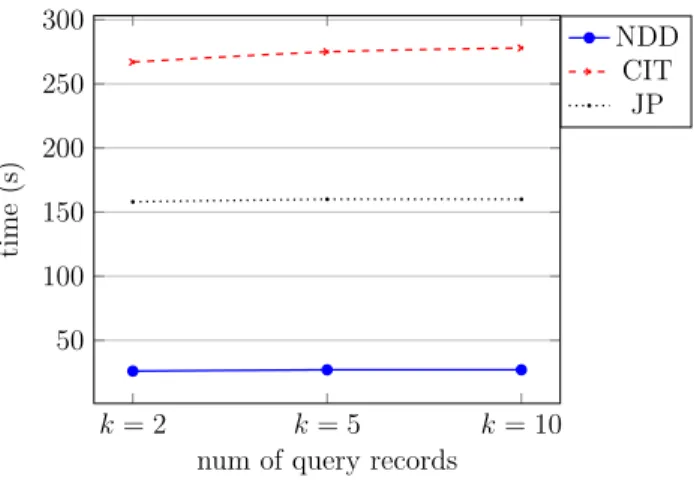
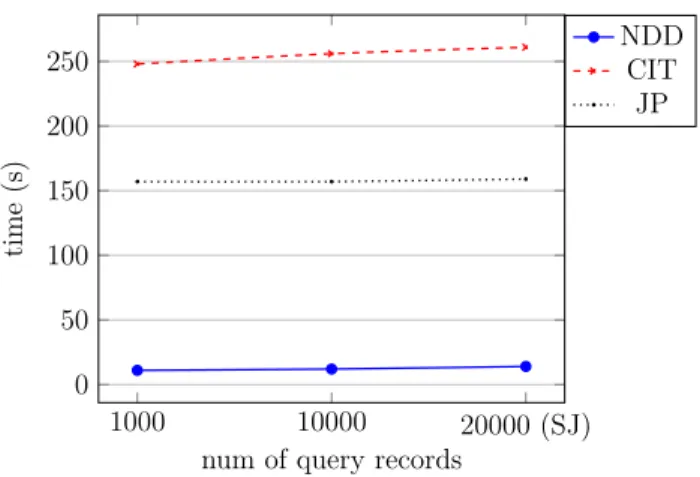
4.4 Performance Comparison between the Proposed Algorithm (ZOLIP) and the Method by Vernica et al. [1] for k= 10. . . 44
4.5 Effect of Increase in λ on Efficiency for k = 10 . . . 45
4.6 Running Time of Each Phase forλ = 8. . . 46
4.7 Running Time of Each Phase for differentkwhere, Query Size is 10,000 andλ = 8 . . . 46
4.8 Running Times for the Reuters data set for λ= 8. . . 47
5.1 Average Accuracy Rate . . . 68
5.2 Time Complexity for Sketch Similarity Search, |D|= 510,000 69 5.3 Time Complexity for Encrypted Sketch Similarity Search . . . 69
6.1 The framework . . . 73
6.2 Flowchart of secure index generation . . . 77 6.3 Average precision rates fork-NN search with differentλ and k 91
6.4 Average search time for kNN search with differentλ . . . 92
7.1 Flowchart of secure index and query generation . . . 99
7.2 Time Complexity . . . 107
List of Tables
4.1 Average of missed queries of ZOLIP Filtering Algorithm with k = 2. . . 50 4.2 Accuracy of the top k documents for ZOLIP Filtering
Algo-rithm with k = 2. . . 50 4.3 Accuracy of the top-k documents for ZOLIP Filtering
Algo-rithm with k = 2. . . 50 4.4 Accuracy of ZOLIP Filtering Algorithm with Different Values
of k whenλ = 8. . . 52 4.5 Relative Error on the Sum (RES) for Different Values of k
when λ= 8. . . 52 5.1 Common Notations . . . 56 7.1 Common Notations . . . 97
List of Algorithms
1 Near-Dupplicate Detection(NDD) . . . 32
2 Common Important Terms(CIT) . . . 36
3 Join Phase . . . 41
4 Secure Multiplication (E(ab)) . . . 62
5 Enhanced Secure Similarity Search . . . 64
6 Secure Index Generation . . . 81
Chapter 1
INTRODUCTION
Big data, referring to not only the huge amount of data being collected, but also associated opportunities, has big potential for major improvements in many fields from health care to business management. Therefore, there is an ever-increasing demand for efficient and scalable tools that can analyze and process immense amount of, possibly unstructured, data, which keeps increasing in size and complexity.
Finding similarities (or duplicates) among multiple data items, or docu-ments, is one of the fundamental operations, which can be extremely chal-lenging due to the nature of big data. In particular, similarity search on a huge data set, where the documents are represented as multi-dimensional feature vectors, necessitates pair-wise comparisons, which requires the com-putation of a distance metric, and therefore can be very time and resource consuming, if not infeasible.
However, complexity of establishing such a powerful infrastructure may be costly or not available especially for small and medium-sized enterprises (SMEs). Cloud computing offers an ideal solution for this problem. The currently available cloud services can provide both storage and computation
capability for massive volumes of data. This motivates us to find new and efficient document similarity searching algorithms that can work in big data setting utilizing cloud computing.
While data outsourcing to cloud is a feasible solution for many organi-zations the fact that the outsourced data may contain sensitive information leads to privacy breaches [2, 3]. Secure processing of outsourced data opera-tions require protection of the confidentiality of both the outsourced data and the submitted queries. Moreover, it also requires to maintain the confiden-tiality of the patterns such as different accesses/queries aiming to retrieve the same data. Encryption of data prior to outsourcing may provide the confidentiality of the content of the data. However, the classical encryption methods do not provide even simple operations over the ciphertext.
In our work, we first concentrate on finding similar documents over data sets in plaintext using an efficient algorithm, which utilizes a new filtering technique and cosine similarity between two documents. Then, we propose secure search algorithms that aim to find similar documents without revealing sensitive data.
1.1
Motivations
While the basic techniques such as k-similarity algorithms have been long known, overwhelming amount of data, being collected such as in big data setting, calls for novel algorithms to find highly similar documents in reason-ably short amount of time. In particular, pairwise comparison of documents’ features, a key operation in calculating document similarity, necessitates pro-hibitively high storage and computation power.
docu-ments, is one of the fundamental operations, which can be extremely chal-lenging due to the nature of big data. In particular, similarity search on a huge data set, where the documents are represented as multi-dimensional feature vectors, necessitates pair-wise comparisons, which requires the com-putation of a distance metric, and therefore can be very time and resource consuming, if not infeasible.
A commonly used technique, known as filtering, decreases the number of pairwise comparisons by skipping the comparison of two documents if they are not potentially similar; e.g., they do not share any common feature. Also, representation, storage, management and processing of documents play an important role in the performance of a similarity search method. A dis-tributed file system and a parallel programming model such as MapReduce [4] are necessary components of a scalable and efficient solution in big data ap-plications.
From security perspective, secure data mining operations require protec-tion of the confidentiality of both the outsourced data along with its index that allows searching capability and the submitted queries. Moreover, it also requires to maintain the confidentiality of the search and access patterns such as different accesses/queries aiming the same data. Data encryption before outsourcing may provide the confidentiality of the content of the data. How-ever, classical encryption methods do not allow even simple operations over the ciphertext. In the past few years several solutions have been proposed for efficient search operations over encrypted data utilizing a searchable index structure that accurately represents the actual data without revealing the sensitive information.
1.2
Contributions
This thesis focuses on the general problem of detecting the k-most similar documents for a given (set of) document(s). It presents four novel algorithms: i) one algorithm for unprotected document sets aiming fast and a scalable search operation based on filtering and ii) three algorithms for secure search operation utilizing various encryption techniques. In the first algorithm, where the search is performed over plaintext data, two cases are considered: i) finding k-most similar documents for each document within a given data set (self join), and ii) finding k-most similar documents for each document in one set from the other set (R-S join), for instance query set and data set. In secure search algorithms, only R-S join is considered as self join is not feasible due to the large sizes of data set used in the experiments.
The contributions of this thesis as well as the techniques employed are summarized as follows:
• We propose an efficient document similarity algorithm that search for document similarity over plaintext data sets.
• We utilize Z-order and propose a Z-order prefix filtering technique to enhance the efficiency of the algorithm.
• We utilize term frequency-inverse document frequency (tf-idf) as a term relevancy score for weight or importance of a term/word of a document. • We use cosine similarity metric to find similarity between documents
whenever it is possible.
• We also propose several approaches that enable enhanced security prop-erties such as search and access pattern privacy and document and query confidentiality.
• We propose three secure document similarity search schemes. The first one is based on secure sketches. The second one is based on locality sensitive hashing (LSH)(i.e MinHash). The last one uses the Z-order prefix encrypted using HMAC algorithm. The security properties of the proposed algorithms are different while some of them provide ac-cess and search pattern privacy in addition to document and query confidentiality, the others provide basic security for data and query privacy.
• For all the above algorithms, we use the MapReduce parallel processing framework which is a popular computing model for big data applica-tions in recent times.
1.3
Outline
The thesis is organized as follows: the next chapter (Chapter 2), presents a literature review on prior work related to document similarity over plain and encrypted data and indexes. In Chapter 3, we provide the preliminaries that will be used throughout the thesis. In Chapter 4, we introduce a novel document similarity search algorithm that is based on Z-order prefix filter-ing. Chapters 5, 6 and 7 give the details of three different secure document similarity search algorithms, respectively. In Chapter 5, we explain Secure Sketch algorithm. In Chapter 6, a secure search algorithm based on a lo-cality sensitive hash function known as MinHash is explained. And finally, in Chapter 7 we explain the secure ZOLIP algorithm, which is the secure version of the algorithm given in Chapter 4. Finally, chapter 8 concludes the thesis.
Chapter 2
RELATED WORKS
This chapter presents a short survey on previous works in the literature re-lated to document similarity over plaintext and encrypted documents. Effi-ciency and accuracy of different algorithms are discussed and their advantages and disadvantages are pointed out.
2.1
Related Work on Similarity Search
In the literature, the problem of set-similarity on a single machine is con-sidered in several works [5–8]. These works are mainly focused on reducing the complexity of vector similarity join. Angiulli et al. [9] used the Z-order space filling curve in order to find the similarity between two high dimen-sional spatial data sets using Minkowski metrics. This method performs well for finding close pairs in high dimensional data, but it is not suitable for text based similarity detection. For text based similarity, as in the case of document similarity problem, the cosine similarity metric is more suitable than the Minkowski metric.
doc-ument detection problem. They used a binary search technique to find k-nearest neighbors (k-NN) within a selectedZhypercube. A popular approach in other works is adapting filtering techniques that filter out pairs that can-not surpass a given similarity threshold. Filtering decreases the number of candidates for the computation of similarity metric and, therefore, the num-ber of similarity join operations by eliminating the documents that do not share a common important term with the query.
There are various filtering techniques used in the literature. A prefix filtering method is suggested by Chaudhuri et al. [7]. The length filtering method is utilized in the works [5] and [8]. Positional and suffix filters are proposed by Xiao et al. [11]. Sarawagi and Kirpal [6] proposed a method called PPJoin+ that utilizes inverted index and uses a Pair-Count algo-rithm which generates pairs that share certain number of tokens. Arasu et al. [5] proposed a signature based method, in which the features of docu-ments are represented by signatures and the similarity among the docudocu-ments is calculated using the similarity of the underlying signatures. Zhu et al. [12] suggested a searching technique based on cosine similarity. They proposed an algorithm that utilizes a diagonal traversal strategy to filter out unrelated documents. In this algorithm, the elements in the data set are represented by binary vectors, meaning that only the existence of terms is considered, ignoring their frequencies or importance in the data set.
The MapReduce computing model is also considered for the similarity search problem and this leads to parallel join algorithms for large data sets that are stored on cloud servers. Elsayed et al. [13] suggested a MapReduce Model with a Full-Filtering technique. They used a simple filter that finds only the pairs that share common tokens. The proposed method is composed of two phases. While the first phase parses and creates the indexes for the
terms in each document, the second phase finds the similar pairs that share these terms. Vernica et al. [1] used the PPJoin+ method [6] in order to perform theself-joinoperation. Yang et al. [14] proposed a method that uses prefix and suffix filters with two phases of MapReduce. Inverted index is used in [15] combined with prefix filtering. A modified double pass MapReduce prefix filtering method was proposed by Baraglia et al. [16]. Phan et al. [17] used Bloom filtering for building similarity pairs, in which each pair should intersect at least in one position with the arrays generated by the Bloom filters.
The previous works in the literature of similarity search do not take the importance of the terms in documents into consideration to the best of our knowledge (at least to the extent in this work). This affects the seman-tic similarity between documents (i.e., some documents may have the same terms but in different contexts). In our algorithm, in order to address this issue, we utilize a cosine similarity based filtering technique using the relative importance of terms in documents for finding similar documents.
Over the years, several secure similar document detection methods have been proposed in the literature. There are two main assumptions on this topic: similar document detection among two parties and similar document detection over encrypted cloud data. The core of search over cloud data de-pends on searchable encryption methods, therefore several different search-able encryption methods are proposed over the recent years [18, 19]
The majority of the works aim similar document detection among two parties. The parties A and B want to compute the similarity between their documents a and b respectively, without disclosing a or b. In this approach, the parties know the data of their own in plaintext form, but do not know the documents in the other party [20–22]. Jiang et al. [20] proposed a cosine
similarity based similar document detection method between two parties. They propose two approaches one with random matrix multiplication and one with component-wise homomorphic encryption. An efficient similarity search method among two parties is proposed by Murugesan et al. [21]. They explore clustering based solutions that are significantly efficient while providing high accuracy. Buyukbilen and Bakiras [22] proposed another similar document detection method between two parties. They generate document fingerprints using simhash and reduce the problem to a secure XOR operation between two bit vectors. The secure XOR operation is formulated as a secure two party computation protocol.
The other important line of research is similar document detection over encrypted cloud data. This approach is more challenging than the former one since the cloud cannot access the plaintext version of the data it stores. Wong et al. [23] propose a SCONEDB (Secure Computation ON Encrypted DataBase) model, which captures execution and security requirements. They developed an asymmetric scalar product preserving encryption (ASPE). In this method the query points and database points are encrypted differently, which avoids distance recoverability using only the encrypted values. Yao et al. [24] investigate the secure nearest neighbor problem and rephrased its definition. Instead of finding the encrypted exact nearest neighbor, server finds a relevant encrypted partition such that the exact nearest neighbor is guaranteed to be in that partition. Elmehdwi et al. [25] also consider the k-NN problem over encrypted data base outsourced to a cloud. This method can protect the confidentiality of users’ search patterns and access patterns. The method uses the euclidean distance for finding the similarity and utilize several subroutines such as secure minimum, secure multiplication and secure OR operations. Overall, the method provides the same security
guarantees with the method proposed in Chapter 5 but considers Euclidean distance, where cosine similarity is considered in our work. Cosine similarity is especially useful for high-dimensional spaces. In document similarity, each term is assigned to a dimension and the documents is characterized by a vector where the value of each dimension is the corresponding tf-idf score. Therefore, cosine similarity captures the similarity among two documents better than the Euclidean similarity.
Chapter 3
PRELIMINARIES
To understand the proposed schemes and follow the pertinent discussions in this thesis, this chapter provides explanations for the following prelimi-naries: “Term Relevancy Scoring”, “Z-Order Mapping”, “Locality Sensitive Hashing” and “Hadoop and MapReduce Framework”.
3.1
Term Relevancy Score
We can represent a data object (e.g., a document, an image, a video file, etc.) as a vector of features, which identifies that data object. In this thesis, we use documents that are represented by a set of terms (i.e., keywords, words from human language). More formally, each document di in the data set D
contains a certain number of terms from a global dictionaryT, where|T|=δ is the total number of terms in the dictionary. Each document in the data set is represented as a vector of term weights derived from the dictionary T. In our scheme, a component of the term vector for the documentdi is in fact the relevance score of the corresponding term tj, which simply indicates the importance of the term tj in distinguishing di from all the other documents
in D.
One of the most commonly used weighting factor in information retrieval is the tf-idf value of a term in a document [26]. This factor quantifies the importance of a term in a document and combines two metrics: i) the term frequency (tf) which is the number of occurrences of the term in a document (i.e., tfj,i is the number of occurrence of the term tj in the document di) and ii) the inverse document frequency (idf) which, represents the number of documents that contain the term tj among the whole document set. In other words idf is a measure of the rarity of the term tj in document set D. The tf-idf of a term tj in the documentdi is calculated as
tf-idfj,i =tfj,i×idfj.
In practice, since a given term usually occurs only in a limited number of documents, the tf-idf vectors contain many zero elements and thus, tf-idf values are stored in a sparse vector to optimize the memory usage.
Let S(di, dj) be the similarity function that quantifies the similarity be-tween two documents,di anddj. Letσbe the threshold of minimum required similarity for the pair di and dj. The similarity join problem is to find the candidatedj for the documentdi such thatS(di, dj)≥σ. There are different choices for suitable similarity functions depending on the application domain. The most commonly used similarity metrics in the literature for the objects di and dj are described as follows
• Jaccard similarity Sj(di, dj) =
|di∩dj| |di∪dj|,
• Cosine similarity Sc(di, dj) = di·dj
||di|| · ||dj||,
which is defined as the size of their symmetric differences.
In the subsequent chapters, we use both cosine similarity and Jaccard simi-larity (or an approximation of the latter).
3.2
Cosine Similarity
The idea behind using cosine similarity is to take into account tf-idf values of terms in document comparison operations as the set of words with high tf-idf values are a determining factor for similarity between two documents. The cosine similarity can be calculated as
Sc(di, dj) = di·dj ||di|| · ||dj|| = δ P t=1dit×djt s δ P t=1d 2 it× s δ P t=1d 2 jt ,
whereditanddjt are the weights of the corresponding terms in the documents di and dj. Without loss of generality, we can assume that di and dj contain the same number of terms. In case there are different number of terms, we can always pad the term vector with terms whose tf-idf values are 0. From the above formula, one can understand that the terms with higher tf-idf values contribute to the cosine similarity metric significantly more than the terms with relatively smaller tf-idf values. This observation is the core of our filtering technique. Example 1 demonstrates the calculation of the similarity of documents using only the important terms.
Example 1 Let a,b and c be documents represented with tf-idf vectors as
follows abusing the notation,
b = (0.5,9,4,0,0,0.125,0,0,0,0) c= (9,0.2,7,0,0.04,1,0.5,1,0,7).
Here, let a,¯ ¯b,¯c be the projected vectors using only the terms with high tf-idf
values, ignoring the values less than 1. Then we obtain the following term
vectors for the objects a, b, and c, respectively ¯
a= (0,8,5,0,0,0,0,0,0,0) ¯b = (0,9,4,0,0,0,0,0,0,0) ¯
c= (9,0,7,0,0,1,0,1,0,7).
Notice that, if we calculate the cosine similarity between each pair of the tf-idf vectors we see that Sc(¯a,¯b) = 0.9888 ≈ Sc(a, b) = 0.9883 and Sc(¯a,¯c) = 0.2757 ≈ Sc(a, c) = 0.2936. Therefore, even though the pair (a, c) has more
common terms, we can conclude that the closest pair is (a, b), small the terms
with small tf-idf values have a very low effect on the cosine similarity.
3.3
Z
-Order Mapping
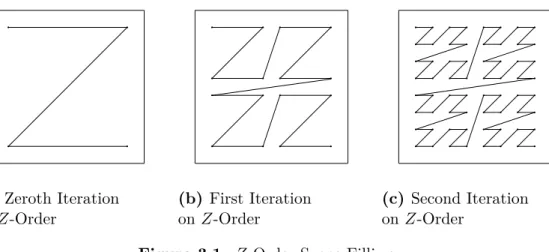
Z-order or Morton order is a space filling curve, whose different iterations can be computed as shown in Figure 3.1. As the number of iterations in-creases, the space can be filled with higher accuracy. One important property of Z-order curve is that, it preserves the locality of data points in the space. Therefore, Z-order is a frequently used approach for mapping multidimen-sional data into one dimenmultidimen-sional space and still supports operations such as comparison and similarity check after the mapping. Here, we formalize our terminology for the Z-order curves.
Definition 1 (Iteration on Z-Order Curve) The lth iteration of the Z
-order curve in δ-dimensional space is a set of2δl
sub-(a) Zeroth Iteration on Z-Order (b) First Iteration on Z-Order (c) Second Iteration on Z-Order
Figure 3.1: Z-Order Space Filling
curve is composed of points whose coordinates have the samelmost significant
bits.
Figure 3.1 illustrates the Z-order sub-curves for different iterations on the original curve.
Definition 2 (Z-Shape of Order l) AZ-shape of orderlinδ-dimensional
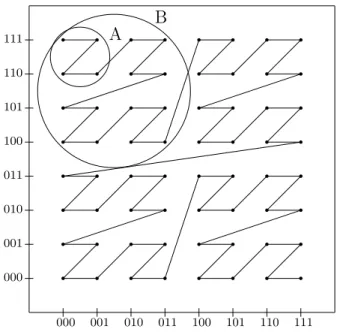
space is any of theZ-order sub-curves in anlthiteration of theZ-order curve. Intuitively, each sub-curve in an iteration on a Z-order curve is a Z-shape. For instance, the circles labeled as Aand B in Figure 3.2 enclose the second and first order Z-shapes, respectively.
Definition 3 (Z-Value) The Z-value of a data point in the
multidimen-sional space is obtained by interleaving the bits of binary representation of the data point coordinate values.
Points in theδ-dimensional space are represented with scalars (i.e.,Z-value), which preserve their locality in such a way that similarity and comparison between points can be calculated. For instance, the point (110,001) in the Z-shape of order 2 in Figure 3.2 is mapped to Z-value of 101001. In summary,
000 001 010 011 100 101 110 111 000 001 010 011 100 101 110 111 A B
Figure 3.2: Data Points onZ-Order Curve
the Z-value of a point in multidimensional space is simply a scalar that can be used in various applications. In the literature [10, 27, 28], the Z-value is used to find the k-nearest neighbors in spatial data sets.
A document represented by a vector of tf-idf values can be viewed as a point in the multidimensional space of terms. Then, the Z-order mapping can be used to map a document into one dimensional space by preserving the locality of the document in the multidimensional space. Consequently, it will be possible to compute the similarity of documents using their Z-values. For instance, in the two-dimensional space in Figure 3.2 (i.e., δ= 2), the circle A denotes a Z-shape of the second order while the one denoted by B is a Z-shape of the first order. The points in the Z-shape A are (000,110), (000,111), (001,110), and (001,111). Their corresponding Z-values, namely (010100), (010101), (010110), and (010111), have the same prefix of (0101). Similarly, theZ-values of the points inB share the prefix (01). From this, we
can conclude that the points on a Z-shape of larger order (i.e., which share a longer prefix) are closer. The common prefix in Z-values of the points can be used to calculate the similarity of documents (i.e., closeness in the multidimensional space), where the coordinates of the points are the tf-idf values of the corresponding terms in the documents.
The next example demonstrates a technique that uses the Z-order map-ping to obtain the most important terms in a document. Let λ·δ be the number of prefix bits shared in the same Z-shape, where δ is the number of terms in the dictionary T (i.e., the dimension of the document space) and λ is an accuracy parameter chosen appropriately.
Example 2 Recall that in Example 1, we have the following term vectors
for three documents, where δ = 10 a= (0,8,5,0.25,0.125,0,0.02,0,0,0.1) b = (0.5,9,4,0,0,0.125,0,0,0,0) c= (9,0.2,7,0,0.04,1,0.5,1,0,7).
In order to represent all the tf-idf values, we need four and three bits to represent their integer and fractional parts, respectively. Thus, we need 7
bits in total for the tf-idf values. However, by setting λ = 3 at the expense
of losing precision, we get the prefix values of the term vectors shown in the following table.
Doc a Z-Order itera-tion t1 t2 t3 t4 t5 t6 t7 t8 t9 t10 1st iteration pre-fix 0 1 0 0 0 0 0 0 0 0 2nd iteration prefix 0 0 1 0 0 0 0 0 0 0 3rditeration pre-fix 0 0 0 0 0 0 0 0 0 0 Doc b Z-Order itera-tion t1 t2 t3 t4 t5 t6 t7 t8 t9 t10 1st iteration pre-fix 0 1 0 0 0 0 0 0 0 0 2nd iteration prefix 0 0 1 0 0 0 0 0 0 0 3rditeration pre-fix 0 0 0 0 0 0 0 0 0 0 Doc c Z-Order itera-tion t1 t2 t3 t4 t5 t6 t7 t8 t9 t10 1st iteration pre-fix 1 0 0 0 0 0 0 0 0 0 2nd iteration prefix 0 0 1 0 0 0 0 0 0 1 3rditeration pre-fix 0 0 1 0 0 0 0 0 0 1
This is natural since a and b are very similar as shown in Example 1. In Chapter 4, we first develop an efficient method to find similar docu-ments such that, cosine similarity between two docudocu-ments is computed only if they are in the sameZ-shape of theλ-th order; i.e., having the sameλδbits as prefix in theirZ values. On the other hand, this method, which eliminates the need of calculating the cosine similarity between many dissimilar docu-ment pairs and therefore yields a very efficient impledocu-mentation, can only be applicable in cases where highly similar documents exist. If the data set does not contain sufficiently many (i.e., k) highly similar documents, it is required to also consider the documents that do not reside in the same Z-shape of λ order.
For similar documents that do not reside in the sameZ-shape of the de-sired order, we propose a slightly different method, in which only documents that contain common important terms (i.e., that have high tf-idf values) will be compared. In other words, if two documents contain at least one im-portant term in common, their cosine similarity is calculated, otherwise the computation is skipped.
Definition 4 (l-th Iteration Projection) Letdi = (di1, . . . , diδ)be a
doc-ument represented in δ-dimensional space of term tf-idf values. Let also dl ij
denote the most significant l-bits of the values dij for j = 1, . . . , δ. Then
we can define the projection of the vector di to l-th iteration on the Z-order
curve as ¯ dl ij = dij, if d l ij >0 0, otherwise, for j ∈ {1, . . . , δ}.
The projection takes already a sparse vector di and generates an expectedly much sparser vector of term tf-idf values, ¯di. We check the new vector, having only the important terms as non-zero elements, to see whether it represents the document with a sufficiently high accuracy.
In the proposed method, we start with 1-st iteration projection ¯di1 of document, for which we try to find similar documents, and compute the similarity, Sc(di,d¯1
i). If the similarity is larger than a predefined similarity threshold σ, namely Sc(di,d¯1i)> σ, then we use 1-st iteration projections of the two documents to decide to compute their cosine similarities.
If Sc(di,d¯1
i) < σ, then we use a higher level projection ¯di l
with l > 1, where l is the minimum value that satisfies the threshold σ. Then, we com-pute Sc(di, dj) of two documents di and dj only if ¯dl
i and ¯dlj have at least one common non-zero term. The following example illustrates the proposed technique.
Example 3 Let the threshold and the precision parameters be set as, σ = 0.8 and λ = 3, respectively. Also let the data set has the following three
documents with δ= 13,
a= (0,27,17,0,5,9,0,11,6,11,0,13,14) b = (0,27,21,0,0,0,15,0,5,0,0,6,10) c= (0,0,0,29,0,0,16,0,0,0,4,0,5).
Using the first and second iteration projections, we can obtain the following vectors for the document a,
¯
a1 = (0,27,17,0,0,0,0,0,0,0,0,0,0) ¯
The corresponding cosine similarities are computed as
Sc(a,¯a1) = 0.7590,
Sc(a,¯a2) = 0.8955.
As can be observed, the second iteration projection ¯a2 satisfies the given
threshold. Therefore, documents whose2nd iteration projections do not share
any term with¯a2 (i.e., that have a zero tf-idf score for the corresponding terms
that appear in ¯a2), will be filtered out and their cosine similarities will not be
computed. Note that, a¯2 has seven nonzero terms as opposed to nine nonzero
terms in the original vector a, which potentially eliminates unnecessary
sim-ilarity comparisons.
Here,Sc(b, a)is computed since¯b2 and ¯a2 have common terms. However,
Sc(c, a) is not computed since ¯a2 and ¯c2 do not share any common term.
Although a and chave a common term (i.e., the last term), it is omitted due
to its low tf-idf value in c. Indeed, the document b is much closer to a as the
following cosine similarities of the original documents indicate
Sc(a, b) = 0.8045,
Sc(a, c) = 0.0493.
The selected λ value which is used to improve the accuracy is a data set
dependent, and should be determined experimentally. The methods that are briefly introduced in this section, will be formalized in Chapter 4.
3.4
Locality Sensitive Hashing (LSH)
The main principle of locality sensitive hashing is to represent arbitrary length features of data items in constant sized sets that are called signatures. The idea is to hash each feature set Fi into a constant size (and preferably small) signature that can represent the similarity accurately. Signatures pro-vide an approximation for measuring the similarity between two data items and the accuracy of the approximation is directly related with the length of the signatures such that, the longer the signature the more accurate the result. However, while very small signatures are sufficient for detection of either almost identical or totally unrelated stuff, relatively longer signatures are required for similarities in between.
The goal of LSH functions is that, for inputs with high similarity, the hash functions should provide the same output with high probability and provide different output with high probability otherwise. Note that, this principle is completely different from the principle of cryptographic hash functions, where finding two different inputs that provide the same output is very difficult.
The signatures are represented as sets. A well known metric for repre-senting the similarity between two sets is the Jaccard similarity.
Definition 5 (Jaccard Similarity) Let A and B be two sets, the Jaccard
similarity of A and B is defined as in Equation (3.1).
Js(A, B) = |A∩B|
|A∪B|. (3.1)
The elements of signatures are constructed using MinHash functions [29] which is defined as follows.
Definition 6 (MinHash) : Let ∆be a set of elements, P be a permutation
on ∆ and P[i] be the ith element in the permutation P. MinHash of a set D⊆∆ under permutation P is defined as:
hP(D) = min({i|1≤i≤ |∆| ∧P[i]∈ D})
Each data element signature is generated by λ MinHash functions each applied with a different randomly chosen permutation. The resulting signa-ture for a data set element D is:
Sig(D) = {hP1(D), . . . , hPλ(D)}, (3.2)
where hPj is the MinHash Function under permutationPj.
The MinHash functions are used while generating the signatures since there is a perfect correlation between the Jaccard similarity and MinHash functions. The probability that MinHash functions provide the same output for two inputs A and B is equal to the Jaccard similarity between A and B as shown in the Equation (3.3).
P r[h(A) =h(B)] = Js(A, B) = |A∩B|
|A∪B|. (3.3)
As MinHash functions with different permutations provide independent ex-periments, using longer signatures (i.e., larger λ) provides more accurate results.
3.5
Hadoop and MapReduce Framework
Currently, the MapReduce programming model became a common model for parallel processing. MapReduce employs a parallel execution and
coor-dination model that can be used to manage large-scale computations over massive data sets [29, 30]. The Hadoop framework [31] is a well known and widely used MapReduce parallel processing framework. It works on a clus-ter of compuclus-ters called cloud. The Hadoop framework works utilizing the MapReduce programing modeling.
The Hadoop framework contains two main parts, namely Hadoop Dis-tributed File System (HDFS) and NextGen MapReduce (YARN). The files are stored in the HDFS, which is a special distributed file system. YARN or MapReduce 2.0 is a system that facilitates writing arbitrary distributed processing frameworks and applications of large data sets.
Data replication is one of the key factors that improves the effectiveness of the Hadoop framework, that survives node failures while utilizing huge num-ber of cluster nodes for data intensive computations. The MapReduce model is successfully implemented in the Hadoop framework as the details of the network communication, process management, interprocess communication, efficient massive data movement and fault tolerance are transparent to the user. Typically, a developer needs to provide only configuration parameters and several high-level routines.
The Hadoop framework is used by most of the major actors including Google, Yahoo and IBM, largely for applications involving search engines and large-scale data processing (e.g., big data applications).
The MapReduce model is based on two functions,Map and Reduce. The Map function is responsible for assigning a list of data items, represented as key-value pairs to cluster nodes. The Map function receives key-value pairs, and sends the result as intermediate data to the reducer. The Reducer function gets the mapped data and applies the processing operation. It receives the intermediate data as a key and a list of values as (key,[values]).
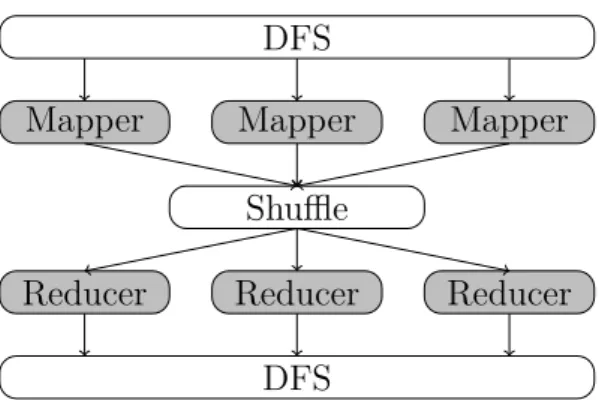
Reducer Reducer Reducer DFS
Shuffle
Mapper Mapper Mapper
DFS
Figure 3.3: MapReduce Job Execution
The signature of these two functions are
map:(k1,v1)→ [(k2,v2)]
reduce:(k2,[v2])→[(k3,v3)].
The shuffling process, between the Map and Reduce functions as illustrated in Figure 3.3, is responsible for designating all keys with the same value to the same computation node. The reducer do the desired operations for records sharing a common property and send the final result to user. Figure 3.3 shows the working principle of MapReduce.
3.6
Hash-based Message Authentication Code
(HMAC)
Hash-based message authentication code known as HMAC is one of the pop-ular deterministic hashing functions used in cryptography [32]. It is used for constructing a fixed size message authentication code using a secret cryp-tographic key. The crypcryp-tographic strength of the HMAC depends upon the cryptographic strength of the underlying construction (e.g. a crypto-graphic hash function), the lengths of its output, and the secret key. In
Chapters 6 and 7, we use SHA-based HMAC functions for the document signatures. HMAC function can be calculated using the following formula
HM AK(K, m) =H((K⊕opad)||H((K⊕ipad||m)),
where H can be a cryptographic hash function, opad is the outer padding, ipad is the inner padding, K is a secret key appropriately padded, andm is the message, data or document.
Chapter 4
EFFICIENT DOCUMENT
SIMILARITY SEARCH
UTILIZING Z-ORDER
PREFIX FILTERING
This chapter proposes a new, efficient document similarity search algorithm [33]. The algorithm uses a new document filtering technique utilizing the prefixes obtained via Z-order space-filling curves as explained previously. The pre-fix in this algorithm filters the documents that do not share only important terms. The subsequent sections in this chapter describe the algorithm and present comparison with another technique in the literature. The proposed algorithm shows a desired improvement in the time performance. Last sec-tion contains accuracy evaluasec-tion for the new algorithm.
4.1
Introduction
There is an ever-increasing demand for efficient and scalable tools that can analyze and process immense amount of, possibly unstructured, data, which keeps increasing in size and complexity. Finding similarities (or duplicates) among multiple data items, or documents, is one of the fundamental oper-ations, which can be extremely challenging due to the nature of big data. In particular, similarity search on a huge data set, where the documents are represented as multi-dimensional feature vectors, necessitates pair-wise com-parisons, which requires the computation of a distance metric, and therefore can be very time and resource consuming, if not infeasible.
A commonly used technique, known as filtering, decreases the number of pairwise comparisons by skipping the comparison of two documents if they are not potentially similar; e.g., they do not share any common feature. Also, representation, storage, management and processing of documents play an important role in the performance of a similarity search method. A dis-tributed file system and a parallel programming model such as MapReduce [4] are necessary components of a scalable and efficient solution in big data ap-plications.
This work focuses on the general problem of detecting thek-most similar documents for each document within a given data set (henceforth self join), and between two arbitrary sets of documents (R-S join), namely query set and data set. The problem is formalized as follows.
Definition 7 (R-S Join Top-k Set Similarity) Let D be a set of
docu-ments {d1, . . . , dn}, di ∈ D. Let Q be a set of query documents {q1, . . . , qm},
qj ∈ Q. Then R-S top-k set similarity is defined as:
where dji is the ith nearest record to qj in D.
Definition 8 (Self Join Top-k Set Similarity) Let D be a set of docu-ments {d1, . . . , dn}, di ∈ D. Then self join top-k set similarity is defined
as:
∀dj ∈ D, top-k(dj,D) = {dj1, . . . , djk},
where dji 6=dj is the ith nearest record to dj in D.
Intuitively, the self join case is the generalization of the R-S join case such that Q=D.
The trivial solution for the set similarity problem, for two sets of items
Q and D, is to compare each element in Q with each element in D. This solution has O(δmn) complexity, wheremand nare the number of elements in Q and D respectively, and δ is the number of dimensions (i.e., features) in Qand D. Recent trends and research are concerned about computing set similarity-join algorithms in an efficient and high performance manner, hence new set similarity-join algorithms that reduce the number of comparisons are proposed.
Current research mainly adapts filtering techniques that filter out pairs that have similarity below a given threshold. Clearly, the adopted filtering technique plays the utmost role in the efficiency as well as the effectiveness of a similarity search algorithm. In this work, we propose a new cosine simi-larity based filtering technique to improve the performance of the simisimi-larity calculation.
In our solution, we suggest a new Z-order based filtering technique in order to eliminate dissimilar documents before performing the costly op-eration of calculating the cosine similarity. Documents in a data set are represented as points on Z-order space filling curves on multidimensional
space of documents’ features. A projection based on the most important features of documents is utilized to filter out dissimilar documents that do not share common important features. The proposed method also filters out documents that only share features of low importance, which have very little effect on the similarity between the data objects. The technique provides a remarkable improvement, especially on finding highly similar documents very quickly. And finally, we describe the algorithms to implement the proposed technique as parallel programs that can take advantage of the Hadoop [31] MapReduce parallel programming framework.
The rest of the chapter is organized as follows. The details of the pro-posedZ-order with Lambda Iteration Prefix (ZOLIP) filtering algorithm are explained in Section 4.2. Section 4.3 presents the experimental results that show the accuracy and the efficiency of the proposed method. Finally, the conclusions are provided in Section 4.4.
4.2
The Proposed Filtering Method
In this section we explain the proposed techniques of theZ-order with Lambda Iteration Prefix (ZOLIP) filtering algorithm. The algorithm has three phases. In the first phase, the ZOLIP algorithm considers the document vectors that lie on the sameZ-shape ofλ order in theZ-order curve. In other words, this phase is designed to find highly similar (i.e., near duplicate) documents in the data set. If this phase cannot findk documents, the second phase consid-ers the documents that are on different Z-shapes. In the second phase, the algorithm finds the most important terms in the queried document such that any document that does not contain any of those important terms, cannot be in the top k similar list of the queried document. Then the similarities
with the documents sharing important terms are calculated. Finally, the last phase performs the actual join operations such that the outputs of the first and the second phases are combined and sorted to find the top k similar list of the queried document.
4.2.1
Phase 1: Near-Duplicate Detection (NDD)
Initially, the first phase reads each document record that is composed of a key/value pair. While the key represents a unique document id, the value holds a vector which contains the tf-idf values of the terms of the correspond-ing document. Instead of the classical vectors, sparse vector representation is used for improving the performance and easing memory requirements as most of the vector elements are zero.
Sparse vector is a data structure that stores only the none-zero entries together with corresponding index values. We assume that the number of dimensions (δ), the number of iterations on the curve (λ) and the maximum tf-idf value (µ) in the whole data set are publicly known and passed as a configuration parameter to the map function in the proposed method, which is described in Algorithm 1. Note that, the operations over sparse vectors are optimized even though the algorithm descriptions are given in classical forms. For instance, theforloop in Steps 4-6 in Algorithm 1 is only executed
for non-zero tf-idf values.
The map function in Algorithm 1 receives the tf-idf scores of each doc-ument in the data set D, its id, docId, the maximum tf-idf value µ, the dimension δ, and the precisionλ for tf-idf values.
The “bitLength” function (Step 2) returns the bit length of the binary representation for the maximum tf-idf value (µ). Then, the method goes over the coordinate values and normalizes them so that they are represented
Algorithm 1 Near-Dupplicate Detection(NDD)
1: procedure Map(docId, d, µ, δ, λ)
2: γ ←bitLength(µ) 3: ZOLIP ←null 4: forj = 1 to δ do 5: d[j]←N ormalize(d[j], γ) 6: end for 7: forl= 1 to λ do 8: forj = 1 to δ do 9: bit←getBit(d[j], l) 10: ZOLIP ←ZOLIP||bit
11: end for
12: end for
13: sendT oReducer(ZOLIP,hdocId :di)
14: end procedure
. listDOC contains the documents with the same ZOLIP key
15: procedure Reduce(ZOLIP, {hdocId:di} )
16: for all di ∈listDOC do .for each document in listDOC
17: ksimi ←null
18: for all docj ∈listDOC and i6=j do
19: ksimi ←f indT KSD() .compute similarity and sort
20: end for
21: end for
22: return ∀i (hdocIdi :di,h{hksimi,Sci},(yes/no)i)
with the number of bits used for the maximum tf-idf value (Step 5). The “Normalize” function gets the bit length of each coordinate tf-idf value and finds the difference (dif) between the number of bits of the maximum tf-idf and the tf-idf of the current coordinate, and pads (dif)-many zero bits to the left of the actual coordinate value to make all the tf-idf values represented with the same number of bits.
Then, the map function extracts the bits of the normalized tf-idf value of each term starting from the most significant bit using the function “getBit” (Step 9), which returns the l-th most significant bit. This operation will be repeated for each of the λ bits of the tf-idf scores. At each iteration, the mapper interleaves the extracted bit and concatenates it to a ZOLIP key (Step 10), which is a sparse vector that represents the none-zero bits in the Z-value.
The key/value pair sent to the reducer is composed of the ZOLIP key and the list of document identifiers and their tf-idf scores as in
(ZOLIP key,hdocId :di).
All the documents that have the sameZOLIP key are grouped by the shuffle process and sent to the reducer instances.
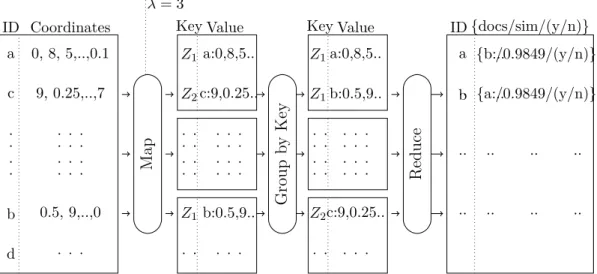
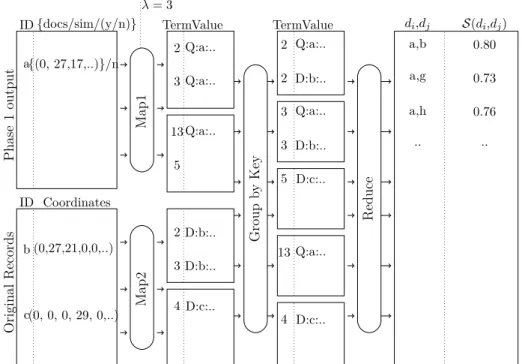
The reducers receive the list of documents that have the same ZOLIP key and calculates the cosine similarity between these records to find the top-k similar documents for each document. The function “findTKSD” (which stands for “find top-k similar documents”) calculates the similarity between documents and sorts the documents depending on their similarity. Then, it selects the top-k similar documents and saves them in a sorted list “ksimi”. Figure 4.1 illustrates an example, in which the mapper creates the ZOLIP keysZ1, for documents “a” and “b” andZ2 for document “c”. Then, it passes
λ= 3
ID Coordinates Key Value Key Value ID{docs/sim/(y/n)}
M ap G ro u p b y K ey R ed u ce d c . . . . b a 0, 8, 5,..,0.1 0.5, 9,..,0 . . . . . . . . . . . . 9, 0.25,..,7 . . . Z1 Z1 . . . . . . . . Z2 . . a:0,8,5.. b:0.5,9.. . . . . . . . . . . . . c:9,0.25.. . . . a:0,8,5.. b:0.5,9.. . . . . . . . . . . . . c:9,0.25.. . . . Z1 Z1 . . . . . . . . Z2 . . a {b:../0.9849/(y/n)} b {a:../0.9849/(y/n)} .. .. .. .. .. .. .. .. ..
Figure 4.1: An Example Execution of ZOLIP Phase 1
the same ZOLIP key, and compares these documents to find the top-ksimilar documents.
The reduce function returns the records in the format (hdocIdi :di,h{hksimi,Sci},(yes/no)i).
Here, the first element is the key of the record (i.e., the identifier of the doc-ument that we intent to find its k-similar documents). The second element, which is the value of the record, contains two parts. The first part is a list that contains the top k-similar document identifiers with their correspond-ing similarity values as (Sc). The second part (i.e., (yes/no)) is an indicator that shows whether the top-k similar documents are found or not. If k sim-ilar documents are found in this step, no further search is applied for this document. Otherwise, further search in a different Z-shape is required.
Algorithm 1 represents the pseudo code based on the MapReduce pro-gramming model. The algorithm can be used both for self-join and R-S join operations. Algorithm 1 is described for self-join operation, in which we find k similar documents for every document in the data set. In R-S join operation, documents should be labeled as query documents and data set
documents. Consequently, in Step 16 of Algorithm 1 only documents in the query set should be considered while Step 18 should use the documents in the data set.
The NDD phase is expected to find k similar documents for a relatively large number of documents without further computations needed for them. While this reduces the overall complexity of the top-k similarity search, fur-ther computation is needed for the documents, for whichksimilar documents are not found. To this end, we propose a method based on common important terms to complete the computation for the remaining part of the database.
4.2.2
Phase 2: Common Important Terms (CIT)
Some documents, although similar, may reside in different Z-shapes. In or-der to calculate the similarity between two such documents, we stipulate that they share at least one important (i.e., high tf-idf valued) term. We, there-fore, propose utilizing only the most important terms to eliminate similarity computation for the distant documents. Note that the probability of two documents, that do not share any important term, being in the top-ksimilar documents of each other is very low.
The common important terms (CIT) phase contains two mapper and one reducer functions. The first mapper function reads the output of the NDD phase to check the (yes/no) value for a document. If k similar documents are not found for the document, the second phase, common important terms (CIT), utilizes the l-th iteration projection in Z order curves to determine the important terms in the document that will be used to filter out dissimilar documents.
The first mapper (the procedure MAP1() in Algorithm 2) computes the projection ¯d1
impor-Algorithm 2 Common Important Terms(CIT)
1: procedure Map1(docId,h{hksimilar,Sci},(yes/no)i, λ, µ)
2: . this mapper reads the output of phase 1
3: if (yes/no) = no then
4: d¯0i ←createEmptyV ec()
5: sim←0
6: forl = 1 to λ ANDsim < σ do
7: . λ is the number of bits in tf-idf scores
8: d¯l i ←P roject(di, l) 9: sim← Sc(di,d¯l i) 10: end for 11: forj = 1 to δ do 12: if d¯l ij 6= 0 then 13: term←d¯l ij 14: sendToReducer(term,hQ:docId, dii) 15: end if 16: end for 17: end if 18: end procedure
19: procedure Map2(docId, di)) .It reads the data set documents and functions exactly as the first mapper.
20: sendToReducer(term,hD:docId, dii)
22: procedure Reduce(term,{h(Q/D) :docId, dii})
. Documents will be partitioned into query and data sets
23: QList←null
24: DList←null
25: for all di do
26: if di is a query document then
27: addQList(di)
28: else
29: addDList(di)
30: end if
31: end for
32: for all di ∈Qlist do
33: candidatesi ←null
34: for all dj ∈Dlist do
35: candidatesi ←docIdDj
36: end for
37: fordj ∈candidatesi do
38: return (hdocIdi :docIdji,Sc(di, dj))
39: end for
40: end for
tant terms in the document. Then, the similarity between ¯d1
i and the original vector di will be calculated. If the similarity threshold is satisfied, namely
Sc(di,d¯1
i)≥ σ, the terms in ¯d1i are sent to the reducer. Otherwise, a higher degree projection ¯dl
i is calculated to satisfy the threshold.
Here, MAP1() creates a key-value pair for each important term, in which the term is used as a key, and the vector di and the document id are con-sidered as the value of the pair. In other words, the original record for the document is replicated as many times as the number of important terms in the projection ¯dl
i. In order to distinguish the documents in the query set from the documents in the data set (the latter will be processed by the sec-ond mapper MAP2() function), a prefix “Q:” is added in the value part of the pair. The resulting record is of the format, (term,hQ:docId:dii).
Using the setting given in Example 3, Figure 4.2 illustrates an example execution of the CIT algorithm steps for finding similar documents that have common important terms. Note that, in the mapper stage, the term indices that are exposed to the reducer correspond only to the terms with high importance (i.e., the terms that appear in ¯a2).
The second mapper, (the procedure MAP2() in Algorithm 2), performs the same operations as the first mapper, but this time on the data set docu-ments, with the only difference that, the prefix “D:” is added instead of “Q:”. The resulting record format is of the form (term,hD:docID :dii). As in the case of the document in the query set, MAP2() creates as many new records as the number of important terms for the corresponding document.
The reducer in this phase receives the key value pairs from the first and the second mappers. Then, it partitions the records into two sets, Qlist and Dlist, depending on whether the document is in the query or in the data set. The first mapper returns the important terms in the query documents
com-λ= 3 ID{docs/sim/(y/n)} ID Coordinates TermValue TermValue di,dj S(di,dj) O ri gi n al R eco rd s Ph ase 1 ou tp u t M ap 2 M ap 1 G ro u p b y K ey R ed u ce a{(0, 27,17,..)}/n Q:a:.. Q:a:.. Q:a:.. b (0,27,21,0,0,..) c(0, 0, 0, 29, 0,..) 2 D:b:.. 3 D:b:.. 13 5 4 3 2 D:c:.. 2 2 3 3 5 13 4 D:c:.. Q:a:.. D:c:.. D:b:.. Q:a:.. D:b:.. Q:a:.. a,b a,g a,h .. 0.80 0.73 0.76 ..
Figure 4.2: An Example Execution of ZOLIP Phase 2
bined with their coordinates, while the second mapper returns the important terms in data set documents combined with their coordinates. The reducer creates two partitions. The partition can easily be done by checking the pre-fixes in the value part, Q and D. Consequently, for every document in the query and data set, the reducer stores them in Qlist andDlist, respectively. The last stage of the reducer calculates the similarity betweendi ∈Qlist and dj ∈Dlist. Then, the identifiers ofdi and dj are combined to form a key for the pair in which the value is Sc(di,dj). Consequently, the final output of this phase is of the form, (hdocIdi :docIdji, Sc(di,dj)), where di and dj represent the documents in the query set and the data set, respectively. Figure 4.2 visualizes all the steps on the setting from Example 3.
4.2.3
Phase 3: Join Phase(JP)
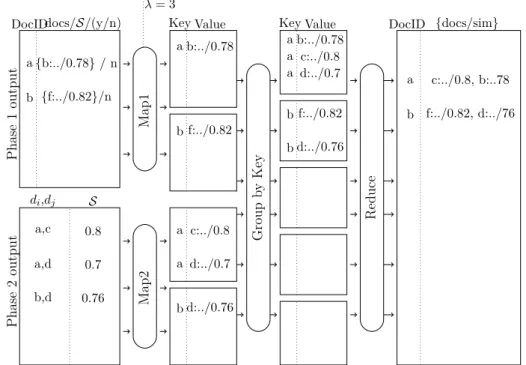
In the join phase (steps are described in Algorithm 3), in order to find the actual top-k similar documents, the join operation is applied on the results from the first and the second phases. This phase contains two mappers. The first mapper receives the output from the first phase and sends one key-value pair to the reducer for each document in the list ksimi, in whichdocId is the key and the tf-idf score vector of the document in ksimi is the value. Thus, the output of the first mapper is of the form, (docIdQ,hdocIdD:Sci).
The second mapper also works in a similar way. It receives the pair, where the key is the similar document identifiers hdocIdD, docIdQiand the value is the corresponding similarity. The mapper parses the docIdQ and docIdD. After this step, it exposes thedocIdQas a key andSc prefixed with docIdD as a value. The output of this mapper is also of the form, (docIdQ,
hdocIdD :Sci).
The last step in the algorithm is to get all the candidate documents and select the top-k similar documents among them. The reducer receives the docIdQ key from the previous mappers and a list of documents that con-tain the same key (i.e term) as the value. Here, the list is sorted and the first k documents with the highest similarity values are considered as the top-k similar documents. The final result of this reducer is of the form, (docIdQ,{hdocIdD :Sci}). Figure 4.3 visualizes the Join phase of the out-puts of Examples 2 and 3, where the details are given in Algorithm 3.
λ= 3
di,dj S
DocIDdocs/S/(y/n) Key Value Key Value DocID {docs/sim}
Ph ase 2 ou tp u t Ph ase 1 ou tp u t M ap 2 M ap 1 G ro u p b y K ey R ed u ce a{b:../0.78}/ n b {f:../0.82}/n a,c a,d b,d 0.8 0.7 0.76 a b:../0.78 b f:../0.82 a c:../0.8 a d:../0.7 b d:../0.76 a b:../0.78 a c:../0.8 a d:../0.7 b f:../0.82 b d:../0.76 a c:../0.8, b:..78 b f:../0.82, d:../76
Figure 4.3: An Example Execution of ZOLIP Phase 3
Algorithm 3 Join Phase
procedure Map1(docId,hhksim,Sci,(yes, no)i)
. this mapper will reads phase 1 output docIdQ ←docId
for all docIdD ∈ksim do
sendT oReducer(docIdQ,hdocIdD:Sci) end for
end procedure
procedure Map2(hdocIdQ :docIdDi,Sc))
. this mapper will reads phase 2 output sendT oReducer(docIdQ,hdocIdD :Sci)
end procedure
procedure Reduce(docIdQ,{hdocIdD,Sci}) topK ← Sort(docIdD,Sc)
expose(docIdQ,topKSimilar) end procedure
4.2.4
R-S Join
The R-S join is used to find k most similar documents for a batch of query documents, which are not a part of the data set. The algorithms given above are described mostly for self join operation that finds topksimilar documents for every document from the same data set. In order to adapt the proposed algorithms for R-S join operations, we need to label documents with “Q:” and “D:”. Also, several simple modifications are necessary to the algorithm steps. As the modifications are only minor and straightforward, we do not include separate algorithms for R-S join operations.
The time complexity of the R-S join depends on the number of documents in the query set and an R-S join usually requires much less time than the self join since the number of the queried documents is expected to be much lower than the number of documents in the data set. We analyze the effect of the query size by testing the algorithm on queries with various number of documents in the next section.
4.3
Experiments
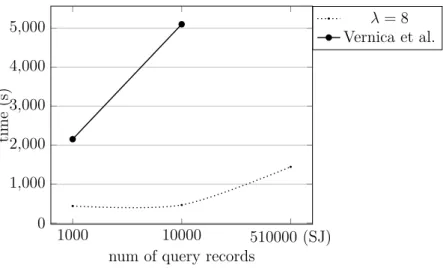
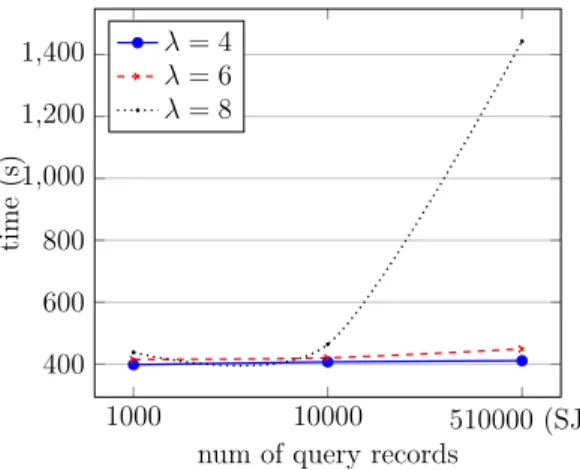
In this section, we first describe the system model and the data sets used in our experiments. Then, we compare the proposed method with the method by Vernica et al. [1]. The proposed method is tested with different param-eter settings to show its efficiency and scalability in the big data context. Finally, we discuss the accuracy of our method and the effect of increasing λ parameter on its accuracy and efficiency.
4.3.1
Setup and Data Description
We used the Cloudera CDH4 installation with a 3-node cluster: Two nodes with Xeon processor E5-1650 3.5 GHz of 12 cores, 15.6 GB of RAM and 1 TB hard disk; and one node with Core i7 3.07 GHz of 8 cores, 15.7 GB of RAM and 0.5 TB hard disk.On each node, Ubuntu 12.04 LTS, 64 -bit operating system is installed and Java 1.6 JVM is used. We used the default Cloudera DFS block size (i.e., 128 MB), so the data is partitioned into 128 MB blocks and a mapper is assigned to each block. As the system is assumed to have no a priori knowledge about the size of the queries, no additional partition is applied before assigning data blocks to mappers. Note that, the data and the query sets are stored in different data blocks in the DFS.
The outputs of the mappers are sent to the reducer directly without any additional combiner function. Note that, query elements labeled with “Q” are compared with data elements labeled with “D”. As the types of the outputs of query and data mappers are different, aggregate calculations using combiner operation after mapping are not possible.
In our experiments, we used primarily the Enron data set [34] which is a data set of real e-mail files. The data set consists of 510,000 e-mail files, which is equivalent to a total of 2,686,224 KB data. The size of the files are ranged from 4 KB to 2 MB. First, the data is cleaned from the mail headers and stop words. The terms are stemmed to their roots using the snowball stemmer included in the Lucene [35], which is an open source library for information retrieval. We, then, calculated the tf-idf values of each term in each file. Finally, we created the sparse vectors of tf-idf values, which represent the documents. For the Enron data set, the resulted sparse vectors have 30,000 dimensions (i.e., terms) with an average density of 160/30,000. The density is defined as the ratio of the number of terms with non-zero