An OMG® Executable UML® Publication
Semantics of a Foundational Subset for
Executable UML Models (fUML)
Version 1.5 – Beta
__________________________________________________
OMG Document Number: ptc/2020-05-10
Date: May 2020
Normative reference:
https://www.omg.org/spec/FUML/1.5
Machine readable file(s):
Normative:
https://www.omg.org/spec/FUML/20200501/fUML_Syntax.xmi
https://www.omg.org/spec/FUML/20200501/fUML_Semantics.xmi
https://www.omg.org/spec/FUML/20200501/fUML_Library.xmi
Copyright © 2012 88Solutions Copyright © 2012 Atego
Copyright © 2008-2010 California Institute of Technology. United States Government sponsorship acknowledged Copyright © 2005-2010 CARE Technologies, S.A.
Copyright © 2017-2020 Commissariat à l’Energie Atomique et aux Energies Alternatives (CEA) Copyright © 2005-2020 Model Driven Solutions
Copyright © 2005-2012 IBM
Copyright © 2005-2010 Kennedy Carter Ltd.
Copyright © 2005-2012 Lockheed-Martin Corporation Copyright © 2005-2012 Mentor Graphics Corporation Copyright © 2008-2020 Object Management Group, Inc. Copyright © 2012 NexJ Systems
Copyright © 2012 No Magic Copyright © 2012 Sparx Systems
USE OF SPECIFICATION - TERMS, CONDITIONS & NOTICES
The material in this document details an Object Management Group specification in accordance with the terms, conditions and notices set forth below. This document does not represent a commitment to implement any portion of this specification in any company's products. The information contained in this document is subject to change without notice.
LICENSES
The companies listed above have granted to the Object Management Group, Inc. (OMG) a nonexclusive, royalty-free, paid up, worldwide license to copy and distribute this document and to modify this document and distribute copies of the modified version. Each of the copyright holders listed above has agreed that no person shall be deemed to have infringed the copyright in the included material of any such copyright holder by reason of having used the
specification set forth herein or having conformed any computer software to the specification.
Subject to all of the terms and conditions below, the owners of the copyright in this specification hereby grant you a fully-paid up, non-exclusive, nontransferable, perpetual, worldwide license (without the right to sublicense), to use this specification to create and distribute software and special purpose specifications that are based upon this specification, and to use, copy, and distribute this specification as provided under the Copyright Act; provided that: (1) both the copyright notice identified above and this permission notice appear on any copies of this specification; (2) the use of the specifications is for informational purposes and will not be copied or posted on any network computer or broadcast in any media and will not be otherwise resold or transferred for commercial purposes; and (3) no modifications are made to this specification. This limited permission automatically terminates without notice if you breach any of these terms or conditions. Upon termination, you will destroy immediately any copies of the
specifications in your possession or control.
PATENTS
The attention of adopters is directed to the possibility that compliance with or adoption of OMG specifications may require use of an invention covered by patent rights. OMG shall not be responsible for identifying patents for which a license may be required by any OMG specification, or for conducting legal inquiries into the legal validity or scope of those patents that are brought to its attention. OMG specifications are prospective and advisory only. Prospective users are responsible for protecting themselves against liability for infringement of patents.
GENERAL USE RESTRICTIONS
Any unauthorized use of this specification may violate copyright laws, trademark laws, and communications regulations and statutes. This document contains information which is protected by copyright. All Rights Reserved. No part of this work covered by copyright herein may be reproduced or used in any form or by any means--graphic, electronic, or mechanical, including photocopying, recording, taping, or information storage and retrieval systems--without permission of the copyright owner.
DISCLAIMER OF WARRANTY
WHILE THIS PUBLICATION IS BELIEVED TO BE ACCURATE, IT IS PROVIDED "AS IS" AND MAY
CONTAIN ERRORS OR MISPRINTS. THE OBJECT MANAGEMENT GROUP AND THE COMPANIES LISTED ABOVE MAKE NO WARRANTY OF ANY KIND, EXPRESS OR IMPLIED, WITH REGARD TO THIS
PUBLICATION, INCLUDING BUT NOT LIMITED TO ANY WARRANTY OF TITLE OR OWNERSHIP, IMPLIED WARRANTY OF MERCHANTABILITY OR WARRANTY OF FITNESS FOR A PARTICULAR PURPOSE OR USE. IN NO EVENT SHALL THE OBJECT MANAGEMENT GROUP OR ANY OF THE
COMPANIES LISTED ABOVE BE LIABLE FOR ERRORS CONTAINED HEREIN OR FOR DIRECT, INDIRECT, INCIDENTAL, SPECIAL, CONSEQUENTIAL, RELIANCE OR COVER DAMAGES, INCLUDING LOSS OF PROFITS, REVENUE, DATA OR USE, INCURRED BY ANY USER OR ANY THIRD PARTY IN CONNECTION WITH THE FURNISHING, PERFORMANCE, OR USE OF THIS MATERIAL, EVEN IF ADVISED OF THE POSSIBILITY OF SUCH DAMAGES.
The entire risk as to the quality and performance of software developed using this specification is borne by you. This disclaimer of warranty constitutes an essential part of the license granted to you to use this specification.
RESTRICTED RIGHTS LEGEND
Use, duplication or disclosure by the U.S. Government is subject to the restrictions set forth in subparagraph (c) (1) (ii) of The Rights in Technical Data and Computer Software Clause at DFARS 252.227-7013 or in subparagraph (c) (1) and (2) of the Commercial Computer Software - Restricted Rights clauses at 48 C.F.R. 52.227-19 or as specified in 48 C.F.R. 227-7202-2 of the DoD F.A.R. Supplement and its successors, or as specified in 48 C.F.R. 12.212 of the Federal Acquisition Regulations and its successors, as applicable. The specification copyright owners are as indicated above and may be contacted through the Object Management Group, 109 Highland Avenue, Needham, MA 02494, U.S.A.
TRADEMARKS
CORBA®, CORBA logos®, FIBO®, Financial Industry Business Ontology®, FINANCIAL INSTRUMENT GLOBAL IDENTIFIER®, IIOP®, IMM®, Model Driven Architecture®, MDA®, Object Management Group®, OMG®, OMG Logo®, SoaML®, SOAML®, SysML®, UAF®, Unified Modeling Language®, UML®, UML Cube Logo®, VSIPL®, and XMI® are registered trademarks of the Object Management Group, Inc.
For a complete list of trademarks, see:http://www.omg.org/legal/tm_list.htm . All other products or company names mentioned are used for identification purposes only, and may be trademarks of their respective owners.
COMPLIANCE
The copyright holders listed above acknowledge that the Object Management Group (acting itself or through its designees) is and shall at all times be the sole entity that may authorize developers, suppliers and sellers of computer software to use certification marks, trademarks or other special designations to indicate compliance with these materials.
OMG’s Issue Reporting Procedure
All OMG specifications are subject to continuous review and improvement. As part of this process we encourage readers to report any ambiguities, inconsistencies, or inaccuracies they may find by completing the Issue Reporting Form listed on the main web page http://www.omg.org, under Documents, Report a Bug/Issue.
Table of Contents
1 Scope... 1
2 Conformance... 1
2.1 General... 1
2.2 Meaning and Types of Conformance...1
2.3 Genericity of the Execution Model...4
2.4 Conformance Statement...5
3 Normative References... 6
4 Terms and Definitions... 6
5 Symbols... 7
6 Additional Information... 9
6.1 Changes to Adopted OMG Specifications... 9
6.2 On the Semantics of Languages and Models... 9
6.3 On the Semantics of Metamodels...11
6.4 Alignment with the OMG Four Layer Metamodeling Architecture...12
6.5 Acknowledgments...14
6.5.1 Submitters... 14 6.5.2 Supporters... 157 Abstract Syntax... 17
7.1 Overview...17
7.2 Syntax Packages... 18
7.3 Common Structure...20
7.3.1 Overview... 20 7.3.2 Constraints... 23 7.3.2.1 MultiplicityElement... 237.4 Values... 23
7.4.1 Overview... 237.5.1 Overview... 24 7.5.2 Constraints... 28 7.5.2.1 BehavioralFeature... 28 7.5.2.2 Feature... 29 7.5.2.3 InstanceSpecification... 29 7.5.2.4 Operation... 29 7.5.2.5 Parameter... 29 7.5.2.6 Property... 29
7.6 Simple Classifiers... 29
7.6.1 Overview... 29 7.6.2 Constraints... 31 7.6.2.1 Reception... 317.7 Structured Classifiers... 31
7.7.1 Overview... 31 7.7.2 Constraints... 33 7.7.2.1 Association... 33 7.7.2.2 Class... 337.8 Packages... 34
7.8.1 Overview... 34 7.8.2 Constraints... 347.9 Common Behavior... 34
7.9.1 Overview... 34 7.9.2 Constraints... 36 7.9.2.1 Behavior... 36 7.9.2.2 OpaqueBehavior... 367.10 Activities...36
7.10.1 Overview... 36 7.10.2 Constraints... 40 7.10.2.1 Activity... 40 7.10.2.2 ActivityEdge... 40 7.10.2.3 JoinNode... 40 7.10.2.4 ObjectFlow... 40 7.10.2.5 ObjectNode... 407.11 Actions... 40
7.11.1 Overview... 40 7.11.2 Constraints... 48 7.11.2.1 AcceptCallAction... 48 7.11.2.2 AcceptEventAction... 49 7.11.2.3 CallBehaviorAction... 49 7.11.2.4 CallOperationAction... 49 7.11.2.5 CreateObjectAction... 49 7.11.2.6 ExpansionNode... 50 7.11.2.7 LoopNode...50 7.11.2.8 Pin... 507.11.2.9 ReadExtentAction... 50 7.11.2.10 ReclassifyObjectAction... 50 7.11.2.11 StartObjectBehaviorAction... 50
8 Execution Model... 51
8.1 Overview...51
8.2 Semantics Packages... 53
8.3 Loci... 55
8.3.1 Overview... 55 8.3.2 Class Descriptions... 60 8.3.2.1 ChoiceStrategy...60 8.3.2.2 ExecutionFactory... 61 8.3.2.3 ExecutionFactoryL1 (Deprecated)... 70 8.3.2.4 ExecutionFactoryL2 (Deprecated)... 70 8.3.2.5 ExecutionFactoryL3 (Deprecated)... 70 8.3.2.6 Executor... 70 8.3.2.7 FirstChoiceStrategy...71 8.3.2.8 Locus... 72 8.3.2.9 SemanticStrategy... 75 8.3.2.10 SemanticVisitor... 758.4 Values... 75
8.4.1 Overview... 75 8.4.2 Class Descriptions... 78 8.4.2.1 Evaluation... 78 8.4.2.2 LiteralBooleanEvaluation... 79 8.4.2.3 LiteralEvaluation...79 8.4.2.4 LiteralIntegerEvaluation... 80 8.4.2.5 LiteralNullEvaluation... 80 8.4.2.6 LiteralRealEvaluation... 81 8.4.2.7 LiteralStringEvaluation... 82 8.4.2.8 LiteralUnlimitedNaturalEvaluation... 82 8.4.2.9 Value... 838.5 Classification...86
8.5.1 Overview... 86 8.5.2 Class Descriptions... 86 8.5.2.1 InstanceValueEvaluation... 868.6 Simple Classifiers... 88
8.6.1 Overview... 88 8.6.2 Class Descriptions... 91 8.6.2.1 BooleanValue... 91 8.6.2.2 CompoundValue... 93 8.6.2.3 DataValue... 968.6.2.7 PrimitiveValue... 103 8.6.2.8 RealValue... 104 8.6.2.9 SignalInstance...106 8.6.2.10 StringValue... 107 8.6.2.11 StructuredValue... 108 8.6.2.12 UnlimitedNaturalValue... 113
8.7 Structured Classifiers...114
8.7.1 Overview... 114 8.7.2 Class Descriptions... 117 8.7.2.1 DispatchStrategy... 117 8.7.2.2 ExtensionalValue... 118 8.7.2.3 Link... 119 8.7.2.4 Object... 122 8.7.2.5 RedefinitionBasedDispatchStrategy... 125 8.7.2.6 Reference... 1268.8 Common Behavior... 128
8.8.1 Overview... 128 8.8.2 Class Descriptions... 134 8.8.2.1 CallEventBehavior...134 8.8.2.2 CallEventExecution... 135 8.8.2.3 CallEventOccurrence... 139 8.8.2.4 ClassifierBehaviorInvocationEventAccepter... 140 8.8.2.5 EventAccepter... 142 8.8.2.6 EventOccurrence... 142 8.8.2.7 Execution... 144 8.8.2.8 FIFOGetNextEventStrategy... 146 8.8.2.9 GetNextEventStrategy... 147 8.8.2.10 InvocationEventOccurrence... 148 8.8.2.11 ObjectActivation... 148 8.8.2.12 OpaqueBehaviorExecution... 153 8.8.2.13 ParameterValue... 154 8.8.2.14 SignalEventOccurrence... 155 8.8.2.15 StreamingParameterListener... 156 8.8.2.16 StreamingParameterValue... 1568.9 Activities...157
8.9.1 Overview... 157 8.9.2 Class Descriptions... 165 8.9.2.1 ActivityEdgeInstance... 165 8.9.2.2 ActivityExecution... 168 8.9.2.3 ActivityFinalNodeActivation... 171 8.9.2.4 ActivityNodeActivation...172 8.9.2.5 ActivityNodeActivationGroup...178 8.9.2.6 ActivityParameterNodeActivation... 185 8.9.2.7 ActivityParameterNodeStreamingParameterListener... 187 8.9.2.8 CentralBufferNodeActivation... 188 8.9.2.9 ControlNodeActivation... 188 8.9.2.10 ControlToken... 188 8.9.2.11 DataStoreNodeActivation... 189 iv Semantics of a Foundational Subset for Executable UML Models (fUML), v1.5 – Beta8.9.2.12 DecisionNodeActivation... 190 8.9.2.13 ExecutableNodeActivation... 197 8.9.2.14 FlowFinalNodeActivation...199 8.9.2.15 ForkedToken... 199 8.9.2.16 ForkNodeActivation... 201 8.9.2.17 InitialNodeActivation...202 8.9.2.18 JoinNodeActivation... 202 8.9.2.19 MergeNodeActivation... 203 8.9.2.20 ObjectNodeActivation...203 8.9.2.21 ObjectToken... 206 8.9.2.22 Offer... 207 8.9.2.23 Token... 209
8.10 Actions... 210
8.10.1 Overview... 210 8.10.2 Class Descriptions... 227 8.10.2.1 AcceptCallActionActivations...227 8.10.2.2 AcceptEventActionActivation... 227 8.10.2.3 AcceptEventActionEventAccepter...230 8.10.2.4 ActionActivation...231 8.10.2.5 AddStructuralFeatureValueActionActivation... 243 8.10.2.6 CallActionActivation... 246 8.10.2.7 CallBehaviorActionActivation... 253 8.10.2.8 CallOperationActionActivation...254 8.10.2.9 ClauseActivation... 255 8.10.2.10 ClearAssociationActionActivation...258 8.10.2.11 ClearStructuralFeatureActionActivation... 258 8.10.2.12 ConditionalNodeActivation... 259 8.10.2.13 CreateLinkActionActivation... 263 8.10.2.14 CreateObjectActionActivation... 265 8.10.2.15 DestroyLinkActionActivation...266 8.10.2.16 DestroyObjectActionActivation... 267 8.10.2.17 ExpansionActivationGroup... 270 8.10.2.18 ExpansionNodeActivation... 272 8.10.2.19 ExpansionRegionActivation... 273 8.10.2.20 InputPinActivation... 281 8.10.2.21 InvocationActionActivation... 284 8.10.2.22 LinkActionActivation... 284 8.10.2.23 LoopNodeActivation... 286 8.10.2.24 OutputPinActivation...292 8.10.2.25 PinActivation... 292 8.10.2.26 PinStreamingParameterListener... 293 8.10.2.27 RaiseExceptionActionActivation...294 8.10.2.28 ReadExtentActionActivation... 295 8.10.2.29 ReadIsClassifiedObjectActionActivation... 296 8.10.2.30 ReadLinkActionActivation... 296 8.10.2.31 ReadSelfActionActivation... 2988.10.2.36 ReplyActionActivation... 307 8.10.2.37 ReturnInformation... 308 8.10.2.38 SendSignalActionActivation... 310 8.10.2.39 StartClassifierBehaviorActionActivation... 311 8.10.2.40 StartObjectBehaviorActionActivation... 312 8.10.2.41 StructuralFeatureActionActivation... 313 8.10.2.42 StructuredActivityNodeActivation... 314 8.10.2.43 TestIdentityActionActivation... 318 8.10.2.44 TokenSet... 319 8.10.2.45 UnmarshallActionActivation... 320 8.10.2.46 Values... 320 8.10.2.47 ValueSpecificationActionActivation... 321 8.10.2.48 WriteLinkActionActivation... 321 8.10.2.49 WriteStructuralFeatureActionActivation... 322
9 Foundational Model Library... 323
9.1 General... 323
9.2 Primitive Types... 323
9.3 Primitive Behaviors... 324
9.3.1 Boolean Functions... 325 9.3.2 Integer Functions... 326 9.3.3 Real Functions... 327 9.3.4 String Functions... 330 9.3.5 UnlimitedNatural Functions... 330 9.3.6 List Functions... 3319.4 Common... 332
9.4.1 Overview... 332 9.4.2 Classifier Descriptions... 3329.4.2.1 Listener (active class)... 332
9.4.2.2 Notification (signal)...333
9.4.2.3 Status (data type)... 333
9.5 Basic Input/Output... 333
9.5.1 The Channel Model... 334
9.5.2 Pre-defined ReadLine and WriteLine Behaviors... 335
9.5.3 Class Descriptions... 336
9.5.3.1 ActiveChannel (active class)... 336
9.5.3.2 Channel... 336 9.5.3.3 InputChannel... 337 9.5.3.4 OutputChannel... 337 9.5.3.5 StandardInputChannel... 338 9.5.3.6 StandardOutputChannel... 338 9.5.3.7 TextInputChannel... 339 9.5.3.8 TextOutputChannel... 340
10 Base Semantics... 343
10.1 Design Rationale... 343
10.2 Conventions...343
10.3 Structure... 344
10.3.1 Primitive Types... 344 10.3.1.1 Boolean... 344 10.3.1.2 Numbers... 345 10.3.1.3 Sequences... 349 10.3.1.4 Strings... 35210.3.2 Classification and Generalization...353
10.3.3 Classifier Cardinality... 354
10.3.4 Properties... 354
10.4 Behavior...358
10.4.1 Property Value Modifiers... 358
10.4.2 Common Behavior... 359
10.4.2.1 Syntax... 359
10.4.2.2 Semantics... 360
10.4.3 Activity Edges Generally... 361
10.4.4 Activity Nodes Generally... 362
10.4.4.1 Syntax... 362
10.4.4.2 Semantics... 363
10.4.5 Structured Nodes Generally... 364
10.4.6 Expansion Regions... 366
10.4.6.1 Syntax... 366
10.4.6.2 Semantics... 366
10.4.7 Control Flow... 370
10.4.7.1 Top level action... 370
10.4.7.2 Initial Node to Action... 371
10.4.7.3 Action to Action, general necessary condition... 371
10.4.7.4 Action to Action, single control flow, optional merge/fork... 372
10.4.8 Object Flow... 373
10.4.8.1 Object node to object node, optional fork/merge... 373
10.4.8.2 Object node to object node, decision, optional fork/merge... 374
10.4.8.3 Action with pins, no incoming control flow or one from initial... 375
10.4.8.4 Action with pins, one incoming control flow from action, optional fork/merge... 376
10.4.8.5 Action with pins, one incoming control flow from action, decision with decision flow from same action, optional fork/merge... 378
10.4.8.6 Action with pins, one incoming control flow from initial, decision with decision flow from initial action in same, optional fork/merge...379
10.4.9 Invocation Actions... 379
10.4.9.1 Syntax... 379
10.4.9.2 Semantics... 381
10.4.10 Object Actions (Intermediate)...384
A Java to UML Activity Mapping... 391
A.1 General... 391
A.2 Type Names...391
A.3 Method Declaration... 392
A.4 Statements...393
A.4.1 Statement Sequence... 393
A.4.2 Statement Sequence (isolated)...394
A.4.3 Local Variable Declaration... 394
A.4.4 Instance Variable Assignment (non-list)... 395
A.4.5 Instance Variable Assignment (list)... 396
A.4.6 Method Call Statement... 397
A.4.7 Start Object Behavior... 397
A.4.8 Signal Send... 398
A.4.9 If Statement... 399
A.4.10 Do-While Loop... 400
A.4.11 While Loop... 401
A.4.12 For Loop (iterative)... 402
A.4.13 For Loop (parallel)... 403
A.5 Expressions... 404
A.5.1 Local Variable or Method Parameter Use... 404
A.5.2 Literal... 405
A.5.3 Null... 405
A.5.4 This... 406
A.5.5 Constructor Call... 406
A.5.6 Instance Variable Use... 406
A.5.7 Operator Expression... 407
A.5.8 Testing For Equality... 407
A.5.9 Testing String Equality... 408
A.5.10 Testing For Null... 409
A.5.11 Method Call... 410
A.5.12 Super Call... 410
A.5.13 Type Cast (non-primitive)... 411
A.5.14 Type Cast (numeric)... 411
A.6 Lists...412
A.6.1 List Clear... 412
A.6.2 List Add... 413
A.6.3 List Remove... 413
A.6.4 Empty List... 414
A.6.5 List of One Element... 415
A.6.6 List Size... 415
A.6.7 List Indexing... 416
Preface
About the Object Management Group
OMG
Founded in 1989, the Object Management Group, Inc. (OMG) is an open membership, not-for-profit computer industry standards consortium that produces and maintains computer industry specifications for interoperable, portable and reusable enterprise applications in distributed, heterogeneous environments. Membership includes Information Technology vendors, end users, government agencies and academia.
OMG member companies write, adopt, and maintain its specifications following a mature, open process. OMG's
specifications implement the Model Driven Architecture® (MDA®), maximizing ROI through a full-lifecycle approach to enterprise integration that covers multiple operating systems, programming languages, middleware and networking infrastructures, and software development environments. OMG's specifications include: UML® (Unified Modeling Language™); CORBA® (Common Object Request Broker Architecture); CWM™ (Common Warehouse Metamodel); and industry-specific standards for dozens of vertical markets.
More information on the OMG is available athttp://www.omg.org/ .
OMG Specifications
As noted, OMG specifications address middleware, modeling, and vertical domain frameworks. All OMG specifications are available from the OMG website at:
http://www.omg.org/spec
OMG’s formal specifications may be downloaded without charge from our website. (Products implementing OMG
specifications are available from individual suppliers.) Copies of specifications, available in PostScript and PDF format, may be obtained from the link cited above or by contacting the Object Management Group, Inc. at:
OMG Headquarters 109 Highland Avenue Needham, MA 02494 USA Tel: +1-781-444-0404 Fax: +1-781-444-0320 Email:[email protected]
Issues
The reader is encouraged to report any technical or editing issues/problems with this by completing the Issue Reporting Form listed on the main web page http://www.omg.org, under documents, Report a Bug/Issue.
1 Scope
The scope of this specification is the selection of a subset of the UML 2 metamodel that provides a shared foundation for higher-level UML modeling concepts, as well as the precise definition of the execution semantics of that subset. Given its fundamental nature, the subset assumes the most general type of system, including physically distributed and concurrent systems with no assumptions about global synchronization.
Many executable UMLs are conceivable, based on executing use cases, activities, workflow, methods, or state machines and their combinations. This specification covers the capabilities shown in the Structural Modeling layer of Figure 6.1, subclause 6.3.2 of the UML 2Specification, as well as the Common Behavior, Actions and Activities capabilities in the Behavioral Modeling layer. This functionality is covered primarily in Clauses 7-12 and Clauses 15-16 of the UML 2 Specification. The selected elements are translatable into an implementation such that a specified functional computation is independent of the control and data structures in which the elements reside. This translatability provides maximum flexibility to modify the organization of the data without affecting the definition of an algorithm. (The UML 1.5 action metamodel was designed in this manner for precisely this reason.)
It is not the intent of this specification to define the specification of every higher-level UML construct in terms of elements from the foundational subset; however, the specification does intend to encourage use of the broadest possible subset of UML constructs that can be reduced to a small set of elements.
In sum, the foundational subset defines a basic virtual machine for the Unified Modeling Language, and the specific abstractions supported thereon, enabling compliant models to be transformed into various executable forms for verification, integration, and deployment.
2 Conformance
2.1 General
This specification defines a subset of UML 2 and specifies foundational execution semantics for it. This subset will be referred to as Foundational UML or “fUML.” Conformance to this specification has two aspects:
• Syntactic Conformance: A conforming model must be restricted to the abstract syntax subset defined for fUML.
• Semantic Conformance: A conforming execution tool must provide execution semantics for a conforming model consistent with the semantics specified for fUML.
The fUML syntactic subset is defined by the abstract syntax subset model given in Clause 7. The packages in this metamodel correspond to similarly named packages in the UML 2 metamodel, which act as the basic language units for the purpose of syntactic conformance. The semantics for fUML is specified by the execution model given in Clause 8. The packaging structure of the execution model parallels the language unit packaging of the fUML abstract syntax exactly, except that there are no semantics packages for “Common Structure” or “Packages”, and there is one additional package called “Loci.”
syntactic elements that are included in the fUML abstract syntax subset. A well-formed model is one that meets all constraints imposed on its syntactic elements by the UML 2 abstract syntax metamodel and any additional constraints imposed on those elements in the fUML subset (given in Clause 7).
• Model Library Conformance – In addition, a conforming fUML model may make use of elements from the fUML model library (see Clause 9). An execution tool is not required to implement any of the model elements defined in Clause 9, but, if such elements are provided, they must conform to the behavior specified in that clause. An execution tool may, in addition, make available a tool-specific model library for use by conforming models accepted by the tool, so long as the execution behavior of elements of the models in that library may be entirely defined in fUML.
The fUML specification provides a precise definition of the execution semantics for a conforming model. Conformance to these semantics is defined in terms of aconforming execution tool (see Clause 4 for the definition of the term “execution tool” as used in this document). If a conforming execution tool is presented with a conforming model, then it must behave as further described below. On the other hand, if it is presented with a non-conforming model, then it may react in one of the following three ways.
• Rejection – It may reject the model and refuse to process it further at all.
• Static Partial Acceptance – If the tool is able to statically determine that the non-conforming parts of the model are all elements of abstract syntax packages that are not included in the fUML subset at all, and that the model elements from packages included in the fUML subset all conform to fUML, then the tool may accept the model. In this case, any elements that are not included in the fUML subset, and are not instances of metaclasses that are specializations, directly or indirectly, of metaclasses in the fUML subset, may be ignored by the tool. Any elements that are not included in the fUML subset, but are instances of metaclasses that are specializations of metaclasses in the fUML subset, must be interpreted as if they are instances of the superclass that is in the fUML abstract syntax.
• Dynamic Partial Acceptance – The tool may accept the model for execution and attempt to evaluate or execute any value specification or behavior from the model, interpreting any model elements as in the case of static partial acceptance. However, if the tool encounters any model element that is defined in an abstract syntax within the fUML subset, but does not conform to the additional constraints defined for the fUML subset, then the tool must terminate execution with an error.
A conforming execution tool need not use the same option above in all cases. However, it must be specified for any conforming tool in which cases each option is used.
To further claim conformance for an execution tool at a specific level, it must be possible to demonstrate the following:
• Abstract Syntax Mapping – An execution tool accepts a UML model for execution in some concrete form. It must be possible to bidirectionally map this concrete input form to a well-formed representation in terms of instances of the metaclasses in the fUML abstract syntax at the given conformance level. One standard way to do this is to use the XML Metadata Interchange (XMI) as the input form for the model, in which case the mapping to the UML abstract syntax is provided by the XMI standard (see Clause 3). However, it is not required that XMI be used as the input form. For example, a tool may provide for direct model input in terms of graphical and or textual notation, so long as this may be fully mapped to the fUML abstract syntax.
• Semantic Value Mapping – Runtime inputs and outputs are semantically specified by a model of values (see 8.4 to 8.7). During the execution of a behavioral model, the model execution will generally take values as inputs and produce values as outputs. The execution tool must provide a concrete implementation for all such values and demonstrate a mapping from this implementation to the model of values provided in the execution model. For this mapping, it is only required to demonstrate the effective implementation of the properties defined for the value classes, showing the corresponding implementation value for any value instance from the semantic model, and vice versa. It is not required to demonstrate the implementation of the operations specified for those classes in the execution model. Also, if the execution tool uses different internal and external forms for values, it is only required to provide a mapping for the external form, so long as this is sufficient to demonstrate semantic conformance, as described below.
• Execution Environment Mapping – The fUML execution model provides an abstraction of the execution environment for a model in terms of the concept of an execution locus (see 8.3). It must be possible to demonstrate how the actual execution environment provided by an execution tool corresponds to the locus concept. Specifically, this must include:
• A definition of whether execution takes place at a single locus or may be distributed across multiple loci. If the latter, then the tool must provide a mechanism for allocating a model or a portion of a model to a specific locus. • A description of whether and how extensional values (see 8.3 and 8.7) are persisted at a locus across behavior
executions.
• A specification of what objects are pre-instantiated at a locus in order to provide system services (such as input/output—see 9.4).
Note that, for an execution tool that, say, compiles a model to some target executable form, the execution environment for the purposes of this mapping will be the environment in which the target executable runs, rather than the environment of the tool itself.
• Semantic Conformance – Finally, a conforming execution tool must provide an implementation of the interface of the Executor class from the execution model (see 8.3). While it is not necessary that this be a strict implementation of the object-oriented operations provided by Executor, it must be possible to demonstrate the following:
•Evaluation – Given a well-formed value specification from a conforming model, the tool must be able to produce a value conforming to the result of the Executor::evaluate operation on the value specification.
•Synchronous Execution – Given a well-formed behavior from a conforming model and values for all input
parameters of the behavior, the tool must be able to execute the behavior in conformance to the effect and results of the Executor::execute operation.
•Asynchronous Execution – Given a behavior or an active class from a conforming model, the tool must be able to asynchronously start the given behavior in conformance to the effect and results of the Executor::start operation. Note that, at a given conformance level, a conforming execution tool must semantically conform when presented with any
conforming model at that level. That is, to conform at a certain level, an execution tool must implement all of the fUML abstract syntax at that level and provide conforming semantics for it.
The above definition of semantic conformance uses the concept ofconforming to an operation of the Executor class from the execution model. This concept is further defined as follows:
• Inputs provided to the execution tool must correspond to the input parameters required for the operation.
• Using the abstract syntax and semantic value mappings for the tool, map the inputs to the execution tool from their implementation form to the corresponding representation in terms of instances of abstract syntax and semantic value classes.
• Using the execution environment mapping, map the intended target execution environment to a corresponding model in terms of execution loci and pre-instantiated extensional values.
• Using the specification of the given operation as part of the execution model (or the subset of that model that applies at a certain conformance level), determine the effect of invoking the operation on the given input values using an executor at a specific execution locus. This includes the generation of output values and any side effects that occur at and through the execution locus.
The conformance requirement here is one ofconsistency rather thanequivalence because, as a semantic specification, the execution model tightlyconstrains, but does not always fully determine, the exact results of an execution. This is particularly true in the presence of the high degree of concurrency possible with UML activity models, in which different conforming implementations may produce significantly different resulting executions of the same model due to timing issues. This allowance for some flexibility in the conformance requirements is known as the genericity of the execution model, (discussed in more detail in 2.3). Nevertheless, it is still possible to formalize the conformance requirements even in the presence of such genericity.
• Clause 10 specifies the base semantics for the execution model. This specification effectively provides for an interpretation of the execution model as a set of first-order predicates, or axioms, over possible execution traces.
• A specific invocation of an operation in the execution model, as called for in the determination of conformance to the operation above, results in an execution trace. Any execution trace that satisfies the axioms of the base semantics is a legal execution trace.
• Conformance to the operation requires that the execution tool conform to the effect and results of any legal execution trace of the operation. The tool is allowed to conform to different execution traces for different invocations of the operation, even on identical inputs in an identical environment.
In essence, the base semantics provides an interpretation of the execution model as a set of constraints on the allowable execution of well-formed fUML models. A conforming execution tool must produce results that do not violate these constraints, but there is flexibility for allowing different implementations to provide somewhat different behavior for the execution of the same well-formed model, within the specified constraints. Ideally, conformance would be demonstrated by a formal proof that the execution tool implementation meets all the required constraints. In reality, it is expected that
conformance will be demonstrated by a sufficient suite of tests hand checked against the specification, as is the case for, say, conformance to most major programming language standards.
2.3 Genericity of the Execution Model
To support a variety of different execution paradigms and environments—including a number of widely used commercial and research variants of executable UML —the specification of the execution model incorporates a degree of genericity. This is achieved in two ways: (1) by leaving some key semantic elements unconstrained, and (2) by defining explicit semantic variation points. A particular execution tool can then realize specific semantics by suitably constraining the unconstrained semantic aspects and providing specifications for any desired variation at semantic variation points.
The semantic areas below are not explicitly constrained by the execution model:
• The semantics of time – The execution model is agnostic about the semantics of time. This allows for a wide variety of time models to be supported, including discrete time (such as synchronous time models) and continuous (dense) time. Furthermore, it does not make any assumptions about the sources of time information and the related mechanisms, allowing both centralized and distributed time models.
• The semantics of concurrency – The execution model includes an implicit concept of concurrent threading of execution (see the discussion in 8.9.1). However, it does not require that a conforming execution tool actually execute such concurrent threads in a physically parallel fashion and it is agnostic about the actual scheduling of execution of
concurrent threads that are not physically executed in parallel. So long as the execution tool respects the various creation, termination, and synchronization constraints placed on such threads by the execution model, any sequentially ordered, or partial or totally parallel, execution of concurrent threads conforms to a legal execution trace.
• The semantics of inter-object communications mechanisms – This refers specifically to communication properties of the medium through which signals and messages are passed between objects. The execution model is written as if all communications were perfectly reliable and deterministic. However, this is not realistic for all execution tool
implementations. Therefore, despite the restrictions that would be imposed by a strict interpretation of the execution model, conformance of an execution tool to the semantics of inter-object communication is not predicated on any assumptions about whether or not such communication is reliable (i.e., that signals and messages are never lost or duplicated), preserves ordering, happens with deterministic or non-deterministic delays, and so on.
Different execution tools may semantically vary in the above areas in executing the same model, while still being
conformant to the semantics specified by the execution model for fUML. Additional semantic specifications or constraints may be provided for a specific execution tool in these areas, so long as it remains, overall, conformant to the execution model. For instance, a particular tool may be limited to a single centralized time source such that all time measurements can be fully ordered.
In contrast to the above areas, the items below are explicitsemantic variation points. That is, the execution model as given in this specification by default fully specifies the semantics of these items. However, it is allowable for a conforming execution tool to define alternate semantics for them, so long as this alternative is fully specified as part of the conformance statement for the tool.
• Event dispatch scheduling – As described in 8.8, event occurrences received by an active object are placed into an event pool. The event occurrences in the pool are then asynchronously dispatched, potentially triggering waiting accepters of such events. By default, events are dispatched from the pool using a first-in first-out (FIFO) rule. However, a conforming execution tool may define an alternative rule for how this dispatching is scheduled by providing a specialization of the GetNextEventStrategy class that redefines the dispatchNextEvent operation to specify the desired rule.
• Polymorphic operation dispatching – Operations in UML are potentially polymorphic—that is, there may be multiple methods for any one operation. The determination of which method to use for a given invocation of the operation depends on the context and target of the invocation. The specification for this determination is provided in the execution model by the dispatch operation of the Object class, as specified in 8.7 (the semantics of operation dispatching is further discussed in relation to the call operation action in 8.9). By default, the method used for an operation must be associated with a (possibly inherited) member operation of a type of the target object of the operation invocation that is either the invoked operation or a redefinition (“override”) of it. However, a conforming execution tool may define an alternative rule for how this dispatching is to take place by providing a specialization of the DispatchStrategy class that redefines the
dispatch operation to specify the desired rule.
If a conforming execution tool wishes to implement a semantic variation in one of the above areas, then a specification must be provided for this variation via a specialization of the appropriate execution model class as identified above. This
specification must be provided as a fUML model in the “base UML” subset interpretable by the base semantics of Clause 10. Further, it must be defined in what cases the variation is used and, if different variants may be used in different cases, when each variant applies and/or how what variant to use is to be specified in a conforming model accepted by the execution tool.
2.4 Conformance Statement
The conformance of an execution tool to the fUML specification may be summarized in aconformance statement for the tool. Such a statement should include the following items.
• Model Library – An identification of what elements of the standard fUML model library are implemented by the tool. A specification of any additional tool-specific model library elements.
• Semantic Constraints – A specification of any additional semantic constraints on semantic areas left unconstrained by the execution model.
• Semantic Variation – For each semantic variation point, a specification of any variation from the default semantics.
3 Normative References
The following normative documents contain provisions which, through reference in this text, constitute provisions of this specification.
The following OMG standards provided the source for the foundational subset.
• UML 2.5.1 Specification, http://www.omg.org/spec/UML/2.5.1
• MOF 2.5.1 Core Specification, http://www.omg.org/spec/MOF/2.5.1
• OCL 2.4 Specification, http://www.omg.org/spec/OCL
XML Metadata Interchange (XMI) provides a syntactic interchange mechanism for models. It is expected that models conforming to this specification will be interchanged using XMI.
• MOF 2.5.1 XMI Mapping Specification, http://www.omg.org/spec/XMI/2.5.1
4 Terms and Definitions
For the purposes of this specification, the following terms and definitions apply.
Base Semantics
A definition of the execution semantics of those UML constructs used in the execution model, using some formalism other than the execution model itself. Since the execution model is a UML model, the base semantics are necessary in order to provide non-circular grounding for the execution semantics defined by the execution model. The base semantics provide the “meaning” for the execution of just those UML constructs used in the execution model. The execution model then defines the “meaning” of executing any UML model based on the full foundational subset. Any execution tool that executes the execution model should reproduce the execution behavior specified for it by the base semantics.
Behavioral Semantics
The denotational mapping of appropriate language elements to a specification of a dynamic behavior resulting in changes over time to instances in the semantic domain about which the language is making statements.
Compact Subset
For the purposes of this specification, a compact subset of UML is one that includes as small a subset of UML concepts as is practicable to achieve computational completeness.
Computationally Complete
A computationally complete subset of UML is one that is sufficiently expressive to allow definition of models that can be automatically executed on a computer by an execution tool.
Execution Model
A model that provides a complete, abstract specification to which a valid execution tool must conform. Such a model defines the required behavior of a valid execution tool in carrying out its function of executing a UML model and therefore provides a definition of the semantics of such execution.
Execution Semantics
For the purposes of this specification, the behavioral semantics of UML constructs that specify operational action over time, describing or constraining allowable behavior in the domain being modeled.
Execution Tool
Any tool that is capable of executing any valid UML model that is based on the foundational subset and expressed as an instantiation of the UML 2 abstract syntax metamodel. This may involve direct interpretation of UML models and/or generation of equivalent computer programs from the models through some kind of automated transformations. Such a tool may also itself be concurrent and distributed.
Foundational Subset
The subset of UML to which execution semantics are given in order to provide a foundation for ultimately defining the execution semantics of the rest of UML.
Static Semantics
Possible context sensitive constraints that statements of a language must satisfy, beyond their base syntax, in order to be well-formed.
Structural Semantics
The denotational mapping of appropriate language elements to instances in the semantic domain about which the language makes statements.
Syntax
The rules for how to construct well-formed statements in a language or, equivalently, for validating that a proposed statement is actually well-formed.
6 Additional Information
6.1 Changes to Adopted OMG Specifications
The Foundational Subset for Executable UML Models specification does not change any adopted OMG specifications. The semantics defined in this specification are generally a precise definition of a subset of the UML semantics given in the UML 2 Specification. For this subset, the foundational execution semantics are intended to be consistent with, though sometimes more restrictive than, the less precise textual semantic specification given in the UML 2 Specification. Cases where the foundational execution semantics restrict some semantic variability allowed in the UML 2 Specification are noted in the overview discussions in the subclauses of Clause 8, Execution Model.
6.2 On the Semantics of Languages and Models
In a general sense, alanguage is a symbolic means for communication. The language provides rules for constructing
statements that communicate some specific meaning. In a natural language, these rules evolve neurologically and socially over time. For a formal language, on the other hand, the rules are constructed artificially in order to create a means of communication that, for some intended purpose, is in some way more precise than natural language.
A formal language only attaches meaning to statements that are correctly constructed or well formed. Thesyntax of the language provides the rules for how to construct well-formed statements or, equivalently, for validating that a proposed statement is actually well-formed. Thesemantics of the language then provides the specification of the meaning of well-formed statements.
It is usually possible to completely specify the syntax of a formal language. This is because syntax has specifically to do with the form and structure of statements in the language. Semantics is more problematical because it is inherently extrinsic to the form of the statements themselves. Meaning can only be assigned to a formal statement in relation to entities in some
semantic domain about which the statement is intended to communicate.
Aninterpretation of a statement is a mapping of syntactic elements of the language to elements of the semantic domain such that the truth-value of the statement can be determined, to some level of accuracy. Colloquially, an interpretation of a model can be said to give it “meaning” relative to the semantic domain. If this mapping can be inverted, so that elements of the semantic domain can be mapped to syntactic language elements, then a statement can also be constructed as a representation
of some part of the semantic domain, such that the statement is true under the interpretation mapping.
As a somewhat stylized example from natural language, consider the simple statement “Jack owns that house.” This is a syntactically correct statement in the English language. We can interpret the statement in terms of the “real world” as the semantic domain.
The word “Jack” is a syntactic element thatdenotes some person in the real world under this interpretation. Similarly, the phrase “that house” denotes a specific structure in the real world. Finally, the word “owns” denotes a legal relationship that may hold between a person and property. If this legal relationship does exist between the previously identified person and structure, then we can say that the statement “Jack owns that house” is true under this interpretation. Otherwise it is false. Conversely, suppose we know it to be true that a person named “Jack” has legal ownership of a specific house being pointed to. Then we can say that the statement “Jack owns that house” is a truthful representation of this situation.
A theory is structured set of rules fordeducing new statements in a language from existing statements. A theory is considered
correct under a certain interpretation if any statements deduced from true statements under the interpretation are themselves always true. In this way, the syntactic deduction rules of the theory may be used to make corresponding actual deductions in the semantic domain.
A model is a set of statements in amodeling language about some domain under study, which provides the semantic domain for the model. The meaning of statements in the model is then assigned by an interpretation that maps model elements to elements of that semantic domain.
A model may be used todescribe a domain. In this case, the model is consideredcorrect (under some interpretation) if all statements made in the model are true for the domain. Similarly, a theory is considered correct for this domain if all statements deduced using the theory from statements in the model are also true.
Alternatively, a model may be used as aspecification for a domain (or for some system within a domain). In this case, a specific domain is consideredvalid relative to this specification if no statement in the model is false for the domain. Similarly, a valid domainconforms to a specific theory if, in addition, no statements deducible using the theory from the model are false. That is, all statements deducible from the model also effectively become part of the specification.
UML is, of course, a modeling language. “Statements” in UML are constructed using a combination of (syntactic) modeling elements, both graphical and textual. The statements made by a UML model can then be interpreted against the domain being modeled.
For example, consider the simple instance model shown in Figure 6.1. As a model of the “real world,” this can be interpreted as making the set of statements: “There is a person whose name is Jack. There is a house. The person is the owner of the house.”
Figure 6.1 - Simple UML Instance Model
Note that it is aninstance model that is interpreted here as making direct statements about the real world. These statements are what logicians callfirst order propositions. However, it is more common in UML to model (at least initially) at the level of classes. A class model makessecond order statements about what kind of first order propositions are valid for the domain under study.
Consider the class model in Figure 6.2. Structurally, this modelrequires that each instance of the class Person have the properties “name” and “houses.” Further, itrequires that the name of an instance of Person have a String value and itallows
the instance to have zero or more houses associated with it.
Figure 6.2 - Simple UML Class Model
Under this interpretation, the relationship between the instance model of Figure 6.1 and the class model of Figure 6.2 is basically one of consistency. The instance p in Figure 6.1 is declared to have the class Person as its type. It is therefore required to have aname attribute. It would certainly be possible to construct a UML model of an instance of Person that does not have a name. However, this would beinconsistent with the class model given in Figure 6.2.
Of course, it is also possible to give a direct interpretation of a class model in terms of the domain under study. For example, we could take the class Person to denote the set of all people and the class House to denote the set of all houses, while the association Ownership denotes a relationship between people and houses. The class model of Figure 6.2 then makes statements about the “real world” such as “Every person has a name” and “Some people own houses” (where the latter statement reflects the “zero or more” multiplicity of the “houses” association end).
There is also another common, but very different, interpretation that may be given to the same class model shown in Figure 6.2. In this interpretation the domain under study is that of computer programs written, say, in the Java programming language. That is, the class model is interpreted as a modelof a Java program in this domain. Each class in the model is taken to denote a corresponding Java class with each property in the model denoting a corresponding field in the Java class. If the class model is taken as a specification, then the model will actually exist before the program is written; the model becomes the design for constructing a valid Java program.
This example points out the fact that the same model may have different “meanings” under different interpretations. In fact, it may even be useful to have multiple interpretations for a model at the same time. Indeed, under the usual tenets of object-oriented design, the design model of program shouldalso be interpretable as a model (in a somewhat restricted sense) of the portion of the real world relevant to the program (the so-called “problem domain”).
6.3 On the Semantics of Metamodels
A metamodel is often rather loosely defined as “a model of a model.” For our purposes here, however, a more precise definition is “a model of a modelinglanguage.” Thus, the UML metamodel is a model with the domain under study being UML, the language.
Another way to look at this is to consider the metamodel to be a specification model for aclass of “systems” in the semantic domain, where each system in the class is itself a valid model expressed in a certain modeling language. The metamodel therefore makes statements about what can be expressed in the valid models of the modeling language. Since a metamodel is a specification, a model in the modeling language isvalid only if none of these statements are false.
If the interpretation mapping for a metamodel is invertible, one can also uniquely map elements of the modeling language back to elements of the metamodeling language. In this case, given any model, we can invert the interpretation mapping to create ametamodel representation of the model; that is, a set of true statements about the model expressed in the
metamodeling language.
A theory of a metamodel is a way to deduce new statements about a modeling language from the statements already in a metamodel of the modeling language. Since a metamodel is a specification, a valid model in the modeling language must not violate any statement deducible using the theory from the explicit metamodel statements.
One way to look at this is to consider the statements of the metamodel asaxioms about the modeling language. Then, given the metamodel representation of a model, we candeduce, using the theory, whether the representation of the model is
consistent with the metamodel. If it is consistent, then the model is valid, otherwise it is not.
The UML Specification provides a metamodel of UML. That is, it includes a set of statements about UML models that must not be violated by any valid UML model. Note that, in its entirety, this metamodel can be considered to include all of the concrete graphical notation, abstract syntax and semantics for UML. However, as defined in the Specification, the only part of this metamodel that isformal is the abstract syntax model.
metamodel that maps completely onto itself, rather than a subset. This minimal metamodel contains the smallest set of modeling elements required in order to specify the modeling language in question.
An interpretation of aminimal reflexive metamodel maps the metamodel onto itself. This means that any statement in the minimal reflexive metamodel can be represented in terms of elements of the minimal reflexive metamodel. However, the interpretation of this representation is itself expressed reflexively as a mapping to yet another representation in terms of the minimal reflexive metamodel. This circularity means that, for a minimal reflexive metamodel, the interpretation mapping really provides no useful expression of the “meaning” of the metamodel itself. To break this circularity, the minimal reflexive metamodel must be given abase semantics that is independent of its circular interpretation in terms of itself. In the case of UML, the “minimal” reflexive abstract syntax metamodel is the UML Infrastructure (for pragmatic reasons the Infrastructure is not actually absolutely “minimal,” but it is still just a small subset of the full UML Superstructure). The Meta-Object Facility (MOF) specification defines a standard meta-metamodel based on the UML Infrastructure that provides the basic elements required to construct the abstract syntax metamodel for any modeling language.
The MOF specification also attempts to provide an “Abstract Semantics” for the MOF meta-metamodel. However, this semantics is still defined in terms of a semantic domain that is specified using a UML class model. Thus, the circularity is not really broken. The only interpretations of the MOF meta-metamodel that are effectively non-circular are those provided by the standard mappings of the meta-metamodel to other technologies, such as XML Metadata Interchange (XMI) and Java Metadata Interface (JMI).
It is one of the goals of the Foundational Subset for Executable UML Models specification to provide a true abstract base semantics for the foundation of UML.
6.4 Alignment with the OMG Four Layer Metamodeling Architecture
OMG modeling language specifications are developed within the framework of a four layer metamodeling architecture.
• M0-The domain under study (the “objects” of the model)
• M1-The user specification (the model)
• M2-The modeling language specification (the metamodel)
• M3-The reflexive metamodeling language specification (the meta-metamodel)
In terms of the OMG metamodeling layers, interpretation can generally be said to “cross meta-layers.” For example, the interpretation mapping for UML maps from model elements, considered to be “at layer M1,” to elements of the domain under study, considered to be “at layer M0.” Similarly, there are interpretation mappings from metamodel elements “at layer M2” to model elements “at layer M1” and from meta-metamodel elements “at layer M3” to metamodel elements “at layer M2.”
On the other hand, a theory is “within a single meta-layer.” For example, a theory of UML allows some models to be deduced from other models (e.g., instance models from class models), entirely at layer M1. Similarly, a theory of the UML abstract syntax allows the validity of a UML model to be determined entirely at level M2, after mapping the model to its metamodel representation.
Note that this view of the meta-layers doesnot consider elements in one layer to necessarily be “instances of” elements in the layer above it. For example, consider the particularly simple case of the domain at level M0 being Java programs. Typically, the relationship of the model of a class at level M1 to level M0 is considered to be something of the sort given in Figure 6.3.
Figure 6.3 - Instance Relationship across Meta-Layers M1 and M0
The view taken here is that the concept of interpretation provides the general relationship between one meta-layer and the next. Thus, the above situation would be considered as in Figure 6.4. Despite the concrete example of a Java class used here at M0, the argument applies equally well to other more abstract domains, such as workers and the conceptual classes of their positions in a company.
Figure 6.4 - Interpretation across Meta-Layers M1 and M0
If we now add level M2 to this diagram, the interpretation mapping is between instances of metaclasses at M2 and the model elements at M1. This is shown in Figure 6.5.
M1 M0 X anX "instance of" : anX <<instanceOf>> X : anX anX X.java "instance of"
"interpretation" "interpretation" <<instanceOf>> M1 M0 “interpretation”
Figure 6.5 - Interpretation across Meta-Layers M2 and M1
The MOF takes the UML Infrastructure subset from layer M2 and places it in layer M3. The relationship between M2 and M3 is thus essentially the same as between M1 and M2. For example, the Class and InstanceSpecification metaclasses in layer M2 are represented as instances of the meta-metaclass Class in layer M3.
Now, it is common mental shorthand to identify a model element directly with its metamodel representation (e.g., the class X with its representation as an instance of the metaclass Class) and loosely refer to the model element as being directly “an instance of” the metaclass (e.g., class X “is an instance of” the metaclass Class). However, strictly speaking, the concept of “instance of” only has meaning within the theory of the metamodeling language. The fact that this concept is in the metamodeling language at all is merely consequence of the use in OMG of an object-oriented modeling language for metamodeling, which is not the only possible approach, and is not really fundamental to the relationship between the meta-layers.
6.5 Acknowledgments
The following companies submitted and/or supported parts of this specification.
6.5.1 Submitters
• CARE Technologies
• International Business Machines Corporation
• Kennedy Carter Ltd.
• Lockheed-Martin Corporation
• Mentor Graphics Corporation
X : anX
anX X.java "instance of"
Class InstanceSpecification : InstanceSpecification : Class +classifier "interpretation" <<instanceOf>> "interpretation" <<instanceOf>> "interpretation" "interpretation" <<instanceOf>> +classifier M1 M0 M2 M1 “interpretation” “interpretation”
• Model Driven Solutions
6.5.2 Supporters
• 88 Solutions Corporation
• CEA LIST
• NASA Jet Propulsion Laboratory
7 Abstract Syntax
7.1 Overview
This clause defines the subset of UML for which foundational semantics are specified in Clause 8. This subset is called Foundational UML or fUML. It is a computationally complete language for executable models.
A fundamental purpose of fUML is to serve as an intermediary between “surface subsets” of UML used for modeling and computational platform languages used as the target for model execution. As shown in Figure 7.1, this generally requires the ability to translate from the surface subset to fUML and from fUML to the target platform language.
Figure 7.1 - Translation to and from the foundational UML subset
In this context, the contents of the fUML subset has been largely determined by three criteria.
• Compactness – The subset should be small to facilitate definition of a clear semantics and implementation of execution tools.
• Ease of translation – The subset should enable straightforward translation from common surface subsets of UML to fUML and from fUML to common computational platform languages.
• Action functionality – This specification only specifies how to execute the UML actions as they are currently defined with primitive functionality. Therefore, the fUML subset should not include UML functionality requiring coordinated sets of UML actions to reproduce.
There is, of course, some tension between these criteria.
Suppose that there is a surface feature of UML (say, polymorphic operation dispatching) that also happens to have a
corresponding analog in a certain platform language (say, an object-oriented programming language such as Java), but which is excluded from fUML (though, in this case, it actually isn’t). It is clearly desirable that the surface UML feature be
translated, ultimately, into the corresponding feature of the platform language. However, if the feature is excluded from fUML, it is necessary for the surface-to-fUML translator to generate a coordinated set of fUML elements that has the same effect as that feature. But then the fUML-to-platform translator would need to recognize the pattern generated by the
surface-feature is not standardized-and such a standard is not in the scope of this specification. Therefore, a general fUML-to-platform translator cannot be optimized to specially handle a standard set of expected patterns.
On the other hand, if a feature of UML is included in fUML to reduce the translation problems described above, it increases the complexity of the semantics of fUML and the implementation of execution tools conforming to those semantics. This might not be so bad for any individual feature, but an accumulation of many such features will eventually defeat the purpose of having a compact subset.
The subset specified in this clause resolves the choice between compactness and ease of translation based on judgments about which functionalities in common between UML and computational platforms are more widely used than others. These judgments have the hazard of making broad generalizations about highly segmented modeling and platform markets, but once made, they help determine the contents of the foundational subset as follows:
• Widely used functionality in common between UML and platforms should have the simplest translation into and out of the fUML subset, namely, one-to-one translations. This functionality is included in the foundational subset. For example, classes with properties and operations are widely used elements of object oriented models and control and object flows are widely used in activity modeling.
• Moderately used functionality in common between UML and platforms should have a straightforward translation into and out of the foundational subset. This translation is not one-to-one, so this functionality is not included in the fUML subset, but the elements needed to enable straightforward mappings are included. For example, composite structure and simple state machines are considered moderately used.
• Less used functionality in common between UML and platforms may have a complicated translation into the fUML subset and is not included in the foundational subset. Little consideration is given to including functionality to simplify the translation. For example, association qualifiers and interruptible activity regions are considered less used.
Further, certain modeling features of UML are not directly supported by UML action functionality. For example, the UML semantics of default attribute values is that the default values are assigned to attributes when the object is created. However, the UML semantics for create object actions require that objects be created without attribute values being set. Therefore, making the semantics of UML default values explicit requires coordinated actions for creating objects and assigning structural feature values, with activity control and object flows between them. Consequently, default attribute values are not included in the foundational subset. In cases such as this, it is expected that the transformational approach above will be used to generate the set of actions corresponding to desired surface UML semantics. (Note, for example, that this is particularly important for embedded systems, where the execution of default actions for initialization purposes must carefully coordinate with other initialization activities.)
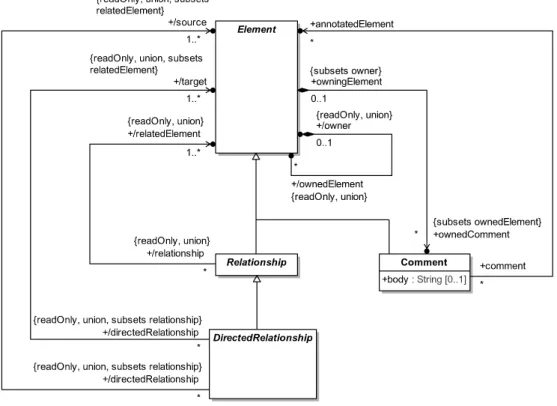
Finally, the fUML subset also contains some UML elements that have no execution semantics. Examples of this are comments and packages from Kernel and modeling declarations such as isDeterminate and isAssured on conditional nodes. These reduce compactness of the subset but not in a way that affects the specification of semantics, the implementation of execution tools or translator construction.
7.2 Syntax Packages
Subclauses 7.3 and following define the abstract syntax of the fUML subset as a subset of the abstract syntax of UML 2. The package structure parallels the package structure of the UML 2 abstract syntax model. Packages in the UML 2 model that have no corresponding package here are excluded in their entirety. For packages that are included, some further elements from the UML package may be excluded in the corresponding fUML package. In this case, the model presented for the fUML version of the abstract syntax package shows those elements that are specifically in fUML and specify additional constraints on the class that that apply in addition to the constraints already specified in UML 2 for the same class.
The fUML subset definition is formally captured in the package fUML_Syntax::Syntax. This package includes the subpackages shown in Figure 7.2, each of which imports into its namespace exactly those metaclasses from the corresponding UML abstract
syntax package. All the elements in the subpackages are then re-imported into the top-level Syntax package, which allows them to be uniformly referenced by qualified name directly from the top-level package (similarly to the namespace structure used in the UML abstract syntax metamodel).
Figure 7.2 - fUML Syntax Package
A UML model that syntactically conforms to this subset shall have an abstract syntax representation that consists solely of instances of metaclasses that are (imported) members of the fUML_Syntax::Syntax package. For simplicity, meta-associations from the UML abstract syntax metamodel are not explicitly imported into the fUML_Syntax::Syntax package, but it is, nevertheless, permissible for the model elements of a conforming model, within the fUML subset, to be involved in any meta-associations consistent with both the UML metamodel and any further constraints as defined in this specification.
Note. This approach for defining a subset of the UML abstract syntax is similar to the approach used for defining the metamodel subset covered by a UML profile, in which specially identified package imports (metamodelReferences) and element imports (metaclassReferences) are used to import the metaclasses from the subset into the namespace of the Profile (see the UML 2 Specification, 12.3).
In addition to being representable within the fUML abstract syntax subset, as described above, a UML model that syntactically conforms to fUML shall also satisfy all relevant constraints defined in the UML abstract syntax metamodel and the additional