Received August 23, 2018, accepted September 16, 2018, date of publication October 16, 2018, date of current version October 31, 2018. Digital Object Identifier 10.1109/ACCESS.2018.2873812
A Framework for Orchestrating Secure and
Dynamic Access of IoT Services in
Multi-Cloud Environments
MUHAMMAD KAZIM , LU LIU , (Member, IEEE), AND SHAO YING ZHU, (Member IEEE) College of Engineering and Technology, University of Derby, Derby DE22 1GB, U.K.
Corresponding authors: Muhammad Kazim ([email protected]), Lu Liu ([email protected]), and Shao Ying Zhu ([email protected])
ABSTRACT IoT devices have complex requirements but their limitations in terms of storage, network, computing, data analytics, scalability, and big data management require it to be used it with a technology like cloud computing. IoT backend with cloud computing can present new ways to offer services that are massively scalable, can be dynamically configured, and delivered on demand with large scale infrastructure resources. However, a single cloud infrastructure might be unable to deal with the increasing demand of cloud services in which hundreds of users might be accessing cloud resources, leading to a big data problem and the need for efficient frameworks to handle a large number of user requests for IoT services. These challenges require new functional elements and provisioning schemes. To this end, we propose the usage of multi-clouds with IoT which can optimize the user requirements by allowing them to choose best IoT services from many services hosted in various cloud platforms and provide them with more infrastructure and platform resources to meet their requirements. This paper presents a novel framework for dynamic and secure IoT services access across clouds using the cloud on-demand model. To facilitate multi-cloud collaboration, novel protocols are designed and implemented on multi-cloud platforms. The various stages involved in the framework for allowing users access to IoT services in multi-clouds are service matchmaking (i.e., to choose the best service matching user requirements), authentication (i.e., a lightweight mechanism to authenticate users at runtime before granting them service access), and SLA management (including, SLA negotiation, enforcement, and monitoring). SLA management offers benefits like negotiating required service parameters, enforcing mechanisms to ensure that service execution in the external cloud is according to the agreed SLAs and monitoring to verify that the cloud provider complies with those SLAs. The detailed system design to establish secure multi-cloud collaboration has been presented. Moreover, the designed protocols are empirically implemented on two different clouds, including OpenStack and Amazon AWS. Experiments indicate that the proposed system is scalable, authentication protocols result only in a limited overhead compared to standard authentication protocols, and any SLA violation by a cloud provider could be recorded and reported back to the user.
INDEX TERMS Authentication, IoT, IoT services, multi-clouds, security, secure collaboration, service level agreement, service matchmaking.
I. INTRODUCTION
The Internet of Things (IoT) paradigm has revolutionized the IT industry by bringing together technologies such as Radio Frequency Identification (RFID), Wireless Sensor and Actor Networks (WSANs) and ubiquitous computing domains. Internet of Things (IoT) connects billions of devices over the Internet. The heterogeneous IoT objects are provided with sensing and actuation capabilities, that enable them to
capture information from physical objects and send it as data streams [1]. Moreover, IoT objects directly co-operate with physical and virtual resources over the internet to deliver data and functionalities to end users and applications. IoT has played a critical role in advancing human lives by bringing applications with usage in the real world. From users per-spective, IoT plays a critical role in application scenarios such as smart homes, healthcare, vehicular networks, and
VOLUME 6, 2018
2169-35362018 IEEE. Translations and content mining are permitted for academic research only.
enhanced learning. While from the business viewpoint, the major applications of IoT are in the areas of logistics, transportation, agriculture, retail and smart cities. It is pre-dicted that the growth of the global IoT services market will be at a compound annual growth rate (CAGR) of 24 percent until 2021 [2]. As the number of IoT devices increases and they generate large volumes of big data, it brings forwards the challenges related to data collection, analysis, management, and storage.
Cloud computing has been proposed as a solution that can potentially solve the problem of managing big data in IoT [3]. Some key advantages cloud computing offers are that: it is massively scalable, can be dynamically configured, deliv-ers on-demand services and provides usdeliv-ers with immediate access to hardware resources without capital investments [4]. Different companies using cloud have infrastructures that scale over several data centres and cloud also has a sim-ple pricing model that lets you pay as you go and only for the services they are being used. Due to these advan-tages, cloud vendors including Google (Google Cloud IoT), Amazon (AWS IoT) and Microsoft (Azure IoT Solution Accelerators) are offering services to support IoT devices and services in terms of computing, storage, resource elasticity and data analytics. Despite the benefits offered by the cloud to IoT sector, the variety and proliferation of services offered by the cloud provider raise some challenges relevant to cloud environment. These challenges include portability issues of IoT services on various IaaS and PaaS platforms, interoper-ability of distributed IoT applications on various cloud plat-forms, PaaS dealing with the heterogeneity of cloud protocols to support IoT service interactions, and the requirement of geo-diverse platforms [5].
The multi-cloud architecture can provide a solution to these challenges. Multi-cloud environment is dependent on multiple clouds, and a user can be reliant on multiple cloud service providers such as Amazon, Microsoft, or OpenStack which are communicating. IoT applications can benefit from the adoption of multi-clouds from their abilities to run work-loads on best-suited platforms, avoiding the need to migrate legacy IoT applications and creating redundancy to avoid vendor lock-in [6]. Multi-cloud providers are increasingly in demand. In a survey by 451-Microsoft, around 50% compa-nies’ representatives were looking for providers that could provide one-stop-shopping from various cloud providers and establish contracts with different providers for additional ser-vices on their behalf [7].
Multi-clouds provide an increased level of efficiency to cloud providers by enabling them to share their services for improving revenues. In terms of IoT, the services to be shared between multi-clouds can include SaaS, PaaS or IaaS service while the clients using these services can be other clouds, organizations or a single user. Other factors driving the adoption of multi-clouds for cloud provider can vary from dealing with a peak in service requests, having backup servers to diminish downtime scenarios and enhancing its own offers to get a market competitive edge.
In a multi-cloud environment, users access services across multiple cloud providers which changes the traditional cloud landscape. However, a very limited research has been done to support IoT services deployment and access across multi-clouds. Therefore, advanced development frameworks are required that can offer IoT services orchestration across multi-clouds and reduce companies time-to-market to keep cloud services running smoothly. Along with the service orchestration issues in multi-clouds, many security concerns are also related to their adoption and application. The basic authentication solutions that exist for traditional networks fail to meet the need of a dynamic collaboration of clouds and services (such as IoT services) in multi-clouds. Consider a scenario in which a cloud (local cloud) user is accessing IoT service located in another cloud (foreign cloud). That cloud user would have no mechanism to verify that the service being used is trustworthy and neither do they have insights on what is happening with their data being handled by services. In order to trust the cloud services, users depend on their assurances given by the cloud provider. Cloud providers give very limited evidence or accountability to users which offers them the ability to hide some behavior of the service.
In order to address these challenges, we propose a novel framework named called Multi-cloud Collaboration for IoT (MC-IoT) in this paper that can facilitate multi-cloud collaboration and provide guarantees to the user that the software or service (such as IoT service) running on a foreign cloud node is secure and the agreed service level agreements (SLAs) are not being violated. The key challenge in designing this framework is to develop solutions for multi-cloud that can support efficient authentication, authorization of large number of cloud users, enable the users to select most suitable service in foreign cloud according to their require-ments as well as to ensure that services in foreign cloud are compliant with the service level agreement (SLA) between user and cloud provider. The proposed framework is based on NIST cloud computing security architecture standard [8]. It satisfies the following conditions: i) rapid provisioning by automated service deployment; ii) mapping authenticated and authorised data and tasks onto VMs; iii) monitoring the cloud resources, operations and performance; iv) metering active user accounts to guarantee that security policies are always enforced; v) maintaining the service level agreement (SLA) established between customers and service providers.
In an IoT based multi-cloud architecture, hundreds of cloud users might be using thousands of IoT services across multi-clouds. The basic authentication solutions that exist for traditional networks fail to meet the need for a dynamic collaboration of clouds and services in multi-cloud. There-fore, this paper provides a lightweight and novel technique for the dynamic authentication which provides single sign-on to users trying to csign-onnect to the foreign cloud. The pro-posed authentication solution achieves better performance than traditional authentication protocols like SAML and Ker-beros while maintaining security. Next, we provide a ser-vice selection algorithm to select the best IoT serser-vice from
multiple cloud providers that best match user quality of service requirements (QoS). In the next stage, service level agreements (SLAs) are used to ensure security and handle ser-vice execution in the foreign cloud. The usage of SLA mech-anisms ensures that QoS parameters including the functional (CPU, RAM, memory etc.) and non-functional requirements (bandwidth, latency, availability, reliability etc.) of users for a particular IoT service are negotiated and secure collabora-tion between multi-clouds is setup. The multi-cloud handling user requests will be responsible to enforce mechanisms that fulfill the QoS requirements agreed in the SLA. While the monitoring phase in SLA involves monitoring the IoT service execution in the foreign cloud to check its compliance with the SLA and report it back to the user.
MC-IoT has been designed with the goal to enhance secure multi-cloud collaboration in which cloud providers can easily apply their business model to achieve extended functionali-ties. The proposed model is based on an architectural solution that can be used to setup multi-cloud collaboration between any clouds irrespective of their underlying implementation. Experiments indicate that the proposed approach supports collaboration among a large number of IoT services across multi-clouds and incurs a minor overhead.
The major contributions of this paper are the following:
• A novel framework is proposed for providing users secure dynamic collaboration and access to IoT services in multi-clouds. The protocols to support the framework and the functionalities of its components responsible for multi-cloud collaboration are presented.
• Dynamic and lightweight authentication protocol to
setup single sign-on (SSO) between multi-clouds has been presented.
• A service selection algorithm is proposed that achieves
high accuracy by providing distance correlation weight-ing mechanism among large number of IoT services QoS parameters.
• Mechanisms to setup service level agreements (SLAs)
for multi-cloud collaboration have been presented. The various stages in setting up SLA include negotiation, enforcement and monitoring. They help in negotiating QoS parameters for IoT services between the user and foreign cloud provider, enforce a mechanism to comply with the agreed SLAs, monitor client usage of IoT ser-vice in the foreign cloud and report back any violation of SLA.
• Business and use cases have been presented to discuss
how the proposed framework can be used in various applications
This paper has been organized as follows: Section 2 presents the background of this work and section 3 presents framework design with the detailed description of various protocols for authentication, service selection and SLA man-agement. In section 4 the workflow of system components has been presented. Experimental results of our system have been given in section 5. Section 6 provides the use cases of this work and section 7 details the literature review related to
the area of multi-clouds, and IoT based cloud systems. In the end, the conclusion of the paper is presented.
II. BACKGROUND
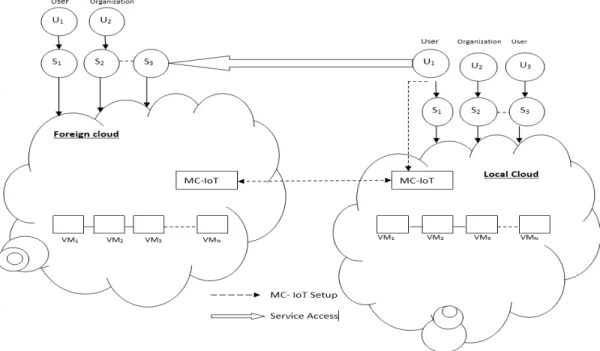
Multiple clouds have two delivery models which are fed-erated cloud and multi-cloud. In fedfed-erated clouds, there is an agreement between different providers that want to col-laborate, and also the user is not aware of the fact if the resources are being used from another cloud. However, multi-clouds provide a way for dynamic collaboration between various clouds as there is no former agreement between par-ticipating clouds and collaboration is established at runtime according to requirements. Moreover, in multi-clouds user has the knowledge of all connected clouds and is directly responsible to the provisioning of services from multiple clouds which can be more beneficial from customers and organizations perspective. Therefore, this work focuses on multi-clouds so that users and organizations can dynami-cally access IoT services across various cloud providers. The multi-cloud communication scenario that provides access of IoT services to users across multi-clouds is shown in figure 1.
In a multi-cloud environment, the user’s access IoT ser-vices across multiple cloud providers which changes the traditional cloud landscape. Multi-clouds offer greater agility, innovation and more intense collaboration and they can be predicted to become an industry norm to handle IoT big data and their associated applications, however, managing service orchestration is still an open issue. Advanced devel-opment frameworks are required that can reduce companies time-to-market.
Along with the service orchestration issues in multi-clouds, multi-clouds bring many security concerns as well. The tra-ditional authentication solutions that exist for networks fail to meet the need of a dynamic collaboration of users and services in multi-cloud due to performance overhead and/or difference of underlying authentication mechanisms across different clouds. Along with authentication problems, secure service orchestration is also a challenge. Once a service from a foreign cloud is being used, the cloud users have no mechanism to verify that the service they are using is trustworthy and depend on that provider to ensure service execution. As a user is accessing services in the foreign cloud, the interaction with malicious or faulty service can lead to the manipulation of data processing results, failure to provide advertised services, violation of the security properties such as confidentiality, integrity and availability, and other mali-cious activities without user consent.
The general mechanisms described in the literature on service security in cloud are based on having a guarantee that the software or service running on a cloud node is similar to its original implementation and it cannot be modified at runtime at foreign cloud. However, cloud customers cannot know if the service functionality has been altered when using services to the foreign cloud. Therefore, advanced mech-anisms are required that can support efficient IoT service
FIGURE 1. Multi-cloud collaboration scenario where user U1made a request to MC-IoT in local cloud to access service S3in foreign cloud. The multi-cloud collaboration is setup using MC-IoT after which U1can directly access service S3.
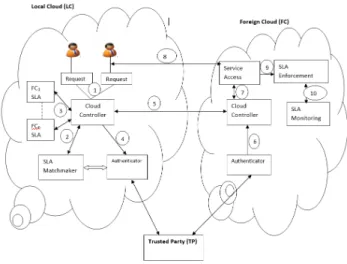
FIGURE 2. Proposed framework MC-IoT for multi-cloud collaboration.
selection according to client functional and non-functional QoS requirements, provide efficient and secure authentica-tion, and enable service level agreement (SLA) management to ensure that proper mechanisms are implemented to comply with agreed SLA parameters, and monitor the service exe-cution to guarantee that foreign cloud always complies with those parameters.
III. PROPOSED FRAMEWORK (MC-IoT)
Based on heterogeneous requirements of multi-clouds and IoT services, we propose a novel framework named MC-IoT that can enable dynamic collaboration between users and services in multi-clouds. The architecture of MC-IoT involves various components that have been imple-mented in each participating cloud to achieve the secure
multi-cloud authentication. These components involved in system design are authenticator for managing iden-tity and authorization, controller to manage user requests and communication with external clouds (functionality mentioned in section 4), matchmaker to select suitable IoT service meeting user specifications and SLA coor-dinator for managing SLA negotiation, enforcement and authorization.
Figure 1 displays various components in a local cloud to communicate and collaborate with foreign clouds. All the system components serve different functions which are described below. In this paper, the communicating clouds are referred to as local cloud (in which user is located) and foreign cloud (to which user needs access and collaboration has to be established).
A. COLLABORATION OBJECTIVE
The objective of multi-cloud collaboration is the maximum number of user requests from local cloud to be handled and successfully granted access to services in foreign cloud. The overall objective for multi-cloud collaboration for M cloud users (j = 1,2. . .M) in local cloud, with requests of S IoT services (i = 1,2. . .N) in a foreign cloud can be formally defined as:
O(i,j)=MaxXN
i=1
XM
j=1(Rij−Cij) (1) In the above equation, N and M are the numbers of services requested and a number of users making requests respectively. Rijis the required number of user’s requests for IoT services to be granted while Cij is the number of IoT services that were actually granted.
B. INITIALIZATION PROTOCOL
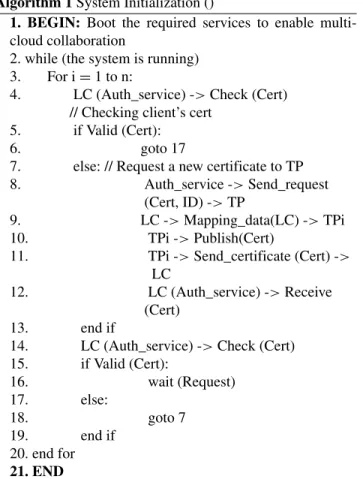
The initialization protocol is the first step that is used to set up the system services, parameters and attributes required for multi-cloud collaboration. When the required services are booted in MC-IoT, and user request for multi-cloud access is received, authentication service in the Authen-ticator component establishes if it has the certificate for that user that can be used for authentication with foreign clouds. If the certificate does not exist in the cloud, Authen-ticator which is a RESTful web service submits a request on behalf of its cloud to Trusted Party (TP) for certificate generation.
A feature of TP is to generate a certificate for cloud Trusted Party (TP) after receiving a request and cloud parameters and to use a function to map a certificate to client ID which is returned to the requesting cloud. The Authentication Service of cloud receives the certificate and stores it to be used for communication with foreign clouds. Similarly, it is the responsibility of Authenticator component to ensure that the certificate obtained from TP is valid and to get a new cer-tificate if the existing one is revoked or rejected by foreign cloud.
Algorithm 1System Initialization ()
1. BEGIN:Boot the required services to enable multi-cloud collaboration
2. while (the system is running) 3. For i=1 to n:
4. LC (Auth_service) ->Check (Cert) // Checking client’s cert
5. if Valid (Cert):
6. goto 17
7. else: // Request a new certificate to TP 8. Auth_service ->Send_request
(Cert, ID) ->TP
9. LC ->Mapping_data(LC) ->TPi 10. TPi ->Publish(Cert)
11. TPi ->Send_certificate (Cert) -> LC
12. LC (Auth_service) ->Receive (Cert)
13. end if
14. LC (Auth_service) ->Check (Cert) 15. if Valid (Cert): 16. wait (Request) 17. else: 18. goto 7 19. end if 20. end for 21. END C. AUTHENTICATION PROTOCOL
This protocol describes how multi-cloud authentication is setup between participating clouds. In a distributed environ-ment usually a large number of clouds are present with each cloud having tens of users, which makes credential manage-ment a big challenge. Moreover, in a dynamic communication setup between multi-clouds, each cloud might have different authentication mechanisms. This raises a need to develop a single sign-on (SSO) authentication mechanism by which any cloud user in the local cloud can authenticate itself with the foreign cloud, and access required resources. In our case, we use a Trusted Party (TP) which acts as an identity provider on which a requesting user must hold a digital identity, based on which TP grants a digital certificate to that user that it can use to authenticate with the foreign cloud. Since the foreign cloud also trusts TP, the user is able to authenticate itself and access resources based on that certificate.
We assume that the local cloud’s request is composed of two parts namely the certificate and the required cloud service. Initially, a certificate is sent by the local cloud (LC) to the foreign cloud (FC) for proving its identity. This certificate contains a set of attributes including the cloud identifier, digital signature, and validity period of the certificate. This message is encrypted by the public key of FC.
FC checks the validity of the certificate sent by LC. If the certificate is valid, FC then sends a response message
to LC that it is authenticated. However, if the certificate is invalid, FC sends the message of failed authentication to LC and waits for a new certificate. This message is encrypted with the public key of LC. In case the message received from FC is that authentication certificate was invalid, LC sends a message with its credentials to the Trusted Party (TP) to generate a new certificate. TP generates a new certificate and sends it to the LC which is sent from LC to FC.
FC checks the new certificate received from LC. If the certificate is invalid again, the authentication request is ter-minated. If authentication of LC is successful, both FC and LC exchange nonce messages to agree on a session key using Diffie-Hellman (DH) algorithm [9]. Since DH key exchange is performed after certificate exchange, it is called authenti-cated DH which is more secure compared to usual DH.
After cloud authentication, LC sends a message to FC containing client authorization details as well as resources required from FC. As FC receives details of IoT services which are to be accessed and required resources message, it locally computes if the tasks from LC have the authorization to access the required services. The corresponding FC com-putes the status of the IoT services associated to the request. The status is computed due to the fact that users on a local cloud can have the different status of privileges that can affect their level of access to resources. For example, only doctors might have access to some expensive IoT services and other hospital staff might not have access to them. The return result is one of the following possible statuses:
• Privileged • Non-privileged
If the result returned is privileged users are granted access to services, otherwise they are not granted access.
D. SERVICE MATCHMAKING
The cloud services states can change dynamically during runtime. Moreover, the dynamic collaboration between users in multi-clouds can make service automatic detection compli-cated. Cloud customers can have varying requirements and in multi-cloud scenarios best services that can meet their required quality of service (QoS) need to be selected from various providers.
To select the most suitable services, the first goal is the efficient discovery according to the characteristics of ser-vices. Service discovery for dynamic multi-cloud collabo-ration could be hard due to requirements such as satisfying service QoS, functionalities and other metrics. Moreover, lack of central repositories for cloud services makes service selection a challenging task.
There might be cases when a single service would be able to satisfy all user requirements and the service that matches most requirements might need to be selected. This leads to partial matchmaking where the service that matches most required QoS criteria will be selected. In this section, we pro-pose an efficient and dynamic algorithm for selection of cloud services in multi-cloud scenarios based on partial or closest matching of service QoS attributes. This protocol for service
Algorithm 2Authentication and Authorization () 1. BEGIN
2. Data: request: Communication request received by cloud controller
3. LC ->Send_request (authentication) ->FC //Secured using SSL
4. for j=1 to n do:
5. FC ->Verify (Cert, ID) 6. if Verify (Cert, ID):
7. goto 17
8. else:
9. FC ->Send_request (New_Cert) -> LC
10. end if
11. LC ->Send_request ((Cert), Profile) ->TP 12. TP ->Send (Cert) ->CC //Generates updated certificate for LC and sends to LC]
13. LC ->Send_msg (Cert) ->FC 14. if Not_valid (Cert): 15. End 16. else: 17. FC ->Send_msg(n) ->LC 18. end if 19. FC ->Wait (response) ->LC 20. if no_resp(): 21. End 22. else: 23. LC ->Send_msg(n+1) ->FC encrypted using LC- FC session key generated by DH
24. FC -> Send_msg(request_authori-zation) ->LC encrypted using LC-FC session key
25. LC-> Send_msg(Send_LCAutho-rization_level) ->FC encrypted using LC-FC session key 26. FC ->compute_local_level (LC) 27. if compute_local_level=True: 28. FC->Authentication_local (LC,FC,+) 29. else: FC ->Authentication_local (LC,FC,-) 30. end if 31. end if 27. end for 28. END
selection is an extension of our previous work on partial web service selection for disaster services [10].
The proposed protocol has three essential characteristics.
• Firstly, the proposed protocol provides service selection among all services in a dynamic decentralized environ-ment of multi-clouds with high accuracy.
• Secondly, different QoS requirements of services can
be supported. In case, there is no exact match of user QoS requirements with available services, services matching the most requirements are selected using par-tial matching.
• And thirdly, the protocol is able to support a
large number of services and by using distance co-relation weighting mechanism it can support various IoT services QoS requirements such as response time, availability, reliability, cost, energy, throughput, latency and best practices.
Once a cloud controller receives a response from various foreign clouds that can deliver required services, it communi-cates with service matchmaking module to select the required service.
1) USER REQUEST AND SERVICE QOS ANALYSIS (PHASE 1) The process of service selection starts with the cloud con-troller passing the requirements to service matchmaking module which includes the required service and desired QoS. Such as a user might require high throughput compared to cost saving while it might be opposite for another user. More-over, the module collects the results of available services in the foreign cloud from the controller component.
Here we represent various denotations for request types:
• RQrepresents a set of user functional QoS requirements, RQ= {q1,q2,q3, . . . .,qn}, where nεN
• S is a set of available services with similar functionality, S={s1, s2, s3. . .sm}, where mεN
• Each service S has QS property matrices, QS = {QS1, QS2,QS3. . .QSi}, where QSi = {qi1,qi2,qi3. . . .qij}, i, jεN. QSirepresents quality matrices for service i.
2) REQUIREMENT MATRIX CONSTRUCTION (PHASE 2) Once the QoS requirements have been gathered, the mod-ule collects all possible service offers and their associated QoS parameters. These are used to construct an accuracy matrix and for the calculation of offers ranks.
In an ideal scenario, user QoS requirements QR must be similar to the service QoS parameters mentioned in QSi. In other words, an ideal service for user request can be represented as,
RQ=QSi
However, in real case scenario that user requirements RQ and the number of quality matrices QSi will be different. Therefore, RQ is taken as a baseline and quality matrices could be arranged in the following way:
• If the quality service matrix QSi lacks in user QR, it is removed and QRis assigned 0
To construct accuracy matrix, n consumer requests RQare identified along with m available services that can satisfy user requirements, an m∗n matrix is constructed which is called R. The columns in the matrix represent QoS parameters RQwhile each available service is represented in a row for the selection process.
Requirement matrix, R can be defined as:
RQ1 RQ2 . . . RQn S1 S2 .. Sm r11 r12 . . . r1n r21 r22 . . . r2n . . . . rm1 rm2 . . . rmn
A service not satisfying the mandatory QoS requirements RQis removed from the selection process.
3) ACCURACY MATRIX CONSTRUCTION (PHASE 3)
The calculation of accuracy matrix, A, is dependent on the tendency of QoS parameters. The tendency which describes how the numeric value of a service QoS parameters changes for a service to be observed as better. It indicates whether high or low values of a QoS parameter are preferred in an ideal case. For example, an ideal service will require availability and throughput parameters to be high while its response time and latency should be low.
Using the user described QoS range and service QoS offered, elements of the accuracy matrix is calculated using case dependent formulae as mentioned in equations below:
For values with high tendency: Qij Q1 when Qij<Q1 Qij−Q1 Qh−Q1 +α Qij+β Qmax when Qij>Qh For values with low tendency:
Qh Qij when Qij >Qh Qh−Qij+α Qh−Q1 when Q1≤Qij≤Qh Qmin Qij +β when Qij<Q1
In the above equations, Qijis the value of ith QoS property of jth service, Q1is the lower limit of user requirements for an attribute, Qhis the highest limit of user requirements for an attribute. Qmax and Qmin are respectively the maximum and minimum values of a QoS property being offered by a service. α and β belong to {1, 2, 3, . . . } where α < β. The results from the above equations are normalized in the range [0, 1].
α and β are used to differentiate between loose range, preferred range and tight range. The preferred range for any service is between Q1and Qh. If a value falls in this range,
αis added to normalize the value so that results are in range (α,α+1). The values in the loose range (between Qminand Q1 for high tendency parameters, and between Qhand Qmaxfor low tendency parameters) are normalized between 0 and 1. While the values in the tight range (between Qhand Qmax for high tendency parameters, and between Qminand Q1for
low tendency parameters) are normalized by addingβso that results are in the range (β,β+1). Therefore, for all the values in accuracy matrix lie between (0, β +1) which helps in consistency. Moreover,β > αwhich always guarantees that higher range always has a higher value in accuracy matrix than other two ranges.
The results of these equations are used to calculate the accuracy matrix, A. It shows how precisely each service matches the user requirements. After constructing the accu-racy matrix, the rank of each service can be calculated in the following way:
Ri=
Xn
j=1Aij∗Wj (2) In the above equation, Rirepresents the rank of service i, Aij represents the accuracy value of the jthQoS property of service i, and Wjrepresents the weight of the jthQoS property.
Algorithm 3Service Matchmaking () 1. BEGIN
2. Data:Input:<Client functional and non-functional QoS requirements (CR)>,
<List of services (LS)>
3. Service LS = {1,2, . . . .,n}; // Total list of available services
4.<Service,CR>ServiceContenderList (SCL)=NULL //List of services satisfying requirements
5. Service S=NULL // Single service instance 6. CR Q=NULL //Single QoS requirement 7.<Service, CR>O=NULL;
8. For each S in LS do:
9. if (Satisfy(S ,CR)) //Add to SCL all appropri-ate services matching user requirements
10. SCL.add (S,CR)
11. end if 12. end for
13. For each O in SCL do:
14. for each Q in O.CR do:
15. Normalize (AccuracyMatrix (Max(Q),Min(Q) )) //Generate accuracy matrix 16. end for
17. end for
18. For each O in SCL:
19. Score=Calculate_Score(O.Service) // Calculate score of each service 20. end for
21. SCL.sort(Score) // Rank all services in SCL 22. Return SCL
23. END
E. SLA NEGOTIATION
The SLA coordinator receives user requirements and SLA’s from the foreign cloud and negotiates a dynamic SLA between them. These SLAs exist within the customer domain that wants to access foreign cloud resources. From the client
viewpoint, SLAs define the mechanisms to securely access services while the SLAs are utilized by cloud administra-tors to manage the mechanisms to offer cloud services. SLA-coordinator negotiates the SLAs on behalf of the user if there is full match of QoS requirements in the stated SLAs. However, as described earlier there might be a partial match after which user can have the ability to negotiate SLAs itself. Therefore, SLA coordinator component in MC-IoT offers added features to customers such as nego-tiating an SLA or switching to a new provider in a multi-cloud scenario if selected provider and user cannot agree on an SLA.
As discussed earlier, the matchmaking component checks the service specs like base service, features, cost and recom-mends them to the user. SLA Negotiation involves agreeing to the service terms for SLA and QoS parameters, measur-ing metrics (service level objectives) and definmeasur-ing how the metrics will be measured. While service providers also check if they can provide requested service and perform basic risk evaluation in case. As provider reputation is on a stake if it fails to provide the service agreed in SLA.
Integrating the security parameters within SLAs is a novel problem and a very limited research has been done in this area. For the case of secure multi-cloud collaboration, we pro-pose a service level objective (SLO) called service identity which can help customers to negotiate the SLAs for secure service execution on the foreign cloud.
1) SERVICE IDENTITY
Service identity as an important property to maintain strong IoT service security and compliance in the foreign cloud. A set j services Fjdeployed on a single cloud platform with functional properties Funci and non-functional properties NFuncican be defined as:
Fi= {Funci,NFunci} 1≤i≤j
During service execution in the foreign cloud, both func-tional and non-funcfunc-tional properties of service instances being used by users must be maintained. Functional proper-ties of instances that could be violated include a change in the code or implementation of service to make it do certain other activities affecting the original behavior of service. While a few non-functional issues can include service taking more processing time, charging more cost than agreed or remaining unavailable during required times.
If F is the original service deployed by the service provider in cloud after agreeing SLAs and F’ is the instance of that ser-vice running in cloud that is being used by client, the serser-vice identity can be satisfied only ifF = F’ holds true for that particular instance of F running in the cloud during the entire lifecycle of F from deployment to decommissioning. The service identity can be described by the following equation:
F≡F0 (a)
In order for functional properties of a service instance F’ to hold, its functional properties must be the same as
original instance. While the case for non-functional proper-ties is more complex as the service states can change dynami-cally during runtime. Moreover, each user will have different QoS requirements from a service. As an example, users X and Y using different instances of F’ of same service F can have varying availability, and cost requirements. Therefore, we define a threshold value for non-functional parameters of a service instance that it must maintain to ensure service identity.
The non-functional parameters of a service agreed in the SLA can be defined as a tuple:
NFunc= {Mini,Maxi,Wi} 0≤i≤l
i is the QoS parameter, Min and Max show the accepted boundaries or threshold values for that parameter, and W denotes the weight assigned to a particular parameter by a user which shows the importance given to that parameter by a user. The range of W is [0, 1] with the higher value showing that parameter is important for the user and it will have a larger impact on service quality, and vice versa for the lower value. In case a user does not define i, medium importance is given to that parameter and for that purpose a medium value is chosen in the range of W which is 0.5. For non-functional properties to hold true in an instance, the following condition must be satisfied at all times:
Mini≤NFunci≤Maxi (b) To comply with functional requirements such as security different techniques can be agreed in the SLA which can ensure that functional behavior of service instances F’ will not change. For example, to maintain service identity trusted platform module (TPM) mechanism could be used. The func-tional property of a service could be defined as:
F−F0=Ø (c)
If both equations (b) and (c) hold than equation (a) will hold. However, in case if service security is compromised than the equation will become F’⊃F meaning that service identity does not hold.
Meanwhile, various authors have proposed definitions of other functional and non-functional metrics (SLOs) for IoT services that can be agreed between customer and provider during SLA negotiation. These parameters include request latency, availability, accessibility, service throughput, completion time, and mean times to repair and failure, energy cost and financial cost.
The proposed system uses WSDL to express the func-tional security requirements and non-funcfunc-tional require-ments. The XML data structures are generated on the basis of WSDL document, the service interface definition and its implementation. Therefore, QoS tags are associated with a new category to recognize security and other properties. The protocols for SLA management are implemented in the form of a REST based service and API.
F. SLA ENFORCEMENT
Once a user is authorized to access cloud resources, next stage is the enforcement of security mechanisms by the provider. In this stage, mechanisms are implemented that can guarantee SLA assurances. The enforcement of agreed SLA is done in two stages. The first stage involves implementing the software modules that can be activated for the acquisition of resources for enforcing security policies and second stages involve dynamic reconfiguration of the resources after a secu-rity alert is generated.
This paper focuses on the implementation of mechanisms for non-functional properties of IoT services to ensure that service complies with the defined SLA policy. The enforce-ment of policies for SLA enforceenforce-ment is done by foreign cloud in its infrastructure by acquiring enough resources for service execution and employing required mechanisms. QoS parameters mentioned in SLAs are measured by main-taining current system configuration information and runtime information of parameters that are part of SLOs (measurable metrics). Depending on the client requirements some or all SLA parameters could be measured, and SLOs such as request latency or service throughput could be measured by retrieving resource metrics.
Development of mechanisms for maintaining functional property is not in the scope of this paper. We discuss var-ious mechanisms that exist in the literature that could be deployed for secure service execution such as trusted comput-ing. Trusted computing is a paradigm used to enforce trust-worthy behavior of computing platforms. It is based on using a hardware crypto-processor module named Trusted Platform Module (TPM) [11]. This feature can be used to run services on only those cloud nodes whose fingerprints are trusted [12]. Various mechanisms for cloud computing based on TPM have been proposed that are used for security of services, data and other resources. Excalibur [12] is a system that can be used to design trusted computing services for cloud. It uses policy sealed data (data encrypted according to customer policy) that can only be unsealed (decrypted) by nodes whose configuration match the node policy. Excalibur uses Attribute Based Encryption to bind policies and attributes to node con-figurations. A mechanism that uses a hardened hypervisor to attest that the image of the VM running on a cloud node is the same as the one uploaded originally by the service provider and initiated by cloud was proposed by Bouchenaket al.[13]. It confines the execution of VM to secure nodes inside the cloud and guarantees that even the system admin with root privileges cannot tamper with the VM memory. Some other recommendations provided by NIST for hardening the hyper-visor include maintaining proper isolation, separating the duties of administrative functions and restricting administra-tor access to security checks [14].
G. SLA MONITORING
Currently, no solutions exist to check for SLA compliance for user support. However, researchers have recommended using the monitoring mechanisms to check for SLA compliance on
FIGURE 3. Workflow of MC-IoT.
the cloud provider which involves, i). verifying that SLAs are followed through infrastructure access, and ii). generating an alert notification if the SLAs are violated to take corrective steps.
Monitoring could either be performed by the client from data received from cloud provider or by the cloud provider at the infrastructure level which is the focus of this paper. The input to monitoring component provided by tbe cloud provider is the formal requirements to be monitored in a for-mal language such as XML. The monitoring component than derives the pattern of events that could occur during service execution and imply SLA violation. In the proposed system uses event-driven modules to collect all generated events and performs required filtration operations before analyzing them. The description of event captors and monitor is used to monitor SLA parameter.
The analysis is performed based on captured events to check if any generated events show an SLA violation. If a security violation is reported by the monitoring component, it logs the event and estimates the current status of service. Monitor also reports to the user if the foreign cloud is com-pliant with the signed SLA or not. In case of SLA violations, user can enforce penalties on the provider.
IV. WORKFLOW
This section explains the workflow for the overall system and the details of various components. A user request to connect to the foreign cloud for accessing an IoT service is received by cloud controller that advertises request to connect to multiple foreign clouds and receives their responses. Service Match-maker selects the best provider based on user QoS require-ments. The authenticator is responsible for authentication while the SLA coordinator is responsible for SLA manage-ment. Workflow of the proposed system is shown in figure 3.
A. CLOUD CONTROLLER
This is the major component responsible to handle the multi-cloud communication and authentication. The controller is
implemented as RESTful web service in cloud and its respon-sibilities are two folds. First in the local cloud when it wants to access a foreign cloud and second in a foreign cloud when a connection request is received.
When a user in the local cloud needs to access service in a foreign cloud, it is the responsibility of a controller to establish a connection with the other foreign cloud. Before sending a message to the foreign cloud, it communicates with the local authenticator component to get the certificate. After sending an authentication request, on behalf of local cloud it establishes the communication channel by sharing session keys.
In a foreign cloud, requests for communication from the local cloud are received by cloud controller. Cloud controller is then responsible to check whether, (a) the requested service is available in the foreign cloud, (b) the connecting local cloud is trustworthy, and (c) respond to the foreign clouds request.
B. AUTHENTICATOR
Authenticator component is responsible to manage the authentication of multi-clouds. Once the communication request from the local cloud reaches the foreign cloud, cloud Controller of the foreign cloud connects with the authen-ticator to verify if the connecting user (of local cloud) is trusted or not. When the authenticator component receives the message containing the identity of local cloud and its digital certificate, it checks whether the certificate is valid and responds to controller component. Based on the response from the authenticator, cloud controller of the foreign cloud responds to the cloud controller of the local cloud.
In a local cloud, when a collaboration request is to be sent to foreign cloud authenticator is responsible to contact trusted party (TP) which generates the certificate for the local cloud, signs it and returns it to the local cloud. Before sending a communication request to the foreign cloud, local cloud controller gets its certificate from the authenticator.
C. TRUSTED PARTY
Trusted party (TP) is the identity provider responsible to handle the authentication among multi-clouds. It has list of trusted cloud providers, and before establishing session the connecting clouds communicate with it to acquire their certificate. After receiving a certificate request, it generates a certificate, signs it with its private key and returns it to the requesting cloud. Any cloud registered with a TP receiv-ing a certificate signed with a private key of that particular TP considers it true.
D. SLA COORDINATOR
This component is responsible to manage SLA’s in the pro-posed framework. It has features including adaptability and rapid response. It initially selects the suitable service for a client in local cloud based on his requirements using nego-tiation. Once a foreign cloud provider has been selected, security and QoS parameters are negotiated. The enforcement
component is responsible to ensure that service execution in the foreign cloud is according to the QoS parameters agreed in the SLA. Moreover, the monitor is responsible to ensure that the service used by the cloud provider complies with the SLA and in case there is a violation of SLA it reports that violation to the service provider.
V. EXPERIMENTS AND RESULTS
To examine the feasibility of the proposed design empirically, it was implemented on two different clouds. The experiments were conducted to assess the, (i) scalability of the proposed system and (ii) runtime overheads of the system during a collaboration between multi-clouds.
The prototype was tested on two different cloud infras-tructures. One of the cloud infrastructures was an OpenStack cloud based in University of Derby. This setup consists of six server machines. Each machine has 12 cores with two 6-core Intel Xeon processors running at 2.4 GHz with 32 GB RAM and 2 TB storage capacity. The cloud nodes on which the experiments were performed had 4 VCPUs running at 2.4 GHz each, 8 GB RAM, and data storage of 100 GB per node. The second cloud was also based on Amazon AWS. The cloud nodes on this machine had 4 VCPUs, 8 GB RAM and 100 GB storage.
Both the Cloud Controller and Cloud Authenticator are employed as web services which help in avoiding tightly bound security. While WS-Agreement was used to implement the SLA components. To enable the interaction among com-ponents in the prototype according to the proposed system, cloud controller of local cloud submits requests for resources to other foreign clouds. When the foreign cloud controller initializes and receives a request for available services from a local cloud, it shares exchange information about available services and their characteristics.
In the experiments, to check the scalability of the system initially a large number of service requests were created in the local cloud so that they can be connected to multiple instances in the foreign cloud. To start the communication, cloud con-troller from a local cloud invokes the cloud concon-troller in the foreign cloud. This is then followed by various operations in the foreign cloud including checking the availability of the required services, verifying if the local cloud user that wants to connect is authorized and SLA negotiation to agree the functional and non-functional requirements of services that need to be satisfied. After performing authentication and communication among multiple instances, a large number of users from local cloud were able to request for multi-cloud collaboration and access service instances in the for-eign cloud, and those instances were generated according to negotiated SLA parameters.
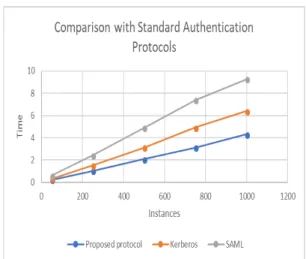
To evaluate the overhead caused by protocol, the time taken by different operations was calculated. The time taken by different instances during authentication of instances in the foreign cloud using the proposed system is shown in figure 4. To assess the effectiveness of our proposed proto-type, we compared the results with other commonly used
FIGURE 4. Authentication time for various instances.
FIGURE 5. Performance comaprison of proposed authentication scheme in multi-cloud scenario.
FIGURE 6. Precision of Accuracy matrix for service selection.
authentication protocols like SAML [15] and Kerberos [16]. Figure 5 shows that the proposed authentication protocol is very efficient compared to other protocols. 2. The proposed authentication protocol has better performance than tradi-tional protocols like SAML and Kerberos as it is designed specifically for heterogeneous multi-cloud scenarios. Ker-beros is a centralized protocol and distributes tickets to all communicating parties which increases its processing time.
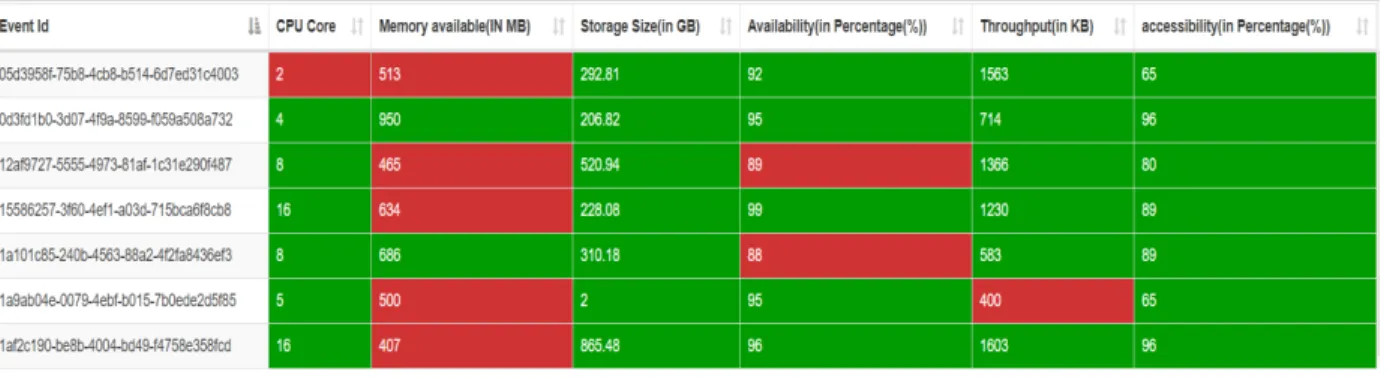
FIGURE 7. UI of client side showing SLA parameters compliance in foreign cloud (Red color shows SLA violations while green shows SLA compliance).
Although SAML is a distributed authentication protocol, it does not support heterogeneous client attributes, and when used in a secure way (in conjunction with SSL) it takes longer than proposed protocol to perform authentication of multiple clients.
To check the accuracy of the service selection algorithm, service selection requests were made from a large number of services instances, and the algorithm was successfully able to select the service with the highest match of QoS properties using accuracy matrix compared to SPSE and simple additive weighting (SAW) technique [17]. Precision measured as the ratio of a total number of correctly returned services to a total number of returned services of using accuracy matrix compared to SPSE and SAW is shown in figure 6.
To measure the performance SLA co-ordinator and effec-tiveness of monitoring we did experiments to measure the accuracy monitoring component during service execution in the foreign cloud. A basic user interface (UI) was cre-ated on the client side to report any SLA violations of the SLA metrics. Figure 7 shows the client UI after accessing a few services in the foreign cloud. The boxes in red are SLA violations that were captured while green boxes indicate the SLA parameters that were successfully implemented and followed.
To measure the delay caused by monitoring, the average time taken to make a decision about the events captured and violations recorded. It is used to measure the difference between the time at which the event leading to the violation of SLA occurred and the time taken by the monitor to decide that a violation has been recorded. The average delay in measuring 1000 events was found out to be 123.34 ms and it remained stable as the number of events increased. Therefore, it can be said that monitoring of SLA parameters take a small amount of time to detect and record violations which can be reported to the foreign cloud so that these violations could be decreased.
VI. USE CASES
IoT has brought revolutionary changes by having applica-tions varying from manufacturing, transport to healthcare
and smart homes. The proposed framework MC-IoT offers various advantages and use cases for IoT. Among these is the usage of MC-IoT in e-Healthcare, smart cities, vehicular networks and smart retail. In this section, we present how the proposed framework can be used in e-Healthcare and improving supply chains.
A. E-HEALTHCARE
Healthcare IoT devices such as sensors including implantable, bio-sensors, micro-electromechanical silicon and nano-sensors can potentially bring huge benefits to e-Healthcare industry in the coming years. Some of the benefits offered to patients include remote monitoring of patients with chronic illness, helping in the treatment of diseases, and monitoring of health statistics by patients themselves can help them to steps to improve their health. With the significant advantages offered by using sensor data in health care, the challenge arises with storing huge amount of data generated by sensors. Moreover, e-Healthcare requires data processing, storage and analytics that can be potentially be used by collaborative healthcare entities and applications.
e-Healthcare solutions enable the delivery of health care services at any required time however, its deployment also raises several challenges. The world population is increas-ing with the passage of time and more healthcare chal-lenges can be expected in the future. Due to the rise in healthcare cost, more sophisticated procedures such as e-Healthcare are required. Sensor based e-Healthcare systems can monitor patient’s health remotely and the doctor can view patients health using e-Health applications without the need of patients visiting a doctor. This ubiquitous monitoring has been predicted as the future of modern healthcare.
Multi-cloud system can provide a service based and application-oriented infrastructure that can be suitable for sensor based e-Healthcare system due to many reasons including the following: sensors generate a large amount of data, number of patient’s records being managed is very large, healthcare workers need inter-organizational and collabora-tive data sharing, some e-Health services need a specific plat-form to run, healthcare workers might need to use an e-Health
service being run on remote platform only for a limited period that will be economically inefficient to be purchased for a long time, and performing data analytics on large datasets of healthcare needs more resources than traditional infrastruc-ture. Based on heterogeneous requirements of multi-cloud and e-Healthcare services, this work proposed framework can enable dynamic collaboration between e-Health services in multi-clouds.
Using MC-IoT based healthcare system, users including patients and healthcare workers will only need to get authen-ticated by their local cloud and the proposed system will enable them to use services in foreign clouds according to requirement. The proposed system design can revolutionize the healthcare by providing key benefits such as ability to use multiple e-Health services on various platforms, scale com-puting resources such as storage according to requirements and share collaborative data with health care workers from other clouds.
B. BUSINESS CASE
As described earlier, MC-IoT can be used to enable users of a cloud platform to access services in another cloud. There are many other business cases of this framework that can help to improve the business supply chain.
Consider a case in which an organization named E-Packagers is using cloud resources and services on a cloud service provider. The company needs cloud resources during peak times between 9 am to 5 pm on working days and usage of these resources and their services on weekends is close to none. In this scenario, E-Packagers will have to pay for the time when the usage of their allocated resources is really low. However, using MC-IoT the company can further lease its services to be used by users from other clouds who can directly contact E-Packagers and use their services for a certain time without cloud provider interaction. This can help the company to generate additional revenues and users to access services with lesser conditions in less time.
VII. RELATED WORK
Delivery models for multiple clouds can be classified into two types which are federated cloud and multi-cloud. These models contrast in the level of co-operation between the included Clouds and the way that the client communicates with them [18].
Celesti et al. abridge the prerequisites of identity manage-ment across clouds in two classifications [19]:
1). Single Sign-On (SSO) authentication, where a Cloud must have the capacity to verify itself to access the assets gave by federated foreign Clouds having a place to a similar trust setting without further identity checks. 2). Digital identities and third parties, where a cloud must be considered as a subject particularly distinguished by credentials and each cloud must have the capacity to confirm itself with outside clouds utilizing its digital identity.
To address the authentication issues in multi-clouds dif-ferent architectures were proposed. Xuet al.[20] proposed an architecture by which different organizations can collab-orate to use business services. The proposed methodology coordinates security pre-requisites in SOA-based business forms and presents techniques for authentication of services from various domains for SOA-based business forms at run-time. Their architecture requires neither credential exchange nor foundation of any validation for creating a business session. The accuracy of the convention is formally broke down and demonstrated, and an observational review is performed utilizing two creation quality Grid frameworks, Globus 4 and CROWN.
Celesti et al. [21] propose a design to empower cloud federation in view of a three-stage model. These stages are named as discovery, matchmaking and authentication. The design includes a matchmaking agent which facilitates brokering, given by a match-production operator, whose errand is picking the more helpful Cloud(s) wherewith to set up an organization in view of data gathered both at the IaaS layer (e.g., CPU or RAM memory) and higher layers (e.g., QoS level). The proposed inter-cloud identity manage-ment infrastructure extends from XMPP, and XACML to SAML [22].
Bohliet al. [23] give a study of security and protection arrangements that expand on the idea of the synchronous use of multiple clouds. Pearson [24] talk about how the ideas of privacy, security, and trust develop with the emergence of cloud, and propose conceivable ways to deal with their insurance and administration.
Al-Aqrabi [25] developed an authentication scheme that can be used to build up certain trust connections among these business intelligence service instances and clients by sharing a typical session key to all members of a session. The distribution and generation of secret keys were managed by a central authority called session authority. The correctness of the protocol was verified and performance overhead was evaluated using a trusted third party.
The concept of IoT backed by cloud was introduced as the advantages of cloud including unlimited storage and process-ing can significantly improve IoT performance. IoT based clouds have introduced concepts such as smart things, things as a service and sensor as a service (SenaaS) [26]. Due to benefits offered by cloud in IoT, several new concepts were proposed.
The idea of cloud federation using IoT has been presented by authors in three stages [27]. The first stage includes embedded devices to be connected to IoT cloud systems, the second stage includes cloud providers leveraging IoT as a service while the third stage includes federation of IoT providers to extend their services and achieve more flexibility. Leitneret al.[28] have proposed a dynamic data-driven architecture that is able enough to ensure service provision-ing in cloud federation with minimum violations of service level agreement (SLAs). The author provided the simulation studies to validate the proposed approach. Rak et al. [29]
has introduced a novel approach named SPECS. The SPECS approach helps to offer various mechanisms to access security features that have been offered by CSPs, specify security requirements and to integrate the security services with cloud services to form security as a service approach.
Despite the considerable amount of research in multi-clouds, establishing dynamic communication to access ser-vices (particularly IoT serser-vices) in heterogeneous clouds is still an open research problem. Current work lacks the pro-tocols and frameworks that can be used for dynamic multi-cloud service collaboration and this research aims to solve this problem.
VIII. CONCLUSION
Multi-clouds offer a promising solution to efficiently deliver IoT services, but their adoption also raises challenges due to lack of supporting frameworks. This paper provides a novel framework to establish secure collaboration across multi-clouds to access services running in the foreign cloud. An authentication scheme is presented by which communi-cating clouds can authenticate each other dynamically. Ser-vice matchmaking technique is proposed to select the best IoT service matching user requirements among multiple for-eign clouds, and SLA approach is used to ensure service execution in the foreign cloud is according to the agreed SLA parameters between the user and the provider. Moreover, we also present the detailed system design to implement these protocols and framework. The experiments are performed on two cloud systems based on OpenStack and Amazon AWS and the results show that our protocols only result in a limited overhead. Furthermore, the use case scenarios are presented to show applications of the proposed framework.
REFERENCES
[1] J. Gubbi, R. Buyya, S. Marusic, and M. Palaniswami, ‘‘Internet of Things (IoT): A vision, architectural elements, and future directions,’’Future Gener. Comput. Syst., vol. 29, no. 7, pp. 1645–1660, 2013.
[2] (2017). Roundup Of Internet Of Things Forecasts. Accessed:
Aug. 4, 2018. [Online]. Available: https://www.forbes.com/
sites/louiscolumbus/2017/12/10/2017-roundup-of-internet-of-things-forecasts/#3a4c69321480
[3] A. Botta, W. De Donato, V. Persico, and A. Pescapé, ‘‘On the integration of cloud computing and Internet of Things,’’ inProc. Int. Conf. Future Internet Things Cloud (FiCloud), Aug. 2014, pp. 23–30.
[4] R. Buyya, C. S. Yeo, and S. Venugopal, ‘‘Market-oriented cloud com-puting: Vision, hype, and reality for delivering it services as computing utilities,’’ inProc. 10th IEEE Int. Conf. High Perform. Comput. Commun., Vancouver, BC, Canada, Sep. 2008, p. 1.
[5] F. Paraiso, N. Haderer, P. Merle, R. Rouvoy, and L. Seinturier, ‘‘A federated multi-cloud PaaS infrastructure,’’ inProc. IEEE 5th Int. Conf. Cloud Comput., Jun. 2012, pp. 392–399.
[6] N. Ferry, A. Rossini, F. Chauvel, B. Morin, and A. Solberg, ‘‘Towards model-driven provisioning, deployment, monitoring, and adaptation of multi-cloud systems,’’ in Proc. IEEE 6th Int. Conf. Cloud Comput., Jun./Jul. 2017, pp. 887–894.
[7] 451 Research. Accessed: Aug. 15, 2018. [Online]. Available:
https://451research.com/images/Marketing/press_releases/Pre_Re-Invent_2018_press_release_final_11_22.pdf
[8] F. Liuet al.,NIST Cloud Computing Reference Architecture, vol. 500, no. 2011. Gaithersburg, MD, USA: NIST, 2011, pp. 1–28.
[9] E. Bresson, O. Chevassut, D. Pointcheval, and J. J. Quisquater, ‘‘Provably authenticated group Diffie-Hellman key exchange,’’ inProc. 8th ACM Conf. Comput. Commun. Secur., Nov. 2001, pp. 255–264.
[10] M. Ahmed, L. Liu, B. Yuan, M. Trovati, and J. Hardy, ‘‘Context-aware ser-vice discovery and selection in decentralized environments,’’ inProc. IEEE Int. Conf. Comput. Inf. Technol., Ubiquitous Comput. Commun., Depend-able, Autonomic Secure Comput., Pervasive Intell. Comput., Oct. 2015, pp. 2224–2231.
[11] A. Awad, S. Kadry, B. Lee, and S. Zhang, ‘‘Property based attestation for a secure cloud monitoring system,’’ inProc. EEE/ACM 7th Int. Conf. Utility Cloud Comput., Dec. 2014, pp. 934–940.
[12] N. Santos, R. Rodrigues, K. P. Gummadi, and S. Saroiu, ‘‘Policy-sealed data: A new abstraction for building trusted cloud services,’’ inProc. USENIX Secur. Symp., Aug. 2012.
[13] S. Bouchenak, G. Chockler, H. Chockler, G. Gheorghe, N. Santos, and A. Shraer, ‘‘Verifying cloud services: Present and future,’’ACM SIGOPS Operating Systems Review, 2013.
[14] M. Kazim and S. Y. Zhu, ‘‘Virtualization security in cloud computing,’’ in Guide to Security Assurance for Cloud Computing. Springer, 2015. [15] SAML. Accessed: Aug. 26, 2018. [Online]. Available: https://developers.
onelogin.com/saml
[16] Kerberos. Accessed: Jul. 16, 2018. [Online]. Available: http://web.mit. edu/kerberos/
[17] A. Afshari, M. Mojahed, and R. M. Yusuff, ‘‘Simple additive weighting approach to personnel selection problem,’’Int. J. Innov., Manage. Technol., vol. 1, no. 5, pp. 511–515, 2010.
[18] D. Petcu, ‘‘Multi-Cloud: Expectations and current approaches,’’ inProc. Int. Workshop Multi-Cloud Appl. Federated Clouds, Apr. 2013, pp. 1–6. [19] A. Celesti, F. Tusa, M. Villari, and A. Puliafito, ‘‘How to enhance cloud
architectures to enable cross-federation,’’ inProc. IEEE 3rd Int. Conf. Cloud Comput., Jul. 2010, pp. 337–345.
[20] J. Xu, D. Zhang, L. Liu, and X. Li, ‘‘Dynamic authentication for cross-realm SOA-based business processes,’’IEEE Trans. Services Comput., vol. 5, no. 1, pp. 20–32, Jan./Mar. 2012.
[21] A. Celesti, F. Tusa, M. Villari, and A. Puliafito, ‘‘Three-phase cross-cloud federation model: The cloud SSO authentication,’’ inProc. 2nd Int. Conf. Adv. Future Internet (AFIN), Jul. 2010, pp. 94–101.
[22] A. Celesti, F. Tusa, M. Villari, and A. Puliafito, ‘‘Security and cloud computing: Intercloud identity management infrastructure,’’ inProc. 19th IEEE Int. Workshops Enabling Technol., Infrastruct. Collaborative Enter-prises (WETICE), Jun. 2010, pp. 263–265.
[23] J.-M. Bohli, N. Gruschka, M. Jensen, L. L. Iacono, and N. Marnau, ‘‘Security and privacy-enhancing multicloud architectures,’’IEEE Trans. Dependable Secure Comput., vol. 10, no. 4, pp. 212–224, Jul./Aug. 2013. [24] S. Pearson, ‘‘Privacy, security and trust in cloud computing,’’ in Pri-vacy and Security for Cloud Computing. London, U.K.: Springer, 2013, pp. 3–42.
[25] H. Al-Aqrabi, ‘‘Cloud BI: A multi-party authentication framework for securing business intelligence on the cloud,’’ Ph.D. dissertation, 2016.
[26] E. Cavalcante et al., ‘‘On the interplay of Internet of Things and cloud computing: A systematic mapping study,’’ Comput. Commun., vols. 89–90, pp. 17–33, Sep. 2016.
[27] A. Celesti, M. Fazio, M. Giacobbe, A. Puliafito, and M. Villari, ‘‘Charac-terizing cloud federation in IoT,’’ inProc. 30th Int. Conf. Adv. Inf. Netw. Appl. Workshops (WAINA), Mar. 2016, pp. 93–98.
[28] P. Leitner, J. Ferner, W. Hummer, and S. Dustdar, ‘‘Data-driven and auto-mated prediction of service level agreement violations in service composi-tions,’’Distrib. Parallel Databases, vol. 31, no. 3, pp. 447–470, Sep. 2013. [29] M. Rak, N. Suri, J. Luna, D. Petcu, V. Casola, and U. Villano, ‘‘Security as a service using an SLA-based approach via SPECS,’’ inProc. IEEE 5th Int. Conf. Cloud Comput. Technol. Sci. (CloudCom), Vol. 2, Dec. 2013, pp. 1–6.
MUHAMMAD KAZIMreceived the bachelor’s degree in computer engineering and the master’s degree in computer security from the National University of Sciences and Technology, Pakistan. He is currently pursuing the Ph.D. degree in com-puter science at the University of Derby, U.K. He has worked at various academic positions at the University of Derby including, as an Associate Academic and a Graduate Teaching Assistant. His research interests include cloud security, IoT, IoT security, networks security, and distributed systems.
LU LIU(M’07) received the M.Sc. degree in data communication systems from Brunel University and the Ph.D. degree from the University of Surrey (funded by DIF DTC). He is currently a Professor of distributed computing with the University of Derby, an Adjunct Professor with Jiangsu Univer-sity, and a Visiting Research Fellow with Tongji University. He has secured many research projects, which are supported by U.K. Research Councils, BIS and RLTF, and industrial research partners. He has authored over 100 scientific publications in reputable journals, academic books, and international conferences. His research interests are in the areas of cloud computing, service computing, peer-to-peer computing, virtual computing, and system of systems engineering. He is a member of BCS. He was recognized as a promising Researcher by the University of Derby in 2011. He received the BCL Faculty Research Award in 2012. He has chaired many international conference and workshops and has served as an editorial board member for several international computing journals.
SHAO YING ZHUis currently a Senior Lecturer in computing at the University of Derby, U.K. She is the Programme Leader for M.Sc. Advanced Computer Networks and B.Sc. (Honors) Computer Networks and Security. She has published many peer-reviewed conference and journal papers on a wide range of topics, such as image processing, E-learning, computer networks, and cloud secu-rity. She has edited a number of books for Springer’s Computer Communications and Net-works Series and organized many IEEE Net-workshops in network security subject areas. She has also served as a technical programme committee member for many conferences in networking area.