econ
stor
www.econstor.eu
Der Open-Access-Publikationsserver der ZBW – Leibniz-Informationszentrum Wirtschaft
The Open Access Publication Server of the ZBW – Leibniz Information Centre for Economics
Nutzungsbedingungen:
Die ZBW räumt Ihnen als Nutzerin/Nutzer das unentgeltliche, räumlich unbeschränkte und zeitlich auf die Dauer des Schutzrechts beschränkte einfache Recht ein, das ausgewählte Werk im Rahmen der unter
→ http://www.econstor.eu/dspace/Nutzungsbedingungen nachzulesenden vollständigen Nutzungsbedingungen zu vervielfältigen, mit denen die Nutzerin/der Nutzer sich durch die erste Nutzung einverstanden erklärt.
Terms of use:
The ZBW grants you, the user, the non-exclusive right to use the selected work free of charge, territorially unrestricted and within the time limit of the term of the property rights according to the terms specified at
→ http://www.econstor.eu/dspace/Nutzungsbedingungen By the first use of the selected work the user agrees and declares to comply with these terms of use.
De Witte, Kristof; Geys, Benny
Working Paper
Evaluating efficient public good provision: Theory
and evidence from a generalised conditional
efficiency model for public libraries
Discussion papers // Wissenschaftszentrum Berlin für Sozialforschung, Schwerpunkt Märkte und Politik: Forschungsprofessur & Projekt The Future of Fiscal Federalism, No. SP II 2010-14
Provided in cooperation with:
Wissenschaftszentrum Berlin für Sozialforschung (WZB)
Suggested citation: De Witte, Kristof; Geys, Benny (2010) : Evaluating efficient public good provision: Theory and evidence from a generalised conditional efficiency model for public libraries, Discussion papers // Wissenschaftszentrum Berlin für Sozialforschung, Schwerpunkt Märkte und Politik: Forschungsprofessur & Projekt The Future of Fiscal Federalism, No. SP II 2010-14, http://hdl.handle.net/10419/54594
WISSENSCHAFTSZENTRUM BERLIN FÜR SOZIALFORSCHUNG SOCIAL SCIENCE RESEARCH CENTER BERLIN
Research Area Markets and Politics
Research Professorship & Project
Schwerpunkt Märkte und Politik
Forschungsprofessur & Projekt
Kristof De Witte *
Benny Geys **
Evaluating Efficient Public Good Provision:
Theory and Evidence from a Generalised Conditional
Efficiency Model for Public Libraries
* University of Leuven
** WZB
SP II 2010 – 14
Kristof De Witte, Benny Geys, Evaluating Efficient Public Good Provision: Theory and Evidence from a Generalised Conditional Efficiency Model for Public Libraries, Discussion Paper
SP II 2010 – 14, Wissenschaftszentrum Berlin, 2010. Wissenschaftszentrum Berlin für Sozialforschung gGmbH,
Reichpietschufer 50, 10785 Berlin, Germany, Tel. (030) 2 54 91 – 0 Internet: www.wzb.eu
ABSTRACT
Evaluating Efficient Public Good Provision: Theory and Evidence from
a Generalised Conditional Efficiency Model for Public Libraries
by Kristof De Witte and Benny Geys
*Provision of most public goods (e.g., health care, libraries, education, police, fire
protection, utilities) can be characterised by a two-stage production process. In
the first stage, basic inputs (e.g., labour and capital) are used to generate
service potential (e.g., opening hours, materials), which is then, in the second
stage, transformed into observed outputs (e.g., school outcomes, library
circulation, crimes solved). As final outputs are also affected by demand-side
factors, conflating both production stages likely leads to biased inferences about
public productive (in)efficiency and its determinants. Hence, this paper uses a
specially tailored, fully non-parametric efficiency model allowing for both outlying
observations and heterogeneity to analyse efficient public good provision in
stage one only. We employ a dataset comprising all 290 Flemish public
libraries. Our findings suggest that ideological stance of the local government,
wealth and density of the local population and source of library funding (i.e.,
local funding versus intergovernmental transfers) strongly affect library
productive efficiency.
Keywords: Public good provision, conditional efficiency, nonparametric estimation, libraries, local govenment
JEL classification: C14, C61, I21
* The authors are grateful to Jos Blank, Elbert Dijkgraaf, Beate Jochimsen, Mika Kortelainen, Erwin
Ooghe and seminar participants at WZB Berlin for useful comments and suggestions. The usual caveat applies.
ZUSAMMENFASSUNG
Evaluierung der effizienten Bereitstellung öffentlicher Güter: Theorie und
Belege aus einem allgemeinem Modell bedingter Effizienz für öffentliche
Bibliotheken
Die Bereitstellung der meisten öffentlichen Güter (zum Beispiel
Gesundheits-versorgung, Bibliotheken, Bildung, Polizei, Brandschutz, Stadtwerke) kann
durch einen zweistufigen Produktionsprozess charakterisiert werden. In der
ersten Stufe werden Produktionsfaktoren (beispielsweise Arbeit und Kapital) zur
Erzeugung eines Dienstleistungspotenzials (beispielsweise Öffnungszeiten,
Materialien) genutzt. Dieses Potenzial wird dann, in der zweiten Phase, in den
beobachtbaren Output transformiert (zum Beispiel in Schulleistungen der
Schüler, dem Bücherumlauf einer Bibliothek, aufgedeckte Straftaten). Da das
Endergebnis auch von den Faktoren der Nachfrageseite bestimmt ist, führt eine
unzureichende Trennung beider Produktionsstufen wahrscheinlich zu verzerrten
Rückschlüssen bezüglich der öffentlichen produktiven (In-)Effizienz und ihrer
Determinanten. Daher wird in dem Paper ein speziell zugeschnittenes,
vollständig nichtparametrisches Effizienz-Modell benutzt. Dieses Modell
ermög-licht isoliert für die 1. Produktionsstufe die Analyse der effizienten Bereitstellung
öffentlicher Güter in einem Schritt. Dabei benutzen die Autoren einen
Daten-satz, welcher alle 290 flämischen öffentlichen Bibliotheken enthält. Die
Ergeb-nisse legen nahe, dass die ideologische Einstellung der
Gemeindeverwal-tungen, Wohlstand und Dichte der ortsansässigen Bevölkerung, sowie die Art
der Bibliotheksfinanzierung (zum Beispiel lokale Finanzierung oder
überregio-nale Transfers) stark die produktive Effizienz der Bibliotheken beeinflussen.
1
Introduction
In much the same way that concerns over allocative efficiency are at the heart of micro-economic theory (e.g., Leibenstein, 1966; Frantz, 1992), allocative efficiency in the public sector has always been a major concern in publicfinance. Numerous studies, for example, analyze whether local governments - which often have important responsibilities with respect to education, housing, health care, social welfare, recreation, infrastructure and the environ-ment (including refuse collection) (John, 2001) - have a tendency to over- or underprovide public goods (see, e.g., the pioneering work of Brueckner, 1979, 1982, 1983 and many refer-ences thereto). Moreover, scholars studying the decentralization of tasks from higher-level governments to the local level often evaluate this evolution in terms of allocative efficiency. Smaller jurisdictions with more homogeneous populations are argued to increase allocative efficiency as they are more capable of matching the provision of public goods with the pref-erences of their constituents (Musgrave, 1959; Oates, 1972), while numerous "informal and
formal versions of the Tiebout model demonstrate that private allocative efficiency tends to
be increased by Tiebout choice" (Hoxby, 2000, 1211).
In contrast, this paper concentrates on local government productive efficiency.1 This has received significantly less attention in the decentralization literature thus far (for important exceptions, see, e.g., Hoxby, 1999, 2000), even though one could argue that decentralization is most fruitful when local governments are, all else equal, more productively efficient than higher-level governments (e.g., Geys and Moesen, 2009). This relative neglect is all the more surprising given that thefinancial constraints within which local governments are expected to execute their (increasing) assignments have tightened significantly over the past decades. Indeed, given that tax- and deficit-increases are often politically costly (e.g., Geys and Ver-meir, 2008a, b), one way to deal with increasing tasksandtightening budget requirements is to improve productive or technical efficiency (understood in terms of providing a maximum amount of output for a given level of inputs; see Koopmans, 1951; Friedet al., 2008).
We are clearly not thefirst attempting to measure and explain local government produc-tive efficiency (for reviews, see Tang, 1997; De Borger and Kerstens, 2000). Yet, we differ from this previous body of work in three crucial respects. First, we build on important - but often neglected - insights from the urban governance and public administration literatures to more thoroughly describe the public sector production process prior to the actual analysis. These literatures illustrate that effective public service provision depends on an active involve-ment by the recipient of these services (e.g., Whitaker, 1980; Parks et al., 1981; Kiser, 1984; 1As in the private sector, efficiency constitutes one among many aims; including effectiveness, equity,
responsiveness, adequateness and appropriateness (Dunn, 2004). Our focus on productive efficiency obviously does not imply that it should take precedence over other aims of public service provision. Note also that we will use the terms productive and technical efficiency interchangeably throughout the paper.
Parry, 1996). That is, schools can "supply little education without inputs from students", police forces have "very little capacity to affect community safety and security without citizen input" such as reporting crimes or testifying in court (Parks et al., 1981, 1003), waste col-lection services require citizen coproduction "in the form of transporting household waste to the curb" (Percy, 1984, 436) and tax collection is eased with "citizens refraining from illegal actions" and "submitting tax returns" (Alford, 2002, 39). Such ‘coproduction’ has impor-tant implications for the measurement of technical efficiency, as it suggests that observable outcomes (e.g., library circulation, school results, waste collected, fires extinguished, crimes solved) - the most commonly employed output indicator in existing studies of public sector productive efficiency2 - are inappropriate as they are not really ‘produced’ in a strict sense by the public service provider (see also Cordero-Ferrera et al., 2008). We therefore propose to view public good provision as a two-stage production process (adapted from Hammond, 2002) in which, first, basic inputs — such as labour and capital — are translated into ‘service potential’ — such as available materials and opening hours — and then, secondly, the latter are transformed into observable outputs — such as school outcomes, library circulation or crimes solved. Particularly in the first stage of this process can the public service producer be most directly held accountable for translating a given amount of public expenditures into a maximum possible amount of service potential (whereas the second stage is probably more appropriately analyzed in a supply-demand framework).
As a second contribution, we employ a recently developed fully non-parametric framework and thus do not impose any a priori assumption on the production technology. This is crucial given the difficulty - if not impossibility - to argue that the public good production process follows one or another functional form. While our approach is closely related to Data Envelopment Analysis (DEA) models (Charnes et al., 1978; Deprins et al., 1984), it goes further than such models by allowing for outliers (following the order-m technique of Cazals
et al., 2002) and heterogeneity (building on the conditional efficiency estimators of Daraio and
Simar, 2005, 2007). Note that reliance on such conditional efficiency estimates is particularly convenient as it does not require a separability condition (i.e., the assumption that the exogenous environment does not influence the level of basic inputs and service potential). The final model is based on De Witte and Kortelainen (2008), who extended Daraio and Simar (2005, 2007) to allow for (1) both discrete and continuous exogenous variables and (2) statistical inference in the conditional efficiency approach. As such, besides reducing the impact of outliers and controlling for heterogeneity, we are able to non-parametrically evaluate the influence of exogenous characteristics on productive efficiency.
The latter also constitutes our third contribution. Previous studies generally fail to evalu-2See, for example, Worthington (2001) for the case of education or De Witte and Geys (2010) for the case
ate how the institutional environment — in terms of socio-demographic, economic or political characteristics — affects efficiency, or look at this via an econometric two-stage approach (e.g., De Borger et al., 1994; Geys, 2006; Hemmeter, 2006; Borge et al., 2008). Both exclusion of such background factors and their use in a two-stage approach, however, leads to biased results and incorrect inferences (see, respectively, Battese and Coelli, 1995 and Kumbhakaret al., 1991; Reifschneider and Stevenson, 1991). In this paper, we exploit the above-mentioned non-parametric conditional efficiency model to include the operational environment immedi-ately in the efficiency estimates. Relying on extensive public choice and political economics literatures, we thereby focus on the following elements: (1) ideological stance of the local government, (2) share of women in the local council, (3) wealth of the municipality, (4) population concentration, and (5) source of public funding.
While our central argument - and the ensuing empirical approach - can be readily ap-plied to various public goods, our empirical application exploits an exceptionally rich dataset of (all 290) municipal public libraries in Flanders in 2007.3 The Flemish setting is particu-larly attractive since nearly every municipality has its own library, generating a large and diverse dataset. Moreover, as the central and regional governments in Belgium set the over-all framework in which local public service providers operate, the latter’s work is largely execution-oriented and devoid of value choices (in contrast to, say, the US, where the value-component of local policy decisions is larger). This generates a situation that is particularly conducive to efficiency measurements as the value-content or neutrality of the inputs and outputs then becomes less of an issue (see also Geys and Moesen, 2009). Finally, we focus on libraries as local public library services are unlikely to be essential to individuals’ choice of residence (for recent evidence, see Bhatt, 2010), unlike, for example, a jurisdictions’ public education, tax policy or public safety. Moreover, selection of consumers by public libraries is unlikely to occur (unlike in, for example, education or health care; e.g., Parry, 1996). This is important since it strongly mitigates potential concerns about endogeneity and identification (more details below). Our findings suggest that the ideological stance of the local govern-ment, the wealth and density of the local population and the source of library funding (i.e., local funding versus intergovernmental transfers) are significant determinants of an efficient generation of service potential. At odds with recent work on the effects of female representa-tion on public policy (e.g., Chattopadhyay and Duflo, 2004; Geys and Revelli, 2009; Svaleryd, 2009), the number of women in the local government or the presence of a female mayor does not add to the explanatory power of the model,ceteris paribus.
The remainder of the paper is structured as follows. Section 2 describes the theoretical background and our main hypotheses. Section 3 introduces the estimation methodology, 3To facilitate the application in alternative settings, the R code underlying the present analysis is available
while Section 4 discusses the institutional setting and data. Our findings are presented in Section 5. Finally, the main conclusions are summarized in Section 6.
2
Theoretical background and hypotheses
2.1
Public good provision as a two-stage production process
A key characteristic of many public services is that "without the productive activities of con-sumers nothing of value will result" (Parks et al., 1981, 1002). Such view of the importance of citizens-consumers as ‘co-producers’ of public service production and deliveryfirst devel-oped among urban governance and public administration scholars in the early 1980s (e.g., Whitaker, 1980; Parks et al., 1981; Kiser, 1984; Percy, 1984). Although discussion about the exact nature, origins and consequences of such coproduction continues (e.g., Alford, 2002; Mitlin, 2008), the basic idea is that effective public service provision depends on active in-volvement by the recipient of these services. That is, schools require students’ (and parents’) effort to produce decent exam results, health care provision can only succeed if doctors’ and nurses’ orders are followed by patients, waste collection proceeds faster when citizens ap-propriately bag it and transport it to the curb, unemployment assistance programs stand or fall with the active engagement of the (long-term) unemployed, ... Urban scholars have extensively discussed similar relevance of citizen involvement for a wide and varied range of local public services includingfire and police protection, libraries, tax collection, recreation, and so on (for a review, see Percy, 1984).
Citizens’ coproduction represents a convenient way of pointing out that public goods have the consumers in their production function. This, however, has important implications for measuring public service providers’ technical or productive efficiency. Indeed, active involve-ment by the recipient of the service implies that observable outcomes (e.g., library circulation, school results, crimes resolved, fires extinguished and so on) are not really ‘produced’ in a strict sense by the public service provider - and thus are inappropriate measures to evalu-ate their technical (in)efficiency (see also Cordero-Ferrera et al., 2008). Indeed, given the importance of demand-side factors in the service production process, relying on observable outcomes in productive efficiency analyses may lead to strongly biased inferences. For exam-ple, when observed library circulation (i.e., the final outcome) is low, a relatively high-cost library will appear inefficient when using circulation as the output variable in the analysis. Yet, it may at the same time be very efficient in translating its basic inputs (such as labour and capital) into books, opening hours and so on. If so, using circulation as an output mea-sure will lead it to be unduly described as productively inefficient simply because it suffers from low demand in its area. This isnot to say that one should support locating such high-cost libraries in low-demand areas. Clearly, this would be a waste of public resources (i.e.
allocativeinefficiency). Rather, the argument is that, from a purelyproductiveefficiency per-spective, this library should be recognized as being technically efficient - and not be described as an underperformer for an element beyond its control (i.e., public demand for its service). To accurately evaluate public sector technical efficiency and its determinants, we argue that one should concentrate on that part of the production process that is fully under the control of the service provider.4 We therefore propose to view public good provision as characterized by a two-stage production process (adapted from Hammond, 2002). In afirst stage, basic inputs — such as (expenditures on) labour and capital — are employed in the production of what could be described as ‘service potential’ (Bookstein, 1981; Hammond, 2002). For public libraries, one can think of, for example, collection size and opening hours; in education, it may include teaching hours, teaching materials, school library; in health care, one can think of the number of hospital beds and operating rooms, opening hours, machinery (and similarly for other types of public services such as police, fire protection, water services, waste collection, and so on). In the second stage, this service potential is then transformed into observable outputs. For libraries, this could reflect book circulation and request processing, for health services the number of patients cured, and forfire and police protection the amount offires extinguished and crimes solved, respectively. At this stage, the outcome is clearly not solely determined by the public service provider, but also depends to an important extent on the ‘demand’ in a given area for the services provided. For example,
fire services are only provided if there arefires to be put out, while good exam results require student input and library circulation a population that cares about reading. Evidently, our distinction between service potential and final outputs is reminiscent of the distinction proposed by Becker (1965) and Lancaster (1966) between goods and commodities; where goods are seen as intermediate outcomes provided byfirms and subsequently transformed by consumers into commodities that fulfil their desires. In such view, food items in a supermarket can be seen as goods, while individuals’ meals or nutrition are the commodity (or final outcome) (see also Kiser, 1984).
This distinction between two production phases of public good provision allows analyses of technical efficiency to concentrate on that stage of public good production where the ser-vice provider has full control over the inputs and outputs (i.e., stage one). At this stage, technical efficiency can most directly be understood as translating a given amount of public expenditures (on, say, labour and capital) into a maximum possible amount of service poten-tial (whereas the second stage is probably more appropriately analyzed in a supply-demand framework). This avoids the bias induced by usingfinal outputs that are influenced by citizen 4Alternative approaches to deal with this problem, often based on advanced econometric techniques, are
reviewed and discussed with respect to productive efficiency in the education sector by Cordero-Ferrera et al. (2008).
coproduction (see above).5 Moreover, and importantly, focus on thisfirst stage also mitigates identification concerns raised, among others, by Hoxby (1999, 2000). Indeed, analysing the effect of Tiebout choice on local education outcomes, she relies on an instrumental variables approach to separate variation "driven by exogenous factors that affect thesupplyof school districts" from that which "is endogenous to observed student achievement or that is driven
by the demand for school districts" (Hoxby, 2000, 1210, boldface added). Our exclusion of
demand-side factors by focusing on thefirst-stage of the public good production process has an equivalent effect on the model’s identification possibilities, without requiring an instru-mental variables technique (which, in effect, has not been developed yet for the empirical model we introduce below).
Two potential limitations of our approach should be pointed out here. First, one might argue that thus far we implicitly assume public service providers to provide servicesfitting to local preferences. In other words, decisions regarding service potential are assumed to reflect the characteristics of expected demanders. For example, service providers are less likely to provide access during weekends in areas where everybody works weekends, while libraries probably buy more (less) children’s books in communities with high birthrates (large share of elderly). This, however, need not hold in reality and we fully agree that a library providing unwanted services (e.g., books no one has an interest in reading, but which are the most inexpensive available) should not be designated as fulfilling its task,even whenit provides the maximum possible amount of services for a given budget. Indeed, a more appropriate overall benchmark would be to consider how the service provider performs in terms of the production of services relevant for the socio-demographic make-up of the jurisdiction. However, this argument introduces the appropriateness of services or the responsiveness of the local service provider into the analysis (see also footnote 1), and thus goes beyond productive efficiency in a strict sense. Once again, it is important to stress that we are not claiming that these additional elements are less important than productive efficiency, but simply that analyses of pure productive efficiency should regard the appropriate framework and not implicitly encompass such effects.
Second, the clear distinction made above may not be all that clear in reality and public service providers could be argued to generally have some influence or control over the second stage of the production process. For example, librarians have an important role to facilitate or actively promote reading through the amount and quality of assistance programs, courses and/or lectures offered;fire services are involved in raising awareness offire risk and preven-tion; and so on. Still, such demand-influencing activities by service providers could within 5Referring once more to Becker (1965) and Lancaster (1966), our focus on stage one of the public good
production process is similar to arguing that the productive efficiency of private-sectorfirms is best evaluated using ’goods’ and not ’commodities’ as the firms’ output. This is, unsurprisingly and uncontroversially, exactly what scholars of private-sector productive efficiency have done for decades.
our framework be seen asfirst-stage outputs (i.e. service potential). While they thus do not invalidate our suggestion to focus on stage one only (because accountability is much more clear-cut here than in stage two), they do potentially affect the interpretation of the ineffi-ciency measured at stage one. Indeed, if this second-stage influence of the service provider is ignored or no appropriate measures for such often intangible services are included, the basic inputs used in the production of programmatic inputs are overstated and the resulting effi-ciency measure at stage one overestimates true ineffieffi-ciency. The key requirement in avoiding this bias would be to identify those inputs specific to stage one alone,or include variables accounting for both tangible and intangible service potential in the analysis.6
2.2
Determinants of e
ffi
cient public good provision: Hypotheses
Now that we have a clear understanding of the appropriate inputs and outputs when analyz-ing efficient provision of public goods, it remains to describe what might explain variations in efficiency across jurisdictions. Based on extent political economy and public choice liter-atures, we thereby concentrate on the institutional (i.e., political, socio-demographic as well as financial) environment in which public service providers (in this case, public libraries) operate. In the remainder of this section, we informally motivate the empirical application below by discussing various possible channels through which local circumstances might affect local public library efficiency.
Firstly, thepolitical environment is likely to matter because (1) right-wing parties and (2) male politicians might have different priorities compared to, respectively, left-wing govern-ments and female politicians. This prediction follows from a large political economy literature stating that ideology determines politicians’ policy preferences (e.g., Hibbs, 1977), as well as from more recent evidence indicating that gender is an important indicator of policy prefer-ences (e.g., Lott and Kenny, 1999; Edlund and Pande, 2002) and determines policy outcomes (e.g., Chattopadhyay and Duflo, 2004; Geys and Revelli, 2009; Svaleryd, 2009). Specifically, this literature suggests that the latter groups - i.e. left-wing and female politicians - tend to be more egalitarian and socially conscious. Translated to the present setting, this could lead left-wing and female politicians to be more inclined to focus on non-economic benefits of libraries (i.e., supplying the opportunity to read for the less well-off, stimulating the popu-lation to read more extensively, etc.), thereby putting more pressure on local public libraries to maximize their service potential (given the limited budget). In other words, for a given budget, they might be more likely to push for higher service potential.
Still, a second channel through which the political environment might matter is that left-wing parties often have close links to (public sector) trade unions. As a result, they might 6Note that ignoring potential variation in the quality of service potential across service providers would
experience a stronger motivation to create ’rents’ for public sector unions (Grossman and Helpman, 2001). This could result in shifting existing inputs towards labour (i.e. more staff, less books) or to increasing the library’s overall budget to support additional employment (Mueller and Murrell, 1986). In either case, however, it is not immediately clear how such budget re-allocation or expansion would affect libraries’ productive efficiency. Indeed, neither need imply a less productive efficient use of funds — unless one is willing to assume, say, that higher labour usage is necessarily detrimental to productive efficiency.
This discussion yields afirst hypothesis:
H1: Library efficiency is affected by a) the ideological stance of the local government and b) the share of women in the local council.
The municipalsocio-demographicmake-up is likely to affect library efficiency through its influence on the demand and willingness to pay for cultural goods. Both of these generally rise with income (e.g., Throsby, 1994; Schulze and Ursprung, 1998), such that high-income residents “may constitute a special interest group striving for cultural provisions” (Wercket al., 2008, 47). They may therefore pressure local public libraries to maximize their service potential given budgetary constraints. Related, distance is often argued to play a crucial role in deciding whether or not to visit a cultural event (e.g., Verhoeff, 1992; Boter et al., 2005; De Graaffet al., 2009; Bhatt, 2010). High concentration of population, by reducing the average cost of travelling to the library, thus increases the group of potential users of the library’s services. Moreover, lower travel costs can be argued to increase the ‘option value’ of library services.7 As such, for a given population size, urban areas (which are more densely populated) may have a larger share of its population interested in and striving for the efficient public provision of cultural goods (in this case, library services). In both cases, one could interpret the variables’ effects also in terms of a monitoring argument (see also below): i.e. with more people likely to use libraries, monitoring of how the library is using its resources is likely to increase.
We should note, however, that the possibility of congestion (for early analyses of con-gestion in public good provision, see, e.g., Brueckner, 1981; Hochman, 1982; Oates, 1988) may not only limit service provision when demand is very high (affecting the library’s final output), but might also limit the force of the previous arguments. Indeed, expectation of congestion may well reduce individuals’ propensity to pressure local service providers for efficient provision by diminishing their expected benefit of the service: i.e. the benefit of the service becomes discounted by the probability of not achieving it due to congestion. This is supported by studies showing reduced willingness-to-pay as well as willingness-to-travel when 7This follows from standard option pricing theory. Specifically, a decrease in the ‘strike price’ of an option
(e.g., through lower travel costs) to acquire a given underlying commodity (i.e., library services) increases its value (see also Wercket al., 2008).
expected congestion increases (e.g., McConnell, 1977; Menz and Mullen, 1981; Ashworth and Johnson, 1996; for a review relating to cultural resources, see Noonan, 2003).
This discussion leads to our second hypothesis:
H2: Library efficiency is affected by a jurisdictions’ a) wealth and b) population density. Finally, we know from principal-agent theory that monitoring reduces information asym-metries between principal and agent. Indeed, this literature shows that under perfect moni-toring afirst-best solution can still be reached. In other words, there is a strong disciplining effect of monitoring that - by limiting possibilities for wasteful spending and rent extrac-tion by the agent - is strictly welfare-improving (Alchian and Demsetz, 1972; Jensen and Meckling, 1976; Holmström, 1979). Recent experimental evidence generally supports this prediction (e.g., Naginet al., 2002; Dickinson and Villeval, 2008). Importantly, monitoring is likely to be higher when a larger share of library spending derives from local sources (i.e., fees and municipal subsidies) rather than subsidies from higher-level governments. The rea-son lies in a form of fiscal illusion, whereby voters fail to fully understand that grants from higher-level governments have to be financed through tax revenues by these governments as well (and that they will at least partly provide these resources). Such an imperfect mapping of consumers and financiers of library services (or, in other words, whenfiscal institutions are not built on the principle of ‘fiscal equivalence’; Olson, 1969) reduces the incentive to act as efficiency guards. It is, after all, perceived to be other people’s money that is being wasted, and voters may well care about government (in)efficiency only when they are directly confronted with the tax bill for public good provision. In other words, local public libraries’ accountability to the public (for fees and charges) and higher-level governments (who pro-vide grants) may differ. Applying this line of argument to our setting, libraries are “more likely to value the careful use of public money when it originates mainly from own revenue sources rather than external transfers” (Geyset al., 2010, 266). This gives our third andfinal hypothesis (for similar arguments, see Hoxby, 2000; Hemmeter, 2006):
H3: Library efficiency is higher when resources derive to a larger extent from own revenues.
3
Empirical methodology
To estimate efficiency in thefirst stage of the library production process and to determine its politico-economy influences (which are in the remainder considered as exogenous from the library’s point of view), we could in principle employ several modelling techniques. However, a closer look at the data and hypotheses limits the possibilities. First, we should focus on a non-parametric model as there is no a priori information on the appropriate production technology for public services. In other words, we have no reason to believe that the relation-ship between the inputs, outputs and exogenous characteristics follows a specific functional
form (e.g., Cobb-Douglas, Translog, Fourier, ...). Although non-parametric models have a lower rate of convergence, they have been shown to be more consistent compared to wrongly specified parametric models (Kneipet al., 1998). Second, as we have no information on price variables, we have to rely on a branch of non-parametric models particularly designed for public performance analysis: Data Envelopment Analysis (DEA; Charnes et al., 1978) and Free Disposal Hull (FDH; Deprinset al., 1984). Finally, given that we want to control for het-erogeneity and test for the influence of the exogenous environment on productive efficiency, the choice of modelling techniques is further narrowed to conditional efficiency estimators (Daraio and Simar, 2005, 2007) and, in particular, conditional efficiency models that allow for discrete and continuous exogenous variables (De Witte and Kortelainen, 2008).
The model starts from the set χn of observed combinations of inputs x(x ∈ Rp+) and outputsy (y ∈Rq+). The set of all feasible input-output combinations defines the production technology: Ψ=©(x, y) ∈Rp++q|xcan produce y
ª
.To determine the efficiency of the eval-uated libraries, we start from the best practice observations, i.e., the libraries that are using the least inputsxfor a given amount of outputsy (this is the so-called input-orientation; for alternative orientations, see Fried et al., 2008). These best practice observations constitute the best practice frontier, i.e., the border of the production technologyΨ.The inefficiencyθ
of the evaluated entity(x, y)is estimated as the distance to the best practice frontier:
θ(x, y) = inf{θ|(θx, y)∈Ψ} (1) where the input efficiency measureθ(x, y)≤1is the proportionate decrease of inputs, which the library operating at level (x, y) should attain in order to be considered ‘efficient’ (i.e.,
θ(x, y) = 1).
Two options now arise. One could impose convexity on the production possibilities (as in DEA) or not (as in FDH). Not imposing convexity clearly implies a more general approach. Moreover, there are “no valid theoretical arguments for assuming a priori that production
possibilities are truly convex” (Cherchye et al., 2000, 263-264) and some empirical studies
suggest violations of the convexity hypothesis (e.g., Hasenkamp, 1976). Hence, as there is no clear justification in our application to estimate a convex hull around the data, we concentrate on the FDH model. The FDH model estimates the production possibility set as:
ˆ ΨF DH = © (x, y) ∈Rp++q|y≤yi, x≥xi,(xi, yi)∈χn ª . (2)
The FDH estimator for the Farrell input-oriented efficiency score is obtained by replacingΨ
withΨˆ in equation (1).
However, a major disadvantage of the traditional non-parametric FDH model is that alln
observations in the sampleχnare considered to be potential best practices: P rob((x, y) Ψ) = 1. Therefore, atypical observations (e.g., due to measurement errors, very atypical structure
of the entity, and so on) heavily influence the best practice frontier and, as a direct result, the efficiency scores. To reduce the influence of these atypical observations, we follow Cazals
et al. (2002) in estimating the FDH efficiency of equation (1) relative to a partial frontier
constituting of m < n observations. By repeatedly drawing (B times) with replacement a subset ofmobservations among thosexi such thatyi≥yand averaging the efficiency scores relative to theseB subsets, we obtain a so-called robust efficiency estimateθm(x, y)[robust in the sense that the efficiency scores are more robust to outlying observations]. The robust estimates θm(x, y) are no longer bounded by 1 as the evaluated observation is not always included in the reference set. These ‘super-efficient’ efficiency scores (i.e., if θm(x, y) <1) indicate that the observation is using less inputs than the average mevaluated observations in its reference set. As such, the super-efficient observation is doing better than what would be expected.8
The robust efficiency approach of Cazals et al. (2002) proves extremely convenient to incorporate the exogenous environment. Traditional non-parametric models suffer from a separability condition in that the operational environment is assumed not to influence the inputs and outputs. However, in real life applications, this is clearly unrealistic. The condi-tional efficiency approach, developed by Cazals et al. (2002) and Daraio and Simar (2005, 2007), allows to incorporate the exogenous environment. Basically, while using the robust efficiency model described above, the idea is to draw the subsample of sizem in such a way that similar observations have a higher probability of being drawn. In practice, one obtains weights by estimating a kernel density around the evaluated exogenous characteristics. Hence, the resulting ’conditional’ efficiency estimates θm(x, y | z) compare like with likes. As the seminal contributions did not allow for multivariate analysis of both discrete and continuous exogenous variables, De Witte and Kortelainen (2008) extended the approach. Basically, their approach uses mixed (i.e., both discrete and continuous) Kernel smoothing around the exogenous variables such that for every observation the probability of being similar to the evaluated observation is known.
A second advantage of the De Witte and Kortelainen (2008) extension - crucial for our analysis - arises from the possibility for statistical inference concerning the influence of the exogenous variables. This extends the original contribution of Daraio and Simar (2005), which allowed for a graphical inference on the effect of exogenous variables (i.e., favorable or unfavorable), to estimating a non-parametric p-value (using an on bootstrapping based approach). Similar as in Daraio and Simar (2005, 2007), the procedure is implemented by estimating the effect of the exogenous variables on the ratio of the conditionalθm(x, y|z) to the unconditionalθm(x, y)efficiency. Indeed, if an exogenous variable has an unfavorable 8Following the literature (e.g., Daraio and Simar, 2007), we select the size of the partial frontiermas the
value of mas of which the percentage of super-efficient observations is only decreasing marginally withm. In our application, this corresponds tom= 50(whereasn= 290, see below).
effect on performance, then θm(x, y | z) (i.e., efficiency when taking z into account) will be larger than the unconditional efficiencyθm(x, y)for large values of z compared to small values ofz(Daraio and Simar, 2007). Non-parametrically bootstrapping this non-parametric regression allows us to obtain statistical inference (in particular, p-values) on the correla-tion between the environmental variable and the efficiency score (which, clearly, does not necessarily constitute a causal effect).9
4
Institutional setting and data
Our empirical application exploits an exceptionally rich dataset of (all 290) municipal public libraries in Flanders in 2007. The data derive from the Department ‘Social Development and Local Cultural Policy’ (Afdeling Volksontwikkeling en Lokaal Cultuurbeleid) of the Flemish Regional government. They collect - and make publicly available - information on library revenues (e.g., subsidies,fines and fees), expenditures (on personnel, infrastructure, library collection maintenance), collection size (e.g., books, CDs, DVDs, and so on) and operations (i.e., circulation, requests, and so on) since 1998. We employ the most recent data available (i.e., 2007) as a change in the data collection methodology in 2006 makes the resulting data imperfectly comparable across time. Data on opening hours are unfortunately not centrally collected and have been brought together by contacting all 290 libraries.
Given that FDH-based approaches - as the one employed here - tend to be sensitive to the number of inputs and outputs included (inclusion of more inputs and outputs increases the number of efficient observations; see Kneipet al., 1998), we opt for three input and four output variables. As inputs, we use expenditures on (1) personnel, (2) operating expenditures (Opex; mainly maintenance of the collection) and (3) infrastructure.10 It is important to note at this point that charitable donations to and employment of volunteers in public libraries are uncommon in Flanders (in contrast to, for example, the US) and are, as such, not included in the analysis. These inputs, which fully exhaust the library expenditure budget, are used to provide (1) youth books, (2) fiction and non-fiction books and (3) other media (CD, DVD, VHS, CD-ROM) during (4) a given number of hours per week. Hence, we use three collection-related variables (expressed in number of books) as indicators of library service potential and add, as a fourth output, the total number of opening hours per week (since this 9Causality and endogeneity issues are traditionally dealt with by a parametric instrumental variables
(IV) approach. However, in a non-parametric setting, IV are technically impossible as efficiency estimators allowing for instruments are not yet developed (neither for the non-parametric estimator used here, as for the parametric / semi-parametric alternatives available in the literature; see Fried et al., 2008).
1 0This infrastructure spending does not refer to big investment projects (such as major renovations or
additions to the library buildings), which tend to be lumpy and time-specific. Instead, it measures the annual, contemporaneous expenditure on infrastructure that occurs because books must be housed in an enclosed space and larger book collections require a larger space with higher maintenance costs.
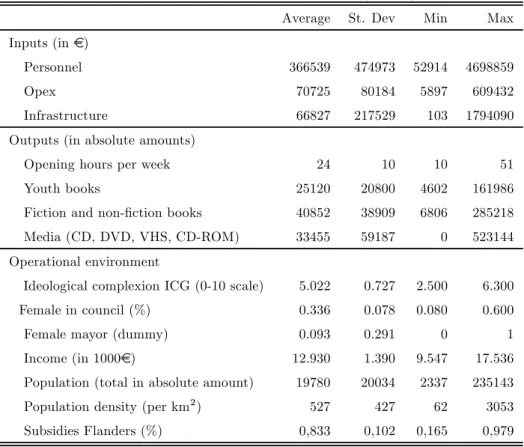
proxies the actual accessibility of the library collection for potential borrowers).11 We should thereby note that although the three former output variables correspond to stock measures, which may benefit older libraries, the variable returns to scale approach employed in our FDH model smoothly accounts for this (see Friedet al., 2008). Descriptive statistics of the variables employed are presented in Table 1.
Table 1: Descriptive statistics for 2007 (n=290)
Average St. Dev Min Max Inputs (in€)
Personnel 366539 474973 52914 4698859
Opex 70725 80184 5897 609432
Infrastructure 66827 217529 103 1794090 Outputs (in absolute amounts)
Opening hours per week 24 10 10 51 Youth books 25120 20800 4602 161986 Fiction and non-fiction books 40852 38909 6806 285218 Media (CD, DVD, VHS, CD-ROM) 33455 59187 0 523144 Operational environment
Ideological complexion ICG (0-10 scale) 5.022 0.727 2.500 6.300 Female in council (%) 0.336 0.078 0.080 0.600 Female mayor (dummy) 0.093 0.291 0 1 Income (in 1000€) 12.930 1.390 9.547 17.536 Population (total in absolute amount) 19780 20034 2337 235143 Population density (per km2) 527 427 62 3053 Subsidies Flanders (%) 0,833 0,102 0,165 0,979
To evaluate the three central hypotheses derived in Section 3.2, we examine the effects of the (1) ideological stance of the local government, (2) share of women in the local council, (3) wealth of the municipality, (4) population concentration, and (5) source of public funding. These are measured as follows:
First, we measure the Ideological Complexion of the local Government (ICG) asICG=
Pn
i=1(pi.Complexioni), where pi is the seat share of party i in the College of Mayor and
Aldermen (i.e., the local government) andComplexioni refers to the ideological position of
1 1Clearly, the service potential of a library goes beyond these four variables and can be thought to also
include the amount and quality of assistance programs, courses, lectures and/or exhibitions offered. Unfortu-nately, however, data for such outputs are unavailable. As such, to the extent that basic inputs are employed for the provision of such services, our analysis is likely to over-estimate true technical inefficiency in stage one of the public service production process (see above).
this party on a Left-Right scale (from 0 to 10). The data concerning a party’s ideological position were obtained from Buelens et al. (2008) and are based on a self-placement survey asking presidents and spokesmen of the parties in the municipalities to locate their party on an ideological scale between 0 (Left) and 10 (Right). Thefigures range from 2.0 (Groen!) to 6.3 (Open VLD) (the extreme-right-wing party Vlaams Belang was not represented in any local government and is therefore not in the dataset). As a higher ICG score represents more a right-wing government, we expect an unfavorable effect on efficiency.
Second, to measure the influence of female representation, we use two operationalizations. The first measures female representation as the share of female members in the municipal council (the local parliament). The more women are elected into the council, the more likely it is that female preferences are translated into actual policies. The second operationalization attempts to establish whether female preferences are more likely to come about when there is a female mayor. In this case, we define female representation using an indicator variable equal to 1 when the mayor is female, 0 otherwise.12
Third, real taxable per capita income (in€1000) is included to assess whether efficiency differs in wealthier municipalities. Population density (measured as inhabitants per km2) is
taken up as a measure for the degree of urbanization.
Finally, libraries are a heavily subsidized public service in Flanders. A large share of these subsidies derives from the Flemish Regional government, which provides each municipality with a ’basic subsidy’ of 6€per inhabitant (with a minimum of 50,000€) towards thefinancing of its library personnel. These subsidies constitute no less than 83% of total library revenues on average (though varying between 16.5% and 97.9%; see Table 1). The remaining revenue is provided by municipal subsidies and various alternative resources such as membership fees, borrowing fees andfines. We include the share of regional subsidies in the total library budget to evaluate the third hypothesis, i.e. whether efficiency is higher (lower) when resources derive to a larger extent from own revenues (higher-level government subsidies).
5
Results
The results of the efficiency estimations are summarized in Table 2. In column 1, we present the results when we do not account for the exogenous environment (i.e., ‘unconditional’ efficiency). We find an average efficiency score of 0.79. This indicates that, on average, Flemish local public libraries would have to decrease their inputs by approximately 21% in order to produce their outputs equally efficient as the best practices. There is, however, a very 1 2Still, the data do not allow us to interpret ourfindings as causal evidence in favour of female influence.
Indeed, women might simply get voted into office more often in municipalities that have a more ‘egalitarian’ population. As such, it might be underlying differences in popular preferences (rather than women’s policy preferences as such) causing both a higher share of female councillors and more efficient libraries.
large variation in the performance across libraries, as can be seen from the sizeable standard deviation around this average inefficiency. Moreover, some efficiency scores are significantly larger than 1 (i.e.,θm(x, y)<1). Hence, some observations can be viewed as super-efficient: they perform better than the averagemobservations in their reference sample.
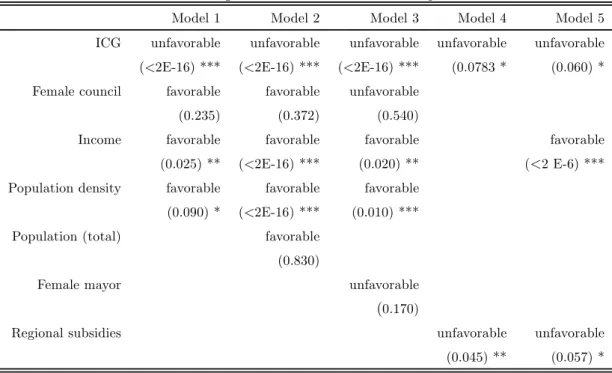
To examine Hypotheses 1 to 3, we developfive alternative conditional efficiency models. In Model 1, we examine the influence of ideological stance, share of female politicians in the local council, average income, and population concentration by analyzing their correlation with the efficiency score via a nonparametric bootstrap procedure (see above). Model 2 adds population size to this baseline model, in order to check whether the population concentration effect not merely derives from a larger population as such. Model 3 adds a dummy variable for female mayors to assess whether this has an independent effect on public library efficiency, after controlling for overall female representation in the local council (as in Model 1). To test Hypothesis 3, we include the percentage of regional subsidies in total library revenues, while controlling for the ideological preferences (in Model 4) and average income (Model 5) of the municipality. A systematic presentation is given in Table 3.
Once we account for the exogenous environment (i.e., conditional efficiency), our earlier conclusions change in two important ways (results summarized in columns 2 to 6 of Table 2). First, the average efficiency score no longer significantly deviates from 1. Second, the standard deviation around this mean reduces significantly. Both results indicate that a large part of the variation in inefficiency observed in the unconditional efficiency estimates can be explained by the exogenous factors and, as a result, we are able to determine to a large degree the apparent source(s) of the previously-observed efficiency differences.
These summarized results, however, do not allow us to evaluate Hypothesis 1-3. Thus, we represent the full estimation results for allfive conditional models in Table 3. We thereby consider the effect on the median, rather than the mean, as the former is less influenced by extreme values. Note also that, due to the structure of the non-parametric bootstrap, we only present whether the exogenous variable has a significant (un)favorable effect on efficiency. The marginal coefficient on the median is less meaningful (see De Witte and Kortelainen, 2008).
Table 2: Order-m efficiency score (N=290)
Unconditional Conditional
(robust FDH) Model 1 Model 2 Model 3 Model 4 Model 5 Average 0.7892 1.0507 0.9891 1.0078 1.1082 1.0096 St. Dev. 0.6575 0.1946 0.1294 0.1606 0.2394 0.2029 Min 0.1965 0.5315 0.4778 0.5061 0.5018 0.5019 Max 5.4843 2.4027 2.0493 2.4284 2.0760 2.0093
Table 3: Influence of the exogenous environment on service potential of libraries
Model 1 Model 2 Model 3 Model 4 Model 5 ICG unfavorable unfavorable unfavorable unfavorable unfavorable (<2E-16) *** (<2E-16) *** (<2E-16) *** (0.0783 * (0.060) * Female council favorable favorable unfavorable
(0.235) (0.372) (0.540)
Income favorable favorable favorable favorable (0.025) ** (<2E-16) *** (0.020) ** (<2 E-6) *** Population density favorable favorable favorable
(0.090) * (<2E-16) *** (0.010) *** Population (total) favorable
(0.830)
Female mayor unfavorable
(0.170)
Regional subsidies unfavorable unfavorable (0.045) ** (0.057) * Note: n=290; Bootstrapped p-values between brackets; ***, ** and * denote significance at 1%, 5%
and 10%-level.
Our results provide strong evidence in line with thefirst part of ourfirst hypothesis. That is, right wing councils are associated with a statistically significantly lower level of public library productive efficiency, ceteris paribus. Thisfinding is robust across all specifications, and suggests that left-wing governments are indeed more likely to care about maximizing library service potential (under a given budget). The second half of our first hypothesis is not supported. That is, although the share of female representatives in the local council is positive related to median efficiency this fails to be statistically significant. A similar conclusion is reached when examining the influence of a female mayor on efficiency (Model 3). Female mayors are not associated with a significantly higher level of library performance, ceteris paribus.13
Wefind strong support for Hypothesis 2. Municipalities with higher income and urban-ization levels (i.e., more densely populated) have better performing libraries. The latter effect is not driven by population size. Indeed, when including population size in the estimation (Model 2), this turns out to be insignificant, while the effect of population concentration remains unaffected.
1 3One potential explanation for this non-finding might be that municipalities with high female
representation also tend to have more leftwing governments (assuming women are more likely to run and be elected -on left-wing party lists). This, however, is not supported by the data. Indeed, while we dofind the expected negative correlation between ICG and fcouncil, this relation is weak (r=-0.1140;p=0.07).
Finally, our results confirm Hypothesis 3. Libraries turn out to have a higher service po-tential for a given budget when library revenues derive to a larger extent from local resources (i.e., municipal subsidies, fees andfines). This confirms the idea that monitoring has a strong and positive effect on local public good provision, and that incentives for monitoring are undermined when a larger share of income derives from higher-level government subsidies. This supports Hemmeter’s (2006) findings for a sample of 3308 US library systems. It also links to recent findings by Geys et al. (2010, 1), who show that "the efficiency-enhancing effect of voter involvement" in German municipalities is significantly reduced when a larger share of local revenues comes from intergovernmental subsidies.
6
Conclusion
Economic efficiency — in terms of maximizing output for a given level of inputs (e.g., Koop-mans, 1951; Fried et al., 2008) — has recently become an increasingly important element in public good provision. This has lead to a concomitant increase in scholarly attention for the determinants of such efficiency. We added to this burgeoning literature in three ways.
First, we characterized public good provision as a two-stage production process. One stage translates basic inputs into service potential, while a second stage describes how these are transformed into observed outcomes. This separation is crucial to accurately defining inputs and outputs in the analysis of productive efficiency (and thus determines the accuracy of the results from such analyses). Indeed, as the second stage outcomes are influenced by public demand (and thus in part lie beyond the control of the public service provider), they are inappropriate to evaluate the pure productive efficiency of public good provision. Hence, we argued that one should concentrate on thefirst stage (in which the production of service potential is fully under control of the service provider).
Second, we employed a specially tailored and fully non-parametric framework, which is rooted in popular Data Envelopment Analysis (DEA) models (Charnes et al., 1978). By using a robust (i.e., allowing for outlying observations; Cazalset al., 2002) and conditional (i.e., allowing for heterogeneity; Daraio and Simar, 2005, 2007) efficiency framework, we were able to evaluate non-parametrically (i.e., without anya priori assumption on the production function) how discrete and continuous exogenous variables affect productive efficiency. We thereby included the operational environment immediately in the efficiency estimates, thus avoiding use of a separability condition, which inappropriately assumes that the exogenous environment does not have an impact on the inputs and outputs.
Third, relying on a large political economy and public choice literature, we used the above framework to examine how political economy factors affect efficiency of local public good provision. Ourfindings - using data on 290 Flemish local public libraries - suggest that library
productive efficiency is higher when (1) the ideological stance of the local government is more left-wing, (2) the population is wealthier, (3) the area is more densely populated and (4) public service revenues derive to a larger extent from local resources. In addition, our results indicate that, ceteris paribus, (5) population size, (6) the share of female representatives in the local council, and (7) having a female mayor does not significantly affect library performances.
References
[1] Alchian, A.A. and H. Demsetz (1972). Production, Information Costs and Economic Organisation.American Economic Review 62, 777-795.
[2] Alford, J. (2002). Why do Public-Sector Clients Coproduce? Toward a Contingency Theory.Administration and Society 34(1), 32-56.
[3] Ashworth, J. and P. Johnson (1996). Sources of ’Value for Money’ for Museum Visitors: Some Survey Evidence.Journal of Cultural Economics 20(1), 67-83.
[4] Battese, G.E. and T.J. Coelli (1995). A Model for Technical Efficiency Effects in a Stochastic Frontier Production Function with Panel Data. Empirical Economics 20, 325-332.
[5] Becker, G.S. (1965). A Theory of the Allocation of Time.Economic Journal 75, 493-517. [6] Bhatt, R. (2010). The Impact of Public Library Use on Reading, Television, and
Acad-emic Outcomes.Journal of Urban Economics 68(2): 148-166.
[7] Bookstein, A. (1981). An Economic Model of Library Service. Library Quarterly 51, 410-428.
[8] Borge, L.-E., T. Falch and P. Tovmo (2008). Public Sector Efficiency: The Impact of Political and Budgetary Institutions, Fiscal Capacity and Democratic Participation.
Public Choice, 136, 475-495.
[9] Boter, J., J. Rouwendal and M. Wedel (2005). Employing Travel Time to Compare the Value of Competing Cultural Organizations.Journal of Cultural Economics 29 (1), 19-33.
[10] Brueckner, J. (1979). Property Values, Local Public Expenditure and Economic Effi-ciency.Journal of Public Economics 11, 223-245.
[11] Brueckner, J. (1981). Congested Public Goods: The Case of Fire Protection.Journal of
[12] Brueckner, J. (1982). A Test for Allocative Effficiency in the Local Public Good Sector.
Journal of Public Economics 19, 311-331.
[13] Brueckner, J. (1983). Property Value Maximisation and Public Sector Efficiency.Journal
of Urban Economics 14, 1-15.
[14] Buelens, J., B. Rihoux and K. Deschouwer (2008).Tussen Kiezer en Hoofdkwartier — De
lokale partijafdelingen en de gemeenteraadsverkiezingen van 2006. VUBPress: Brussel.
[15] Cazals, C., J.P. Florens and L. Simar (2002). Nonparametric Frontier Estimation: A Robust Approach.Journal of Econometrics 106 (1), 1-25.
[16] Charnes, A., W.W. Cooper and E. Rhodes (1978). Measuring Efficiency of Decision-Making Units.European Journal of Operational Research 2 (6), 428-449.
[17] Chattopadhyay, R. and E. Duflo (2004). Women as Policy Makers: Evidence from a Randomized Policy Experiment in India.Econometrica 72 (5), 1409-1443.
[18] Cherchye, L., T. Kuosmanen and T. Post (2000). What is the Economic Meaning of FDH? A Reply to Thrall.Journal of Productivity Analysis 13, 263-267.
[19] Cordero-Ferrera, J.M., F. Pedraja-Chaparro and J. Salinas-Jiménez (2008). Measuring Efficiency in Education: An Analysis of Different Approaches for Incorporating Non-Discretionary Inputs.Applied Economics 40, 1323-1339.
[20] Daraio, C. and L. Simar (2005). Introducing Environmental Variables in Nonparametric Frontier Models: A Probabilistic Approach. Journal of Productivity Analysis 24 (1), 93—121.
[21] Daraio, C. and L. Simar (2007). Advanced robust and nonparametric methods in effi
-ciency analysis. Methodology and applications. Series: Studies in Productivity and
Effi-ciency, Springer: Heidelberg.
[22] De Borger, B., K. Kerstens, W. Moesen and J. Vanneste (1994). Explaining Differences in Productive Efficiency: An Application to Belgian Municipalities. Public Choice 80, 339-358.
[23] De Borger, B. and K. Kerstens (2000). What is Known about Municipal Efficiency? The Belgian Case and Beyond, in J. Blank (Ed.), Public Provision and Performance:
Contributions from Efficiency and Productivity Measurement Elsevier: Amsterdam. pp.
299-330.
[24] De Graaff, T., J. Boter and J. Rouwendal (2009). On Spatial Differences in Attractiveness of Dutch Museums.Environment and Planning A41(11), 2778-2797.
[25] Deprins, D., L. Simar and H. Tulkens (1984). Measuring Labor Efficiency in Post
Of-fices. In Marchand M., P. Pestieau and H. Tulkens (Eds.), The Performance of Public
Enterprises: Concepts and Measurements. North-Holland: Amsterdam. pp. 243-267.
[26] De Witte, K. and B. Geys (2010). Evaluating the Technical Efficiency of Local Public Libraries: Accounting for Consumers as Coproducers, WZB Berlin, mimeo.
[27] De Witte, K. and M. Kortelainen (2008). Blaming the Exogenous Environment? Con-ditional Efficiency Estimation with Continuous and Discrete Environmental Variables.
CES Discussion Paper Series DPS 08.33;MPRA Paper 14034.
[28] Dickinson, D. and M.-C. Villeval (2008). Does Monitoring Decrease Work Effort? The Complementarity between Agency and Crowding-Out Theories. Games and Economic
Behavior 63, 56-76.
[29] Dunn, W.N. (2004). Public Policy Analysis: An Introduction. Pearson Prentice Hall: New Jersey.
[30] Edlund, L. and R. Pande (2002). Why have Women Become Left-Wing? The Political Gender Gap and the Decline in Marriage. Quarterly Journal of Economics 117 (3), 917-961.
[31] Frantz, R. (1992). X-Inefficiency and Allocative Efficiency: What have we Learned?
American Economic Review 82(2), 434-438.
[32] Fried, H., C.A.K. Lovell and S. Schmidt (2008). The Measurement of Productive Effi
-ciency and Productivity Growth. Oxford: Oxford University Press.
[33] Geys, B. (2006). Looking across Borders: A Test of Spatial Policy Interdependence using Local Government Efficiency Ratings.Journal of Urban Economics 60 (3), 443-462. [34] Geys, B., F. Heinemann and A. Kalb (2010). Voter Involvement, Fiscal Autonomy and
Public Sector Efficiency: Evidence from German Municipalities. European Journal of
Political Economy 26(2), 265-278.
[35] Geys, B. and W. Moesen (2009). Sources of Local Government Technical Efficiency: Evidence from Flemish Municipalities.Public Finance and Management 9(1), 1-29. [36] Geys, B. and F. Revelli (2009), Decentralization, Competition and the Local Tax Mix:
Evidence from Flanders.University of Torino Working Paper nr.02/2009.
[37] Geys, B. and J. Vermeir (2008a). Taxation and Presidential Approval: Separate Effects from Tax Burden and Tax Structure Turbulence? Public Choice 135 (3-4), 301-317.
[38] Geys, B. and J. Vermeir (2008b). The Political Cost of Taxation: New Evidence from German Popularity Ratings.Electoral Studies 27(4), 633-648.
[39] Grossman, G. and E. Helpman (2001).Special Interest Politics. Cambridge: MIT Press. [40] Hammond, C.J. (2002). Efficiency in the Provision of Public Services: A Data
Envelop-ment Analysis of UK Public Library Systems.Applied Economics 34 (5), 649-657. [41] Hasenkamp, G. (1976). A Study of Multiple-Output Production Functions. Journal of
Econometrics 4, 253-262.
[42] Hemmeter, J.A. (2006). Estimating Public Library Efficiency using Stochastic Frontiers.
Public Finance Review 34 (3), 328-348.
[43] Hibbs, D. (1977). Political Parties and Macro-Economic Policy.American Political
Sci-ence Review 71, 1467-1487.
[44] Hochman, O. (1982). Congestable Local Public Goods in an Urban Setting.Journal of
Urban Economics 11(3), 290-310.
[45] Holmström, B. (1979). Moral Hazard and Observability. Bell Journal of Economics 10 (1), 74-91.
[46] Hoxby, C. (1999). The Productivity of Schools and other Local Public Goods Producers.
Journal of Public Economics 74, 1-30.
[47] Hoxby, C. (2000). Does Competition among Public Schools Benefit Students and Tax-payers? American Economic Review 90(5), 1209-1238.
[48] Jensen, M.C. and W.H. Meckling (1976). The Theory of the Firm: Managerial Behavior, Agency Costs and Ownership Structure.Journal of Financial Economics 3 (4), 305-360. [49] John, P. (2001).Local Governance in Western Europe. Sage: London.
[50] Kiser, L.L. (1984). Toward an Institutional Theory of Citizen Coproduction. Urban
Affairs Quarterly 19(4), 485-510.
[51] Kneip, A., B. Park and L. Simar (1998). A note on the convergence of nonparametric DEA estimators for production efficiency scores.Econometric Theory 14, 783-793. [52] Kumbhakar, S.C., S. Gosh and J.T. McGuckin (1991). A Generalized Production
Fron-tier Approach for estimating Determinants of Inefficiency in US Dairy Firms.Journal
of Business and Economic Statistics 9 (3), 279-286.
[53] Koopmans, T.C. (1951).Activity Analysis of Production and Allocation. New York: John Wiley.
[54] Lancaster, K.J. (1966). A New Approach to Consumer Theory. Journal of Political
Economy 74(2), 132-157.
[55] Leibenstein, H. (1966). Allocative Efficiency vs. "X-Inefficiency". American Economic
Review 56(3), 392-415.
[56] Lott, J.R. and L.W. Kenny (1999). Did Women’s Suffrage Change the Size and Scope of Government? Journal of Political Economy 107, 1163-1198.
[57] McConnell, K.E. (1977). Congestion and Willingness to Pay: A Study of Beach Use.
Land Economics 53(2), 185-195.
[58] Menz, F.C. and J.K. Mullen (1981). Expected Encounters and Willingnes to Pay for Outdoor Recreaetion.Land Economics 57(1), 33-40.
[59] Mitlin, D. (2008). With and Beyond the State: Co-Production as a Route to Political Influence, POwer and Transformation for Grassroots Organizations. Environment and
Urbanization20(2), 339-360.
[60] Mueller, D.C. and P. Murrell (1986). Interest Groups and the Size of Government.Public
Choice48, 125-146.
[61] Musgrave, R.M. (1959).The Theory of Public Finance. McGraw-Hill: New York. [62] Nagin, D.S., J.B. Rebitzer, S. Sanders and L.J. Taylor (2002). Monitoring, Motivation
and Management: The Determinants of Opportunistic Behavior in a Field Experiment.
American Economic Review 92 (4), 850-873.
[63] Noonan, D.S. (2003). Contingent Valuation and Cultural Resources: A Meta-Analytic Review of the Literature.Journal of Cultural Economics 27(3-4), 159-176.
[64] Oates, W.E. (1972).Fiscal Federalism.Harcourt Brace Jovanovich: New York.
[65] Oates, W.E. (1988). On the Measurement of Congestion in the Provision of Local Public Goods.Journal of Urban Economics 24(1), 85-94.
[66] Olson, M. (1969). The Principle of ’Fiscal Equivalence’: The Division of Responsibilities among Different Levels of Government,American Economic Review 59, 479-487. [67] Parks, R.B., P.C. Baker, L. Kiser, R. Oakerson, E. Ostrom, V. Ostrom, S.L. Percy, M.B.
Vandivort, G.P. Whitaker and R. Wilson (1981). Consumers and Coproducers of Public Services: Some Economic and Institutional Considerations.Policy Studies Journal 9(7), 1001-1011.
[68] Parry, T.R. (1996). Will Pursuit of Higher Quality Sacrifice Equal Opportunity in Higher Education? An Analysis of the Education Voucher System in Santiago. Social Science Quarterly. 77(4), 821-841.
[69] Percy, S.L. (1984). Citizen Participation in the Coproduction of Urban Services.Urban
Affairs Quarterly 19(4), 431-446.
[70] Reifschneider, D. and R. Stevenson (1991). Systematic Departures from the Frontier: A Framework for the Analysis of Firm Inefficiency.International Economic Review 32 (3), 715-723.
[71] Schulze, G.G. and H.W. Ursprung (2000). La Donna e mobile — or is she? Voter Prefer-ences and Public Support for the Performing Arts.Public Choice 102, 129-147.
[72] Svaleryd, H. (2009). Women’s Representation and Public Spending. European Journal
of Political Economy 25 (2), 186-198.
[73] Tang, K.-L. (1997). Efficiency in the Private Sector: A Critical Review of Empirical Evidence from Public Services.International Review of Administrative Sciences63, 459-474.
[74] Throsby, C.D. (1994). The Production and Consumption of the Arts: A View of Cultural Economics.Journal of Economic Literature 32, 1-29.
[75] Verhoeff, R. (1992). Explaining Differences in the Geographical Reach of Performances.
Journal of Cultural Economics 16 (2), 73-82.
[76] Werck, K., B. Heyndels and B. Geys (2008). The Impact of ‘Central Places’ on Spatial Spending Patterns: Evidence from Flemish Local Government Cultural Expenditures.
Journal of Cultural Economics 32 (1), 35-58.
[77] Whitaker, G. (1980). Co-Production: Citizen Participation in Service Delivery.Public
Administration Review 40, 240-246.
[78] Worthington, A.C. (2001). An Empirical Survey of Frontier Efficiency Measurement Techniques in Education.Education Economics 9(3), 245-268.