A tensor motion descriptor based on histograms of
gradients and optical flow
Virginia Fernandes Mota, Eder de Almeida Perez, Silva Maciel Luiz Maur´ılio
Da, Marcelo Bernardes Vieira, Philippe-Henri Gosselin
To cite this version:
Virginia Fernandes Mota, Eder de Almeida Perez, Silva Maciel Luiz Maur´ılio Da, Marcelo Bernardes Vieira, Philippe-Henri Gosselin. A tensor motion descriptor based on histograms of gradients and optical flow. Pattern Recognition Letters, Elsevier, 2014, 39, pp.85-91. <10.1016/j.patrec.2013.08.008>. <hal-00861395>
HAL Id: hal-00861395
https://hal.archives-ouvertes.fr/hal-00861395
Submitted on 12 Sep 2013
HAL is a multi-disciplinary open access archive for the deposit and dissemination of sci-entific research documents, whether they are pub-lished or not. The documents may come from teaching and research institutions in France or abroad, or from public or private research centers.
L’archive ouverte pluridisciplinaire HAL, est destin´ee au d´epˆot et `a la diffusion de documents scientifiques de niveau recherche, publi´es ou non, ´emanant des ´etablissements d’enseignement et de recherche fran¸cais ou ´etrangers, des laboratoires publics ou priv´es.
A tensor motion descriptor based on histograms of
gradients and optical flow
Mota V. F.1a,b, Perez E. A.a, Maciel L. M.a, Vieira M. B.a, Gosselin, P. H.c
aDCC/ICE, Universidade Federal de Juiz de Fora, Juiz de Fora, Brazil bDCC/ICEx, Universidade Federal de Minas Gerais, Belo Horizonte, Brazil
cINRIA Rennes Bretagne Atlantique
Abstract
This paper presents a new tensor motion descriptor only using optical flow and HOG3D information: no interest points are extracted and it is not based on a visual dictionary. We propose a new aggregation technique based on tensors. This is a double aggregation of tensor descriptors. The first one represents motion by using polynomial coefficients which approximates the optical flow. The other represents the accumulated data of all histograms of gradients of the video. The descriptor is evaluated by a classification of KTH, UCF11 and Hollywood2 datasets, using a SVM classifier. Our method reaches 93.2% of recognition rate with KTH, comparable to the best local ap-proaches. For the UCF11 and Hollywood2 datasets, our recognition achieves fairly competitive results compared to local and learning based approaches.
Keywords: Global motion descriptor, optical flow, histogram of gradients, action recognition
1Corresponding author: Tel: +55 32 88856321 E-mail address: [email protected]
1. Introduction
1
Human action recognition is a very attractive field of research as it is a key
2
part in several areas such as video indexing, surveillance, human-computer
3
interfaces, among others. Most works address this problem by a motion
4
analysis and a representation step. Several descriptors were proposed over
5
the past years, most of them using some motion representation, because it
6
is one of the main characteristics that describe the semantic information
7
of videos. Some examples of motion representations are the histogram of
8
gradients and optical flow.
9
Usually the optical flow itself is not used as a descriptor. Instead, its
10
histogram is largely associated with other features in order to improve the
11
recognition rate [1, 2]. In our preliminary work, presented in [3], we showed
12
that the modeling of optical flow vector fields gives a consistent global motion
13
descriptor. This descriptor is obtain using the parameters of a polynomial
14
model for each frame of a video. The coefficients were found through the
15
projection of the optical flow on Legendre polynomials, reducing the
dimen-16
sion of the motion estimation per frame. The sequence of coefficients were
17
then combined using orientation tensors.
18
This work is motivated by the possibility of combining the tensor
de-19
scriptor presented in [3] with other global features. Indeed, the optical flow
20
projected onto Legendre polynomial basis captures a specific nuance of the
21
underlying motion. Its combination with other motion representations can
22
improve the results and drive a competitive recognition for the problem of
23
human action recognition.
24
Our main contribution is a new motion descriptor based on orientation
tensor which uses only optical flow [3] and HOG3D information [4]: no
inter-26
est points are extracted and no bag-of-features strategy is used. The global
27
tensor descriptor created is evaluated by a classification of KTH [5], UCF11
28
(also known as UCF YouTube) [6] and Hollywood2 [7] video datasets with a
29
non-linear SVM classifier.
30
2. Related work
31
Laptev et al [2] present a combination of histograms of gradients (HOG)
32
with histogram of optical flow (HOF) to characterize local motion and shape.
33
Histograms of spatial gradient and optical flow are computed and
accumu-34
lated in space-time neighborhoods of detected interest points. Similarly to
35
the SIFT descriptor, normalized histograms are concatenated to HOG and
36
HOF vectors. Then, the signature of the video is computed through a
bag-37
of-features technique.
38
In [1], HOG, HOF, MBH (motion boundary histogram) and trajectory are
39
combined in order to create a better motion descriptor. For each descriptor
40
type, bag-of-features are computed thanks to a visual codebook. A SVM
41
classifier is then used in the context of action classification for the KTH,
42
Hollywood2, UCF11 and UCF sports datasets.
43
Also using a bag-of-features strategy, Zhen and Shao [8] presents a new
44
descriptor for action recognition based on Laplacian pyramid coding. The
45
idea is to represent the video by the combination of motion history images and
46
three orthogonal planes, obtained from a set of cuboids extracted from the
47
video sequence. Then, this information is encoded with a Laplacian pyramid
48
model and the final video representation is computed thanks to an improved
version of bag-of-features using the soft-assignment coding and max pooling.
50
Kobayashi and Otsu [9] propose motion features based on co-occurrence
51
histograms of the space-time 3D gradient orientations. They are employed
52
for frame based features to densely characterize the motion. These
frame-53
based features are extracted from sub-sequences densely sampled along the
54
time axis. Thus, they describe a bag-of-frame-features approach to create
55
the video feature.
56
The use of local features for human action recognition is more exploited,
57
as they provide higher recognition rates. In general, these approaches use
58
bag-of-features (BoF) strategy. Hence, there are few references about global
59
descriptors which do not rely on a visual dictionary and are uniquely
depen-60
dent on the video, instead of the whole training set as such in BoF method.
61
Global approaches, however, are much simpler to compute and can achieve
62
fast and fairly high recognition rates.
63
Zelnik et al presents a global descriptor based on histogram of
gradi-64
ents [10]. This descriptor is applied on the Weizmann video database and
65
is obtained with the extraction of multiple temporal scales through the
con-66
struction of a temporal pyramid. To calculate this pyramid, they apply a
67
lowpass filter on the video and sample it. For each scale, the intensity of
68
each pixel gradient is calculated. Then, a histogram of gradients is created
69
for each video and compared with others histograms to classify the database.
70
In order to obtain a global descriptor on the KTH dataset, Laptev et al
71
[11] apply the Zelnik descriptor [10] in two different ways: using multiple
72
temporal scales like the original and using multiple temporal and spatial
73
scales.
Solmaz et al [12] present a global descriptor based on bank of 68 Gabor
75
filters. For each video, they extract a fixed number of clips and compute the
76
3-D Discrete Fourier Transform. Applying each filter of the 3-D filter bank
77
separately to the frequency spectrum, the output is quantized in fixed
sub-78
volumes. They concatenate the outputs and perform dimension reduction
79
using PCA and classification by a SVM.
80
3. Proposed Method
81
3.1. Tensor based on optical flow approximation
82
The basic idea of a polynomial based model is to approximate a vector
83
field with a linear combination of orthogonal polynomials [13, 14]. Let us
84
define F an optical flow:
85
F : Ω⊂R
2 →R2
(x1, x2)7→(V1(x1, x2), V2(x1, x2))
where the functions V1(x1, x2) and V2(x1, x2) corresponds to the horizontal
86
and vertical displacement of the point (x1, x2)∈Ω.
87
This optical flow is then approximated by projecting the displacement
88
functions onto each polynomial Pi,j, which belong to an orthogonal basis, as 89
such Legendre basis.
90
In that way, it reduces the dimension of the optical flow field. Thus, we
91
can express ˜F = ( ˜V1(x1, x2),V˜2(x1, x2)), using a basis of degreeg, as:
92 ˜ V1(x 1, x2) =Pgi=0Pg −1 j=0v˜ 1 i,jPi,j ˜ V2(x1, x2) = Pg i=0 Pg−1 j=0v˜ 2 i,jPi,j
where 93 ˜ v1 i,j = R R ΩV 1(x 1, x2)Pi,jω(x1, x2)dx1dx2 ˜ v2 i,j = R R ΩV 2(x 1, x2)Pi,jω(x1, x2)dx1dx2 (1) It is important to note that the number of polynomials which composes
94
a basis of degree g is:
95
ng =
(g+ 1)(g+ 2) 2
3.1.1. Orientation tensor: coding frame coefficients
96
An orientation tensor is a representation of local orientation which takes
97
the form of an m×m real symmetric matrix for m-dimensional signals [15].
98
Given the vector~v with m elements, it can be represented by the tensor
99
T = ~v~vT. It is desired that the eigenvector with the largest eigenvalue of 100
the tensor points out the dominant direction of the signal. A signal with
101
no dominant direction is represented by an isotropic tensor, i.e. the three
102
eigenvalues are approximately equal. It is important to note that the well
103
known structure tensor is a specific case of orientation tensor [16].
104
In order to capture the motion variation in time, we can use both the
105
polynomial coefficients ˜v1
i,j and ˜v2i,j (Eq. 1) and an approximation of their 106
first temporal derivative ∂v˜qi,j = ˜vi,jq (f)−˜vi,jq (f −1) with i+j < g, to create
107
a vector ˜vf for each frame f of the video: 108 ˜ vf = [˜v01,0, ...,˜v 1 g,0, ˜v 2 0,0, ...,˜v 2 g,0, ∂v˜ 1 0,0, ..., ∂v˜ 1 g,0, ∂v˜ 2 0,0, ..., ∂˜v 2 g,0].
Using the vector ˜vf, we generate an orientation tensor Tf = ˜vfv˜fT for 109
each frame f of the video, which is a 4ng ×4ng matrix. This orientation 110
tensor captures the covariance information between ˜v1
i,j and ˜vi,j2 . It carries 111
only the information of the polynomial of frame f and its rate of change in
112
time.
3.1.2. Global tensor descriptor
114
We have to express the motion average of consecutive frames using a series
115
of tensors. This can be achieved by TOF =Pb
aTf using all video frames or 116
an interval of interest. By normalizing Tf with a L2 norm, we are able to
117
compare different video clips or snapshots regardless their length or image
118
resolution.
119
If the accumulation series diverges, we obtain an isotropic tensor which
120
does not hold useful motion information. But, if the series converge as an
121
anisotropic tensor, it carries meaningful average motion information of the
122
frame sequence. The conditions of divergence and convergence need further
123
studies.
124
Instead of using the entire optical flow of the video frames, it is also
125
possible to use only the optical flow from a region with most representative
126
motion. Then, we tested a sliding window with fixed dimensions placed
127
around the subject who is doing the action. The center of mass of global
128
optical flow gives the center of the window.
129
The accumulated tensor is symmetric, therefore we can use only a
trian-130
gular superior (or inferior) matrix to represent the video, which reduces the
131
number of coefficients of the final tensor descriptor.
132
3.2. Tensor based on histogram of gradients
133
The partial derivatives of the j-th video frame at point p 134 ~gt(p) = [dx dy dt] = ∂Ij(p) ∂x ∂Ij(p) ∂y ∂Ij(p) ∂t ,
or, equivalently, in spherical coordinates~st(p) = [ρp θp ψp] with θp ∈[0, π], 135
ψp ∈ [0, 2π) and ρp = ||~gt(p)||, indicate brightness variation that might be 136
the result of local motion.
137
The gradient of allnpoints of the imageIj can be compactly represented 138
by a tridimensional histogram of gradients ~hj = {hk,l}, k ∈ [1, nbθ] and 139
l ∈[1, nbψ], wherenbθ andnbψ are the number of cells forθandψ coordinates 140
respectively. There are several methods for computing the HOG3D and we
141
chose, for simplicity, an uniform subdivision of the angle intervals to populate
142 the nbθ·nbψ bins: 143 hk,l = X p ρp·wp, where{p∈Ij |k = 1 + j nbθ·θp π k , l= 1 + jnb ψ·ψp 2π k
}are all points whose angles
144
map to k and l bins, and wp is a per pixel weighting factor which can be 145
uniform or gaussian as in [17]. The whole gradient field is then represented
146
by a vector~hj with nbθ·nbψ elements. 147
3.2.1. Global tensor descriptor: coding HOG3D coefficients as tensors
148
Analogously to the previous descriptor (Sec. 3.1.2), the HOG3Ds withm 149
bins~hj, computed forj-th frames, can be combined in a tensor as following: 150
THOG =X j
~hj~hTj,
using all video frames or an interval of interest. By normalizing THOG with a 151
L2 norm, we are able to compare different video clips or snapshots regardless
152
their length or image resolution.
153
3.2.2. Global tensor descriptor: subdividing the frame using a grid
154
When the gradient histogram is computed using the whole image, the
155
cells are populated with vectors regardless their position in the image. This
implies in a loss of the correlation between the gradient vectors and their
157
neighbors. As observed in several works [17], the subdivision of the video
158
into cubes of frames enhances the recognition rate, using a gaussian weight
159
for wp. 160
Suppose the video framef is uniformly subdivided in ~x and ~y directions
161
by a grid with nx and ny non-overlapping blocks. Each block can be viewed 162
as a distinct video varying in time. The smaller images result in gradient
163
histograms ~hc,rj , c∈ [1, nx] and r ∈ [1, ny], with better position correlation. 164
The tensor for the frame j is then computed as the addition of all block
165 tensors: 166 Tj = X c,r ~hc,r j ~h c,r j T , (2)
which captures the uncertainty of the direction of them-dimensional vectors
167 ~ha,b
f in the frame j. This tensor is normalized using the L2 norm. The 168
image subdivision does not change the descriptor size and the accumulation
169
described above is the same. The global descriptor with image subdivision
170
and histograms of gradients is then
171 THOG = f X j=1 Tj.
Another improvement is to accumulate the tensor obtained with the video
172
frame flipped horizontally. Therefore, the HOG3D is computed for each
173
block, the final tensor is computed (Eq. 2) and simply added to the original
174
frame tensor. This flipped version enforces horizontal gradient symmetries
175
that occur on the video, even those between multiple frames. In our
experi-176
ments (Sec. 4) all HOG3D descriptors are obtained using this improvement.
3.3. Combining orientation tensors
178
We propose to concatenate the individual tensors, computed with the
179
optical flow approximation (Sec. 3.1) and HOG3D (Sec. 3.2), to form the
180
final descriptor for the input video:
181
T ={TOF, THOG}. (3)
Despite other combination methods are possible, concatenation preserves
182
the motion information extracted by each individual descriptor. The
informa-183
tion of those descriptors are complementary and can improve the recognition
184
rate.
185
This descriptor depends only on the video itself, not requiring any
re-186
computation of the previously computed descriptors after the addition of
187
new videos and/or new action categories to the dataset.
188
It is important to note that the nature of these two tensors is different and,
189
as such, need to be equalized. One possible way is to use a power
normal-190
ization in one of the descriptors. Experimentally, best results were obtained
191
by normalizing the HOG3D tensor: the THOG descriptor in Equation 3 has 192
all of its elements ak adjusted to aγk, γ ∈ ]0,1]. 193
4. Experimental results
194
We compute the optical flow using the method described by Augereau
195
et al [18]. This method was chosen because we found experimentally that it
196
computes a more regular optical flow than the one computed by the standard
197
Lucas-Kanade [19].
4.1. KTH Dataset
199
The KTH actions dataset [5] consists of six human action classes:
walk-200
ing, jogging, running, boxing, waving, and clapping. Each action class is
201
performed several times by 25 subjects. The sequences were recorded in four
202
different scenarios: outdoors, outdoors with scale variation, outdoors with
203
different clothes and indoors. The background is homogeneous and static in
204
most sequences. In total, the data consists of 2391 video samples. We use
205
the same evaluation protocol of the original paper [5], as [1].
206
The best optical flow descriptor for KTH dataset was obtained with a
207
sliding window with fixed dimensions put around the subject who is doing
208
the action. The center of mass of global optical flow gives the center of the
209
window. It works for KTH scenes because they have only one person acting
210
and a nearly static background. Table 1 shows the recognition rates for this
211
descriptor using a sliding window of 60x100 pixels. The best recognition rate
212
was 87.8% with polynomials of degree 8, leading to a descriptor with 16290
213
elements.
214
In [4] is reported that the best result is achieved with a grid 8x8 and
215
128 bins obtaining 92.0% of recognition rate. Thus, we concatenate our
216
optical flow tensor descriptor with this HOG3D to form a new global motion
217
descriptor. Table 2 shows the recognition rates for several degrees. The best
218
recognition rate was 93.2% with polynomials of degree 5 (3670 elements)
219
concatenated with a HOG3D of 128 bins (8256 elements). The confusion
220
matrix is presented in Table 3.
Table 1: Recognition rates of KTH dataset for several degrees using only the optical flow descriptor with a sliding window with dimensions 60x100.
Degree 1 2 3 4 5 6 7 8 9 10
Rate (%) 81.8 85.5 85.9 86.7 85.8 87.6 87.6 87.8 87.5 87.1
Table 2: Recognition rates of KTH dataset for several degrees using a sliding window with dimensions 60x100 concatenated with a HOG3D [4] of 128 bins withγ= 1.
Degree 1 2 3 4 5 6 7 8 9 10
Rate (%) 92.6 92.1 92.5 92.7 93.2 92.1 92.0 91.3 91.8 90.6
Table 3: Confusion matrix of KTH dataset for the best result, 93.2% using polynomials of degree 5 and a HOG3D of 8x16 with grid 8x8 [4].
Box HClap HW av
Jog Run Walk
Box 95.8 0.0 0.0 0.0 0.0 4.2 HClap 6.2 93.8 0.0 0.0 0.0 0.0 HW av 0.7 4.2 95.1 0.0 0.0 0.0 Jog 0.0 0.0 0.0 90.3 6.9 2.8 Run 0.0 0.0 0.0 14.6 84.7 0.7 Wal k 0.0 0.0 0.0 0.7 0.00 99.3
4.2. UCF11 Dataset
222
The UCF11 dataset [6] consists in 11 action categories: basketball
shoot-223
ing, biking/cycling, diving, golf swinging, horse back riding, soccer juggling,
224
swinging, tennis swinging, trampoline jumping, volleyball spiking, and
walk-225
ing with a dog. We use the same evaluation protocol of the original paper
226
[6].
227
The sliding window is not interesting for this dataset because its actions
228
are more complex than those in KTH dataset. Table 4 shows the recognition
229
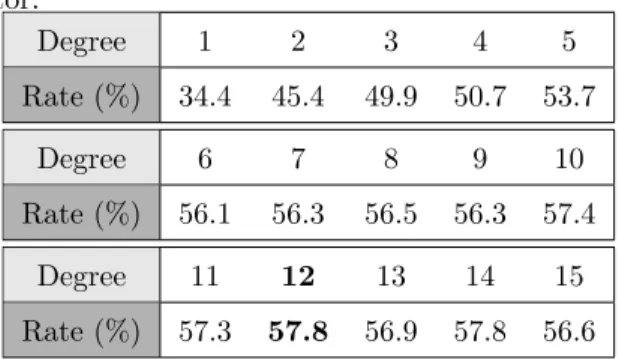
rates for several degrees using the optical flow tensor descriptor. The best
230
recognition rate was 57.8% with polynomials of degree 12 (66430 elements).
231
Table 4: Recognition rates of UCF11 dataset for several degrees using only the optical flow descrip-tor. Degree 1 2 3 4 5 Rate (%) 34.4 45.4 49.9 50.7 53.7 Degree 6 7 8 9 10 Rate (%) 56.1 56.3 56.5 56.3 57.4 Degree 11 12 13 14 15 Rate (%) 57.3 57.8 56.9 57.8 56.6
Table 5 presents recognition rates for several parameter sets for HOG3D
232
descriptor (3.2). The best recognition rate was 68.9% using a grid 32x32 and
233
a HOG3D of 128 bins.
234
Table 6 shows the recognition rates obtained with the proposed descriptor
235
with a grid of 32x32 and a HOG3D of 8x16 [4]. A power normalization with
236
γ = 0.2 was applied on the final HOG3D tensor. The best recognition rate
Table 5: Recognition rates of UCF11 dataset for several parameter sets for the HOG3D descrip-tor [4]. Parameters Rate (%) Grid 4x4 HOG3D 8x16 65.0 Grid 8x8 HOG3D 8x16 67.5 Grid 16x16 HOG2D 8x16 68.4 Grid 32x32 HOG3D 8x16 68.9
was 72.7%, concatenating the HOG3D with polynomials of degree 13 (88410
238
elements).
Table 6: Concatenating the optical flow tensor descriptor with a grid of 32x32 and a HOG3D of 8x16 [4] for UCF11 dataset. A power normal-ization was applied on the final HOG3D tensor withγ= 0.2. Degree 1 2 3 4 5 Rate (%) 69.3 68.0 70.0 70.0 71.2 Degree 6 7 8 9 10 Rate (%) 70.7 71.8 71.5 71.4 72.2 Degree 11 12 13 14 15 Rate (%) 71.9 72.5 72.7 72.4 71.8 239 4.3. Hollywood2 Dataset 240
The Hollywood2 dataset [7] consists of 12 action classes: answering the
241
phone, driving car, eating, fighting, getting out of the car, hand shaking,
242
hugging, kissing, running, sitting down, sitting up, and standing up. We
use the same evaluation protocol of the original paper [7]. The performance
244
is evaluated by computing the average precision (AP) for each of the
ac-245
tion classes. For the individual optical flow descriptor, the best results are
246
achieved with a Gaussian kernel. For the combination, the triangular kernel
247
shows the best recognition rates.
248
Table 7 shows the recognition rates for several degrees using the optical
249
flow tensor descriptor. Similar to UCF11 dataset, the sliding window is not
250
interesting for this dataset because the actions are more complex than on
251
KTH dataset. We can see that the recognition rates achieved are very low.
252
In fact, the summation of tensors will tend to be an isotropic tensor because
253
there are a lot of different motions happening at the same time in the scenes.
254
The best recognition rate was only 15% with polynomials of degree 2 (300
255
elements).
256
In [4] is reported that the best result is achieved with a grid 4x4 and
257
128 bins obtaining 34.03% of recognition rate. Thus, we concatenate our
258
optical flow tensor descriptor with this HOG3D to form a new global motion
259
descriptor. Table 8 shows the recognition rates for several degrees. The best
260
recognition rate was 40.3% concatenating the HOG3D with polynomials of
261
degree 3 (820 elements).
262
Table 7: Recognition rates of Hollywood2 dataset for several degrees using only the optical flow descriptor.
Degree 1 2 3 4 5 6 7 8 9 10
Table 8: Concatenating the optical flow descriptor with a grid of 4x4 and a HOG3D of 8x16 [4] for Hollywood2 dataset. A power normalization was applied on the final HOG3D tensor with γ= 0.2.
Degree 1 2 3 4 5 6 7 8 9 10
Rate (%) 39.5 39.9 40.3 40.2 40.3 39.8 40.1 39.7 39.9 40.3
4.4. Comparison with the state-of-the-art
263
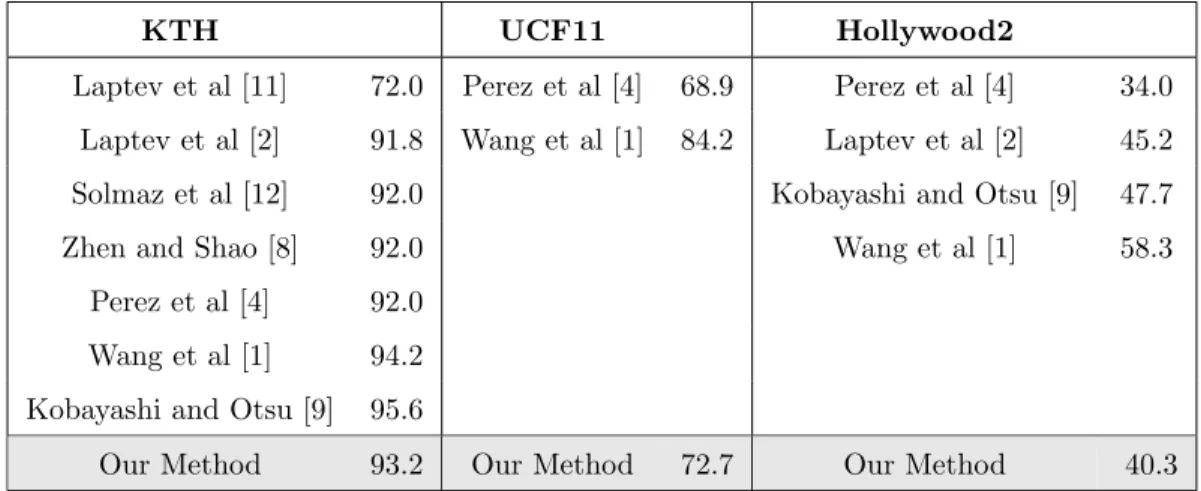
A comparison with the state-of-the-art methods is presented in Table 9.
264
Table 9: Comparison with state-of-the-art for KTH, UCF11 and Hollywood2 datasets.
KTH UCF11 Hollywood2
Laptev et al [11] 72.0 Perez et al [4] 68.9 Perez et al [4] 34.0 Laptev et al [2] 91.8 Wang et al [1] 84.2 Laptev et al [2] 45.2 Solmaz et al [12] 92.0 Kobayashi and Otsu [9] 47.7 Zhen and Shao [8] 92.0 Wang et al [1] 58.3
Perez et al [4] 92.0 Wang et al [1] 94.2 Kobayashi and Otsu [9] 95.6
Our Method 93.2 Our Method 72.7 Our Method 40.3
The proposed method achieves a competitive accuracy with a much
sim-265
pler global approach, using only the information from optical flow and
his-266
tograms of gradients, without any bag-of-features strategy [1, 2, 9].
267
In all datasets we improved the performance of the descriptors previously
268
proposed in [3, 4] and showed better results than other global descriptors
269
[11, 12].
270
When compared to bag-of-features strategy on KTH dataset, our
descrip-271
tor shows better performance than those methods which uses HOF and HOG
as features [2]. The addition of more information to the descriptor, as MBH
273
and trajectory associated with HOF and HOG [1], induces a better
recog-274
nition than our descriptor. Even though, the recognition rate is very close
275
with a much simpler approach.
276
For UCF11 and Hollywood2 datasets, we note that using several features
277
plays an important role and that learning methods improve overall
recog-278
nition. The performance of our descriptor is lower than these approaches
279
[1, 2, 9] but is fairly competitive.
280
Thereby, we can conclude that our descriptor aggregates useful
informa-281
tion of optical flow and HOG3D, enhancing the recognition rate. Moreover,
282
our descriptor only depends on the video, no learning method is required.
283
The addition of new videos and/or new action categories with our approach
284
does not require any re-computation or changes to the previously computed
285
descriptors.
286
5. Conclusion
287
In this paper, we presented a novel approach for motion description in
288
videos combining optical flow and HOG3D information. It is an effective
ap-289
proach reaching 93.2% of recognition rate with KTH, comparable to the best
290
local and learning-based methods. However, for the UCF11 and Hollywood2
291
datasets we note points of interest play an important role and that learning
292
methods improve overall recognition. Our recognition rate is lower than the
293
approaches based on codebook but is fairly competitive in both datasets.
294
The main advantage of our method is that it reaches good recognition
295
rates depending uniquely on the video. The addition of new videos and/or
new action categories with our approach does not require any re-computation
297
or changes to the previously computed descriptors. Finally, it might be
298
valuable in a scenario where no human action classification method solves all
299
application demands.
300
The drawback of our method is that larger and complex video datasets
301
require higher degree polynomials to give good classification results. As a
302
consequence, the number of coefficients increases exponentially leading to
303
high time complexity. In some cases, increasing the degree does not
neces-304
sarily leads to a better classification, such as in Hollywood2 dataset.
305
In order to improve the recognition rate of our descriptors, we intend to
306
further analyze the spectral characteristics of the proposed orientation tensor.
307
Furthermore, we need to study the conditions of divergence and convergence
308
of the tensor accumulation.
309
6. Acknowledgements
310
Authors thank to FAPEMIG and CAPES for funding.
311
References
312
[1] H. Wang, A. Kl¨aser, C. Schmid, L. Cheng-Lin, Action Recognition by
313
Dense Trajectories, in: IEEE Conference on Computer Vision & Pattern
314
Recognition, Colorado Springs, United States, 2011, pp. 3169–3176.
315
[2] I. Laptev, M. Marsza lek, C. Schmid, B. Rozenfeld, Learning realistic
hu-316
man actions from movies, in: Computer Vision & Pattern Recognition,
317
2008.
[3] V. F. Mota, E. A. Perez, M. B. Vieira, L. M. Maciel, F. Precioso, P.-H.
319
Gosselin, A tensor based on optical flow for global description of motion
320
in videos, in: SIBGRAPI 2012 (XXV Conference on Graphics, Patterns
321
and Images), Ouro Preto, MG, Brazil, 2012, pp. 298–301.
322
[4] E. A. Perez, V. F. Mota, L. M. Maciel, D. Sad, M. B. Vieira, Combining
323
gradient histograms using orientation tensors for human action
recog-324
nition, in: International Conference on Pattern Recognition, 2012, pp.
325
3460–3463.
326
[5] C. Schuldt, I. Laptev, B. Caputo, Recognizing human actions: A local
327
svm approach, in: In Proc. ICPR, 2004, pp. 32–36.
328
[6] J. Liu, J. Luo, M. Shah, Recognizing realistic actions from videos in the
329
wild, IEEE CVPR, 2009.
330
[7] M. Marsza lek, I. Laptev, C. Schmid, Actions in context, in: Conference
331
on Computer Vision & Pattern Recognition, 2009.
332
[8] X. Zhen, L. Shao, A local descriptor based on laplacian pyramid coding
333
for action recognition, Pattern Recognition Letters (0) (2012) –, in Press.
334
doi:10.1016/j.patrec.2012.10.021.
335
[9] T. Kobayashi, N. Otsu, Motion recognition using local auto-correlation
336
of spacetime gradients, Pattern Recognition Letters 33 (9) (2012) 1188
337
– 1195. doi:10.1016/j.patrec.2012.01.007.
338
[10] L. Zelnik-manor, M. Irani, Event-based analysis of video, in: In Proc.
339
CVPR, 2001, pp. 123–130.
[11] I. Laptev, B. Caputo, C. Schuldt, T. Lindeberg, Local velocity-adapted
341
motion events for spatio-temporal recognition, Comput. Vis. Image
Un-342
derst. 108 (2007) 207–229. doi:10.1016/j.cviu.2006.11.023.
343
[12] B. Solmaz, S. M. Assari, M. Shah, Classifying web videos using a
344
global video descriptor, Machine Vision and Applications (2012) 1–
345
13doi:10.1007/s00138-012-0449-x.
346
[13] M. Druon, Mod´elisation du mouvement par polynˆomes orthogonaux :
347
application `a l’´etude d’´ecoulements fluides, Ph.D. thesis, Universit´e de
348
Poitiers (02 2009).
349
[14] O. Kihl, B. Tremblais, B. Augereau, M. Khoudeir, Human activities
dis-350
crimination with motion approximation in polynomial bases, in: IEEE
351
International Conference on Image Processing, Hong-Kong, 2010, pp.
352
2469–2472.
353
[15] C.-F. Westin, A tensor framework for multidimensional signal
process-354
ing, Ph.D. thesis, Link¨oping University, Sweden, S-581 83 Link¨oping,
355
Sweden, dissertation No 348, ISBN 91-7871-421-4 (1994).
356
[16] B. Johansson, G. Farnebck, G. F. Ack, A theoretical comparison of
357
different orientation tensors, in: Symposium on Image Analysis, SSAB,
358
2002, pp. 69–73.
359
[17] D. G. Lowe, Object recognition from local scale-invariant features, in:
360
Proceedings of the International Conference on Computer Vision -
Vol-361
ume 2, ICCV ’99, IEEE Computer Society, Washington, DC, USA, 1999.
[18] B. Augereau, B. Tremblais, C. Fernandez-Maloigne, Vectorial
computa-363
tion of the optical flow in color image sequences., in: Thirteenth Color
364
Imaging Conference, 2005, pp. 130–134.
365
[19] B. Lucas, T. Kanade, An iterative image registration technique with an
366
application to stereo vision (ijcai), in: Proceedings of the 7th
Interna-367
tional Joint Conference on Artificial Intelligence (IJCAI 81), 1981, pp.
368
674–679.

![Table 6: Concatenating the optical flow tensor descriptor with a grid of 32x32 and a HOG3D of 8x16 [4] for UCF11 dataset](https://thumb-us.123doks.com/thumbv2/123dok_us/9216879.2805817/15.918.304.612.643.828/table-concatenating-optical-flow-tensor-descriptor-grid-dataset.webp)