Philippines
Engineering and Science Education Project
Report Date: February 2003 Field Survey: October - November 2002 1. Project Profile and Japan’s ODA Loan
Project area location map (Philippines) Equipment for Science and Technology Education (University of the Philippines, Los Baños Campus)
1.1 Background
In the Philippines, while as many as one third of students advanced to institutes of higher education, the problems listed below were evident in the education system and the quality of education.
(1) Problems concerning the education system
・ Since most postgraduate courses were offered by private institutes, higher education in science and technology was costly and generally did not attract students.
・ The number of graduate scholars was few in relation to the number of university entrants, and as a result, professors and researchers were in short supply.
(2) Problems concerning the quality of education
・ Few professors had master’s or doctor’s degrees and the facility infrastructure was not developed well, as was seen in insufficient or outdated research facilities or equipment and the shortage of libraries.
・ An up-to-date practical curriculum necessary for the development of science and technology in the Philippines was not in place.
・ Due to insufficient education at the elementary and secondary levels, the ability of the science and technology students was generally low in science (physics, chemistry and biology) and mathematics.
(3) Other problems
・ Educational facilities were not utilized efficiently due to the absence of a system for sharing equipment among universities.
・ As researchers did not receive employment packages appropriate to their academic degrees, the incentive to improve the quality of science education was low.
・ Every university was suffering from chronic funds shortages.
In the Philippines, where export-oriented industries (electronics, chemical, food processing, Malaysia
Cebu
Davao Manila
metal processing, etc.) which require high technology, rather than traditional industries, were becoming the driving force of economic growth, the demand-supply gap for workers with high technology skills was widening year by year.
As part of the Philippine Medium-term Development Plan, a “Science and Technology Master Plan” was set up in 2000 with a view to the Philippines joining the group of newly industrialized countries based on the recognition that the quality improvement of secondary and higher education and promotion of science and technology are essential for the development of the country. Under this Master Plan, the country has been tackling enhancement of its research and development abilities, establishment of infrastructure in the fields of science and technology, and the strengthening of cooperation between industry and the academic community. This project formed a part of the efforts to achieve these national goals and plans.
1.2 Objectives
To promote education in science and technology at high school, university and graduate school with the aim of cultivating high quality technologists who can play a central role in the economic development of the country.
1.3 Project Scope
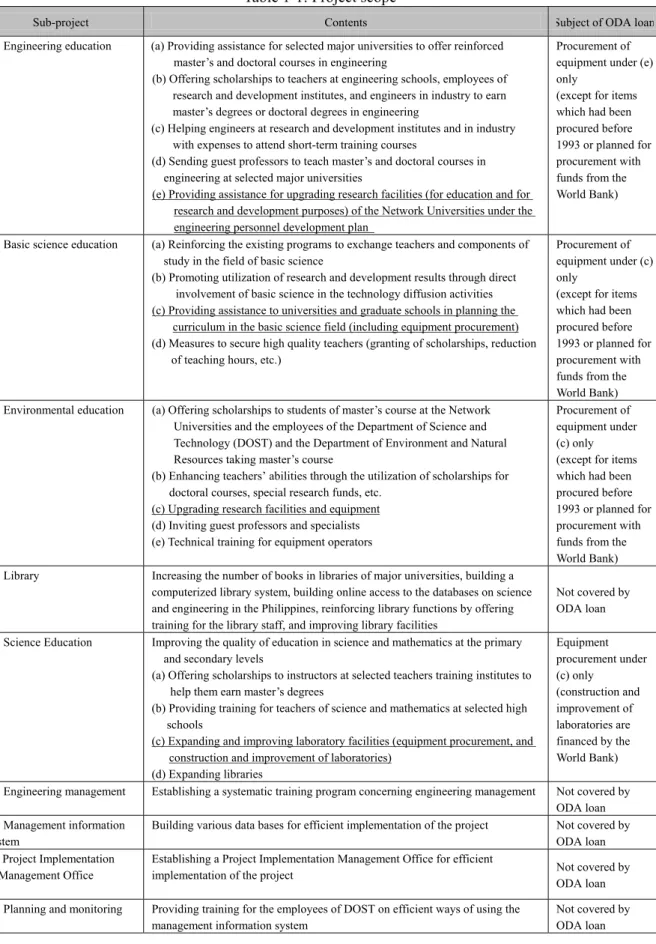
This project aimed to improve education at major universities of science and technology in the Philippines mainly through (1) fostering education in engineering (electrical engineering, chemical engineering, production engineering, etc.), (2) fostering education in science (physics, biology, mathematics, computer science, environmental science, etc.), (3) expanding libraries, (4) education in engineering management (production management, commercialization programs, etc.), (5) science education (improvement of education on science and mathematics at high school to establish a basis for the promotion of science and mathematics education at universities), and (6) planning and management (establishment of an information management system to manage implementation and progress of the project, training of the personnel, etc.).
Project activities included (a) offering scholarships to university professors, researchers and engineers who take doctoral or master’s course at home or abroad, (b) offering researchers and engineers bursaries to take training courses at home or abroad, (c) sending guest professors and specialists to doctoral and master’s courses, (d) installation of equipment for science and technology education and research equipment, (e) training high school teachers of science and mathematics, (f) acquisitions of research reference books and expansion of libraries, and (g) consulting services.
This project targeted 19 major universities of science and technology in the Philippines (Flagship Universities) and 110 public high schools in all parts of the country, and was co-financed by JBIC (ODA loan) and the World Bank. The project consisted of 9 sub-projects for which details are presented in Table 1-1.
Table 1-1: Project scope
Sub-project Contents Subject of ODA loan
(1) Engineering education (a) Providing assistance for selected major universities to offer reinforced master’s and doctoral courses in engineering
(b) Offering scholarships to teachers at engineering schools, employees of research and development institutes, and engineers in industry to earn master’s degrees or doctoral degrees in engineering
(c) Helping engineers at research and development institutes and in industry with expenses to attend short-term training courses
(d) Sending guest professors to teach master’s and doctoral courses in engineering at selected major universities
(e) Providing assistance for upgrading research facilities (for education and for research and development purposes) of the Network Universities under the engineering personnel development plan
Procurement of equipment under (e) only
(except for items which had been procured before 1993 or planned for procurement with funds from the World Bank)
(2) Basic science education (a) Reinforcing the existing programs to exchange teachers and components of study in the field of basic science
(b) Promoting utilization of research and development results through direct involvement of basic science in the technology diffusion activities (c) Providing assistance to universities and graduate schools in planning the
curriculum in the basic science field (including equipment procurement) (d) Measures to secure high quality teachers (granting of scholarships, reduction
of teaching hours, etc.)
Procurement of equipment under (c) only
(except for items which had been procured before 1993 or planned for procurement with funds from the World Bank) (3) Environmental education (a) Offering scholarships to students of master’s course at the Network
Universities and the employees of the Department of Science and Technology (DOST) and the Department of Environment and Natural Resources taking master’s course
(b) Enhancing teachers’ abilities through the utilization of scholarships for doctoral courses, special research funds, etc.
(c) Upgrading research facilities and equipment (d) Inviting guest professors and specialists (e) Technical training for equipment operators
Procurement of equipment under (c) only (except for items which had been procured before 1993 or planned for procurement with funds from the World Bank) (4) Library Increasing the number of books in libraries of major universities, building a
computerized library system, building online access to the databases on science and engineering in the Philippines, reinforcing library functions by offering training for the library staff, and improving library facilities
Not covered by ODA loan (5) Science Education Improving the quality of education in science and mathematics at the primary
and secondary levels
(a) Offering scholarships to instructors at selected teachers training institutes to help them earn master’s degrees
(b) Providing training for teachers of science and mathematics at selected high schools
(c) Expanding and improving laboratory facilities (equipment procurement, and construction and improvement of laboratories)
(d) Expanding libraries Equipment procurement under (c) only (construction and improvement of laboratories are financed by the World Bank) (6) Engineering management Establishing a systematic training program concerning engineering management Not covered by
ODA loan (7) Management information
system
Building various data bases for efficient implementation of the project Not covered by ODA loan (8) Project Implementation
Management Office
Establishing a Project Implementation Management Office for efficient
implementation of the project Not covered by
ODA loan (9) Planning and monitoring Providing training for the employees of DOST on efficient ways of using the
management information system
Not covered by ODA loan
The yen loan for the project covered science and technology equipment for education and research use (only items procured in and after 1994, excluding those to be financed by the World Bank) and consulting services concerning procurement of items for each component of (1) engineering education, (2) basic science education, (3) environmental education, and (5) science education among the 9 sub-projects listed above.
1.4. Borrower/Executing Agency
Government of the Republic of the Philippines/Department of Science and Technology (DOST)
1.5 Outline of Loan Agreement Loan Amount
Loan Disbursed Amount
3,055 million yen 3,055 million yen Exchange of Notes Loan Agreement August 1993 August 1993 Terms and Conditions
-Interest Rate -Repayment Period (Grace Period) -Procurement 3.0% 30 years (10 years) General untied Final Disbursement Date September 2000
2. Results and Evaluation 2.1 Relevance
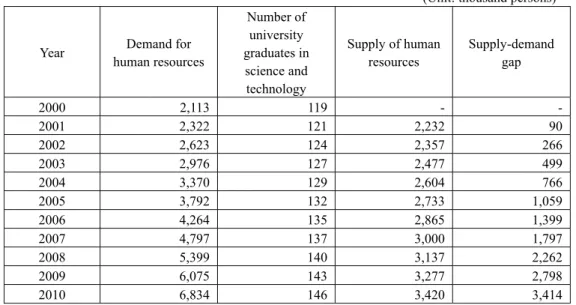
The Philippine Government set the National Science and Technology Plan (2002-2020) in July 2002 as a medium-term plan defining its policy on science and technology. In this plan, development of human resources in the field of science and technology including higher education is mentioned among high priority polices. It indicates that the importance of science and technology education in the Philippines continues to be recognized. A survey conducted by DOST1 shows that the demand for human resources in the field of science and technology is expected to remain high for the future. Therefore, the project maintains its effectiveness and relevancy in that it aims at further promoting high quality education in science and technology at the secondary and higher levels and development human resources in this field.
1 Projecting Science and Technology Human Resource Requirements in the Private Sector 2001-2010, Science
Table 2-1: Projection of demand and supply of human resources in science and technology for 2000 - 2010 (Unit: thousand persons)
Year Demand for
human resources Number of university graduates in science and technology Supply of human resources Supply-demand gap 2000 2,113 119 - - 2001 2,322 121 2,232 90 2002 2,623 124 2,357 266 2003 2,976 127 2,477 499 2004 3,370 129 2,604 766 2005 3,792 132 2,733 1,059 2006 4,264 135 2,865 1,399 2007 4,797 137 3,000 1,797 2008 5,399 140 3,137 2,262 2009 6,075 143 3,277 2,798 2010 6,834 146 3,420 3,414
Source: Projecting Science and Technology Human Resource Requirements in the Private Sector 2001-2010, Science Education Institute, DOST
2.2 Efficiency 2.2.1 Project Scope
The portion of the project financed by the ODA loan was implemented as initially planned, with no change in the project scope.
2.2.2 Implementation Schedule
The implementation period of the whole project, initially scheduled for April 1991- December 1998 (93 months), was February 1992- June 1999 (89 months). The portion financed by JBIC, which was initially planned to be implemented during a 65-month period from August 1993 (L/A conclusion) to December 1998 (completion of equipment procurement and installation), took 71 months from August 1993 to June 1999.
The delay in the schedule was caused by the late project start, which was 10 months behind the original plan, and the delayed payment of the budget for the portion of the project to be financed in the local currency and mainly borne by the Philippine Government during the first 2 years from 1992 to 1993. However, the project progressed smoothly in the third year and onward. As a result, the project period was 3 months shorter than the original plan, and the project was completed 6 months behind schedule.
2.2.3 Project Cost
The total project cost was originally estimated at 16,301 million yen (131.46 million dollars), including the ODA loan of 3,055 million yen and a loan by the World Bank amounting to 7,564 million yen (61 million dollars). The amount to be disbursed by the Philippine Government was 5,682 million Yen. 65% of the total project cost was supposed to be assisted by JBIC and World Bank. The actually incurred project cost was 15,623 million yen (125.72 million dollars) in total, including the ODA loan of 3,055 million yen, the World Bank’s loan of 7,000 million yen (56.33 million dollars) and the Philippine Government’s own funds of 5,568 million yen. The total project
cost was almost the same as planned.2
2.3 Effectiveness
2.3.1 Project Achievements
This project is unique in that it targets the major 19 technology universities in the Philippines and 110 public science high schools throughout the country to strengthen their research and development capacity in the fields of engineering, basic science and environmental science, etc. and to improve the quality of science and technology education (especially in the above-mentioned fields) at the secondary and higher levels. Accordingly, the project mainly focuses on the enhancement of the research and teaching ability of university and high school teachers through the establishment of scholarship systems and enrichment of training programs (human resource development), the creation of an excellent environment for research and education through the installation of equipment for engineering and science education at universities and high schools, and the reinforcement of the functions of libraries (improvement of research and education infrastructure), and the construction of engineering management and information management systems (improvement of managing ability). DOST made the Project Completion Report at the project completion (1998). According to the report, the achievements of the project are as follows:
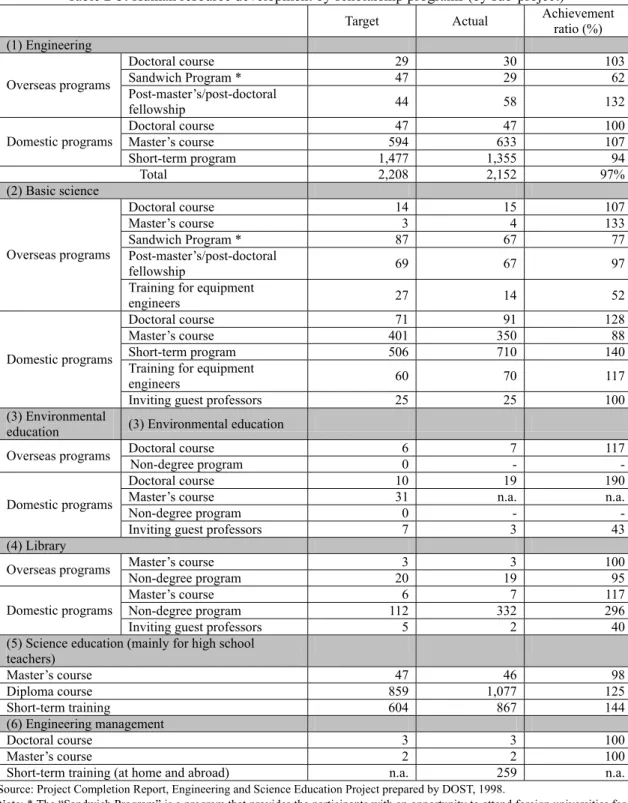
In the area of human resource development, a total of 6,181 university and high school teachers obtained opportunities for studying, research or training at universities as well as educational and research institutes at home and abroad under the scholarship program, achieving 119% of the targeted 5,179 (Table 2-2 and Table 2-3).
Table 2-2: Human resource development by scholarship programs (whole project)
Target (persons) Actual (persons) Achievement ratio (%) 1. Doctoral course 180 212 114% 2. Master’s course 1,087 1,045 95% 3. Sandwich Program 134 96 72% 4. Post-doctoral/post-master’s fellowship 113 125 111% 5. Diploma course 859 1,077 125% 6. Non-degree program 132 351 266%
7. Short-term program/short-term training 2,587 3,191 123%
8. Training for equipment engineers 87 84 97%
Total 5,179 6,181 119%
Source: Project Completion Report, Engineering and Science Education Project prepared by DOST, 1998.
Note: * The “Sandwich Program” is a program that provides the participants with an opportunity to attend foreign universities for a certain period of time as part of their master’s or doctoral course for the purpose of study, research or writing dissertation.
2 Since exchange rates used in the project completion report and documents submitted by the implementing agency
Table 2-3: Human resource development by scholarship programs (by sub-project)
Target Actual Achievement ratio (%)
(1) Engineering Doctoral course 29 30 103 Sandwich Program * 47 29 62 Overseas programs Post-master’s/post-doctoral fellowship 44 58 132 Doctoral course 47 47 100 Master’s course 594 633 107 Domestic programs Short-term program 1,477 1,355 94 Total 2,208 2,152 97% (2) Basic science Doctoral course 14 15 107 Master’s course 3 4 133 Sandwich Program * 87 67 77 Post-master’s/post-doctoral fellowship 69 67 97 Overseas programs
Training for equipment
engineers 27 14 52
Doctoral course 71 91 128
Master’s course 401 350 88
Short-term program 506 710 140
Training for equipment
engineers 60 70 117
Domestic programs
Inviting guest professors 25 25 100
(3) Environmental
education (3) Environmental education
Doctoral course 6 7 117
Overseas programs
Non-degree program 0 - -
Doctoral course 10 19 190
Master’s course 31 n.a. n.a.
Non-degree program 0 - -
Domestic programs
Inviting guest professors 7 3 43
(4) Library Master’s course 3 3 100 Overseas programs Non-degree program 20 19 95 Master’s course 6 7 117 Non-degree program 112 332 296 Domestic programs
Inviting guest professors 5 2 40
(5) Science education (mainly for high school teachers) Master’s course 47 46 98 Diploma course 859 1,077 125 Short-term training 604 867 144 (6) Engineering management Doctoral course 3 3 100 Master’s course 2 2 100
Short-term training (at home and abroad) n.a. 259 n.a.
Source: Project Completion Report, Engineering and Science Education Project prepared by DOST, 1998.
Note: * The “Sandwich Program” is a program that provides the participants with an opportunity to attend foreign universities for a certain period of time as part of their master’s or doctoral course for the purpose of study, research or writing dissertation. With regard to the improvement of infrastructure, experimental equipment for research and educational use has been provided to the major 19 universities and 110 high schools, and laboratories have been constructed as planned. In addition, a computer library system connecting the libraries of 8 Network Universities was created and networked, and about 73,000 books and materials were provided to universities and high schools covered by the project.
As for the expansion of management information system, various systems and information databases have been constructed for the purpose of supervising and implementing the project. These systems include (1) Scholarship Program Monitoring System (SCOLM), (2) Graduates Information
System (GIS), (3) Staff Appraisal Report System (SAR) Indicator, (4) Financial Management Information System (FMIS), (5) Library Equipment Procurement System (LIBPC), and (6) Bidders Module (SUM96).
Also, in order to ensure smooth implementation of the project, the Project Implementation Control Office (PICO) was established and engaged in total management and coordination of the project including support for the Project Management Committee, supervision of procurement, coordination with donors, financial management, and monitoring of the project. In addition, an overseas training program for employees of DOST engaging in the project was held at the Asian Institute of Technology in Bangkok to provide them with skills in data analysis and information utilization necessary for planning, monitoring and evaluation.
2.3.2 Effectiveness Indicators
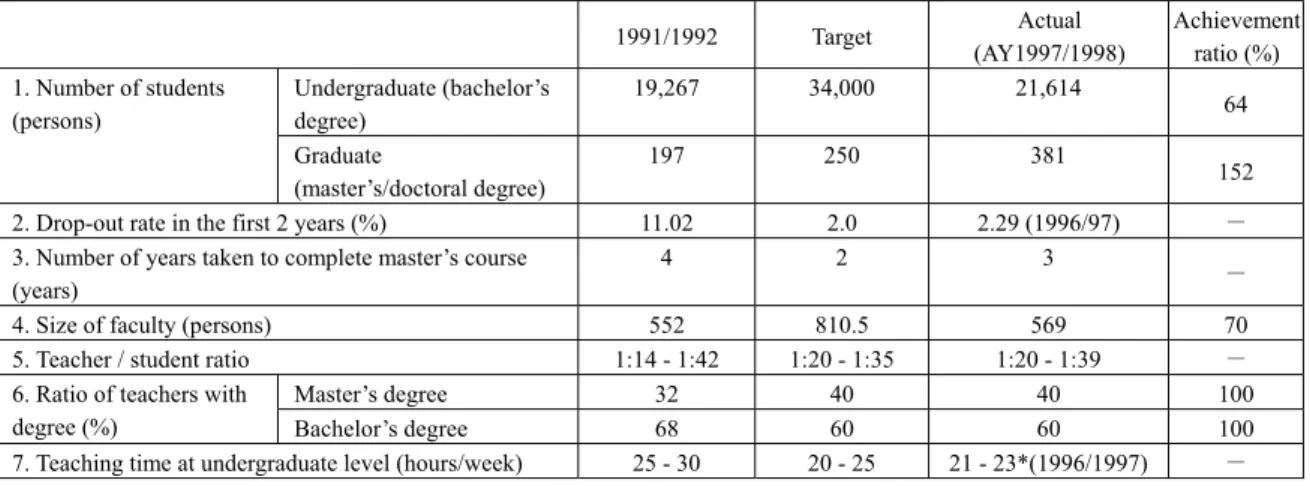
The objective of the project was to promote education in science and technology at high school, university and graduate school with the aim of cultivating high quality technologist who are capable of playing a central role in the economic development of the country. To evaluate the achievement level of this objective, we selected the following elements at the departments of major 19 universities to which the project was applied, and compared the achieved results with the target values: (1) number of students; (2) drop-out rate; (3) number of years taken to complete master’s course; (4) size of faculty; (5) teacher/student ratio; (6) ratio of teachers with degrees; and (7) teaching time at the undergraduate level. The degree of improvement in science and technology education at target universities and departments after the project started was examined from a quantitative viewpoint in indicators (1) and (4), from the viewpoint of efficiency in indicators (2), (3), and (5), and from a qualitative viewpoint in indicators (6) and (7).
In this survey, although we tried to collect recent data for the Academic Year (AY) of 1997/98 and after, sufficient data was not provided by the executing agency or each university. Therefore, we decided to evaluate the achievement as of AY1997/98 based on the data available from the Project Completion Report and the Evaluation Report prepared by DOST and the Implementation Completion Report by the World Bank.
The Engineering Education Project is applied to 19 universities which have engineering related departments. In these 19 universities, the number of undergraduate and graduate students has increased by 112% and 193% respectively from AY1991/92. At the graduate school level, in particular, the target achievement ratio was 152%, while that at the undergraduate level was 64%. The number of faculty members remained almost unchanged from AY1991/92,achieving 70% of the target. As for the degree holding rate of teachers, that for bachelor’s degree only has declined and that for master’s degree has increased, evidencing that the project provided an opportunity to earn a master’s degree to many teachers. As the teaching time is approaching the target level, an environment is being created in which teachers can spend more time in research activities (Table 2-4).
Table 2-4: Effectiveness indicators (engineering education) 1991/1992 Target Actual (AY1997/1998) Achievement ratio (%) Undergraduate (bachelor’s degree) 19,267 34,000 21,614 64 1. Number of students (persons) Graduate (master’s/doctoral degree) 197 250 381 152
2. Drop-out rate in the first 2 years (%) 11.02 2.0 2.29 (1996/97) -
3. Number of years taken to complete master’s course (years)
4 2 3
-
4. Size of faculty (persons) 552 810.5 569 70
5. Teacher / student ratio 1:14 - 1:42 1:20 - 1:35 1:20 - 1:39 -
Master’s degree 32 40 40 100
6. Ratio of teachers with
degree (%) Bachelor’s degree 68 60 60 100
7. Teaching time at undergraduate level (hours/week) 25 - 30 20 - 25 21 - 23*(1996/1997) -
Source: a) Project Completion Report, Engineering and Science Education Project prepared by DOST;
b) Implementation Completion Report, Republic of the Philippines, Engineering and Science Education Project (Loan 3435-PH), November 24, 1998, World Bank.
Note: * The data marked* are quoted from the Implementation Completion Report by the World Bank (source b) above).
The Basic Science Education Project is applied to 7 universities which have basic science related departments. In these 7 universities, the number of undergraduate and graduate students has increased by 124% and 126% respectively from AY1991/92, although stopping short of achieving the target for the both. At the graduate school level, in particular, the target achievement ratio was 58%. On the other hand, the number of faculty members at the graduate schools level has increased by as much as 181% from AY 1991/92, and its target was well achieved. Meanwhile, this number at the undergraduate level has decreased from AY1991/92. The teacher/student ratio has improved significantly, and is well within the targeted level. As with the Engineering Education Project, the ratio of teachers with bachelor’s degrees only has declined and that of those with master’s degrees has increased. The teaching time also achieved the target (Table 2-5).
Target 2-5: Effectiveness indicators (basic science education)
1991/1992 Target Actual (AY1997/1998) Achievement ratio (%) Undergraduate (bachelor’s degree) 5,565 7,209 6,897 96 1. Number of students (persons) Graduate (master’s/doctoral degree) 1,350 2,924 1,698 58
2. Drop-out rate in the first 2 years (%) - - -
3. Number of years taken to complete master’s course (years)
- -
-
Undergraduate 205 260.5 195 75
Graduate (master’s degree) 178 265.5 361 136
4. Size of faculty (persons)
Graduate (doctoral degree) 215 308.5 351 118
5. Teacher / student ratio 1:3 - 1:36 1:5~1:55 1:18 *(1996/97) -
Master’s degree 60 70 70 *(1996/97) 100
6. Ratio of teachers
with degree (%) Bachelor’s degree 40 30 30 *(1996/97) 100
7. Teaching time at undergraduate level (hours/week) 12 - 40 18 18 *(1996/97) -
Source: Implementation Completion Report, Republic of the Philippines, Engineering and Science Education Project (Loan 3435-PH), November 24, 1998, World Bank.
In the Science Education Project, 14 universities in each region played a central role in providing professional education to teachers at 110 public science and engineering high schools throughout the country. In these 14 universities, the number of undergraduate students marked a significant increase of 481% from AY 1991/92, mostly achieving the target. The ratio of teachers to students has declined from the AY 1991/92 level. The reason is considered to be that the increase in the number
of teachers has not been able to match the increase in the number of students. As for the ratio of teachers with degrees, in contrast to the cases of engineering education and basic science education presented above, the ratio of teachers with bachelor’s degrees only has increased and that of those with master’s degrees has decreased. The ratio of doctoral degree holders has increased. The teaching time also achieved the target (Table 2-6).
Table 2-6: Effectiveness indicators (science education)
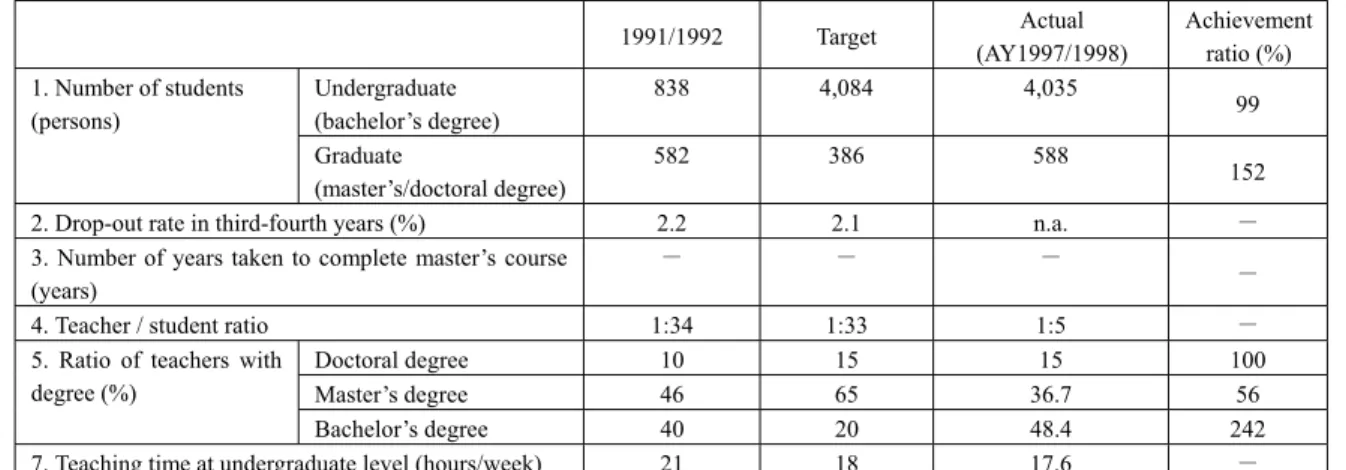
1991/1992 Target Actual (AY1997/1998) Achievement ratio (%) Undergraduate (bachelor’s degree) 838 4,084 4,035 99 1. Number of students (persons) Graduate (master’s/doctoral degree) 582 386 588 152
2. Drop-out rate in third-fourth years (%) 2.2 2.1 n.a. -
3. Number of years taken to complete master’s course (years)
- - -
-
4. Teacher / student ratio 1:34 1:33 1:5 -
Doctoral degree 10 15 15 100
Master’s degree 46 65 36.7 56
5. Ratio of teachers with degree (%)
Bachelor’s degree 40 20 48.4 242
7. Teaching time at undergraduate level (hours/week) 21 18 17.6 -
Source: Implementation Completion Report, Republic of the Philippines, Engineering and Science Education Project (Loan 3435-PH), November 24, 1998, World Bank.
2.3.3 Recalculation of Internal Rate of Return (IRR)
Because of the nature of the project, IRR was not calculated at appraisal. Consequently, recalculation was not conducted.
2.3.4 Use of Equipment
In this survey, we visited 5 universities and 2 high schools selected as case study schools and examined how the equipment provided under the project is managed and used. The results are as follows:
At 2 case study high schools, all the equipment except for the computers was working and being fully used. Fragile glass apparatuses such as flasks, beakers and tubes have been frequently replaced with new ones. The computers have already become obsolete and are rarely used because they are too outdated to use in the classroom. Ilocos Norte National High School updates computers with the funds donated by PTA or graduates’ associations because the school budget is limited, while Quezon City Science High School updates computers within the school budget.
At the 5 case study universities, nearly 80% of the equipment is still working and being used. As with the high schools, most of the computers installed under the project, which are early 1990s models, have become obsolete and unfit for use today. In the case of the University of the Philippines-Diliman, outdated computers have been handed over to affiliated schools for free. Other than that, they have been disposed of in most cases. At the Mechanical Engineering Department of this university, there are some cases where computers are rarely used because software manuals were not provided with machines and they do not know how to use them.
The project effectiveness mentioned in 2.3.1 and 2.3.2 above refers to the effectiveness of the whole project including the ODA loan project portion. In this co-financed project, JBIC supports only a part of a large scale project of the World Bank. Therefore, the project effectiveness stated above, particularly that in human resource development such as the study abroad program for teachers and the increase in the number of students, are effects of the scholarship project directly
attributable to the World Bank’s portion rather than the ODA loan project. The effects of the project portion financed by the ODA loan was examined in case studies section below.
2.3.5 Result of Case Studies on Project Effectiveness
Case studies were conducted to examine the effects and impact of the project on target schools and the use situation of research and education equipment provided under the ODA loan. For the study, 5 universities and 2 high schools were selected from the major 19 universities and 110 high schools covered by the projects. At these schools, we interviewed management persons (faculty deans of each target department of the universities, and principals and administrative directors of high schools), teachers, engineers who operate and manage equipment (they may be teachers in some cases) and students, using the questionnaire which we prepared in advance to examine mainly the qualitative effects and impact of the project. Also, we conducted on-site inspections in an effort to grasp the use situation and maintenance system of equipment delivered to each school. Case study schools were selected taking into consideration the geographic distribution (the capital district and other parts), the balance between the national and private schools, types of offered equipment and the amount of loan allocated. We interviewed a total of 155 persons (136 from universities and 19 from high schools). Table 2-7 below is the list of case study schools.
Table 2-7: Case study schools
School Department Location National/Private
Chemical Engineering, Mechanical Engineering, Electrical Engineering, Metallurgical Engineering University of the Philippines-
Diliman Chemistry, Mathematics/Statistics, Physics, Earth science, Biology, Molecular Biology, Bioengineering
Quezon City
Metro Manila National
University of the Philippines- Los Baños
Chemistry, Mathematics, Biology, Computer Science
Los Baños City Laguna Province Region IV
National
Ateneo de Davao University Chemical Engineering, Mechanical Engineering, Electrical Engineering,
Davao City Davao Province Region XI
Private Ateneo de Manila University Chemistry, Mathematics, Physics, Computer
Science
Quezon City
Metro Manila Private
Electronic Communication Engineering, Chemical Engineering, Mechanical Engineering
De La Salle University
Chemistry, Mathematics, Physics, Computer Science
Manila City
Metro Manila Private
Ilocos Norte National High
School -
Laoag City
Ilocos Norte Province Region II
National Quezon City Science High
School -
Quezon City
Metro Manila National Source: According to the university counting policy of the project, Diliman Campus and Los Baños Campus of the University of the
Philippines are treated as separate universities even though they are under the same university. The same is applied to Ateneo University.
1) Result of the high school case studies
At the two high schools, it was informed that enrichment in education boosted the quality of students. As a result, the schools have gained high reputations as being among the best secondary education institutes in each region after the project. The number of applicants and entrants has been increasing. Teachers also seem to enjoy the benefits created by the project. Before the project, most classes had to be theoretical lectures because of the shortage of educational and experimental equipment, and it was hard to make students understand. Even if there was equipment, students were provided with only limited opportunities to handle equipment and carry out experiments due to shortages of items for distribution across the class. After the project, it has become possible to explain theories to student using equipment, and more efficient teaching has been realized. Thanks to the introduction of equipment, the quality of classes has been improved and teacher’s knowledge and skills with computers have been developed. Most teachers say they have gained confidence in themselves. On the students’ side, they have acquired more knowledge and skills through the use of computers and experimental equipment. Moreover, the improvement of teaching skills of teachers helps increase student’s interest in science.
2) Result of the university case studies
The project brought about the following effects on universities. First, certain departments of certain universities covered by the project, such as the Department of Biology of the University of the Philippines-LosBaños, have come to be certified by the Commission on Higher Education as “Centers of Excellence”, the highest-level education and research institutes of the country. Secondly, most universities started to offer master’s and doctoral courses after the project and further raised their reputation for excellence in higher education. Thirdly, under the project, the participant universities have established formal cooperative relationships which enable them to share equipment and facilities. Fourthly, the effect mentioned by most respondents was that the project provided a good environment for excellent university teachers who returned to the Philippines after having earned master’s and doctoral degrees; and assisted those who had attained achievements in their research at foreign institutes with scholarships to continue their research at their own universities, thus helping securing brilliant researchers in the country and preventing brain drain.
3) Result of the university teacher case studies
In the interview, the following effects on university teachers have been recognized: (1) research projects which used to be impossible at domestic universities due to lack of equipment have now become possible at their own universities or jointly with other research institutes; (2) introduction of various kinds of educational and research equipment has made classes easier; (3) as the structure of higher research and educational institutes has been established thanks to the introduction of the up-to-date equipment and improvement of the academic capacities of the faculties, most universities have come to be able to offer master’s and doctoral degrees. The biggest direct beneficiaries of the project are university teachers who have earned master’s or doctoral degrees at domestic or foreign universities and gained opportunities to do advanced research abroad taking advantage of the scholarship program. In addition, research and experimental equipment on a par with that of advanced countries has been installed to support their teaching and research activities. With this supports in both software and hardware, improvement of the quality of education and research seems to have been accelerated at all the universities we surveyed on this occasion. As is recognized by many university teachers and departments we interviewed, the quality and the investigative fields of research have been improved and expanded. One example is that the research papers presented by teachers at academic meetings have improved significantly both in numbers and quality.
4) Result of the student case studies
According to the students whom we interviewed, major effects of the project on students are: (1) by making practical experiments and research using equipment possible, the project helped students understand scientific theories and get more pleasure from studying; (2) as they have received a high level professional education required by industry and have acquired knowledge of equipment and experience in operating it, they can make use of their knowledge and experience in the jobs they take after graduation; and (3) they have gained access to the latest information on technological developments in their special fields.
2.4 Impact
2.4.1 Result of the Case Study on Impact
From the results of the case studies, two types of qualitative impact were identified. One is the impact relating to the ability of universities to produce high quality students (undergraduate and graduate) sought after by industry. For example, graduates of engineering related departments find employment with the leading companies (manufacturing, information communications industry, etc.) where high skills are required.3 However, in order to prove the causal relationship between the project and this result, we need to examine the quantitative aspect while conducting more detailed interviews. The responses in this case study should be used only as indicators of general tendencies. Another impact is that at many universities, private companies or other research institutes use the installed equipment, and universities are carrying out joint research with the private sector using these items of equipment. By allowing private companies to use equipment delivered under the project, a situation arises where the project is contributing to the promotion of their research and technological development. For the administration side, these situations are contributing toward securing maintenance costs, though only partially. In the case of De La Salle University, the project gave them impetus to purchase new equipment with their own budget to be used in combination with the equipment provided under the project.
2.4.2 Environmental Impacts
The main part of this project is installation and improvement of research and educational equipment, which has been installed inside school facilities. Therefore, the project had no negative impact on the environment.
2.5 Sustainability
2.5.1 Organizational System
The executing agency of the project was DOST. After the completion of the project, DOST exchanged memorandums with each school which held each school responsible for the maintenance of research facilities and equipment for science education and research constructed or delivered under the project. At the same time, the ownership of these facilities and equipment was transferred to each school.
2.5.2 Technical Capacity
3 In the case of the Department of Electrical Engineering of University of the Philippines-Diliman, 50% of the
The case study universities assign laboratory technicians in charge of equipment maintenance to almost all laboratories where equipment is installed. In some cases, teachers directly operate and maintain equipment. At high schools, teachers take charge of equipment maintenance. Each school updates the equipment inventory every year, and DOST also makes an inventory of equipment every year. Those who are in charge of equipment maintenance at each school do easy repairs and, since their main duties are operation and management of equipment, general repairs are contracted out to the agents of manufacturers or outside engineers. However, not all manufactures have agents in the Philippines. In the case where no engineer who can do the same repairs as agents was found in the country, the equipment was sent to a foreign manufacture for repair at huge costs. For certain items of equipment, contact with manufacturers has been lost and, this situation makes repairs more difficult. At one school, broken equipment is left unrepaired because no engineers from the responsible company can be found.
As time passes, other kinds of problems arise, such as that the manufacturers do not keep spare parts for old types of equipment, or that the equipment is difficult to update. There were some cases in whichcomputer-connected equipment caused problems because it could not be interfaced with other computers. Still, in general, equipment seems to have been properly maintained at case study schools.
2.5.3 Financial Status
Under the memorandum with DOST and the Order of the Department of Education, Culture and Sports (DECS Order No. 33, s. 1992), each school is allowed to collect equipment use fees from users, including students and companies, to finance the necessary maintenance. Each university is required to establish a Science and Engineering Laboratory Fund (SELF) using the special use fee and tuition revenue to cover the cost of repairs and update of equipment and personnel expenses of the staff in charge of equipment maintenance. However, among 5 case study universities, only De La Salle University established and properly operates SELF.4 As a general tendency, national universities have fewer funds available for equipment maintenance than private universities, and the situation varies by department or division. Each university is making efforts to secure budgets for equipment maintenance and, in spite of some difficulties, the necessary financial measures are carried out to a certain extent at present.
Most departments and divisions do not have enough funds for equipment maintenance allocated to them by their university administrations. They carry out research activities sponsored by the government or donors and use a portion of these project funds to purchase spare parts or update equipment. Use fees for experimental facilities and equipment rented out to private companies or research institutes are also used for maintenance. However, as these fees are set at lower rates than those of the private sector, they are not a major source of revenue.
Departments or divisions involved with the IT industry, such as computer-related departments and electrical or electronic-related departments, have many opportunities to conduct joint research and development with private companies and receive donations of facilities or equipment. Therefore, securing funds for maintenance is relatively easy for these departments compared with others.5 On the university side, as IT related departments attract many applicants, they give high priority to those departments which are related to growth industries and allocate them a large portion of the university
4 One of the factors which enabled De La Salle University to establish SELF is that the students of this university are
generally wealthy and it is well off because of adequate tuition revenue.
5 For example, the Electrical Engineering Division of University of Philippines-Diliman receives supports from
budget.
On the contrary, in the case of the departments of mechanical engineering, the number of students is on the decline and only a small number of tie-up or joint research projects with private companies are being carried out. The limited sources of revenue makes it difficult to secure funds for equipment maintenance. As we witnessed, facilities at some departments and divisions are not in good condition because of shortage of funds.
With respect to high schools, each school is required to allocate a portion of the school budget to equipment maintenance. In addition, they receive support from PTA or graduates’ associations.
3. Feedback
3.1 Lessons Learned
In a project like this one, which is largely devoted to procuring equipment, it is necessary to consider the procedures for procuring equipment while fully taking into account maintenance costs.
In this project, equipment was procured through competitive bidding collectively held by DOST based on the request list submitted by each school. The procurement process was carried out properly in accordance with JBIC’s Procurement Guidelines. The operating rate of the procured equipment is maintained at a high level, around 80%. However, some kinds of equipment place a heavy financial burden on schools due to insufficient after-sales service by the manufacturers or agents in the Philippines, which makes it difficult to repair equipment and purchase spare parts and may make it necessary to have equipment repaired abroad. In order to achieve higher operating rates in similar projects in the future, it is necessary to procure equipment with full consideration given not only to the price but also to the cost necessary for maintenance as well as the after-sales service system and capacity of suppliers.
With respect to the maintenance of educational equipment, it is important to encourage voluntary and independent efforts by the beneficiary schools to raise funds to cover maintenance costs, including the establishment of SELF. At the same time, the project plan should be drawn up from a viewpoint of long-term maintenance including the possible necessity of assistance from the national budget.
In order to achieve sustainability in an equipment procurement project like this one, funds to cover the maintenance costs must be secured. At the beneficiary high schools and universities, funding of equipment maintenance through self efforts has become possible thanks to increases in the numbers of students and increases in income from entrustments by private companies. However, considering that only one university has established the SELF program required for the beneficiary universities, it will be necessary in similar projects in the future to call for the beneficiaries to make efforts to secure equipment maintenance costs while taking into account their financial status.
On the other hand, equipment related to science and technology, particularly advanced research equipment, is expensive in terms of spare parts and maintenance, and many schools have difficulty in securing the maintenance costs. Prior to implementing a similar project in the future, it will be necessary to study a project plan which is appropriate for the financial situation of the recipient nation and which enables long-term maintenance, with consideration being given to assistance from the national budget.
Comparison of Original and Actual Scope
Item Plan Actual 1. Project Scope
(ODA loan portion) (1) Engineering
a. Procurement of equipment for educational and research & development use (2) Basic science
a. Procurement of equipment for educational and research & development use
b. Procurement of shared research equipment
(3) Environmental education a. Procurement of equipment for
educational and research & development use
(4) Science education
a. Procurement of equipment for educational use
(5) Consulting services a. Coordination between the
executing agency and JBIC b. Supervision of project progress
Major 19 universities
11 universities
2 specified universities 3 universities
110 public high schools throughout the country Foreign specialists:15 M/M Local specialists:24 M/M As left As left As left As left As left As left 2. Implementation Schedule
(ODA loan portion) (1) L/A conclusion (2) Consultant selection
(3) Procurement and installation of equipment Aug. 1993 May 1993 – May 1994 May 1994 – Dec. 1998 Aug. 1993 May 1993 – May 1994 May 1994 – Jun. 1999 3. Project Cost
(ODA loan portion) Foreign currency Local currency Total
ODA loan portion (Cost of Entire Project)
Total project cost World Bank’s portion Exchange rate 3,055 million yen 6 million yen (1.2 million peso) 3,061 million yen 3,055 million yen
17,149 million yen (138.3 million dollars) 7,564 million yen (61 million dollars)
1 dollar = 124 yen, 1 peso = 5 yen (Jan. 1993) 3,055 million yen 23.6 million yen N.A. 3,078.6million yen 3,055 million yen
15,623 million yen (125.72 million dollars)
7,000 million yen (56.33 million dollars) 1 dollar = 124.27 yen
(the exchange rate used in the document submitted by the implementing agency)
Third Party Evaluator’s Opinion on Engineering and Science Education Project
Ruperto P. Alonzo Professor University of the Philippines Relevance
The project’s objective of improving engineering and science education in the Philippines was meant to address a key concern identified in government’s Science and Technology Master Plan (STMP) for 1991-2000. At that time, the country was severely left behind by the Asian NICs (newly industrializing countries) and it was felt that public investment in the science and technology education sector would help improve the quality of human resources needed to push the economy forward.
In terms of physical output, the project has been highly successful, as most of the targets on human resource development were met or even surpassed. The project has indeed contributed significantly to expanding the pool of scientific manpower in the country. (Almost all scholars sent abroad also came back.) In terms of effectiveness, however, there were some slippages, especially in engineering education where the target expansion in the number of bachelor’s degree students among beneficiary institutions was not met. Better quality instructors and instructional equipment apparently do not necessarily translate into more students being attracted to a given program.
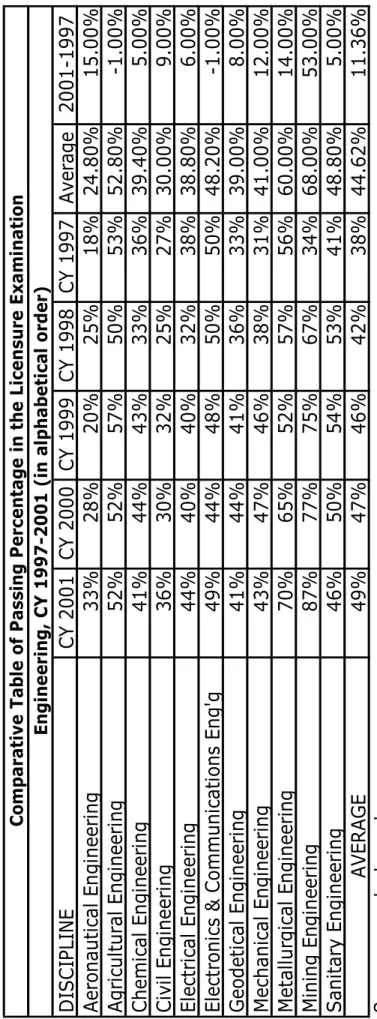
The main indicator of project effectiveness should be improvements in the quality of the graduates produced by the institutions assisted by the project, where quality is gauged in terms of academic achievement measures and labor market performance such as enhanced employability and increased earnings. Unfortunately, the project did not provide for graduate tracer studies that would allow monitoring of these indicators. Nevertheless, in engineering where professional board examinations are conducted, there has been a marked improvement in the overall passing rate, from 38% in 1997 to 49% in 2001. Three of the four most popular fields (electrical, mechanical, and civil engineering) showed gains of over five percentage points; among the top four, only electronics and communications engineering had a decline in passing rate of one percentage point (Table 1).
Impact
In the Philippine context where private institutions account for at least 75% of university enrollments, there is a continuing policy debate on the appropriate role of government in the sector. Economists argue that the students themselves capture the returns to investment in higher education, so that there is no need to subsidize the sector. The private institutions themselves would invest in program quality improvements if the demand is there, and they recover their costs through increased user (tuition) fees. Public funds should instead go towards improving basic education, where positive spillovers to the rest of society are more likely. They also point out that only a small proportion of the students who reach university level come from poor families, so that public subsidies to the sector are not justified from an equity standpoint. This view appears to be shared by senior officials in government at present, for a project proposal similar to ESEP (the Higher Education Development Project) was turned down recently.
The project institutions (public and private) reach at most 10% of total tertiary enrollments; they are the ones already reputed to be “high quality,” whose graduates have a greater tendency to migrate abroad. Also, with the project, much support (by way of grants) went to a few private higher education institutions that were not even cash-strapped. Some observers consider the project focus on these institutions as leading to further inequities in the system.
More financial cost recovery measures for government should have been built into project design. The only clear financial contribution expected of the beneficiary institutions was the Science and Engineering Laboratory Fund (SELF) to maintain the donated equipment, and compliance in this regard was even low.
18