ORIGINAL ARTICLE
Development of a Behavior Change Intervention to Encourage
Timely Cancer Symptom Presentation Among People Living
in Deprived Communities
Using the Behavior Change Wheel
Stephanie Smits, PhD1 &Grace McCutchan, BSc1&Fiona Wood, PhD1&
Adrian Edwards, PhD, MRCGP1&Ian Lewis, PhD2&Michael Robling, PhD3&
Shantini Paranjothy, PhD1&Ben Carter, PhD1&Julia Townson, BA3&Kate Brain, PhD1
#The Author(s) 2016. This article is published with open access at Springerlink.com
Abstract
BackgroundTargeted public awareness interventions are
needed to improve earlier cancer diagnosis and reduce socio-economic inequalities in cancer outcomes. The health check (intervention) is a touchscreen questionnaire delivered by trained lay advisors that aims to raise awareness of cancer symptoms and risk factors and encourage timely help seeking.
PurposeThis study aimed to apply the Behavior Change
Wheel to intervention refinement by identifying barriers and facilitators to timely symptom presentation among people liv-ing in socioeconomically deprived communities.
MethodsPrimary data (six focus groups with health
profes-sionals, community partners and public) and secondary data (systematic review of barriers and facilitators to cancer symp-tom presentation) were mapped iteratively to the Behavior Change Wheel.
ResultsBarriers and facilitators were identified from the
sys-tematic review and focus groups comprising 14 members of the public aged over 40, 14 community partners, and 14
healthcare professionals. Barriers included poor symptom knowledge and lack of motivation to engage in preventive or proactive behaviors. Facilitators included cues/prompts to ac-tion, general practitioner preparedness to listen, and social networks. The following behavior change techniques were selected to address identified barriers and facilitators: informa-tion about health consequences, prompts/cues, credible sources, restricting physical and social environment, social support, goal setting, and action planning.
Conclusions The Behavior Change Wheel triangulated findings
from primary and secondary data sources. An intervention com-bining education and enablement could encourage timely symp-tom presentation to primary care among people living in socio-economically deprived communities. Social encouragement and support is needed to increase symptom knowledge, challenge negative cancer beliefs, and prompt decisions to engage with the healthcare system.
Keywords Cancer . Complex intervention . Qualitative .
Behavior change . Inequality . Symptom presentation
Background
Socioeconomic inequalities in stage at cancer diagnosis and
survival are well documented [1–3], partly due to delayed
symptom presentation among socioeconomically deprived
populations [4,5], as well as reported links to low knowledge
or awareness of cancer symptoms, negative beliefs about
can-cer, and low health literacy [6, 7]. The revised National
Awareness and Early Diagnosis Initiative (NAEDI) pathway includes socioeconomic status, age, sex, and ethnicity as in-fluences on cancer survival and premature mortality in the
Electronic supplementary materialThe online version of this article (doi:10.1007/s12160-016-9849-x) contains supplementary material, which is available to authorized users.
* Stephanie Smits [email protected]
1
Division of Population Medicine, School of Medicine, Cardiff University, Neuadd Meirionnydd, Heath Park, Cardiff CF14 4YS, UK
2
Tenovus Cancer Care, Cardiff, UK
3 South East Wales Trials Unit, Centre for Trials Research, Cardiff University, Cardiff, UK
UK. The NAEDI pathway (supplementary file1) hypothe-sizes that these factors influence presentation to primary care in terms of low public awareness, barriers to help seeking, and negative beliefs about cancer, which in turn influence primary
and secondary care delays [8]. Improved cancer survival
out-comes could therefore be achieved through early detection
and diagnosis [9,10].
Barriers to early symptom presentation include fatalism
and denial [11]; fear of diagnosis, fear of treatment, and fear
of dying [12]; and misinterpretation of symptom seriousness
[13]. Other barriers include concerns about wasting the
doc-tor’s time [14], difficulties making appointments [6,14,15],
and lack of continuity in primary healthcare [16]. A systematic
review of the influences of awareness and beliefs on symptom presentation reported that the combination of fearful and fa-talistic beliefs is associated with longer presentation times in
lower socioeconomically deprived populations [12].
Empirical evidence about social influences on help seeking and symptom presentation suggests that the social context in which perceptions about illness and health systems are formed are important considerations that are often overlooked in
research [17].
Evidence-based initiatives that target public awareness and reduce barriers to early cancer diagnosis among people living in socioeconomically deprived communities are needed to
improve cancer outcomes and reduce inequalities [18,19].
Targeted community-based interventions that attempt to use social norms and influences show promise, by promoting pos-itive attitudes and increasing motivation to present early while challenging automatic negative associations of cancer as a
death sentence [11]. To date, interventions designed to
in-crease cancer awareness and encourage help seeking have not been targeted at people living in socioeconomically de-prived communities. The Medical Research Council guidance for the development and evaluation of complex interventions emphasizes the importance of developing a theoretical under-standing of the area in question and embedding of interven-tions in local needs, preferences, and priorities to ensure that
the intervention fits the needs of the community [20]. Tenovus
Cancer Care (a cancer charity based in Wales, UK) have de-veloped an innovative community outreach intervention as a potential way of engaging people in socioeconomically de-prived communities to become more aware of cancer symp-toms. The health check is a touchscreen questionnaire deliv-ered face-to-face by a trained lay advisor that aims to raise awareness of cancer risk factors and symptoms and encour-ages people to seek medical help in the presence of symptoms. To date, 3898 original health checks have been completed across 147 events. However, due to funding and capacity is-sues, these were not evaluated to measure effectiveness. A study of effectiveness, including follow-up assessment, is needed in order to provide evidence before the intervention can be implemented.
Interventions designed to increase cancer symptom aware-ness and timely help seeking are more likely to be effective not only if they are developed in partnership with local stake-holder groups but if they are also informed by a theoretical understanding of how cancer awareness interacts with cancer attitudes and beliefs in influencing help-seeking intentions and behaviors in socioeconomically deprived communities
[21]. We sought to refine the content of the health check and
identify essential elements to include based on the Behavior
Change Wheel [22], a model of behavior change that is based
on an integrated framework of existing theories [22].
The Behavior Change Wheel is a multiphase process guide for developing complex behavior change interventions, which identifies sources of behavior that could be targeted in
inter-ventions (see Fig.1). The Behavior Change Wheel comprises
the COM-B model and is supported by the Theoretical Domains Framework (TDF), the intervention functions map-ping matrices, and a taxonomy of behavior change techniques
[23,24]. The COM-B model describes how changing
behav-ior (B) is a result of changing one or more components of psychological and/or physical capability (C), social and phys-ical opportunities available (O), and automatic and reflective motivation (M). The TDF provides a more granular level of understanding and consists of domains that can be condensed to fit the three components of the COM-B model, as follows: capability (knowledge, cognitive and interpersonal skills, memory, attention and decision processes and behavioral reg-ulation, physical skills), opportunity (social influences, envi-ronmental context, and resources), and motivation (reinforce-ment, emotions, social/professional role and identity, beliefs about capabilities, beliefs about consequences, goals, and
in-tentions) [25]. Capability and opportunity can influence
moti-vation while behavior can influence capability, opportunity,
and motivation [26]. The COM-B model and TDF can be used
together to identify what needs to change in order to bring about the target behavior. Intervention functions are then
con-sidered (see Fig.1). These are broad categories aligned to the
COM-B Model through which an intervention can change
behavior [24] and include education, persuasion,
incentivisation, coercion, training, restriction, environmental
restructuring, modeling, and enablement [24]. The behavior
change techniques taxonomy (v1) is a separate tool that is linked to the Behavior Change Wheel and assists decision-making about specific behavior change techniques (BCTs) to include in the intervention, based on the identified
interven-tion funcinterven-tions [23]. BCTs are active ingredients that will bring
about change and are selected to deliver the intervention
functions [23].
The aim of the study was to refine the content and delivery of the cancer awareness intervention (health check) aimed at encouraging timely symptom presentation among people aged 40 years and over living in socioeconomically deprived com-munities, using the Behavior Change Wheel as a guide.
Specific objectives were to (1) gather evidence from primary (focus groups) and secondary (systematic review) data sources to identify barriers and facilitators to symptom presen-tation in people living in socioeconomically deprived commu-nities and determine which barriers and facilitators need to be addressed in the health check, (2) identify the type of inter-vention functions required to bring about the change, and (3) identify specific BCTs aligned to the purpose of the health check.
Method
The InterventionThe health check consists of 30 questions
in three domains: your history, your lifestyle, and your health
(see supplementary file 2 for full list of questions).
Questionnaire responses are used to provide individualized advice and signposting to primary care and other relevant services. Responses for each question are given in a traffic
light system, with“green”indicating results where no change
is suggested,“amber”indicating an area where change or
signposting could be considered, and“red”results indicating
that action should be taken. Text-accompanying results
provide information and guidance based on individual results. The health check was initially developed in 2009 and used exclusively on-board a mobile cancer support unit. In 2011, a new online version was developed to enable delivery in multiple locations simultaneously. Existing content was de-veloped by a group of Tenovus Cancer Care staff across sev-eral departments (research, health and well-being, and the cancer support team).
The health check has previously been delivered by Tenovus in a variety of community settings (mobile units, GP practices, and public areas such as community centers and workplaces) in deprived areas of South and North Wales. The current study provided an opportunity to formally refine, develop, and evaluate the health check in a research context. Theoretically driven changes were identified using the Behavior Change Wheel, with empirically driven changes made based on the latest clinical guidelines for the referral and
recognition of suspected cancer in the UK (https://www.nice.
org.uk/guidance/ng12?unlid=49677604320162173631). A process of mapping the health check to the Behavior Change Wheel was undertaken in three stages separately by SS, KB, and GM in order to refine and develop health check content. Discrepancies in mapping or coding were discussed
and resolved. The methods used to address each of study objectives 1 to 3 are described below.
1. Identification of barriers and facilitators to timely
symp-tom presentation among people living in socioeconomi-cally deprived communities
The aim of the intervention is to encourage timely presen-tation to primary care in people who have symptoms indica-tive of possible cancer. Primary (focus groups) and secondary (systematic review) evidence sources were used to identify barriers and facilitators to the target behavior.
Systematic Review
Findings from a systematic review of barriers and facilitators to early symptom presentation (13) were mapped on to the
COM-B model and TDF [22] in order to understand the target
behavior in terms of capability, opportunity, and motivation. The systematic review was conducted on studies of actual or anticipated symptom presentation across all tumor sites and highlighted that poor knowledge, fearful and fatalistic beliefs about cancer, and emotional barriers lead to later presentation
among lower socioeconomic groups [12]. The methods for the
systematic review are described in full elsewhere [12].
Barriers and facilitators identified in the 60 papers included in the review were extracted for use in the current study. Extracted barriers and facilitators were mapped on to the COM-B/TDF independently by KB, SS, and GM. The map-ping process was facilitated by an Excel spreadsheet with COM-B components and related TDF domains in separate columns, and each barriers and facilitators added as a row. KB, SS, and GM independently coded each barrier and facil-itator to the COM-B and TDF. Any discrepancies in coding were resolved through discussion.
In order to streamline the number of barrier and facilitator that could feasibly be targeted in the intervention, all barriers and facilitators were categorized as modifiable or
non-modifiable separately by SS, KB, and GM [24]. This was
done by considering whether each individual barrier and fa-cilitator was within the scope of the intervention. For example,
“continuity of care”was not considered to be modifiable
be-cause the intervention is targeted at the level of the individual rather than the medical system. Again, any discrepancies were resolved through discussion.
Focus Groups
Focus groups were undertaken in Communities First areas in
Wales to gain local stakeholders’ views regarding cancer
awareness and health check content. Communities First is a Welsh Government community program focused on tackling
poverty that supports the most disadvantaged people in the most deprived areas of Wales with the aim of contributing to the alleviation of persistent poverty. Focus group topic guides were constructed based on barriers and facilitators identified during the COM-B/TDF mapping process of the systematic review and included questions related to capability, opportu-nity, and motivation. Topics included the importance of health for people in the local community, what people in the com-munity would do if they had a potential symptom of cancer, barriers and facilitator to early symptom presentation, per-ceived benefits of the intervention, and intervention delivery
(supplementary file3). Ethical approval was received from the
National Research Ethics Service (NRES) Research Ethics Committee (REC reference no 14/NW/1104), and all partici-pants provided written informed consent.
Sample
Six focus groups were conducted in two health boards (Aneurin Bevan University Health Board and Cwm Taf University Health Board). Separate focus groups were con-ducted with healthcare professionals (general practitioners, practice nurses, practice managers, community pharmacists and public health consultants), community partners (housing association workers, Communities First workers, and other community-based workers), and members of the general pub-lic (males and females aged over 40 living in Communities First areas). Separate focus groups were held in these group-ings to encourage attendance and facilitate relaxed and open discussion. Participants were reimbursed for their time in at-tending the focus groups. Opportunistic sampling was used with local study collaborators and snowballing to identify par-ticipants. A member of the project team within each health board acted as local study collaborator and aided recruitment by providing stakeholder lists of healthcare professionals, public health specialists, and community partners. The public focus groups were conducted last so that the community part-ners who participated in the focus groups could identify mem-bers of the public from within their community to participate.
Procedure
Focus groups were audio-recorded and transcribed verbatim. A topic guide was developed to ensure similar topics were covered in each group, with enough flexibility to enable issues of importance to emerge. A brief presentation to demonstrate the intervention was conducted by SS or GM, and after this familiarization, the participants were asked to give their views on the intervention. A report summarizing the focus group was e-mailed to the participants for their review and validation.
Analysis
Anonymized focus group transcripts were analyzed
themati-cally using techniques of constant comparison [27], supported
by qualitative data analysis software (NVivo 10). This in-volved coding and comparing emerging themes and codes within transcripts and across the dataset, looking for shared or disparate views. One transcript was double coded by KB. Four discrepancies were noted and resolved through discussion.
An additional step was taken to code the focus group data to the COM-B/TDF. This involved reading each code in NVivo and then locating the code in the list of agreed-upon mappings in the previous step. NVivo codes were mapped to the relevant COM-B components and TDF domain, with all codes mapped to at least one domain within the COM-B/TDF and some codes mapped to multiple domains. Quotes
present-ed in the“Results”section represent examples of the identified
themes.
2. Identification of the types of intervention likely to
encour-age timely symptom presentation among people living in socioeconomically deprived communities
The previous step reflects a behavioral diagnosis, whereby the COM-B components and TDF domains that need to be targeted in order to bring about the target behavior have been
identified [24]. This diagnosis was then linked to functions
through which the intervention can change behavior. The Behavior Change Wheel framework stipulates that a full range of intervention functions should be considered and provides a list of intervention functions linked to the COM-B/TDF (see
Fig.1). The nine intervention functions and the related
COM-B components are presented in an intervention functions
ma-trix (see supplementary file4). The matrix presents the links
between the intervention functions and COM-B components,
with the links established by an expert consensus process [24].
Intervention functions that were related to the COM-B components and TDF domains identified in the previous phase were identified and considered using the intervention
function matrix [24]. For example, barriers and facilitators
coded under “physical capability” may require intervention
functions relating to “training” and “enablement” (see
supplementary file 4). When multiple intervention functions
are highlighted for consideration by the matrix, the afford-ability, practicafford-ability, effectiveness/cost-effectiveness, accept-ability, side effects/safety, equity (APEASE) criteria are used to guide judgments for selecting the most appropriate
inter-vention functions [24]. This step is completed by assessing
the affordability, practicability, effectiveness/cost-effectiveness, acceptability, side effects/safety, and equity of each of the intervention functions in relation to the behavior. SS, GM, and KB separately applied the APEASE criteria (24) to the
intervention functions, with discrepancies resolved by discussion.
3. Identification of specific intervention content to address
identified barriers and facilitators to timely symptom presentation
Following identification of intervention functions, as guid-ed by the COM-B/TDF, intervention content was identifiguid-ed in the form of behavior change techniques (BCTs) that would help bring about the target behavior. This is visualized as the
third layer in Fig. 1 (see Intervention Functions layer of
Fig. 1). BCTs that were relevant to each of the identified
intervention functions were considered using the APEASE criteria (24). The full taxonomy and definitions are available
elsewhere [23]. The APEASE criteria were used again by SS,
KB, and GM in order to narrow down the most frequently
used BCTs for each intervention function [24].
Results
The results relating to each of the three study objectives will be discussed separately. The intervention refinement, development process and summary of results is presented in
Fig.2.
1. Barriers and facilitators to timely symptom presentation in
people living in socioeconomically deprived communities
Systematic Review
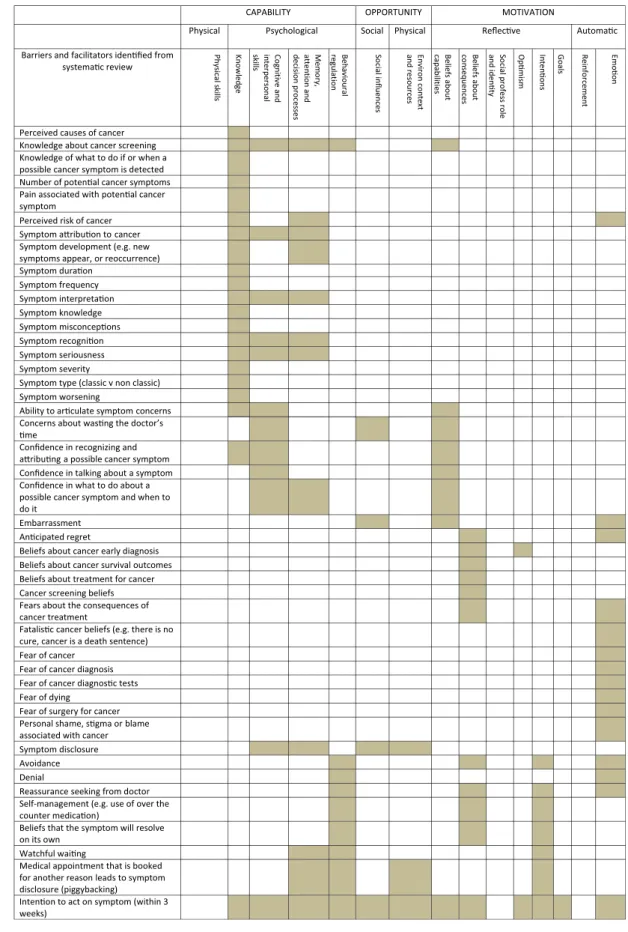
A total of 69 barriers and facilitators were identified. When coded against the COM-B components and TDF domains, frequencies of barriers and facilitators coded were as follows: capability:knowledge (25); cognitive and interpersonal skills (14); memory, attention, and decision processes (12);
behav-ioral regulation (9); physical skills (0);opportunity: social
influences (11); environmental context and resources (19); motivation: reinforcement (0); emotion (18); social/ professional role and identity (0); beliefs about capabilities (9); optimism (2); beliefs about consequences (11); intentions (7); goals (1).
Coding of barriers and facilitators as“modifiable”or“
non-modifiable”resulted in 46 modifiable and 23 non-modifiable
barriers and facilitators. The final 46 barriers and facilitators
were mapped as follows:capability: knowledge (21);
cogni-tive and interpersonal skills (12); memory, attention, and de-cision processes (11); behavioral regulation (9); physical skills (0);opportunity: social influences (4); environmental
(15); social/professional role and identity (0); beliefs about capabilities (8); optimism (2); beliefs about consequences (11); intentions (7); and goals (1). A list of the 46 included barriers and facilitators mapped to COM-B and TDF can be
found in Table1.
Focus Groups
Focus groups took place between November 2014 and March 2015 and lasted between 64 and 82 min. In Health Board 1, the first focus group consisted of six health profes-sionals (three general practitioners (GPs), two public health consultants, and one practice nurse), the second focus group had eight community partners, and the third had six members of the general public (four females, two males). In Health Board 2, the first focus group consisted of eight health profes-sionals (four GPs, one practice director, one community phar-macist, one public health consultant, and one practice nurse), the second had six community partners, and the third had eight members of the public (six females, two males).
Overall, the intervention was viewed as an acceptable and useful tool for encouraging people living in socioeconomical-ly deprived communities to engage in cancer awareness and help seeking. The focus group findings are discussed in terms of the COM-B components and TDF domain mapping (see
Table2).
Capability
Knowledge A lack of knowledge in the community was
discussed in relation to cancer symptoms and risk factors. Lack of knowledge was thought to influence symptom inter-pretation and decisions about when and where to seek help. The non-specificity of many cancer symptoms was described as making it difficult for people to attribute symptoms to can-cer. This could sometimes lead to minimizing symptoms and attribution to benign or everyday physical sensations. Fatalism and fear were perceived to stem from poor knowledge, with participants discussing how people in their community held outdated views on cancer outcomes. Crisis point care in the community was discussed, with this describing the act of
Table 1 Barriers and facilitators identified from systematic review mapped to COM-B model and Theoretical Domains Framework
CAPABILITY OPPORTUNITY MOTIVATION
Physical Psychological Social Physical Reflecve Automac
Barriers and facilitators idenfied from systemac review sl li ks l ac is y h P e g d el w o n K d n a e vi ti n g o C l a n os r e pr et ni skills , yr o m e M d n a n oi t n et t a s es s ec or p n oi si c e d l ar u oi v a h e B n oi t al u g er s ec n e ul f ni l ai c o S t x et n oc n or i v n E and s ec r u os er Beliefs ab out s ei ti li b a p ac Beliefs ab out co nseque nc es el or ss ef or p l ai c o S and identy Op mis m Inte non s Goals Re in force m e n t Emoon
Perceived causes of cancer Knowledge about cancer screening Knowledge of what to do if or when a possible cancer symptom is detected Number of potenal cancer symptoms Pain associated with potenal cancer symptom
Perceived risk of cancer Symptom aribuon to cancer Symptom development (e.g. new symptoms appear, or reoccurrence) Symptom duraon Symptom frequency Symptom interpretaon Symptom knowledge Symptom misconcepons Symptom recognion Symptom seriousness Symptom severity
Symptom type (classic v non classic) Symptom worsening
Ability to arculate symptom concerns Concerns about wasng the doctor’s me
Confidence in recognizing and aribung a possible cancer symptom Confidence in talking about a symptom Confidence in what to do about a possible cancer symptom and when to do it
Embarrassment Ancipated regret
Beliefs about cancer early diagnosis Beliefs about cancer survival outcomes Beliefs about treatment for cancer Cancer screening beliefs Fears about the consequences of cancer treatment
Fatalisc cancer beliefs (e.g. there is no cure, cancer is a death sentence) Fear of cancer
Fear of cancer diagnosis Fear of cancer diagnosc tests Fear of dying
Fear of surgery for cancer Personal shame, sgma or blame associated with cancer Symptom disclosure Avoidance Denial
Reassurance seeking from doctor Self-management (e.g. use of over the counter medicaon)
Beliefs that the symptom will resolve on its own
Watchful waing
Medical appointment that is booked for another reason leads to symptom disclosure (piggybacking)
Intenon to act on symptom (within 3 weeks)
All items listed can be a barrier or facilitator; the directionality varies depending on individuals and circumstances; therefore, the directionality is not specified
Ta b le 2 Illus trativ e quotes from focus g roups aligned to C OM-B model and Th eoretical Domains F ramework a CO M-B and TDF mapping Description Illustrative quote Capab ili ty — knowled g e Sympto ms I think some of the sy m ptoms can b e ta k en as b eing other thing s. There ’ s o n e that they say ,if y o u h av e h eart burn a lot th at can be a sy m p tom of stomach cancer .I h ad n o idea about that. I thin k for a lo tof people if they h ad heart burn, they would just take m edicatio n to d eal with th e h eart burn rather than them thinkin g it was a bigg er prob lem. (FG2_ H B 1 _CP) Risk factors I thin k also there ’ s the fact that it ’ s p er cep ti on th at it won ’ t h appen to them, they do n ’ t d rink an d they don ’ ts m o k e.T h at ’ s a big issue. Because I don ’ td o X, Y and Z, I ’ ll no t g et this cancer or that ca n cer . I think that ’ s a b ig p la y er in the game as well. (F G2_ H B1_C P) Capab ili ty — cognitive and interp er sonal skills , memory , attention a n d d ec is ion pr ocess es , b ehavior regulatio n Commu n ication A close fr ien d o f m ine is a GP … sh e p u ts a lot o f emphasis o n w hat she calls the d o o r h andle d iagno si s, she calls it. Someo n e w il l come to see you about somethin g an d then as they are o n their way o u t, th ey ’ ll say , oh yes ,th ere ’ s this o ther thing, this mole. A nd that ’ s w hat they ’ ve really come to see you abou t. Th e cold that they ’ ve had for a w eek isn ’ tw h att h ey ’ ve come to see.. . It ’ s oh, while I ’ m h ere, um... (FG1_ H B 2 _CP) Some doctors tak e time, do n ’ t th ey? Y o u g o into them and you can talk to them, they tak e time to listen .And then th ere are o ther d o ctors, like the on e I ’ m talking abou t, the fir st thing h e d o es is take a prescription car d and he ’ s w riting a p re sc rip ti on for you before yo u ’ ve even finished telling h im. Y ou k no w , tha t ’ s w rong . (FG4 _ HB2_ P ) Oppo rtunity — envir o n m ental context and re sour ces Relation ship with h ealt h profession al I ’ ll get o n m e soapbo x now rather than later .One o f the major p roblems w e h av e in our cluster is G P appointmen ts … And b ecause o f that, p eople tend to no t bother , p ar ticu larly with screening type thin g s, thin g s like th at. They ju st ... Oh, I can ’ t g et an appoin tme n t to see th e doctor wh en I ’ mb ad so I ’ m no t goin g to go when I ’ m p er fectly all rig h t, k ind o f attitud e. (FG1 _ HB 2 _ CP) So th ey go with the one iss u e. And as you sa id ,you can ’ tg o with multiple is su es. Y ou ’ ve g o tt hat timeslot and you k n ow ,I ’ ll be fine, k ind o f thin g ,u n ti lit all b lows up. (FG1_ H B2_ C P) Comp eting p rioritie s I th in k a lot o f o u r tenan ts, fo r whatever rea so ns, they won ’ t b e u p and be in a positio n w h er e they can be ring in g in o r v isiting a sur g er y at 8 .30 am to g et an appoin tme n t. It ’ s just not possib le for some o f them. (FG1_ HB2_ C P) Cultu ra l factors In m any cu ltu re s, they either don ’ th ave d o ctors available o r they w ou ld have to pay a lot o f m o n ey to see a doctor so th ey just assume it ’ s the same in this coun try . So it ’ s a lack of information about what serv ices are available an d wh at are o n o ff er . (FG2_ HB1_C P) Oppo rtunity — so ci al influ en ces Social supp o rt I th in k th ey wo u ld sp eak to some family member o r fri en d first of all, they n o rmally do .W e still get m ums coming in with son s in their thirt ies and fo rties and w e still get husb ands and w ives come in togeth er . N o rmally , the wife drags alon g the hus b and. (FG3_ H B2_ H CP) W ell, I would ask my partner , then basically , b ecause she ’ s a nurse. B ut I also wo u ld ask m y sister , wh o su ffered cancer . I ’ ds ay “ I am feeling like this ” . See what reaction I g et an d if she said well, I actually had sympto m s lik e th at, go to the doctor quickly ,a s so o n as you can. Don ’ tput it of f. That ’ s w ha t I w ould do. (FG4_ H B2_ P ) Social networks I think there ’ s an o p p ortunity as well for some sort o f friending scheme where p eop le who perhap s felt a little bit, yo u kno w , vulnerable o r af raid to g o to see the GP by themselves, just someon e th at can go with them and can maybe supp o rt th em ,h elp th em ex p lain to th e GP exactly what the p roblem is. (FG2_ H B1 _ CP) Facilitated d elivery o f health information It co u ldb e u se d w it hs o m eb o d yi nt h e co m m u n it y.Id o n ’ t think they would access it o n their own (FG2_HB1 _ CP) It ’ s always going to be more ef fective wh en th ey are with the advisor .Listenin g to them talking rather than reading something .Y ou kn o w ? Page lik e that come up and full o f text, after something like that, a lot of peo p le kind of th ink, put it together . T hey ju st can ’ t b e bothered. Conv er sa tio n is a little bit more engaging . (FG2 _ HB1_C P) Motivatio n — emotion Fearful o f cancer I th ink it ’ s the fear thou g h perhaps b ecause sort of on your day to d ay life is jus t ticking ov er . A s soon as you get a diag n o sis though ,e v er y th ing changes an dIt h in kt h at ’ s th e fear o f this as w ell that you do not want to k n ow because things would chan g e o r poten ti ally they do . (FG3 _ HB 2 _ HCP) Fear o f cancer tr eatment The o th er thing that came to m ind is that p eople o ften fear treatment as well. Oh, chemotherapy , I ’ m going to lose my hair .T hat ’ s the first thing that they think o f, losin g th ei r h air , ra th er than curing the cancer . S o th at sort o f th ing mi g h t h el p. (F G 5 _ HB1_HC P ) Gend er dif fe rences Because women are g iving birth, we are m ore so rt o f, you kno w ? I think sometimes men p u t of f g o ing to the d o ctors, don ’ t they ? Becaus e they are embarrassed. (FG4_HB 2 _P) Cultu ral b eliefs It ’ s always b een classed as a p riv at e, you don ’ t talk about an y thing down there. A nd it ’ s still a cu lture. Especially British p eo p le, still h ave that st if f upp er lip, don ’ t ta lk abo u t th at . (F G 5_ HB 1 _ H C P) Motivatio n — beliefs abou t capa b ilities a n d beliefs abou t con se quences Negative cancer b elief s Cancer is like a st igma … and they th ink it ’ s a death sen tence, it ’ s not. C ancer has b ecome a chron ic disease n o w ,i t ’ s lik e d iabetes an d oth er things, we ’ re talking abo u t 1 0 o r 20 years survival rat es . (FG3 _ HB 2 _ HCP) Self-ef ficacy And p eople ’ s ex p ectations of th ei r o w n health an d the health o f their fam ily dependin g on w h ere they live. So living in an area where there is relatively low life ex p ectancy ,h ig h level o f prema tu re m ortality , everyon e that you know has g o t a chronic co n dition, that ’ s p rob ably w hat you exp ect yourself. So maybe th er e is a lack of motivation to m ake changes b ecause it just seems, it ’ s that external levels o f control, you just th ink w ell, these things are ou ts ide o f m y control. That ’ s how I ’ m goin g to end u p .I think it ’ s v ery d if ficult for p eople to chan g e if you igno re the context in w hich they live th eir lives. (FG5_ HB1 _ HCP) If th ey h av e a symptom of something, they will try and minimize it. Oh, h ave I got bloo d , losing blood , it ’ s from so m ething else. T hey always find anoth er reason of what it could b e b ecause they don ’ t want to confront the fac t that it could b e that, try to instill a b it of confidence in them. Go and get yo u rself checked ou t, y o u know? (FG2_ HB1_C P) a Insertions to clarify topic content are denoted b y squar e br acke ts. The remova l o f irr ele v an t infor ma tion w ithi n the q u o tes is d enot ed by “… . ” .F ocus grou p characteristics ar e provided at the end of quotes: focus groups (FG) are numbered 1-6, the location of the focus g roup is included as either H ealth B oard 1 (HB1 ) or Health Board 2 (HB2), and the focus g rou p me mbe rs wer e eit her g en er al public (P ), community partners (CP) or heal thcare professionals (HCP )
presenting with signs or symptoms that are progressed to an advanced stage. Crisis point care was perceived to be a con-sequence of lack of capability, with people in the community sometimes waiting until symptoms reached a point where they impacted on day-to-day life before seeking help.
Cognitive and Interpersonal Skills, Memory, Attention
and Decision Processes, and Behavior RegulationSkills
to appraise symptoms and communicate concerns, as well as decisions to seek help, were perceived to be influenced by an
individual’s psychological capability. Engaging and
commu-nicating with healthcare professionals was perceived to be difficult for many people in the community. This perceived difficulty was described as being influenced by lack of confi-dence in discussing symptoms, the preparedness of the GP to listen to symptom concerns, and previous experiences. When people think about presenting with symptoms, they draw on previous decisions they have made, previous symptom expe-riences, and previous experiences with doctors. Therefore, the three TDF domains of cognitive and interpersonal skills, memory, attention and decision processes, and behavior reg-ulation are closely linked.
Opportunity
Physical Opportunity (Environmental Context and
Resources)Service barriers, such as difficulty getting
ap-pointments and problems with appointment booking process-es, were frequently mentioned. Consistency of GP was con-sidered important, with lack of continuity of care making it harder for people to voice health concerns. Length of time in primary care appointments was described as a barrier to dis-cussion about health concerns, with the duration of appoint-ments not long enough for patients to explain their health concerns, leading to feelings of being rushed and pressured.
Competing priorities and life commitments were also discussed. It was acknowledged that people living in deprived communities often have commitments and concerns, such as family, housing, or people who depend on them, limiting the opportunities to look after their own health. These competing priorities and commitments were perceived as compounding the issues surrounding booking processes, leading people to neglect their own health. Long-term health was perceived not to be a priority for many people in the local community. The cultural diversity of the community was also discussed, with reflection that people who have moved to the local community from other countries were not aware that primary care could be a place to discuss health concerns.
Social Opportunity (Social Influences)Support from
fam-ily and friends was perceived to encourage people to seek help, and those without social support were de-scribed as less likely to present. Social support was
perceived to facilitate many aspects of help seeking, from symptom appraisal and making the decision to seek help to discussing symptom concerns with health professionals. It was thought that people in the commu-nity would often turn to family members, friends or elders to talk about health concerns. Social circles were also an opportunity to acquire knowledge about cancer symptoms, treatment, and curability. Participants discussed how people in their community would often draw on experiences of family and friends when consid-ering aspects of their own health. Building relationships with community partners or other people in the commu-nity was suggested as a way to help people become more aware and engaged in their health by making it easier to disclose health issues. It was discussed how people in the local community find it easier to discuss health with those they trust and may be more receptive to the advice and support provided by the trusted person (e.g., friend, family, or elder).
When access to health information and the delivery of the health check was discussed, the participants thought people in their community may not have oppor-tunities to access information on their own. For exam-ple, people may not know where to look for information or would not have access or the skills to access online health information. It was suggested that community partners were trusted people who could engage people in a conversation about their health and provide support in the form of the health check intervention.
Motivation
Emotion (Automatic Motivation) Emotions were
consid-ered to influence motivation to present in the presence of symptoms. Automatic emotional responses such as fear of cancer were thought to influence people in the community on different levels, whether through general fear of being di-agnosed with a life-threatening illness, fear of cancer itself, or fear of cancer treatment. Embarrassment was suggested as an emotional barrier that was particularly relevant for signs and symptoms originating from intimate areas of the body and was thought to reflect British cultural attitudes of embarrassment
and maintaining a“stiff upper lip.”Gender differences were
also highlighted, with men thought to be less motivated and more inclined to delay presentation than women were. Beliefs about Capabilities and Beliefs about Consequences
(Reflective Motivation)Discussion centered on beliefs about
early diagnosis, treatment, and the curability of cancer. Concerns were expressed about prevailing negative beliefs about cancer within the local community, which were
de-scribed as influencing people’s motivation to engage with
how cancer is perceived as beyond the individual’s control, non-treatable, and a death sentence. These beliefs were thought to stem from experience of cancer in family or friends
and could reduce people’s motivation to engage with their
health. Participants felt that much could be gained by encour-aging positive beliefs, for example, by emphasizing current treatment successes and benefits of early diagnosis. It was also discussed how people living in socioeconomically deprived populations may take longer to act on symptoms, instead hop-ing the symptom will resolve by itself and only seekhop-ing help when the symptom can no longer be ignored. Lack of confi-dence in recognizing and attributing symptoms was also raised as a barrier to presentation.
2. Types of intervention likely to encourage timely symptom
presentation
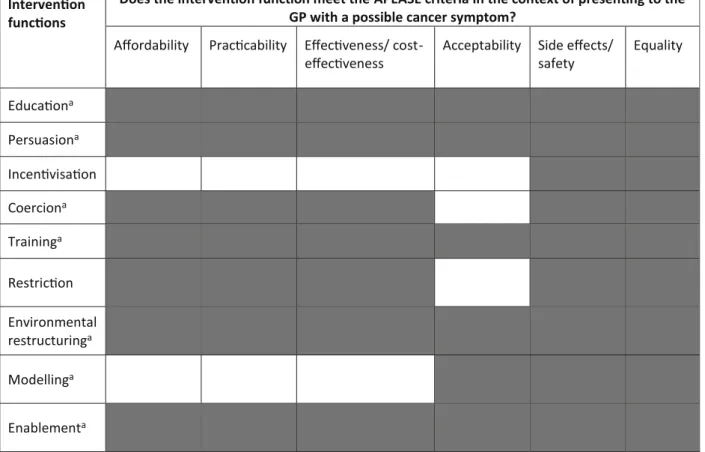
Mapping the COM-B components to the intervention func-tion matrix identified that all of the intervenfunc-tion funcfunc-tions needed to be considered. Applying the APEASE criteria (24) led to the identification of the following intervention
functions for inclusion:education,persuasion,training,
envi-ronmental restructuring, and enablement (see Table 3). Educationformed a central part of the intervention, involving
the provision of information aimed at increasing knowledge
about symptoms and what to do in their presence.Persuasion
was selected to reflect the intervention’s potential to
encour-age and advise people who are currently experiencing symp-toms to see their GP promptly. Persuasive language could be used to emphasize the importance of presenting and the health benefits of early presentation.
Training was selected to reflect that timely symptom presentation could be achieved by training intervention users to create action plans in response to potential cancer symptoms, enabling users to act on symptoms that they
may experience. Environmental restructuringwas selected
because the intervention requires the physical and social context of the individual to be altered in order for early symptom presentation to be achieved. Taking the intervention into the community and delivering it in non-traditional medical settings is one way of achieving
this. Finally, enablement was selected because increasing
means and reducing barriers to presentation is important in order for early symptom presentation to be achieved. Modeling was considered impractical and unlikely to meet the affordable and effectiveness/cost-effectiveness aspects of APEASE (24). Incentivisation was not applicable due to financial incentives for such an intervention deemed
Table 3 Selection of intervention functions based on the APEASE criteria Intervenon
funcons
Does the intervenon funcon meet the APEASE criteria in the context of presenng to the GP with a possible cancer symptom?
Affordability Praccability Effecveness/
cost-effecveness
Acceptability Side effects/
safety Equality Educaona Persuasiona Incenvisaon Coerciona Traininga Restricon Environmental restructuringa Modellinga Enablementa a
unaffordable and unacceptable to professional stakeholders. Coercion and restriction were also considered to be unaccept-able to users and providers.
3. Specific intervention content to address identified barriers
and facilitators to timely symptom presentation
The APEASE criteria were applied to the most frequently
used BCTs [24] for each of the identified intervention
func-tions (see supplementary file5). A summary of intervention
functions and BCTs that were selected to address the barriers
and facilitators to the target behavior is presented in Table4,
alongside examples of strategies that describe how the BCTs
Table 4 Summary of COM-B model, Theoretical Domains Framework, intervention functions, behavior change techniques, and proposed intervention content
COM-B and TDF Intervention functions Behavior change techniques selected
Intervention strategy (examples of application within the intervention)
Influencing capability
Knowledge Education, persuasion Information about health consequences
•Questions and results included for 12 symptoms which reflect current guidelines
•Results emphasize the benefits of early presentation •Results highlight improvements in cancer treatment to
reduce negative cancer beliefs Influencing opportunity Environmental context and resources Environmental restructuring, enablement Restructuring the physical environment
•The intervention is delivered in a variety of non-medical community settings
Environmental context and resources
Education, environmental restructuring
Prompts/cues •Questions ask whether people have received and taken up relevant screening invitations (based on age and gender) •Results encourage participants to look for lumps when in
the shower. This will lead to the shower acting as prompt/cue for checking for lumps.
Social influences Environmental restructuring, enablement
Restructuring the social environment
•Results encourage people to tell others about symptom concerns
•A lay advisor will be available to do the health check with the individual and will build a rapport with the participant to facilitate delivery of the health information
Social influences Persuasion Credible source •The intervention is associated with Tenovus Cancer Care as a credible source
•Intervention is delivered by a lay advisor as a trusted source of information and support
Social influences Enablement Social support (unspecified) •Results encourage people to take someone with them to primary care appointments
•Results provide information and advice for making a primary care appointment
•Results emphasize GP support and availability Influencing motivation
Goals Enablement Goal setting (behavior) •The goal of timely presentation with potential cancer symptoms is presented throughout the intervention results •People who receive“red results”receive information
telling them to seek medical advice
•Those who receive green results are presented with information about the symptom to enable them to seek help if they experience the symptom in the future Goals Enablement Goal setting (outcome) •Participants set a goal to present to primary care with
potential cancer symptoms. This is a positive outcome of increased symptom knowledge and also represents knowledge of the importance of early diagnosis Intentions Enablement Action planning •Action planning will be prompted after the results by
people completing the statement in the results printout “If I notice a symptom, I will go and see my ____ within ______ of noticing the symptom”
Beliefs about consequences
Education, persuasion Information about health consequences
•Results emphasize the benefits of early presentation •Results highlight improvements in cancer treatment to
will be delivered in the modified intervention. These examples cover changes to the touchscreen questionnaire and the indi-vidualized results. This table represents a summary of all of the phases of the Behavior Change Wheel and is the culmina-tion of all of the phases of work in the current study.
Provision of information about health consequences in the intervention could educate people to seek help and act as
persuasion in the presence of symptoms (see Table 4).
Emphasizing the benefits of early presentation and improve-ments in cancer treatimprove-ments may encourage people to act earlier in the presence of symptoms. Information on symptoms that may indicate cancer and when to act on them is crucial content for the health check and could act as a prompt or cue to action, which involves introducing or defining environments so that
people are prompted or cued to the behavior (see Table4).
Goal setting and action planning were also identified as valu-able BCTs and emphasize the importance of acting in the present but also planning for the future. This is important because many people who complete the intervention may not be currently experiencing symptoms but may go on to
do so (see Table4).
Credible source relates to presenting verbal or visual information for or against the behavior by a credible source, which will be the health check advisor on behalf of Tenovus
Cancer Care (see Table4). The health check advisor will
help restructure the social environment by being on hand to facilitate the individual to go through the intervention and encourage them to act on their own personalized results (see
Table4). Other social support strategies will involve
em-phasizing facilitators to presentation such as social net-works and GP preparedness to listen to symptom concerns. Restructuring the physical environment is a change in the physical environment in order to facilitate performance of
the behavior [24]. By restructuring the physical
environ-ment and taking the intervention to people in community settings, barriers to discussing health concerns, such as
ap-pointment processes, may be reduced (see Table 4).
Engaging people within community settings may facilitate discussions about health and act as a springboard from which people can be encouraged by the lay advisor to seek advice from a healthcare professional.
The refined health check contains 26 questions in three domains: about you (7), your lifestyle (5), and your health
(14) (see supplementary file 2 for full list of questions).
Symptom questions and results have been refined to reflect the latest clinical guidelines, with lifestyle and personal histo-ry questions and responses also refined to reflect current clin-ical guidelines for the referral and recognition of suspected
cancer in the UK (https://www.nice.org.uk/guidance/ng12
?unlid=49677604320162173631). Questions and results about screening has also been developed to reflect the importance of discussing ways to manage cancer risk and engagement with screening services.
Discussion
The Behavior Change Wheel [22] and its constituent
ele-ments were applied to refine and develop an intervention that aims to encourage timely symptom presentation to primary care among people living in socioeconomically deprived communities. To our knowledge, the current study is the first to apply the Behavior Change Wheel in this context. This systematic approach provided insights into cancer symptom awareness, help-seeking behaviors, and barriers and facilitators to early presentation in people living in socioeconomically deprived communities. The study also demonstrates how primary and secondary data can be applied to the Behavior Change Wheel for inter-vention development and refinement. The COM-B and
TDF [22] were used to map important barriers and
facil-itators relating to presentation to primary care with possi-ble cancer symptoms in socioeconomically deprived com-munities and formed the theoretical basis for refining the intervention. The behavior change taxonomy was then drawn upon to specify the intervention content, enabling barriers and facilitators to be targeted in order to encour-age earlier presentation. Primary qualitative data collec-tion added to the secondary systematic review data by enabling exploration of identified barriers and facilitators. Findings suggest that capability, opportunity, and mo-tivation play an important role in cancer awareness and help seeking for potential cancer symptoms in people liv-ing in socioeconomically deprived populations, and that these constructs are not independent, and all contribute to decisions surrounding presentation. This was evident in the overlapping influence of many of the constructs in our systematic review and focus group analysis. Findings were incorporated into an intervention to in-crease cancer awareness and encourage help seeking; 4 intervention functions (education, persuasion, environ-mental restructuring, and enablement) were identified to address 46 modifiable barriers and facilitators in an af-fordable, practical, and acceptable way. Behavior change techniques aligned to these four functions were then se-lected in order to address the barriers and facilitators to early symptom presentation for people living in socioeco-nomically deprived communities.
Previous studies have highlighted barriers to symptom pre-sentation among socioeconomically deprived populations, in-cluding fatalism, fear of diagnosis, and concerns about wasting
the doctor’s time [6,11,14,15]. The present study adds to the
existing literature by suggesting that social networks and sys-tems influence barriers and facilitators to presentation in people living in socioeconomically deprived communities. The influ-ence of social networks suggests that there is a lay system of healthcare, whereby people seek help and advice from friends
and family is regarded as an“asset”[30] and is drawn upon by people with lower health literacy. This willingness to seek help from others and engaging with health can be viewed positively. However, if the confidante lacks knowledge or has had a neg-ative personal experience with the health system, this could potentially lead to erroneous advice that could delay presenta-tion. The use of a lay system of healthcare highlights the im-portance of improving community levels of cancer awareness and dispelling negative beliefs about cancer.
Opinions were expressed in the focus groups that some com-munity members may possess outdated or incorrect information about cancer symptoms, risk factors, and treatments. Recognizing the public image of cancer has been identified as
an important first step for the delivery of cancer messages [31].
Understanding existing perceptions is important to be able to provide information that aims to modify perceptions through beliefs about consequences. Information that emphasizes early diagnosis and related benefits may encourage people to act in the presence of symptoms, with this echoed in recommendations for future intervention research in a recent review of
socioeco-nomic differences in responses to possible cancer symptoms [7].
Information on symptoms that may indicate cancer and when to act on them is central to the current intervention and could act as a prompt or cue to action, with previous studies suggesting that high levels of symptom awareness are
associ-ated with earlier presentation [6,14,19]. This information will
be useful to people who are currently experiencing symptoms, as it will enable them to seek help following the intervention but will also be useful for those who experience symptoms in
the future. Action planning [32] could also be used to help
override the automatic negative associations of cancer as a death sentence and other fatalistic beliefs.
Recommendations for intervention delivery were also gained in the current study. Preferences were expressed for facilitated delivery of the health check in community settings,
for example, by a trained lay advisor [33]. It may therefore be
worthwhile training community partners to deliver the inter-vention. Doing so could increase the number of completed interventions due to increased access and confidence to dis-cuss health with someone familiar, as opposed to a perceived outsider. A trained community member could act as a credible source, and delivery by such a person in community settings will restructure the physical environment. Both of these rec-ommendations are examples of understanding the needs of the community and demonstrate the importance of embedding interventions in local needs and preferences, as outlined in the Medical Research Council complex intervention
guidelines [20].
Strengths and Limitations
The study was underpinned by a strong theoretical base and has demonstrated that the COM-B Model and TDF
can be systematically applied to the identification of bar-riers and facilitators to symptom presentation to primary care in people living in socioeconomically deprived com-munities. This study has also demonstrated how focus groups (primary data) and a systematic review (secondary data) can be applied to the Behavior Change Wheel to guide intervention development and refinement. The use of qualitative methods enabled in-depth exploration of barriers and facilitators to presentation, in addition to oth-er contextual factors arising during the focus groups. This led to identification of other relevant ideas for consider-ation, such as intervention delivery recommendations. The systematic review therefore proved beneficial for ensuring the identification of existing barriers and facilitators in the literature, with the focus groups enabling deeper explora-tion of these, in addiexplora-tion to the opportunity to identify any new barriers and facilitators and to explore other relevant contextual factors that could enhance the intervention.
The Behavior Change Wheel triangulates the findings from these sources and enables intervention content to be developed that takes into account the barriers and facili-tators to the target behavior, in the target population. The systematic approach afforded by the Behavior Change Wheel ensures that intervention developers consider the target audience at every stage of development and have a clear set of steps to follow to ensure that the interven-tion reflects the needs of the target audience. Although subjectivity is a potential problem in the process of devel-oping interventions, this was minimized by having three team members involved in the Behavior Change Wheel process. Future research could go beyond this and involve stakeholders in processes, such as applying the APEASE criteria, to try to gain wider opinions and judgments.
The focus group analysis was conducted inductively, with themes identified from this approach then mapped to the COM-B/TDF codes identified from the systematic review. This approach was chosen to ensure that all themes within the data were identified and not restricted to the COM-B com-ponents and TDF domains. However, when the focus group codes were mapped to the COM-B/TDF, all codes were aligned to at least one COM-B component and TDF domain. This suggests that future studies may benefit from deductively mapping qualitative findings to COM-B components and TDF domains.
The focus groups were completed in two Welsh Health Boards, and therefore results may not be generalizable to people outside of these areas. However, previous studies have shown similar levels of cancer knowledge, beliefs,
and barriers in Wales, England and Northern Ireland [6];
hence, the findings may be applicable and transferable to other UK settings. The current study provides an approach to applying the Behavior Change Wheel to intervention development that draws upon both primary and secondary
data sources to create an intervention based on empirical evidence and embedded in the needs and preferences of the target users. The findings may therefore be transfer-able to other studies of intervention development and re-finement. Transparency in the reporting of intervention details is important for progressing the field of
interven-tion development and behavior change [34]; therefore, the
health check questionnaire, results, and accompanying manual for intervention delivery will be published in a future paper alongside the evaluation.
The opportunistic sampling methods also limit representa-tiveness. This kind of sampling can lead to clustering of par-ticipants among certain groups of individuals, such as health professionals who have a particular interest in cancer aware-ness or who are particularly outspoken in their professional groups, rather than those with no special interest who are perhaps more representative of the health profession as a whole.
Conclusions
The Behavior Change Wheel enabled intervention content to be developed and refined using a theoretically driven method and led to specific BCTs being incorporated in the interven-tion that will maximize the likelihood of the target behavior
being carried out [24]. The Behavior Change Wheel can be
used to triangulate the findings from primary (focus groups) and secondary (systematic review) data sources and enables intervention content to be developed that takes into account the barriers and facilitators to the target behavior. Social net-works were found to be prominent in shaping health-related knowledge and actions for people from socioeconomically deprived communities. A community-based intervention fa-cilitated by a trained community member may prove effective at engaging hard-to-reach groups and maximizing interven-tion usability, acceptability, reach, and feasibility. The inter-vention was refined using rigorous theoretically based methods and will be evaluated for its influence on cancer symptom awareness and help-seeking behavior in socioeco-nomically deprived communities.
Acknowledgments We are grateful to the National Awareness and Early Diagnosis Initiative (NAEDI) for funding this work. The NAEDI funding consortium, under the auspices of the National Cancer Research Institute (NCRI), consists of Cancer Research UK; Department of Health (England); Economic and Social Research Council; Health and Social Care R&D Division, Public Health Agency (Northern Ireland); National Institute for Social Care and Health Research (Wales); and the Scottish Government.
We would like to thank ABACus project management team members Tim Banks and Maura Matthews from Tenovus Cancer Care for their ongoing support and involvement in the project. The authors would also like to acknowledge the support of the ABACus steering group (Danny
Antebi, Tracey Deacon, Karen Gully, Jane Hanson, Sharon Hillier, Alex Murray, Richard Neal, Gill Richardson, Mark Rogers, and Sara Thomas).
Compliance with Ethical Standards
Conflict of Interest The authors declare that they have no conflict of interest.
Ethical Approval All procedures performed in studies involving hu-man participants were in accordance with the ethical standards of the institutional and/or national research committee and with the 1964 Helsinki declaration and its later amendments or comparable ethical standards.
Informed Consent Informed consent was obtained from all individual participants included in the study.
Open AccessThis article is distributed under the terms of the Creative C o m m o n s A t t r i b u t i o n 4 . 0 I n t e r n a t i o n a l L i c e n s e ( h t t p : / / creativecommons.org/licenses/by/4.0/), which permits unrestricted use, distribution, and reproduction in any medium, provided you give appropriate credit to the original author(s) and the source, provide a link to the Creative Commons license, and indicate if changes were made.
References
1. Jeffreys M, Sarfati D, Stevanovic V, et al. Socioeconomic inequal-ities in cancer survival in New Zealand: the role of extent of disease at diagnosis. Cancer Epidem Biomar. 2009;18(3):915–921. 2. Rachet B, Ellis L, Maringe C, et al. Socioeconomic inequalities in
cancer survival in England after the NHS cancer plan. Br J Cancer. 2010;103(4):446–453.
3. Lyratzopoulos G, Abel G, Brown C, et al. Socio-demographic in-equalities in stage of cancer diagnosis: evidence from patients with female breast, lung, colon, rectal, prostate, renal, bladder, melano-ma, ovarian and endometrial cancer. Annals of oncology. 2013;24(3):843–850.
4. Rutherford M, Hinchliffe S, Abel G, Lyratzopoulos G, Lambert P, Greenberg D. How much of the deprivation gap in cancer survival can be explained by variation in stage at diagnosis: an example from breast cancer in the east of England. Int J Cancer. 2013;133(9): 2192–2200.
5. Woods L, Rachet B, Coleman M. Origins of socio-economic in-equalities in cancer survival: a review. Annals of Oncology. 2006;17(1):5–19.
6. Quaife S, Forbes L, Ramirez A, et al. Recognition of cancer warn-ing signs and anticipated delay in help-seekwarn-ing in a population sample of adults in the UK. Br J Cancer. 2013;110(1):12–18. 7. Whitaker K, Scott S, Wardle J. Applying symptom appraisal
models to understand sociodemographic differences in responses to possible cancer symptoms: a research agenda. Br J Cancer. 2015;112:S27-S34.
8. Hiom S. Diagnosing cancer earlier: reviewing the evidence for im-proving cancer survival. Br J Cancer. 2015;112:s1–5.
9. Richards MA. The national awareness and early diagnosis initiative in England: assembling the evidence. Br J Cancer. 2009;101:S1-S4. 10. Sant M, Allemani C, Santaquilani M, et al. EUROCARE-4. Survival of cancer patients diagnosed in 1995–1999. Results and commentary. Eur J Cancer. 2009;45(6):931–991.
11. Chatwin J, Povey A, Kennedy A, et al. The mediation of social influences on smoking cessation and awareness of the early signs of lung cancer. BMC Public Health. 2014;14(1):1043.
12. McCutchan GM, Wood F, Edwards A, Richards R, Brain KE. Influences of cancer symptom knowledge, beliefs and barriers on cancer symptom presentation in relation to socioeconomic depriva-tion: a systematic review. BMC Cancer. 2015;15(1):1.
13. Smith LK, Pope C, Botha JL. Patients’help-seeking experiences and delay in cancer presentation: a qualitative synthesis. The Lancet. 2005;366(9488):825–831.
14. Robb K, Stubbings S, Ramirez A, et al. Public awareness of cancer in Britain: a population-based survey of adults. Br J Cancer. 2009;101:S18-S23.
15. Simon AE, Waller J, Robb K, Wardle J. Patient delay in presenta-tion of possible cancer symptoms: the contribupresenta-tion of knowledge and attitudes in a population sample from the United Kingdom. Cancer Epidem Biomar. 2010;19(9):2272–2277.
16. Emery JD, Walter FM, Gray V, et al. Diagnosing cancer in the bush: a mixed-methods study of symptom appraisal and help-seeking behaviour in people with cancer from rural Western Australia. Fam Pract. 2013;30(3):294–301.
17. Corner J, Brindle L. The influence of social processes on the timing of cancer diagnosis: a research agenda. J Epidemiol Community Health. 2010;65:477–482.
18. Austoker J. Diagnosis of ovarian cancer in primary care. Bmj. 2009;339:583–589.
19. Waller J, Robb K, Stubbings S, et al. Awareness of cancer symp-toms and anticipated help seeking among ethnic minority groups in England. Br J Cancer. 2009;101 Suppl 2:S24–30.
20. Craig P, Dieppe P, Macintyre S, Michie S, Nazareth I, Petticrew M. Developing and evaluating complex interventions: the new Medical Research Council guidance. Bmj. 2008;337(1):a1655-a1655. 21. Bartholomew LK, Parcel GS, Kok G, Gottlieb NH.Planning health
promotion programs: An intervention mapping approach. Wiley; 2011.
22. Michie S, Johnston M, Abraham C, Lawton R, Parker D, Walker A. Making psychological theory useful for implementing evidence
based practice: a consensus approach. Quality and Safety in Health Care. 2005;14(1):26–33.
23. Michie S, Richardson M, Johnston M, et al. The behavior change technique taxonomy (v1) of 93 hierarchically clustered techniques: building an international consensus for the reporting of behavior change interventions. Ann Behav Med. 2013;46(1):81–95. 24. Michie S, Atkins L, West R. The behaviour change wheel: a guide
to designing interventions. 2015.
25. Cane J, O’Connor D, Michie S. Validation of the theoretical do-mains framework for use in behaviour change and implementation research. Implement Sci. 2012;7(1):37.
26. Michie S, van Stralen MM, West R. The behaviour change wheel: a new method for characterising and designing behaviour change interventions. Implementation Science. 2011;6(1):42.
27. Braun V, Clarke V. Using thematic analysis in psychology. Qualitative research in psychology. 2006;3(2):77–101.
28. Campbell R, Starkey F, Holliday J, et al. An informal school-based peer-led intervention for smoking prevention in adolescence ( A S S I S T ) : a c l u s t e r r a n d o m i s e d t r i a l . T h e L a n c e t . 2008;371(9624):1595–1602.
29. Levin L. The lay resource in health and health care. Health Promotion International. 1986;1(3):285–291.
30. Edwards M, Wood F, Davies M, Edwards A.‘Distributed health literacy’: longitudinal qualitative analysis of the roles of health lit-eracy mediators and social networks of people living with a long-term health condition. Health Expect. 2013;18:1180–1193. 31. Robb KA, Simon AE, Miles A, Wardle J. Public perceptions of
cancer: a qualitative study of the balance of positive and negative beliefs. BMJ open. 2014;4(7):e005434.
32. Gollwitzer PM, Sheeran P. Implementation intentions and goal achievement: a meta-analysis of effects and processes. Advances in experimental social psychology. 2006;38:69–119.
33. South J, Raine G, White J. Community health champions: evidence review.Community health champions: evidence review.2010;
http://www.altogetherbetter.org.uk/SharedFiles/Download. aspx?pageid=4&mid=112&fileid=90
34. Hoddinott P. A new era for intervention development studies. Pilot and Feasibility Studies. 2015;1(1):1.