Salt crystallization in porous construction materials I
Estimation of crystallization pressure
A. La Iglesiaa,*, V. Gonzalezb, V. L6pez-Acevedoc, C. Viedmac , Inslituto de Geologia Economica del CSIC, Facultad de Ciencias Ge% gicas, UCM, E·280411 Madrid. Spain
b Deparlamento de Quimica, ETSI, Agronomos, UPM, E·28IJ40 Madrid, Spain
, Deparlamenlo de Cristalografia y Mineralogia, Facultad de Ciencias Ge% gicas, UCM. E·28040 Madrid, Spain
Abstract
The crystallization process of soluble salts inside the natural and artificial porous materials partially immersed in different saline solutions has been studied, This procedure is used to simulate the conditions of exposure to salt weathering in which foundations and lower walls of building structures are within the zone of capillary rise of saline ground water.
Crystallization pressures that can develop in the samples, which are a function of the pore size and salt-solution interfacial tension, have been calculated and are compared with experimental values of the materials tensile strength. since both these parameters allow the prediction of porous materials behaviour against salt weathering.
Keywords: Salt weathering; Porous media; Salt crystallization; Crystallization pressure
1. Introduction
The crystallization process of soluble salts in porous materials can generate pressures inside the pores sufficient to exceed the elastic limit of the material, causing its breakage. This phenomenon, since time immemorable, has been one of the major causes for the deterioration of rock materials in arid climates or in environments close to the sea [1-5].
The problem of crystallization pressure of salt was first studied by Correns [6J, who presented a workable equation based on the Riecke principle
from which the pressure generated P versus salt
supersaturation may be calculated:
P = RT/Vs In (C/Cs), (I)
where Vs is the molar volume of solid salt, C the
concentration of salt solution and Cs the solubility
of salt at temperature T.
The variation of the molar volume of a salt on changing its state of hydration can generate elevated pressures in pores and fissures. Thus, for example, the molar volume of Na2S04 may increase by
240 times when it transforms into Na2S04'
\ O H20, this effect being used in laboratory alter
ation studies on rocks [7]. The German Geomor
phologist Mortensen [8] first recognized the
importance of salt hydratation as a disinteg rating factor in desert weathering and attempted the calculation of hydration pressures. This work was later continued by Winkler and Wilhelm
[9].
It was recognized many years ago that the tex tural characteristics of porous system is an impor tant factor in determining the crystallization pressure in rocks. Thus, Shaffer [10] indicates that salt damage is higher in materials of high micro porosity compared to those of low one.
The theoric problem of the crystallization pres sure of salt in porous media was resolved by Fitzner
and Snethlage ell] following the thermodynamics
of freezing mechanisms in porous materials de
veloped by Everet [12]. According to these authors,
salt crystals grow preferentially in the largest pores and the salt solution is withdrawn from the smaller pores. When a coarse pore is filled with crystals, crystallization continues in the smaller pores con
nected to it, but a crystallization pressure P is then
necessary which can be expressed according to Fit zner and Snethlage [11] as
(2) where (J is the salt-solution interfacial tension,
,. and R are the radii of the small and coarse pores,
respectively. Employing this equation Rossi
Manaresi and Tucci [13] determined the crystalli
zation pressure of gypsum in a porous material and La Iglesia et al. [14] amplified the method to in clude the crystallization of soluble salts.
According to Sohnel [15, 16], a reliable estimate
of the electrolyte-crystal aqueous solution inter facial tension (J for substances with solubility lower
than approximately 1 mol/l can be obtained from
the equation:
(J = kT In(c./Cs)/ha, (3)
where k is the Boltzmann constant, T the temper
ature (K), C. = p/M the concentration in the crys
tal, Cs the solubility of salt at temperature T, h the
hydration number, a = (M/vpN A}2/3 the surface
area per ion, M the molecular weight, p the solid
density, v the number of ions in a formula unit, and
N A the number of Avogadro. For soluble salts, where C > 1 mol/I, an estimate of (J can be ob tained on the basis of the expression suggested by
Kahlweit [\7]:
(4)
where I1Hc is the heat of crystallization.
In engineering materials the tensile strength (Jt is the quantity which on a macroscopic level reflects the cohesive strength of the solid, governing the maximum load per surface area which can be sup ported without fracture. When the crystallization pressure surpasses the tensile strength (Jt the mate rial is damaged.
In this article the crystallization process of sol uble salts in a number of different porous materials is studied, and the crystallization pressures cal culated and compared to their experimentally measured tensile strengths.
2. Experimental procedure
Two types of building stones, both carbonatic rock, were selected and an artificial sample of cal cium carbonate agglomerate was used as a refer ence material with a homogeneous texture. The building stones used were:
• Limestone of Colmenar (Madrid, Spain); this
rock has been described by Dapena et al. [18]
and was used extensively in sculptures and con struction of monuments throughout the center of Spain (in Madrid Royal Palace, El Prado Na tional Museum, Alcala Gate, National Li brery,San Jeronimo the Royal Monastery, etc.).
• Dolostone of Cerro de la Rosa (Toledo, Spain);
this material has been described by La Iglesia et al. [14], it was used in the construction of some well-known monuments in Toledo (Cathe dral and the Monastery of San Juan de los Reyes).
In the initial tests 0.5 M Na2S04, K2S04 and
MgS04 solutions were mixed in the adequate vol umetric ratios to obtain the various solutions shown in Table 1. The ionic concentration of the solutions allows the crystallization of simple salts
Table 1
Concentration (mol/I) of the salt solutions in the experiments
Solution Na2S04 K2S04 MgS04 Na 0.500 0 0 Na: K (3: I) 0.375 0.125 0 Na: K (3: 2) 0.300 0.200 0 Na: K (I: 1) 0.250 0.250 0 Na: K (2: 3) 0.200 0.300 0 Na: K (I : 3) 0.125 0.375 0 K 0 0.500 0 Mg 0 0 0.500 Mg: K (3: I) 0 0.125 0.375 Mg: K (3: 2) 0 0.200 0.300 Mg:K ( 1: I) 0 0.250 0.250 Mg: K (2: 3) 0 0.300 0.200 Mg: K (I: 3) 0 0.375 0.125
such as: K2S04, Na2S04, Na2S04 ' 10H20, MgS04' 7H20 and mixed salts such as:
K2Mg(S04b . 6H20, K2Mg(S04h and
K3Na(S04h-A method of controlling the supply of salt to the specimen rock material, similar to that described by Sperling and Cooke [19] was used; samples were continuously and partially immersed in a constant volume of ionic solution, allowing capillary rise, concentration by evaporation and crystallization of the salt in a narrow zone of the sample. This pro cedure simulates the situation in which foundations and lower walls of the buildings are within the zone of capillary rise of saline ground water and conse quently exposed to salt weathering. Instead of 30 mm edge cubic samples used by Sperling and
Cooke [19], 120 x 15 x 15 mm prisms in natural
samples and 10 mm diameter by 80 mm high cylin
ders of calcium carbonate agglomerate samples were employed for this study. In all the cases, the immersion in salt solutions was of a constant depth of 10 mm.
The experiments were carried out in ambient conditions without control of temperature and relative humidity (variation interval of both para
meters, 16�28C'C and 30-60%). The calcium car
bonate agglomerate samples were treated for 15 d and the building stone samples were exposed to saline solution for three months. At the end of this
period, they were imbedded in an epoxy resin and cut parallel to their longest axis, so that any chan ges could be observed.
The porosity data were obtained by means of a Micromeritic 9 310 mercury porosimeter. The ten sile strength of the samples was determined in directly by the Brazil test, using the procedure
described by Brown [20]. This test is an alternative
to the classical uni-axial tensile method, which is difficult to perfom to acceptable standards for brittle materials. The justification for the Brazil test is based on the experimental fact that the stress field which induces tensile failure, when a disc is com pressed diametrally, can be fully determined. This test has received considerable attention in the fields of concrete testing, rock mechanics and ceramics technology. Data were collected from five speci mens of each sample tested, and the tensile strength,
(it was calculated using the equation: (it = 2F/rrDt, where F is the load at failure and D and t are the diameter and the thickness of the test specimen, respectively.
3. Results
Several stages can be distinguished in the weathering of these materials, rise of saline solu tions through the porous material, ion-enrichment in the solution due to evaporation and conse quently, salt crystallization. The latter phenom enon is produced after 24 h of the immersion of agglomerate samples and after about a week in the rock samples. By X-ray diffraction the following phases were identified: Na2S04' IOH20 (mirabilite), Na2S04 (thenardite), MgS04' 7H20 (epsomite), K2S04 (arkanite), K2Mg(S04b . 6 H20 (pic romerite) and K3Na(S04h (aphthitalite). The crys tals of aphthitalite and arkanite appear as subefflorescences which have grown in parallel bands within the porous material and are the major causes for failure. In another paper [21] we de scribe in more detail, the crystallization processes which occur in various materials studied.
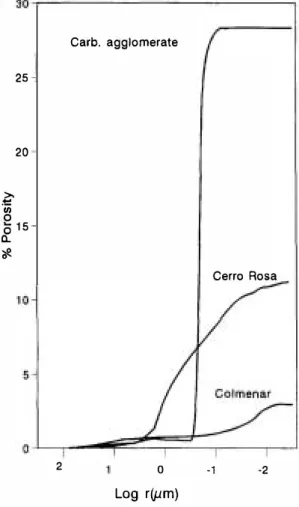
Fig. 1 shows the pore volume distribution versus pore size of the studied materials. The natural sam ples had lower porosity than the calcium carbonate agglomerate, although with a higher proportion of
30 �---�
.�
11) o 25 20 ... 15�
'#. 2 Carbo agglomerate oLog r(J1m)
Cerro Rosa -1 -2Fig. 1. Pore-volume distribution versus pore diameter of the studied samples.
pores with diameters less than O.I/lm. The calcium carbonate agglomerate has a uniform pore-size dis tribution, mainly between 1 and 0.1 ).lm.
Table 2
Pore volume % (A) and porosity % (B) distribution in the samples Sample Total porosity % Class of pore size
II
Following the method employed by Rossi
Manaresi and Tucci [13], we have estimated the
crystallization pressures that can develop in the materials under study. For this, we considered five classes of pores as a function of their radius (ex pressed in /lm): class I, r < 0.01; class 11,
0.01 < r < 0.1; class Ill, 0.1 < r < 1; class IV,
1 < r < 10; class V, 10 < r < 100. The following values of average radii for each class were taken: 0.0045, 0.045, 0.45, 4.5 and 45 /lm, respec tively. Using the data of the pore volume distribu
tion versus pore diameter from Fig. 1, an estimate
of the percentage pore volume of each pore class
was made, the results of which are shown m
Table 2.
To calculate the crystallization pressures in
different classes we have taken 45/lm as the
constant value for R in Eg. (2), the values r of the
other classes and 0.064 N m-I for a K3Na(S04h
(Table 3) obtaining values of 28.44, 2.84, 0.28 and
0.03 M Pa for the theorical pressures which can build up when a coarse pore of class V is connected to smaller pores of classes I-IV.
The values of salt-solution interfacial tension,
a, of different salts were calculated employ
ing Eg. (3) and the solubility data of Risacher
and Fritz [22], the results are presented in
Table 3.
To calculate the effective pressure which can arise in the material, it is necessary to take into account the volume percent of the pores of each class,
V"
which should be related to the volume percent of large poresV
R. The product of the factorVrlV
R for the theoretical pressure of each class permits calculation of the effective pressure value,III IV V r < om om < r < 0.1 0.1 <r < 1 1 < r < 10 10<r< 100 A B A B A B A B A B Colmenar 2.952 8.70 0.26 58.26 1.72 6.6 0.21 10.43 0.31 15.65 0.46 C. Rosa 11.104 3.59 0.40 12.68 1.41 66.1 7.42 16.49 \.83 0.42 0.05 C. Agglomerate 28.340 0 0 2.52 0.71 95.4 27.08 1.09 0.31 0.86 0.24
Table 3
Solubility products [22], solubility and interfacial tension at 298 K of the considered salt
Compound LogK, Log Cq u (N m-1)
Na2S04 (thenardite) � 0.29 � 0.29 0.040 Na2S04 . 10H20 (mirabilite) � 1.23 �0.61 0.046 K2S04 (arcanite) � 1.78 � 0.79 0.049 K3 Na (S04h (aphthitalite) � 7.61 � 1.61 0.064 K2Mg(S04h . 6H20 (picromerite) � 4.33 � 1.11 0.055 MgS04 . 6H20 (hexahidrite) � 1.64 � 0.82 0.050 MgS04 . 7H20 (epsomite) � 1.88 �0.94 0.052 Table 4
Pore-volume relation and calculated pressures of epsomite, aphthitalite or thenardite
Salt Sample V,/V R Pe (MPa) P total (MPa)
Class I Class II Class III Class IV
r = 0.0045 J.lm r = 0.045 J.lm r = 0.45 J.lm r = 4.5 J.lm Na2S04 Colmenar 0.56 9.96 3.72 6.60 0.44 0.08 0.67 0.01 16.65 C. Rosa 8.49 150.90 29.96 53.14 157.85 27.45 39.96 0.68 232.17 C. Agglomerate 0 0 2.93 5.20 110.97 19.30 1.27 0.03 24.53 K3Na(S04h Colmenar 0.56 15.93 3.72 10.56 0.44 0.13 0.67 0.01 26.63 C. Rosa 8.49 241.45 29.96 85.02 157.85 43.93 39.96 1.09 371.48 C. Agglomerate 0 0 2.93 8.32 110.97 30.87 1.27 0.04 39.23 MgS04'7H2O Colmenar 0.56 12.45 3.72 8.25 0.44 0.10 0.67 0.01 20.81 C. Rosa 8.49 188.63 29.96 66.42 157.85 34.32 39.96 0.85 290.22 C. Agglomerate 0 0 2.93 6.40 110.97 24.12 1.27 0.03 30.55
V, = volume percent of the pores of each class; V R = volume percent of large pores; Pe = effective pressure.
Pe. The sum of the effective pressure of each class will give the total pressure (tension) that the material will support when aphthitalite crystallizes. The values of the effective pressure calculated for the crystallization of aphthitalite, thenardite and epsomite in the artificial and natural samples are presented in Table 4.
The average values and standard deviations ob tained from the determination of the tensile strength of the samples, expressed in MPa were as follows: Colmenar 8.333 (0.756), Cerro de la Rosa 5.845 (0.542) and calcium carbonate agglomerate 0.834 (0.018).
4. Discussion
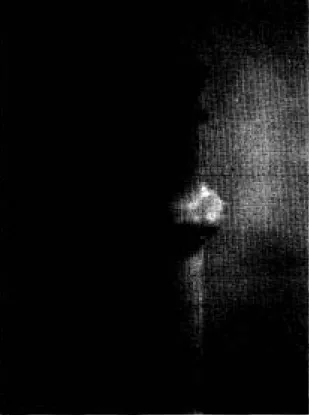
The crystallization technique used in this study, based on the capillary rise, concentration by evap oration of the solution as it migrates through the porous structure, leads to the nucleation and crys tal growth in a narrow zone of the materials, Fig. 2. Due to the continual contribution of saline solution an elevated ionic concentration is maintained in this zone, which permits crystallization in the small pores and the generation of pressures sufficient to produce cracking or even the disintegration of the aterial, Fig. 3.
Fig. 2. Ring of salt crystallization in calciun carbonate agglom erate samples partially inmersed in Na : K(3 : 2) solution for 2 d in ambient conditions.
As indicated by Eq. (2), the pressure generated during crystallization depends upon the pore size and the salt-solution interfacial tension. Thus, these two factors will determine the stability of the material. With respect to the interfacial tension the order of the disruptive effect of the salts considered in this study (Table 3) was as follows: K3Na(S04lz >
K2Mg(S04h . 6 H20 > MgS04' 7 H20 > MgS04 .
6HzO > KZS04 > NaZS04 ·10H20 > Na2S04' According to Fitzner and Snethlage [11], salt crystallization in porous media takes place in the first moment in the largest pores and continues in the smaller pores. Thus, the filling of each class of
pore in Table 2 may be related with the pressures
calculated for the same class presented in Table 4.
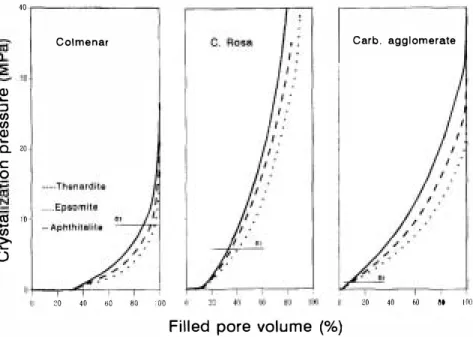
The variation of pressure against the percentage of pores filled in the three studied materials for the crystallization of K3Na(S04h, NaS04 and
Fig. 3. Cracking of Cerro de la Rosa sample partially immersed in Na: K(3: I) solution for 12 d in ambient conditions.
MgS04' 7HzO is shown in Fig. 4. As indicated in
the figure, the behaviour of the materials is differ ent. In the samples of calcium carbonate agglomer ate and Cerro de la Rosa elevated crystallization
pressures are reached (greater than 5 MPa) when
approximately 30°/" of the pores are filled, whilst in the Colmenar sample these pressures are reached only when about 80% of the pores are filled. The behaviour of the various salts are also different. Those with high values of (J produce greater pres sures, an effect which rises on increasing the % of pores filled.
The disruptive effect of salt crystallization in porous media is due to the generation of crystalli zation pressures which are greater than the cohe sive forces of the material. The uniaxial tensile strength, (Jt, reflects at a macroscopic scale these cohesive forces and represents the tensile load per surface unit which leads to the failure of the mater ial. When the crystallization pressure, P, exceeds the tensile strength, (Jt, the material cracks. With this in mind the tensile strengths of the studied
40 r---, Q) .... ::J en en Q) .... Q. 20 C o
�
ttI 10 ... en >. .... () Colmenar 20 40 tiO 80 00 Carbo agglomerate 20 40 liD 80 100Filled pore volume (%)
Fig. 4. Estimation of crystallization pressures for the various samples and salts. Values of tensile strength for all samples arc shown.
samples were determined, these values are shown
in Fig. 4 as continual horizontal lines. In the
case of the Cerro de la Rosa and calcium carbonate agglomerate samples, the tensile strength limits were reached with low contents of any salt
(30-40% and 5 7%, respectively). This confirms the breakage of these materials just after a few days in contact with the saline solutions. However, in the case of the Colmenar sample only after ap
proximately 85% filling of the pores with
K3Na(S04h or 95% with Na2S04, the crystalliza
tion pressure approaches the tensile strength limit, justifying the stability of this material, even after being in contact with the saline solutions for
3 months.
5. Conclusions
From the results obtained the following con clusions may be drawn:
• The proposed salt crystallization method in por
ous media. based on capillary rise and concen
tration by evaporation and consequent
crystallization allows the simulation, in a
short-time period, of salt weathering processes on building stone materials.
• With the knowledge of the pore volume, pore
size distribution and the tensile strength, the behaviour of the material due to salts may be predicted.
• The crystallization pressure produced in a por ous media is proportional to the salt-solution interfacial tension and the last magnitude is re lated the solubility of the salt by Eq. (3). The results obtained in this study allow the classifica tion of the disruptive effect of the studied salts as follows: aphthitalite > picromerite > epsomite > arcanite > mirabilite > thenardite.
• The calculated values of the crystallization pres
sures in the studied samples were greater than the tensile strengths measured, even in materials with low percentages of small pores. A continu ous supply of saline solution in an environment which permits their saturation would cause, with time, the breakage of these materials. Thus, this study highlights the risk of salt weathering to building stone materials in arid climates or in those with proximity to the sea which can suffer attack from salt mist.
Acknowledgements
The authors wish to thank the Comunidad Au t6noma of Madrid for the financial support of the projects 0061/94 and 0126/94.
References
[I] R.U. Cooke and 1.1. Smalley, Nature 220 (1968) 1226.
[2] I.S. Evans, Revue de Geomorphologie Dynamique 19 (1970) 155.
[3] E.M. Vinkler, Stone: Properties, Durability in Man's Evironment, (Springer, New York, 1975) p. 229. [4] K. Zhender and A. Arnold, GP News Lett. 4 (1983) 2. [5] K. Zhender and A. Arnold, Stud. Conserv. 29 (1984) 32. [6] c.w. Correns, Disc. Faraday Soc. 5 (1949) 267.
[7] American Society for Testing Materials, ASTM C 88, Standard Test Method for Soundness of Aggregates by use of sodium sulfate and magnesium sulfate, Annual Book of ASTM Standard (1990).
[8] H. Mortensen, P. Geog. Mitt. (1933) 130.
[9] E.M. Winkler and E.J. WilheJm, Geol. Soc. Ameri. Bull. 81 (1970) 567.
[10] R.J. Shaffer, The Weathering of Natural Building Stones. DSIR, Build. Res. Special Report No. 18 Stationary Office, London (1932) p. 34.
[11] B. Fitzner and R. Snethlage, GP News Lett. 3 (1982) 13. [12] D.H. Everet, Trans. Faraday Soc. 57 (1961) 1541. [13] R. Rossi-Manaresi and A. Tucci, in: Proc 1st Symp. Bari
The Conservation of Monuments in the Mediterranean Basin. (1989) p. 97.
[14] A. La Iglesia, M.A. Garcia del Cura and S. Ord6nez, Sci. Total Environ. 152 (1994) 179.
[15] O. Sohnell, 1. Crystal Growth 57 (1982) 101. [16] O. Sohnel, 1. Crystal Growth 63 (1983) 174. [17] M. Kahlweit, Z. Phys. Chem. 28 (1961) 245.
[18] E. Dapena, M.A. Garcia del Cura and S. Ordonez, in: Engineering Geology of Ancient Works, Monuments and Historical Sites, Eds. Marinos and Koukis (Balkema, Rot terdam, 1988) p. 683.
[19] c.H.B. Sperling and R.U. Cooke, Earth Surface Process and Landforms 10 (1985) 541.
[20] E.T. Brown, Rock Characterization Testing and Monitor ing ISRM Suggested Methods, (Pergamon, New york, 1981) p. 242.
[21] V. L6pez-Acevedo, C. Vied ma, V. Gonzalez and A. La Iglesia, 1. Crystal Growth, submitted.