by
Jingwei Wu
A thesis
presented to the University of Waterloo in fulfillment of the
thesis requirement for the degree of Doctor of Philosophy
in
Computer Science
Waterloo, Ontario, Canada, 2006
c
I understand that my thesis may be made electronically available to the public.
This thesis undertakes an empirical study of software evolution by analyzing open source software (OSS) systems. The main purpose is to aid in understanding OSS evolution. The work centers on collecting large quantities of structural data cost-effectively and analyzing such data to understand software evolutiondynamics(the mechanisms and causes of change and growth).
We propose a multipurpose systematic approach to extracting program facts (e.g., func-tion calls). This approach is supported by a suite of C and C++ program extractors, which cover different steps in the program build process and handle both source and binary code. We present several heuristics to link facts extracted from individual files into a combined system model of reasonable accuracy. We extract historical sequences of system models to aid software evolution analysis.
We propose that software evolution can be viewed asPunctuated Equilibrium(i.e., long periods of small changes interrupted occasionally by large avalanche changes). We develop two approaches to study such dynamical behavior. One approach uses the evolution spec-trograph to visualize file level changes to the implemented system structure. The other ap-proach relies on automated software clustering techniques to recover system design changes. We discuss lessons learned from using these approaches.
We present a new perspective on software evolution dynamics. From this perspective, an evolving software system responds to external events (e.g., new functional requirements) according to Self-Organized Criticality(SOC). The SOC dynamics is characterized by the following: (1) the probability distribution of change sizes is a power law; and (2) the time series of change exhibits long range correlations with power law behavior. We present em-pirical evidence that SOC occurs in open source software systems.
First and foremost, I thank my advisor Prof. Richard C. Holt for his support, patience and encouragement throughout my doctoral studies. It is Richard who guided me through the maze of academic research and made the work in this thesis happen. His technical and editorial advice was essential to the completion of this thesis. Thanks Ric!
I thank my other dissertation committee members, Prof. Charlie Clarke, Prof. Michael Godfrey, Prof. Kostas Kontogiannis, and Prof. Gail Murphy, for their invaluable time and effort put into reading my thesis. In particular, I want to thank Michael for encouraging me to purse research in the field of software evolution and for providing constructive comments on many aspects of this thesis.
I thank Prof. Margaret-Anne Storey and Prof. Hausi M¨uller for showing me the door to exciting research in software engineering in my early graduate school life at the University of Victoria. My sincere gratitude goes to Margaret for her early supervision of my masters thesis. She taught me many valuable lessons on the workings of academic research.
I also thank many current and previous members of SWAG, in particular, Cory Kapser, Davor Svetinovic, Lijie Zou, Xinyi Dong, Yuan Lin and Ahmed E. Hassan (with whom I have collaborated on many research papers). I appreciate their great friendship as well as their insightful comments on many ideas in this thesis. They have made my life at SWAG a very enjoyable experience.
I feel honored to have been awarded by IBM the Center for Advanced Studies Fellowship for four years. I thank IBM for offering me opportunities to work on many exciting research projects at the IBM Toronto Lab during summers. In particular, I thank my mentors, Dr. Marin Litoiu and Dr. Kelly Lyons, for their inspiring guidance.
I am grateful to my fiancee, Hong, for sharing her experience of writing dissertation with me, for listening to my frustrations and for believing in me. I am greatly indebted to
able to come this far.
This thesis would not have been possible if it were not for a truly great person, my dear mom. Her love, encouragement and understanding are my greatest source of strength throughout this long journey.
I dedicate this thesis to my dear mom.
Jingwei Wu in January 2006
1 Introduction 1
1.1 Prior Research . . . 1
1.1.1 Open Source Software Evolution . . . 3
1.2 Problem Definition . . . 5
1.3 Thesis Organization . . . 6
1.4 Thesis Overview . . . 8
1.5 Contributions . . . 11
2 An Extractor Suite for C and C++ 15 2.1 Introduction . . . 15 2.2 The CX Suite . . . 17 2.2.1 CPPX . . . 18 2.2.2 BFX . . . 19 2.2.3 LDX . . . 21 2.2.4 CTSX . . . 23 2.3 Applications . . . 27
2.3.1 Creating Comprehension Pipelines . . . 28
2.3.2 Building Software Evolution Database (EvolDB) . . . 32 vii
2.4.2 Accuracy and Robustness . . . 38
2.4.3 Systematic Support for C/C++ Extraction . . . 40
2.5 Related Work . . . 41
2.6 Conclusion . . . 42
3 Improving Linkage Resolution in System Model Extraction 43 3.1 Introduction . . . 44
3.2 Program Model Linking . . . 46
3.2.1 Sample Schema of LPM . . . 46
3.2.2 LPM Linking . . . 48
3.2.3 Linkage Anomalies . . . 48
3.3 Linking Rules and Heuristics . . . 50
3.3.1 Linking Rules . . . 50 3.3.2 Linking Heuristics . . . 51 3.4 Linking Methods . . . 54 3.4.1 Raw Linking . . . 55 3.4.2 Heuristics-Based Linking . . . 55 3.4.3 Simulation-Based Linking . . . 57
3.4.4 Simulation plus Heuristics . . . 61
3.4.5 Summary . . . 62
3.5 Experimental Setup . . . 63
3.5.1 Experimental Conditions . . . 63
3.5.2 Baseline for Comparison . . . 66
3.6 Experimental Results . . . 67 viii
3.7 Conclusion . . . 73
4 An Empirical Study of Punctuated Software Evolution 75 4.1 Introduction . . . 76
4.2 Punctuated Software Evolution . . . 77
4.2.1 Software Architecture . . . 78 4.2.2 Periods of Punctuation . . . 78 4.2.3 Periods of Equilibrium . . . 79 4.3 Methodology . . . 79 4.3.1 Analysis Overview . . . 80 4.3.2 Evolution Spectrograph . . . 82 4.4 Case Studies . . . 87 4.4.1 OpenSSH . . . 88 4.4.2 PostgreSQL . . . 91 4.4.3 Linux Kernel . . . 94 4.5 Discussions . . . 96 4.5.1 Threats to Validity . . . 97 4.6 Related Work . . . 98 4.6.1 Evolution Understanding . . . 98 4.6.2 Evolution Visualization . . . 99 4.7 Conclusion . . . 101
5 Clustering Comparison in the Context of Software Evolution 103 5.1 Introduction . . . 104
5.4 A Simple Ordinal Measure . . . 111
5.5 Empirical Results and Interpretation . . . 112
5.5.1 Stability Comparison . . . 112 5.5.2 Authoritativeness Comparison . . . 117 5.5.3 Extremity Comparison . . . 121 5.6 Discussion . . . 125 5.7 Related Work . . . 128 5.8 Conclusions . . . 129
6 Fractal Nature of Software Evolution and SOC Dynamics 131 6.1 Introduction . . . 132
6.2 Background . . . 134
6.2.1 Fractal . . . 134
6.2.2 Power Law . . . 135
6.2.3 Time Series Analysis . . . 136
6.2.4 Self-Organized Criticality . . . 139
6.3 Data Collection . . . 139
6.3.1 Software Change . . . 139
6.3.2 Time Series of Change . . . 142
6.4 Examining Fractals in Software Evolution . . . 142
6.4.1 Power Law Distribution of Software Changes . . . 142
6.4.2 Long Range Correlations in Time Series . . . 148
6.4.3 Summary . . . 151
6.5 Discussions . . . 151 x
6.8 Conclusion . . . 160
7 Conclusions and Future Work 161 7.1 Thesis Contributions . . . 163
7.2 Future Work . . . 165
7.2.1 Preprocessor-Based Program Extraction . . . 165
7.2.2 Evolution Visualization on a Large Scale . . . 165
7.2.3 Evolution Analysis of Software Architecture . . . 166
7.2.4 Evolution Simulation Based on Known SOC Models . . . 167
A A List of Open Source Projects 169
B Distributions of Software Changes 175
1.1 Laws of software evolution as summarized by Lehman [LRW+97] . . . . 2
2.1 Uses of comprehension pipelines on software systems . . . 30
2.2 Open source systems extracted using the CX extractors . . . 34
3.1 Experimental conditions for linkage resolution . . . 64
3.2 Linkage resolution under condition C1 (PostgreSQL) . . . 68
3.3 Individual linking steps of LDH and HEU (PostgreSQL) . . . 69
3.4 Anomaly ratios at varying levels of granularity (PostgreSQL) . . . 70
4.1 Setting for studying punctuated software evolution . . . 87
4.2 Ratio of changed files in PostgreSQL . . . 91
5.1 Software systems chosen for the clustering experimentation . . . 106
5.2 Relative stability scores obtained using MoJo . . . 116
5.3 HML-based stability scores obtained using MoJo . . . 116
5.4 Relative authoritativeness scores obtained using MoJo . . . 120
5.5 A summary of ordinal evaluation of clustering algorithms . . . 125
6.1 Scaling exponents for distributions of software changes . . . 146
6.2 Hurst exponents from R/S analysis of daily time series . . . 150 xii
1.1 Thesis Overview . . . 7
2.1 BFX fact schema . . . 20
2.2 LDX as a substitute for LD . . . 22
2.3 CTSX built on Ctags and Cscope . . . 23
2.4 Program comprehension pipelines built on the CX extractors . . . 27
2.5 Performance comparison of the CX extractors . . . 37
3.1 A sample schema of LPM . . . 47
3.2 Linking heuristic: File-File . . . 52
3.3 Linking heuristic: File-File Closure . . . 53
3.4 Linking heuristic: Same Subsystem . . . 53
3.5 Linking heuristic: Nearest Super Subsystem . . . 54
3.6 A partial build dependency graph of PostgreSQL . . . 60
3.7 Quantitative comparison of cross-references in PostgreSQL . . . 72
4.1 Spectrograph model based on matrix . . . 85
4.2 Evolution spectrographs of OpenSSH . . . 89
4.3 Evolution spectrographs of PostgreSQL . . . 92
4.4 Evolution spectrographs of Linux . . . 95 xiv
5.3 Stability comparison wrt PostgreSQL . . . 115
5.4 Inter-sequence clustering comparison . . . 118
5.5 Authoritativeness comparison wrt PostgreSQL . . . 119
5.6 Distribution comparison of clustering algorithms wrt PostgreSQL . . . 122
5.7 NED-based distribution comparison wrt PostgreSQL . . . 124
6.1 A delta graph between two adjacent versions . . . 141
6.2 Tail cumulative distribution of change sizes for GCC . . . 144
6.3 R/S analysis of daily time series for GCC . . . 149
B.1 Tail CDF of changes recovered from the CVS repository . . . 176
B.2 Tail CDF of daily system structural changes . . . 177
The work presented in this thesis has appeared peer-reviewed articles listed below:
1. Fractal Nature of Software Evolution and SOC Dynamics. Jingwei Wu, Richard C. Holt and Ahmed E. Hassan. Draft.
2. An Extractor Suite for C and C++: Choosing the Right Tool for the Job. Jingwei Wu and Richard C. Holt. Draft.
3. Comparison of Clustering Algorithms in the Context of Software Evolution. Jingwei Wu, Ahmed E. Hassan and Richard C. Holt. Proceedings of International Conference on Software Maintenance (ICSM). Budapest, Hungary, September 2005.
4. Visualizing Historical Data Using Spectrographs. Ahmed E. Hassan, Jingwei Wu and Richard C. Holt. Proceedings of International Symposium on Software Metrics (METRICS). Como, Italy, September 2005.
5. Exploring Software Evolution Using Spectrographs. Jingwei Wu, Richard C. Holt and Ahmed E. Hassan. Proceedings of IEEE Working Conference on Reverse Engineering (WCRE). Delft, Netherlands, November 2004.
6. Evolution Spectrographs: Visualizing Punctuated Change in Software Evolution. Jing-wei Wu, Claus W. Spitzer, Ahmed E. Hassan and Richard C. Holt. Proceedings of International Workshop on Principles of Software Evolution (IWPSE). Kyoto, Japan, September 2004.
7. Resolving Linkage Anomalies in Extracted Software System Models. Jingwei Wu and Richard C. Holt. Proceedings of International Workshop on Program Comprehension (IWPC). Bari, Italy, June 2004.
8. Linker-Based Program Extraction and Its Uses in Studying Software Evolution. Jing-wei Wu and Richard C. Holt. Proceedings of International Workshop on Unantici-pated Software Evolution (FUSE). Barcelona, Spain, March 2004.
Introduction
As open source software gains popularity, researchers have great opportunities to study and explore large numbers of open source projects to gain an enhanced understanding of soft-ware evolution. In this research, we develop techniques and approaches to support softsoft-ware evolutionary data collection and investigation on a large scale. We present several new ways for understanding the evolution of open source software systems by making use of collected evolutionary data.
1.1
Prior Research
Lehmanet al. formulated and refined eight laws of software evolution to model the dynam-ical behavior (change or growth) of software systems as these systems are maintained and enhanced over time [LB85, Leh97]. As summarized in Table 1.1, the eight laws are Con-tinuing Change, Increasing Complexity, Self Regulation, Conservation of Organizational Stability,Conservation of Familiarity,Continuing Growth,Declining Quality, andFeedback System [Leh97]. Lehman’s laws represent the best known body of work on understanding
No. Brief Name Law Description
I Continuing Change AnE-type system must be continually adapted else it becomes progressively less satisfactory.
II Increasing Complexity As an E-type system evolves its complexity increases unless work is done to maintain or reduce it.
III Self Regulation GlobalE-type system evolution processes are self-regulating. IV Conservation of
Organizational Stability
The average effective global activity rate in an evolvingE-type system is invariant over system lifetime.
V Conservation of Familiarity
During the active life of anE-type system, the content of suc-cessive releases is statistically invariant.
VI Continuing Growth The functional content ofE-type systems must be continually increased to maintain user satisfaction over their lifetime. VII Declining Quality
The quality of E-type systems will appear to be declining un-less they are rigorously maintained and adapted to operational environmental changes.
VIII Feedback System
E-type evolution processes constitute multi-level, multi-loop, multi-agent feedback systems and must be treated as such to be successfully modified or improved.
Table 1.1: Laws of software evolution as summarized by Lehman [LRW+97]
(An E-type system solves a problem or addresses an application in the real world.)
the evolution of large, long-lived software systems.
The laws of software evolution were initially grounded on observing how large software systems were developed and maintained in corporate environments using conventional man-agement techniques and processes [LB85]. Attention was mainly directed to phenomena related to growth, continual adaptation, user satisfaction, global activity rate and feedback. The advent of open source software projects provides new opportunities for studying soft-ware evolution over large numbers of systems. A large amount of effort have been devoted to studying open source software evolution, and a variety of interesting and sometimes even conflicting findings have been reported, which we review briefly in the following section.
1.1.1
Open Source Software Evolution
Open source software projects rely on a development approach different from the way most closed source industrial software systems are created [Ray99]. This approach promotes free access to the source code and collaborative development which is commonly supported by a decentralized Internet-based developer and user community. Recent empirical studies of open source software evolution have reported on evidence for either validation or disproof of Lehman’s laws. Many interesting evolutionary phenomena not characterized by Lehman’s laws are also discovered.
Godfrey and Tu observed the super-linear growth of the Linux kernel from 1994 to 1999 [GT00]. The growth of Linux is unusual because it is different from the most commonly observed linear and inverse-square growth models [Tur02]. Three factors have been found to contribute to such a growth: (a) much of the code is device drivers; (b) much of the code is orthogonal and intended for different platforms; and (c) the code base is open to interested developers who can make their own contributions. Their findings are further confirmed in a recent study conducted by Robles et al. [RAGBH05]. Linux grew at a super-linear rate from 100,000 to 4,500,000 lines of code during the period between 1994 and 2004. Similar findings are reported by O’Mahony on the Debian GNU/Linux distribution from release 0.01 in 1993 to 3.0 in late 2002. This study shows that the Debian GNU/Linux distribution size has grown at a super-linear rate [O’M06]. These findings cause speculation that open source systems may evolve in a way different from closed source industrial systems.
Not all open source projects can grow at a super linear rate. Open source projects from different domains are found to grow at different rates -- some super-linear, some linear and some sub-linear, but the linear growth appears to be the dominating trend [RAGBH05].
common couplings1in Linux exhibited an exponential growth, thus suggesting an increased
complexity [SO02]. They suggested that Linux developers should be aware of this alarming growth trend and design solutions to reduce the number of common couplings. Otherwise, the Linux kernel may become too expensive to maintain in the future.
Bauer and Pizka summarized a number of principles and practices which contribute to the success of open source projects [BP03]. They have hands-on experience with some high profile products such as GCC and Linux and many small systems. According to them, the process and organization scale as the project increases in size; and the system architecture is hardly pre-planned but evolves with the development process and requirements. For ex-ample, the Mozilla application was split into isolated parts which are either independently maintainable modules or completely new products. Nakakoji et al. found that open source projects followed different patterns of split and merge across releases, and they proposed to classify open source projects into three types: Exploration-Oriented, Utility-Oriented and Service-Oriented [NYN+02]. Based on such a classification, the authors provided guidance
on the creation and maintenance of sustainable OSS development and communities. Mockus, Fielding and Herbsleb reported that a core team of 10 to 15 developers could enable a high rate of growth [MFH02]. Such core teams are important to anchor a broader community of users and developers and to ensure the long term evolution of an open source project. Madeyet al. studied how developers participated in multiple open source projects [MFT02]. They observed that developers collaborated through social networks interlinking different projects. Such networks allow the interlinked projects to share source code.
These early studies of open source systems have enhanced the understanding of software evolution by taking into consideration many different types of entities including the system, architecture, development process, and developer organization. Although many interesting
evolutionary phenomena or patterns are observed, the mechanism underlying them,i.e., the evolution dynamics, is still not well understood. A simple, unified explanation for diverse evolutionary phenomena observed in open source software systems is needed.
1.2
Problem Definition
We now describe two main research problems under our investigation. Their solutions form the main body of the thesis.
Change is the essential nature of software evolution. In response to the changing envi-ronment and requirements, a software system has to be changed to add new functionality, to reduce growing complexity, and to maintain the quality of service. Throughout the life-time of a software system, changes can be made for different purposes, which are related to features, refactorings, defects, cleanup and etc. From an external perspective, changes are planned by an organizational and management structure to accommodate large unexpected requirements. From an internal perspective, developers collaborate with one another to perform assigned or self-selected tasks in various parts of the system. What evolutionary patterns can one observe from either an external or internal perspective? What underlying mechanism constrains evolutionary changes and how? These questions have been only par-tially answered by prior work. Lehman’s seminal work provides most insights into software evolution through observing how large, long-lived software systems grow over time. In this thesis we describe and explain the evolution of open source systems from both the external and internal perspectives.
Prior studies of software evolution are commonly limited to about 10-20 versions (data points) [Leh97, GJKT97, Per02] or measure basic attributes such as the release date and the system size [GT00, RAGBH05]. Complex data such as structural dependency graphs
has not been adequately used in studying software evolution. Recovering historical changes to the system structure or architecture over an extended period of time can provide valuable information for understanding how a software system is maintained [CKN+03, ZG03]. To
substantiate a large scale investigation of software structural evolution over many systems and over many versions, we need automated, efficient and scalable techniques.
The problems addressed in this thesis can be summarized as follows:
1. Develop a cost-effective solution to collect structural information over system lifetime. 2. Develop an understanding of open source software evolution dynamics from both the
external and internal perspectives.
A solution to the first problem helps us obtain large quantities of historical data, upon which we can conduct large scale empirical analyses of the evolution of many open source systems and seek ways for approaching the seconde problem.
1.3
Thesis Organization
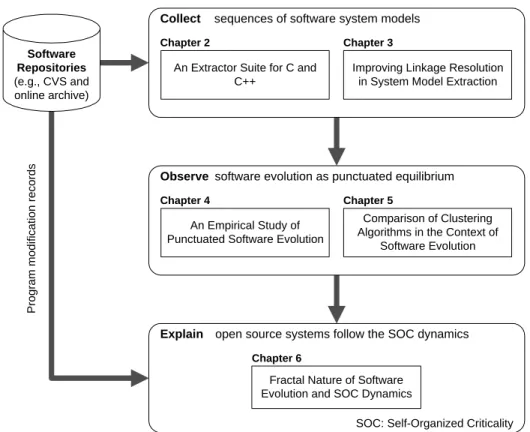
Throughout this thesis we build an understanding of software evolution by analyzing large quantities of historical information collected from open source software systems. This thesis has three main parts as shown in Figure 1.1. The chapters contained by each part are also included in Figure 1.1.
• Part I -- Collect Data
We present approaches and techniques for extracting software system models over a software system’s lifetime in a timely and cost-effective manner. We focus on program extraction (Chapter 2) and program model linking (Chapter 3) respectively.
Collect sequences of software system models
Observe software evolution as punctuated equilibrium
Explain open source systems follow the SOC dynamics
Software Repositories (e.g., CVS and online archive)
Program modification records
Chapter 4 Chapter 5
Chapter 6
An Empirical Study of Punctuated Software Evolution
Comparison of Clustering Algorithms in the Context of
Software Evolution
Fractal Nature of Software Evolution and SOC Dynamics
Chapter 2 Chapter 3
An Extractor Suite for C and C++
Improving Linkage Resolution in System Model Extraction
SOC: Self-Organized Criticality
Figure 1.1: Thesis Overview
• Part II -- Observe Phenomena
We present approaches and techniques for examining how the structure of a software system is changed at two levels of abstraction: the implementation level (Chapter 4) and the design level (Chapter 5). Our objective is to build an empirical understanding of software evolution as punctuated equilibrium. We present evidence that a software system evolves through long periods of small changes interrupted occasionally by large avalanche changes. This part helps us to gain an understanding of software evolution from an external perspective.
We present a new perspective on evolution dynamics, which is based on Self-Organized Criticality (SOC) [BTW87]. From this perspective, a system follows an intrinsic com-plex process to respond to external events or forces (Chapter 6). The SOC process has special statistical features which are related to power laws. This part offers a view of software evolution from an internal perspective.
Each of these three parts of this thesis is covered by one or two chapters. Related work for each part will be examined in the corresponding chapters.
1.4
Thesis Overview
We now provide an overview of the remaining chapters.
Chapter 2: An Extractor Suite for C and C++
In Chapter 2 we describe a suite of program extractors for C and C++ which are developed by means of adopting and extending current extractors and/or tools. Each extractor from this suite is targeted at an individual step in the build process of C and C++ programs such as compilation and linking.
We assess the benefits of this suite by applying it to support two major applications: (1) creating program comprehension pipelines to support various understanding tasks, and (2) building an open source software evolution database to support empirical research on software evolution. We discuss the lessons learned in detail.
Chapter 3: Improving Linkage Resolution in System Model Extraction
Separating compilation and linking is critical to the development of modern C/C++ soft-ware systems up to millions of lines of code. Similarly, program extraction is also separated
from program model linking to deal with large programs. An extractor is first applied to extract program models from individual files and then a linker is used to create a software system model by combining separate program models. This separation has diverted a sig-nificant amount of effort to developing new extraction techniques but left program model linking unattended in reverse engineering.
Linking errors (unexpected or missing dependencies) can be introduced to the resulting system model even if individual files can be extracted correctly. Even worse, linking errors can propagate to high level models and yield an increasingly larger impact on downstream software analyses such as software clustering and reflexion modeling.
In Chapter 3, we describe four different methods for linking individual program models and discuss their benefits and limitations. We conduct a comparison of these methods on an open source system, PostgreSQL [Pos03]. The obtained results show that inappropriate linking can lead to a relatively large percentage of dependency anomalies at higher levels of granularity. While, a small set of linking heuristics independent of system configuration are found effective for reducing the occurrences of dependency anomaly. These heuristics combined with lexical program extractors are particularly useful for creating large software system models over hundreds of versions.
Chapter 4: An Empirical Study of Punctuated Software Evolution
Theories of biological evolution provide rich sources of ideas from which software evolution research can benefit. Motivated by the theory of Punctuated Equilibrium[EG72] as well as previous research on discontinuous software evolution [Leh97, Law82, AP01], we propose to view software evolution as punctuated equilibrium. A software system evolves through an alternation between long periods of small incremental changes and short periods of large avalanche changes.
We provide an interpretation of punctuated equilibrium in the context of software evolu-tion. We conduct an empirical study on three open source systems (OpenSSH, PostgreSQL, and Linux) to examine structural changes over system lifetime. A visualization technique called the Evolution Spectrograph is used to highlight major change events. The observed events are then correlated manually with design changes documented in various sources (e.g., release notes). The results we obtained show that the three examined systems exhibit strong characteristics of punctuation during their evolution.
Chapter 5: Comparison of Clustering Algorithms in the Context of Software Evolution
To support software understanding and maintenance tasks, various automated clustering algorithms have been developed to partition a software system into meaningful subsystems (or clusters). However, it is unknown whether these algorithms produce similar meaningful clusterings for similar versions of a software system under continual change and growth. If we find an algorithm with such capability, we can apply it to automate design recovery over system lifetime. The recovered design data (clusterings) can provide new opportunities for examining software evolution at the system design level. To pursue such research, we need to compare automated clustering algorithms in the context of software evolution.
In Chapter 5 we evaluate six automated software clustering algorithms. Each of these algorithms is applied to subsequent versions from five open source systems. The obtained clusterings are compared based on three criteria respectively: stability (Does the clustering change only modestly as the system undergoes modest updating?), authoritativeness (Does the clustering reasonably approximate the structure an authority provides?), and cluster distribution extremity (Does the clustering avoid huge clusters and many small clusters?). The six studied algorithms exhibit distinct characteristics. For example, the clustering
from the most stable algorithm bears little similarity to the as-implemented structure of the system; and the clustering from the least stable algorithm has the best cluster distribution. The obtained results indicate that current automated clustering algorithms need significant improvement to provide continual support for maintaining large software projects. They are also not suitable for automating a large scale empirical analysis of software evolution at the design level.
Chapter 6: Fractal Nature of Software Evolution and SOC Dynamics
We study software evolution dynamics by adopting the theory of Self-Organized Criticality (SOC) [BTW88]. The SOC dynamics is characterized by spatial and temporal fluctuations which exhibit fractal properties measured as power laws. Our previous empirical obser-vation of punctuated evolution in software systems leads us to question whether software systems follow the SOC dynamics during their evolution.
In Chapter 6 we examine the change history of eleven open source software systems and show empirical evidence for the presence of fractal structures in the dynamical behavior of software systems. Specifically, we report two power law related findings throughout system lifetime: (1) the probability density of change occurrences decreases as a power function of the change size; and (2) the time series of change exhibits long range correlations with power law behavior. The existence of such spatial and temporal power laws strongly suggests that the SOC dynamics may provide a useful conceptual framework for understanding software evolution.
1.5
Contributions
• The proposal and development of a suite of program extractors for C and C++. By covering individual steps in the program build process, such a suite supports program extraction in a systematic manner and allows for tradeoff between accuracy, efficiency and robustness to varying degrees.
– A number of program comprehension pipelines are built on this suite to support various downstream software analysis.
– An open source software evolution database called EvolDB is created using this suite to support empirical research on software evolution. EvolDB contains tens of thousands of system models.
• The development of program model linking methods to aid the extraction of software system models. A small set of heuristics are proposed to link separate program models into a combined system model when system configuration information is difficult to obtain. They provide convenient support for the mass-production of system models.
• The proposal of viewing software evolution as punctuated equilibrium. In this view, a software system undergoes long periods of small changes separated by large avalanche changes. The evolution spectrograph is used to visualize structural changes through system lifetime, providing a visual display of punctuated change.
• A theoretical explanation of open source software evolution dynamics based on Self-Organized Criticality (SOC). Such an explanation is supported by our observation of two fractal related phenomena in the change history of open source software systems. The observed phenomena are (1) the power law distribution of changes and (2) long range correlations in the time series of change.
• The proposed framework for evaluating software clustering algorithms based on three criteria: stability, authoritativeness and extremity. Within this framework, a number of representative automated software clustering algorithms are compared using data stored in EvolDB. Such a comparison demonstrates the usefulness of large quantities of historical data in advancing software clustering research.
An Extractor Suite for C and C++
This chapter describes a suite of program extractors which are developed by adopting and extending current techniques and tools. This suite is called CX since it is mainly targeted at extracting facts from C and C++ programs. It is currently composed of four extractors: CPPX, BFX, LDX and CTSX. The main goal of creating CX is to form a convenient set of program extractors which complement each other and work in a systematic manner. The benefits of this extractor suite will be discussed in terms of two practical applications: (1) creating program comprehension pipelines to support various understanding tasks, and (2) building an open source software evolution database to support empirical research on software evolution.
2.1
Introduction
Program extraction is important to program comprehension and maintenance tasks [FSG04, MN96]. For example, an architect may need to monitor changes made to a software system to identify changes violating the design constraints of the system. In this case, a program
extractor is needed to collect structural information to support continual maintenance. In empirical research on software evolution, a robust and efficient extractor is often required to collect structural artifacts from a large number of versions, sometime up to several hundred versions. A researcher may also be interested in deriving a domain reference architecture by studying several systems from the same domain (e.g., the compiler domain and the web browser domain). In these various examples, an extractor needs to be chosen by making an appropriate tradeoff among requirements on accuracy, efficiency and robustness. In an empirical study of software evolution, a researcher is not likely to use an accurate extractor which spends months in extracting structural artifacts from many historical versions of a long-lived system (e.g., Linux [Lin04]). A robust and efficient extractor, though it may be less accurate, is more likely to prevail.
No single extraction technique can meet the highest standards on accuracy, efficiency and robustness and in the meanwhile support as many tasks as possible [SHE02]. Instead, a very small set of complementary extractors should be developed to support a wide range of tasks and meet extraction requirements to varying degrees. In this chapter, we describe our effort in developing a suite of program extractors for the C and C++ programming lan-guage. The main design goals of this suite are as follows.
• It should be simple and convenient to use.
• It should scale up to handle large programs.
• It should support diverse program analysis tasks.
• It should cover the entire build process of software.
• It should efficiently handle large numbers of versions.
CPPX [CPP02] is the first extractor we added to the CX suite. CPPX is a C/C++ source code extractor based on the front end of GCC [GCC02]. It was developed by the
SWAG group at the University of Waterloo. CPPX outputs detailed information of a program at the abstract syntax graph level. However, CPPX is neither efficient nor robust in handling very large programs over many versions. This motivated us to develop several lightweight extractors to complement it. These new extractors and CPPX form a suite that provides a simple and cost-effective solution for a wide variety of program analysis tasks (see Section 2.3).
This chapter is organized as follows. Section 2.2 describes each extractor from the CX suite and their pros and cons. Section 2.3describes two major applications of the CX suite. Lessons learned from each application are also summarized. Section 2.4 further compares four CX extractors and discusses their role in supporting systematic extraction of C/C++ programs. Section 2.5 considers related work. Section 2.6 draws the conclusion.
2.2
The CX Suite
The CX suite consists of four program extractors which are created by means of adapting free open source tools, including GNU Compiler Collection (GCC) [GCC02], GNU Binu-tils (binary utilities) [BUM02], Ctags [Cta04] and Cscope [Csc04]. These extractors are briefly summarized below.
• CPPXis a C/C++ source code extractor based on the GCC frontend. It relies on the preprocessing, parsing, and semantic analysis of GNU g++ and can produce program facts as detailed as abstract syntax graph (ASG).
• BFX is a binary code extractor built on the Binary File Descriptor (BFD) library. It parses binary code to locate definitions of functions and variables and outputs symbol references to these definitions.
• LDX is a binary code extractor based on the GNU code linker LD. It reuses BFX to process individual binary files and then resorts to the real code linker in the resolution of cross-references among different binary files under a specific system configuration.
• CTSXis an efficient and robust source code extractor built upon Ctags and Cscope. The Ctags is invoked to locate source program entities and Cscope is used to extract references to source program entities.
We now describe each extractor in the CX suite and their pros and cons in detail.
2.2.1
CPPX
CPPX is a general-purpose parser and fact extractor for C and C++ programs. It relies on the preprocessing, parsing, and semantic analysis of GNU g++, and produces an abstract syntax graph in accordance with the Datrix model [Bel01]. The produced fact base is in TA [Hol02], GXL [GXL02], or VCG [San95] format.
Abstractly speaking, CPPX output is an E/R graph, which is essentially the abstract syntax graph of the source program being extracted. The vertices represent the program’s templates, classes, methods, compound statements, and expressions down to the lowest level of constants and variable references. The graph edges represent syntactic relationships as well as semantic facts linking identifiers to their declarations, function calls to their targets, objects to their types, and most things to their enclosing scopes. From the CPPX output graph it is (almost) possible to reconstruct the original program [LHM03].
CPPX is suitable for use in architectural recovery, data flow analysis, pointer analysis, program slicing, query techniques, source code visualization, object recovery, refactoring, restructuring, re-modularization, and the like. It has been used in both industrial software development environments and academic software engineering research. However, CPPX
has several problems. For example, CPPX may take an unusually long time (up to months) to extract facts from large software systems (up to several million lines of code); and the abstract syntax graph, which is overly detailed for many downstream analysis, often needs lengthy transformations to filter out large quantities of unwanted data such as compound expressions and statements. These problems make it necessary to develop more efficient and simplified program extractors. As a result, we have developed three lightweight program extractors, each of which is detailed in the following.
2.2.2
BFX
BFX (Binary File Extractor) is built on the Binary File Description (BFD) library which is shipped with the GNU Binutils toolkit [BUM02]. Unlike CPPX which deals with source code, BFX extracts facts from binary code (machine code). It can process object modules (.o), archives (.a), dynamic libraries (.so) and executables (.exe). The output is in TA or GXL format and conforms to the fact schema shown in Figure 2.1.
The schema in Figure2.1shows that the BFX output has three levels of granularity: the level of object modules, the level of functions and variables and the level of name references. The cObjectFile class represents files ending with .o, .soand .exe. ThecArchiveFile represents archive files (.a). ThecFunctionandcObjectrepresent functions and variables respectively. ThecExternSymbolrepresents unique string names. There are four relations: a structural relation contain and three reference relationscRefersTo,cRefersToExtern and cResolvedByExtern. The contain relation for any binary module always forms a tree with a universal root of type cScopeGlb. The cRefersTo relation refers to resolved references to symbols defined within the same binary module. The cResolvedByExtern relation denotes references to externally defined symbols andcRefersToExternmeans that
cScopeGlb cExternSymbol cFunction cNameRef cObject cObjectFile ResolvedByExtern RefersToExtern RefersTo RefersToExtern RefersTo cArchiveFile contain
Figure 2.1: BFX fact schema
a definition can be looked up globally by searching for its name1, i.e., cExternSymbol.
In the above schema,cNameRef has an attribute called kind, which can be assigned a value of F orV. TheF value means a function call and the V value means a variable use.
Pros
BFX is built on the BFD library. Technically speaking, BFX is equivalent to the binary code dump toolobjdump[BUM02]. BFX is independent of source code compilation. There-fore, it is able to extract programs written in programming languages other than C and C++, which include, for example, Fortran and Pascal. The BFX output is more than an order of magnitude smaller than the CPPX output since it extracts only function calls and variable uses. In terms of speed, BFX normally operates in a matter of seconds or at most minutes to extract large systems with thousands of object units. BFX’s performance will
be further discussed in Section 2.4.
Cons
BFX is used only after source files are compiled into object units. This results in the loss of a significant amount of structural information related to various programming constructs such as abstract data types (e.g., union data types) and macros. The extracted function calls and variable uses reflect only what object units contain and what external symbols are referenced. There exists a gap between this kind of structural information and what the programmer sees in the source code. For example, a function-like macro, which is often treated and used like a real function by the programmer, can not be extracted using BFX since it is expanded in the step of preprocessing.
2.2.3
LDX
LDX (Linker Based Extractor) is built on the GNU code linker LD [BUM02]. LDX per-forms both code linking (including symbol name resolution across the boundary of object modules) and fact extraction. Its output includes everything produced by BFX as well as build dependencies between object modules, archive files, dynamic libraries and executa-bles. The output is in TA or GXL format. As shown in Figure 2.2, LDX operates as a full substitute for LD during the extraction of a program.
Compared to BFX, LDX has two distinct features. First, it relies on the actual configu-ration of the program and the internal linking logic of GNU LD to resolve cross-references among separately extracted object units. Therefore, the extraction and linking of program facts are correctly and simultaneously carried out as the target system is being built. Sec-ond, LDX captures build dependencies among object units as perceived by the code linker during link time. For example, a simple hello world program (e.g.,Hello.exe) compiled on
LDX LD LDX data flow LD data flow .ta .ta/.gxl .a .o .so .exe
Figure 2.2: LDX as a substitute for LD
a Linux machine normally depends on an object module (e.g., Hello.o) and a particular version of the C dynamic library (e.g., /lib/libc.so.6).
Pros
Like BFX, LDX is multi-lingual and operates at a very fast speed. It adds only negligible overhead to the build process of a target system. Being a link time extractor, LDX utilizes the system configuration information (i.e., build dependencies among object modules) and LD’s symbol resolution functionality to derive cross-reference facts correctly. LDX does not introduce any erroneous cross-references.
Cons
LDX has similar cons BFX has. In addition, LDX causes slightly more interference to the build process of a software system than BFX since it needs to be substituted for LD.
Cscopepost Ctags Ctagspost Cscope Source files CTSX Cscope DB Cross-ref. Symbol definition 1 2 3 4
Figure 2.3: CTSX built on Ctags and Cscope
2.2.4
CTSX
The three extractors described above require a successful build of the target system. The extraction can run into serious trouble when large numbers of versions need to be extracted. For a long lived system, it is common that many versions can not be compiled successfully on a specific platform. A robust extractor is required to tolerate erroneous and incomplete source code as well as system configuration problems. In addition, the extractor needs to be efficient in handling large numbers of versions. For example, the Linux kernel has more than 550 versions publicly posted on its official archive Web site [Lin04] until July 2005. It is a daunting task to use CPPX, BFX or LDX to extract Linux versions since considerable manual effort is needed to deal with various configuration and compilation difficulties over the lifetime of Linux (about 12 years).
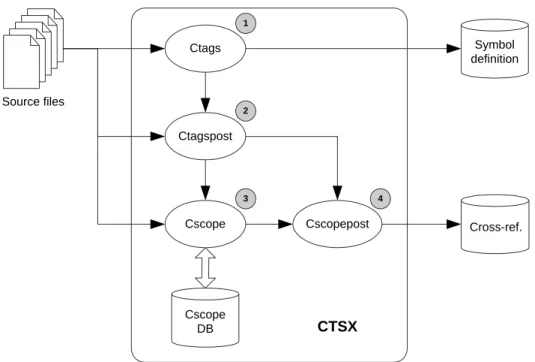
We developed a lightweight C and C++ source code extractor to support the extraction of a large long-lived software system over hundreds of versions. This extractor is based on Ctags [Cta04] and Cscope [Csc04]. For this reason it is called CTSX in which T stands for Ctags and S for Cscope.
Ctags is a tagging tool used by source code editors to parse the source code being edited. Using Ctags, editors can provide rudimentary support for code highlighting and searching. Cscope is a cross-referencing tool for browsing the source code. It allows the user to search for source code entities (definitions and regular expression patterns) as well as references to these entities in an interactive mode. Ctags and Cscope are both efficient and robust. They scale up to deal with more than 20 million of lines of code [Csc04].
The implementation of CTSX is illustrated in Figure2.3. CTSX has four components: Ctags, Ctagspost, Cscope and Cscopepost. We instrumented Ctags and Cscope to parse new command line options and to read/write facts in a proper format such as TA and CSV (Comma Separated Values). Ctagspost and Cscopepost were written in Perl and they are aimed at reducing errors and adding extra attributes. The execution order of these tools is indicated by numbers. CTSX takes in a list of source files and produces two main text files, which contain symbol definitions and cross-references respectively. The main functionality of each component is detailed as follows.
• Ctags extracts various program entities including functions, global variables, local
variables, macros, abstract data types (class, struct, union, enum and typedef), enumerators (values inside an enumeration), function prototypes, namespaces, and external variable declarations. Ctags has command line options for specifying which kinds of program entity to extract. By default, CTSX instructs Ctags to extract all entities listed above.
extract function parameters ignored by Ctags; (2) determine modifiers (e.g., inline and static) for functions or variables; and (3) calculate the effective scope of local variables and function parameters. To be simple, the effective scope of a local variable is treated to be equal to the scope of the function enclosing the variable.
Ctagspost needs to parse the source code briefly to collect extra information because additional texts associated with each program entity located by Ctags are insufficient for collecting the extra information mentioned above.
• Cscope parses the entire source code to build an initial cross-reference database. It
then reads program entities from Ctagspost output and retrieves static references to those entities. Depending on the command line options the user specifies for CTSX, Cscope can retrieve different kinds of cross-reference. By default, it outputs references to functions, global variables, macros, and data types (including typedefs).
Every name reference produced by Cscope is assigned akindattribute to indicate its type. Cscope itself can determine which reference is a function call. However, the type of other references is determined by using regular expressions to match relevant code syntax. For example, a type reference can be determined if the type name appears as part of a declaration or a type cast. The references to variables and macros are not distinguished in the current implementation.
• Cscopepost filters out references to static functions, static variables, local variables
and function parameters through the use of the scoping and accessibility information produced by Ctagspost. For example, a reference to a static function within the same file is filtered out as a non cross-reference. A reference to a global variable is filtered out as an erroneous reference if it falls in the scope of a local variable which has the same name as the global variable. The Cscopepost output contains only references
that cross the actual boundary of source files.
Pros
Compared to writing an extractor from scratch, the reuse of Ctags and Cscope significantly speeds up the development of CTSX. Only a few days were spent in instrumenting Ctags and Cscope and writing the postprocessing utilities in Perl scripts.
CTSX is a useful program extractor when (1) the target system is extremely large and time consuming to build, (2) the system cannot be built due to configuration or compilation errors, and (3) the correctness of extracted facts is not of critical concern to downstream software analysis. These characteristics make CTSX suitable for extracting program facts of reasonable quality from the evolution history of a long-lived software system in a timely and cost-effective manner. The benefits of CTSX will be demonstrated in section 2.3.2.
Cons
As a lightweight program extractor, CTSX is more error prone than CPPX, BFX and LDX. This is mainly caused by three factors. First, Ctags is reliant on fault tolerant parsing and it thus may result in the missing of program entities or the recognition of wrong entities. Second, Cscope has no knowledge of the typing of symbol references except function calls. The lexical analysis based on regular expressions can only alleviate this typing problem. Third, Cscope does not differentiate references to local and global program entities. To reduce the undesirable impacts of these factors, Ctagspost and Cscopepost are added to search for more semantic clues. However, without complete semantic analysis, it should not be expected that CTSX or any lightweight parsing techniques (commonly based on regular expressions [MN96] and island grammars [Moo01]) can produce results as accurate as those produced by the extractors based on full parsing and semantic analysis (e.g., CPPX).
lsedit CTSX ld gcc LDX BFX CPPX
transformer(s) linker(s) lifter addcontain
Build
Source code Preprocessed
code Object code Executable
User-defined decomposition Extract Abstract Present addschema Predefined landscape schema Configuration cpp
Program fact bases
Legend Tool script Data flow Tool substitution Human interaction JGrok
Figure 2.4: Program comprehension pipelines built on the CX extractors
2.3
Applications
This section describes two main applications of the CX suite to demonstrate its benefits in practice: (1) creating various program comprehension pipelines to aid software developers and researchers; and (2) building an open source software database to support empirical research on software evolution. These applications involve a number of open source software systems. Each involved system is briefly described in Appendix A.
2.3.1
Creating Comprehension Pipelines
A program comprehension pipeline commonly consists of three main steps: extract,abstract and present. The SwagKit uses such a pipeline to manipulate CPPX facts [Swa02]. As new extractors (BFX, LDX and CTSX) are developed, we have extended the old SwagKit by implementing new comprehension pipelines to support more diverse software analysis tasks cost-effectively, for example, the recovery of reference architecture for an application domain [GG05].
Figure 2.4 illustrates the main components shared by various comprehension pipelines currently supported by the extended SwagKit. Each extractor from the CX suite serves as the starting point of a specific comprehension pipeline. The four main steps are as follows:
• Buildis an extra yet important step in a program comprehension pipeline. The build
process of a C/C++ software system normally consists of configuration, compilation and linking. For extractors which are created by adapting build related tools such as the compiler and linker, the build process provides a simple vehicle for carrying out program extraction. However, build is not needed for extractors which ignore system configuration information and perform their own parsing and semantic analysis from scratch.
• Extractrefers to the extraction of program related facts by using appropriate tools.
Broadly speaking, the extracted facts can be as abstract as software architecture or as concrete as cross-references among various program entities (e.g., functions). The latter is what a program extractor normally produces.
The CTSX extractor can be used independent of system configuration. By contrast, the other three extractors must be applied after the system is configured. CPPX and LDX need to be embedded into the build process through tool substitution. Program
facts are extracted as the system is being built. BFX can be embedded into the build process or applied directly on all object modules after a successful compilation.
• Abstract is the step of manipulating program facts through transformation, linking
and lifting. Facts produced by different extractors are transformed into an appropri-ate form with unwanted program entities and relationships removed and new program entities and relationships created. A sequence of transformers is applied until a de-sired form is achieved. The transformed program facts for individual files or units are linked to form a graph model representing a part of the system or the whole system. The linker resolves references across the boundary of files. The lifterabstracts lower level cross-references into higher level dependencies. The addcontain script imposes a subsystem decomposition hierarchy on the flat system model. The resulting model can be further lifted if it is too large to handle in a subsequent step.
• Present is the last step. The addschema adds a standard schema to the abstracted
system model to produce a software landscape view which a user can explore by using the visualization tool lseditdeveloped by the SWAG group[Swa02]. The user can ex-amine relationships among various program entities at different levels of granularity. After program facts are transformed, all the pipelines share the remaining tools: linkers, lifter,addcontain,addschema andlsedit. These tools are implemented in JGrok, a scripting language designed for manipulating sets and relations [JGr04]. Several different linkers can be used to combine individual small program models into a large system model. Depending on the linker, the resulting system model can contain erroneous dependencies to varying degrees. How to link program models will be further discussed in Chapter 3.
Pipeline Architecture RecoveryExample for Reference Architecture RecoveryExample for Domain Software Evolution AnalysisExample for CPPX Pipeline Emacs (2003) PostgreSQL (2003) [ZG03] InnoDB (2002) MySQL (2002) PostgreSQL (2002) BFX Pipeline DB2 UDB (2003) KSpread (2004) Mozilla (2004) Web Browser(2004) [GG05]: Dillo Epiphany Flower Konqueror Lynx Mozilla Safari Instant Messenger(2004): CenterICQ EG-lite Gaim Kopete Miranda KSpread (2004) OpenSSH (2004) PostgreSQL (2004) Linux kernel (2004) LDX Pipeline
First Person Shooter(2003): Gnumeric (2004) DB2 UDB (2003) Cube OpenSSH (2004)
Gnumeric (2004) Quake PostgreSQL (2004) [WH04a] Quake II Linux kernel (2004) [WH04a] CTSX Pipeline OpenOffice (2005)
Table 2.1: Uses of comprehension pipelines on software systems
Common Uses
The comprehension pipelines starting with each CX extractor have been successfully used in a variety of circumstances which include industrial and academic environments as well as
graduate course teaching. They are mainly used to support three kinds of software analysis: software architecture recovery, software evolution study, and domain reference architecture recovery. Table 2.1 lists systems on which four pipelines have been applied in each kind of analysis. A brief introduction to the performed analysis is given below.
• Software architecture recovery aims at reconstructing views on the system architec-ture as-built. A recovered architecarchitec-ture is commonly represented using a hierarchical organization with components and their relationships at varying levels of granularity.
• The empirical study of software evolution is commonly conducted as a longitudinal analysis of one or more software system properties such as the system size and system structural complexity.
• Domain reference architecture recovery aims at generalizing more than one recovered system architectures from the same application domain into a standardized architec-ture which can be referenced for developing and understanding similar applications.
Lessons Learned
A number of lessons have been learned from observing how these comprehension pipelines were used in practice. The users mainly include graduate students from the SWAG group and students who enrolled in graduate level software engineering courses at the University of Waterloo as well as myself. During the period from 2002 to 2005, I worked as a teaching assistant to aid students in applying these pipelines on a number of open source software systems. Here are some of the lessons learned.
• Perform system extraction after a successful build. This requirement characterizes a common way of using program extractors which need to be embedded into the build
process. This has two important implications when a pipeline requires a successful build. First, build success increases the user’s confidence of performing an extraction. Second, by building a system, the user can determine proper components (or features) that need to be included as the system is being configured by the user.
• The pipelines based on BFX/LDX are more convenient to use than the one based on CPPX. Two factors contribute to this observation: (1) CPPX has noticeable defects in extracting source code and often causes compilation errors; and (2) BFX/LDX is faster and produces less detailed information than CPPX. This perhaps explains why students tend to use BFX/LDX to deal with multiple versions which either belong to the same system or are from the same domain.
• CTSX is not satisfactory in conducting an accurate extraction of large C++ systems. The sheer volume of overloaded methods, local variables and type casts causes CTSX to produce a fairly large amount of inaccurate facts. In 2005, a student group enrolled in the graduate course on software architecture recovery felt uncomfortable with the accuracy of facts extracted from OpenOffice using CTSX. The group switched to the BFX-based pipeline.
In brief, the four program comprehension pipelines built on the CX suite provide useful support for analyzing large software systems in a variety of ways. Depending on the nature of software analysis, the user can choose an appropriate extractor or use different extractors in combination.
2.3.2
Building Software Evolution Database (EvolDB)
One of the main factors that impede empirical research on software evolution is the lack of appropriate tool support for collecting historical information from a long lived software
system [KS96]. Software structural artifacts such as call graph are important for software understanding and maintenance tasks [MNS95]. A sequence of structural artifacts collected from the historical versions of a system can be valuable for understanding how the system has evolved [CKN+03,ZG03].
This section describes the application of the CX suite on a number of large open source systems to build a large evolution database of software structural artifacts. This database is referred to as EvolDB. We have extracted ten open source systems over large numbers of versions (official releases or daily snapshots). These systems include GCC, KSDK, KOffice, Linux, Mozilla, OpenSSH, OpenSSL, PHP, PostgreSQL and Ruby. The benefits of building EvolDB include the following:
• The extraction of diverse software systems over a large number of versions can subject the CX suite to substantial software development in real life. The CX extractors can thus be contrasted in terms of quality attributes such as robustness and efficiency.
• The resulting evolution database is free for public use. The researchers interested in software evolution can take advantage of this database to advance empirical research on open source software evolution. Possible directions may include validating software evolution laws or explaining open source software evolution from new perspectives.
• Most important of all, EvolDB provides a large amount of historical data on which our work (described in the remaining chapters of this thesis) will depend.
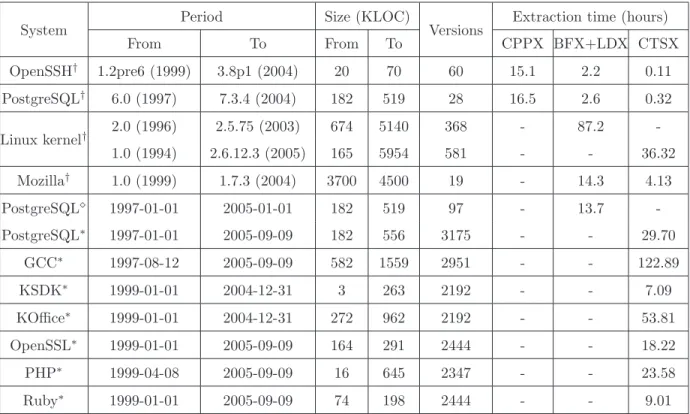
Table2.2 summarizes how many versions were extracted and how much time was spent for each target software system. The extraction was conducted on either official releases or snapshot versions checked out from the CVS source control repository. Two computers were used. CPPX, BFX and LDX were used on a Linux machine with one Intel(R) Pentium(R) IV 1.6GHz CPU and 1GB memory. CTSX was used on a Linux server with two Intel(R)
System Period Size (KLOC) Versions Extraction time (hours) From To From To CPPX BFX+LDX CTSX OpenSSH† 1.2pre6 (1999) 3.8p1 (2004) 20 70 60 15.1 2.2 0.11 PostgreSQL† 6.0 (1997) 7.3.4 (2004) 182 519 28 16.5 2.6 0.32 Linux kernel† 2.0 (1996) 2.5.75 (2003) 674 5140 368 - 87.2 -1.0 (1994) 2.6.12.3 (2005) 165 5954 581 - - 36.32 Mozilla† 1.0 (1999) 1.7.3 (2004) 3700 4500 19 - 14.3 4.13 PostgreSQL¦ 1997-01-01 2005-01-01 182 519 97 - 13.7 -PostgreSQL∗ 1997-01-01 2005-09-09 182 556 3175 - - 29.70 GCC∗ 1997-08-12 2005-09-09 582 1559 2951 - - 122.89 KSDK∗ 1999-01-01 2004-12-31 3 263 2192 - - 7.09 KOffice∗ 1999-01-01 2004-12-31 272 962 2192 - - 53.81 OpenSSL∗ 1999-01-01 2005-09-09 164 291 2444 - - 18.22 PHP∗ 1999-04-08 2005-09-09 16 645 2347 - - 23.58 Ruby∗ 1999-01-01 2005-09-09 74 198 2444 - - 9.01 †: official release ∗: daily snapshot version ¦: monthly snapshot version (the first day of every month)
Table 2.2: Open source systems extracted using the CX extractors
Xeon(R) 2.2GHz CPUs and 4GB memory. Although the server has more computing power, it is approximately 40% faster than the first computer due to the running of many backend services and user tasks. A detailed performance comparison of these CX extractors will be described in section 2.4.1.
Using CPPX
We substituted CPPX for gcc to extract abstract syntax graphs from 28 official releases of PostgreSQL, which range from 6.0 to 7.3.4. The extraction ran into two major difficulties: (1) every version before 6.5 had configuration problems such as missing header files and
could not be built successfully, and (2) CPPX has some defects in handling very large arrays of strings and it ran out of memory for almost each of the 28 versions of PostgreSQL. We modified configuration scripts and source files to achieve a successful compilation on the Linux platform. We also used CPPX to extract a total of 60 official releases of OpenSSH ranging from 1.2pre6 to 3.8p1. Similar problems were encountered and fixed manually.
The measured extraction time given in Table 2.2 does not include the time we spent on solving problems. After a system could be built and extracted successfully, we cleaned all the generated object code and re-compiled the system from scratch in order to measure the time spent on extraction.
Using BFX and LDX
LDX and BFX were successfully used to extract four large systems (OpenSSH, PostgreSQL, Linux and Mozilla) over a large number of versions. These two extractors are able to handle very large systems at a reasonable speed. The time spent by both BFX and LDX accounts for approximately 5∼10% of the total build time of a system (see section2.4.1).
When using BFX and LDX on Mozilla, we did not encounter any configuration problems and compilation errors. For the other three systems, the older the version, the more likely we ran into problems. All encountered problems were fixed manually.
Using CTSX
CTSX was applied to extract all the ten open source software systems. For systems which have a CVS repository, we conducted daily snapshot extraction. For OpenSSH, Linux and Mozilla, only public official releases were extracted. The extraction of 2951 daily snapshots of GCC took the longest time (122.89 hours) to finish. In general, the total time spent by CTSX on each target system is satisfactory. CTSX did not break for any version we have
extracted.
Lessons Learned
We now discuss several lessons learned from building large software evolution databases.
• For a large software system, many of its official releases may not be readily configured and compiled because the underlying platform (both hardware and software) changes drastically. This kind of build break often needs to be solved by manually modifying the configuration scripts or even the source code in order to get the system compiled. Installing outdated libraries is also required sometimes. Our experience with Linux and PostgreSQL shows that it is a daunting task to obtain a successful build for every available release. A program extractor depending on build success is not suitable for extracting a large number of versions over a long period of time.
• It is not guaranteed that CPPX can perform a successful extraction even if a software system can be compiled successfully. This is mainly caused by the internal defects of CPPX. For example, a very large array of constants can cause CPPX to break. By contrast, BFX and LDX are relatively more robust than CPPX. They can be applied to extract a version as long as the version can be compiled. CPPX transforms abstract syntax graphs which are more complicated than the format of binary code handled by BFX and LDX. This is the main reason why CPPX is less robust.
• CTSX is more satisfactory than CPPX, BFX and LDX in extracting a large software system in a robust but less accurate manner. In particular, it is capable of performing daily snapshot extraction on a long lived system within just a few hours or at most several days. CTSX is well positioned for supporting software evolution analysis on a large scale.
2.4
Discussion
2.4.1
Performance
Performance measures the speed of an extractor in extracting program facts. Performance is an important consideration when extraction is conducted on very large programs, which may have several million lines of code. In particular, if hundreds of versions of such a large system (e.g., Linux) need to be extracted for the purpose of examining various evolution phenomena (e.g., growing complexity), speed becomes a critical concern in the design of a program extractor. 5.25 36.28 5.38 5.65 0.95 0 5 10 15 20 25 30 35 40
Build CPPX Build+BFX Build+LDX CTSX
Minutes
Figure 2.5: Performance comparison of the CX extractors
We applied the CX extractors on PostgreSQL 7.4 (an open source database management system) to conduct a performance comparison. Each CX extractor was used repeatedly to extract the system three times. The average extraction time was calculated. The average time required to build the system was also collected in order to provide a standard base for showing speed differences. Figure 2.5 displays the performance results obtained on a