Physiological and kinanthropometrical parameters of
an elite climber. Single case study
Gaizka Mejuto
1ABCD
, Julio Calleja-González
1,2ABCD
, Jose Antonio Lekue
2B
, Xabier Leibar
2B
,
Ramón Gárate
3B
, Jose Ignacio Emparanza
4AD
, Julen Erauzkin
2B
, Maialen Beldarrain
2B
,
Nicolás Terrados
5,6ACD
1
Laboratory of Analysis of Sport Performance, Sport and Physical Education Department, Faculty of Sport Sciences, University
of the Basque Country, Spain
2
Sport Performance Center, Culture Department, Basque Government, Spain
3Traumatology Department, Gipuzkoa Policlinic, Spain
4
Clinical Epidemiology Unit, CASPE, CIBERESP, Donostia University Hospital, Spain
5Regional Unit of Sport Medicine- Avilés City-Council Foundation, Spain
6
Functional Biology Department, University of Oviedo, Spain
Source of support:
Departmental sources
Received:
29 November 2011;
Accepted:
27 August 2012;
Published online:
10 September 2012
Abstract
Background
Extreme altitude climbing effects have been described in several studies. Usually these studies are carried out onex-peditions but not longitudinally. The aim of this study is to describe physiological and kinanthropometrical chang-es over the time in a top-level climber.
Material/Methods:
This is a single-subject study on an individual career part (from ages 27 to 41). Some physiological andkinanthro-pometrical parameters were analysed in 3 different season parts at sea level; before (PRE), after (POST) and off climbing expeditions (OFF). All expeditions were >7000 m.
Results:
No changes were found in physiological parameters during the period of study regarding to season part.Kinanthropometry in contrast, presented significant changes (P<0.01) in two skinfolds (PRE/OFF vs. POST), whereas ∑ of SF showed differences between (PRE vs. OFF). Results also indicate some significant correlations (P<0.05) between both kinanthropometrical and physiological variables and the participant aging process.
Conclusions:
The high fitness level of the participant combined with his gift for acclimatization and a broad climbing career,maintain physiological and kinanthropometrical stability during the analysed period even after repeated exposure to extreme altitudes. However, aging process appears to be involved in maximal exercise cardiovascular capacity decline. Surprisingly, kinanthropometrical variables such as weight, BMI and fat percentage showed lower values through the time attributable probably to a high physical activity.
Key words: extreme altitude • climbing • physiology • kinanthropometry
Author’s address: Gaizka Mejuto, Laboratory of Analysis of Sport Performance. Sport and Physical Education Department. Faculty of Sport Sciences. University of the Basque Country. Portal de Lasarte, 71. Vitoria-Gasteiz 01007 (Álava), Spain; e-mail: [email protected]
B
ackgroundExtreme altitude begins at 5500 m above sea lev-el [1] but summiting the highest peaks of the world in Himalaya, involves exposures over 8000 m. These mountains, are in the threshold of human limits of
tolerance to hypoxia (HP) [2]. Studies of individuals who face these challenges usually report physiological alterations as human body responses to HP. At an alti-tude of 8500 m, often called “Death Zone”, the baro-metric pressure is 70% less than at sea level, and some-times records values of 80%, like on the summit of the
and Study Aim:
Extreme altitude – altitudes above 5500 m above sea level.
HP – hypoxia.
Authors’ Contribution: A Study Design
B Data Collection
C Statistical Analysis
D Manuscript Preparation
E Funds Collection
Everest mountain, where the values of barometric pres-sure oscillate between 251 to 253 Torr (when is used to be climbed). In these altitudes, the inspired O2 pres-sure is 43 Torr, close to the limit tolerated by the hu-man body [3]. Different hazards threat mountaineers when they attempt to reach these mountains. Chronic HP above 6000–7000 m, can cause a sea level resident to became more vulnerable to different altitude related pathologies. Commonly observed problems range from mild headache to potentially lethal edemas [4,5]. This chronic HP combined with extremely low temperatures and dehydration, among other risks at extreme altitude, make the environment life threatening [6].
Heart Rate (HR). Physiological parameters are suscep-tible to changes in extreme altitudes. At cardiorespirato-ry level, the HR, is affected under HP situations imme-diately upon arrival even at moderate altitudes above 1500 m. This acute exposure to high altitude produc-es hypoxia-associated stimulation of the sympathet-ic nervous system. This response is further enhanced by physical activity and induces an increase in heart rate and blood pressure [7]. The persistent rise in HR at rest and during exercise at altitude, would appear to be mediated via sustained changes in autonomic ner-vous system activity and circulating catecholamine lev-els [8]. Hypoventilation induces a higher HR both at rest and in exercise, consistently higher in acute HP [9]. At high altitude, HR increases to 136% of the sea level value, but gradually decreases [10], giving a progressive decrement in its peak under conditions of acute HP (6 weeks after acclimatization to 5400 m) [11]. Other field studies carried out by the “Silver Hut Expedition” cer-tified previously exposed data [12]. In barometric pres-sure below 530 mmHg (130 m of altitude gained above 3100 m) the maximal HR (MHR) begins to descend in accordance with 1 beat·min–1 for every 7 mmHg [11]. Blood lactate accumulation [LA]. At extreme altitude, this parameter has shown in a low concentration in ac-climatized subjects, even at maximal intensity exercises [13], arising the “lactate paradox” theory, which still re-mains as debate object [14–19]. After maximal exercise at altitudes exceeding 7500 m, no increase of [MLA] at all despite the extreme O2 deprivation has been reported. It is predicted that above this altitude, there is no rise in [LA] during exercise. Sutton et al. (1988) [13] demon-strated the low maximal [LA] (M[LA]) in extreme alti-tude, showing that at altitudes over 7500 m above sea level [LA] did not surpass the 4 mmol/L in blood. The paradoxically low values are possibly related to plasma bicarbonate depletion [6]. Nevertheless, Brooks et al. (1998) [20], suggest that usually 2 fundamental ques-tions are not considered to support this theory: 1) the cause of fatigue in extreme altitude, which cannot be
due to low [LA] (blood and muscles) and 2) the para-doxically low cardiac outputs that occur even though myocardial function is highly preserved during maximal exercise in extreme HP [21]. Thus, progressively lower levels of skeletal muscle recruitment prevent the devel-opment of sufficient muscle power, leading to the termi-nation of maximal exercise at progressively lower work rates, cardiac outputs, blood and muscle [LA] with in-creasing altitude. This control would protect the brain from dangerous levels of HP at extreme altitude [21]. [LA] is determined by factors in addition to hypoxemia such as circulating epinephrine, and net lactate release from active muscle beds rejecting beta-adrenergic in-fluences. Savard et al. (1995) demonstrated that low-er blood [LA] levels at altitude, is a function of muscle mass involvement rather than adrenergic activation, as normal peak values were reached during exercise with a small muscle mass [22]. In any case, M[LA] and [LA] at rest (R[LA]) at extreme altitude are still discussed among altitude physiologists and physicians [14–19]. Maximal oxygen consumption (VO2max). At the alti-tude of Mt Everest, is reduced to 20–25% of its sea level value, and it is exquisitely sensitive to barometric pres-sure especially above altitudes of 1500 m. Seasonal vari-ations of barometric pressure affect the ability of man to reach the summit without supplementary O2 [6]. For elite climbers, it was established in the research work of Pak et al. (2011) that the forecasting of a successful as-cension, could be improved if the potential VO2max was added to the standard definition parameters of aerobic metabolism, such as the VO2max and anaerobic thresh-old of O2 uptake [23]. The potential VO2max is consid-ered to be the parameter of reserve growing in condi-tion of realizacondi-tion of adaptive reaccondi-tion to HP [23]. Also Cerretelli et al. [24] concluded that still at an altitude of 2500 m, the VO2max begins to fall between 5% and 10% comparing with sea level values. Other research works reporting changes after chronic acute HP, like published by Robach et al. [25], simulate the ascent of 8 men to Everest with an hypobaric chamber (COMEX). In this study, the VO2max decreased 59% at 7000 m above sea level. On the other hand Takahashi et al. showed that elite climbers are characterized by their enhanced ven-tilatory response to HP rather than prominence in aer-obic work capacity [26]. And when subjects return to sea level they did not appear to improve as Sutton et al. reported after Everest Operation II [13]. However, exposure to acute HP, makes this parameter to remain stable or even decrease mainly due to 3 reasons; 1) the reduction of pressure of inspired O2, 2) the impairment of pulmonary gas exchange, each explaining about one-half of the drop in arterial O2 content, and 3) the duction of maximal carbon monoxide explaining the re-maining one-third of the loss in VO2max.
O2 – oxygen.
HR – physiol. Subject’s heart
rate. Determined by the number of heart beats per unit of time. In many types of exercise, the increase in heart rate is linear with the increase in rate of exercise. Expressed in beats per minute [77].
MHR – physiol. Subject’s
heart rate at maximum workload. Expressed in beats per minute. Indicator that VO2max has been
reached. Highly conditioned endurance athletes tend to have lower MHR values than untrained individuals of the same age [79].
[LA] – physiol. Blood lactate
concentration is commonly used to predict anaerobic glycolytic ability. Expressed in mmol per litre of blood.
M[LA] – maximum blood lactate concentration expressed in mmol per litre of blood. An accumulation of blood lactate is correlated with an increase in pulmonary ventilation beyond the demand of a sufficient oxygen supply to exercising muscles [77].
VO2max – maximal oxygen
uptake. A common measure of fitness for endurance activities. The maximum volume of oxygen the body can consume per time unit [82]. In our case expressed as millilitre per kg of body weight per minute (mL–1kg–1min–1).
Kinanthropometry. Majority of the studies state that the practice of the extreme altitude mountaineering causes weight (W) loss [27,28]. These authors conclud-ed that the mechanisms could not be totally due to a misalignment between the food intakes and energy ex-penditure, but to a bad absorption of carbohydrates (CHO). On the other hand, the loss of water could play a determinant role. In this sense, it is necessary to con-sider the acute HP at the time of intestinal absorption of fats and CHO [29,30]. In this case, xylose plays a major role in a decrement of arterial O2 saturation im-pairing the correct absorption of CHO [31]. In 1981, the American Medical Research Expedition to Everest (AMREE) carried out an exhaustive control of these parameters. It was observed that the 70% of the total body fat lost during the expedition was while approach-ing at moderate altitude, against the 27.2%, which was lost above 5,400 m. It is also significant that the fat ab-sorption decreased 48.5% in 3 subjects, and in 6 out of 7 members the excretion of xylose decreased until 24.3% at 6300 m of altitude. For this reason it can be deduced, that a high F% does not protect from losses of muscular tissue [32]. On the other hand, Kayser et al. [33] used cutaneous skinfolds (SF) measurements before and af-ter expedition to calculate the loss of fat and conclud-ed that the loss is an average of 9% on the basis of the measurements made at 5000 m of altitude. In contrast, Kayser et al. [34] indicated that the food palatability could play an important role. At 5050 m of altitude, loss of body mass from fat and muscle tissue, and hence im-pairment of maximum anaerobic muscle power (alactic) appears to be avoidable by food intake matched to en-ergy expenditure. It may be achieved simply by proper acclimatization, sufficient comfort and availability of palatable food [34]. A longitudinal monitoring of alti-tude climbers who are repeatedly exposed to hypobaric hypoxia among other stressors could be helpful to un-derstand long-term responses, or adaptations of human body to them. However, to the best knowledge of the authors, there are no scientific evidences of longitudi-nal, long term, sea level reports on this type of athletes. Thus, the aim of this study is to describe physiological and kinanthropometrical changes of a specific individ-ual (highly trained athlete holder of several records as professional climber) who has been intermittently and repeatedly exposed to extreme altitude during 14 yr.
M
aterialsandM
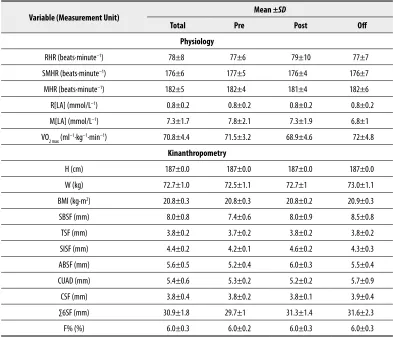
ethodsThe study is retrospective, longitudinal and based on a single-case. Variables respond to parameters of exer-cise physiology and kinanthropometry (see Table 1). The measurements of these parameters were made at sea level and their evolution and correlation were an-alysed according to the part of the season when they
were taken PRE expedition (7±2 days before departure to expedition), POST (9±5 days after leave expedition base camp) and OFF (Off expedition, as fitness con-trol of the participant), during 14 years (1996–2010). Participant
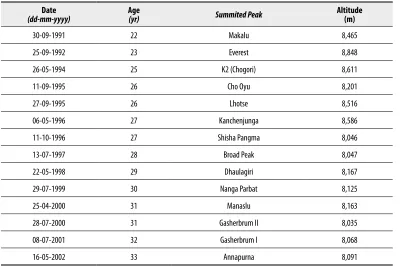
The participant was a Caucasian male aged 27 at the beginning of the period of study (1996) and aged 41 at the end (2010). Highly trained, especially in endur-ance since his teen age (~14). A remarkable rock climb-ing trainclimb-ing experience among other disciplines related to outdoor sports such as mountain running, mountain biking, trekking, extreme sports etc. featured the sport background of the participant at that time. When the participant accepted to take part in the study, he already was professional climber with at least 10 years of experi-ence on extreme altitude. Grown up at an altitude below ~250 m, started mountaineering and climbing at mod-erate altitudes in his childhood along with his brother (first fraternal summit of 8000 m peak, both with no bottled O2). He is the 4th lowlander in mountaineering history that has successfully culminated the 14 highest tops of the World (Table 2) without the use of supple-mentary O2 and holds several records in mountaineering. The participant, exercise scientists and medical staff of the High Performance Centre of Fadura-Getxo (Spain) were informed about the experimental processes as well as the studies that were made with him, whom accepted them with a written consent. The study was approved by the ethical committee of the University of the Basque Country according to the Declaration of Helsinki and the Data Protection Law of Spain (LOPD 15/1999). Experimental procedure
The blood extraction, physical examination, effort test and the meeting with the physicians and trainer of the athlete were carried out according to the standard pro-tocol of the Sport Performance Centre of Fadura-Getxo, Basque Government (Bilbao, Spain) under laborato-ry standards.
The protocol was the following:
1. 8:30 am. Blood sampling. Blood samples were taken every day of his visit to the centre during the period of study, on an empty stomach, and obtained from the antecubital vein in the decubital-supine position. Then, the samples were collected and analysed under laboratory standards.
2. 8:45 am. Kinanthropometrical measurement. The subject was measured in this order: First H on tall meter, barefoot and in standing position. Then, W on the scale, barefoot and in a standing position.
Kinanthropometry – the application of measurement to the study of human size, shape, proportion, composition, maturation and gross function. Its purpose is to help understand human movement in the context of growth, exercise, performance and nutrition [78].
W – body weight expressed in kilograms.
CHO – carbohydrates.
AMREE – American Medical Research Expedition to Everest, carried out in 1981.
F% – Body at percentage expressed in% from Carter and Yuhasz formula [41].
SF – skinfold. The skinfold method for estimating percent body fat relies on the relationship between subcutaneous fat and overall body fatness [81].
Physiology – the study of life itself. It is the study of function of all parts of living organisms [80].
PRE – data collected before expedition (7±2 days before expedition base camp arrival).
POST – data collected after expedition (9±5 days after leave expedition base camp).
OFF – Data collected during the season as athlete’s control test.
Skin folds were measured with the callipers follow-ing the indications of International Standards for
Kinanthropometric Assessment (ISAK), approved
by the Spanish Group of Kinanthropometry (GRE). 3. 10:00 am. Effort Test. The climber performed a stag-gered, progressive, intervallic, maximal test of effort (running) on a treadmill following the protocol of Clasingand Siegfried [35]. Constant increases of inten-sity (every 3 min) with rest intervals (20 s) were done during the test. The test began with a speed of 8 km/h and 1.5% grade (stage I) and every 3 min, 2 km/h is added progressively with 20 sec rest breaks mentioned above until volimic exhaustion. In order to register the athlete’s recovery capacity, physiological parameters were registered 1, 2 and 3 min after exhaustion. For the [LA] analysis, the ear lobe was punctured and pe-ripheral blood taken previously, to test every rest break between stages, at the end of the test and recovery pe-riods (1, 2 and 3 min). The HR and VO2 max were continuously monitored until 3 min after the test.
4. Supervision of the evolution of the training. Fitness status as well as training progress were analysed ex-ercise scientists and medical and staff.
5. Fitness program schedule. Exercise scientists along with medical staff assessed sport aims and training patterns.
6. Nutritional advising. Medical staff and nutritionists fixed diet, intake needs, hydration rules for training and expeditions.
Instruments and measurements
The instrumentation used for measurements was the following:
For physiological parameters, the HR (beats·min–1) was registered beat to beat by Polar Team Advantage Monitor Ltd. (Polar, Kempele Finland) [36]. For the [LA] analy-sis (mmol/L–1) the blood was taken with a pipette nee-dle (YSI 1500, calibrated with 5 and 15 mmol/L–1 stan-dard solutions) (Sport Yellow Springs Instrument Ltd.,
Variable (Measurement Unit) Mean ±SD
Total Pre Post Off
Physiology
RHR (beats·minute–1) 78±8 77±6 79±10 77±7
SMHR (beats·minute–1) 176±6 177±5 176±4 176±7
MHR (beats·minute–1) 182±5 182±4 181±4 182±6
R[LA] (mmol/L–1) 0.8±0.2 0.8±0.2 0.8±0.2 0.8±0.2
M[LA] (mmol/L–1) 7.3±1.7 7.8±2.1 7.3±1.9 6.8±1
VO2 max (ml–1·kg–1·min–1) 70.8±4.4 71.5±3.2 68.9±4.6 72±4.8
Kinanthropometry
H (cm) 187±0.0 187±0.0 187±0.0 187±0.0
W (kg) 72.7±1.0 72.5±1.1 72.7±1 73.0±1.1
BMI (kg·m2) 20.8±0.3 20.8±0.3 20.8±0.2 20.9±0.3
SBSF (mm) 8.0±0.8 7.4±0.6 8.0±0.9 8.5±0.8
TSF (mm) 3.8±0.2 3.7±0.2 3.8±0.2 3.8±0.2
SISF (mm) 4.4±0.2 4.2±0.1 4.6±0.2 4.3±0.3
ABSF (mm) 5.6±0.5 5.2±0.4 6.0±0.3 5.5±0.4
CUAD (mm) 5.4±0.6 5.3±0.2 5.2±0.2 5.7±0.9
CSF (mm) 3.8±0.4 3.8±0.2 3.8±0.1 3.9±0.4
∑6SF (mm) 30.9±1.8 29.7±1 31.3±1.4 31.6±2.3
F% (%) 6.0±0.3 6.0±0.2 6.0±0.3 6.0±0.3
Table 1. Climber’s profile.
RHR – rest heart rate; SMHR – submaximal heart rate; MHR – maximal heart rate; VO2max – maximum oxygen uptake; R[LA] – rest blood lactate concentration; M[LA] – maximum blood lactate concentration; H – height; W – weight; BMI – body mass index; SBSF – subescapular skinfold; TRSF – tricipital skinfold; SISF – suprailiac skinfold; ASF – abdominal skinfold; TSF – thigh skinfold; CSF – calf skinfold; ∑6SF – skinfold summatory; F% – fat percentage.
RHR – physiol. Subject’s
heart rate registered just before the effort test. It has been taken after a quick warm up. Beats per minute. Resting heart rate decreases as a result of endurance training. Expressed in beats per minute [79].
SBSF – subescapula skinfold thickness in millimetres.
TRSF – triceps skinfold thickness in millimetres.
ASF – abdominal skinfold thickness in millimetres.
TSF – thigh skinfold thickness in millimetres.
CSF – calf skinfold thickness in millimetres.
∑6SF – skinfolds summatory in millimetres.
H – body height expressed in centimetres.
Himalayism – Alpinist activity featured by reaching mountains above 7000 m above sea level.
SMHR – physiol. Subject’s
heart rate at sub-maximum workload. Expressed in beats per minute. Corresponds to 80% of the maximal theoretical heart rate and its rates are likewise lower during exercise at the same workload, generally by 10 to 20 beats/min or more [79].
SPSF – suprailiac skinfold thickness in millimetres.
ISAK – International Standards for Kinanthropometric Assessment.
GRE – Spanish group of kinanthropometry.
OH, USA) [37]. The measurements of composition and volumes of the breathed air were taken with equipment Jaeger Oxycon Pro Ltd. (Würzberg, Germany) [38] and VOmax expressed in ml·kg–1·min–1.
In kinanthropometry measurements, the study fol-lowed the International Standards for Anthropometric Assessment (ISAK), approved by the Spanish Group of Kinanthropometry (GRE) [39]. The H (cm) was taken by a tallimeter model SECA Ltd. (Germany), with a pre-cision of 2 mm and a range 130 to 210 cm. The W (kg) was recorded by a scale model SECA Ltd. (Germany), with a precision of 0.2 kg and a range 2 kg to 130 kg. 6 SF, (subescapula (SBSF), tricipital (TRSF), supraili-ac (SISF), abdominal (ASF), thigh (TSF), calf (CSF), were measured with calipers (Holtain Ltd., Crymych, UK) with a precision of 0.2 mm [40]. The sum of them was also registered (∑6SF). The fat percentage (F%) was calculated with Carter and Yuhasz equation [41]: Carter and Yuhasz Equation: = (0.1051 × [SBSF + TRSF + SISF + ASF + TSF + CSF] + 2.585
Statistical analysis
Descriptive data are expressed as means ± standard devi-ation (SD). To analyse changes in variables during the pe-riod of study ANOVA (repeated measures) test was used, for elite single-case athletes [42]. Bonferroni Post Hoc Test was used for group comparisons (season parts; PRE, POST
and OFF). The correlation between the age of the partic-ipant and his kinanthropometry and physiology param-eters was evaluated by means of a bivariate linear corre-lation (Pearson coefficient). Significant levels were set at (P<0.05)* for both statistical analyses. SPSS statistical package version 17.0 (SPSS, Chicago, USA) was used.
r
esultsHR. Differences in RHR, SMHR and MHR were not
observed during the period of study regarding to the season part when they were performed. However, the following correlations were found: MHR vs. M[LA]*
(181±6 bpm vs. 7.3±1.7 mmol/L–1) and MHR vs.
VO2max* (182±5 bpm vs. 70.8±4.4 ml·kg–1·min–1), SMHR vs. Age* (176±6 bpm vs. 34±4 yr) and MHR vs. Age* (182±5 bpm vs. 34±4 yr). VO2max did not present dif-ferences during the analysed period related to the sea-son parts. A significant correlation with the MHR is described above. [LA] differences in its evolution have not been found, but it is correlated significantly with
MHR as previously mentioned. Kinanthropometry.
Significant differences in SF were observed in SISF and ASF after expeditions; SISF [PRE (7.4±0.6 mm)/OFF (8.5±0.8 mm) vs. POST* (8.0±0.9 mm)] and ASF [PRE
(5.2±0.4 mm)/OFF (5.5±0.4 mm) vs. POST* (6.0±0.3
mm)] whereas ∑6SF showed differences between PRE
and OFF [PRE (29.7±1 mm vs. OFF* (31.6±2.3 mm).
Negative correlations were observed at W (72.7±1 kg) vs. Age (34±4 yr); SBSF (8.0±0.8 mm) vs. Age (34±4
Date
(dd-mm-yyyy) Age(yr) Summited Peak Altitude(m)
30-09-1991 22 Makalu 8,465
25-09-1992 23 Everest 8,848
26-05-1994 25 K2 (Chogori) 8,611
11-09-1995 26 Cho Oyu 8,201
27-09-1995 26 Lhotse 8,516
06-05-1996 27 Kanchenjunga 8,586
11-10-1996 27 Shisha Pangma 8,046
13-07-1997 28 Broad Peak 8,047
22-05-1998 29 Dhaulagiri 8,167
29-07-1999 30 Nanga Parbat 8,125
25-04-2000 31 Manaslu 8,163
28-07-2000 31 Gasherbrum II 8,035
08-07-2001 32 Gasherbrum I 8,068
16-05-2002 33 Annapurna 8,091
Table 2. 14 8,000 m summits chronology.
dd-mm-yyyy – day-month-year; yr – year; m – meters.
yr); ∑6SF (30.9±1.8 mm) Age (34±4 yr); W (72.7±1 kg) vs. ∑6SF (30.9±1.8 mm); W (72.7±1 kg) vs.%F (6±0.3%)].
d
iscussionThe purpose of this study is to describe the changes oc-curred through the years in a top level climber who is re-peatedly exposed to extreme altitudes and analyse whether
this exposures are related to changes at kinanthropometri-cal and/or physiologikinanthropometri-cal level
HR. Extreme altitude climbing has been traditional-ly studied by scientists and physicians in expeditions [43–47]. The rise in RHR and during exercise starts even at moderate altitudes [48] and returns to sea level values hours after descent. In our follow up study through the time we did not observe significant differences between season parts (PRE vs. POST vs. OFF) in HR. These data
76
74
72
70
68
W (k
g)
Pre
Post
Off
27 28 29 30 31 32 33 34 35 36 37 38 39 40 41
Age (yr)
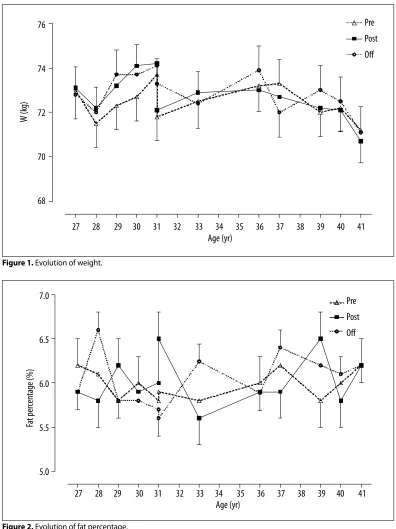
Figure 1. Evolution of weight.
7.0
6.5
6.0
5.5
5.0
Fa
t per
centage (%)
Pre
Post
Off
27 28 29 30 31 32 33 34 35 36 37 38 39 40 41
Age (yr)
Figure 2. Evolution of fat percentage.
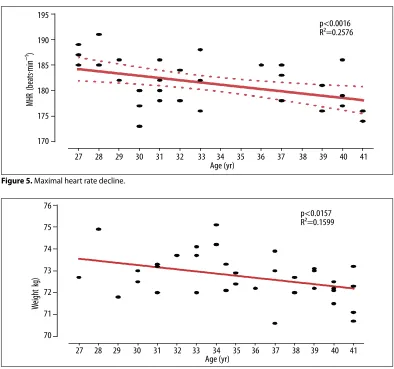
agree with those provided by the EEIII, where significant differences in this sense did not exist at maximal work-loads when the analysed subjects returned to sea level. According to Malconian’s work, most changes reverted back to normal within 12 hours of returning to sea level in electrocardiogram at rest and exercise during a simu-lated ascent of Mt. Everest (Operation Everest II) (49). Significant correlations were observed between MHR vs. M[LA]*. These results agree with data published by Tanaka et al. [50]; Bangsbo et al. [51] and Saltin et al.
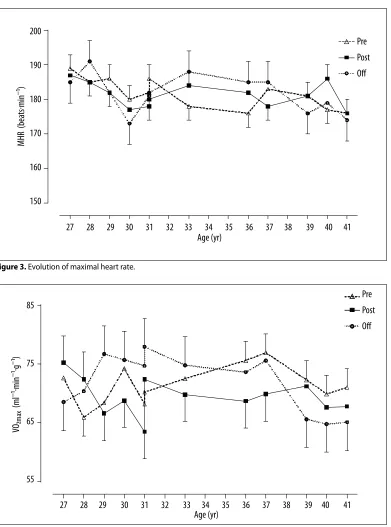
[52]. In these studies, highly trained athletes presented a relationship between these two parameters at maximal exercise. The decline in SMHR (P<0.0001) and MHR (P<0.001) through the time (age 27 to 41 years) can be related to aging process of the participant. This two variables showed a significant correlation towards the age. Is well known that aging decreases maximal heart rate and is linear for a given individual [53]. This aging effect on cardiovascular parameters has been previously reported in other follow up studies with highly trained
200
190
180
170
160
150
MHR (beats·min
–
1)
Pre
Post
Off
27 28 29 30 31 32 33 34 35 36 37 38 39 40 41
Age (yr)
Figure 3. Evolution of maximal heart rate.
85
75
65
55
VO
2
max(ml
–
1·min
–1·g
–1)
Pre
Post
Off
27 28 29 30 31 32 33 34 35 36 37 38 39 40 41
Age (yr)
Figure 4. Evolution of maximal oxygen consumption.
athletes [54,55]. Quinn et al. tested different age groups of competitive runners. In the same age group of test-ed athletes, (“Y group”, n=18 ages from 18 to 39) the decline in strength and power were significantly related to running velocity, indicating that age-related declines in running performance are associated with declines in maximal and submaximal cardiorespiratory variables [55]. Therefore, it can be concluded that the decline in the physiological capacity of humans is an inevita-ble consequence of the biological aging process [56]. VO2max is one of the most used parameters in sport training theory to determine the intensity of exercise in low and high altitudes [57–60]. At the altitude of Mt Everest, maximal oxygen uptake is reduced to 20–25% of its sea level [6]. The VO2max of the participant during the studied period was 70.5±4.7 ml·kg–1·min–1, consid-erably higher than the data provided by Oelz [61] where successful non bottled O2 users showed values around 60±6 ml·kg–1·min–1. On the other hand, changes were not observed in relation to expeditions. This data is con-sistent with Cerretelli’s work. He measured VO2max in a group of subjects at sea level shortly before exposition
to an altitude of 5.350 m for 10–12 weeks, and again at sea level about 4 weeks after their return from alti-tude. Although there was an approximately 11% (PRE vs. POST) increase in haemoglobin concentration, this was not accompanied by a statistically significant rise in VO2ma [62]. Perhaps the reduction of muscle mass fibre size at very high altitude is the explanation for the fail-ure to see an increase in VO2max after exposure to these extreme environments [63,64]. Failure to recover VO2max after acclimatization despite normalization of arterial O2 concentration is explained by two circulatory effects of altitude: 1) failure of cardiac output to normalize and 2) preferential redistribution of cardiac output to non-exercising tissues [65].
The level of [LA] is known to be very low in acclima-tized subjects at high altitude even during maximal work [66] although other recent studies have shown values in the opposite direction [14,67]. This paradox remains still unclear [17,68]. We have not found in existing sci-entific bibliography works of the evolution of this pa-rameter after extreme altitude expeditions. Oelz et al. presented data of some legendary elite climbers (n=6)
MHR (beats·min
–
1)
27 28 29 30 31 32 33 34 35 36 37 38 39 40 41 Age (yr)
p<0.0016 R2=0.2576 195
190
185
180
175
170
Weight k
g)
27 28 29 30 31 32 33 34 35 36 37 38 39 40 41 Age (yr)
p<0.0157 R2=0.1599 76
75
74
73
72
71
70
Figure 5. Maximal heart rate decline.
Figure 6. Correlation between weight and aging.
made at sea level, showing M[LA] values of 11.9±3.3 mmol/L–1 after performing 2 treadmill tests. The sub-ject analysed in our study showed M[LA] values of 7.1 mmol/L–1 after treadmill tests during his career. We have not found a significant differences in R[LA] and M[LA] related to when the test was performed. Both data (as well as VO2max values) show the high fitness level of the participant in the present study. On the other hand Robach et al. [25], in EEIII, observed significant chang-es in M[LA] for the control group [69].
Kinanthropometry at extreme altitude has traditional-ly been focused in body changes produced during expe-ditions, analysing the data collected immediately before and immediately after [27,33,34,70–73]. In the present study, SISF, ABSF and the ∑6SF presented changes after expedition [SISF PRE (7.4±0.6 mm)/OFF (8.5±0.8 mm)
vs. POST* (8.0±0.9 mm), ABSF PRE (5.2±0.4 mm)/
OFF (5.5±0.4 mm) vs. POST* (6±0.3 mm) and ∑6SF
PRE (29.7±1.0 mm)/OFF (31.6±2.3 mm) vs. POST*
(31.3±1.4 mm). These data contrast with majority of the studies that confirm the W loss, mentioned above with the exception of Kayser et al. [34] who demon-strated that an altitude of 5050 m, loss of body mass from fat and muscle tissue, and hence impairment of maximum anaerobic muscle power (alactic) appears to be avoidable by food intake matched to energy expen-diture. The latter may be achieved simply by proper ac-climatization, sufficient comfort and availability of pal-atable food. However, it’s unknown the physical fitness level of participants in that study, whereas the partici-pant of the present study showed a highly trained ath-lete profile. Aging appears to have an impact in body composition, especially process in sedentary popula-tion increasing body fat and body mass. However, mus-cle lean mass can be preserved and thus, athletic per-formance at some aging stages [74]. Our data indicate that W (72.7±1 kg), BMI (20.8±0.3 kg.m2) and ∑6SF (30.9±1.8 mm) slightly decrease especially in the last
part of the period of study (36 to 41 yr). This fat/weight loss can be due to different causes. The high fitness lev-el and the devlev-elopment of the new training strategies based in a long endurance programs promoting lipolytic pathways might be one of the main causes. However, as some authors reported in their studies, top-level athletes might present extraordinary rare values due to individ-ual variability and other several factors [75].
c
onclusionsThis report has identified the physiological and kinan-thropometrical features of an elite climber from ages 27 to 41 who has become the 4th of alpinism history reaching all highest peaks of the earth “by fair means” (without supplementary O2) [76]. It might be conclud-ed that as a result of sport training preparation and his broad climbing career, analysed parameters showed a sta-ble pattern through the years with slightly variations. Exposure to extreme altitude conditions does not seem to modify athlete’s either kinanthropometrical or phys-iological profile. Nevertheless the aging process appears to have a certain effect at physiological level with a de-cline at cardiovascular capacity.
Limitations of the study
Given the complexity of the expeditions, participant per-formed tests as close as it was possible to departure/ar-rival dates and when logistics permitted it. On the other hand, single case studies have to deal with several factors such as the little interest in generalizing to a population. Acknowledgements
The authors of the article appreciate the collaboration of the Technical Improvement and Sport Performance Centre Staff of Fadura-Getxo (Bilbao) and the climber who participated in the study.
1. Gallagher SA, Hackett PH: High-altitude illness. EmergMedClinNorth Am, 2004; 22(2): 329–55, viii
2. Cymerman A, Reeves JT, Sutton JR et al: Operation Everest II: maximal oxygen uptake at extreme alti-tude. JApplPhysiol, 1989; 66(5): 2446–53 3. West JB: Recent advances in human physiology at
extreme altitude. Adv Exp Med Biol, 1999; 474: 287–96
4. Singh I, Khanna PK, Lal M et al: High-Altitude Pulmonary Hypertension. Lancet, 1965; 1(7404): 146–50
5. Schoene RB: High in the cold, thin air: risks and benefits. J Am Coll Health Assoc, 1980; 29(3): 143–44
6. West JB: Limiting factors for exercise at extreme altitudes. Clin Physiol, 1990; 10(3): 265–72
7. Allemann Y, Saner H, Meier B: [High altitude stay and air travel in coronary heart disease]. Schweiz Med Wochenschr, 1998; 128(17): 671–78 8. Martin DS, Levett DZ, Grocott MP, Montgomery
HE: Variation in human performance in the hy-poxic mountain environment. Exp Physiol, 2010; 95(3): 463–70
9. Dejours P, Kelloggrh, Pace N: Regulation of respi-ration and heart rate response in exercise during altitude acclimatization. J Appl Physiol, 1963; 18: 10–18
10. Hirata K, Ban T, Jinnouchi Y, Kubo S: Echocardiographic assessment of left ventricular function and wall motion at high altitude in nor-mal subjects. Am J Cardiol, 1991; 68(17): 1692–97 11. Lundby C, van HG: Peak heart rates at extreme al-titudes. High Alt Med Biol, 2001; 2(1): 41–45
12. Pugh LG: Man at high altitude: studies carried out in the Himalaya. Sci Basis Med Annu Rev, 1964: 32–54
13. Sutton JR, Reeves JT, Wagner PD et al: Operation Everest II: oxygen transport during exercise at ex-treme simulated altitude. J Appl Physiol, 1988; 64(4): 1309–21
14. van Hall G, Lundby C, Araoz M et al: The lactate paradox revisited in lowlanders during acclimati-zation to 4100 m and in high-altitude natives. J Physiol, 2009; 587(Pt 5): 1117–29
15. Richalet JP: Commentaries on viewpoint: evidence that reduced skeletal muscle recruitment explains the lactate paradox during exercise at high altitude. J Appl Physiol, 2009; 106(2): 743–44
r
eferences:
16. Noakes TD: Evidence that reduced skeletal mus-cle recruitment explains the lactate paradox dur-ing exercise at high altitude. J Appl Physiol, 2009; 106(2): 737–38
17. Noakes TD: Last word on viewpoint: evidence that reduced skeletal muscle recruitment explains the lactate paradox during exercise at high altitude. J Appl Physiol, 2009; 106(2): 745
18. West JB: Point: the lactate paradox does/does not oc-cur during exercise at high altitude. J Appl Physiol, 2007; 102(6): 2398–99
19. Wagner PD, Lundby C: The lactate paradox: does acclimatization to high altitude affect blood lac-tate during exercise? Med Sci Sports Exerc, 2007; 39(5): 749–55
20. Brooks GA, Wolfel EE, Butterfield GE et al: Poor relationship between arterial [lactate] and leg net release during exercise at 4,300 m altitude. Am J Physiol, 1998; 275(4 Pt 2): R1192–201 21. Noakes TD: Evidence that reduced skeletal
mus-cle recruitment explains the lactate paradox dur-ing exercise at high altitude. J Appl Physiol, 2009; 106(2): 737–38
22. Savard GK, Areskog NH, Saltin B: Cardiovascular response to exercise in humans following acclima-tization to extreme altitude. Acta Physiol Scand, 1995; 154(4): 499–509
23. Pak GD, Seluianov VN, Pivtsov VT, Maevskii VI: [The functional prognosis of physical working abili-ty under conditions of extreme high altitude]. Ross Fiziol Zh Im I M Sechenova, 2011; 97(3): 330–35 24. Cerretelli P, Whipp BJ: Exercise bioenergetics and
gas exchange: proceedings of the International Symposium on Exercise Bioenergetics and Gas Exchange, held in Milan, Italy, July 7–9, 1980, a satellite of the XXVIII International Congress of Physiological Sciences. Amsterdam; New York, New York, N.Y.: Elsevier/North-Holland Biomedical Press; sole distributors for the USA and Canada, Elsevier North Holland; 1980
25. Robach P, Dechaux M, Jarrot S et al: Operation Everest III: role of plasma volume expansion on VO(2)(max) during prolonged high-altitude expo-sure. J Appl Physiol, 2000; 89(1): 29–37 26. Takahashi H, Asano K, Kikuchi K: [Control of
ven-tilation and aerobic work capacity in elite climb-ers]. Ann Physiol Anthropol, 1990; 9(1): 31–39 27. Sergi G, Imoscopi A, Sarti S et al: Changes in total
body and limb composition and muscle strength af-ter a 6–8 weeks sojourn at extreme altitude (5000– 8000 m). J Sports Med Phys Fitness, 2010; 50(4): 450–55
28. Hamad N, Travis SP: Weight loss at high altitude: pathophysiology and practical implications. Eur J Gastroenterol Hepatol, 2006; 18(1): 5–10 29. Kormanovski A, Harasymowicz J: Survival
adap-tation in everest: Metabolic response during accli-matization in lowlander and sherpa climbers. Arch Budo, 2010; 6(2): 83–89
30. Pugh LG: Physiological and medical aspects of the Himalayan scientific and mountaineering expedi-tion, 1960–61. Br Med J, 1962; 2(5305): 621–27 31. Milledge JS: Arterial oxygen desaturation and intes-tinal absorption of xylose. Br Med J, 1972; 3(5826): 557–58
32. Boyer SJ, Blume FD: Weight loss and changes in body composition at high altitude. J Appl Physiol, 1984; 57(5): 1580–85
33. Kayser B, Acheson K, Decombaz J et al: Protein ab-sorption and energy digestibility at high altitude. J Appl Physiol, 1992; 73(6): 2425–31
34. Kayser B, Narici M, Milesi S et al: Body composi-tion and maximum alactic anaerobic performance during a one month stay at high altitude. Int J Sports Med, 1993; 14(5): 244–47
35. Clasing D, Al-Bazaz S: Sportärztliche Untersuchung und Beratung: Spitta-Verl, 2002
36. Dahlstrom N, Nahlinder S: A comparison of two re-corders for obtaining in-flight heart rate data. Appl Psychophysiol Biofeedback, 2006; 31(3): 273–79 37. Buckley JD, Bourdon PC, Woolford SM: Effect of
measuring blood lactate concentrations using dif-ferent automated lactate analysers on blood lactate transition thresholds. J Sci Med Sport, 2003; 6(4): 408–21
38. Foss O, Hallen J: Validity and stability of a com-puterized metabolic system with mixing chamber. Int J Sports Med, 2005; 26(7): 569–75 39. Hume P, Marfell-Jones M: The importance of
ac-curate site location for skinfold measurement. J Sports Sci, 2008; 26(12): 1333–40
40. Rehs HJ, Berndt I, Rutenfranz J, Burmeister W: [Determination of lean body mass by skin fold measurements (author’s transl)]. Z Kinderheilkd, 1975; 120(2): 121–33
41. Carter JEL: Physical structure of Olympic athletes: Kinanthropometry of Olympic athletes: Karger, 1984
42. Kinugasa T, Cerin E, Hooper S: Single-subject re-search designs and data analyses for assessing elite athletes’ conditioning. Sports Med, 2004; 34(15): 1035–50
43. Aigner A, Berghold F, Muss N: [Investigations on the cardiovascular system at altitudes up to a height of 7,800 meters (author’s transl)]. Z Kardiol. 1980; 69(9): 604–10
44. West JB, Boyer SJ, Graber DJ et al: Maximal exer-cise at extreme altitudes on Mount Everest. J Appl Physiol, 1983; 55(3): 688–98
45. Wu T: [Changes in cardiac function at rest and dur-ing exercise in mountaineers at an extreme altitude]. Zhonghua Yi Xue Za Zhi, 1990; 70(2): 72–76 46. Lundby C, van Hall G: Peak heart rates at extreme
altitudes. High Alt Med Biol, 2001; 2(1): 41–45 47. Windsor JS, Rodway GW, Montgomery HE: A
re-view of electrocardiography in the high altitude en-vironment. High Alt Med Biol, 2010; 11(1): 51–60 48. Milledge JS, Ward MP, Williams ES, Clarke CR:
Cardiorespiratory response to exercise in men re-peatedly exposed to extreme altitude. J Appl Physiol, 1983; 55(5): 1379–85
49. Malconian M, Rock P, Hultgren H et al: The elec-trocardiogram at rest and exercise during a simu-lated ascent of Mt. Everest (Operation Everest II). Am J Cardiol. 1990; 65(22): 1475–80
50. Tanaka K: Lactate-related factors as a critical de-terminant of endurance. Ann Physiol Anthropol, 1990; 9(2): 191–202
51. Bangsbo J, Graham T, Johansen L, Saltin B: Muscle lactate metabolism in recovery from intense ex-haustive exercise: impact of light exercise. J Appl Physiol, 1994; 77(4): 1890–95
52. Saltin B, Larsen H, Terrados N et al: Aerobic exer-cise capacity at sea level and at altitude in Kenyan boys, junior and senior runners compared with Scandinavian runners. Scand J Med Sci Sports, 1995; 5(4): 209–21
53. Charansonney OL: Physical activity and aging: a life-long story. Discov Med, 2011; 12(64): 177–85 54. Trappe SW, Costill DL, Vukovich MD et al: Aging
among elite distance runners: a 22-yr longitudinal study. J Appl Physiol, 1996; 80(1): 285–90 55. Quinn TJ, Manley MJ, Aziz J et al: Aging and
fac-tors related to running economy. J Strength Cond Res, 2011; 25(11): 2971–79
56. Rogers MA, Hagberg JM, Martin WH III et al: Decline in VO2max with aging in master athletes
and sedentary men. J Appl Physiol, 1990; 68(5): 2195–99
57. Terrados N, Mizuno M, Andersen H: Reduction in maximal oxygen uptake at low altitudes; role of training status and lung function. Clin Physiol, 1985; 5(Suppl.3): 75–79
58. Andersen P, Saltin B: Maximal perfusion of skele-tal muscle in man. J Physiol, 1985; 366: 233–49 59. Bangsbo J, Gollnick PD, Graham TE et al: Anaerobic
energy production and O2 deficit-debt relationship during exhaustive exercise in humans. J Physiol, 1990; 422: 539–59
60. Stirling JR, Zakynthinaki MS, Saltin B: A model of oxygen uptake kinetics in response to exercise: in-cluding a means of calculating oxygen demand/def-icit/debt. Bull Math Biol, 2005; 67(5): 989–1015 61. Oelz O, Howald H, Di Prampero PE et al:
Physiological profile of world-class high-altitude climbers. J Appl Physiol, 1986; 60(5): 1734–42 62. Cerretelli P: Limiting factors to oxygen transport
on Mount Everest. J Appl Physiol, 1976; 40(5): 658–67
63. Howald H, Hoppeler H: Performing at extreme al-titude: muscle cellular and subcellular adaptations. Eur J Appl Physiol, 2003; 90(3–4): 360–64 64. West JB, Schoene RB, Milledge JS: High altitude
medicine and physiology. 4th ed ed. London: Hodder
Arnold, 2007
65. Calbet JA, Boushel R, Radegran G et al: Determinants of maximal oxygen uptake in severe acute hypoxia. Am J Physiol RegulIntegr Comp Physiol, 2003; 284(2): R291–303
66. Hochachka PW, Beatty CL, Burelle Y et al: The lac-tate paradox in human high-altitude physiological performance. News Physiol Sci, 2002; 17: 122–26 67. Wagner PD: Origin of the lactate paradox: muscles
or brain? J Appl Physiol, 2009; 106(2): 740–41 68. West JB: Point: the lactate paradox does/does not
oc-cur during exercise at high altitude. J Appl Physiol, 2007; 102(6): 2398–99
69. Robison JI, Rogers MA, Carlson JJ et al: Effects of a 6-month incentive-based exercise program on ad-herence and work capacity. Med Sci Sports Exerc, 1992; 24(1): 85–93
70. Boyer SJ, Blume FD: Weight loss and changes in body composition at high altitude. J Appl Physiol, 1984; 57(5): 1580–85
71. Fulco CS, Cymerman A, Pimental NA et al: Anthropometric changes at high altitude. Aviat Space Environ Med, 1985; 56(3): 220–24 72. Fusch C, Gfrorer W, Koch C et al: Water turnover
and body composition during long-term exposure to high altitude (4,900–7,600 m). J Appl Physiol, 1996; 80(4): 1118–25
73. Hamad N, Travis SP: Weight loss at high altitude: pathophysiology and practical implications. Eur J Gastroenterol Hepatol, 2006; 18(1): 5–10 74. Wroblewski AP, Amati F, Smiley MA et al: Chronic
exercise preserves lean muscle mass in masters ath-letes. Phys Sportsmed, 2011; 39(3): 172–78 75. Sands WA: Measurement issues with elite athletes.
Sports Technology, 2008; 1(2–3): 101–4 76. Messner R, Bittebierre M: Everest sans oxygène.
París: Arthaud, 1979
77. Åstrand PO: Textbook of work physiology: physi-ological bases of exercise. Human Kinetics, 2003 78. Carter JEL: Physical structure of Olympic athletes:
Kinanthropometry of Olympic athletes. Karger, 1984
79. Wilmore JH, Costill DL, Kenney WL: Physiology of sport and exercise: Human Kinetics, 2008 80. Guyton AC: Physiology of the human body.
Saunders, 1979
81. Brown SP, Miller WC, Eason JM: Exercise Physiology: Basis of Human Movement in Health and Disease. Lippincott Williams & Wilkins, 2006 82. Haywood K, Getchell N: Life span motor
develop-ment. Human Kinetics, 2009