HOMOLOGY SEQUENCE ANALYSIS
USING GPU ACCELERATION
A Thesis presented to
the Faculty of the Graduate School at the University of Missouri
In Partial Fulfillment
of the Requirements for the Degree Doctor of Philosophy
by
HUAN TRUONG
Dr. Gavin Conant, Thesis Supervisor JULY 2018
The undersigned, appointed by the Dean of the Graduate School, have examined the dissertation entitled:
HOMOLOGY SEQUENCE ANALYSIS USING GPU ACCELERATION
presented by Huan Truong,
a candidate for the degree of Doctor of Philosophy and hereby certify that, in their opinion, it is worthy of acceptance.
Dr. Gavin Conant
Dr. J. Chris Pires
Dr. William Lamberson
ACKNOWLEDGMENTS
I would like to use this opportunity to express my gratitude to people who have supported me throughout my research.
My research career would not have been possible without my parents, who have believed in me in every step I took since college.
I would like to give my deepest gratitude to my advisor, Dr. Gavin Conant. Dr. Co-nant has not only been a great scientist with his insightful ideas and constructive crit-icisms, but also a supportive, patient, and gentle mentor. I would like to thank the current lab members Yue Hao and Rocky Patil for their support inside and outside the lab.
I would like to thank members of the committee, Dr. William Lamberson and Dr. Jianlin ‘Jack’ Cheng for many insightful inputs. I would like to personally thank Dr. Chris Pires and Dr. Michela Becchi for them always considering me being an “adopted” lab member. I was able to learn a substantial amount of knowledge from their lab members as well. Notably, I had the first tastes of late-night bench work from Sarah Unruh and Dustin Mayfield-Jones from Pires Lab; I have seen many algorithms and snippets of code from Dr. Daniel Li and Dr. Kittisak Sajjapongse (co-author in chapter 2), Andrew Todd (co-author in chapter 3), and Michael Butler from Becchi lab.
I was able to learn by looking up to former Conant lab members, Dr. Corey Hudson and Sara Wolff. During the year we shared the responsibility to be Teaching Assistants, Dr. Hudson has set an example of being an educator who makes hard concepts easy. There are many more graduate students in other labs who also helped me in many steps along the way, notably, Dr. Isaiah Taylor from Walker Lab and Samuel ‘Sam’ McInturf from Mendoza Lab.
administra-tion staff, especially Dr. Chi-Ren Shyu, Robert Sanders, and Tracy Pickens, who have worked tirelessly over the years to support all students in the department. I would like to thank the Division of Animal Sciences, University of Missouri for hosting me for the five years of my study in Columbia, and the Bioinformatics Research Center, North Carolina State University for hosting me in the last year in Raleigh.
I thank NVIDIA Corporation for providing the critical components of my research depend on. This thesis would not be possible without their compilers, tools, and hardware.
Personally, I would like to thank Dustin Mayfield-Jones for being a supportive friend during and after his time at the University of Missouri. I thank Anh ‘Gau’ Pham for turning my life around when I was a college student in Vietnam. I thank Quyen Nguyen, Dr. Donald Bindner, Amy Nunan and Lathe Nunan for supporting me through the years, and Ly Vuong for the mental support I needed towards the completion of this thesis.
In the limited space of this acknowledgment, I am not able to list all the names of people I owe my gratitude to. I thank everyone who has worked with me or helped me during my years as a graduate student. I thank the world to allow me to stand on its shoulder, and I hope to contribute back to it one day in the future.
Lastly, the layout of this thesis is modified from an open-source template written by John Hammond and all mistakes in this thesis are of my own.
TABLE OF CONTENTS
ACKNOWLEDGMENTS . . . ii
LIST OF TABLES . . . viii
LIST OF FIGURES . . . ix
ABSTRACT . . . xii
CHAPTER . . . . 1 Introduction & Background . . . 1
1.1 Introduction . . . 1
1.1.1 The need for accelerated computing in bioinformatics . . . 1
1.2 Organization of this work . . . 3
1.3 Background . . . 4
1.3.1 The pairwise sequence alignment problem . . . 4
1.3.2 The Needleman-Wunsch Global Alignment Algorithm . . . 6
1.3.3 K-mer counting and motif finding problem . . . 7
1.3.4 The NVIDIA CUDA platform . . . 8
2 Large-Scale Pairwise Alignments on NVIDIA GPUs . . . 10
2.1 Introduction . . . 11
2.2 Background . . . 13
2.2.1 Related Work . . . 13
2.2.2 Parallelism in NVIDIA GPUs . . . 14
2.2.3 Rodinia-NW: Needleman-Wunsch on GPU . . . 15
2.3 Design of the algorithms . . . 17
2.5 Experimental setup and evaluation . . . 28
2.5.1 Experimental setup . . . 28
2.5.2 Performance on single GPU for general use cases . . . 29
2.5.3 Performance analysis of LazyRScan-mNW on single GPU . . . 35
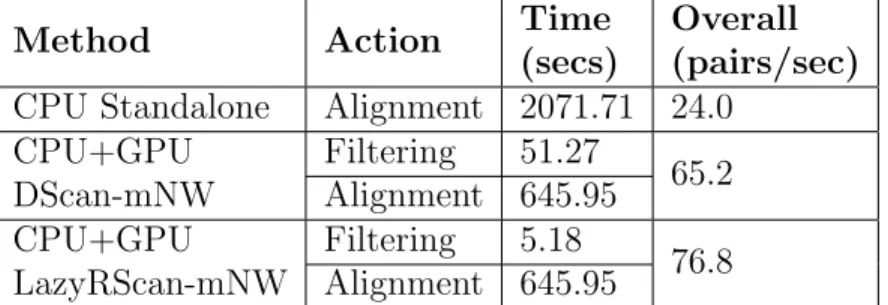
2.5.4 Performance analysis on a single node, using GPU kernels as filtering methods . . . 37
2.6 Conclusion . . . 39
3 Parallel Gene Upstream Comparison via Multi-Level Hash Tables on GPU . . . 40
3.1 Introduction . . . 40
3.2 Design of proposed motif-finding framework . . . 43
3.3 GPU parallelization of hash-table comparison . . . 50
3.4 Related work . . . 57
3.5 Results . . . 60
3.6 Conclusion & Future work . . . 66
4 PolyHomology: A Comparative Genomics Approach to Regula-tion Pattern Discovery . . . 68
4.1 Introduction . . . 68
4.2 Materials and Methods . . . 70
4.2.1 Materials . . . 71
4.2.2 K-mer composition similarity score . . . 71
4.2.3 Meta graph construction . . . 73
4.2.4 Sensitivity evaluation . . . 74
4.3 Results . . . 75
4.3.1 Initial graph construction and initial parameter estimation . . 75
4.3.3 Sensitivity to other factors . . . 77
4.3.4 Sensitivity with different orderings of genome addition . . . . 78
4.3.5 Sensitivity with Hughes pairwise data . . . 80
4.4 Discussion . . . 81
4.4.1 Overall effectiveness . . . 81
4.4.2 Limitations and future improvements . . . 82
5 Operational Taxonomic Units classification: Diving into Phenetics Approach with the 16S rDNA Subunit . . . 84
5.1 Introduction . . . 84
5.2 Results . . . 90
5.2.1 Sequence identity levels and reference species and genera clas-sification . . . 90
5.2.2 Reference genera and species classifications . . . 92
5.2.3 Tree-like interpretation of the OTU classification . . . 92
5.2.4 Network-based analysis of OTU classification approaches . . . 97
5.3 Discussion . . . 98
5.4 Methods . . . 100
5.4.1 Data source and reference classification analysis . . . 100
5.4.2 All-against-all sequence alignments on GPU and sequence iden-tity computation . . . 101
5.4.3 Building OTU clusters from pairwise alignments . . . 104
5.5 Conclusion . . . 105
6 Summary . . . 106
APPENDIX . . . 108
A OTU Analysis: OTU estimation pipeline . . . 108
LIST OF TABLES
Table
Page
2.1 Comparison of alignment methods . . . 25 2.2 Characteristics of the GPUs used in our evaluation . . . 28 2.3 Performance of LazyRScan-mNW with different shared memory, block
size, and slice size settings . . . 34 2.4 Speedup on a single node as a result of using DScan-mNW and
LIST OF FIGURES
Figure
Page
2.1 Exemplification of our 4 GPU implementations of NW-based parallel
pairwise alignments . . . 17
2.2 Pseudo-code version of LazyRScan-mNW . . . 22
2.3 LazyRScan-mNW optimization . . . 22
2.4 Exemplification of dual-buffering . . . 26
2.5 Evaluation of memory optimizations on Rodinia-NW . . . 29
2.6 Kernel speedup over Rodinia-NW . . . 30
2.7 Kernel speedup of RScan-mNW over Rodinia-NW on sequences of var-ious lengths . . . 32
2.8 Speedup reported by DScan-mNW over an 8-threaded CPU implemen-tation running on the 8-core CPU on Node-4 . . . 33
2.9 Effect of slice size k on performance of LazyRScan-mNW . . . 36
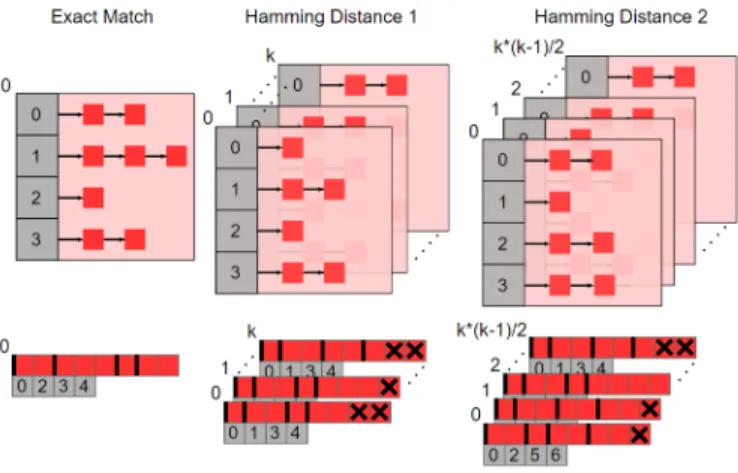
3.1 Representation of K-mer in GPU . . . 47
3.2 Hamming distance meta-tables and their respective sub-tables before and after array based conversion . . . 48
3.3 DJB2 hashing algorithm . . . 49
3.4 2-U MT hashing algorithm . . . 50
3.5 Custom XOR hashing algorithm . . . 50
3.7 Construction time for three hash functions . . . 61
3.8 Execution time of different kernels for various bucket settings and block sizes . . . 62
3.9 Execution time of the Thread to Bucket kernel with both upstreams fully cached . . . 63
3.10 Speedup over 8-thread CPU implementation for different k and GPU implementations . . . 65
4.1 Local- and meta graph construction . . . 73
4.2 Sensitivity of co-regulation detection with variablek . . . 76
4.3 Initial meta graph with parametersk =w= 8 . . . 78
4.4 Sensitivity of co-regulation detection to differing values of the mis-match weight parameterw . . . 79
4.5 Sensitivity of co-regulation detection with different values of the mis-match weight parameterw . . . 79
4.6 Sensitivity as more genomes are added in random order . . . 80
4.7 Sensitivity to co-expression detection as more genomes are added in order . . . 81
5.1 The modified Needleman-Wunsch alignment approach to compute se-quence identity in GPU . . . 89
5.2 Identity levels between pairwise comparisons . . . 89
5.3 Taxonomic unit sizes using current species taxonomic classification as a reference . . . 91
5.4 Inferred OTU counts as a function of the percentage identity threshold 92 5.5 Inferred OTU counts as a function of the proportion of the network retained . . . 93
5.7 Measurement of the Simpson index on different rarefaction levels . . . 94 5.8 Metrics on network under graph representation. . . 94 A.1 OTU estimation pipeline from 16S sequence samples . . . 109
ABSTRACT
A number of problems in bioinformatics, systems biology and computational bi-ology field require abstracting physical entities to mathematical or computational models. In such studies, the computational paradigms often involve algorithms that can be solved by the Central Processing Unit (CPU). Historically, those algorithms benefit from the advancements of computing power in the serial processing capabil-ities of individual CPU cores. However, the growth has slowed down over recent years, as scaling out CPU has been shown to be both cost-prohibitive and insecure. To overcome this problem, parallel computing approaches that employ the Graphics Processing Unit (GPU) have gained attention as complementing or replacing tradi-tional CPU approaches. The premise of this research is to investigate the applicability of various parallel computing platforms to several problems in the detection and anal-ysis of homology in biological sequence. I hypothesize that by exploiting the sheer amount of computation power and sequencing data, it is possible to deduce informa-tion from raw sequences without supplying the underlying prior knowledge to come up with an answer. I have developed such tools to perform analysis at scales that are traditionally unattainable with general-purpose CPU platforms.
I have developed a method to accelerate sequence alignment on the GPU, and I used the method to investigate whether the Operational Taxonomic Unit (OTU) clas-sification problem can be improved with such sheer amount of computational power. I have developed a method to accelerate pairwise k-mer comparison on the GPU, and I used the method to further develop PolyHomology, a framework to scaffold shared sequence motifs across large numbers of genomes to illuminate the structure of the regulatory network in yeasts. The results suggest that such approach to heteroge-neous computing could help to answer questions in biology and is a viable path to new discoveries in the present and the future.
Chapter 1
Introduction & Background
1.1
Introduction
1.1.1
The need for accelerated computing in bioinformatics
A number of problems in the field of bioinformatics, systems biology, and compu-tational biology field require abstracting physical entities to mathematical or com-putational models [94]. In such studies, the comcom-putational paradigms often involve algorithms that can be solved by the Central Processing Unit (CPU). Historically, those algorithm benefits from both advancements of computing power in both perfor-mance gains in the serial processing capabilities of individual CPU cores and parallel gains - more cores per CPU and more computers per network. However, the increases in serial performance have slowed down over recent years [55], and scaling out CPU has shown to be cost-prohibitive [103]. More alarmingly, recent research has shown that approaches and practices used to accelerate the CPUs that are traditionally considered safe for decades are fundamentally insecure [73] [62].known. The limitation of new discoveries in biology have shifted from the lack of data and equipment to lack of suitable models [22]. Massive quantities of sequencing data can be generated by platforms such as Illumina [25] [109], but tools to analyze such data have not kept pace with this increase in data volume. One approach to address this problem has been to explore acceleration of analyses using parallel computing tools such as clusters, cloud-computing, and heterogeneous accelerator platforms such as the Intel Many Integrated Core (MIC) Architecture, Field-Programmable Gate Array (FPGA) devices, GPUs, or hybrid solutions such as Accelerated Processing Units (APUs) [152].
While scaling-up and scaling-out approaches (obtaining more powerful silicon) are popular, they are more cost-prohibitive and are approaching a plateau [103]. More-over, the energy envelop required to operate an exascale cluster comprising about 100,000 compute cores is essentially prohibitive with current CPU technology [152]. Thus, heterogeneous platforms are being actively researched as an alternative in medium-sized research institutes. In the GPU field, the de-facto platform of choice is from NVIDIA corporation, which uses the CUDA libraries and has gained attention as complementing or replacing traditional CPU approaches.
Heterogeneous accelerator platforms enable research projects in bioinformatics in two main themes [121]:
• Utilizing new parallel optimizations (“porting”) of well-known algorithms to existing pipelines and programs [74] [165] [112] [78].
• Deriving new algorithms to enable new research directions and paradigms. This includes innovations such as enabling demanding visualizations [134] [135] and simulations [45].
Traditionally, because computational power was limited, thus there was always a trade-off between computational power and the level of detail that the models take
in into consideration. This research tackles those limitations by the applying the increased computational power provided by the accelerator platforms to classically intractable problems. Our hypothesis is that new patterns emerge as more data comes in, thus as long as the algorithm can handle these increased data flow, we could answer and improve the answer by processing the additional data.
1.2
Organization of this work
The premise of this research is to investigate the applicability of various parallel computing platforms to several problems in the detection and analysis of homology in biological sequence. I hypothesize that by exploiting the sheer amount of com-putation power and sequencing data, it is possible to deduce information from raw sequences without supplying the underlying prior knowledge to come up with an an-swer. I have developed such tools to perform analysis at scales that are traditionally unattainable with general-purpose CPU platforms. I have studied both the algo-rithms, their respective performance in the GPU context, and investigated biological questions with the tools I have developed.
The basic algorithms investigated with complete, exhaustive search algorithms that are unattainable on the CPU are:
• GPU Parallel Needleman-Wunsch alignment.
• GPU Parallel k-mer comparison.
The two aforementioned problems are addressed in Chapter 2 and Chapter 3 of this thesis, respectively. With those algorithms as a start, I addressed the following biological question:
• Can scaffolding of shared sequence motifs across large numbers of genomes illuminate the structure of the regulatory network?
To address those questions, the NVIDIA GPU platform is used to conduct pairwise analyses. Specifically, the following packages were developed:
• PolyHomology, a suite of algorithms and tools that mine motifs from the up-stream regions of genes. The motif length is specified beforehand can range up to 30 nucleotides long. The suite accomplishes the goal by scaffolding homology information data from multiple yeast genomes.
• NEAT, a suite of pairwise comparison program to construct pairwise alignment graph for any given set of sequence, and apply to understand the OTU structure from the 16S genes database.
The answer to the biological questions powered by the two packages is presented in Chapter 4 and Chapter 5 of this thesis, respectively.
1.3
Background
1.3.1
The pairwise sequence alignment problem
The pairwise sequence alignment is one of the most basic operations in sequence anal-ysis and is essential to many problems, including phylogenetics and molecular evo-lution studies. Each comparison is carried on by a dynamic programming procedure (using either the Needleman-Wunsch [88] or the Smith-Waterman [128] algorithm) in order to retrieve an alignment or similarity score between a pair of sequences. Each pairwise alignment problem for s sequences has a polynomial complexity of O(s2). Each individual pairwise comparison, in turn, has the complexity of O(n2) (where n is the length of the sequences). The multiplication of these two factors results in the
time needed for the comparison of many long sequences being computationally expen-sive. However, biologists require such comparisons to being handled quickly. In some cases, there are available heuristics given a degree of background knowledge about the underlying data. For instance, if relatively few of the sequences being compared bear significant similarities to each other but the vast majority do not, a heuristic can halt most comparisons and alignments when the dissimilarity passes a threshold, thus saving significant time.
However, there exists a class of problems where all the sequences bear a consid-erable similarity. This situation is true of metagenomics studies which employ the 16S rDNA gene. Metagenomics sampling from the environment enables researchers to study microbial communities that they are unable to cultivate in lab settings [81]. Because the 16S rDNA gene is an essential gene among prokaryotic species, it is highly conserved. Thus, orthologs from different species bear high similarities, making it impossible to apply such heuristic-pruning techniques. If one wishes to construct a ”tree of life” using the 16S gene, it is necessary to compare every single pair of sequences. According to Wood et al. [162], programs that are used to analyze DNA libraries are ”relatively slow and computationally expensive.” With the contin-ual improvements in next-generation sequencing techniques, for example, the cheap and abundant micro-Biome kit [28], the amount of data generated by metagenomics studies is increasing rapidly. Thus, the need for a fast algorithm that can run on a standard PC is needed, not only for traditional researchers but also for enabling citizens’ involvement in science [150].
There have been several solutions proposed for the alignment problem. On the GPU, the solution proposed by Manavski-Valle provides up to 30 times speedup [80] with local alignment. However, this solution is not applicable to our global alignment problem. With global alignment, the reference benchmark suite Rodinia provides up to 8x speedup over one CPU core [19]. However, Rodinia relies heavily on the GPU
global memory access; thus the solution does not scale well and provides diminishing returns compared to a multi-threaded CPU version [19].
In a previous study, we have shown that in the special case when only the identity score is required and the actual alignment itself is not considered, then an 8x speedup is achievable on a workstation-grade GPUs [68]. Recently, Balhaf et al. [7] proposed a method that provides an 11x speed up to the Levenstein distance calculation by implementing a diagonal-based tracing technique.
None of the aforementioned solutions are designed for exhaustive pairwise com-parison. Moreover, none take into account possible heuristics that could be employed to further reduce the number of computation steps needed: instead, they always carry out a full distance calculation.
1.3.2
The Needleman-Wunsch Global Alignment Algorithm
The classic Needleman-Wunsch algorithm uses a dynamic programming approach to calculate the cost function to align two arbitrary sequences of length m and n. The cost function is a measurement of the relative similarity between two sequences and is computed by a list of successive operations. The operation is either an inser-tion/deletion of a base or an alignment of two bases (one from each sequence) in the form of a match or mismatch. In the case of protein sequences, the cost of a mismatch is defined by a scoring matrix that is configurable at run-time S. For example, the BLOSUM62 scoring matrix scores the log likelihood of the two amino acids in ques-tion being homologous [33]. Hence, the total score is proporques-tional to the probability that two sequences being homologous. In the case of DNA protein sequences in the aforementioned problem, a simple, static scoring scheme can be used. Note also that the introduction of a new gap by an insertion/deletion operation has a relatively high fixed penalty. In some implementations, the extension of an already open gap adds a smaller penalty. To simplify the problem, here we use a constant gap cost G.From the description, each of the comparisons requires O(nm) space and O(nm) time to compute (often simplified as O(n2) when given the two sequences have the same length m = n). Hirschberg’s algorithm can reduce the space complexity to O(n) [50]. For a database of s sequences, the complexity of all pairwise comparisons isO(ns2) for space andO(n2s2) for time requirement. Our database, consisting of the genes from The Ribosomal Database Project [100] and NCBI GenBank [11], provides 25,000 unique 16S rDNA sequences of bacteria: this complexity implies a total of 300 million comparisons. With each comparison being a quadratic time complexity operation, the CPU is an unfeasible option.
1.3.3
K-mer counting and motif finding problem
Discovering unknown sequences of certain lengths is a valuable tool for biologists, and is applicable to applications such as motifs discovery. Motifs are short sequences in DNA, most often upstream of the coding portion of a gene, that regulate the gene by the binding of special transcription factor (TF) proteins [35] [84]. These TFs in turn control whether or not the gene is expressed as a mRNA and potentially as a protein. A small fraction of expected set of motifs in various organisms are known and have relatively standard and simple sequences, for example, the TATA-box region. However, the rest are unknown: for instance, 50% of all genes in the human genome are estimated to have alternative promoters [13] [26]. To add to the complexity, while a single transcription factor generally recognizes a single motif, that motif can be degenerate, meaning that in some positions multiple bases are tolerated. Coupled with the fact that one gene may well be regulated by several TFs, this problem can be challenging [48].
Thus, a de-novo algorithm to dynamically account and mine all variants of any short sequence of lengthk (k−mer) that can potentially be a motif is needed. While
effective in comparing two known sequences, they are not applicable when searching for unknown sequences. Space and time complexity are among the reasons why an alignment algorithm is ineffective [91]. First, representing each kmer as a sequence has the ”curse of dimensionality” phenomenon: the space needed for such operation exponentially increases with the length of the sequence k. An 8 −mer requires 48 = 65,536 vectors to account for all possible 8-mers, but adding just two bases increases the size of the vector to over one million. Second, deducing the distance between any pair of k−mersusing the Needleman-Wunsch algorithm is a quadratic operation in terms of time complexity. To solve this problem, software packages often use a statistical model combined with prior knowledge to estimate the significance of the motifs in question [92] [163].
The advent of inexpensive DNA sequencing technologies [125] means that a many genomes of closely-related species are becoming available, for instance among the fruit flies [20], yeasts [16], and mammals [38]. With such data, it is possible to use a comparative approach to this problem. We propose a new method to identify clusters of co-regulated genes, by analyzing the similarity of upstream sequences across dozens of genomes.
1.3.4
The NVIDIA CUDA platform
The CUDA platform is a scalable parallel computing model designed by the NVIDIA corporation for high-performance computing applications [93]. The programming model uses the GPU as an accelerator to the ordinary CPU when an intensive com-puting task is required. For the task to be accelerated, it first has to be expressed as a parallelizable problem. Then the algorithm has to be written in a way that utilizes the NVIDIA architecture memory and computational hierarchy.
With regard to the computational hierarchy, the GPU consists of several streaming processors (SMs), and each streaming processor contains tens to hundreds of smaller
scalar cores. When executing, a set of at least 32 cores executes the same instruction and is called a warp. On the programming interface, the logic of the hardware is exposed to the programmer as threads (code executed on individual cores), blocks (groups of warps), and grid (the whole GPU). The architecture is different from the CPU in two fundamental ways. First, the cores need to have very limited capabilities in order to keep them small and efficient. Second, they are structured in a Single-Instruction, Multiple-Data (SIMD) architecture, meaning that all of the cores in the same warp have to execute the same instruction on different pieces of data, instead of being the independent units seen in the CPU case.
NVIDIA GPUs have a two-level memory hierarchy. First, there is the off-chip, slow, high-latency read-write memory, often referred to as the global memory. Second, there is a small on-chip, fast read-write memory often referred to as the shared mem-ory or scratchpad. Besides the shared memmem-ory, an off-chip, fast read-only memmem-ory can also be used for special purposes. In traditional CPU models, the CPU generally takes care of the caching of data and instructions. However, in the NVIDIA CUDA platform, the programmer has the power to designate at a much finer level how the cache behaves.
With those considered requirements in mind, a modern consumer NVIDIA GPU can provide a speedup of 2x-40x compared to the CPU for sequence alignment, molec-ular dynamics, protein docking and other applications in bioinformatics [94]. Com-bined with a familiar C/C++ programming base that is nearly identical to CPU, the GPU hence provides a good trade-off between speedup, development time and cost.
Chapter 2
Large-Scale Pairwise Alignments
on NVIDIA GPUs
This chapter has previously appeared in the substantially the same form as: Huan Truong et al. “Large-scale pairwise alignments on GPU clusters: exploring the imple-mentation space”. In: Journal of Signal Processing Systems 77.1-2 (2014), pp. 131– 149. I contributed to this research in the LazyRScan algorithm, design optimization, test data collection and filtering, and benchmark. The computing cluster setup part has been omitted from the original paper as it is not relevant to the scope of this dissertation.
Copyright information:
Reprinted by permission from Springer Nature Journal of Signal Processing Systems. Where ‘reuse in a dissertation/thesis’ has been selected the following terms apply: Print rights for up to 100 copies, electronic rights for use only on a personal website or institutional repository as defined by the Sherpa guideline.
2.1
Introduction
The pairwise sequence alignment algorithms, both local and global [89] [129], are in many ways the core technology for the study of biological sequences. They have key roles in multiple sequence alignment [142], phylogenetics [49], and molecular evolution studies [90]. In addition, heuristic improvements to the basic dynamic programming approach are essential features of sequence database search programs such as FASTA [106] and BLAST [4, 5] and various forms of genome assembly algorithms [64] [69]. Such acceleration is useful because, while the dynamic programming approach to alignment is only O(n2) in time complexity, biologists often wish to make millions or even billions of such comparisons [10]. However, these heuristics depend on the assumption that the vast majority of the sequence pairs being compared have essen-tially no similarity and that, once this fact has been demonstrated for a sequence pair, the computation of the alignment itself is unnecessary.
Increasingly a second class of problem is becoming relevant. In this case, there is a requirement to compare very large numbers of sequences that are all evolution-arily related. As a result, it is not possible to omit the computation of any of the alignments, making approaches such as that of BLAST inappropriate. One example is the computation of very large multiple sequence alignments for analyses such as inference of the “tree of life” [85, 101, 104]. A similar problem motivates our work here, namely the analysis of complex microbial communities through the sequencing of a particular microbial gene, the 16S rDNA gene. Biologists have discovered that many microbes cannot be cultured under laboratory conditions but that it is possible to assess their presence through the direct sequencing of the DNA in an environment [9, 61, 151, 159]. To compare microbial communities across environments, it is help-ful to survey a single gene: the 16S gene is usehelp-ful in this regard as it is essentially ubiquitous across prokaryotic life. However, the sequencing of the gene is only a first
other known 16S sequences to assess the taxonomic diversity present in the sample. As there are hundreds of thousands of 16S sequences in sequence databases and tens of thousands of unique sequences among those [23], this analysis can be daunting.
The problem as stated is clearly highly parallel, and, as such, we sought to bring the massively parallel computing potential of GPUs to bear on it. General-purpose graphics processing units (GPGPUs) are advancements of hardware originally devel-oped to accelerate complex graphical rendering for applications such as 3D gaming. These devices can be programmed in several ways, including the CUDA framework proposed by Nvidia. The design of parallel kernels for GPU directly affects the uti-lization of the underlying hardware: its compute cores and memory hierarchy. This usage, in turn, influences the performance achieved.
Our contributions can be summarized as follows.
• We propose four implementations of multiple pairwise alignments using the Needleman-Wunsch (NW) algorithm on GPU. Three of our parallel kernels (TiledDScan-mNW, DScan-mNW and RScan-mNW) are general purpose. Our forth implementation (LazyRScan-mNW) is optimized for problems that require performing the trace-back operation only on a subset of the sequence pairs in the initial dataset (for example, the pairs which alignment score exceeds a predefined threshold).
• The methods considered differ in their computational patterns, their use of the available hardware parallelism, and their handling of the data dependences in-trinsic in NW. Our analyses give insights into the architectural benefits and costs of using GPUs for bioinformatics, insights likely applicable to other do-mains.
• We evaluate our framework on a dataset of about 25,000 unique 16S rDNA genes from the Ribosomal Database [23]. We use a variety of Nvidia GPUs: from the
low-end Quadro 2000 to the high-end Tesla K20. We show that our optimiza-tions are effective on all of the considered devices. Our experiments based on the general purpose TiledDScan-mNW, DScan-mNW and RScan-mNW kernels show a throughput in the order of 250 and 330 pairwise alignments/sec on low-and high-end GPUs, respectively. In addition, we achieve a throughput of 1,015 pairwise alignments/sec on a 6-node commodity cluster equipped with a low-end GPU on each node. Finally, our LazyRScan-mNW kernel allows throughputs up to about 4,000 and 6,000 pairwise alignments/sec on low- and high-end GPUs, respectively.
2.2
Background
2.2.1
Related Work
In recent years GPUs and other accelerator devices have been widely used to acceler-ate a variety of scientific applications from many domains [96, 18, 139]. In particular, a number of biological applications, including BLAST [153], hidden Markov mod-els [118, 155] and structure comparisons [102], have been ported to GPU or FPGA architectures. Most relevant to our work are several sequence alignment algorithms implemented on GPU [18, 76]. In Section 2.2.3, we will provide more background on one of these: the NW implementation in the Rodinia benchmark suite [18].
Among the alignment implementations, Liu et al. [77] present an optimized se-quence database search tool based on the Smith-Waterman (SW) local alignment algorithm (in contrast to the NW global alignment problem considered here). Com-pared to other implementations [138, 160], their tool provides better performance guarantees for protein database searches. Li et al., [70] offer a GPU acceleration of SW intended for a single comparison of two very long sequences; we focus on
accel-erating many pairwise alignments of shorter sequences. We are interested in the NW problem, which rather than being used for database search is more commonly applied to situations where all possible pairwise alignments are required (e.g., alignments for phylogenetics or metagenomics as described above). In their first phase (computa-tion of the alignment matrix), NW and SW share similar computa(computa-tion patterns, so optimization techniques can be reused between the two methods.
There are also distributed CPU-based implementations of NW: for example ClustalW-MPI [71] aligns multiple protein, RNA or DNA sequences in parallel using ClustalW-MPI. Biegert et al., [12] have introduced a more general MPI bioinformatics toolkit in the form of an interactive web service that supports searches, multiple alignments and structure prediction. Our tool differs from these in combining MPI and CUDA to allow deployment on CPU/GPU clusters where multiple GPUs may be employed simultaneously.
2.2.2
Parallelism in NVIDIA GPUs
Nvidia GPUs comprise a set of Streaming Multiprocessors (SMs), where each SM in turn contains a set of simple in-order cores. These in-order cores execute instructions in a SIMD manner. GPUs have a heterogeneous memory organization consisting of high latency off-chip global memory, low latency read-only constant memory (which resides off-chip but is cached), low-latency on-chip read-write shared memory, and texture memory. GPUs adopting the Fermi and Kepler architecture, such as those used in this work, are also equipped with a two-level cache hierarchy. Judicious use of the memory hierarchy and of the available memory bandwidth is essential to achieve good performances. In particular, the utilization of the memory bandwidth can be optimized by performing regular access patterns to global memory. In this situation, distinct memory accesses are automatically coalesced into a single memory transaction, thus limiting the memory bandwidth used.
The advent of CUDA has greatly simplified the programmability of GPUs. With CUDA, the computation is organized in a hierarchical fashion, wherein threads are grouped into thread-blocks. Each thread-block is mapped onto a different SM, whereas different threads are mapped to simple cores and executed in SIMD units, called warps. The presence of control-flow divergence within warps can decrease the GPU utilization and badly affect the performance. Threads within the same block can communicate using shared memory, whereas threads within different thread-blocks are fully independent. Therefore, CUDA exposes to the programmer two degrees of parallelism: fine-grained parallelism within a thread-block and coarse-grained paral-lelism across multiple thread-blocks.
2.2.3
Rodinia-NW: Needleman-Wunsch on GPU
The Rodinia benchmark suite [18] offers a GPU parallelization of Needleman-Wunsch algorithm (hereafter, Rodinia-NW), that we will use as baseline.
Rodinia-NW operates as follows. Since each element in the alignment matrix depends on its left-, upper- and left-upper-neighbors, a way to exploit parallelism is by processing the matrix in minor diagonal manner. Each minor diagonal depends on the previous one, thus leading to the need for iterating over minor diagonals. However, at every iteration, all the (independent) elements in the same minor diagonal line can be calculated simultaneously. If the matrix is laid out in global memory in row-major order, the involved memory access patterns are uncoalesced, potentially leading to performance degradation. Since each element in the alignment matrix is used for calculating three other elements, performance can be improved by leveraging shared memory and dividing the alignment matrix in square tiles (each of them fitting the shared memory capacity). Rodinia-NW performs tiling and exploits two levels of parallelism: (i) within each tile elements are processed in minor diagonal manner, and
by distinct thread-blocks. Threads within the same thread-block manipulate the data and store elements in shared memory temporarily. After the computation of a tile completes, all of the data are moved to global memory using coalesced accesses. For square alignment matrices and tiles of width N and T, respectively, Rodinia-NWs parallel kernel is invoked 2×(N/T)−1 times (once for each minor diagonal of tiles). After carefully analyzing Rodinia-NW, we found the following limitations.
First, Rodinia-NW is designed for a single pairwise comparison. Applications such as those above require hundreds to thousands of comparisons. As such, they introduce a second exploitable level of parallelism, especially as each pairwise comparison is independent. Moreover, the sequences generally differ in length but Rodinia-NW only supports sequences of equal length, requiring padding to handle more general cases.
Second, Rodinia-NW requires three data transfers for each alignment, an approach that can be improved. Before kernel launch, the alignment matrix is initialized (with the gap information) on the CPU. Next, alignment matrix and score matrix are copied from CPU to GPU. The alignment matrix is processed on the GPU, and finally copied back to the CPU. We note that the two copies of the alignment matrix are O(nm) each. However, the first data transfer of the alignment matrix can be avoided by initializing its 1st row and 1st column directly on the GPU.
Finally, CUDA does not support global barrier synchronization among thread-blocks within a parallel kernel (an implicit global synchronization takes place at the end of each kernel execution). Since in Rodinia-NW each tile is mapped to a thread-block and tiles must be processed in diagonal strip manner, a global synchronization among thread-blocks operating on the same diagonal is required before proceeding to the next diagonal. This is accomplished by invoking multiple kernel launches from the host side. This approach has two limitations: (i) each kernel launch has an associated overhead (that depends on the GPU device), and (ii) the GPU is underutilized by
kernel launches that process small numbers of tiles (i.e., those corresponding to the first and the last diagonals).
2.3
Design of the algorithms
(a) TiledDScan-mNW
(b) DScan-mNW
(c) RScan-mNW (d) LazyRScan-mNW
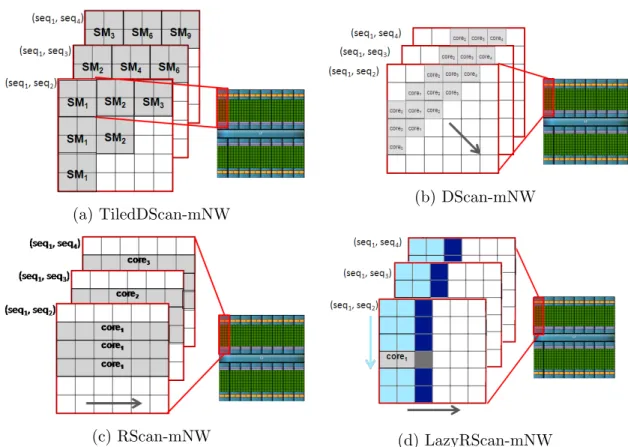
Figure 2.1: Exemplification of our 4 GPU implementations of NW-based parallel pairwise alignments and of the mapping to the underlying GPU cores and SMs. In TiledDScan-mNW, the alignment matrices are tiled, and each tile is processed by a thread-block (and mapped onto a SM). In DScan-mNW, every alignment ma-trix is processed by a thread-block (and mapped onto a SM). In RScan-mNW and LazyRScan-mNW, every alignment matrix is processed by a thread (and mapped onto a core). However, in LazyRScan-mNW, every thread only writes to the global memory the last column of each slice (denoted by darker blocks).
In this Section we describe four alternative implementations of multiple pairwise alignments using NW on GPUs: TiledDScan-mNW, DScan-mNW, RScan-mNW and LazyRScan-mNW. All these implementations, exemplified inF igure2.1, aim to
over-TiledDScan-mNW: Multiple alignments with tiling
The first method (TiledDScan-mNW) is a directed extension of Rodinia-NW to multi-ple pairwise alignments. This approach still uses tiling and operates in diagonal strip manner, performing multiple kernel invocations to compute the alignment matrices. However, for each kernel invocation, multiple alignment matrices are concurrently processed using different thread-blocks (and SMs). This is illustrated inF igure2.1a, where we concurrently perform three pairwise comparisons: (seq1, seq2), (seq1, seq3) and (seq1, seq4). In the first iteration, the top-left tiles of the three matrices are processed in parallel by three thread-blocks, and thus mapped onto three stream-ing multiprocessors: SM1, SM2 and SM3. In the second iteration, the tiles of the second minor diagonal of the three matrices are processed in parallel by six thread-blocks, and thus mapped onto streaming multiprocessors SM1-SM6. Note that, for m pairwise comparisons, the number of kernel invocations of TiledDScan-mNW is re-duced by a factor m (as compared to Rodinia-NW); for each kernel call, the number of thread-blocks is increased by a factor m. This has two advantages: (i) a limited kernel invocation overhead, and (ii) an improved GPU utilization. Execution configu-rations with a large number of threads allow not only exploiting all the SMs and cores available on the GPU, but also hiding the global memory access latencies (and NW is a memory-intensive application). Being an extension of Rodinia-NW, TiledDScan-mNW retains its advantages: regular computational patterns and coalesced memory access patterns when storing alignment data from shared memory to global memory.
DScan-mNW: Single-kernel diagonal scan
TiledDScan-mNW still requires multiple kernel invocations to perform m pairwise alignments. Even if the parallelism within each kernel call is improved by a factor m compared with Rodinia-NW, some kernel invocations still exhibit limited parallelism
(and limited opportunity to hide memory latencies). Our second implementation DScan-mNW performs a diagonal scan with a single kernel call. As illustrated in F igure 2.1b, in this case each alignment matrix is assigned to a thread-block (and mapped onto a SM). No tiling is performed. The computation iterates over diagonals. For each diagonal, every element is processed by a thread (and mapped onto a core). To limit the number of expensive accesses to global memory, the computation is fully performed in shared memory. The alignment matrix is stored in row-major order in global memory and in minor diagonal order in shared memory. According to equation (1), at each iteration three diagonal lines are required: the first two diagonal lines cache previous data and the third one contains the newly computed elements. Once computed, this third line can be copied from shared to global memory. At that point, the first diagonal line can be discarded and the shared memory reused for the next iteration. To summarize, the matrices are created in shared memory and moved to global memory diagonally. The main disadvantage of this approach is the uncoalesced memory accesses required to store diagonal data to global memory. We found that the latencies of such irregular access patterns can be effectively hidden by using large numbers of threads.
The computational pattern of our DScan-mNW is similar to the SW intra-task parallelization proposed by Liu et al. [77]. However, [77] avoids uncoalesced memory accesses by storing the alignment matrix in global memory in minor diagonal order. We found that, when using large thread-blocks to hide memory latencies (e.g., 512 threads/block), the overhead due to uncoalesced memory access patterns is reduced to 10% and 7% of the execution time on Fermi and Kepler GPUs, respectively (the exact percentage depends also on the clock-rate of the memory system). On the other hand, storing the alignment matrix in row-major facilitates the trace-back operation (which is not considered in [77]) in two ways: first, it avoids the need for complex index translation; second, the more regular data layout leads to better caching properties.
RScan-mNW: Row scan via single CUDA core
Our third method RScan-mNW uses a fine-grained matrix-to-core mapping and a row-scan approach. First, each alignment matrix is computed by a single GPU core. Second, to allow regular compute and memory access patterns, each alignment matrix is computed row-wise (rather than diagonal-wise). This computational pattern is illustrated in F igure 2.1c.
This method leverages shared memory in order to allow data reuse and mini-mize the global memory transactions. The parallel kernel iterates over the rows of the alignment matrices. For each iteration, only two rows per matrix must reside in shared memory: the previously computed one and the one containing newly com-puted elements. Only the left-most element of the new row must be loaded from global memory; for the rest, the computation happens solely in shared memory. Once the new row has been computed, it is copied from shared to global memory. The previ-ously computed row can be discarded, and the new one can be cached for use in the next iteration. The kernel has two phases: computation and communication. In the computation phase, the threads within a thread-block operate fully independently: each thread computes the data corresponding to the row of an alignment matrix and stores them in shared memory. In the communication phase, threads belonging to the same thread-block cooperate to transfer row data from shared to global memory in a coalesced fashion (that is, each alignment matrix is transferred cooperatively by multiple threads). In case of very long sequences, rows are split into slices so as to fit into shared memory. The size k of these slices is configurable. Large slices require more shared memory, which in turn limits the number of active threads on each SM. Small slices (e.g. k < 32 elements) lead to warp underutilization in the communica-tion phase, which in turn can hurt the performance. The usage of shared memory is a major concern in the kernel configuration process. The per-block shared memory can be calculated using the following formula:
shmem =BLOCK SIZE×k×(1char+ 2ints)
Each thread stores three sets of data: the sequence data and two sections of the alignment matrix. Each thread-block performs BLOCK SIZE pairwise alignments using slices of size k. By setting the BLOCK SIZE and k to 32, we use 12KB of shared memory with no warp underutilization. With this setting, each SM can concurrently run up to four thread-blocks.
The advantages of this approach are twofold. First, the computational pattern is extremely regular: unlike diagonals, rows are all of the same size. Second, data trans-fers between shared and global memory are naturally coalesced. The main drawback to this approach is that the parallelism is limited by the GPU memory capacity. For example, if the sequences to be compared are of length 2,000 and the alignment ma-trices contain 4-byte integers, then each matrix will be of size 32MB. To fully utilize the cores of typical GPUs (say 480 cores), we should allow 480 parallel pairwise com-parisons, requiring a total of roughly 15GB of memory. This number considerably exceeds the 1-5GB of memory present on most GPUs. Therefore, on long sequences RScan-mNW will tend to underutilize the GPU resources. On the other hand, this approach is very promising for short sequences (e.g. < 500). For long sequences, an alternative optimization would be to break the alignment matrices into smaller strips to reduce the memory footprint, and use dual-buffering to move previously computed strips to the CPU while computing new ones. Finally, we note that certain scor-ing schemes allow for linear memory NW algorithms of minimal complexity: under these limited and less-commonly used schemes, highly efficient parallelism could be achieved using RScan-mNW.
The computational pattern of our RScan-mNW is similar to the SW inter-task parallelization proposed by Liu et al. [77]. However, their proposal does not use shared memory in the kernel and adopts a different data layout in global memory. Specifically, to avoid uncoalesced global memory accesses, Liu et al. place data
cor-responding to different alignment matrices into continuous global memory space. For instance, theith element of global memory is from theith alignment matrix, while the (i+ 1)th element is from the (i+ 1)th alignment matrix. This memory layout leads to poor data locality during the trace-back phase. As mentioned above, trace-back is not considered in [77], but is a necessary operation in the problem we consider.
LazyRScan-mNW: Whole matrix calculation via single CUDA
core with lowered global memory requirements
Figure 2.2: Pseudo-code version of LazyRScan-mNW.
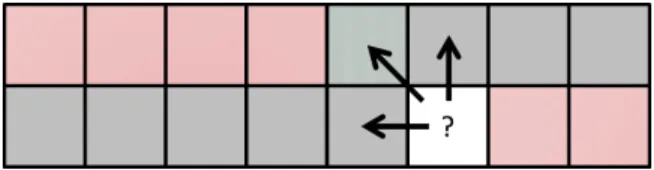
Figure 2.3: Storing in shared memory a hybrid row consisting of cells belonging to two contiguous rows allows saving half of the shared memory required for row calculation. As computation (white cell) progresses from left-to-right horizontally, obsolete cells (cross-hatched in red) are gradually evicted from shared memory. To complete the computation, only the solid grey cells as well as an interim diagonal look-back value (denoted with the zig-zag pattern) are required. The diagonal loopback value is stored in a register.
The three aforementioned methods share the same problem: the maximum num-ber of alignments that can be computed in parallel is limited by the amount of global memory. As discussed, this limitation is particularly significant in the case
of RScan−mN W, where each alignment is mapped onto a GPU core. In this case, the limited number of alignment matrices that can be accommodated in the available global memory leads to severe core underutilization. However, several applications only require the actual sequence alignment (computed through the trace-back opera-tion) only for a subset of the pairs in the dataset. For these applications, it is possible to record only the alignment score (rather than the whole alignment matrix). This score can then be used as a filter to avoid performing unnecessary trace-back opera-tions on sequence pairs that are too dissimilar. Exactly such a requirement spawned our initial interest in this topic namely computing all possible pairwise comparisons among a large number of sequences but retaining only those with a high level of sim-ilarity. In this case, the lack of the need to have the whole alignment matrix stored in global memory makes it possible to derive a method that can make full use of the computational power of the GPU cores.
With this relaxed requirement in mind, LazyRScan−mN W optimizes our row-scan approach (Rrow-scan-mNW) so as to minimize global memory reads and writes and at the same time make better use of the shared memory available on the streaming multi-processors. The new method is based on the following insight: much of the information in one slice of an alignment matrix can be discarded safely during the computation of that slice. LazyRScan-mNW is extremely frugal about global memory usage, and avoids accessing global memory whenever possible. The computational pattern is illustrated in Figure 2.1d and presented in the pseudo-code in Figure 2.2.
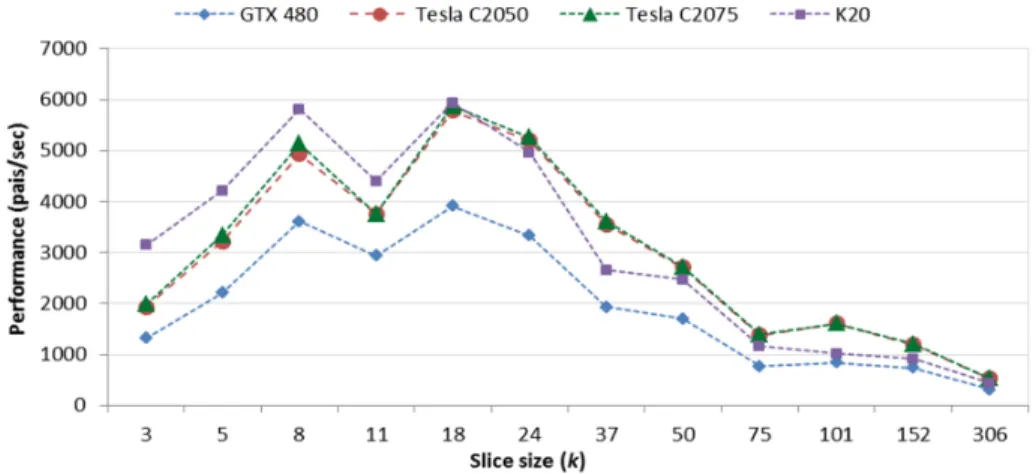
Similarly to RScan-mNW, in order to effectively use shared memory even in the presence of long sequences, LazyRScan-mNW divides the alignment matrix into ver-ticalslicesofk columns each. However, when copying the scores into global memory, this method only retains the scores in the last column of each slice (and discards the other scores). For each matrix, the computation of the next slice resumes where the last one left off, by taking the stored rightmost scores of the last computation as its
leftmost columns scores. Given the leftmost column’s scores, each iteration of verti-cal slice can compute the rightmost column’s scores by performing the standard NW computation. Thus, by carefully selectingk(see section 2.5.3), we reduce the number of write operations to global memory. Computing a slice of width k and height l requires 2l global memory operations (l reads and l writes). In addition, for each matrix, the global memory requirement is limited to l scores, and the shared mem-ory requirement is linear in k. Limiting the shared memory utilization allows more thread-blocks to be executed in parallel, thus hiding global memory access latencies. We further reduce the shared memory usage of each vertical slice by implementing an optimization suggested by Myers and Miller [87]. Specifically, instead of storing in shared memory two distinct rows (the current and the previously computed one), we store a hybrid row obtained by progressively overwriting the last computed row with the current one. This method requires recording an additional interimdiagonal look-back value, representing the conflicted array element that would otherwise be overwritten by the next row’s value. We store this additional value in a register. Figure 2.3 illustrates the optimization.
LazyRScan-mNW inherits all the advantages of RScan-mNW as well as some ad-ditional benefits. First, each thread only requires a linear amount of global memory. Thus, the global memory required will be equal to batch size×l integers, where l is the length of the longest sequence, and batch sizethe number of pairwise alignments computed in parallel. Second, instead of reading and writing to global memory at every cell, the method reads and writes to global memory once every k cells. This allows the GPU scheduler to alternate between warps that are performing calcula-tion and warps that are waiting on memory accesses, thus better hiding the latency between global memory accesses. Third, the amount of shared memory required to store the scores is halved using the optimization described above.
align-Method Global memory Per-block shared memory
Rodinia-NW batch size×2l2 ints 2k2 ints TiledDScan-mNW
batch size×l2 ints
k2ints + 2k chars
DScan-mNW 3l ints + 2k chars
RScan-mNW (2k ints + k chars) ×block size
LazyRScan-mNW batch size×ints (k ints + k chars) ×block size Table 2.1: Global and per-block shared memory requirements for different methods (the amount of storage needed for actual sequence data is not accounted for in global memory usage). A batch is a set of pairwise alignments processed in parallel on the GPU.
ment matrix, making the trace-back operation challenging. LazyRScan-mNW is therefore more suitable to applications that require the trace-back to be calculated only for a subset of the sequence pairs (for example, those with a similarity score above a predefined threshold).
Comparisons of memory usage between different methods
Table 2.1 summarizes the global and per-block shared memory usage of the described methods. In the table, batch size is the number of pairwise alignments computed in parallel, l is the length of the longest sequence, and k denotes the slice size, and is a configurable value smaller thanl.2.4
Design optimizations
Pinned memory - Generally there are three stages on a GPGPU computation. First, the initial data will be copied from the host to the device’s global memory. Then, the CPU will launch the kernel, allowing the calculation of the results on the device. After this operation finishes, the data will be copied back to the host memory. With pageable memory, the memory copy operations contribute a significant fraction of the time of the GPGPU computation due to the mandatory involvement of the
CPU, as memory allocated on the host may not be physically present and thus may require swapping. Pinned memory guarantees that the memory allocated is always physically present in the host’s physical RAM. Pinned memory therefore can provide significant speedups to device-and-host memory transport, as the GPU can handle the transfer using its DMA hardware capabilities without the involvement of the CPU. This approach has two potential advantages. First, the copy operation on pinned memory is usually much faster than for pageable memory [115]. Second, the CPU only needs to pass the list of physical pages to the driver and is then free to do other work.
Figure 2.4: Exemplification of dual-buffering.
Dual-buffering - Dual-buffering is a common scheme for reducing overhead by overlapping communication and computation. It requires that a non-blocking com-munication mechanism is provided by the system. In our system, there are two main operations that are time-consuming but can be executed concurrently: kernel calls to calculate the alignment matrix, and the memory copy operation to transfer the calculated alignment matrix from device’s global memory back to the host’s memory. Dual-buffering is employed in order to ensure mutual exclusion in the access to the two alignment matrices, one of which is being calculated and one copied. The result is that the kernel always works on half of the available memory, leaving the other half the buffer that is already fully calculated free to be transferred back in a non-blocking manner. By using dual-buffering, we can further exploit the concurrency offered by the GPU, by interleaving the two operations (Figure 2.4). To implement dual-buffering, we used asynchronous pinned memory operations and CUDA streams.
Global memory access pattern optimization Parallel threads in CUDA are grouped into thread-blocks, and the GPU coalesces the global accesses into as few
transactions as possible. Misaligned memory operations cause delays in the compu-tation as some threads have to wait for the misaligned reads to complete. This issue however, can potentially be minimized. In the LazyRScan-mNW implementation, global memory reads and writes on the same position on different matrices of consec-utive threads are also consecconsec-utive, enabling the hardware to perform memory access operations in a coalesced fashion.
Caching global memory reads into shared memory Global memory is needed to store the sequences, however reading the sequences from global memory is an expensive operation. In (Lazy)RScan-mNW, each slice of sequence of width k has a relatively small number of bases that need to be repeatedly accessed and compared against the other sequence. Thus, we avoided reading the slice sequence from global memory by caching the whole slice up front in shared memory. Given that, in the inner loop (Figure 2.2, line 6), each base of the slice is then repeatedly compared to one base from the other sequence, the base belonging to the other sequence could also be cached up front to reduce global memory read latency.
Device-to-host data-level optimization In the case of SlicedRScan-mNW, it is possible to transfer only the final score instead of the whole alignment matrix, largely eliminating the device-to-host transfer latency. In order to allow this simpli-fication, we derive a lower bound L on the potential alignment score with a given percent identity. As an aside, the percent identity statistic is a reasonable indicator of sequence relatedness and is commonly employed in the biological literature. Our bound guarantees that all pairs having identity score at least as high as our threshold level are realigned and the trace-back computed on the CPU. Given identity score target MID (0< MID <1) and two sequences of length m and n (where m > n), L is given by:
L=m×MID×Smatch×2×m×Sgap×(1MID)
GPU Type Type Values
Low-end GPU Quadro 2000 4 SM x 48 cores 1 GB Global memory Low-end GPU GTX 460 7 SM x 48 cores
1 GB Global memory Low-end GPU GTX 480 15 SM x 32 cores
1.5 GB Global memory High-end GPU Tesla C2050 14 SM x 32 cores
2.6 GB Global memory High-end GPU Tesla C2070/C2075 14 SM x 32 cores
5 GB Global memory High-end GPU Tesla K20 13 SM x 192 cores
4.7 GB Global memory Table 2.2: Characteristics of the GPUs used in our evaluation.
a gap (recall we are using linear gaps). For the required percentage identity is to be achieved, we must have at leastm×MID positions that match. The worst case of an alignment with such a percent identity is then that all of the remaining positions are gaps (Sgap), giving us our value of L.
2.5
Experimental setup and evaluation
2.5.1
Experimental setup
Hardware setup Single GPU experiments have been performed on a variety of low-end and high-end GPUs, listed in Table 2.2.
Software setup The CUDA 5.0 driver and runtime are installed in all the machines used. The OS in use on the high-end cluster is CentOS5.5/6 with g++4.1.2; the OS in use on the low-end cluster is Ubuntu 12.04 with g++ 4.6.3. We used MPICH2 (version 1.4.1p1) as the implementation of MPI. Each data point represents the average across 3 executions.
from the Ribosomal Database [23]. The sequences are on average 1,536 bases long.
2.5.2
Performance on single GPU for general use cases
Our first set of experiments is meant to evaluate our GPU implementations and com-pare them with NW. In Section 2.2.3 we noted two limitations in Rodinia-NW: unnecessary memory transfers from CPU to GPU and inefficiencies in the com-putational kernel and its invocations. Below, we will show how we improve perfor-mance with respect to both limitations.
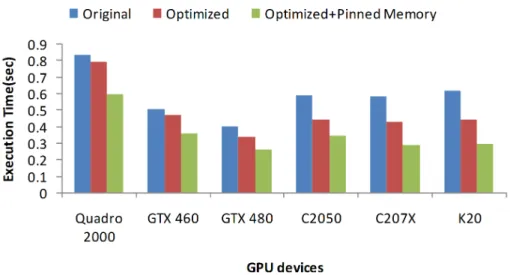
Figure 2.5: Evaluation of memory optimizations on Rodinia-NW: original implemen-tation, optimized implementation with initialization of the alignment matrices on GPU, optimized implementation with pinned memory.
Memory Transfers: As explained in Section 2.2.3, Rodinia-NW initializes the alignment matrix on CPU and copies it to GPU. Also, to simplify memory access dur-ing computation, it creates a temporary substitution score table of sizem×n during CPU initialization. For problems of the size considered, data transfer consumes con-siderable amount of time. An obvious optimization is to move the initialization from CPU to GPU. In addition, by omitting the creation of the temporary substitution table, more alignment matrices can be accommodated on the GPU, thus allowing
on different GPUs. In all experiments, 64 pairwise alignments are performed. The optimized version initializes the alignment matrices on GPU and avoids the initial CPU-to-GPU data transfer. On top of this, the optimized + pinned memory version uses pinned memory. As can be seen, the proposed memory optimizations lead to a 5-10% and a 20-25% decrease in execution time on low-end and high-end GPUs, respectively. In addition, the combination of the memory optimization with the use of pinned memory leads to a decrease in execution time in excess of 30% and 50% on low-end and high-end GPUs, respectively.
(a) TiledDScan-mNW (b) DScan-mNW
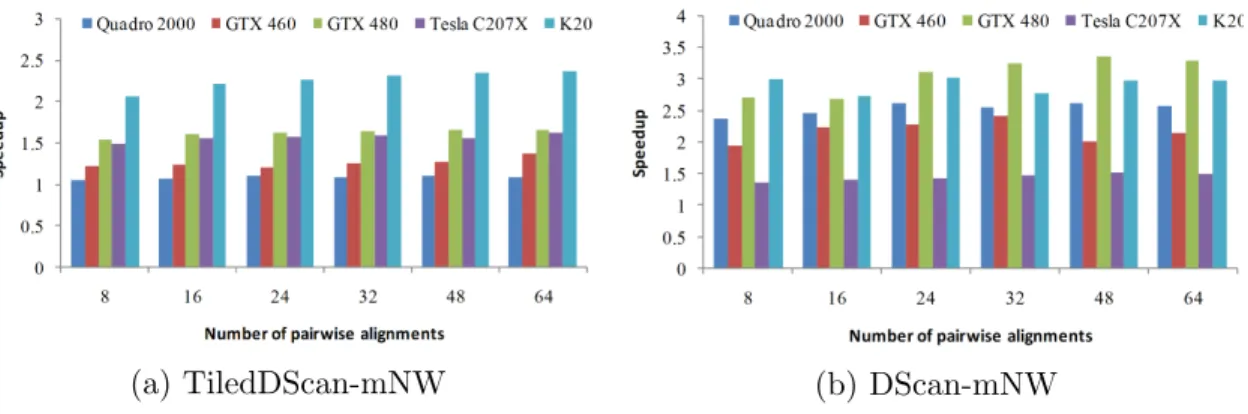
Figure 2.6: Kernel speedup over Rodinia-NW.
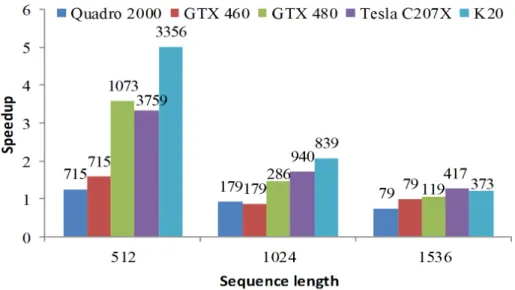
Kernel computation: We now focus on the performance of our compute ker-nels. Our analysis has two goals: (i) evaluating the performance improvements over Rodinia-NW, and (ii) devising criteria for selecting the optimal GPU implementation depending on the underlying GPU device. In Figure 8 we show the relative speedup in kernel computation time of DScan-mNW and TiledDScan-mNW over Rodinia-NW (the speedup is computed as the ratio between the compute time of Rodinia-NW and that of our GPU implementations). We performed experiments on all available GPUs and varied the number of pairwise comparisons performed from 8 to 64. Given its fine-grained alignment-to-core mapping, on these datasets RScan-mNW underutilizes the GPUs and reports poor performance. This, in general, holds when comparing long sequences on GPUs with 1-5GB device memory. Therefore, we focus on the other schemes.
Figure 2.6a reports the speedup of TiledDScan-mNW over Rodinia-NW. Note that TiledDScan-mNW performs fewer kernel calls (and therefore, has less kernel overhead) and involves more per-kernel computation (thus leading to increased paral-lelism). This motivates the performance improvement achieved by TiledDScan-mNW over Rodinia-NW. Note that the speedup increases with the computational power of the GPU (from 1.2x on the Quadro2000 to 2x on the K20). In fact, the increased parallelism in the TiledDScan-mNW kernel can be better serviced by GPUs with more SMs and compute cores.
As can be seen in Figure 2.6a, DScan-mNW also outperforms Rodinia-NW on all devices and datasets. Its performance is also generally better than that of TiledDScan-mNW, except on Tesla C207x cards. It is somewhat surprising that our approach does not show substantial speedup over Rodinia-NW on this device. It must be said that NW is an integer application, and Tesla GPUs are optimized for larger memory capacity (5GB vs. 1GB) and improved support for double precision floating point operations, but have a reduced clock rate (1.15GHz vs. 1.4GHz in GTX 480 cards, for example). We believe that the high number of uncoalesced memory accesses performed by DScan-mNW may motivate the poor performances on Tesla C207x cards, which have a slower memory clock.
Figure 2.7 reports the speedup of RScan-mNW over Rodinia-NW on sequences of different lengths. The number of pairwise comparisons performed in each experiment is reported on top of each bar (all experiments have been configured so to use 70% of the global memory capacity). As mentioned in Section 2.3, in RScan-mNW each core computes an alignment matrix: in order to fully utilize the computational resources of the GPU, RScan-mNW needs to perform a large number of parallel sequence align-ments. This leads to pressure on the global memory capacity: for long sequences, the GPU global memory becomes the bottleneck, and the performance of RScan-mNW is penalized. RScan-mNWs performance improves when the length of the sequence
Figure 2.7: Kernel speedup of RScan-mNW over Rodinia-NW on sequences of various lengths. The numbers on the bars represent the number of pairwise alignments on the device for each experiment.
decreases: in the case of shorter sequences, the global memory can accommodate more alignment matrices, thus leading to higher utilization of the GPU cores. In particular, on 512-base sequences, RScan-mNW gives a speedup over Rodinia-NW up to a factor 5x.
In general, Figure 2.6 and 2.7 show that DScan-mNW and TiledDScan-mNW are preferable to RScan-mNW on the 1,536-base sequences in the 16S rDNA gene dataset. In addition, these results show that our methods overcome inefficiencies of Rodinia-NW, and suggest that DScan-mNW is preferable on all devices except Tesla C207x. On such cards, TiledDScan-mNW provides better performance. This finding will be used to configure our GPU-workers. As next step, we want to determine how to size the amount of work that each GPU-worker should pull from the GPU-dispatcher to operate at full capacity. In fact, we want to fully utilize the GPUs present in the system. The number of pairwise comparisons that can be performed concurrently on each GPU is limited by its memory capacity. We configured each GPU to operate with its global memory 75% full. For the sequence lengths being considered, this leads to 79, 79, 119, 208, 417, and 372 parallel alignments on Quadro2000, GTX460,
GTX480, Tesla C2050, Tesla C207x and K20 GPU, respectively.
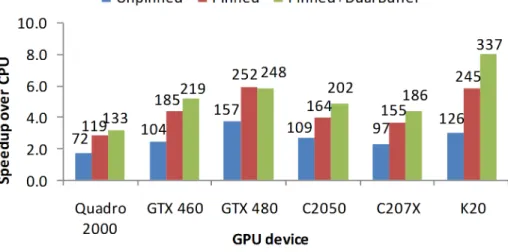
Figure 2.8: Speedup reported by DScan-mNW over an 8-threaded CPU implementa-tion running on the 8-core CPU on Node-4. The numbers on the bars represent the processing throughput (number of pairwise alignments/sec).
Figure 2.8 shows the speedup reported by Dscan-mNW over an 8-threaded OpenMP implementation running on the 8-core CPU on Node-4 (2 x Intel Xeon E5620, 2.4 GHz, 48 GB RAM and 4 x GTX 480). The numbers on each bar represent the throughput in number of pairwise alignments/sec. For each GPU, we performed three experiments: one using unpinned memory, one using pinned memory, and one using dual-buffering. We first define an “optimal batch size” bSIZE for a particular GPU to be the number of simultaneous alignments that can be performed given the device memory (as above). For the first two versions, we ran analyses consisting of a number of sequences equal to 3×bSIZE in order to effectively time the computation. For dual-buffering, only half of the GPU memory performs alignments at one time, so 6 batches of size bSIZE/2 were timed. The performance was measured as the number of sequence pairs compared per second.
As can be observed from Figure 2.8, switching to pinned memory offers a gain of roughly 1.6x, consistent with previous findings [115]. Not using the OS’s virtual memory system could in principle limit the number of sequences that can be processed
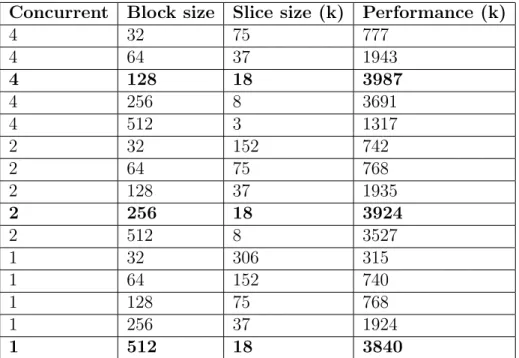
Concurrent Block size Slice size (k) Performance (k) 4 32 75 777 4 64 37 1943 4 128 18 3987 4 256 8 3691 4 512 3 1317 2 32 152 742 2 64 75 768 2 128 37 1935 2 256 18 3924 2 512 8 3527 1 32 306 315 1 64 152 740 1 128 75 768 1 256 37 1924 1 512 18 3840
Table 2.3: Performance of LazyRScan-mNW with different shared memory, block size, and slice size settings. Bold values represent the best results reported for each shared memory configuration.
concurrently. However, our observation is that problem sizes are instead generally limited by the amount of physical memory on the GPU, so we do not consider this CPU-based memory limitation to be a significant disadvantage. The application of dual-buffering along with pinned memory offers an additional average 1.2x speedup, with the exception of the GTX480 system, which does not show significant speedup. We speculate that the reason for this lack of improvement is that the GTX480 has a more restricted handling of CUDA streams, that does not allow the same level of overlapping of memory transfers and kernel computations possible on other devices. In general, it can be observed that even cheap low-end GPUs (like the GTX460 and GTX480) offer throughput in the order of 200-250 pairwise comparison/sec.