Electronic Thesis and Dissertation Repository 8-14-2020 10:00 AM
Formative Space: Literacy Practices in 21st Century Curriculum
Formative Space: Literacy Practices in 21st Century Curriculum
Making
Making
Mary C. Ott, The University of Western Ontario
Supervisor: Hibbert, Kathryn, The University of Western Ontario
A thesis submitted in partial fulfillment of the requirements for the Doctor of Philosophy degree in Education
© Mary C. Ott 2020
Follow this and additional works at: https://ir.lib.uwo.ca/etd
Part of the Curriculum and Instruction Commons, Educational Assessment, Evaluation, and Research Commons, Elementary Education Commons, Language and Literacy Education Commons, and the Social and Philosophical Foundations of Education Commons
Recommended Citation Recommended Citation
Ott, Mary C., "Formative Space: Literacy Practices in 21st Century Curriculum Making" (2020). Electronic Thesis and Dissertation Repository. 7174.
https://ir.lib.uwo.ca/etd/7174
This Dissertation/Thesis is brought to you for free and open access by Scholarship@Western. It has been accepted for inclusion in Electronic Thesis and Dissertation Repository by an authorized administrator of
ii
Partnerships for 21st Century learning support curricular reforms for global,
cross-disciplinary competencies that will leverage and benefit education technologies. However, this research partnership with a literacy program developer occasioned an opportunity to study curriculum making in the 21st century that did not make assumptions about
technologies and competencies. The integrated thesis based on this project pushes boundaries on how assessment and curriculum making are conceptualized by exploring broader
questions of inquiry and participation through literacy and assessment practices in six junior elementary classrooms in Ontario, Canada, over a two-year period. Chapter 1 provides the background and purpose of the study in inviting teachers to re-design the literacy program with the students and pedagogical resources in their classrooms. Chapter 2 details the
methodology of video inquiry, making contributions to narrative, collaborative, multimodal, and sociomaterial approaches to researching practice. Chapter 3 explores the participation of space, time, and material in curriculum making through the concept of spatial topology. Chapter 4 extends this consideration of relational space to literacy and assessment practices. This paper challenges and adds complexity to the discourse on 21st Century learning
regarding cross-disciplinary competencies, by showing how closed and open questions in assessment and literacy practices perform disciplinary spaces for making meaning. While Chapters 3 and 4 focus more on intentionality and materiality in curricular design and enactment, Chapter 5 studies the immateriality of affect in curriculum making, and how agencies of the unintended effect emergent practices. The integrated work has implications for curriculum makers to attend to and participate with more than human actors in practices of curriculum making, and the role of inquiry and improvisation in making space for disciplinary practices.
Keywords
Literacy, Assessment, Curriculum, Pedagogy, Practice, Sociomaterial, Video inquiry, Narrative inquiry, 21st Century learning, Google, Elementary education
iii
How is learning practiced in elementary education in the 21st century? What forms of assessment and literacies are needed? What participates in curriculum making? These are questions about practice, inquiry, and participation that explore the agency of human and more than human actors in learning through a study of curriculum making in the 21st century. The context for the study was an invitation to educators to re-design the lesson materials and assessment practices in a literacy program. This thesis is the result of work with six, junior elementary classrooms in Ontario, Canada. In order to participate collaboratively in these classrooms, the research was designed to be open-ended and respond to different literature as needed. For this reason, Chapters 3, 4, 5 can be read in more of a “choose your own
adventure” style, both topically and theoretically. If you want to learn more about
sociomaterial notions of practice, turn to Chapter 3, “Seeing Double,” to see the limits to human agency in curriculum making. This chapter also takes a second look at empathy, “one of those things we’re supposed to be teaching you to be good at” (teacher participant) in the 21st Century Learning narrative. If you are interested in any or all of the following: formative assessment, literacy education, or cross-disciplinary learning, skip ahead to Chapter 4, “Assessment in 21st Century Learning.” Here you will find theories from sociomaterial and posthuman orientations that may challenge the boundaries of these topics when you see them as boundary-making. If you are interested in affect, embodiment, or complexity thinking, you will find ideas to play with in Chapter 5. And if you are hoping to learn more about
technology in 21st Century education, this chapter considers how to tend to the “Magic and Monsters” made in practices with Google, contributing a more complex understanding of collaborative learning. Integrating (embodying) this research, the chapters in the thesis can also be read chronologically to tell my story as a researcher using narrative and video
inquiries for studying multimodality and sociomateriality in literacy curriculum making, with implications for understanding the entanglement of inquiry with practice.
iv
I am responsible for the conceptualization and writing of all chapters in this thesis. Overall 95% of the literature review and the writing is mine. Chapter 2 (Ott, 2020) is an individual methodological contribution based on my work developing video inquiry. However, this program of doctoral research takes place within a broader research study initiated by Dr. Kathy Hibbert with multiple research partners from different institutions. As lead research assistant at Western on this project, I was responsible for updating the ethics application and letters of information and consent following the first study, applying to research in two school boards, recruitment of participants, coordinating the work of other research assistants, and leading data analysis through video inquiry in Chapter 3 (Ott, MacAlpine, & Hibbert, 2018). The participation of Kelly-Anne and Kathy in the data analysis is acknowledged throughout this chapter, but I would like to recognize here Kathy’s contribution to writing part of the conclusion. Dr. Hibbert has continued to contribute through her roles as supervisor and principal investigator by providing guiding comments, questions and revisions to
Chapter 4 (Ott & Hibbert, 2020) and Chapter 5 (Ott et al., forthcoming). My committee member, Dr. Rachel Heydon, and collaborator, Jenny Kassen, contributed key concepts about monsters to Chapter 5 (Ott et al., forthcoming).
v
I acknowledge, with gratitude and responsibility, that “I” am the result of relationships, and one of the most significant is to this place and all its peoples. My relations of privilege as a settler in London and student at Western University are enacted on traditional lands and through treaty relations with the Anishinaabek, Haudenosaunee, Lūnaapéewak and Attawandaron peoples. I acknowledge historical and ongoing injustices that Indigenous Peoples endure in Canada and accept responsibility as a public educator toward correcting miseducation and renewing respectful relationships with Indigenous communities through my teaching, research and community service.
I further acknowledge that this study was made possible through a Canadian Social Sciences and Humanities Research Council (SSHRC) Partnership Development Grant, and also supported by a Joseph Armand Bombardier Canada Doctoral Scholarship. I am deeply grateful to our partners in this work: QWILL Media and Education, Lois Burdett, members of the researcher team, and the teachers and students who participated in this study. You were all so generous with your time, resources, and insights.
Some of my relations – the most precious to me – are the result of being seen, valued, nurtured, loved. I am here through the loving support of my husband, Dr. Michael Ott, and our children, Cate and Ally. Thank you for making time and space so that I may share with others some of the things you give and teach to me.
To my mother, Dr. Marjorie Cooper, thank you for all you’ve done to help me “notice
noticing.” My research in education would never have begun without your loving persistence calling me into the practice. To teachers, friends and colleagues in the Faculty of Education: Rachel, Jill, Jess, Kelly, Mel, Lin, Yin, Amber, Jenny, Naj – what great fun and privilege it has been to learn with and from all of you.
To my supervisor, Dr. Kathy Hibbert, your ability to realize potential in others is something I strive to emulate. Thanks to you, I have a much stronger understanding of how and why this matters. The opportunities you have given me to teach and to research are far more joy than struggle. Thank you for mentoring me. I hope you always will.
vi
ABSTRACT ... II SUMMARY FOR LAY AUDIENCE ... III CO-AUTHORSHIP STATEMENT ... IV ACKNOWLEDGMENTS ...V TABLE OF CONTENTS ... VI LIST OF FIGURES ...X LIST OF APPENDICES ... XI CHAPTER 1 ... 1
1 INTRODUCTION: STORIES IN PRACTICE... 1
1.1 ASSESSMENT NARRATIVES ... 2
1.2 CURRICULUM MAKING ... 3
1.3 RESEARCH PUZZLES ... 4
1.4 STUDY SANDBOX ... 5
1.5 ORGANIZATION OF THE THESIS... 7
1.5.1 Chapter 2 ... 8 1.5.2 Chapter 3 ... 8 1.5.3 Chapter 4 ... 8 1.5.4 Chapter 5 ... 9 1.5.5 Chapter 6 ... 9 REFERENCES ... 10 CHAPTER 2 ... 12 2 PERFORMING FIELDTEXTS ... 12 2.1 INTRODUCTION ... 12 2.2 NARRATIVE INQUIRY ... 13 2.3 QUESTIONS OF MATERIALITY ... 14
2.4 ENTERING THE STORY ... 14
vii
2.4.3 Movement 3: Re-storying ... 22
2.5 CONCLUSION... 25
REFERENCES ... 28
CHAPTER 3 ... 30
3 SEEING DOUBLE: DESIGN AND ENACTMENTS OF A LESSON ON PERSPECTIVE-TAKING ... 30
3.1 INTRODUCTION ... 30
3.2 CURRICULUM MAKING AS DESIGN AND ENACTMENT ... 32
3.3 EMPATHY AND PERSPECTIVE-TAKING ... 33
3.4 METHODOLOGY:RESEARCH AS STORY ... 34
3.4.1 Video inquiry ... 34
3.4.2 Narrative inquiry ... 35
3.4.3 Following the actors: Actor network theory ... 36
3.5 THE LESSON DESIGN:“SEEING IT MY WAY”... 38
3.6 ACT 1 ... 39 3.6.1 Act 1, Scene 2 ... 41 3.7 ACT 2 ... 42 3.8 ACT 3 ... 44 3.8.1 Act 3, Scene 2 ... 44 3.9 DISCUSSION ... 46 3.10 CONCLUSION... 50 REFERENCES ... 53 CHAPTER 4 ... 57
4 ASSESSMENT IN 21ST CENTURY LEARNING: IMPROVISATION AND INQUIRY ... 57
4.1 INTRODUCTION ... 57
4.2 CLOSED AND OPEN QUESTIONS... 59
4.3 KNOWLEDGE AS THE PRACTICE OF INQUIRY ... 60
viii
4.5.1 Field texts ... 62
4.5.2 The literacy program ... 63
4.5.3 Pedagogical narratives in curriculum making ... 64
4.5.4 Participants ... 64
4.6 CASES OF INQUIRY AND IMPROVISATION ... 66
4.6.1 Teacher 1: Improvisation for extending literacies... 66
4.6.2 Teacher 2: Improvisation with material ... 69
4.6.3 Teacher 3: Experimental inquiry ... 72
4.6.4 Teacher 4: Dialogic inquiry... 75
4.6.5 Assembling formative material ... 79
4.7 DISCUSSION:ORCHESTRATION AND IMPROVISATION ... 80
4.7.1 Teacher as orchestra conductor ... 81
4.7.2 Disciplined improvisation ... 82
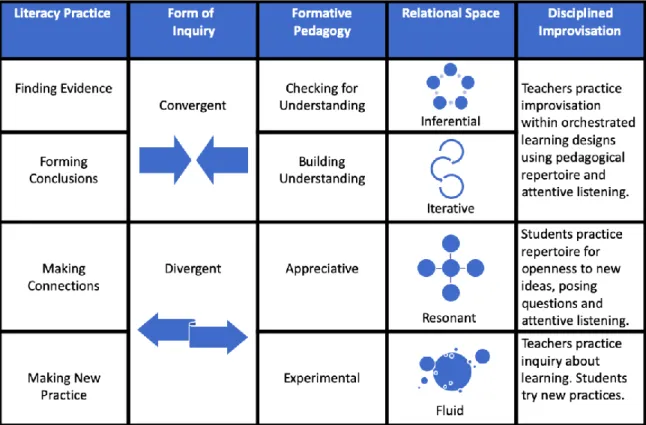
4.7.3 Disciplined improvisation in formative pedagogies ... 83
4.8 CONCLUSION... 86
REFERENCES ... 89
CHAPTER 5 ... 92
5 MAGIC AND MONSTERS: COLLABORATING WITH GOOGLE IN 21ST CENTURY LITERACIES ... 92
5.1 PROLOGUE:21STCENTURY COLLABORATION ... 92
5.2 INTRODUCTION:COLLABORATORS ... 93
5.2.1 Google in education ... 94
5.2.2 Google in elementary literacy education ... 96
5.3 METHODOLOGY ... 98
5.3.1 Posthumanism: more than human, more than material in practice ... 98
5.3.2 Complexity theories: uncertainty in practice ... 98
5.3.3 Participants and data sources ... 99
5.3.4 Cases of collaborating with Google ... 100
ix
103
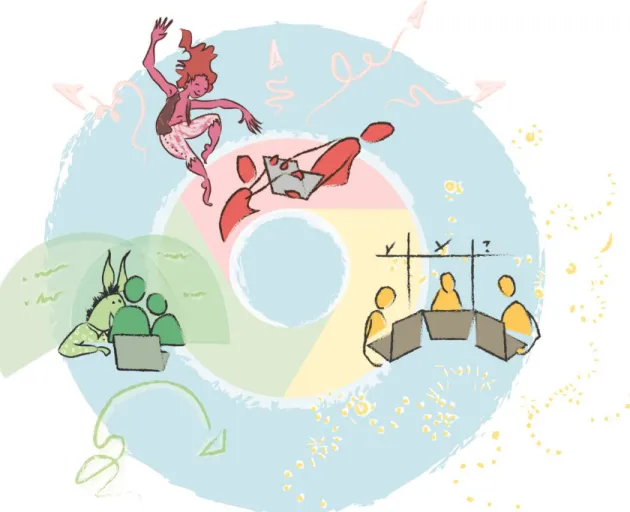
5.4.2 Making sense: Character maps with Chromebooks and Google Docs ... 109
5.5 DISCUSSION:CARING FOR MONSTERS ... 114
5.5.1 Noticing care-fully ... 115
5.5.2 Noticing diffraction ... 116
5.5.3 Noticing bodies ... 116
5.6 CONCLUSION:MONSTERS AND MAGIC ... 117
5.7 EPILOGUE:LOVE IN THE 21STCENTURY ... 117
REFERENCES ... 119
CHAPTER 6 ... 123
6 FORMATIVE SPACE: LITERACY PRACTICES IN 21ST CENTURY CURRICULUM MAKING ... 123
6.1 RE-MEMBERING THE STUDY ... 123
6.2 RE-VISITING THE RESULTS ... 125
6.2.1 Pedagogical narratives and monsters ... 126
6.3 ENVISIONING IMPLICATIONS ... 127
6.3.1 Formative pedagogies ... 128
6.3.2 Not everything we value should be evaluated ... 128
6.3.3 Space, time and matter give dimension to meaning making ... 129
6.3.4 Literacies make worlds ... 129
REFERENCES ... 131
APPENDICES ... 134
... 135
x
List of Figures
Figure 1: Curriculum Sandbox... 5
Figure 2: Connective Tissue ... 20
Figure 3: Formative Space for Learning ... 83
xi
Appendix A Video Inquiry Guide 1... 133
Chapter 1
1
Introduction: Stories in Practice
“There is nothing as theoretical as a good story” (Arthur Bochner, 1997, p. 435). Initiatives for 21st Century learning call for innovative educational models to foster the digital literacies and participatory culture that are the hallmarks of modern competencies. The challenge lies in how to assess these new forms of learning – they have many moving parts. My program of study asks how assessment can support 21st Century learning by leveraging the ubiquity of video technology to provide both students and teachers with multimodal evidence and participatory forms of feedback. When I was an elementary teacher, I provided visual materials to support my
students’ reading. But it wasn’t until I started paying attention to what they were
learning through the images, not just the print, that my understanding of their strengths and next steps was enhanced. The methodology of video inquiry I
developed in my master’s research was exploratory work developing a framework for
teachers to study learning from an asset-oriented perspective and a multimodal data set. The need for teachers to reflect critically on their assessment practices is also forwarded by my conceptualization of assessment as narrative, proposing knowledge about learning is narrated in ways that are mediated by context and power. I set out to explore the affordances of video for doing this kind of work; one of the things I discovered was the affordance of learning collaboratively. But the most pressing question for assessment pedagogy today is how to help students to improve
‘achievement’ by studying their own learning. The implications for my doctoral work
are to investigate the affordances of collaborative video inquiry for teacher with teacher, teacher with students, and peer feedback.
Petra Hendry (2009) taught me that all inquiry is narrative; Arthur Frank that stories are actors (2010). Everything we say is a story to make sense of the world, and everything we do plays out the stories that make our worlds. The problems, characterizations, and explanations of a story are theories of action (Latour, 2005). From the excerpt of my SSHRC doctoral scholarship application in 2017 that opens this chapter, you can infer that I was working through a tangle of assessment with achievement; an approach to critical narrative research, a gesture to – what? Theories of literacy, sociomaterialism? And a move toward more multimodal, participatory methodologies. You can see that I
was a teacher of children, that literacy plays a role; that the problem was, I was not paying attention.
A title sets up a story by encapsulating the problem or foreshadowing the conclusion. To improvise on Bochner (1997), maybe there is nothing so theoretical as a good title. The
title for my thesis proposal was “Participatory Assessment for 21st Century Learning.”
Now in this introduction to the body of work that integrates my thesis, I drop hints about why the title has changed, but I leave the climax for the conclusion. Similarly, I am only dropping hints here about how I conceptualize formative assessment, what I mean by literacy practices, and where I stand on the topic of 21st century learning, because much
of the work of theorizing in this study happens through it (Clandinin, 2016; Latour, 2005). But this thesis is in partial fulfillment of a PhD in Curriculum Studies. I do feel
compelled to answer this one: “What does assessment have to do with curriculum
inquiry?” That was the question a reviewer asked when I submitted a proposal to present
part of my doctoral work at a curriculum conference in 2018.
1.1
Assessment narratives
I began to think about assessment as paying attention when I started my Master of Education degree. I didn’t come into graduate studies wanting to be a researcher or a
scholar – as a teacher I was ready for more, but not sure of what. I enrolled in the
Curriculum Studies program because that’s what teachers do – plan and teach curriculum.
Dillon (2009) divides the field into three queries on the nature, elements, and practice of
curriculum. It’s always been about practice for me. My first course, ‘Introduction to
Curriculum Studies,’ was a rocky trip over the terrain – online and impersonal, I wrote
out my resistance to rethinking my practice with a passive-aggressive candor. But I had my first generative moment when we spent time on the relationship of assessment to
curriculum through A. V. Kelly’s The Curriculum. “The assessment tail will always wag
the curriculum dog,” he wryly observed (Kelly, 2009, p. 148). “I’ve come to believe that it’s more important to plan how we are going to assess, than what we are going to teach,”
teachers to re-vision their practice formatively, inspired by the philosophy of pedagogical documentation (Forman & Fyfe, 2012) and the pedagogy of multiliteracies (Cope & Kalantzis, 2015). This study asked how studying learning multimodally and
collaboratively might change teachers’ “assessment narratives” – the stories they tell
about learners’ strengths, needs, and next steps.
1.2
Curriculum making
I came out of my master’s as a practice-based researcher. The goal of a PhD is to produce
a philosopher of practice. Early on in my doctoral story, I had something of an existential crisis. What do curriculum scholars do? Michael Connelly and Jean Clandinin offered wisdom to me:
We need to listen closely to teachers and other learners and to the stories of their lives in and out of classrooms. We also need to tell our own stories as we live our own collaborative researcher/teacher lives. Our own work then becomes one of learning to tell and live a new mutually constructed account of inquiry in teaching and learning. What emerges from this mutual relationship are new stories of teachers and learners as curriculum makers, stories that hold new possibilities for both researchers and teachers and for those who read their stories. (Connelly & Clandinin, 1990, p. 12)
The theme of inquiry in curriculum making is one of two “connective tissues” (Ott, 2020)
embodying this thesis about formative practice in 21st century literacies. The other is the
fact that the results come from an overarching study initiated by my supervisor, Dr. Kathy Hibbert, about multiliteracies in 21st century learning. Designed as a digital
sandbox for playing with a cloud curriculum and funded by a SSHRC Partnership Development grant with QWILL Media and Education (Quality Writing in Literacy Learning), this research explores how teachers and students make curriculum in the 21st
century as they redesign a literacy program developed in the 20th century by celebrated
children’s author and teacher Lois Burdett (Burdett, 1997; QWILL, 2014). One of the
findings in the pilot study (Ott, MacAlpine, & Hibbert, 2018) was that the assessment rubrics provided in the literacy program did not attend to the depth and breadth of
multiliteracies opportunities in the mentor curriculum (Hibbert, Ott, & Iannacci, 2015), even before the participants made new possibilities.
1.3
Research puzzles
Each findings chapter in this dissertation is designed as a journal article or book chapter that responds to calls for research on 21st Century learning, curriculum making, and
formative assessment. As such, each paper stands alone but is also a chapter in the story. Take note of words like attention and attunement, noticing and narrative across the papers, and you will see a theoretical argument take shape about how inquiry makes space for practice. Questions matter (Ott & Hibbert, 2020).
The research puzzles in my doctoral proposal were:
1) How might students and teachers redesign assessment in participatory ways in the QWILL curriculum?
2) What assessment narratives are composed when teachers, students, and activities are assembled?
These questions were framed as emergent puzzles, because the research was designed to be conducted with participants and therefore responsive to their interests and experiences
(Clandinin, 2016). Guided by Delandshere’s (2002) question about assessment as inquiry,
“What does it mean to know?” my research design signaled a fresh way of thinking about
formative assessment as research, and a contribution to a sociomaterial understanding of who/what participates in knowing. This purpose was introduced by a literature review of
formative assessment summarized in chapter 4, “Assessment in 21stCentury Learning”
and sharpened by the pilot study, included here as chapter 3, “Seeing Double” because it
is germane to my understanding that assessment goes beyond intentionality to materiality.
Seeing double in this way is also the story of chapter 2, “Performing Fieldtexts,” which
describes how the methodology works.
As my research in assessment practices in literacy curriculum making unfolded in participatory ways through approaches to narrative inquiry, video inquiry, and actor
network theory, my guiding question shifted to “How does knowing matter?’ On its own,
chapter 5: “Magic and Monsters” may seem to have nothing to do with formative
assessment, but read as part of the research narrative, it has everything to do with how the final title came to be. Whether I am able to answer my research puzzles or set new ones is the task for the conclusion in Chapter 6. The remainder of this introduction provides a short primer on the participants and theories informing my study, followed by a chronological organization of the chapters.
1.4
Study sandbox
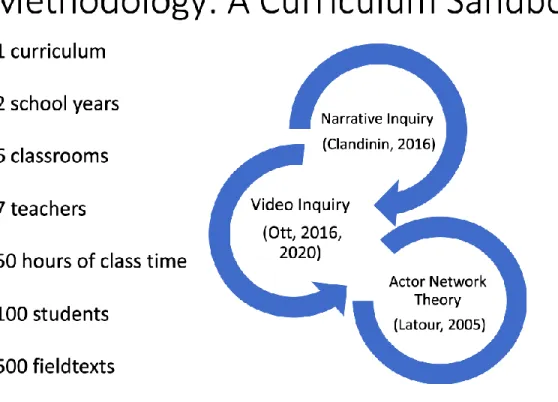
Figure 1 below, “Curriculum Sandbox” paints the study methodology by the numbers. Materialized in this way, without evoking the immaterialities of interest, disinterest, joy, anxiety, passion, sadness, energy, avoidance and play embodying the actors, the
spacetimematter of this study is flattened.
The story of the curriculum we played with – a literacy program based on the mentor text of Shakespeare’s play, “A Midsummer Night’s Dream” is a significant actor in all the curriculum enactments, although one I backstage to foreground new improvisations. Playful, relational work in classroom curriculum making assembled this sandbox, and I am one of the 7 teachers. The ethics of conducting and reporting research apply not only to my research with educational communities on assessment puzzles, but to assessment as inquiry in general, and go far beyond the masking of identities and postures of reflexivity. Participatory research seeks to break down insider/outsider dichotomies by treating the researcher as one of many participants, co-creating and disseminating knowledge in a range of ways, depending on needs and interests. In narrative inquiry, this work is called relational ethics:
As narrative inquirers, we become part of participants’ lives and they part of ours. Therefore, our lives – and who we are and are becoming, on our and their
landscapes – are also under study…Relational ethics live at the very heart,
perhaps are the very heart, of our work as narrative inquirers. (Clandinin, 2016, p. 30)
The ethics of participation in practice is one of the inquiries traced diffractively through this study. While we had institutional research ethics board consent from both Western University and the school boards in which the research was conducted that included consent forms for teachers and parent consent/child assent forms for students (ages 9-12), as an emergent and relational approach to research consent was an ongoing process of negotiation through every research encounter (Ott, 2020). Complicit in this work is an ensemble of onto-epistemological stances which might be described as posthumanism (Barad, 2003), complexity thinking (Davis & Sumara, 2006), and sociomaterial approaches to research (Latour, 2005; Mol, 2002). These methodological orientations afford attention to the complex improvisation of space, time, and matter through practice, and the agency of more than human actors in practice making:
These perspectives share insights about the indeterminacy of knowledge, and the instability of definitions of who counts and what matters, which add much needed complexity and critique to the 21st century learning discourse seeking to
respond to or profit from an indeterminate and unstable world. The terms perform, enact, and assemble can be interpreted synonymously in [this study] but if it is helpful to think with distinctions, ‘perform’ suggests the continual making of practice, ‘enact’ reminds us that there can be multiple versions of a practice, and ‘assemble’ draws attention to the agency of more than social actors
in practice making... Mol and Latour’s work in actor network theory has also been influential to researchers in education for thinking about the ways
different assemblages enact different relational spaces.
‘Relational space’ in this type of work is not only a social metaphor for ways people can relate to one another, as in the teacher-student relationship. More than social, relational space in a topographical, spacetime sense refers to the way that space is made through relations between actors (Mol & Law, 1994). Picture a spider web instead of a circle, or a folded map bringing the far near. (Ott & Hibbert, 2020, p. 3)
1.5
Organization of the thesis
Chapters 2 to 5 were more or less written in the order they appear. Chapter 2 tells the arc of the research story that played out from Chapter 3 to 5. Please note that the published chapters have copyright permission to use author versions of the accepted manuscripts for dissertation. With a few minor tweaks, Chapter 4 is reprinted as is. The publisher style guide required writing “in the objective third person,” but I was able to make some exceptions for the narrative inquiries. Chapter 2 is longer than what made the editor’s cut, because, to borrow an idea from one of the participants in Chapter 3, this is “the story of how I wanted it.” We do a dance with our reviewers too. Chapter 3 is an article published in a European journal, and the editors required that “students” be changed to “pupils” in every case. I joked with my co-author Kelly MacAlpine that every time I read “pupil” now I feel like I am being poked in the eye. It is reprinted here as the author version with the original wording. However, it may be that poking readers in the eye is not such a bad provocation, in a chapter about perspective in a thesis that raises questions about
participation in assessment. The word “pupil” in both senses of its use is a metaphor for the phenomenon that when you look in someone’s eye, you see a tiny, doll-like figure (from the Latin pupa, doll – Merriam-Webster, n.d.). We are in the eyes of our beholders.
1.5.1
Chapter 2
Performing fieldtexts (Ott, 2020) begins with the question: “What am I tuning into, and what am I missing?” and ends with “what are we tuning into?” I describe how my ensemble of multimodal materials and questions about the social and material actors in curriculum making danced in ensemble with other participants, performing fieldtexts. Written for a book on fieldnote practices in education research, this chapter is a
contribution to narrative inquiry because it teases out the material affordances of different kinds of text-making. It also extends my work on video inquiry by describing how it can be used for re-membering, re-visioning, and envisioning practice.
1.5.2
Chapter 3
Seeing double: Design and enactment in a lesson on perspective-taking (Ott, MacAlpine, & Hibbert, 2018) tells the story of three enactments of a key lesson in the QWILL
curriculum about seeing a situation through another’s eyes. Although not about formative assessment directly, this paper introduced key concepts about the topology of curriculum making and the influence of “silent actors” such as graphic organizers, success criteria, rubrics, and assumptions about literacy achievement as not only players in, but directors of literacy practices. The question about how assemblages of students, teachers, and materials compose assessment narratives came through this work, because we saw that purposes and practices of assessment could not be overlooked in curriculum making.
1.5.3
Chapter 4
Assessment in 21st century learning: Improvisation and inquiry (Ott & Hibbert, 2020)
invited teachers to play with literacy and assessment practices in the QWILL Curriculum. The question explored in this chapter is what produced these formative pedgagogies, and how they made space for inferential, iterative, resonant and fluid literacy practices. This chapter contributes to a handbook of formative assessment in education by offering a more complex understanding of assessment as formative pedagogy, and a frame of
reference for understanding the kinds of inquiry work embedded in literacy practices that can help to organize cross-disciplinary 21st century learning.
1.5.4
Chapter 5
Magic and monsters: Collaborating with Google in 21st century literacies (forthcoming)
is my response to two prompts by my committee member, Dr. Rachel Heydon. After I explored materiality in chapter 4, Rachel asked me to consider how immaterialities (Burnett et al., 2014) also matter in assessment and curriculum making. Then, when I told her I was writing a paper to help teachers participate formatively in the kinds of
collaborative practices with Google Docs I observed in the study, she mused, “are we collaborating with a monster?” Chapters 1 and 5 are bookends to the study, with that subtle shift in emphasis to how knowing matters. These chapters draw attention to ways in which fields, texts, researchers, teachers, students, technologies, and other intended and unintended consequences are entangled with and emerge from the im/materiality of inquiry.
1.5.5
Chapter 6
The conclusion to my thesis situates the papers in the different research conversations they contribute to, highlighting theoretical concepts developed through the study and demonstrating implications for further research. My integrated program of research goes beyond literacies and beyond assessments to trace the complexities of inquiry in
References
Barad, K. (2003). Posthumanist performativity: Toward an understanding of how matter comes to matter. Signs, 28(3), 801-831.
Burdett, L. (1997). Shakespeare can be fun: ‘A midsummer night’s dream’ for kids. Richmond Hill, Canada: Firefly Books.
Burnett, C., Merchant, G., Pahl, K., & Rowsell, J. (2014). The (im)materiality of literacy: The significance of subjectivity to new literacies research. Discourse: Studies in the Cultural Politics of Education, 35(1), 90–103.
Bochner, A. (1997). It’s about time: Narrative and the divided self. Qualitative Inquiry, 3(4), 418-438.
Clandinin, D.J. (2016). Engaging in narrative inquiry. New York, NY: Routledge. Connelly, F.M., & Clandinin, J. (1990). Stories of experience and narrative inquiry.
Educational Researcher, 19(5), 2-14.
Cope, B. & Kalantzis, M. (2015). The things you do to know: An introduction the pedagogy of multiliteracies. In B. Cope & M. Kalantzis, Eds., A pedagogy of multiliteracies: Learning by design (pp. 1-36). New York: Palgrave Macmillan. Davis, B., & Sumara, D. (2006). Complexity and education: Inquiries into learning,
teaching, and research. Mahwah, NJ: Lawrence Erlbaum Associates. Delandshere, G. (2002) Assessment as inquiry. Teachers College Record, 104(7),
1461-1484.
Dillon, J. T. (2009). The questions of curriculum. Journal of Curriculum Studies, 41(3), 343-359.
Frank, A. (2010). Letting stories breathe: A socio-narratology. Chicago, IL: University of Chicago Press.
Forman, G., & Fyfe, B. (2012). Negotiated learning through design, documentation, and discourse. In C. Edwards, L. Gandini, & G. Forman, (Eds.), The Hundred
languages of children: The Reggio Emilia experience in transformation (pp.247-271). Oxford: Praeger.
Hendry, P.M. (2009). Narrative as inquiry. The Journal of Educational Research, 103, 72-80.
Hibbert, K., Ott, M., & Iannacci, L. (2015). Co-constructed by design: Knowledge processes in a fluid ‘cloud curriculum.’ In B. Cope & M. Kalantzis (Eds)., A pedagogy of multiliteracies: Learning by design. Melbourne, AU: Palgrave. Kelly, A. V. (2009). The curriculum: Theory and practice (6th ed.). London: Sage. Latour, B. 2005. Reassembling the social. Oxford: Oxford University Press.
Merriam-Webster (n.d.). Pupil [online dictionary definition]. Retrieved on May 21, 2020 from: https://www.merriam-webster.com/dictionary/pupil
Mol, A. (2002). The body multiple: Ontology in medical practice. Durham, NC: Duke University Press.
Mol, A., & Law, J. (1994). Regions, networks and fluids: Anaemia and social topology. Social Studies of Science, 24(4), 641-671.
Ott, M. (forthcoming). Magic and monsters: Collaborating with Google in 21st century literacies.
Ott, M. (2020) Performing fieldtexts. In C. Burkholder & J. Thompson (Eds.), Field notes in qualitative education and social science research: Approaches, practices, and ethical considerations (chapter 8). New York, NY: Routledge.
Ott, M. (2016). Assessment narratives: The affordances of video inquiry for formative assessment of multiliteracies. (Master's thesis). Retrieved from
http://ir.lib.uwo.ca/ (Paper 3651).
Ott, M.,& Hibbert, K. (2020). Assessment in 21st century learning: Improvisation and inquiry. In C. Martin, D. Polly, & R. Lambert (Eds.), Handbook of research on formative assessment in pre-K through elementary classrooms (pp. 346-367). Hershey, PA: IGI Global. doi:10.4018/978-1-7998-0323-2.ch017
Ott, M., MacAlpine, K.A., & Hibbert, K. (2018). Seeing double: Design and enactment in a lesson on perspective-taking. The Curriculum Journal, 29(2), 277-294.
QWILL Media and Education Inc. (2014). Why QWILL. Retrieved from http://viewer.zmags.com/publication/037099ad#/037099ad/1
Chapter 2
2
Performing Fieldtexts
This chapter stories my experience developing a methodology for making fieldnotes using approaches to narrative inquiry and video inquiry. I discuss how I composed texts using smartphone videos and handwritten notes in elementary classrooms over a two-year period. This multimodal ensemble allowed me to document a rich diversity of meaning making in curricular practice. My smartphone became an assistive technology for following participants’ mobile and multisensory actions. However, as this research narrative illustrates, texts are not only design choices about how to compose data in the field. The negotiations of presence and inquiry woven as connective tissues between human and material participants in a research ensemble perform field and text together as embodied entanglements. I offer possibilities for caring for a body of inquiry by seeing with participants to re-member, re-vision, and envision fieldtexts.
Citation for published version of this chapter: Ott, M. (2020) Performing fieldtexts. In C. Burkholder & J. Thompson (Eds.), Field notes in qualitative education and social science research: Approaches, practices, and ethical considerations (chapter 8). New York, NY: Routledge.
2.1
Introduction
November 9, 2016
Classroom 1, Observation 1
When to take notes and when to use video? How to decide what to record and when to stop? How to get best quality for study? I seem to be getting a sense of ‘narrative chunks’ as the lesson plays out. Why and how? What am I tuning into, and what am I missing?
I asked these questions in the first fieldnote I wrote as part of a narrative inquiry about curriculum making as a sociomaterial practice, a study exploring the doings of teachers, students, and materials (Ott, MacAlpine, & Hibbert, 2018). The field work in
this study included making written notes and smartphone video recordings of classroom activities and discussions about the curriculum with teachers and students.
Fieldnotes have a rich disciplinary association with being an anthropologist (Jackson, 2016). But researchers in education tend to select methods suited to our questions, a pragmatic approach that can open us to critiques about unconsciously adopting blind spots from disciplinary modes of inquiry. The anxious tone in my fieldnote is about more than the worry of getting the right kind of data for a research study, it is about the
question of fieldnotes as gaze. What kinds of questions can we answer by sensing multimodally? And how do our perceptions intervene in the world?
Part of the work of this research narrative is to envision possibilities for using a smartphone in field research. But this is not simply a chapter about how to make
multimodal fieldnotes, or what questions they might answer. This story is an exploration of how research performs the field through questions. My first fieldnote marks the beginnings of an inquiry theorizing my fieldnotes as entangled, embodied performances of field with text. To frame this inquiry, I briefly introduce my methodological resources for meaning making: Narrative inquiry and sociomateriality.
2.2
Narrative inquiry
Teachers are more than curriculum takers (Clandinin & Connelly, 1992). My research in curriculum making is situated in narrative inquiry, a methodology developed through research in curriculum as storied experience by Michael Connelly and
Jean Clandinin (1990). Narrative inquiry shares an affinity with ethnographic approaches for spending an extended time researching experience; it also aligns with methodologies taking an ethical stance on research that seeks to be with and for participants
Narrative inquiry has distinct traditions about what fieldnotes are and the work they do. Here, fieldnotes are expanded as field texts to emphasize that field data is composed (Clandinin & Connelly, 2000). Researchers story experience into texts, whether through written notes, recorded sounds and images, or collected artifacts (Connelly & Clandinin, 1990). Field texts are compositional arrangements, made relationally through
negotiations of presence with participants, and made again as meanings of texts are re-storied while researcher and participants inquire with and through them (Clandinin, 2016; Clandinin & Murphy, 2009). However, while narrative inquiry offers rich insights into what it means to compose and inquire about field texts with participants, it provides little guidance as to how different modalities of texts change our ways of knowing. And the focus on human relations in narrative research more generally risks making
assumptions about participation that overlook the agency of other kinds of actors in meaning making (McKenzie & Bieler, 2016).
2.3
Questions of Materiality
My research in curriculum making is also situated in a broader project about curriculum making as sociomaterial practice. Methodologies with sociomaterial orientations seek to answer questions that are overlooked by research that focuses only on social actors and relationships (Fenwick & Edwards, 2013). While diverse in disciplinary and theoretical focus, theorists exploring material agency and relations use verbs such as assemble (Latour, 2005), enact (Mol, 2002), and perform (Barad, 2003) to emphasize that what comes to be described as social, as material, and as practice are not givens but
continual makings. To theorize my practice in making fieldnotes, I bring Barad’s thinking on performative relations (2003, 2007, 2012) into conversation with Clandinin’s (2016) relational approach to composing field texts as the chapter progresses.
2.4
Entering the story
An authentic research narrative (Clandinin, 2016) has the problems, ambiguities, and emotional resonances that allow readers to imaginatively enter an experience and find
opportunities for seeing and doing things differently. Starting with the questions posed in my first note, I story this chapter as three movements of an unfolding methodology, a re-search of my study. In the first movement, I describe my approach to video inquiry (Ott, 2016), using smartphone video recording as an assistive research technology. However, the advantages of composing texts through different research modalities also come with constraints, not only on ways of knowing, but on ways of relating. As my inquiry progressed over time and through different classrooms, I became increasingly aware of the ways that fields and texts are entangled with questions. The second movement illustrates how the relations between human and material participants and inquiries are the connective tissues embodying field and text. This movement explores how inquiry performs field with text. From this point forward, I refer to field and text as becoming together: fieldtext. In the final movement, the story continues from making to
analyzing fieldtexts. I present some of the difficulties foreshadowed by my final question, “what am I tuning into, and what am I missing?” to consider response-abilities (Barad, 2007) for performing fieldtexts.
2.4.1
Movement 1: Assistive research technology
How might different recording modalities assist in making fieldnotes? Anthropologist Jane Burrell (2016) described the affordance of incorporating layers of meaning through images in her approach to cross-referencing fieldnotes, “I found they integrated within their frames great quantities of detail that were not reflected in the [written] fieldnotes” (p. 142). Research in multimodality has explored how different modes for
communication design meaning (Bezemer & Kress, 2008), change meaning as one mode is translated into another (Cowan & Kress, 2017), and expand ensembles for meaning making (Mckee & Heydon, 2015).
In my master’s research, I began exploring how video recordings could attune teachers to the multimodality of learning (Ott, 2016). In education settings, assistive technologies work best when they are simple, accessible, and unobtrusive in use (Peterson & Murray, 2006). I asked teachers to record short videos of learning activities they had questions
about, using familiar personal or classroom technologies, such as smartphones and tablet devices. We then studied these recordings together through multiple viewings, at first by tuning out the sound (Rowe, 2012) to attend to the silent agencies of non-verbal
communication and material resources for meaning making. One of the unanticipated findings was that we sometimes saw actors we did not expect to see pressing into view. Video inquiry can assist the study of layers of modality and a wider frame of reference (Ott, 2016).
The multimodality and accessibility of smartphone video recordings has advantages for composing fieldtexts, as the following vignette from my first classroom observation illustrates:
As I began observing in classrooms for my doctoral work, I planned to write fieldnotes along with recording images and conversations of the teachers and students innovating with the curriculum. There was just one problem. I could write about what was being said, or what was being done. I tried solving this dilemma by placing an audio recorder on a table to record a small group discussion while I took notes. Then the teacher called me over to show me something about a curricular material she wanted to change. As I frantically scribbled in my notebook, she pointed to different parts of a graphic organizer for a writing activity, showing how she would redesign the size and order of the boxes to “give more weight” to the thinking. I held up my hand for a pause: “hold on for a minute – can you do that again?” Raising an eyebrow, she asked, “why don’t you just take a video?” And there was my smartphone in my pocket, ready to assist.
Reviewing the data from this observation with the research team in the curriculum
development project, we noticed two things. First, the video had the teacher’s voice about “more weight” on record. Using the approach of tuning out the sound for video inquiry, we were also able to focus on the silent actors of the other curriculum materials and the use of time in the lesson. By taking a layered approach to attending to these actors through multiple viewings, we saw how materials and time make spatial weight that is productive for generating depth of thinking in writing (Ott, MacAlpine, & Hibbert, 2018). But we also had the audio recorder data, and so we were able to contrast the cacophony of background classroom noise on the audio recording with the clarity of sound in the
video. One of the team members pointed out the higher quality sound filter on my phone. I remembered the affordances of accessible video recordings from my study of video inquiry and added noise filtering to the list.
As my doctoral work moved into the study of curriculum making, I soon discovered that the scratchiest of jot notes could not keep up with the complexity of what I was seeing and hearing, but a video recording would allow me to revisit both modalities. The mobility of smartphone video recording also enabled me to see the (im)mobility of material actors and follow their potential agency in assembling practices (Latour, 2005). I used my smartphone as an assistive research technology to extend my sensory capacities to see, hear, and follow action as I studied curriculum making in different classrooms. It also seemed that the smartphone was no more obtrusive or unwieldy than a notebook and pen. That doesn’t mean accessibility is free from accountability.
Issues of framing and positionality are hardwired in research, from the perspectival technologies of the recording device to the researcher (Haraway, 1988). Turning to the next movement, I take up the question: “When to take notes and when to use video?” by first sharing a vignette based on my classroom observations. I use this vignette along with illustrations to explore how interests in composing texts that were sensitive to classroom practice performed the connective tissues that embody these fieldtexts.
2.4.2
Movement 2: Connective tissue
I began each classroom observation on the margins, positioned by the teacher at the front giving direction to the class, pushed to the edges of the room by the students watching from their desks. I took notes of the date and time, the opening remarks of the teacher, and drew rough maps of the arrangement of desks and technologies in the room, if it was the first time, or if I noticed any changes. I learned to open my senses to the experience, to become aware of what was happening with the teachers, with the students, and with myself. What
experiences were unfolding? Sometimes, at the beginning, I would take a few quick pictures of other materials on the borders of the room. What would be their role in the curriculum making? Although the pictures could only display the actors, not reveal their action, I always felt shy about recording video of the students right away. Even on the margins, it felt more obtrusive, with my hand
holding up my smartphone for all to see. In one classroom, early on, a student turned around, noticed me recording, and frowned. I quickly put my phone down and hid in my notebook. Which is not to say that my notebook was a camouflage. On more than one occasion students asked what I was writing about them in my journal.
My notes were private encodings, while the video recordings appeared to enfold a public spectacle. Still, visual research risks revealing placed identities and meanings in ways that anonymity in writing can conceal. The study ethics protocol included a menu of options for the use of visual observations (Mitchell, 2011), and some families did not consent to having their child’s image in my fieldtexts. Some teachers tried to solve this problem for me by choosing seating arrangements and activity groupings ahead of time, but there was never a perfect solution due to the constant ebb and flow of life in the classroom. From transitions between groupings to movements to bring materials into action, nothing stays in place in a classroom for long. Many times, my answer to “when to take video” was to not take video – putting the camera down to record a note instead, as I did when the student frowned at me or when I needed to move out of the way or into a better position.
Narrative inquiry emphasizes not only that data be composed in many textual modes, but that these compositions emerge through the different experiences of researcher and participant coming into relation (Clandinin, 2016). Here, text is both a design consideration and a negotiation of presence. Drawing on the physical performance metaphor of dance and recalling how a friend called my field notebook “the connective tissue” (Amber White, personal communication, 2018), I offer the metaphor of
connective tissue to weave these considerations into my understanding of the embodied entanglement of fieldtexts.
As a narrative inquirer, I observed practices of curriculum making with narrative relations: problems, actions, resolutions. Sometimes, as the vignette demonstrates, I put my smartphone down and picked up my notebook to solve a tension between my purposes for being in the classroom and those of the teacher and students. I also noticed
that wherever I was positioned, the teachers took a stand on the opposite side of the room. Front, back, and side to side, we danced a set of relations and produced an inquiry field. I also danced with the students. I would circle in as they began an activity, warming them up to my presence and sensing through the openness of their eyes and shoulders whether they wanted me to listen in or move away, before I began recording with the smartphone. Some of my fieldtexts are conversations video-recorded with the students and teachers, as I asked questions about the meaning they were making with the curriculum materials. Sometimes students approached me, wanting to show me their work. My smartphone and notebook were extensions of my hand, my eyes, my ears, my interests, and my feelings. Yet the texts I composed are also embodiments of the teachers’ and students’ interests and desires moving in and out of my gaze.
Emotions are productive materially, forming bodies through desire and avoidance
(Ahmed, 2014). It is these kinds of human negotiation of presence, sometimes spoken but often felt, that Clandinin suggests create not just field texts but the field itself: “In
narrative inquiry we negotiate with participants a relational space for inquiry, a relational space we call the field” (Clandinin, 2016, p.10). However, during each classroom
observation, I also took a “nomadic” approach (Sørensen, 2009, p. 24), forcing my gaze away from the narrative action to attend to the silent actors of materials, space, and time (Ott, MacAlpine, & Hibbert, 2018). Decentering human agency to study materiality requires conscious work to disrupt familiar ways of being (Sørensen, 2009). Because I was sensitive to material agency, I noticed that the spatial arrangements of classroom resources such as desks, computers, and digital whiteboards positioned where the students, the teacher, and I could be in relation to these materials and to each other. As we worked with and around them, these materials also negotiated the embodiment of fieldtexts.
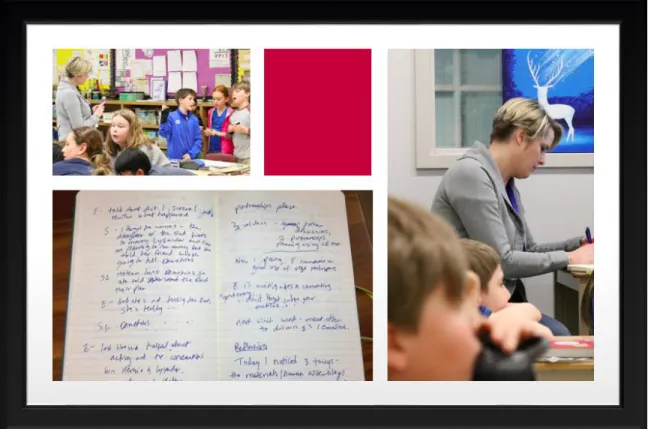
Figure 2: Connective Tissue
Figure 2 traces some of these embodiments of inquiry. The journal with jot notes sits between photos of my dance between taking video and taking notes. The notebook is central because I didn’t just write notes when I couldn’t record video. There were times when I wanted to slow down, to engage in writing as inquiry (Richardson & St Pierre, 2005) by taking note of what I was noticing and questioning. I also wanted to keep a record of the contents of the video recordings, knowing that would be important for how I tagged the texts when I archived them digitally. My handwritten journal of descriptions, reflections, and questions formed a connective tissue of inquiry between my video recordings and digital analytic tools.
The ensembles of notes and videos composing the study fieldtexts are woven together through flows of inquiry, including choices in how to attend, with which human and material participants, and where, embodying the fieldtext inquiry space.
movements with, around, and sometimes against both human and non-human agencies. My ensemble of fieldtexts was performed in ensemble, danced into a body of inquiry. Ensembles for knowing perform what can be known – entangling matter with meaning (Barad, 2003).
For physicist-philosopher Karen Barad (2007), entanglement is more than a metaphor for complex interplays of relations, it is a term for the sensory experimentations through which space/time/matter is performed. Barad draws on her understanding of quantum mechanics to demonstrate that matter is materialized through practices for making known, that require setting boundary conditions on observer and observed. Change the observational arrangements, and seeming stable constructs of time, space, and matter can be reconfigured in ways that demonstrate how spacetimematter become together,
entangled with practice (Barad, 2007).
My story of connective tissue demonstrates how my smartphone and
notebook were extensions of my senses and experimentations and danced a set of
relations between other materials, bodies, and interests that performed field with text with inquiry as embodied fieldtext. This knowing/becoming together carries deep
responsibilities for ethical practice: “in a breathtakingly intimate sense, touching, sensing, is what matter does, or rather, what matter is: matter is condensations of response-ability. Each of ‘us’ is constituted in response-ability” (Barad, 2012, p. 215).
Anthropologists describe fieldnotes as evocative (Jackson, 2016). The multiple modes of experience embodied in the textual ensemble of smartphone videos and notes assist me to recall the sensations of my research as I move into analysis. What are my ongoing
response-abilities to this knowing together? In narrative inquiry, texts are more than evocative. Clandinin (2016) wrote that as participants and researchers in a narrative inquiry meet in the midst of their experiences, “[they] begin to shape time, places, and spaces where we come together and negotiate ways of being together and ways of giving accounts of our work together” (p. 44). Texts in narrative inquiry should function
produce a field of inquiry and questions about how to story these findings into new experiences. In Movement III, I share examples of re-storying my fieldtexts to discuss response-abilities for performing findings through membering,
re-visioning, and envisioning. I begin this movement with the story of Joy.
2.4.3
Movement 3: Re-storying
During my first visit to this classroom, I walked around and commented positively on the students’ writing. Afterwards, the teacher told me that she noticed one student who “glowed” after I noticed her. On my next visit, the student, who I call Joy, gifted me one of her drawings about the play they were learning about in the curriculum. Each time I came back, Joy had something new for me. One day the class was working with individual laptops on a shared, multimodal text. It seemed to me that Joy was watching her partner but unable to contribute to the print/visual assemblage on her own computer because she struggled to keep up with the composition. I moved in to help her read some of the words appearing on her screen. But I sensed Joy distancing herself. There was no gift that day. The next week, she brought me a list of the character’s names she had copied from the play. As I wondered about this and shared my thinking with Joy’s teacher, I understood that I was placing my concerns about literacy onto others.
2.4.3.1
Re-membering
This movement engages with the question in my first fieldnote: “what am I tuning into, and what am I missing?” Narrative inquirers judiciously invite their tensions and uncertainties into the relational field with participants in what Clandinin described as interim texts (2016). We attend to difficulties and blind spots as the starting points for possible understandings. As we revisit our research experiences in the interim phase with participants, we have opportunities to re-member – to imagine and embody ethical possibilities for being together, while we are still together.
Marilyn Huber (2008) recognized the tension she felt when her meanings did not align with her participants as a necessary “dis-positioning” (see Clandinin, 2016, p. 77). The dis-positioning I sensed in Joy prompted me to re-member my understanding of literacy. Another act of re-membering through this story is the work of making things visible.
When we attend with participants to “the composed gaps and silences” in our texts (Clandinin, 2016, p. 46), to the moments of difficulty and uncertainty that spark awareness that in tuning in to one thing, we may have missed another, we are able to envision more possibilities. Inquiring with Joy’s teacher into the reasons for her silence allowed me to see how Joy was repositioning her embodied relation to me as a literate student.
2.4.3.2
Re-visioning
In another example of inquiry with Joy’s teacher, she wondered how her students were collaborating in a drama activity. We decided to use video inquiry and she made short recordings on her iPad of the student groupings at work. Re-viewing these together, she described the communicative resources she saw Joy using: “look at how she is using her eyes and positioning her body to focus on her group and engage their ideas.” The multimodal record of Joy’s group talking and moving together afforded a richer analysis when this teacher revisited the experience, an analysis amplified as we
discussed ways she might use this understanding of collaboration formatively. Our shared uncertainties and tentative interpretations performed an inquiry space about how to extend Joy’s strengths as a learner. Again, it was the experience of wondering together that opened our borders to performing a new fieldtext.
Coded relations (Edwards, 2015) between the software and hardware of my
smartphone, computer, and institutional digital archive, also see with me in ways that re-materialize the fieldtexts. Using Onedrive, a suite of software applications bundled in Microsoft Office 365, I can upload data, stream videos, and transcribe or describe the contents in Word or Excel documents within the same platform. Our research team chose Onedrive because it works within our institution’s sanctioned and technologically supported policies for secure data storage, allowing shared access to team members from other research sites, both in Canada and internationally. But this archive does not allow us to tag the data with multiple codes by different users. To work around this, I split the screen between thumbnail images and a Word document and give brief descriptors of the
data using my journaled notes so that I could later add these to a shared coding
spreadsheet. This digital fieldtext is a new embodiment of the classroom inquiry space for others – it is the field re-visioned, a fieldtext that has travelled some way from the
original participants in the inquiry and has still farther to go.
The travel metaphor is a familiar and problematic trope for research, particularly for field work (Fine, 1994). Relations materialize fields. Burkholder, Makramella, Abdou, Khoja, and Khan (2015) outlined four sets of relations at work in participatory visual research: participants and society, researcher and participants, participants in community, and power to disseminate. In my inquiries of curriculum making, schools and classrooms involved societal and community relations with tight boundaries (Who gets in? Who gets a voice?). I often felt powerless, even as a former insider-teacher, working as outsider-researcher trying to negotiate entries to these borders. Then again, the teachers often had expectations that they owed me something: “Are you getting what you want?” And the students wondered what I was taking away: “What are you writing about us?” and “What will you do with those videos?”
2.4.3.3
Envisioning
It is my last day observing in this classroom. The class has just performed their adaptation of the play featured in the researched curriculum. In a bold stroke of curriculum making, this teacher translated the curriculum materials from a print-based set of literacy practices into one that was drama-print-based. I ask the students for their perspectives on how the curriculum should be re-designed. The students agree, “It’s so much more fun when it’s acted.” What words fail to express is the feeling in the room. I have a picture from today, which I don’t have permission to share, of students watching their play with their arms wrapped around each other. What kinds of curriculum making practices might such a
multimodal fieldtext envision?
In this fieldtext, I negotiate presence and inquiry with participants as one way to reveal different facets of vision. Composing texts with multimodal ensembles offers another way to refract rich layers of meaning for inquiry. Multimodal fieldtexts are instruments for tuning in to seeing, hearing, and feeling experience. But instruments do not just tune
us in, they produce the noise – field and text are the entangled, embodied performances of inquiry. I have learned to consider “what am I tuning into” a reminder to act in sensitivity with the participants performing fieldtexts. In answer to the final question of my first fieldnote: “what am I missing,” I re-member that it not my privilege or
possibility to carry away every experience in research. Instead, I care for the responsibility that I embody some of these fieldtexts in new relations.
2.5
Conclusion
The questions in my first fieldnote about how to observe—and through which modalities—led me to orchestrate narrative inquiry and video inquiry into a
relational methodology for performing fieldtexts. In this chapter, I drew on Clandinin and Connelly’s (2000) work to explore how the composition of multimodal texts provides a rich research ensemble for hearing, seeing, and sensing the sociomateriality of
experience.
As the story began, I showed how smartphone video recording can be an assistive research technology by amplifying meaning and affording a nomadic performance of attention, providing access to multiple modes, actors and vantage points. A video records the things we intend to see, some things we don’t intend, and things we may not pay attention to. Backgrounded actors may press into view, disrupting our gaze and
expanding opportunities for meaning making. The re-visioning afforded by video inquiry, a layered and collaborative attention to the multimodality of making meaning, provides a richer attunement to experience. Tuning out the sound in a video recording, for example, helps tune us in to other resources for meaning.
In the second movement, I illustrated how I put a multimodal ensemble of notebook and smartphone to work as assistive technologies in making fieldnotes. The smartphone extended my sensory capacities to see, hear, and follow the textures and contours of curriculum making in multiple classrooms. My notebook punctuated these mobile engagements, slowing me down to think with writing. But my stories also demonstrated
why we must not assume in field research that any kind of record of social practice records a public spectacle.
Through Clandinin’s (2016) work on narrative inquiry, I became aware of how the field is performed relationally. I signaled this shift in thinking by introducing dance and connective tissue metaphors. I turned to Barad’s (2003, 2007, 2012) work on the
performativity of inquiry to understand how questions, observations, and instruments are entangled with space/time/matter—the practice of knowing materializes meaning. This means that apparent boundaries to what is public knowledge are not pre-formed. Knowing is performed (Barad, 2003). Field research is the opening of borders to make discoveries in which the field, the text, the participants, and the researcher are performed together. We dance a set of relations I describe as the connective tissues that embody inquiry. The meanings in this study are materialized by the connective tissues
between what I observed and how I recorded those observations. For example, sometimes I was a researcher with pen and notebook making notes on conversations with teachers and students, while other times I was a researcher with a smartphone moving with and around other material bodies. Sometimes I made compositional choices, deciding when to inquire with notes and when to use video, and sometimes the questions, interests, and movements of other human and material participants, in Barad’s (2012) sensory theory of mattering, made me.
Fieldtexts are the effects of these connective tissues, the entangled, performed,
embodiments of inquiry. This tells us what fieldtexts can be. Entanglements are no more, or less, than “our connections and responsibilities to one another” (Barad, 2007, xi). So how should we care for a body of inquiry, which is knowing together? What
are we tuning into, and what are we missing? These are complex questions about making fieldtexts, and I offered readers a story of research as a way to engage this problem through my experience of trying to work it out. The vignettes and discussion in this chapter are thought experiments about what fieldtexts do – how texts extend our sensory capacities, how field and text are performed together through
inquiry, making sense, how to be care-ful with embodied fieldtexts. As the story ended, I shared ways to enact care as fieldtexts are storied into new performances. Re-visioning by seeing with human and more than human assistive technologies can
perform fieldtexts in multiple and multisensory ways, affording us more facets of expression along with opportunities to listen closely to composed gaps and silences. Re-membering with participants in narrative inquiry allows us to reconstitute relationships in ways that might envision and embody more just possibilities.
References
Ahmed, S. (2014). The cultural politics of emotion (2nd edition). New York: Routledge.
Barad, K. (2003). Postumanist performativity: Toward an understanding of how matter comes to matter. Signs, 28(3), 801-831. doi:10.1086/345321
Barad, K. (2007). Meeting the universe halfway: Quantum physics and the entanglement ofmatter and meaning. Durham, NC: Duke University Press.
Barad, K. (2012). On touching: The inhuman that therefore I am. Differences: A Journal of Feminist Cultural Studies, 23(3), 206-223. doi:10.1215/10407391-1892943 Bezemer, J., & Kress, G. (2008). Writing in multimodal texts: A social semiotic account
of designs for learning. Written Communication, 25(2), 166 195. doi:10.1177/0741088307313177
Burkholder, C., Khoja, N., Makramalla, M., Abdou, E., & Khan, F. (2015). Why study power in digital spaces anyway? Considering power and participatory
visual methods. Perspectives in Education, 33(4), 6-22.
Burrell, J. (2016). “Through a screen darkly”: On remote, collaborative work in the digital age. In R. Sanjek & S. W. Tratner (Eds.), eFieldnotes: The makings of anthropology in the digital world (pp. 132-152). Philadelphia, PA: University of Pennsylvania Press.
Clandinin, D.J. (2016). Engaging in narrative inquiry. New York, NY: Routledge. Clandinin, D.J., & Connelly, F. M. (2000). Narrative inquiry: Experience and story
in qualitative research. San Francisco, CA: Jossey-Bass.
Clandinin, D. J., & Murphy, M. S. (2009). Relational ontological commitments in narrative research. Educational Researcher, 38(8),
598-602. doi:10.3102/0013189X09353940
Connelly, F.M., & Clandinin, J. (1990). Stories of experience and narrative
inquiry. Educational Researcher, 19(5), 2-14. doi:10.3102/0013189X019005002 Cowan, K., & Kress, G. (2017). Documenting and transferring meaning in the
multimodal world. In F. Serafini & E. Gee (Eds.), Remixing multiliteracies: Theory and practice from New London to new times (pp. 50-61). New York, NY: Teachers College Press.
Edwards, R. (2015). Software and the hidden curriculum in digital education. Pedagogy, Culture & Society, 23(2), 265–279. doi:10.1080/14681366.2014.977809
Fenwick, T., & Edwards, R. (2013). Performative ontologies: Sociomaterial approaches to researching adult education and lifelong learning. European Journal for Research on the Education and Learning of Adults, 4(1)
49-63. doi:10.3384/rela.2000-7426.rela0104
Fine, M. (1994). Working the hyphens: Reinventing the Self and Other in qualitative research. In N. Denzin and Y. Lincoln. (Eds.), Handbook of qualitative research (pp. 70-82). Newbury Park, CA: Sage.
Haraway, D. (1988). Situated knowledges: The science question in feminism and the privilege of partial perspective. Feminist Studies, 14(3),
575-599. doi:10.2307/3178066